Showing posts with label food. Show all posts

Monday, 21 February 2022

From Panchatantra to Popeye, we owe our liking to food because of tales and cartoons

Kheer, khichdi, and Scooby snacks, the many foods that played a role in our childhood.

Have you ever wondered what the rose apple from Panchatantra’s ‘the monkey and the crocodile’ tastes like? Or what you could eat from the picnic spread in Enid Blyton’s Famous Five series? Even the plump, shiny, red apple from Snow White and the Seven Dwarves looked appetising, although it was poisoned. A lot about food has been seeped into our minds at a very young age – be it through cartoons, fairy tales, comic books, folklore, rhymes and bedtime stories.


From the witch’s house made of gingerbread, cake, and candy in Hansel and Gretel to Raja Hooja’s laddoos in Tinkle comics’ Tantri the Mantri, these stories were written with an idea that goes beyond just being a casual read….

A lot about food has seeped into our minds at a very young age... Image Credit: Shutterstock


A means to connect, eat and learn about food

Gulf News Food caught up with Rakesh Raghunathan, a food historian and raconteur based out of Chennai in India, who said that food bridged the gap between people, especially because people were opening up to the idea of various regional meals. “Folklores helped people connect to food easily, be it through temple prasadams or just prepared at home. The Hindu mythology, especially, had a very strong role in shaping meal patterns, where they would talk about how deities like certain ingredients like butter and dairy, which encourage people to eat the same. It also brought to light what was available in that region.


“If you look at ancient texts in Sangam literature from Tamil Nadu, it’s not just about how old certain ingredients are, it also emphasises how they are used in cooking. When it comes to children, these tales helped in getting them to eat, of course, but it helped in getting them to understand the ingredients and stir their imagination. Like the moral-based story of the grand mum, crow and fox really helped in picturing what a vada looks like.”


Raghunathan highlights that most of these stories follow a very similar pattern as well. “It would often be moral-based stories, with animals as the protagonists and the story would often surround food. I think it is a great way to help children understand their food better. Today, it’s much more elaborate and I think children like that a lot.”


We also spoke to 40-year-old Ratika Bhargava, who runs a social media page called 'CauldronSisterss' with her sister Riccha Khetan, which feature Indian food recipes inspired by fables and fairy tales. The sisters, who are from Jaipur in Rajasthan, India, said these folktales and stories shaped their passion for all things food. “When my sister and I were young, our grandmother used to tell us a lot of stories. She was paralysed at the time, but she always told us stories from Panchatantra when we went up to her.


“One story which we fondly remember is ‘Ganesh ji ki kheer’. The story is basically that the Hindu deity Ganesh takes the form of a little boy and comes to a village, where the people are getting ready to prepare for Ganeshotsav or the festival of Ganesh. Seeing this from the skies above, the deity Ganesh, decides to have a little fun with the people and disguised himself as a small, poor boy. As he descended from the skies in his new form, all he had with him was teaspoon of milk, a grain of rice and a pinch of sugar. While he went around the village asking for someone to help him make kheer or rice pudding, all the villagers mocked him except for an old woman.


“She helps the little boy out by making kheer out of what he has and suddenly the vessel starts overflowing with kheer. It’s a story that made us try out kheer for the first time and we would eat saying it’s a blessing from Ganesh. The idiom, ‘ganeshji ki kheer ho gayi hai’, is also often used among our families, when something happens in abundance. It’s because of this story that we actually understood that you only need three ingredients to make this dish.”

Bhargava believes that food stories hold the power to strengthen one’s relationship with food. She also added that it adds to the culinary choices we make growing up.


“Another story which really stuck to us was Birbal’s Khichri. We have loved khichri since then, and today we’ve experimented with it so much that we have over 60 ways to make it,” she added.


Stories layered with many meanings

These stories used food as a means to encourage children to eat their meals, learn about different kinds of food, thus reducing the fuss that comes in eating and finishing a meal. In addition to this, it also told of social issues along with a region’s culinary traditions and practises.


Raghunathan fondly remembers the story of kozhukattai, a rice dumpling made with a sweet filling using coconut, jaggery and cardamom, which was told to him by his mum, as a child. “The story of kozhukkattai is actually a tale of many meanings. The story talks about a man who eats a kozhukattai and learns about its name for the first time. On his way back home, he repeats it to himself in order to remember it. However, he jumps across a small stream of water and utters the word ‘athiribacha’ during the jump, forgetting what he had memorised. So, when he reaches home, he tells his wife he loved eating athiribacha and she should make it for him.


“Unable to understand what he meant, the husband beats her up, outraged by her impudence. Soon, the couple’s neighbour comes over after hearing the commotion, to which he says after seeing her injured forehead: ‘your head is swollen like a kozhukattai’. This story not only taught children about the dish and its ingredients, but also underlines the problematic issue of patriarchy that was prevalent in the south at the time.”


The story also tells readers about the abundance of rice and the use of coconut in south India. However, Kozhukattai, has a different story in the North, where the protagonist is the Hindu deity Ganesh, and the dumpling goes by the name ukadiche modak.


It’s not just fables, but also cartoons

Have you ever wanted to try Scooby snacks just because Shaggy and Scooby-Doo from the cartoon ‘Scooby-Doo’ ate it? Even the multi-layered ham sandwiches did just fine, right? What about the steak and turkey in ‘Tom and Jerry’? If you have wanted to eat them while you watched these cartoons, you are not alone, because so did these UAE kids.


“Yes, Tom and Jerry and Scooby-Doo had really tasty drawings and animations of food. But what I personally loved was the tubby custard Po made from Teletubbies. I’ve always loved that, and I wish I could make it. The same goes for Ratatouille, after I saw the movie titled with the same name. It was just so amazing to watch Remy [the protagonist] make it, you know? However, when I tried it in real life, I didn’t like it when I ate it, as much as I loved watching it being made. It visually helped me understand a little bit about French cuisine, and now I like watching anything that has food in it,” said 24-year-old Dubai-based Indian expatriate and Gulf News reader Karun Mathew.


“Growing up, Cartoon Network of the 1990s was one of the best things that happened to our generation. For instance, Dexter's Laboratory taught us that science was indeed cool. Or Captain Planet was our first environmental studies professor. But my all-time favourite was hands down Scooby doo, and my favourite characters were Shaggy and Scooby as they always depicted that food, especially sandwiches, gave them a certain level of strength to face any problem and get out of any situation. Naturally, I followed that and did not fuss about food ever,” explained 28-year-old Murtaza M P, an Indian expatriate based in Dubai.


“It did not make me hungry as much as it taught me about the importance of eating good food. In my head, food gave us power, hungry or not, you should eat the right foods to be able to function and conquer any situation. When I was a kid and even now, I experiment with sandwiches, it’s the fastest thing to make and watching them mixing different foods together would just help me experiment with my palette, for instance creating my own chicken and waffle sandwich. However, my love for food expanded when I started watching Anime. I watch them on my days off and surprisingly some of them are actual shows that have soulful stories about people and food for instance – shows such as Yakitate, are quite interesting,” he added.


The portrayal of food in her son’s cartoons encouraged 30-year-old Sakina Rokadia, another Indian expat in Dubai, to make hot dogs for her son. “I actually grew up watching Tom and Jerry – their refrigerator would always be so full with cakes, jelly, sausages and pies – and it would actually make me hungry because it was always showing the two chasing each other and that would make me wonder why they want it to so bad. I remember asking my mum to prepare dishes for me after watching them on TV, especially the big pieces of meat that they would show. In fact, my son asked to me to make hot dog for him after seeing it in a cartoon, and was excited to try an avocado based on a cartoon he had seen.”


Rokadia believes that these cartoons are a great tool for children, especially because it increases the awareness of different foods and cultures. “I don’t mind watching cartoons even now. I think it encourages children to know what different kinds of food is available, especially those that are far from the foods that we eat in our culture,” she concluded.


Do you have a dish you love to eat after watching a cartoon or reading a children’s book?


(Source: Gulf News)

Monday, 17 January 2022

Food historian Rakesh Raghunathan recalls memories of Pongal

The chef has fond memories of puliyodharai, and talks about his mother feeding him ghee-laden pongal before his early-morning tuition class.

Food historian and raconteur Rakesh Raghunathan, the host of shows like Dakshin Diaries and 100% South Indian, has fond memories of Pongal. “It is always around food, around people coming together,” remembers Raghunathan, adding, “We still celebrate Pongal in a big way.”


This year, Pongal kicks off on January 14. In an interview with Lounge, he talks about his fascination for puliyodharai, describes the food that was served at the festival and shares memories of his mother feeding him a bowl of ghee-laden pongal before his early-morning maths tuition class.


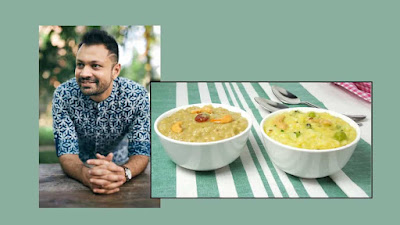
Rakesh Raghunathan (left); bowls of pongal.  


What is the most prominent food memory of your childhood?

I think it is the puliyodharai or tamarind rice. I have very fond memories of being in the kitchen and watching my grandmother and mother make this dish as a child. It was a laborious process. We always lived in a large joint family. We would use age-old heirloom traditional vessels that were really large.


Making the puliyodhorai involved a 3–4-day long process. It begins with getting the vessels from storage and polishing them. Another day, she would plan to fry something; the oil used to fry crisps or papad is used in puliyodharai since it infuses that flavour into the dish. Then, she would roast and grind the spices for the spice powder, make the tamarind concentrate, boiling it for hours into a molten mass. Even today, a whiff of those familiar smells takes me back to my childhood.


She would layer it like a biryani—add the rice first, spice powder, infused oil, tamarind concentrate, and nuts. As she was doing that, I would sit with her, taste every layer, and tell her whether it needs more concentrate, spice or salt. She would talk to me about her own childhood memories of growing up, how it was back then, how she liked cooking--all of that.


How was Pongal celebrated in your own house?
We lived with our grandparents in Chennai. We were a large family, and this would become a hub. All the other family members would end up coming here. The day of Pongal would invariably be only us—my parents, sister and I and my grandparents. Ven pongal, the savoury version of pongal, and sakkarai pongal, the sweetened version of pongal, was made typically. And any sweet to go with them. The dishes are mainly rice-based because it was the festival of harvest.


The day after, something called kanu is celebrated in some homes. It is essentially the sisters praying for the welfare of their brothers. All my aunts, my father's sisters, would come here.


On that day, they would make a lot of variety rice—coconut rice, tamarind rice, lemon rice and more. We would make chips at home—potato chips, sweet potato, and raw banana chips. There was also a particular bean-based kozhambu or curry called the avaramani kuzhambu paired with the tamarind rice. It is very peculiar to our household and the recipe's roots can be traced to our ancestral village Kethandapatti in Tamil Nadu.


The third day of Pongal is usually spent recovering from all that eating (laughs).


What is your most prominent memory of cooking or eating Pongal?
The month preceding the festival, margazhi, is believed to be the sacred month. Generally, women in the household—not to stereotype—wake up early, have a bath and put rangoli outside their home, placing a small ball of cow dung and a red pumpkin flower in the centre of it. My mother has been following this practice for a very long time.


She would then make ven pongal. She makes it every day that month and still does. When I was young, I had tuition classes very early in the morning. I would cycle and go to maths classes at 5.30 am, and she would insist that I eat this pongal and go. So I would wake up at 4.30, brush my teeth, have this pongal and cycle to class. So whether I learnt math or not, I got a lot of sleep (laughs). That is my memory of pongal: going to my tuition having this bowl of pongal filled with ghee and nuts.


What does using the clay pot for cooking do to the dish's flavour? Do you still use this for cooking in your home?
In terms of taste, one may not really know—unless you cook it on a firewood stove, the smoke kind of adds to it. The innate properties of the minerals used to make the terracotta ware is known to neutralise pH levels because the pots are alkaline in nature and therefore interact with the acidity in the food. My aunt uses traditional cookware to make pongal on the day of the festival. My mother, however, has found an easier, less messy option: the pressure cooker.


What is your comfort food and why?
For me, it is a good bowl of rasam-sadam. It may seem like a simple dish but making a good rasam isn't easy. It hit me in the US, where I studied when I was trying to cook it. I had everything—the tamarind, the rasam powder, the lentils—but to make it like my mother was very tough. I didn't know it was so complicated. Even today, people judge wedding caterers based on the rasam they make.


Are we going beyond the idli-dosa-sambar cliché? Do you feel the narrative around South Indian food is changing and what is driving it?
There has been a great shift. I think the micro cuisines of every region is catching on, particularly in South Indian food. Also, people want food presented more aesthetically, thanks to shows like MasterChef and so on. Otherwise, South Indian food has just been this huge mountain of rice with rasam and sambar or chicken or fish curry.


I remember curating a food festival for The Park called Annam to Arancini, which was about reimagining our grandmothers' kitchen, heirloom recipes presented in a very contemporary aesthetic way. For instance, usually, puliyodharai is paired with applams, avaramani kuzhambu and buttermilk. I made an arancini ball with the puliyodharai, coated it with applam and deep-fried it like a patty. I then put it on a bed on avaramani sauce, drizzled some buttermilk and put microgreens on it. When I served it to people they didn’t know it was—it looked very funky. But when they ate it, it took them to their childhood.


Raghunathan's recipe for ven pongal

Ingredients

1 cup rice 
Half cup moong dal
6 cups water
1 tsp ginger, chopped
2 tsp cumin seeds
2 tsp whole pepper
Half tsp asafoetida
10 curry leaves
1 tsp oil
3 tsp ghee
Salt to taste
10 cashews


Method

1. Mix rice and dal together. Wash under running water and strain.
2. In a pressure cooker, add the rice dal mixture along with 6 cups of water.
3. Also add one teaspoon cumin seeds, chopped ginger, asafoetida, curry leaves, salt , oil and a tsp of ghee and pressure cook for four whistles.
4. Remove the cooker when pressure settles down.
5. In a separate wok, mix oil and ghee and heat until hot.
6. Add one teaspoon cumin seeds and whole black pepper. Allow to splutter.
7. Add cashews and roast till golden brown.
8. Add curry leaves and pour the tempering over the molten pongal.
9. Drizzle more ghee on the pongal. 
10. Serve hot with sambar and/or chutney.


(Source: Live Mint)

Tuesday, 8 June 2021

A depreciating diet

About one year has passed since the COVID-19 pandemic began. In India, domestic workers are among the most severely hit groups. In the initial stages of the lockdown, most domestic workers were laid off. Many did not get paid for months. Some of them were initially assured that they would be rehired and paid after the lockdown was over. But even as the lockdown eased, the condition of domestic workers has barely improved.

For many, like Shabana*, who has been working as a cleaner in Guwahati for almost a decade now, things have been rough. Shabana used to work in three houses before the lockdown but has been rehired in only one.


“I was told that I would be rehired after the lockdown, but then only one family did that. The other two families did not pay me during the lockdown and now have hired others,” she says.


As a result, her income has dipped substantially, but costs have not. While they cannot compromise on expenses such as rent, there has been a direct impact on their diets and nutritional needs.


“We have not had anything other than rice and chillies for months. We also skip meals. Everything is so expensive. We have a young daughter whose nutritional needs are getting severely impacted. As a growing person, she should eat well, but unfortunately, it is not happening. I hear on the TV that one needs good immunity to protect themselves against COVID-19. But how will we have immunity if we cannot eat anything good?” says Shabana.


Initially, her family received rice for free from the government, but now they have to buy it at a discounted rate in the market. Data shows that India is facing food inflation of 7.9 percent. In fact, food inflation was an issue much before the COVID-19 pandemic, and the situation has only worsened now.


Families like Shabana’s are forced to compromise on their nutritional intake. While fruits and vegetables have always been luxury items for them, now even daal (lentils) and potatoes fall within that category.


*Name changed to maintain confidentiality.


Rituparna Patgiri teaches sociology in Indraprastha College for Women (IPCW), University of Delhi. Ritwika Patgiri is a PhD student in the Faculty of Economics, South Asian University (SAU), New Delhi. The authors have been conducting research on domestic workers in Assam since August, as part of a research grant from Zubaan Books.


(Source: idr)

Friday, 7 May 2021

Memories of my father Faiz Ahmed Faiz and our simple dal-chawal meals

 Broadcaster Moneeza Hashmi remembers the quiet, unpretentious meals of her childhood.

I do not have clear memories of all of us, the whole Faiz family, sitting down at the dining table to eat together every day. Neither do I recall any particular occasion when we would all get together for a family meal. This was probably because my father, the poet Faiz Ahmed Faiz, was rarely home at mealtimes. Moreover, my mother, Alys Faiz, being a working mom, had to keep to the schedules of her office, as well as making sure we young girls, my elder sister Salima and myself, were never late for school.


What I can remember from my school days, back in the 1950s, is that each day during the winter term we would receive from home a tiffin, as we called it, or lunch box. All of us school friends would sit together in the grounds and share our lunch while we laughed and talked non-stop during the long lunch break. The food in that lunch carrier was always simple. One roti and one curry, sometimes a dal and sometimes veggies.


Courtesy: Moneeza Hashmi


Our dinner at home would mostly be a snack food. Perhaps omelettes and toast or Hunter’s beef sandwiches. Maybe dal and plain rice. When we had a treat, it would be a sort of pancake made with mashed potatoes and cabbage with a fried egg on top. I used to look forward to that as it was a hot meal.


Our dining table seated four. My father always sat at the head, and my mother next to him on his left-hand side, with me on his right and my sister Salima opposite him. The table itself was not too big, made of rather cheap wood and rickety, with a plywood top, and the chairs were straight-backed and simple. The tablecloth was cotton. The pattern, I remember, was a hand block print from the famous Jhandoo Khan who had a shop in the Mozang area of Lahore. The colours were turquoise and bright blue with matching napkins. We always had placemats too, but I don’t recall their pattern. The plates were white and made from simple china. Our cutlery was the most basic forks and spoons. The glasses were again straight and plain.


The dining room was next to the pantry, so our bearer would be in and out carrying the food. The kitchen was a few steps down, but the food was never cold when it reached us. These were not the times of microwaves or ovens, but we did have a toaster in the pantry, as well as a kettle to warm the water for my parents’ tea.


Kitchen Cabinet

There was never much talk at mealtimes. I cannot remember us eating together often, as lunch was always between my sister and myself or in school during winter. Dinner was usually a threesome as my father was almost always in the office at that time. Now and again, we had breakfast together on Sundays, but, on reflection, that too was not as frequent as I would have liked.


We had two servants in my childhood whom I can remember clearly, even to this day. Mohammad Ali, our cook, was a Punjabi and spoke only that language. I am surprised even today thinking how well my British mother Alys Faiz conversed with him. He stayed only in the kitchen and was never found in the main house.


The second servant was a sort of Jeeves figure who was known as “Bearer” throughout his life. I remember him as an oldish man who spoke only fluent Urdu. Again, how he and the cook got on is beyond me, but I never heard of any arguments or disagreements happening in the pantry or the kitchen. Our bearer used to double up as a sort of nanny for us two sisters as well. Since my mother worked for a newspaper, her hours were long and we would be left in the care of this male nanny. He looked after our food and our laundry, making sure we did our homework and at times even putting us to bed. He would cycle home late every evening after the dishes had been washed and dried. He was there too in the early morning to give my parents their “bed tea” and see us off to school after serving breakfast. He was with us for so long that I cannot recall how many years it was exactly. I do know my father depended on him for everything and my mother would admonish him at times for spoiling my dad.


Modest Resources

What I can remember of my father’s eating habits was that he was always completely dressed before he sat down for breakfast, which consisted of a fried egg, toast and tea. He would always eat his egg on his toast with a fork and knife and sip at his tea. His lunch, if at home, was again simple: a roti and possibly dal and some vegetables. We were not a meat-eating family, probably because we could not afford it. Both my sister and I were brought up with simple tastes in clothes and food. Now, I reflect this must have been the case because of the strains on our parents’ finances.


My father was fond of eating spinach in all forms, so I am told. He liked the desi palak and also sarson ka saag with missi roti. My paternal grandmother would sometimes send us exotic sweetmeats, which she must have learnt from the other Afghan wives of my paternal grandfather who lived in the same house. I loved to eat them and can smell their aroma even today. Unfortunately, nobody from our family learnt the recipe from Bebe ji, as we called our grandmother.


I recall my father as quite a modest eater. Perhaps his smoking killed his desire to eat. By the time he sat down to food, he was either too tired or too stimulated for getting on with the next engagement. However, when he did sit down at the table, he ate slowly and carefully, chewing his food quietly and cleaning his plate completely.


I am told he liked meatballs, which we call koftas, with gravy. He preferred roti to rice, and I can still see him breaking his roti into small pieces and picking up the meatballs one by one. He liked chutney made of coriander and green chillies, but was not a fan of hot spices. Pickles were something he was partial to, and his favourite was mango pickle. He also sometimes liked to have a paratha, a roti which preferably had butter mixed into it and was then fried. This bread is rich but so filling and satisfying. Parathas are still usually enjoyed in the winter as they keep you full and warm.

Author

Simple Tastes

His morning and afternoon tea habit continued throughout his life, almost like a ritual. In the morning, his newspaper accompanied his cuppa. The afternoon tea was just a simple cup without any snacks. He would sip the tea slowly and gently with a cigarette in one hand, usually remaining silent.


When we shifted to London in 1962 for two years and lived in Cornwall Avenue in Finchley, I remember he started liking steak and kidney pies, as did I. During those days in Britain, our evening meals were again simple. Usually, we had fried eggs on toast and baked beans, sometimes chicken sausages. My mom probably did not want too many dishes piled up to be washed, and so she kept it straightforward. Also, in Britain, there were no servants, so it was only my mother doing all the housework. I was still going to school and my elder sister Salima was at university.

Yes. We were a simple family with simple tastes and simple needs. I think we still are.


Moneeza Hashmi is a broadcaster, television producer, media consultant, and former general manager of Pakistan Television. She is also the youngest daughter of the prominent Pakistani poet Faiz Ahmed Faiz.


This article is part of the project “Forgotten Food: Culinary Memory, Local Heritage and Lost Agricultural Varieties in India”, curated by Tarana Husain Khan and edited by Siobhan Lambert Hurley and Claire Chambers. It has been funded by Global Challenges Research Fund through the Arts & Humanities Research Council in the United Kingdom. Read the other parts here.


(Source: Scroll)

Wednesday, 5 May 2021

How Satyajit Ray described the world through food

 The master storyteller used food as a device to interpret gender, politics and human civilisation. In his birth centenary year, his cinema and its idioms are as relevant as ever

In a scene from his final film Agantuk (The Stranger), Satyajit Ray captures the theatrics of a Bengali sit-down meal. Anila has never met her uncle Manmohan Mitra, who left home to see the world 35 years ago. His sudden visit has now sparked a controversy as his identity is questionable. Albeit, like a good host, she puts out a lavish spread.


It is a traditional Bengali menu. Palong shaak-er ghonto or a mishmash cooked with spinach, sweet pumpkin and lentil dumplings, daal and bhaaja or lentils with a side of something fried, maach-er jhol or fish curry followed by maangsho or goat meat curry. There’s also goyna bori, the artistic dried lentil crisps from Midnapore. “First daal and then fish,” says Manmohan, reassuring her that he has not forgotten the Bengali way of eating, i.e. course-wise. Eventually he goes for the meat instead of fish, saying: “We cannot talk freely if we have to pick bones.” 


Ray’s protagonist, played by the legendary Utpal Dutt, is a world traveller who has spent three decades sampling a buffet of cultures. Yet, Manmohan’s affinity for his roots is unmistakable. For someone who has been away from home, he does not falter eating with his hands. It says a lot about the character who retains his bond with a culture he could have chosen to forget. 


Filmmaker Satyajit Ray. Photo: NN Sareen/Alamy


In a classic scene, Manmohan is interrogated on his many life experiences. His eyes light up when he starts talking about his time spent with the tribal communities around the world. When asked if as an omnivore, he has consumed human flesh, Manmohan surprises his hosts: “Shunechi noro mangsho khete shushadu, kintu amar shei shoubhagya hoyni.” (I have heard human meat is delicious, but I have not had the good fortune of tasting it.) Where does he place cannibalism in the context of civilisation then, he is asked. “Barbaric,” he screams. “A civilised society is one where a man can destroy an entire city with a press of a button,” he says, his voice now dripping with sarcasm.


References to food are common in Agantuk, a film that challenges our notions of human civilisation. Through his swansong, Ray wanted to express his liberal, often iconoclastic worldview through Manmohan. Apparently, on the last day of the shoot, he stood up and announced: “That’s it! That’s all there is. I don’t have anything more to say.” He had already said it all. 


In Pather Panchali (The Song of the Road), Ray shows how hunger shapes the lives and relationships in a poor Brahmin family in 1950s Bengal. In the fictional village of Nishchindipur lives Harihar with his wife Sarbajaya, children Apu and Durga, and his widowed sister Indir Thakuran. The income is meager, the rations are limited. 


The film begins with little Durga stealing a lone guava from the orchard of a wealthy neighbour. When her mother Sarbajaya learns of it, she blames it on her sister-in-law Indir, who has been sneaking salt and spices from the kitchen for the odd indulgent meal. (Bengali Hindu widows of the time were forbidden from enjoying food with ‘too much’ flavour.) Sarbajaya is upset that Indir’s habits are rubbing off on her daughter. But this is only one of the flashpoints—the friction between Sarbajaya and her aged sister-in-law comes largely from the fact that the family has an extra mouth to feed. 


The conflict between hunger and morality comes up later again. When rain clouds gather, and the monsoons bring respite from the sweltering heat, Ray paints the picture of a joyous landscape. While the children play in the rain, Sarbajaya hurriedly makes her way home carrying kochu shaak or colocasia leaves foraged from the marshes. This time, it is she who picks up a fallen fruit, and hides it between the folds of her sari lest she gets caught. 


Food and gender collide in Mahanagar (The Big City), a 1963 film that revolves around the lives of a lower middle-class Bengali family. Arati is the ‘ideal’ wife, mother and daughter-in-law who carries out her household duties. But when the family is plunged into a financial crisis, she decides to apply for a job. While the in-laws eventually come around, it is Arati’s husband Subrata who has an issue. The man who is initially supportive turns insecure when he loses his bank job. Arati shines at work, and is now the sole breadwinner for the family.


On the morning of her first day of work, for the first time, the couple sits together to eat—a practice rare for the time in India. And later in the film, in one poignant scene, Ray shows how economic realities have reversed both the social hierarchy and gender roles. It is now the mother-in-law who is serving her son’s wife. And although it’s a blink-and-you’ll-miss moment, we see Maa plating up the maach-er muro or the head of the fish for Arati, an honour reserved for the man of the house. 


Cut to 1990. Shakha Proshakha (Branches of the Tree) is a film that tells the story of an upper middle class family that has reunited after years. Ray brings us a six-minute scene, where actors are shown eating a full-course meal—rare for an Indian film. Times have changed by now, gender equations have evolved. We see men and women dining together. 


Satyajit Ray came from an illustrious family of children’s writers. Food humour often made a large part of his father Sukumar Ray’s Abol Tabol—a collection of ‘nonsense verse’. No wonder the family-run popular children’s magazine Sandesh was also named after Bengal’s favourite sweet. It was in the same magazine that Goopy Gyne, Bagha Byne was first published, a story that Ray adapted for the screen in 1969. The fantasy adventure is about two tone-deaf musicians Goopy and Bagha, who are blessed with three boons—unlimited food, ability to travel wherever, and musical prowess. This time Ray uses food as a political device, albeit farcical. A war is brewing in the fictional land of ‘Shundi’. Just when the king prepares to launch an attack, good samaritans Goopy and Bagha step in. The mood on the battlefield suddenly shifts when pots filled with roshogolla waft down from the sky. The starving soldiers quickly reassess their priorities and run to fill their empty stomachs. If only peace was this easy.


Satyajit Ray was a widely travelled man, and his experiences shaped his life and his craft. In 1950, on a trip to London, Ray watched around 100 films over six months, including Vittorio De Sica’s neorealist drama Bicycle Thieves, which left a profound impact on him. Like Manmohan, he allowed his experiences to shape the understanding of his own culture and returned home to capture what he knew best—the lives and stories of his own people. He found beauty in the ordinary, and meaning in simplicity. And like a true Bengali, he saw food as a way to appreciate humanity.


(Source: CN Traveller)

Monday, 3 May 2021

The British loved their meat, but some were fascinated by Hindu-Brahminical vegetarianism

 In ‘Meat, Mercy, and Morality’, Samiparna Samanta writes that the British in India thrived on an elaborate diet of meat, but some preferred vegetarianism in the tropical climate.

The nation’s national wealth was indicated through meat consumption: Britain was the heaviest consumer of meat in Europe. Several private memoirs, diaries, and letters of British officers and memsahibs attest that the British in India thrived on an elaborate diet of meat during the period. 


The starling array of meat consumed at Anglo-Indian breakfasts alone included crumbed chops, brain cutlets, beef rissoles, devilled kidneys, whole spatchcocks, duck stews, Irish stews, mutton hashes, brawns of sheep’s heads, and trotters in addition to Indian meat dishes like jhal frazie, chicken malai, and beef hussainee.


The massive consumption of red meat at breakfast was merely an English custom transferred to a tropical climate, irrespective of its suitability. During the early decades of Company rule in India, as Elizabeth Collingham’s work has shown, such ostentatious and unhealthy dining habits ‘served well to underline the status of the Company grandee in India’. 


Representational image | The Afternoon Meal (La Merienda) | Metropolitan Museum of Modern Art | Wikimedia Commons


However, with the increasing racialization of the Raj after 1857, the body of the British official in India became an even more powerful signifier of ‘Britishness,’ and diet and dress became, accordingly, cultural sites on which a sense of bodily difference between the British and their Indian subjects was maintained. According to Collingham, the lavish consumption of food and drink by the British in India was reminiscent of the nabob and continued to construct the official’s body as an aristocratic body in the Indian context. Over time there might have been a refinement of the eating etiquette compared with the meat-eating excesses of the earlier period, elaborate meals continued to be the norm.


Some Europeans in India, however, advocated vegetarianism. Tristram Stuart discusses the European fascination with Hindu-Brahminical vegetarianism in the early years of the Company rule. According to Stuart, the most surprising to western travellers in India were the masses of ordinary people who lived on what Europe considered an exceptionally abstemious diet. 


Stuart closely examines a few European travellers in India—Thomas Tryon and John Evelyn, among others—to demonstrate how they drew from Hindu theology and enshrined Indian vegetarianism in the mainstream of intellectual debate. The revered Jesuit missionary Abbe Jean Antione Dubois composed a tract, Hindu Manners, Customs and Ceremonies, where he depicted ahimsa as a cowardly and effeminate doctrine, but sought to explain the real historical origin for vegetarianism through climatic compulsions.


According to Dubois, meat was indigestible and putrid in a tropical climate His suggestion was endorsed by a widespread tradition of European tropical medicine like the work of British naval surgeon, James Johnson, who, in his The Influence of Tropical Climates, More Especially the Climate of India, on European Constitutions (1813), applied the principle of temperance very strictly. H


aving identified over-stimulation and a tendency to plethora as the greatest risk to the Europeans newly arrived in a tropical climate, he recommended a cooling vegetable diet. Johnson’s recommendations were based on the eighteenth-century view of a vegetable diet as an antiseptic regimen which cleansed the bodily fluids of impurities while meat, as a stimulant, induced plethora, especially if taken in large quantities. 


Collingham argues that the Brahminical prohibition of wine and meat, as well as the simple diet of rice and vegetables of the Hindu poor, appealed to the temperance-minded British physicians as a laudable Indian custom, which contributed greatly to the health of the Indian population. Thus, British physicians like Johnson held up the Brahmins as models of ascetic, suitable behaviour. Having said that however, Collingham notes that most Anglo-Indians took little heed of arguments in favour of the vegetable diet and many resisted medical attempts to Indianize their constitutions.


Thanks to the lavish consumption of meat by the British in India, stomach disorders were inevitably common, but everyone blamed the climate rather than the unsuitability of their diet. The Governor, Philip Francis, thus wrote in 1775, which attests to the over-indulgence in meat: ‘I am tormented with the bile and obliged to live on mutton chop and water. The Devil is in the climate I think.’ These ostentatious eating habits were, as Burton argues, deployed as the cultural markers of a masculine, physically superior British Raj. In a similar vein, John Beames wrote about their daily eating habits:


Our chota haziri, or little breakfast, was at five-thirty to six, and consisted of tea, eggs boiled or poached, toast and fruit. 


Breakfast at eleven consisted of fried or broiled fish, a dish or two of meat—generally fowl cutlets, hashes and stews, or cold meat and salad followed by curry and rice and dessert. We drank either bottled beer—the universal Bass— or claret. Between four and five there was tea and cakes. Dinner at half past seven or eight consisted of soup, and entree, roast fowls or ducks, occasionally mutton, and in cold weather once or twice beef, an entremet of game or a savoury, and sweets.


If the gastronomic delights of the British were considered to be a metaphor for a physically superior Raj, the native kitchen was however very bleakly portrayed as symbolic of all that was filthy, dirty, and uncouth about Oriental cultures. The author of a cookbook described a typical kitchen in an Anglo-Indian compound as ‘a wretchedly mean, carelessly constructed, godown [outbuilding] … inconveniently far from the house, and consequently open to every passer-by.’


This excerpt ‘Meat, Mercy, and Morality: Animals and Humanitarianism in Colonial Bengal, 1850–1920’ by Samiparna Samanta has been published with permission from Oxford University Press.


(Source: The Print)

Friday, 12 March 2021

How all Indians (including teetotallers) end up consuming a lot of alcohol without knowing it

 An excerpt from Krish Ashok’s ‘Masala Lab’, an exploration of the science of Indian cooking.

Armchair-uncleji theories about how tropical parts of the world do not have brewing traditions because of their climate are patently silly. When you put human beings, carbohydrates and some microbes together, alcoholic drinks will emerge. [...] When you ferment things, ethanol is almost always produced. There is no escaping it.


If you make yoghurt at home, it will have a tiny amount of ethanol that is produced by wild yeast in the environment. Industrially produced yoghurt is fermented in sterile conditions to ensure that only specific strains of bacteria, such as streptococcus thermophilus and lactobacillus lactis, feast on the milk sugars and do not produce alcohol. This is also why homemade yoghurt is almost always richer in flavour, because a diversity of microbes results in more complex flavours. And some alcohol.


Representational image. | The Bombay Canteen/Facebook


If you bake bread, there is literally no escaping alcohol production. Yeast produces alcohol when it eats up sugars. In fact, one element of the sweet smell of baking bread is the ethanol evaporating. The alcohol molecule has a slight resemblance to the sugar molecule, which is why, in low concentrations, it tastes sweet. Breads, such as naan, made after a long fermentation process with yeast can sometimes contain about 2 per cent residual alcohol even after baking. Leave aside bread-bakers and naan-makers, the long-standing tradition of eating rice fermented overnight involves consuming a finished product that can be pretty alcoholic. Now you know why people eat fermented rice with raw onions soaked in yoghurt in south India. The onions overpower the smell of alcohol.


I want you to consider using alcohol in moderate amounts while cooking process. You don’t have to drink it, and rest assured, your finished product will not be any more alcoholic than the bread you bake or the yoghurt you ferment.


[...] If you remember, flavour is a multisensory experience that involves the taste buds, nose, ears, eyes and mouthfeel. Among these, aroma contributes to about 80 per cent of how we perceive flavour. While our tongues can detect five kinds of tastes, our noses can detect thousands of aromas. In fact, we can detect some aromas even if the concentration is of a few molecules in a trillion! Sulphur-based aroma molecules, like the smell of cooked fish, tend to be detectable at concentration levels approaching one molecule in a quadrillion!


This is a crucial thing to remember when making good food – we can only taste things that are water-soluble, but we can smell way more volatile aroma molecules thanks to the olfactory receptors in our noses. Most spices and strongly aromatic ingredients have volatile flavour molecules that are not water-soluble, so we can’t actually taste them.


Remember, you smell cardamom, you don’t taste it. What you taste when you bite into cardamom is its woody mouthfeel and bitter taste. This is why fats are absolutely crucial to cooking, because most flavour molecules are fat-soluble, not water-soluble.


This means that when you cook spices in hot oil, it extracts all of these flavour molecules and dissolves them into the oil, thus preventing them from being lost to the air. When you eat this food, the enzymes in your saliva start breaking down the fats, which results in those dissolved aroma molecules escaping into your mouth. As they enter the short, shared highway that transports both food and air, the act of breathing out elevates the aroma molecules, which are basically gases, and makes them hit the olfactory receptors. That is when you truly experience the complex taste of the thousands of aroma molecules from the saffron in your biryani.


Now that I have your attention with the words ‘saffron’ and ‘biryani’ (no political angle here, I assure you), let me tell you that after fats, the silver medal winner in the 100 m flavour extraction race is alcohol. A tiny amount of alcohol used while cooking will almost always result in a stronger flavour. The alcohol will help transport more aroma molecules to your nose and make your dish pop.


Here is how I use alcohol when making Indian dishes:

  1. A splash of vodka, brandy or rum when cooking onions, ginger, garlic, tomatoes and spice powders has two benefits: extraction of more flavour from the spices and the alcohol’s ability to release all those sticky bits from the bottom of the pan, which have a ton of flavour thanks to the Maillard reaction.
  2. A splash of wine added at the end of a dish, along with finishing spices, will amplify the effect of those spices when you eat.
  3. Keep in mind that while a small amount of alcohol can amplify flavour, a large amount will actually prevent the release of flavour molecules by holding on to them like family heirlooms. This is incidentally one of the reasons why bar snacks tend to be overpoweringly spicy in India. When had with a large whisky, that mirchi bajji could well be made using bhut jolokia chillies and you won’t notice.
  4. The amount of alcohol in beer is not strong enough to make a difference, so at the very least, use wine. The cheapest one will do because once heated, all the evocative notes of strawberries and smoked salmon in your fine Chardonnay will largely be destroyed. You can, however, use beer as an acid.
  5. If you are frying fish (or vegetables) using a batter, try a batter made of maida, salt and vodka (which is just plain ethanol diluted in water). What the alcohol does is reduce gluten development, which we do not want in a fried product, as it will cause chewiness. It also prevents surface starches from absorbing too much water to gelatinize, which will result in a drier and crispier crust. This technique was pioneered by Heston Blumenthal, who went one step further and carbonated his batter before use. The aerated batter makes the crust airy, in addition to being crisp. Trust me, use this technique and you will have some game-changing pakoras to enjoy.


Excerpted with permission from Masala Lab: The Science of Indian Cooking, Krish Ashok, Penguin Books.


(Source: Scroll)

Friday, 5 March 2021

How much can you trust Bollywood’s favourite dietician Rujuta Diwekar?

 Celebrity dietician Rujuta Diwekar stirred up a Twitter row last month when she said mangoes are safe for diabetics. It was yet another of her many contentious claims.

If you’ve Googled “how to lose weight” in India, a name you would not have missed in the results is Rujuta Diwekar.


The celebrity nutritionist with a glittering clientele such as Kareena Kapoor and Anupam Kher, is the author of the popular book Don’t Lose Your Mind, Lose Your Weight. Diwekar also has a formidable online presence —her Twitter followers and YouTube video views are both in excess of half a million.


Celebrity nutritionist Rujuta Diwekar (centre) has a glittering clientele | Commons


The 44-year-old’s emphasis on cooking locally available produce, exalting “Indian food the way your grandmother cooked them”, advocating counting pranic value (which she classifies as freshness of food) instead of calories, while also citing new American research on heart disease and using WHO statistics to back sugar consumption, have earned her admirers across the spectrum.


But her ideas have also drawn as much flak as they have followers as Diwekar has earned the ire of doctors, nutritionists and researchers.


On 30 April, Diwekar, who came into prominence in 2008 for helping Kapoor achieve a “size zero” body for the movie Tashan, created a stir when she recommended mangoes for diabetics, tweeting that the fruit is seasonal, local and low on glycemic index (GI).


It angered medical professionals, who termed the advice dangerous.


But such is her following, Diwekar was swiftly defended, with many of her followers pointing to the fruit’s relatively low glycemic index.


Responding by email to queries from ThePrint, Diwekar said that her recommendation was based on one from a doctors’ body. 


“Mango and its effect on blood sugars — it’s from the Association of Physicians of India, Karnataka chapter. One of the objectives of this study was to get diabetics to consume fresh, local fruits without fear,” she said.


She also stressed that her statements are based on available research. “Every idea that I talk about or tweet has been in the public domain for over a decade. A cursory Google search will help you find articles from authoritative journals that back that information,” she said.


Lack of context

Technically, Diwekar’s statements are often correct. Mangoes do have a lower GI but her throwaway advice, say medical experts, lacks the larger context of portion control and total sugar consumption. Mangoes aren’t just sugar; they’re full of nutrients. But mangoes aren’t just nutrients either; they’re also full of sugar.


“It is highly incorrect to make recommendations for any food item solely on the basis of GI,” explained Maaz Shaikh, the co-founder of Wellthy therapeutics, India’s first digital therapeutic firm managing thousands of diabetics every day. “For a diabetic, what matters most is the glycemic load — total amount of sugar that enters their system.”


So, the problem is not a diabetic patient eating mangoes, it is not knowing when to stop.


But Diwekar not only avoids mentioning portion control in public, she seemingly advocates against it, saying in this interview, “We are born with the ability to self-terminate eating; we do not need a dietician or a doctor to tell us where to stop.”


To her credit, that’s not entirely wrong.


“All animals do have checks and balances that keep them from overeating,” explained Ishi Khosla, clinical nutritionist at the Centre For Dietary Counselling, Delhi, and founder of The Celiac Society Of India. “The perfect example of this is how you can never overfeed a baby or a pet. But that is provided they aren’t exposed to sugar or junk.”


But sugar changes everything.


All about sugar

Diwekar’s assertions on sugar are contentious, to say the least. Her new book, ‘Indian Super Foods’, lists sugar as one. In a fiction vs fact table, she terms the medical advice to “avoid sugar if diabetic” as fiction and claims that meta studies have shown no “conclusive link between consumption of sugar and diabetes”. 


Diwekar also claims that refined sugar and jaggery are healthier than beet sugar.


“Most forms of sugar are converted to glucose in the body,” explained Shaikh. “Simple sugars like our everyday white sugar spike our blood sugar levels very fast while more complex sugars lead to slower rise. Sugarcane, jaggery, beet sugar are all simple sugars that are absorbed rapidly and spike blood sugar levels.”

In her book, Diwekar claims low-calorie sweeteners can cause cancer — a claim heavily debunked. Her advice, particularly on Twitter, where her words reach more than 5 lakh people, doesn’t explain the complexities of nutrition nor does she cite authoritative sources.


Links she provided to ThePrint backing her statement on sweeteners (like here, here, here) all demonstrate older studies on rats. Today, even the most conservative of studies show that the mechanism of increased cancer incidence can be seen only in rats. It is non-reproducible in human physiology and artificial sweeteners were completely delisted from carcinogen lists in 2000.


She often proclaims that microwaves are harmful as micronutrient bonds “break, get oxidised, become toxic”. This myth has been refuted again and again; nutrients are best preserved when cooked fastest and microwaves are more suitable for that than low flames.


Her links to back these statements  (like this 1992 study, this study on any form of heating on garlic, this 1995 paper on milk, and this self-critical piece on microwave plastic) are at least 10 years old.


Diwekar uses the age of the studies to validate her stance without recognising that all of it is very much outdated, replaced today with better products and safe results.


“People who follow me on Twitter are intelligent and don’t take anything at face value. They arrive at their own decisions on food,” she said. “All I hope for is that one arrives at them based on facts and not fears.”


Unfortunately, Diwekar’s factually incorrect statements appear alongside sensible advice — like responsibly reducing plastic — increasing the credibility of her words.


Eat-local, the business model

Much of Diwekar’s appeal lies in her emphasis on consuming locally available produce and relying on our grandmothers’ cooking techniques. Her USP is simple: Stick to Indian foods the way our grandparents ate them.


Diwekar backs her claims on what our “ancestors” ate without details or context of the evolution of food. A whole host of vegetables that are staple today, including potatoes, tomatoes, and capsicum, came to India just 400 years ago. Apple came to India a little under a century ago.


“Our dadis, nanis seem to be eating whatever they like. They have great skin and look good even today. What are they doing that we aren’t?” she asks. The answer is obvious: No processed foods, sugar and junk that surround us at every corner. It’s not what they eat, it’s what they don’t.


Her standard recommendation to everyone, even those with diabetes and blood pressure, is eating rice, dal, and ghee every day.


“A lot of her advice on ‘traditional’ foods doesn’t apply to people who don’t belong to educated, upper-caste elite,” said Dr Veena Shatrugna, former deputy director and head of the Clinical Division at the National Institute of Nutrition.


Even today, the majority of the country simply cannot afford to eat rice, ghee and dal every day. “A large part of the working class eats rice with chutney or roti with onions. On the ground, it is important to not straddle class and social layers with sweeping statements,” added Shatrugna.


Diwekar also advocates for simple changes that are mostly just common sense and non-specific: Exercise every day, eat in short intervals for blood sugar stability, avoid packaged foods, eat healthy fats, cook foods we understand.


“Brazil is in this area,” she told ThePrint. “Their official dietary guidelines reflect the current space that nutrition science is in — eating is a social act, we should eat traditional and home cooked food (to account for diversity in cuisines and climate), and pay attention to food while eating to guide us on quantities instead of fussing about portion size.”


Nutritionist or dietician?

Diwekar’s words have impact and reach for a reason: There is a dearth of voices on nutrition, particularly from medical professionals.


“I would heavily fault doctors,” said Shatrugna. “Most have abdicated nutrition entirely. They advise diabetics to stop eating sugars and carbs like rice and meat, but don’t tell them what to eat instead. So, patients turn to nutritionists who are often without medical training, and whose important science isn’t seen as academic or useful by doctors.”


It is this void that Diwekar has tapped into efficiently. A lot of people whose troubles need to be controlled by diets don’t really know what to eat, so they turn to whoever has advice.


“Nutritional advice can apply to someone who’s hale and hearty and wants to lose weight at best,” said Dr. Kamini Rao, IVF specialist and founder of Milann Centre for Reproductive Medicine.


“Anyone with even the slightest of diseases requires personalised advice. Everyone with the same disease can’t be bunched into one group. Nutrition cannot replace medical advice, and it isn’t safe to recommend foods online to those with diseases,” she said.


In India, dietetics and nutrition aren’t well regulated. While the field of nutritionists is pretty much unregulated in most parts of the world, being a dietician requires a licence in several countries. 


But not in India, where the two words are used interchangeably.


“Nutrition is something everyone is waking up to today. It’s an evolving science that is often accompanied by a lot of sensationalism,” explained Khosla, a clinical nutritionist.


“Unfortunately, there is no prerequisite for a nutritionist in India today. People with a personal weight loss story or even marketers of nutritional supplements can call themselves a nutritionist.”


That isn’t good news for those seeking advice online, which is pretty much most of us.


“In the battle of your research vs mine, common sense, experience and practicality wins,” Diwekar told ThePrint. 


“Thanks to the internet, we are demanding more transparency about food research, asking questions of who funds a study, and if this affects the conclusion it arrives at.”


Like Diwekar herself seemingly agrees, words of celebrity nutritionists — especially in non-professional consultations — perhaps need to be taken with a generous helping of salt.


(Source: The Print)