Showing posts with label Tamil Nadu. Show all posts

Monday, 17 January 2022

Food historian Rakesh Raghunathan recalls memories of Pongal

The chef has fond memories of puliyodharai, and talks about his mother feeding him ghee-laden pongal before his early-morning tuition class.

Food historian and raconteur Rakesh Raghunathan, the host of shows like Dakshin Diaries and 100% South Indian, has fond memories of Pongal. “It is always around food, around people coming together,” remembers Raghunathan, adding, “We still celebrate Pongal in a big way.”


This year, Pongal kicks off on January 14. In an interview with Lounge, he talks about his fascination for puliyodharai, describes the food that was served at the festival and shares memories of his mother feeding him a bowl of ghee-laden pongal before his early-morning maths tuition class.
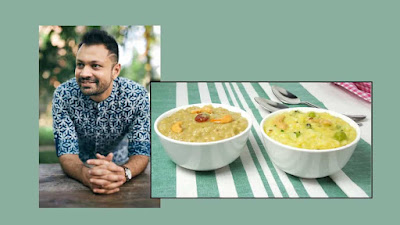

Rakesh Raghunathan (left); bowls of pongal.  


What is the most prominent food memory of your childhood?

I think it is the puliyodharai or tamarind rice. I have very fond memories of being in the kitchen and watching my grandmother and mother make this dish as a child. It was a laborious process. We always lived in a large joint family. We would use age-old heirloom traditional vessels that were really large.


Making the puliyodhorai involved a 3–4-day long process. It begins with getting the vessels from storage and polishing them. Another day, she would plan to fry something; the oil used to fry crisps or papad is used in puliyodharai since it infuses that flavour into the dish. Then, she would roast and grind the spices for the spice powder, make the tamarind concentrate, boiling it for hours into a molten mass. Even today, a whiff of those familiar smells takes me back to my childhood.


She would layer it like a biryani—add the rice first, spice powder, infused oil, tamarind concentrate, and nuts. As she was doing that, I would sit with her, taste every layer, and tell her whether it needs more concentrate, spice or salt. She would talk to me about her own childhood memories of growing up, how it was back then, how she liked cooking--all of that.


How was Pongal celebrated in your own house?
We lived with our grandparents in Chennai. We were a large family, and this would become a hub. All the other family members would end up coming here. The day of Pongal would invariably be only us—my parents, sister and I and my grandparents. Ven pongal, the savoury version of pongal, and sakkarai pongal, the sweetened version of pongal, was made typically. And any sweet to go with them. The dishes are mainly rice-based because it was the festival of harvest.


The day after, something called kanu is celebrated in some homes. It is essentially the sisters praying for the welfare of their brothers. All my aunts, my father's sisters, would come here.


On that day, they would make a lot of variety rice—coconut rice, tamarind rice, lemon rice and more. We would make chips at home—potato chips, sweet potato, and raw banana chips. There was also a particular bean-based kozhambu or curry called the avaramani kuzhambu paired with the tamarind rice. It is very peculiar to our household and the recipe's roots can be traced to our ancestral village Kethandapatti in Tamil Nadu.


The third day of Pongal is usually spent recovering from all that eating (laughs).


What is your most prominent memory of cooking or eating Pongal?
The month preceding the festival, margazhi, is believed to be the sacred month. Generally, women in the household—not to stereotype—wake up early, have a bath and put rangoli outside their home, placing a small ball of cow dung and a red pumpkin flower in the centre of it. My mother has been following this practice for a very long time.


She would then make ven pongal. She makes it every day that month and still does. When I was young, I had tuition classes very early in the morning. I would cycle and go to maths classes at 5.30 am, and she would insist that I eat this pongal and go. So I would wake up at 4.30, brush my teeth, have this pongal and cycle to class. So whether I learnt math or not, I got a lot of sleep (laughs). That is my memory of pongal: going to my tuition having this bowl of pongal filled with ghee and nuts.


What does using the clay pot for cooking do to the dish's flavour? Do you still use this for cooking in your home?
In terms of taste, one may not really know—unless you cook it on a firewood stove, the smoke kind of adds to it. The innate properties of the minerals used to make the terracotta ware is known to neutralise pH levels because the pots are alkaline in nature and therefore interact with the acidity in the food. My aunt uses traditional cookware to make pongal on the day of the festival. My mother, however, has found an easier, less messy option: the pressure cooker.


What is your comfort food and why?
For me, it is a good bowl of rasam-sadam. It may seem like a simple dish but making a good rasam isn't easy. It hit me in the US, where I studied when I was trying to cook it. I had everything—the tamarind, the rasam powder, the lentils—but to make it like my mother was very tough. I didn't know it was so complicated. Even today, people judge wedding caterers based on the rasam they make.


Are we going beyond the idli-dosa-sambar cliché? Do you feel the narrative around South Indian food is changing and what is driving it?
There has been a great shift. I think the micro cuisines of every region is catching on, particularly in South Indian food. Also, people want food presented more aesthetically, thanks to shows like MasterChef and so on. Otherwise, South Indian food has just been this huge mountain of rice with rasam and sambar or chicken or fish curry.


I remember curating a food festival for The Park called Annam to Arancini, which was about reimagining our grandmothers' kitchen, heirloom recipes presented in a very contemporary aesthetic way. For instance, usually, puliyodharai is paired with applams, avaramani kuzhambu and buttermilk. I made an arancini ball with the puliyodharai, coated it with applam and deep-fried it like a patty. I then put it on a bed on avaramani sauce, drizzled some buttermilk and put microgreens on it. When I served it to people they didn’t know it was—it looked very funky. But when they ate it, it took them to their childhood.


Raghunathan's recipe for ven pongal

Ingredients

1 cup rice 
Half cup moong dal
6 cups water
1 tsp ginger, chopped
2 tsp cumin seeds
2 tsp whole pepper
Half tsp asafoetida
10 curry leaves
1 tsp oil
3 tsp ghee
Salt to taste
10 cashews


Method

1. Mix rice and dal together. Wash under running water and strain.
2. In a pressure cooker, add the rice dal mixture along with 6 cups of water.
3. Also add one teaspoon cumin seeds, chopped ginger, asafoetida, curry leaves, salt , oil and a tsp of ghee and pressure cook for four whistles.
4. Remove the cooker when pressure settles down.
5. In a separate wok, mix oil and ghee and heat until hot.
6. Add one teaspoon cumin seeds and whole black pepper. Allow to splutter.
7. Add cashews and roast till golden brown.
8. Add curry leaves and pour the tempering over the molten pongal.
9. Drizzle more ghee on the pongal. 
10. Serve hot with sambar and/or chutney.


(Source: Live Mint)

Tuesday, 11 January 2022

Manjappai and its Tamil roots: How the yellow bag has long been part of TN households

In the wake of the ‘Meendum Manjapai’ campaign launched by Tamil Nadu Chief Minister MK Stalin, we revisit how the vibrant yellow-coloured bags have been an essential part of Tamil households.

Thirty-eight-year-old Panchavarnam, a tailor based in Tamil Nadu’s Madurai, recalls nostalgically, “I have seen my father carry medicines and groceries in the manjappai. I too use it for similar purposes. Since it is associated with our heritage, it’d be great if we continue using it in our day-to-day lives.”


Manjappai, meaning yellow bag in Tamil, is the ubiquitous yellow-coloured bag seen at weddings with the names of the bride and groom printed or at shops with the brand name in block red or green letters, and diligently hung within the house for everyone to use. After Tamil Nadu Chief Minister MK Stalin launched the ‘Meendum Manjapai Vizhipunarvu Iyakkam’ campaign in December to encourage people to quit using plastic bags and revive the usage of the traditional yellow bags, many have come out in support of the idea as it promotes sustainability.


The manjappai, however, is strongly rooted in Tamil culture as it has been part of our households for generations and reminds one of bygone times. From medicines to documents; ration to money; groceries to jewellery; the vibrant manjapai has been used in innumerable ways by people across generations. People believe that when dipped in turmeric (which is known for its antibacterial properties) water, dried and used, the manjappai turns into a medicinal bag that can fight infections. At the same time, it is also used as a thamboolam pai (customary gift bag) by many. 


Many families dearly hold on to the gift bags they received during festivals and weddings.


A group of women tailors holding Manjappai designed by Yellow Bag Foundation in support of
the 'Meendum Manjapai' initiative. Source: TNM


Eco-friendly and sustainable

The multipurpose manjappai was an integral part of many Tamil households but in recent times, people have been consciously shifting to cloth bags as they are more eco-friendly. For Krishnan Subramanian, the co-founder of the Yellow Bag Foundation, the manjappai was the starting point that inspired him to start a business promoting eco-friendly cloth-based products.


“I grew up in Madurai where the manjappai was commonly used. I saw many women involved in sewing these bags to make a living. Although we produce different kinds of cloth-based products including bags, the foundation got its name from manjappai since we support locally sourced labour, creating employment opportunities for women tailors, and also because of its cultural significance,” Krishnan tells TNM.


Started by Krishnan and his wife Gouri in 2014, Yellow Bag Foundation produces sustainable and practical alternatives to cloth bags and sells a range of products such as bags, files, pouches, etc. With minimalism finely ingrained in its making, the manjapai is accessible to many, Krishnan points out. “The manjappai is sturdy, the handles don’t tear off easily, it has a minimalistic design, and is easy to stitch at home.”


Panchavarnam, who works with the Yellow Bag Foundation, adds that although she has seen many products come and go, the manjapai is etched in her memories and is here to stay.


Be it the Meendum Manjapai initiative or programmes like ‘carry your own bag’ that support sustainable products, Krishnan observes that it is a welcome departure from the top-down approach that’s generally employed. “Whenever we talk about eco-friendliness, the onus is on business owners or manufacturers. But we cannot achieve it without customers making conscious choices too. In that context, the idea of going back to the manjappai is appreciated,” he notes.


Ganesh, who runs The Legend Bags, a company that has been manufacturing manjappai in Madurai for occasions like weddings, festivals, pujas, and providing customised bags to jewellery shops for over 20 years, agrees with Krishnan. “Sometimes customers prefer polyester cotton or nylon bags that are cheaper and readily available. Unlike cloth bags, these products don’t have to be rewashed but people hardly reuse them, which is again harmful to the environment,” Ganesh quips. He also wonders that if jewellery shops in towns across Tamil Nadu have continued using the manjappai, what is stopping the rest of us from using it?


Reinventing the manjappai

It is ironic that although the manjappai is used across age, gender, religion or socio-economic status, it is often looked down upon and used to take a jibe at one’s identity, especially if they hail from a village. A 2014 Tamil film based on the life of a villager adjusting to life in a big city, starring Vimal, Rajkiran and Lakshmi Menon, was titled Manjapai to challenge such links between manjappai and rural identity.


Many, like visual designer Raajadharshini, have taken to social media to question these preconceived notions. The 23-year-old’s ‘The Manja Pai Project’ features cloth bags printed with intricate and complex pulli kolams (designs made using rice flour in front of homes), while the layout of Aadu puli aattam, a traditional board game, forms another design.


Speaking to TNM, the National Institute of Fashion Technology graduate who works on multiple projects like photography, graphic design, lifestyle products and arts explains that the Manja Pai Project was conceptualised with the aim to bring back the yellow bag as a fashion statement. “Having born and brought up in Tamil Nadu, I have seen the manjappai being used in various ways. It has been an accessory in our culture that has no religious ties. People from every generation use it in a different way,” she says.


Raajadharshini’s project – which is currently in the works and likely to be merchandised by this year – presents an interesting take on the traditional manjappai. By printing on the bags the layout of traditional board games, mardhani (henna) art, pulli kollam designs, and illustrations of mallipoo (jasmine flowers) along with instructions on how to string them, the visual designer straddles the thin line separating art and fashion, and uses the bag to represent stories or practices that are unique to Tamil Nadu.


“I want to screen-print eco-friendly dyes on industry waste fabric that will be dyed yellow. This is basically an initiative to upcycle. I’m currently waiting for the right manufacturer and a platform to come on board,” she says.

Speaking about the concept behind her project, Raajadharshini says, “Totes are loved around the world because of how easy it is to make them artistic. So I thought why not blend them with my cultural concept. I want them to be ethical, durable, look cool, and a way to express oneself.”


Like Krishnan and Ganesh, Raajadharshini also hopes that the manjapai continues to stand the test of time and remains the eco-friendly, multipurpose and accessible product it always has been.


(Source: TNM)

Monday, 3 January 2022

Perumal Murugan: ‘How I, descended from a legacy of illiteracy, become a writer’

 Murugan’s new book of short stories in translation, ‘Four Strokes of Luck’, will be published shortly.

I was born into a family that was immune to the fragrance of letters. When my grandfather once chanced upon my books, he glanced through them and said, “What is this, it looks like pellets of goat dung stacked together!” My ancestors reared cattle, and their world was restricted to the needs of their cows and goats. I had arrived into a tradition in which letters looked like goat pellets. And yet, I represent the first generation that could distinguish the two from each other. How did I, descended from this legacy of illiteracy, become a writer?


As a child, I could usually be found clinging to my mother’s pallu. I did not like being in crowds – of four or five people. I was terrified of human voices. Even after I was enrolled in school, I preferred solitude. I was hesitant to make conversation. I would rarely utter more than a word or two, and those were murmured. I loved my textbooks. The pictures and lessons created a little universe, just for me.


Perumal Murugan


In Class 1, we had a single textbook. In Class 2, there were two. These weren’t enough. I would wait with great anticipation for my mother’s return from the weekly market – her basket was a treasure trove.


Tamarind, jeera, black pepper and other condiments were less interesting to me than the newspaper in which they were wrapped. I would collect these newspapers. I would read these broken bits of news items, opinions and short stories, not leaving out a single fragment of a line irrespective of how much I understood.


The treats my mother brought home were divided equally between my brother and me. Once he was done eating his share, he would give me the newspaper in which it had been packed. I had to give him part of my share of treats in return. Sensing an opportunity, he came up with another proposition – just as the treats were divided between us, so should all the newspaper packaging.


He had figured that he could charge me a larger sum in treats to hand over his share of newspaper. My mother refused to oblige. She was furious that my brother had tried to pull a fast one on me with bits of newspaper whose only use was as fuel for the stove.


“Why are you such a simpleton?” she sighed.


She would search out bits of paper and bring them to me as grand presents. She would use them for the stove only once I had finished with them. My cousins got to know of our deal. There was a paucity of paper in that agricultural land on which all of us lived in little houses scattered about our holdings.


News of my obsession with paper travelled through the school too. The pocket money I occasionally got for sweets was spent on orange mithai. Each mithai would come in its own newspaper packaging, and so I was able to overcome the shortage. I didn’t mind sacrificing my entire quota of treats for the joy these bits of newspaper gave me.


In Class 3, we had five textbooks. I was thrilled.


In those days, the sunset was our signal to finish our dinner and draw our cots to settle down for the night. We were already half asleep when we heard the bells chime eight o’ clock in the neighbouring town. It was also the heavy labour on the farm, which began in the wee hours of the morning, that necessitated this early retirement to bed.


Kerosene was expensive. And hard to procure. Because of the prevailing belief that a lamp should be lit at dusk, we would put a tiny wick into the mini-lantern and let it burn for exactly an hour. We had to be frugal with the oil. I used to take my textbooks close enough to the lamp for its tiny glow to fall on the page, and read aloud.


Dialogue and narration had the same inflections. Maths could be read out like science. It was all language, wasn’t it? I loved the music latent in language. Words moved me. Amma helped me out by substituting the kerosene with castor oil so I could read longer. Castor bean grew on our lands, and so we didn’t have to be stingy with castor oil.


I had a little game – I would switch the words that appeared in my textbooks for others. There was a song that went, “Maambazhamaam maambazham, malgova maambazham.” (Mango, mango, Malgoa mango.) I would change it to “Goyya pazhaamaam goyya pazham” or “Pappaali pazhamaam pappaali pazham”, throwing guavas and papayas into the mix. The semantics were all right, but the aural effects were lost.


There is a variety of banana called poovanpazham, which we used to call “poompazham”. “Poompazhamaam poompazham, pudhupudhu poompazham” worked as a refrain. And so I would skip about the fields, stringing together words, making sense and nonsense as my whims dictated.


These strings of words eventually made it to the empty pages of books. At the end of the academic year, I would tear off the blank pages from my various notebooks and stitch them together to make a receptacle for my scribbles. I sensed that writing was my one acceptable companion, even as a child who craved solitude. Those scribbles were essentially imitations of things I had already read. All literature is imitation, isn’t it? An imitation of life.


Translated from the Tamil by Nandini Krishnan.


(Source: Scroll)

Monday, 5 July 2021

Coimbatore Thayi, the Carnatic singer who struck a chord in Paris but is unknown in India

Gramophone records were usually colour‐coded based on the artiste’s popularity. Thayi’s was coded violet, indicating she was among the most popular.

It was in 1911 when Maurice Delage, a pianist and composer in Paris, came across a gramophone record of an artist from India. Delage was the heir of a shoe-polish manufacturing company in France. Born with severe vision impairment, Delage studied music for 10 years under renowned French composer Joseph Maurice Ravel. Delage wrote to Ravel about the Indian musician’s recording, saying they “sent chills up and down my spine.” His keen ear detected “the microtonal effects she produced while singing.” He described the artist as a “master of open and closed mouth singing.”


Coimbatore Thayi | Gramophone Records


The music that fascinated Delage was that of a devadasi in distant Madras– Coimbatore Thayi. Delage visited India thereafter and decided to meet the woman whose music had blown him away. He met her during one of her performances at a temple in Mahabalipuram. The two supposedly interacted, and Delage was said to have been left deeply inspired by Thayi’s music, and dedicated a Western composition, ‘Ragamalika’ – a garland of ragas – to her. 


Music publisher Durand was so enchanted by this composition that on 20 June 1914, he paid Delage 500 francs to orchestrate it.


A modern-day rendition of Delage’s ‘Ragamalika’ has such swift glides in its notes, or bhrigas, that it lends quite a touch of Carnatic music to the entire composition.


This wondrous episode where Delage composed a song after being inspired by Thayi underscores the unintended osmosis of Western and Eastern cultures that recording technology facilitated in its wake. The records had truly brought Indian music from its local confines to not only a wider Indian audience and global mass media, but also to Western musicians and audience.


Born in 1872 in a family of traditional devadasis of Coimbatore, Thayi was named Pazhanikunjaram. Her mother Vengammal and grandmother Visalakshi were famed courtesans of their times. Spotting musical and dance talents in her, Vengammal put Thayi through rigorous training at an early age. Thayi gave her maiden dance performance or arangettram at the age of 11. She learnt music under the tutelage of several teachers, and Kannada songs from singer Mysore Kempe Gowda. With time, given the social stigma that came to be attached with the sadir (the precursor to Bharatanatyam) dance of the devadasis, Thayi gave up dancing completely and shifted her focus to music.


With the gradual loss of power of royalty in parts of Tamil Nadu, the matriarchs of her family migrated to Madras in the 1890s for better opportunities. They settled in the city’s devadasi bastion of George Town, sharing the neighbourhood with eminent artists such as Veena Dhanammal and Salem Godavari. The developing urban cities of Madras, Calcutta, and Bombay not only provided the courtesans new patrons – the nouveau rich, neo‐literate gentry – but also gave them wider exposure to train and perform.


It was in Madras in 1910 that Thayi was solicited by The Gramophone Company to record songs. From 29 August 1910 to 2 September 1910, The Gramophone Company held special ‘Coimbatore Thayi Recording Sessions’. 


Records were usually colour‐coded based on the artiste’s popularity. Thayi’s, like Janki Bai, her counterpart in Hindustani music, was coded violet, which indicated she was among the most popular and celebrated artistes of her times. The Gramophone Company made nearly 60 recordings during this single session.


Here is an early recording of hers of the famous varnam in raga Bhairavi – ‘Viriboni’ composed by Pacchimiriam Adiyappa, a court musician in the Maratha kingdom of Thanjavur in the 18th century.


The records made Coimbatore Thayi popular, and awards and invitations for performances started coming in from the royal courts of southern India such as Mysore and Travancore, and rich zamindars or aristocracies.


In a public gathering in 1914, Thayi was felicitated for her musical talents and the stupendous success of her records by the people of her hometown Coimbatore. Prominent citizens of the city presented her a thick golden bracelet embedded with diamonds and emeralds.


Thayi was a prolific recording artist and produced nearly 300 records in her lifetime. Her recorded repertoire is vast and has the compositions of the Trinity of Carnatic music – Thyagaraja, Muthuswami Dikshitar and Shyama Shastri.


Here is Thayi’s recording of Thyagaraja’s composition ‘Maa Janaki’ in Raga Kambodhi. Thyagaraja heaps encomiums on Sita and mentions that Rama attained his greatness only because of Sita’s presence in his life.


Thayi also recorded the sensuous padams and javalis, along with Tamil devotionals like the Tiruppugazh and Arutpas. Though her soft and supple voice, unlike the loud voice of her contemporaries, seemed inadequate for the early acoustic recording technology, the success of the sales showed that she had a vast fan base.


The following is a recording of a Telugu javali, ‘Mariyada Teliyakane’, in Raga Surati composed by Patnam Subramanya Iyer. It is addressed to a woman who is asked by the hero, if it is appropriate to talk without showing him any modicum of respect or politeness, without knowing who he is, though their amorous relationship allows room for being flippant with each other.


Through her records, Thayi popularised the Tamil devotional compositions of the 19th century mystic siddha poet and saint, Ramalinga Swamigal, known as Arutpas. One such recording of an Arutpa in Raga Saveri:


Thayi died early when she was barely in her 40s in 1917. But by then, she had created a rich and vast corpus of her songs on gramophone discs. They continued to make brisk sales for several decades after her demise.


Unfortunately, the voice of this Indian artist, which touched a chord in distant Paris, is anonymous in India today. 


Coimbatore Thayi, or the story of her life and music, walk the annals of Carnatic music’s history as a barely discernible ghost, with no recall among musicians or aficionados. The extant records, most of which are found in a terrible condition in shanties and flea markets and full of scratches on them, struggle to convey to us a fleeting glimpse of the glory of the musician who recorded on them.


The author is a historian, political analyst and a Senior Fellow at the Nehru Memorial Museum and Library, with an upcoming biography of Savarkar. The music clips are from the ‘Archive of Indian Music’ that he has established to digitise and preserve vintage recordings of India. Views are personal.


(Source: The Print)


Wednesday, 31 March 2021

With a new comic book, an ecologist has stepped up his efforts to save the elusive Madras Hedgehog

 Brawin Kumar was introduced to the tiny creature because locals were worried about it often ending up as roadkill.

Hedgehogs seem to be the stuff of picture books from Britain or characters from American animation films, but they are living, breathing mammals and three different species of hedgehogs inhabit the Indian subcontinent alone. Of these, the Madras Hedgehog (Paraechinus nudiventris) is very poorly studied, said Brawin Kumar, ecologist and conservationist, who is working to save this endemic species from obscurity, even possible oblivion. The Kanyakumari-born researcher recalled his first sighting of the spiny animal, resembling “a small bunch of twigs arranged with utmost care”, as it ambled about in the scrub looking for food.


Brawin Kumar examining a Madras Hedgehog during a day-time field survey. | Jude


Kumar, who earned his PhD from the Chinese Academy of Sciences, Beijing (2015-2019), is now a National Postdoctoral Fellow at the Indian Institute of Science Education and Research, Tirupati.


The ecologist studies the Elvira Rat (Cremnomys elvira), a rodent of the Eastern Ghats. As part of his efforts to save the Madras Hedgehog, the conservationist has brought out a comic book in the local dialect for children in Tamil Nadu, who live in and around the hedgehog’s habitat.


When did you begin to study the Madras Hedgehog?
In 2010, soon after I graduated with a master’s degree in biotechnology, I joined the ZOO Outreach Organization in Coimbatore to work in conservation biology. I worked on small mammal surveys. A year later, on World Environment Day, I went to Tirunelveli for a celebration.


There, the locals asked me about the mull-eli (thorny rat), a tiny creature that often ends up as roadkill. This was my first introduction to the Madras Hedgehog. I read up everything I could about them. These mammals, endemic to South India, were recorded in scientific literature way back in 1851.


Even today so little is known about the behaviour of these, solitary, nocturnal and elusive animals. Perhaps, the hedgehogs in Tirunelveli come out to sun themselves on tar roads. The hedgehogs cannot scurry away to avoid the traffic.

An adult Madras Hedgehog sighted in Sankaran Kovil drylands in 2020 by Brawin Kumar, who measured the morphometry and weighed the animal and safely returned it to the field. Photo credit: Jude


Soon, I began gathering data about the distribution of hedgehogs in Tamil Nadu. The work which was formally launched in 2012 covered 16 districts in the state. We did fieldwork in areas where they have been historically documented.


Local newspapers that reported sightings turned out to be a surprisingly good resource. We networked with local conservation groups like the Nellai Nature Club, and people reported sightings from camera traps.


I drew up a questionnaire to document people’s perceptions about hedgehogs across their known range and had nearly a thousand respondents. At the end of the five-year-long study, my fellow researchers and I got a clearer picture of the distribution of these hedgehogs and about the threats to their survival. In 2018, we published a detailed paper in Mammalia, based on our findings.


What were some of the findings that came out of your study?
Hedgehogs were not confined only to arid landscapes in Tamil Nadu and have a wider distribution than previously thought. The habitats include pasture lands, edges of agricultural fields, shrublands, grasslands, urban areas, sand dunes, and foothills of small hillocks.


Madras Hedgehogs live in burrows and come out in search of insects. You can see them in cattle-grazing fields, behind houses and under palmyra tree leaves. In the late evenings, you could see them near lampposts, hoping to feast on insects that fall to the ground.


We also pooled together confirmed locations and sighting records and used an algorithm to predict the potential distribution range of hedgehogs in southern India. We have to conduct more field-based research to make sure these mammals are living safely in those locations.


Ninety per cent of the hedgehog population in the state lives outside protected areas, where, unlike megafaunas like elephants and tigers, small mammals have no safeguards under the Indian Wildlife Protection Act. Photo credit: Jude


The fact is 90% of the hedgehog population in the state lives outside protected areas, where, unlike megafaunas like elephants and tigers, small mammals have no safeguards under the Indian Wildlife Protection Act. Hedgehogs are not vermin, but their local name is mull-eli (thorny rat), so people do not think twice about killing them. This is truly unfortunate. Being insectivores, hedgehogs are natural allies of farmers, a fact we need to emphasise during outreach.


Though the International Union for Conservation of Nature places Madras Hedgehog in the “least concern” category, you have seen worrisome things on the ground.

Worldwide, wildlife has had to contend with habitat loss and the threats of climate change. But the Madras Hedgehog is also a victim of local superstitions. The dried skin of the hedgehog is considered a status symbol and hung outside people’s homes. Hedgehog spines are dried and used as medicine for whooping cough and other ailments.


When hedgehogs sense a physical threat, they curl up into a spiny ball. Hunters then pick them up easily and sell them in the marketplace. Hedgehog meat is also consumed as a delicacy.


Hedgehogs that end up as pets die soon because they are fed vegetables instead of insects. They are not mini porcupines. Even zoos which get rescues do much the same thing. There is simply not enough scientific awareness about the animal.


Speaking to village elders, I learned that, in the past, they would see dainty pugmarks made by these spiny animals in the fine sand, but such sightings are rarer now. Speaking to the children, I learned that if they found a hedgehog near, say, a termite mound, they’d make it curl up, and use it as a ball in their games. I was horrified!


Is that why you decided to bring out a Tamil comic book on Madras Hedgehogs?
As an ecologist, it shocked me to see that the children in the hedgehog’s homeland were growing up ignorant of this tiny mammal. I worked to create a 20-page Tamil comic book Mullikkaattu Ithigaasam (Legend of Scrub Forest).


Brawin Kumar, along with Venkatesh Babu, created ‘Mullikkaattu Ithigaasam’, a 20-page comic book about two school kids who rescue a young hedgehog.


The plot is like this: two schoolchildren rescue a little hedgehog from an unlicensed, misinformed practitioner of medicine. Most of its siblings have already ended up as roadkill and the mother is delighted to be reunited with her little one. (On average, the Madras Hedgehog has a lifespan of five years and gives birth to two to three young ones in each reproductive cycle.)


In the academic year 2018-’19, I started distributing the [comic] books in a few schools in southern Tamil Nadu, near the habitats of Madras Hedgehogs. The response was heartening. When schools reopen after the pandemic, I will start my outreach efforts once again.


In Tamil Nadu, there are more than 150 locations where hedgehogs live. Researchers and local NGOs in these areas have to work together to save these little creatures before they go locally extinct. The endemic hedgehog is in need of a mention in local school textbooks.


Tell us about your stint in China and your plans for hedgehog outreach.
In 2014, I attended the week-long International Training Course on Frontiers in Animal Ecology and Conservation Biology at the Chinese Academy of Sciences in Beijing. The following year, I was offered a fellowship to pursue doctoral research at the institute.


My research was on the evolutionary history of the Yarkand Hare (Lepus yarkandensis), which is endemic to China’s Takla Makan Desert. At first, it was tough for me, without knowing the language, but when I completed my degree in 2019, I received the Excellent International Graduate Award, with a certificate and cash prize from the director of the institute.


Now that I am back in Tamil Nadu (where language is not an issue for me), my goal is to conduct a mass outreach programme for the conservation of the Madras Hedgehog and its habitat. We need to get corporates, wildlife enthusiasts, forest officials, students of zoology and celebrities involved.


I would also like to explore linking with community radio stations to try and save the last remaining few pockets of hedgehog habitats. It is hard to find grant money for small mammal research, but we need to do the research to conserve any animal in the best possible manner.


The Madras Hedgehog is found in the other southern states as well. Besides, there are two other species of hedgehogs in our country: the Long-eared Hedgehog and the Indian Hedgehog. The government could nominate a Hedgehog Day to shine a spotlight on these creatures and make them a part of the nation’s biodiversity conservation mission.


The birthday of M Krishnan (June 30, 1912), a pioneering Indian naturalist and nature writer, would be an ideal date. 


While these mammals are known to resist a range of toxins, M Krishnan was the first person to document that the Madras Hedgehog can even survive snakebites. It would be great to research the science behind this surprising ability.


This article first appeared in Nature In Focus and has been republished with the permission of the author.


(Source: Scroll)

Thursday, 4 February 2021

The lost continent of Kumari Kandam

 Most people are familiar with the story of Atlantis, the legendary sunken city as described by the ancient Greek philosopher Plato. Till this day, opinion is still divided as to whether this story should be understood literally or taken merely as a morality tale. Further east in the subcontinent of India is a similar tale, though it probably is less well known compared to that of Atlantis. This is the ‘lost continent’ of Lemuria, frequently connected to the legend of Kumari Kandam by speakers of the Tamil language.

The term Lemuria has its origins in the latter part of the 19 th century. The English geologist Philip Sclater was puzzled by the presence of lemur fossils in Madagascar and India but not in mainland Africa and the Middle East. 


Thus, in his 1864 article entitled ‘The Mammals of Madagascar’, Sclater proposed that Madagascar and India were once part of a larger continent, and named this missing landmass ‘Lemuria’. Sclater’s theory was accepted by the scientific community of that period as the explanation of the way lemurs could have migrated from Madagascar to India or vice versa in ancient times. With the emergence of the modern concepts of continental drift and plate tectonics, however, Sclater’s proposition of a submerged continent was no longer tenable. Yet, the idea of a lost continent refused to die, and some still believe that Lemuria was an actual continent that existed in the past.


One such group is the Tamil nationalists. The term Kumari Kandam first appeared in the 15 th century Kanda Puranam, the Tamil version of the Skanda Puranam. Yet, stories about an ancient land submerged by the Indian Ocean have been recorded in many earlier Tamil literary works. According to the stories, there was a portion of land that was once ruled by the Pandiyan kings and was swallowed by the sea. When narratives about Lemuria arrived in colonial India, the country was going through a period when folklore was beginning to permeate historic knowledge as facts. As a result, Lemuria was quickly equated with Kumari Kandam.


The story of Kumari Kandam is not regarded as just a story, but seems to be laden with nationalistic sentiments. It has been claimed that the Pandiyan kings of Kumari Kandam were the rulers of the whole Indian continent, and that Tamil civilisation is the oldest civilisation in the world. When Kumari Kandam was submerged, its people spread across the world and founded various civilisations, hence the claim that the lost continent was also the cradle of human civilisation.


Bhagavata-Purana, 10th Skanda. Image source .


So, how much truth is there in the story of Kumari Kandam? According to researchers at India’s National Institute of Oceanography, the sea level was lower by 100 m about 14,500 years ago and by 60 m about 10,000 years ago. 


Hence, it is entirely possible that there was once a land bridge connecting the island of Sri Lanka to mainland India. 


As the rate of global warming increased between 12,000 and 10,000 years ago, the rising sea levels resulted in periodic flooding. This would have submerged prehistoric settlements that were located around the low-lying coastal areas of India and Sri Lanka. Stories of these catastrophic events may have been transmitted orally from one generation to another and finally written down as the story of Kumari Kandam.


One piece of evidence used to support the existence of Kumari Kandam is Adam’s Bridge (also called Rama’s Bridge), a chain of limestone shoals made up of sand, silt and small pebbles located in the Palk Strait extending 18 miles from mainland India to Sri Lanka.  This strip of land was once believed to be a natural formation, however, others argue that images taken by a NASA satellite depict this land formation to be a long broken bridge under the ocean's surface. 


The location of Adam's Bridge between India and Sri Lanka


The existence of a bridge in this location is also supported by another ancient legend.  The Ramayana tells the tale of Sita, Rama’s wife, being held captive on the island of Lanka. Rama commissions a massive building project to construct a bridge to transport his army of Vanara (ape men) across the ocean to Lanka. 


As with most so-called myths, it seems likely that there is at least some truth to the ancient Tamil legends of Kumari Kandam, but just how much, is yet to be determined.


By Ḏḥwty


References

Jayakaran, S. C., 2011`. The Lemuria Myth. [Online] 

Available at: http://www.frontline.in/navigation/?type=static&page=archiveSearch&aid=20110422280809000&ais=08&avol=28

Mahalingam, N., 2010. Lemuria and Kumari Kandam. [Online] 

Available at: http://www.thehindu.com/news/national/tamil-nadu/lemuria-and-kumari-kandam/article482101.ece

Parameswaran, N., 2005. Tamil civilisation - is it the oldest?. [Online] 

Available at: http://www.tamilguardian.com/article.asp?articleid=256

Wikipedia, 2014. Kumari Kandam. [Online] 

Available at: http://en.wikipedia.org/wiki/Kumari_Kandam

Wikipedia, 2014. Lemuria (continent). [Online] 

Available at: http://en.wikipedia.org/wiki/Lemuria_(continent)


(Source: Ancient Origins)

Saturday, 26 December 2020

This Tamil Nadu artist turns drab doors into colourful and memorable ones

 KR Santhana Krishnan’s doors adorn the homes of several popular personalities, including Kamal Haasan, Pa Ranjith, Kanimozhi and J Jayalalithaa.

Artist KR Santhana Krishnan — better known as “Doors” Santhanam — will tell you that his ancestral house in Edappadi, a town in Salem district of Tamil Nadu, had 82 doors. But that was not why the 43-year-old artist picked up his brush and began illustrating a doorway for the very first time in the late 90s. When Santhanam began first, about 20 years ago, it was by chance; an innovative idea he thought of while pursuing his Bachelors in Fine Arts at Kumbakonam. Now, two decades later, he is still on the same relentless pursuit of painting doors, which may have crossed 1,000 in number by now. “Not to boast, but I don’t have any of the doors I have painted with me right now. They have all been bought by patrons,” he tells TNM.


Up until 2004, Santhanam was painting doors, trying to capture all of its facets but a specific incident from that year changed his outlook. “I got a call from the gallery where some of my paintings were displayed. Someone wanted to meet me,” he recounts.


From this encounter, Santhanama gained an important perspective, he shares. “The person had come from the United States along with his children and had chanced upon my painting that was exhibited in the Vinyasa Gallery at the Music Academy. He was stunned to see that it was his ancestral house from Kumbakonam and was curious to know about the painter,” Santhanam explains.


“But even while I was standing there, he began pouring his memories to his children. It was a trip down memory lane and that was when it struck me that my paintings were not just works of art but they contained stories. It brought out the nostalgia in the viewer,” he adds.


But from being just figurative models that captured architectural details, Santhanam’s doors went on to take a deeper meaning.

Of the many comments that Santhanam has received from his patrons —  most of who are living outside the country — the most endearing to him are when he was told that they are conversation starters. Buyers attach a deep sense of nostalgia with Santhanam’s doors that end up becoming not just a piece of meaningful art but personal art for its viewer.


“I have painted doors from across the country. “In those days, people had the habit of keeping doors open, unlike how it is in the cities. You can see how the house breathed in air through these doors and the open mitham (a courtyard of sorts) and how it exhaled through the backyard that usually had the garden. It is a beautiful concept,” he shares.


“Ideally, the format of the doors are the same. I add some details to it with door numbers, geographical location markers like corporation markers, etc. But I make sure there is always a good pop of colour. You can find it in the way I dress. I love colours and would always like to keep everything I am associated with very colourful,” he adds.


From starting to illustrate simple doors in watercolours, Santhanam has constantly been reinventing his style within the constraints of the door. In one minimalistic bright-yellow door peeks a flower-patterned zari set against purple in a typical Kancheepuram weave, with a pop of blue in the heavy-looking lock that hangs below.  Then there is a leaf-green door set against a deep-red wall with fading traces of Rajput painting on its transom. One can also find film posters on the walls. From canvas and mixed media in wood three-dimension to Thanjavur style relief painting, there are life-size doors and the world they open up are limitless.


Santhanam’s doors adorn several popular personalities’ homes. From actor-politician Kamal Haasan, director Pa Ranjith to politicians like Kanimozhi and former Chief Minister J Jayalalithaa. Kamal Haasan, in fact, once said, who once told him, “Everyone needs a door, don’t they?”.


When asked if his door adorns the house of another popular figure from Edappadi, Santhanam adds with a chuckle, “No, but I know him (Chief Minister Edappadi K Palaniswami) quite well. I have ridden with him on his Bullet when I was a young boy. 

Back then, he used to sport a moustache just like Singam Suriya.”


The artist, who recently moved to Kumbakonam, has built a stunning homestay with the doors as their theme, which also doubles as an artist residency. “I have been very dedicated to this idea,” he tells TNM.


Twenty years on, Santhanam is never tired of painting doors. “People have made fun of me, asking if I ever get bored with doors. I’ve never been bored,” he says.


He recounts the moment when Telangana-based artist Thota Vaikuntam came up to him during one of his shows and gave him a word of advice. “He said: ‘You are a beautiful artist. Everyone would want to confuse you. Take me for example. They keep asking why I keep drawing a woman’s face. But keep doing what you’re doing, unless you yourself are bored of it’.”

Santhanam remembers those words and adds, “I’ve never grown tired of it.”


(Source: TNM)