Showing posts with label books. Show all posts

Monday, 30 May 2022

Feisty, fragile, fascinating: An interview with Chitra Divakaruni

 The writer paints her protagonists not as the meek and mild queens of traditional mythology, but as intelligent, firebrand women, who protested the wrongs heaped upon them, and took up cudgels on behalf of women around them.

As a child, Dr. Chitra Banerjee Divakaruni spent her summer holidays with her maternal grandfather in Bengal, where he regaled her with stories from the epics, the Mahabharata and the Ramayana, along with tales from Bengal.


“My grandfather had a huge influence on my writing,” she says. “The land, the customs, the folktales and fairytales, many of which make their way into my writing, all came from him.” 


As did the epics. Though in the narratives of Divakaruni, they came with a twist. The Palace of Illusions (2008) and The Forest of Enchantments (2019), two of the most ambitious novels she embarked on, were retellings of the epics where Divakaruni gave voice to the innermost thoughts of Draupadi and Sita. 


Growing up in Kolkata, the sense of Sita she got was of a “very meek and mild, obedient wife and daughter-in-law, who did not create any trouble. Elders would bless me and say, may you be like Sita, the epitome of all those qualities. That used to really annoy me! I thought there has to be more to Sita than that.” 


That’s the kind of fallacious thinking that Divakaruni hopes to address through her portrayals of strong heroines. In her books, she paints them not as the meek and mild queens of traditional mythology, but intelligent, firebrand women, who protested the wrongs heaped upon them, and took up cudgels on behalf of women around them. 


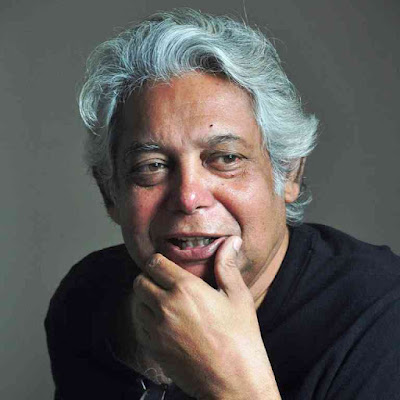
Author Chitra Banerjee Divakaruni (Image Credit: Chitra Banerjee Divakaruni)


In her latest book, The Last Queen, which was just released in the United States, Divakaruni continues to delve into the minds of powerful queens, this time with the story of Maharani Jind Kaur, the youngest and most beloved wife of the Lion of Punjab, Ranjit Singh, Maharaja of the Sikh empire. 


Why Rani Jindan?


“She is an amazingly strong woman who was just pushed aside in the annals of our history,” says Divakaruni.


History books teach about the Sher-e-Punjab, and his son, Dalip Singh, who was deposed by the British, exiled to England in his childhood, and ultimately made a puppet of the British crown. But in between the father and son ruled Maharani Jind Kaur, as the Queen Regent, an astute young widow fighting to protect Punjab, the legacy of her beloved husband, and the birthright of her son Dalip, from mercenary courtiers and the avaricious British. 


“I thought Rani Jindan had a fascinating life and deserved to be in the limelight. She was very inspiring to me because of the difficulties she went through in a world that was pretty hostile to women who stepped out of their roles; I really wanted to tell her story,” says Divakaruni. 


Readers and critics have called her books, especially the epic retellings, “unputdownable.” 


“I love that word!” Divakaruni exclaims in delight. “I want it to be unputdownable.”


In this regard, The Last Queen doesn’t disappoint. The story has everything a fast-paced novel can be expected to have: royalty, romance, conspiracy, murder and mayhem. Divakaruni’s narrative style is fluid and accessible, with a sprinkling of wit and humor. 


Divakaruni herself is a disarmingly charming conversationalist; her humor belies her towering persona as a multiple award-winning author. Her work has been included in the Best American Short Stories, The O’Henry Prize Stories, and two Pushcart Prize Anthologies, among others. She is also Professor of Creative Writing at the University of Houston, a program that is rated among the top creative writing programs in the US. 


A strong advocate for women’s rights, she co-founded the San Francisco Bay Area-based Maitri, a nonprofit that provides support services to South Asian survivors of domestic violence. She is also an Emeritus board member of Pratham, a nonprofit dedicated to eradicating illiteracy in India.  


Both Draupadi and Sita were relegated to a corner in the traditional epic narrative, not given much of a say in terms of what they were thinking, feeling or their motives.


As in the Palace of Illusions and The Forest of Enchantments, Divakaruni continues to write The Last Queen in the first-person narrative. Why?


“The first person allowed me direct interiority into the minds of these women, and in these three books, that was important. These are all strong women; their world is important, and therefore their voice.” 


Both Draupadi and Sita, she felt, were relegated to a corner in the traditional epic narrative, not given much of a say in terms of what they were thinking, feeling or their motives, and so Divakaruni addressed them with first-person female perspectives. 


At the same time, she also made both gods and kings disarmingly human with a generous dose of humor. In the Forest of Enchantments, readers are treated to a delightful scene where Lord Ram is teased about his dark skin color by Sita’s friends, and he gives back naughtily in jest by saying that when they unite in love, some of Sita’s fairness might rub off onto him.


“Normally, our popular concept of Ram is not of someone who jokes,” says Divakaruni, “but I found this in the Krittibasi Ramayan [a popular Bengali retelling] and had to put it in.” 


In the Last Queen too, readers also get a sense of Maharaja Ranjit Singh as a person, in all his glory and his failings (with a fondness for both women and drink), who finally found true love in the twilight of his years with an extraordinary woman of very ordinary birth.


Divakaruni’s feminist message, while strong, is also delicately nuanced, and therein lies her appeal to readers across genders. This has earned her a fan following among male readers.


Retelling of epics and historicals can be literary landmines for any author. So, how does Divakaruni tread through those?


“I feel huge amounts of trepidation, and oh, there are a lot of landmines, but what helps is my mission, which is to tell the truth as best as I can see it. I really don’t have any agenda except to bring women to the center of the story.” 


Divakaruni’s feminist message, while strong, is also delicately nuanced, and therein lies her appeal to readers across genders. This has earned her a fan following among male readers, many of whom write to her and engage with her on social media, all of which she finds very gratifying. “Reading across the genders is a very healthy thing, mentally and psychologically, healthy for our communities and ultimately for our societies,” she says. 


Divakaruni also feels keenly about the current world situation, where ideas and opinions are polarized to the extreme, and different interpretations are unwelcome. “I think we are going through a period, all over the world, and also in India, where it seems like there is only one possible interpretation of things, and if you veer from that, then hey, you are a problem. I really feel that that was not in our Indian spirit. Our Indian spirit is very embracive of many different ways of interpreting, of living, of worshiping.”


Currently, she is working on her next book, about a family in Bengal caught in the calamity of the Partition, which echoes those very sentiments. “It is at once hugely inspirational and a warning story as well of what happens when people don’t come together. Bengal too felt the violence of partition very keenly, but those events are less documented than the western borders,” she says.


Divakaruni’s other enduring love is teaching creative writing. “Every time I critique a student’s work, I learn something new. My students read a lot of contemporary books and they are always recommending things to me to read.” 


Her message for aspiring writers out there: I want you to know that when I started writing, I was a very bad writer. I had to learn how to become a good writer. Sometimes, writers have to be prepared to do that.


(Source: India Currents) 

Friday, 21 January 2022

‘The truth is biased’: Prashant Panjiar on the backstories of four decades of photographing India

 The veteran photojournalist’s latest book is a chronicle of the country’s journey through economic liberalisation.

When people discuss a photographer’s talent, they often speak about a photographer’s eye – that unique vision that individual photographers bring to their work.


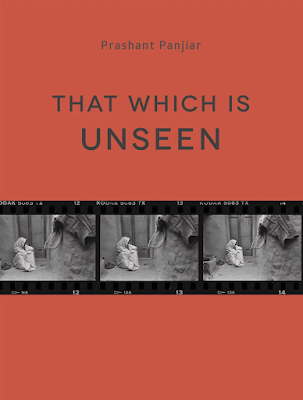
But looking over four decades of Prashant Panjiar’s images in his new book, That Which Is Unseen: Back Stories From My Years in Photojournalism, it’s clear that another part of his face has also been at work: his nose.


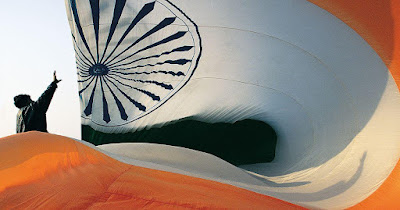
A giant flag at Hindon Air Force base. | Prashant Panjiar, Outlook, from 'That Which Is Unseen', by Prashant Panjiar


Panjiar, who spent significant portions of his career with leading newsweeklies India Today and Outlook, has an uncanny ability to sniff out momentous events and to be in the right place at the critical moment: in the Chambal Valley with its legendary dacoits in the 1980s; in Punjab during the Khalistan movement, just before Blue Star; in Ayodhya on December 6, 1992, when the Babri Masjid was demolished.


Edited excerpts from a conversation at his launch event in Mumbai.


You were in Ayodhya on December 6, 1992, when the Babri Masjid was demolished. You got the only pictures of the domes collapsing. How did you manage that?

India Today had three teams tailing Bharatiya Janata Party leaders as they made their way to Ayodhya for a symbolic kar seva. My brief had been to follow LK Advani. Tens of thousands of karsevaks had gathered in front of the Babri Masjid-Ram Janmabhoomi. That’s where all the camera crews and photographers were too. But Advani and the other leaders were some distance away on the terrace of a structure called the Ram Katha Kunj, from where they were making speeches.


From here, I only had a view of the domes.


The Babri Masjid demolition. Credit: Prashant Panjiar, India Today, from 'That Which Is Unseen', by Prashant Panjiar.

As the karsevaks began to break the barricades at the site, all the journalists there were systematically attacked. All their cameras were smashed. Many colleagues were badly injured. Some were locked away by karsevaks so there would be no evidence of the demolition. But on top of the Ram Katha Kung, people thought I was with the Vishwa Hindu Parishad so I could photograph right throughout. That is how I was able to take photographs of when the domes actually fell.


Twenty years after this, the story was still with me because I was called in to depose in the Central Bureau of Investigation inquiry into the demolition. I went to Lucknow to depose. But it was such a farce. All the lawyers were in cahoots with each other. I don’t know whether my testimony would have made any difference.


But it’s a reminder that what journalists do is pretty important, isn’t it? After all, we pride ourselves on producing the first draft of history…
All I knew at that point in time was that I had to keep my head down, don’t show my emotions, and just keep on photographing – because if I had shown any kind of emotion, I would have been thrown out of there.


I kept quiet and I listened. That’s an advantage we photographers have over reporters: we can eavesdrop. Many politicians and others don’t think we’re listening. They think we’re deaf. But we are actually privy to a lot of inside information.


During your stint with Outlook, where you joined as associate editor in 1995, some of the pictures that readers best remember you for being outside of the world of politics.
At Outlook, I could choose to do a lot of the stories that I was interested in. For instance, we had started doing profiles of writers. Many of them were childhood heroes, so it was great to be able to see and photograph them. I shot VS Naipaul when I was in London to research for the 50th year of Independence issue.


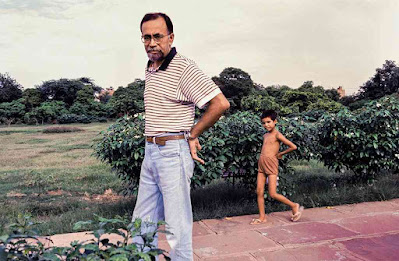
And then there was that serendipitous picture of Allan Sealy. Did you prompt that child to pose that way?


Author Allan Sealey. Credit: Prashant Panjiar, Outlook, from 'That Which Is Unseen', by Prashant Panjiar.

No, no, I actually prompted Alan Sealey. In a portrait, you’re always negotiating with the subject. He had only a little time. I had to photography where he was staying, so decided to take him to the park behind his apartment. He put on that pose himself. And the kid just walked into the frame. I think half of our work is luck.


Your book is, in a way, a chronicle of liberalizing India. Through its pages, we see a country getting more prosperous, more flamboyant. It’s a country that’s getting more jingoistic in some way, and displaying more religiosity. But you also depict the many losers. What, to you, have been the challenges of photographing this story?
After 1995, we’d started doing stories about how cell phones were spreading everywhere, about shopping malls and the construction boom. When I left Outlook in 2001, the sexy story of the Great Indian Middle class and how they were going to buy everything was everywhere. I did stories on India’s super-rich, for example.


There was an amazing amount of construction happening across India. I did a book called Pan India Shared Habitat, which I’d been photographing with a panoramic camera, featuring some of these new landscapes of demolition and construction. Many artists were thinking about these themes too at the time.


But after some time, it seemed like an overload. It seemed like anytime I did an assignment for a foreign publication, the photo editor in New York or in Hong Kong would ask me to do one picture of a shopping mall, even though it wasn’t necessary for the story. I just got fed up.


A photograph you shot in Bhuj in the aftermath of the 2001 Gujarat earthquake gets to the heart of the moral dilemmas that we face as journalists. What were your thoughts about it?

The Gujarat earthquake happened on a Friday and the magazine had already gone to press. We all convened for an emergency meeting in the Outlook office. We said that we needed to cover this. Vinod Mehta, the editor, was hesitant because he didn’t know if we’d get the story in time for our deadline. We had a major shouting match. I realized that there’s no way we’d win unless we had a plan that worked.


So we had two colleagues from the Bombay office fly in that evening and two of us went in from Delhi. We got there by dawn. I carried a portable scanner. We spent the day in Bhuj, dashed to Rajkot 250 km away where there was a lab that could process the film and then file the pictures on the dial-up internet lines that we had at the time.


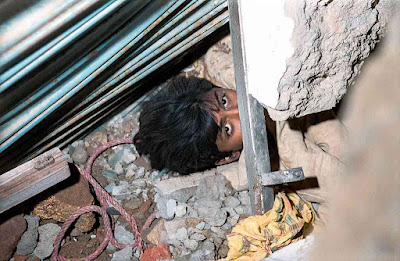
When it was very close to our deadline to leave Bhuj, I went into this building that had collapsed. This boy, Prakash, was stuck inside. It was a Cabinet of Dr Caligari kind of scene. The roof had collapsed, the floor was uneven – and the boy was trapped.


A scene from the Gujarat earthquake. Credit: Prashant Panjiar, Outlook, from 'That Which Is Unseen', by Prashant Panjiar.

People had tried to prise him out but it seemed impossible because a slab had collapsed on his chest. So I made the picture and I got out. We were told that the Army was coming to rescue him. We filed the picture – it was used as the lead picture in the story.


When we came back later, we found that Prakash had been rescued but he died shortly afterward because his body had been crushed for so long.


Later, someone asked the question that is put to so many photographers: should you be helping somebody or should be taking a picture? I thought about that a lot.


Often that’s not the choice that we have to make because you’re not in a position to help anybody – and other people are better equipped to do it. But the real question is whether to photograph or not to photograph. It raises the question of whether the subject is in a position to consent to their picture being taken.


Could I have asked him, can I take your picture? That would have been too effing stupid. But should I actually have taken the photograph? To shoot or not to shoot: that’s the moral dilemma, actually.


As a photojournalist, how does personal ideology influence your work?
Early on in my career, I had a discussion with a senior editor at India Today and asked if as journalists we were supposed to be unbiased and objective. He said, no, whether you’d like it or not, the truth is biased. That kind of stuck with me.


I came from Left-wing politics and that has always informed my work as a journalist. Because of my politics, I became aware of how the visual image can enhance or demean someone. It’s easy to present India in contrast, to juxtapose the rich against the poor, the powerful against the weak and to use stereotypes. That was something many of us did unconsciously when we started street photography.


After seeing Satyajit Ray’s Jalsaghar when I was in university, I was interested in the idea of people who had gone into oblivion. That’s why I decided to shoot the former maharajas of India. I later did an exhibition called King, Commoner, Citizen. The idea of that show was that when you photograph someone in India, you have to be aware of your own position of privilege and that you have to accord the same respect to both the powerful and those who don’t have power.


I’ve benefited from what I believed in. I think it’s important for us photographers to have a worldview. You might call it an ethic, a politics, whatever you like – to have a view of what you believe in is important.


Writers and reporters bring their opinion into their work. Why shouldn’t we as photojournalists not have that right too?


Prashant Panjiar. Credit: Manish Sinha


That Which is Unseen, images and texts by Prashant Panjiar (Navajivan Trust).


(Source: Scroll)

Tuesday, 18 January 2022

‘Santiniketan taught us that there is no such thing as worthless activity’: Mahasweta Devi

 Remembering the writer and activist on her 96th birth anniversary with an excerpt from ‘Our Santiniketan’, translated from the Bengali by Radha Chakravarty.

About the plants and trees of the Santiniketan that lives within my heart, I feel compelled to say more.


The neem trees will feel offended if I don’t give you a proper account of them.


The neem trees that I know belong to three varieties. Akash neem, mahaneem and ghora neem. All three varieties blossomed in the warm month of Chaitra, and their fragrance filled the air. I saw the flowers, some white, some blue, but I can’t say which type of neem had white flowers and which had blue.


Mahasweta Devi. | Naveen Kishore.


I can say for sure though that just in front of Sri Bhavana, beyond a spreading sirish tree, stood a row of neem trees, stretching right up to the end of the path. Today, the Sabars bring me neem honey and neem oil. And all year round, I consume boiled neem leaves.


In front of the Kala Bhavana flourished a “jambuvana” or jamun grove. Why call it a grove? Because it was a unique type of jamun tree. Not the familiar high-crested black jamun, but low-growing trees that spread their boughs long and wide. As far as I can recall, none of these trees grew even to the height of an ata tree.


There was no dearth of fruit. Not too fleshy, the stone so large it felt like mango seed. Not too sweet either. But you could carry some salt wrapped in paper, and gorge on the fruits endlessly, until your throat began to choke on the bitter jamun sap.


Our entire cohort would invade the jamun grove together.


“What clever jamun trees, bhai!” Kitu (Krishna Roychoudhury) would exclaim. “Not growing too tall. How easily we can enjoy the fruit.”


I’ve never seen such jamun trees anywhere else. They were just right for a place like Santiniketan.


Very profound, cheerful and large-hearted was the Ghantaghar, the bell tower, located beyond the library, to the right (am I correct?). A giant banyan or peepul grew there. And other trees too: bakul, jamrul, gaab and sapeda. Close to Chhatimtola was a hapless tree that bore sour fruit which we knew by the name of “nol”.


That was the tree a boy from Garhwal (was his name Vinay?) tried to climb, when he slipped and fell, fracturing a bone. The name “banapulak” (“rapture of the forest”) was given by Rabindranath to the tree that grew to the left of the path to Uttarayan. It bore clusters of blossoms resembling hasnuhana, exuding a sweet fragrance.


To the left, on the way to Uttarayan, the road had a culvert, and below, on a deep slope, was the house where Sebak-da lived – Sebak Sen and Jamuna-di. Mastermoshai’s younger daughter Jamuna-di played the role of Kurupa Chitrangada in the first performance of Chitrangada. With her sculpted features, as if chiselled in black stone, she was exquisitely beautiful.


To continue what I was saying: in winter, beneath that culvert grew wild, flowering shrubs. In the month of Chaitra, those shrubs had dried up, but the ripe kul fruit still grew on every branch. Down I jumped, from the edge of the culvert, without a thought. Who was to know that, lying coiled under the bushes, was a hibernating gokhro snake? It was clear to me that all that stood between the snake and my feet was a kul shrub. I also realised that the coiled form was moving, beginning to unravel.


“Snake! Snake!” I shrieked.


The louder I screamed, I’m told, the entire bunch of Class Seven students shouted even louder: “Snake! Snake!”

The boys reached out to me.


“Khuku! Grab our hands, bend your legs and clamber up!”


Thankfully for us, Sebak-da came rushing to the scene. (I think he taught us arithmetic.) Getting to the road, he yanked me up. And killed the snake as well.


And after that, a storm of scoldings! We beat a hasty retreat.


Near the rail tracks grew wild kul shrubs. Crossing the Khoai, we’d go in search of the wild kul. At Uttarayan, on the wall of Bouthan’s (Protima Devi) private garden, Rathi-da had painted a guava tree in playful strokes, styled exactly like the trees in Mughal paintings. A branch of the tree, twisted around and secured to an iron hook on the wall, looked quite wonderful.


To our eyes, the most miraculous flower was the yellow palash from Goalpara village. A pure yellow, like the atasi blossom. Later, in 1945, when Abanindranath was Vice Chancellor, we went to him once and found him gazing in rapture at a yellow palash flower placed in front of him. Between the Shyamali and Udichi buildings, did they later plant a yellow palash tree? I forget.


Rabindranath educated us in the idea of beauty in the design of houses. And beauty in naming a house – that too was a lesson to be learnt from him. Amiya Chakravarty’s elder brother Arun died before his time. “Aruni” was the name chosen by their parents for the house they built in Puri. I believe that Rabindranath’s influence had something to do with it.


We saw birds. Birds of many species. In the years 1936-38, immediately upon entering Uttarayan, one saw an enormous room to the left with a metal grill in front. A pair of snow-white peacocks resided there. Someone must have gifted them to Rabindranath. When the rains approached, the peacocks would spread their fans and dance. That was a sight worth watching.


Santiniketan trained our vision. Learn to see, learn to see!


Chhabighar, the picture gallery, was located directly in front of the kitchen. So many pictures to be seen there! For a week they displayed a Chinese painting. The paintings were put up there by the teachers and students of Kala Bhavana. Then came a Japanese painting, then others. Everybody viewed them. In their comings and goings, they saw the pictures.


Observing images is also something to be learnt. I didn’t learn. Thanks to Baba, right from infancy, we were used to seeing paintings at home. The Jibansmriti edition of those days carried a painting by Gaganendranath. I still recall the lines jal parey pata narey, and daibadurjogey aparahata sei kalo chhatati dekha diyachhey. After reading Jibansmriti, I went to Santiniketan. This impossible addiction to reading was the reason why I learnt to recognise life and the world through my experience of books. That is what I believe now.


In Patha Bhavana, Jadupati-da offered art lessons. Sometimes he took us to Kala Bhavana. From morning to evening, what a varied work schedule!


A work schedule, indeed! Identifying trees, raiding fruit trees, and in the rains, running towards the Kopai with Jiban-da and Sudhir Gupta-da, all of us getting soaked together, learning how to swim as we plunged about in those red, muddy waters during that downpour – these were forms of action, after all.

Every so often, listening to the baitalik songs at night, joining in the singing (was that in my college days?) – all that was action too.


Santiniketan taught us that there is no such thing as worthless activity.


Excerpted with permission from Our Santiniketan, Mahasweta Devi, translated from the Bengali by Radha Chakravarty, Seagull Books.


(Source: Scroll)

Monday, 3 January 2022

Perumal Murugan: ‘How I, descended from a legacy of illiteracy, become a writer’

 Murugan’s new book of short stories in translation, ‘Four Strokes of Luck’, will be published shortly.

I was born into a family that was immune to the fragrance of letters. When my grandfather once chanced upon my books, he glanced through them and said, “What is this, it looks like pellets of goat dung stacked together!” My ancestors reared cattle, and their world was restricted to the needs of their cows and goats. I had arrived into a tradition in which letters looked like goat pellets. And yet, I represent the first generation that could distinguish the two from each other. How did I, descended from this legacy of illiteracy, become a writer?


As a child, I could usually be found clinging to my mother’s pallu. I did not like being in crowds – of four or five people. I was terrified of human voices. Even after I was enrolled in school, I preferred solitude. I was hesitant to make conversation. I would rarely utter more than a word or two, and those were murmured. I loved my textbooks. The pictures and lessons created a little universe, just for me.


Perumal Murugan


In Class 1, we had a single textbook. In Class 2, there were two. These weren’t enough. I would wait with great anticipation for my mother’s return from the weekly market – her basket was a treasure trove.


Tamarind, jeera, black pepper and other condiments were less interesting to me than the newspaper in which they were wrapped. I would collect these newspapers. I would read these broken bits of news items, opinions and short stories, not leaving out a single fragment of a line irrespective of how much I understood.


The treats my mother brought home were divided equally between my brother and me. Once he was done eating his share, he would give me the newspaper in which it had been packed. I had to give him part of my share of treats in return. Sensing an opportunity, he came up with another proposition – just as the treats were divided between us, so should all the newspaper packaging.


He had figured that he could charge me a larger sum in treats to hand over his share of newspaper. My mother refused to oblige. She was furious that my brother had tried to pull a fast one on me with bits of newspaper whose only use was as fuel for the stove.


“Why are you such a simpleton?” she sighed.


She would search out bits of paper and bring them to me as grand presents. She would use them for the stove only once I had finished with them. My cousins got to know of our deal. There was a paucity of paper in that agricultural land on which all of us lived in little houses scattered about our holdings.


News of my obsession with paper travelled through the school too. The pocket money I occasionally got for sweets was spent on orange mithai. Each mithai would come in its own newspaper packaging, and so I was able to overcome the shortage. I didn’t mind sacrificing my entire quota of treats for the joy these bits of newspaper gave me.


In Class 3, we had five textbooks. I was thrilled.


In those days, the sunset was our signal to finish our dinner and draw our cots to settle down for the night. We were already half asleep when we heard the bells chime eight o’ clock in the neighbouring town. It was also the heavy labour on the farm, which began in the wee hours of the morning, that necessitated this early retirement to bed.


Kerosene was expensive. And hard to procure. Because of the prevailing belief that a lamp should be lit at dusk, we would put a tiny wick into the mini-lantern and let it burn for exactly an hour. We had to be frugal with the oil. I used to take my textbooks close enough to the lamp for its tiny glow to fall on the page, and read aloud.


Dialogue and narration had the same inflections. Maths could be read out like science. It was all language, wasn’t it? I loved the music latent in language. Words moved me. Amma helped me out by substituting the kerosene with castor oil so I could read longer. Castor bean grew on our lands, and so we didn’t have to be stingy with castor oil.


I had a little game – I would switch the words that appeared in my textbooks for others. There was a song that went, “Maambazhamaam maambazham, malgova maambazham.” (Mango, mango, Malgoa mango.) I would change it to “Goyya pazhaamaam goyya pazham” or “Pappaali pazhamaam pappaali pazham”, throwing guavas and papayas into the mix. The semantics were all right, but the aural effects were lost.


There is a variety of banana called poovanpazham, which we used to call “poompazham”. “Poompazhamaam poompazham, pudhupudhu poompazham” worked as a refrain. And so I would skip about the fields, stringing together words, making sense and nonsense as my whims dictated.


These strings of words eventually made it to the empty pages of books. At the end of the academic year, I would tear off the blank pages from my various notebooks and stitch them together to make a receptacle for my scribbles. I sensed that writing was my one acceptable companion, even as a child who craved solitude. Those scribbles were essentially imitations of things I had already read. All literature is imitation, isn’t it? An imitation of life.


Translated from the Tamil by Nandini Krishnan.


(Source: Scroll)

Monday, 18 October 2021

‘No one person gets to limit what it means to be Indian’: Namit Arora, author of ‘Indians’

To write his book, Arora travelled to the seats of the different civilisations of India.


An alumnus of IIT, Kharagpur, Namit Arora spent almost two decades in Silicon Valley as an Internet technology professional. In 2013, he quit his job and returned to India and, almost for two years, he volunteered with the Delhi government to find innovative solutions to civic problems; he led the drafting of Delhi’s solar energy policy and a task force on air pollution. In between, he published two books, The Lottery of Birth: On Inherited Social Inequalities, a non-fiction, and Love and Loathing in Silicon Valley, a novel set in Silicon Valley.


Arora’s third book is about Indian civilization, titled Indians: A Brief History of a Civilization. He spoke to Scroll.in about his journey from tech professional to author, his latest book, and how he looks at the idea of Indianness. Excerpts from the interview:


Tell us something about your journey from a career in internet technology to becoming a published author of two non-fiction books and a novel. What inspired Indians: A Brief History of a Civilization?
I was herded into the “safe” engineering profession by the great forces of the Indian middle-class. Not that I desired something else in my teens. It was actually good for me in many ways. It took me from IIT Kharagpur to California. Earnings from my career funded my wanderlust and evening education in the humanities. But I did see it mostly as a day job that paid the bills.


In the early years, as with most aspiring writers, I too faced my share of rejections in the publishing world, but I lived and learned, and built a nest egg. In due course, I quit the job, returned to India, and persevered until, fortunately, things worked out. Ironically, it was my unloved tech career that financed my new life of full-time reading, writing, travelling and the sporadic volunteer project like drafting the solar energy policy for Delhi – not to mention my labour of love, Indians.


My interest in history really began after leaving India, when life in the US raised for me various questions of culture and identity. In my mid-twenties, backpacking through Mexico in the early 1990s, I was blown away by the ruins of the Mayan and Aztec civilisations. That got me hooked on “lost cities”, or historical sites that were entirely lost to living memory and were dug out by archaeologists. I’ve since visited scores of lost cities around the world.


In the mid-2000s, my partner and I took a break from work to travel in India for two years. That was an amazing experience. We visited over a hundred sites in 20 states, including all of the lost cities I write about in Indians. Each of them raised new questions for me whose answers I could not easily find.


Namit Arora at the site of Nalanda University.


For instance, I wondered what life was like in the city of Dholavira, and what of the Harappan ethos is still with us. What urban milieu produced a great thinker like Nagarjuna? What was a day in the life of a student at Nalanda? What religious worldview promoted erotica on Khajuraho’s temple walls, and why did it disappear? How did the city of Vijayanagar become so rich? Can scoundrels also gain moksha after death in Varanasi? Questions like these.


So I started digging for answers, from which emerged the idea for a book like Indians. I read early travellers and literary-philosophical works, academic histories and monographs, Bahujan and feminist scholars, and Hindu nationalists. I visited site museums and read archaeologists’ reports. I wrote book reviews, essays and travelogues. As I connected the dots, the scope of the project evolved.


What was the transition to the history of Indian civilisation after writing a novel, Love and Loathing in Silicon Valley?
It wasn’t difficult. Though the novel and the history book were published within eighteen months of each other, both books had gestated for over a decade. They proceeded in parallel and became two different modes through which I explored questions of culture and identity, with the hope of gaining a better understanding of my world and my place in it.


The dust jacket of your new book says ‘Indian civilisation is an idea, a reality, an enigma.’ Can you elaborate on this statement?
I think the statement tries to capture the varied, mutating quality of Indian civilisation. Its reality is, of course, borne out by any academic definition of “civilisation”, even as its form and content have never been stagnant or singular. 


Indeed, Indian civilisation has been a journey of profound and continuous change – from the Harappans who built the first cities with indoor toilets and the most egalitarian civilisation of the ancient world, through the dramatic reshaping of the subcontinent’s culture by the Aryan migrants with new languages, religious ideas and the varna system, the rise and fall of Buddhism and Tantrism, the advent of feudalism and Bhakti, and the Turko-Persians bringing Islam and giving rise to a new syncretic culture, to India’s momentous encounter with European colonialism and western modernity.


Not surprisingly, then, Indian civilisation has been different things to different people. For instance, there is no historical evidence that Brahmins and outcastes, or urbanites and Adivasis, or priests and Carvakas, or sultans and peasants, or Tamils and Mizos, took pride in a common idea of Indian civilisation – and is there a good reason to privilege one over the other? Can it not contain many such ideas? With so many coexisting social realities, Indian civilisation is also an enigma that has produced various, often conflicting, appraisals of its central features and qualities. People joke that India frequently confounds academic social science. To adapt Whitman, Indian civilisation is large, it contains multitudes. So it’s all of these at once: idea, reality, enigma.


Different sets of people describe and define ‘Indianness’ in different ways. How do you look at the idea of Indian identity? What according to you are the basic qualifications for being an Indian?
As I see it, anyone who considers herself an Indian is Indian. Period. There should be no further litmus tests, no additional qualifications. “Indianness”, or “Indian identity”, which transcends the citizenship of the modern state, ought to be expansive enough to accommodate all those who consider themselves Indian in whatever ways they see fit, wherever they live. No one person or group gets to limit what it means to be Indian, at least not without a fight. As the poet Rahat Indori memorably said, “Kisi Ke Baap Ka Hindustan Thodi Hai”.


Many books have been written about the history of Indian civilisation by Indians as well as foreigners. How is your book different from them?
I think each reader will see my book as different (or not) in her own way. That said, let me offer a few provisional thoughts of my own. I’d say that Indians is rare in combining narrative history with archaeological travel writing. It’s a non-traditional history. It aims for an engaging, human portrait of our lost cities, in which the traveller (me) is part of the narrative.


It also draws new insights from early travellers’ accounts that speak to our 21st century concerns and sensibilities. In short, it tries to bring alive our forgotten pasts in rich and evocative detail, combining quirky stories with the big picture of Indian civilisation and its evolution. It strives to include non-elite perspectives – the view from below – rare in histories written by non-Indians and upper-caste Indians. Nor do I shrink from controversial topics or avoid calling a spade a spade. It also incorporates significant new research from archaeology and genetics.


According to American historian Hayden White, ‘history is no less a form of fiction than the novel is a form of historical representation’. How do you interpret this statement?
What I hear White saying is that, as narrative forms, history and fiction have more in common than meets the eye. This is a compelling view, though it can be easily misunderstood. I mean, one might object and point out that the historical narrative is built on facts and verifiable events, while the fictional narrative requires nothing more than subjective human experience and imagination, and so these are two very different kinds of endeavours.


But facts are one thing, their interpretation another. Facts alone do not necessarily make the narrative of history more truthful than the narrative of fiction. Indeed, fiction can often reveal our past and present more truthfully and vividly than what facts alone can convey. This is because both types of narratives must also employ significant interpretation – ie, subjective moral and aesthetic choices and judgments – which is what makes them similar forms.


A corollary is that a great historian has much in common with a literary master. Both must attempt to enter the society they reference, to see the world as its members saw it, and understand, to the extent possible, what it was like to live in it. Both require ample sensitivity, imagination, depth of perception, the right distance, and the ability to synthesise vast bits of social knowledge. Both must examine the psychology, morals, aspirations, and assumptions of ordinary people. Neither can claim to be an impartial or omniscient narrator, and so both history and fiction are subjective, value-laden enterprises sharing a family resemblance.


You present insights in your book from the accounts of the Persian traveller, Alberuni, and the French traveller, François Bernier. Both spent more than a decade in India and wrote extensively about their experiences. How do you compare their views about India?
Alberuni visited India between 1017 and 1030, when Mahmud of Ghazni was raiding wealthy temples. Bernier stayed from 1658-69, during Aurangzeb’s first decade as emperor in Delhi. They are two of the most fascinating and perceptive observers of medieval north Indian society. Both espoused a scientific temper and a humanistic ethos. 


Both admired many things Indian but also criticised other things. They each wrote near the eve of a major incursion from outside the subcontinent – Turko-Persian and European, respectively. Like any observer, they too had their biases and blind spots (which I discuss), but they’re still very informative about two different moments in Indian society.


Alberuni, a veritable polymath, had emerged from a great flowering of science and cosmopolitan culture centred in Persia. He despised Mahmud and condemned his raids. He learned Sanskrit in India, studied the major Indian religious, philosophical and scientific texts, translated some into Arabic, and sought out learned Brahmins to clarify his doubts. He praised earlier Indian achievements in mathematics and science, but noted the dismal state of science in contemporary India (for instance, unlike Aryabhata half a millennium earlier, leading Indian astronomers now held that the earth did not rotate on its axis but was at rest).


Caste made a powerful impression on Alberuni. He saw that such birth-based inequalities and segregated living, sustained by both religious scriptures and temporal laws, prevented social solidarity and a sense of common cause. He called it the chief difference between Indians and his own people. He hated the caste mindset of the elites. It bothered him that learned Indians did not mingle with foreigners like him – refusing to sit, eat, and drink with him – for fear of being “polluted”. He saw this as a kind of “fanaticism”, and called them more “narrow-minded” than their ancestors.


Alberuni’s extensive account confirms that on the eve of the Turko-Persian invasions, Indian society wasn’t exactly the picture of intellectual and moral vigour that many now fondly imagine it to have been. India’s intellectual culture had declined in the preceding centuries; it had fallen behind in science. Buddhism and Tantrism were in terminal decline, Bhakti and Brahminical orthodoxy were ascendant. Indians had grown more insular, conservative, superstitious, caste-bound, puritanical and patriarchal (I explore this change and its causes in the book).


Such “is the state of things in India”, Alberuni lamented, that Brahmins attempt to combine ideas of purity and pollution with the pursuit of science. He also described and analysed Indian texts, marital and funerary customs, taxation and inheritance, laws and punishments, etc – which frequently differed based on one’s varna status. His portrait of north India is so thoughtful and persuasive that he deserves to be called the “first Indologist”.


As for Bernier, he was a physician-philosopher who identified with the emerging Enlightenment thought in Europe. He greatly admired the fine architecture of Delhi and Agra. Employed by one of Aurangzeb’s noblemen, he observed the pomp and glitter of the Mughal court, “the base and disgusting adulation which is invariably witnessed there” and “the vice of flattery [that] pervades all ranks”.


He derided harmful superstitions, the practice of Sati fuelled by “merciless Brahmens” but discouraged by Mughal governors, and noted the primitive state of Indian medicine. Indians “understand nothing of anatomy,” he wrote. “They never open the body either of man or beast,” so do not know of the circulation of blood (working with bodily fluids was “polluting”). According to Bernier, Hindu scholastic education in its customary guru-shishya format, which he observed in Varanasi, was limited to mostly Brahmin men of “an indolent disposition”. He proclaimed that ‘”profound and universal ignorance is the natural consequence of such a state of society”.


Bernier’s account reveals a powerful, extractive bureaucracy concentrating riches at the top, funding a huge army and the luxuries of Indian aristocrats and the seraglio. This malady went beyond the Mughal realm. He reports extreme disparities and that “most towns in Hindoustan are made up of earth, mud, and other wretched materials”, and are poorer “than those of many other parts of the globe” (then too, India’s per capita GDP was below the global average).


Bernier analysed the causes of the dismal economic state of common folk in pre-colonial India – worse than in Europe, and a far cry from popular history’s boosterish metaphor, sone ki chidiya. As in Alberuni’s time, Bernier’s account shows Indians, especially Hindus, as creatively weak, ritualistic, mired in regressive cultural habits – and, in hindsight, entirely ill-equipped to resist the next big incursion too: a European imperialism powered by modernity, joint-stock mercantilism, the nation-state, science and scholarship (which would also lead them to discover, through the coloniser’s eyes, their own forgotten antiquity).


In his recent book, Early Indians, Tony Joseph, whose work you also quote in your book, argues, ‘We are all migrants. We are all mixed.’ What is your take on this statement?
Tony’s claim is spot on, not only in terms of physical migration and the mixing of genes; it’s also true with the migration and mixing of culture. Whatever the means, cultural diffusion across regions, ethnicities, languages, religions, traders, etc has been a prominent feature of Indian life. Think of what the Aryans from Central Asia added to Indian languages, the Greeks to art, the Persians to architecture, the Sufis to music, the British to politics, and so on.


The Hindu pantheon grew out of extreme cultural appropriation and assimilation of non-Vedic folk deities. Look at how mixed our art, architecture, literature, philosophy, music, dance, cuisine, sports, dress, painting, and crafts are today. And Indians gave much to others too. The depth and complexity of such mixing becomes even more vivid in the long view of history that I take in my book.


Can you talk to us about your visits to Dholavira? How has it contributed to the understanding of Harappan civilisation?
Dholavira (2600-1900 BCE) is the best excavated Harappan city in India. It is a lovely site to wander through, with gateways, streets and homes laid out on a grid-like plan. Astonishingly, one can still find on the ground shards of their painted pottery, bits of stone bangles, and semi-precious stones used to make jewellery. One can see greenish copper slag from the smelting process for purifying the ore, as well as the tiny bones of some of the animals Dholavirans ate: cows, buffaloes, goats, sheep, wild pigs, wild asses, deer, fish, rabbit and chicken.


The onsite museum has evocative game boards carved on stone, children’s toys, figurines, seals, pottery, and more. The village of Dholavira, after which the Harappan city is named, is a short walk away, and the landscape around the island is starkly picturesque.


All Harappan sites have much in common but they spanned a large geography and are also diverse. Unlike the four larger Harappan cities we know of, riverine and rain-blessed, Dholavira was on an arid island in the Arabian Sea (it’s now amidst a salt marsh, the Great Rann of Kutch). Because of this, its inhabitants focused a lot more on capturing water.


They built amazing water harvesting systems, city-wide storm-water drains, and sixteen giant reservoirs, one of which is nine times larger than an Olympic sized swimming pool and a hundred times larger than the Great Bath of Mohenjo-Daro. They surrounded the city centre with reservoirs, which must have made a visually appealing sight.


Most of Dholavira’s structures were built not in mud-brick, the Harappan norm, but in stone, including beautiful multihued stones from a nearby quarry that I visited. Dholavira has turned up what may be the world’s first stadium, with a stand of three rows. Its trade and material culture were more maritime than riverine, and it was likely a leader in Harappan seafaring innovations. Its funerary structures also differ from other Harappan cities in largely being cenotaphs, devoid of human remains, suggesting different cultural beliefs.


Dholavirans had other distinctive cultural attributes, but their major legacy seems to me their incredible creativity, resolve and engineering acumen ,through which they managed their scarce water resources for many centuries. They waged an epic struggle against the elements. Will we, their descendants, be inspired by them and rouse ourselves to tackle climate change?


Are you planning a follow-up to Indians?
No concrete plans yet. I’m just making my way through a pile of books that had built up while I was working on Indians. I also lost my father to Covid this year during the second wave, which has been very unsettling. Perhaps a new book project, for which I have at least a couple of candidates, will emerge in due course.


Abdullah Khan is a Mumbai-based novelist, screenwriter, literary critic and banker. His debut novel Patna Blues has been translated into eight languages. 


(Source: Scroll)