Showing posts with label quran. Show all posts

Wednesday, 20 May 2020

'It’s a very different Ramadan': how coronavirus has upended ancient rituals

This year, Islam’s holiest month has been held in lockdown in Australia. Mufti Zeeyad Ravat, from Melbourne, sees some positives: ‘It’s bonding families’

Mufti Zeeyad Ravat is an Islamic scholar, an authority on the day-to-day practice of Islam. His path to Australia was a circuitous one, from his birthplace in Johannesburg, South Africa, through India, Syria (where he studied Arabic), Brazil, Brisbane and Melbourne. In March last year, he travelled to New Zealand to lead a prayer service in Christchurch after 50 worshipers at a mosque were slaughtered.
During Ramadan, Mufti Zeeyad Ravat broadcasts lessons live on social media from his home in Melbourne, Australia. He sees coronavirus as a test and a vehicle to take him closer to God. Photograph: Gay Alcorn/The Guardian

Ravat, 39, is a bundle of energy, his arms waving to make a point, one leg tucked underneath him on a recliner in his home in Dandenong in south-east Melbourne. The everyday noise of family life (he is married with five children) break through from the next room as he explains how important Ramadan is, and how the coronavirus pandemic has upended its rituals.

“It’s a very different Ramadan,” he says. “I think it’s the first and last Ramadan of this kind.”

There are 1.8 billion Muslims in the world. More than 600,000 live in Australia, some born here, some arriving from countries as diverse as Indonesia, Turkey, Lebanon, Egypt, Indonesia, Pakistan and Somalia. There are different cultures, different traditions.

Like the followers of any religion, there are the devout and the less devout. Some people, says Ravat, pray five times a day. Others turn up for Friday prayers only. But Ramadan is special.

Ramadan is Islam’s holiest month, a time for reflection and self-discipline, as well as fasting from dawn to dusk for 30 days. This year in Australia, it began on 23 April and ends on 23 May.
Mufti Zeeyad Ravat (right) leads a prayer at the Deans Avenue memorial near the Al Noor mosque in Christchurch on 19 March 2019. Photograph: Anadolu Agency/Getty Images

The idea of Ramadan hasn’t changed, Ravat says. It’s a time when acts of goodness – always an obligation – are especially rewarded. The practice of generosity, particularly to the poor and vulnerable, is intensified. Ravat’s garage is full of boxes of groceries ready to be delivered to those struggling to buy food.

“We look forward to the month of Ramadan, because it’s that time that whatever you couldn’t do in the last 11 months, it’s the one month that you can speed up things, you can get things going from the spiritual perspective.”

The world is full of greed and power, he says, and “fasting is to realign our focus. We keep hungry for 30 days during the day. It’s taming the ego, and ultimately, slowly, that ego breaks down and the spirituality takes over. It’s about becoming peaceful.”

The rituals of Ramadan are impossible this year, with academics saying the restrictions are a first for Islam.

There are no communal gatherings in mosques for “tarawih” prayers every night after the fast is broken. There are no large iftar dinners with family and friends.

Last year, Ravat spent Ramadan at the Pillars of Guidance Community Centre, which he helped found in Melbourne’s south-east in 2016. Ravat is Sunni, of the Hanafi school, but says the centre’s purpose is to welcome everyone. There’s a strong social welfare program, youth classes, advice on traditions such as weddings, and a fine-dining restaurant.
The Gallipoli mosque in Auburn, Sydney, is among places of worship around the world that are closed to prevent the spread of coronavirus. Photograph: Brook Mitchell/Getty Images

During Ramadan, Muslims gathered at the centre after dusk to listen to Ravat recite a chapter of the Qur’an (the whole Qur’an is spoken over 30 days) and to teach a lesson afterwards.

As a boy in South Africa, Ravat memorised the Qur’an – a respected but uncommon practice among Muslims – and says that even if people can’t understand Arabic, it has meaning.

“It’s so melodious and beautiful that when you read it it actually soothes you and the meaning is so beautiful, because God is talking to you,” he says.

This year, mosques and other places of religious worship are shut to prevent the spread of coronavirus. Families are expected to recite the tarawih prayers at home and iftars are only for households. Each evening, Ravat or his eldest son recite a chapter of the Qur’an to the family. The little ones, he says, get a little tired of the prayers and are not expected to fast every day.

“The challenge is that in normal Ramadans, you have a strong environment in the mosque, a community that creates that vibe of Ramadan,” he says. “You go to the mosque, everyone is praying, and the imam is reading … and there’s these huge iftars that are happening.

God creates everything, whether it is a plague or whether it’s good times- Mufti Zeeyad Ravat

“There’s no environment [now] … that has bothered a lot of people, a lot of people are feeling down,” he says.

But “disaster is the mother of invention”. A week before Ramadan, Ravat set up a makeshift studio in his living room, with a camera and lights. Each night he broadcasts a lesson live on social media. His 18-year-old son, a tech wizard, works the camera. Up to 12,000 people have tuned in.

Similar experiments are happening across the country. Dr Ibrahim Abu Muhammad, the Grand Mufti of Australia and New Zealand, has said that online tarawih prayers should not be held “because one of the conditions of the group prayers is that there is direct contact between the imam and the people”. But online lessons and teachings are encouraged.

Ravat sees some positives emerging.

“It’s bonding families,” he says. “We’re stuck at home now [and] we actually eat much more slowly because there’s no rush.”

Every major religion has struggled to explain suffering in a spiritual context. Some believers have argued that natural disasters are a test of faith; others that they are a punishment of some kind, a notion that can seem cruel.
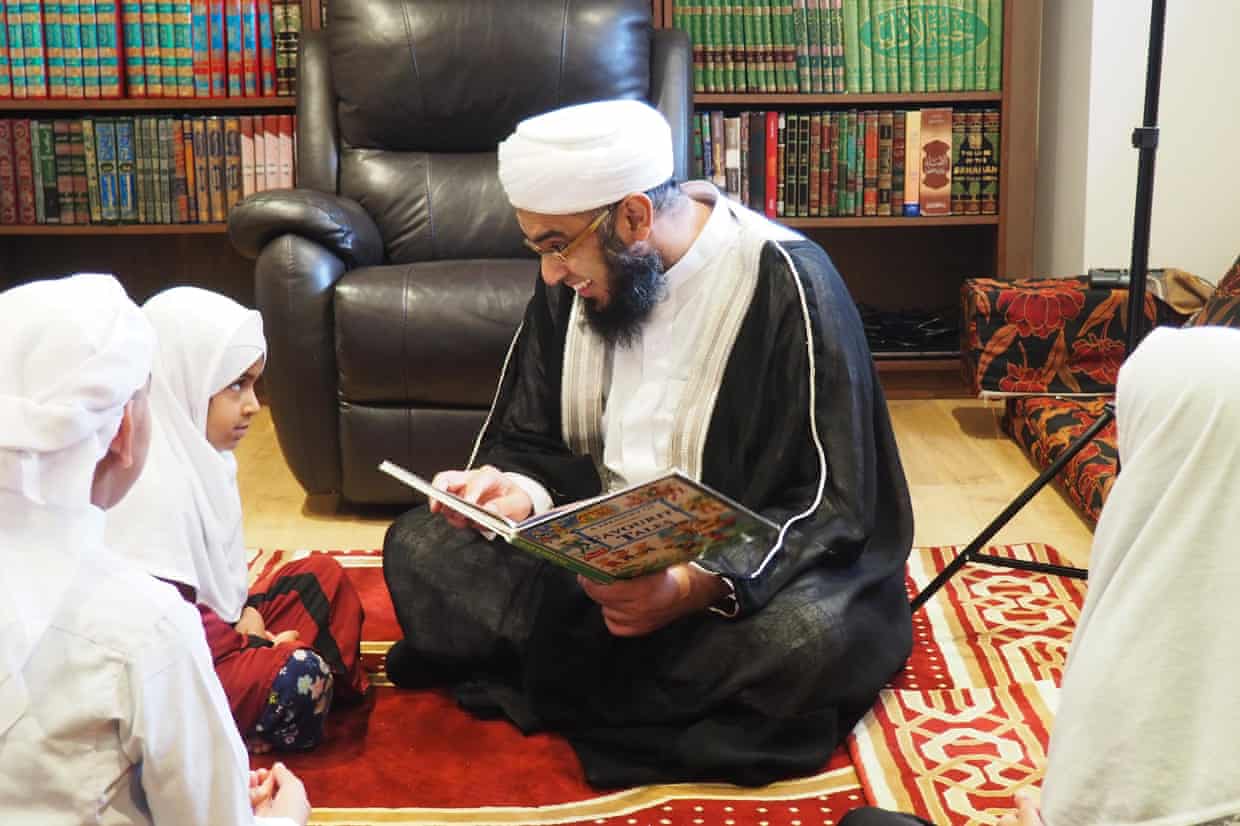
Mufti Zeeyad Ravat gives a lesson to his children at home. Photograph: Gay Alcorn/The Guardian

Jesuit priest James Martin wrote in the New York Times that it’s the same question when a single child dies from cancer or a hurricane kills hundreds of people: why, if God is all powerful and all-loving, does he not prevent such suffering?

“In the end, the most honest answer to the question of why the Covid-19 virus is killing thousands of people, why infectious diseases ravage humanity and why there is suffering at all is: we don’t know,” he writes.

For Ravat, Allah is all-knowing, the creator of everything, which includes Covid-19. Mehmet Ozalp, associate professor in Islamic Studies at Charles Sturt University, wrote in the Conversation that while the emergence of the virus might not be in human control, its spread is. The prophet Muhammad sought medical treatment and encouraged his followers to do the same, saying that “God has not made a disease without appointing a remedy for it, with the exception of one disease – old age”.

Ravat puts it this way: “God creates everything, whether it is a plague or whether it’s good times, God creates it, but it’s us with our actions that draws whichever one [out].”

He does see this time as some kind of cleansing, some kind of reckoning. “As human beings we are greedy, we cannot just be happy with what we have, we want to conquer this world, we want to dig every hole, we want to turn every mountain upside down, we want to pull every [piece of] coal out, we want to suppress the weaker.”

Coronavirus is a test, a vehicle to take him closer to God. But has it shaken his faith in any way, even for a moment?
“No,” he says. “Never ever.”

(Source: The Guardian)

Monday, 24 June 2019

Muslim men need to understand that the Quran says they should observe hijab first, not women

For some reason, a lot of men seem to think they can simply force women to observe hijab. Instead, the Quran and Prophet Muhammad are clear: in Islam, us men are not actually allowed to do that at all. The burden of modesty lies with us

In my day job, I’m a civil rights attorney fighting for Muslim women’s rights. So, when I saw #MuslimWomensDay trending on Twitter this week, I felt compelled to share my thoughts on hijab. The thread went viral, I believe, because it addressed an apparently novel point about hijab that too few people realise.

That is, when addressing hijab, the Quran does not address women first. It addresses men first. That’s not a typo. Islam places the primary responsibility of observing hijab not on women – but on men. It’s critical to understand this point.

People often conflate “hijab” and “headscarf”. Wearing the headscarf is one form of hijab, but men often forget that hijab is much more. And at the genesis of the hijab discussion, the Quran commands men to not stare at women and to not be promiscuous. The Quran 24:31 obliges men to observe modesty: “Say to the believing men that they restrain their eyes and guard their private parts. That is purer for them. Surely, Allah is well aware of what they do.”

‘There is not even any commandment to forcibly cover the heads of Muslim women, let alone non-Muslim women,’ says the Khalifa of Islam ( Nike )
This verse rebukes forced laws on women that claim “women must cover otherwise men are distracted”. It destroys rape culture because it commands men to reform themselves first and exclusively. It demolishes complaints that what a woman is wearing is “too provocative”, whatever that means, because it flat out forbids men from gawking at women.

In Islam, men have an obligation to God and to women to observe hijab. I imagine a conversation between someone teaching the Quran and a guy as follows:

Teacher: Don’t stare at women.

Guy: But she’s wearing revealing clothing!

Teacher: Why are you staring? Stop.

Guy: But it’s revealing.

Teacher: Why-are-you-staring?

Guy: Uh…

It’s that simple. If a guy chooses to accept Islam, Islam says he must observe hijab. The Prophet Muhammad’s directives further affirm this view. He admonished men, “Be chaste yourselves, and women will be chaste as well,” again putting the primary burden of hijab on men.

This point was again illustrated when the Prophet rode with his companion Al Fadl bin Abbas. A woman described as strikingly beautiful approached the Prophet to seek his guidance on some religious matters. Al Fadl began to stare at her because of her beauty.

Noting this, the Prophet Muhammad did not scold the woman for dressing immodestly or revealing her beauty. Instead, he “reached his hand backwards, catching Al Fadl’s chin, and turned his face to the other side so that he would not gaze at her”. Thus, the Prophet Muhammad once more established that the primary burden to observe hijab rests on men.

This teaching has a subtle but significant point. We’ve all heard guys say, “I want a chaste wife,” yet themselves they’re anything but. To such men I say: don’t be a hypocrite. The Quran keeps us accountable. Only after the Quran thoroughly commands men to observe hijab by being modest, not staring, and reforming ourselves, does the Quran address women.

But here, something strange happens to many men. While wholly missing the primary burden of hijab first placed on them, men suddenly and magically discover the concept of hijab for women. It’s an amazing phenomenon I see all too often in my day job. For some reason, men think they can simply force women to observe hijab. Instead, the Quran and Prophet Muhammad are clear: in Islam, no such permission exists for men to force hijab on women.

As His Holiness, the Khalifa of Islam Mirza Masroor Ahmad, reminds men who force hijab on women: stop and restrain yourselves instead. In a 2014 sermon he admonished men: “Men should remember that they have not been given powers to police others and they should restrain themselves. It is not for them to cover the heads of women from outside. Men are commanded to restrain their eyes, they should fulfil their own obligations. There is not even any commandment to forcibly cover the heads of Muslim women, let alone non-Muslim women. It is men like these who have hardline ideas…”

Hijab is a critically important Islamic teaching. No one denies this. But it seems to me that too many men forget it applies to us first. Let’s stop obsessing over women, and worry about reforming ourselves first. That apparently novel idea is indeed the true jihad and true meaning of hijab.

And finally, here’s another novel idea for those seeking to understand how hijab applies to Muslim women.

Ask them.

p.s. Qasim Rashid is an attorney, author and national spokesperson for the Ahmadiyya Muslim Community USA. Follow him at @MuslimIQ

(Source: Independent)

Tuesday, 5 March 2019

Egypt’s grand imam calls polygamy an ‘injustice’ for women

Sheikh Ahmed al-Tayeb argues practice comes from ‘lack of understanding of the Quran and the tradition of the prophet’

The grand imam of Egypt’s top Islamic institution, Al-Azhar, has stirred up controversy after saying that polygamy is an “injustice” for women.

Sheikh Ahmed al-Tayeb, Sunni Islam’s highest authority, said “those who say that marriage must be polygamous are all wrong”.

He made the comment on his weekly television programme and on Twitter.

Sheikh Ahmed al-Tayeb denounced polygamy on his weekly
television programme on state TV ( AP )
Mr Tayeb said polygamy is restricted in Islam and requires fairness. “If there is not fairness it is forbidden to have more than one wife,” he said.

He added that polygamy came from “a lack of understanding of the Quran and the tradition of the prophet”.

Mr Tayeb’s comments, broadcast on Friday on state TV, sparked a heated debate on social media, with some siding with scholars calling for a ban on the practice.

Al-Azhar sought on Saturday to clarify the comments, saying that Mr Tayeb wasn’t calling for a ban on polygamy.

(Source: Independent)

Wednesday, 6 February 2019

Woman Qazi conducts marriage: A victory in women reclaiming spaces taken up by men

Although in Islam there is nothing that stops a woman from solemnising a nikah, the practice has been mostly limited to the male domain for centuries.

Amidst news of what women can and cannot do, and diktats on their right to religious freedom with regard to traditions and culture, a Muslim couple got their nikah solemnised by a woman Qazi earlier this month. This marks another victory in women reclaiming spaces that have just been taken up by men, irrespective of what religion has to say about it.

Maya and Shamaun, a couple based in Mumbai, got their nikah solemnised by Qazi Hakima Khatoon in Kolkata on January 5. A communications consultant by profession, Maya tells me that when a few years ago she read an article stating that a woman can also be a Qazi and solemnise a nikah, something that she was not aware of like most others because it is not common practice, she and Shamaun decided that their Qazi will be a woman.

All pictures courtesy: Maya and Shamaun
Although in Islam there is nothing that stops a woman from solemnising a nikah, the practice is so uncommon that even locating a woman Qazi can be an impossible task. There have been earlier instances where a couple has asked a woman to carry out the nikah, but these instances are so rare and a woman Qazi so difficult to find that most nikahs, if not all, are conducted by men in Muslim families in India. Maya and her fiancé came across the Bharatiya Muslim Mahila Andolan’s (BMMA) website and saw that the movement had trained women Qazis in Quranic and constitutional rights. They got in touch with BMMA in 2017. When asked why they chose a woman to conduct the ceremony, the couple said ‘why not’.

Maya and Shamaun’s nikah marks a new beginning for women’s rights – an ordinary Muslim woman activist, who has, after undertaking a rigorous course on rights of women in the Quran and the Constitution, been invited by a regular couple to solemnise their wedding. A practice which has been mostly limited to the male domain for centuries. “It feels nice to give another woman a platform like this, which ideally should be easily available to her anyway. It has been empowering for her and me, both,” Maya tells me.


Qazi Hakima says she cannot explain in words what it has meant for her to be approached and to be able to successfully solemnise the nikah for the couple. She is also aware that as part of her duties as a Qazi she is responsible, under the training that she has taken, to ensure that there is proof of residence and age, and an affidavit from the groom stating that he is not previously married (the marriage is not polygamous). She has to make the couple go through the Nikahnama, fix the mehr (dower) amount and ensure that it is given at the time of the nikah, has to counsel the couple and ensure that the marriage is being carried out with their full consent. BMMA has trained 16 women Qazis in Maharashtra, MP, Rajasthan, Tamil Nadu, Karnataka and Odisha.

Maya, who is half-Bengali and half-British, has a degree from the School of Oriental and African Studies, London. Owing to her belonging to a liberal household, both her family as well as her in-laws were very happy with the decision of the couple. Until the wedding happened and people started reaching out to them, they did not see their decision to choose a woman to solemnise their wedding as ‘a big deal’.


“The biggest challenge,” says Noorjehan Safia Niaz, co-founder of the BMMA, “is to get couples to come forward. We need more Mayas and Shamauns – the new age, modern, liberal Muslim men and women.”

Muslim women have long been denied rights which the Quran has guaranteed to them, because of the patriarchal norms set by society at large to keep them confined and subjugated. This is changing today when the ordinary Muslim woman is questioning the status quo and is not ready to accept customs and traditions being forced on her in the name of religion. Whether it is re-entering Haji Ali and demanding that religious spaces be easily available to all women, or fighting to ban instant triple talaq, Muslim women are the frontline warriors fighting their own battles.

Qazi Hakima and her like need to be supported so that more couples come forward to get their nikahs solemnised by them – where the mehr will not be a mere eyewash and never be asked to be forgiven, the couple will be made aware of their rights and responsibilities, underage marriages will not be solemnised, and the bride will get all her due rights as per the Quran.

(Source: TNM) 

Sunday, 21 October 2018

Imam discovers everyone in mosque 'had been praying in wrong direction' for 37 years

Key part of building is misaligned

Congregants at a mosque in Turkey had been praying in the wrong direction for nearly four decades before its new imam realised the error, according to reports in Turkish media.

The mosque in Sugoren, in the country’s western Yalova province, had a key flaw in its construction that meant faithful Muslims – who are instructed to kneel in the direction of Mecca during prayers – had misaligned themselves by as much as 33 degrees, the Daily Sabah reported.

Hurriyet, citing the Demiroren News Agency, said imam Isa Kaya was appointed last year and that, following rumours about the alignment of a niche in the mosque’s wall indicating the direction of the Kaaba in Mecca, he decided to ask the advice of local muftis.

The officials confirmed the niche, or mihrab, had been constructed in the wrong place when the mosque was built in 1981, it was reported.

Rather than tear down the niche immediately, Mr Kaya used a temporary measure to point people in the right direction – placing arrows made of white tape on the mosque’s carpet.

“We have explained the situation to our congregation and most of them have reacted positively to our solution,” the imam told Demiroren News Agency.

An architect will be given the task of redesigning the structure.

Dr Mustafa Baig, Lecturer in Islamic Studies at the University of Exeter’s Institute of Arab and Islamic Studies, explained the misalignment.

“It is important to emphasise that Muslims do not worship the Ka‘ba but it is the direction (or qibla) to which Muslims pray,” he said. “Worship is to Allah.”

“In the Qur’an it states: ‘Wherever you turn, there is the countenance of Allah (2:115).’ Moreover, the direction (or jiha) is determined by a 90 degree span and not at the exact angle of the Ka’ba.”

Dr Baig added: “The Qur’an mentions: ‘Turn your face in the direction of the Sacred Mosque’ (2:149) and the word shatar in this verse has been defined as one of the four cardinal directions, giving a leeway of 45 degrees to either side of the Ka‘ba: in other any aspect of the forehead should be facing the Ka‘ba. In this particular case, the niche was ‘misaligned’ by 33 degrees so it is with the 45 degree limit.

“Even in the event of praying outside the range of direction, the jurists stipulate that if one has made an effort to determine the direction of the qibla (where due diligence was made) then if later (after the prayer time has lapsed) it becomes known that the prayer direction was completely wrong, the prayer will be considered valid and need not repeated,” the lecturer added.

“In this case, therefore, the previous prayers would not be considered invalid and the placement of the prayer niche is also not ‘wrong’, although they may want to reposition it in order to be facing in the exact direction of the Ka’ba.”

(Source: The Independent)

Saturday, 25 August 2018

To get all the world’s Muslims to hajj, it would take at least 581 years

At least 1.7 million foreign pilgrims are in Mecca, Saudi Arabia, this week for the hajj, the annual five-day pilgrimage that Muslims from around the world make to follow in the footsteps of the Prophet Muhammad.

Amid growing demand and concerns for safety after deadly accidents, the Saudi government has been rapidly expanding Mecca’s hajj facilities to accommodate more pilgrims. At its peak in 2012, the hajj included 3.16 million pilgrims. But even at a rate of 3 million people per hajj, it would be impossible for all the world’s 1.8 billion Muslims to meet the Islamic obligation of performing hajj in their lifetimes. In fact, it would take at least 581 years.

That’s just looking at the Muslims alive today — not accounting for future birth rates or for people who have already performed hajj, though a 2013 Pew survey of 39 countries found that 9 percent of Muslims had.
Pilgrims circled the Kaaba, which is considered to be the House of God, at this year’s hajj in Mecca, Saudi Arabia. Dar Yasin/Associated Press
All Muslims who are physically and financially able to complete the hajj are supposed to do so at least once in their lives. Attendance by foreign pilgrims has grown more than tenfold since World War II. (In 2013, attendance quotas dropped to account for continuing construction in Mecca.)

Not everyone who wants to make the hajj can do so easily, and millions of Muslims all over the world wait years for the chance. The costs can be prohibitive — two to three times a year’s salary in some places — and visas can be hard to get.

At least a quarter of pilgrims every year are citizens or residents of Saudi Arabia. The Saudi government sets quotas for every other country that sends pilgrims to the hajj based on its Muslim population.

Even countries with large Muslim populations can send only a small fraction of their citizens to the hajj. In Indonesia — which at more than 200 million has by far the largest Muslim population in the world — the wait time can range from seven to 37 years. Some countries complain that the quota allocation is not transparent enough, or that it should be based on demand rather than on Muslim population.

Other critics say Mecca is already at capacity during the hajj, and expansion efforts have come at the cost of Islam’s cultural heritage and the spirituality of the pilgrimage. Several historic Islamic sites were destroyed in recent years to make way for luxury high-rise hotels and malls that cater only to wealthy pilgrims. These developments dominate the Kaaba, the cubelike structure at the center of the Grand Mosque that is circled by pilgrims and that is considered to be the House of God.

Still, Saudi Arabia continues to build. The multiyear construction plan includes expanding the mosque around the Kaaba to hold 1.85 million people.

(Source: NYT)

Wednesday, 22 August 2018

Eid al-Adha: Why do Muslims sacrifice animals and where is the practice legal in public?

Practice honours Abraham's willingness to slay his son Ishmael for love of Allah

Muslims around the world are celebrating Eid al-Adha.

Falling on the 10th day of the holy month of Dhu al-Hijjah, Eid is the “Festival of Sacrifice” and coincides with the Hajj pilgrimage from Medina to Mecca.

It honours Abraham’s willingness to slay his son Ishmael at Allah’s request, a supreme act of faith.

The prophet, distressed by the order, asked Ishmael what he should do and the boy advised him to follow through with the commandment. Satan tried to dissuade Abraham from slitting the boy’s throat but was driven away by the prophet pelting stones, an act recreated by pilgrims on the Hajj.


When Abraham held the blade to his son’s neck on Mount Arafat, the angel Gabriel appeared to prevent him from going through with it, saying he had already demonstrated his love for god. A goat was slaughtered in the boy’s stead.

Today, the same animal – or a sheep, cow or camel, depending on the region – is sacrificed in memory of the story.

The Qu’ran quotes the Prophet Muhammad as saying: “On the 10th of al-Hijjah, there is no better act in the view of Allah than shedding the blood. Hence you should offer it in good spirit.”

The point of the sacrifice is to kill something dear to man as an offering to the divine, as Abraham was prepared to do, serving as a reminder to followers of Islam not to become preoccupied by their possessions or lose sight of their spiritual compass.

As Allah says in the Qu’ran. “It is not their meat, nor their blood, that reaches god. It is their piety that reaches god.”

The sacrificed animal is cut into thirds: one portion is given to the impoverished, another to friends and relatives and the last retained and eaten by the family.

Carrying out this sunnah (Islamic custom or sacred duty), can be controversial in practice, however, particularly in relation to where it is undertaken.

A man holds a ram at a market in Istanbul, Turkey, ahead of the annual Muslim holiday of Eid al-Adha or 'Festival of Sacrifice' (Ozan Kose/AFP/Getty)
In Egypt, the Cairo governor’s office is currently working to stop people from enacting the slaughter on the city’s streets on hygiene grounds, fearing the spread of disease through the discarded entrails and blood and the meat itself becoming tainted by exhaust fumes or close proximity to garbage.

City spokesman Khaled Mostafa described the sacrifice as “barbaric and unacceptable” as he introduced a strict prohibition, fining private citizens or vendors who kill animals in public at pop-up livestock markets 5,000 Egyptian pounds (£218), well above the average monthly wage, according to The New Straits Times.

In the UAE, slaughter must be carried out at accredited public abattoirs. Doing otherwise incurs a fine of 5,000 Emirati dirhams (£1,060).

A Yemeni boy stands among a herd of sheep in a livestock market in the capital Sanaa as people buy provisions in preparation for the Eid al-Adha celebrations (Mohammed Huwais/AFP/Getty)
Elsewhere, cities like Chittagong in Bangladesh have set aside temporary areas where the sacrifice can be carried out under tarpaulin canopies, employing 5,000 cleaners to ensure the zones remain sanitary.

In India, a further complicating factor in the slaughter of cattle for Eid is causing grave offence to Hindus, to whom the cow is a sacred beast. States like Jharkhand have issued orders telling all deputy police commissioners their officers must intervene to prevent the killing of cows in their districts.

The United Nations Food and Agriculture Organisation offers strict guidelines on the slaughter of animals, stressing it must be carried out in abattoirs, which in turn must be “situated away from residential areas” and calling for “a well-planned, well-executed and controlled cleaning and sanitation programme”.

Not all Muslims agree with the necessity of making the sacrifice. The Vegan Muslim Initiative, for one, campaigns against the practice, with co-founder Sammer Hakim branding it “highly irresponsible”.

To the majority though, the act is an important annual reassertion of the individual’s faith in Allah and a tradition dating back to the prophets that must be honoured.

(Source: The Independent)

Tuesday, 30 January 2018

Over 7 lakh muslims congregate at Nanjangud for 3-day Ijtema

Nearly seven lakh Muslims including 13 Maulvis from the country and abroad are congregating at the three-day All India Mushavarathi Ijtema (Convention), organised by the Muslim community at the Adakanahalli Industrial Area, near Kadokola in Nanjangud taluk.

People have been coming in buses, cars and trains from yesterday from Gujarat, Uttar Pradesh, Telengana, Maharashtra and even from Bangladesh, Kenya, Mauritius and other parts of Karnataka and the number has already touched six lakhs and it is likely to go up to seven lakhs by this evening.

The Ulemas or Maulvis conduct prayers, speak about unity and communal harmony, is the message that is strongly sent on all the three days. One of the organisers, speaking on condition of anonymity told Star of Mysore that this is the first time such a big convention is being held in Mysuru and the earlier conventions were held only at the district level.

There are ten camps set up at the site and the food for three days that includes breakfast, lunch and dinner both vegetarian and non-vegetarian costs Rs.150 for all the three days. Five times Namaz is held.


Teachings on Quran are held and there are no political speeches, said the source. People living in Mysuru, return home, while all others stay in the camp.

One of the camp coordinators Aftab Ahmed has set up a camp at the Mysuru Toll Gate to receive the visitors and the second camp is at the City Railway Station where KSRTC buses hired for taking the participants to the venue by paying Rs.50 for Volvo buses and Rs.40 for ordinary ones.

Hazrath Moulana Ahmed Hussain, Gujarat  Hazrath Moulana Ibrahim Ibrahim Devos, Gujarat and Hazrath Moulana Ahmed Lad Saheb, Gujarat, Hazrath Moulana Dr. Khalid Ahmed, Aligarh, UP, Hazrath Moulana Dr. Sana Ulla, Aligharh, UP, Hazrath Moulana Abdul Rahman, Hazrath Moulana Farooq Ahmed, Hazrath Moualna Akbar Shariff Shariff, Bengaluru and Hazrath Moulana Mohamed Zaka Ulla Saheb Siddiqui, President, All India Mili Council, Mysuru District Unit, are some of the many Maulvis attending the Ijtema.

Thousands of volunteers are working day and night and vehicular traffic is being controlled by them. There are no banners or slogans raised at the venue, said the source.

(Source: Star of Mysore)

Thursday, 18 January 2018

Isis persecution of Christians not justified by Prophet Mohammed's teachings: Study

Previously untranslated writings by the Prophet Mohammed can act as 'a kind of medicine to cure the diseases of Islamic extremism and Islamophobia'

The persecution of Christians in the so-called Islamic State is not justified by Prophet Mohammed’s writings, according to research.

The study into the works of the Muslim prophet written between 622 and 632 AD indicates Christians living within the “ummah” – Arabic for community – were protected and defended.

Craig Considine, the paper's author, considers the prophet's vision of a Muslim nation to be one with religious pluralism and civil rights.

“The research clearly shows that contemporary Islamic states that mistreat and discriminate against Christians cannot be justified in light of Prophet Muhammad’s covenants,” he said.

Dr Considine, from Rice University, Texas, believes the rediscovery of these documents could ease anti-Muslim sentiments.

Ancient Islamic scriptures advocated religious pluralism and civil rights MOHAMMED HUWAIS/AFP/Getty Images
He said they could be viewed “as a kind of medicine to cure the diseases of Islamic extremism and Islamophobia”.

“His message radiates compassion and peace. This is what American society – and indeed the world – needs now more than ever,” he said.

According to Dr Considine, the documents have been located in monasteries around the world and in books which have been out of print for centuries, and in many cases they were never translated for a wider audience.

But, he said: “Scholars and believers are turning to them now because of the widespread violence against Christians in places like Iraq and Syria.

“The Prophet Mohammed did not want to inflict harm on Christians, nor interfere or encroach on their privacy or private property.

“For the state to give preference to one or more groups means devaluating citizens based upon their ethnic or cultural backgrounds.”

(Source: Independent)

Wednesday, 29 November 2017

Anita Nair comes up with a book of Quran stories for kids

Anita Nair’s gorgeus new children’s book, Muezza and Babyjaan: Stories from the Quran, illustrated by Harshad Marathe, sees Muezza, the Prophet Muhammad’s cat, narrating stories to Babyjaan, an adorable baby camel with lashes to sigh over. Full of shape-shifting djinns, desert animals and the 99 names of god, there’s something so compelling about the story, and it made us wonder why exactly she decided to write it, and how she settled on these particular characters.

Anita Nair will be at the Times Litfest Bengaluru 2017, presented by ACT Fibernet this weekend. On the 11th of February, she’ll be part of a panel discussion on the concept of the noir hero, and on the 12th of February, she’ll be reading from her new book.

The team of The Ladies Finger spoke to Anita Nair about what made her write this book, her writing process and her immense productivity as a writer. Edited excerpts from the conversation:


Your children are grown up now. Why children’s books now?
I’ve written five children’s books before. I think I write them for the manic child jumping around within me.

What different kind of skills does it take to write a children’s book?
It’s the tone that you really have to think about when writing for children. When you’re writing for a child, you can’t talk down to them, but while sounding all buddy-buddy, I always try to weave in some nuance, some kind of life lesson for them, maybe through humour or an anecdote.

The other thing is, when writing for adults, you’re talking to your peers, plus, you have some leeway. Adults judge books based on various factors, like what other people have said about the book, for example. They also give a book a chance. Even if the first page is boring, they think maybe it’ll pick up by page five. With kids, you don’t have that luxury — if it isn’t interesting right from the first page they aren’t going to read the book, so you have to be much edgier, and in a way, go back to being a child yourself. I try to find a way to use a child’s point of view while using adult techniques.

Do you have to go into a separate zone, so to speak, when writing children’s books?
Not really. As a full-time writer, it would be tough for me to write the same things again and again, so working on many books simultaneously allows me to switch head spaces and get out of that zone a little.

What made you decide to write this particular book?
I had very very specific reasons for deciding to write this book. I’ve been feeling so uneasy about the rising intolerance all around. There just seems to be such a profound lack of understanding, even among my own close circle of friends and family, who’re otherwise lovely people. I notice even bleeding heart liberals disparaging Islam so casually. There’s such a lack of inclusiveness that I notice generally.

When I was writing Idris, I had to delve into the Quran, and I found myself wondering so many times, why didn’t I know this already without having to set out to do specific research? I mean, I’m not Muslim myself, I’m a Hindu, and while I had a very secular upbringing, I had no real meaningful access to the Quran, and it’s like that for a lot of us. There are so many myths and veils around the Quran that it’s important to know what actually in it. I’m not some kind of Quran expert myself, but I can tackle stories in it. And I wanted to do that through a children’s book; children are so much easier to get through to.


Can you tell me a bit about the characters, Muezza and Babyjaan, and how you decided upon them?
So when I decided to write this book, I was thinking of how to locate it, in a literary sense. So while reading, I randomly came across the fact that the Prophet had a cat that he was very fond of. I have lots of cats myself, and I know that they’re very intelligent creatures — very different, no dithering, they know exactly what they want. So I thought having a cat who lived in close proximity to the Prophet would be a great voice to speak through, also so that it wouldn’t be me talking, it would all be through the voice of the cat. That also made it easier to write these stories.

Then it came to the next character, whom the cat would be speaking to. It really came to me so randomly, like a lightning bolt. I was reading about djinns, and learned that there was a category of djinn called jaan that takes the form of a white camel. So I decided to name her Babyjaan, since she’s a baby camel, and the name also has a really nice Arabic flavour to it.

What is your writing process like — do you have a routine? On a good day, how many words do you average?
I do have a routine. I’m definitely a morning person, I’m an early riser and I work best in the mornings. I’m done writing by 11.30 am and I spend the rest of the day reading and doing other things. I average about 1,000 words a day.

Do you have tips for other people to increase their writing productivity?   
Well, I would say two things in particular, discipline and planning. You can’t do “maybe”, you have to plan your writing and be realistic. Don’t aim for too much, or you’ll end up with backlogs. Also, if you like what you do, you sometimes don’t want to stop. Sometimes, when I’m reading or researching or writing something interesting, I just keep going. But you also should know when to stop, else you get fatigued. Writing is a bit like marathon running, you have to pace yourself.

Would you consider yourself a productive person?
Well, I don’t really consider myself a productive person. But then when I look at my body of work, it seems that I am.

Saturday, 14 October 2017

Researchers find name of Allah woven into ancient Viking burial fabrics

Find suggests evidence of Islamic influence not just 'the result of plundering and eastward trade', says archaeologist

Allah's name has been found embroidered into ancient Viking burial clothes, a discovery researchers in Sweden have described as "staggering".

The silk patterns were originally thought to be ordinary Viking Age decoration but a re-examination by archaeologist Annika Larsson of Uppsala University revealed they were a geometric Kufic script.

They were found on woven bands as well as items of clothing, in two separate grave sites, suggesting that Viking funeral customs had been influenced by Islam.
A tablet woven band, from a Viking burial site Annika Larsson

The woven bands contained ancient Arabic script, Kufic characters, invoking both Allah and Ali. The Kufic characters were found in the Viking Age in mosaics on burial monuments and mausoleums, primarily in Central Asia.

“One exciting detail is that the word ‘Allah’ is depicted in mirror image," Ms Larsson said. "Perhaps this was an attempt to write prayers so that they could be read from left to right.

“That we so often maintain that Eastern objects in Viking Age graves could only be the result of plundering and eastward trade doesn’t hold up as an explanatory model, because the inscriptions appear in typical Viking Age clothing.

“It is a staggering thought that the bands, just like the costumes, [were] made west of the Muslim heartland. Presumably, Viking Age burial customs were influenced by Islam and the idea of an eternal life in paradise after death."

She added: “In the Quran, it is written that the inhabitants of paradise will wear garments of silk, which along with the text band’s inscriptions may explain the widespread occurrence of silk in Viking Age graves. The findings are equally prevalent in both men’s and women’s graves.”

Ms Larsson’s prior research has uncovered widespread use of silk during the Viking Age in Scandinavia, the university said.

The cloth is thought to have come from ancient Persia and Central Asia.

(Source: Independent)

Wednesday, 18 January 2017

'Violence more common' in Bible than Quran, text analysis reveals

An analysis into whether the Quran is more violent than the Bible found killing and destruction occur more frequently in the Christian texts than the Islamic.

Investigating whether the Quran really is more violent than its Judeo-Christian counterparts, software engineer Tom Anderson processed the text of the Holy books to find which contained the most violence.

In a blog post, Mr Anderson explains: "The project was inspired by the ongoing public debate around whether or not terrorism connected with Islamic fundamentalism reflects something inherently and distinctly violent about Islam compared to other major religions."

Using text analytics software he had developed, named Odin Text, he analysed both the New International Version of both the Old and New Testaments as well as an English-language version of the Quran from 1957.

It took just two minutes for his software to read and analyse the three books.

By categorising words into eight emotions - Joy, Anticipation, Anger, Disgust, Sadness, Surprise, Fear/Anxiety and Trust - the analysis found the Bible scored higher for anger and much lower for trust than the Quran.

Further analysis found the Old Testament was more violent than the New Testament, and more than twice as violent as the Quran.

Mr Anderson summarises: "Of the three texts, the content in the Old Testament appears to be the most violent.

"Killing and destruction are referenced slightly more often in the New Testament (2.8%) than in the Quran (2.1%), but the Old Testament clearly leads—more than twice that of the Quran—in mentions of destruction and killing (5.3%)."

However, he adds: "First, I want to make very clear that we have not set out to prove or disprove that Islam is more violent than other religions.

"Moreover, we realize that the Old and New Testaments and the Quran are neither the only literature in Islam, Christianity and Judaism, nor do they constitute the sum of these religions’ teachings and protocols.

"I must also reemphasize that this analysis is superficial and the findings are by no means intended to be conclusive. Ours is a 30,000-ft, cursory view of three texts: the Quran and the Old and New Testaments, respectively."

(Source: Independent)

Monday, 18 November 2013

First cousin marriages in Muslim communities are putting hundreds of children at risk

The man wept as he told how his beautiful, dark-eyed child died in a hospital cot with medical tubes snaking from his frail body as nurses fought unsuccessfully to save him. Sick with pneumonia, the two-year-old gave up the battle for life.

A rare tragedy, you might think, in modern Britain, with all the advances of medical science.
But in the terraced streets of Bradford, Yorkshire, a child’s death is anything but rare. At the boy’s inquest, coroner Mark Hinchliffe said Hamza Rehman had died because his Pakistan-born parents (shopkeeper Abdul and housewife Rozina) are first cousins. 

Four years before, Hamza’s older sister, three-month-old Khadeja, had died of the same brain disorder which causes fits, sickness and chest infections. The couple had another baby born with equally devastating neurological problems.  

A heartbroken Mr Rehman told the inquest that he and his wife were unsure whether to have any more children. The coroner expressed deep sympathy before saying that Hamza’s death should serve as a warning to others.

He said: ‘This highlights a cultural and religious issue relating to first-cousin marriages and the potential risk to children that some medical experts say can result from such unions.’

The coroner chose his words carefully, since he was addressing one of the most controversial — and taboo — subjects in multi-cultural Britain: marriage between cousins in the Muslim communities which has left hundreds, if not thousands, of children damaged or dead. 

This week, leading geneticist Professor Steve Jones, of University College London, warned that ‘inbreeding’ in Islamic communities was threatening the health of generations of children.

He said: ‘We should be concerned as there can be a lot of hidden genetic damage and children are much more likely to get two copies of a damaged gene.’ 

He highlighted Bradford as a city that was ‘very inbred’.

This is not the first time the distressing issue has been raised. Ann Cryer, the Labour MP for nearby Keighley, has said that cousin marriages are medieval, harm children and are arranged in order to keep wealth and property within families. 

‘It is not fair to the children or to the NHS which has to treat them. If you go into a paediatric ward in Bradford or Keighley, you will find more than half the kids are from the Asian community,’ she said.

Since Asians form only 20 to 30 per cent of the population, that figure is clearly disproportionate.

Mrs Cryer recalled the case of a young girl in hospital who had to carry an oxygen tank on her back and breathe from a hole in the front of her neck.

‘Her parents were warned by doctors not to have more children,’ she explained.

‘But when the husband returned again from Pakistan, his wife had given birth within months to another child with exactly the same condition.’

Are the MP’s words, and those of Professor Jones, inflammatory or simply a truth that needs to  be aired?

Sadly, the facts speak for themselves. British Pakistanis, half of whom marry a first cousin (a figure that is universally agreed), are 13 times more likely to produce children with genetic disorders than the general population, according to Government-sponsored research.

One in ten children from these cousin marriages either dies in infancy or develops a serious life-threatening disability.  

While British Pakistanis account for three per cent of the births in this country, they are responsible for 33 per cent of the 15,000 to 20,000 children born each year with genetic defects.
The vast majority of problems are caused by recessive gene disorders, according to London’s Genetic Interest Group, which advises affected families.

Everyone carries some abnormal genes, but most people don’t have a defect because the normal gene overrules the abnormal one.

But if a husband and wife both have an abnormal recessive gene, they have a one in four chance of producing a child with defects.

These include blindness, deafness, blood ailments such as sickle cell anaemia, heart or kidney failure, lung or liver problems and myriad complex neurological or brain disorders.

Even their healthy children have a one in four chance of being a carrier of a defect, with terrible implications for the next generation.

The problem is most serious in Bradford. A recent survey of 1,100 pregnant women in the city showed that 70 per cent have husbands who are first cousins — a higher percentage than the average of 50 per cent among Pakistanis across the whole of Britain.

It is no surprise therefore that more than six per cent of children in Bradford have health defects, with paediatric wards looking after countless children, including teenagers lying in nappies who are unable to speak and are fed through a tube.

Meanwhile, the city’s special schools struggle to cope with huge numbers of pupils with learning difficulties.

Bradford’s St Luke’s Hospital has seen an extraordinary rise in the number of different types of genetic disorders. Some are very rare and, hitherto, unknown in Britain.

In a typical health authority area, the range of different types of genetic disorder total 25 a year. But in Bradford, 140 have been diagnosed, according to Dr Peter Corry, a consultant paediatrician at the hospital.

Many are degenerative ailments which lead to a decline in the ability of the brain and spinal cord to function properly after a child is born, as in the case of Hamza and Khadeja. Their bodies weakened, and unable to fight off infections, they gradually faded away.

The British Paediatric Surveillance Unit says eight per cent of all UK children born with this kind of neuro-degenerative condition come from Bradford, although the city has just one per cent of the UK’s population.

Research into the city’s 9,000 disabled youngsters also revealed a ‘disproportionately high’ level of hearing and sight problems in Pakistani families.

But Bradford is not alone. In Birmingham, which also has a big Pakistani community, the city’s Primary Care Trust estimates that one in ten of all children born to first cousins either dies in infancy or goes on to have a serious disability because of a recessive gene disorder.

Yet cousin marriages — and the resulting consequences — remain a taboo subject. Few of the affected families will discuss the issue publicly.

Many NHS doctors, while admitting privately there is a crisis, refuse to speak out for fear of being branded ‘racist’.

However, on Muslim websites the issue is discussed more freely. An Asian health worker wrote recently: ‘I went to two special schools in my city. One was for children with physical disabilities; the other with kids who had learning difficulties.

‘The children at the second school were aged 13 to 19. None of them was capable of functioning beyond the behaviour expected of an infant. They all wore nappies.

‘They didn’t speak, a few grunts aside. All needed inordinate amounts of special care, from doctors, speech therapists and so on. The parents are drained emotionally.

‘Of the six 16-year-olds at the second school, five were Pakistani and one was a Tamil. All had blood-related ancestry. I rest my case: cousin marriages don’t work.’

So why are cousin marriages so popular?

As one British-Pakistani put it bluntly on a similar website: ‘A main reason why this corrupt practice is still followed in Britain is because the family wants to keep their property, land, jewellery and money in the family.

‘The lack of education in families, along with a Pakistani village culture, encourages these incestuous marriages. The children are born disabled and it must cost the NHS millions of pounds to treat them. Maybe if the NHS refused to treat the children the families would have second thoughts.’

They were harsh words. But this week I was told by charity workers, doctors and counsellors working with families in Yorkshire, Lancashire and the Midlands that many parents also believe it is an ‘act of God’ or the ‘will of Allah’ that their children are born disabled. 

According to Zed Ali, manager of a Lancashire charity, Project BME (Black Minority Ethnics), some parents think that if their children die, they will become angels in heaven. 

‘It is hard to counter these religious views without offending the Pakistani community,’ she says.
Zed, who has what she calls dual-heritage Asian and British background, was a social worker in Burnley, Lancashire, before founding Project BME. 

She said: ‘In Burnley, I saw a huge number of children from cousin marriages with learning disabilities. It was often not just one child, but two or three in one family.

‘When it comes to cousin marriages, the boy and girl often have no choice.

‘Their families don’t take their happiness into account. Marriage is arranged by the parents or grandparents, who are also often related to each other. 

'A girl will be told she is marrying her cousin when she is 14, 15 or 16. They catch them young before they are old enough to break away from the family. The girls are frightened of being ostracised if they don’t do it. A male cousin is chosen in Pakistan to marry them.

‘It is cruel because of the possible consequences. Arranged marriages can work, but they can be a form of abuse to both sexes.’

In Bradford, Dr Peter Corry says he knows of one family with six children all with the same genetic neurological disorder, which means none of them will survive to adulthood.

A Muslim doctor trying to tackle the problem is Mohamed Walji, who runs a health centre in Balsall Heath, Birmingham.

‘The huge number of applications for child disability allowances in our multicultural cities and towns shows the reality,’ he explains.

‘We all carry mutations in our genome [the genetic blueprint for our body] — half of which comes from our father and half from our mother. But the chances of carrying the same mutations is higher in first cousins and those marrying within very close-knit communities.

‘If they both carry the same mutations, there is a one-in-four chance of having an affected child — which can result in anything from a mild disability to a catastrophic illness or a miscarriage.’
Dr Walji says the consequences are devastating — not only to the sick child, but also to siblings, parents and the extended family.

There are endless hospital visits and one of the parents has to become a full-time carer. At worst, there is the trauma of watching a child die or suffer from a long-term illness with no cure.

Dr Walji has discussed how cousin marriages were damaging local families with the imam in his local mosque, who has since given lectures about the dangers of such unions to children.

‘It has had quite an impact,’ says Dr Walji, proudly. ‘It has led to fewer cousin marriages.’

Yet you only have to read the internet messages on Muslim medical forums to understand the scale of this tragedy.   

One young mother, calling herself by the Pakistani name of Shenzah, wrote recently: ‘I have a huge difficulty. I am married to a first cousin. My parents and my husband’s parents were also married to their first cousins.

‘Now I have one daughter with lots of defects and the doctor is sure it is due to these marriages.
‘I was against marrying a first cousin because I believed it would cause genetic problems, but my family forced me. According to them, what the doctors say is all nonsense.

‘I cannot understand why cousin marriages are not forbidden in Islam. The Koran doesn’t forbid it and this encourages people around me to disbelieve what the doctors say.

‘My daughter is not going to survive for long and the doctors are unable to find out what she is suffering from.

‘They are sure if I get pregnant again, the risk for the next baby will be the same.’

She said she had two options: ‘One is to give up the idea of having any children, ever. The other is to get a divorce. Please, can anyone tell me what to do?’

These are despairing words which will bring little comfort to so many families across Britain who, like Abdul and Rozina Rehman, grieve the loss of their precious children.

(Source: Dailymail)

Deformed babies and a shameful conspiracy of silence

Few subjects are more universally heartbreaking than the plight of sick children. Yet in this country babies are routinely born with terrible disabilities that could easily be avoided — if only the dangerous tradition of first cousins marrying, which still prevails in many Muslim communities, could be stamped out.

A whole raft of genetic disabilities —from blindness and hearing problems to blood disorders — are being bred into our children thanks to this antediluvian practice.

As a British-born Pakistani Muslim, this is something I have seen first-hand — and yet, in this politically-correct age, it is seen as a taboo, with precious few people willing to speak out.

At the weekend, however, geneticist Professor Steve Jones from University College London made a brave speech at the Hay Literary Festival highlighting the health problems of ‘inbreeding’ within Islamic communities.

He warned of the ‘hidden genetic damage’ to children born when first cousins marry, explaining this occurs because children are much more likely to inherit two copies of any damaged genes from their parents.

While everyone inherits some abnormal genes, in most cases a normal gene from one parent will overrule a defective gene from the other parent. But if the child’s parents are related, they are more likely to both carry the same defective genes.

Professor Jones’s research showed that children of first cousins were ten times more likely to have recessive genetic disorders and face deafness, blindness and infant mortality.

This is a shocking statistic, which is why I’m grateful that someone has finally been prepared to stand up and say what many of us in Islamic communities have known for decades.

I can only hope that David Cameron’s Government will not shy away from confronting a problem which for too long has allowed outrageous practices to flourish unchallenged in this country.

Growing up in England as the child of Pakistani parents (who moved here in 1965, five years before I was born) I know of several children, born to first cousins, who have severe disabilities. I have little doubt that most Muslims in this country would say the same.

It is a problem I have always been aware of. Thankfully, I was under no personal pressure to ‘marry within the family’ — indeed my own British husband is not even Muslim.

I am even more grateful for the fact that my two-year-old son has no health problems.

Unfortunately, others in my community cannot say the same. Many Muslims born in Britain are under intense family pressure to ‘marry within’, as a way of keeping money within the family. If they do not, they face being ostracised by their own relatives.

Studies show that in Bradford, which has a large Pakistani community, 70 per cent of marriages are between relatives — and more than half of these are between first cousins.

The result of this inbreeding? Terrible disabilities like the ones I have witnessed in the children born to a woman in my own community. Her first child was born blind, the second deaf and the third mute.

As if that were not tragic enough, these disabilities are simply accepted with a casual shrug. Because everyone seems to know someone with a sick child, it is barely commented on within the community.

In the Pakistani-Muslim communities I have experience of, it is not a cause for  concern. The only thing that matters is ‘marrying within the family’; after that, no questions are asked.

Those who do acknowledge the issue take no responsibility for the hardships they are inflicting upon their children.

To me, it is nothing short of shocking that this is happening in third, fourth and fifth generation British Pakistani communities.

My own mother, whom I love dearly, arranged the marriage of her niece to her nephew, the children of her brothers. If they have children, will they be born healthy? I just don’t know.
But no one should be surprised that blood disorders, diabetes and obesity are commonplace among Muslim children.

This is the case in Pakistan, of course, where these practices have been common for hundreds of years.

But while I can understand — without condoning it — why this might still be happening among poor, uneducated villagers halfway around the world, there is no excuse for it in a modern, advanced country like Britain in 2011.

One thing needs to be clear: these practices have no basis in religion — there is nothing in the Koran that dictates a man should marry his first cousin.

And while I’m prepared to stand up and say how appalled I am at the indifference of my own community, I am every bit as outraged by the lack of interest shown by liberal Britain to this deeply troubling problem.

Although as a nation we are quite prepared to storm into places like Libya and stand up for the human rights of their citizens, we do not have the same approach to social problems in our own country.
Terrified of being branded Islamophobic, most people simply choose to ignore these issues and are more worried about causing offence than the plight of these poor, blameless children. But in keeping quiet out of a misplaced sense of political correctness, we are failing our own citizens.

If this were a problem in any other section of the population, it would be openly debated and tackled. After all, it’s the overstretched state that is left, quite literally, holding the baby.

Because the Muslim community takes no responsibility for the disabilities among its young, it is left to the NHS and local authorities to provide healthcare and learning support.

While only 3 per cent of UK babies are born to British Pakistanis, their babies account for one in three of those born with genetic illnesses.

When, for example, underage pregnancy was identified as a problem in the UK (and a drain on resources), efforts were made to educate the young, predominantly poor, white, women this was happening to.

Yet because this is happening within Muslim communities, those who speak out about it are made to feel racist, while the liberal elite step back, vowing not to ‘meddle’.

As a young woman who knows only too well how difficult it is to grow up in Britain’s prevailing culture, while another set of rules and norms dictate life within your own home, I would suggest that today’s young Muslim men and women would heartily welcome ‘interference’.

Most of them do not want to marry their first cousins, or have arranged marriages. Instead, they identify themselves as British and would like the laws and cultural traditions of this country to be observed within their own communities.

Many of the women  who have been coerced into marrying first cousins probably do not speak any English, and will not even know of the health problems they may be storing up for their children.

There should be a mandatory genetic screening programme and counselling for any first cousins planning to marry, to ensure they are aware of the potential health problems they could be passing on to their offspring.

Similarly, anyone coming into this country to marry should have to be screened to determine their suitability for their intended spouse. Instead of taking pot luck, people would know the risks they were taking before they conceived.

After all, how can it be racist to protect the well-being of innocent children?

While it is the children who suffer most in all of this — having to negotiate life with crippling disabilities — the impact it has on their families should not be underestimated.

The woman I know who has children who are blind, deaf and dumb is now struggling on her own after her husband left her, remarried and went on to sire more children with another woman.

In the twisted logic that still governs many Muslim communities, this was seen as his right — because his wife had been unable to bear him a healthy child. She, meanwhile, is a single parent with three disabled children who has no choice but to ask the state to support her.

It is a shameful state of affairs, and the more courageous people like Professor Jones draw attention to it, the sooner these families can be dragged into the 21st century.

(Source: Dailymail)