Showing posts with label Buddha. Show all posts

Thursday, 10 February 2022

Geography of god

With this, one gets the feeling that Hindu gods privilege the Gangetic plain, writes Devdutt Pattanaik. Read on: 

In north India, as per politicians, three major pilgrimage sites are important. The first is Ayodhya, where Ram was born and the kingdom of Ram was established. The second is Mathura where Krishna was born. The third is Kashi, with which Shiva is associated. Ram, Krishna and Shiva form the foundations of modern Hindu practices. With this, one gets the feeling that Hindu gods privilege the Gangetic plain.  


The early Hindu scriptures were restricted to North India. There is reference to Punjab and Haryana in the Rigveda. The Upanishads refer to the wider Gangetic plain. The Mahabharata refers to Bengal and Odisha. Ramayana  speaks of a more southern movement. By the Puranic period, we get more familiar with river systems, like the Narmada and Godavari, indicating a southward movement. Tamil scriptures, of course, talk of Kaveri. The Himalayan region gets increasingly connected with Shiva and many forms of Shakti whose shrines are found atop mountains and in caves.


Illustration/Devdutt Pattanaik


When the Parshuram mythology emerges, the western coast of India becomes more and more prominent. Very few people know about the connection of Anga, Vanga and Kalinga (modern-day Bihar, Odisha and Bengal) with the sage Dhirgatamas of the Mahabharata. The Godavari region is connected to the rishi, Gautama and his wife, Ahalya. Most southern rivers are considered to be extensions of the Ganga itself, brought from the north to the south by rishis. In the same way the southern mountains are considered Dakshina Kailasa, brought from the north to the south by rishis, like Agastya.


In a recent lecture, a guruji kept insisting that they have been able to date the Ramayana and Mahabharata, using astronomical data found in the scriptures. He was asked by a student whether this happened before the exodus of Moses or after? This irritated the guru. He retorted that he was not concerned about what happened in other countries. The student then countered this reasoning by saying that he thought god belonged to all countries, not just to India. The guruji had no answer to it, especially since he prided himself on getting white men from Europe and America to take part in Hindu rituals. 


This indicates how god is provincialised in religions. Even religions that claim to be universal such as Christianity and Islam are anchored in a holy land located in the Middle East, which seems odd to people, say, in the Artic circles who wonder why prophets are always in the land of sand, not snow.


As Buddhism spread to China, a new idea emerged. That there are many Buddhas with many Buddha heavens located in infinite worlds. This allowed Buddha to be located anywhere, not just India. So Buddhas were seen manifesting in Tibet, Japan, China and even Korea. Mormons did the same thing for America, by stating that hundreds of years ago prophets escaped from Babylon and took God’s word to America and this was rediscovered in the 19th century by Joseph Smith. While some religions stay anchored to geography, some choose to break the fetter, and others invent new stories to link geography to God.


Devdutt Pattanaik writes and lectures on the relevance of mythology in modern times.


(Source: Mid Day)

Sunday, 25 April 2021

Harp's relationship with Gautama Buddha

 In my two previous blogs on the Burmese harp, I gave examples of how the Burmese harp or Saung was incorporated into Jātaka stories (stories of the previous lives of the Buddha). In this final instalment I will discuss how the Saung was intimately connected with the life of the Gautama Buddha.

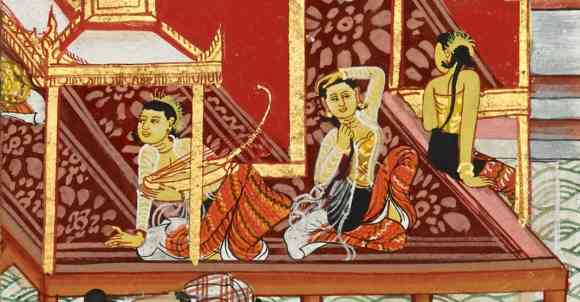
The Buddha was originally born as a prince into a lavish lifestyle, and is described as having been accompanied by forty thousand dancing women and an all-female orchestra. In this depiction of the court (Or 14197) one can see alongside the dancer a full female orchestra with a fiddle, a xylophone, a harp (back row, next to the fiddle), a flute and a drum. Two of the women are clapping their hands in rhythm.


Prince Siddhartha Gautama enjoying the entertainment of his private orchestra and a dancer. British Library, Or 14197, f. 1r


The orchestra played an important part in the Buddha’s disillusionment and decision to leave his princely life. One day, when he returned to his palace the orchestra started enthusiastically entertaining him. However, his mind was already detached from such pleasures and he fell asleep. Without its main audience, the orchestra also dozed off while still hugging their instruments. When the prince woke up and saw them lying around in a disorderly fashion, leg showing here, breast showing there, some sleeping with their mouths open, some grinding their teeth, he became even more disillusioned. He decided to bid goodbye to his sleeping wife and child and leave the palace for good in the Great Departure (Or 4762, Or 14197).


Siddhartha Gautama, standing next to a mislaid harp, peers over the orchestra, strewn about in a disorderly fashion. British Library, Or 4762, f. 1


Although the Buddha left his earthly orchestra behind, the Saung still followed him throughout his journey in heavenly form. In this rare illustrated Kammavācā manuscript (Or 13896), which is currently on display at the Treasures Gallery at the British Library, the deva Sakka plays the harp in order to lead the Buddha, who now has become a monk, to the Middle Path.


Sakka plays the Saung to the Buddha in order to lead him to the Middle Path. British Library, Or 13896, f. 16r 


The Saung was an integral part of the life in the heavenly realms, and is shown in cosmology manuscripts in all four heavenly realms of sensual pleasure - Paranimmita-vasavatti, Nimmānaratī, Tusita, and Yāma. In the depiction below, which describes the heavenly musicians of the Paranimmita-vasavatti realm the Saung is accompanied by a bell and a dancer (Or 14004).


The ruler of the Paranimmita-vasavatti realm accompanied by his heavenly musicians and a dancer. British Library, Or 14004, f. 15r 


The most impressive orchestra of all, however, could be found in the Tāvatiṃsa realm, or the realm of the thirty-three devas, located on top of the Sumeru world mountain. In the depiction below we can see two joined orchestras with a dancer in the middle. There are two harps and a bell in the left side orchestra, and a xylophone and a harp in the right side orchestra (Or 14004).


The ruler and the heavenly orchestras of the Tāvatiṃsa heaven. British Library, Or 14004, f. 21r 


Until the 19th century the Saung was played exclusively within the royal court, and was considered the most valued of instruments. The most notable harpists were given posts at court, where they composed many famous pieces. 


Myawaddy Mingyi U Sa (1766-1853) was one of these great musicians, and added six more harp strings to the existing seven, thus producing a fuller range (of two and a half octaves). A fourteenth string was added by the famous and last court harpist U Maung Maung Gyi (1855-1933), who was appointed to King Mindon’s court in Mandalay, where he was given the title "Deiwa-Einda" (Heavenly Musician) already at the age of thirteen. The Saung gradually came out of the palace during the 19th century via small outlying courts and travelling troupes of actors and musicians. Since then it has found its way to the general public and can now be enjoyed by all.


The Buddha meditating under the Bodhi tree, with the devas Sakka, Brahma and Mahākāla next to him singing songs of praise. British Library, Or 14297, f. 18r


The Saung returned at the pivotal moments of the Buddha’s life. The scene above depicts the beginning of the process of meditation that in the end led to Enlightenment. The Buddha is here shown meditating under the Bodhi tree, with the three devas Sakka, Brahma and Mahākāla from the three realms next to him singing songs of praise. Sakka blows the conch, while Mahākāla plays the harp and sings with over a hundred verses (Or 14297).


The Buddha’s Enlightenment, celebrated with harp music. British Library, Or 14297, f. 20r 


The devas ran away when Māra’s frightening troops arrived, and a difficult mental battle ensued which the Buddha eventually conquered. He had now attained Enlightenment, and the event was celebrated and rejoiced with much music. The Saung (with Mahākāla) is depicted here again right at his side (Or 14297).


The Buddha descends from Tāvatiṃsa heaven with a heavenly retinue beside him. British Library, Or 5757, f. 17r


After his Enlightenment the Buddha travelled around and taught the Dhamma to others. In the above illustration the Buddha is descending from the Tāvatiṃsa heaven, where he spent three months preaching the Dhamma to his mother, who was there. The Saung accompanies his descent to Earth (Or 5757). It has been said that the Saung was indeed the Buddha’s preferred instrument or even a symbol of him, and in temple murals he has been portrayed as a harpist in many of his previous incarnations.


References:

Muriel C. Williamson, The Burmese Harp: its classical music, tunings, and modes. Dekalb, Ill.: Southeast Asia Publications, 2000.

N.A. Jayawickrama (trans.), The Story of Gotama Buddha. Oxford: The Pali Text Society, 2002.

A documentary about the harp in Southeast Asia, by Patrick Kersalé, Sounds of 


(Source: Asian and African studies blog)

Sunday, 18 April 2021

How harpists were portrayed in the tales of the Buddha’s former lives

 The theme of these stories revolves around longing and heartache.

In my previous blog, I gave examples of how female harpists were depicted in Burmese manuscript illustrations. In this blog, I will discuss stories of male harpists that appear in Jātakas, or tales of the Buddha’s former lives, in the British Library’s Burmese manuscripts collection. The theme of these stories revolves around longing and heartache.


The Sussondi Jātaka recounts the story of Sagga, a harpist-minstrel. He is sent by the king of Benares (Varanasi) to find the queen who has disappeared. Unbeknownst to the king, the queen had in fact fallen in love with the Garuḍa king, who had taken her with him to Nāga Island.


The king sends Sagga, his harpist-minstrel, to search for Sussondi, his queen. | British Library


While looking for her, Sagga crosses the sea with a ship of merchants who implore him to play his harp. He responds: “I would make music, but if I do, the fish will be so excited that your vessel will be wrecked.”


The merchants disbelieve him and insist, and in the end, he plays and sings with great beauty. The fish start splashing about and a sea monster who lives in the area leaps up falls onto the ship and sinks it. Nevertheless, Sagga manages to reach the shore of the Nāga island clutching onto his (boat-shaped) harp.


Queen Sussondi, who was strolling on the shore in the absence of the Garuḍa king, finds him. She recognises Sagga and welcomes him with open arms. They become lovers and Sussondi hides him from the Garuḍa king whenever he returns.

Sagga is shipwrecked by jumping fish, but manages to swim to shore with his harp. Photo credit: British Library


The next time a group of merchants reach the shore, Sagga sails back with them to Benares (this time successfully), where he plays his harp and sings the song of Sussondi, replete with his own longing of her, to the king.


Sagga makes the return voyage by boat. Photo credit: British Library


The Burmese harp or Saung is a very old instrument that has a continuous history that spans over a thousand years. Many temple reliefs and wall frescoes from Bagan (ninth century-13th centuries) depict harps, although Judith Becker has suggested these harps may be different from the Sri Ksetra harp (see previous blog), which in turn resembles quite closely the modern Burmese harp.


Sagga returns to the palace and sings the story of Sussondi to the king. Photo credit: British Library


There probably were many different kinds of harps in use at the time. Although the terminology for the harp varies, the word Saung first appears at the Lokatheikpan temple in Bagan (c. 1125), where it describes “monks, who can play the harp”.


Indeed, the Saung seems to have an inextricable connection with Buddhism and, according to Becker, the disappearance of the harp accompanied the decline of Buddhism in certain parts of South Asia.


The earliest known songs thought to have been composed for harp music date to the early 14th century. Although song-texts were inscribed on palm leaf, there was no musical notation, and so the musical tradition was passed on orally with the music itself being impressed on memory when performed.


The oldest harp music that still survives is the “Three Barge Songs”, attributed to Wungyi Padei-tha-yaza (1683-1754), a minister at the Toungoo court. These songs purportedly describe a river voyage from Lake Meiktila to Tagaung.


A blindfolded Brahmin plays the harp to his wife, while her lover hits him from behind. Photo credit: Mss Burmese 202, f. 75v


The Aṇḍabhūta Jātaka (Mss Burmese 202) makes use of the harp for a lighthearted slapstick humour scene. It recounts the story of a Brahmin who has gone to great effort to find and keep a wife who has never seen any other men.


Here he plays the harp to her at home for her entertainment. Unbeknownst to him, however, she has taken a lover and tricks him into being blindfolded through the pretence of her being too shy of him watching her dance. While he is blindfolded in this way, the lover, who is currently staying in the house, hits him on the head and hides.


The Dīghītikosala Jātaka (Or 13538) tells the heart-wrenching story of a prince (the Bodhisatta), whose parents are cruelly slain by a deceitful rival. He is devastated, but instead of seeking revenge he goes to stay with the keeper of the red elephant of the palace and leads a simple life.


Slowly he recovers from his heartache and when the monsoon rains fall he sings and plays beautiful songs of acceptance and reconciliation with his harp.


In the next instalment of this series of blogs on the Burmese harp, I will talk about the Saung’s relationship with Gautama Buddha.


References:

Muriel C. Williamson, The Burmese Harp: Its Classical Music, Tunings, and Modes. Dekalb, Ill.: Southeast Asia Publications, 2000.

Judith Becker, “The Migration of the Arched Harp from India to Burma”, The Galpin Society Journal, Vol. 20 (Mar., 1967), pp. 17-23.

E.B. Cowell (ed.), The Jātaka or stories of the Buddha’s former births, Vols. I-VI. Oxford: The Pali Text Society, 2004-2005.


(Source: Asian and African Studies blog)

Sunday, 11 April 2021

The Burmese harp and the tales of the Buddha’s previous lives

 The earliest description of the music instrument in Buddhist literature, ‘Jātaka’ stories, can be traced back to the 8th century.

The British Library’s collection of digitised Burmese manuscripts, dating mainly from the 19th century, has many depictions of the Burmese harp or Saung. The Saung appears often in certain Jātaka stories, or tales of the previous lives of the Buddha, which have seduction and pleasure as one of the prevailing themes.


The Mandhātu Jātaka tells the story of Mandhātā, a powerful king who had everything he could ever desire. Although he ended up ruling even the heavenly realms, he still remained dissatisfied. Shown below is a detail from an illustrated manuscript of the Mandhātu Jātaka. It gives us a peek into Mandhātā’s court, which included beautiful musicians. The Saung player is turning curiously to see who is entering the palace.


The Boddhisatta and his four brothers at the enchanted pavilion of music. Telapatta Jātaka, 19th century | British Library, Or 4542/A f. 53r


The Saung is a unique musical instrument with a continuous history that stretches over a thousand years. It is known for its soothing, melodious sound and can be recognised by its horizontal boat-shaped body and its long, inwardly arched neck. 


The ends of the strings, which used to be made from silk, are decorated with red cotton tassels. The harp is held on the lap and the strings are plucked with one hand, while the other is used for damping and staccato notes. The Saung usually accompanies a singer, who also controls the tempo with a bell (Si) and a clapper (Wa).


Women of the court, including a musician holding the Burmese harp or Saung, Mandhātu Jātaka, 19th century. Photo credit: British Library, Or 4542/B, f.57r


The earliest description of the Saung comes from a temple relief at Bawbawkyi in Sri Ksetra from the 8th century. It depicts a dancer with an accompanying harpist and a rhythm keeper. Tang chronicles from the 9th century also describe a delegation from the kingdom with thirty-five musicians and dancers that enchanted the court with their elaborate music performance.


The orchestra included two harps and it performed twelve songs on Buddhist texts. These harps were tuned with pegs rather than strings, and interestingly peg-tuned harps are still used in Mon and Karen traditions. A later 10th-century Tang chronicle confirms that the music from these two geographic areas (from the present-day lower Myanmar) was the same.


Another of the Jātaka stories, the Telapatta Jātaka recounts the story of the Bodhisatta as a prince who had to travel through a dangerous, enchanted forest inhabited by ogresses. His five brothers accompany him but are eaten one by one by the ogresses who seduce them with different sensory pleasures.


Temiya’s last temptation. 'Temiya Jātaka', 19th century. Photo credit: British Library, Or 3676, f. 7r


In this manuscript illustration, the Boddhisatta (on the right in gold) has arrived to the ogresses’ magical pavilion of music. By this time he has already lost one brother in the pavilion of beauty. One of his remaining brothers, the lover of music, is raising the curtain in order to be fully immersed by the entertainment and is just about to become the next victim. The harpist is here accompanied by a flute and a singer.


The famous Temiya Jātaka is one of the ten last lives of the Buddha. He was a much wished-for son of the king of Benares. However, as soon as he discovered that his future kingly duties would involve inflicting punishment, he stopped speaking and sat motionless, as he did not want to inherit the throne.


The Bodhisatta hears beautiful music through his window and slowly falls in love with the harpist. ‘Culla Palobhana Jātaka’a, 19th century. Photo credit: British Library, Or 4542/B, f. 89r


The king tried to budge him in many different ways, from tempting him with cakes to scaring him with snakes and loose elephants, but with no success. When Temiya turned sixteen he was put to the final test with beautiful women, song and dance. Although this illustration actually shows him quite tempted, he did in fact hold firm and ended up not having to inherit the kingdom.


A somewhat similar story is recounted in the Culla Palobhana Jātaka. In this story as well, the Bodhisatta was born as a much-wanted prince, but from his earliest days as a baby he did not like to be nursed by women and was only attended by male members of the court. The king grew worried about his son’s lack of desire for pleasure, for surely this would also include ruling the kingdom.


The Boddhisatta and his lover are banished from the kingdom after a fit of jealousy. ‘Culla Palobhana Jātaka’, 19th century. Photo credit: British Library, Or 4542/B, f. 89r


A young dancing girl, accomplished in music and song, was therefore asked to seduce him. In return, she would become his queen. When morning came she played and sang outside the place where the prince was meditating. Little by little he fell in love with her and they became closer.


Unfortunately, the Bodhisatta became so enamoured with her that he ran amok the town in a fit of jealousy. As punishment for this bad behaviour both of them were banished from the kingdom and went on to live together in the forest.


In forthcoming blog posts I will give examples of how male harpists were depicted in manuscript illustrations, and how the Saung was inextricably entwined with the life of the Gautama Buddha.


References:

Muriel C. Williamson, The Burmese Harp: Its Classical Music, Tunings, and Modes. Dekalb, Ill.: Southeast Asia Publications, 2000.

Judith Becker, “The Migration of the Arched Harp from India to Burma”, The Galpin Society Journal, Vol. 20 (Mar., 1967), pp. 17-23.

E.B. Cowell (ed.), The Jātaka or stories of the Buddha’s former births, Vols. I-VI. Oxford: The Pali Text Society, 2004-2005.


(Source: Asian and African Studies blog)

Saturday, 18 May 2019

Robes of Buddhist monks

My latest on the robes of the Buddhist monks on the occasion of Buddha Purnima in today's Kannada Prabha newspaper. Here's the link:


Tuesday, 15 January 2019

The Buddha’s aunt led the first women’s rights march in recorded history

On Jan. 19, women in US cities and around the globe will gather for the third annual Women’s March. In so doing, whether they know it or not, they’ll be following in the footsteps of Mahapajapati Gotami—a feminist from ancient India born in 600 BC, and the aunt and foster mother of Siddhārtha Gotama, best known as the Buddha.

Gotami was the queen of a region in northern India now known as Nepal. But by age 40, she had given birth to no heir, so her husband married her younger sister as well.

Soon, both women got pregnant, but the younger one gave birth first. When the Buddha’s mother died shortly after his birth, his aunt was tasked with caring for the newborn prince. She gave her own son to a servant to nurse and provided her milk to young Siddhartha.

Famously, when the prince grew up, he rejected his riches and set off to discover the meaning of life, eventually alighting upon a path he called “the middle way” and forging a new spiritual philosophy known as Buddhism. The Buddha’s school of thought had lots of followers, including his aunt and his father, the king, who both marveled at his spiritual transformation.

Women were already studying Buddhism in its early days—but there was no monastic order for them to join. And while women could participate, they could not lead this burgeoning movement.

Mahapajapati Gotami entreats the Buddha
After the king died, Gotami, then in her 70s, asked her nephew to form an order of nuns so that women, too, could be ordained, devote themselves to Buddhism, and develop to their fullest capacity spiritually. The Buddha refused. She asked again, and he said no. Gotami tried a third time and still her nephew, the man she had raised as her own son, disagreed despite her entreaties. He gave no reason for his refusal.

Gotami was crushed. But she discovered that she was not alone. According to Buddhist lore, 500 women who were either widows or simply sought to devote themselves to a spiritual path gathered by her side to support her cause.

Bolstered, the Buddha’s aunt shaved her hair and donned yellow robes, just like a monk. Her 500 supporters joined her in this move. Then, the group walked more than 100 miles (or more than 350 miles, depending which account you read) to the Jetavana monastery where the Buddha taught. All along the way, the women drew crowds as people gathered to marvel at this group, heads shorn, dressed identically, joined for a cause. “This was the first women’s rights march in recorded history,” writes Pema Khandro Rinpoche in the Buddhist publication Lion’s Roar.

The women arrived at the monastery dusty, tired, and with swollen feet, but still determined. They were greeted at the entrance by the monk Ananda, one of the Buddha’s principal disciples and his cousin. He was shocked to see his aunt in tears and her followers in this state of disarray, and asked what they were doing there, certain some calamity had befallen them. Had there been a revolution?

Gotami explained that they came to ask for the creation of an order of nuns. She was lingering at the monastery’s entrance because she simply couldn’t take no for an answer this time and was trying to figure out the right approach with her nephew.

Sympathetic to their cause, Ananda offered to speak to the Budhha on their behalf. But he, too, got the same answer: No. Ananda asked again and again and was repeatedly refused, just as Gotami had been. Finally, he asked the Buddha whether a woman could ever be enlightened and attain the bliss of sainthood. She could, the Buddha said. Ananda queried, “Well then, why can’t a woman be a nun?”

With this question, he changed the Buddha’s mind. An order of nuns was created.

It should be noted that there were eight conditions laid out for the creation of the female monastic order. Nuns, no matter how senior, must defer to monks, even new ones. They could never chide or advise a monk, and yet had to seek the counsel of the male order and abide by the rules of both the male and female orders. Nuns also had to study two years before being ordained, compared to a year for monks, and had to live within six hours travel of a male order.

Nonetheless, Gotami achieved her goal. She became the first ordained Buddhist nun and led her 500 followers and other women as a spiritual guide. Her efforts are proof positive that activism matters and that taking no for an answer—even when you get the same answer over and over—isn’t the only option.

Since then, countless women over the centuries have followed her example, in their own lives and as participants in movements for equality. And they will do it again this month, in numerous cities, from Portland, Oregon to Ranomafana in Madagascar. The gathering that began as a resistance to US president Donald Trump taking office in 2017 continues to inspire women to participate in politics, by voting and running for public office, and to stand up to be seen and heard. The organizers of the US movement predict, “The #WomensWave is coming, and we’re sweeping the world forward with us.”

They’ll be following the impressive precedent first set by Mahapajapati Gotami more than 2,500 years ago.

(Source: Quartz)

Friday, 29 June 2018

Buddha tattoos and e-cigs: Things that get you arrested abroad

Smoking e-cigarettes, showing a Buddha tattoo or wearing camouflage clothing - these are all things which could land you in trouble abroad.

The government's Foreign and Commonwealth Office is warning people about strict laws and customs when on holiday.

It says trips to Sri Lanka and the UAE are on the rise, with more of us being inspired by celebrities.

People are being urged to read up on advice before leaving the UK.


It may not come as a surprise that indecent behaviour won't be tolerated in Greece, or that causing a forest fire could get you into trouble in Spain, but there are other laws and customs which many Brits are unaware of when travelling abroad.

The Government says that hardly any of us are reading up on advice before holidaying in places with different customs to the UK.

It also says that we're increasingly travelling further afield than Europe, because we're being inspired by celebrities.

Scroll down for the top tips on what to avoid and where.

The Kardashian sisters recently visited Japan and shared the photos with their millions of Instagram followers.

But Japan has strict rules about what medicines you can take into the country.

The Foreign Office says A-listers often have concierge support when travelling abroad, but other tourists are travelling without the right information.

British tourist Naomi Coleman was arrested in Sri Lanka for having a Buddha tattoo
Visits to Sri Lanka are up more than a fifth and trips to the UAE are up more than a sixth.

Dubai has become a popular spot for many celebrities, including the stars of The Only Way is Essex.

Here are some of the top tips:

Swearing in the UAE
A bad idea, along with rude gestures - even online. You could be jailed or deported.

E-cigarettes in Thailand
You can't bring vaporisers into the country. They're likely to be confiscated but you could also be fined or sent to prison for up to 10 years if convicted.

Buddha and Sri Lanka
In Sri Lanka the mistreatment of Buddhist images is a serious offence. People are also advised not to pose for pictures in front of a statue of Buddha.

British tourist Naomi Coleman was arrested there in 2014 for having a tattoo of Buddha. After appearing before a magistrate she was deported and described it as a "hellish" experience.

Inhalers and Japan
You have to be careful taking some medicines into Japan. Vicks inhalers and painkillers containing Codeine are banned. You could end up being detained or deported.

Camouflage in the Caribbean
Countries like Barbados and St. Lucia ban the wearing of camouflage clothing, even for children.

Wherever you're going, the advice is to check before you travel.

(Source: BBC)

Wednesday, 13 June 2018

How Buddha was turned Anti-Hindu

Despite being every inch a Hindu himself, the Buddha has been falsely portrayed as a rebel going against conventional Hindu beliefs and practices, writes Koenraad Elst, a researcher, in Pragyata. Read on: 

Introduction
Orientalists have started treating Buddhism as a separate religion because they discovered it outside India, without any conspicuous link with India, where Buddhism was not in evidence. At first, they didn’t even know that the Buddha had been an Indian. It had at any rate gone through centuries of development unrelated to anything happening in India at the same time. Therefore, it is understandable that Buddhism was already the object of a separate discipline even before any connection with Hinduism could be made.

Buddhism in modern India
In India, all kinds of invention, somewhat logically connected to this status of separate religion, were then added. Especially the Ambedkarite movement, springing from the conversion of Dr. Bhimrao Ambedkar in 1956, was very driven in retro-actively producing an anti-Hindu programme for the Buddha. Conversion itself, not just the embracing of a new tradition (which any Hindu is free to do, all while staying a Hindu) but the renouncing of one’s previous religion, as the Hindu-born politician Ambedkar did, is a typically Christian concept.

The model event was the conversion of the Frankish king Clovis, possibly in 496, who “burned what he had worshipped and worshipped what he had burnt”. (Let it pass for now that the Christian chroniclers slandered their victims by positing a false symmetry: the Heathens hadn’t been in the business of destroying Christian symbols.)

So, in his understanding of the history of Bauddha Dharma (Buddhism), Ambedkar was less than reliable, in spite of his sterling contributions regarding the history of Islam and some parts of the history of caste. But where he was a bit right and a bit mistaken, his later followers have gone all the way and made nothing but a gross caricature of history, and especially about the place of Buddhism in Hindu history.

The Ambedkarite worldview has ultimately only radicalized the moderately anti-Hindu version of the reigning Nehruvians. Under Jawaharlal Nehru, India’s first Prime Minister, Buddhism was turned into the unofficial state religion of India, adopting the “lion pillar” of the Buddhist Emperor Ashoka as state symbol and putting the 24-spoked Cakravarti wheel in the national flag. Essentially, Nehru’s knowledge of Indian history was limited to two spiritual figures, viz. the Buddha and Mahatma Gandhi, and three political leaders: Ashoka, Akbar and himself.

The concept of Cakravarti (“wheel-turner”, universal ruler) was in fact much older than Ashoka, and the 24-spoked wheel can also be read in other senses, e.g. the Sankhya philosophy’s worldview, with the central Purusha/Subject and the 24 elements of Prakrti/Nature. The anglicized Nehru, “India’s last Viceroy”, prided himself on his illiteracy in Hindu culture, so he didn’t know any of this, but was satisfied that these symbols could glorify Ashoka and belittle Hinduism, deemed a separate religion from which Ashoka had broken away by accepting Buddhism.

More broadly, he thought that everything of value in India was a gift of Buddhism (and Islam) to the undeserving Hindus. Thus, the fabled Hindu tolerance was according to him a value borrowed from Buddhism. In reality, the Buddha had been a beneficiary of an already established Hindu tradition of pluralism.

In a Muslim country, he would never have preached his doctrine in peace and comfort for 45 years, but in Hindu society, this was a matter of course. There were some attempts on his life, but they emanated not from “Hindus” but from jealous disciples within his own monastic order.

So, both Nehru and Ambedkar, as well as their followers , believed by implication that at some point in his life, the Hindu-born renunciate Buddha had broken away from Hinduism and adopted a new religion, Buddhism. This notion is now omnipresent, and through school textbooks, most Indians have lapped this up and don’t know any better. However, numerous though they are, none of the believers in this story have ever told us at what moment in his life the Buddha broke way from Hinduism. When did he revolt against it? Very many Indians repeat the Nehruvian account, but so far, never has any of them been able to pinpoint an event in the Buddha’s life which constituted a break with Hinduism.

The term “Hinduism”
Their first line of defence, when put on the spot, is sure to be: “Actually, Hinduism did not yet exist at the time.” So, their position really is: Hinduism did not exist yet, but somehow the Buddha broke away from it. Yeah, the secular position is that he was a miracle-worker.

Let us correct that: the word “Hinduism” did not exist yet. When Darius of the Achaemenid Persians, a near-contemporary of the Buddha, used the word “Hindu”, it was purely in a geographical sense: anyone from inside or beyond the Indus region. When the medieval Muslim invaders brought the term into India, they used it to mean: any Indian except for the Indian Muslims, Christians or Jews. It did not have a specific doctrinal content except “non-Abrahamic”, a negative definition.

It meant every Indian Pagan, including the Brahmins, Buddhists (“clean-shaven Brahmins”), Jains, other ascetics, low-castes, intermediate castes, tribals, and by implication also the as yet unborn Lingayats, Sikhs, Hare Krishnas, Arya Samajis, Ramakrishnaites, secularists and others who nowadays reject the label “Hindu”. This definition was essentially also adopted by VD Savarkar in his book Hindutva (1923) and by the Hindu Marriage Act (1955). By this historical definition, which also has the advantages of primacy and of not being thought up by the wily Brahmins, the Buddha and all his Indian followers are unquestionably Hindus. In that sense, Savarkar was right when he called Ambedkar’s taking refuge in Buddhism “a sure jump into the Hindu fold”.

But the word “Hindu” is a favourite object of manipulation. Thus, secularists say that all kinds of groups (Dravidians, low-castes, Sikhs etc.) are “not Hindu”, yet when Hindus complain of the self-righteousness and aggression of the minorities, secularists laugh at this concern: “How can the Hindus feel threatened? They are more than 80%!” The missionaries call the tribals “not Hindus”, but when the tribals riot against the Christians who have murdered their Swami, we read about “Hindu rioters”. In the Buddha’s case, “Hindu” is often narrowed down to “Vedic” when convenient, then restored to its wider meaning when expedient.

One meaning which the word “Hindu” definitely does not have, and did not have when it was introduced, is “Vedic”. Shankara holds it against Patanjali and the Sankhya school (just like the Buddha) that they don’t bother to cite the Vedas, yet they have a place in every history of Hindu thought. Hinduism includes a lot of elements which have only a thin Vedic veneer, and numerous ones which are not Vedic at all. Scholars say that it consists of a “Great Tradition” and many “Little Traditions”, local cults allowed to subsist under the aegis of the prestigious Vedic line. However, if we want to classify the Buddha in these terms, he should rather be included in the Great Tradition.


Siddhartha Gautama the Buddha was a Kshatriya, a scion of the Solar or Aikshvaku dynasty, a descendant of Manu, a self-described reincarnation of Rama, the son of the Raja (president-for-life) of the Shakya tribe, a member of its Senate, and belonging to the Gautama gotra (roughly “clan”). Though monks are often known by their monastic name, Buddhists prefer to name the Buddha after his descent group, viz. the Shakyamuni, “renunciate of the Shakya tribe”. This tribe was as Hindu as could be, consisting according to its own belief of the progeny of the eldest children of patriarch Manu, who were repudiated at the insistence of his later, younger wife.

The Buddha is not known to have rejected this name, not even at the end of his life when the Shakyas had earned the wrath of king Vidudabha of Kosala and were massacred. The doctrine that he was one in a line of incarnations which also included Rama is not a deceitful Brahmin Puranic invention but was launched by the Buddha himself, who claimed Rama as an earlier incarnation of his. The numerous scholars who like to explain every Hindu idea or custom as “borrowed from Buddhism” could well counter Ambedkar’s rejection of this “Hindu” doctrine by pointing out very aptly that it was “borrowed from Buddhism”.

Career
At 29, he renounced society, but not Hinduism. Indeed, it is a typical thing among Hindus to exit from society, laying off your caste marks including your civil name. The Rg-Veda already describes the Muni-s as having matted hair and going about sky-clad: such are what we now know as Naga Sadhus. Asceticism was a recognized practice in Vedic society long before the Buddha. Yajnavalkya, the Upanishadic originator of the notion of Self, renounced life in society after a successful career as court priest and an equally happy family life with two wives. By leaving his family and renouncing his future in politics, the Buddha followed an existing tradition within Hindu society.

He didn’t practice Vedic rituals anymore, which is normal for a Vedic renunciate (though Zen Buddhists still recite the Heart Sutra in the Vedic fashion, ending with “sowaka”, i.e. svaha). He was a late follower of a movement very much in evidence in the Upanishads, viz. of spurning rituals (Karmakanda) in favour of knowledge (Jnanakanda). After he had done the Hindu thing by going to the forest, he tried several methods, including the techniques he learned from two masters and which did not fully satisfy him,– but nonetheless enough to include them in his own and the Buddhist curriculum.

Among other techniques, he practised Anapanasati, “attention to the breathing process”, the archetypal yoga practice popular in practically all yoga schools till today. For a while he also practised an extreme form of asceticism, still existing in the Hindu sect of Jainism. He exercised his Hindu freedom to join a sect devoted to certain techniques, and later the freedom to leave it, remaining a Hindu at every stage.

He then added a technique of his own, or at least that is what the Buddhist sources tell us, for in the paucity of reliable information, we don’t know for sure that he hadn’t learned the Vipassana (“mindfulness”) technique elsewhere. Unless evidence of the contrary comes to the surface, we assume that he invented this technique all by himself, as a Hindu is free to do. He then achieved Bodhi, the “Awakening”. By his own admission, he was by no means the first to do so. Instead, he had only walked the same path of other Awakened beings before him.

 At the bidding of the Vedic gods Brahma and Indra, he left his self-contained state of Awakening and started teaching his way to others. When he “set in motion the wheel of the Law” (Dharma-cakra-pravartana, Chinese Falungong), he gave no indication whatsoever of breaking with an existing system. On the contrary, by his use of existing Vedic and Upanishadic terminology (Arya, “Vedically civilized”; Dharma), he confirmed his Vedic roots and implied that his system was a restoration of the Vedic ideal which had become degenerate. He taught his techniques and his analysis of the human condition to his disciples, promising them to achieve the same Awakening if they practiced these diligently.

Caste
On caste, we find him is full cooperation with existing caste society. Being an elitist, he mainly recruited among the upper castes, with over 40% Brahmins. These would later furnish all the great philosophers who made Buddhism synonymous with conceptual sophistication. Conversely, the Buddhist universities trained well-known non-Buddhist scientists such as the astronomer Aryabhata.

Lest the impression be created that universities are a gift of Buddhism to India, it may be pointed out that the Buddha’s friends Bandhula and Prasenadi (and, according to a speculation, maybe the young Siddhartha himself) had studied at the university of Takshashila, clearly established before there were any Buddhists around to do so. Instead, the Buddhists greatly developed an institution which they had inherited from Hindu society.

The kings and magnates of the eastern Ganga plain treated the Buddha as one of their own (because that is what he was) and gladly patronized his fast-growing monastic order, commanding their servants and subjects to build a network of monasteries for it. He predicted the coming of a future Awakened leader like himself, the Maitreya (“the one practising friendship/charity”), and specified that he would be born in a Brahmin family. When king Prasenadi discovered that his wife was not a Shakya princess but the daughter of the Shakya ruler by a maid-servant, he repudiated her and their son; but his friend the Buddha made him take them back.

Did he achieve this by saying that birth is unimportant, that “caste is bad” or that “caste doesn’t matter”, as the Ambedkarites claim? No, he reminded the king of the old view (then apparently in the process of being replaced with a stricter view) that caste was passed on exclusively in the paternal line. Among hybrids of horses and donkeys, the progeny of a horse stallion and a donkey mare whinnies, like its father, while the progeny of a donkey stallion and a horse mare brays, also like its father. So, in the oldest Upanishad, Satyakama Jabala is accepted by his Brahmins-only teacher because his father is deduced to be a Brahmin, regardless of his mother being a maid-servant. And similarly, king Prasenadi should accept his son as a Kshatriya, even though his mother was not a full-blooded Shakya Kshatriya.

When he died, the elites of eight cities made a successful bid for his ashes on the plea: “We are Kshatriyas, he was a Kshatriya, therefore we have a right to his ashes”. After almost half a century, his disciples didn’t mind being seen in public as still observing caste in a context which was par excellence Buddhist. The reason is that the Buddha in his many teachings never had told them to give up caste, e.g. to give their daughters in marriage to men of other castes. This was perfectly logical: as a man with a spiritual message, the Buddha wanted to lose as little time as possible on social matters. If satisfying your own miserable desires is difficult enough, satisfying the desire for an egalitarian society provides an endless distraction from your spiritual practice.

The Seven Rules
There never was a separate non-Hindu Buddhist society. Most Hindus worship various gods and teachers, adding and sometimes removing one or more pictures or statues to their house altar. This way, there were some lay worshippers of the Buddha, but they were not a society separate from the worshippers of other gods or Awakened masters. This box-type division of society in different sects is another Christian prejudice infused into modern Hindu society by Nehruvian secularism. There were only Hindus, members of Hindu castes, some of whom had a veneration for the Buddha among others.

Buddhist buildings in India often follow the designs of Vedic habitat ecology or Vastu Shastra. Buddhist temple conventions follow an established Hindu pattern. Buddhist mantras, also outside India, follow the pattern of Vedic mantras. When Buddhism spread to China and Japan, Buddhist monks took the Vedic gods (e.g. the twelve Aditya’s) with them and built temples for them. In Japan, every town has a temple for the river-goddess Benzaiten, i.e. “Saraswati Devi”, the goddess Saraswati. She was not introduced there by wily Brahmins, but by Buddhists.

At the fag end of his long life, the Buddha described the seven principles by which a society does not perish (which Sita Ram Goel has given more body in his historical novel Sapta Shila, in Hindi), and among them are included: respecting and maintaining the existing festivals, pilgrimages and rituals; and revering the holy men. These festivals etc. were mainly “Vedic”, of course, like the pilgrimage to the Saraswati which Balaram made in the Mahabharata, or the pilgrimage to the Ganga which the elderly Pandava brothers made. Far from being a revolutionary, the Buddha emphatically outed himself as a conservative, both in social and in religious matters. He was not a rebel or a revolutionary, but wanted the existing customs to continue. The Buddha was every inch a Hindu.

Friday, 4 May 2018

In Japan, Aibo robots get their own funeral

The robot dogs lined up in their dozens last Thursday in Chiba Prefecture were no tech fair display. They were the dearly departed being honored with their own traditional “funeral.”

In some respects, it was a funeral like any other in Japan, with incense smoke wafting as a priest chanted a sutra, praying for the peaceful transition of the souls of the departed.

But the departed were 114 of Sony’s old generations of Aibo robot dogs, each wearing a tag to show where they came from and to which family they belonged.

Electronics repair company A-Fun Co., which specializes in fixing vintage products, has sent off around 800 Aibos this way in recent years at a centuries-old Buddhist temple.

Kofukuji Temple holds a ceremony for Aibo dogs. | AFP-JIJI
With the Aibo no longer in production, owners of old or “dead” robodogs often send them to the company, the only way it can obtain genuine parts to use in repairs.

The defunct dogs serve as the equivalent of organ donors for defective robots, but before they are put to use, the company honors them with a traditional send-off.

The dogs often arrive with letters that give their names, how they spent their lives and other details.

“I feel relieved to know there will be a prayer for my Aibo,” one owner said in a letter.

Another wrote: “Please help other Aibos. Tears rose in my eyes when I decided to say goodbye.”

Bungen Oi, the priest at 450-year-old Kofukuji Temple in Isumi, dismisses the idea that holding memorials for machines is absurd.

“All things have a bit of soul,” he said after the service.

Bungen Oi | AFP-JIJI
Nobuyuki Norimatsu, who heads A-Fun, also says he feels the robodogs have souls, even if they are destined to be “donors.”

“We’d like to return the souls to the owners and make the robot a machine to utilize their parts,” he said. “We don’t take parts before we hold a funeral for them.”

The Aibo was the world’s first home-use entertainment robot capable of developing its own “personality.”

Sony rolled out the first-generation Aibo in June 1999, with the initial batch of 3,000 selling out in just 20 minutes despite the hefty ¥250,000 price tag.

Over the following years, more than 150,000 were sold, in numerous iterations ranging from gleaming metallic-silver versions to round-faced cub-like models.

By 2006, however, Sony’s business was in trouble and the Aibo, an expensive and somewhat frivolous luxury, had to go.

The company kept its “Aibo Clinic” open until March 2014 but then told dedicated and loving owners that they were on their own.

Desperate owners have turned to A-Fun, which draws on the knowledge of former Sony engineers, to get repairs.

Broken-down Aibos, Sony Corp.'s famed first-generation pet robot, are arranged on an altar prior to their 'funeral' at Kofukuji Temple in Isumi, Chiba Prefecture, last Thursday. | AFP-JIJI
In January, Sony unveiled a new version of Aibo, packed with artificial intelligence and internet connectivity, but it has not resumed repairs of old models.

The media fanfare did however prompt many owners of older models to look for ways to repair their faithful friends, or to donate those beyond salvage.

A repaired Aibo is the product of generous owners, whose own dogs have become lifesaving donors, Narimatsu said.

“I feel it moves on the combined hearts of owners,” he said.

(Source: JT)

Sunday, 29 April 2018

The previous 10 births of Gautama Buddha

My latest for Buddha Poornima on the last ten previous births of Gautama Buddha, published in today’s Kannada Prabha. Here's the link:


Sunday, 28 January 2018

Instagrammers are sucking the life and soul out of travel

My view of Sri Lanka was spoiled by the peachy backsides of tourists obsessed with their social media feeds, writes Rhiannon Lucy Cosslett in the Guardian. Read on: 

A recent trip to Sri Lanka reminded me of that well known Buddhist proverb: “If you visit a temple but do not take a selfie, did it actually happen?” At these sacred sites, tourists are free to take photographs – as indeed I saw a delegation of enthusiastic monks doing at the Temple of the Sacred Tooth Relic in Kandy – but you are asked to please not pose with statues of the Buddha, or be photographed with your back to him. Naturally, I observed several western tourists, most of them young, ignoring this request.

The Instagrammability of a destination is apparently now the number one motivation for booking a holiday for millennials. The eternal quest for social approval, which the platform was accused of taking advantage of this week by “withholding” likes from certain users to encourage them to log in more frequently – a charge Instagram denies – continues apace. I joined Instagram relatively recently, mainly to look at travel photos of places and people around the world, a cheering endeavour in these cold, dark Brexity times, but was disappointed how many of the photos seemed to follow a particular format. A thin, blonde, white girl stands in a floaty dress, her back to the viewer, in a seemingly preordained beautiful location. Off camera a queue of other “influencers” wait patiently to get the perfect shot.


Many of them are paid in brand endorsements and partnerships with luxury travel companies. Then you have the “arses on tour” – bums with a backdrop, basically (and if there is a sunset peeking through your thigh gap, even better).At some hotels, you can now even pay extra for your very own “Instagram butler”, who will show you all the most picturesque spots and help you and your bum conduct your own photoshoot.

These Instagrammers are collectively sucking the joy and spontaneity out of travel photography, and for those unfortunate enough to bump into them abroad, possibly travel itself. We must pity the poor locals, who have to put up with them.

Consider the train I took last week from the mountain village of Ella to Sri Lanka’s cultural capital of Kandy. Widely regarded to be one of the most beautiful train journeys in the world, it traverses verdant mountain passes, waterfalls, and tea plantations. But many of the passengers under 35 were interested only in obtaining the same photograph – lifted right from Instagram – of themselves hanging barefoot out of the open doors of the train, with significant risk to life and limb. Meanwhile, in contrast, an older couple sitting in our carriage wondered aloud what on earth the young people were playing at and spent the journey watching the scenery go by through the window.

Tourists have always taken photographs. Like graffiti, it’s a very human way of saying “I was here”. But in the pre-digital age, because of the expense of film as well as high shooting ratios, you were lucky if you ended up with one usable picture. Now “influencers” can take as many photographs as they need, photoshopping and filtering until they are able to post the perfect advertisement (for that indeed is what these images are). The centering of the self to such an extent is new too, and at the expense of knowledge, exploration and adventure.

‘The easily influenced will flock to Tegalalang in Bali.’ Photograph: Suzanne Plunkett/AP
When most travel photographs on Instagram begin to look like fashion editorials you have to wonder whether anyone is learning anything. And when people are taking idiotic risks such as hanging out of fast moving trains or proffering food to tempt wild animals into shot, all for the sake of a photo that isn’t even an original composition, you might start to think that we’re approaching the end times.

It all goes to show how ineffective the internet can be as a lens for human experience, especially within a capitalist system. You might think social media would diversify the range of images we see, yet the most popular users operate according to a strict schema that takes full advantage of the relevant algorithms (creative, fascinating accounts are still there, but said algorithms make them harder to find). And it’s not just travel – it’s interiors, fashion, weddings, food, children. Social media encourages the memeification of human experience. Instead of diversity we see homogeneity. It’s extremely boring.

There is, of course, an irony to being a tourist who is complaining about other tourists. And we all fall victim to the odd corny snap every now and again. Live and let live, you might say. We all just want to see the world. Some of us just want to see it without someone’s peachy backside blocking the view. On the plus side, while the easily influenced will see these pictures and flock to the lupin fields of New Zealand or Tegalalang in Bali, or to selfie-stick the sunset in Santorini, those of us too grumpy, paunchy and tired to travel fashionably might be left in peace.