Showing posts with label buddhism. Show all posts

Thursday, 10 February 2022

Geography of god

With this, one gets the feeling that Hindu gods privilege the Gangetic plain, writes Devdutt Pattanaik. Read on: 

In north India, as per politicians, three major pilgrimage sites are important. The first is Ayodhya, where Ram was born and the kingdom of Ram was established. The second is Mathura where Krishna was born. The third is Kashi, with which Shiva is associated. Ram, Krishna and Shiva form the foundations of modern Hindu practices. With this, one gets the feeling that Hindu gods privilege the Gangetic plain.  


The early Hindu scriptures were restricted to North India. There is reference to Punjab and Haryana in the Rigveda. The Upanishads refer to the wider Gangetic plain. The Mahabharata refers to Bengal and Odisha. Ramayana  speaks of a more southern movement. By the Puranic period, we get more familiar with river systems, like the Narmada and Godavari, indicating a southward movement. Tamil scriptures, of course, talk of Kaveri. The Himalayan region gets increasingly connected with Shiva and many forms of Shakti whose shrines are found atop mountains and in caves.


Illustration/Devdutt Pattanaik


When the Parshuram mythology emerges, the western coast of India becomes more and more prominent. Very few people know about the connection of Anga, Vanga and Kalinga (modern-day Bihar, Odisha and Bengal) with the sage Dhirgatamas of the Mahabharata. The Godavari region is connected to the rishi, Gautama and his wife, Ahalya. Most southern rivers are considered to be extensions of the Ganga itself, brought from the north to the south by rishis. In the same way the southern mountains are considered Dakshina Kailasa, brought from the north to the south by rishis, like Agastya.


In a recent lecture, a guruji kept insisting that they have been able to date the Ramayana and Mahabharata, using astronomical data found in the scriptures. He was asked by a student whether this happened before the exodus of Moses or after? This irritated the guru. He retorted that he was not concerned about what happened in other countries. The student then countered this reasoning by saying that he thought god belonged to all countries, not just to India. The guruji had no answer to it, especially since he prided himself on getting white men from Europe and America to take part in Hindu rituals. 


This indicates how god is provincialised in religions. Even religions that claim to be universal such as Christianity and Islam are anchored in a holy land located in the Middle East, which seems odd to people, say, in the Artic circles who wonder why prophets are always in the land of sand, not snow.


As Buddhism spread to China, a new idea emerged. That there are many Buddhas with many Buddha heavens located in infinite worlds. This allowed Buddha to be located anywhere, not just India. So Buddhas were seen manifesting in Tibet, Japan, China and even Korea. Mormons did the same thing for America, by stating that hundreds of years ago prophets escaped from Babylon and took God’s word to America and this was rediscovered in the 19th century by Joseph Smith. While some religions stay anchored to geography, some choose to break the fetter, and others invent new stories to link geography to God.


Devdutt Pattanaik writes and lectures on the relevance of mythology in modern times.


(Source: Mid Day)

Sunday, 25 April 2021

Harp's relationship with Gautama Buddha

 In my two previous blogs on the Burmese harp, I gave examples of how the Burmese harp or Saung was incorporated into Jātaka stories (stories of the previous lives of the Buddha). In this final instalment I will discuss how the Saung was intimately connected with the life of the Gautama Buddha.

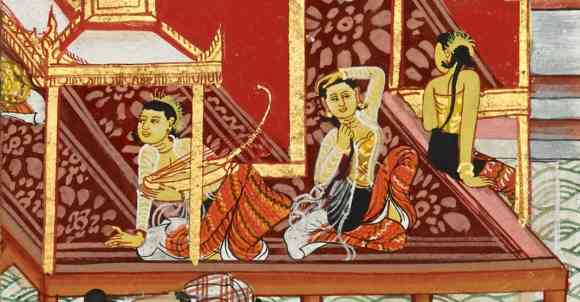
The Buddha was originally born as a prince into a lavish lifestyle, and is described as having been accompanied by forty thousand dancing women and an all-female orchestra. In this depiction of the court (Or 14197) one can see alongside the dancer a full female orchestra with a fiddle, a xylophone, a harp (back row, next to the fiddle), a flute and a drum. Two of the women are clapping their hands in rhythm.


Prince Siddhartha Gautama enjoying the entertainment of his private orchestra and a dancer. British Library, Or 14197, f. 1r


The orchestra played an important part in the Buddha’s disillusionment and decision to leave his princely life. One day, when he returned to his palace the orchestra started enthusiastically entertaining him. However, his mind was already detached from such pleasures and he fell asleep. Without its main audience, the orchestra also dozed off while still hugging their instruments. When the prince woke up and saw them lying around in a disorderly fashion, leg showing here, breast showing there, some sleeping with their mouths open, some grinding their teeth, he became even more disillusioned. He decided to bid goodbye to his sleeping wife and child and leave the palace for good in the Great Departure (Or 4762, Or 14197).


Siddhartha Gautama, standing next to a mislaid harp, peers over the orchestra, strewn about in a disorderly fashion. British Library, Or 4762, f. 1


Although the Buddha left his earthly orchestra behind, the Saung still followed him throughout his journey in heavenly form. In this rare illustrated Kammavācā manuscript (Or 13896), which is currently on display at the Treasures Gallery at the British Library, the deva Sakka plays the harp in order to lead the Buddha, who now has become a monk, to the Middle Path.


Sakka plays the Saung to the Buddha in order to lead him to the Middle Path. British Library, Or 13896, f. 16r 


The Saung was an integral part of the life in the heavenly realms, and is shown in cosmology manuscripts in all four heavenly realms of sensual pleasure - Paranimmita-vasavatti, Nimmānaratī, Tusita, and Yāma. In the depiction below, which describes the heavenly musicians of the Paranimmita-vasavatti realm the Saung is accompanied by a bell and a dancer (Or 14004).


The ruler of the Paranimmita-vasavatti realm accompanied by his heavenly musicians and a dancer. British Library, Or 14004, f. 15r 


The most impressive orchestra of all, however, could be found in the Tāvatiṃsa realm, or the realm of the thirty-three devas, located on top of the Sumeru world mountain. In the depiction below we can see two joined orchestras with a dancer in the middle. There are two harps and a bell in the left side orchestra, and a xylophone and a harp in the right side orchestra (Or 14004).


The ruler and the heavenly orchestras of the Tāvatiṃsa heaven. British Library, Or 14004, f. 21r 


Until the 19th century the Saung was played exclusively within the royal court, and was considered the most valued of instruments. The most notable harpists were given posts at court, where they composed many famous pieces. 


Myawaddy Mingyi U Sa (1766-1853) was one of these great musicians, and added six more harp strings to the existing seven, thus producing a fuller range (of two and a half octaves). A fourteenth string was added by the famous and last court harpist U Maung Maung Gyi (1855-1933), who was appointed to King Mindon’s court in Mandalay, where he was given the title "Deiwa-Einda" (Heavenly Musician) already at the age of thirteen. The Saung gradually came out of the palace during the 19th century via small outlying courts and travelling troupes of actors and musicians. Since then it has found its way to the general public and can now be enjoyed by all.


The Buddha meditating under the Bodhi tree, with the devas Sakka, Brahma and Mahākāla next to him singing songs of praise. British Library, Or 14297, f. 18r


The Saung returned at the pivotal moments of the Buddha’s life. The scene above depicts the beginning of the process of meditation that in the end led to Enlightenment. The Buddha is here shown meditating under the Bodhi tree, with the three devas Sakka, Brahma and Mahākāla from the three realms next to him singing songs of praise. Sakka blows the conch, while Mahākāla plays the harp and sings with over a hundred verses (Or 14297).


The Buddha’s Enlightenment, celebrated with harp music. British Library, Or 14297, f. 20r 


The devas ran away when Māra’s frightening troops arrived, and a difficult mental battle ensued which the Buddha eventually conquered. He had now attained Enlightenment, and the event was celebrated and rejoiced with much music. The Saung (with Mahākāla) is depicted here again right at his side (Or 14297).


The Buddha descends from Tāvatiṃsa heaven with a heavenly retinue beside him. British Library, Or 5757, f. 17r


After his Enlightenment the Buddha travelled around and taught the Dhamma to others. In the above illustration the Buddha is descending from the Tāvatiṃsa heaven, where he spent three months preaching the Dhamma to his mother, who was there. The Saung accompanies his descent to Earth (Or 5757). It has been said that the Saung was indeed the Buddha’s preferred instrument or even a symbol of him, and in temple murals he has been portrayed as a harpist in many of his previous incarnations.


References:

Muriel C. Williamson, The Burmese Harp: its classical music, tunings, and modes. Dekalb, Ill.: Southeast Asia Publications, 2000.

N.A. Jayawickrama (trans.), The Story of Gotama Buddha. Oxford: The Pali Text Society, 2002.

A documentary about the harp in Southeast Asia, by Patrick Kersalé, Sounds of 


(Source: Asian and African studies blog)

Sunday, 18 April 2021

How harpists were portrayed in the tales of the Buddha’s former lives

 The theme of these stories revolves around longing and heartache.

In my previous blog, I gave examples of how female harpists were depicted in Burmese manuscript illustrations. In this blog, I will discuss stories of male harpists that appear in Jātakas, or tales of the Buddha’s former lives, in the British Library’s Burmese manuscripts collection. The theme of these stories revolves around longing and heartache.


The Sussondi Jātaka recounts the story of Sagga, a harpist-minstrel. He is sent by the king of Benares (Varanasi) to find the queen who has disappeared. Unbeknownst to the king, the queen had in fact fallen in love with the Garuḍa king, who had taken her with him to Nāga Island.


The king sends Sagga, his harpist-minstrel, to search for Sussondi, his queen. | British Library


While looking for her, Sagga crosses the sea with a ship of merchants who implore him to play his harp. He responds: “I would make music, but if I do, the fish will be so excited that your vessel will be wrecked.”


The merchants disbelieve him and insist, and in the end, he plays and sings with great beauty. The fish start splashing about and a sea monster who lives in the area leaps up falls onto the ship and sinks it. Nevertheless, Sagga manages to reach the shore of the Nāga island clutching onto his (boat-shaped) harp.


Queen Sussondi, who was strolling on the shore in the absence of the Garuḍa king, finds him. She recognises Sagga and welcomes him with open arms. They become lovers and Sussondi hides him from the Garuḍa king whenever he returns.

Sagga is shipwrecked by jumping fish, but manages to swim to shore with his harp. Photo credit: British Library


The next time a group of merchants reach the shore, Sagga sails back with them to Benares (this time successfully), where he plays his harp and sings the song of Sussondi, replete with his own longing of her, to the king.


Sagga makes the return voyage by boat. Photo credit: British Library


The Burmese harp or Saung is a very old instrument that has a continuous history that spans over a thousand years. Many temple reliefs and wall frescoes from Bagan (ninth century-13th centuries) depict harps, although Judith Becker has suggested these harps may be different from the Sri Ksetra harp (see previous blog), which in turn resembles quite closely the modern Burmese harp.


Sagga returns to the palace and sings the story of Sussondi to the king. Photo credit: British Library


There probably were many different kinds of harps in use at the time. Although the terminology for the harp varies, the word Saung first appears at the Lokatheikpan temple in Bagan (c. 1125), where it describes “monks, who can play the harp”.


Indeed, the Saung seems to have an inextricable connection with Buddhism and, according to Becker, the disappearance of the harp accompanied the decline of Buddhism in certain parts of South Asia.


The earliest known songs thought to have been composed for harp music date to the early 14th century. Although song-texts were inscribed on palm leaf, there was no musical notation, and so the musical tradition was passed on orally with the music itself being impressed on memory when performed.


The oldest harp music that still survives is the “Three Barge Songs”, attributed to Wungyi Padei-tha-yaza (1683-1754), a minister at the Toungoo court. These songs purportedly describe a river voyage from Lake Meiktila to Tagaung.


A blindfolded Brahmin plays the harp to his wife, while her lover hits him from behind. Photo credit: Mss Burmese 202, f. 75v


The Aṇḍabhūta Jātaka (Mss Burmese 202) makes use of the harp for a lighthearted slapstick humour scene. It recounts the story of a Brahmin who has gone to great effort to find and keep a wife who has never seen any other men.


Here he plays the harp to her at home for her entertainment. Unbeknownst to him, however, she has taken a lover and tricks him into being blindfolded through the pretence of her being too shy of him watching her dance. While he is blindfolded in this way, the lover, who is currently staying in the house, hits him on the head and hides.


The Dīghītikosala Jātaka (Or 13538) tells the heart-wrenching story of a prince (the Bodhisatta), whose parents are cruelly slain by a deceitful rival. He is devastated, but instead of seeking revenge he goes to stay with the keeper of the red elephant of the palace and leads a simple life.


Slowly he recovers from his heartache and when the monsoon rains fall he sings and plays beautiful songs of acceptance and reconciliation with his harp.


In the next instalment of this series of blogs on the Burmese harp, I will talk about the Saung’s relationship with Gautama Buddha.


References:

Muriel C. Williamson, The Burmese Harp: Its Classical Music, Tunings, and Modes. Dekalb, Ill.: Southeast Asia Publications, 2000.

Judith Becker, “The Migration of the Arched Harp from India to Burma”, The Galpin Society Journal, Vol. 20 (Mar., 1967), pp. 17-23.

E.B. Cowell (ed.), The Jātaka or stories of the Buddha’s former births, Vols. I-VI. Oxford: The Pali Text Society, 2004-2005.


(Source: Asian and African Studies blog)

Sunday, 11 April 2021

The Burmese harp and the tales of the Buddha’s previous lives

 The earliest description of the music instrument in Buddhist literature, ‘Jātaka’ stories, can be traced back to the 8th century.

The British Library’s collection of digitised Burmese manuscripts, dating mainly from the 19th century, has many depictions of the Burmese harp or Saung. The Saung appears often in certain Jātaka stories, or tales of the previous lives of the Buddha, which have seduction and pleasure as one of the prevailing themes.


The Mandhātu Jātaka tells the story of Mandhātā, a powerful king who had everything he could ever desire. Although he ended up ruling even the heavenly realms, he still remained dissatisfied. Shown below is a detail from an illustrated manuscript of the Mandhātu Jātaka. It gives us a peek into Mandhātā’s court, which included beautiful musicians. The Saung player is turning curiously to see who is entering the palace.


The Boddhisatta and his four brothers at the enchanted pavilion of music. Telapatta Jātaka, 19th century | British Library, Or 4542/A f. 53r


The Saung is a unique musical instrument with a continuous history that stretches over a thousand years. It is known for its soothing, melodious sound and can be recognised by its horizontal boat-shaped body and its long, inwardly arched neck. 


The ends of the strings, which used to be made from silk, are decorated with red cotton tassels. The harp is held on the lap and the strings are plucked with one hand, while the other is used for damping and staccato notes. The Saung usually accompanies a singer, who also controls the tempo with a bell (Si) and a clapper (Wa).


Women of the court, including a musician holding the Burmese harp or Saung, Mandhātu Jātaka, 19th century. Photo credit: British Library, Or 4542/B, f.57r


The earliest description of the Saung comes from a temple relief at Bawbawkyi in Sri Ksetra from the 8th century. It depicts a dancer with an accompanying harpist and a rhythm keeper. Tang chronicles from the 9th century also describe a delegation from the kingdom with thirty-five musicians and dancers that enchanted the court with their elaborate music performance.


The orchestra included two harps and it performed twelve songs on Buddhist texts. These harps were tuned with pegs rather than strings, and interestingly peg-tuned harps are still used in Mon and Karen traditions. A later 10th-century Tang chronicle confirms that the music from these two geographic areas (from the present-day lower Myanmar) was the same.


Another of the Jātaka stories, the Telapatta Jātaka recounts the story of the Bodhisatta as a prince who had to travel through a dangerous, enchanted forest inhabited by ogresses. His five brothers accompany him but are eaten one by one by the ogresses who seduce them with different sensory pleasures.


Temiya’s last temptation. 'Temiya Jātaka', 19th century. Photo credit: British Library, Or 3676, f. 7r


In this manuscript illustration, the Boddhisatta (on the right in gold) has arrived to the ogresses’ magical pavilion of music. By this time he has already lost one brother in the pavilion of beauty. One of his remaining brothers, the lover of music, is raising the curtain in order to be fully immersed by the entertainment and is just about to become the next victim. The harpist is here accompanied by a flute and a singer.


The famous Temiya Jātaka is one of the ten last lives of the Buddha. He was a much wished-for son of the king of Benares. However, as soon as he discovered that his future kingly duties would involve inflicting punishment, he stopped speaking and sat motionless, as he did not want to inherit the throne.


The Bodhisatta hears beautiful music through his window and slowly falls in love with the harpist. ‘Culla Palobhana Jātaka’a, 19th century. Photo credit: British Library, Or 4542/B, f. 89r


The king tried to budge him in many different ways, from tempting him with cakes to scaring him with snakes and loose elephants, but with no success. When Temiya turned sixteen he was put to the final test with beautiful women, song and dance. Although this illustration actually shows him quite tempted, he did in fact hold firm and ended up not having to inherit the kingdom.


A somewhat similar story is recounted in the Culla Palobhana Jātaka. In this story as well, the Bodhisatta was born as a much-wanted prince, but from his earliest days as a baby he did not like to be nursed by women and was only attended by male members of the court. The king grew worried about his son’s lack of desire for pleasure, for surely this would also include ruling the kingdom.


The Boddhisatta and his lover are banished from the kingdom after a fit of jealousy. ‘Culla Palobhana Jātaka’, 19th century. Photo credit: British Library, Or 4542/B, f. 89r


A young dancing girl, accomplished in music and song, was therefore asked to seduce him. In return, she would become his queen. When morning came she played and sang outside the place where the prince was meditating. Little by little he fell in love with her and they became closer.


Unfortunately, the Bodhisatta became so enamoured with her that he ran amok the town in a fit of jealousy. As punishment for this bad behaviour both of them were banished from the kingdom and went on to live together in the forest.


In forthcoming blog posts I will give examples of how male harpists were depicted in manuscript illustrations, and how the Saung was inextricably entwined with the life of the Gautama Buddha.


References:

Muriel C. Williamson, The Burmese Harp: Its Classical Music, Tunings, and Modes. Dekalb, Ill.: Southeast Asia Publications, 2000.

Judith Becker, “The Migration of the Arched Harp from India to Burma”, The Galpin Society Journal, Vol. 20 (Mar., 1967), pp. 17-23.

E.B. Cowell (ed.), The Jātaka or stories of the Buddha’s former births, Vols. I-VI. Oxford: The Pali Text Society, 2004-2005.


(Source: Asian and African Studies blog)

Sunday, 26 July 2020

Protection without punishment: Turning to Buddhist gods during Covid-19

For political leaders today, a pandemic means never having to say you’re sorry. This has not always been the case. Once upon a time, in a different era, rulers publicly proclaimed their shortcomings, taking moral responsibility for a host of disasters, from droughts to epidemics, thought to be caused by the lack of virtue in a sovereign. While people around the world today still call upon the gods for help in response to Covid-19, political leaders’ ritualized public confessions have largely disappeared. I want to consider the case of Japan, both in contemporary and ancient times, to think about changes in ritual practice, particularly those aimed to enlist divine aid and confess wrongdoing. I am curious about how people turned to the gods historically, the discursive modes permissible for doing so in 2020, and the implications of these shifts.

Buddhist institutions in Nara, Japan’s eighth-century capital, are amongst the oldest in the country. These temples have promoted practices in response to Covid-19 that would have been familiar to residents of the city in antiquity, such as sutra copying, a ritualized form of writing. The basic idea is that transcribing scripture, like other virtuous acts, can bring this-worldly benefits to the patron or copyist, including healing, as well as post-mortem salvation for the deceased. 

Yakushiji, a temple in Nara dedicated to a deity known as “Medicine Master Buddha” and founded to help cure the illness of an imperial consort, has been promoting sutra copying at home as a way to pray for a rapid end to the Covid-19 crisis. Newspaper reports suggest that Yakushiji has seen a threefold increase in requests to send sutra copying materials for in-home transcription. Other prominent Nara temples such as Kōfukuji and Tōdaiji have performed both old and new rituals to quell the coronavirus pandemic. These are just some of the many religious responses we have witnessed to Covid-19 in Japan.

Seeking divine aid in moments of distress is not unusual. Scholars of Japan have long pointed out that people “turn to the gods in times of trouble.” These tendencies challenge popular perceptions of Japan as a secularized society, a narrative derived in part from low response rates to problematic survey questions based on norms from non-Japanese contexts, as well as from definitions of religion and non-religion that do not accord to English usage. These findings complicate debates over whether Japan is actually secularizing or if such decline narratives are just recycled stories that serve the interests of researchers and practitioners. As scholars of religion have noted more generally, we should not be surprised that disenchantment is a myth, one that does not accord to belief and practice on the ground. The presence of spirits persists even into modernity.

Part of the appeal—dare I say timeless appeal—of the gods is that they can look after us, though they do so with an ominously watchful eye. While Tōdaiji restricted visitation due to Covid-19, it opened a typically shut viewing window upon the face of the Great Buddha, its famous, fifteen-meter-tall object of worship; the monk Morimoto Kōjō tweeted the reminder that it is not for us to see the Buddha but for the Buddha to watch and protect us.

The eighth-century history of the temple that came to be called Tōdaiji is tied closely to protection from epidemics. This can be seen in relation to a smallpox outbreak in the 730s, which decimated around one third of Japan’s population. This crisis sparked the creation of a large network of official monasteries and convents, one of each per province. Tōdaiji was the administrative center of this temple network. An edict by Emperor Shōmu from 3/24/741 announcing the creation of these provincial monasteries and convents explained that the Four Heavenly Kings, key deities in the Buddhist pantheon, will always come and protect kingdoms in which the Golden Light Sutra was promulgated. In fact, he named the monasteries the Temples for Protecting the State by the Four Heavenly Kings of Golden Radiant Light and had copies of the scripture enshrined in every temple to enlist their guard.

But these gods did not only protect. They also observed and reported transgressors, who would in turn be punished. The celestial realm was itself a moral surveillance state patrolled by the four heavenly kings. This is expressed in iconography from ancient Japan, including a set of images enshrined in Tōdaiji’s Precept Platform Hall. Two of the Four Heavenly Kings gaze off in the distance surveilling people; one holds a brush and a scroll to record the acts of humans and report them up the heavenly hierarchy. The other two carry swords and stand with fierce bulging eyes. They will either protect or punish depending on one’s actions. This idea also appears in one of the origin stories of Japanese Buddhism from the temple Gangōji, which may date to the Heian period (794–1185), in which the female sovereign Suiko prays for the four kings to protect the realm but cautions that future rulers will be visited by “great calamity and great shame” if they fail to promote Buddhism.

In this Buddhist imaginaire, the virtue of the ruler is utterly transparent. If epidemics or disasters strike, it means the sovereign was to blame. For this reason, rulers in antiquity constantly lamented their own shortcomings. Emperor Shōmu responded to various disasters including the aforementioned smallpox epidemic with repeated edicts stressing that such crises emerged from his lack of virtue and that “the fault is not with the people.” He echoed this sentiment in his aforementioned 741 vow for the provincial temple network: “I with meager virtue have unworthily born this weighty appointment [as emperor]. I have yet to spread governance and civilization. In waking and sleeping, I’m filled with shame . . . Recently, the year’s crops are not prospering and pestilence repeatedly spreads. Shame and dread mix together, I just toil away and blame myself.”

In this way, rulers in ancient Japan, sometimes seen as both human and divine themselves, were under celestial surveillance while also seeking heavenly protection. Their legitimacy was in part based on how the world responded to their moral integrity or lack thereof, as the virtue of their bodies was thought to manifest in the world. To sin brought visible punishment in the form of disease as well as a host of other calamities ranging from famine to warfare. The deities that protected you would also destroy you. Rulers needed to constantly proclaim their inadequacies through these ritualized proclamations and confessions. Penance and protection required one another.

It was this climate of belief that caused the constant confessions and patronage by political leaders. And it is this notion of public confession of moral culpability by leaders lest the people face divine punishment that has been largely lost in recent years. While a range of individuals from moral philosophers to everyday citizens interpreted the 1923 Great Kantō Earthquake as punishment by kami or the Buddha for Japan’s materialism and individualism, the 3/11 triple disaster from 2011 only saw a few people, most prominently Tokyo’s governor and a well-known academic, claim divine retribution. On the one hand, this evidence shows that public figures still occasionally invoke this discourse. On the other hand, they were clearly in the minority for 3/11 and largely condemned for insensitivity toward the victims, facts that suggest scholars need other ways to study religion and disaster beyond a rhetoric of theodicy. I have yet to hear of any prominent public figure in Japan referring to Covid-19 as divine punishment.

As a global pandemic rages, it is perhaps an ironic coincidence that the statues of the Four Heavenly Kings from Tōdaiji’s Precept Platform are currently being moved from the temple to a museum to facilitate needed repairs to the hall. The gods are no longer on duty. While people in Japan may still pray for protection in the age of Covid-19, for the most part, politicians neither vocalize fear of divine punishment for their immorality nor proclaim their moral shortcomings as a cause of the pandemic. I am by no means suggesting that Japan or any country should return to a world patrolled by celestial kings, particularly as discourses of divine retribution for sin tend to enforce norms that target marginalized communities and practices.

Rather, I am left wondering what is lost when public leaders are no longer expected to regularly perform penance or publicly express their failings as they once did in response to epidemics. Such confessions might be viewed by critics as empty gestures, maybe even self-serving ones. But ritual theorists have found that repeated outward performance, even when conducted (at least initially) without sincerity, can generate subjunctive “as if” worlds and endow the self with new, often more pious, qualities. What are the implications of an age when prayers for protection from disease are made without the threat of punishment? What is the role of apology for the nation’s sins in a liberal and supposedly secular state? What would our world look like if our leaders regularly performed culpability and confession?

(Source: TIF)


Saturday, 25 July 2020

No one knows what Thailand is doing right, but so far, it’s working

Can the country’s low rate of coronavirus infections be attributed to culture? Genetics? Face masks? Or a combination of all three? 

No one knows exactly why Thailand has been spared.

Is it the social distancing embedded in Thai culture — the habit of greeting others with a wai, a prayer-like motion, rather than a full embrace — that has prevented the runaway transmission of the coronavirus here?

Did Thailand’s early adoption of face masks, combined with a robust health care system, blunt the virus’s impact? Was it the outdoor lifestyle of many Thais, or their relatively low rates of pre-existing conditions?

Is there a genetic component in which the immune systems of Thais and others in the Mekong River region are more resistant to the coronavirus? Or is it some alchemy of all these factors that has insulated this country of 70 million people?

Monks from Wat Matchanthikaram, wearing masks and face shields to protect them from COVID-19, receive alms from local residents in Bangkok, in April. Credit... Adam Dean for The New York Times

One thing is certain. Despite an influx of foreign visitors early in the year from countries badly hit by the coronavirus, Thailand has recorded fewer than 3,240 cases and 58 deaths. As of Thursday, there had been no cases of local transmission for about seven weeks.
Police officers in Bangkok patrolling a checkpoint on one of the city’s busiest streets after a nationwide curfew was put into effect. 

Thais were quick to adopt wearing face masks early in the pandemic and maintain social distancing when using public transportation. 

A nearly empty flight from Bangkok to Phuket, Thailand, on March 30.

Construction workers, a group largely made up of migrant workers, returned to their dormitories in Bangkok in April.

Thailand’s low rate of infection appears to be shared by other countries in the Mekong River basin. Vietnam has not recorded a single death and has logged about three months without a case of community transmission. Myanmar has confirmed 336 cases of the virus, Cambodia 166 and Laos just 19.

Yunnan, the southwestern Chinese province through which the Mekong flows before meandering to Southeast Asia, had fewer than 190 cases. None are active now.

“I don’t think it is about immunity or genetics alone,” said Dr. Taweesin Visanuyothin, the Covid-19 spokesman for Thailand’s Ministry of Public Health. “It has to do with culture. Thai people do not have body contact when we greet each other.”
The authorities spraying travelers with disinfectant in Phuket, a popular vacation spot, in March.

Disinfecting a market before it reopened in Bangkok, in May.

Drive-through testing at a hospital in Bangkok, in March.

Workers making cloth face masks at a factory owned by Wacoal, an underwear manufacturer, in Bangkok, in April.
“This is how the countries in the Mekong region greet each other as well,” Dr. Taweesin added.

It didn’t always look so upbeat. In January, Thailand confirmed the world’s first case of the coronavirus outside of China — in a tourist from Wuhan, the central Chinese city where the outbreak is believed to have begun.

Another wave of infections was set off by people arriving from Japan, Europe and the United States. A Thai boxing event turned into a super-spreader event. But after a lockdown was enforced in March, shuttering businesses and schools, domestic transmissions subsided. All of Thailand’s recent cases have been among people who arrived from overseas.

Dr. Wiput Phoolcharoen, a public health expert at Chulalongkorn University in Bangkok who is researching an outbreak of the coronavirus in Pattani in southern Thailand, noted that more than 90 percent of those who tested positive there were asymptomatic, much higher than normal.

“What we are studying now is the immune system,” he said.

Dr. Wiput said Thais and other people from this part of Southeast Asia were more susceptible to certain serious cases of dengue fever, a mosquito-borne virus, than those from other continents.

“If our immune systems against dengue are so bad, why can’t our immune system against Covid be better?” he asked.

Though Thailand’s hospitals have not been overwhelmed by coronavirus patients, the country’s tourism-dependent economy has been battered.

In April, Thailand banned almost all incoming flights, amid the tightening lockdown. Holidaymakers stopped coming to Bangkok, once the world’s most visited city. The Thai tourism and sports ministry estimates that 60 percent of hospitality businesses could close by the end of the year.
Students at Sawasdee Wittaya Primary School learning about washing hands after schools reopened this month.

Registering to receive financial aid from the government in Bangkok, in May.

The closed Apple Store at Icon Siam, one of Thailand’s most upmarket and largest shopping malls, in March.

Homeless people lining up at a food distribution center in Bangkok, in April.

The International Monetary Fund predicts the Thai economy will shrink by at least 6.5 percent this year. More than eight million Thais may lose their jobs or income in 2020, the World Bank has said, in a nation already cleaved by a yawning gap between rich and poor.

Thai households have some of the highest debt loads in Asia, and the most desperate have lined up at Buddhist temples for handouts of rice.

After a promised disbursement of emergency government funds was bogged down in bureaucracy, a woman swallowed rat poison outside of a government building. She survived, but suicides are up in Thailand.

Covid Thailand Aid, a charity set up in the wake of the pandemic, has been inundated by pleas from Thais with only a dollar or two left in their bank accounts, said Natalie Narkprasert, one of the group’s founders.

The country’s large population of migrant workers, many from neighboring Myanmar and Cambodia, is also hurting. While some people managed to make it home before the borders closed, others are stuck in Thailand with no wages from their jobs as hotel cleaners, kitchen hands and food stall operators.

“Now is when people want more help because it’s been so long and it’s not going to get better,” Ms. Natalie said.
A park in Bangkok on May 3, after the city began easing restrictions.

Protective screens at street food stalls in Bangkok, in May.

Thai boxing gyms were allowed to re-open on June 1.

A salon after re-opening in Bangkok, in May.

A sense of normalcy has recently returned to Thailand. Schools have reopened with children wearing face masks and studying at spaced-out desks. And in early July, the first holiday weekend in months — Thai New Year festivities were canceled in April — prompted an uptick in domestic tourism.

Thailand has also allowed a trickle of foreigners back into the country. But with the new arrivals comes the risk of contagion.

A popular entertainment street, just before curfew, was closed down due to a localized coronavirus outbreak, in Patong, Phuket, in March.

This week, an Egyptian military pilot was confirmed to have tested positive for the coronavirus, after he breached quarantine and visited shopping centers in a Thai beach town. Some schools in the area are now closed again. Two activists who protested the government’s handling of the quarantine violation were arrested on Wednesday for contravening Thailand’s emergency decree.

Questions are also being raised about why migrant workers who were deported from Thailand arrived home and immediately tested positive for the disease, despite not being included in the official Thai count of coronavirus cases. 

Thailand’s testing rates remain relatively low.

“With the disease still looming,” said Dr. Taweesin, the health ministry spokesman, “we have to keep our guard up.”

(Source: NYT)