Showing posts with label USA. Show all posts

Monday, 30 May 2022

Feisty, fragile, fascinating: An interview with Chitra Divakaruni

 The writer paints her protagonists not as the meek and mild queens of traditional mythology, but as intelligent, firebrand women, who protested the wrongs heaped upon them, and took up cudgels on behalf of women around them.

As a child, Dr. Chitra Banerjee Divakaruni spent her summer holidays with her maternal grandfather in Bengal, where he regaled her with stories from the epics, the Mahabharata and the Ramayana, along with tales from Bengal.


“My grandfather had a huge influence on my writing,” she says. “The land, the customs, the folktales and fairytales, many of which make their way into my writing, all came from him.” 


As did the epics. Though in the narratives of Divakaruni, they came with a twist. The Palace of Illusions (2008) and The Forest of Enchantments (2019), two of the most ambitious novels she embarked on, were retellings of the epics where Divakaruni gave voice to the innermost thoughts of Draupadi and Sita. 


Growing up in Kolkata, the sense of Sita she got was of a “very meek and mild, obedient wife and daughter-in-law, who did not create any trouble. Elders would bless me and say, may you be like Sita, the epitome of all those qualities. That used to really annoy me! I thought there has to be more to Sita than that.” 


That’s the kind of fallacious thinking that Divakaruni hopes to address through her portrayals of strong heroines. In her books, she paints them not as the meek and mild queens of traditional mythology, but intelligent, firebrand women, who protested the wrongs heaped upon them, and took up cudgels on behalf of women around them. 


Author Chitra Banerjee Divakaruni (Image Credit: Chitra Banerjee Divakaruni)


In her latest book, The Last Queen, which was just released in the United States, Divakaruni continues to delve into the minds of powerful queens, this time with the story of Maharani Jind Kaur, the youngest and most beloved wife of the Lion of Punjab, Ranjit Singh, Maharaja of the Sikh empire. 


Why Rani Jindan?


“She is an amazingly strong woman who was just pushed aside in the annals of our history,” says Divakaruni.


History books teach about the Sher-e-Punjab, and his son, Dalip Singh, who was deposed by the British, exiled to England in his childhood, and ultimately made a puppet of the British crown. But in between the father and son ruled Maharani Jind Kaur, as the Queen Regent, an astute young widow fighting to protect Punjab, the legacy of her beloved husband, and the birthright of her son Dalip, from mercenary courtiers and the avaricious British. 


“I thought Rani Jindan had a fascinating life and deserved to be in the limelight. She was very inspiring to me because of the difficulties she went through in a world that was pretty hostile to women who stepped out of their roles; I really wanted to tell her story,” says Divakaruni. 


Readers and critics have called her books, especially the epic retellings, “unputdownable.” 


“I love that word!” Divakaruni exclaims in delight. “I want it to be unputdownable.”


In this regard, The Last Queen doesn’t disappoint. The story has everything a fast-paced novel can be expected to have: royalty, romance, conspiracy, murder and mayhem. Divakaruni’s narrative style is fluid and accessible, with a sprinkling of wit and humor. 


Divakaruni herself is a disarmingly charming conversationalist; her humor belies her towering persona as a multiple award-winning author. Her work has been included in the Best American Short Stories, The O’Henry Prize Stories, and two Pushcart Prize Anthologies, among others. She is also Professor of Creative Writing at the University of Houston, a program that is rated among the top creative writing programs in the US. 


A strong advocate for women’s rights, she co-founded the San Francisco Bay Area-based Maitri, a nonprofit that provides support services to South Asian survivors of domestic violence. She is also an Emeritus board member of Pratham, a nonprofit dedicated to eradicating illiteracy in India.  


Both Draupadi and Sita were relegated to a corner in the traditional epic narrative, not given much of a say in terms of what they were thinking, feeling or their motives.


As in the Palace of Illusions and The Forest of Enchantments, Divakaruni continues to write The Last Queen in the first-person narrative. Why?


“The first person allowed me direct interiority into the minds of these women, and in these three books, that was important. These are all strong women; their world is important, and therefore their voice.” 


Both Draupadi and Sita, she felt, were relegated to a corner in the traditional epic narrative, not given much of a say in terms of what they were thinking, feeling or their motives, and so Divakaruni addressed them with first-person female perspectives. 


At the same time, she also made both gods and kings disarmingly human with a generous dose of humor. In the Forest of Enchantments, readers are treated to a delightful scene where Lord Ram is teased about his dark skin color by Sita’s friends, and he gives back naughtily in jest by saying that when they unite in love, some of Sita’s fairness might rub off onto him.


“Normally, our popular concept of Ram is not of someone who jokes,” says Divakaruni, “but I found this in the Krittibasi Ramayan [a popular Bengali retelling] and had to put it in.” 


In the Last Queen too, readers also get a sense of Maharaja Ranjit Singh as a person, in all his glory and his failings (with a fondness for both women and drink), who finally found true love in the twilight of his years with an extraordinary woman of very ordinary birth.


Divakaruni’s feminist message, while strong, is also delicately nuanced, and therein lies her appeal to readers across genders. This has earned her a fan following among male readers.


Retelling of epics and historicals can be literary landmines for any author. So, how does Divakaruni tread through those?


“I feel huge amounts of trepidation, and oh, there are a lot of landmines, but what helps is my mission, which is to tell the truth as best as I can see it. I really don’t have any agenda except to bring women to the center of the story.” 


Divakaruni’s feminist message, while strong, is also delicately nuanced, and therein lies her appeal to readers across genders. This has earned her a fan following among male readers, many of whom write to her and engage with her on social media, all of which she finds very gratifying. “Reading across the genders is a very healthy thing, mentally and psychologically, healthy for our communities and ultimately for our societies,” she says. 


Divakaruni also feels keenly about the current world situation, where ideas and opinions are polarized to the extreme, and different interpretations are unwelcome. “I think we are going through a period, all over the world, and also in India, where it seems like there is only one possible interpretation of things, and if you veer from that, then hey, you are a problem. I really feel that that was not in our Indian spirit. Our Indian spirit is very embracive of many different ways of interpreting, of living, of worshiping.”


Currently, she is working on her next book, about a family in Bengal caught in the calamity of the Partition, which echoes those very sentiments. “It is at once hugely inspirational and a warning story as well of what happens when people don’t come together. Bengal too felt the violence of partition very keenly, but those events are less documented than the western borders,” she says.


Divakaruni’s other enduring love is teaching creative writing. “Every time I critique a student’s work, I learn something new. My students read a lot of contemporary books and they are always recommending things to me to read.” 


Her message for aspiring writers out there: I want you to know that when I started writing, I was a very bad writer. I had to learn how to become a good writer. Sometimes, writers have to be prepared to do that.


(Source: India Currents) 

Sunday, 20 February 2022

As BA.2 subvariant of Omicron rises, lab studies point to signs of severity

The BA.2 virus -- a subvariant of the Omicron coronavirus variant -- isn't just spreading faster than its distant cousin, it may also cause more severe disease and appears capable of thwarting some of the key weapons we have against Covid-19, new research suggests.

New lab experiments from Japan show that BA.2 may have features that make it as capable of causing serious illness as older variants of Covid-19, including Delta.


And like Omicron, it appears to largely escape the immunity created by vaccines. A booster shot restores protection, making illness after infection about 74% less likely.


BA.2 is also resistant to some treatments, including sotrovimab, the monoclonal antibody that's currently being used against Omicron.


The findings were posted Wednesday as a preprint study on the bioRxiv server, before peer review. Normally, before a study is published in medical journal, it is scrutinized by independent experts. Preprints allow research to be shared more quickly, but they are posted before that additional layer of review.


"It might be, from a human's perspective, a worse virus than BA.1 and might be able to transmit better and cause worse disease," says Dr. Daniel Rhoads, section head of microbiology at the Cleveland Clinic in Ohio. Rhoads reviewed the study but was not involved in the research.


The US Centers for Disease Control and Prevention is keeping close watch on BA.2, said its director, Dr. Rochelle Walensky.


"There is no evidence that the BA.2 lineage is more severe than the BA.1 lineage. CDC continues to monitor variants that are circulating both domestically and internationally," she said Friday. "We will continue to monitor emerging data on disease severity in humans and findings from papers like this conducted in laboratory settings."


BA.2 is highly mutated compared with the original Covid-causing virus that emerged in Wuhan, China. It also has dozens of gene changes that are different from the original Omicron strain, making it as distinct from the most recent pandemic virus as the Alpha, Beta, Gamma and Delta variants were from each other.


Kei Sato, a researcher at the University of Tokyo who conducted the study, argues that these findings prove that BA.2 should not be considered a type of Omicron and that it needs to be more closely monitored.


"As you may know, BA.2 is called 'stealth Omicron,' " Sato told CNN. That's because it doesn't show up on PCR tests as an S-gene target failure, the way Omicron does. Labs therefore have to take an extra step and sequence the virus to find this variant.


"Establishing a method to detect BA.2 specifically would be the first thing" many countries need to do, he says.


"It looks like we might be looking at a new Greek letter here," agreed Deborah Fuller, a virologist at the University of Washington School of Medicine, who reviewed the study but was not part of the research.


Mixed real-world data on subvariant's severity

BA.2 has been estimated to be about 30% more contagious than Omicron, according to the World Health Organization. It has been detected in 74 countries and 47 US states.


The US Centers for Disease Control and Prevention estimates that about 4% of Americans with Covid-19 now have infections caused by BA.2, but many other parts of the world have more experience with this variant. It has become dominant in at least 10 other countries: Bangladesh, Brunei, China, Denmark, Guam, India, Montenegro, Nepal, Pakistan and the Philippines, according to World Health Organization's weekly epidemiological report.


However, there's mixed evidence on the severity of BA.2 in the real world. Hospitalizations continue to decline in countries where BA.2 has gained a foothold, like South Africa and the UK. But in Denmark, where BA.2 has become the leading cause of infections, hospitalizations and deaths are rising, according to WHO.


Resistant to monoclonal antibody treatments

The new study found that BA.2 can copy itself in cells more quickly than BA.1, the original version of Omicron. It's also more adept at causing cells to stick together. This allows the virus to create larger clumps of cells, called syncytia, than BA.1. That's concerning because these clumps then become factories for churning out more copies of the virus. Delta was also good at creating syncytia, which is thought to be one reason it was so destructive to the lungs.


When the researchers infected hamsters with BA.2 and BA.1, the animals infected with BA.2 got sicker and had worse lung function. In tissues samples, the lungs of BA.2-infected hamsters had more damage than those infected by BA.1.


Similar to the original Omicron, BA.2 was capable of breaking through antibodies in the blood of people who'd been vaccinated against Covid-19. It was also resistant to the antibodies of people who'd been infected with Covid-19 early in the pandemic, including Alpha and Delta. And BA.2 was almost completely resistant to some monoclonal antibody treatments.


But there was a bright spot: Antibodies in the blood of people who'd recently had Omicron also seemed to have some protection against BA.2, especially if they'd also been vaccinated.


And that raises an important point, Fuller says. Even though BA.2 seems more contagious and pathogenic than Omicron, it may not wind up causing a more devastating wave of Covid-19 infections.


"One of the caveats that we have to think about as we get new variants that might seem more dangerous is the fact that there's two sides to the story," Fuller says.


The virus matters, she says, but as its would-be hosts, so do we.


"Our immune system is evolving as well. And so that's pushing back on things," she said.


Right now, she says, we're in a race against the virus, and the key question is, who's in the lead?


"What we will ultimately want is to have the host be ahead of the virus. In other words, our immunity, be a step ahead of the next variant that comes out, and I don't know that we're quite there yet," she said.

For that reason, Fuller says, she feels like it's not quite time for communities to lift mask mandates.


"Before this thing came out, we were about 10 feet away from the finish line," she said. "Taking off the masks now is not a good idea. It's just going to extend it. Let's get to the finish line."


(Source: CNN)

Tuesday, 15 February 2022

The common tongue of twenty-first-century London

Schoolchildren in the British capital have developed a dialect, Multicultural London English—and my American-born son is learning it.


In the summer of 2018, my family moved to London, the city of my birth, from New York, my home for three decades. We wanted to be closer to my mother as she neared the age of ninety, and my husband and I were eager to expand the horizons of our son, who had just turned thirteen. My parents had moved to Weymouth, on the southern English coast, when I was just three years old, and so London was unfamiliar to me. Acquainting myself anew with the city, I walked its streets and visited its parks and museums with an exhilarating sense of novelty.


Not long after my family settled into a new home, near Hampstead Heath, I went south to the Tate Britain museum, on the bank of the Thames, to see an ambitious project undertaken by the British artist and filmmaker Steve McQueen. He had made a collective portrait of London by photographing its Year Three students—second grade, in the British system. All the city’s elementary schools—public, private, faith-based, special-needs—were invited to participate, and more than fifteen hundred of them agreed to have photographers deputized by McQueen take a class picture. The result, called “Year 3,” is an assemblage of more than three thousand images, featuring seventy-six thousand children.


“Year 3” was overwhelming in scale. Individually framed, and mounted on white, the photographs were stacked wall to wall, a dozen high, in the museum’s lofty Duveen Galleries. From a distance, the regular arrangement of brightly colored rectangles looked like the board of a children’s game. Close up, each rectangle resolved into a traditional class portrait, with the tallest children standing in the back row, and the smallest sitting cross-legged in the front. Many students wore school uniforms—blue blazers and gray shorts, gingham dresses and red cardigans—the outfits barely changed from those my mother wore when she went off to grammar school, or those I wore when it was my turn to enter the British equivalent of kindergarten.


I wished that my mother, who still lives in Weymouth, could have accompanied me, as she would have found the children as irresistibly appealing as I did, with their broad grins showing teeth that are still jostling into position: a boy in a soccer uniform, with a soccer-player haircut, cropped on the sides and long on top; a girl in a green hijab next to a girl with a white satin hairband. Aged seven or eight, they are on the cusp of an understanding of the world, and of their place as individuals in it. Though the project must have been logistically difficult, with all the paperwork and the permissions and the persuasion, it offered a brilliantly simple conceit: displaying the heterogeneity—class, race, nationality, faith—of young Londoners at the age when they first develop an awareness of their own differences, and of the structures that bring them together or keep them apart.


The museum was full of lively children scampering from one side of the gallery to the other, pointing at the images and chattering about the faces on the walls. An essential element of “Year 3” was that all the classes who sat for McQueen’s photographers had the opportunity to come in to see themselves represented. You are the future of London, museum staffers told the students when they arrived—hundreds of them every day. Some of the children had never been to a museum. One purpose of the project was to instill in them the sense that the institution belongs to them, and not just to people like me, a middle-aged ticket buyer overhearing their squealed reactions: Look at this boy, picking his nose! Look, here are children with disabilities, in wheelchairs. Look, these children have a dog with them, a mascot—lucky them.


An essential element of “Year 3” was that all the classes who sat for McQueen’s photographers had the opportunity to come to the Tate Britain to see themselves represented.Photograph © Steve McQueen and Tate / Courtesy Steve McQueen / Thomas Dane Gallery / Marian Goodman Gallery


London itself belongs to these students, whose parents and grandparents have come from all over. More than three hundred different languages are spoken by the children who attend London’s schools, but, as I listened to their voices at the Tate, I was struck by how similar to one another they sound. Sociolinguists who study the way that Londoners speak have identified the emergence, since the late nineteen-nineties, of a new variant of English among the younger generations: M.L.E., or Multicultural London English.


In recent decades, large-scale studies have been undertaken of language use in Hackney, in East London. Historically, Hackney was occupied by white working-class residents, or Cockneys, whose basic elements of speech are familiar not just to Londoners who grew up with them but to anyone who has watched Dick Van Dyke effortfully twist his tongue in “Mary Poppins”—saying wiv for “with” and ’ouse for “house.” The years after the Second World War brought an influx of immigration that resulted in Hackney becoming one of London’s most decisively multiethnic neighborhoods. In one cohort of Hackney five-year-olds, who were studied between 2004 and 2010, there were Cockneys, but there were many more children with parents from Bangladesh, China, Colombia, Albania, Turkey, the Middle East, the Caribbean, and various African countries. Friendship groups were multiethnic, the researchers noted, and often included children who spoke a language other than English at home, or children whose first language was English of a postcolonial variety, such as Ghanaian or Indian English. In this diverse milieu, the children found their way to a new common language.


Speakers of M.L.E. use notably different pronunciations from speakers of Cockney: “face,” which in Cockney sounds like fay-eece, for example, slides closer to fess. (In linguistic terms, the Cockney diphthong is replaced by a near-monophthong.) Some of M.L.E.’s features are lexical, with vocabulary especially influenced by the language spoken by people with Jamaican backgrounds—one of the first postwar immigrant groups to arrive in the East End. But the shifts in the language of London amount to more than the borrowing of vocabulary or changes in pronunciation: there are structural changes, too. David Hall, a linguist at Queen Mary University of London, has written of the organic emergence of a new pronoun, “man,” which, depending on its context, can mean “I” or “me” or “him” or “them.” As an example of generic-impersonal use, Hall gives the example “Man’s gotta work hard to do well these days.” To describe the second-person use, he cites a command that might be issued to an upset friend: “Man needs to calm down!” I asked Hall to meet me in a café in Mile End, in East London, not far from the university. Over coffee, Hall—who is young and bearded, and uses many features of M.L.E. in his speech—discussed other attributes of the linguistic variant, such as the dropping of prepositions with the verbs “go” and “come” in certain contexts.

“It has to be some sort of familiar or institutional goal, like ‘I went pub last night,’ or ‘I went chicken shop,’ ” he told me. “It can’t be ‘I went art gallery.’ ”


This is a feature that M.L.E. has in common with modern Greek, he said, but it’s hard to tell precisely in which foreign languages the novelties of M.L.E. are rooted, because it has emerged from such variegated and fertile ground. “It is difficult to say if there is a direct influence from Nigerian English, or Jamaican Creole, because they are all in the mix somewhere,” Hall explained. Moreover, the London children whom Hall and other scholars have studied are influenced more strongly by the phonologies of their peers than by those of their caregivers. Starting at four or five years old, they pool a set of languages and linguistic features, and settle on some subset of that pool as their common language. They begin to speak like one another instead of like their parents. “Normally, kids, until they are eight or nine, will copy their caregivers, and then they will match the community afterwards,” Hall told me. “But these kids are doing it very, very young. It is language change not from the outside but from the inside—they are building it themselves.”


If McQueen’s cameras had captured the chatter of the Year Three students as they shuffled into place and smiled, M.L.E. is one language that nearly all of them would have been familiar with. Hall explained to me that, when groups who speak in different ways come into frequent contact, people often shift the way they speak, eventually sharing speech styles and modes of pronunciation. If you have an extremely mixed group—one whose members speak, say, ten different languages—speakers will settle on linguistic features that allow them to do what they most want to do, which is communicate. “Ultimately, people want to sound like one another,” Hall told me. Linguists use the term “accommodation” to describe the way that individuals change how they speak to align with one another. “It’s not cultural appropriation, it’s not rude, it’s just what we do,” Hall said. We accommodate ourselves to others’ speech because we want to get along; we want to understand, and to be understood.


Soon after my son enrolled at his new school, a few blocks from our house, he started bringing home words and phrases that his new peers, at the onset of adolescence, use to demarcate themselves from their parents, claiming their status as the future of London. The vocabulary was new to his Brooklyn-raised ears, and to me, who had been absent from London for so long. Whenever he brought such words home, I turned them over with him, like fossils found among stones on a pebbly beach. (“Bare,” perplexingly, means “plenty,” or “a lot of.” “Allow it” means “leave it alone.”) Among his classmates are students with English surnames that sound as if they date back to the Norman Conquest or earlier, but there are also children with parents from Somalia, Syria, Bangladesh, Turkey, Poland, France, and Germany. Some of the students arrived in Year Three from Romania, speaking not a word of English; just listen to them now.


For a while, my son was the new outsider, the one who talked funny. Say “aluminum,” his classmates demanded. Say “candy.” Say “elevator.” His American accent was long enough established that it now seems likely to be indelible, though over the past few years he has adjusted to his new context, to fit in. He now says “sweets” instead of “candy,” “maths” instead of “math.” He speaks of his teachers as “Miss” and “Sir,” just as I did—the latter honorific now striking me as peculiar, because I’m hearing it on his democratic American tongue. When my son calls me on his phone after school, to say he’ll be home later than expected, he says, “We’re going shop,” just like his new friends say it—the ones I can hear larking in the background behind him. He used the expression at first with a slight self-consciousness, but in a spirit of openness. Gradually, it has become his default. He is accommodating himself to London, this new city to which he has been translated.


In moving my son between two English-speaking countries, I have not made available to him the opportunity to become fluent in another language. Unlike his classmates with Romanian or Somali or French parents, he cannot move easily and unconsciously between two tongues. But learning to speak like a Londoner is granting him a certain flexibility. I have watched his growing comfort with this new language and am gratified: this expansion of range is, after all, one of the reasons why my husband and I decided to up and move.


When I reflect on the upheaval of moving countries in midlife, I am shocked by what the months of displacement, the anxiety of resettlement, and the disconcerting unfamiliarity of daily life have taken out of me. On a merely practical level, the experience is draining. In so many ways, it would have been easier to stay put. We have voluntarily given up comforts and continuities in favor of choosing a more open-ended prospect. My husband and I told ourselves that we wanted to make a change of our choosing, before unsought change was visited upon us. We chose to get ahead of the instability that we felt was inevitable, by destabilizing ourselves. We hoped and trusted that we would be stimulated by placing ourselves in a new context, that there would be value for us in seeing the world from a new vantage point.


But we knew, too, that there would be costs to our choice, and that moving would demand of us a reckoning with loss. The closer I am to my mother, from whom I was distant for so long, the farther I am from my beloved American family: my sister-in-law, my brothers-in-law, my husband’s three adult sons. Indeed, we learned of the impending birth of our first grandchild only after we had moved to London, when my husband’s oldest son called and we put him on speakerphone, his voice sounding thrilled and proud as we looked out of the window toward a garden wall along which a red fox creeps at twilight.


But my midlife is my son’s youth, and the move has already shown him that the world is wider than it would have appeared to him had we never strayed from our old neighborhood, in brownstone Brooklyn, with its scrappy basketball courts around the corner; its friendly, progressive middle school and its constantly inflating property prices; its coffee shop where, on the sidewalks outside, dogs slurp at aluminum bowls of water while their owners stand in line waiting for their own carefully crafted refreshments. I have seen teen-agers grow up in New York, and I know how the competitiveness of the city—the urgency and drive and self-importance of it, the characteristics that so thrilled me as an ambitious new arrival in my early twenties—can leave a young person feeling defeated before she has begun. I have seen, alternatively, how New York can make a young person believe that there is no other place in the world significant enough to matter. I want to inoculate my son against such provincialism. I want to nurture his native cosmopolitanism.


I go to a party at the home of a new acquaintance, in Central London. It’s like being transported back to a party from the eighties, the decade in which I first left England behind. Everyone is drinking whatever gets put into their hands. Everyone is smoking cigarettes that will leave my hair reeking by night’s end. There is urgent, shouted conversation about art and politics and history. I fall into conversation with a woman, a filmmaker with some recent success. Reflexively, I explain my relocation. I cannot bear to be taken for just another Londoner—someone who never left and made a life elsewhere, though my British accent remains intact, belying my thirty years away, my American passport, my American fidelities.


I tell the filmmaker that I want my son to grow up with the ability to move comfortably among countries, continents, worlds. You want to turn your son into an Englishman, she replies, with a note of apparent satisfaction at having found such a neat formulation. God, no, I reply, surprising myself with my vehemence. That’s the very last thing I want to do. My son is a complete American, born a New Yorker as the summer dawn broke over the East River, its rising red disk visible from the hospital bed in which I first held him in amazement. My son, blessed in childhood with a cheerful temperament, has what I think of as an American’s optimism and an American’s openness, even though he has been raised and loved by an English mother with her English instincts for repression and regret.


Those instincts may account for the aspects of my decision to move that I find hardest to explain to a stranger, or to anyone: the sense that I wanted to dislocate my son so that he would know what it is to yearn for elsewhere. I did not bring him to England in the hope of bequeathing on him an alternative national identity as an Englishman. My ambivalence about this chilly, moated island nation does not accommodate that fantasy of homecoming. I have known many city dwellers whose affection for the structures of their own childhood is so great that, upon becoming parents, they wish to replicate them, and thus yearn to move to the country or to the suburbs. I do not share this longing. Though I am delighted by the pleasures of introducing my son to the landscape of my childhood—to have him bounce on the same seafront trampolines as I did, and race along the same cliffside slopes—there is no sense in which I want to reduce his world to the narrowness of that from which I came.


What I do want to grant him from my own childhood experience is the corollary of that narrowness. I want to cultivate in him a sense of ambition and a quest to roam—attributes that, in my own adolescent experience, were nurtured by a sense of never quite feeling at home in my home.


By uprooting my son just as he was about to begin applying to high schools, I placed his childhood definitively within one retrospective landscape and offered him an unknown vista for his adolescence. I am excited for what this new territory will offer him. London is a good place to be a teen-ager, friends old and new have told me—there’s a freedom offered by the city, with its sprawling streets and generous parks, its network of tubes and buses, its intersecting social circles. These days, I often walk past high-spirited gatherings of kids on Hampstead Heath—lounging on blankets with bottles of drinks that they aren’t old enough to buy, playing music on loudspeakers that they aren’t supposed to use here—and their vitality delights me. Their pleasures seem almost Arcadian; these hours whiled away in urban fields under open skies display a liberty that seems to me both wilder and more innocent than that offered by the sophisticated constraints of life in New York City. I want my son to have access to that range and freedom and sense of ownership. I want him to get to know London like a new language that he’s mastered while his tongue is still flexible. But there’s something else that motivates me. A sense of displacement is so constitutional to my own being that I seem to have been compelled to make it my son’s inheritance. I have given him this questionable gift: a lost place to long for.


(Source: The New Yorker)

Wednesday, 2 February 2022

What happened to the British children born to black GIs?

 Eighty years ago, US soldiers began arriving in the UK to help in the fight against Hitler's Nazi Germany. In a small sleepy village in Suffolk, life was about to change forever.

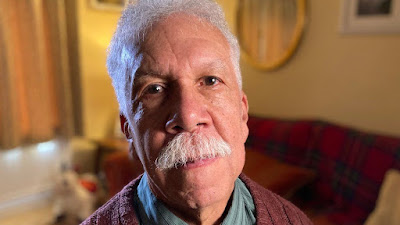
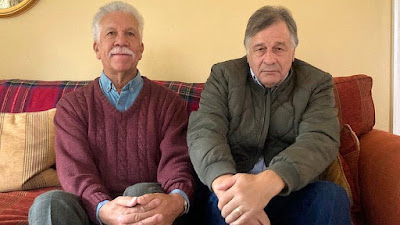
Best friends Eldridge Marriot and Trevor Everett grew up together in Tostock, where they still live today.


As the pair, now aged in their 70s, reminisce over summers spent playing on the village green, it is clear they have a deep connection.


They were two of 14 children in the village, and about 2,000 across the UK, born to white British mothers and black American soldiers during World War Two.


"We definitely stood out with our curly hair," Eldridge laughs. "But we didn't have any racial problems; we were never treated differently."


"We had some good times and I've had a brilliant life, I wouldn't change it for nothing," Trevor adds.


Eldridge says he would have loved to have met his father


As small boys they played in the woods by Tostock Hall, a large house taken over for the war effort, where their fathers were stationed a few years before.


It was very exciting for the village, near Bury St Edmunds, when the soldiers arrived in 1943, Eldridge says.


About 240,000 of the three million US troops, who began arriving in the UK in January 1942, were black.


It was the first time many British people in rural areas had seen a black person.


The US servicemen were mainly helping build airbases, such as Lakenheath and Mildenhall, but in nearby Tostock they were asked to look after Italian prisoners of war at the hall.


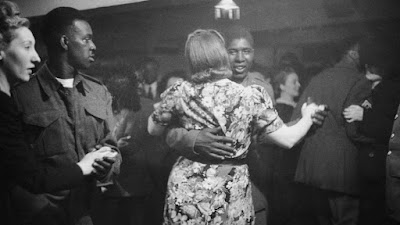
Dances were held at a ballroom attached to the house, where many romances began.


Eldridge and Trevor bonded as children over having absent fathers who were black US serviceman


"A lot of them figured they'd got nothing to lose anyway, they could just disappear back to the States," Eldridge says.

His mother Olive was already married to a merchant seaman who was away at war when Eldridge was born in November 1944. Two months later, his father William Ellis - known as Willie - "disappeared to France, never to be seen again".


When Olive's husband came back and discovered the baby, he said they could only stay married if she put Eldridge into care. Olive refused and they got divorced, while Eldridge went to live with his grandparents.


"My mother wasn't in a position to bring me up," Eldridge says. "She used to come over every Tuesday throughout her life. We never spoke about my father - it was a closed shop.


"My grandfather talked about my father a lot, he liked him. The circumstances were I was left behind and they had to bring me up but they didn't bear any malice at all."


Eldridge's aunt and uncle also lived in the family cottage while he was growing up and he was "spoilt rotten" by them and his grandparents. He later built a house at the end of the garden where he still lives today with his wife.


"All my life I've been on this patch of land. I've had a really good life. It's difficult to see how it could have been any better," he says.


British authorities tried to discourage relationships between white British women and black troops but many romances began at dances like this one in London in July 1943


Trevor was born a few years after Eldridge and the others, in 1946, after his father Paul Woods left his post in France to go back and visit Trevor's mother.


"He got in a lot of trouble for that. He used to climb up a drainpipe to see her; it was very exciting," Trevor says.


His father, who he describes as "half-Indian, a native American" was born in Atlanta and later moved to Maryland.


Trevor still has seven years' worth of letters from his father to his mother, who brought Trevor up and later remarried.


"My mother used to worry someone would come and take me away so she was ever so protective of me. She used to watch me wherever I went," he says.


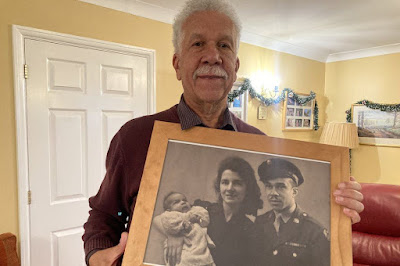
Eldridge's wife had this treasured photo produced for his birthday - a picture of his father Willie superimposed on to a photo of his mother Olive holding him as a baby


Both men grew up in loving homes but that was not the case for many of the so-called Brown Babies - the term given by the African-American press to these children born during the war.


Black troops were not allowed to marry their pregnant white girlfriends and many of the children were given up for adoption, according to Prof Lucy Bland, from Anglia Ruskin University, who interviewed 50 of them for a book called Britain's Brown Babies.


Many of them experienced racism and were shunned by society, like Babs Gibson-Ward. Her mother told her white naval officer husband that Babs was his daughter, until her skin darkened at six months old and the lie was revealed.


She was sent away from her family in Ipswich to live in a children's home until a foster family came forward, but local children avoided her and teachers refused to educate her.


Speaking on The Localist - Suffolk podcast, Prof Bland says: "Nearly half of these babies were put in children's homes. They were often lied to and told their fathers were dead and that their mothers didn't want them.


"They were often called names and didn't understand. Some of them didn't even realise they were a different skin colour; no-one was explaining it to them."


Very few of them were adopted. Officials said it would be impossible to place mixed-race children and the government blocked adoptions from the US, worried they would be seen as dumping them there.


Leon Lomax was one of only a few of the children who went to the US to be brought up by his father, Cpl Leon Lomax.


He arrived back in Ohio at the end of the war with a confession for his wife Betty - he had fathered baby Leon, who was born in Chelmsford, Essex in December 1945.


"As a kid I wondered 'why hasn't my mum tried to find me?,'" says Leon, speaking on the phone from his home in Ohio.


He had a difficult upbringing with his father, who never told him who his mother was or even that he was mixed race.


"I figured I was just black basically," he says. It was only when he had children of his own that he decided to find out more about his heritage.


Leon managed to trace his mother to England, but sadly she had died two years previously.


"I found that I had a sister, Pauline. She said our mother was always nervy around Christmas time and Pauline didn't know why, but I was born on 17 December. My mother never shared anything with her about me," he says.


He recently found a letter his mother had written to his father 75 years ago, detailing her visits to him in the children's home before he was flown to the US.


"She wanted to keep me but could not afford to. I smiled at her for the first time and she was really happy," he says, his voice thick with emotion. "I cried when I read that. It closed a circle for me."


Trevor and Eldridge both decided to trace their fathers when they grew up. Trevor traced his to the US in 1987 with the help of the Red Cross and flew out with his family to meet him.


"He worked in a military hospital and he took me to meet all his friends - he was proud. He used to say he had a son in England, but nobody would believe him."


Trevor spent two days with his father, who was then aged 68, but tragically on his third day out there, his father died.


"I was waiting for ages in this hotel and I thought he didn't want to know anymore," Trevor says. "But then his friend drove up and said 'we've got some bad news, your father died in the night'.


"He died in his chair. They said he died from being overjoyed."


Trevor was pleased to be able to attend the funeral but wishes he had got a photo of them together before he died.

"I didn't get the chance to ask all the questions I wanted to ask," he adds.


Eldridge recently traced his family to Los Angeles, but his father had died in 2004 at the age of 89. He discovered a half-sister called Elsie who was born before him and didn't know of his existence.


"She wasn't really shocked," Eldridge says. "Our father used to tell her he enjoyed his time in Europe. She still lives in the same house as he did.


"Elsie says I look just the same as he did when he was in his 70s," he adds.


Eldridge had always presumed his father was married with children so he didn't attempt to make contact earlier, concerned he would "intrude and spoil his life".


"He was married to his wife for 60 years and kept me a secret all that time. There was nothing he could do. He couldn't say what he had done."


Eldridge says he would have loved to have met him and asked about his time in Tostock.


His son is going to LA to meet Elsie and her family later this year and Eldridge is excited that they are all planning to come to Tostock next year.


And finding Elsie has solved a mystery that has puzzled him for his whole life.


"I always knew my mother in deep Suffolk would never ever have called me Eldridge, and I thought it must come from my father [Willie Ellis]," he says.


"Eldridge was his name at birth. So he obviously picked my name.


"It's a bit unusual, isn't it?" he adds proudly.


(Source: BBC)

Thursday, 13 January 2022

American parents are way too focused on their kids’ self-esteem

 Our over-the-top efforts to ensure that kids feel valued and adored can actually make them feel inept.

For two kids who share so much of their DNA, my children couldn’t be more different in their displays of self-confidence. My 7-year-old recently got toothpaste on her dress while brushing her teeth, and in response, she burst into tears, dropped to the floor, and rolled around screaming, “I’m the worst person ever!” My 10-year-old, however, acts as though his knowledge already surpasses that of Albert Einstein. Whenever we point out that he’s wrong about something, he disagrees, as if the number of moons orbiting Jupiter is a matter of opinion. Sometimes I wonder if my daughter’s self-esteem is too low and my son’s is too high. How important is having the right amount of self-esteem? Does the right amount even exist?


As an American parent, I’ve always assumed that having a healthy amount of self-esteem is crucial for my kids’ well-being. Once that’s secure, the thinking goes, everything else will just fall into place. This idea is such a given that when I was researching my book, How to Raise Kids Who Aren’t Assholes, one of my good friends—also a parenting journalist—advised me to make my first chapter about self-esteem.


But as I dug into the research, I learned that many American parents have been woefully overvaluing and misunderstanding the concept. Having healthy self-esteem does not ensure that kids will fare well or stay out of trouble. And although self-esteem is a tricky concept to study, research suggests that the steps parents take to foster self-esteem in their kids often have the paradoxical effect of undermining it. Our over-the-top efforts to ensure that kids feel valued and adored can actually make them feel inept—whereas intentionally exposing our kids to disappointment and failure, which so many parents are loath to do, can give children a satisfying sense of self-efficacy.


Christopher Anderson / Magnum


For decades, Americans have been a little obsessed with the concept of self-esteem, a measure of how much confidence and value people feel they have. In 1986, the governor of California, George Deukmejian, signed legislation that created the Task Force to Promote Self-Esteem and Personal and Social Responsibility, which concluded that boosting Californians’ collective levels of self-esteem would lower rates of crime, teen pregnancy, drug abuse, welfare dependency, and school underachievement. The task force’s final report referred to self-esteem as a “social vaccine” that is “central to most of the personal and social problems that plague human life in today’s world.”


That’s a bold statement, based on a bold assumption that the U.S. is suffering from an ongoing epidemic of low self-esteem, and that this deficiency is dangerous. You’ve probably heard that teens with low self-esteem are more likely than other kids to be depressed, to be anxious, to drink, to do drugs, and to commit crimes. This is all true. But what might come as a surprise is that the inverse of this statement is not also true. High self-esteem is not a panacea against all things bad, and kids with high self-esteem often make bad choices too.


“It’s unclear, actually, just how important self-esteem may be in terms of predicting healthy outcomes,” says Grace Cho, a developmental psychologist at St. Olaf College, in Minnesota, and the co-author of Self-Esteem in Time and Place: How American Families Imagine, Enact, and Personalize a Cultural Ideal. “The literature is actually really kind of messy and mixed.” In an exhaustive review of the research literature, the Florida State University social psychologist Roy F. Baumeister and his colleagues concluded that “raising self-esteem will not by itself make young people perform better in school, obey the law, stay out of trouble, get along better with their fellows, or respect the rights of others.”


Healthy self-esteem cannot be universally essential for another reason too: It is largely an American construct. Many other countries, including Japan and China, do not give self-esteem much, if any, consideration (some languages don’t even have a word for it). “Even in very modern societies, cultures that we think are very similar to ours don’t necessarily view self-esteem with the same set of ideals that we do,” Cho told me.


America’s obsession with self-esteem makes evaluating and encouraging it difficult and messy. U.S. parents often have a hard time estimating how much self-esteem their children have. “It’s a really complex construct in our day-to-day lives,” Chris Barry, a developmental psychologist at Washington State University, told me. For instance, some American kids (and adults) with low self-esteem outwardly project confidence in an attempt to appear self-confident. On top of that, parents tend to overestimate their children’s self-esteem—perhaps both because kids are adept at hiding their issues, and because parents assume that healthy self-esteem is crucial and desperately want to believe their kids are doing fine.


Parents also try to boost their kids’ sense of self-worth in the wrong way, through effusive praise. One survey found that 87 percent of U.S. parents believe that children need praise to feel good about themselves. But research conducted by Eddie Brummelman, a psychologist at the University of Amsterdam, suggests that praise can sometimes have the opposite effect. When parents give kids with low self-esteem what he calls “inflated” praise—such as saying “Oh, that is incredibly gorgeous!” to a kid who just made a stick-figure drawing—their self-esteem drops even more. Brummelman theorizes that when kids with low self-esteem hear inflated praise, they interpret it as pressure to continue performing exceptionally. They then launch into self-protection mode and end up doubting their ability more. (On the flip side, other research suggests that when we make our kids feel like the center of the universe all the time, we also increase the chance that they will grow up to become narcissists.)


Praising kids specifically for their ability or smarts—which parents do when they say things like “You’re so smart!” or “You’re such a great artist!”—can also pose problems. Research by the Stanford University psychologist Carol Dweck has shown that this kind of praise, compared with praising kids for their effort, increases the chance that kids will buckle in the face of setbacks and have deflated feelings of self-worth. They begin to question the ability they were told they had. Over time, they come to think of ability as a fixed trait—not something that can be cultivated with practice.


American parents today are also quick to protect their kids from disappointment and failure. We give participation trophies when kids don’t win first place; we fly into the school to deliver kids’ forgotten homework. But these well-meaning interventions backfire because a child with healthy self-esteem is a child who has learned, through experience, that he can overcome obstacles and disappointment. He’s had the opportunity to fail and has discovered that failing doesn’t preclude him from being loved.


When I asked Dario Cvencek, a cognitive psychologist at the University of Washington Institute for Learning and Brain Sciences who studies self-esteem, to describe to me what children with healthy self-esteem act like, he said that they’re often kids who are willing to accept a new challenge or work longer on challenging tasks. Perhaps that’s because they have had to do so before, and they have learned that perseverance through disappointment pays off. Martin Seligman, the director of the University of Pennsylvania’s Positive Psychology Center, has argued that “by cushioning feeling bad, it has made it harder for our children to feel good.”


What should parents do to foster healthy self-esteem in their kids? We should stop obsessing over the concept, because it is probably not the be-all and end-all that we think it is. According to Cho, research has shown, for instance, that many East Asian children score low on traditional self-esteem measures, but that they rarely suffer from psychological problems or do poorly in school as a result. This suggests that “self-esteem is just one thing in a myriad of practices that parents can engage in that could help children thrive,” Cho said. We’re not going to ruin our kids by not focusing on it—and we might even help them, given that our approaches for boosting self-esteem are often counterproductive.


We should also be careful about showering our children with indiscriminate praise. Instead, we should be more honest in our appraisals—not by shaming kids or putting them down, but by giving them feedback that is commensurate with their effort. Tell your kid that you like their off-key singing, but don’t tell them it’s the most beautiful thing you’ve ever heard. When we praise our kids, we should encourage their efforts, rather than celebrate them for their achievements, abilities, or smarts. And we should let them experience hardships. When kids face adversity and get through it, they learn that they are loved unconditionally and that failure is not a sign of ineptitude, but an opportunity to learn, grow, and come to believe in themselves.


This post is adapted from Wenner Moyer’s recent book, How to Raise Kids Who Aren't Assholes.


(Source: The Atlantic)