Showing posts with label Sankranti. Show all posts

Monday, 17 January 2022

Food historian Rakesh Raghunathan recalls memories of Pongal

The chef has fond memories of puliyodharai, and talks about his mother feeding him ghee-laden pongal before his early-morning tuition class.

Food historian and raconteur Rakesh Raghunathan, the host of shows like Dakshin Diaries and 100% South Indian, has fond memories of Pongal. “It is always around food, around people coming together,” remembers Raghunathan, adding, “We still celebrate Pongal in a big way.”


This year, Pongal kicks off on January 14. In an interview with Lounge, he talks about his fascination for puliyodharai, describes the food that was served at the festival and shares memories of his mother feeding him a bowl of ghee-laden pongal before his early-morning maths tuition class.
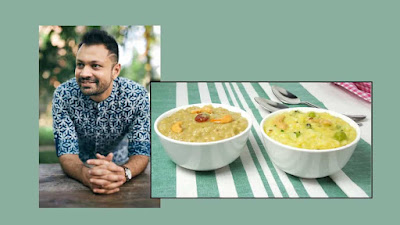

Rakesh Raghunathan (left); bowls of pongal.  


What is the most prominent food memory of your childhood?

I think it is the puliyodharai or tamarind rice. I have very fond memories of being in the kitchen and watching my grandmother and mother make this dish as a child. It was a laborious process. We always lived in a large joint family. We would use age-old heirloom traditional vessels that were really large.


Making the puliyodhorai involved a 3–4-day long process. It begins with getting the vessels from storage and polishing them. Another day, she would plan to fry something; the oil used to fry crisps or papad is used in puliyodharai since it infuses that flavour into the dish. Then, she would roast and grind the spices for the spice powder, make the tamarind concentrate, boiling it for hours into a molten mass. Even today, a whiff of those familiar smells takes me back to my childhood.


She would layer it like a biryani—add the rice first, spice powder, infused oil, tamarind concentrate, and nuts. As she was doing that, I would sit with her, taste every layer, and tell her whether it needs more concentrate, spice or salt. She would talk to me about her own childhood memories of growing up, how it was back then, how she liked cooking--all of that.


How was Pongal celebrated in your own house?
We lived with our grandparents in Chennai. We were a large family, and this would become a hub. All the other family members would end up coming here. The day of Pongal would invariably be only us—my parents, sister and I and my grandparents. Ven pongal, the savoury version of pongal, and sakkarai pongal, the sweetened version of pongal, was made typically. And any sweet to go with them. The dishes are mainly rice-based because it was the festival of harvest.


The day after, something called kanu is celebrated in some homes. It is essentially the sisters praying for the welfare of their brothers. All my aunts, my father's sisters, would come here.


On that day, they would make a lot of variety rice—coconut rice, tamarind rice, lemon rice and more. We would make chips at home—potato chips, sweet potato, and raw banana chips. There was also a particular bean-based kozhambu or curry called the avaramani kuzhambu paired with the tamarind rice. It is very peculiar to our household and the recipe's roots can be traced to our ancestral village Kethandapatti in Tamil Nadu.


The third day of Pongal is usually spent recovering from all that eating (laughs).


What is your most prominent memory of cooking or eating Pongal?
The month preceding the festival, margazhi, is believed to be the sacred month. Generally, women in the household—not to stereotype—wake up early, have a bath and put rangoli outside their home, placing a small ball of cow dung and a red pumpkin flower in the centre of it. My mother has been following this practice for a very long time.


She would then make ven pongal. She makes it every day that month and still does. When I was young, I had tuition classes very early in the morning. I would cycle and go to maths classes at 5.30 am, and she would insist that I eat this pongal and go. So I would wake up at 4.30, brush my teeth, have this pongal and cycle to class. So whether I learnt math or not, I got a lot of sleep (laughs). That is my memory of pongal: going to my tuition having this bowl of pongal filled with ghee and nuts.


What does using the clay pot for cooking do to the dish's flavour? Do you still use this for cooking in your home?
In terms of taste, one may not really know—unless you cook it on a firewood stove, the smoke kind of adds to it. The innate properties of the minerals used to make the terracotta ware is known to neutralise pH levels because the pots are alkaline in nature and therefore interact with the acidity in the food. My aunt uses traditional cookware to make pongal on the day of the festival. My mother, however, has found an easier, less messy option: the pressure cooker.


What is your comfort food and why?
For me, it is a good bowl of rasam-sadam. It may seem like a simple dish but making a good rasam isn't easy. It hit me in the US, where I studied when I was trying to cook it. I had everything—the tamarind, the rasam powder, the lentils—but to make it like my mother was very tough. I didn't know it was so complicated. Even today, people judge wedding caterers based on the rasam they make.


Are we going beyond the idli-dosa-sambar cliché? Do you feel the narrative around South Indian food is changing and what is driving it?
There has been a great shift. I think the micro cuisines of every region is catching on, particularly in South Indian food. Also, people want food presented more aesthetically, thanks to shows like MasterChef and so on. Otherwise, South Indian food has just been this huge mountain of rice with rasam and sambar or chicken or fish curry.


I remember curating a food festival for The Park called Annam to Arancini, which was about reimagining our grandmothers' kitchen, heirloom recipes presented in a very contemporary aesthetic way. For instance, usually, puliyodharai is paired with applams, avaramani kuzhambu and buttermilk. I made an arancini ball with the puliyodharai, coated it with applam and deep-fried it like a patty. I then put it on a bed on avaramani sauce, drizzled some buttermilk and put microgreens on it. When I served it to people they didn’t know it was—it looked very funky. But when they ate it, it took them to their childhood.


Raghunathan's recipe for ven pongal

Ingredients

1 cup rice 
Half cup moong dal
6 cups water
1 tsp ginger, chopped
2 tsp cumin seeds
2 tsp whole pepper
Half tsp asafoetida
10 curry leaves
1 tsp oil
3 tsp ghee
Salt to taste
10 cashews


Method

1. Mix rice and dal together. Wash under running water and strain.
2. In a pressure cooker, add the rice dal mixture along with 6 cups of water.
3. Also add one teaspoon cumin seeds, chopped ginger, asafoetida, curry leaves, salt , oil and a tsp of ghee and pressure cook for four whistles.
4. Remove the cooker when pressure settles down.
5. In a separate wok, mix oil and ghee and heat until hot.
6. Add one teaspoon cumin seeds and whole black pepper. Allow to splutter.
7. Add cashews and roast till golden brown.
8. Add curry leaves and pour the tempering over the molten pongal.
9. Drizzle more ghee on the pongal. 
10. Serve hot with sambar and/or chutney.


(Source: Live Mint)

Monday, 15 January 2018

Three recipes to give the ‘Pongal’ a mouthwatering twist!

Ponga in Tamil means to ‘boil over.’ One of the most popular harvest festivals celebrated in South India, ‘Pongal’ derives its name from this very tradition of cooking the newly harvested rice until it overflows from an earthen pot, writes Jovita Aranha in The Better India. Read on:

Today marks the second day of Pongal, a day dedicated to worshipping the Sun God popularly known as ‘Surya Pongal.’

Cooked in a new mud-pot called ‘Pongapani,’ a special dish with sugarcane sticks is offered to thank the Sun God for the abundant harvest.

This dish is ‘Sarkkarai Pongal.’


Ponga in Tamil means to ‘boil over.’ One of the most popular harvest festivals celebrated in South India, ‘Pongal’ derives its name from this very tradition of cooking the newly harvested rice until it overflows from an earthen pot.

Relished across Tamil Nadu, Andhra Pradesh, Telangana and Sri Lanka, Pongal is cooked using various methods and ingredients.

The traditional Chakkara or Sakkarai Pongal, which is commonly offered as prasadam in temples and cooked in Tamil households, is made of rice, coconut and moong dal and sweetened with jaggery, to give it its quintessential brown colour.

Another variant, Venn Pongal, is made from clarified butter and is typically served as a special breakfast in South India and parts of Sri Lanka with sambar and coconut chutney.

Also, Melagu Pongal, a spicy variant, is made with pepper, rice and moong daal. Meanwhile, Puli Pongal, which usually isn’t associated with the festival, is made with tamarind and boiled rice and is often served for dinner.

But this Pongal, you can give this classic traditional dish your twist with some of these easy-to-make recipes:

Chocolate Pongal


Preparation time: ten mins

Cooking time: 30 mins

Total time 40 mins

Serves: 4

Ingredients
Varagu / Kodo Millet – 1 cup

Yellow Moong Dal / Pasi Paruppu – ¼ cup

Water – 2 cups

Cocoa Powder – ¼ cup

Jaggery – 2 cups

Milk – 1 cup + ½ cup

Cardamom Powder – ½ tsp

Ghee – ¼ cup

Cashews – 10

Raisins – 3 tblsp

Method:
Heat 1 tsp ghee in a pressure cooker, add moong dal and roast for 1 min. Add it to the Kodo millet and mix well. Add water, and 1 cup milk and pressure cook it at least for two whistles, simmer for five mins and turn off the heat. Let the steam go all by itself.

Now take the content in a nonstick pan, add in ½ cup milk, jaggery, cocoa powder and mix well. Keep mixing until it thickens.

Now add ghee little by little and mix well.

Heat some ghee in a pan, fry cashews and raisins till golden and add it to the Pongal.

Add cardamom powder and mix well.

Serve.

Brown Rice Pongal


For all you healthy people out there, who are vying for healthier variants of the classic dish. This is just the dish for you!

Soaking time: 30 minutes

Preparation Time: 10 mins

Cooking Time: 30 mins

Total Time: 1 hours 10 minutes

Serves 4

Ingredients
1/2 cup brown rice

1/2 cup yellow moong dal (split yellow gram)

1/2 tsp roasted and crushed cumin seeds (jeera)

1/2 tsp crushed peppercorns (kalimirch)

1/8 tsp salt

Two tsp oil

1/4 tsp cumin seeds (jeera)

1/4 tsp asafoetida (Hing)

Four curry leaves (kadi patta)

Two whole dry Kashmiri red chillies, broken into pieces

One tsp finely chopped ginger (adrak)

Method
Clean, wash the brown rice and moong dal using a strainer and drain well.

Spread the brown rice on a dry muslin cloth and allow it to completely dry for 30 minutes.

Heat a deep non-stick pan, add the brown rice and moong dal and dry roast on a medium flame for 7 to 8 minutes.

Combine the rice- moong dal mixture, crushed cumin seeds, peppercorns, 3¼ cups of water and salt, mix well and pressure cook for five whistles.

Allow the steam to escape before opening the lid.

Mash it well using a spatula. Keep aside.

Heat the oil in a small non-stick pan and add the cumin seeds.

When the seeds crackle, add the asafoetida, curry leaves, dry red chillies and ginger and sauté on medium flame for 1 minute.

Add this tempering over the cooke+d Pongal and mix well

Serve immediately.

Banana Pongal


Cook a cup of rice and half a cup of moong daal with a few strands of saffron in a pressure cooker till soft.

Mash two bananas and add a cup of condensed milk to it.

Add the rice mixture and stir it in well.

Add nuts, raisins and cardamom and nutmeg powder.

Serve hot with cubes of jaggery on the side.

Saturday, 14 January 2017

Makar Sankranti, the harvest festival

This is Sid's third Makar Sankranti. This is the festival which marks the shift of the sun into ever-lengthening days. Every year it falls on January 14, and very rarely on January 15.

We Hindus dedicate this to the Sun God and it also marks the six months of auspicious period known as Uttaarayana. Yes, it's the same period for which Bhishma in Mahabharata waited to die, as there is a belief that the gates of the heaven open during Uttarayana.

Makara Sankranti is believed to be a time for peace and prosperity. The day is regarded as important for spiritual practices and accordingly people take a holy dip in rivers, especially Ganga, Yamuna, Godavari, Krishna and Cauvery. The bathing in holy rivers is believed to wash away sins.

This is the Suggi or harvest festival for our farmers in Karnataka. On this auspicious day, girls wear new clothes to visit near and dear ones with a Sankranti offering in a plate and exchange the same with other families. This ritual is called "Ellu Birodhu".
The plate normally contains "Ellu" (white sesame seeds) mixed with fried groundnuts, neatly cut dry coconut and fine cut bella (jaggery). The mixture is called "Ellu-Bella". The plate also contains sugar candy moulds (Sakkare Acchu) with a piece of sugarcane.

We eat sesame and jaggery during this festival because the festival marks the arrival of sunny days. Our bodies require moisture and sesame seeds and peanuts which are rich in oil content act as moisturizers.

There is a saying in Kannada "ellu bella thindu olle maathadi" that translates to 'eat the mixture of sesame seeds and jaggery and speak only good.'

This festival signifies the harvest of the season, since sugarcane is predominant in these parts. Ellu Bella, Ellu Unde, bananas, sugarcane, red berries, haldi and kumkum and small gift items useful in everyday lives are often exchanged among women in Karnataka.

In some parts of Karnataka, a newly married woman is required to give away bananas for five years to married women (muthaidhe/sumangali) from the first year of her marriage and increase the number of bananas in multiples of five.

There is also a tradition among some households giving away red berries "Yalchi Kai" with the above.

We prepare Sihi (sweet) and Khara (spicy) Pongal as a naivedyam, besides vada and akki (rice) payasa. It was indeed fun to watch little Sid enjoying Khara Pongal for the first time, though he has tasted sweet pongal several times earlier.  

In north Karnataka, kite flying with community members is a tradition.

Drawing rangoli in groups is another popular event among women during Sankranti.

An important ritual is display of cows and bulls in colourful costumes in an open field. Cows are decorated for the occasion and taken on a procession. They are also made to cross a fire. This ritual is common in rural Karnataka and is called "Kichchu Haayisuvudu."

Happy Makar Sankranti to all!