Showing posts with label Russia. Show all posts

Monday, 19 July 2021

How Gorky’s adopted son became a French diplomat

 Zinovy Peshkov came from a poor provincial Jewish family, but thanks to his natural talents, he had a brilliant career and even became friends with Charles de Gaulle.

Zinovy Peshkov was a son of a Nizhny Novgorod craftsman, who became a French military commander and diplomat. He was a brother of the famous revolutionary Yakov Sverdlov, but an ardent anti-Bolshevik. A graduate of a provincial parish school, he spoke on equal terms with great writers, military leaders and politicians. Zinovy Peshkov had an amazing life story, full of unexpected twists and turns.  


Adopted by Maxim Gorky 

A future French legionnaire and friend of Charles de Gaulle, Zinovy Sverdlov was born in 1884 to the family of a Jewish craftsman in Nizhny Novgorod. The world famous Russian writer Maxim Gorky (his real name was Alexey Peshkov) came from the same city. Gorky knew the Sverdlov family and was particularly fond of Zinovy, an inquisitive and enthusiastic kid.


The young man soon joined the writer’s circle, where he met many rebellious intellectuals and developed an enthusiasm for revolutionary ideas, which even landed him in trouble with the police. They say that after Zinovy converted to the Russian Orthodox Church, his Jewish family renounced him and Gorky adopted him, giving the young man his name. 


Zinovy was very gifted artistically. He had a beautiful voice and a great ear for music and even considered becoming a professional musician. However, his life took a different turn. At the age of 20, Zinovy left Russia in search of adventure and interesting work. Another motive was to escape the watchful eye of the police...  


A friend of de Gaulle 

Canada, the U.S., New Zealand... Abroad, Peshkov worked as a loader at a brick factory, at a fur factory and in a printing house. He tried his hand at business, but went bankrupt. He had relative success working in a Russian publishing house in the U.S., before travelling to France, where he found himself caught in the outbreak of World War I. 

Unlike the revolutionaries he used to know back in Russia, Zinovy did not want Russia and its allies to suffer a defeat in the war. Without a second thought, he signed up as a volunteer. Since foreigners were not allowed to join the French army, he ended up in the Foreign Legion.


In 1915, in an attack near Arras, Peshkov was badly wounded in the arm. The orderlies thought there was no hope for him and wanted to leave him on the battlefield. However, Zinovy’s life was saved by a lieutenant named Charles de Gaulle, who insisted that the wounded soldier be evacuated from the field. Zinovy was then sent to an American hospital in Neuilly.


The arm had to be amputated, but the patient showed great perseverance and learned to manage perfectly well with one arm. That same year, under an order from Marshal Joffre, the Russian legionnaire was awarded the Croix de Guerre with palm at a ceremony in Les Invalides. As for his savior de Gaulle, the two men would become friends. And there was a new war awaiting them... 


An enemy with his brother 

At first, both Zinovy and his brother Yakov were quite taken with revolutionary ideas. However, in the end, different life paths led them to opposite sides of the barricades, turning them into ideological enemies. Zinovy did not accept the Bolshevik Revolution, with its violence and desire to seize and divide everything.


“With him, it was more about some romantic notions of revolutions, which were typical of the young generation at the time. It is for a reason that, after 1917, he never returned to Russia, although, without a doubt, he could have, had he wanted to. Peshkov had long developed different values and ideals. That is why in the Civil War he found himself on the side of the White Army,” says writer and journalist Armen Gasparyan, a member of the Russian Military Historical Society and author of numerous books on Russian military history. 


In the meantime, Zinovy’s brother Yakov became one of the leaders of the Red Terror, a mastermind of repressions against the Cossacks and one of the officials behind the decision to execute the royal family.Yakov publicly disowned his brother, who had become an “agent of the Entente”. In early 1919, Zinovy sent a telegram to Yakov: “Yashka, when we take Moscow, we will hang Lenin first and you second, for what you did to Russia!” But Yashka did not have long to live: in March 1919, he died of the Spanish flu, which was raging in Russia at the time. At least, that was the official version...


It was known that Lenin was not too fond of dangerous rivals.  


Russian-French agent 

His shrewdness and cunning, the ease with which he established contacts, his rhetorical talent and ability to win people over did not go unnoticed in certain circles in France. That was how Peshkov began his diplomatic career. He hit the ground running: very soon Zinovy was sent on very serious and sometimes secret missions to different countries. 


During the Russian Civil War, Peshkov was a member of the French diplomatic mission in the country. He took an active part in the famine relief effort, arranging deliveries of goods from Le Havre and Marseille. He also helped many compatriots to evacuate from war-ravaged Russia.


His next mission was a military one. Peshkov travelled to Morocco, where he was assigned command of a company. The writer André Maurois described him as follows: “…One of those commanders who know how to boost the morale of the humiliated and the insulted, inspiring them to join in the task that the Foreign Legion inherited from the legions of the Roman Empire - the task of serving civilization. When Zinovy Peshkov talks about the Legion, his eyes glint with emotion. He is an apostle of this religion.” 


Despite Peshkov’s anti-Bolshevik views, the French security services kept a close eye on him: After all, his brother was a prominent Bolshevik in Russia and his father was a writer favored by the Soviet regime. That aroused a lot of suspicion. However, today historians are convinced that those suspicions were totally unfounded. “Peshkov certainly did not work for the 7th Directorate of the NKVD of the USSR. Moscow had other sources of information in France. 

But the suspicions that arose are understandable. The papers at the time were full of articles exposing Bolshevik gangsters in Paris. Many emigrants were under suspicion, so it is not surprising that a striking character like Peshkov was, too. But, as far as I know, the Sûreté did not find a single fact indicating his possible ties with Moscow,” Armen Gasparyan said. 


Loyal to France to the last 

In 1940, Zinovy refused to recognize the power of the Nazi occupiers and to serve under the Germans’ command. He was arrested and sentenced to death by a military tribunal. But here, too, he was, once again, saved by his talent of a diplomat and his combat experience in hot spots: he managed to turn his guard, exchange the gold watch that Maxim Gorky had gifted him for a grenade, take the commander hostage, seize a plane and fly it to join de Gaulle’s forces. 


His old friend knew Peshkov’s talents well and entrusted him with serious assignments. Zinovy worked in South Africa to persuade the local authorities to side with the allies. Then, he became the head of the French mission in China and, later, in Japan. Finally, he was elevated to the rank of ambassador. 


During World War II, Zinovy Peshkov received numerous decorations and distinctions, becoming a brigadier general of the French army. He retired in 1950, a highly decorated officer, including with a Grand Cross of the Legion of Honor, and lived in Paris, on rue Lauriston. 


Zinovy died at the age of 82 in Paris and was buried in the cemetery in Sainte-Genevieve-des-Bois. The ceremony was attended by prominent French military figures and politicians. In line with his will, his tombstone carries a simple inscription: “Zinovy Peshkov, a legionnaire.”


(Source: Russia Beyond)

Monday, 2 November 2020

3 myths in Russian history that won't die

 Dmitri Mendeleev didn’t dream up the periodic table, while Ivan the Terrible didn’t kill his son. But these tales, among others, were so believable and repeated so many times people still think they’re true.

1. Emperor Alexander didn’t really die but became a vagabond

In the years before his death, Alexander I of Russia seldom talked about his wish to withdraw from public life. In 1819, he said to his brother Nicholas: “I’m not who I used to be and I think it is my duty to withdraw.” In 1824, he said he wouldn’t mind “throwing off the burden of the crown.”


In the autumn of 1825, Alexander traveled to Taganrog with his wife and abruptly died there because of a fever. An autopsy was performed, and an act was signed by 9 doctors. After embalming, the emperor’s body was transported to St. Petersburg, but only the members of the Emperor’s family saw the emperor in the open coffin; during the subsequent 7 days that the body was in the Kazan Cathedral for public farewells, the coffin was closed.


In 1836, in Perm’ Region, an old man was been apprehended for vagrancy. He called himself Fyodor Kuzmich and was tall with grey hair. He was very physically fit, seemed educated and gentle, but refused to say anything about his past. For vagrancy, Fyodor was sent to Siberia, where he lived and then died in 1864. During his life, he often told stories of St. Petersburg and of famous people, including military commanders Kutuzov and Suvorov – apparently, the old man took part in the War of 1812. 


But who was the first to suggest that Fyodor was Alexander in disguise? Allegedly, Semyon Khromov, a merchant who invited Fyodor to live in his house in Tomsk and was completely sure that the old man was the Emperor – which accidentally made Khromov a celebrity of sorts. So it’s no wonder Khromov even tried to write to Alexander II – but in 1882, when he was apprehended by Tomsk authorities, Khromov said he really knew nothing about the old man’s past. Fyodor himself, while alive, didn’t deny nor confirm the legend.


Before his death, Fyodor gave Khromov an encrypted message that was to reveal his identity, but the message still hasn’t been deciphered up to the present day. Russian historians agree that Fyodor Kuzmich existed, but he wasn’t Alexander I – Fyodor probably was some high-ranked nobleman in the military service, but definitely not the Emperor. 


2. Dmitri Mendeleev dreamed up the periodic table

The legend goes as follows: in 1869, Dmitri Mendeleev strived to discover the periodic trends in the properties of chemical elements. Exhausted, he once fell asleep at his desk and dreamed up the table he couldn’t compose while awake. Springing up from his slumber, Mendeleev took a pen and a paper and quickly drafted the periodic table of elements.


Mendeleev himself never told anyone this story. But his friend, geologist Alexander Inostrantsev, often retold Mendeleev’s alleged story about discovering the table while asleep, despite Mendeleev himself denying this. Speaking to a journalist for the Peterburgskiy Listok (The St. Petersburg Paper) newspaper, he said: “No! Not a dime for a line, as you journalists do! I could have well spent 25 years inventing it [the periodic system], and you say I was just sitting there, and all out of the blue – one dime a line, one dime a line, and it’s cooked!”


Also, Mendeleev wasn’t the first to create a periodic table – in 1864, German chemist Julius Lothar Meyer created one, consisting of just 28 elements. 


3. Ivan the Terrible killed his son with a staff

This myth was, in large part, created by Ilya Repin’s painting ‘Ivan the Terrible and His Son’. However, the chronicles don’t contain any information on this, they just say Ivan’s son Ivan died because of “a disease”. 


In 1963, in Moscow Kremlin’s Arkhangelsky Cathedral, the place of interment of the Russian tsars, corpses of Ivan the Terrible and his sons Ivan and Fyodor were temporarily exhumed. All of them contained arsenic, usual for those times when tsars took homeopathic amounts of arsenic to develop tolerance to it – as it was the most common poison. However, the bones of Ivan and his son Ivan also contained high levels of mercury. Later in the 1990s, comparably high levels of mercury were then found in the bones of Anastasia, Ivan the Terrible’s first wife, and his mother Yelena Glinskaya. The research made it clear that Ivan the Terrible’s family has most likely fell victim to poisoning.


It is widely reported that Ivan was devastated after his elder son’s death. Ivan spent 4 full days next to his son’s bed, while Ivan Jr. was dying. This fact doesn’t fit in the image of a madman who slaughtered his son. Moreover, Ivan the Terrible was preparing Ivan Jr. for tsardom, making him a military commander and summoning him to discuss state affairs. So it was unlikely that Ivan could kill his heir, given the disastrous consequences it would bring – a dynastic crisis. It was clear Ivan’s death was a catastrophe, but who needed it to look like the Tsar killed his son?


The first mention of Ivan murdering his son is found in the papers of Antonio Possevino, a papal legate and the first Jesuit to visit Moscow, who tried to convince Ivan the Terrible to negotiate with the Pope about Russia becoming a Catholic country. When Possevino’s mission failed, the enraged legate smeared the Russian tsar with the accusation of filicide. This defamation was readily spread by other foreign and Russian foes of Ivan the Terrible. And finally, at the end of the 19th century, even made it onto Repin’s famous painting.


(Source: Russia Beyond)

Sunday, 1 November 2020

The Russian stove: More than just heating

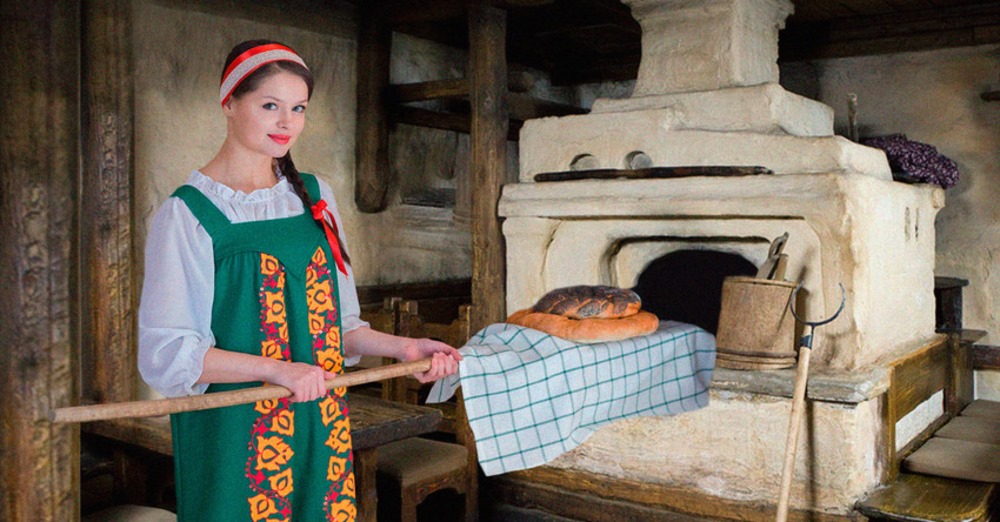
The Russian stove has always been more than just a source of heating. It is an element of culture, a sleeping place, a character in fairy tales and the focal point in a traditional Russian house. Find out who was fond of lying on the stove, in which part of the stove the household spirits lived and why unmarried girls hid behind the stove.

The two most famous Russian fairy tale characters - Ilya Muromets and Yemelya - are inextricably linked with the Russian stove. The former lay on a stove for 33 years until he was endowed with magical heroic powers and sent to fight evil. The latter never left the stove and rode it like a convertible. The stove entered folklore for a reason: Practically until the middle of the last century, it was the focal point around which Russians’ everyday life revolved.


The heart of the house

The stove is the warmest place in a house. To lie on it, feeling warm and cozy and for once idle was the ultimate dream for a peasant. During the winter months, that was the place where peasants spent most of their time. Interestingly, the place on the stove was reserved only for men: either the head of the family or an elder. Whereas women’s job was to keep the stove warm, cook and do other household chores. As for children, they were allowed to climb onto the stove only for a short time, for fun, and only with the permission of adults.


The stove features in numerous Russian literary works like, for example, in Maxim Gorky’s My Childhood:


“I slept on the floor between the stove and the window. There was not enough room, so I had to put my feet in the oven and the cockroaches used to tickle them. This corner allowed me not a little malicious enjoyment, for, when cooking, grandfather was continually breaking the window with the end of the oven-rale, or the poker…”


The stove usually had a “women’s corner”, known as a kut, where men were not allowed in. That was where dishes were kept and where women did their needlework. Often, the kut was separated from the main part of the hut by a special curtain. It was behind that curtain that brides hid before their wedding, women gave birth and breast-fed.


When building a new hut, the first thing to do was to design a stove, and only then everything else. Hence the Russian expression “to dance from the stove”, meaning to begin at the beginning. The stove features in many Russian proverbs, for example: Станешь лежать на печи, так не будет ничего в печи (“If you keep lying on the stove, there will be no food in it”); Хочешь есть калачи, так не лежи на печи (“If you want to eat rolls, don’t lie on the stove”).

What was the stove like?


The Russian stove developed its familiar look approximately in the 15th century. In different parts of the country, stoves could differ in terms of what they were made of (stone or clay) and what fuel they used (mostly firewood, but it could also be dung cakes, straw or peat).

The stove is the main element of the interior in a traditional Russian house. Old stoves could occupy almost half the room. Wooden benches that were used for sleeping were stretched from the stove to the opposite wal.

Stove building was an important element of Russian life. Stove-makers were much in demand and enjoyed much respect, as their job required a lot of knowledge and skill. 

The main part of the stove is the hearth, or the combustion chamber, where the firewood is burnt. The hearth was also used for cooking: clay or cast-iron pots were put inside the hearth when the stove was still burning. It was usually done with special oven forks, which can be found in any Russian ethnography museum. Some stoves had hearths large enough to have a bath inside.


Directly under the hearth is a special recess, known as hearth bottom, where bread was also baked. Dough was put inside when the stove was still hot to get a crispy crust, and was left inside when the fire was already out until it was ready. Stoves were also used for preparing baked milk (click here to find out more about this unique Russian drink).

The sleeping place on the stove (known as perekryshka) was usually located right under the ceiling, where the air was the warmest. Even when the fire was already out, the stove would take a very long time to cool, so food and water could be heated in and on it. Usually, there were small niches in the stove that were used for drying or storing food, like mushrooms or herbs, or for putting away clothes or shoes.


Firewood, a poker and other appliances were usually kept by the fireside, which was also the favorite place of mice and cockroaches. That was also where various unused items were usually stored.


In well-to-do households, stoves were decorated with painted clay tiles. This craft became particularly popular in the late 19th and early 20th century, with the fashion for the so-called ‘Russian Style’. This decorative element still remains popular. Click here to find out more about Russian stove tiles.


Mystical and practical significance of the Russian stove

Superstitious Russian peasants believed that household spirits lived behind or under the stove. It was believed that stoves could heal, so sick people would lie on a stove in the hope of a speedy recovery. Also, stove steam was used for inhalations, as it was believed to possess medicinal properties. Stove ash was not thrown away but used for making ointments, decoctions as well as for more mundane purposes, as soap and bleach for clothes.


Stoves were lit with the onset of cold weather: from October till April or May. Russians always had many signs and superstitions about the weather, and stoves were one of the sources of their weather forecasts. If the draft was strong or the fire red, one could expect frosty weather. Whereas, if the firewood was burning quietly and the fire was white, a thaw was on the cards.


The stove today

From the mid-19th century, massive Russian stoves began to give way to compact Dutch brick stoves. The latter not only took up less space, but had a much simpler design. One could not lie on them, but they had a small platform on top for preparing food, like a cooker.


These days, the traditional Russian stove has become a rarity and can only be found in museums. Whereas, its smaller and simpler Dutch variety is still in use in villages today.


(Source: Russia Beyond)

Friday, 30 October 2020

TOP 3 rare Russian AKs used in Netflix’s ‘To The Lake’

 Еverything you need to know about the baddest Russian guns of the hit TV Show. 

The Russian-made ‘To The Lake’ TV show became one of Netflix’s most streamed TV shows just a week later after its premier on the streaming platform. 


It’s a post-apocalyptic drama about families in Russia risking their lives as a fast-spreading deadly virus is on the verge of breaking down society.


The show also features a number of rare Soviet and Russian-made AKs that you don’t often see on a TV screen.


AKS-74U

This is a compact version of the AK-74M that became the weapon-of-choice of the main character and his former wife. We know little of how the heroes obtained a fully-automatic version of a compact Spec Ops assault rifle, but for sure, they have a pretty darn good taste in rifles. 


The weapon first appeared in the Soviet military in the late 70s. It has a barrel and a shortened gas piston that are two times shorter compared to the AK-74M. Engineers shorted the twists inside of its barrel from 200 up to 160 mm, in order to stabilise a bullet during flight to its target. However, due to the shortened fore grip, it’s impossible to install a grenade launcher on the bottom of an AKS-74U.

All of its other mechanisms are identical to an AK-74M, with the exception of the trigger turn limiter installed instead of the rate of fire retarder.


The AKS-74U is chambered with powerful 5,45x39 mm rounds, thus making it way more powerful compared to the vast majority of submachine guns. It’s very reliable and easy to clean and maintain. 


It also has great muzzle velocity of a bullet (735 m/s versus 400-450 of 9x19 ‘Parabellum’).


All of these factors make it a great weapon-of-choice for the characters. 


Saiga semi-auto rifle

The ‘Saiga’ series of rifles is based on the AK weapon system. The series was developed for those who wanted the reliability of an AK pattern rifle in a non-military package. 


Basically, the assault rifle used by the characters is an AK-74M, but only firing in semi-auto. This assault rifle earned its fame for its durability, accompanied by reliability and tactical capabilities. This AK modification fixed a number of AK-47 cartridge disadvantages, such as accuracy and range. You can find out why the USSR dropped the most powerful cartridge for the 7.62 x 39 mm Kalashnikov AKM here.  


So, the AK-74M - or Saiga - the main character uses is chambered with 5,45x39 mm rounds. It’s originally used for hunting and at shooting ranges in Russia. As could be seen on screen, the main character mainly uses it as a showpiece at home, as he previously had no experience in firing or holding the weapon. 

The AK-74M is a lighter version of an AK-47 or an AKM. It’s mainly created out of polymer materials, instead of wooden parts of previous AK models. The new weapon also received a muzzle break to decrease the weapon recoil and weapon’s ‘tossing' upwards after firing. 


As for today, Saigas chambered with 5,45x39 mm can be found in hunters’ arsenals all around Russia and is one of the most favourite weapons in the country, due to its price (around $500) and the high reliability of AK models. 


AK-12

It’s funny, but the AK-12, the most bad-ass assault rifle of modern Russia, is used by the baddest guys in the series - by private military company soldiers, who raid rich people’s houses in the first two episodes. 


The AK-12 increases the classic AK rifle’s ergonomics and accuracy, while saving the reliability of the system.


It received a new retractable side-folding shoulder stock that can be suited for any user’s anthropometry. You can adjust the weapon to any circumstances - even while wearing body-armor, crawling through mud or grass in a field, forest or on a shooting range. 


AK-12 also has a new pistol grip that holds all the instruments required for complete disablement of a rifle. 


Yet, the rifle is still compatible with magazines from the AK-74, RPK-74 and even the 96-round drum mag from the new RPK-16 machine gun.


You can also notice Picatinny Rails on the top and bottom of the rifle. This feature allowed the bad guys to install various scopes, red dots, optics and flashlights. 


Moving forward to the tip of the rifle, you can find an army-style muzzle brake for smashing windows and cutting barbed wire.


Also worth mentioning, the action system of an AK-12 remains the classic one - it’s a gas-operated long stroke gas piston with a rotating bolt.


(Source: Russia Beyond)

Monday, 26 October 2020

7 facts about Matryoshka, the iconic Russian doll

These traditional souvenir toys are full of surprises (and smaller versions of themselves, of course).

1. Younger than you think

At first glance, the Matryoshka might look like an ancient folk character, but in fact, it only appeared in 1890 - and it has real “authors”, turner (lathe operator) Vasily Zvezdochkin and painter Sergei Malutin. Both men worked at the Savva Mamontov workshop for kids. Mamontov was a famous Russian industrialist, merchant and patron of the arts.


According to one version of Matryoshka’s creation, the wife of Mamontov once brought a wooden figure to the workshop. It depicted a Japanese wise man and contained five figurines of his students inside. Inspired by this multi-layer idea, Zvezdochkin carved eight wooden figures, and Malutin painted them.


Another version says that they created the doll themselves (there had already been some examples of such figures with “surprise” inside before – resembling Easter eggs), and the “Japanese origin” legend only appeared in Soviet times.


In any case, the first Matryoshka resembled a lady in a shawl holding a black cockerel. Inside were figurines of boys and girls, with the last one being a baby. This doll is still preserved at the Toy Museum in Sergiev Posad outside Moscow.


2. Matryoshka’s real name 

Matryoshka is actually the “pet name” for the female name Matryona, that was popular in the 19th century among peasants and means “mummy”, “respectable lady” or “the mother of a big family”. 


Some rumors say that it was the name of Mamontov’s housemaid. After all, the name perfectly suited this Russian doll with the entire “family” inside.


3. There was a big gap in Matryoshkas production

On the brink of the 20th century, Russian folk style became trendy in architecture, music, and art, thanks to Sergei Dyagilev’s ‘Russian Seasons’ and regular international crafts exhibitions. Russian Matryoshkas were on display in Paris, Berlin, London, Greece, Turkey and the Middle East. After the fall of the Russian Empire, the production of these dolls went into decline: the country was engaged in a civil war and then in World War II. 


The “most Russian souvenir” was reborn in the late Soviet Union, when lots of foreign tourists began visiting the country and craftsmen started reviving old workshops.


4. There are five main Matryoshka painting styles

There are several Matryoshka production centers in Russia and therefore more than one main style of painting. The most famous style was born in Sergiev Posad (or Zagorsk in Soviet times), the city that has a long history of making wooden toys. They depict girls in a shawl and a saraphan (folk dress) with an apron, using only 3-4 colors (usually red, yellow, green) with black contours.


Another style of painting belongs to craftsmen from the village of Polkhov Maidan (near Nizhny Novgorod). They decorate their dolls with roses in bloom.


Matryoshkas made in Semenovo (Nizhny, too) wear yellow or red polka dot shawls and hold flowers. Usually, these Russian dolls consist of 6-8 figures.


5. Choosing the right type of wood for matryoshkas is the key

A Matryoshka starts from the right wood. The most suitable tree for making the doll is a linden. However, some makers also use wood from birch, aspen, or larch trees. The tree should be cut in early spring or winter, when it has little to no sap. The bottom part of the doll is made from wood that was dried for two to three years. The upper part is made from fresh wood, which will dry later: that’s why the doll can close so tightly.


6. The double meaning

Russian artists often played with the Matryoshka concept to include irony in their creations. Even before the Revolution, there were such dolls as the groom and the bride with LOTS of their relatives inside. In 1912, commemorating the 100th anniversary of the Patriotic War, Kutuzov and Napoleon dolls with their armies inside were made. 


Since Perestroika, craftsmen have been creating Russian dolls depicting famous politicians from all over the world. You can easily find Matryoshkas with Lenin, Trump and Putin in the local souvenir shops. Who do you think is inside them?   


7. The biggest Matryoshka is located in China

Near the Russian-China border, in the Chinese city of Manzhouli, is a mall and amusement park called ‘Matryoshka’ with officially the biggest Russian doll in the world. It’s height is a whopping 30 meters. The main Matryoshka is surrounded by eight smaller dolls and 200 even smaller figures. Moreover, the vast majority of modern Matryoshkas are also now made in China. In Russia, dolls are still produced in some villages in Nizhny Novgorod. So there’s every chance that while on Arbat street in Moscow and/or at other tourist locations in Russia you will accidentally buy a Chinese made Matryoshka. So, double check with the shop assistant.


(Source: Russia Beyond)

Monday, 27 July 2020

Moscow-on-Thames: Soviet-born billionaires and their ties to UK's political elite

How party donations, sports teams and lavish London residences have granted access to highest echelons of public life

Businesspeople born in the Soviet Union play a significant role in British business and politics. Some have given money to political parties. Others have made substantial investments in media and industry. All have homes in London, with several visiting regularly from Moscow.
Boris Johnson pictured with Alexander Temerko, who has given more than £1.3m to the Conservative party. Photograph: alexandertemerko.co.uk

Following a week in which Russia and its links to the UK have been in the news, the Guardian has looked into the impact of Soviet-born men and women on recent UK public life.

Lobbying and the media
Alexander Lebedev bought the loss-making Evening Standard newspaper in 2009, installing his son Evgeny as proprietor. Lebedev later acquired the Independent and launched a successful spinoff version, the i. The Standard office is around the corner from where Lebedev worked in the 1980s as an undercover spy based at the Soviet embassy.

As he recounts in his memoir, Hunt the Banker, the KGB approached Lebedev in his final year at university in Moscow. He learned espionage at the Red Banner Institute and joined the KGB’s prestigious first directorate, specialising in foreign intelligence work. After the USSR’s collapse, Lebedev went into banking and the media.

Lebedev funded Russia’s independent Novaya Gazeta newspaper. In 2016, however, he wrote a column in the Evening Standard defending Vladimir Putin after the Russian president’s close friend Sergei Roldugin appeared in the Panama Papers. Lebedev supported Russia’s takeover of Crimea and held a conference there in 2017 to counter what he said was western media “bias”. Russia’s foreign ministry spokesperson Maria Zakharova went to his Moscow book launch.

In recent years, Lebedev has come under scrutiny over his close personal ties with Boris Johnson.
Alexander Lebedev (left) and his son Evgeny (right), with the former chancellor George Osborne in September last year, when Osborne was editor of the Evening Standard. Photograph: David M Benett/Dave Benett/Getty Images

In spring 2018, Johnson flew to the Lebedevs’ villa in Perugia, Italy. The then foreign secretary left his security detail behind and was spotted at the airport on his way home, dishevelled and hungover. 

Johnson attended Lebedev’s 60th birthday party the day after winning December’s general election. David Cameron and then Evening Standard editor George Osborne were guests too.

Meanwhile, Lebedev’s billionaire Moscow contemporary Alexander Mamut bought the bookshop chain Waterstones in 2011 for £53.5m. 

Mamut introduced a Russian-language section to its store in Piccadilly Circus, central London. His then teenage son was educated at a leading British private school.

Mamut owns extensive media assets in Russia, including the news website Lenta.ru. In 2014, he fired its editor, Galina Timchenko, after she published an interview with a Ukrainian nationalist. Mamut replaced her with a pro-Kremlin journalist. In 2018, he sold a majority stake in Waterstones to a hedge fund.

The PR executive and former Ulster Unionist MP David Burnside has introduced several prominent Kremlin figures to senior Conservatives. His communications firm, New Century Media, founded a Positive Russia foundation to improve Moscow’s image in the UK. One of Burnside’s employees is Alex Nekrassov, whose late father Alexander was a Kremlin adviser and hardline Putin apologist.

In 2012, Burnside took a Russian embassy diplomat, Sergei Nalobin, to a Conservative party fundraising dinner. Nalobin, the son of a senior officer in the FSB, the successor to the KGB, founded the Conservative Friends of Russia, a parliamentary group. Its 2012 launch party took place in the Russian ambassador’s Kensington garden.

John Whittingdale MP and Carrie Symonds, then a young Tory party worker and now Johnson’s fiancee, were among the guests. Raffle prizes included a biography of Putin and bottles of vodka.

The following year, Burnside invited Vasily Shestakov, an influential MP in Russia’s Duma, to the same Tory fundraising dinner. He introduced him to the prime minister, David Cameron. Shestakov is an old friend of Putin’s and with him co-authored several books, including Learn Judo With Vladimir Putin and Judo: History, Theory, Practice.

Politics
The Conservatives have received more than £3m from wealthy Soviet-born donors – all of whom can legally give money to the party as British citizens. They include Alexander Temerko, a former Russian junior defence minister, and Lubov Chernukhin, a financier whose husband Vladimir served in Putin’s cabinet as deputy finance minister.
Alexander Temerko said he was ‘no friend’ of Vladimir Putin. Photograph: Bloomberg via Getty Images

Temerko has funded the constituency associations of several leading Tory MPs, including the business secretary, Alok Sharma, and Mark Pritchard. Pritchard sits on parliament’s intelligence and security committee (ISC), which on Tuesday published its long-awaited Russia report. The Scottish National party has called on Pritchard to resign from the committee or give the money back.

In an interview with the Guardian, Temerko said he was “no friend” of Putin’s, whom he called an “enemy of democracy”. He said he had zero intention of going to Russia. Temerko has given more than £1.3m to the Conservative party. He would not be drawn on whether the Kremlin had interfered in the EU referendum vote in support of Leave, but said that he opposed Brexit.

An investigation by Reuters, based on conversations with Temerko, alleges that he supported Johnson’s campaign to take Britain out of the EU – at least initially. It said the industrialist had funded some of Johnson’s key allies in parliament, including James Wharton, who ran Johnson’s successful prime ministerial campaign. Johnson and Temerko were close, sharing bottles of wine and sometimes calling each other “Sasha”, it added.

In contrast to Temerko, Chernukhin keeps a low public profile. The former banker turns down interview requests and has not publicly explained why she has given the Conservative party more than £1.7m. Born in the Soviet Union, Chernukhin is the biggest female donor in British political history and one of the Tories’ most important cash supporters.

Her largesse seems directed at whoever is the Conservative leader. In 2014, she paid £160,000 at a Tory fundraiser to play tennis with Cameron and Johnson, then the PM and London mayor. She paid £135,000 in April 2019 for a dinner at the luxury Goring hotel with Theresa May, also then the PM, and several female cabinet members.

Other donations have flowed to Brandon Lewis, the former Tory party chairman. He has received £24,500, according to Electoral Commission filings. He defended the donations in media interviews on Thursday. Cash has also gone to Theresa Villiers, who sits on the ISC. In February, Chernukhin spent £45,000 on another game of tennis with Johnson and Ben Elliot, the Tories’ co-chair. The SNP is calling on Villiers to return the money.

Chernukhin’s husband served as a Russian minister in 2000, during Putin’s first presidential term. He was chairman of Vnesheconombank (VEB), a bank and state corporation with reported close ties to the Kremlin security establishment. He later left Moscow and became a British citizen in 2011. The couple have an £8m London mansion, owned by an offshore trust, a jet and two yachts.
Lubov Chernukhin (fourth from right, next to Theresa May) paid £135,000 to attend a dinner last year with senior female Conservatives at the Goring hotel in central London. Photograph: Elizabeth Truss/Twitter

Another prominent figure is Andrei Borodin, the former president of the Bank of Moscow. In 2013, Borodin attended the Conservatives’ summer ball with his wife Tatiana Korsakova, a model, four months after receiving political asylum. He spent £40,000 on a portrait of Margaret Thatcher.

The payment was made by Henley Concierge, a firm registered to a cottage on Borodin’s £120m country estate near Henley-on-Thames, Oxfordshire. Borodin said he did not discuss party policy at the event, nor make a donation. Russian authorities have accused him of a massive fraud. Borodin denies this and says he’s the victim of a politically motivated witch-hunt.

Business and property
Super-wealthy businessmen from former Soviet countries also control a dizzying array of UK assets spanning football clubs, oil and gas and multimillion-pound mansions. Their financial clout affords members of this select group considerable influence and access to Britain’s professional and ruling classes.

Perhaps the most high-profile London-based oligarch, thanks to his £140m purchase of Chelsea Football Club in 2003, is Roman Abramovich. The Israeli-Russian billionaire has limited UK business interests outside football, but his extensive property portfolio includes a 15-bedroom mansion in London’s prestigious Kensington Palace Gardens, bought for £90m in 2011.

The Chelsea owner’s wealth is derived partly from proceeds from the controversial privatisation of the oil giant Sibneft after the fall of the Soviet Union. When Sibneft needed an international communications chief it turned to Greg Barker, who would go on to become Conservative energy minister under David Cameron.

Lord Barker of Battle, as he has been known since his elevation to the House of Lords, has also worked for another Russian businessman with the ear of Britain’s powerful elite, Oleg Deripaska. Deripaska attracted public attention in 2008 over claims that he discussed making a donation to the Tories with George Osborne, during a meeting held aboard his yacht in the Mediterranean.
Roman Abramovich, pictured in the stands at Chelsea FC’s Stamford Bridge ground, in 2017 - the last year Chelsea won the Premier League. Photograph: Ben Stansall/AFP via Getty Images

In 2017, Deripaska listed his En+ energy and metals group on the London Stock Exchange and turned to Lord Barker to serve as its chairman. The Tory peer received a bonus of $4m (£3.14m) after helping Deripaska get the company removed from a list of firms hit by US sanctions.

Barker and Deripaska are not the only peer and oligarch double-act on the UK business scene. The legendary oil dealmaker and former BP boss Lord Browne is executive chair of billionaire Mikhaeil Fridman’s Letter One Energy group, which has a one-third stake in the oil and gas company Wintershall DEA.

Fridman and Browne enjoy a longstanding business relationship that includes the foundation of TNK-BP, a joint venture involving British oil supermajor BP and a group of three billionaires, including Fridman, under the banner AAR. The relationship between BP and AAR often proved acrimonious and TNK-BP boss Bob Dudley was at one stage forced to flee the country fearing for his safety. After a power struggle, AAR eventually sold its half in the venture to Russian state-owned oil giant Rosneft. That deal left BP with a near-20% stake in the Kremlin-backed company, making cordial Russian relations vital for BP. Rival Shell also has interests in Russia via the huge Sakhalin-2 offshore gas project.

One of the other billionaires behind AAR, Sir Leonard (Len) Blavatnik, also wields significant influence in the UK. Blavatnik was born in Odessa, in Soviet Ukraine, but has renounced Russian citizenship and is a dual US-UK citizen. Blavatnik has amassed a vast business empire, including Warner Music. He endowed Oxford University by spending £75m to found the Blavatnik School of Government. He also sponsors the Baillie Gifford literature prize and is the main benefactor of multiple London museums and art galleries. Like Abramovich, he owns a mansion in Kensington Palace Gardens, a property that has been valued at up to £200m.
Greg Barker, a former Conservative minister, has worked for the Russian oligarch Oleg Deripaska. Photograph: Martin Argles/The Guardian

But that pales in comparison to the estimated price tag on Witanhurst, often referred to as Britain’s most expensive home. The mansion in London’s upmarket Highgate was bought for £50m in 2008 by the family of the Russian fertiliser baron Andrey Guryev, through an offshore company called Safran Holdings, located in the tax haven of the British Virgin Islands. It has been valued at more than £300m after extensive refurbishment.

A few miles across north London lies Arsenal Football Club, in which the Uzbek-born Russian metals, mining and publishing billionaire Alisher Usmanov was a long-time shareholder – even at one time considering a full takeover. Ultimately he sold his shares for £550m in 2018 to the US sports tycoon Stan Kroenke.

One of London’s most successful Russian businessmen is Andrey Andreev. He has made a fortune of close to £1bn by founding dating apps, including the female-focused Bumble and Badoo.

• Luke Harding’s latest book Shadow State: Murder, Mayhem and Russia’s Remaking of the West (Guardian Faber) is available from the Guardian Bookshop.

(Source: The Guardian)

Saturday, 20 June 2020

Coronavirus: Covid-denying priest Father Sergei Romanov seizes Russian monastery

An ultraconservative Russian priest who denies coronavirus exists has taken over a women's monastery by force.


Father Sergei Romanov entered the Sredneuralsk convent outside the city of Yekaterinburg on Tuesday.


The mother superior and several nuns have left and armed guards are patrolling the site.


Father Sergei has stated church authorities "will have to storm the monastery" if they want him to leave.


Police visited the site on Wednesday but made no arrests.


Father Sergei Romanov has encouraged people to disobey public health orders. Getty Images


The controversial cleric was barred from preaching in April and then stripped of the right to wear a cross in May after he encouraged the faithful to disobey public health orders.


Father Sergei helped found the Sredneuralsk Convent in the early 2000s, and hundreds of supporters have flocked there over the years to hear his sermons.


Russian authorities shut churches to worshippers on 13 April amid the ongoing pandemic, and only reopened them this month.


On Thursday officials reported Russia has confirmed 7,790 new infections - its lowest daily rise in six weeks - bringing the total recorded cases to 561,091. The official death toll stands at 7,660, though critics fear the true number is far higher.


What's happening at the monastery?

Father Sergei has described the ongoing coronavirus outbreak as a "pseudo-pandemic" and accused church leaders of "working with the forerunners of the Antichrist" by closing churches.


After suspending him in May the Russian Orthodox Church organised an ecclesiastical court to determine his future.


But at the court session on Monday Father Sergei told officials his conscience was clear and declared they would have to kick him out of the Sredneuralsk monastery by force. He left the meeting, and on Tuesday seized control of the site.


Reports suggest many of the armed men now guarding it are veterans of the ongoing conflict in eastern Ukraine. Journalists are barred, though one reporter from Russian newspaper Novaya Gazeta managed to get inside past the guards and met Father Sergei.


"The diocese forbids me to serve, forbids me to speak. But I was blessed to speak," he told the journalist.


The controversial cleric has been banned from preaching. Getty Images


Father Sergei faces another session of the ecclesiastical court on 26 June.


The Yekaterinburg diocese says Mother Superior Varvara - who has led the convent since 2005 - left temporarily "to avoid unnecessary strife", and said the cleric should use the time ahead of his next court date "for correction and repentance".


Who is Father Sergei?

A former policeman, Father Sergei spent 13 years in a prison colony for murder - though his supporters deny this is the case. He was released in the late 1990s.


Legally, the priest has changed his name to Nikolai Romanov, in honour of Russia's last Tsar Nicholas II. The former emperor and his family were thought to have been buried outside Yekaterinburg after their murders in 1918, near the Sredneuralsk site, and Father Sergei is seen as the figurehead of the shadowy "tsar worshipper" movement within the church.


Father Sergei has made numerous controversial claims in the past, including suggesting the Antichrist would soon rise in Russia as a counterpart to President Vladimir Putin, and has criticised laws against domestic violence and anti-Semitic sermons. He has also ministered to several Russian sports stars and politicians.


(Source: BBC)