Showing posts with label Ramadan. Show all posts

Wednesday, 20 May 2020

'It’s a very different Ramadan': how coronavirus has upended ancient rituals

This year, Islam’s holiest month has been held in lockdown in Australia. Mufti Zeeyad Ravat, from Melbourne, sees some positives: ‘It’s bonding families’

Mufti Zeeyad Ravat is an Islamic scholar, an authority on the day-to-day practice of Islam. His path to Australia was a circuitous one, from his birthplace in Johannesburg, South Africa, through India, Syria (where he studied Arabic), Brazil, Brisbane and Melbourne. In March last year, he travelled to New Zealand to lead a prayer service in Christchurch after 50 worshipers at a mosque were slaughtered.
During Ramadan, Mufti Zeeyad Ravat broadcasts lessons live on social media from his home in Melbourne, Australia. He sees coronavirus as a test and a vehicle to take him closer to God. Photograph: Gay Alcorn/The Guardian

Ravat, 39, is a bundle of energy, his arms waving to make a point, one leg tucked underneath him on a recliner in his home in Dandenong in south-east Melbourne. The everyday noise of family life (he is married with five children) break through from the next room as he explains how important Ramadan is, and how the coronavirus pandemic has upended its rituals.

“It’s a very different Ramadan,” he says. “I think it’s the first and last Ramadan of this kind.”

There are 1.8 billion Muslims in the world. More than 600,000 live in Australia, some born here, some arriving from countries as diverse as Indonesia, Turkey, Lebanon, Egypt, Indonesia, Pakistan and Somalia. There are different cultures, different traditions.

Like the followers of any religion, there are the devout and the less devout. Some people, says Ravat, pray five times a day. Others turn up for Friday prayers only. But Ramadan is special.

Ramadan is Islam’s holiest month, a time for reflection and self-discipline, as well as fasting from dawn to dusk for 30 days. This year in Australia, it began on 23 April and ends on 23 May.
Mufti Zeeyad Ravat (right) leads a prayer at the Deans Avenue memorial near the Al Noor mosque in Christchurch on 19 March 2019. Photograph: Anadolu Agency/Getty Images

The idea of Ramadan hasn’t changed, Ravat says. It’s a time when acts of goodness – always an obligation – are especially rewarded. The practice of generosity, particularly to the poor and vulnerable, is intensified. Ravat’s garage is full of boxes of groceries ready to be delivered to those struggling to buy food.

“We look forward to the month of Ramadan, because it’s that time that whatever you couldn’t do in the last 11 months, it’s the one month that you can speed up things, you can get things going from the spiritual perspective.”

The world is full of greed and power, he says, and “fasting is to realign our focus. We keep hungry for 30 days during the day. It’s taming the ego, and ultimately, slowly, that ego breaks down and the spirituality takes over. It’s about becoming peaceful.”

The rituals of Ramadan are impossible this year, with academics saying the restrictions are a first for Islam.

There are no communal gatherings in mosques for “tarawih” prayers every night after the fast is broken. There are no large iftar dinners with family and friends.

Last year, Ravat spent Ramadan at the Pillars of Guidance Community Centre, which he helped found in Melbourne’s south-east in 2016. Ravat is Sunni, of the Hanafi school, but says the centre’s purpose is to welcome everyone. There’s a strong social welfare program, youth classes, advice on traditions such as weddings, and a fine-dining restaurant.
The Gallipoli mosque in Auburn, Sydney, is among places of worship around the world that are closed to prevent the spread of coronavirus. Photograph: Brook Mitchell/Getty Images

During Ramadan, Muslims gathered at the centre after dusk to listen to Ravat recite a chapter of the Qur’an (the whole Qur’an is spoken over 30 days) and to teach a lesson afterwards.

As a boy in South Africa, Ravat memorised the Qur’an – a respected but uncommon practice among Muslims – and says that even if people can’t understand Arabic, it has meaning.

“It’s so melodious and beautiful that when you read it it actually soothes you and the meaning is so beautiful, because God is talking to you,” he says.

This year, mosques and other places of religious worship are shut to prevent the spread of coronavirus. Families are expected to recite the tarawih prayers at home and iftars are only for households. Each evening, Ravat or his eldest son recite a chapter of the Qur’an to the family. The little ones, he says, get a little tired of the prayers and are not expected to fast every day.

“The challenge is that in normal Ramadans, you have a strong environment in the mosque, a community that creates that vibe of Ramadan,” he says. “You go to the mosque, everyone is praying, and the imam is reading … and there’s these huge iftars that are happening.

God creates everything, whether it is a plague or whether it’s good times- Mufti Zeeyad Ravat

“There’s no environment [now] … that has bothered a lot of people, a lot of people are feeling down,” he says.

But “disaster is the mother of invention”. A week before Ramadan, Ravat set up a makeshift studio in his living room, with a camera and lights. Each night he broadcasts a lesson live on social media. His 18-year-old son, a tech wizard, works the camera. Up to 12,000 people have tuned in.

Similar experiments are happening across the country. Dr Ibrahim Abu Muhammad, the Grand Mufti of Australia and New Zealand, has said that online tarawih prayers should not be held “because one of the conditions of the group prayers is that there is direct contact between the imam and the people”. But online lessons and teachings are encouraged.

Ravat sees some positives emerging.

“It’s bonding families,” he says. “We’re stuck at home now [and] we actually eat much more slowly because there’s no rush.”

Every major religion has struggled to explain suffering in a spiritual context. Some believers have argued that natural disasters are a test of faith; others that they are a punishment of some kind, a notion that can seem cruel.
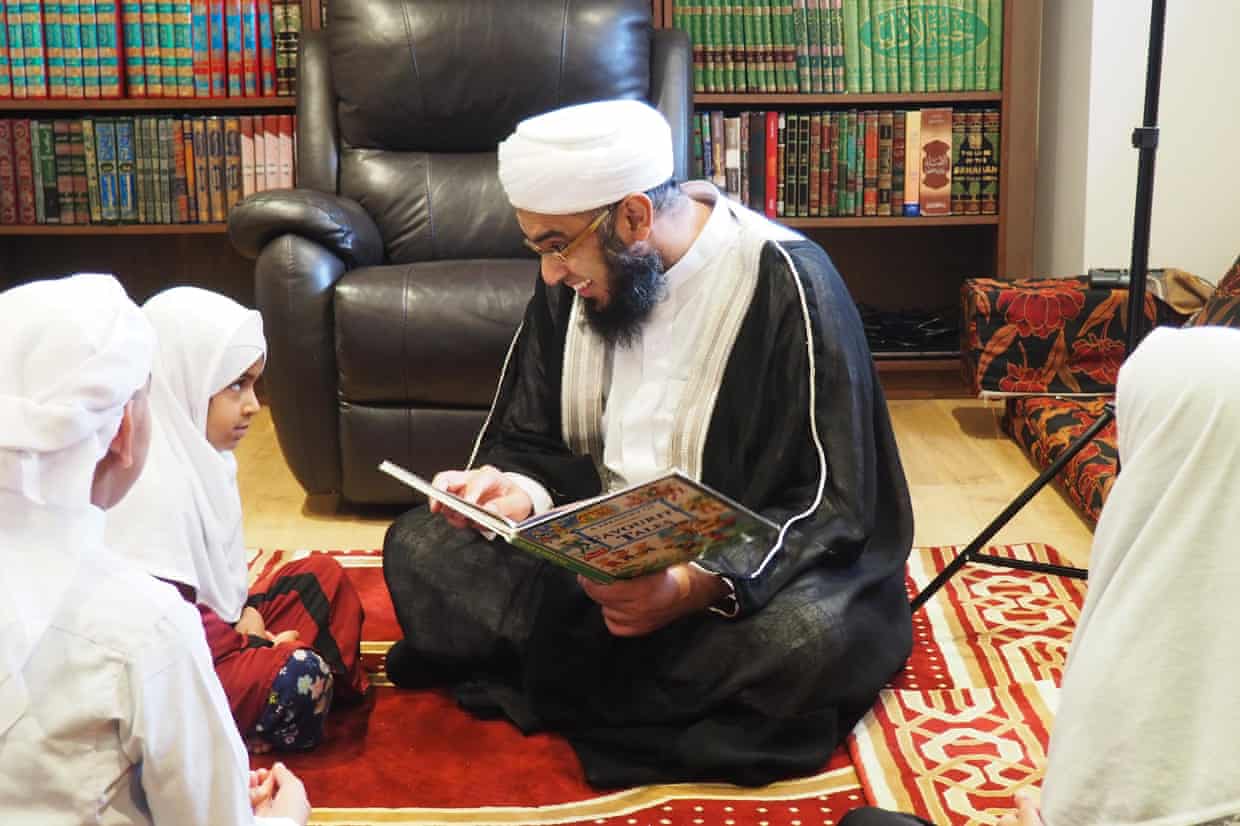
Mufti Zeeyad Ravat gives a lesson to his children at home. Photograph: Gay Alcorn/The Guardian

Jesuit priest James Martin wrote in the New York Times that it’s the same question when a single child dies from cancer or a hurricane kills hundreds of people: why, if God is all powerful and all-loving, does he not prevent such suffering?

“In the end, the most honest answer to the question of why the Covid-19 virus is killing thousands of people, why infectious diseases ravage humanity and why there is suffering at all is: we don’t know,” he writes.

For Ravat, Allah is all-knowing, the creator of everything, which includes Covid-19. Mehmet Ozalp, associate professor in Islamic Studies at Charles Sturt University, wrote in the Conversation that while the emergence of the virus might not be in human control, its spread is. The prophet Muhammad sought medical treatment and encouraged his followers to do the same, saying that “God has not made a disease without appointing a remedy for it, with the exception of one disease – old age”.

Ravat puts it this way: “God creates everything, whether it is a plague or whether it’s good times, God creates it, but it’s us with our actions that draws whichever one [out].”

He does see this time as some kind of cleansing, some kind of reckoning. “As human beings we are greedy, we cannot just be happy with what we have, we want to conquer this world, we want to dig every hole, we want to turn every mountain upside down, we want to pull every [piece of] coal out, we want to suppress the weaker.”

Coronavirus is a test, a vehicle to take him closer to God. But has it shaken his faith in any way, even for a moment?
“No,” he says. “Never ever.”

(Source: The Guardian)

Thursday, 30 May 2019

Eid Al Fitr holidays to start from June 2: Amiri Diwan

On the occasion of Eid Al Fitr, the Amiri Diwan announces that the Eid holiday will be as follows:

First: Eid Al Fitr holiday for the ministries, the other governmental organs and the general authorities and institutions will start on Sunday June 2, 2019 and ends on Monday June 10, 2019. State employees are to resume their work on Tuesday June 11, 2019


Second: Eid Al Fitr holiday for Qatar Central Bank (QCB) and banks and financial institutions working under the supervision of QCB and Qatar Financial Markets Authority (QFMA) will be determined by QCB Governor.

(Source: Qatar Tribune)

Sunday, 13 May 2018

Qatar government announces official working hours during Ramadan

Minister of Justice and Acting Minister of State for Cabinet Affairs H E Dr Hassan Lahdan Saqr Al Hassan Al Mohannadi issued a circular today setting the working hours during the holy month of Ramadan for ministries, government sector and public bodies and institutions.


According to the circular, on the occasion of the holy month of Ramadan 1439 AH, it has been decided that the official working hours during the holy month of Ramadan will be five hours a day, starting from 9am to 2pm.

(Source: The Peninsula)

Friday, 25 August 2017

Why Ramadan is a big “WooW” for Japanese

There are some solid reasons why Japan and the Japanese are very different from the rest of the world, or at least the world we are aware of so far. Japan was isolated, literally, for hundreds of years. No one knew what was happening on the islands, nor did the Japanese have a clue about what was beyond their islands. And only by 1868, the legend began to uncover.

One example of those differences is the concept of “religion”. Let me give you an idea about religion in Japan. To begin with, Buddhism and Shinto are the two most popular religions in Japan. Interestingly, they do not contradict in values and teachings. So, one can actually believe in both, as most Japanese do. However, when it comes to marriage, or death, most of Japanese follow Buddhism traditions and rituals.

From my experience, most Japanese are a bit confused whether to define themselves as believers or not, especially the youth. That’s why religion for Japanese is not related to things you can or can’t do, nor to rewards and punishments. It is just not a thing that you remember and live by every day, nor does it affect how you think or how you act. It is also NOT okay to discuss things like hell and heaven, afterlife or God in a casual conversation with a colleague or on a dinner table with a friend. It is just not right. And if you try, there is a fairly good chance that you would be avoided by that person forever.

Saying this, it’s pretty understandable why Japanese get very surprised and confused when they know that I pray five times a day, I don’t eat pork, or drink alcohol, just to follow my religion and to please my God. Hence, when they know about fasting from sunrise to sunset for a whole month, it does not make much of a sense for them.


Keeping all this in mind, let me take you to a whole different side of the story that really blows my mind away. Ready? I always thought that the picture I just painted for you is to be generalized. But it is not, let me tell why. I was lucky enough to personally meet non-Muslim Japanese who are fasting for the whole holy month, just like a Muslim would do. This actually leaves my mouth wide open and keeps me thinking. Since this Ramadan is my second in Japan, and I have also spent two other Ramadan in the U.S. before, luckily, I have always been around people who are interested in Arabic and Islam. But honestly, I have never seen such a will to fast for a whole month, especially when all they know about Islam is either too little or too recent. Not to mention the many silent “whys” that they get from their family and friends.

I also kept asking them a lot of questions to try to understand why would they do this. Now, let me summarize two interesting and quite diverse answers I’ve gotten from two Japanese ladies I know.

The first lady
She started learning Arabic last year, and so she got to meet some Arabs and Muslims. Last Ramadan, she fasted for only one day and she explains “it was very hard, because I didn’t do it with my heart”, I have to add that her image about Muslims was not very good at first due to the few people she met. She says “some people do not respect time and do not keep their word”. This year, she is fasting just like a Muslim. She told me that throughout last year, she has met two Muslims whom she truly cares about and believes they are good people. So, she wants to take Ramadan as an opportunity to pray for their safety and happiness, and also to pray for her own daughter as well. She adds “I am not a Muslim, and do not have plan to be one, but my heart is softened when I hear the Quran and the call for the prayers from the application on my phone. It makes me very calm”.

The second lady
The story began four years ago when she was in high school. I quote: “I met a Muslim for my first time four years ago, and we talked about death. Unfortunately, all Japanese have to burn the dead bodies by law. I always thought that maybe the destiny for all people is hellfire.” She adds “…and then he told me ‘all people burn dead bodies, except Muslims’, this is very important and I was really amazed. Also, two weeks later, my grandmothers’ brother passed away, a Christian, but because of the Japanese law, they burned his body as well. Since then, I always think about Islam. Now, I don’t eat pork or drink alcohol, and I pray. But, I can’t touch the Quran though, I learn through my phone”. I asked her for the reason, and then she answered: “Many scholars say that non-Muslims can’t touch the Quran”.


One of things that distinguishes non-Muslim Japanese from other non-Muslims around the world is that most of them do not have existing stereotypes about Muslims. They receive the information, process it logically, “the Japanese way”, and react to it. And maybe as not many Muslims travel, study or live in Asian countries, we are not used to getting different reactions than from what we expect.

This world is really big enough to never stop learning, communicating, helping, exploring, trying, and smiling. Ramadan Kareem!

(Source: Mvslim)

Tuesday, 14 March 2017

Ramadan 2017 likely to start on May 27

The fasting hours during the Holy month of Ramdan are set to begin from May 27, 2017 and are expected to end on June 24, based on moon sighting reports.

Ramadan ends when the first crescent of the new moon is sighted again. Eid Al Fitr is the Islamic holiday that marks the end of Ramadan.

In the UAE, work days are usually shortened by two hours during Ramadan.

Ramdan consists of fasting from dawn to sunset. Muslims all over the world fast during the days of this month and make special prayers at night. The month of Ramadan traditionally begins with a new moon sighting, marking the start of the ninth month in the Islamic calendar. They abstain from food, drink, and certain other activities during daylight hours in Ramadan.

Although Ramadan is always on the same day of the Islamic calendar, the date on the Gregorian calendar varies from year to year, since the Gregorian calendar is a solar calendar and the Islamic calendar is a lunar calendar. This difference means Ramadan moves in the Gregorian calendar approximately 11 days every year.

The date of Ramadan may also vary from country to country depending on whether the moon has been sighted or not. The duration of daily fast depends on the amount of hours between sunrise and sunset, which is affected by which season Ramadan falls on.

During summer months, those observing the month of Ramadan have to fast longer hours due to the longer days, which vary in length depending on the country they live in.

Here's the complete calendar for the holy month of Ramadan, according to iacad.gov.ae

RamadanWeekdayGregorian date
1Saturday5/27/17
2Sunday5/28/17
3Monday5/29/17
4Tuesday5/30/17
5Wednesday5/31/17
6Thursday6/1/17
7Friday6/2/17
8Saturday6/3/17
9Sunday6/4/17
10Monday6/5/17
11Tuesday6/6/17
12Wednesday6/7/17
13Thursday6/8/17
14Friday6/9/17
15Saturday6/10/17
16Sunday6/11/17
17Monday6/12/17
18Tuesday6/13/17
19Wednesday6/14/17
20Thursday6/15/17
21Friday6/16/17
22Saturday6/17/17
23Sunday6/18/17
24Monday6/19/17
25Tuesday6/20/17
26Wednesday6/21/17
27Thursday6/22/17
28Friday6/23/17
29Saturday6/24/17

(Source: Khaleej Times)

Sunday, 22 January 2017

40 years and not once this buttermilk tap has gone dry in Qatar

For over 40 years, Sheikh Ghanem al Thani's charity buttermilk tap is still running at his mansion.

The tap offering fresh buttermilk as well as cold water was installed at the mansion of Sheikh Ghanem bin Ali al Thani just opposite Radisson Blu hotel (Ramada).

The buttermilk tap is available from 7:30 am until 3 pm.

Sheikh Ghanem, who owns a cattle farm outside Doha, has been offering fresh buttermilk for free for more than 40 years now.

Around 2,000 litres of milk is brought in to the mansion by dawn every day for preparing buttermilk.

The buttermilk tank then is filled up to be ready for the public.

The buttermilk tap also helps in quenching the thirst, especially in summer, of passersby or anyone who can't afford it.

Sheikh Ghanem, who owns the Almaha dairy, also distributes butter and other dairy products for free to the public during the Holy Month of Ramadan.

Sheikh Ghanem also distributes buttermilk at labour camps in Industrial Area during Ramadan andputs up Iftar tents for low-income expatriates.

(Source: Qatar Tribune)

Saturday, 1 October 2011

A trip to Meghalaya- Day 1

As planned, we all met at Doha International Airport and we were the last among the group of five to reach the place. Umer, Sajid and his brother Shahid had some snacks in the airport and I think it was their last day of Ramadan fasting.
Fasting ends...
Happy time, food time...
How about this? ;)
Wine, Vodka, Rum, Whisky... name it, you have it ;)
Smoking is injurious to health?!!! ;)
Thinking which chocolate to buy ;)
His phone doesn't stop ringing...
Umer buying a phone
Umer buying a phone
Posing as if it's his own!
See the passion in his eyes!
Phantoms!
Our flight departed on time and we reached Netaji Subhash Chandra Bose International Airport in Dum Dum, West Bengal, at 4.10 am.
Doha seen from the flight
Kolkata seen from the flight

Originally, the airport was known as Dum Dum Airport and later renamed in the honour of Subhash Chandra Bose. It is the largest airport in eastern India and a major centre for all flights to North-East India, Bangladesh and Bangkok. Sorry to say this, the first impression of the airport was not at all good. It looked rather like a railway station. No wonder it is considered to be one of the busiest airports in the country in terms of overall passenger traffic.

As we had booked rooms in Hotel Trimoorti, which is supposedly 10 km away from the airport, we hired two taxis from the airport – Rs 260 each. The reviews of the hotel sounded good and the location seemed convenient to go in and around the city. The driver of one of the taxis was fast asleep and when we woke him up, maybe he cursed us for disturbing his sweet dreams ;) Umer, Sajid and Shahid went in one cab and I and Vij went in another. We told our driver to follow Umer’s taxi. Let me not forget to mention that taxis in West Bengal are yellow coloured Ambassador cars. Yes, Ambassador cars still exist!

The early morning cool breeze and the wet roads, yes, it had rained the previous night. The air was fresh and free of dust and smoke. The roads were empty, and there was hardly any traffic, just amazing. After so many months, we were seeing the early morning. These hours are so peaceful, so quiet and so endearing… I was reminded of the Dalai Lama’s statement: “Everyday, think as you wake up, ‘today I am fortunate to have woken up, I am alive, I have a precious human life, I am not going to waste it. I am going to use all my energies to develop myself, to expand my heart out to others, to achieve enlightenment for the benefit of all beings, I am going to have kind thoughts towards others, I am not going to get angry or think badly about others, I am going to benefit others as much as I can.” Don’t ask me if I was remembering his words because I’m on a North-East visit, and you know the answer ;) The morning breeze whistling through my hair and we can hear some birds chirping. The heat waves that were scorching Doha for the past couple of months, and suddenly a comfortable chill in Kolkata… The town had yet to switch off the streetlights as it was still quite dark and the rays of the sun were yet to illuminate the valley. What more to ask for? Oh, wait, wait… We had to be on high alert as the driver was half awake and half asleep, literally us giving goose bumps. Maybe the cool breeze was lulling him to sleep. We could see his eyes fluttering in the rear view mirror. So we pulled him to our conversation to wake him up every now and then.

On the way, we found some people sleeping on footpaths and police checking vehicles as part of their night patrol. At one moment the driver got impatient because we did not have the phone number of the hotel. Only Saji had the details and their car was much ahead of us. Even their driver tried calling the hotel, but in vain. All I could hear from the conversation was that the hotel was on Ray Road.

After five minutes, Saji’s car stopped as they also couldn’t find the hotel. But our driver was so impatient that he didn’t even bother to stop the car. He just took a right turn at a junction and kept on driving despite us requesting him to stop the vehicle. We were worried and he was very rude and started yelling at us. Then he started telling that he would drop us there and we can find our way to the hotel. We were shocked at his response. Meanwhile, we saw night patrol cops and we shouted at them to stop their vehicle. They stopped their vehicle and asked us if there was any problem and we told them that we were searching for Hotel Trimoorti and it was on Ray Road. The cops saw me and thought it was a family and were ready to help us. They said the hotel was just nearby and they told the driver to follow their vehicle. It was just a road behind the junction where we stopped the cops.  

What a relief! They took us till the hotel and the road was so narrow that there was a lorry parked right in front of the hotel and our car couldn’t move ahead. Even Saji’s car had found the place and they too were stuck there. Thanks to the cops, they immediately got it removed from the road and we easily parked the car in front of the hotel. We thanked the cops for helping us.

After getting the taxi money, Saji’s driver asked for tips and Saji started bargaining. The driver asked for Rs 50 so that they can have Rs 25 each and Saji was still thinking, and our driver sarcastically asked Rs 50 each and I felt like laughing at Saji when he agreed and paid Rs 100. Had he agreed to his driver’s demand, we would have given them only Rs 50, but at the end, we paid them Rs 100 as tips!

Wednesday, 21 September 2011

Hurray, I Got My Qatar Driving License

I had not made up my mind to get a Qatar driving license till Maria insisted me to take one when I met her at a party last month. I was scared even to apply for one as I had heard it’s very difficult to pass the driving test here. Even my hubby was little worried when I asked him if I could go for a driving test. He asked me if Maria was my inspiration, else why would I even think of a driving test after seven months of my arrival in Doha? Yes, she was the first person in Doha to encourage me with supportive words and here I am with my Qatar DL :)
 
Vij took me to Al-Rayah Driving School before we left for Meghalaya last month and got me enrolled for a 25-day class. They offer 12-day class with one test, 25-day class with two tests and 40-day class with three tests. I wondered if I need to go for 25 days when I already know driving and have an Indian driving license, but Vij didn’t want to take the risk and he put me in a 25-day class. As a Ramadan offer, they charged only QR2000 for the 25-day class and QR125 for the CD and instructional manual. 

Before accepting the application they asked me to go for an eye test which cost me QR30. All they took along with the application was three passport size photos, eye test certificate, a copy of my Indian driving license attested by the traffic department, plus a copy of Qatari resident permit. Vij was more than happy because rules to obtain driving license have been changed and made little easy. When he took his DL, he had to produce a no objection letter from the company/ sponsor he was working for, of course in Arabic.
The fee had to be paid using the debit card as cash is not accepted. Ladies section is open only in the morning hours and I had to go for early morning class of 45 minutes duration for two weeks (except Friday which is a holiday) before giving my first test. I paid QR50 for the test. This test includes -- Identifying Road Signs, Slope test, Pocket parking and finally Road test. Vij initially had doubts if I could make through the test in my first attempt as a very few get passed in their very first test. 

My driver, a Sri Lankan, had told me that I should reach the traffic department at 5 am. I reached the place at 5.10 am and the room was filled with so many aspirants. As women are not allowed to take Road test in the Holy month of Ramadan, the number of aspirants was huge. Around 5.30 am, I gave my Road Signs test. The police pointed at 5-6 signs and I had to tell him what they are and I felt it was easy. After the oral test, I waited anxiously to know if I had passed in it. Meanwhile, a Malayali woman, who was appearing for the test, told me that she had failed in Slope test, Pocket parking during her first attempt and how difficult it is to pass the test. The theory test is quite easy – the examiner points at a sign and you say what it is. My tension increased and when my name was announced, I was happy that I had passed the first stage of the test and little tensed as to how I would perform in the Slope test and Pocket parking test. Vij had warned me how the test is very difficult and about half of all the applicants fail. Most notorious in the test is Pocket Parking – manoeuvring the car backwards into a small place. Applicants have to do it in one go, although they can take as long as they want. They can also fail if they stall the car. I went through this stage successfully and was taken for the last stage -- Road test. 

I remembered all the points Vij and my driver had told me a day ahead of the test.
Fix the seat belt.
Adjust all the three mirrors properly.
Adjust the seat.
Fix the seat belt.
Start and stop the car very smoothly.
Maintain the track always.
Keep an eye on the speed limits.
Follow the road marks and signs.
Always use the mirror and side mirrors while driving.
Use the signal lights properly.
Apply handbrake in parking.
Be careful while overtaking.
Maintain safe distance from the vehicle in front of you.
Be confident and near roundabouts.
Concentrate on driving.

After giving each test, we were made to wait and each passing moment was like a day. In my mind I was only thinking, have I made it or not, have I made it or not. Meanwhile, Vij called me asking for the test result and my tension increased. When finally they called out my name, I couldn’t believe my ears. I had made it, made it in my very first attempt! They took QR250 and issued my Qatar driving license immediately. I received a Congrats message from Vij the minute I got the DL in my hand. Not telepathy, but he had received bank message for using his debit card ;) The DL is valid for five years and it is 10 years for Qataris.

I just went and thanked my driver and he was also excited to know that I had made it. He congratulated me and said, “I know you enjoy driving, but drive safely. Be extra careful near roundabouts.” I agreed J Roundabouts are like a feature of Qatar road system. It is a circle, can also call it a central island, where traffic travels in one direction around this circle. Traffic entering the circle must slow down and give way to drivers already in the circle. As I have observed, they are actually well signed and well marked with approach lanes, give way lines, circulating lanes, and exit lanes. Most large roundabouts have three lanes on approach, three lanes for circulating traffic and three lanes for exit. Most of the busy roundabouts also have signals that help in managing the traffic. And I have seen many accidents in these roundabouts. Some drivers force their way onto a roundabout without giving way to the drivers who are already in the roundabout. I have also seen some drivers using any approach lane for any exit. Some approach the right lane to turn left, or approach the left lane to turn right!

In Qatar, legal age to obtain driving license for light motors or motorcycles is 18 years and 21 years for heavy public motors or construction and agricultural equipment vehicles. People having GCC driving license can automatically obtain a permanent driving license. People from several European and Western countries can also enjoy this benefit. But Americans can no longer directly exchange their license for a Qatari license. Even they have to take a test. And all nationalities can exchange their original license, i.e., country of origin license for a temporary license. But it is not possible if the residence visa is still in the processing stage. After getting a temporary license, a person can drive only rental cars and drive them till the Visa expires. After getting a residence visa, he/she has to apply for a permanent driving license which is valid for 5 years. On the other hand, a person with an international driving license can drive rental cars with no time limit. But we, with or without non-exchangeable license will have to undergo training and driving tests. If caught driving without a license, people can end up in jail besides penalty fee according to the prevailing laws applicable.

Authorised driving schools in Qatar
Al Rayah Driving School: +974-4877774
Doha Driving Center: +974-4792263
Gulf Driving School: +974-4652822
United Driving Company: +974-4681003

Sunday, 18 September 2011

Desire to Flee Qatar’s Blazing Sun

Oh, who said vacation is a luxury? After coming to Qatar I have realized that it’s not, it is a necessity! In India we used to go on vacations and it was like falling in love again and again… a love which I always anticipated with pleasure, experienced with discomfort and remembered with nostalgia. Back home, living nearly 10 years in Bangalore, if there was one season that brought both smile and frown on our face, it had to be summer. While many in Qatar dislike the sweltering summer heat, the breezy summer days in Bangalore made us beam with joy… the clear skies, the blazing sun, the gentle summer breeze and the lazy afternoons flavoured the season with passion and warm love. Suddenly, I used to remember the lines of Shakespeare: “Shall I compare thee to a summer’s day? Thou art more lovely and more temperate…” The city, which is known as ‘Air-conditioned City’ is blessed with salubrious climate throughout the year. I still remember my dad telling me that most of the homes and schools in Bangalore did not have fans till the 1990s, not because they had no money, but because there was no need for one. In summer while the rest of the country wilted in the heat, residents of Bangalore would snuggle under warm blankets while sleeping. Several gardens, parks trees along the roads add to the cool climate of the city.

After moving to Qatar, where summers are extremely hot, I miss Bangalore. As everybody knows, residents of Qatar — who are rich, thanks to the oil-driven economy — long to avoid the scorching heat of this summer by going on vacation to cooler countries. Who would love no fluctuation in weather — eternal sunshine and cloudless skies? Their desire to flee the blazing summer anywhere between 45 and 50 degree Celsius is imaginable. Even though they have their air-conditioned comfort, they want to escape from that artificial cocoon of comfort. Plus, everybody gets Eid holidays and all they want to do is escape from this heat and enjoy some good weather. And we cannot be an exception to this. When most of the Indians go home for the vacation, we had to plan something to make this summer a memorable one.

Last month, when my hubby said we will go to Meghalaya for vacation, I was like, “Oh man, this can’t be your idea. Who told you about this place to you?” Then, I had forgotten all about it and then one day appeared the culprit — Sajid a.k.a.Saji, my hubby’s friend — who had given him the idea of visiting Meghalaya. So after a few days, we decided that we – I, Vij, Saji, Umer and Shahid — would explore and do a ‘rain dance’ in Meghalaya.

Saji kept on doing online research if there’s any tension in the North-Eastern state and whenever he found something bad on Shillong Times, we used to get disappointed thinking we may not be able to visit the place. Looking for hotels, sightseeing, food, transport, purchase… what not, everything was in our talks. After planning so much and discussing things into late nights, my hubby used to disappoint me by telling that someone has been killed in Meghalaya, there’s a landslide, there’s a protest etc etc. But I was pleased to know that last week, things have sorted out, tickets are booked and we are at last packing our bags to Meghalaya. Yes, I also know that vacation is a time when we often take twice the clothes and half the money we need. Oops, no worries, my hubby will take care of it ;) Visiting Kolkata, Guwahati, Shillong and other nearby places… a week away from newly found home (Qatar) and yet in the old home (India)… what more can I say, we’re excited! There’s lot to see, lot to enjoy. So keep waiting for more…