Showing posts with label Qatar University. Show all posts

Friday, 15 September 2017

Qatar University moves up in the rankings of world’s best varsities

Qatar’s national university has jumped nearly 50 spots in an annual ranking of the world’s top schools.

Qatar University is now 349th in the latest edition of the Times Higher Education (THE) World University Rankings, which came out this week.

That’s up from 393rd in last year’s index. However, QU remained at ninth out of the top 100 higher education institutions in the Arab world.

Qatar University. Credit: QU
The university’s growing number of Master’s and PhD programs, along with its “research successes,” were cited as main reasons for its improving score.

In a statement, QU’s President said the assessment marks a milestone moment for the university.

“The new ranking highlights the reputation that QU has built over the years, and in this occasion I would like to thank the entire QU community for their contribution towards this proud achievement.”

Other schools
A total of 959 schools were assessed for the 2018 version of the Quacquarelli Symonds (QS) Rankings, up from 916 last year.

The highest-ranking varsity in the region was once again the King Fahd University of Petroleum & Minerals. It was 173rd and had obtained a five-star rating.

Two other Saudi schools also received five-star ratings. They are King Saud University (222nd) and King Abdulaziz University (267th).

The American University of Beirut was 235rd, and Qatar was fifth in the region at 349th.

The top universities globally were all based in the US: Massachusetts Institute of Technology (MIT), Stanford University and Harvard University.

However, the University of Cambridge and University of Oxford followed closely behind at 5th and 6th, respectively.

(Source: Doha News)

Sunday, 22 January 2017

24% students in Qatar University had or thinking of plastic surgery: Study

In a study by a student of the Qatar University it was revealed that a good number of students are undergoing plastic surgery procedures or are planning to have one in the future.

Arabic daily Al Sharq said in a report that final-year student in Department of Public Health, Abir Abu Qaoud, in a study titled “Experiences, motivations, psychological and social factors associated with plastic surgeries in Qatar University students”, concluded that a high percentage of students, more than 24 percent, had plastic surgery or have a desire to do the same in the future.

The study was done under the supervision of Dr Manar Hassan.

The study finds that there is a strong relation between the motive for undergoing a plastic surgery and the experiences of friends and relatives with these type of procedures.

Results of the study suggest that plastic surgery procedures are in a nascent stage and could have undesirable consequences if not practiced with properly and that more studies are required on various social and psychological aspects of the subject.

(Source: The Peninsula)

Sunday, 15 April 2012

Qatar tops MENA region in female literacy rate


Qatar is the only country in the MENA region where female adult literacy is higher than male adult literacy, which confirms the vital role women have come to play in nation building, says Qatari writer and Faculty Member of Carnegie Mellon University in Qatar, Dr Amal Mohammed al Malki. Excerpts:

Q: How would you assess the present status of Arab women?
A: Arab women have achieved some critical rights, such as a more equal personal status code for women in Morocco, the right to divorce in Egypt, the right to vote and run in elections in Oman, Bahrain and Kuwait over the last decade or so.

However, there is so much more to be done. Women are still caught between politics and culture.

There is the need to institutionalise their rights to ensure they are not left to be hijacked by political factions or outdated traditions.

How would you rate the role of Qatari women in the process of nation building?
Qatari women are a central resource in Qatar’s strategy of national development.

According to World Bank statistics on women and development in the Middle East, Qatar is a leader in women’s advancement in the MENA region. Qatar closed the malefemale secondary school enrollment gap back in 1980, much, much before any other MENA country.

UNESCO figures for 2000 put Qatar as one of the only six MENA countries (along with the UAE, Kuwait, Lebanon, Bahrain, and Jordan) where adult female literacy is over 80 percent. It is the only country in MENA where female adult literacy surpasses male adult literacy.

Among the school-age population, Qatar stands third in the ratio of female to male literacy, second only to Palestine and Saudi Arabia. More than any other MENA country, Qatar has encouraged women to continue their education after high school, with three Qatari women attending a post-secondary college or university for every male who does so. Qatari women study the humanities, arts, and education at the tertiary level by a ratio of 9:1 over men, suggesting that Qatar, already and will for decades to come, rely primarily on experts drawn from its female population to design and implement its core educational strategies.

What are the stages of development Arab women have passed through in the past one to two decades?
Arab women’s recent development has been mainly tied to politics and economy, and thus we see that women in stable economies and political atmospheres have been granted more freedom and equality, especially in terms of education and employment.

The two main global agreements in recent history that have benefited Arab women are the Convention on the Elimination of All Forms of Discrimination against Women (CEDAW), a universal “bill of rights” for women that requires all signatories to abolish all laws that are inconsistent with women’s equality with men and the Fourth World Conference on Women, better known as the Beijing Declaration and Platform for Action (Beijing Declaration 1995).

What has been the impact of Arab Spring on Women in the Arab world?
Nothing that is positive so far. On the contrary actually, women rights are further jeopardised due to change of political ideologies and women themselves are the first victims of any political unrest, so until the Arab Spring settles down and we see its results on women’s struggle for equality, I’m afraid any claim of it having positive impact on women is just hypocrisy.

However, I would like to reverse the question and talk about the impact of women on the Arab Spring.

Women have proved that they are in fact equal citizens with political consciousness and can be major players in the political scenes.

Men and women stood side by side in every venue calling for freedom and political reform. They talked to the world east and west and utilised traditional media as well as new media.

They proved to the world and their own societies that they aren’t passive and that they have voices which they used in all languages.

Why is it that you are the only Qatari faculty member of the Education City?
It happened that I had the right qualifications and wouldn’t take “no” for an answer. The moment I knew what I wanted and that is to teach in Education City, I was determined to achieve my aim.

I believe nothing is impossible and you can overcome any obstacle with determination and hard work. To teach in a branch campus here in Qatar, I had to go through the main campus, which meant that I had to teach in Carnegie Mellon- Pittsburgh before teaching here. It was one of the most fulfilling experiences that shaped who I am today.

Do you think that Qatari women are unwilling to take up such responsibilities?
I believe in the will and power of Qatari women and I believe that many will follow in my footsteps.

What kind of role do you foresee for the Qatari woman by 2030?
I see her working as a partner and a leader. She will be the wife and mother, student, educator, manager, minister, politician, economist, pilot, athletic, and many more. She will demand the respect of the world and will break all stereotypes about her.

(Source: Qatar Tribune)

Saturday, 14 April 2012

Archaeologists plan to uncover Doha's past


In a pioneering effort that may throw more light on the origins of Doha, archaeologists are preparing for excavations in the city, but the dig is unlikely to be easy. Urban archaeology is not easy, and Doha being a city teeming with modern constructions, the process will be complicated, say archaeologists.

“It’s complicated, since there are many buildings in the city, finding patches, which are available for digging, will be challenging. The problem with modern buildings is that they ruin the archeology,” Dr Robert Carter, Senior Lecturer, University College of London-Qatar told The Peninsula.

Yet, they are planning to consult historians and look for signs of early occupation in Doha in the early 19th century.

“We need to find places in the central Doha, where the old town was located and dig some holes to look for evidence of earlier occupation. Now the historical understanding of Doha is that it was originally two towns – Bidha, the older town, and Doha. They  eventually grew together,” Dr Carter said.

“If we could get a wide enough excavation we will be happy to find out how people lived at that time, what their international connections were, what they were eating, what they were living in, what their life style and economic situation was,” he said.

As the University College of London-Qatar is scheduled to begin its academic activities in archeology by September, they aim to begin the research about early settlements of Doha, through the Qatar National Research Fund.

“We need to get a training dig, since we need to teach students about archeology materials and analysis so we hope to get a site preferably close to Doha or in Doha. It will be very interesting to find the origins of Doha and historical research with some oral history,” said Dr Carter.

“We have a plan and we are pushing a research application to find funding to do this,” he said.

The archeology research will look for foundations of buildings from the early 20th century and beneath expecting to find signs of early occupation in Doha in the early 19th century.

People had been living in Doha even in the early 18th century according to British soldiers who were mapping gulf that time.

“The old town area was around the Souq Waqif or the Khabeeb mosque area. So, that’s going to be difficult. However, they recently cleared the area near the mosque which again had a traditional architecture in it, so the archeology should survive underneath,” said Dr Carter.

“I have seen some of the holes they have been digging and putting pipes, I can see the archeology there,” he said.

A large area of modern Doha is being reclaimed form the sea, however, by examining aeriel photographs from the 1940s the researchers will distinguish the original, recent extensions and reclaimed lands.

Once archeological evidence are found the team will conduct lots of research and special studies on the food remains, ceramics, architecture, plaster used in making buildings. They will then decide on the appropriate action to be taken to do with the findings.

“In the long term we will integrate our discoveries with the historical research going on in parallel, oral testimonies about earlier life in Doha,” said Dr Carter. Finally a publication through open access online outlet will be published based on large findings of the origins of Doha.

(Source: The Peninsula)

Sunday, 27 November 2011

When it rains in the desert...

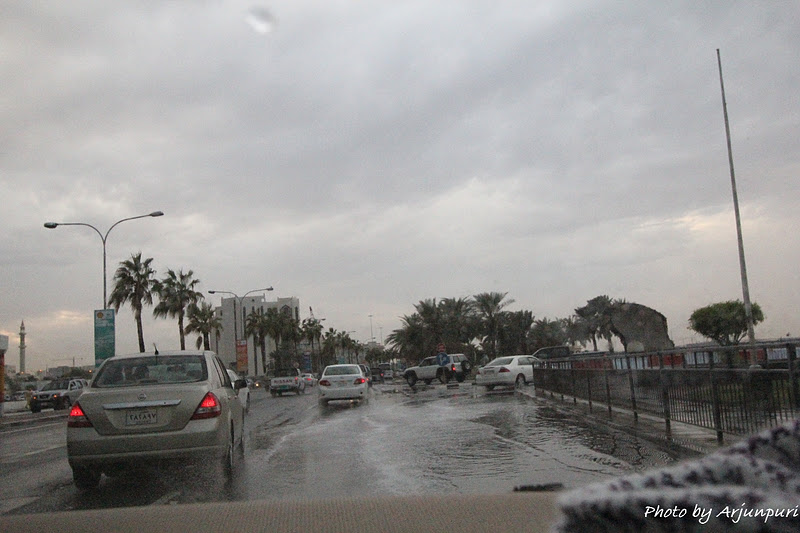
There can nothing be more exciting than soaking in rain, that too in a desert country like Qatar. The weekend couldn’t be more pleasant to waking up to a rainy day. Even though Friday evening offered a bit of foreshadows for the pleasant gift to come on Saturday, I had not expected this kind of rain, call it a drizzle, for the whole day. I could see the joy when Vij kept saying mazha, mazha several times throughout the day.
Near TV Roundabout


The morning, Sunday, after the rain reminds me Steven’s song:
Morning has broken, like the first morning
Blackbird has spoken, like the first bird
Praise for the singing, praise for the morning
Praise for them springing fresh from the world

Sweet the rain’s new fall, sunlit from heaven
Like the first dewfall, on the first grass
Praise for the sweetness of the wet garden
Sprung in completeness where his feet pass

Mine is the sunlight, mine is the morning
Born of the one light, Eden saw play
Praise with elation, praise every morning
God’s recreation of the new day.

Madinat Kalifat


Though Vij keeps telling me that on an average, it may rain for about eight days in a year in Qatar, it does not mean that those eight days are spread evenly throughout the year. So, over the past 11 months of my stay in Doha, I have seen rain here for 3-4 times, lucky me! Rainfall in Qatar is concentrated in the winter months. From June through October, rainfall average is zero, and May and November is little more. So those eight days are not spread over seven months, but rather five, from December through April, more than doubling the probability of rain taken over the whole year. But again, this too need not be accurate, as the weather keeps changing very frequently here.


Near Corniche


But Saturday’s rain made us cry, we want rain, rain and more rain… Having hot breakfast and lunch with some hot pakoras when it drizzled continuously giving pitter-patter sound on the roof was nothing, but bliss.

Spiral Mosque

Corniche


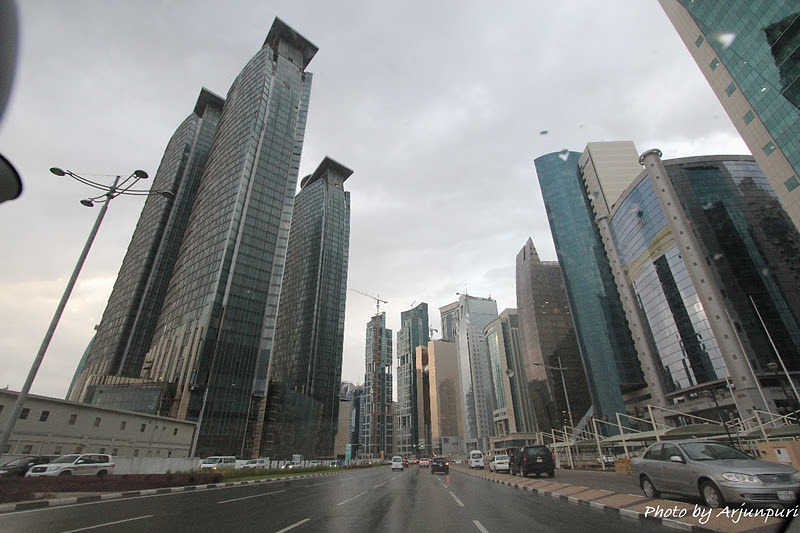
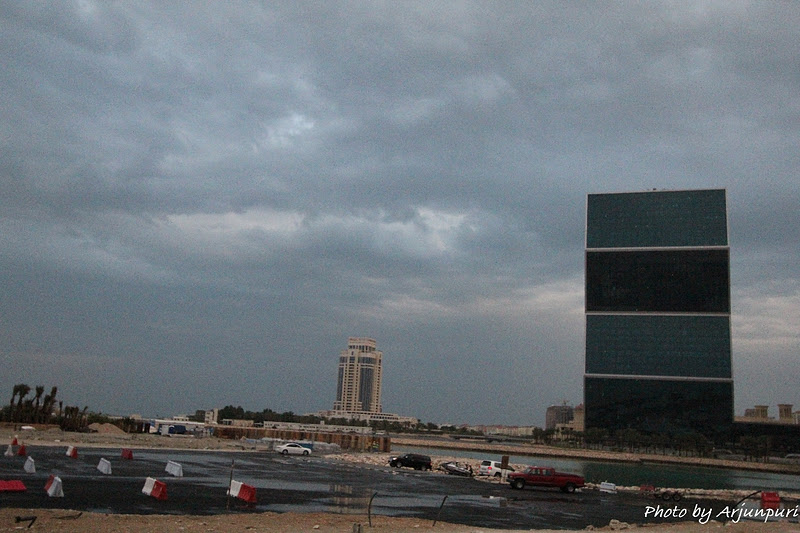
After lunch, we decided to go on a long drive as we wanted to see the rain-soaked Doha. And yes, it was a wonderful drive, from Khalifat Madinat to Corniche, to West Bay, to Pearl Qatar, to Al Khor town, to Al Khor Corniche, to Purple Island and back to Khalifat Madinat. Nothing could have been more exciting that driving in the drizzle and watching the rain hitting the windshield of our car and watching the trees doing moonwalk in this climate. For the first time, we noticed lanterns on the date trees along the Corniche.


I wanted to stand under the date trees in Corniche and feel the rain drops trickling from its leaves. The flowerbeds along the road were soaked with rainwater and when I wanted to click some pictures, drops of cool drizzles splashed on my face, sending cold waves across my body. Still, I could feel the nature, the beautiful smell of the earth.
Pearl fountain at Corniche

West Bay seen from Corniche


Navigating flooded roads, especially roundabouts, Vij had to drive carefully around broken down cars with flooded engines. As we moved towards Zig Zag Towers, we could see some more broken down cars littering the roads.
Corniche


It was cold, too, at least for us accustomed to the Middle East sunshine. Vij had forgotten to take his sweater and yes, I could see him shiver at times. I’ve never felt this cold. Wet, yes, but not this cold, he told me once.
Lanterns in the date trees


Sheraton hotel

But still I could see him enjoying the rain, the smell of the soil touched by the first rain drops, pitter-patter on the roof, and of course, the mood it brings – romantic, musical, slowdown and relax, not to forget the point that it was a blissful weekend!


City Centre


Rains always bring memories. I still remember how Vij used to ride me back home in the downpour. He never used to wear a sweater or a jacket. He just loved vrooming on the Bangalore roads during rainy season. It was fun watching school children going and coming back from schools. They were least bothered about getting wet. It was fun to see how they enjoyed every bit of the rain, splashing water to both sides as they walked on the wet roads. There used to be joy, a glow on their faces, a glow which gave them all the freedom to play in the rainwater. How I used to feel that I want to join them in splashing the water all around. When I was a student, I also had an experience of all this. Every academic year started with rains. Rambling umbrellas, drenched school bags and uniforms, window closed bus journeys, classrooms filled with dampness and darkness, those plays in the pool of water on roads, the smell of washed clothes all over the house, fear filled cold and damp nights…

Inter Continental Hotel


Outside Katara
And I loved sitting behind Vij on his bike during those rainy days. Walking in the rain, holding his hand tightly meant so much for me then. His warm hand gave me the comfort, the comfort of being loved and being taken care of, and now as the rain falls on the windshield of our car, old memories gush through memory.

Zig Zag Towers


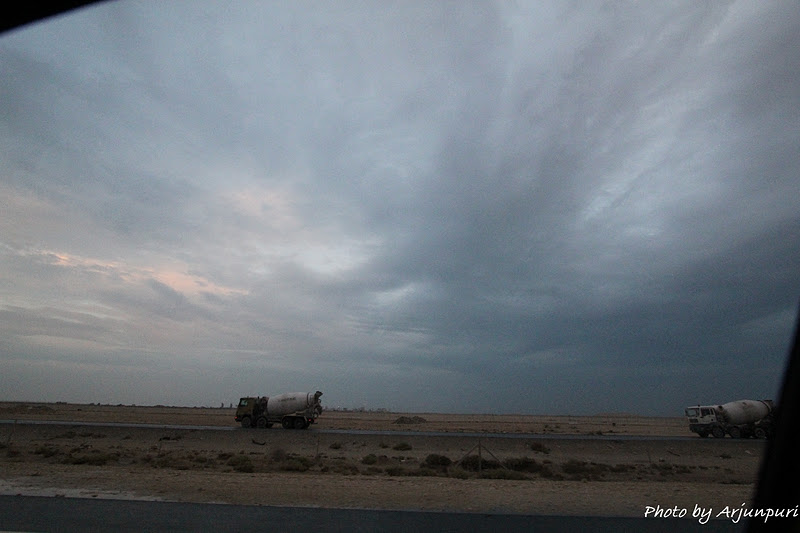
After clicking several pictures inside the city, suddenly Vij felt like turning the wheels towards Al Khor, and in 30 minutes we reached the town and it was still 4 pm, but it was getting dark. As it’s always a pleasure to listen to some music when it rains, our music system in the car was playing some romantic songs. The time was so apt that even Vij kept humming till we returned from Al Khor: “Neeralli sanna aleyondu moodi, choorada chandraneega, allondu chooru, illondu chooru, ondagabeku bega…” without even knowing its meaning!
Flooded roundabout near Zig Zag Towers


Cricket field

Road to Al Khor

Even though it was getting dark, we thought of going to the Purple Island and went till the entrance and stopped. He wanted to go further, but I was too afraid to make a move, as it was still drizzling and getting dark. I insisted that we return and Vij agreed. As he took reverse, suddenly I felt that the car is about to topple, it was revolving at the same place. Vij was drifting in that wet sand and our car came two full circles within a moment and all I was doing was hold the seat firmly and scream, wondering if there was an accident. My hearbeat increased and was shocked for two-three minutes. Then the car stopped and Vij was all smiles, telling me that he wanted to do a drifting and was just doing that!
Road to Al Khor


At the entrance of Al Khor

Al Khor town
After two-three minutes, we left the Island and were back on the main road. Again, rain welcomed us to Doha and after another hour’s drive around the city and a yummy shawarma at a Lebanese restaurant near Decoration Roundabout, we headed towards
home.

Towards Pearl Island
Ras Lafan lights

If anybody says sunshine brings happiness, I will say they have not danced in the rain. And yes, sitting next to the man whom I love most, and driving on a rainy day makes me the most happiest person in the world. I’m in love with this guy, all over again! And now, living in the Middle East, the rains are distant dreams, but still, when it rains, it brings back so many memories, oh yes, all sweet memories…