Showing posts with label Christmas. Show all posts

Wednesday, 22 July 2020

Coronavirus: 'Infection here for many years to come'

The UK will be living with coronavirus for many years to come and even a vaccine is unlikely to eliminate it for good, experts are warning.


Wellcome Trust director Prof Sir Jeremy Farrar told the House of Commons' Health Committee "things will not be done by Christmas".


He went on to say humanity would be living with the virus for "decades".


It comes after the prime minister said last week he hoped for a return to normality by Christmas.


Boris Johnson made the comments as he set out plans to further ease restrictions, including the opening of leisure centres and indoor swimming pools later this month and the prospect of mass gatherings being allowed from the autumn.


But experts giving evidence to the cross-party group of MPs said it was important to be realistic that the virus would still be here.


Reuters


Sir Jeremy, a member of Sage, the government advisory body, said the world would be living with Covid-19 for "very many, many years to come".


"Things will not be done by Christmas. This infection is not going away, it's now a human endemic infection.


"Even, actually, if we have a vaccine or very good treatments, humanity will still be living with this virus for very many, many years.... decades to come."


He urged against complacency during the summer, saying the period was a "crucial phase" to prevent a second wave.


"If we have any sense of complacency of 'this is behind us', then we will undoubtedly have a second wave, and we could easily be in the same situation again."


He said it was important to further build up testing capacity as well as investing in treatments and vaccines.


Vaccine 'unlikely to have durable effect'

Prof Sir John Bell, of the University of Oxford, said he thought it was unlikely that Covid-19 would ever be eliminated despite the positive news announced on Monday that trials by his university had triggered an immune response - an important step in developing a vaccine.


"The reality is that this pathogen is here forever, it isn't going anywhere," he told MPs.


"Look at how much trouble they've had in eliminating, for example, polio, that eradication programme has been going on for 15 years and they're still not there.


"So this is going to come and go, and we're going to get winters where we get a lot of this virus back in action.


"The vaccine is unlikely to have a durable effect that'll last for a very long time, so we're going to have to have a continual cycle of vaccinations, and then more disease, and more vaccinations and more disease.


"So I think the idea that we're going to eliminate it across the population, that's just not realistic."


Chief adviser defends government record

The government's chief medical adviser was also quizzed by MPs.


Prof Chris Whitty was asked at length about the UK's record so far in tackling coronavirus.


He defended moves to end attempts at trying to contain the virus in March, while defending the actions of ministers accused of announcing lockdown too late.


Crucial evidence about the scale of the outbreak and modelling about how quickly it could spread was presented to ministers on 16 March.


But it was a full week later that a total lockdown was announced.


Prof Whitty said it was not a "huge delay" given the "enormity" of the decision.


He also pointed out that others steps were taken in the meantime, including the closing of schools.


Meanwhile, Health Secretary Matt Hancock has defended the government's record on testing - and his decision to set the target of providing 100,000 tests a day by the end of April.


The move has been criticised with some describing it as arbitrary.


But Mr Hancock told the Science and Technology Committee, which was sitting after the Health Committee, that it was important because of the need to "scale up" at an unprecedented speed.


"The point of the big, hairy, audacious goal is to say to the whole system, 'this is where we're going, you do your bit, let's get there'."


UK coronavirus statistics:

  • 45,422 people had died in hospitals, care homes and the wider community after testing positive for coronavirus in the UK as of 5pm on Monday, up by 110 from the day before
  • Separate figures published by the UK's statistics agencies show there have now been 56,100 deaths registered in the UK where Covid-19 was mentioned on the death certificate
  • In the 24-hour period up to 9am on Tuesday, there had been a further 445 lab-confirmed cases. Overall, a total of 295,817 cases have been confirmed since the outbreak began


(Source: BBC)


Monday, 6 January 2020

Lottery winning couple's son declared cancer free three days later

A couple who won £2m on the lottery days before finding out their son was clear of cancer have said it was "like all our lifelong dreams come true."

John and Allison McDonald, from Stockton-on-Tees, scooped the win on a Lucky Dip ticket on 18 December.
John and Allison McDonald have now handed in their notices at work

Three days later they received the news their 15-year-old son, Ewan, who was diagnosed with non-Hodgkin lymphoma in May, was cancer free.

The pair have since handed in their notices at work.

Mr McDonald, 62, worked as a security officer and frequently worked 70-hour weeks, while Mrs McDonald, 49, worked at an opticians.

"It is just like all of our lifelong dreams came true in the space of three days," Mr McDonald said.

"What a start to 2020. Everyone always dreams of winning the lottery at Christmas - and talks about how amazing this would be - but Allison and I never believed it would happen to us - and it has.
Ewan had been treated for cancer after being diagnosed in May

"And then to receive news that Ewan's latest scans are all clear is just truly amazing. We are so thankful. 2020 is certainly looking like being one amazing year for the three of us."

Mrs McDonald said: "This is just the most amazing feeling ever."

(Source: BBC)

Sunday, 5 January 2020

Portrait of Queen and three heirs marks the start of a new decade

A portrait of the Queen with the next three heirs to the throne has been released to mark the start of the new decade.

It shows the Prince of Wales, the Duke of Cambridge and Prince George standing with the Queen at Buckingham Palace.


The new photograph was taken in the week before Christmas, but has not been published until now.

It is the second official portrait of the four generations of royals together.

The Queen, 93, standing at the front of her family, wears a white dress with a blue brooch and clutches a handbag.

Her son, Prince Charles, who is dressed in a pinstripe suit, stands on the first step behind her.
A portrait of the four royals was previously released in 2016 to mark the Queen's 90th birthday

His arm rests on the shoulder of his six-year-old grandson, who is wearing a pair of green and navy tartan trousers.

Prince William, wearing a dark suit and navy tie, stands with his hands together to the right of his grandmother.

The photograph was taken by Ranald Mackechnie, who was also responsible for the only other portrait of the four royals together.
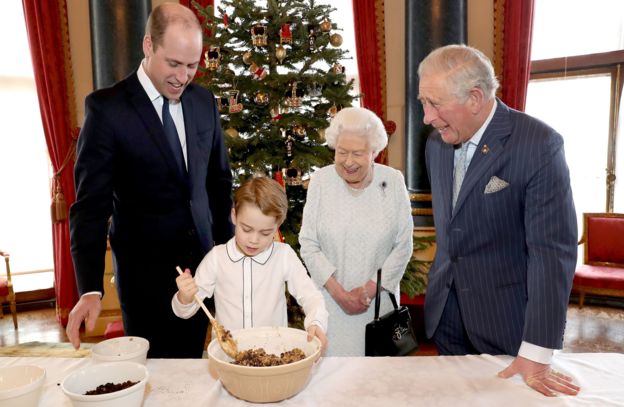
The Queen, Prince Charles, Prince William and Prince George made Christmas puddings last month

It was released in 2016 to mark the Queen's 90th birthday and was printed on commemorative stamps.

The latest portrait was taken on December 18 - the same day the four royals were photographed making a Christmas pudding together at the palace.

The moment, captured in front of a Christmas tree decorated with miniature corgis and crowns, featured in the Queen's Christmas Day message.


(Source: BBC)

Saturday, 28 December 2019

UK increasingly shuns sofa for outdoor activities during 'Twixtmas'

Period between Christmas and New Year is utilised for activities from ice-cold swimming to birdwatching

When Christmas is over and you are getting ready for the dawn of the new year, it can be tempting to hibernate indoors, watching Home Alone on repeat and eating endless boxes of chocolates. But an increasing number are shunning the sofa and instead taking part in the many activities planned between Christmas and New Year.

For providers of a stream of unusual activities over the limbo period sometimes dubbed “Twixtmas”, the period is characterised by getting out and about. On Christmas Day itself options included a walking tour, icy cold swims, and even a trip to the cinema. In Birmingham, brave souls gathered on Christmas morning to jump into Blackroot pool in Sutton Park. Other activities from Boxing Day on include a tree maze in Edinburgh and the Bibury duck race, one of Gloucestershire’s more unusual traditions.

Ben Caughters, 37, from Bangor, in County Down, Northern Ireland, always takes part in the Christmas Cracker run in nearby Newcastle on 28 December. “It’s a bit of fun really,” he said. “We run it in pairs and it is usually about eight to 10 miles of a trail around the Mourne Mountains ... I don’t take it too seriously. The last few years I finished it around an hour or just over. You run with a partner and have to both finish at the same time.”
Swimmers of the Serpentine Swimming Club take part in the Peter Pan Cup race in central London. Photograph: Dominic Lipinski/PA


Caughters said he did it annually: “You have to wait for your partner or run with them the whole way. As long as you’re both crossing the line together that is the main thing ... A lot of people do it in fancy dress.”

Caughters said it gave him something to do after Christmas, “when people maybe feeling a wee bit sluggish and hungover.”

He added: “It just gets them to clear their head and get up in the mountains. It is beautiful up there and usually very cold, so it is a good way to blow away the cobwebs.”

Swimming is another favourite Twixtmas pastime. Katy Ferguson spent Christmas morning at the Park Road Lido in Crouch End, London, and said growing numbers were opting for a winter dip. “There are usually two swims, one around 9am and another at 10am. People absolutely love it. I am not sure how many years it has been going but it makes Christmas Day special. You feel you can then indulge for the rest of the day. It is a really nice atmosphere.”

Ferguson said there were around 80 people per swim in 2018, with interest growing annually. “It is a heated lido, around 22 to 24 degrees. Other pools are unheated, but I am not sure I could cope with that. There is a core of us that do it but it’s growing as outdoor swimming grows in popularity.”

On Christmas Day, scores of people took to the water for the Peter Pan Cup at London’s Serpentine. The race has been an annual tradition since 1864 and involves members of the Serpentine Swimming Club completing a 100-yard course in London’s Hyde Park. The race got its name in 1902 when JM Barrie, who wrote Peter pan, was a member who competed in the event.

But for others, Twixtmas means a slower tempo. Jamie Dunning, 27, from Hertfordshire is spending the time birdwatching. “Over Christmas I will be out a few times but there will be people out every day. There are people who take it seriously and others just see as a nice Christmas tradition ... It can be a nice day out at Christmas.”

He added: “I will be doing it with my partner this year if I can convince her to – it’s a nice walkout over Christmas. You can usually see 30-40 species in a day.”

Dunning said that what began as an American festive activity has crossed over to the UK. “In the US the Audubon society use Christmas bird count data to do real demographic monitoring. In the UK Christmas bird counting is also a thing, but we collect citizen science data year round … so it has less of an organised feel. But the data collected is uploaded to bird track and saved for future use. Here, there is a tradition of semi-competitive birding in the festive period. There are those who keep year lists –the number of birds they’ve seen in the year – who try and get some last minute ticks, and start the new year on a high number. ”

“What’s so great about birding in this period is that it’s all for the sheer joy of birds and being outside, there is a huge amount of valuable data collected by citizen scientists who don’t even realise they’re doing it. And, that it truly is something that everybody and anybody can do.”


(Source: The Guardian)

Wednesday, 25 December 2019

Perhaps the true hero of Christmas has always been Mary

Christmas has always been a festival that has been fraught with much emotion for me. When I was young, my earliest memories of the festival are being togged up in my best and dragged off kicking and squealing to the church at the crack of dawn for the early mass. My hair would be carefully combed out and subdued into two tight ponytails, or when it was longer, two plaits with ribbons tied into neat bows at the ends, my shoes would be polished to mirror levels of shiny Mary Janes, worn with knee-high socks and my dress would be an obnoxious meringue of pink and satin and lace and ribbons that would nauseate the tomboy in me. As I grew, I resisted. Adolescence and teen courage gave me the nerve to flat out refuse to accompany Mom to church on the rare days that I hitherto had. I had also, by then, completely lost religion, not that I had much to begin with. I grew into an adult, and define myself not an atheist, but rather a nonbeliever in organised religion and a believer in power I still can’t quite define.


Christmas was also carol singing, and Christmas tree decorations and throwing tantrums about the fact that we had no chimney for Santa Claus to come and how on earth was he to know that balconies were meant to be his entry point into the house?

Among the more cheerful memories of Christmas was of visiting assorted relatives and eating from the tray of temptingly arranged sweets that inevitably resulted in an upset stomach the next day from the gluttony. Marzipans, kulkuls, milk cream, rum cake, coconut sweet, guava sweet, dol sweet, and more that tempted one down the path of sin and sneaking some into pockets to be consumed at leisure later. I lived through that day with sticky hands and pockets that would eventually need a scrubbing down to get clean.

Christmas was also carol singing, and Christmas tree decorations and throwing tantrums about the fact that we had no chimney for Santa Claus to come and how on earth was he to know that balconies were meant to be his entry point into the house and for goodness sake, just how was he to get a respectable sized gift into the little socks we would hang up on the balcony railing with no fireplace. The sheer logistics of traversing the world in a single night, finding all the good kids homes, was not lost on me either, in an age where we can still go around in circles for hours, never mind google maps kindly instructing us to take the next right turn and at 100 metres, your destination to your left. Luckily, my son saw through the Santa myth rather early when a surly, skinny Santa in a mall barked at him for interrupting his cigarette break. This generation is smarter than we were, they also have magic of a different kind to be fascinated by, that of the swipe screens.

What did always fascinate me though, was the story of Mary. Chosen to be the virgin womb to bear the son of God, I’ve always wondered what went through her mind when she was told of it. Her story begins when the angel Gabriel appears before her and tells her that she has been chosen to carry and give birth to the saviour and that she was to call him Jesus. She accepted the challenge that had been given to her, that of the immaculate conception. Given the era she lived in, I can only assume she was very young at the time, perhaps in her early teens.
She travelled miles in an advanced state of pregnancy from Nazareth to Bethlehem, giving birth in a dingy stable, with the focus instantly shifting to the baby boy she gave birth to, having to fend for herself, weakened and drained by childbirth, as well as the newborn infant Jesus, in a cold, wintry stable.

 Who hasn’t looked upon the Pieta by Michelangelo and wept? Perhaps this is why so many of us identify so strongly with Mary—her suffering is real and palpable. It is the suffering of every woman, across the world, who has given birth, raised a child.

What did Mary really think about this, being chosen to be the Mother of God, we will never really know. How did her parents and her fiancé Joseph take to this announcement by her that she was already with child, and would bear the son of God, at a time when virginity was a non negotiable for women? We do know a bit about how Joseph decided that he would not castigate her publicly and that an angel appeared to him in a dream telling him to accept her pregnancy as it was the child of God growing in her womb. That three wise men came, bearing with them gifts of myrrh, frankincense, and gold we know. I might also think now, in retrospect, that it might have come handier to have three wise women visit the newborn and his mother bearing gifts that would make things a tad easier for her. Clean clothes, food, and such.

When I became a mother, I realised the enormity of what this young girl would have faced. She is the reminder that women have, down the centuries, been cast into the roles of nurturers and bearers of life, through biology and patriarchy and have had to live their lives in the roles assigned to them. She called herself “the handmaiden of God.” While we may not all want to be handmaidens of God, and might be quite content with the moniker of meanest mom in the world, but that she was pregnant through circumstances not of her choosing, brought life into the world in circumstances that were trying in any time period, brought up the baby knowing that there was sorrow in store for her when he grew, is true bravery. Who hasn’t looked upon the Pieta by Michelangelo and wept? Perhaps this is why so many of us identify so strongly with Mary—her suffering is real and palpable. It is the suffering of every woman, across the world, who has given birth, raised a child.

Perhaps, it is time we realised that we’ve got it all wrong all these centuries. Perhaps the true hero of the Christmas story has always been Mary. And we do need to celebrate her story too.


(Source: She the People TV) 

Japan's first Christmas

The first Noel, the Jesuits in Yamaguchi did say, was a 16th-century celebration in a converted Buddhist temple with midnight hymns

In a letter home to Portuguese brethren, Jesuit missionary Pedro de Alcacova writes of singing a Mass to Japanese believers in 1552: “Our voices weren’t good,” he recalls, “still the Christian believers rejoiced.”
It was Christmas Eve in Yamaguchi, and the patience, if not faith, of the new Japanese converts may have been tested after dubious singing by nanban (“southern barbarian”) missionaries turned into a scripture reading that ran deep into the night and resumed for another day with the “crow of the cock.”

This was Japan’s first Christmas on record, and in subtropical Yamaguchi, at the southern edge of Honshu, the celebration of the virgin birth was in a sense also a virgin encounter: It featured much surprised delight (the Jesuit account says) along with the first Western vocal music heard in Japan. Saint Francis Xavier — the Jesuit who brought Christianity to Asia — had landed in Japan’s Satsuma domain only three years earlier, winning favor with daimyō lords and with it permission to seek converts. Japan was still decades away from the Christian persecutions ushered in by the seclusion policy of the Tokugawa shogunate — the backdrop of the great Shusaku Endo novel “Silence” recently adapted into a film by Martin Scorsese.

Mutual fascination — along with commercial and strategic interests — still featured highly. Regional daimyō invited missionaries home in order to learn about the West, and to lobby for advantageous trade, while Xavier sought friends in high places to help him win converts in lower ones. It was a period of remarkable and often cordial exchange for both sides, although even then street-side Jesuit preachers would be prone to spitting, jeers and pelting from passers-by.

The Christmas of 1552 could hardly have been more different from the Christmases we know today. Familiar Yuletide iconography — Christmas trees, reindeers, mistletoe and the like — was not yet established anywhere in the world (and, naturally, there was not a whiff of the commercialism that marks modern-day Christmas festivities.) The setting for this Christmas was the abandoned Daido-ji Buddhist temple, converted into the Jesuits’ house of worship and living quarters. It would be among the first of Japan’s nanban-dera, or southern barbarian temples, the name given to the makeshift Christian churches housed in Buddhist buildings, with shoji and engawa (a type of terrace) and, often the sole exterior visual difference, a cross erected upon the kawara roof tiles.

On Christmas Eve, Japanese believers were invited to spend the night in the Jesuit living quarters, cramming the venue as they embarked upon an all-nighter of hymns, sermons, scripture readings and Masses. For today’s readers, at least, de Alcacova’s account comes across as a rather gruelling experience, although there’s no reason to doubt the missionary’s numerous references to the “great joy” of the Japanese converts. From dusk until dawn, the new converts were treated to sermons and readings about “Deus” — the Portuguese word for God. The entire celebration contained no fewer than six Masses.

Father Juan Fernandez, an important Jesuit who wrote the West’s first lexicon of Japanese, opened the midnight scripture sessions. When his voice grew weary, he was relieved by “a Japanese youth with knowledge of our language,” de Alcacova writes. At the crack of dawn, Cosme de Torres — leader of the Jesuit mission after Xavier’s departure for India — led a new Mass, while another priest read passages from the gospels and the Epistles. After this night of Christian immersion, the faithful were allowed to go home, likely exchanging greetings of “Natala” — the Portuguese word for Christmas, meaning “birth.”
A folding screen depicts Portuguese sailors arriving in Japan. | MUSEU NACIONAL DE ARTE ANTIGA

That was not the end, however. For soon the Japanese converts were back for more, attending yet another Mass, and listening to sermons about the Creation and the life of Christ.

“In a land where we were often called devils and other such things,” de Alcacova writes, “we gave thanks to the Lord for meeting so many good Christians.”
Then it was mealtime — and by de Alcacova’s account it was a popular affair. There were so many people eager to partake, the letter says, that “it was difficult to fit everybody into the living quarters.”

The Japanese faithful and the Jesuit brothers — along with a sprinkling of non-Christians — sat down together for the meal prepared by Japanese leaders of the flock. The congregation then handed out food to the poor, an effective method of winning new souls.

This Christmas of 1552 is often called “Japan’s first Christmas.” That’s probably misleading. Xavier would almost certainly not have passed up the opportunity to celebrate a Christmas on Japanese soil between his arrival in Satsuma, today’s Kagoshima Prefecture, in 1549 and departure for India in 1552, according to historians Klaus Kracht and Katsumi Tateno-Kracht. There is just no record of such an event. De Alcacova’s letter, written to brethren back home in Portugal, is simply the first extant account of a Christmas celebrated in Japan.

The Jesuit’s report unfortunately makes no mention of what was eaten on Christmas Day. However, a tantalizing glimpse into the gastronomy of Japan’s early Christian feast days comes in a letter penned by missionary Gaspar Vilela in 1557. It describes an Easter for which a cow was imported, and beef and rice were dished out to the faithful (perhaps an early forerunner of the gyūdon). This would have been exotic to the converts because eating beef at the time was not part of Japanese life. Nevertheless, the letter says, “they all ate with great contentment.”

Jesuit accounts of Japanese Christmases in subsequent years follow roughly the same pattern.

“High-class men and women assembled in great numbers in the priestly residence,” missionary Duarte da Silva writes in a letter about the Japanese Christmas of 1553, also in Yamaguchi City. “From one in the morning, they listened to stories from the Bible — hearing of the creation of heaven and Earth and of man’s sin, then of Noah’s flood, the separation of languages, the beginning of idol worship, the destruction of Sodom, the story of Nineveh, the story of Joseph’s son of Jacob, the Babylonian captivity, the 10 commandments of Moses and the flight from Egypt, then of the prophet Elisha, Judith, Nebuchadnezzar’s statue — according to the ages — and finally the story of Daniel brought us into the dead of night.” Such protracted instruction in Old Testament storytelling was meant to bring home the necessity of Christ’s advent — which the Japanese converts learned about during the second half of the night.

There were, however, a couple of new features that developed in these first Japanese Christmases as the years went on. First, Japanese believers introduced a custom of gift exchanges on Christmas Day — and this was seen by the Jesuit missionaries as somewhat exotic, a part of Japanese tradition rather than their own.

Next, the Jesuits began to hold Christmas plays to bring life to stories from the gospels. Torres and his brethren reasoned they would be easier to digest than lengthy sessions of Bible reading, a promising tool to spread the faith. They were right. The plays were such a big hit that some accounts recall the Christmas theater attracting up to 2,000 people. Among them were non-Christians who came for a bit of entertainment, and perhaps handouts of food. The Jesuits encouraged this as a way to expand the mission. At times, however, there was such a crush for places in the traditional sajiki viewing boxes that the Jesuits had to limit entry “to people who had introductions from the Christian faithful.”

The first of these Christmas plays took place in Bungo — today’s Oita Prefecture — in 1560. People traveled from distant towns and villages to witness the event. Enacted by Japanese believers, the play told the story of Adam and Eve, and a tree decorated with golden apples was placed in the middle of the stage, according to a letter by Juan Fernandez. The set also included a stable and crib to symbolize the birth of Christ. Such was the performance’s hypnotic spell that when Lucifer proceeded to tempt Eve beneath the apple tree, the spectators — men, women and children alike — are said to have burst into tears. The distress escalated to fever pitch as an angel appeared and led Adam and Eve out of the Garden of Eden. For the playgoers, relief came only when the angel reappeared before the first man and woman — wearing the clothing given to them by God — and consoled them with news of a distant day of salvation.

This was the age of Christianity’s heyday in Japan. It was a period lasting roughly a century in which the Jesuit missionaries are estimated to have won several hundred thousand converts, and were granted authority over Nagasaki by Omura Sumitada — the first of the daimyō converts to Christianity. The religion gained a foothold during Japan’s Sengoku period of warring domains, in which the Jesuits found powerful daimyō protectors in the lack of a centralized authority. Some feudal lords, such as the formidable Otomo Sorin, lord of Bungo in Kyushu, became Roman Catholics at least in part as a calculation that it would enhance their wealth and power.

“He had always found much advantage from the ship of the Portuguese,” writes Alessandro Valignano, a prominent Italian Jesuit. Even the atheist Oda Nobunaga — the first of Japan’s great unifiers — gave audiences to Jesuits and granted them a license to preach in Kyoto.

It was Ouchi Yoshitaka, the powerful and cultivated daimyō of the Suo domain, who granted the Daido-ji temple complex to Xavier in the year before Japan’s first recorded Christmas. The gift was all the more remarkable because the first meeting between Xavier and Ouchi had not gone well, according to historian John Dougill, author of “In Search of Japan’s Hidden Christians.” 

Arriving in shabby dress to the audience at Ouchi’s castle, Xavier denounced sodomy as one of the three great sins afflicting Japan, along with abortion and infanticide. Ouchi stormed off in a huff. He was not immune, scholars assume, to a fondness widespread among feudal lords for samurai boys. 

Xavier made amends the following year, dressed resplendently in a silk cossack and bearing Western gifts such as “cut glass, a table service, Portuguese wine, a pair of spectacles and a telescope,” according to Dougill’s account. Soon afterward the Jesuits were granted permission to set up their first mission in Japan.

History turned against the Christians in Japan, as Toyotomi Hideyoshi and Tokugawa Ieyasu completed Japan’s unification. They viewed Christianity as a threat to their secular power — partly a legacy of earlier Buddhist religious uprisings — and persecutions began. Christians were tortured and forced to apostatize by stepping on a fumie likeness of Christ; those who refused were crucified. Japan’s Christian era came to a definitive end in 1639 when Shogun Tokugawa Iemitsu issued the final sakoku — or closed country — edict banning all interaction with Catholic lands.

There is a key passage in Endo’s “Silence” that poignantly captures the dilemma of the early modern Christian adventure in Japan. The hero Sebastian Rodrigues, a passionate Jesuit missionary, confronts Cristovao Ferreira, a Jesuit leader who apostatized under torture and went on to live in almost equally tortured comfort under the careful watch of the Tokugawa authorities.

“When you first came to this country, churches were built everywhere,” Rodrigues says, “faith was fragrant like the fresh flowers of the morning, and many Japanese vied with one another to receive baptism like the Jews who gathered at the Jordan.”

Ferreira replies: “And supposing the God whom those Japanese believed in was not the God of Christian teaching? … What the Japanese of that time believed in was not our God. It was their own gods.”

Ferreira is speaking about an anomaly that was to color the fate of Christianity in Japan. The concept of God, under the guidance of Xavier’s illiterate Japanese guide, Anjiro, was introduced to the Japanese as “Dainichi” — or “Great Sun” — a manifestation of Buddha in Japan.

According to historian George Elison, Anjiro mistakenly told Xavier that “the Japanese believed in one personal God who punished the bad and rewarded the good, the creator of all things.” However, Xavier had only Anjiro to rely upon as a source of knowledge of Japanese culture, and he began his missionary career in the new land preaching the doctrine of Dainichi. It was only after discussions with Buddhist scholars revealed his error that Xavier switched to teaching the word of “Daiusu” — Deus — but the damage had already been done.

“The danger,” writes Elison in his seminal work “Deus Destroyed,” “was that old beliefs would remain tied to the adopted terminology, being submerged under the surface of the new terminology rather than erased.”

As Christianity was driven underground — and believers were forced into isolated mountain villages, feigning adhesion to Buddhism — the religion took on even more departures from the adopted faith. The kakure-kirishitan, or “hidden Christians,” adopted elements of ancestor worship and concealed the figure of the forbidden god within Buddhist altars, wrapped in cloth.

And yet Endo’s “Silence” — a moving novel for people of any faith or nonfaith — points to a redemptive quality in the Christian experience in Japan. It is a work of courage and beauty that conveys a universal vision of human existence, in which cultures collide amid the most extreme circumstances, and emerge to find a measure of hope out of despair.


“True religion,” Endo writes in another novel, “Scandal,” “should be able to respond to the dark melodies, the faulty and hideous sounds that echo from the heart of man.”

(Source: JT)

Tesco halts production at Chinese factory over alleged 'forced' labour

Tesco has suspended production of charity Christmas cards at a factory in China after a six-year-old girl found a message from workers inside one.

The note, found by Florence Widdicombe, was allegedly written by prisoners in Shanghai claiming they were "forced to work against our will".

"Please help us and notify human rights organisation," the message said.

Tesco said it was "shocked" by the report, adding: "We would never allow prison labour in our supply chain."

The supermarket said it would de-list the supplier of the cards, Zhejiang Yunguang Printing, if it was found to have used prison labour.

Florence was writing cards to her school friends when she found that one of them - featuring a kitten with a Santa hat - had already been written in.
The pack of cards cost £1.50 from Tesco


In block capitals, it said: "We are foreign prisoners in Shanghai Qingpu prison China. Forced to work against our will. Please help us and notify human rights organisation."
A
It asked whoever found the message to contact Peter Humphrey, a British journalist who was himself imprisoned there four years ago.

Florence, from Tooting in south London, told BBC News she was writing "my sixth or eighth card" when she saw "somebody had already written in it".

"It made me feel shocked," she said, adding that when it was explained to her what the message meant she felt "sad".

Her father, Ben Widdicombe, said he first felt "incredulity" at discovering the message, adding he first thought it was "some sort of prank".

"But on reflection we realised it was potentially quite a serious thing," he said. 

"I felt very shocked but also felt a responsibility to pass it on to Peter Humphrey as the author asked me to do."

He said: "It hits home. There are injustices in the world and there are people in difficult situations and we know about that and we read about that each and every day.

"There is something about that message hitting home at Christmas... that really does make it very poignant and very powerful."

He added: "It could have ended up anywhere. And indeed we have many cards as all families do that are left over and we put them in a drawer and forget about them. There is an incredible element of chance in all of this that the card was written, it got to us and we opened it on the day we did."

A Tesco spokeswoman said: "We were shocked by these allegations and immediately halted production at the factory where these cards are produced and launched an investigation."

The supermarket said it has a "comprehensive auditing system" to ensure suppliers are not exploiting forced labour.
Florence Widdicombe, aged six, says finding the message made her feel shocked


The factory in question was checked only last month and no evidence of it breaking the ban on prison labour was found, it said.

Sales of charity Christmas cards at the company's supermarkets raise £300,000 a year for the British Heart Foundation, Cancer Research UK and Diabetes UK.

The retailer has not received any other complaints from customers about messages inside Christmas cards.

'Very bleak life'
The message in the card urged the recipient to contact Peter Humphrey, who was formerly imprisoned at Qingpu on what he described as "bogus charges that were never heard in court".

After the Widdicombe family sent him a message via Linkedin, Mr Humphrey said he then contacted ex-prisoners who confirmed inmates had been forced to work.

He then wrote the story for the Sunday Times.

Mr Humphrey told the BBC: "I spent two years in captivity in Shanghai between 2013 and 2015 and my final nine months of captivity was in this very prison in this very cell block where this message has come from.

"So this was written by some of my cellmates from that period who are still there serving sentences.

"I'm pretty sure this was written as a collective message. Obviously one single hand produced this capital letters' handwriting and I think I know who it was, but I will never disclose that name."

He said the cell block of foreign prisoners has about 250 people in it, who are living a "very bleak daily life" with 12 prisoners per cell.

"They sleep in very rusty iron bunkbeds with a mattress which is no more than about 1cm thick underneath," he said.

"In the winter it's extremely cold, there's no heating in the building and in the summer it's extremely hot because there is no air conditioning.

"They get up around 5:30-6:00am every day they have to go to bed again at about 9.30."

He said when he was in there, manufacturing labour work was voluntary - to earn money to buy soap or toothpaste - but that work has now become compulsory.

"Everyone I know in there at the time was in there for very questionable reasons," he said. "I met so many people who I considered to be the victims of wrongful imprisonment or at least reckless sentencing for minor offences."

Mr Humphrey said he believes those who wrote the note "knew very well what risks they were taking and they were prepared to take this risk".

"They know very well that if they're caught, they will be punished. They could be punished for example by losing some merit points or having some kind of deprivation of some of their food allowance.

"They could be punished by sending them to solitary confinement for a month or something like that where conditions are fairly harsh."
A foreign inmate dries clothes at Shanghai Qingpu prison in 2006. Getty Images

Mr Humphrey also said that censorship in the prison had increased, cutting off his usual methods of contacting prisoners he had met before his release in 2015.

"They resorted to the Qingpu equivalent of a message in a bottle, scribbled on a Tesco Christmas card," he said.

It is not the first time that prisoners in China have reportedly smuggled out messages in products they have been forced to make for Western markets.
In 2012, Julie Keith from Portland, Oregon, discovered an account of torture and persecution by a prisoner who said he was forced to manufacture the Halloween decorations she had purchased.

And in 2014, Karen Wisinska from Co Fermanagh in Northern Ireland, found a note on a pair of Primark trousers reading: "Our job inside the prison is to produce fashion clothes for export. We work 15 hours per day and the food we eat wouldn't even be given to dogs or pigs."

Under the UN's guidance for human rights and prisons, prisoners "should not be subordinated merely to making a profit either for the prison authorities or for a private contractor".

The standard minimum rules for the treatment of prisoners state: "Prison labour must not be of an afflictive nature."

(Source: BBC)

How to tell your children about Father Christmas

Talking about Father Christmas can be a pretty difficult business when kids get older.

You can never quite remember the moment yourself, but it happens to all of us eventually; the realisation that the big man isn't real and your parents have been dutifully leaving presents under the tree.

Leslie Rush, a high school history teacher in El Paso, Texas shared her approach to that delicate topic years ago when her kids first began asking if Father Christmas was real. 

The approach involves changing a belief in Father Christmas into 'becoming' Santa himself. This is done through a series of good deeds, Christmas spirit and good will to all people.
Picture: avid_creative / iStock
Leslie wrote:
This way, the Santa construct is not a lie that gets discovered, but an unfolding series of good deeds and Christmas spirit.
When they are 6 or 7, whenever you see that dawning suspicion that Santa may not be a material being, that means the child is ready.

She goes on to talk about the best things about being Father Christmas, including how the giving of gifts can be far more gratifying than receiving them.

Mother Charity Hutchinson posted Leslie's advice on Facebook and it resurfaces around the holidays, as parents hunt down help and advice.

You can read Charity's full Facebook post, below:


Charity Hutchinson
This is by far the best idea I've seen about telling your kids about Santa. Had to share!
*********

"In our family, we have a special way of transitioning the kids from receiving from Santa, to becoming a Santa. This way, the Santa construct is not a lie that gets discovered, but an unfolding series of good deeds and Christmas spirit.

When they are 6 or 7, whenever you see that dawning suspicion that Santa may not be a material being, that means the child is ready.

I take them out "for coffee" at the local wherever. We get a booth, order our drinks, and the following pronouncement is made:

“You sure have grown an awful lot this year. Not only are you taller, but I can see that your heart has grown, too. [ Point out 2-3 examples of empathetic behavior, consideration of people's feelings, good deeds etc, the kid has done in the past year]. In fact, your heart has grown so much that I think you are ready to become a Santa Claus.

You probably have noticed that most of the Santas you see are people dressed up like him. Some of your friends might have even told you that there is no Santa. A lot of children think that, because they aren't ready to BE a Santa yet, but YOU ARE.

Tell me the best things about Santa. What does Santa get for all of his trouble? [lead the kid from "cookies" to the good feeling of having done something for someone else]. Well, now YOU are ready to do your first job as a Santa!"

Make sure you maintain the proper conspiratorial tone.

We then have the child choose someone they know--a neighbor, usually. The child's mission is to secretly, deviously, find out something that the person needs, and then provide it, wrap it, deliver it--and never reveal to the target where it came from. Being a Santa isn't about getting credit, you see. It's unselfish giving.

My oldest chose the "witch lady" on the corner. She really was horrible--had a fence around the house and would never let the kids go in and get a stray ball or Frisbee. She'd yell at them to play quieter, etc--a real pill. He noticed when we drove to school that she came out every morning to get her paper in bare feet, so he decided she needed slippers. So then he had to go spy and decide how big her feet were. He hid in the bushes one Saturday, and decided she was a medium. We went to Kmart and bought warm slippers. He wrapped them up, and tagged it "merry Christmas from Santa." After dinner one evening, he slipped down to her house, and slid the package under her driveway gate. The next morning, we watched her waddle out to get the paper, pick up the present, and go inside. My son was all excited, and couldn't wait to see what would happen next. The next morning, as we drove off, there she was, out getting her paper--wearing the slippers. He was ecstatic. I had to remind him that NO ONE could ever know what he did, or he wouldn't be a Santa.

Over the years, he chose a good number of targets, always coming up with a unique present just for them. One year, he polished up his bike, put a new seat on it, and gave it to one of our friend's daughters. These people were and are very poor. We did ask the dad if it was ok. The look on her face, when she saw the bike on the patio with a big bow on it, was almost as good as the look on my son's face.

When it came time for Son #2 to join the ranks, my oldest came along, and helped with the induction speech. They are both excellent gifters, by the way, and never felt that they had been lied to--because they were let in on the Secret of Being a Santa."


(Source: Independent)