Showing posts with label mysore. Show all posts

Tuesday, 23 November 2021

I looked closely at two famous portraits of Tipu Sultan – and found that one isn’t actually of him

 A history enthusiast goes beyond the captions at the museum at the 18th-century ruler’s summer palace in Srirangapatna.

Visitors to the museum run by the Archaeological Survey of India in Tipu Sultan’s summer palace in Srirangapatna, near Mysore, have the opportunity of inspecting two painted portraits of the 18th-century ruler himself.


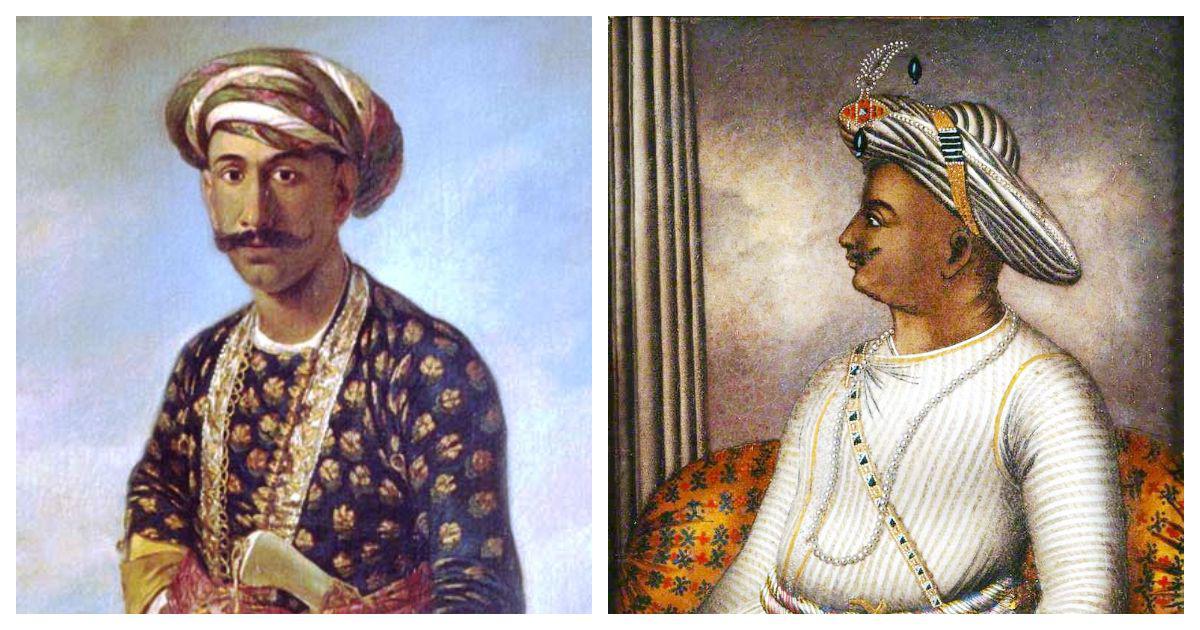
The one by GF Cherry is the popular portrait of Tipu Sultan. Since the late 18th century, it has appeared in a variety of books, magazines, journals and newspapers articles about him.


Two portraits at Tipu Sultan's summer palace that are said to be of him. | Public domain, via Wikimedia Commons


The other is a full-length portrait and has been attributed by the museum to the German artist Johan Zoffany. Here, the direct gaze of the subject falls on the visualiser in contrast to the depiction of the subject’s profile in Cherry’s painting.


Especially since the advent of the internet and social media, this painting has increasingly been appropriated into Tipu Sultan’s life story: it has appeared both online and in print as a definitive portrait of Tipu Sultan in his younger days.

The noted Tipu Sultan historian Kate Brittlebank has even incorporated this painting on the cover page of her biography, Tiger: The Life of Tipu Sultan.


I had been long fascinated with this portrait of Tipu Sultan both on account of my interest in the ruler’s history as well as my hobby as an artist who experiments in paint as well as pencil. The striking contrast between the tawny and near-corpulent Tipu Sultan in the Cherry painting and the slim Tipu Sultan in the Zoffany painting intrigued me. But I brushed it off as Tipu Sultan gaining in weight with the passage of years.


GF Cherry, who painted the first portrait, was the Persian secretary to Governor General of India, Lord Cornwallis at Srirangapatna. Anne Buddle, a noted historian mentions that a similar portrait by the same artist was presented by Lord Cornwallis in 1792 to Tipu Sultan’s mother. This work, after being passed on to Tipu Sultan’s youngest son Prince Gholam Mohammad, was gifted by him to the East India Company and is now in the British Library, London.


This portrait can be considered an authentic representation of Tipu Sultan on account of it being painted in the lifetime of Tipu Sultan and once, having been in the possession of both his mother and his son.


This image of Tipu Sultan is also congruent with the description of Major Allan, who was present on the spot when Tipu Sultan’s lifeless body was discovered in an archway, and mentions the ruler as having a “…short thick neck, small arched eyebrows, tawny complexion, (with) moustache and clean-shaven chin. He was inclined to ‘corpulency’.”


Portrait of Tipu Sultan, attributed by Dariya Daulat Museum to Johan Zoffany, 1780.


The second painting also wandered a little before it came to the Dariya Daulat Bagh Museum. Writes the British historian and author Denys Forrest:


“…. a full-length which, according to the Descriptive List (above), was presented to the Government of India by Sir P. C. Tagore in 1934 and hung in the corridor to the State Dining Room at Viceroy’s House. This picture was then attributed to Zoffany, but I have been unable to obtain any further details of it.”


It’s clear that the painting was already attributed to Zoffany before its arrival at the museum in Srirangapatna.


However, when I delved deeper into art history, I realized that Zoffany’s style of painting was very different from this painting of Tipu Sultan attributed to him. Renowned art historian Mildred Archer had this to say about him: “Zoffany found it difficult to suppress his interest in bounding movement and love of histrionic gesture.”


That is evident from Zoffany’s “The Impey Family listening to strolling musicians” (1783-’84), “Warren Hastings with his wife” (1783-’87), “Col. Mordaunt’s Cock Match” (1784-’86). But the painting of Tipu Sultan has the subject standing idly looking ahead without any semblance of movement whatsoever, something quite different from the regular works of art attributed to the artist.


Portrait of Tipu Sultan, attributed to GF Cherry; British Museum, London, and Dariya Daulat Bagh, Srirangapatna. Credit: Public domain, via Wikimedia Commons


Besides this oddity, Zoffany is known to have visited Calcutta, Lucknow and Delhi but neither Mysore nor Srirangapatna during his travels in the subcontinent.


It was during this research on this painting and European art history in India that I also started to look at paintings by another artist Tilly Kettle (d.1786) who was in India between 1769 and 1776. While explaining Kettle’s paintings, Pauline Rohatgi and Graham Parlett write, “Kettle usually portrayed his sitters, their serious expressions largely devoid of emotion, against a plain or simple background.”


Kettle usually painted full-length portraits of his sitters having a direct gaze, with distinct elements like, the direction of the light source and shadows, stance of the foot and bearing of the sword.


This distinctive style is evident in paintings by Kettle such as “An Army Officer, Madras” (1770), “Mohammed Ali Khan, Nawab of Arcot” (1770), “Shuja-ud-Daula” (1772) and “An officer in the 2nd Bengal Infantry Brigade”, Calcutta (1772).


Emperor Shah Alam reviewing the 3rd brigade of the East India Company’s troops at Allahabad by Tilly Kettle (c. 1781).


This style is also noticeable in the Dariya Daulat painting. Besides, Kettle incorporated backdrops featuring part of a building or vegetation, often palm trees like the one observed in the background of the Dariya Daulat Bagh portrait.

This is in contrast with Zoffany’s style, with subjects showing marked expression, conversation pieces, and paintings often with varied complex backdrops and at times incorporating detailed paintings in display, while painting indoor scenes.


Tilly Kettle is also not documented as having visited Mysore or Srirangapatna during his time in India.

One evening as I was looking at art books, I had my breakthrough. I found the Dariya Daulat “Tipu Sultan” in a Kettle painting titled “Emperor Shah Alam reviewing the 3rd brigade of the East India Company’s troops at Allahabad.”


This subject in the Kettle painting not only looks exactly similar but wears similar coloured and decorated clothing as the subject in the Dariya Daulat museum painting. No doubt remains now that this was the same person depicted in both the paintings. It is obvious that Tipu Sultan could not have been present in Allahabad by the side of the then Mughal Emperor Shah Alam during his review of the English troops commanded by General Barker. This had to be somebody else.


My subsequent research, that I will leave for another article in the future, shows why I’m certain that the subject in the painting is actually Salar Jung, brother in law of Shuja-ud-Daula, the Nawab-vizier of Awadh both of whom were present in Allahabad at the review of the English troops by the Emperor Shah Alam. Apart from his brief stint in Madras (1769-1771), Kettle was also the court painter of Shuja-ud-Daula and painted several portraits of Shuja-ud-Daula and his family members.


This means that the Dariya Daulat painting is a clear case of misattribution of both the painter as well as subject of the portrait.


(Source: Scroll)

Saturday, 21 March 2020

How the Maharaja of Mysore ended up fulfilling the last wish of composer Richard Strauss

Jayachamarajendra Wadiyar made valuable but uncelebrated contributions to Western classical music, including paying for the premiere of ‘Four Last Songs’.

The year was 1948. Europe was limping back to normalcy after seven terrible years of a world war. Richard Strauss had managed to escape his shattered homeland in the last year of the war and had settled in neutral Switzerland. It was here that the ailing 84-year-old composer wrote his farewell to the world through Four Last Songs, which included Frühling (Spring), September, Beim Schlafengehen (When Falling Asleep) and the haunting Im Abendrot (At Sunset). He was never to hear them performed, but he expressed the desire to have them sung by the reigning Wagnerian soprano, Kirsten Flagstad, writing to her in 1949: “…I have the pleasure to provide to you my Four Last Songs with orchestra, which are currently in print in London; to give their premier performance in an orchestral concert with a first class conductor and orchestra…” He died soon after; his wish unfulfilled.
Wikimedia Commons [Public Domain]
Half a world away, similar turmoil, bloodshed and destruction had touched the lives of those living in the Indian subcontinent. In 1947, a newly-formed nation had emerged into independence from British rule, and one of the first princely states to accede to the Dominion of India was Mysore. Its last ruler was the youthful Jayachamarajendra Wadiyar. That a 31-year-old Indian maharaja should be instrumental in carrying out the last wish of a legendary German composer is not as surprising as it may seem. Wadiyar was not only a musician of exceptional brilliance, but a patron of European classical music.

The premiere of Four Last Songs was sponsored by Wadiyar, who offered some $5,000 at the time, which not only guaranteed the performance but paid for the cost of making a live recording of the work. This historic recording was added to his personal collection, which exceeded 20,000 records. The conductor at Royal Albert Hall, on May 22, 1950, was none other than Wilhelm Furtwängler who conducted the Philharmonia Orchestra, and the soprano was indeed, as Strauss had desired, Flagstad. And thereby hangs not just a tale, but a veritable saga.

Early influences
Wadiyar had ascended the throne in 1940, at the age of 21 after the death of his natural father Kanteerava Narasimharaja Wadiyar and his uncle Krishnaraja Wadiyar IV, Maharaja of Mysore. His sister Vijaya Devi has reminisced, “Had my brother not been heir apparent, I expect he would have gone seriously into studying the piano.” The cultural atmosphere of the palace where the young prince and his sisters grew up, had, she said, a “profound influence on us… I do not remember any function, formal or informal, of which music did not form an integral part.”

Though the young royals grew up with Carnatic music and dance, their earliest music studies commenced with piano lessons for the young prince with the “very good” but strict teacher, Sister Ignatius from the Good Shepherd Convent in Mysore. The young Wadiyar’s talent was evident at a very early stage. His sister recalled that at a piano examination, after he had finished playing, the examiner Dr Adolf Mann went to the piano and played Handel’s rousing song See, the Conqu’ring Hero Comes! as an affectionate acknowledgment of the child’s incredible performance. The young boy, according to his sister, “was thrilled to bits.” Western classical music thus became an early passion with him and though unable to attend live concerts, he acquired a huge record collection which helped him develop his powers of appreciation and discrimination to an advanced degree.

Devi herself went on to become a proficient pianist, gaining, like her brother, qualifications from Trinity College London and later continuing her piano studies under the eminent musician and professor Edward Steuermann of the Juilliard School of Music in New York. In 1974, at the suggestion of her brother, she founded the International Music & Arts Society in Bengaluru. This institution continues to function under the active engagement and guidance of her daughter, Urmila Devi.

Service to music
Both children grew up under the supportive gaze of a father who was a jazz aficionado. He would introduce the young Wadiyar and his sister to guests as “my two highbrow children”. The young maharaja acquired a Licentiateship in Piano Performance from the Guildhall School of Music & Drama and was granted an honorary Fellowship of Trinity College London in 1945. Shortly before his coronation, he visited Sergei Rachmaninoff in Switzerland looking to being accepted by the legendary pianist and composer as a student. It was perhaps during this European tour that he had occasion to listen to works by the Russian composer Nikolai Medtner (1880-1951).

Though the two never met, Wadiyar financed a series of recordings for HMV, a debt that was repaid by Medtner dedicating his Third Piano Concerto to him. Writing in Gramophone (1948), critic Fred Smith described the recording as “one of the greatest romances in the history of the gramophone”. For the reclusive composer living a quiet life in London, it was, Smith said, “wonderful that destiny should have brought Medtner’s genius within the spheres of vision and great musical appreciation of the H.H. The Maharaja of Mysore...I shall not forget the look of wonder in Medtner’s countenance as Captain Binstead, the Maharaja of Mysore’s Commissioner, in my presence, put the proposal to him. What a service has been rendered to music…” The recordings were made with an expert team, and the albums went a long way in, as Smith poetically put it, giving Medtner due recognition “in the autumn of his life”.

Wadiyar was so appreciative of his music that, in 1949, he formed The Medtner Society and continued being instrumental in spreading awareness about this little-known composer’s work throughout his life.


(Source: Scroll)

Thursday, 29 November 2018

Concrete jungle taking shape atop Chamundi Hills

Rise in number of houses has led to leaking UGD pipelines, garbage heaps

“There used to be barely 100 houses here till a few years ago. Now, there could be more than 700,” rued Subbanna, an 85-year-old long-time resident of Veera Madakari Nayaka Street atop Chamundi Hills.

Even as the environmentalists have their daggers drawn against the State government for taking up developmental works including construction of a multi-level parking lot to accommodate 600 cars and 50 buses and a commercial complex to house 116 shops atop Chamundi Hills, the number of houses atop the hillock, which draws a large number of tourists and pilgrims, is perceptibly increasing.

Even though the Chamundi Hills Gram Panchayat officials deny having issued building licenses, house construction activity appears to be going on unabated.


Illegal
“Only 80 to 90 houses, which were built a long time ago, are authorised. The rest had been built illegally”, said Poornima, Panchayat Development Officer of Chamundi Hills Gram Panchayat. During the last count, there were about 380 houses, she said.

“Whenever people approach us for a licence to build houses, we ask them to bring a no-objection certificate from Forest, Archaeology and Muzrai Departments. So, we have not issued any building licences. When we serve notices against illegal construction, pressure is brought upon us from higher-ups”, said Ms. Poornima.

Property tax
Chamundi Hills Gram Panchayat member Rathnamma, who admitted that the number of houses atop Chamundi Hills had increased several fold in the last few years, said property tax was being paid only by around 60 houses.

The increase in the number of houses has already brought pressure on the infrastructure, leading to leaking UGD pipelines and mounting heaps of garbage.

Ms. Poornima regretted that a survey of the land atop Chamundi Hills had not been taken up.

“It is up to the Revenue Department or the Forest Department to crack down on encroachment and illegal construction”, she said.

(Source: The Hindu)

Saturday, 20 October 2018

Why the abused don't speak up

We all need to belong. For yoga practitioners, the community we choose based on our preferred yoga style, studio, and teacher, informs our friendships. When someone is molested, sexually harassed, or touched inappropriately by a leading figure of their yoga community, the consequences of a confrontation, legal or otherwise, can be devastating.

Just like survivors of childhood sexual abuse often lose their families, and may be disinherited, adult victims of sexual improprieties in the yoga community stand to lose their chosen family. They may suffer financial loss if their teaching style is trademarked. It always takes courage to speak up about abuse, because the loss is real, and healing the wounds is slow, difficult, and often lonely.

A few days into the Ashthanga workshop with Sri K. Pattabhi Jois in the Puck Building, with four hundred or so students curled up into halasana, I was suddenly groped by the guru.

In absolute shock, I rolled to sitting and found found myself staring across the room at Sharath, Jois’s grandson, who stared back looking just as horrified as I felt.


Pattabhi Jois remonstrated: “Bad lady!” and I heard the mild laughter of the crowd at the guru’s old joke. In disbelief, I crouched to find his eyes. He smiled as if he had no idea what had  transpired, and said:

“You no come out of pose.”

I sensed that if I were to respond in public, he would have experienced the humiliation he'd just made me feel. He would be angry, send me off. I thought I might be banned from my community that had come to feel like home. I was confused, felt helpless, and held my tongue.

Sri Krishna Pattabhi Jois was born in 1915. He came from a patriarchical culture, a poor orthodox family at a time in which natural bodily functions were considered dirty. Sexuality was taboo, physical and sexual abuse of children prolific, and misogyny taken for granted. Self-hating women unthinkingly unleashed scorn and frustrations from countless injustices onto their broods, the only ones over whom they had power, perpetuating the secret legacy of worthlessness that is at the crux of the dominator paradigm. Not much has changed.

I was born in 1963, in Belgium. At the age of six I was sold into a pedophile network, mentioned in the aftermath of the pedophile scandal that rocked Europe in 1996, when Marc Dutroux was arrested in connection to child murders. The rapes and violence I endured were all gender-based. In 1974, at age eleven, I was rescued from the network by an insider and given precise survival instructions, which included moving to New York. Following these instructions enabled me to spend my adult life in the context of healing, a privilege rarely enjoyed for people with a background as extreme as mine. Ashtanga yoga was part of that healing, and I came to see the journey of healing in the context of the

Raja yoga path.

A few days after the incident, after early morning practice, I got in the customary long line of students who were given audience with their guru. When it was my turn, I asked, in his own broken English to better make myself understood:

“Guruji, why you no respect women?”

“I no understand! I no understand!” He cried out.

“In this country, it is against the law to touch women on their genitals or their buttocks. It is against the law!” I stressed.

“Okay, tomorrow I no touch!” he sneered.

And that was that.


The next morning, we sped through the fastest ever led primary class. Jois was in quite a bad mood and didn’t adjust anyone. I had told a friend about my private conversation with the teacher the previous day and we were full of glee. Throughout the practice, the more annoyed Jois sounded, the more we laughed.

Worldly power is often a shield warding off the sense of worthlessness and shame resulting from humiliations in childhood. Poke that shield and you get childishness.

I experienced plenty of humiliation in childhood, observing men of power—heads of state, businessmen, and aristocrats—sink to the lowest depths, all for a fix of their power addiction. Every rape came with an invisible package of feelings, which the abusers needed to exorcise and put into me. I would feel dirty, guilty, cheap, ashamed, worthless, and so on. Having to finely attune myself to these men for my survival, I got a firsthand look into their psyches, often had visions of their own abused child self, which called on me, the victim, in this most twisted way, to relieve them of their suffering.

Part of my trauma consisted of being physically injured. I had been stabbed in the backs of my knees and tortured. Ashtanga yoga proved the perfect physical therapy. The practice replicates various physical forms in which I was placed, or made to take on during the rapes. Other poses trigger a variety of mental states I entered during the abuse. In the past, my body would go into freeze mode, relaxing to survive. My spirit was often completely dissociated from the body, and I observed details in the surroundings I would have never been able to see with the naked eye. I grew up without body consciousness below the ribcage, the ribcage itself permanently extended from holding my breath, in fear. With Ashtanga yoga, practiced Mysore style at my own pace, I found a way to remain present, to assuage fears, and heal the body.

The fear would come; the physical or emotional pain would come, and I would listen. 

I never had a yoga teacher who intuited what I was dealing with, especially Jois. The assists and suggestions I received in the few weeks during the New York workshops created no "aha" moments, or deeper understanding. I'm aware that many did receive this from Jois, and I respect it, though I remain skeptical. When we blindly trust an authority figure, we give away credit for what we do right, and accept blame for what they do wrong.

Trauma is described as helplessness in the face of an overwhelming, life-threatening event. The groping happened so abruptly that my fear was very short lived. But knowing there was no hope for an apology, no place for my anger in the ashtanga community, no support to take the issue before a court, left me feeling helpless. 

I never loved Jois. I’d just met the man and was never confused about his intention. Others, who are drawn into a situation with a teacher and sustain sexual harassment or rape over sometimes prolonged periods, when such a person eventually finds the courage to take action, they are further victimized as the community turns a blind eye to the guru, and is scapegoated (assigned labels that belong with the perpetrator: greedy, angry, unstable, etc.)

Lucas in 2009. Scars on right leg are from childhood injuries.
The dehumanization I'd experienced during the groping, and the community's passivity afterwards, affected my sense of self-worth. I was back in the prison of my childhood situation, believing that somehow, I must deserve it.

And I think that was the point. All abuse of power is essentially a rejection of feelings too painful for the perpetrator. Each insult, each trespass helps him see the fear of these negative qualities outside of himself, once again proving that he is not the worthless one.

Attachment to status is based on fear.

Status serves as a fighting machine around a vulnerable, hurt part of the self. Empowermet brings that part to light, safely, by acceptance and nurturance. Power hides that part, perversely showing the world aggression instead of strength, control over others instead of self-control, and dehumanization instead of respect.

Every criminal act is a misguided attempt at reclaiming one’s innocence.

In the role of victim, the adult hopes for a different outcome, even though she attracts people and circumstances that lead to the same outcome. In the role of the abusive power figure, she finds momentary relief, and a sense of freedom, but, because it is without awareness, the same relief has to be sought repeatedly, as in an addiction.

If sexual abuse is the core trauma, love may be hopelessly confused with fear-based protection of authority figures and lack of boundaries. Possibly every member of the original abuser's gender, all women, or all men, may trigger the trauma story. I speak from personal experience. It took me many years to acknowlegde and overcome my hatred of men, hiding behind an automatic survival tactic to placate, particularly, by finding just the way to boost a man's ego, much as I had in the pedophile network.

Without conscious awareness, trauma remains in the body, and focus remains outward, on the body or on postures. Outward focus is also easily expressed through over-intellectualization to cover up an underdeveloped or stifled emotional intelligence.                                           

With a guru leaving a legacy of mysogyny, adult disciples take on the roles of innocent (abused) children, blind to the dark side of their guru, staying in fear-based love, justifying or excusing what is lovingly referred to as his "flaws" or "humanness" instead of having the courage to confront the guru. I should mention that I did hear of senior Ashtanga teachers who stood up to Jois about his groping problem, who supposedly did lose his affection and are said to have been banned from the shala in Mysore.

The atmosphere in the SoHo ballroom was intense: hundreds expecting greatness from the man who had taken on the part, who fluidly conformed to the mental image his disciples projected, who absorbed the love and, at times, shined it back at them.

If a student projects fear onto a wise teacher, they will receive exactly what they need on her journey of personal growth. If the teacher is attached to power, the students may be met with mockery and humiliation. But they can always look for a life lesson—such as one about humility—preserve their reverence for their yoga master, and maybe go and mock their own students.

Love requires courage. Any person with power will be tempted to allow their weaknesses to flourish, exactly because followers are so ready to excuse them. A guru needs disciples who love him enough to be honest.
Lucas, six years old.
Love reaches beyond instinctual reaction, beyond unconscious revenge, beyond identification with victimhood, beyond cool externals, to empowerment and kindness for those who expect none. 

Power is a terrible trap, because from the vantage point of someone in power, whether it is a guru, a famous yoga teacher, a star, or a hedge-fund manager, it is almost impossible to discern true kindness from flattery and fear-based protection. It's easy to be kind to one whom people respect and admire, but just how kind are we to everyone else? It requires mindfulness tools, introspection, and a living practice of ahimsa to be kind to all, and not act from revenge.

Annoyed as Jois was the first day after our conversation, on the next day he slowed the pace, and the day after that he was back to adjusting, this time paying attention to men and older women, helping some students with particular issues and poses. He exuded joy. 

On the last day of the workshop, after the last primary practice, I got back in line, with my three-month old daughter. When Jois saw me, he smiled an ingenious, almost grateful smile. He stretched his arms forward to take my baby. Holding her out in front of him so their eyes were level, he zapped her—his eyes transparent with light—and my baby zapped him back, jubilantly flailing her little arms and legs as if she was going to bound right out of her little body into the realm of pure joy where their spirits were meeting.

It was the first time in my life that I was able to make a positive connection with someone who had touched me inappropriately. I had spoken up many times before, even when I was brought to the pedophile network. At age six, after a night of soul-slaying humiliations, I felt that I had to do something, or my spirit would be dead and I would never again be whole. I stood up, and addressing the guests at the orgy, I stated:

“You can't do this to me! I'm going to make sure you all get punished for this!”

Afterwards, I was quietly led away and calmly, but  graphically, threatened with my life. From the get-go, inside the pedophile network, I was considered problematic. The worse the crime, the harder it is to come back from. It's very difficult to live with the knowledge that you've harmed someone.

Jois was not a hardened criminal like the men I’d met as a child, but he did cause harm—to himself, to women, and all those who looked to him as an example. He never experienced the discomfort preceding accountability and never mended his ways. But he was open enough to accept my correction and that is very rare. Most men would remain petulant or become aggressive or dismissive.


Though I continued to practice Ashtanga, I never traveled to Mysore to study with Jois. I did return to the workshop whenever he came back to New York. At one of these workshops, I noticed him zero in on a woman during prasarita padhottanasana. I stood up and turned towards him, arms crossed, staring. Sharath had planted himself behind the woman’s mat, standing guard as well. Through four long prasarita padhottanasanas, Jois's hands moved in closer, then farther, then closer to her backside. He looked like he was dying to touch her and he never did.

After practice, I once again got on line and was greeted by a humorous flicker of recognition. Without a word or gesture, he conveyed that he wanted me to pranam, Indian style.

The idea of bowing to a man who had groped me some years back, who had never apologized and presently wanted me to surrender at his feet, created a unique conundrum. I did not want to be humiliated again. The power balance between us was still uneven. It was easy to see why he wanted people to bow down to him. It was easy not to bow.


As long as the threat of humiliation lingers, there is no room for humility. Surrendering to another person is dangerous, but surrender to what is, can relax the ego and allow humility. I had never been heard, seen, or understood about what had happened between this man and myself. All I’d had was my healthy pride, gained from overcoming many obstacles on the long road to recovery—the spiritual journey.

The choice to do something or not was entirely mine. I chose to let go and found forgiveness. I let go of him, of what he had done, of all knowledge and reserve, got on my knees, and brought my hands from his feet to my forehead, three times. 

I experienced a cleansing. Innocence and purity were mine, physically and psychically. Surrender created a sweet release and openness. I felt attuned to the young boy this man had been, a boy in pain, and found understanding for the man.

I became aware of Jois's nasal voice with his strong Indian accent: “Very good. Very good.”

Remembering his restraint towards the female student during prasarita padhottanasana, I smiled, pointed at him, and replied: "You too, very good!"

An explosion of his laughter filled the room.


When a friend of mine opened a yoga studio in Brooklyn some years later, she asked me to teach the Mysore class. I never missed a day of teaching, except once: I had been awake during the night and something told me not to go in the next morning. I texted my friend and, because I felt strongly about not teaching, but didn’t know why, I said I was sick, and she closed the studio for the day. 

It was the morning of May 18, 2009. The day Jois died.

—Anneke Lucas

(Source:  Yoga City)

Sunday, 7 October 2018

The Mysoreans who won Battle of Haifa

On Sept 23, 1918, Mysore Lancers, the personal army of the erstwhile Maharaja, played a crucial role in winning one of the greatest battles of World War-I

Every year on September 23, the Indian Army celebrates ‘Haifa Day’ in remembrance of the Battle of Haifa — one the bravest battles of World War-I.

Even as the 95th anniversary of the battle was celebrated this year, not many outside the Army are aware of the Karnataka connection to it. Mysore Lancers, the personal army of the Mysore Maharaja, played a crucial role in winning the battle for the Allied Powers.

Along with the Jodhpur Cavalry and 16th Imperial Cavalry Brigade, soldiers from Mysore Lancers charged on Turkish positions in and around the city of Haifa. The Indian soldiers were armed only with lances (a kind of sphere) and swords while the Turks were armed with artillery and machine guns.

This battle is one of the last cavalry charges that resulted in a victory in a modern war. By the end of WWI, horses had become redundant in wars.

Paved the way for Israel
Israel ambassador to India, Alon Ushpiz, who participated in the Haifa Day celebration at Teen Murti Bhavan on September 23, said in his speech, “The heroism, tenacity and cavalry skills of the Mysore and Jodhpur Lancers that took control of the city from the Turks on September 23, 1918, proved to be a decisive factor in the victory over the Ottoman Empire. The historical battle of Haifa paved the way to the victory of the British Army and 30 years later — to the creation of the State of Israel.” Incidentally, Ushpiz was born in Haifa in 1966.

Haifa is today the third largest city in Israel with a population of over 2.91 lakh.

When Mysore Lancers saved the city in 1918, they ended the Ottoman Empire’s 400-year long rule over the region. The Ottomans joined WWI on the side of the Central Powers (Germany) against the British Empire, France and Russia. Twenty five years later, Haifa became a part of the newly formed nation of Israel.

Though 1.4 million Indian troops are recorded to have fought in WWI on behalf of the British Empire, the participation of troops from Karnataka, then mainly the Mysore Kingdom, is largely forgotten from public memory. Memorials to the Mysore Lancers in New Delhi and Bangalore are also no more in public view.

A long forgotten memorial to the Mysore Lancers in Bangalore states that Mysore Lancers, Mysore Transport Corps, and Mysore Imperial Service Troops participated in the ‘Great War 1914-1918’.

SERVED AT SUEZ CANAL
The Mysore Lancers served at the Suez Canal between 1915 and 1917 and in Gaza, Meggiddo, Sharon, Damascus and Palestine between 1917 and 1918. The Mysore Transport Corps served at Tigris Kut-Al-Amara in 1916–1917 and at Baghdad between 1916 and 1918.

The Bangalore memorial has a list of Mysore soldiers who died including that of two officers, A Lingaraj Urs and Meer Ashroff Alli. Other soldiers who died were Venkata Rao Maney, Annaji Dhummal, Rachunatha Rao Birjey, Mohammed Abdul Sattar, Nar Singh, Mohammed Peer Khan, Rahimon Khan, Ganapaty Rao Sindhey, Rama Rao Gaikwad, Manadeva Rao Bobdey, Sheik Ibrahim, Sham Singh, Roya Sundaram, Chithambara Rao Ithapay and Meer Abdul Latheef.

The Lancers returned home on February 21, 1920, to a rousing reception by His Highness Nalwadi Krishna Raja Wadiyar. The Lancers were merged with the Indian Army in 1950 and lost their distinct identity.

WON OVER MACHINE GUNS...
On September 23, 1918, Othe 15th (Imperial Service) Cavalry Brigade was ordered to capture Haifa.

The area to be captured lay between Kishon River and Mount Carmel. The Jodhpur Lancers entered the field from the south while the Mysore Lancers moved around and attacked the town from east and north. They had to take on the Turks, who were supported by German machine gun troops and Austrian soldiers manning field guns.

One set of Mysore Lancers attacked the Austrian battery at 2 pm after climbing a steep slope of Mount Carmel. They captured the guns and took prisoners. The rest of the Mysore Lancers joined forces with the Jodhpur Lancers to launch the main attack on German machine gunners from behind. This attack led to the capture of two machine guns, two camel guns and 30 prisoners. The road to Haifa had been opened.

The Jodhpur Lancers then charged into the town, while the Mysore Lancers provided fire support and followed them into Haifa. The two managed to capture 1,350 German and Ottoman soldiers. Artillery and machine guns were captured. Nobody knows how many Mysore Lancers and Jodhpur Lancers fought in that battle.

There are about 800 graves of Indian soldiers in Israel today.

(Source: BM)

Friday, 5 October 2018

Glow of innocence

Gita Haldankar was 16 when she posed for the iconic ‘Lady With the Lamp’ painting. At 100, she is still a picture of elegance

A thing of beauty is a joy forever/Its loveliness increases; it will never/Pass into nothingness, wrote John Keats in the 19th century. In the 21st century, the lines ring true for Gita Krishnakant Uplekar, who as a 16-year-old beauty posed for her father, S.L. Haldankar, the renowned painter. Seeing her in a Nauvari sari holding a lamp during Diwali celebrations, he immediately decided to capture the image on his canvas and thus was born ‘Lady With the Lamp’, aka ‘Glow of Hope’ painting. The painting is now displayed at the Sri Jayachamarajendra Art Gallery at the Jaganmohan Palace in Mysuru.

Gita is now 100, but she continues to be a picture of grace and elegance, and shutterbugs simply can’t have enough of her. “Recently, we celebrated her 100th birthday with a grand feast for 150 people and the guest of honour was Shahu Maharaj of Kolhapur,” says her son Raj Prakash Krishnakant Uplekar.

Timeless beauty: Gita with a copy of the painting | Amey Mansabdar
Although Gita’s vision has blurred and she is a little hard of hearing, she remembers the events leading to the painting vividly. “It was the day of Diwali and I was lighting lamps on our big terraced flat. When my father saw me with a lamp, wearing my mother’s sari [I used to wear only skirt and blouse], he told me that he would make my portrait,” says Gita, at her home in Kolhapur. “Immediately after Diwali, he made me stand for the portrait in his studio downstairs. Later, the Maharaja of Mysore bought the painting for Rs 300.”

Haldankar, who hailed from Sawantwadi in Sindhudurg district of Maharashtra, was persuaded to go to Mumbai by his headmaster, who saw his talent early on. Though it was a life of hardship initially, Haldankar carved a niche for himself. “He went on to establish the Haldankar Fine Arts Institute in 1908, as well as the Art Society of India, along with a few friends, in 1918,” says Sampada Haldankar, his granddaughter. “He also received two commendation certificates from the Royal Society of British Artists, London, and the Governor’s Prize by the British Government of Bombay Presidency in 1910, 1927 and 1932. In Independent India, he was felicitated by Dr Rajendra Prasad, and was made a fellow of the Lalit Kala Akademi.”

Place in posterity: Gita’s brother Vijay Anand Sawlaram Haldankar and his daughter Aradhana pose next to the original painting kept at the Sri Jayachamarajendra Art Gallery in Mysuru.
Haldankar had, in fact, painted the pictures of all his three daughters. He also had four sons. “It was because of the 3D effect of sorts that Gita’s painting received so much critical acclaim,” says Sampada. “A painting of another aunt is displayed at the Nagpur Museum. My father took us to Mysuru to see the painting, and when he said he was Haldankar’s son, everybody was so excited to have us there. We were told that ‘Lady With the Lamp’ gets several visitors each day, besides the Raja Ravi Varma Gallery, of course, which is right next door. Only this painting is on display in that particular room. They switch off the lights and because the painting has a 3D effect, you actually feel that the light is glowing on her face. It is when the lights are switched off that the real effect is felt, and you can see the orange colour of the flame on her fingers.”

Most people mistake it for one of Raja Ravi Varma’s works. “It is a pre-Independence watercolour painting by Haldankar and he deliberately created a watercolour painting, and not an oil painting because he wanted to show that a watercolour painting could be made without any errors,” says Sampada, who grew up in a house full of paintings, with models walking in and out at all times. “In fact, it was over there that my father’s brother, Gajanan Sawlaram Haldankar, did a beautiful painting of Sam Manekshaw.”

Gita with son Raj Prakash Krishnakant Uplekar and daughter-in-law Rajlakshmi | Amey Mansabdar
According to Professor Prabhakar Kolte, who went to and later taught at J.J. School of Arts, the painting is a “wonderful study of light and human form. Light was his subject and his reason for expression. He wanted to paint the light and not the model is what I feel,” says Kolte. “Haldankar’s treatment of the sari is very personal. He is deeply concerned with the texture of the sari, and that can be seen in the strokes for the folds.”

Poet and art critic Ranjit Hoskote says “Works like Haldankar’s passed into a popular vocabulary of art partly because the paintings were reproduced extensively. Images such as ‘Lady With the Lamp’ came to embody a new emerging modern Indian art in the popular consciousness.” Also, watercolour portraits and landscapes happen to be one of the traditions of J.J. School of Arts, where Haldankar studied, says Hoskote.

Mumbai has paid its dues to Haldankar by naming a road after him. A few years ago, the French government expressed interest in acquiring the painting for a handsome sum, says Sampada, but the Maharaja of Mysore politely declined saying that the painting would never leave his art gallery.

(Source: The Week)

Thursday, 4 October 2018

Woman in iconic 'Glow of Hope' painting dead at 102

The girl holding the lamp in the celebrated painting `Glow of Hope', also known as the 'Woman With the Lamp', died at 102. Gita Uplekar died at her daughter's house in Kolhapur in western Maharashtra on Tuesday evening after a brief illness, family sources said.

The painting, a watercolour masterpiece by S.L. Haldankar, is now housed in the Jaychamarajendra Art Gallery at the Jaganmohan Palace in Mysuru, Karnataka. It is one of the most prized possessions as well as a major attraction at the gallery.

It was painted in 1945-46, almost seven decades ago, but yet holds the same amount of fascination for art lovers all over the country as then.

Though the masterpiece is Haldankar's creation, it has been wrongly attributed to legendary painter Raja Ravi Verma.

The girl in the painting was Gita Uplekar, Haldankar's third daughter. She was staying at Kolhapur since the 1940s after her marriage to jeweller Krishnakant Uplekar.

Gita with a copy of the painting | Amey Mansabdar
The last rites were performed at 11pm Tuesday, said Raja Uplekar, Gita's nephew.

She is survived by two daughters and a son and was staying in the house of the daughter who lives in the US, he said.

"I was 12 and lighting the Diwali diya when Bhau (her father Haldankar) saw me and asked me to pose for the sketch," Gita had said at an event in Kolhapur to mark her turning 100.

The painting was completed in three days, she had said.

Raja Uplekar had said some years ago, a buyer from France was ready to buy the painting for Rs 8 crore, but the Mysuru gallery did not part with the portrait, which was bought from Haldankar for Rs 300.

When the painting was being done, she had to hold her pose for over three hours continuously, Gita Uplekar had said. There is an interesting story about how the idea for this iconic painting was conceived. During one Diwali, Haldankar saw his daughter in a beautiful sari with a candle and her hand woven around the flame to prevent the wind from blowing it out. The rays of the candle radiated from the gap within her fingers and it also illuminated her face.

(Source: The Week)

Saturday, 29 September 2018

Secrets behind Tipu’s rockets uncovered

Clay, carbon and phosphorus were key ingredients that lent special traits to the ammo
Why did rockets made in Karnataka 200 years ago make the British go all crazy? Tipu’s rockets were an enigma for the armies fighting him. They travelled longer, had metal casing and did not burst prematurely. The British took these rockets to the UK to copy them. It took them more than a decade to come up with anything that could compare. Now, the secret to Tipu’s rockets is finally out.

The rockets discovered from an abandoned well in Shivamogga are helping uncover Indian science from 200 years ago. The casings of 100 rockets like the ones used by Hyder Ali and Tipu Sultan in their wars against the British in the late 18th Century were discovered in a farm belonging to a farmer Nagaraja Rao in Nagara of Hosanagara taluk in Shivamogga some years ago. In January this year, they were confirmed to be rocket casings.


A few months later, a 1,000 more casings were recovered from the same well. The total count now is 1,700 rocket casing. The Department of Archaeology, Museum and Heritage sent these casings for tests and have unmasked some facts.

Till earlier this year, only five specimens of the Tipu rockets were known to exist, including two in the Woolwich Royal Armoury in the UK. Many of the rockets were taken by the British after the fall of Tipu and they became the basis for the Congreve rockets they developed a few years later. Tipu’s rockets the most advanced of their time but they also baffled the British. Till then rockets were used in battles only for signalling.

Hyder Ali, Tipu’s father, is credited with first using iron casings for rockets instead of wood/bamboo. It became a weapon in the hands of Tipu. Some questions the British could not answer back then were: How was iron rolled into a casing? How was rusting prevented and what prevented the rocket from exploding before reaching its destination? History documents that Tipu spent considerable time and effort on research on the rockets.

T Venkatesh, commissioner of the department, has been handling the research on the rockets. Shejeshwara Nayak of the department had earlier this year concluded that the casings found were those of Tipu era rockets.

The tests conducted on the rocket casings were ferrite microstructure test, spectroscopy and wet chemistry. And this is what they found: The explosive (gunpowder) used in the rockets had 11 per cent carbon, 9 per cent sulphur and 80 per cent nitrate. The fuse made of cotton was of 20 micron.


The rolling of the iron into casing was made possible by mixing carbon as low as 0.2 to 0.5 per cent. The low carbon content in iron made it malleable. Such low carbon levels are not known to have been used before that. Even today, it is a rarity. The rusting of the iron was prevented by using 0.1 per cent phosphorus. Though there is some rusting, the cases have held for at least 220 years.

Another thing that baffled Tipu’s adversaries was how the iron casings held up in spite of the enormous heat. Why did they not blast immediately but only after travelling for a kilometre? Tests have found that a layer of clay was coated on the inside of the iron casing before being filled up with explosives. This prevented it from blowing up the rocket immediately.

(Source: BM)

Tuesday, 4 September 2018

When the south was one

Historian Vasundhara Filliozat on distortions of history, and how the Karnataka empire ruled over most of south India and fought Muslim invasions.

Vijayanagara was one of the most dazzling of the capitals of mediaeval India. The ruins of the city have awed travellers and scholars alike. But a historian, a woman who lives in Paris, says an empire by the name Vijayanagara never existed. She has created an uproar but insists the correct name is Karnataka empire.

Vasundhara Filliozat has been working on the history of Karnataka since the early 1960s. She was born in Haveri in Dharwad district as the fifth child of Sanskrit and Kannada scholar Pandit Chennabasavappa Kavali. She studied history, Indian epigraphy and French at Karnataka University, Dharwad before she got a scholarship to study theatre in France. After two years of studying theatre, she returned to history and did her PhD from Sorbonne University in Paris. There, she studied the first two kings of Vijayanagara under Prof. Jean Filliozat, the celebrated Indologist of that era.

Her approach to history is simple: Read what is written at the site. She studies inscriptions and icons to dig out stories from the past. While studying Hampi, she translated more than 150 Kannada inscriptions into French.

She has worked on several temple sites in Karnataka including Hampi, Badami, Pattadakal and Muktesvara (at Caudadanapura) and Kalamukha temples. Her books on the temples in Karnataka are co-authored with her husband Pierre-Sylvain Filliozat, son of her mentor. While Vasundhara writes on history, epigraphy and iconography, chapters on architecture are authored by Pierre-Sylvain. Her books include: Vijayanagar, Alidulida Hampe, Hampi-Vijayanagar: The Temple of Vithala. She is currently working on two books—a book on Vijayanagara for the National Book Trust and another on legends of Hampi for the Indira Gandhi National Centre for the Arts.


Now, she divides her time between Paris and Mysuru. At her house in Mysuru, sitting amid paintings by her husband, she talks to us about the “Hinduness” of the kings who unified the south to fight Islamic invasion, the role of the temple in everyday life, the current phenomenon of politics over history, and more.

Edited excerpts from an interview.

What was your childhood in Dharwad in 1940s like?

Though I come from a poor family, my background was very rich. We belong to the Nekara (weaver) community. My father, Pandit Chennabasavappa Kavali studied old Kannada and Sanskrit in the 1920s. Father would bring up various topics during regular conversations and stories or his own experiences. He would discuss novels and dramas with us.

During my BA final examinations, AIR was airing a Mallikarjun Mansur concert on a Saturday. I had my paper on Monday. He said:‘Oh! The examination can come next year as well but not Mansur’s programme.’ My mother didn’t object to it either whereas neighbours did. This is the kind of upbringing I had.

I did my high school in Dharwad and my higher studies at Karnataka University. I was a Gandhi class student. The distinction students stop at getting a good job. But for mediocrities like me, our brains continue to work since it has not exhausted itself in those initial years (laughs). Being mediocre is what pushed me to do better later in life.

How did you get interested in studying history?

I considered history and philosophy. But, history is like a story. I found it more interesting than philosophy, which is more abstract.

In Paris, I met Prof Jean Filliozat. He was just back after visiting temples of Aihole (Hindu, Jain and Buddhist monuments built between the 4th century and the 12th century in Badami Chalukya, Rashtrakuta and Kalyani Chalukya periods) and Pattadakal (Badami Chalukya era, 7th and 8th century) and happy to have a student from Karnataka. He asked me questions about Karnataka: have you seen these sites; do you speak Kanara or Canari? I said boldly, no, sir, I speak Kannada. He corrected himself calling it Kannada. At that time, I had no idea how great a scholar he was and what a great institution Collège de France was. Under his guidance, I started my PhD on the first two kings of Vijayanagara.

How did you discover your love for Vijayanagara?

That was my first love! It started as early as in 1962-63 when I was an MA student and taken on a study tour to Hampi. When I saw Hampi, I said to myself that I must take photos of every inch and every nook and corner of this place and I must study this site. That was the day! At that time, Hampi was so beautiful. All the ruins were there—all the broken structures and pillars, and mutilated images. And there was not so much of vegetation on the monuments. We spent three days there and I immediately decided to study Hampi for my PhD.

What initiated you into epigraphy?

I was working on the beginning of the dynasties—whether they were Kannadigas or Telugus, whether Desapattana was Vijayanagara, etc. I was studying a lot of published material. My guide Dr Filliozat—by then I had become his daughter-in-law—said: ‘Stop this nonsense! Go to the inscriptions; translate them and write about that. That is going to be your original contribution to the history of Vijayanagara.’ I wasn’t happy.


Today, I am thankful to him. This is the path I have taken not just for that PhD work, but in all my works, be it Hampi, Pattadakal or Kalamukha temples (Lakulashaiva temples in North Karnataka built in 11th-13th century, Kalyani Chalukya period). I go only through the inscriptions and give my own impressions about them. And that’s what makes my work original.

Which language were these inscriptions in?

The art of writing inscriptions starts from Ashoka in the 3rd century BC and his inscriptions are many in that area— Muski, Sanganakallu, Koppal in Bellary district. They are in Brahmi script and the language is Prakrit; it is neither Sanskrit nor Kannada. It’s like that all over India. Later, each region developed its own script, taking Brahmi as the base. Karnataka wasn’t an exception; they developed Kannada from Brahmi. We have Hale (old) Kannada, Nadu (medieval) Kannada, and Hosa (new) Kannada.

However, in the inscriptions of this so-called Vijayanagara period, there is no Prakrit. Most are in Kannada except the first few words in Sanskrit. So the Hampi inscriptions were not very difficult for me to translate.

Badami Chalukya and Hoysala inscriptions are in Hale Kannada. To read and understand these, you should have a good knowledge of Kannada literature, Sanskrit literature and Prakrit, which most people don’t have. I can’t read Prakrit. I can understand Kannada and manage Sanskrit.

However, in the inscriptions of this so-called Vijayanagara period, there is no Prakrit. Most are in Kannada except the first few words in Sanskrit. So the Hampi inscriptions were not very difficult for me to translate.

How important is it for a historian to understand the local language and culture?

When the Europeans came to India, they said Indians didn’t have a historical sense. This is stupid. They did not know that in each and every temple, at every historical place, there are inscriptions and they are our authentic documents which tell our history. In most of the inscriptions, the first portion is eulogy of the king or the donor or the patron. Next, they mention the date— on such and such a date, the temple was built or such a donation was made. They go on to detail which rituals were performed in the temple, who were employed for which service and how much salary they were getting. If you study an inscription, every word tells you a good history.

The British did a very nasty thing. They thought Indians were fond of legends and mythology so they put legendary history in history textbooks.

Europeans have done some epigraphy work but most of it is superficial. A professor from Paris collected several inscriptions of Vithala (built in 1406, Sangama era) and Virupaksha temples (Badami Chalukya era, 7th century). The copies were in Kannada but some European historians called them Telugu inscriptions. Many inscriptions have been translated wrongly by Europeans. They read it correctly but interpreted it wrongly because they did not have a good knowledge of the language or culture. They took some assistance from good pandits but couldn’t find reference material. Not many books were published as now and material was not as abundantly available as today. Some translated inscriptions just give a resume of the inscription, not the details. For instance, they mention that the inscription has details of a grant but don’t translate the details of the grant. In fact, details of the grants are very important to understand life in that period.

A lot of your works have been published in French. While in Paris, you also hold public lectures. Who are your audiences?

Many, many people are interested in Vijayanagara the capital, the history of the empire, and history of Karnataka. Not much has been published. In France, I think, I am the only one working on Karnataka.

In Europe there is an epidemic; they all go to Tamil Nadu (laughs). When the British became rulers of India, Madras was one of the important places so many people went there. Then, Pondicherry became independent and the French Institute of Pondicherry was established in 1955. It was established by my father-in-law and unfortunately that is also in Tamil Nadu (laughs). Also scholars are well received by institutions like Madras University. In Karnataka, there is no infrastructure for receiving these scholars and help them with material. There was one American who wanted to study the Lakulisha Pashupata shaivism in Karnataka. He abandoned it for lack of support.

Making works available in various languages encourages future works.

Vasundhara Filliozat with her husband Pierre-Sylvain Filliozat. This and title photo: Sriram Vittalamurthy. 
What discoveries from Hampi inscriptions surprise or interest you the most?

The most interesting bit for me was that the kings were Kannadigas. I can’t say if Telugu was their mother tongue but the official language was Kannada. They called it deshabhasha, roughly translated as national language. All inscriptions are in Kannada. Even the inscriptions in Tamil Nadu and Andhra start in Tamil or Telugu but switch to Kannada in the details of the grant.

The most interesting bit for me was that the kings were Kannadigas. I can’t say if Telugu was their mother tongue but the official language was Kannada. They called it deshabhasha, roughly translated as national language. All inscriptions are in Kannada.

 There are many Sanskrit copper plates—grants were given on copper plates— where the first portion of the text is in Sanskrit and when they come to the date and the details of the grant, they say ‘deshabhashya kathyate’ (to be said in deshabhasha). And this is followed by text in Kannada. So, Kannada is the deshabhasha.

Did reading inscriptions help you find original material on Vijayanagara?

Yes. Most importantly, the foundational legend turned out to be untrue. The legend is—Harihara goes hunting and sees hounds being chased by a hare. Vidyaranya, a saint of Sringeri matha, considers it a blessed and protected place and advises him to build a city on that spot. Harihara builds an empire, with his capital on the hare-hounds spot. Goddess Bhuvaneshwari showers gold upon Vidyaranya.

The empire was founded in 1336. The inscriptions reveal that Vidyaranya didn’t exist at that time. A renowned scholar in 1336 was Vidyatirtha, the guru of Vidyaranya. This was also the time of Ballala III, the last great Hoysala ruler (1292-1342), the only surviving Hindu king in the south and fighting to eliminate Muslim rule in the south. Can you imagine saints like Vidyaranya or Vidyatirtha saying ‘let Ballala fight but instead of supporting him, let us build a new empire’? This is really stupid.

Also, Bhuvaneshwari wasn’t worshipped in Hampi. In fact, until the 18th century, there is no mention of Bhuvaneshwari but now she has become the goddess of Karnataka, the Mysore Dasara festival, etc. and people proudly shout Jai Bhuvaneshwari! Jai Karnataka Mate!

The legend was concocted in the 17th-18th century but people have taken it as historical fact. And our people are happy to repeat it.

For all your love for Vijayanagara, you state that an empire called Vijayanagara never existed.

What they refer to as Vijayanagara empire was actually called Karnataka Samrajya (empire). Vijayanagara was only the capital.

Robert Sewell (1845-1925, Keeper of the Madras Record Office) was the first to study Hampi and write a book on it, A Forgotten Empire Vijayanagar. Though he mentioned in the body of the text that the empire was called Karnataka, he chose Vijayanagar in the title because he knew Kannada and Telugu groups would fight if he called it Karnataka.

Most Indian historians, like B. A. Saletore, P. B. Desai and Ram Sharma, also knew it was called Karnataka. Still, Saletore titled his thesis ‘Social and political life in the Vijayanagara empire’. Desai titled his novel Vijayanagara Samrajya Sthapane. Suryanarain Rao titled his book Vijayanagar, The Never To Be Forgotten Empire.

In 1936, they celebrated the 6th centenary of the foundation of the empire. There were great scholars like Saletore, P. B. Desai and Aluru Venkata Rao but they did not have the courage to say it was Karnataka Empire.

The Indian Council for Historical Research requested Dr Shrinivas Ritti, who also called the empire Vijayanagara in his works, to bring out a compilation of all published inscriptions. In the introduction to the second volume, he says the empire was never called Vijayanagara; it was called Karnataka and that Mrs Filliozat was the first to point out, and that Sewell knew about it. He said historians chose the name Vijayanagara since it was better known but forthcoming scholars should think of using the correct nomenclature.

Could you independently verify the name of the empire?

Yes, I’m basing this on epigraphical evidence. It shouldn’t be called by a certain name because I’m saying so or because Sewell said so. In all official mentions, it was Karnataka. Dr Ritti has also quoted more than 30 inscriptions that show it was Karnataka empire, right from the beginning.


Karnataka or Kannada Nadu embraced some parts of Andhra and Maharashtra. In Amoghavarsha Nrupathunga’s time (ruler of the Rasthrakuta dynasty, 800-878 CE), the region between the Godavari river in the north and Kaveri river in the south was Kannada country. Pampa and Janna, two of the greatest Kannada poets come from today’s Andhra.

Kings didn’t call themselves Badami Chalukya or Kalyani Chalukya but rulers of Karnataka. The Maharaja of Mysore, in his inscriptions, used to say he was king of Karnataka. Even later, Thanjavur, Vellore, and Madurai were ruled by Nayaks who were vassals of Karnataka kings and called themselves Nayaks of Karnataka. The British called the two styles of music in India Hindustani and Carnatic because the northern Mughal Empire was Hindustan and the southern Karnataka. The wars  between the British and the Nawab of Arcot were called Carnatic wars.

Today, when I say the empire should be referred to as Karnataka, the response is ‘no madam, if we say Karnataka, we’ll be limiting ourselves to Karnataka state’. They exhibit their idiocies because there is a difference between the empire and the state that exists today. It makes me feel very sorry.

How willing are historians to take a fresh look at ideas that are widely accepted?

It’s very difficult to change these ideas. A lot of history in India has been reduced to supporting or refuting what’s already been said. That’s what modern students do; whatever the former scholars have said, I should speak for or against it. And if he is a foreigner who has said something, they repeat it and they take it as gospel truth. I am not sure if it is a lack of original study or plain jealousy.

How important is it to call the empire Karnataka and not Vijayanagara? Do you expect it to provide a new context in the study of history?

It definitely will. If you are a good historian, you should say what is in the text and not conform to general perceptions. When you study the Hoysala empire, do you call it Dwarasamudra empire or Belur empire? Do you call the Chalukyas the Badami empire? You don’t do that. Why should you call Karnataka empire by a different name? You should call a thing by its original, correct name.

In this particular case, the correct name solves several problems. When you say Karanataka empire, the big question about the date of and story behind the foundation of the empire vanishes. The untrue legends of Vidyaranya and Bhuvaneshwari showering gold vanish too.

So, when and how did the Karnataka Empire come into existence?

In 1346. There was no foundation as such. It was decided that to face the northern invaders, there must be only one kingdom and one king for the whole of the south. The Hoysala ruler Ballala III started bringing the entire south together and it was fully realised in the time of Harihara I.

Probably it was Vidyatirtha’s (the guru of Vidyaranya) idea. Since Ballala III was the last surviving Hindu king, he started this. It was decided that the Hoysala Empire would continue but the king didn’t call it Hoysala to spare the feelings of other rulers who came together. Since Ballala III was from Karnataka he called the new empire Karnataka.

According to me, it starts in 1336-37 when Ballala III goes on a tour to supervise the northern frontiers— Badami, Koppal, Gadag, etc.— of his kingdom. He realises a stronghold in this area can stop invasions from the north. Hampi answers his problems because of its geographical situation—it is on the banks of the Tungabhadra, not far from his northern frontiers, and surrounded by rocky mountains that serve the purpose of fort walls. Hampi was in the hands of Kampila, a minor chieftain whose capital was at Kammatadurga, not far from Hampi. Ballala III got him killed and took control of Hampi.

Ballala III was treacherously killed by the Madurai Sultan in 1342, after he was invited to go unarmed to sign a treaty. Ballala IV comes to the throne in 1342 but there are no inscriptions about him after that. He was in his 60s and must have died.

From 1346 onwards, we don’t get any Hoysala inscriptions but we do get inscriptions of Sangamas, Harihara I and Bukka I. To publicise his victory, the king makes a grant to the Sringeri Sharada Peetham in 1346. That marks the beginning. So there was no foundation as such. The study of inscriptions gives you this picture.

How was the south unified?

It was done over a long period. Madurai, the Yadavas of Devagiri were originally Hindu kingdoms but occupied by Muslims at that point. Most temples in these areas were closed and no rituals were performed. When Malik Kafur invaded (generalissimo of the Delhi Sultan Alauddin Khilji, he invaded the Yadava, Kakatiya, Hoysala and Pandya kingdoms between1308 and 1311), the whole of the south was a patchwork ruled by the Hoysalas, the Yadavas of Devagiri, the Kakatiyas of Warangal, the Cholas and Pandyas. They were fighting among themselves for further aggrandisement of territory. The Hoysalas had a lot of vassals holding small areas.

So Vidyatirtha must have advised that the south must be united. He sent his students, Madhavacharya and Sayanacharya, to campaign in this direction. It was executed so well that by the time of Harihara I, all the Hoysala vassals had come to their support. When Bukka I came to the throne, he sent his son Kampana II to various places to study them and establish peace and order. Kampana went to Madurai and succeeded in re-establishing the rituals in all the temples and order in the south.

So, at that time whole of south India was united under one banner and it was called Karnataka.

Is this the only time in history when the whole of south India is united as one kingdom?

Yes, yes! The entire area south of the Krishna was under the Karnataka Empire while the two oceans formed the boundaries in the east and the west. It existed for more than 200 years—from 1346 to 1565. It fell only in 1565 after the battle of Talikota (where its army was defeated by the Deccan Sultanates).

Was Vijayanagara a significant place for other empires?

It was known beyond the seas, both the eastern and the western. Many western chroniclers, including Portuguese and Italian travellers, have written about Vijayanagara, visited it. Many horse merchants visited it; they had a trade with Portugal. Before the Portuguese, they had contacts with Arabs. And on the eastern side, it had contacts— both trade and diplomatic—with China. An inscription mentions that Bukka sent his ambassador to the Ming ruler in China. It is recorded in the Ming annals. But Vijayanagara’s contacts on the eastern side have been neglected in studies.

Do you find inscriptions at Vijayanagara site on the empire’s relations with other kingdoms?

Unfortunately, there are none. We have to study foreign documents. The Chinese mention they had their traders in the western oceans. It is published in a journal called T’oung Pao. I feel I should study it in detail. There is Hikayat Hang Tuah from Malaysia, which mentions links with the kings of Karnataka and the writer gives a description of the capital Vijayanagara— there were heads of terrifying lions on the top of every gate so that miscreants who wanted to enter the capital would get scared.

Did the travellers call the empire Karnataka?

No, it was hard for them to pronounce Karnataka. The chroniclers and the horse merchants called the capital Bisnaga and the kingdom Narasanga, by the name of the king Saluva Narasimha, who was on the throne when they came. Abd-ur Razzaq (a Persian scholar) doesn’t speak about the empire but gives a beautiful description of the capital in the mid-15th century. He calls it Biznagalia;it was very difficult for them to say Vijayanagar. Diogo do Couto came in the 16th century after the downfall of the empire. He was an archivist and had documents. It is he who writes that we call the empire Narasanga and the capital Bisnaga but local people call it Biznagalia; it was difficult for him to pronounce Vijayanagara. He called the empire Canarine; he couldn’t pronounce Karnataka.

Does studying the Karnataka empire and Vijayanagara capital offer significant insights into Indian history?

It is after the downfall of Vijayanagara that the Keladis and the Maharaja of Mysore and other chieftains came. That is the continuation of the culture. The rulers of Mysore used to say they were Karnataka Simhasanadhishawara (lord of the throne of Karnataka). It was the British who compelled them to call themselves Mysore Samsthanikaru (Ruler of Mysore). It’s in their documents.

The greatest contribution of Karnataka kings to Indian architecture is the musical pillars of the Vithala temple. You have musical pillars in Madurai, Shuchindram and some other temples. To understand what it is, where it came from, you must go to Hampi. Musicians suggest that the quality of musicality in Hampi pillars is missing in other temples.

Do inscriptions talk about musical pillars at Hampi?

Unfortunately, no. These pillars were built in 1554 and the downfall of the empire occurred in 1565. The empire hardly survived 10-11 years after the pillars so we do not have any reference to this.

How was the musicality of pillars found out?

It was believed that those pillars were musical. The Archaeological Survey of India (ASI) gave pieces of wood to monument attendants to beat the pillars with wood and show the tourists the pillars were musical. But it didn’t work well. In 1975, Vasant Kavali, my elder brother, discovered the way. He was a producer in AIR, Bangalore and a musician. He tried various ways and figured that you get musical notes only on tapping with fingers.

The capital was Vijayanagara. So, what was Hampi?

Hampi is the nucleus of Vijayanagara. Initially, it was called Virupaksha tirtha. After the marriage of Pampa and Virupaksha, she demanded that the place be called after her name. So, it became Pampa tirtha. And Pampa became Hampi in Kannada.

Which is your favourite Hampi legend? And, how do you know it is not a true story?

My favourite is the Radha legend. It talks about why all Vithala idols are naked. It is the most beautiful story, a very funny story.

Shachi, the wife of Indra, goes to see Vishnu and praises him. A happy Vishnu grants her a wish and she asks him to seat her on his lap. Vishnu declines but promises he will do it when he is born as Krishna and Shachi as Radha. So, when Radha meets Krishna, now the king of Dwaraka, he makes Radha sit on his lap, which infuriates his wife Rukmini. She leaves him and goes to the jungle. Krishna goes to get her back home.

He tells her in Marathi: ‘Aga vedhe chal (Hey, you mad girl, come on)’. This gets her angrier. Krishna stands in front of her and undresses. The poet doesn’t explain why. It is believed that all the Vithala temples since then have idols of a naked Krishna.

This story became popular in Karnataka but we do not have literary evidence for this. But in Marathi it is written. G. H. Khare has written a book on Pandharpur Vitthal. He says we do not know why he removed all his clothes but he stands naked in front of her and since then the Vithala temples are built with idols of naked Krishna.

In Hampi, there is no Vithala idol now. But we discovered a temple near Mahabalipuram in Tamil Nadu where the image is naked. Khare speaks about the image of Vitthal in Pandharpur; it is not the original image, which was replaced by the current one. He says he has examined it closely and the image is dressed but Krishna’s private parts are visible.

The cult of Vithala starts in Karnataka from the 7th or 8th century, before the Hoysalas. At that time the images of Vithala were fully clad. In the time of Krishnadevaraya, somebody concocted this legend about Vithala being naked.

Also, the Radha cult was not popular in Karnataka. Nobody accepted Radha as a goddess or the beloved of Krishna. She is not present even in Tamil Nadu. This story came up later and became popular in Maharashtra. In fact, it was concocted after the downfall of the kingdom since there is no mention of Radha in any of these inscriptions. There is no Radha mentioned in the compositions of Purandar Dasa, Kanaka Dasa, Vijayadasa or other saints. She is worshipped in the whole of north India (north of Krishna river);  there are Meera bhajans about Radha and stories of her in Gita Govinda; but not in Karnataka.

Another favourite is the story that the Vithala temple was never completed and there never was an idol. You know this is not true if you study the inscriptions. Many donations were made to the temple. The dholotsava mantapa was built and the festival celebrated in the centre of the mantapa. If the temple had not been completed or the idol not installed, why did they celebrate so many days of festival and describe it in great detail in the inscriptions?

As late as in 1563, Nammalavaralu, a devotee of Vithala and a Telugu man with a Tamil name, makes donations to the temple, specifying that the prasada of the morning rituals should be brought to his house with a procession of musicians and dancers. That kind of pomp implies the temple was open.

So do we know why doesn’t the Vithala temple in Hampi have an idol today?

The Muslims who attacked the empire were not against temples or Hindus. But they wanted to efface the memory of Rama Raya, the defeated king, from history. They thought if they demolished the temples so dear to Rama Raya, he would be forgotten. So, first, they attacked the Vithala temple and wanted to raze it to the ground but it is built so solidly that they could not succeed. So they covered it with wooden logs and set fire to the sanctum. It burnt. That is why only the central part is open to the sky.

The temples in Hampi exhibit Aihole-Pattadakal style as well as influences of Indo-Islamic architecture. Didn’t this era witness a Hindu-Muslim divide as some historians have suggested?

Yes, there are monuments that have Indo-Islamic architecture because Islam was already there. There were many Muslims living in the capital. If you go towards Kadirampura, you will find Muslim tombs. And next to them, you will find an inscription of a temple. Towards the north from the core of the capital towards the Vithala temple in the ruins, you can’t see it from the road but if you have the courage to walk inside like we did in those days, you will find Muslim tombs with inscriptions and Hindu temples, next to each other.

Domingo Paes, a Portuguese horse merchant, who came in the time of Krishnadevaraya, says Hindus and Muslims had their houses next to each other. He says that to the north of the capital there are Muslim quarters where Hindus also live.

A Muslim bodyguard of Deva Raya II, Katige (one who holds a stick) Ahmad Khan, built a chhatra (umbrella) in Hampi for the good of the king. After Khan’s death, the king built his tomb next to that chhatra. The tomb and the chhatra with an inscription on the door still exist.

Hindus and Muslims lived in harmony there. These British historians have made a mess, concocting stories of Hindu-Muslim divide and our people want to repeat it.

How important were temples in this empire? Were they just for worship or did they serve a larger purpose?

Temples were, first of all, banks. People would deposit an amount in the temple and on the interest rituals were celebrated. Some revenues from villages were given to the temple. Right from the beginning, they became cultural as well as educational and financial centres.

In Hampi, there are several inscriptions detailing donations to temples, specifying which rituals they were meant for and how much was to be spent for which purpose. Donations were made for renovation and construction as well.

The temple was a religious centre but it served many other purposes. All the life in that area developed around the temple so it was the pivot of the agglomeration.

You have studied the Hampi, Pattadakal and Kalamukha temples. Do you study only temple sites?

The temple is an open book—you get mythology, history, social, cultural and religious lives. A student gets abundant material here. This is what makes me interested in studying them.

But I study the entire place, not just the temple site. Whichever site I choose, I want to study the history of that place. While studying Vijayanagara, I wanted to understand the whole empire.

Why have some historians complained that Basaveswara hampered temple building in Karnataka?

In Badami Chalukya and Kalyani Chalukya period (6th to 8th centuries and 10th to 12th centuries, respectively), Lakulashaivas(followers of Lakulisha, the founder of the Pashupata Shaivite school) in Karnataka advised people to build temples and make donations to them. People who made donations were not required to pay taxes to the king, making him weak. When Bijjala comes to power, he employs Basaveswara to find a via media. Basaveswara teaches that your body is god; if you perform your duty, god will be happy and you get moksha; going to temples isn’t necessary.

Some historians accuse Basaveswara of impeding temple-building. Yes, building a temple anywhere and everywhere stopped, but existing temples got enlarged. Because of his movement, Karnataka has some large and beautiful temples, instead of several small and insignificant ones.

There is a huge discussion about lingayatism being a separate religion but Basaveswara never said it was a religion. He said ‘do your duty and don’t think of anything else’. He talked about it as a way of life. In his days, lingayatism did not get recognition. It became prominent only in the 15th century.

There are demands to recognise Lingayatism as a separate religion. Can we find early references if we look through the inscriptions?

You will be wasting your time. There is a huge discussion about lingayatism being a separate religion but Basaveswara never said it was a religion. He said ‘do your duty and don’t think of anything else’. He talked about it as a way of life. In his days, lingayatism did not get recognition. It became prominent only in the 15th century.

In Basaveswara’s time, Lakulashaivas were prominent in Karnataka. They were treated as equal to Brahmins and held important posts as royal preceptors and advisors to ministers. They did not accept Basaveswara’s ideas. That led to revolution in the capital Kalyani. King Bijjala was assassinated and Basaveswara had to leave the place. His period was over by 1168 and the Chalukya empire ends in 1189. Seunas of Devagiri continued to rule and we have a number of Lakulashaiva inscriptions that suggest they were heads of the temples and continued to perform pooja, unlike what Basaveswara taught. He was not forgotten but we get his references only in some inscriptions, including one at Chaudadanapur near Ranebennur, where a saint says ‘I want to be like Sangana Basava’.

Basaveswara’s principles and lingayatism came to prominence only in the time of Deva Raya II, when all the vachanas were codified. This is in the first half of the 15th century.

The Karnataka Empire was founded to protect Hindu kingdoms from Muslim invasion. So, how Hindu was this empire?

The kings were not against Muslims. They were against Muslim rule over Hindu kingdoms. I must make this point very clear. There was no hatred. In fact, they just wanted to protect their kingdom from invaders, who happened to be Muslim. They saw it as alien invasion. In fact, they used a title Suratrana, derived from the title Sultan that Muslim rulers used. They called themselves Hindu Raya Suratrana meaning Hindu Sultan.

Did they not want to build a fierce Hindu identity or promote Hindu nationalism?

No. They were just stopping alien invasion. Temples were built and rituals conducted but there wasn’t a state religion. When the Bhakti movement started, Purandara Dasa, Kanakadasa and other saints sang the praises of their gods. In a way, itwas maintaining Hinduism but the kings never asked people to do anything about religion. They accepted all religions. Buddhism had disappeared from this area by then; Jainism was there; and Madhava, Sri Vaishnava and Shaivism were there. Lingayatism started after the 15th century. The kings accommodated all of them. Some Jesuits in their documents have said the king—I think it was about a king of the Aravidu dynasty—was ready to become Christian. They must have exaggerated but it shows how accommodating the king was.

You mentioned in one of your lectures that Karnataka is celebrating Hampi Utsav (festival) without giving Tipu Sultan due credit. What’s Tipu’s Hampi connection?

When the British were organising the states, the Hyderabad Nizam had an eye on Hampi since Anegundi was already in his dominion. At the same time, the Marathas, who had Bombay-Karnataka (Dharwad, Bijapur, etc.) thought Hampi should come under their territory. But Tipu said Hampi was the capital of the Karnataka Empire and must remain in Karnataka. He fought for it. Also, he had a soft corner for the last descendant of the maharaja of Anegundi, who called himself the descendant of Aravidu Rama Raya, surviving on a meagre revenue and some help from Tipu who thought if Hampi stayed in Karnataka, he would have better means of survival.

In any case, it is because of Tipu that Hampi is in Karnataka today. If Karnataka is celebrating Hampi Utsav, they must give Tipu his due.They must remember him for what he did.

There has been a lot of political drama around celebrating Tipu’s birth anniversary with some political groups calling him anti-Hindu. Do you think he was anti-Hindu?

These are all stupid people. The BJP is backed by the VHP, who are fanatics. They don’t acknowledge Tipu’s contribution but this is a fact and written by the British in a published paper.

You celebrate Krishnadevaraya and all other rulers. Why not Tipu? He is part of our history. Whether you like Tipu or not is not the question. By celebrating his jayanti, you are remembering a historical figure and you’re reminding the people of our history. Doing this is not anti-Hindu. In fact, he was not anti-Hindu. He is being portrayed as one but he wasn’t. In fact, Tipu used to say he was a devotee of Ranganatha of Srirangapatna. He gave lots of donations to temples in Srirangapatna, Melkote, etc.

It was the British who started anti-Tipu propaganda to turn people against him. In the beginning, Tipu was a kind and gentle ruler. When the British attacked him continuously and he had a lot of difficulties, probably he became cruel. But, I don’t believe it when they say he massacred hundreds of Iyengars because he wanted to kill Hindus. His acts were more of suppression to save his state than anti-Hindu.

You seem to take your role as a historian as somebody who separates myth from facts very seriously.

That should be the primary objective.

Our current political dispensation is blurring the line between myth and history. There are attempts at rewriting history from one point of view and to erase parts that are not to one’s liking. How do you see that as a historian?

It makes me very sad. We have an expression in Kannada ‘Boregall mele neer suridhanthe’. On a rock, you pour water, it doesn’t sprout. Talking to politicians about these things is like that.

I’m not saying that myth is worthless and you should discard it. Some legends are based on certain facts. But, you need to verify. It is important to separate historical facts and myth.

In the original Ramayana, Hanuman is not a monkey but a great scholar and musician. The legend about him being a monkey appears much later. Recently, I attended a seminar where a professor from Hyderabad spoke about Aurangzeb’s atrocities as well as his good qualities. When he spoke about the good qualities, nobody wanted to accept it.

Our people are happy repeating legends.

(Source: Fountain Ink)