Showing posts with label funeral. Show all posts

Monday, 6 April 2020

Coronavirus: How to grieve a loved one when you can't say goodbye

Dealing with the death of a loved one is one of the most difficult things we have to go through in life. Now, coronavirus is making it even harder for people to say goodbye.
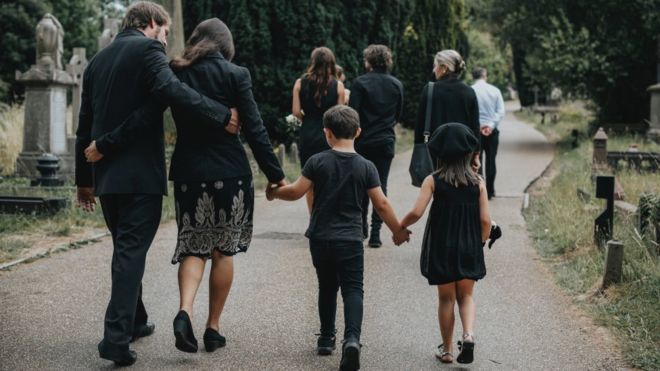
The stark reality is that, to keep everyone safe from the virus, the very sick and dying cannot have their family around them. Funerals cannot be conducted as planned. And people cannot grieve together.

But there are still ways to celebrate and mourn those we love and bid farewell in a meaningful way.

'The hard thing was not being together'
Dr Nick Schindler, a paediatrician at Norfolk and Norwich University Hospital, knew that when his 99-year-old grandfather John Cohen went into hospital last week with a chest infection it was unlikely he would be coming back home.

"Normally one of us would go with him," he said. "We would be there to discuss things and pass them on to the family. 

But we couldn't do that so we had to do it remotely."


He said staff at London's Royal Free Hospital were "absolutely wonderful" but only had "limited time" to speak on the phone.

Dr Nick Schindler with his grandfather John Cohen

It was decided that one person could visit the hospital if they wore personal protective equipment (PPE) - including a mask - and then isolated for 14 days afterwards. Dr Schindler's aunt, the youngest of three siblings, went.

"At that point, we knew there was going to be a funeral. And so she did that, knowing she then wouldn't be able to attend it."

Dr Schindler, 32, said by the time his grandfather died none of the family felt there was anything left unsaid, but "the really hard thing was not being together".

On the day of the funeral, he was isolating at home as his two-year-old son Ben had a fever. Unable to be there in person, they live-streamed the funeral on Zoom, with a total of 12 relatives watching from three different countries.

His mother, father and sister were the only ones who attended - his sister staying two metres apart from her parents.

Mr Cohen, front, with his family

After the funeral, the family members had another Zoom meeting, raising a toast and sharing stories. The family invited people to sit shiva with them, in the Jewish tradition, which was also done remotely.

Dr Schindler admits "it just doesn't seem real still", but he takes comfort from his belief that his grandfather is now reunited with his wife, who died 10 years ago.

"He must be so happy to be spending time with her," he says. "I don't think any of us felt that we could regret him dying. We felt like we'd held on to him for so long."

Lianna Champ, a funeral director and civil funeral celebrant with 40 years' experience, said she found the current situation heartbreaking.

"It's terrible seeing families sitting six feet apart, not able to reach out to each other," she said. "And can you imagine how awful it is choosing who attends a funeral?

"Coronavirus has turned funerals into something we don't recognise. People have rituals they expect to take place when someone dies, including being physically together.

"This trauma of coronavirus has changed how we live and die, and it has changed funerals."

Ms Champ, who is also an author and grief specialist, said it would be kinder to have a clear government directive saying cremations or burial currently had to take place with no friends or relatives present.

"People are less aware of hygiene when they are grieving - things like touching tables and chairs, or blowing their nose. 

We have to be careful where the health of the bereaved, funeral staff and cemetery or crematorium staff are concerned."

Lianna Champ leading a funeral procession

She urged people to "focus on the life that has been lived" and not "get stuck on the manner of death or the funeral".

If you can't attend a funeral she says people can light a candle in front of a photograph of loved ones at the same time it is taking place. "It helps to create an emotional connection. Or you could set up a memorial altar for them and offer up thoughts or prayers.

"Talking is so important as well - sharing feelings with someone. And don't be afraid to allow silence, or tears."

'Loved ones know we love them'
Andy Langford, clinical director at Cruse Bereavement Care, says he would encourage mourners to stay in contact with each other by phone or online - and to support those who are grieving.

"It's not necessarily about having the right words to say because there aren't always the right words. But you can be there for them and say you're thinking of them. It can feel pretty lonely right now, but if you've been bereaved it's even more so."

Sue Gill, a 26-year volunteer at Cruse, usually helps support children through grief - something she is now having to do through speaking to their parents or caregivers on the phone instead.

"I think those final moments with somebody are really, really important," she said. "That's when we get the chance to say our goodbyes and tell everybody we love them. And they've been taken away from them.

"But our loved ones know we love them. Perhaps we don't say it enough, but that knowledge is inside everybody."

She says memorial events can always be held in the future. "It will be a much better way of saying goodbye and having everybody come together," she says.

"That is something to plan for as part of the grieving process, to be able to say goodbye collectively - to have a cup of tea and a bun and laugh at memories together."

What does Public Health England say about funerals?
  • Funeral directors and faith leaders are advised to restrict the number of mourners at funerals
  • Only members of the household or close family members should attend
  • Anyone with coronavirus symptoms cannot attend
  • A small number of friends can go if no family or household members can attend
  • Mourners cannot take part in any rituals bringing them into close contact with the body
(Source: BBC)

Thursday, 26 March 2020

Coronavirus: How Covid-19 is denying dignity to the dead in Italy

Italy has banned funerals because of the coronavirus crisis. For many, the virus is now robbing families of the chance to say a final goodbye.

"This pandemic kills twice," says Andrea Cerato, who works in a funeral home in Milan. "First, it isolates you from your loved ones right before you die. Then, it doesn't allow anyone to get closure."

"Families are devastated and find it hard to accept."
"We put the clothes the family gives us on top of the corpse, as if they were dressed"


'They have no choice but to trust us'
In Italy, many victims of Covid-19 are dying in hospital isolation without any family or friends. Visits are banned because the risk of contagion is too high.

While health authorities say the virus cannot be transmitted posthumously, it can still survive on clothes for a few hours. This means corpses are being sealed away immediately.

"So many families ask us if they can see the body one last time. But it's forbidden," says Massimo Mancastroppa, an undertaker in Cremona.

The dead cannot be buried in their finest and favourite clothes. Instead, it is the grim anonymity of a hospital gown.

But Massimo is doing what he can.

"We put the clothes the family gives us on top of the corpse, as if they were dressed," he says. "A shirt on top, a skirt below."

In this unprecedented situation undertakers are suddenly finding themselves acting as replacement families, replacement friends, even replacement priests.

People close to those who die from the virus will often be in quarantine themselves.

"We take on all responsibility for them," says Andrea. "We send the loved ones a photo of the coffin that will be used, we then pick up the corpse from the hospital and we bury it or cremate it. They have no choice but to trust us."

The hardest thing for Andrea is not being able to ease the suffering of the bereaved. Instead of telling families all the things he can do, he is now forced to list everything he is no longer allowed to do.

"We can't dress them up, we can't brush their hair, we can't put make up on them. We can't make them look nice and peaceful. It is very sad."
"We can't make them look nice and peaceful. It is very sad."


Andrea has been an undertaker for 30 years, just like his father before him. He says small things are usually important for the bereaved.

"Caressing their cheek one last time, holding their hand, and seeing them look dignified. Not being able to do that is so traumatic."

In this time of virus, undertakers are often forced to meet grieving families either side of a closed door.

Relatives still try to pass on handwritten notes, family heirlooms, drawings and poems in the hope they will buried alongside their mother or father, brother or sister, son or daughter.

But not one of these things will be put in the coffins.

Burying personal items is now illegal. A drastic measure but one designed to stop the spread of the disease.

If someone dies at home, undertakers are still allowed inside - but they have to come in wearing full protective gear: glasses, masks, gloves, coats. It is a deeply distressing sight for someone who's just seen a loved one die.

But many undertakers are now in quarantine themselves. Some have had to close their business. A big worry is that those who handle the dead don't have sufficient masks or gloves.

"We have enough protective gear to keep us going for another week," says Andrea.

"But when we run out, we will not be able to operate. And we are one of the biggest funeral homes in the country. I can't even imagine how the rest are coping."
The deaths have overwhelmed Italy's funeral industry. Getty Images


An emergency national law has now banned funeral services in Italy to prevent the spread of the virus. 

This is unprecedented for a country with such strong Roman Catholic values.

At least once a day, Andrea buries a body and not even one person shows up to say goodbye - because everyone is in quarantine.

"One or two people are allowed to be there during burial, but that's all," Massimo says. "No-one feels able to say a few words, and so it is just silence."

Whenever he can, he tries to avoid that. So he drives to a church with the coffin in the car, opens the boot, and asks a priest to perform a blessing there and then.

It is often done in seconds. And then the next person awaits.

A country inundated with coffins
Italy's mortuary industry is overwhelmed and the number of dead keeps rising. Almost 7,000 people have been killed by the virus so far (24 March) - more than any other country in the world.

"There's a queue outside our funeral home in Cremona," says Andrea. "It's almost like a supermarket."
Funeral services have been banned in Italy as an emergency measure. Getty Images


Hospital morgues in northern Italy are inundated.

"The chapel at the hospital in Cremona looks more like a warehouse," says Massimo.

Caskets are piling up in churches. In Bergamo, which has the highest number of cases in Italy, the military has had to step in because the city's cemeteries are now full.

One night last week, locals watched in silence as a convoy of army trucks slowly drove more than 70 coffins through the streets.

Each one contained the body of a friend or neighbour being taken to a nearby city to be cremated. Few images have been more shocking or poignant since the outbreak began.
The Italian army was called in to help transport the dead. Reuters


Doctors and nurses across the country have been hailed as heroes, saviours in Italy's darkest hour. But funeral directors have not received recognition for what they too are doing.

"Many people see us as merely transporters of souls," Massimo sighs.

He says many Italians look at their work in the way they view that of Charon, the sinister mythological ferryman of the underworld who carries the souls of the newly deceased across a river dividing the world of the living from the world of the dead.

A thankless and unthinking task in the eyes of many.

"But I can assure you that all we want is to give dignity to the dead."

#Andratuttobene - "everything is going to be ok" - is a hashtag that has been trending in Italy since the crisis erupted. It's accompanied with a rainbow emoji.

But at the moment there is no sunshine in sight. And although all pray for it, no-one knows exactly when everything will indeed be ok once again.

*Illustrations by Jilla Dastmalchi

(Source: BBC)

Tuesday, 31 December 2019

We should stop the false praise for the deceased

Opinion - Why are bad things not spoken of the dead? 

Why is it we will not hesitate to refer to the ills of others when they are alive but will only stress their good after their death?

The absurdity of speaking only good about dead people, something that I regard as misapplied death etiquette, again occurred to me in the wake of the passing away of Struggle icon and “Mother of the Nation”, Winnie Madikizela-Mandela.

Barely hours after her death, strong debate was being waged in the mainstream and social media whether it was appropriate to make reference to her errors of judgement or only focus on her inspirational spirit and self-sacrifice in the fight for freedom.
Winnie Madikizela Mandela


I have attended many funerals of some not-so-savoury characters and waited in vain for even the slightest mention of their moral transgressions.

So often speakers who never had anything good to say of someone while he or she was still alive will suddenly be singing their praises at the graveside, while keeping the dark side private and confidential because it is considered the right thing to do.

In life, a fellow could have been a downright scoundrel, a con artist and swindler who cheated everyone he could. 

But the moment he kicks the bucket, he is invested with an instant halo and declared to be a saintly soul by the very people who had been his former detractors.

More baffling is that we are not only enjoined not to speak ill of the dead, but to speak as well of them as it is possible to do.

Yet, if the truth be told, there are many instances when people, including family members, do get some relief when a bad person passes on.

Often obituaries for drug dealers, murderers, child molesters and people who spend all their lives causing severe pain to others, are sugar-coated to make them appear to be saints and are given a massive, undeserved send-off. 

Gang leaders are celebrated as heroes after their demise. 

Frequently, when a gang boss dies, cars are stolen by gang members and burnt in his honour.

Bad people are let off the hook too easily in South Africa.

When the architect of apartheid and prime minister of South Africa, Hendrik Verwoerd, was assassinated in Parliament in September 1966, the local media did not go all out to vilify him. 

In defence of the Fourth Estate, I must assert the media during those days had to contend with a minefield of legislation which did not easily condone criticism of the government. 

Hence Verwoerd was spared any serious post mortem denigration.

PW Botha, who was prime minister and president of apartheid South Africa for 11 years, and was regarded as one of the most evil men of the 20th century because of his commitment to state terrorism, war and murder to thwart black majority rule, got away lightly when rigor mortis set in.

Although the post-apartheid Truth and Reconciliation Commission said he had been responsible for “gross violations of human rights”, there was no nationwide rejoicing at his death in October 2006.

Yet when former British prime minister Margaret Thatcher died in April 2013, there were celebration parties in several cities because her policies saw hundreds of thousands of jobs being lost. 

Many Britons remembered the Iron Lady pouring the country’s blood and treasure into the Falklands War.

Occasionally, an obituary writer will cut close to the bone and tell it as it should be.

I was in London in August 1997 at the time that there was worldwide outpouring of grief over Princess Diana’s fatal car accident. 

I remember that while the majority of the media held her up as the epitomé of everything good and beautiful, one brave British journalist ripped into her as “a spoiled child bride, a sulky wife, a narcissist, and a borderline airhead with zero interest in books, history or tradition”. 

I did not follow whether the hack was lynched by the Princess Diana Fan Club for being unsympathetic.

The media does not have to abide by convention and only write glowingly about the dead. 

A South African journalist who has refused to hero-worship the dead is Chris Barron, an obituary writer.

His obits have always been honest, truthful, and sometimes downright damning.

In reporting deaths, the media should tilt in favour of balance and qualification. 

The record of a person’s life should include the good and bad that they did, more so, in the case of public officials.

When Phoenix taxi owner and self-confessed drug lord Vernon John was shot dead in December 2016 in a drive-by shooting outside his home, the media was justified in denouncing him. 

After all, he will be most remembered for destroying lives through the sale of drugs. 

You cannot make a silk purse out of a sow’s ear. If you are bad, then you are bad.

The only way to remember Uganda’s fallen president, Idi Amin Dada, is as a bloodthirsty dictator who kept severed heads of political opponents in his refrigerator. 

During his eight-year regime, an estimated 300 000 civilians were massacred. He expelled all Indian and Pakistani citizens in 1972, contributing to the country’s economic decline.

The public must become accustomed to taking the bad with the good.

This newspaper, POST, came in for criticism from some readers two months ago when it reported on two friends who died when the car they were in burst into flames after crashing into a tree on the M4 in Durban. 

Mention was made in the story of the caring, compassionate nature of the men as well as their zest for life and hard work ethic. 

However, readers were not happy that reference was also made to their flamboyant lifestyles which, after all, is what made them so popular.

We humans seem to have a strange sense of sacredness for the dead, akin to the reverence we accord to religious deities. 

This would appear to be a self-proclamation of our weakness as mortals, a sense of respect for that one journey that we are all destined for - the damning journey of no return.

One reason often given for not bad mouthing the dead is that they are unable to defend themselves.

Another reason why it is socially inappropriate to speak anything negative about a deceased person is that when someone dies, the family, close friends and other loved ones are often confused and deeply hurt emotionally. 

To avoid inflicting further pain upon the family and loved ones, one avoids mentioning the wrongdoings the deceased might have done on earth.

Will I say bad things about a bad person at his funeral? I am not sure.

It is important to state factually the deceased’s strengths and weaknesses; one can learn wonderful lessons from both.
Mention of the bad side of a dead person must be done indirectly, like in the form of advice to the mourners not to sin.
Remember that death does not erase bad acts. If you want people to say good things about you when you are gone, do only good things when you are alive. 

Then you will RIP - Rest In Praise.

Shakespeare would beg to disagree. Mark Antony says in Julius Caesar: “The evil that men do lives after them. The good is oft interred with their bones.”


(Source: IOL)

Wednesday, 5 September 2018

Ariana Grande reminds us women have no safe place in America

On Friday at the Greater Grace Temple in Detroit, friends, family members, fans, music icons and powerful politicians came together to celebrate the life of Aretha Franklin. But after singer Ariana Grande took the stage to sing "(You Make Me Feel Like) A Natural Woman," a funeral fit for a queen also served as a reminder that there isn't a single place in this country where a woman can feel safe from sexual assault and harassment.

Following Grande's performance, Pastor Charles H. Ellis III wrapped his right arm around Grande, pulled her close to him and touched her breast. He did this on stage, in a church, during a funeral -- in front of thousands of attendees. Visibly uncomfortable and tense, Grande forced her way through awkward laughs as to not make a scene at the Queen of Soul's eight-hour funeral.

Ellis later apologized to Grande and her fans, telling the Associated Press, "I don't know; I guess I put my arm around her. Maybe I crossed the border, maybe I was too friendly or familiar, but again, I apologize."

The majority of us have felt what Grande undoubtedly felt on that stage: the undeniable fear that accompanies a violation; the need to keep everyone around you happy while you're internally screaming; the cultural expectation to keep smiling while your bodily autonomy is wholly dismissed.

To watch it play out at a funeral is not to be shocked by what you've witnessed, but to be reminded that women -- no matter how powerful or famous -- are not granted the same public safety as men.

But Grande is not the first woman to have been sexually assaulted at a funeral. Sophie Saint Thomas, a freelance writer, was groped while attending her grandmother's funeral this year. "My grandmother died of colon cancer earlier this summer." Thomas told me. "Her death was a massive loss for me, and I was very deep in mourning when I traveled to the funeral."


After giving a eulogy at the funeral proceedings, Thomas was approached by a man. "[He] told me how beautiful I looked on stage giving my eulogy, while putting his hand around my waist, only to slide it down and grab my ass. I froze and was bewildered by such behavior."

After Thomas was groped, she sat alone for the rest of the evening trying to regroup and avoiding the man who had fondled her.

"Being faced with confronting groping in a mourning setting, surrounded by people in grief, who should be allowed to have their grief ... is honestly just so astoundingly disgusting I don't know how anyone could come up with the 'ideal' response," Thomas said.

When Thomas watched Franklin's funeral and the groping play out on national television, she was reminded of her grandmother's funeral and the violation she endured at a time of profound loss. "The way [Ellis] touched [Grande] was exactly the same way I was touched, just on her breasts instead of butt," Thomas said.

Grande is not alone. Thomas is not alone. And the prevalence of sexual assault and harassment in this country cannot be understated. Yet approximately 70% of victims don't report their assaults for fear they won't be believed.

Of course, the current political climate doesn't help matters. We have a president who has mocked the #MeToo movement, a secretary of education who has proposed new college campus sexual assault misconduct rules that would provide additional protections to those accused of misconduct, and more than $17 million of taxpayer-funded money that has been used to settle complaints of sexual harassment in Congress.

And for the few brave women who come forward with sexual assault or harassment allegations, they face rebuke, criticism and personal attacks -- even though sexual assault has become a fundamental problem in American culture.

"I'm so sick of sexual assault victims and women having to do the emotional labor of trying to teach men that we are people just like them and should be treated as such," Thomas said.

But until we start holding abusers accountable, stop blaming victims for what they wore or how much they had to drink, and start acknowledging systemic abuses of power, we will continue to witness revolting reminders that the entire world is the stage of Franklin's funeral: a place where powerful men feel comfortable violating women regardless of who they are, where they are or who is watching.

(Source: CNN)

Wednesday, 24 January 2018

I took my mother to Dignitas

I said a cheery ‘Goodbyeeee!’ and she giggled. Then she went to sleep in our arms and died about an hour later, writes Joe Wilson in the Guardian. Read on: 

I always called my mum “Sandy”. Once, as a kid, I asked, “Can I call you Mum?” And she said, “Of course, and I’ll call you Sonnypie.” From the age of six, after she split from my stepdad, it was just the two of us. There were lots of rude words and giggling, listening to music and dancing, and she was proud of me when I became a musician. When my wife and I had our first daughter, she became Grandy, but she never met our youngest.

In May 2016, she started getting bad headaches, and the next month, we had a diagnosis: a brain tumour. She had three months to live, at 66. It was crushing, but seeing Sandy ask her sister Norah to look after me was also beautiful. That night, she texted me about a drive we’d been on together in ridiculous rain, when she’d parked up and we’d lain in the road and the rain just hit our faces. I cried and cried.

Sandy didn’t want hospitals, pain and palliative care – she just wanted to die. It was so intrinsic to who she was that, in a funny way, none of us was surprised by her decision. But while you spend your whole life worrying about dying, when it comes to wanting to do it you realise how difficult it is. She found a load of morphine from when her sister was dying of cancer, and decided to take it. But the attempt failed, and that’s when she decided to go to Dignitas.

We spoke to someone who had travelled to Dignitas with their loved one and was happy to speak to us about their experience. Sandy emailed Dignitas, letting them know she had a deadline of less than three months. Then she started the process of collecting letters and documents, and transferring money – it would cost £12,000 all in.

The next weeks were precious. I’d spend half the week with Sandy at her home in Oxford, the other half with my family in London while Norah took over, and every weekend we would all have a big Sunday lunch together. She didn’t have any other visitors: she didn’t want to be at her funeral before she died. We danced in the front room, drove to the country listening to playlists of her favourite music, watched films like Die Hard and one awful Adam Sandler movie. She sat in her bed in an opiate high with the sun beaming down and a breeze through the window.

She got the green light from Dignitas and Sandy, Norah and I flew out in August. The doctor came to our hotel and asked her, over and over, “Is this what you want?” She bit his hand off.


The next morning, I remember Sandy, Norah and I laughing at the word ausfahrt in the cab, before the building came into view. Volunteers welcomed us, then there were more interviews and more documents to sign. Sandy took the first vial of liquid to line her stomach, then we walked around the garden to wait the half hour before she could take the next step. We had tea and a biscuit, and Sandy sat on the sofa between Norah and me and we hugged, before she took the final vial.

When she turned to me, I did an over-the-top wave and said a cheery “Goodbyeeee!” and she giggled. Then she went to sleep in our arms and died about an hour later. It’s only supposed to take 10 minutes – that’s how strong her body still was. Driving back from the airport next to an empty seat, I thought, thank God she got there in time.

Throughout it all, I was writing music: I recorded a song on my phone in the car park after the diagnosis; on all the drives to Oxford; and lying next to her when she was asleep. It was very therapeutic, but also sad because she wanted to listen to the songs: I couldn’t play them to her without leaving her for a few weeks to record them. Now it’s an album she’ll never hear. What shocks me most is that the thing I was so scared of throughout my childhood ended up being a moment of such freedom; that the experience of Sandy’s death brought so much good into our lives.

Saturday, 14 October 2017

Researchers find name of Allah woven into ancient Viking burial fabrics

Find suggests evidence of Islamic influence not just 'the result of plundering and eastward trade', says archaeologist

Allah's name has been found embroidered into ancient Viking burial clothes, a discovery researchers in Sweden have described as "staggering".

The silk patterns were originally thought to be ordinary Viking Age decoration but a re-examination by archaeologist Annika Larsson of Uppsala University revealed they were a geometric Kufic script.

They were found on woven bands as well as items of clothing, in two separate grave sites, suggesting that Viking funeral customs had been influenced by Islam.
A tablet woven band, from a Viking burial site Annika Larsson

The woven bands contained ancient Arabic script, Kufic characters, invoking both Allah and Ali. The Kufic characters were found in the Viking Age in mosaics on burial monuments and mausoleums, primarily in Central Asia.

“One exciting detail is that the word ‘Allah’ is depicted in mirror image," Ms Larsson said. "Perhaps this was an attempt to write prayers so that they could be read from left to right.

“That we so often maintain that Eastern objects in Viking Age graves could only be the result of plundering and eastward trade doesn’t hold up as an explanatory model, because the inscriptions appear in typical Viking Age clothing.

“It is a staggering thought that the bands, just like the costumes, [were] made west of the Muslim heartland. Presumably, Viking Age burial customs were influenced by Islam and the idea of an eternal life in paradise after death."

She added: “In the Quran, it is written that the inhabitants of paradise will wear garments of silk, which along with the text band’s inscriptions may explain the widespread occurrence of silk in Viking Age graves. The findings are equally prevalent in both men’s and women’s graves.”

Ms Larsson’s prior research has uncovered widespread use of silk during the Viking Age in Scandinavia, the university said.

The cloth is thought to have come from ancient Persia and Central Asia.

(Source: Independent)

Monday, 23 January 2017

The rules and regulations of mourning in the Victorian era

Mourning the dead in the Victorian age was a very strict and formal event with many rules and regulations.

By the 19th century, mourning behaviour in England had developed into a complex set of rules, particularly among the upper classes. For women, the customs involved wearing heavy, concealing, black clothing, and the use of heavy veils of black crêpe. The entire ensemble was colloquially known as “widow’s weeds” (from the Old English waed, meaning “garment”).

Special caps and bonnets, usually in black or other dark colours, went with these ensembles. There was special mourning jewelry, often made of jet. Jewelry was also occasionally made from the hair of the deceased. The wealthy would wear cameos or lockets designed to hold a lock of the deceased’s hair or some similar relic.

Widows were expected to wear special clothes to indicate that they were in mourning for up to four years after the death, although a widow could choose to wear such attire for the rest of her life. To change the costume earlier was considered disrespectful to the deceased and, if the widow was still young and attractive, suggestive of potential sexual promiscuity. Those subject to the rules were slowly allowed to re-introduce conventional clothing at specific time periods; such stages were known by such terms as “full mourning”, “half mourning”, and similar descriptions. For half mourning, muted colours such as lilac, grey and lavender could be introduced.

Friends, acquaintances, and employees wore mourning to a greater or lesser degree depending on their relationship to the deceased. Mourning was worn for six months for a sibling. Parents would wear mourning for a child for “as long as they feel so disposed”. A widow was supposed to wear mourning for two years and was not supposed to enter society for twelve months. No lady or gentleman in mourning was supposed to attend social events while in deep mourning. In general, servants wore black armbands when there had been a death in the household.

However, amongst polite company the wearing of a simple black armband was seen as appropriate only for military men, or others compelled to wear a uniform in the course of their duties – a black arm band instead of proper mourning clothes was seen as a degradation of proper etiquette and to be avoided.In general, men were expected to wear mourning suits (not to be confused with morning suits) of black frock coats with matching trousers and waistcoats. In the later interbellum period between World War I and World War II, as the frock coat became increasingly rare, the mourning suit consisted of a black morning coat with black trousers and waistcoat, essentially a black version of the morning suit worn to weddings and other occasions, which would normally include colored waistcoats and striped or checked trousers.

Victorians were also very superstitious when it comes to death and mourning period. So they have assembled a bunch of superstitious rules such as:

It is bad luck to meet a funeral procession head on. If you see one approaching, turn around. If this is unavoidable, hold on to a button until the funeral cortege passes.

Stop the clock in a death room or you will have bad luck.

If you hear a clap of thunder following a burial it indicates that the soul of the departed has reached heaven

If you don’t hold your breath while going by a graveyard you will not be buried.

If the deceased has lived a good life, flowers would bloom on his grave; but if he has been evil, only weeds would grow. source

Unlike nowadays where anyone can attend a funeral service, in the Victorian age,  before attenting a funeral a person must first wait to receive their formal written invitation.

(Source: The Vintage News)

Friday, 13 January 2017

Friday the 13th: Why is it unlucky?

Some people refuse to leave their house on Friday the 13th for fear something truly awful might happen. I have gone through horrible things in my life on 13th, though not Friday the 13th. I had written a post also on that topic earlier. Here's some more info on the dreaded date.

While Hollywood think it is the perfect time to release the latest gory horror flick.

Whether you are superstitious - or just intrigued by the day - find out why it is unlucky and the superstitions some people believe.

When are the 2017 dates?
There will be two Friday the 13ths this year with one falling on January 13 and the other on October 13.

Why is it considered unlucky?
Superstition around the day is thought to have come from the Bible as there were 13 people present at the Last Supper before the crucifixion of Christ.

However some historians claim it dates further back and the 13th was when Eve bit the apple in the Garden of Eden.

13 bizarre myths and beliefs about the unlucky day:

  1. If you pass a funeral procession on Friday the 13th you will die.
  2. Most tall buildings miss out a thirteenth floor because of the bad luck associated with the number.
  3. If you have thirteen letters in your name you might want to lay low on the day as some people you have the devil's luck.
  4. In some countries like Mexico the day of bad luck is actually Tuesday the 13th.
  5. If you pay a bill and it comes to £6.66 - or you get that much back in change - you should either buy something else or leave a penny from your change to avoid getting bad luck.
  6. A child born on this day will be unlucky for life.
  7. Ships that sail out will sink or encounter bad luck.
  8. If you cut your hair someone in your family will die.
  9. To avoid bad luck when passing a cemetery you're supposed to hold your breathe until you see a black or brown dog.
  10. If 13 people dine together one of them will die within a year.
  11. Leaving your handbag on the floor means you will go on to lose money.
  12. There is a myth that you can break bad luck by spinning around 7 times.
  13. To avoid bad luck get out of bed on the same side every day.