Showing posts with label mosque. Show all posts

Tuesday, 3 November 2020

List of mosques in Qatar prepared for Istisqa prayers

The Ministry of Awqaf and Islamic Affairs has called on all Muslims in the State to perform Istisqa (rain-seeking) prayer on Thursday Nov. 5 at 6 am local time at a number of mosques in the country in line with the Sunnah of Prophet Muhammad (Peace Be Upon Him) to pray for rainfall when rain is lacking. The Ministry prepared 78 mosques for the prayer.

File Photo by Salim Matramkot © The Peninsula

In a statement, the ministry reminded Muslims of the requirements for the acceptance of dua (pleading to Allah) which include fasting, offering Sadaqah, repentance to Allah, cleaning their bodies and using miswak.


List of mosques:

1 - Al Wajba prayer ground - Al Wajba

2 - Imam Muhammad ibn Abd al-Wahhab Mosque - Al Jebailat

3 - Rawdat Qadeem prayer ground - Rawdat Qadeem

4 - Al Rayan Al Jadeed prayer ground - Al Rayan Al Jadeed

5 - Education city mosque - Al Rayan Al Qadeem

6 - Muaither prayer ground - Muaither 

7 - Abdul Aziz bin Abdulrahman Al Thani Mosque - Gharafa Al Rayan

8 - Sheikh Faisal bin Jasim Mosque - Al Gharafa

9- West Al Murra prayer ground  - West Al Murra

10 - Prayer ground - Mouezla

11 - North Al Sailiya prayer ground - North Al Sailiya

12 - Abu Nakhla prayer ground - Abu Nakhla

13 - Islamic centre prayer ground - Industrial Area

14 - Prayer ground beside Al Atiya Mosque - Industrial Area

15 - Prayer ground beside Soufian Al Thawri Mosque - Al Ghanem Al Jadid

16 - Al Aziziyah Mosque number 19 - Al Aziziyah

17 - Al Waeeb Prayer ground - Al Waeeb

18- Mesaimeer Cemetery  Mosque - Mesaimeer 

19 - Barwa Mosque - Abu Hamour

20 - Maintenace department mosque - Abu Hamour 

21 - Jassim Al Darwish Center - Abu Hamour 

22 - Sheikh Jabr bin Ali Al Thani Mosque - Ain Khaled

23 - Anas bin Malek mosque - Central Market 

24 - Al Saad mosque - Al Maamoura

25 - Muhammed Abdurahman Zaman Mosque - Asalata Jadida

26 - Prayer ground beside Al Asmakh Mosque - Al Thumama

27 - Al Hadarima Mosque - Al Hadarima

28 - Al Wakrah City Mosque - Al Wakrah

29 - New Al Wukair Mosque - Al Wukair

30 - Old Al Wukair Mosque - Al Wukair

31 - Umm Saeed Prayer ground -Mesaieed

32 - Prayer ground beside Abu Hanifa Mosque - Old Airport

33 - Nayla bint Qassim Al Thani Mosque - Al Najma

34 - Abu Bakr Al Saddiq Mosque - Umm Ghuailina

35 - Musheirib Prayer ground - Musheirib

36- Bin Mahmoud Prayer ground - Bin Mahmoud

37 - Al Hassan bin Ali Mosque - Musheirib 

38 - prayer ground Al Nasr Al Jadid - Al Nasr Al Jadid

39 - Bin Omran prayer ground - Bin Omran

40 - Omar bin Al Khattab Mosque - Madinat Khalifa south 

41 - Hessa Bint Khalid Mosque - Al Luqta

42 - Khalid bin Muhammed Al Thani Mosque - Al Luqta

43 - Dahl Al Hamam Mosque - Madinat Khalifa North

44 - Prayer ground beside 222 Mosque - Al Naeem

45 - Prayer ground beside Sheikh Saoud bin Fahed Al Thani Mosque - Al Khisah

46 - Rawdat Al Hamama Prayer ground -  Rawdat Al Hamama 

47 - Prayer ground beside Al Misnid - Hazm Al Markhiya

48 - Munira Al Swaidi Prayer ground - Unaiza

49 - Prayer ground beside Hasan Ghani Al Ghanim - Jaryan Njaima

50 - Bin Ajaj Prayer ground beside the park - Azghawa 

51 - Prayer ground inside Al Khuraitiyat Club - Al Khuraitiyat 

52 - Umm Salal Muhammed prayer ground - Umm Salal Muhammed 

53 - Naser Bin Jassem Prayer ground - Umm Salal Muhammed 

54 - Umm Salal Ali prayer ground - Umm Salal Ali 

55 - Umm Al Amad prayer ground - Umm Al Amad

56 - Umm Qarn prayer ground - Umm Qarn

57 - Sumaisma prayer ground - Sumaisma

58 - Al Khor City prayer ground - Al Khor

59 - Al Dhakhira prayer ground  - Al Dhakira

60 - Al Kaaban prayer ground -Al Kaaban

61 - Al Ghwairiya prayer ground - Al Ghwairiya

62 - Al Ghashamiya prayer ground - Al Ghashamiya

63 - Al Shamal City prayer ground - Al Shamal

64 - Al Ruwais prayer ground - Al Ruwais

65 - Abu Zallouf prayer ground- Abu Zallouf

66 - Dukhan City prayer ground - Dukhan 

67 - Al Kharsaah prayer ground - Al Kharsaah

68 - Umm al `Azam prayer ground - Umm al `Azam

69 - Al Jumailiah prayer ground - Al Jumailiah 

70 - Al Karaana  prayer ground - Al Karaana 

71 - Umm Howtah prayer ground -Umm Howtah

72 - Atturiyah prayer ground - Atturiyah

73 - Al Khara'rb prayer ground- Al Khara'rb

74 - Al Rayes prayer ground-  Al Rayes 

75 - Al Nasraniya prayer ground - Al Nasraniya 

76 - Al Shahaniyah  prayer ground- Al Shahaniyah

77 - Rawdat Rashed prayer ground- Rawdat Rashed 

78 - West Umm Al Zubar prayer ground - West Umm Al Zubar


List of mosques (Arabic)


(Source: The Peninsula)


Awqaf calls on Muslims in Qatar to pray for rain on Thursday

The Ministry of Awqaf and Islamic Affairs has called on all Muslims in Qatar to perform the Istisqa (rain-seeking) Prayer on Thursday at 6 am at mosques in the country in line with the Sunnah of Prophet Muhammad (Peace Be Upon Him) to pray for rainfall when rain is lacking. 

His Highness the Amir Sheikh Tamim bin Hamad Al Thani on Monday called for Istisqaa Prayer to be performed across the country on Thursday morning.


HH the Amir will perform the Istisqaa Prayer with crowds of worshipers at Al-Wajba prayer ground.


Although the Wasmi season began in the country on October 16, rainfall has been scarce. 


Wasmi season is the local term for rain season, during which the country witnesses a drop in temperatures, winds, storms and rainfall for 52 days.


The rainfall during this season also helps certain local plants such as helianthemum and geranium grown. During this period, clouds move from west to east, and rainfall in the beginning of the season is usually an indication of a good rainy season.


(Source: Qatar Tribune)

Thursday, 20 August 2020

Looted landmarks: how Notre-Dame, Big Ben and St Mark's were stolen from the east

They are beacons of western civilisation. But, says an explosive new book, the designs of Europe’s greatest buildings were plundered from the Islamic world – twin towers, rose windows, vaulted ceilings and all

As Notre-Dame cathedral was engulfed by flames last year, thousands bewailed the loss of this great beacon of western civilisation. The ultimate symbol of French cultural identity, the very heart of the nation, was going up in smoke. But Middle East expert Diana Darke was having different thoughts. She knew that the origins of this majestic gothic pile lay not in the pure annals of European Christian history, as many have always assumed, but in the mountainous deserts of Syria, in a village just west of Aleppo to be precise.

“Notre-Dame’s architectural design, like all gothic cathedrals in Europe, comes directly from Syria’s Qalb Lozeh fifth-century church,” Darke tweeted on the morning of 16 April, as the dust was still settling in Paris. “Crusaders brought the ‘twin tower flanking the rose window’ concept back to Europe in the 12th century.”
Twin towers flanking a monumental arched entrance … the remains of Qalb Lozeh church in Syria, the inspiration behind Notre-Dame. Photograph: Bertramz

It is not only the twin towers and rose window that have their origins in the Middle East, she pointed out, but also the ribbed vaults, pointed arches and even the recipe for stained glass windows. Gothic architecture as we know it owes much more to Arab and Islamic heritage than it does to the rampaging Goths. “I was astonished at the reaction,” says Darke. “I thought more people knew, but there seems to be this great gulf of ignorance about the history of cultural appropriation. Against a backdrop of rising Islamophobia, I thought it was about time someone straightened out the narrative.”

And so she has, with Stealing from the Saracens, an exhilarating, meticulously researched book that sheds light on centuries of borrowing, tracing the roots of Europe’s major buildings – from the Houses of Parliament and Westminster Abbey to Chartres cathedral and St Mark’s basilica in Venice – back to their Middle Eastern precedents. It is as much a story of political power, wealth and fashion as it is of religious belief, with tales of looting Crusaders, fashion-conscious bishops and globe-trotting merchants discovering new styles and techniques and bringing them home.

“Now we have this notion of east and west,” says Darke. “But back then, it wasn’t like that. There were huge cultural exchanges - and most came from the east to the west. Very little went the other way.”
Masterpiece of geometry … the exquisite interior of Córdoba’s mosque-cathedral. Photograph: Ingo Mehling

Given their prevalence in the great cathedrals of Europe, it is easy to imagine that pointed stone arches and soaring ribbed vaults are Christian in origin. But the former dates back to a seventh-century Islamic shrine in Jerusalem, while the latter began in a 10th-century mosque in Andalucia, Spain. In fact, that first known example of ribbed vaulting is still standing. Visitors to the Cordoba Mezquita can marvel at its multiple arches intersecting in a masterpiece of practical geometry and decorative structure, never needing a repair in its thousand-year existence. The vaulted maqsura – the part of the mosque reserved for the ruling caliph – was designed to cast a sacred glow across the leader. However, the official leaflet will tell you little of the building’s Islamic origin, perhaps because it has been a Catholic church since 1236.

The pointed arch, meanwhile, was a pragmatic solution to a problem encountered by masons working on the Dome of the Rock in Jerusalem. One of the holiest sites in the Muslim world, it was built in 691 by the ruler of Islam’s first empire. The challenge was how to line up an outer arcade of rounded arches with a smaller inner arcade, while maintaining a horizontal ceiling between them. For the openings to align, the masons had to give the inner arcade tighter arches, forcing them to become pointed. Another world first can be spotted higher up in the shrine, where encircling the dome is an arcade of trefoil arches, the three-lobed style of arch that went on to encrust practically every European cathedral, voraciously adopted as a symbol of the Holy Trinity.
Looks familiar? … from left, the interior of Jerusalem’s Dome of the Rock, and Temple Church in London. Composite: Virtutepetens/Getty Images/iStockphoto

“Again and again,” says Darke, “I am so struck by how much of this stuff that we think of as essentially Christian and European was based on ignorance and misinterpretation of much earlier Islamic forms.” She points out that the enormous influence of the Dome of the Rock was down to the Crusaders of the Middle Ages mistakenly thinking the building was the Temple of Solomon.

They used the domed, circular layout of this supposedly Christian shrine as the model for their Templar churches (like the City of London’s round Temple church), even copying the decorative Arabic inscription, which openly chastises Christians for believing in the Trinity rather than in the oneness of God. Their pseudo-Kufic calligraphic patterns went on to adorn French cathedral stonework and the borders of richly woven textiles, with no one aware of what they actually meant.

The confusion was spread further by the first printed map of Jerusalem, published in Mainz, Germany, in 1486. It not only mislabels the Dome of the Rock as the Temple of Solomon, but depicts the building with a fine onion dome – a pure orientalist fantasy from the mind of a Dutch woodcut artist named Erhard Reeuwich. The book containing the map became a bestseller, reprinted 13 times and translated into multiple languages, influencing the spread of onion-domed churches across Europe in the 16th century. It is a tale of mistaken identity and unintended consequence worthy of a Monty Python sketch.
More Arab than European … Jerusalem’s Dome of the Rock, left, and St Mark’s basilica in Venice. Composite: Godot13/Zairon

The transfer of Islamic motifs to the west wasn’t always so simple, though. The pointed arch took a more circuitous route. Darke traces how the arches first spread to Cairo, becoming sharper and more pointed under the Abbasid empire, and were in turn admired by visiting merchants from the wealthy Italian port of Amalfi, who channelled discoveries from their travels into their eclectic 10th-century basilica. This exotic building caught the eye of Abbot Desiderius, who visited Amalfi in 1065 on a shopping trip for rare luxury merchandise, and decided to take the pointed window design for his monastery at Monte Cassino.

Those windows were then copied for the Benedictine abbey at Cluny in France, the largest church in the world at the time. Abbot Suger, an adviser to kings Louis VI and VII, liked how the windows let in more light, and immediately applied the same design to his Saint-Denis basilica in Paris. Regarded as the earliest fully gothic structure, the basilica was completed in 1144 and its architect went on to work at Notre-Dame. “They all just copied it,” says Darke. “These were the most powerful churches in Europe, so the style completely took off, as all fashions do. When powerful people adopt something, everyone wants one.”

The list goes on. There are the early square minarets, found on such buildings as the Great Mosque of Damascus, that taper thinner and are crowned with a bulbous finial dome. These inspired such great Italian towers as those of Florence’s town hall and St Mark’s Campanile in Venice, prefiguring centuries of church bell-towers.
Borrowed time … from left, the now destroyed minaret of the Great Mosque in Aleppo, Syria; and Big Ben in London. Composite: Alamy/Getty Images/Dorling Kindersley

Drawing on architectural historian Deborah Howard’s research, Darke shows Venice to be more Arab than European, from its narrow winding passageways and courtyard homes with rooftop terraces, to the Islamic ornamentation of the Doge’s Palace (modelled on Al-Aqsa Mosque in Jerusalem) and the onion domes of St Mark’s. All are the fruit of trips made by Venetian merchants to Egypt, Syria, Palestine and Persia, fostering a level of influence that extended even to fashion: women in Venice were veiled in public and dressed in black from head to toe. “One cannot see their faces for all the world,” a 15th-century source commented. “They go about so completely covered up, that I do not know how they can see to go along the street.”

The book comes at a charged time, when supposedly western architecture is being mobilised by right-wing nationalist groups to bolster their idealised vision of a “pure” European identity. There are now countless social media accounts promoting messages of white supremacy disguised as heritage appreciation, while recent government edicts about tradition and beauty carry similar overtones. Darke’s work takes an eloquent sledgehammer to such ignorant, dog-whistle propaganda, revealing how the monuments idealised by the alt-right have their roots in the very culture of which they are so suspicious.

The ignorance is widespread, and perhaps the most surprising thing in Stealing from the Saracens is how much of this should not come as a surprise to the modern reader. After all, throughout the book, Darke summons the words of Christopher Wren, who was well aware of the Middle Eastern origins of gothic architecture, and of the structural techniques he was using for St Paul’s Cathedral.

“Modern gothic,” he wrote in the 1700s, “is distinguished by the lightness of its work, by the excessive boldness of its elevations … by the delicacy, profusion and extravagant fancy of its ornaments … Such productions, so airy, cannot admit the heavy Goths for their author.” Instead, he concluded, “from all the marks of the new architecture, it can only be attributed to the Moors; or what is the same thing, to the Arabians or Saracens”.

The irony is in the name itself: in Wren’s day, Saracen was a pejorative term for the Arab Muslims, against whom the Crusaders had fought their “holy war”. It originated from the Arabic word “saraqa”, meaning “to steal”, as Saracens were seen as looters and thieves. Never mind the fact that the Crusaders plundered their way across Europe, Jerusalem and Constantinople – pilfering the wonders of Islamic architecture as they went, and airbrushing the origins of their booty in the process.


(Source: The Guardian)

Saturday, 11 July 2020

Hagia Sophia: Turkey turns iconic Istanbul museum into mosque

The world-famous Hagia Sophia museum in Istanbul - originally founded as a cathedral - has been turned back into a mosque.


Turkey's President Recep Tayyip Erdogan announced the decision after a court annulled the site's museum status.


Built 1,500 years ago as an Orthodox Christian cathedral, Hagia Sophia was converted into a mosque after the Ottoman conquest in 1453.


A woman wrapped in a Turkish national flag gestures outside the Hagia Sophia museum. Getty Images


In 1934 it became a museum and is now a Unesco World Heritage site.


Islamists in Turkey long called for it to be converted to a mosque but secular opposition members opposed the move. The proposal prompted criticism from religious and political leaders worldwide.


Defending the decision, President Erdogan stressed that the country had exercised its sovereign right in converting it back to a mosque.


He told a press conference the first Muslim prayers would be held inside the building on 24 July.


"Like all our mosques, the doors of Hagia Sophia will be wide open to locals and foreigners, Muslims and non-Muslims," he added.


Shortly after the announcement, the first call to prayer was recited at Hagia Sophia and was broadcast on all of Turkey's main news channels. The cultural site's social media channels have now been taken down.


What has the reaction been?

Unesco has said it "deeply regrets" the decision to turn the museum into a mosque and called on the Turkish authorities to "open a dialogue without delay."


The organisation had urged Turkey not to change its status without discussion.


The head of the Eastern Orthodox Church has condemned the move, as has Greece - home to many millions of Orthodox followers.


The Hagia Sophia has huge significance as a religious and political symbol. Getty Images


Culture Minister Lina Mendoni said it was an "open provocation to the civilised world".


"The nationalism displayed by President Erdogan... takes his country back six centuries," she said in a statement.


The court ruling "absolutely confirms that there is no independent justice" in Turkey, she added.


But the Council of State, Turkey's top administrative court, said in its ruling on Friday: "It was concluded that the settlement deed allocated it as a mosque and its use outside this character is not possible legally."


"The cabinet decision in 1934 that ended its use as a mosque and defined it as a museum did not comply with laws," it said.


The Church in Russia, home to the world's largest Orthodox Christian community, immediately expressed regret that the Turkish court had not taken its concerns into account when ruling on Hagia Sophia.


It said the decision could lead to even greater divisions.


While the move is popular with conservative religious supporters of President Erdogan, Turkey's most famous author, Orhan Pamuk said the decision would take away the "pride" some Turks had in being a secular Muslim nation.


"There are millions of secular Turks like me who are crying against this but their voices are not heard," he told the BBC.


The site is now one of Turkey's most visited tourist attractions. Getty Images


Analysis by Oral Guerin, BBC News Istanbul

A change is coming to Hagia Sophia, which has endured since the 6th century, outlasting the Byzantine empire and the Ottoman era. 


Now, once again, it will be a mosque. But Turkish officials say Christian emblems, including mosaics of the Virgin Mary which adorn its soaring golden dome, will not be removed.


Making changes at Hagia Sophia is profoundly symbolic. It was Kemal Ataturk, the founder of modern Turkey, who decreed that it should be a museum. President Erdogan is now taking one more step to dismantle Ataturk's secular legacy, and remould Turkey according to his vision. The Turkish leader - who presents himself as a modern day conqueror - is making no apologies for the change. He says anyone who doesn't like it - and plenty abroad don't - is attacking Turkey's sovereignty.


Reclaiming Hagia Sophia plays well with his base - religious conservatives - and with Turkish nationalists. Critics say he's using the issue to distract attention from the economic damage done here by the Covid19 pandemic.


But many in the international community argue that the monument belongs to humanity - not to Turkey - and should have remained unchanged. They say it was a bridge between two faiths, and a symbol of co-existence.


History of a global icon

  • Hagia Sophia's complex history began in the year 537 when Byzantine emperor Justinian built the huge church overlooking the Golden Horn harbour
  • With its huge dome, it was believed to be the world's largest church and building
  • It remained in Byzantine hands for centuries apart from a brief moment in 1204 when Crusaders raided the city
  • In 1453, in a devastating blow to the Byzantines, Ottoman Sultan Mehmed II captured Istanbul (formerly known as Constantinople) and the victorious conqueror performed Friday prayers inside Hagia Sophia
  • The Ottomans soon converted the building into a mosque, adding four minarets to the exterior and covering ornate Christian icons and gold mosaics with panels of Arabic religious calligraphy
  • After centuries at the heart of the Muslim Ottoman empire, it was turned into a museum in 1934 in a drive to make Turkey more secular
  • Today Hagia Sophia is Turkey's most popular tourist site, attracting more than 3.7 million visitors a year


(Source: BBC)

Wednesday, 20 May 2020

'It’s a very different Ramadan': how coronavirus has upended ancient rituals

This year, Islam’s holiest month has been held in lockdown in Australia. Mufti Zeeyad Ravat, from Melbourne, sees some positives: ‘It’s bonding families’

Mufti Zeeyad Ravat is an Islamic scholar, an authority on the day-to-day practice of Islam. His path to Australia was a circuitous one, from his birthplace in Johannesburg, South Africa, through India, Syria (where he studied Arabic), Brazil, Brisbane and Melbourne. In March last year, he travelled to New Zealand to lead a prayer service in Christchurch after 50 worshipers at a mosque were slaughtered.
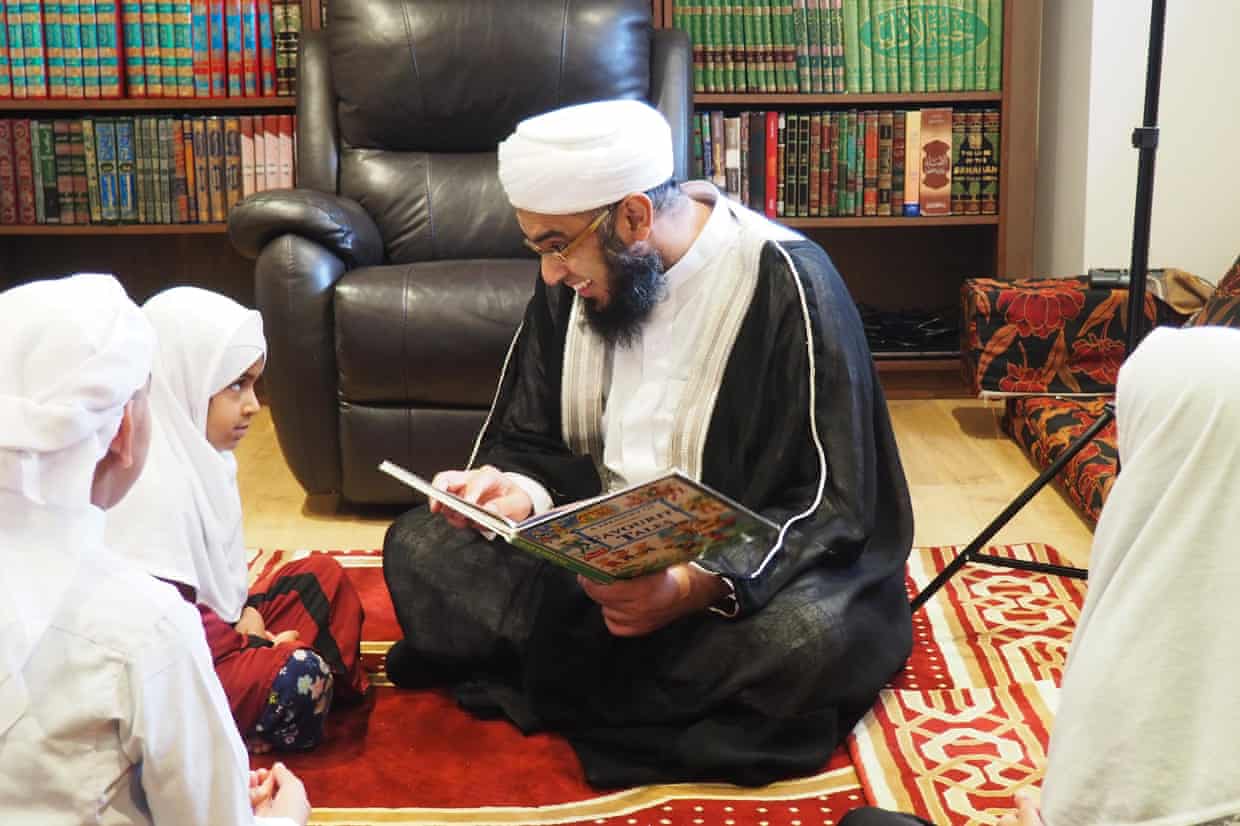
During Ramadan, Mufti Zeeyad Ravat broadcasts lessons live on social media from his home in Melbourne, Australia. He sees coronavirus as a test and a vehicle to take him closer to God. Photograph: Gay Alcorn/The Guardian

Ravat, 39, is a bundle of energy, his arms waving to make a point, one leg tucked underneath him on a recliner in his home in Dandenong in south-east Melbourne. The everyday noise of family life (he is married with five children) break through from the next room as he explains how important Ramadan is, and how the coronavirus pandemic has upended its rituals.

“It’s a very different Ramadan,” he says. “I think it’s the first and last Ramadan of this kind.”

There are 1.8 billion Muslims in the world. More than 600,000 live in Australia, some born here, some arriving from countries as diverse as Indonesia, Turkey, Lebanon, Egypt, Indonesia, Pakistan and Somalia. There are different cultures, different traditions.

Like the followers of any religion, there are the devout and the less devout. Some people, says Ravat, pray five times a day. Others turn up for Friday prayers only. But Ramadan is special.

Ramadan is Islam’s holiest month, a time for reflection and self-discipline, as well as fasting from dawn to dusk for 30 days. This year in Australia, it began on 23 April and ends on 23 May.
Mufti Zeeyad Ravat (right) leads a prayer at the Deans Avenue memorial near the Al Noor mosque in Christchurch on 19 March 2019. Photograph: Anadolu Agency/Getty Images

The idea of Ramadan hasn’t changed, Ravat says. It’s a time when acts of goodness – always an obligation – are especially rewarded. The practice of generosity, particularly to the poor and vulnerable, is intensified. Ravat’s garage is full of boxes of groceries ready to be delivered to those struggling to buy food.

“We look forward to the month of Ramadan, because it’s that time that whatever you couldn’t do in the last 11 months, it’s the one month that you can speed up things, you can get things going from the spiritual perspective.”

The world is full of greed and power, he says, and “fasting is to realign our focus. We keep hungry for 30 days during the day. It’s taming the ego, and ultimately, slowly, that ego breaks down and the spirituality takes over. It’s about becoming peaceful.”

The rituals of Ramadan are impossible this year, with academics saying the restrictions are a first for Islam.

There are no communal gatherings in mosques for “tarawih” prayers every night after the fast is broken. There are no large iftar dinners with family and friends.

Last year, Ravat spent Ramadan at the Pillars of Guidance Community Centre, which he helped found in Melbourne’s south-east in 2016. Ravat is Sunni, of the Hanafi school, but says the centre’s purpose is to welcome everyone. There’s a strong social welfare program, youth classes, advice on traditions such as weddings, and a fine-dining restaurant.
The Gallipoli mosque in Auburn, Sydney, is among places of worship around the world that are closed to prevent the spread of coronavirus. Photograph: Brook Mitchell/Getty Images

During Ramadan, Muslims gathered at the centre after dusk to listen to Ravat recite a chapter of the Qur’an (the whole Qur’an is spoken over 30 days) and to teach a lesson afterwards.

As a boy in South Africa, Ravat memorised the Qur’an – a respected but uncommon practice among Muslims – and says that even if people can’t understand Arabic, it has meaning.

“It’s so melodious and beautiful that when you read it it actually soothes you and the meaning is so beautiful, because God is talking to you,” he says.

This year, mosques and other places of religious worship are shut to prevent the spread of coronavirus. Families are expected to recite the tarawih prayers at home and iftars are only for households. Each evening, Ravat or his eldest son recite a chapter of the Qur’an to the family. The little ones, he says, get a little tired of the prayers and are not expected to fast every day.

“The challenge is that in normal Ramadans, you have a strong environment in the mosque, a community that creates that vibe of Ramadan,” he says. “You go to the mosque, everyone is praying, and the imam is reading … and there’s these huge iftars that are happening.

God creates everything, whether it is a plague or whether it’s good times- Mufti Zeeyad Ravat

“There’s no environment [now] … that has bothered a lot of people, a lot of people are feeling down,” he says.

But “disaster is the mother of invention”. A week before Ramadan, Ravat set up a makeshift studio in his living room, with a camera and lights. Each night he broadcasts a lesson live on social media. His 18-year-old son, a tech wizard, works the camera. Up to 12,000 people have tuned in.

Similar experiments are happening across the country. Dr Ibrahim Abu Muhammad, the Grand Mufti of Australia and New Zealand, has said that online tarawih prayers should not be held “because one of the conditions of the group prayers is that there is direct contact between the imam and the people”. But online lessons and teachings are encouraged.

Ravat sees some positives emerging.

“It’s bonding families,” he says. “We’re stuck at home now [and] we actually eat much more slowly because there’s no rush.”

Every major religion has struggled to explain suffering in a spiritual context. Some believers have argued that natural disasters are a test of faith; others that they are a punishment of some kind, a notion that can seem cruel.
Mufti Zeeyad Ravat gives a lesson to his children at home. Photograph: Gay Alcorn/The Guardian

Jesuit priest James Martin wrote in the New York Times that it’s the same question when a single child dies from cancer or a hurricane kills hundreds of people: why, if God is all powerful and all-loving, does he not prevent such suffering?

“In the end, the most honest answer to the question of why the Covid-19 virus is killing thousands of people, why infectious diseases ravage humanity and why there is suffering at all is: we don’t know,” he writes.

For Ravat, Allah is all-knowing, the creator of everything, which includes Covid-19. Mehmet Ozalp, associate professor in Islamic Studies at Charles Sturt University, wrote in the Conversation that while the emergence of the virus might not be in human control, its spread is. The prophet Muhammad sought medical treatment and encouraged his followers to do the same, saying that “God has not made a disease without appointing a remedy for it, with the exception of one disease – old age”.

Ravat puts it this way: “God creates everything, whether it is a plague or whether it’s good times, God creates it, but it’s us with our actions that draws whichever one [out].”

He does see this time as some kind of cleansing, some kind of reckoning. “As human beings we are greedy, we cannot just be happy with what we have, we want to conquer this world, we want to dig every hole, we want to turn every mountain upside down, we want to pull every [piece of] coal out, we want to suppress the weaker.”

Coronavirus is a test, a vehicle to take him closer to God. But has it shaken his faith in any way, even for a moment?
“No,” he says. “Never ever.”

(Source: The Guardian)

Wednesday, 8 January 2020

Destroying cultural heritage sites is a war crime

President Trump threatened to destroy 52 Iranian sites — “some at a very high level & important to Iran & the Iranian culture” — on Twitter on Saturday. This may seem like a small issue in the midst of an international crisis, but, as others have noted, his tweet amounts to an announcement of an intention to commit war crimes.

A part of the Hague Convention of 1907, signed over a century ago, says that “all necessary steps must be taken” to spare “buildings dedicated to religion, art, science, or charitable purposes, historic monuments, hospitals, and places where the sick and wounded are collected.” Similarly, the Geneva Convention Protocol I, signed in 1949 and amended in 1977, renders unlawful “any acts of hostility directed against the historic monuments, works of art or places of worship which constitute the cultural or spiritual heritage of peoples.”

Federal law in the United States says that violating these international conventions would constitute a war crime. Anyone who violates them could be imprisoned or, if death results from their actions, be sentenced to death. Members of the Trump administration should be on notice that they can be held liable under these provisions.
The 17th-century Imam Mosque in Isfahan is one of many UNESCO World Heritage Sites in Iran.(Los Angeles Times)

Trump’s threatened actions would be morally reprehensible even outside the law, because they would destroy centuries-old places of profound importance not just to Iranians, but to all of human civilization.

Measuring the significance of sites is always a delicate exercise. In the United States, we conduct a formal evaluation before we place a site on a list such as the National Register of Historic Places.

The worldwide list is the United Nations Educational, Scientific and Cultural Organization (UNESCO) List of World Heritage Sites. The United States has 24 places on UNESCO’s list, including Independence Hall, widely recognized as the birthplace of modern democracy and a symbol of hope for people around the world. The San Antonio Missions, Statue of Liberty and Mesa Verde National Park are also listed. It’s worth noting that many sites that we might think of as important to our national identity are not included on this international list. Not even Mount Vernon has made it, though President Washington’s home is one of 19 places nominated by the United States for consideration.

Iran, just one-sixth the size of the United States, also has 24 UNESCO designations and has nominated 56 more for consideration.

That country, recognized as a cradle of civilization, is home to World Heritage Sites like the Shustar hydraulic system, initiated in the fifth century B.C. and hailed by UNESCO as a “masterpiece of creative genius.” Also included as a group are eight Persian gardens whose distinct design influenced the Alhambra in Spain and the Taj Mahal in India and countless modern landscapes today.

But perhaps the most significant place on the UNESCO list is Persepolis, reportedly the most-visited historic site in Iran. It was a ceremonial capital of the Persian Empire, completed by Darius I and given a place of prominence in architectural history courses across the world. Some believe that Persepolis was the place where the clay Cyrus Cylinder (today housed at the British Museum) was inscribed in cuneiform. Recognizing the diversity of the Persian Empire, the cylinder sets forth a vision of governing a pluralistic society and is considered by some Iranians to be the world’s first charter of human rights.

A nation that willfully destroys another country’s heritage would be no better than the criminals who have destroyed irreplaceable sites in Syria, Afghanistan, Iraq and elsewhere in recent years.

Protecting civilian lives is paramount, but saving cultural sites is consistent with that mission, too. Destroying mosques, museums and libraries will certainly result in civilian casualties.

If President Trump’s rhetoric is a calculated attempt to pressure Iranian citizens to topple their regime, it seems likely to backfire. Imagine how Americans would respond if a foreign power threatened to fire missiles at the Statue of Liberty. If he follows through on his threat, he will violate international law and the United States will risk further damage to its increasingly fragile global reputation.


(Source: LA Times)

Friday, 1 November 2019

Building bridges with Islam at Tokyo Camii

With hoodies and scarves covering their heads, a group of Japanese high school students point and whisper in awe upon entering the main hall of Tokyo Camii as Muslim worshippers prostrate beneath a glittering dome set against a bright sky.
Call to prayer: Tokyo Camii and Turkish Cultural Center is the Japanese capital's largest mosque and can hold up to 1,200 people at a time. | KENDREA LIEW

Located just five minutes from Yoyogi-Uehara Station in Tokyo’s Shibuya Ward, Tokyo Camii welcomes hundreds of visitors weekly as Japan’s largest congregational mosque. The spectacular Ottoman-styled building can hold up to 1,200 people at a time and includes a Turkish cultural center for social gatherings.

Although there are more than 80 mosques in Japan (with 10 based in Tokyo), Islamic culture remains rather unfamiliar to many people in Japan. Furthermore, as in other countries, Islam tends to get a lot of negative press due to problems with extremist groups and religious fundamentalists. Despite this, Tokyo Camii spokesperson Shigeru Shimoyama says he has noticed a growing curiosity about Islam thanks to the influx of tourists from Muslim countries visiting and, sometimes, moving here.

Fount of knowledge: Shigeru Shimoyama converted to Islam and gives tours to Japanese students at Tokyo Camii mosque. | KENDREA LIEW
As a Japanese convert to Islam, Shimoyama says that he once saw Islam as a religion of violence until he experienced the warmth and hospitality of Sudanese Muslims firsthand on an overseas trip in 1967.

“The unknown is dangerous,” says Shimoyama, who now dedicates his life to raising awareness about Islam. “It leads to prejudice and then discrimination.”

Besides holding free tours in Japanese on the weekends, Shimoyama actively collaborates with media representatives and academics looking to feature the mosque and Islamic culture in their work.

For Muhammad Ghufron Yazid, who helps to run the Tokyo Camii Young Muslim Club, social media has been crucial for building a warmer climate of acceptance and understanding of Islamic culture.

“When people think about Islam, the first thing they think about is how we cannot eat pork or drink alcohol. So they don’t know (much) about our lifestyle or beliefs,” he says.

By promoting activities centered around art and conversation, Yazid hopes to help Islam maintain its relevance to young people, and he does this with his @youngmuslimtokyo Instagram account and olivejapan.org website.

“I want to show that being Muslim is not unfashionable,” he says.


Mine Candas, who works at the mosque, explains that, just like Islam, “every school has its good and bad students … just like how there are good and bad Muslims.”

“I want people to know the real Islam,” Candas says, highlighting how the faith emphasizes values such as kindness and consideration toward others.

Islam came to Japan proper at a relatively late point in history, when the first mosques were built by Tartarian refugees fleeing the Russian Revolution in the early 20th century.

Tokyo Camii, which was established in 1938, served as a sanctuary for the Turkish community at that time. Turkish mosques are characterized by a central dome representing the unfolding expanse of Allah’s (God’s) universe. The roof, which symbolizes the “vault of heaven,” is often engraved with the holy names of Allah and his prophets.

Given religious restrictions on idolatry, mosques are inscribed with flowing Arabic calligraphy based on Quranic verses and geometric motifs that unfold in an endless repetition called the “arabesque.” Its flexible, interwoven patterns can be multiplied on any scale, symbolizing the creator’s abstract and infinite nature.

Intricate designs: Tokyo Camii is decorated with Arabic calligraphy and geometric motifs. | KENDREA LIEW
Most of the two-story mosque’s materials were sourced from Turkey and it took more than 100 Turkish craftsmen to finish building it in a year. As the original building aged over time, it was demolished in 1986 and its new structure was completed by 2000. Despite its Turkish roots, today Tokyo Camii’s congregation comprises Muslims primarily from Indonesia and other South Asian nations.

Yazid, who was raised in Japan in a Muslim Indonesian family, relates a common encounter, “If I say I’m Muslim, they will be like, “You’re not Japanese?”

“When they hear ‘Islam’, it’s not something related to Japan (or to them),” he adds.

“Japan is changing,” says Shimoyama. The seed of Islam has just started … so it is a very important time for Japanese people and Muslims to (get to) know each other.”

Etiquette for visits
Tokyo Camii is open daily from 10 a.m. till 6 p.m. and welcomes visitors of all faiths. As a form of courtesy, visitors should dress modestly and abstain from any loud conversations while in the mosque. Women will also need to cover their hair by wearing headscarves, which can be borrowed at the entrance of the main prayer hall.

Finally, visitors should refrain from blocking the paths of worshippers while they are praying, so as to avoid interrupting their connection with Allah.

(Source: JT)