Showing posts with label Hajj. Show all posts

Monday, 26 August 2019

Soaring temperatures could make Hajj pilgrimage to Mecca lethal, study finds

In 1990 peak temperatures were linked to deadly stampedes which resulted in 1,462 people dying

Climate change could mean that the millions of Muslims who make the annual five-day pilgrimage to Mecca in Saudi Arabia are putting themselves in “extreme danger”.

For the world’s 1.8 billion Muslims, the Hajj pilgrimage is considered a religious duty that must be carried out at least once in their lifetime.

However, researchers say worshippers could be taking huge risks in the coming years as temperatures start to soar, with some spending 20 to 30 hours outside.

There have already been deadly stampedes during the event – one in 1990 resulted in 1,462 deaths and one in 2015 left 769 dead and 934 injured. Both years coincided with peaks in temperatures in the region.

Scientists from Massachusetts Institute of Technology (MIT) say authorities should consider limiting how many people can take part.

“If you have crowding in a location the harsher the weather conditions are, the more likely it is that crowding would lead to incidents,” said Elfatih Eltahir, professor of civil and environmental engineering at MIT.

The timing of the Hajj varies each year but it is set to take place during the hottest summer months between 2047 and 2052 and from 2079 to 2086.

When looking at the level at which heat and humidity become dangerous, scientist refer to the “wet bulb temperature” which is a measure of how well sweating cools the body down.

At a humidity of 100 per cent, wet bulb temperatures are the same as dry bulb temperatures. Otherwise, wet bulb temperatures will be lower than dry bulb temperatures because of the cooling effect of sweating.

Temperatures above 39C are classified as a “danger” by the US National Weather Service. A wet bulb temperature of above 51C is classified as an “extreme danger” with a high risk of heat stroke, which can damage the brain, heart, kidneys and muscles, and even result in death.

Scientists say climate change will significantly increase the number of days each summer where wet bulb temperatures will exceed the “extreme danger” limit, according to the paper published in Geophysical Review Letters.

Professor Eltahir says preparing for these potentially unsafe conditions will be important for officials in Saudi Arabia.

There are certain protective measures in place, such as nozzles that provide a mist of water in some outdoor locations but in years ahead, researchers say it may be necessary to limit the number of participants allowed to take part. 

Authorities say 1.85 million pilgrims from 180 different countries joined more than 600,000 Saudi residents in the journey this year which finished earlier this month.

The rite marks the beginning of the Islamic holiday Eid-al-Adha, which translates as “festival of the sacrifice”.

(Source: Independent)

Saturday, 25 August 2018

To get all the world’s Muslims to hajj, it would take at least 581 years

At least 1.7 million foreign pilgrims are in Mecca, Saudi Arabia, this week for the hajj, the annual five-day pilgrimage that Muslims from around the world make to follow in the footsteps of the Prophet Muhammad.

Amid growing demand and concerns for safety after deadly accidents, the Saudi government has been rapidly expanding Mecca’s hajj facilities to accommodate more pilgrims. At its peak in 2012, the hajj included 3.16 million pilgrims. But even at a rate of 3 million people per hajj, it would be impossible for all the world’s 1.8 billion Muslims to meet the Islamic obligation of performing hajj in their lifetimes. In fact, it would take at least 581 years.

That’s just looking at the Muslims alive today — not accounting for future birth rates or for people who have already performed hajj, though a 2013 Pew survey of 39 countries found that 9 percent of Muslims had.
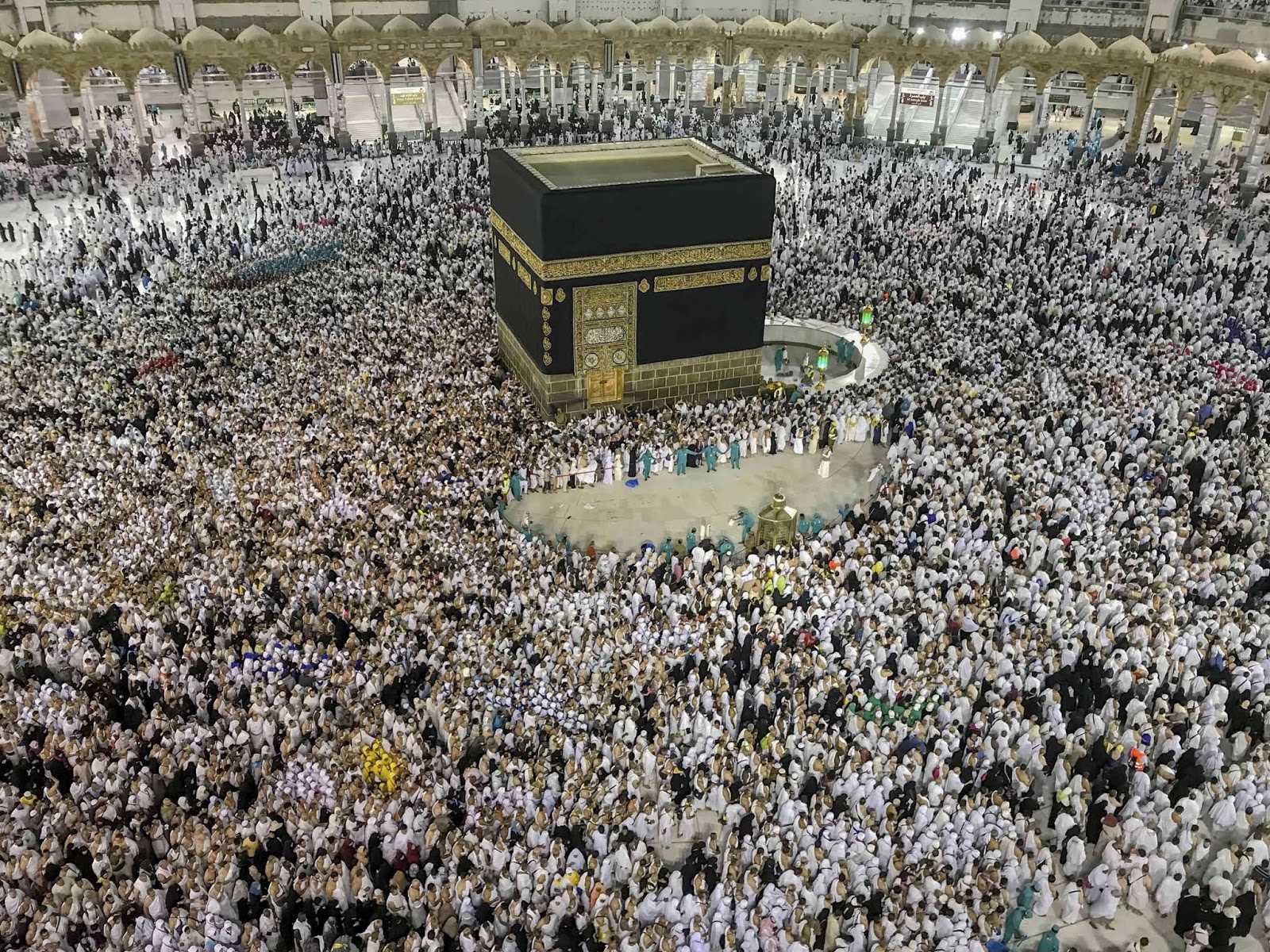
Pilgrims circled the Kaaba, which is considered to be the House of God, at this year’s hajj in Mecca, Saudi Arabia. Dar Yasin/Associated Press
All Muslims who are physically and financially able to complete the hajj are supposed to do so at least once in their lives. Attendance by foreign pilgrims has grown more than tenfold since World War II. (In 2013, attendance quotas dropped to account for continuing construction in Mecca.)

Not everyone who wants to make the hajj can do so easily, and millions of Muslims all over the world wait years for the chance. The costs can be prohibitive — two to three times a year’s salary in some places — and visas can be hard to get.

At least a quarter of pilgrims every year are citizens or residents of Saudi Arabia. The Saudi government sets quotas for every other country that sends pilgrims to the hajj based on its Muslim population.

Even countries with large Muslim populations can send only a small fraction of their citizens to the hajj. In Indonesia — which at more than 200 million has by far the largest Muslim population in the world — the wait time can range from seven to 37 years. Some countries complain that the quota allocation is not transparent enough, or that it should be based on demand rather than on Muslim population.

Other critics say Mecca is already at capacity during the hajj, and expansion efforts have come at the cost of Islam’s cultural heritage and the spirituality of the pilgrimage. Several historic Islamic sites were destroyed in recent years to make way for luxury high-rise hotels and malls that cater only to wealthy pilgrims. These developments dominate the Kaaba, the cubelike structure at the center of the Grand Mosque that is circled by pilgrims and that is considered to be the House of God.

Still, Saudi Arabia continues to build. The multiyear construction plan includes expanding the mosque around the Kaaba to hold 1.85 million people.

(Source: NYT)

Wednesday, 22 August 2018

I went to Hajj last year and it had a profound impact on me. This is what it was like

As millions travel to Saudi Arabia for the annual Hajj, Zara Mohammed reflects on what it meant to her a year on

I just remember the sheer excitement. A combination of nerves and heightened euphoria. I wasn’t sure how I would feel when I stood before the Ka’bah. Holding my husband’s arm tightly as waves of people overtook us; I was in complete amazement. Considering all the history in this same spot, the footsteps of so many that had travelled before by camel, foot and now, many air miles, I was filled with joy and a surreal sense of peace.

This was the centre of Islam, and the Ka’bah signified a place of unity for Muslims irrespective of background or race. I felt incredibly blessed to be among a fraction of the 1.5 billion Muslims who actually get to be here in person.

This was my first time in the Middle East and so the 44-degree heat was a new sensation to me. I was startled by the Muslim world before me. The incredible diversity of people journeying far and wide was a sight to behold. Many came with little other than unyielding determination and what clothes they had on. They walked for hours in the burning heat, some without shoes. The majority them were also much older than ourselves; our plane journey from Beirut was the first time some of them had ever been on a flight! I loved seeing the bright colours of the Malaysian ladies as they interlocked arms to stay together.

Our Hajj journey began at Mina – a neighbourhood in Mecca – where we stayed in huge white tents with massive Persian-style rugs on the floor. Each encampment was divided by country. I was sharing a space with 70 other ladies, a bit like a really massive sleepover, whilst camping in intense heat. There was a really nice atmosphere inside with everyone sharing stories and snacks, the worries from home felt so far away.


When walking through the camp area, I would see crowds of others, mainly from the subcontinent, lying completely exposed on the floor without apparent concern about UV umbrellas or sun cream. I was struck by how content these people were despite the challenging conditions they were in. I learned later that many of them came without a government or tour operator, they were part of a quota of the very poor. It was humbling to see how this pilgrimage was worth so much to them, the discomfort didn’t matter. The conditions we were in were tough but we all learnt to adapt and make the best of it.

The main day of Hajj is at the plains of Arafat, the place in which the Prophet Muhammad, peace be upon him, gave his final sermon. He stressed the equality of all; to treat women well, that there was no superiority of race, only in good action and piety.

All around me I saw men and women deep in supplication, praying for betterment in the world and in themselves. Unfortunately, I became very sick during this time (it was a combination of the heat, too much liquid, and not eating enough). But I was grateful to my husband and family (as well as all the ladies in the tent) for the love and care I received. The journey of Hajj is a social one. Even if you are alone, someone will be there to offer a hand, a cold drink and a smile.

After recovering slightly with a quick cup of tea, we were bused to Muzdalifah, essentially an open location with dusty grounds. Millions (not hyperbole) of us slept on the floor until sunrise. I remember being fascinated by every country’s delegation, corresponding ID cards, flags and coloured bags to ensure no one got lost. It was funny that even throughout my Hajj journey, you could usually tell the British from the other pilgrims; great at queueing and always polite. Many people say they have a great sleep in Muzdalifah, I think it just made me more grateful for the comforts of home.

In the final days, we carried out the Jamaraat (the representation of the stoning of the devil in the story of Abraham). We walked there during the hottest time of the day, the sun was fierce. There was an elderly lady in a wheelchair with us who was clearly baking in the heat, but she remained calm and reserved. As a young person, I was struggling, so I don’t know how she and so many others in her position managed it.

When we first began the long trip to Saudi, my husband and I did not come with our group. We happened to bump into another Brit also on his way to Hajj who had been detained twice at the airport without any charges, lost his group, and missed his flight. Upset about the way he was treated, he spoke of wanting this part of the trip to be over, so, as was customary during Hajj, we took him in as a member of our mini group, comforted him, and gave him some tea.

During the Hajj journey there is such a beautiful sense of Islam in its truest form. Any semblance of hate is incompatible with what Muslims are striving for; collective betterment and the worship of one God. But at the same time, his ordeal brought to life this reality many Muslims face in the pursuit of spirituality.

For me, the journey of Hajj brought to life many home truths. I recall so many lectures before taking the trip on the nature of sacrifice and bearing the struggle with patience. What I did not anticipate was the manner in which these tests would manifest and how my already very comfortable self would regularly wake up to some uncomfortable realities. There are many tests in this life, but it is ultimately our attitudes and actions that will define how we handle them. For all the buzzwords used to describe Hajj, there really isn’t any single adjective that can do it justice. Hajj is hard, Hajj is powerful, Hajj is inspiring, but ultimately, Hajj is change.

(Source: The Independent)