Showing posts with label museum. Show all posts

Tuesday, 23 November 2021

I looked closely at two famous portraits of Tipu Sultan – and found that one isn’t actually of him

 A history enthusiast goes beyond the captions at the museum at the 18th-century ruler’s summer palace in Srirangapatna.

Visitors to the museum run by the Archaeological Survey of India in Tipu Sultan’s summer palace in Srirangapatna, near Mysore, have the opportunity of inspecting two painted portraits of the 18th-century ruler himself.


The one by GF Cherry is the popular portrait of Tipu Sultan. Since the late 18th century, it has appeared in a variety of books, magazines, journals and newspapers articles about him.
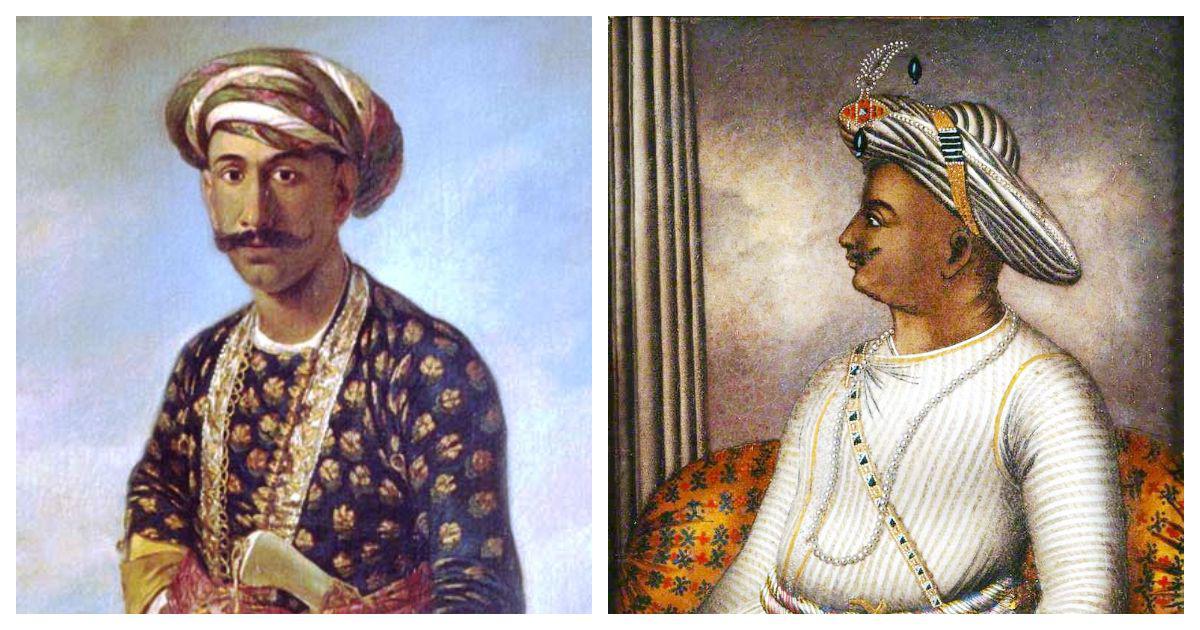

Two portraits at Tipu Sultan's summer palace that are said to be of him. | Public domain, via Wikimedia Commons


The other is a full-length portrait and has been attributed by the museum to the German artist Johan Zoffany. Here, the direct gaze of the subject falls on the visualiser in contrast to the depiction of the subject’s profile in Cherry’s painting.


Especially since the advent of the internet and social media, this painting has increasingly been appropriated into Tipu Sultan’s life story: it has appeared both online and in print as a definitive portrait of Tipu Sultan in his younger days.

The noted Tipu Sultan historian Kate Brittlebank has even incorporated this painting on the cover page of her biography, Tiger: The Life of Tipu Sultan.


I had been long fascinated with this portrait of Tipu Sultan both on account of my interest in the ruler’s history as well as my hobby as an artist who experiments in paint as well as pencil. The striking contrast between the tawny and near-corpulent Tipu Sultan in the Cherry painting and the slim Tipu Sultan in the Zoffany painting intrigued me. But I brushed it off as Tipu Sultan gaining in weight with the passage of years.


GF Cherry, who painted the first portrait, was the Persian secretary to Governor General of India, Lord Cornwallis at Srirangapatna. Anne Buddle, a noted historian mentions that a similar portrait by the same artist was presented by Lord Cornwallis in 1792 to Tipu Sultan’s mother. This work, after being passed on to Tipu Sultan’s youngest son Prince Gholam Mohammad, was gifted by him to the East India Company and is now in the British Library, London.


This portrait can be considered an authentic representation of Tipu Sultan on account of it being painted in the lifetime of Tipu Sultan and once, having been in the possession of both his mother and his son.


This image of Tipu Sultan is also congruent with the description of Major Allan, who was present on the spot when Tipu Sultan’s lifeless body was discovered in an archway, and mentions the ruler as having a “…short thick neck, small arched eyebrows, tawny complexion, (with) moustache and clean-shaven chin. He was inclined to ‘corpulency’.”


Portrait of Tipu Sultan, attributed by Dariya Daulat Museum to Johan Zoffany, 1780.


The second painting also wandered a little before it came to the Dariya Daulat Bagh Museum. Writes the British historian and author Denys Forrest:


“…. a full-length which, according to the Descriptive List (above), was presented to the Government of India by Sir P. C. Tagore in 1934 and hung in the corridor to the State Dining Room at Viceroy’s House. This picture was then attributed to Zoffany, but I have been unable to obtain any further details of it.”


It’s clear that the painting was already attributed to Zoffany before its arrival at the museum in Srirangapatna.


However, when I delved deeper into art history, I realized that Zoffany’s style of painting was very different from this painting of Tipu Sultan attributed to him. Renowned art historian Mildred Archer had this to say about him: “Zoffany found it difficult to suppress his interest in bounding movement and love of histrionic gesture.”


That is evident from Zoffany’s “The Impey Family listening to strolling musicians” (1783-’84), “Warren Hastings with his wife” (1783-’87), “Col. Mordaunt’s Cock Match” (1784-’86). But the painting of Tipu Sultan has the subject standing idly looking ahead without any semblance of movement whatsoever, something quite different from the regular works of art attributed to the artist.


Portrait of Tipu Sultan, attributed to GF Cherry; British Museum, London, and Dariya Daulat Bagh, Srirangapatna. Credit: Public domain, via Wikimedia Commons


Besides this oddity, Zoffany is known to have visited Calcutta, Lucknow and Delhi but neither Mysore nor Srirangapatna during his travels in the subcontinent.


It was during this research on this painting and European art history in India that I also started to look at paintings by another artist Tilly Kettle (d.1786) who was in India between 1769 and 1776. While explaining Kettle’s paintings, Pauline Rohatgi and Graham Parlett write, “Kettle usually portrayed his sitters, their serious expressions largely devoid of emotion, against a plain or simple background.”


Kettle usually painted full-length portraits of his sitters having a direct gaze, with distinct elements like, the direction of the light source and shadows, stance of the foot and bearing of the sword.


This distinctive style is evident in paintings by Kettle such as “An Army Officer, Madras” (1770), “Mohammed Ali Khan, Nawab of Arcot” (1770), “Shuja-ud-Daula” (1772) and “An officer in the 2nd Bengal Infantry Brigade”, Calcutta (1772).


Emperor Shah Alam reviewing the 3rd brigade of the East India Company’s troops at Allahabad by Tilly Kettle (c. 1781).


This style is also noticeable in the Dariya Daulat painting. Besides, Kettle incorporated backdrops featuring part of a building or vegetation, often palm trees like the one observed in the background of the Dariya Daulat Bagh portrait.

This is in contrast with Zoffany’s style, with subjects showing marked expression, conversation pieces, and paintings often with varied complex backdrops and at times incorporating detailed paintings in display, while painting indoor scenes.


Tilly Kettle is also not documented as having visited Mysore or Srirangapatna during his time in India.

One evening as I was looking at art books, I had my breakthrough. I found the Dariya Daulat “Tipu Sultan” in a Kettle painting titled “Emperor Shah Alam reviewing the 3rd brigade of the East India Company’s troops at Allahabad.”


This subject in the Kettle painting not only looks exactly similar but wears similar coloured and decorated clothing as the subject in the Dariya Daulat museum painting. No doubt remains now that this was the same person depicted in both the paintings. It is obvious that Tipu Sultan could not have been present in Allahabad by the side of the then Mughal Emperor Shah Alam during his review of the English troops commanded by General Barker. This had to be somebody else.


My subsequent research, that I will leave for another article in the future, shows why I’m certain that the subject in the painting is actually Salar Jung, brother in law of Shuja-ud-Daula, the Nawab-vizier of Awadh both of whom were present in Allahabad at the review of the English troops by the Emperor Shah Alam. Apart from his brief stint in Madras (1769-1771), Kettle was also the court painter of Shuja-ud-Daula and painted several portraits of Shuja-ud-Daula and his family members.


This means that the Dariya Daulat painting is a clear case of misattribution of both the painter as well as subject of the portrait.


(Source: Scroll)

Friday, 27 November 2020

Maradona Shrine in Kerala: Hotel room he once stayed in has been a museum for 8 years

 This hotel room in Kerala is rented out only to customers who are fans of the iconic player- Diego Maradona.

When V Ravindran heard that football legend Diego Maradona had passed away, one of the first things he remembered was the deafening applause that one of the greatest footballers of all time received as he stepped out of the Blue Nile hotel in Kannur district of Kerala on 23 October 2012.


"Three months before Maradona arrived, his team came to inspect hotels in Kannur. They selected our hotel and gave us a list of preparations that they wanted for a VIP's stay, without revealing the name. We thought that it would help our business too. Two rooms were joined together and made into a large suite room. We arranged everything as they mentioned. Later in October we were informed that the guest was Maradona. I was overjoyed, because I was a great fan of the game and of Maradona," Ravindran, the owner of Blue Nile hotel says.


Room number 309 of the hotel is still kept as a tiny museum in memory of Maradona's visit. The accessories used by the football player, plates, spoons, bed sheets, bathroom accessories and even the shell of the prawns he ate were kept in glass frames. The room also has a display of rare pictures of the footballer and newspaper clippings about him.


The room is rented out to other customers as 'Maradona special suite'. "We give the room only to people who are fans of Maradona and to those who come in search of the room, because everyone may not maintain the room as it is and won't understand the value," he says by adding that at least two or three guests come to his hotel in a month to stay in the room.


On Thursday, for the first time, the room was opened from 10 am to 5pm for the public in Maradona's memory.

Ravindran has a lot of memories to share about Kannur's favorite, Maradona.


"It was like god coming to our hotel. So we made sure that everything was perfect. Prior to Maradona's arrival we read that he is used to Russian cuisine. So I appointed a person who had previously worked as a chef in Russia. Prawns, salads, carrots and sweet lemon juices were the things Maradona mainly ordered. He doesn't speak English so his secretary spoke to us," he added.


Maradona stayed in the hotel for two days. Ravindran recalls how thousands of people gathered around his hotel just to catch a glimpse of their icon.


"I haven't seen that much of a crowd ever in my life. We were scared that they would rush inside the hotel. So we requested Maradona just to come out of the balcony and wave at the public. He did so, and the applause, I can still hear it in my ears, it was huge" he recalled.


He says that when the footballer hugged him while leaving, he was elated. "I still get goosebumps thinking about those days," he added.


(Source: TNM)

Saturday, 11 July 2020

Hagia Sophia: Turkey turns iconic Istanbul museum into mosque

The world-famous Hagia Sophia museum in Istanbul - originally founded as a cathedral - has been turned back into a mosque.


Turkey's President Recep Tayyip Erdogan announced the decision after a court annulled the site's museum status.


Built 1,500 years ago as an Orthodox Christian cathedral, Hagia Sophia was converted into a mosque after the Ottoman conquest in 1453.


A woman wrapped in a Turkish national flag gestures outside the Hagia Sophia museum. Getty Images


In 1934 it became a museum and is now a Unesco World Heritage site.


Islamists in Turkey long called for it to be converted to a mosque but secular opposition members opposed the move. The proposal prompted criticism from religious and political leaders worldwide.


Defending the decision, President Erdogan stressed that the country had exercised its sovereign right in converting it back to a mosque.


He told a press conference the first Muslim prayers would be held inside the building on 24 July.


"Like all our mosques, the doors of Hagia Sophia will be wide open to locals and foreigners, Muslims and non-Muslims," he added.


Shortly after the announcement, the first call to prayer was recited at Hagia Sophia and was broadcast on all of Turkey's main news channels. The cultural site's social media channels have now been taken down.


What has the reaction been?

Unesco has said it "deeply regrets" the decision to turn the museum into a mosque and called on the Turkish authorities to "open a dialogue without delay."


The organisation had urged Turkey not to change its status without discussion.


The head of the Eastern Orthodox Church has condemned the move, as has Greece - home to many millions of Orthodox followers.


The Hagia Sophia has huge significance as a religious and political symbol. Getty Images


Culture Minister Lina Mendoni said it was an "open provocation to the civilised world".


"The nationalism displayed by President Erdogan... takes his country back six centuries," she said in a statement.


The court ruling "absolutely confirms that there is no independent justice" in Turkey, she added.


But the Council of State, Turkey's top administrative court, said in its ruling on Friday: "It was concluded that the settlement deed allocated it as a mosque and its use outside this character is not possible legally."


"The cabinet decision in 1934 that ended its use as a mosque and defined it as a museum did not comply with laws," it said.


The Church in Russia, home to the world's largest Orthodox Christian community, immediately expressed regret that the Turkish court had not taken its concerns into account when ruling on Hagia Sophia.


It said the decision could lead to even greater divisions.


While the move is popular with conservative religious supporters of President Erdogan, Turkey's most famous author, Orhan Pamuk said the decision would take away the "pride" some Turks had in being a secular Muslim nation.


"There are millions of secular Turks like me who are crying against this but their voices are not heard," he told the BBC.


The site is now one of Turkey's most visited tourist attractions. Getty Images


Analysis by Oral Guerin, BBC News Istanbul

A change is coming to Hagia Sophia, which has endured since the 6th century, outlasting the Byzantine empire and the Ottoman era. 


Now, once again, it will be a mosque. But Turkish officials say Christian emblems, including mosaics of the Virgin Mary which adorn its soaring golden dome, will not be removed.


Making changes at Hagia Sophia is profoundly symbolic. It was Kemal Ataturk, the founder of modern Turkey, who decreed that it should be a museum. President Erdogan is now taking one more step to dismantle Ataturk's secular legacy, and remould Turkey according to his vision. The Turkish leader - who presents himself as a modern day conqueror - is making no apologies for the change. He says anyone who doesn't like it - and plenty abroad don't - is attacking Turkey's sovereignty.


Reclaiming Hagia Sophia plays well with his base - religious conservatives - and with Turkish nationalists. Critics say he's using the issue to distract attention from the economic damage done here by the Covid19 pandemic.


But many in the international community argue that the monument belongs to humanity - not to Turkey - and should have remained unchanged. They say it was a bridge between two faiths, and a symbol of co-existence.


History of a global icon

  • Hagia Sophia's complex history began in the year 537 when Byzantine emperor Justinian built the huge church overlooking the Golden Horn harbour
  • With its huge dome, it was believed to be the world's largest church and building
  • It remained in Byzantine hands for centuries apart from a brief moment in 1204 when Crusaders raided the city
  • In 1453, in a devastating blow to the Byzantines, Ottoman Sultan Mehmed II captured Istanbul (formerly known as Constantinople) and the victorious conqueror performed Friday prayers inside Hagia Sophia
  • The Ottomans soon converted the building into a mosque, adding four minarets to the exterior and covering ornate Christian icons and gold mosaics with panels of Arabic religious calligraphy
  • After centuries at the heart of the Muslim Ottoman empire, it was turned into a museum in 1934 in a drive to make Turkey more secular
  • Today Hagia Sophia is Turkey's most popular tourist site, attracting more than 3.7 million visitors a year


(Source: BBC)

Monday, 30 April 2018

Étienne Terrus museum in Elne uncovers fake art in collection

A French museum dedicated to painter Étienne Terrus has discovered paintings it thought were by him were fakes.

The Terrus museum in Elne in the south of France discovered 82 works originally attributed to the artist were not painted by him.

More than half the collection is thought to be fake. The paintings cost about €160,000 (£140,000).

Staff at the museum were not aware of the forgeries until a visiting art historian alerted them.

More than 80 paintings said to be by Étienne Terrus were fake
(this one, of Collioure in the Pyrenees, is real and is now on display)
The council in Elne bought the paintings, drawings and watercolours for the museum over a 20-year period.

Eric Forcada, an art historian, contacted the museum in the town near Perpignan several months ago to express his doubts about the authenticity of the paintings.

The museum assembled a committee of experts from the cultural world, who inspected the works and concluded that 82 of them had not been painted by the Elne-born artist.

The news was announced on Friday as the museum opened after a renovation.

In interviews on Friday, the mayor of the Pyrenees town, Yves Barniol, said the situation was "a disaster" and apologised to those who had visited the museum in good faith.

Terrus was born in 1857 and died in 1922 in Elne, although he lived most of his life in Roussillon, also in the Pyrenees. He was a close friend of painter Henri Matisse.

The authentic Vue Cathédrale remains on display
Some of the paintings show buildings that were built after Terrus' death, France 3 said.

The town hall has filed a complaint against those who ordered, painted, or sold the fake paintings.

Local police are investigating the case, which they say could affect other regional artists too.

(Source: BBC)

Sunday, 21 January 2018

UAE distorts Gulf history and geography by removing Qatar from Louvre museum map

The United Arab Emirates (UAE) has omitted Qatar from a world map exhibited at a recently opened Louvre museum in Abu Dhabi, according to a veteran observer of Gulf affairs.

In an analysis piece written earlier this week entitled “The UAE/Qatar rivalry is escalating”, the Washington Institute’s Simon Henderson noted that a large map of the world featured at the museum “completely omits” the nation of Qatar.

“In the children's section of Abu Dhabi's new flagship Louvre Museum, a map of the southern Gulf completely omits the Qatari peninsula -- a geographical deletion that is probably incompatible with France's agreement to let Abu Dhabi use the Louvre's name,” Henderson wrote.

UAE has omitted Qatar from a world map. Photo Credit: Twitter/@Dr_Ulrichsen
Many Twitter users were seen criticising this action which contradicts international norms and decency. There is no comment yet from the Louvre Museum authorities.

Rice University's Baker Institute for Public Policy & Associate Fellow, Chatham House and author Kristian Ulrichsen tweeted a photo from the museum saying “Here is the map from an exhibit in the Louvre Abu Dhabi that omits the Qatari peninsula from the Lower Gulf.”

To which, Chairperson of Qatar Museums, H E Sheikha Al Mayassa bint Hamad bin Khalifa Al Thani, commented saying “Throughout history museums were a source of reference. People would visit to acquire knowledge and learn about world cultures through the exploration of objects on display. Although the notion of museums is a new one to Abu Dhabi, surely the @MuseeLouvre is not okay with this?”
Many people including President of Qatar Olympic Committee HE Sheikh Joan bin Hamad Al Thani and H E Sheikh Mohammed bin Hamad have tweeted quoting Ulrichsen’s tweet.

A Twitter user from UAE also wondered over the social media that “The children's section in the Louvre Abu Dhabi offers a map of the Arabian Gulf without the name of Qatar. This way we educate our children!”

Last year, the UAE paid France’s iconic Louvre Museum a whopping $520 million for the use of its name in its own Louvre Abu Dhabi Museum, which finally opened its doors last November after a five-year delay.

(Source: The Peninsula)

Wednesday, 10 January 2018

Did the new Bible museum copy this Muslim artist’s award-winning work? It depends on who you ask

When Pakistani-American artist Anila Quayyum Agha saw a piece that looked like her work at the Museum of the Bible, she "felt gutted", writes Rafia Zakaria, the author of “The Upstairs Wife: An Intimate History of Pakistan”, and "Veil", in The Lily. Read on: 

She found out via email. In late November, Pakistani-American artist Anila Quayyum Agha was sitting at her computer when a message popped up on her screen. It contained two images.

One of them was of her award-winning installation “Intersections,” which won the coveted ArtPrize just three years earlier. The other was of a markedly similar but unattributed piece in the “Stories of the Bible” exhibit at the newly opened Museum of the Bible in Washington, D.C.

Anila Agha’s “Intersections” on the top and photo of the exhibition from the Museum of the Bible below. (Courtesy of Anila Agha / Photo by Ashley Nguyen)


“I felt gutted, just devastated,” Agha says of the moment. The two images revealed installations that were alarmingly similar, both large metal cubes that use a single light source to project patterned shadows on surrounding walls. Agha’s installation uses Islamic motifs and geometric designs inspired from mosques in her native Lahore. The Museum of the Bible’s very similar rendition uses verses from the Hebrew Bible.

“I know I can’t prove plagiarism,” Agha admits, noting that since the piece hasn’t been attributed, there is no way to gauge the artist’s influences.

For their part, the Museum of the Bible seems to see little cause for concern. The museum worked with BRC Imagination Arts to produce its exhibits, and when asked about the similarities between the two works, the organization’s founder, Bob Rogers, sent a long list of other artists who have used a single light projection through metal.

Some seemed slightly similar, others not at all so. The museum’s implication was clear: There was nothing particularly original or unique about Agha’s “Intersections,” therefore there was nothing problematic with the museum’s piece.

Part of the Hebrew Bible exhibition at the Museum of the Bible. (Ashley Nguyen)
For the museum, adding an attribution to the piece would “be a distraction,” spokesperson Heather Cirmo says.

“The Museum of the Bible is a huge collaborative effort,” Cirmo says, an attribution would draw away from the fact that “it’s all about the Bible, not about the people who contributed.”

Religion and inclusivity
Agha saw resemblances between the two works, but that wasn’t the only thing that bothered her. Agha’s piece, “Intersections,” was made to promote inclusivity. The Museum of the Bible says it exists to “invite all people to engage with the history, impact and narrative of the Bible,” a text used largely in Christianity. The museum also focuses on the Hebrew Bible, which is used in Judaism and, among Christians, is known as the Old Testament.

The $500-million museum was also funded by evangelical Christians. One of the museum’s primary donors is Hobby Lobby, a chain of craft stores that gained national attention when the company went to the Supreme Court, arguing that it should not be required to provide female employees no-cost access to contraception if it violated religious beliefs. Hobby Lobby president Steve Green is chairman of the museum’s board, which is almost entirely evangelical.

The idea behind the museum’s work is far different from what Agha had in mind when she created “Intersections.”

The piece in the Museum of the Bible is “just relevant to one faith, whereas I wanted to include everyone, draw everyone in,” the artist explained.

There is a particular tragic irony in Agha’s predicament. As a female artist in her native Pakistan, she confronted similar conundrums, a hemming in by fundamentalists who believed in singular truths and branded the artistic project of questioning them subversive. In the America of 2017, she confronts a second silencing, where the power of a large corporation — Hobby Lobby — and the museum it has erected, can use the power of another fundamentalism to appropriate her ideas and hide behind technicalities.

Neither seems to understand that in Agha’s case, putting her name next to her work has never been an act of egoism, but one of courage. “Intersections” is a dogged reiteration of the beauty of building bridges in a world of warring truths.

Art and attribution
The issue of attribution is crucial for fine artists like Agha.

“When artists use each other methodologies, they credit them,” Agha explains. “It’s a matter of artistic ethics to credit the work of other artists who have influenced our work.”

This implicit code of ethics, of giving credit and mentioning those that came before, lubricates the exchange of ideas that is crucial to art, while deterring near plagiarisms that use identical concepts but change a few things to remain legally unassailable.

The latter seems to have been at play, at least on some level, in the “Stories of the Bible” installation at the museum. The ideas for the piece were generated in or after 2014–2015, just when Agha’s “Intersections” was getting the most attention in media and in exhibitions around the world.

Monday, 30 January 2017

Museum of linguistics

The Franklin School in downtown Washington, D.C., has sat vacant since 2008, but the city abandoned the building decades earlier. Designed by Adolf Cluss, the architect who built the Smithsonian Institution’s Castle and its Arts and Industries Building, the revival-style gem survived many efforts to demolish it. More recently, it’s been the focus of everything from mayoral redevelopment schemes to an Occupy demonstration in 2011.

Now another group will take a stab at the historic Franklin School. On Wednesday, the city announced plans to turn the building into a museum of linguistics. Led by philanthropist Ann B. Friedman (wife of New York Times columnist Tom Friedman), “Planet Word” will be an interactive center dedicated to language arts, in the vein of the National Museum of Mathematics in New York, according to the city. (Disclosure: Katherine Brittain Bradley, who sits on the board of Planet Word, is married to David Bradley, the owner of the Atlantic Media company.)

Turning the Franklin School into a museum is a practical use for a gorgeous if quirky space. The building’s historical protections are so thorough they all but rule out a more intensive use. This is, in fact, the second time in just more than two years that a museum concept has won the city’s support for a rehabilitation plan for the building. A cultural use for the space is by far the best outcome: A great public building deserves a great public use. And a closer look at the Franklin School’s rocky road to reuse shows why giving over historic architecture to culture—certainly not the city’s first instinct—could also be in the best financial interests of D.C.

So what does one do at a linguistics museum? It’s not entirely clear yet.

One reason the Franklin School has long sat vacant as the District’s downtown bloomed all around it is the splendor of the building itself. The architecture hails back to D.C.’s Red Brick City era, which Cluss penned nearly by himself. The architect helped to build D.C. up as an architecturally distinctive city in its own right, designing Eastern Market, Calvary Baptist Church, and dozens of other important red-brick buildings.

Many were not saved. As one of the most prominent examples of Cluss’s work, the Franklin School is a National Historic Landmark and is listed in the National Register of Historic Places. It’s also one of about a dozen or so buildings whose interior also has preservation status—making it a poor candidate for adaptation as a luxury hotel or condo building.

In 2014, after years of dithering, the city went a different direction with the Franklin School. Under former D.C. Mayor Vincent Gray, the city picked a development partnership that planned to turn the Franklin School into the Institute for Contemporary Expression, a contemporary art and performance center. But when D.C. Mayor Muriel Bowser came into office the following year, she swiftly scrapped the city’s agreement and started the Franklin School bid process all over again.

The reasons behind that reversal fired up critics locally. Bowser argued in 2015 that fundraising by ICE-DC founder Dani Levinas was too weak to continue. But that fundraising effort had not yet begun. Emails obtained by CityLab under a Freedom of Information Act request show that officials from both the Office of the Deputy Mayor for Planning & Economic Development as well as the Downtown DC Business Improvement District urged the D.C. Council to confirm the ICE-DC program so that fundraising could begin in earnest. At the time, Levinas had already raised $3 million toward a $15 million goal—a decent start—but Bowser scotched the museum plan before the Council could consummate the deal.

Whatever the reason for the mayor’s about-face, the project’s new team has her support. Dantes Partners, the developer behind Friedman’s Planet Word concept, is a relatively young boutique firm that in recent years has developed hundreds of affordable and supportive housing units. (Buwa Binitie, the founder of Dantes Partners, is a Bowser supporter who contributed $10,000 to her former political action committee and joined her on a recent trip to China.) This new team also has the funds to execute their vision: Planet Word is going to cost more than $30 million, but Friedman won’t have to raise funds for it. According to the city, Planet Word will pay for itself upfront.
Preservation restrictions have made reusing the historic Franklin School a challenge. Will "Planet Word" be the perfect fit?

Finally, the new team has the technical know-how to do a delicate job. SmithGroupJJR, an architecture firm with a lot of historic rehabilitation and adaptation experience, will lead a renovation to rebuild the interior to include a maker space and classrooms as well as an auditorium in the building’s third-floor mezzanine level.

So what does one do at a linguistics museum? It’s not entirely clear yet. On the Planet Word site, founder Friedman invites future visitors to “[i]dentify accents, tell us how you say soda and hoagie, learn tips from professional dialect coaches, and climb a Tower of Babel or tunnel through a prepositional playground.” The museum could potentially occupy the space once claimed by the now-defunct Children’s Museum as the D.C. institution with the kid-friendliest programming.

One thing is clear: Planet World will definitely be unlike anything else in D.C.—or really anywhere. Contemporary art, the program for ICE-DC, might have been a more proven model for the city to choose. In recent years, spectacle-scaled art installations have commanded enormous attention here. The National Building Museum’s architectural follies, from “The Maze” to “The Beach,” draw capacity-straining crowds. More than 732,000 viewers piled into “Wonder,” an Instagram-ready affair at the newly refurbished Renwick Gallery. ICE-DC could have served as a permanent local home for such shows.

Crowds will be key to fixing Franklin Square, one of D.C.’s least-loved parks.  Restoring this space (which is anchored by the Franklin School) is a perennial subject of conversation in the city. ICE-DC planned to host performances and happenings to draw in the office-lunch crowd; if “Wonder” and “The Beach” are any indication, the lines would have snaked around the square. If Planet Word comes up with a similar scheme to draw daytime foot traffic, it will have done the hardest work in revivifying Franklin Square, saving the city money in the long run and boosting the values of adjacent properties (which now include The Washington Post’s headquarters). A private use for the museum, say, as a tech incubator or boutique office space, would not make use of the unique affinity between Franklin Square and the Franklin School—a public space and a public building.

But will crowds really come for Planet Word? If the whole fun-with-linguistics concept doesn’t take off with locals, the museum might face the same tough sell as other non-Smithsonian downtown cultural centers (such as the National Museum of Women in the Arts) that are trying to lure tourists away from the National Mall. Unlike those local attractions, however, Planet Word will debut with one huge advantage: Entrance will be free.

It’s good that the city sees the wisdom (again) in preserving the Franklin School by turning it into a museum meant for residents. Planet Word is bound to do more for the Franklin School, and for the city, than any private building would have. When linguist nerds convene there to talk gerunds and hit up a nearby food truck—or when bored Posties amble over during a lunch break to learn a few things about dangling modifiers—they will be giving Franklin Square a use as well. For the city, a quality museum at the Franklin School is a two-for-one deal.

(Source: City Lab)

Sunday, 16 December 2012

Echoes of the past ring true in sound museum

The online Museum for Endangered Sounds stores long-forgotten gadget-based audio for today's networked generation.


Brendan Chilcutt wears oversized glasses and glances over his shoulder as he types.

"Imagine a world where we never again hear the symphonic startup of a Windows 95 machine… the textured rattle and hum of a VHS tape being sucked into the womb of a 1983 JVC HR-7100 VCR," he writes.

Chilcutt? Yes, Brendan Chilcutt. He is a fabrication, a "nerd mascot" dreamt up by three advertising students in their mid-20s who met at Virginia Commonwealth University's Brandcenter.

"Where will we turn for the sound of fingers striking QWERTY keypads? Tell me that," Chilcutt writes.
"And tell me: Who will play my GameBoy when I'm gone?"

It is this question which haunted the trio - Marybeth Ledesma, Phil Hadad and Greg Elwood - who came up with an idea to create an online museum for "endangered sounds".

Read more here...

Saturday, 8 December 2012

Echoes of the past ring true in sound museum

The online Museum for Endangered Sounds stores long-forgotten gadget-based audio for today's networked generation.

Brendan Chilcutt wears oversized glasses and glances over his shoulder as he types.

"Imagine a world where we never again hear the symphonic startup of a Windows 95 machine… the textured rattle and hum of a VHS tape being sucked into the womb of a 1983 JVC HR-7100 VCR," he writes.

Chilcutt? Yes, Brendan Chilcutt. He is a fabrication, a "nerd mascot" dreamt up by three advertising students in their mid-20s who met at Virginia Commonwealth University's Brandcenter.

"Where will we turn for the sound of fingers striking QWERTY keypads? Tell me that," Chilcutt writes.

"And tell me: Who will play my GameBoy when I'm gone?"

It is this question which haunted the trio - Marybeth Ledesma, Phil Hadad and Greg Elwood - who came up with an idea to create an online museum for "endangered sounds".

The homepage of the Museum of Endangered Sounds houses audio clips and memories from many a long-forgotten childhood.

The museum, which started as a fun extracurricular project, was born out of a late-night snack session.

"The idea all started when we were on our way to a restaurant. Everyone was texting on the way there, but you could only hear Marybeth because she didn't have a smart phone. We heard her clicking while our texting was silent," explained Hadad, a 28-year-old from Boulder, Colorado.

"It was like an epiphany, because we realised how technology today is so silent and sleek. Then we thought of the opposite - how loud technology was when we were growing up," Hadad, a copywriter at Crispin Porter + Bogusky, told Al Jazeera.

Read more here.

Wednesday, 28 September 2011

Al-Zubarah Fort

One weekend we thought of going to Al-Zubarah Fort and Vij asked Umer and Sajid to accompany us. After having breakfast at a south Indian restaurant, we left for Al-Zubarah which is around 105 km from Doha. We went out of Doha along the North road, looking for the signs to Al-Zubarah, which we found after the turn off to Al Khor. Then we took a U-turn and head back a few metres before turning right. Then we followed the road until we got to the fort. 

Al-Zubarah is a ruined and deserted town located in the northwestern coast of Qatar. Al-Zubarah is noted for its old fortress built in 1938 by Sheikh Abdu’llah bin Qasim Al-Thani and restored in 1987 as a museum. It is different from the Murair fort built outside the town of Al-Zubarah. Bani Utbah tribe was settled in Al-Zubarah in the second half of the 18th century. It is this tribe which established the town of Al-Zubarah and its port making it one of the most important port and pearl trading centers in the Persian Gulf in the 18th Century. The tribe also built a fort outside the town and called it Murair.
Al-Zubarah Fort
When we arrived at the place, we expected the caretaker to give us keys so that we can let ourselves into the fort, but there were already some archaeologists who were busy in studying the fort and they saved us from that part of business. We found a cannon in front of the fort, while the Qatari flag fluttered proudly at the top of the fort.
Well under the four-pillared canopy
As we entered the courtyard we saw a deep well under the four-pillared canopy. When we peeped through the metal grid that covers the top of the well, we could see our reflection along with the floating bottles in the water deep below.

We saw eight rooms on the ground floor that are used to display exquisite pottery and archaeological findings from the Al-Zubarah town. These rooms were originally meant to accommodate soldiers in the past.  The rooms had wooden shutters and when we opened them, cool wind gushed in. The ground floor also features ‘iwan’, small porticos overlooking the courtyard through square arcades.
Rectangular tower
Circular tower
At the very first sight, we could make out that Al-Zubarah fort is a typical Arab fort constructed using the traditional Qatari architecture. It is an impressive structure which is square in shape. The walls of the fort were thick and very high. It had three circular towers in three corners and a rectangular tower in the fourth corner. This rectangular tower had machicolations, traditional triangular-based ledges with slits, used to shoot at enemies in case of any attack. The walls not only strengthened the fort but also helped the fort to beat the heat. And it is because of these thick walls, we found the rooms inside the fort so cool! These walls were constructed by joining overlapping raw pieces of coral rocks and limestone with mud mortar and then covering it with gypsum-based plaster. 


The roof is made of four layers. The first consists of a series of ‘danchal’ wood poles, often protected by bitumen. The second is a layer of ‘basgijl’, which are woven bamboo strips. A close net of mangrove branches makes up the third layer, and the roof is then finished with a layer of compressed mud, protecting the buildings from the blazing sun during the hot season. One of the most interesting features of this technique is the building of architraves using poles of ‘danchal’ wood held together with a rope, to increase the adherence of the mud mortar and plaster.
Courtyard
Heading towards internal staircase
Photographs of archaelogical findings on display
Gunfire hole
We also used staircases in the courtyard to reach the second floor and found some rooms tucked inside the corner towers. The walls of these rooms had gunfire holes angled in different directions. Some of them had lizards and some of them had birds' nests. These holes not only allowed light and wind to come in, but also helped soldiers to shoot enemies attacking from all sides. They were not straight, but twisted making it difficult for enemies to fire from the opposite side!
Qatari flag
External staircase and the rickety ladder
Machicolations and gunfire holes
A view of courtyard from the first floor
Maybe the rickety ladder that is still in the towers enabled the soldiers to climb up to the roof and patrol the surrounding area with a clear view.
Umer standing in front of a room
Guys had a good time playing around cannon
Cannon in front of the fort
In front of the fort
Umer
It was too windy on that day and it didn’t allow us to spend much time outside the fort. After clicking a few pics near the cannon and the fort, we left for Al-Zubarah town where exacavations by the Department of Antiquities in Qatar have been conducted in the 1980s and 2002-2004.
Old car near the fort