Showing posts with label music. Show all posts

Friday, 23 September 2022

FIFA World Cup Qatar 2022™ official soundtrack - Hayya Hayya

Hayya Hayya is the official soundtrack of FIFA World Cup Qatar 2022™. 

Lyrics:

Hayya, hayya, hayya (yeah)

Hayya, hayya, ha (you know what it is)

Hayya, hayya, hayya

Hayya, hayya, ha (red one)

Hayya, hayya, hayya (Aisha)

Hayya, hayya, ha (Davido)

Hayya, hayya, hayya (Trinidad)

Hayya, hayya, ha


I wanna walk the walk on every street

I wanna ball out with the world at my feet

Hit every discotheque and not skip a beat, yeah-yeah

I wanna party, party eight days a week


I promise, I promise, I promise you now

Everything, everything gonna work out

Every tomorrow, no matter what goes down

I promise, I promise, I promise you now

Gonna be, gonna be sticking around

Every tomorrow, no matter what goes down


you know we're better together

(Oh-yo-yo-yo, oh) don't wanna wait forever

(Oh-yo-yo-yo, oh) you know we're better together

(Oh-yo-yo-yo, oh) the time is now or never


you know we're better together

(Oh-yo-yo-yo, oh) don't wanna wait forever

(Oh-yo-yo-yo, oh) you know we're better together

(Oh-yo-yo-yo, oh) the time is now or never


Hayya, hayya, hayya

Hayya, hayya, ha


Life can be up and down, but what can you do? Eh

We navigate through all the rough and the smooth, yeah

We got that rock and roll, that rhythm and blues, yeah-yeah

I'm never blue if I am rockin' with you, oh-oh

I promise, I promise, I promise you now

Everything, everything gonna work out

Every tomorrow, no matter what goes down


I promise, I promise, I promise you now

Gonna be, gonna be sticking around

Every tomorrow, no matter what goes down

you know we're better together

(Oh-yo-yo-yo, oh) don't wanna wait forever

(Oh-yo-yo-yo, oh) you know we're better together

(Oh-yo-yo-yo, oh) the time is now or never


you know we're better together

(Oh-yo-yo-yo, oh) don't wanna wait forever

(Oh-yo-yo-yo, oh) you know we're better together

(Oh-yo-yo-yo, oh) the time is now or never


Yeah, you can hop on your own wave

Yeah, you can ride it for life

But every journey is better

When you got love on your side


you know we're better together

(Oh-yo-yo-yo, oh) don't wanna wait forever

(Oh-yo-yo-yo, oh) you know we're better together

(Oh-yo-yo-yo, oh) the time is now or never


you know we're better together

(Oh-yo-yo-yo, oh) don't wanna wait forever

(Oh-yo-yo-yo, oh) you know we're better together

(Oh-yo-yo-yo, oh) the time is now or never


Hayya, hayya, hayya

Hayya, hayya, ha

Hayya, hayya, hayya

Hayya, hayya, ha


Songwriters: Adil Khayat / Mehdi Bouamer / Redone / Trinidad Cardona / Steph / Pat Devine


Wednesday, 21 September 2022

FIFA World Cup 2022™ official soundtrack - Hayya Hayya (Better Together)

Hayya Hayya (Better Together) is the first of a selection of singles released from the multi-song FIFA World Cup Qatar 2022™ Official Soundtrack.


The uplifting track, featuring Trinidad Cardona, Davido, and Aisha, draws on R&B and reggae influences and will play a central role in tonight’s final draw for the tournament.


The single is available on multiple platforms and the song’s official video has premiered on FIFA’s YouTube channel.


Thursday, 3 February 2022

Should Bhimsen Joshi be considered a pathbreaking artist?

 The birth centenary of the renowned vocalist falls on February 4. Bhimsen Joshi’s renditions of raags like Mia ki Todi, Multani, Shuddha Kalyan, Marubihag, Abhogi, Puriya Kalyan, Puriya, among others, progress in an unhurried manner gradually building up a virtual storm of taans spanning three octaves, writes Aneesh Pradhan. Read on: 

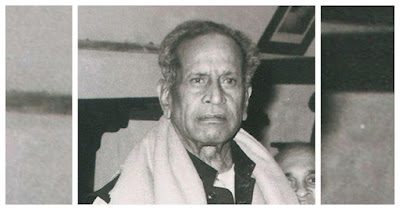
February 4 will mark the birth centenary of Bhimsen Joshi, renowned vocalist and recipient of the Bharat Ratna, India’s highest civilian award. In our series on public spaces named after Hindustani musicians, we visit a garden in Pune named after Joshi to discuss aspects of his life and work.


Most Hindustani music practitioners and aficionados believe that renowned musicians possess god-gifted talents and that it is their divinity that enables them to transport their listeners to an other-worldly realm. Despite being a practitioner and a diehard admirer of these musicians, I do not subscribe to such a belief. It does not comply with my sense of logic and reason.


Bhimsen Joshi. | Flute India, CC BY-SA 3.0 via Wikimedia Commons


I also feel that it robs musicians of the acknowledgement that they should rightfully receive for their success in facing the immense challenges that they have encountered during their long years of learning and performing. Ascribing godliness to such musicians also does not give them due credit for their ability to work on inherent musical aptitude to achieve new heights in creativity.


In the case of Bhimsen Joshi, the Kirana gharana maestro, thousands of listeners would subscribe to the belief that I have mentioned. Fortunately for us, his journey of music has been well-documented by those who have written about him so we are able to understand and appreciate the intense struggle and hardship that he underwent.


This was obviously possible because he had shared his experiences about his musical training and about the musicians who he regarded as his sources of inspiration, without indulging in any self-glorification.


These qualities of plain-speaking, forthrightness and abstinence from any unnecessary decorative elements, mark the vocal style that he evolved based not just on his training in the Kirana gharana under his guru Rambhau Kundgolkar, more popularly known as Sawai Gandharva, but equally on the material he imbibed from various celebrated musicians, who he met or heard during his travels across the country.


In an interview conducted by eminent scholar-musician Ashok Da Ranade, Joshi speaks about his training and musical perspective.


Bhimsen Joshi’s renditions of raags like Mia ki Todi, Multani, Shuddha Kalyan, Marubihag, Abhogi, Puriya Kalyan, Puriya, among others, progress in an unhurried manner gradually building up a virtual storm of taans spanning three octaves. A strident voice like his would seem inflexible and incapable of delivering the taans that he was always identified with, but he had trained his voice to move effortlessly from a deep and robust vocal projection to a falsetto, thus seamlessly producing the entire spectrum required to navigate such taans.


The volleys of taans that can be heard on a video recording of his Mia ki Malhar rendition lay bare this fact. Such is the forcefulness and speed in these taans sung in long breaths that it recreates the natural splendour that one associates with thundershowers.


To my mind, instead of transporting the listener to an abstract space, this rendition seems to bring a sense of immediacy with the material world and makes a connection for the listener between the music and the monsoon season for which this raag is prescribed.


He is accompanied on this recording by tabla player Chandrakant Kamat and harmonium player Eknath Thakurdas.


Like many other vocalists, the words of khayal and thumri compositions sung by Joshi may not be easily discernible to most listeners. This could partially be because of his predilection to give less importance to the songtexts. But equally, there was never a battle with the words of the composition in the hope of demonstrating his prowess over rhythm.


It could be argued that he chose this strategy only because he was unable to negotiate rhythm in an intricate manner do so, but it could well be said that this was a conscious aesthetic choice that he made. He probably recognised his natural aptitude and what his heart and mind suggested to him as a possible musical trajectory that would help him establish a unique identity for himself.


Consequently, while he never overawed the listener with a display of intricate and complex mathematical virtuosity, he would momentarily shift to a rhythmic playfulness that would provide a respite to the intensity that he brought to his taans.


It is true that Joshi’s concert repertoire did not demonstrate great variety, and he was criticised for this in some quarters. But it would be churlish to ignore the strengths that his choice of repertoire brought to his concerts. Further, could these critics have unequivocally promised listeners they would experience superlative performances by those who presented great diversity in their concert repertoire? Clearly, the answer would be in the negative.


Besides, one has only to study the raags and compositions presented by Joshi’s contemporaries or even his seniors to realise that there were many others who worked with select repertoire and made slight departures only on some occasions. Joshi held his own in the face of such criticism and reached out to diverse audiences in India and overseas, due to the practised ease with which he masterfully handled his chosen repertoire so much so that his admirers looked forward to the same repertoire.


His critics feel that the public recognition that Joshi received, a phenomenon that had not been witnessed earlier in the context of any Hindustani vocalist and has not been experienced since, was due to his incredibly popular santavani recordings and concerts that focused on the poetry of saint-poets from Maharashtra.


But his forays into areas outside the strict confines of Hindustani music without changing the treatment that he gave to the latter speaks volumes of his versatility as a performer.


The next track has an abhang penned by the saint-poet Namdeo. He is accompanied by Keshav Badge on the tabla and harmonium accompaniment is provided by Appa Jalgaonkar.


Regarding his involvement with music other than Hindustani raagdaari sangeet, who can deny the fact that the music video popularly known as Mile sur mera tumhara espousing national integration through the late 1980s and the 1990s had an unforgettable identity because of Joshi’s rendition of the opening segment? Arguably, this music video made him even more popular and identifiable even among those who were not familiar with Hindustani music. But this did not change his manner of approaching conventional Hindustani concerts.


For uninitiated music lovers, Joshi’s overt gesticulation with his singing was a visual delight. But even the uninformed realized that his style symbolised a strong sense of determination and perseverance that was rarely found elsewhere.

Would Bhimsen Joshi be considered a pathbreaking artist? The question would be answered by an analysis of the affect that his artistry had on the world of Hindustani music. Did it significantly change the way khayal and thumri were performed? Perhaps not.


Yet, many vocalists from succeeding generations have been influenced by him. Some have sought to adopt his vocal projection, others have tried to emulate the speed and clarity of his taans, and some have even been happy imitating his enunciation. Sadly, though, most of these attempts have come across only as caricatures.


Perhaps, we would have had a better idea of what could have progressed as a Bhimsen Joshi style within the larger framework of the Kirana gharana, had he mentored several disciples. Unfortunately, that does not seem to have happened. As a result, devoted followers among vocalists draw inspiration from him but miss out on the crucial fact that he developed his unique style despite having imbibed influences from various sources.


One of India’s leading tabla players, Aneesh Pradhan is a widely recognised performer, teacher, composer and scholar of Hindustani music. Visit his website here.


(Source: Scroll)

Wednesday, 12 January 2022

A dhrupad composed by Tansen, long considered a touchstone of musical ‘authenticity’

 Another part in a series on public places named after Hindustani musicians.

When was the last time that we heard of politicians battling it out to name a street, a garden or a similar public place after a musician – or any artist for that matter? I must confess that I cannot recall any such occasion (but I am hoping to be surprised at some point).


But even as artists are on the periphery of politicians’ visions, what about those in the artist community? Most artists are quick to seek acknowledgement for themselves or their family members or those who have been close collaborators but are completely indifferent about those who preceded them and made vital contributions to their fields and to society. In fact, with the race for renaming streets, I wonder if even those that have been named after artists will soon be changed to names of deceased politicians.


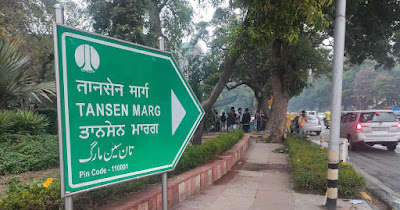
Delhi's Tansen Marg. | Taru Bhatia


Recently, there has been a demand to rename Akbar Road in Delhi. I fear there will soon be a call to rename Tansen Road situated in the same vicinity, simply because Tansen was the one of the principal musicians at Emperor Akbar’s court.


For the unthinking, anything even remotely connected with the Mughal empire is worth casting into the dustbin of history. Never mind the fact that we continue to sing forms and raags that date back to Tansen’s time or some raags like Mia ki Todi, Mia ki Sarang and Darbari Kanada that are considered to be his creations, albeit probably not in the manner that they were presented during that period.


In fact, for generations until today, Hindustani musicians have vied with each other to claim a link with Tansen’s genealogy, as that has for long been an important factor considered to prove historicity, legitimacy, musical “authenticity” and “purity”. If we were to take the illogic of renaming roads a step further, some may even consider renaming institutions and festivals that bear the name Tansen, all in the hope of severing any links with the Mughal empire.


I wonder if musicians will remain mute witnesses to such a reinterpretation of history or will even support wholeheartedly these attempts to position themselves close to the seat of power.


We end with a concert recording featuring Nasir Moinuddin Dagar and Nasir Aminuddin Dagar, who were popularly known as the senior Dagar brothers. They present a dhrupad composed by Mia Tansen in the raag Malkauns and set to the 12-matra Chautaal.


One of India’s leading tabla players, Aneesh Pradhan is a widely recognised performer, teacher, composer and scholar of Hindustani music. Visit his website here.


(Source: Scroll)

Monday, 5 July 2021

Coimbatore Thayi, the Carnatic singer who struck a chord in Paris but is unknown in India

Gramophone records were usually colour‐coded based on the artiste’s popularity. Thayi’s was coded violet, indicating she was among the most popular.

It was in 1911 when Maurice Delage, a pianist and composer in Paris, came across a gramophone record of an artist from India. Delage was the heir of a shoe-polish manufacturing company in France. Born with severe vision impairment, Delage studied music for 10 years under renowned French composer Joseph Maurice Ravel. Delage wrote to Ravel about the Indian musician’s recording, saying they “sent chills up and down my spine.” His keen ear detected “the microtonal effects she produced while singing.” He described the artist as a “master of open and closed mouth singing.”


Coimbatore Thayi | Gramophone Records


The music that fascinated Delage was that of a devadasi in distant Madras– Coimbatore Thayi. Delage visited India thereafter and decided to meet the woman whose music had blown him away. He met her during one of her performances at a temple in Mahabalipuram. The two supposedly interacted, and Delage was said to have been left deeply inspired by Thayi’s music, and dedicated a Western composition, ‘Ragamalika’ – a garland of ragas – to her. 


Music publisher Durand was so enchanted by this composition that on 20 June 1914, he paid Delage 500 francs to orchestrate it.


A modern-day rendition of Delage’s ‘Ragamalika’ has such swift glides in its notes, or bhrigas, that it lends quite a touch of Carnatic music to the entire composition.


This wondrous episode where Delage composed a song after being inspired by Thayi underscores the unintended osmosis of Western and Eastern cultures that recording technology facilitated in its wake. The records had truly brought Indian music from its local confines to not only a wider Indian audience and global mass media, but also to Western musicians and audience.


Born in 1872 in a family of traditional devadasis of Coimbatore, Thayi was named Pazhanikunjaram. Her mother Vengammal and grandmother Visalakshi were famed courtesans of their times. Spotting musical and dance talents in her, Vengammal put Thayi through rigorous training at an early age. Thayi gave her maiden dance performance or arangettram at the age of 11. She learnt music under the tutelage of several teachers, and Kannada songs from singer Mysore Kempe Gowda. With time, given the social stigma that came to be attached with the sadir (the precursor to Bharatanatyam) dance of the devadasis, Thayi gave up dancing completely and shifted her focus to music.


With the gradual loss of power of royalty in parts of Tamil Nadu, the matriarchs of her family migrated to Madras in the 1890s for better opportunities. They settled in the city’s devadasi bastion of George Town, sharing the neighbourhood with eminent artists such as Veena Dhanammal and Salem Godavari. The developing urban cities of Madras, Calcutta, and Bombay not only provided the courtesans new patrons – the nouveau rich, neo‐literate gentry – but also gave them wider exposure to train and perform.


It was in Madras in 1910 that Thayi was solicited by The Gramophone Company to record songs. From 29 August 1910 to 2 September 1910, The Gramophone Company held special ‘Coimbatore Thayi Recording Sessions’. 


Records were usually colour‐coded based on the artiste’s popularity. Thayi’s, like Janki Bai, her counterpart in Hindustani music, was coded violet, which indicated she was among the most popular and celebrated artistes of her times. The Gramophone Company made nearly 60 recordings during this single session.


Here is an early recording of hers of the famous varnam in raga Bhairavi – ‘Viriboni’ composed by Pacchimiriam Adiyappa, a court musician in the Maratha kingdom of Thanjavur in the 18th century.


The records made Coimbatore Thayi popular, and awards and invitations for performances started coming in from the royal courts of southern India such as Mysore and Travancore, and rich zamindars or aristocracies.


In a public gathering in 1914, Thayi was felicitated for her musical talents and the stupendous success of her records by the people of her hometown Coimbatore. Prominent citizens of the city presented her a thick golden bracelet embedded with diamonds and emeralds.


Thayi was a prolific recording artist and produced nearly 300 records in her lifetime. Her recorded repertoire is vast and has the compositions of the Trinity of Carnatic music – Thyagaraja, Muthuswami Dikshitar and Shyama Shastri.


Here is Thayi’s recording of Thyagaraja’s composition ‘Maa Janaki’ in Raga Kambodhi. Thyagaraja heaps encomiums on Sita and mentions that Rama attained his greatness only because of Sita’s presence in his life.


Thayi also recorded the sensuous padams and javalis, along with Tamil devotionals like the Tiruppugazh and Arutpas. Though her soft and supple voice, unlike the loud voice of her contemporaries, seemed inadequate for the early acoustic recording technology, the success of the sales showed that she had a vast fan base.


The following is a recording of a Telugu javali, ‘Mariyada Teliyakane’, in Raga Surati composed by Patnam Subramanya Iyer. It is addressed to a woman who is asked by the hero, if it is appropriate to talk without showing him any modicum of respect or politeness, without knowing who he is, though their amorous relationship allows room for being flippant with each other.


Through her records, Thayi popularised the Tamil devotional compositions of the 19th century mystic siddha poet and saint, Ramalinga Swamigal, known as Arutpas. One such recording of an Arutpa in Raga Saveri:


Thayi died early when she was barely in her 40s in 1917. But by then, she had created a rich and vast corpus of her songs on gramophone discs. They continued to make brisk sales for several decades after her demise.


Unfortunately, the voice of this Indian artist, which touched a chord in distant Paris, is anonymous in India today. 


Coimbatore Thayi, or the story of her life and music, walk the annals of Carnatic music’s history as a barely discernible ghost, with no recall among musicians or aficionados. The extant records, most of which are found in a terrible condition in shanties and flea markets and full of scratches on them, struggle to convey to us a fleeting glimpse of the glory of the musician who recorded on them.


The author is a historian, political analyst and a Senior Fellow at the Nehru Memorial Museum and Library, with an upcoming biography of Savarkar. The music clips are from the ‘Archive of Indian Music’ that he has established to digitise and preserve vintage recordings of India. Views are personal.


(Source: The Print)


Sunday, 25 April 2021

Harp's relationship with Gautama Buddha

 In my two previous blogs on the Burmese harp, I gave examples of how the Burmese harp or Saung was incorporated into Jātaka stories (stories of the previous lives of the Buddha). In this final instalment I will discuss how the Saung was intimately connected with the life of the Gautama Buddha.

The Buddha was originally born as a prince into a lavish lifestyle, and is described as having been accompanied by forty thousand dancing women and an all-female orchestra. In this depiction of the court (Or 14197) one can see alongside the dancer a full female orchestra with a fiddle, a xylophone, a harp (back row, next to the fiddle), a flute and a drum. Two of the women are clapping their hands in rhythm.


Prince Siddhartha Gautama enjoying the entertainment of his private orchestra and a dancer. British Library, Or 14197, f. 1r


The orchestra played an important part in the Buddha’s disillusionment and decision to leave his princely life. One day, when he returned to his palace the orchestra started enthusiastically entertaining him. However, his mind was already detached from such pleasures and he fell asleep. Without its main audience, the orchestra also dozed off while still hugging their instruments. When the prince woke up and saw them lying around in a disorderly fashion, leg showing here, breast showing there, some sleeping with their mouths open, some grinding their teeth, he became even more disillusioned. He decided to bid goodbye to his sleeping wife and child and leave the palace for good in the Great Departure (Or 4762, Or 14197).


Siddhartha Gautama, standing next to a mislaid harp, peers over the orchestra, strewn about in a disorderly fashion. British Library, Or 4762, f. 1


Although the Buddha left his earthly orchestra behind, the Saung still followed him throughout his journey in heavenly form. In this rare illustrated Kammavācā manuscript (Or 13896), which is currently on display at the Treasures Gallery at the British Library, the deva Sakka plays the harp in order to lead the Buddha, who now has become a monk, to the Middle Path.


Sakka plays the Saung to the Buddha in order to lead him to the Middle Path. British Library, Or 13896, f. 16r 


The Saung was an integral part of the life in the heavenly realms, and is shown in cosmology manuscripts in all four heavenly realms of sensual pleasure - Paranimmita-vasavatti, Nimmānaratī, Tusita, and Yāma. In the depiction below, which describes the heavenly musicians of the Paranimmita-vasavatti realm the Saung is accompanied by a bell and a dancer (Or 14004).


The ruler of the Paranimmita-vasavatti realm accompanied by his heavenly musicians and a dancer. British Library, Or 14004, f. 15r 


The most impressive orchestra of all, however, could be found in the Tāvatiṃsa realm, or the realm of the thirty-three devas, located on top of the Sumeru world mountain. In the depiction below we can see two joined orchestras with a dancer in the middle. There are two harps and a bell in the left side orchestra, and a xylophone and a harp in the right side orchestra (Or 14004).


The ruler and the heavenly orchestras of the Tāvatiṃsa heaven. British Library, Or 14004, f. 21r 


Until the 19th century the Saung was played exclusively within the royal court, and was considered the most valued of instruments. The most notable harpists were given posts at court, where they composed many famous pieces. 


Myawaddy Mingyi U Sa (1766-1853) was one of these great musicians, and added six more harp strings to the existing seven, thus producing a fuller range (of two and a half octaves). A fourteenth string was added by the famous and last court harpist U Maung Maung Gyi (1855-1933), who was appointed to King Mindon’s court in Mandalay, where he was given the title "Deiwa-Einda" (Heavenly Musician) already at the age of thirteen. The Saung gradually came out of the palace during the 19th century via small outlying courts and travelling troupes of actors and musicians. Since then it has found its way to the general public and can now be enjoyed by all.


The Buddha meditating under the Bodhi tree, with the devas Sakka, Brahma and Mahākāla next to him singing songs of praise. British Library, Or 14297, f. 18r


The Saung returned at the pivotal moments of the Buddha’s life. The scene above depicts the beginning of the process of meditation that in the end led to Enlightenment. The Buddha is here shown meditating under the Bodhi tree, with the three devas Sakka, Brahma and Mahākāla from the three realms next to him singing songs of praise. Sakka blows the conch, while Mahākāla plays the harp and sings with over a hundred verses (Or 14297).


The Buddha’s Enlightenment, celebrated with harp music. British Library, Or 14297, f. 20r 


The devas ran away when Māra’s frightening troops arrived, and a difficult mental battle ensued which the Buddha eventually conquered. He had now attained Enlightenment, and the event was celebrated and rejoiced with much music. The Saung (with Mahākāla) is depicted here again right at his side (Or 14297).


The Buddha descends from Tāvatiṃsa heaven with a heavenly retinue beside him. British Library, Or 5757, f. 17r


After his Enlightenment the Buddha travelled around and taught the Dhamma to others. In the above illustration the Buddha is descending from the Tāvatiṃsa heaven, where he spent three months preaching the Dhamma to his mother, who was there. The Saung accompanies his descent to Earth (Or 5757). It has been said that the Saung was indeed the Buddha’s preferred instrument or even a symbol of him, and in temple murals he has been portrayed as a harpist in many of his previous incarnations.


References:

Muriel C. Williamson, The Burmese Harp: its classical music, tunings, and modes. Dekalb, Ill.: Southeast Asia Publications, 2000.

N.A. Jayawickrama (trans.), The Story of Gotama Buddha. Oxford: The Pali Text Society, 2002.

A documentary about the harp in Southeast Asia, by Patrick Kersalé, Sounds of 


(Source: Asian and African studies blog)

Sunday, 18 April 2021

How harpists were portrayed in the tales of the Buddha’s former lives

 The theme of these stories revolves around longing and heartache.

In my previous blog, I gave examples of how female harpists were depicted in Burmese manuscript illustrations. In this blog, I will discuss stories of male harpists that appear in Jātakas, or tales of the Buddha’s former lives, in the British Library’s Burmese manuscripts collection. The theme of these stories revolves around longing and heartache.


The Sussondi Jātaka recounts the story of Sagga, a harpist-minstrel. He is sent by the king of Benares (Varanasi) to find the queen who has disappeared. Unbeknownst to the king, the queen had in fact fallen in love with the Garuḍa king, who had taken her with him to Nāga Island.


The king sends Sagga, his harpist-minstrel, to search for Sussondi, his queen. | British Library


While looking for her, Sagga crosses the sea with a ship of merchants who implore him to play his harp. He responds: “I would make music, but if I do, the fish will be so excited that your vessel will be wrecked.”


The merchants disbelieve him and insist, and in the end, he plays and sings with great beauty. The fish start splashing about and a sea monster who lives in the area leaps up falls onto the ship and sinks it. Nevertheless, Sagga manages to reach the shore of the Nāga island clutching onto his (boat-shaped) harp.


Queen Sussondi, who was strolling on the shore in the absence of the Garuḍa king, finds him. She recognises Sagga and welcomes him with open arms. They become lovers and Sussondi hides him from the Garuḍa king whenever he returns.

Sagga is shipwrecked by jumping fish, but manages to swim to shore with his harp. Photo credit: British Library


The next time a group of merchants reach the shore, Sagga sails back with them to Benares (this time successfully), where he plays his harp and sings the song of Sussondi, replete with his own longing of her, to the king.


Sagga makes the return voyage by boat. Photo credit: British Library


The Burmese harp or Saung is a very old instrument that has a continuous history that spans over a thousand years. Many temple reliefs and wall frescoes from Bagan (ninth century-13th centuries) depict harps, although Judith Becker has suggested these harps may be different from the Sri Ksetra harp (see previous blog), which in turn resembles quite closely the modern Burmese harp.


Sagga returns to the palace and sings the story of Sussondi to the king. Photo credit: British Library


There probably were many different kinds of harps in use at the time. Although the terminology for the harp varies, the word Saung first appears at the Lokatheikpan temple in Bagan (c. 1125), where it describes “monks, who can play the harp”.


Indeed, the Saung seems to have an inextricable connection with Buddhism and, according to Becker, the disappearance of the harp accompanied the decline of Buddhism in certain parts of South Asia.


The earliest known songs thought to have been composed for harp music date to the early 14th century. Although song-texts were inscribed on palm leaf, there was no musical notation, and so the musical tradition was passed on orally with the music itself being impressed on memory when performed.


The oldest harp music that still survives is the “Three Barge Songs”, attributed to Wungyi Padei-tha-yaza (1683-1754), a minister at the Toungoo court. These songs purportedly describe a river voyage from Lake Meiktila to Tagaung.


A blindfolded Brahmin plays the harp to his wife, while her lover hits him from behind. Photo credit: Mss Burmese 202, f. 75v


The Aṇḍabhūta Jātaka (Mss Burmese 202) makes use of the harp for a lighthearted slapstick humour scene. It recounts the story of a Brahmin who has gone to great effort to find and keep a wife who has never seen any other men.


Here he plays the harp to her at home for her entertainment. Unbeknownst to him, however, she has taken a lover and tricks him into being blindfolded through the pretence of her being too shy of him watching her dance. While he is blindfolded in this way, the lover, who is currently staying in the house, hits him on the head and hides.


The Dīghītikosala Jātaka (Or 13538) tells the heart-wrenching story of a prince (the Bodhisatta), whose parents are cruelly slain by a deceitful rival. He is devastated, but instead of seeking revenge he goes to stay with the keeper of the red elephant of the palace and leads a simple life.


Slowly he recovers from his heartache and when the monsoon rains fall he sings and plays beautiful songs of acceptance and reconciliation with his harp.


In the next instalment of this series of blogs on the Burmese harp, I will talk about the Saung’s relationship with Gautama Buddha.


References:

Muriel C. Williamson, The Burmese Harp: Its Classical Music, Tunings, and Modes. Dekalb, Ill.: Southeast Asia Publications, 2000.

Judith Becker, “The Migration of the Arched Harp from India to Burma”, The Galpin Society Journal, Vol. 20 (Mar., 1967), pp. 17-23.

E.B. Cowell (ed.), The Jātaka or stories of the Buddha’s former births, Vols. I-VI. Oxford: The Pali Text Society, 2004-2005.


(Source: Asian and African Studies blog)

Wednesday, 14 April 2021

How Virginia Woolf’s work was shaped by music

 Many of Virginia Woolf’s early reviewers noted parallels between her literary innovations and those of contemporary composers, such as Claude Debussy. Woolf’s interest in music was overlooked after her death. However, 80 years on, we are now beginning to explore how her extraordinary experimental uses of narrative perspective, repetition and variation derive from her close study of particular musical works and specific musical forms.

Music provided Woolf (and other modernists including James Joyce, Ezra Pound, Gertrude Stein and Katherine Mansfield) with a vocabulary to imagine and describe their creative practice and formal innovations. Woolf, for instance, compares her diary writing to a pianist practising their scales. She describes her reading as a process of “tuning up” for her writing. And in 1940 she famously observed:

It’s odd, for I’m not regularly musical but I always think of my books as music before I write them.


Virginia Woolf listened to a wide variety of music, including Russian ballet music which she heard when the Ballets Russes visited London in 1912. Wikimedia


Music in Woolf’s life

Woolf grew up immersed in music. As a young woman, she attended operas and concerts at the Royal Opera House three or four times a week – sometimes, every night. Like most women of her age and social class, she had received basic music education in singing and piano. But her passion as a listener far outstripped her abilities as a performer.


Her letters and diaries repeatedly convey her love of classical repertoire – particularly the works of Bach, Mozart, Beethoven and Wagner. But she heard a wide variety of music in varied settings. She heard folk music as she travelled in England, Scotland and continental Europe. Took in comic and patriotic songs in music halls. Delighted in the work of Arnold Schoenberg and another avant-garde repertoire through her subscription membership of the National Gramophonic Society, and Russian ballet music when the Ballets Russes visited London in 1912.


Woolf’s Hogarth Press also published studies of contemporary music, composers and popular books of music appreciation. Her understanding of – and in some cases intimate friendships with – leading composers, music critics, conductors and other musicians of her time gave her an insight into professional musical life, too. Friends included the composers and critics Eddy Sackville-West and Gerald Berners, the conductor and educator Nadia Boulanger, and the composer and feminist Ethel Smyth.


Music in Woolf’s writing

Woolf’s feminism, pacificism and cosmopolitanism were significantly shaped by her enduring, passionate love of music. The social conventions surrounding music education, performance and composition catalyse some of her wittiest and most acerbic social comedy but also inform her critiques of, for example, women’s unequal access to music education.


In her first novel, The Voyage Out (1915), Woolf references specific musical works to challenge the established expectation that men and women should play different repertoire. The novel’s female protagonist, who is an accomplished amateur pianist, plays Beethoven’s late piano sonatas. These works were frequently characterised as too technically and intellectually demanding for women performers. Essays addressed to amateur female pianists characterised the works as “simply unattainable”.


Virginia Woolf painted by Roger Eliot Fry. Leeds Museums and Galleries, CC BY-NC


Music also influences Woolf’s creative innovations. The double narrative structure of Mrs Dalloway, for example, which contrasts and entwines the lives of society hostess Clarissa Dalloway and traumatised veteran Septimus Warren Smith, may well be modelled on the double form of musical fugues (“fugue” was a contemporary term for shell shock).


Woolf observed in 1909 that, “We are miserably aware how little words can do to render music.” But this difficulty frequently catalyses and becomes a subject of her writing.


It’s perhaps unsurprising, then, that her prose has been a rich source of creative inspiration for composers. For instance, her work inspired Dominick Argento’s 1974 song cycle From the Diary of Virginia Woolf and more oblique responses, such as Max Richter’s music for the 2015 ballet Woolf Works.


In the last 15 years, musical responses to Woolf’s writing have proliferated, from the string quartet and songs premiered by the Virginia Woolf and Music project, to the recent announcement that composer Thea Musgrave is writing an opera inspired by Orlando.


In a 1905 essay, Woolf invited contemporary writers to remember words’ allegiance to music and take inspiration from that. Scholars of Woolf’s work and composers are now, it seems, doing just that.


(Source: The Conversation)