Showing posts with label CHinese. Show all posts

Saturday, 7 March 2020

Bread, Banana, Apple, Milk, Goodbye

When my sister and I were children, we, along with our parents, were often invited to dine at the homes of other Chinese families. On such occasions, while our German American mother prepared Chinese food in the kitchen, our Chinese father would give us a crash course in Mandarin. We would learn—i.e. memorize—a brief paragraph designed to last the duration of the few minutes we spent on the host’s doorstep. Something along the lines of: Hello, Uncle Wu. How are you? Thank you very much for inviting us to your home. Our father would pay us a nickel ahead of time, saying, If you say X, I’ll pay you Y. But we knew the “if” was incidental. Refusing the money was not an option. We knew we would have to speak.

We dreaded the feeling of that foreign language in our mouths; those native speakers watching us, their expert ears listening for mistakes; the possibility of a mispronunciation; the possibility that the host might ask a question that required an answer. In effect, we dreaded the moment our cover might be blown, exposing us as puppets who could no more speak the language than dolls could. When we succeeded in delivering our performances as Chinese-speaking girls, the dread grew worse, for then we might be spoken to further.

Our father, however, took great pleasure in our successes. It was as if for once in his life he had arrived at those doorsteps of his acquaintances with the appropriate cargo: genuine 100% Chinese children. Never mind that our mother was German American, that our native language was English. When the Mandarin sounds flew from our mouths like songs, in tandem, perfectly timed, a look of pure joy crossed his otherwise angry face. He loved us best as puppets, our radiant puppeteer. For days in advance of a Chinese party, he fed us our lines. When the day finally arrived, our crash course intensified. 

How many hours did we spend for those few minutes of doorstep bliss?

I often think of the words we uttered, how comically out of context those mundane sentences were. Yet our performed utterances served a meaningful, if fleeting, function: to enact our father’s “These are my Chinese daughters” narrative in the face of his colleagues.

Though the tenuousness of our performance may have been discernible to our Chinese-speaking audience—after all, they knew that ours was mostly an English-speaking household—we likely could have fooled a random English speaker who happened to be taking an evening stroll through the predominantly white neighborhood, someone outside the performative context. And though that passerby may have caught a glimpse of our father’s dream in action, the true meaning of our words would have been lost to her. For words, perhaps even more so foreign words, are forged through context, their context and meaning virtually inextricable.

Gloria Anzaldúa, in her book Borderlands/La Frontera, reminds us that “an Indian mask in an American museum is transported into an alien aesthetic system where what is missing is the presence of power invoked through performance ritual.” The mask’s meaning or the mask as meaning is vastly altered by its new context. Despite the lengthy description mounted on the wall next to it, perhaps no one in the museum will perceive its original meaning. A mask, an utterance, a word, transported out of its original context, changes. To the passerby, we were simply speaking a language they could not understand.

*

One of our most prized possessions was a sixty-minute cassette tape containing children’s stories read by our father in English. According to his handwriting on the label, he read four stories: “Lisa, Lena Had Measles,” “Angela + Puppy,” “Where is the Bunny?” and “Little half chick,” but I only remember the first one. “Lisa, Lena Had Measles” was the story of two girls, not unlike ourselves (though quite blonde), who stayed home from school with the measles. Our father produced the tape for similar occasions when we, too, were sick, home from school while he and our mother were at work. The stories were for bedtime as well, when our father was away or when our parents were home but otherwise engaged. This was before audio books.

Aside from its grammar and pronunciation errors, his recorded voice was virtually unrecognizable, infused with a peculiar calm and tenderness, so unlike his usual bellow. Our father, too, must have rehearsed for hours—as my sister and I did before stepping onto those Chinese porches—aware of the performative, almost public element of the recording. He was delighted with his own ingenuity. You girls should learn to be this efficient. See, your daddy only has to read once. Story lasts forever.

For years, we listened to his voice retell the story as we fell asleep. We grew to love it, both the story of Lena and Lisa and the gentle, imperfect voice that told it. This was the father we dreamed of, the one who sat reading by our beds each night.

For most of my adult life, I recalled that cassette tape with a mixture of affection and self-pity, partly charmed by my father’s impulse to make it, partly resentful of his ever mechanical efficiency, the tape a sorry stand-in for his real voice. Over the years, I began to think that part of what was beloved to us about the recording was that it was evidence, however small, of a moment in which our father bent down to us, spoke to us and for us. But now I realize that he did that every day, though not always with such tenderness. 

Our awkward porch jigs were few and far between compared with the work he faced each day of communicating with us, and with everyone else in the town, in a foreign tongue. After all, was he not the student and we, his American wife and children, his teachers in a lifelong total immersion language course? Was it not he who learned a new language?

*

My father spoke English with my sister, my mother, and me. The many Chinese words he uttered were for and to himself or to other Chinese-speaking people. The characters he wrote in his notebooks (which, in his absence, I pored over, the characters like hieroglyphs whose meanings I longed to decipher) were written for himself or for other Chinese readers. We, his American family, were not privy to their meanings. Our life together was in English, with the occasional miànbāo and niúnǎi thrown in, like an entry in a glossary. (Miànbāo means bread in Chinese. Can you say that? How about niúnǎi? Do you remember the word for milk?)

Our performances on the porches of Chinese party hosts were also isolated moments during which our mouths made Chinese sounds—the words were not part of our daily speech, but part of the short glossary nestled in the back pages of our life, that list of “difficult,” “unusual,” often food-related words that existed outside of context and fluency. Most days, our father’s need to assimilate overwhelmed his desire to teach us Chinese. The joy we saw on his face when, for a small fee, on the porches of his colleagues, my sister and I spoke Chinese, was overshadowed by his anxieties about not fitting in. I have my father to thank for my fluency in English. Studying English was one of the few things I did that he believed in.

I still remember the few Mandarin words he had a habit of testing us on. There were five he chose most often:
miànbāo — bread
xiāngjiāo — banana
píngguǒ — apple
niúnǎi — milk
zàijiàn — goodbye

The list reads like a found poem or a koan, chronicling the life of a family, that, in lieu of speaking to each other, eats together, until one day their shared life is over.

What if the task of teaching us Chinese hadn’t belonged to our father alone? What if he had used ten words instead of five? Or ten sentences instead of ten words? What will I do with a few groceries and goodbye? Were there not hundreds of words in his notebooks? Was there not more we could have said?


(Source: The Paris Review) 

Tuesday, 17 September 2019

Portrait of our white mother sitting at a Chinese men’s table

February 1982

It’s night. The curtains are closed, which gives the room a claustrophobic look. The men are all wearing brown or black, with white. Our mother is wearing blue, which both complements the oranges on the table and is the color that, as a child, I thought of as a white person’s color. When asked what their favorite color was, white kids almost always said “blue.” It’s our mother’s favorite color, too. Mine is red, the Chinese color of happiness. The men match the room, its fixtures and decor. Our mother and the oranges stand out as things that have come in from the outside; things that, like imports or immigrants, have come from elsewhere. Though the oranges agree with the orange chairs, one of the men’s shirt collars, the painting on the wall, our mother is the only blue thing.

This photograph, taken when I was thirteen, always provokes mixed feelings in me. I spent much of my childhood observing the ways in which our Chinese father didn’t belong in the mostly white, English-speaking town where we lived. Chinese parties (sponsored by the small Chinese association of which he was president) were both the one place where our father could speak his native language and a place where our mother was usually miserable. She was shy. She dreaded these parties. They meant stepping out of her comfort zone.

Our father stepped out of his comfort zone every day. He moved through the streets of our California town because he had to in order to survive. Relatively speaking, our mother had the luxury of choosing when (or whether) to step outside her comfort zone and into an all-Chinese situation. But our home—most people’s primary comfort zone—was a place where she felt distinctly uncomfortable. Under our father’s strict rule, she lived on tenterhooks. So it’s complicated.
IMAGE COURTESY JENNIFER TSENG, PHOTOGRAPHER UNKNOWN.

She has her hand on a glass. When it came to drinking, our parents were virtuous. For our father this virtue had as much to do with saving money as it did with maintaining sobriety. On special occasions, they shared a beer. Our mother had always been a lover of wine and after their marriage ended, she became someone who had a glass of wine or a beer with dinner. In the photo, when I see her hand touching the glass, I wonder if she’s glad to have a little something to soften the blows of the evening. It would be her chance to have a glass of wine or maybe an entire beer to herself.

Not one of the men is looking at her. Their attention is focused elsewhere. The seat next to her is empty, the living thing nearest her, a plant. Plants are one of our mother’s greatest loves. She dreamed of majoring in ornamental horticulture but our father persuaded her to major in microbiology. He’s the one who sent her to college, so I’m not sure she had a choice.

Having the parents I did made me acutely aware of intersectionality at an early age. I searched in countless books for a representation of the complex power dynamics between them, and I didn’t find one until I encountered Marguerite Duras’s The Lover.

The Chinese restaurant scene in The Lover is one of many that leap out at me. Like the image of our mother at a Chinese party, the scene is many scenes rolled into one, an event that happens over and over again. Duras’s Chinese lover is seated at the table with her white family who are all “strikingly alike, especially in the face.” No one looks at him or speaks to him. The only time they turn their heads in his direction is the moment he settles the bill.

He pays. He counts out the money. Puts it in the saucer. Everyone watches. The first time, I remember, he lays out seventy-seven piastres. My mother nearly shrieks with laughter. We get up to leave. No one says thank you. No one ever says thank you for the excellent dinner, or hallo, or goodbye, or how are you, no one ever says anything to anyone.

The lover pays for Duras’s brothers to “gorge themselves,” he pays to be insulted. He’s filthy rich. It is his money that allows their relationship to flourish, to happen in the first place. If he’d been poor, his Chinese-ness would have disqualified him. He never would have been there in his black car at the ferry. He wouldn’t have known French, couldn’t have spoken to her. Without his money, her family wouldn’t have tolerated him. “This is because he’s Chinese, because he’s not a white man.” Despite their hatred of his Chinese-ness, given their precarious financial situation, his money makes it difficult, if not impossible, to dismiss him.

In the photograph, our mother is the reverse of Duras’s lover. She possesses whiteness but no money. Another strike against her: she is a woman. Our father was particularly scornful of “American women,” by which he meant white women. He complained they were fat, lazy, sloppy, loud—never mentioning in the same breath that he had married an American woman who was slim, hard-working, clean, and quiet.

My sister and I speculate on the identity of the photographer. Whose eyes are trained on our mother, if not the eyes of the men at the table? Who has elicited this faint smile? Such a smile strikes us as significant in the context of her usual misery at a Chinese party. Is it a genuine smile or is it a smile that obscures her true feelings?

Mei wonders if our father took the picture, if the faint smile is for him, the empty seat next to her, his. This possibility moves me, though it is difficult to imagine our mother producing even a faint smile for him. In part because of this, in part because of the alien-looking date stamped on the back of the photograph, I imagine it is someone other than our father. The likelihood that she smiled for a stranger out of politeness seems, to me, far greater.

When a woman is unhappy in a relationship, sometimes the only recourse she has is the power to withhold a smile. The powerless often rely on absence or lack as forms of passive violence or action. The refusal to smile is an act of passive resistance.

And yet our father might have been the photographer. This leaves room for the possibility that, in the moment of the shutter opening and closing, a remnant of love still existed between them, which is something the part of me that is their child wants to believe. No child wants to believe they were born of hate. To be born of love is to be born with the capacity to love. It is the only inheritance that matters.

Regardless of who’s looking at our mother, regardless of whom our mother’s smile is for, the image marks her as foreign. The photograph is evidence that once, she stepped out of her world and into our father’s.

Not, as in our father’s case, because she had to—growing up on the South Side of Chicago, she was surrounded by people like herself: white (and black), working class, native speakers of English. Our father wasn’t rich. Something more than necessity compelled her. She could have married the gas station attendant she spoke of so fondly (someone she no longer remembers).

My sister and I indulge in the dream of the gas station man, too, the dream of a white father for both of us, a white husband for her. Someone poor but loving, a sweet talker, someone the opposite of our father. As children we rarely paused to consider that if this white dream man had been our father, we would have ceased to exist.

It was our parents’ idiosyncratic union—riddled with power differentials, rife with cultural, temperamental, and linguistic misunderstandings, set in a world in which, only one year prior, such a marriage would have been illegal—that made us. We were born of their difficult and complicated love and we will never be otherwise.

The men’s table at a Chinese party is the equivalent of the captain’s table on a cruise ship. When I think of it this way I can easily imagine our father taking the picture. He had a sense of humor and would certainly have found our mother’s presence at this table funny and ironic.

As I learned in The Cat’s Table, by Michael Ondaatje, who is himself the result of an Asian-European union (Dutch, Sinhalese, and Tamil), on a ship the cat’s table is the table farthest away from the captain’s table. At home, the four of us sat around the dinner table. We ate at a picnic table, which we brought outside when the weather was warm. It gave the room a rustic, temporary look. Like a table belonging to a family of nomads, it was constantly moved back and forth between the family room and the backyard patio. If the house was a ship, the table, when our father was present, was the captain’s table. In his absence, it became a cat’s table. Cats were another thing about America that he hated.

Our father faced the television; it held his attention throughout every meal. My sister and I sat with our backs to it. On occasion we swiveled around to look at it, but the program was always World News, which we found boring. Instead, we watched our father gorge himself on the Chinese food our mother had cooked for him. This was far more compelling, something we couldn’t watch anywhere but at our own dinner table, not even on TV.

Our mother sat facing a row of windows to the backyard. The window sills were lined with her plants—begonias, violets, succulents—which she watered every morning while we slept. If my sister and I weren’t sitting across from her she would have had a clear view of World News. As it was, she spent most of her time looking out the windows, as if waiting for it to end—the newscast, the dinner, the evening, her life. Although he gorged himself right next to her, she didn’t look at our father or speak to him.

As far back as I can remember, she hated him. Maybe that’s why this picture moves me so much. I can’t look at it and believe she never loved him. A shy, soft-spoken white girl from the South Side of Chicago, born in 1947, doesn’t just stumble into a photo like this. The distance between the two places is not unlike the distance between the U.S. and China, a sea she crossed without knowing how long it would take, or how arduous the journey.

(Source: The Paris Review)

Monday, 19 August 2019

Chinese speakers use more of their brain than English speakers

If you speak Mandarin, your brain works differently. That’s according to a recent study published in the Proceedings for the National Academy of Sciences. The report is the first to conclude that those who speak tonal languages like Mandarin exhibit a very different flow of information during speech comprehension, using both hemispheres of the brain rather than just the left, which has long been seen as the primary neurological region for processing language.
Reading Jane Austen in Chinese uses more parts of your brain.

After analyzing brain imaging data from Mandarin and English speakers listening their respective languages, researchers from Peking University and other universities found that native Mandarin speakers and native English speakers both showed evidence of activity in the brain’s left hemisphere. But Mandarin speakers also saw activation in the right hemisphere, specifically in a region important for processing music, via pitch and tone, that has long been seen as largely unrelated to language comprehension.

Since at least the 1950s, researchers in the field of neurolinguistics have been questioning how languages influence perception, and physiological behavior. This latest study supports one emerging theory, connectionism, that maintains that some languages require interactions across the entire brain. The findings are important for better protecting language-related regions during brain surgery as well as understanding the “constitution of knowledge of language, as well as how it is acquired,” according to the study.

“Pitch processing is crucial for music, but also crucial for tone processing of a tone language. Based on our current results, it is reasonable to hypothesize that all tone languages use both hemispheres,” Gang Peng, deputy director of the Joint Research Centre for Language and Human Complexity at the Chinese University of Hong Kong and one of the study’s co-authors, told Quartz. Other tonal languages include Vietnamese, Cantonese, and Thai.

Specifically, Chinese and English speakers both show activity in three regions in the left hemisphere: the inferior frontal gyrus, the anterior superior temporal gyrus, and the posterior middle gyrus, labeled F, A, and P, respectively (picture A in the image below). But Chinese speakers exhibit activity in an extra area in addition to those three: the superior temporal gyrus (figure R, picture B).


So what differences does it make? For one, according to Gang, there’s likely to be a higher prevalence of absolute, or perfect pitch among native tonal language speakers learning music, a theory that has been floated before.

And for those who are learning Mandarin—including Mark Zuckerberg and Prince William—they may notice that their brains are working just a little bit harder to crack the code of a notoriously difficult-to-learn language.

(Source: Quartz)

Wednesday, 10 July 2019

Chinese ethnic group biggest earners in the UK

Chinese and Indian ethnic group workers have higher average earnings than their white British counterparts, the first detailed official figures show.

But the data on the ethnicity pay gap, showed all other ethnic groups have lower wages than white British workers.

The Office for National Statistics said employees in the Bangladeshi ethnic group have the largest pay gap, earning 20% less than white British employees.

On average, ethnic minorities earn 3.8% less than white ethnic groups.

The categories are the official ones used by ONS.

In 2018, employees from the Chinese ethnic group earned 30.9% more than white British employees.


Hugh Stickland, senior ONS analyst, said: "Overall, employees from certain ethnic groups such as Indian and Chinese, have higher average earnings than their white British counterparts.

"However, all other ethnic groups have average wages lower than for white British employees, with employees from the Bangladeshi ethnic group having the largest pay gap.

"However, once characteristics such as education and occupation are taken into account, the pay gap between white British and most other ethnic groups becomes narrower, though significant differences still remain."

Bangladeshis are the UK's lowest earners
The data - based on median gross hourly earnings between 2012 and 2018 - shows that the Chinese ethnicity group is the highest paid, receiving £15.75 an hour in 2018.

That group is followed by the Indian ethic group - which earns £13.47 an hour - and mixed/multiple ethnicity group, with a £12.33 hourly pay rate.

The median pay of the white British group was £12.03. The Bangladeshi group had the lowest median hourly pay of £9.60 with the second-lowest paid group being of Pakistani origin at £10 an hour.


The data comes after a report last year from the Resolution Foundation found black and ethnic minority workers were paid significantly less than their white counterparts.

"The harsh reality is that even today race still plays a real role in determining pay," said Frances O'Grady, general secretary of the TUC.

"Ministers must take bold action to confront inequality and racism in the labour market. The obvious first step is to introduce mandatory ethnicity pay gap reporting without delay," she said.

The government has consulted on whether mandatory reporting will help address disparities between the pay and career prospects of minorities.

The female gap
The government has already introduced mandatory reporting on the gender pay gap - which stands at 9.6% in favour of men - and the ONS data also shows discrepancies in male and female earnings in the ethnic groups.

The Chinese and Indian groups, which both have the highest rate of hourly pay, were among those with the biggest gender gaps.

Chinese men on average earned 19.1% more than women and Indian men earned 23.2% more than women.


But women in the Bangladeshi ethnic group earn more than their male counterparts - with a 10.5% gap.

The ONS said, though, that the sample size for the Bangladeshi group was smaller and susceptible to inaccuracy compared with other ethnic groups.

London's gap
London, which has the highest proportion of its population classified as an ethnic minority group, also has the largest pay gap of 21.7%.

The ONS found this gap was reversed in other parts of Britain. In the north-east of England, for instance, employees from an ethnic minority group had average earnings that were 6.5% more than the average earnings of white employees.


Birth-place divide
The ONS says that where someone is born can have an influence on how much they are paid.

"By comparing those who were born in the UK and those who were not, it may give us an idea of what sort of effect having a UK education and the higher likelihood of speaking English as a first language may have on those from an ethnic minority background," the ONS said.

It found those in the Bangladeshi ethnic group - who had been born in the UK - earned 8% less than white British employees. But for Bangladeshi employees born outside the UK the gap was 26.8%.


When taking other factors into account, such as education, UK-born employees in the Indian and Chinese ethnic groups do not have pay gaps that are "statistically different" from the UK-born white British employees, the ONS found.

For example, almost a third of workers in the Indian ethnic group work in professional roles which means they tend to be higher-paid.

(Source: BBC)

Sunday, 19 May 2019

One word: Understand

On an international flight many years ago, I sat beside an old Eastern European man who spoke no English. He occupied the aisle seat and communicated with me by tapping my shoulder when the attendant came by, or by extending an open palm to pass my trash to her. We were eating a meal silently and, I thought, companionably in the near-dark, hunched over our trays, when he reached over and took my dinner roll. He didn’t make eye contact with me. He simply unwrapped my roll, took a bite, and then went on to eat the whole thing.

There was nothing ambiguous about it. The dinner roll was on my tray, and he’d already finished his own. Had he assumed I was done with my meal? But I’d had a fork in hand. At least half of my pasta remained.

It would be easy to riff on the idea that he took my bread because he was a man, or white, or because I was Asian and a woman. That it had to do with entitlement, with a pattern of taking. But that wouldn’t feel true, not in this case. It would feel only like the sort of thing I was supposed to say.

So what was I left with? Not much, I admit. The conclusion that other minds are impenetrable. That reasons are never fully known.

*

When someone says in conversation, “I understand,” I’ve never felt that they understood much. It’s my hunch that the people who say “I understand” to me, in fact, understand the least. If only they understood that they didn’t understand, we would all feel less alone. If you remove the letter s from the word understand, you can rearrange the letters to spell the word redundant. One small slash of the pen, and you reveal that the whole word is useless.

*

The problem is that people like to express understanding of common life events. It makes sense; birth and death are universal, illness, evolving and deteriorating love, parenthood are nearly so. We all have some knowledge of these subjects. We want others to know that we also know. Human connection is the point of life.

1947 PRODUCTION OF ROMEO AND JULIET (PHOTO: ANGUS MCBEAN)

The birth of my son, not to speak of the recovery afterward, was so difficult for me that for nearly a year after, memories of the two-day labor would continue to flash through my mind, unbidden, briefly blacking out my desire to live. It wasn’t just that I was forced to confront an elemental pain—the anesthesiologist placed an epidural in my spine three separate times, but it brought no relief—or that without repeated interventions of modern medicine, both my son and I likely would have died. It had something to do with living on that thin, pulsing edge for hour after hour and feeling that I was about to, even meant to, die. I have not really spoken about this with anyone, not other mothers, not my closest friends. Although I don’t think of myself as someone who is easily harmed by speech, I am afraid of hearing two simple words. If, at the hospital, my husband had told me that he understood, he would have torn our relationship in two. Instead, he cried.

This is where people misstep: they express understanding of a specific, private experience you have not yet been able to sufficiently describe—an experience you yourself may not yet understand. I recall watching an art teacher correct an abstract painting of mine, painting over a section of detailed work with his large, white brush.

*

Recently, at the neighborhood playground, my son was scooping up bark in his hands and adding it to the growing pile on the bottom of the slide, an activity that gives him a sense of accomplishment, which in turn gives me a thrill. How easy it is for him to feel he’s acted upon the world.

A girl of three or four approached him and said something, and when he ignored her, she came up to me. She spoke too softly and had the loose enunciation of young children—in which they approximate words more than they hit them—so I said, “Excuse me?”

She mistook my confusion. Her eyes were huge and sorrowful. “I don’t speak your language,” she said. She continued to look at me, her gaze very direct in a way I liked.

Laughing, I said, “But you do.”

We quickly cleared up the matter. She wanted to go down the slide. She found the idea of hitting a pile of bark to be unacceptable. I swept the bark off the slide, my son cried, and then we all continued on with our lives.

Remembering it later, I marveled at the complexity of her thought process. Our neighborhood is predominantly Latino. Earlier I’d heard her speaking Spanish to her older sister, but the little girl’s attempts to communicate with me had been in English from the outset. When she thought I hadn’t understood her, she assumed I spoke a third language, one she could not access. At what age do we grasp the existence of whole worlds in other people’s minds? At what age do we grasp the notion of barriers?

*

In Mandarin Chinese, the commonly used terms dong (懂), mingbai (明白), liaojie (了解), and lijie (理解) can all be translated to the English “understand,” though which term you use is related to tone, context, familiarity, and abstractness. The breakdown of the terms can be illuminating. For example, mingbai is composed of the words ming, “bright” or “clear,” and bai, “white,” and conjures a sense of clarity. The written character for dong contains the radical, or written component, that means “heart”—often found in words that deal with feelings and thoughts. Lijie and liaojie both contain the word jie, “untie.” And the written character for jie (解) unfolds further. If you start at the upper right and work clockwise, you can identify the pictographs 刀 (knife), 牛 (ox), and 角 (horn); the word is said to have originated from “cut off the ox’s horn”—to dissect or open up.

In English, the word understand itself resists easy understanding. Its opacity is interesting, too. Stand under? When I stand under a bridge, I have no particular feelings or insights, except the vague sense that something large is looming over me, blocking my view of the sky. Romeo stands under Juliet’s balcony, Cyrano and Christian under Roxane’s, and a prince far below Rapunzel’s window. Let’s say they at least want to understand the person above them. But doesn’t their positioning—under, rather than face-to-face—make us question whether the under-stander in fact understands anything at all?

*

“Tunnel!” my son shouts. This word is pronounced “nunno” and must be exclaimed rather than spoken. A block and a half from our house, there is an underpass. Above it are train tracks. On walks, my son likes to linger here, in the shade of the concrete overhang. I try to hurry him along; pigeons have roosted along the top edges of the abutments, and the sidewalk beneath them is a scramble of feathers and bird shit. I have stumbled upon dismembered birds—the work of raccoons or feral cats. But my son, he likes it here. Maybe children are good at under-standing. He seems to know something about this spot that I do not.

*

The etymologist Anatoly Liberman posits that the Old English understandan is a blend of the synonyms forstandan, “stand in front of,” and undergetan, from whose root the modern concept of “getting someone” still lingers. If we give up our preoccupation with the specific preposition “under,” we are left with this fuzzy notion: I stand near you. I am close to you.

But sometimes I say, “I understand,” and what I mean is, “Please stop talking to me.” Usually the person doing the talking is saying the same thing, over and over, in a hundred different ways, and I am trying to signal receipt—I’ve got it, you have handed it over to me—so that the onslaught will stop. But often it does not stop. My mother is telling me she’s unhappy; doctors won’t listen, she has a hard time walking, her houseplants are failing to thrive. An in-law describes aging. The details are in flux, but the fear is constant. The conversations loop and replay. Everyone is saying, “Hear this. Hear me.” But I just say, “I understand.” It’s a way of walking away, of adding distance while still standing in the same exact place. Maybe I don’t want to understand. Maybe I suspect a gutting awaits me at the end of that road. Or maybe, as we age, the desire to understand fades a little, while the need to be understood grows larger and ever more pressing.

(Source: The Paris Review)

Wednesday, 17 April 2019

Cultural appropriation: Why is food such a sensitive subject?

Earlier this week, a restaurant in New York made headlines for rather unfortunate reasons.

Lucky Lee's, a new Chinese restaurant run by a Jewish-American couple, advertised itself as providing "clean" Chinese food with healthy ingredients that wouldn't make people feel "bloated and icky the next day".

It told Eater website: "There are very few American-Chinese places as mindful about the quality of ingredients as we are."


It prompted a fierce backlash on social media from people who accused the restaurant of racist language, cultural appropriation, and a lack of understanding of Chinese food.

The restaurant's Instagram account was besieged with thousands of angry comments, including some which questioned the credentials of a white couple running a Chinese restaurant - as well as comments from defenders who accused the "online slacktivists" of being easily offended, and targeting the restaurateurs simply because of their race.

The whole debate became so polarised that ratings site Yelp placed an "unusual activity" alert on the restaurant's page after it was flooded with both positive and negative reviews, many seemingly from people who hadn't actually been to the restaurant.

Lucky Lee's has since issued a statement saying that it was not "commenting negatively on all Chinese food… Chinese cuisine is incredibly diverse and comes in many different flavours (usually delicious in our opinion) and health benefits".

It added that it would "always listen and reflect accordingly" to take "cultural sensitivities" into account.

The owner, Arielle Haspel, told the New York Times: "We are so sorry. We were never trying to do something against the Chinese community. We thought we were complementing an incredibly important cuisine, in a way that would cater to people that had certain dietary requirements."

The uproar is the latest in a series of rows over food and cultural appropriation.
US celebrity chef Andrew Zimmern came under fire for saying that his restaurant Lucky Cricket would save people from the low-standard "restaurants masquerading as Chinese food that are in the Midwest". Critics accused him of being patronising towards smaller restaurants run by immigrant families, and he later issued an apology.

Meanwhile, in the UK, supermarket chain Marks and Spencer was accused of cultural appropriation after it produced a new vegan biriyani wrap, despite the Indian dish normally being served with rice and meat.

And Gordon Ramsay's new London restaurant, Lucky Cat, was criticised for selling itself as an "authentic Asian Eating House" - despite not having an Asian chef.

When did food become such a sensitive topic - and why does it provoke such strong reactions from both sides of the debate?

Food can be closely linked to identity
For many people - particularly those from ethnic minority backgrounds - food can be both personal, and political.

Second and third generation immigrants often have "a sense of loss of their own culture - their attire is western, their language is western, and food is almost the last of the cultural domain that they retain a vivid memory of", Krishnendu Ray, a sociologist and professor of food studies at New York University, tells the BBC.

Many Chinese Americans have talked about their experiences growing up - for example when classmates would make fun of the food in their lunch boxes.

Luke Tsai, a food writer in the San Francisco Bay Area, says: "We grew up in the US with a sort of in-between status of our identity. Were we American? Were we Chinese? It was hard to find acceptance in a lot of mainstream culture.

He remembers being "slightly ashamed" of Chinese food when he was younger - "I didn't want to bring Chinese food for my lunch at school - I wanted a sandwich or pizza to fit in."


"People would say: 'Why are you eating that smelly thing? That's gross!'"

"But for many of us as we got older, we remembered the food our parents cooked us, and it became a great source of nostalgia for us - in a way, embracing that was embracing the Asian, immigrant side of our identity."

Many Chinese restaurants deliberately adapted their menus to serve more fried foods or thickened sauces because those were items a "mainstream white audience" were more familiar with, he adds.

"The reason that they opened those restaurants was not because they couldn't cook their 'true' Chinese food, it was because that was what they did to survive and cater to their audience.

"So to see that flipped around nowadays, and have a white restaurateur open a restaurant and say 'we're not like those Chinese American restaurants you know about, we're serving clean Chinese food… is particularly hurtful and offensive for a lot of people."

There's also a historical context to this. In the 1880s, the US passed legislation barring Chinese workers from immigrating to the US. Only a few categories were exempt - including restaurateurs - and historians say this contributed to a boom in Chinese restaurants in the US.

Yet "American exposure to Chinese food has mostly been cheap Chinese food", and the cuisine has been associated with "a kind of disdain" due to the presumption that it is associated with "cheap ingredients and mostly untrained labour", says Prof Ray.

"Very few Americans realise or know that China probably had the most sophisticated food culture in the world at least 500 years before the French did."

Whose food is it anyway?
Some of the sharpest criticism on both sides has been around ownership.

Some negative social media comments about Lucky Lee's have focused on the fact that the owners are white - while critics have responded that it would be ridiculous to suggest that only Chinese people are allowed to cook Chinese food.

Francis Lam, host of The Splendid Table radio programme, believes that a lot of the furore around cultural appropriation and food is due to a "disconnect in the conversation".

"I think if you're a chef or restaurant owner, it's fair to say you probably put a lot of yourself into your business, and don't want to hear it when you think people are saying 'you're not allowed to do that'."

However, he thinks that for those opposed to cultural appropriation, the issue is "not about who's allowed or not allowed to do things", but rather about the manner in which things are done.

"If you are going to promote yourself as someone who cooks or sells food from a culture you didn't grow up in, I would say it's also your responsibility to make sure you're doing it in a way that truly respects the people who grew up in the culture - and the people who frankly invented some of the things you're doing."

Andy Ricker says chefs need to be respectful - but also need a thick skin
Andy Ricker, an award-winning chef and bestselling cookbook author, spent 13 years learning about Thai cuisine, familiarising himself with ingredients and the language, before starting the restaurant chain Pok Pok.

He is recognised as an expert in northern Thai cuisine - and his approach has been praised by Asian chefs and food critics. However, others have also questioned why a white chef is being seen as the authority on Thai food, rather than a Thai one.

He suggests chefs should "be aware that language is important", and try "to be as accurate and faithful as you can".

"I can't say that I'm making authentic food because I don't have any claim to that."

The most important thing for chefs like him, he says, is to "be respectful and not claim anything is yours. Don't apply labels to food - don't just add chillies, basil and peanuts to something and call it Thai, or put something in a sandwich and call it Banh Mi… you're playing to clichés which is not a good look".

He also says it's crucial for chefs to "grow a thick skin - it doesn't matter what's in your heart or how careful you are about what you say, there's going to be people who just aren't having it."

Meanwhile, Chris Shepherd cooks a range of cuisines at UB Preserv in Houston, Texas, but says highlighting and cherishing the cultures that inspired him is important to him.

Chris's dishes include "boudin siu mai" - a take on a type of Chinese dumpling
His restaurant's bills come with a listing of his favourite local restaurants, and the message "we'd love to have you back at UB Preserv, but we politely request that you visit at least one of these folks first".

He acknowledges that his restaurant attracts more funding and publicity than many small businesses, but says his goal is to "get people who wouldn't normally go" to those places, or try different cuisines, to "visit these restaurants and become part of this community".

Why is it hard to separate food and politics?
These days, there seems to be constant debate about identity politics, and an endless stream of incidents provoking outrage. It can certainly feel tempting to keep politics out of food.

But commentators argue that the food business, like any other business, is linked to power structures and privilege - and it's not a level playing field for everyone.

"If you're opening a business you're already engaging with the public, making decisions about who you're going to hire, who can afford to eat at your restaurant, what your staff is going to look like - there's hundreds of decisions you're making that will have an impact on society," Mr Tsai says.

Meanwhile, Prof Ray says that his research suggests some ethnic minority chefs may face specific barriers.

"There is a tendency to 'ghettoise' Chinese, Mexican and Indian American chefs into cooking 'their own food', whereas white chefs tend to find it easier to cross boundaries", and are seen as "artistic" when they do.

Kwame Onwuachi, 29, has been nominated for awards for his cooking
Kwame Onwuachi says in his memoir that, during a casting session, a television producer told him that US audiences would not be prepared to see a black chef like him doing fine dining.

Similarly, chef Edourdo Jordan has previously told GQ that some people found it hard to believe he was the owner of a restaurant serving French and Italian food.

Mr Ricker agrees that white chefs face some advantages when cooking in the West.

"Of course in white dominant culture, white people always get away with more than other people. But I would say this too - if you're a westerner trying to cook in Thailand you're faced with a massive amount of scepticism and sometimes downright derision…. I think it's human nature for the dominant culture to pigeon hole people who're not of their culture."

It all comes down to money
These perceptions also have financial implications that affect restaurants' bottom lines.

In one study, Prof Ray found that dishes from certain cuisines were seen as more prestigious, enabling restaurants to charge more.

For example, an average meal at a Zagat-listed French or Japanese restaurant cost about $30 more than an average meal at a Zagat-listed Chinese or Southern restaurant in 2015, his research found.

Chef Jonathan Wu encountered this when he opened a high-end Chinese restaurant, Fung Tu, in New York.

The restaurant received excellent reviews, with Bloomberg calling the food "genius", and the New York Times giving it a two-star, "very good" review.

One of the dishes at Fung Tu - egg whites poached in a broth with Toona sinesis leaves
But Mr Wu says he received a lot of "blowback" for its prices, with complaints that the restaurant was "too expensive for what it is".

Fung Tu closed down in 2017, and was reopened as Nom Wah Tu, a dim sum restaurant with lower prices.

Mr Wu says there is still an "expectation that Chinese food is cheap".

He compares how hand-made Chinese dumplings are sometimes sold for "five for a dollar", whereas a high-end plate of ravioli can sell for "$45 a plate".

"If you tried that for a plate of dumplings, people would freak out."

Which would you pay more for?
Are things changing?
In a way, the whole cultural appropriation debate is also "a symptom of a very visible, assertive, middle and professional class" of people from ethnic minorities in the US, says Prof Ray.

And US perceptions of Chinese food could be radically different in 20 years' time, due to China's economic rise, and a growing Chinese middle class presence in US cities.

Prof Ray says a similar process happened from the 1980s with Japanese food, as the culture became associated with affluent immigrant groups or businessmen.

In the meantime, the cultural appropriation debate is likely to continue - but not everyone thinks that's a bad thing.

"We're experiencing growing pains in this whole conversation, but the bigger picture is that it's amazing to see how the American palate has widened, and there is a greater market acceptance of different stories and backgrounds," says Mr Lam.

"These conversations can seem frustrating and tiresome, but you have to have them."

Mr Ricker agrees. "There's a lot of angst, anger and defensiveness out there, [but] it's important that people understand the sensitivity around food and culture, because they're very powerful things. I don't think it's comfortable for anybody, but it's certainly necessary."

(Source: BBC)

Monday, 28 January 2019

Duke University professor removed over ‘Speak English’ email

A US university professor has been removed as director of a graduate programme, amid a furore over an email she sent urging students not to speak Chinese.

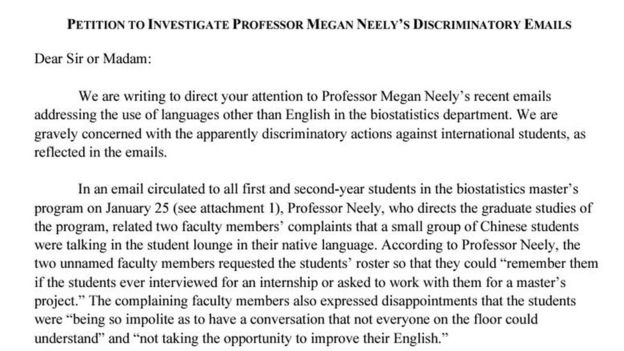
Megan Neely, an assistant professor at Duke University in North Carolina, said in an email to students that two unnamed faculty members of the biostatistics Masters programme had complained to her about students speaking Chinese in public areas in the department.

She said that not speaking English could lead to "unintended consequences" for international students.

Her email went viral on Twitter and Chinese social media, while Duke's medical faculty has promised to review its biostatistics programme.

The course attracts students from a wide range of backgrounds

Many have criticised Dr Neely's email as racist or insensitive, and raised concerns that faculty members were discriminating against international students.

However, some ethnic minority students on the Masters programme told the BBC they supported Dr Neely, describing her as a supportive programme director and "definitely not a racist, not even close".

What exactly happened?
The controversy erupted after screenshots of Dr Neely's email to biostatistics students began circulating online over the weekend. Duke University confirmed to US media that the screenshots were genuine.

Dr Neely said that two faculty members had asked her if she had photos of students on the Masters programme, before picking out a number of first-year students "who they observed speaking Chinese (in their words, VERY LOUDLY), in the student lounge/study areas".

Dr Neely said that the faculty members told her "they wanted to write down the names so they could remember them if the students ever interviewed for an internship or asked to work with them for a masters project. They were disappointed that these students were not taking the opportunity to improve their English and were being so impolite as to have a conversation that not everyone on the floor could understand.

"To international students," she continued, "PLEASE PLEASE PLEASE keep these unintended consequences in mind when you choose to speak in Chinese in the building."

She added that she respected international students for learning "in a non-native language", but "I encourage you to commit to using English 100% of the time when you are in Hock [the faculty building] or any other professional setting".

The petition was signed by 2,000 people by Sunday
Why was it so controversial?
The email went viral after it was leaked online and reported in the student paper The Chronicle. Many found the language in the email patronising, while others wondered if the students had been targeted because they spoke Chinese, rather than another foreign language.

For many, however, the most concerning part of the email was the allegation that two faculty members appeared ready to discriminate against students based on what language they spoke with their friends.

A group calling themselves Concerned Duke Students said in a petition that they were "gravely concerned" with the implication "that students of diverse national origin would be punished in academic and employment opportunities for speaking in their native language outside of classroom settings."

The group told the BBC that more than 2,000 people had signed their petition by Sunday, including current Duke students and alumni, as well as students from other institutions.

"We recognise that language difficulties could be a… barrier for many international students, but we think this is all the more reason why Duke should treat us with more respect and understanding," they said in a statement.

Mary Klotman, dean of the medical school which oversees the biostatistics programme, wrote to students over the weekend, telling them: "There is absolutely no restriction or limitation on the language you use to converse and communicate with each other. Your career opportunities and recommendations will not in any way be influenced by the language you use outside the classroom. And your privacy will always be protected.

"I have asked the university's Office of Institutional Equity to conduct a thorough review of the Master of Biostatistics Programme," she added.

Dr Neely, who is still in post as an assistant professor, has not yet publicly commented on the controversy.

What do her students think?
As of Sunday night, millions on Weibo had viewed the hashtag "Duke University bans speaking Chinese", while "Duke University professor who banned speaking Chinese resigns" was the ninth-most trending hashtag.

One Weibo user described the email as "naked racism", while another joked: "Should we also chuck out any foreign exchange students who aren't speaking Chinese on campus, because they haven't taken advantage of the opportunity to learn Chinese in China?"
Meanwhile, several Twitter users began sharing Dr Neely's faculty photo or calling for her to be fired.

However, others have argued that the furore has been overblown - or that Dr Neely has unfairly borne the brunt of the criticism.

One Weibo user suggested that the email had revealed deeper issues on the programme.

"I think this professor's actions may have been well intentioned, instead it might be the two faculty members who asked [for names and photos] who are the real racists," they wrote.

Three students on Duke's biostatistic masters programme, who asked not to be named, expressed support for her to the BBC.

"Dr Neely is a great instructor and definitely not a racist, not even close," one Chinese student said.

Another Chinese student told the BBC he had found Dr Neely "always willing to help" students of all nationalities, and hoped the university would investigate the two unnamed faculty members mentioned in her email instead.

A third student of Asian descent said: "Megan is truly the best instructor and mentor I ever had… She made a mistake [with her email], but we still know what was her intention and how much she cares about us.

"When some people talk loudly in foreign language, other people [in the lounge] are definitely disturbed."

The student added: "Some of my Chinese friends also told me they are worried that if they support Megan in the public, they might be regarded as 'people who betrayed their country' by other Chinese students in the United States."

(Source: BBC) 

Wednesday, 16 January 2019

The world’s most musical languages

Why one syllable spoken at different pitches can have seven meanings

People don’t generally speak in a monotone. Even someone who couldn’t carry a tune if it had a handle on it uses a different melody to ask a question than to make a statement, and in a sentence like “It was the first time I had even been there,” says “been” on a higher pitch than the rest of the words.

Still, if someone speaks in a monotone in English, other English-speakers can easily understand. But in many languages, pitch is as important as consonants and vowels for distinguishing one word from another. In English, “pay” and “bay” are different because they have different starting sounds. But imagine if “pay” said on a high pitch meant “to give money,” while “pay” said on a low pitch meant “a broad inlet of the sea where the land curves inward.” That’s what it feels like to speak what linguists call a tonal language. At least a billion and a half people worldwide do it their entire lives and think nothing of it.

Mandarin Chinese, with its four tones, is a typical example. Take the word ma. If you say it the way an English-speaker would say it, just reading it sitting by itself on a page, then it means “scold.” Say ma as if you were looking for your mother—ma?—and it means “rough.” If you were just whining at her—“ma-a-a?!?”—with your voice swooping down a bit and then back up even higher, that would mean, believe it or not, “horse.” And if you say ma on a high pitch, as if you were singing the first syllable of “The Star-Spangled Banner” as ma instead of “oh” for some reason, that would actually mean mother. That’s the way almost every syllable works in Chinese.

An ethnic Hmong boy plays the lusheng to welcome the new year in Guizhou province, China.CHINA STRINGER NETWORK / REUTERS
As tone languages go, Mandarin is by no means the most complicated. The Hmong language, spoken in China, Vietnam, Laos, and Thailand, can have seven or even eight tones. It’s dazzling, really. If you say paw like a statement, it means “female.” Say it like a question and it means “to throw.” Say it up high in an impatient way and you’re saying “ball.” Say it down low as if you ran into someone in a basement and didn’t want anyone upstairs to know you were down there, and it means “thorn.” Say it in a tone between the impatient high and the down-low and it means “pancreas.” If you say paw in a creaky way—kind of like the way one might imitate an elderly person’s voice—then it means “to see,” while if you say it in a breathy, amazed way as if you were seeing a horsey in the clouds, then it means “paternal grandmother.” (For what it’s worth, maternal grandmother is tai, said on the “basement” tone.)

Tone languages are spoken all over the world, but they tend to cluster in three places: East and Southeast Asia; sub-Saharan Africa; and among the indigenous communities of Mexico. Why there and not elsewhere? One thing these regions might have in common is heat, though it’s hard to imagine how that would make people speak more melodically. Yet environment may not be entirely unrelated to the phenomenon—according to one hypothesis, tone languages are less likely to develop in dry environments because dry air deprives the vocal cords of the suppleness required to produce subtle differences in tone.

The jury is still out on that one, but even if it turns out to be true, it only gets us so far. The theory proposes that where the climate isn’t dry, there’s no predicting whether a language will take on tones or not. As such, it’s easy to suppose—and fun to imagine—that people decide to “sing” language out of some kind of cultural impulse. The reality is less groovy, but just as interesting.

It’s ultimately a matter of one thing leading to another. Take the words “pay” and “bay.” It looks like the only difference between them is that they start with different letters, but there’s more to it up close. English-speakers tend to say the ay sound on a slightly lower pitch after a b than after a p, because of the different mechanics involved in saying those consonants. That is, one tends to say “pay” a little higher than one says “bay.” In daily life that’s so subtle as to be barely noticeable: What stands out is the good old difference between p and b. But p and b are very similar sounds, and sounds that are similar have a way of melting together—a Cockney English-speaker can say “bref” for breath and “fing” for thing because the f and th sounds are made close together at the front of the mouth. Suppose as time went by English-speakers started pronouncing b as p so that there was no more b sound at all?

Imagine: “Brother” is “prother,” “bat” is “pat,” “big” is “pig.” Things like that happen in languages all the time, and if it happened to English, then instead of “pay” and “bay” there would just be “pay” and “pay”—except there would still be that difference in the tone. “Pay” with a neutral tone would mean “pay,” while “pay” with a low tone would mean “bay.” The tone alone would convey the difference in meaning. This is exactly how a tone language happens, and in some places you can even see the steps in the process. For example, there is a language called Khmu spoken in parts of Laos, Vietnam, Thailand, and China. In one dialect of Khmu, pok means “bite” and bok means “to cut down a tree.” In another dialect, though, b has become p, and all that’s left behind is the difference in the tone, as if the Cheshire Cat had left behind his smile. Thus in that dialect, pok on a high tone means “bite,” while pok on a low tone means “to cut down a tree.”

There are certain advantages to speaking tone languages. Speakers of some African languages can communicate across long distances playing the tones on drums, and Mazatec-speakers in Mexico use whistling for the same purpose. You know those people who can hear a stray note and instantly identify its pitch, for instance recognizing that a certain car horn is an A flat? They have “absolute pitch,” and there is evidence that speakers of tone languages are more likely to have it. In one experiment, for instance, Mandarin-speaking musicians were better at identifying musical pitches than English-speaking ones. The same has been found for speakers of Cantonese—which has six or even nine tones, depending on how you count—relative to English- and French-speakers.

Could a language rely completely on tones? As key as tones can be to conveying meaning, they aren’t fine-grained enough by themselves to communicate the full range of human expression—speaking only in tones would be akin to writing only in emojis. The tone-language counterpart to the new all-emoji translation of Moby-Dick, for example, would have been a language created by a Frenchman in the 1820s called Solresol, which was based solely on musical tones. Do-re-mi was “day,” do-re-fa was “week,” do-re-sol was “month,” and so on; mi-sol was “good,” and the reverse, sol-mi, was “bad.” Cute idea, but Solresol would have been no more able to equal the speed, nuance, and complexity of actual speech than Emoji-Dick can render the magnificence of Melville’s prose.

(Source: The Atlantic)

Thursday, 10 January 2019

Why Mandarin doesn’t come from Chinese

The name of the world’s most spoken language has a surprising origin story.

Since the mandarin duck appeared in Central Park last fall, his unexpected presence has stirred up many questions: Where did he come from? Why is he so hot? Can such beauty survive in our garbage world? And, for the linguistics nerds out there, where do mandarin ducks get their name?

Yes, true, mandarin ducks are native to China, where Mandarin is the official language. But the word mandarin has a more roundabout origin. It does not come from Mandarin Chinese, which refers to itself as putonghua (or “common speech”) and China, the country, as zhongguo (or “Middle Kingdom”). It doesn’t come from any other variant of Chinese, either. Its origins are Portuguese.

This one word encapsulates an entire colonial history. In the 16th century, Portuguese explorers were among the first Europeans to reach China. Traders and missionaries followed, settling into Macau on land leased from China’s Ming dynasty rulers. The Portuguese called the Ming officials they met mandarim, which comes from menteri in Malay and, before that, mantrī in Sanskrit, both of which mean “minister” or “counselor.” It makes sense that Portuguese would borrow from Malay; they were simultaneously colonizing Malacca on the Malay peninsula.

For centuries, Europeans’ impressions of China filtered largely through the Portuguese. The 16th-century Jesuit priest Matteo Ricci, for instance, was Italian, but he arrived in China through Portuguese Macau. Following the twisty logic of colonialism, when he attempted to transpose Chinese characters into the Latin alphabet, he made use of both Italian and Portuguese, comparing the sounds of individual characters to the sounds of Portuguese and Italian words. Even today, “linguists go to town and try to figure [out] what Chinese would have sounded like at the time,” says David Moser, author of A Billion Voices: China’s Search for a Common Language. “They could use as a clue the way Matteo Ricci wrote the Portuguese.”

Mandarin duck showing off in Central ParkSETH WENIG / AP

Over time, the Portuguese coinage of “mandarin” took on other meanings. The Ming dynasty officials wore yellow robes, which may be why “mandarin” came to mean a type of citrus. “Mandarin” also lent its names to colorful animals native to Asia but new to Europeans, like wasps and snakes and, of course, ducks. And the language the Chinese officials spoke became “Mandarin,” which is how the English name for the language more than 1 billion people in China speak still comes from Portuguese.

But words have a way of collecting just-so origin stories, and Chinese speakers have sometimes retroactively given a Chinese origin to “mandarin,” says Moser. It sounds similar enough to mandaren, a phrase that could mean “important Manchurian.” The rulers of China’s last dynasty, the Qing, were from Manchuria, so it make sense if you squint at it. “But it’s not true,” says Moser. “Mandarin” has a distinctly non-Mandarin origin.

“Mandarin” is what linguists call an exonym, an external name for a place, people, or language. And exonyms often tell a history of how cultures met, fought, and interacted. Many English names for continental European cities derive not from the local language but from French—probably a legacy of the Norman conquest of England. For example, English and French both use Cologne for Köln, Florence for Firenze, Prague for Praha, and Belgrade for Beograd.

In other cases, says the lexicographer Grant Barrett, exonyms arise because two places have a relationship that pre-dates current national boundaries. For example, adds the linguist Anatoly Liberman, we use “Germany” from the Latin Germania. In French, the name is Allemagne from a group of tribes called the Alemanni; in Finnish, Saksa from the Saxons. Germany (Deutschland in German) only became a unified country in 1871, long after other Europeans had adopted their own names for the place, based on different peoples who once lived there.

From the vantage point of English speakers, many of the exonyms for non-European places and languages come filtered through the languages of former colonial powers. Bombay and Ceylon, for example, also come from the Portuguese, whose empire once sprawled through Asia. The names imposed by colonial powers can be controversial, of course; Bombay and Ceylon have since officially changed their names to Mumbai and Sri Lanka. The name “Mandarin” still endures, perhaps because its origin is more obscure or because China has enjoyed warmer relations with Portugal than with other European countries. As for the mandarin ducks, they also live in Portugal now.

(Source: The Atlantic)

Tuesday, 20 November 2018

Albert Einstein’s private diaries reveal his racist views

Newly translated into English, Albert Einstein’s private travel diaries from the 1920s reveal that he was racist in his early life, especially toward Chinese people.

The journals, published as “The Travel Diaries of Albert Einstein” by Princeton University Press, reveal that Einstein, perhaps the most famous scientist of all time and known for his theory of general relativity and the equation e=mc2, was extraordinarily biased toward certain populations. This is a stark contrast to his stance later in life when he said that racism was a “disease of white people.”

The diaries were written between October 1922 and March 1923. In one entry Einstein wrote that the “Chinese don’t sit on benches while eating but squat like Europeans do when they relieve themselves out in the leafy woods. All this occurs quietly and demurely. Even the children are spiritless and look obtuse.”

Speaking about the “abundance of offspring” and the “fecundity” of the Chinese, he continued: “It would be a pity if these Chinese supplant all other races. For the likes of us the mere thought is unspeakably dreary.”


Einstein also derided the people of Ceylon, which is now known as Sri Lanka. In Ceylon, he wrote, the locals “live in great filth and considerable stench at ground level,” before adding they “do little and need little. The simple economic cycle of life.”

Einstein also gave his thoughts on Japanese people, who he viewed in a more positive light, calling them “unostentatious, decent, altogether very appealing.” However, he also wrote the “intellectual needs of this nation seem to be weaker than their artistic ones – natural disposition?”

“Entries… contain passages that reveal Einstein’s stereotyping of members of various nations and raise questions about his attitudes on race,” a description of the book reads.

The journals were translated from the German and are described as “the first publication of Albert Einstein’s travel diary to the Far East and Middle East.”

Speaking with The Guardian, the book’s editor, Ze’ev Rosenkranz, said that Einstein’s views were not intended for public consumption and provide a shock to those who read them.

“I think a lot of comments strike us as pretty unpleasant – what he says about the Chinese in particular,” Rosenkranz told The Guardian. “They’re kind of in contrast to the public image of the great humanitarian icon. I think it’s quite a shock to read those and contrast them with his more public statements. They’re more off guard, he didn’t intend them for publication.”

Rosenkranz is also the assistant director of the Einstein Papers Project at the California Institute of Technology and has written several books about the life of Einstein.

The remarks in his journal are markedly different to the public image Einstein had in his later years.

In 1946, speaking at Lincoln University, the first degree-granting historically black university in the US, Einstein said that racism was a “disease of white people” and added “I do not intend to be quiet about it,” according to a 2007 article in the Harvard Gazette.

Einstein was a founder of the Hebrew University in Jerusalem and left it his literary estate and personal papers. He declined an invitation to serve as Israel’s first president.

He died in 1955 at the age of 76.

(Source: NY Post)

Monday, 19 November 2018

The land that failed to fail

China Rules: They didn’t like the West’s playbook. So they wrote their own.

The West was sure the Chinese approach would not work. It just had to wait. It’s still waiting.

In the uncertain years after Mao’s death, long before China became an industrial juggernaut, before the Communist Party went on a winning streak that would reshape the world, a group of economics students gathered at a mountain retreat outside Shanghai. There, in the bamboo forests of Moganshan, the young scholars grappled with a pressing question: How could China catch up with the West?

It was the autumn of 1984, and on the other side of the world, Ronald Reagan was promising “morning again in America.” China, meanwhile, was just recovering from decades of political and economic turmoil. There had been progress in the countryside, but more than three-quarters of the population still lived in extreme poverty. The state decided where everyone worked, what every factory made and how much everything cost.

The students and researchers attending the Academic Symposium of Middle-Aged and Young Economists wanted to unleash market forces but worried about crashing the economy — and alarming the party bureaucrats and ideologues who controlled it.

Late one night, they reached a consensus: Factories should meet state quotas but sell anything extra they made at any price they chose. It was a clever, quietly radical proposal to undercut the planned economy — and it intrigued a young party official in the room who had no background in economics. “As they were discussing the problem, I didn’t say anything at all,” recalled Xu Jing’an, now 76 and retired. “I was thinking, how do we make this work?”

The Chinese economy has grown so fast for so long now that it is easy to forget how unlikely its metamorphosis into a global powerhouse was, how much of its ascent was improvised and born of desperation. The proposal that Mr. Xu took from the mountain retreat, soon adopted as government policy, was a pivotal early step in this astounding transformation.

China now leads the world in the number of homeowners, internet users, college graduates and, by some counts, billionaires. Extreme poverty has fallen to less than 1 percent. An isolated, impoverished backwater has evolved into the most significant rival to the United States since the fall of the Soviet Union.


It is less worried now about catching up to the West. Instead, it wonders how to pull ahead.
China today might be unrecognizable to its Communist founders, but the past still holds a powerful allure. “Red tourism” is a big industry.
The country leads the world in the number of internet users and college graduates. It is now working to land a person on the moon.
Gone are the days when the state decided where everyone worked and what every factory made.
The world thought it would change China, but China’s success has been so spectacular that it has changed the world.
An epochal contest is underway. With President Xi Jinping pushing a more assertive agenda overseas and tightening controls at home, the Trump administration has launched a trade war and is gearing up for what could be a new Cold War. Meanwhile, in Beijing the question these days is less how to catch up with the West than how to pull ahead — and how to do so in a new era of American hostility.

The pattern is familiar to historians, a rising power challenging an established one, with a familiar complication: For decades, the United States encouraged and aided China’s rise, working with its leaders and its people to build the most important economic partnership in the world, one that has lifted both nations.

During this time, eight American presidents assumed, or hoped, that China would eventually bend to what were considered the established rules of modernization: Prosperity would fuel popular demands for political freedom and bring China into the fold of democratic nations. Or the Chinese economy would falter under the weight of authoritarian rule and bureaucratic rot.

But neither happened. Instead, China’s Communist leaders have defied expectations again and again. They embraced capitalism even as they continued to call themselves Marxists. They used repression to maintain power but without stifling entrepreneurship or innovation. Surrounded by foes and rivals, they avoided war, with one brief exception, even as they fanned nationalist sentiment at home. And they presided over 40 years of uninterrupted growth, often with unorthodox policies the textbooks said would fail.

In late September, the People’s Republic of China marked a milestone, surpassing the Soviet Union in longevity. Days later, it celebrated a record 69 years of Communist rule. And China may be just hitting its stride — a new superpower with an economy on track to become not just the world’s largest but, quite soon, the largest by a wide margin.

The world thought it could change China, and in many ways it has. But China’s success has been so spectacular that it has just as often changed the world — and the American understanding of how the world works.

There is no simple explanation for how China’s leaders pulled this off. There was foresight and luck, skill and violent resolve, but perhaps most important was the fear — a sense of crisis among Mao’s successors that they never shook, and that intensified after the Tiananmen Square massacre and the collapse of the Soviet Union.

Even as they put the disasters of Mao’s rule behind them, China’s Communists studied and obsessed over the fate of their old ideological allies in Moscow, determined to learn from their mistakes. They drew two lessons: The party needed to embrace “reform” to survive — but “reform” must never include democratization.

China has veered between these competing impulses ever since, between opening up and clamping down, between experimenting with change and resisting it, always pulling back before going too far in either direction for fear of running aground.

Many people said that the party would fail, that this tension between openness and repression would be too much for a nation as big as China to sustain. But it may be precisely why China soared.

Whether it can continue to do so with the United States trying to stop it is another question entirely.

Apparatchiks Into Capitalists
None of the participants at the Moganshan conference could have predicted how China would take off, much less the roles they would play in the boom ahead. They had come of age in an era of tumult, almost entirely isolated from the rest of the world, with little to prepare them for the challenge they faced. To succeed, the party had to both reinvent its ideology and reprogram its best and brightest to carry it out.

Mr. Xu, for example, had graduated with a degree in journalism on the eve of Mao’s violent Cultural Revolution, during which millions of people were purged, persecuted and killed. He spent those years at a “cadre school” doing manual labor and teaching Marxism in an army unit. After Mao’s death, he was assigned to a state research institute tasked with fixing the economy. His first job was figuring out how to give factories more power to make decisions, a subject he knew almost nothing about. Yet he went on to a distinguished career as an economic policymaker, helping launch China’s first stock market in Shenzhen.

Among the other young participants in Moganshan were Zhou Xiaochuan, who would later lead China’s central bank for 15 years; Lou Jiwei, who ran China’s sovereign wealth fund and recently stepped down as finance minister; and an agricultural policy specialist named Wang Qishan, who rose higher than any of them.

Mr. Wang headed China’s first investment bank and helped steer the nation through the Asian financial crisis. As Beijing’s mayor, he hosted the 2008 Olympics. Then he oversaw the party’s recent high-stakes crackdown on corruption. Now he is China’s vice president, second in authority only to Xi Jinping, the party’s leader.

The careers of these men from Moganshan highlight an important aspect of China’s success: It turned its apparatchiks into capitalists.

Bureaucrats who were once obstacles to growth became engines of growth. Officials devoted to class warfare and price controls began chasing investment and promoting private enterprise. Every day now, the leader of a Chinese district, city or province makes a pitch like the one Yan Chaojun made at a business forum in September.

“Sanya,” Mr. Yan said, referring to the southern resort town he leads, “must be a good butler, nanny, driver and cleaning person for businesses, and welcome investment from foreign companies.”

It was a remarkable act of reinvention, one that eluded the Soviets. In both China and the Soviet Union, vast Stalinist bureaucracies had smothered economic growth, with officials who wielded unchecked power resisting change that threatened their privileges.

Mikhail Gorbachev, the last leader of the Soviet Union, tried to break the hold of these bureaucrats on the economy by opening up the political system. Decades later, Chinese officials still take classes on why that was a mistake. The party even produced a documentary series on the subject in 2006, distributing it on classified DVDs for officials at all levels to watch.

Afraid to open up politically but unwilling to stand still, the party found another way. It moved gradually and followed the pattern of the compromise at Moganshan, which left the planned economy intact while allowing a market economy to flourish and outgrow it.

Once an impoverished backwater, China is now the most significant rival to the United States. Wuhan, a former river town, has swelled into a metropolis of over 10 million.
A businessman stretched before a round of video golf at a hotel he built in Kunming.
Rising incomes have turned China into a nation of consumers.
In cities like Shanghai, Chinese schoolchildren outperform peers around the world.
Western economists doubted that innovation could take place under China’s rigid bureaucracy. They were proved wrong.
Party leaders called this go-slow, experimental approach “crossing the river by feeling the stones” — allowing farmers to grow and sell their own crops, for example, while retaining state ownership of the land; lifting investment restrictions in “special economic zones,” while leaving them in place in the rest of the country; or introducing privatization by selling only minority stakes in state firms at first.

“There was resistance,” Mr. Xu said. “Satisfying the reformers and the opposition was an art.”

American economists were skeptical. Market forces needed to be introduced quickly, they argued; otherwise, the bureaucracy would mobilize to block necessary changes. After a visit to China in 1988, the Nobel laureate Milton Friedman called the party’s strategy “an open invitation to corruption and inefficiency.”

But China had a strange advantage in battling bureaucratic resistance. The nation’s long economic boom followed one of the darkest chapters of its history, the Cultural Revolution, which decimated the party apparatus and left it in shambles. In effect, autocratic excess set the stage for Mao’s eventual successor, Deng Xiaoping, to lead the party in a radically more open direction.

That included sending generations of young party officials to the United States and elsewhere to study how modern economies worked. Sometimes they enrolled in universities, sometimes they found jobs, and sometimes they went on brief “study tours.” When they returned, the party promoted their careers and arranged for others to learn from them.

At the same time, the party invested in education, expanding access to schools and universities, and all but eliminating illiteracy. Many critics focus on the weaknesses of the Chinese system — the emphasis on tests and memorization, the political constraints, the discrimination against rural students. But mainland China now produces more graduates in science and engineering every year than the United States, Japan, South Korea and Taiwan combined.

In cities like Shanghai, Chinese schoolchildren outperform peers around the world. For many parents, though, even that is not enough. Because of new wealth, a traditional emphasis on education as a path to social mobility and the state’s hypercompetitive college entrance exam, most students also enroll in after-school tutoring programs — a market worth $125 billion, according to one study, or as much as half the government’s annual military budget.

Another explanation for the party’s transformation lies in bureaucratic mechanics. Analysts sometimes say that China embraced economic reform while resisting political reform. But in reality, the party made changes after Mao’s death that fell short of free elections or independent courts yet were nevertheless significant.

The party introduced term limits and mandatory retirement ages, for example, making it easier to flush out incompetent officials. And it revamped the internal report cards it used to evaluate local leaders for promotions and bonuses, focusing them almost exclusively on concrete economic targets.

These seemingly minor adjustments had an outsize impact, injecting a dose of accountability — and competition — into the political system, said Yuen Yuen Ang, a political scientist at the University of Michigan. “China created a unique hybrid,” she said, “an autocracy with democratic characteristics.”

As the economy flourished, officials with a single-minded focus on growth often ignored widespread pollution, violations of labor standards, and tainted food and medical supplies. They were rewarded with soaring tax revenues and opportunities to enrich their friends, their relatives and themselves. A wave of officials abandoned the state and went into business. Over time, the party elite amassed great wealth, which cemented its support for the privatization of much of the economy it once controlled.

The private sector now produces more than 60 percent of the nation’s economic output, employs over 80 percent of workers in cities and towns, and generates 90 percent of new jobs, a senior official said in a speech last year. As often as not, the bureaucrats stay out of the way.

“I basically don’t see them even once a year,” said James Ni, chairman and founder of Mlily, a mattress manufacturer in eastern China. “I’m creating jobs, generating tax revenue. Why should they bother me?”

In recent years, President Xi has sought to assert the party’s authority inside private firms. He has also bolstered state-owned enterprises with subsidies while preserving barriers to foreign competition. And he has endorsed demands that American companies surrender technology in exchange for market access.

In doing so, he is betting that the Chinese state has changed so much that it should play a leading role in the economy — that it can build and run “national champions” capable of outcompeting the United States for control of the high-tech industries of the future. But he has also provoked a backlash in Washington.

‘Opening Up’
In December, the Communist Party will celebrate the 40th anniversary of the “reform and opening up” policies that transformed China. The triumphant propaganda has already begun, with Mr. Xi putting himself front and center, as if taking a victory lap for the nation.

He is the party’s most powerful leader since Deng and the son of a senior official who served Deng, but even as he wraps himself in Deng’s legacy, Mr. Xi has set himself apart in an important way: Deng encouraged the party to seek help and expertise overseas, but Mr. Xi preaches self-reliance and warns of the threats posed by “hostile foreign forces.”

In other words, he appears to have less use for the “opening up” part of Deng’s slogan.

Of the many risks that the party took in its pursuit of growth, perhaps the biggest was letting in foreign investment, trade and ideas. It was an exceptional gamble by a country once as isolated as North Korea is today, and it paid off in an exceptional way: China tapped into a wave of globalization sweeping the world and emerged as the world’s factory. China’s embrace of the internet, within limits, helped make it a leader in technology. And foreign advice helped China reshape its banks, build a legal system and create modern corporations.

The party prefers a different narrative these days, presenting the economic boom as “grown out of the soil of China” and primarily the result of its leadership. But this obscures one of the great ironies of China’s rise — that Beijing’s former enemies helped make it possible.

President Xi Jinping has shown no sign of abandoning what he calls “the great rejuvenation of the Chinese nation.” The observation deck of the Shanghai Tower, the world’s second-tallest building.
A Communist Party Congress. Mr. Xi seems to believe that China has been so successful that the party can return to its authoritarian past.
China tapped into a wave of globalization and emerged as the world’s factory. Advertising for day laborers in Shenzhen.
A fashion design employee at a bridal wear exhibition in Beijing may have taken the opportunity for a break, but no one calls China a sleeping giant anymore.
Installing solar panels on a 47-story residential development. China succeeded by leaving a planned economy intact and allowing a market economy to flourish and outgrow it.
The United States and Japan, both routinely vilified by party propagandists, became major trading partners and were important sources of aid, investment and expertise. The real game changers, though, were people like Tony Lin, a factory manager who made his first trip to the mainland in 1988.

Mr. Lin was born and raised in Taiwan, the self-governing island where those who lost the Chinese civil war fled after the Communist Revolution. As a schoolboy, he was taught that mainland China was the enemy.

But in the late 1980s, the sneaker factory he managed in central Taiwan was having trouble finding workers, and its biggest customer, Nike, suggested moving some production to China. Mr. Lin set aside his fears and made the trip. What he found surprised him: a large and willing work force, and officials so eager for capital and know-how that they offered the use of a state factory free and a five-year break on taxes.

Mr. Lin spent the next decade shuttling to and from southern China, spending months at a time there and returning home only for short breaks to see his wife and children. He built and ran five sneaker factories, including Nike’s largest Chinese supplier.

“China’s policies were tremendous,” he recalled. “They were like a sponge absorbing water, money, technology, everything.”

Mr. Lin was part of a torrent of investment from ethnic Chinese enclaves in Hong Kong, Taiwan, Singapore and beyond that washed over China — and gave it a leg up on other developing countries. Without this diaspora, some economists argue, the mainland’s transformation might have stalled at the level of a country like Indonesia or Mexico.

The timing worked out for China, which opened up just as Taiwan was outgrowing its place in the global manufacturing chain. China benefited from Taiwan’s money, but also its managerial experience, technology and relationships with customers around the world. In effect, Taiwan jump-started capitalism in China and plugged it into the global economy.

Before long, the government in Taiwan began to worry about relying so much on its onetime enemy and tried to shift investment elsewhere. But the mainland was too cheap, too close and, with a common language and heritage, too familiar. Mr. Lin tried opening factories in Thailand, Vietnam and Indonesia but always came back to China.

Now Taiwan finds itself increasingly dependent on a much more powerful China, which is pushing ever harder for unification, and the island’s future is uncertain.

There are echoes of Taiwan’s predicament around the world, where many are having second thoughts about how they rushed to embrace Beijing with trade and investment.

The remorse may be strongest in the United States, which brought China into the World Trade Organization, became China’s largest customer and now accuses it of large-scale theft of technology — what one official called “the greatest transfer of wealth in history.”

Many in Washington predicted that trade would bring political change. It did, but not in China. “Opening up” ended up strengthening the party’s hold on power rather than weakening it. The shock of China’s rise as an export colossus, however, was felt in factory towns around the world.

In the United States, economists say at least two million jobs disappeared as a result, many in districts that ended up voting for President Trump.

Selective Repression
Over lunch at a luxurious private club on the 50th floor of an apartment tower in central Beijing, one of China’s most successful real estate tycoons explained why he had left his job at a government research center after the crackdown on the student-led democracy movement in Tiananmen Square.

“It was very easy,” said Feng Lun, the chairman of Vantone Holdings, which manages a multibillion-dollar portfolio of properties around the world. “One day, I woke up and everyone had run away. So I ran, too.”

Until the soldiers opened fire, he said, he had planned to spend his entire career in the civil service. Instead, as the party was pushing out those who had sympathized with the students, he joined the exodus of officials who started over as entrepreneurs in the 1990s.

“At the time, if you held a meeting and told us to go into business, we wouldn’t have gone,” he recalled. “So this incident, it unintentionally planted seeds in the market economy.”

Such has been the seesaw pattern of the party’s success.

The pro-democracy movement in 1989 was the closest the party ever came to political liberalization after Mao’s death, and the crackdown that followed was the furthest it went in the other direction, toward repression and control. After the massacre, the economy stalled and retrenchment seemed certain. Yet three years later, Deng used a tour of southern China to wrestle the party back to “reform and opening up” once more.

Many who had left the government, like Mr. Feng, suddenly found themselves leading the nation’s transformation from the outside, as its first generation of private entrepreneurs.

Now Mr. Xi is steering the party toward repression again, tightening its grip on society, concentrating power in his own hands and setting himself up to rule for life by abolishing the presidential term limit. Will the party loosen up again, as it did a few years after Tiananmen, or is this a more permanent shift? If it is, what will it mean for the Chinese economic miracle?

The fear is that Mr. Xi is attempting to rewrite the recipe behind China’s rise, replacing selective repression with something more severe.

For decades, China has veered between openness and repression, including of the ethnic Uighur minority.
Since the Tiananmen movement, the government has been vigilant about crushing potential threats. Surveillance cameras in Beijing.
China’s high-speed rail network, the largest in the world, has changed the way its people move. In Hangzhou, passengers waited outside the railway station.
As China opened up, farmers were allowed to grow and sell their own crops, while the state retained ownership of the land. Greenhouses filled with bok choy and yellow cabbage abut investment properties and golf courses.
Under Mao, many educated Chinese were sent to “cadre schools,” where they did manual labor. In May, these real estate agency employees went for a morning run as part of a company team-building exercise.
The party has always been vigilant about crushing potential threats — a fledgling opposition party, a popular spiritual movement, even a dissident writer awarded the Nobel Peace Prize. But with some big exceptions, it has also generally retreated from people’s personal lives and given them enough freedom to keep the economy growing.

The internet is an example of how it has benefited by striking a balance. The party let the nation go online with barely an inkling of what that might mean, then reaped the economic benefits while controlling the spread of information that could hurt it.

In 2011, it confronted a crisis. After a high-speed train crash in eastern China, more than 30 million messages criticizing the party’s handling of the fatal accident flooded social media — faster than censors could screen them.

Panicked officials considered shutting down the most popular service, Weibo, the Chinese equivalent of Twitter, but the authorities were afraid of how the public would respond. In the end, they let Weibo stay open but invested much more in tightening controls and ordered companies to do the same.

The compromise worked. Now, many companies assign hundreds of employees to censorship duties — and China has become a giant on the global internet landscape.

“The cost of censorship is quite limited compared to the great value created by the internet,” said Chen Tong, an industry pioneer. “We still get the information we need for economic progress.”

A ‘New Era’
China is not the only country that has squared the demands of authoritarian rule with the needs of free markets. But it has done so for longer, at greater scale and with more convincing results than any other.

The question now is whether it can sustain this model with the United States as an adversary rather than a partner.

The trade war has only just begun. And it is not just a trade war. American warships and planes are challenging Chinese claims to disputed waters with increasing frequency even as China keeps ratcheting up military spending. And Washington is maneuvering to counter Beijing’s growing influence around the world, warning that a Chinese spending spree on global infrastructure comes with strings attached.

The two nations may yet reach some accommodation. But both left and right in America have portrayed China as the champion of an alternative global order, one that embraces autocratic values and undermines fair competition. It is a rare consensus for the United States, which is deeply divided about so much else, including how it has wielded power abroad in recent decades — and how it should do so now.

Mr. Xi, on the other hand, has shown no sign of abandoning what he calls “the great rejuvenation of the Chinese nation.” Some in his corner have been itching to take on the United States since the 2008 financial crisis and see the Trump administration’s policies as proof of what they have always suspected — that America is determined to keep China down.

At the same time, there is also widespread anxiety over the new acrimony, because the United States has long inspired admiration and envy in China, and because of a gnawing sense that the party’s formula for success may be faltering.

Prosperity has brought rising expectations in China; the public wants more than just economic growth. It wants cleaner air, safer food and medicine, better health care and schools, less corruption and greater equality. The party is struggling to deliver, and tweaks to the report cards it uses to measure the performance of officials hardly seem enough.

“The basic problem is, who is growth for?” said Mr. Xu, the retired official who wrote the Moganshan report. “We haven’t solved this problem.”

Growth has begun to slow, which may be better for the economy in the long term but could shake public confidence. The party is investing ever more in censorship to control discussion of the challenges the nation faces: widening inequality, dangerous debt levels, an aging population.

Mr. Xi himself has acknowledged that the party must adapt, declaring that the nation is entering a “new era” requiring new methods. But his prescription has largely been a throwback to repression, including vast internment camps targeting Muslim ethnic minorities. “Opening up” has been replaced by an outward push, with huge loans that critics describe as predatory and other efforts to gain influence — or interfere — in the politics of other countries. At home, experimentation is out while political orthodoxy and discipline are in.

In effect, Mr. Xi seems to believe that China has been so successful that the party can return to a more conventional authoritarian posture — and that to survive and surpass the United States it must.

Certainly, the momentum is still with the party. Over the past four decades, economic growth in China has been 10 times faster than in the United States, and it is still more than twice as fast. The party appears to enjoy broad public support, and many around the world are convinced that Mr. Trump’s America is in retreat while China’s moment is just beginning.

Then again, China has a way of defying expectations.

(Source: NYT)