Showing posts with label Europe. Show all posts

Tuesday, 24 May 2022

How tall will Mount Everest get before it stops growing?

 Arching over 8,849 metres (29,032ft) into the sky, Everest is the world’s tallest mountain. But will it always be?

Aurora Elmore was approaching Mount Everest's South Base Camp in Nepal. But rather than taking the traditional 12-day hiking route, she was soaring between the frozen peaks, the rotor blades of her helicopter slicing through the thin air with a whap, whap, whap.


It was April 2019, and she was delivering supplies to a team of scientists working on the slopes of the world's tallest mountain. Her reward was a spectacular view: the day was crystal clear, exposing the entire Himalayan range.


Over the next two months, researchers on the National Geographic and Rolex expedition she helped to organise would study the effects of climate change on this part of the Himalayas. Elmore, a geologist and at the time senior programme manager of the National Geographic Society in the US, supported the team installing the world's highest weather station on the flanks of Mount Everest. During the course of their expedition, her colleagues discovered the world's highest evidence of microplastic pollution in snow and stream water close to the summit. 


Gliding closer to Everest's iconic peak, Elmore got a bird's-eye view of them. A miniature city of green and yellow tents, each sheltering mountaineers headed for the top, had formed at Everest Base Camp more than 5km (3 miles) above sea level. Thousands flock to Everest every spring to make an attempt to reach the roof of the world.


And while few of the climbers would have noticed, Everest grew a tiny bit bigger during their time on the mountain.

Mount Everest, along with the rest of the Himilayas, inches further skyward every year. It raises an interesting question – with enough time, just how tall can Mount Everest grow? There are mountains on other planets in our Solar System that dwarf those on our own, so are there limits to how big a mountain can get on Earth?


Mount Everest towers 8,848.86m (29,032ft) above sea level, according to the most recent official joint survey by China and Nepal, whose borders run across its summit. But it isn't the only giant in these lands – 10 of the world's 14 peaks higher than 8,000m (26,247ft) above sea level can be found in the Himalayan range. Everest, Elmore says, is among friends. "If you've ever flown over Greenland or the Canadian Rockies you can see big mountains, but [the Himalayas] are just on another level," she says.


Surrounded by so many other enormous peaks, is it possible to discern just what a monster Everest is? Elmore hesitates before answering. "It's kind of like trying to tell the tallest person on a basketball team," she says finally. "They're all tall, but which one is the teeny [bit taller]?"


The history of measuring the tallest mountain in the world stretches back to 1852. In Europe, Charles Dickens was publishing serialised instalments of his novel Bleak House. North America had started testing its first steam-powered fire engine. In Asia, the height of Mount Everest was a mystery. It was known only as "Peak XV". Radhanath Sikdar, an Indian mathematician, had been employed by the British to work on their Great Trigonometrical Survey. They wanted to gather a more accurate geographical picture of the territory they were occupying so they could control it more effectively, be it for trade or military purposes.


Sikdar used trigonometry. He measured the horizontal and vertical angles of Everest's summit from other mountaintops whose positions and heights were already known. In doing so he made a momentous discovery: the tallest mountain ever recorded. According to his calculations, the mountain stood at 8,839.8m (29,002ft) tall.


Though the technology behind measuring mountains has advanced since the 1850s, his figure was astonishingly accurate, just nine metres off the latest official height. Despite Sikdar's findings, the mountain eventually was named after his previous boss, British surveyor Sir George Everest, who had retired several years before Sikdar's discovery.


At more than 8,848m (29,032ft) tall, Mount Everest towers over the other giants in the Himalayas (Credit: Getty Images)


Since then, teams have continued to work to understand Mount Everest's height. In 1954 an Indian survey determined Mount Everest to be 8,848m (29,029ft) tall, a figure which was accepted by the Nepalese government. But then, in 2005, the Chinese measured it at 8,844.43m (29,017ft) – nearly four metres (13ft) lower. In 2020, teams from China and Nepal jointly agreed upon a new officially accepted height that was 0.86m (2.8ft) higher than the Survey of India's original calculation. 


While these changes in the measured height are partly due to improvements in the measuring technology available to surveyors, there has also been some politics involved. China and Nepal historically have argued over whether the snow cap on the summit should be included in the measurement or not.


But we mustn't ignore that Everest also grows a tiny little bit taller every year too.


Once, the craggy limestone peaks that skim the sky of Everest were on the ocean floor. Scientists believe it all began to change about 200 million years ago – at around the time the Jurassic dinosaurs were beginning to emerge – when the supercontinent of Pangea cracked into pieces. The Indian continent eventually broke free, journeying north across the vast swathe of Tethys Ocean for 150 million years until it smacked into a fellow continent – the one we now know as Asia – around 45 million years ago.


The crushing force of one continent hitting another caused the plate beneath the Tethys Ocean, made of oceanic crust, to slide under the Eurasian plate. This created what is known as a subduction zone. Then the oceanic plate slipped deeper and deeper into the Earth’s mantle, scraping off folds limestone as it did so, until the Indian and Eurasian plates started compressing together. India began sliding under Asia, but because it's made of tougher stuff than the oceanic plate it didn't just descend. The surface started to buckle, pushing the crust and crumples of limestone upwards.


Weather stations installed on Mount Everest were damaged by rocks the size of cricket balls that were picked up by the wind


And so the Himalayan mountain range began to rise skyward. By around 15-17 million years ago, the summit of Everest had reached about 5,000m (16,404ft) and it continued to grow. The collision between the two continental plates is still happening today. India continues to creep north by 5cm (2in) a year, causing Everest to grow by about 4mm (0.16in) per year (although other parts of the Himalayas are rising at around 10mm per year [0.4in]).

But understanding how and why Everest's height changes is more complex than just this. While plate tectonics push the summit higher into the sky, erosion claws away at it.


To understand this process better, scientists studied another mountain some 8,700km (5,405 miles) away from Mount Everest, in Alaska.


Rachel Headley, an associate professor of geosciences at the University of Wisconsin-Parkside, was part of a scientific expedition to Mount Saint Elias on the border of Alaska and Canada between 2005-2008. The mission intended to understand the complex roles of tectonics and erosion in how mountains grow and shrink. The second largest mountain in both Canada and the US, Saint Elias faces the same effects as Everest, from tectonic activity to erosion, but across a far smaller, more manageable area. "In that region, Alaska, there were very particular weather patterns that had helped these large glaciers grow," Headley says. "And then both glaciers and rivers, landslides, and avalanches were all kind of the processes that connected to tear them down."


Headley's role on the team was to understand the thickness of the Seward Glacier, which runs through the Saint Elias mountains, and how fast it was moving. Both can impact the rate of erosion, which can affect how quickly a mountain's height is worn away. "If we have a thinner glacier, and it's moving super fast… we know there has to be some sliding, which we think is really important for erosion," she says. "Sliding" can cause glacial abrasion, which is when the glacier drags rock fragments across the surface as it moves, creating a sandpapering effect.


Weather can also cause significant erosion to a mountain. Elmore describes one of the weather stations she helped install during the 2019 Mount Everest expedition as being "damaged by rocks the size of cricket balls that were picked up by the wind and thrown at it". Buffetting by debris and ice picked up by the wind takes its toll after a while.
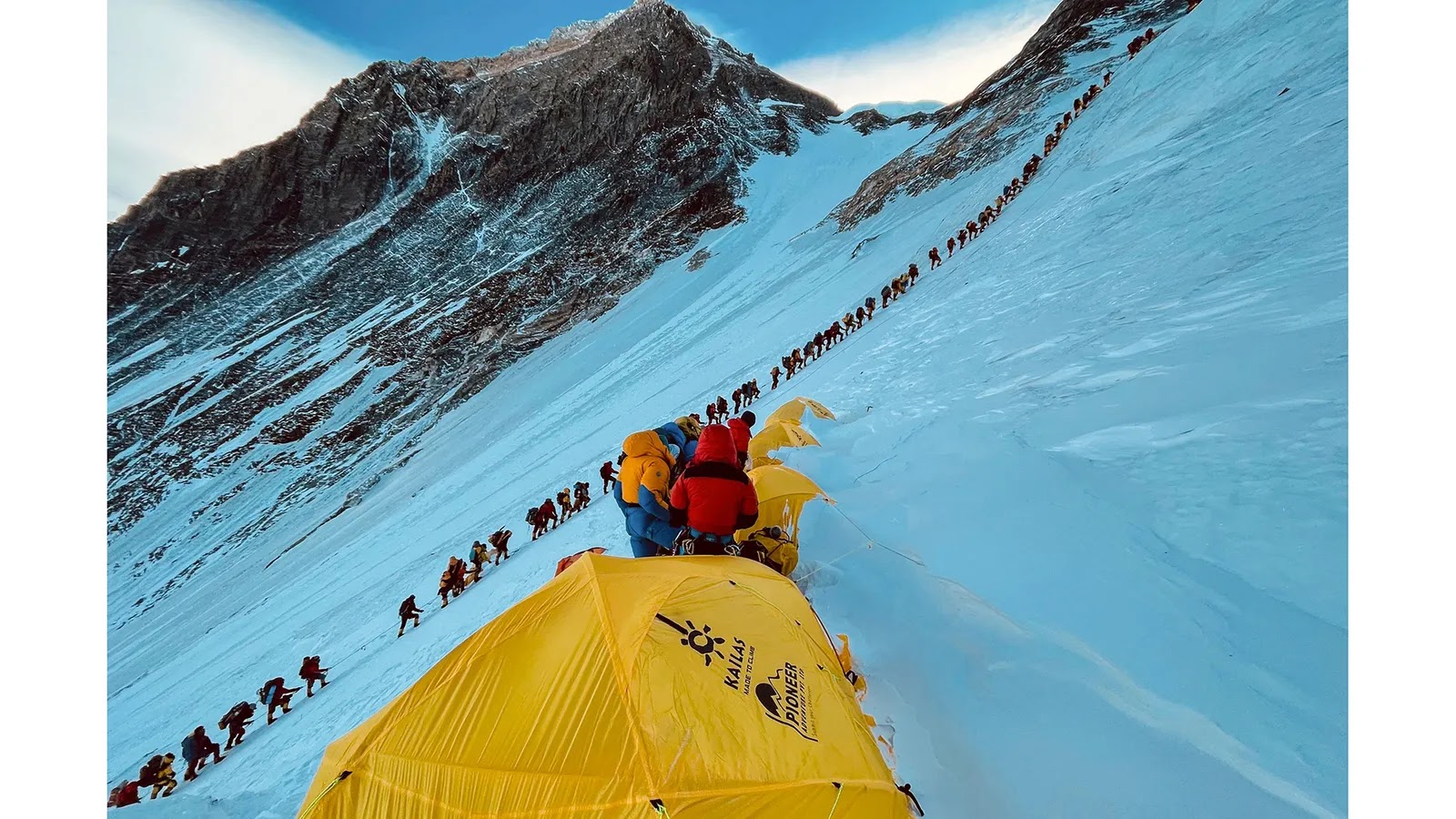

The main routes up Mount Everest have now become so popular with climbers that long queues can form (Credit: Lakpa Sherpa/AFP/Getty Images)


Many of the highest peaks in the world, including Everest, have permanent snow caps that help protect them from this wind-blown barrage. Rock covered in a soft blanket of snow suffers less weathering and erosion than bare rock, says Headley. It also protects the rock from chemical reactions with the air that can gradually degade the minerals in the limestone that comprises much of the uppermost parts of Mount Everest. But there are still places where the rock is exposed to the elements.


"For a tall mountain range, you can basically get to such a steep angle in the rock that it can't actually support ice, and snow, and then you start to get avalanches, and you get bare rock," says Elmore. Rock falls and land slides – a constant hazard on Everest and the surrounding area – both play a role in shaving away at Everest's height, and rivers too. They have been estimated to be cutting gorges into the rock at a rate of between 4-8mm (0.2-0.3in) a year.


But the exact impact erosion has on a mountain's height is still to be understood. Some scientists believe that reducing the weight of a mountain (by taking away the snow, ice and rock it's made of) might actually allow the tectonic plates to push the, now lighter, mountain even further into the sky. 


Headley's colleague Terry Pavlis, who was the lead investigator on the St Elias Erosion Tectonics Project (Steep), explains that, on a large scale, "erosion attacking a landscape allows it to rise up".


In some parts of the world, entire landmasses are still rearing up after the last ice age – something known as isostatic rebound. Parts of North America and northern Europe, including Scotland, are rebounding after the rocky crust there was squashed by enormous continental ice sheets that waxed and waned during the Pleistocene. According to one study by researchers at Germany's University of Postdam, up to 90% of the uplift in the European Alps can be explained by this surprisingly elastic response to the end of the ice age. Experts believe similar glacial isostatic rebound may have taken place on the Tibetan Plateau and in the Himalaya as the ice age glaciers receeded – contributing between 1-4mm (0.04-0.16in) a year to the uplift.


"But there's some kind of equilibrium between how fast that landscape can erode and how high those peaks can get," adds Pavlis.


The exact details of this equilibrium are still being explored. In a region like the Appalachians in north-eastern North America, or the Scottish Highlands, erosive forces like rivers and landslides are cutting mountains down lower and lower, Headley says. "But in regions with tectonic activity, the tectonic force can be driving the mountains up slower, faster, or at around the same rate as the erosion is cutting it down. We don't fully understand all the drivers in those types of systems."
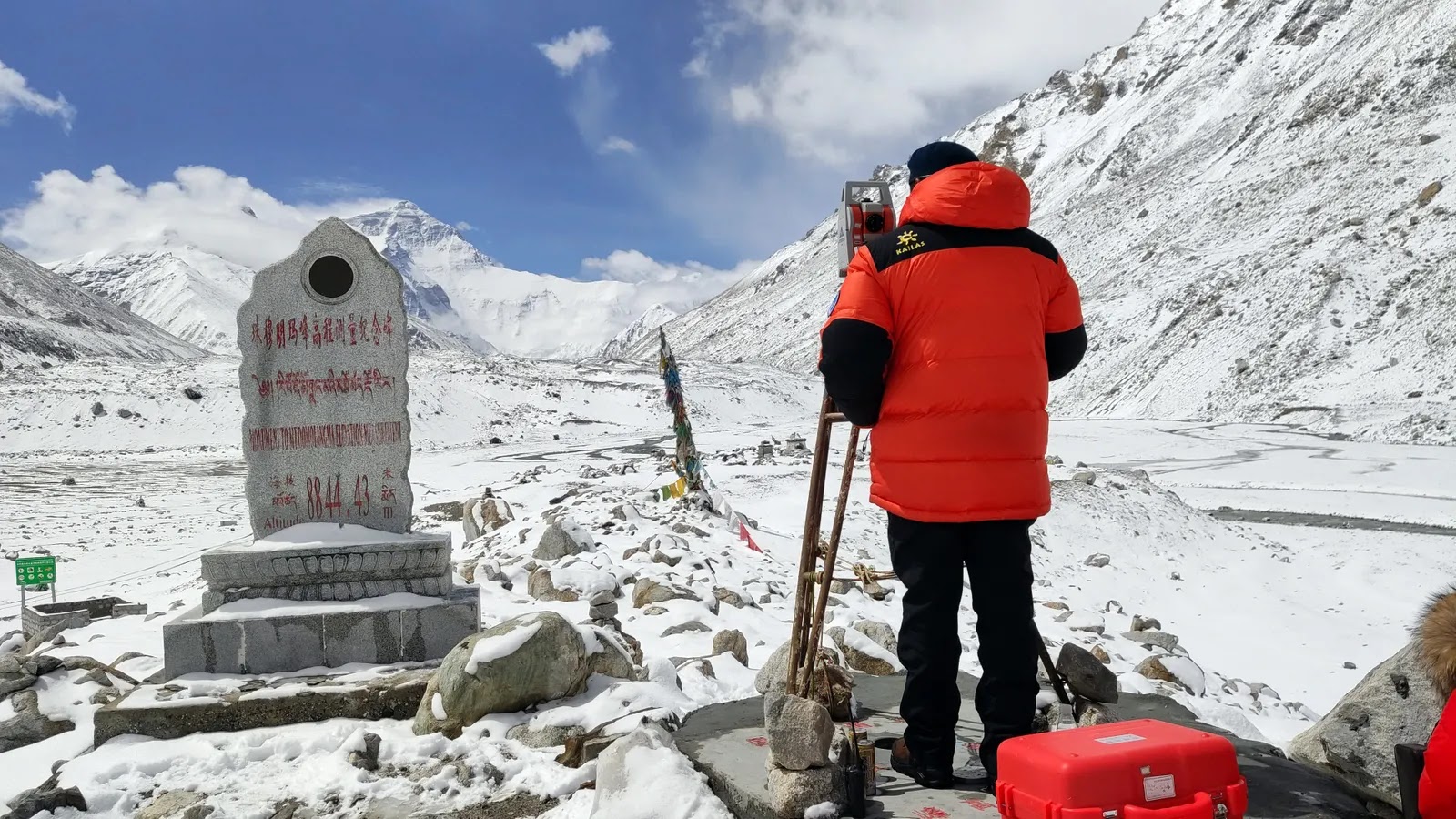

The most recent official height for Mount Everest was agreed following Chinese and Nepalese surveying expeditions to the summit (Credit: VCG/Getty Images)


So how are mountains actually measured nowadays? One of the most common instruments used is the Global Navigation Satellite System (GNSS), which records the precise position of the mountain peak using a network of satellites. GNSS can "measure heights to the millimetre," according to Pavlis. The challenge, for a mountain like Everest, has always been the weight of the equipment. "It's hard enough to get to the peak – try adding a 30lb (13kg) instrument," he says.


A helicopter taxi to the top with the heavy luggage is out of the question – the thin air around Everest's summit means the engine can't produce enough power and there's too much drag from the rotor blades to operate safely. The strong winds and jagged creeks also make touching down anywhere near the summit dangerous. One helicopter pilot did set a world record by touching down briefly on top of Mount Everest in 2005, but only after the manufacturer stripped it bare of every unessential item to make it feather light.


Luckily, GNSS systems have gotten smaller over the years. Now they weigh more like 1.2kg (2.6lbs) and are "about the size of a lunchbox, maybe a little smaller", says Pavlis. But the devices still need batteries, which can struggle in cold temperatures. The average temperature at the summit of Everest during the summer monsoon months is a balmy -19C. And there are other complications too. "There's an antenna that's about, you know, half a metre in diameter. And those have to be set up somehow so that they are absolutely stationary," Pavlis explains. 


To gather millimetre-accurate results the instrument then has to record for several hours. In the thin air of Everest's "death zone", operating these instruments can be hazardous for surveyors. Members of a Nepalese expedition to take GNSS measurements on Everest in 2019 spent two hours on the summit – far longer than most who make their way there – after arriving at 03:00 in the pitch black and biting cold.


Another option, often used in addition to GNSS for the most accurate readings, is Ground Penetrating Radar (GPR). "GPR uses radar pulses to image below the surface, so it can tell us the thickness and internal structure of snow and ice overlying the rocks on Everest's summit," says Elmore. "There's something like 4m (13ft) of snow and ice on the top of Mount Everest, but that can change depending on the climate."


The mountain that measures the greatest distance from the centre of Earth to its peak is Chimborazo in Equador, at 10,920m (35,826ft)


While Elmore and her team were conducting their own scientific experiments on Everest they leant the Nepalese expedition a GPR device so they could take measurements from the summit. "It had to be a specific design of GPR, one that was super lightweight so [it could be carried] to the top of Everest, but that also had the right transmitter and receiver to measure the ice," says Elmore. The device had recently been used at the summit of Denali, the tallest mountain in the US, so they knew it was up to the job.


Despite the many hurdles they faced, the Nepalese team's expedition to measure the height of Everest was successful. They had hoped to answer questions about whether a deadly 7.8 magnitude earthquake that hit Nepal in April 2015 had affected Mount Everest's height. Initial reports indicated the mountain had shifted 3cm (1.9in) to the south-west by the large earthquake, which killed 9,000 people and damaged hundreds of thousands of homes, but had not changed its height.


The project, however, soon became muddied with international politics. A few months later a team of Chinese surveyors conducted their own measurements during an expedition from the other side of the mountain. They had their own figure, which didn't include the snow cap. The Nepalese figure, on the other hand, did. In October 2019, the two countries decided to combine their data and in December 2020 they released the figure for the new official height – 8,848.86m (29,032ft), including the snow on top.


As China and Nepal found, deciding exactly what you measure, and how you measure, is fundamental to establishing a mountain's height. For example, to agree upon how tall a mountain is, we must first agree on where the bottom is. But that's not as easy as it might sound.


For centuries mountains have been measured using sea level as the base from where their height is calculated. But the Earth is not perfectly round: it bulges along the equator. And sea level isn't static, it is pulled and changed by our planet's gravity. Plus, Everest isn't sticking out of the ocean, it's nestled among a landscape of other mountains. 


Many complex calculations have to be done to establish where sea level would actually be, and Everest's relative height to it. When that starting point is changed, everything changes.


The Himalayas began rising around 45 million years ago as the Indian and Eurasian continental plates collided (Credit: Rik Olde Engberink/Alamy)


But let's say scientists started their measurements from the core of the planet instead. Everest would no longer be considered the tallest mountain on Earth. The mountain that measures the greatest distance from the centre of Earth to its peak is Mount Chimborazo, in Equador at 10,920m (35,826ft). What about starting from the seabed? The accolade of tallest mountain would then go to Mauna Kea, a volcano in Hawaii that arches 10,000m (32,808ft) from the ocean floor.


Looking beyond our own planet, we can see examples of just how enormous mountains can become. Olympus Mons, a volcano on Mars, towers 21km (19.2 miles) into the sky and stretches 624km (388 miles) wide. It is roughly the size of the state of Arizona. Because gravity on Mars is weaker than on Earth, and because Mars doesn't have tectonic plates shifting and colliding beneath the surface, the ooze of lava that flowed out of the Martian volcano in the planet's past was able to grow to monstrous proportions.


Could Everest become a similar giant? In the 1980s, a researcher at the Cavendish Laboratory in Cambridge, UK, attempted to estimate what such a limit might be on Earth, taking into account the strength of gravity and the strength of the rock underlying the mountain. The calculations, which made "no presensions to serious geophysics" estimated the theoretical maximum height of a mountain range with a granite base – as Mount Everest largely has – to be 45km (28 miles) on Earth. 


But there are a number of barriers – apart from our planet's relentless weather – that might stand in the way of this, according to Headley. For starters, "you would eventually run out of your tectonic forces, and then it would stop growing", she says. Scientists believe that eventually the Earth's mantle will cool to such a degree that the planet-wide dance of plate tectonics will end. Until then, earthquakes and landslides will also erode away the mountain too.


"At some point, [the mountain] becomes so steep that it's unstable and chunks start falling off," Elmore says.

With the wind, snow and ice buffeting, cracking and splitting the rock, Everest is unlikely to ever reach the sizes seen on Mars. "We have our weather systems, and weather is really good at creating erosional forces," Headley says. "Basically, the fact that we have water, whether in the form of ice or snow, or just rain, is what really can limit mountain growth."


For now, Everest keeps edging, bit by bit, into the sky as other forces try to tear it down. Elmore's 2019 team discovered global warming was yet another of these, driving considerable thinning of the snow and ice on the upper reaches of the mountain in recent decades and revealing more bare rock to the erosive impacts of weather.


Olympus Mons, a volcano on Mars, towers 21km (19.2 miles) into the sky and stretches 624km (388 miles) wide


Everest is also far from being the fastest-growing mountain on our planet. The closest contender for the top spot is perhaps Nanga Parbat, a neighbour to Everest located in the Pakistani Himalayan range, which is 8,126m (26,660ft) tall and growing at 7mm (0.27in) per year. In 241,000 years it could overtake Everest to be the tallest mountain on Earth, provided rates of erosion don't change.


Others, such as those in the Swiss Alps, are also growing rapidly thanks to an imbalance in the amount of erosion taking place. Scientists found that uplift is more than 50 times faster than any negative effects from erosion here. But the Swiss Alps are far shorter than Mount Everest and most studies suggest the mountains there are currently growing at 2-2.5mm (0.08-0.1 inches) per year. 


Meanwhile, Everest retains its allure as a mountain at the extreme of what can be found and endured here on Earth. Its reputation as the highest peak on our planet continues to attract climbers from all over the world, even as its height continues to shift.


Over a video call I ask Billi Bierling, a mountaineering journalist who hiked Everest herself in 2009, whether an extra millimetre, metre or mile higher matters to people like her. She is relaxing on the sofa at her mother's house in Germany, preparing to head back to Nepal for the summer season in March.


"The exact measurement doesn't matter," she says, laughing warmly at my question. "What matters is that it's the highest, and that you go to the highest point. If you're having a bad day, or someone is not very nice to you, or they put you down, you can think to yourself, you know what? I've climbed Everest."


For most who reach the summit, it is simply being there that counts.


(Source: BBC)

Saturday, 17 July 2021

The rise and fall of the world’s largest lake

 When continental plates smashed together about 12 million years ago, they didn’t just raise new mountains in central Europe—they created the largest lake the world has ever known. This vast body of water—the Paratethys Sea—came to host species found nowhere else, including the world’s smallest whales. Two new studies reveal how the ancient body of water took shape and how surrounding changes helped give rise to elephants, giraffes, and other large mammals that wander the planet today.

To build that timeline, paleo-oceanographer Dan Palcu of the University of São Paulo and his colleagues at the main campus assembled clues from geological and fossil records. At its largest, the body of water—which some scientists consider to have been an inland sea—stretched from the eastern Alps into what is now Kazakhstan, covering more than 2.8 million square kilometers. That’s an area larger than today’s Mediterranean Sea, they write this week in Scientific Reports. Their analyses further estimate the lake once contained more than 1.77 million cubic kilometers of water, more than 10 times the volume found in all of today’s fresh- and saltwater lakes combined.


At its largest, the megalake Paratethys (shown superimposed on modern geography) stretched from the eastern Alps to today’s Kazakhstan. DAN PALCU; NATURAL EARTH


But climate shifts caused the lake to shrink dramatically at least four times in its 5-million-year lifetime, with water levels falling by as much as 250 meters between 7.65 million and 7.9 million years ago. During that largest episode of contraction, the lake lost as much as one-third of its water and more than two-thirds of its surface area. That sent water salinity in the lake’s central basin—which closely matches the outlines of today’s Black Sea—skyrocketing, from about one-third as salty as today’s oceans to a level on par with seawater.


Those shifts wiped out many aquatic species, including numerous species of single-celled algae and other small free-floating organisms, the researchers report. Creatures that could survive the brackish water, including some mollusks, survived to repopulate the lake when it expanded during wetter times, Palcu says.


The Paratethys soon became home to a wide variety of mollusks, crustaceans, and marine mammals found nowhere else on Earth. Many of the whales, dolphins, and seals living there were miniature versions of those found in open seas, says evolutionary biologist Pavel Gol’din of the National Academy of Sciences of Ukraine’s I. I. Schmalhausen Institute of Zoology, who was not involved with the work. One species, the 3-meter-long Cetotherium riabinini—1 meter shorter than today’s bottlenose dolphin—is the smallest whale ever found in the fossil record. Such dwarfism might have helped these animals adapt to a shrinking Paratethys, Gol’din says.


The changes to the climate that triggered lake shrinkage also influenced the evolution of land animals, says evolutionary biologist Madelaine Böhme of the University of Tübingen. As water levels dropped, the newly exposed shorelines became grasslands—and hot spots for evolution, she notes.


The Paratethys Sea was home to many species found nowhere else, including Cetotherium riabinini (depicted with human for scale), the smallest known whale in the fossil record. PAVEL GOL’DIN; LENA GODLEVSKA/WIKIMEDIA COMMONS


Recently, Böhme and her colleagues focused on the geological record in western Iran, where sediments chronicle repeated long-term changes in climate. The fossil record shows that in areas north of the Paratethys, the ancestors of modern-day sheep and goats roamed side by side with primitive antelope. And in what is now western Iran, south of the lake, the progenitors of today’s giraffes and elephants thrived.


Four lengthy dry periods that occurred between 6.25 million and 8.75 million years ago likely drove those creatures to migrate southwestward into Africa, Böhme and her colleagues reported last month in Communications Earth & Environment. Here, they evolved to produce the diversity of creatures for which today’s African savanna is famous.


The Paratethys was destined for a sadder fate. It ceased to exist sometime between 6.7 million and 6.9 million years ago, when erosion created an outlet at the lake’s southwestern edge. This outlet—which is likely now submerged beneath the Aegean Sea—birthed a short river that eventually found its way to the Mediterranean. But the massive lake had one last hurrah, Palcu says: The water draining from it likely carved “an impressive waterfall” as it flowed down to the sea.


(Source: Science Mag)

Saturday, 10 July 2021

No evidence and little research – it’s no wonder that women and babies continue to die

 A series of fatal failings in maternity care is evidence of a systemic problem within the NHS

Giving birth used to be one of the most dangerous things a woman could do. In parts of 15th-century Europe, women wrote wills as soon as they knew they were pregnant. In the 17th and 18th centuries, around one in 25 women died in childbirth. It was a danger that cut right across class, from queens to domestic servants, and one that women had to face over and over again. For their babies, the risks were even higher.


It is a miracle of modern medicine that the joy of getting pregnant no longer has to be tempered with the very real prospect that you or your baby may not survive the birth. A true marker of human progress is the fact that maternal and infant mortality have dropped dramatically in the UK even as births have become more complicated, with babies getting bigger and women having children later.


But in recent years, horror stories have emerged of women and babies suffering dreadful maternity care in a number of NHS trusts. Bereaved parents and spouses have fought to be heard in the face of a culture of cover-up and medical professionals blaming mothers for the deaths of their babies. First, there was the inquiry into baby deaths at Morecambe Bay foundation trust, which came about as a result of the tireless campaigning of James Titcombe, whose baby died in its care. It found a “lethal mix” of failings caused the avoidable deaths of at least 11 babies and one mother. Last year, an interim report was published into baby and mother deaths at Shrewsbury and Telford; covering more than 1,800 cases over 20 years, it is one of the biggest ever NHS scandals.


Some midwives and institutions have pursued an ideology of ‘normal birth’ at ‘pretty much any cost’. Photograph: UK Stock Images Ltd/Alamy


It described how babies and mothers needlessly died or were left with profound disabilities as a result of terrible care; babies suffered fatal skull fractures as they were forced out using forceps, and women were left screaming in agony for hours as medics belittled their pain and told them they were “lazy”. An inquiry is currently underway into baby deaths at East Kent, and last week the Independent reported that dozens of babies had died or been left brain-damaged at Nottingham University Hospitals NHS Trust.


The vast majority of mothers and babies will experience good maternity care in the UK. But this crop of scandals shows there is a systemic problem with the quality of NHS maternity care, with too many mothers and babies losing their lives as a result. More than 1,000 babies die or are left with severe injury each year as a result of something going wrong during labour. It goes beyond the current crisis of underfunding: the Care Quality Commission has found that four in 10 maternity services require improvement or are inadequate. Women of colour are disproportionately affected: black women are four times more likely to die in pregnancy or childbirth than white women.


When it comes to childbirth, this predisposition to disbelieve women in pain has been particularly toxic


There are two deep-seated cultural factors that are holding back maternity care. First, it has become increasingly well documented that women are disproportionately disbelieved when they say they are in pain, because there is a perception that we are oversensitive to pain, or exaggerate it. This is undoubtedly a factor in poor-quality healthcare for women.


Second, women’s healthcare is under-researched and under-evidenced. This is true of conditions that affect both men and women – diagnosis and care for women who suffer strokes and heart attacks is poorer because the research has predominantly focused on men – as well as things only women experience, like the debilitating pain of endometriosis. Research out last week showed that women are continuing to struggle to access treatment for the menopause: only 37% of women seeking help were given HRT despite Nice guidelines stating that the majority of women can benefit from it.


When it comes to childbirth, this predisposition to disbelieve women in pain and to underemphasise their medical needs has been particularly toxic, allowing an ideology to take hold that so-called normal non-medicalised birth is best, regardless of what a woman herself thinks or feels. Until just a few years ago, this was widely embraced by the establishment: a working group including the National Childbirth Trust, the Royal College of Midwives (RCM) and the Royal College of Obstetricians and Gynaecologists, advocated for “normal birth” without medical interventions such as an epidural or caesarian section.


This has certainly been a factor in women and babies being denied life-saving care: at Morecambe Bay, midwives pursued non-medical births “at any cost”, bullying those doctors who tried to intervene. At Shrewsbury and Telford, there was a multi-professional focus on “normal birth” at “pretty much any cost”.


The best kind of birth is obviously a birth that delivers a baby safely, leaving a mother unharmed. For plenty of women, that will involve an epidural or a caesarian section. Terms like “normal birth” are stigmatising and shaming.


But while the RCM formally dropped this language in 2017, it lives on strongly in some parts of the midwifery profession. There are still midwifery conferences that promote “normal birth”. The University of Central Lancashire – a major midwifery training centre – still runs a course on “normal birth”. And a former president of the RCM last year submitted evidence to a select committee that stated women were not afforded the luxury dogs and cats have to “go off somewhere quiet and just get on with the process”, and argued for reduced obstetrician levels in labour wards.


Failures in maternity care are not just about understaffing and underfunding: they are linked to a deep-rooted societal perception that women are not to be trusted with their own bodies or to be allowed to make their own informed choices about birth. How much more evidence do we need that institutionalised sexism at the heart of our healthcare system has cost women and babies their lives?


(Source: The Guardian)

Friday, 25 September 2020

Obsession

 On translating Nathalie Léger’s Exposition.

Exposition is the first in a triptych of books by Nathalie Léger that intertwines Léger’s mother’s story with that of a female artist or celebrity.


You could say that Exposition is about the Countess of Castiglione. Considered by many in Europe to be the most beautiful woman alive, Castiglione was probably the most photographed person of the nineteenth century. Born in 1837 in Florence, she was sent to Paris in 1855 to plead the cause of Italian unity at the French court, as an instrument of soft power, essentially. Unfortunately, she had terrible social skills, and it didn’t go well. She became the mistress of Napoleon III but overstepped her social position at the court and was soon asked to leave. Beginning in 1856, she had herself photographed hundreds of times at a high-end studio, spending her family fortune. She would often restage scenes from mythology but also moments of glory from her life at the French court. Some of her portraits were even presented in the International Exposition of 1867. As late as 1871, Castiglione was asked to intercede with Otto von Bismarck to discourage a German occupation of Paris. This point, the end of the Second Empire with which she was so identified, seems to mark the beginning of Castiglione’s decline, and she lived out her days in increasing isolation in her funereal Paris apartment until her death in 1899. However, she remained a legend in urban lore, granting viewings to her admirers and taking long nocturnal walks through a Paris that had changed around her.


PIERRE-LOUIS PIERSON, COUNTESS VIRGINIA OLDOINI VERASIS DI CASTIGLIONE, 1861-67


Exposition is about the Countess of Castiglione, but it isn’t a biography. The genesis of the book was Léger’s attempt to curate an exhibition of photographs of Castiglione for a museum. Léger ran into some problems, the museum management didn’t share her enthusiasm for Castiglione, the exhibition never happened, and Exposition is her endeavor to come to terms with the difficulty of her subject. It’s also about Léger’s mother, and the way both she and Castiglione were unable to control their own fates. Léger’s writing often has a telescopic effect: one woman collapsing into the next; one woman’s life rendering certain facts of another’s visible. I think of it as a tool that allows her to broach big subjects that might be unwieldy with other methods. And so, shifting from one woman’s story to the next, Exposition becomes an interrogation of female self-representation and agency, but more than that, an exploration of what it means for a book to be about anything at all.


What is it to be captivated by a subject and to try to capture it? “For years,” Léger writes, “I had thought that to write you needed, at the very least, to master your subject. Many reviewers, famous writers, and critics have said that to write you have to know what you want to say. They repeat, hammering it home: you have to have something to say, about the world, about existence, about, about, about. I didn’t know then that the subject is precisely what masters you.”


CASTIGLIONE IN HER MOST FAMOUS “QUEEN OF HEARTS” BALL GOWN, BUT IN THIS PHOTO, SHE’S WEARING IT A DECADE AFTER THE BALL ACTUALLY HAPPENED. PIERRE-LOUIS PIERSON, LA DAME DE COEURS, 1861-63


When one submits to a subject, it is not necessarily a benign or unambiguous force. Castiglione is thorny, difficult to pin down and often unlikeable. Your average portrait subject can’t sink a museum exhibition; perhaps the more personal format of a book was better suited to the extremities of the project anyway. Ultimately it’s the power of Léger’s obsession that drives the story. We know that obsession is a corrosive force, a vampire, a thing with hooked claws. But obsession also preserves. Obsession communicates, reinforces—translates. And as the translator of Exposition, Léger’s alchemy of obsession and repulsion, submission and mastery is precisely what I had to convey.


Other people’s obsessions are always a dangerous thing to become involved with, and no one knows this better than the translator. Every job has its dangers and its attractions, and sooner or later any translator develops her methods for inhabiting a mind that is not her own. For me, the best approach is usually to craft a careful distance from the material; if you want to gain perspective on a subject, you can’t be sitting on top of it. Before I began, I pored over portraits of Castiglione, read about her. In a rare books collection, I turned the brittle pages of an album dedicated to her, turned them with something like reverence, the album’s fragile spine resting in a book cradle. At some point, a woman came into focus: alluring, repugnant, everything I already knew she would be.


Léger isn’t the only person who has been fascinated by Castiglione; for over a century, she’s been an irresistible subject. The first person on the list must be Castiglione herself, who never would have gone to such prodigious lengths and expense to record her own image without the considerable force of self-obsession. And then there are the men. Besides her husband, Napoleon III, and her various other lovers, Castiglione was a gay icon in her lifetime. (This is a phenomenon that is much older than you might think: before Judy Garland, there was Castiglione and others like her.) So many of her images were well-preserved because the French dandy Robert de Montesquiou (who, besides being an Olympic bronze medalist in 1900, was Proust’s inspiration for Baron de Charlus) purchased as much of her estate as he could after her death, keeping together a trove of pictures and artifacts that would otherwise have been dispersed.


And so Léger is simply one of the most recent in a long line of people to be moved by Castiglione’s force of fascination. But Castiglione was never my obsession, nor even my subject.


PIERRE-LOUIS PIERSON, LA COMTESSE, 1861-67


I came to know Exposition not through an interest in Castiglione, but through an interest in Léger’s work. Like most American readers, I first encountered her Suite for Barbara Loden. As in Exposition, the eponymous filmmaker’s story is interwoven with that of Léger’s parents’ failed marriage (as the final book in the triptych, The White Dress, would do with the story of the performance artist Pippa Bacca). Reflections upon reflections, one woman’s life within another’s, and another’s, and another’s. That is, it was a formal question that hooked me, a way of telling a story against the grain. More than any book I’ve translated, Exposition made me wonder what, as the translator, is my subject. The question may seem either self-evident or nonsensical, but let’s follow Léger’s thinking and define “your subject” as “what masters you.” That is, what was it that obsessed me as a translator?


I know that it has something to do with immersion. What is it that I am immersing myself in? What is my material, what is it that makes up the world of the book? It’s tempting to say “language,” that’s a trope we hear enough. But words can be dead matter—what infuses them with living spirit? Instead, I would say that I am obsessed with, immersed in, the movements of a mind. For me, literature has always been a way of being close to other people. There is nothing more interesting than someone else’s perspective, and the sheer excess of a book’s hundreds of pages are the perfect opportunity to indulge my obsession in their obsessions. Not the content of those obsessions, exactly, but their form. It’s the way idea connects to language and gives it shape.


Exposition tracks the movements of an erudite, restless mind. Its fragmentary, probing style draws on a rich array of artistic and literary references, joining together the past and the present, the personal and the public, the abstract and the tangible in order to leap from one place to the next. What I love about it is that it is a book that is always in motion. It’s the same thing that makes it indefinable in terms of subject, outside of the relationality of the women whose stories it tells. What mastered me were gestures, movements, forms I would shape and reshape, returning again and again until they were right. If anything, by the time I’d finished translating it, Castiglione had ceded her position in my mind, nudged aside and balanced by the acute and personal pain of Léger’s family story. It’s a book that comes alive in the connection of its figures, the way that language comes alive when it connects with thought, giving shape to emotion, intuition, insight.


It’s unsurprising, when I flip back through my translation of Exposition, that Léger arrived at this conclusion before I did. There I find, written in my own words but more so hers, that to have a subject is to give something form, and that this is an act of tremendous concentration, of giving something shape in language:


It would be best to leave it at what the painters say on the subject: “I hold on to my motif,” Cézanne told Gasquet. Cézanne, clasping his hands. He drew them together slowly, joined them, gripped them, made them fuse together, merging the one into the other, Gasquet recounted. That’s what it is. “This is what you have to achieve. If I go too high or too low, it’s all ruined.” What is my motif? Something small, very small, what will be its gesture? I look at her face in Portrait with Lifted Veil from 1857, her eyes downcast, her mouth so weary, tight and thin, her air of mourning. This woman’s sadness is frightful, a sadness without emotion, true self-defeat, an inner collapse, desolation. Photography can create an image of it, but to make a motif of it, something more is required; one must use words to bring things together slowly, so to speak, join them, fuse them.


The English translation of Exposition will be published by Dorothy, a publishing project, this September.


Amanda DeMarco is a translator living in Berlin.


(Source: The Paris Review)

Thursday, 20 August 2020

Looted landmarks: how Notre-Dame, Big Ben and St Mark's were stolen from the east

They are beacons of western civilisation. But, says an explosive new book, the designs of Europe’s greatest buildings were plundered from the Islamic world – twin towers, rose windows, vaulted ceilings and all

As Notre-Dame cathedral was engulfed by flames last year, thousands bewailed the loss of this great beacon of western civilisation. The ultimate symbol of French cultural identity, the very heart of the nation, was going up in smoke. But Middle East expert Diana Darke was having different thoughts. She knew that the origins of this majestic gothic pile lay not in the pure annals of European Christian history, as many have always assumed, but in the mountainous deserts of Syria, in a village just west of Aleppo to be precise.

“Notre-Dame’s architectural design, like all gothic cathedrals in Europe, comes directly from Syria’s Qalb Lozeh fifth-century church,” Darke tweeted on the morning of 16 April, as the dust was still settling in Paris. “Crusaders brought the ‘twin tower flanking the rose window’ concept back to Europe in the 12th century.”
Twin towers flanking a monumental arched entrance … the remains of Qalb Lozeh church in Syria, the inspiration behind Notre-Dame. Photograph: Bertramz

It is not only the twin towers and rose window that have their origins in the Middle East, she pointed out, but also the ribbed vaults, pointed arches and even the recipe for stained glass windows. Gothic architecture as we know it owes much more to Arab and Islamic heritage than it does to the rampaging Goths. “I was astonished at the reaction,” says Darke. “I thought more people knew, but there seems to be this great gulf of ignorance about the history of cultural appropriation. Against a backdrop of rising Islamophobia, I thought it was about time someone straightened out the narrative.”

And so she has, with Stealing from the Saracens, an exhilarating, meticulously researched book that sheds light on centuries of borrowing, tracing the roots of Europe’s major buildings – from the Houses of Parliament and Westminster Abbey to Chartres cathedral and St Mark’s basilica in Venice – back to their Middle Eastern precedents. It is as much a story of political power, wealth and fashion as it is of religious belief, with tales of looting Crusaders, fashion-conscious bishops and globe-trotting merchants discovering new styles and techniques and bringing them home.

“Now we have this notion of east and west,” says Darke. “But back then, it wasn’t like that. There were huge cultural exchanges - and most came from the east to the west. Very little went the other way.”
Masterpiece of geometry … the exquisite interior of Córdoba’s mosque-cathedral. Photograph: Ingo Mehling

Given their prevalence in the great cathedrals of Europe, it is easy to imagine that pointed stone arches and soaring ribbed vaults are Christian in origin. But the former dates back to a seventh-century Islamic shrine in Jerusalem, while the latter began in a 10th-century mosque in Andalucia, Spain. In fact, that first known example of ribbed vaulting is still standing. Visitors to the Cordoba Mezquita can marvel at its multiple arches intersecting in a masterpiece of practical geometry and decorative structure, never needing a repair in its thousand-year existence. The vaulted maqsura – the part of the mosque reserved for the ruling caliph – was designed to cast a sacred glow across the leader. However, the official leaflet will tell you little of the building’s Islamic origin, perhaps because it has been a Catholic church since 1236.

The pointed arch, meanwhile, was a pragmatic solution to a problem encountered by masons working on the Dome of the Rock in Jerusalem. One of the holiest sites in the Muslim world, it was built in 691 by the ruler of Islam’s first empire. The challenge was how to line up an outer arcade of rounded arches with a smaller inner arcade, while maintaining a horizontal ceiling between them. For the openings to align, the masons had to give the inner arcade tighter arches, forcing them to become pointed. Another world first can be spotted higher up in the shrine, where encircling the dome is an arcade of trefoil arches, the three-lobed style of arch that went on to encrust practically every European cathedral, voraciously adopted as a symbol of the Holy Trinity.
Looks familiar? … from left, the interior of Jerusalem’s Dome of the Rock, and Temple Church in London. Composite: Virtutepetens/Getty Images/iStockphoto

“Again and again,” says Darke, “I am so struck by how much of this stuff that we think of as essentially Christian and European was based on ignorance and misinterpretation of much earlier Islamic forms.” She points out that the enormous influence of the Dome of the Rock was down to the Crusaders of the Middle Ages mistakenly thinking the building was the Temple of Solomon.

They used the domed, circular layout of this supposedly Christian shrine as the model for their Templar churches (like the City of London’s round Temple church), even copying the decorative Arabic inscription, which openly chastises Christians for believing in the Trinity rather than in the oneness of God. Their pseudo-Kufic calligraphic patterns went on to adorn French cathedral stonework and the borders of richly woven textiles, with no one aware of what they actually meant.

The confusion was spread further by the first printed map of Jerusalem, published in Mainz, Germany, in 1486. It not only mislabels the Dome of the Rock as the Temple of Solomon, but depicts the building with a fine onion dome – a pure orientalist fantasy from the mind of a Dutch woodcut artist named Erhard Reeuwich. The book containing the map became a bestseller, reprinted 13 times and translated into multiple languages, influencing the spread of onion-domed churches across Europe in the 16th century. It is a tale of mistaken identity and unintended consequence worthy of a Monty Python sketch.
More Arab than European … Jerusalem’s Dome of the Rock, left, and St Mark’s basilica in Venice. Composite: Godot13/Zairon

The transfer of Islamic motifs to the west wasn’t always so simple, though. The pointed arch took a more circuitous route. Darke traces how the arches first spread to Cairo, becoming sharper and more pointed under the Abbasid empire, and were in turn admired by visiting merchants from the wealthy Italian port of Amalfi, who channelled discoveries from their travels into their eclectic 10th-century basilica. This exotic building caught the eye of Abbot Desiderius, who visited Amalfi in 1065 on a shopping trip for rare luxury merchandise, and decided to take the pointed window design for his monastery at Monte Cassino.

Those windows were then copied for the Benedictine abbey at Cluny in France, the largest church in the world at the time. Abbot Suger, an adviser to kings Louis VI and VII, liked how the windows let in more light, and immediately applied the same design to his Saint-Denis basilica in Paris. Regarded as the earliest fully gothic structure, the basilica was completed in 1144 and its architect went on to work at Notre-Dame. “They all just copied it,” says Darke. “These were the most powerful churches in Europe, so the style completely took off, as all fashions do. When powerful people adopt something, everyone wants one.”

The list goes on. There are the early square minarets, found on such buildings as the Great Mosque of Damascus, that taper thinner and are crowned with a bulbous finial dome. These inspired such great Italian towers as those of Florence’s town hall and St Mark’s Campanile in Venice, prefiguring centuries of church bell-towers.
Borrowed time … from left, the now destroyed minaret of the Great Mosque in Aleppo, Syria; and Big Ben in London. Composite: Alamy/Getty Images/Dorling Kindersley

Drawing on architectural historian Deborah Howard’s research, Darke shows Venice to be more Arab than European, from its narrow winding passageways and courtyard homes with rooftop terraces, to the Islamic ornamentation of the Doge’s Palace (modelled on Al-Aqsa Mosque in Jerusalem) and the onion domes of St Mark’s. All are the fruit of trips made by Venetian merchants to Egypt, Syria, Palestine and Persia, fostering a level of influence that extended even to fashion: women in Venice were veiled in public and dressed in black from head to toe. “One cannot see their faces for all the world,” a 15th-century source commented. “They go about so completely covered up, that I do not know how they can see to go along the street.”

The book comes at a charged time, when supposedly western architecture is being mobilised by right-wing nationalist groups to bolster their idealised vision of a “pure” European identity. There are now countless social media accounts promoting messages of white supremacy disguised as heritage appreciation, while recent government edicts about tradition and beauty carry similar overtones. Darke’s work takes an eloquent sledgehammer to such ignorant, dog-whistle propaganda, revealing how the monuments idealised by the alt-right have their roots in the very culture of which they are so suspicious.

The ignorance is widespread, and perhaps the most surprising thing in Stealing from the Saracens is how much of this should not come as a surprise to the modern reader. After all, throughout the book, Darke summons the words of Christopher Wren, who was well aware of the Middle Eastern origins of gothic architecture, and of the structural techniques he was using for St Paul’s Cathedral.

“Modern gothic,” he wrote in the 1700s, “is distinguished by the lightness of its work, by the excessive boldness of its elevations … by the delicacy, profusion and extravagant fancy of its ornaments … Such productions, so airy, cannot admit the heavy Goths for their author.” Instead, he concluded, “from all the marks of the new architecture, it can only be attributed to the Moors; or what is the same thing, to the Arabians or Saracens”.

The irony is in the name itself: in Wren’s day, Saracen was a pejorative term for the Arab Muslims, against whom the Crusaders had fought their “holy war”. It originated from the Arabic word “saraqa”, meaning “to steal”, as Saracens were seen as looters and thieves. Never mind the fact that the Crusaders plundered their way across Europe, Jerusalem and Constantinople – pilfering the wonders of Islamic architecture as they went, and airbrushing the origins of their booty in the process.


(Source: The Guardian)