Showing posts with label snow. Show all posts

Sunday, 15 December 2019

This hamlet in West Bengal is a perfect getaway to experience the most gorgeous snowfall ever!

Beautiful virgin forests, snow-clad mountains and scenic views all around you. If this sounds like a description of some beautiful town in North India, then you are in for a surprise. While very few places are known for experiencing snowfall in India apart from the North, tourists wanting to escape the crowds will be thrilled to know about this hamlet in West Bengal.

Where?
Lava, in West Bengal is located on the foothills of the Himalayas at an altitude of 7000 ft. Situated at a distance of approx. 34 km. from Kalimpong, it is one of the very places in West Bengal to receive snowfall.

A heaven for nature lovers, it is known to be more of a destination to relax and experience utmost calmness than a tourist attraction.

With views of the mighty Kanchenjunga, this offbeat destination offers a chance to catch some breathtaking scenic views. You can see the other nearby snow peaks such as Mt Siniolchu, Jelep La Pass, and Rechila Pass as well.

It is also known as a gateway to the Neora Valley National Park which is bordered between Sikkim and Bhutan. This also makes it a delight for bird watchers and adventure enthusiasts. From scenic treks to rare orchards and a valley filled with greenery, Lava will amaze you with its beauty.

Things to do
While trekking and watching the beautiful sunrise over the peaks of Kanchenjunga are the most popular things to do here, it also has a list of attractions which should not be missed while on your visit here. The famous Lava Monastery situated besides the Neora Reservoir lake is a famous tourist attraction for its architecture and beauty. The Rachela Pass, Rimbik, Samthar plateau and Rishop are popular for their trekking routes which take you through exotic forests and snowy mountains.

The Neora Valley National Park is an offbeat attraction with many unexplored routes and forests so thick that in most areas sunlight also cannot pass through. The best way to explore this small town is by pitching a tent along the hill side and enjoying the sunset.

Best time to visit
Although October-April is an ideal time to visit Lava, to witness the snowfall December-January would be perfect.

Accommodation
There are limited options for stay. However, Hotel Orchid and Dreamland Lava are amongst the few popular ones in the area. The tariff in most places can be from 900-1700 per night on twin sharing.

How to reach
By Air: The nearest airport is at Bagdogra (115 km.) and Sikkim (113 km.) which are well connected to all major metros in India.

By Train: The nearest railway stations are in New Jalpaiguri (105 km.) and Siliguri (100 km.) which are connected with trains from all major cities and operate daily or bi-weekly.

By Road: From Siliguri (100 km.) via NH-31 you can easily reach Kalimpong which is close to Lava(34 km.)

(Source: Tripoto)

Thursday, 28 November 2019

Alaska’s ice cellars melting due to climate change after being used to store food for generations

Rising temperatures are causing dramatic changes to an ancient way of life in Alaska’s far-north

After generations of storing their food in handmade cellars dug deep into the permafrost, growing numbers in Alaska’s far-north now find their cellars filling up with water and blood.

Dozens of the naturally refrigerated food shelters exist underneath the region’s mainly Inupiat whaling villages – where many rely on hunting and fishing to eat.

But now climate change and other modern factors are forcing changes to an ancient way of life, rendering traditional storage methods dangerously unreliable.

Ranging from small arctic root cellars to spacious, wood-lined underground chambers, ice cellars are typically stocked with vast amounts of whale, walrus, seal and caribou.
Alaska's traditional ice cellars, upon which many native communities rely upon for large portions of their diet in the harsher months, are being impacted by climate change ( Alaska Native Tribal Health Consortium/AP )

These chambers, usually built 10 to 12 feet below the surface, have long been used to age subsistence food to perfection and ensure a steady supply during the sparser months, which is critical for survival.

But increasingly, these cellars are beginning to collect mould and water, in some cases becoming completely submerged. Others collapse completely.

In Alaska’s northernmost community, Utqiagvik – which saw its warmest summer on record this year – about 60 per cent of the 1,500 households rely on subsistence foods for at least half of their diet, National Geographic wrote in 2015.

“I’m worried,” said Gordon Brower, a Utqiagvik whaling captain whose family owns two ice cellars.

One is more than a century old and used to store at least two tonnes whale meat set aside for community feasts. The other, built in 1955, is used to feed Mr Brower and his family.

He recently asked his son to retrieve some whale meat from the one of the cellars, and discovered both were in a bad state.

“He came back and said: ‘Dad, there’s a pool of blood and water at the bottom,’” said Mr Brower, who is now housing the community’s meat under a tarpaulin sheet above ground.

“It seems like slight temporary variations in the permafrost – that active layer – is affecting the temperature of our cellar,” Mr Brower said.

There were once at least 50 ice cellars in Point Hope, a native village built precariously on a thin spit of land caught between the Chukchi and Arctic oceans.

Now, there are less than 20 cellars in the village of 750 people.

Many in the community have little money and cannot afford to replace traditional methods with modern freezers.

To compensate, Point Hope whaling captains have use of three walk-in freezers that were donated for use by the whaling community.

But the much colder freezers do not impart the taste of aged whale meat so favoured throughout the region.

“It’s definitely a challenge at this time to be able to feed our people that acquired taste,” said 52-year-old whaling captain Russell Lane, who has spent his whole life in Point Hope.

The problem has been building for decades as a warming climate impacts multiple facets of life in the far-north – thawing permafrost, disruptions in hunting patterns and shorter periods of coastal ice that had long protected coastal communities from powerful storms. Other factors include development and soil conditions.

The changes have increased vulnerability to foodborne illnesses and raised concerns about food security, according to studies by the Alaska Native Tribal Health Consortium.

State health officials said so far they have not heard of anyone becoming ill.

Despite the unprecedented rate of modern climate change, ice cellars have failed as far back as the early 1900s, according to a 2017 study in Utqiagvik in response to reports of flooded and collapsed cellars.
An entrance to a traditional Alaskan ice cellar (Alaska Native Tribal Health Consortium/AP)
Researchers mapped 71 ice cellar locations around town and monitored five functioning cellars from 2005 to 2015, finding little thermal change over that relatively short timeframe. One of those cellars has since failed, however, and another is starting to collapse.

The study concluded that while a changing climate has great potential to affect ice cellars, there are other factors, including soil conditions and urban development.

“Climate change, air temperatures, all these physical changes are affecting them,” said Kelsey Nyland from George Washington University, one of the study’s authors.

“But also, a lot of it has to do with development and modern life in an arctic setting.”

Scientists had previously agreed that an underground tunnel, known as the utilidor, built in Utqiagvik in 1984 to provide water, electricity, and other utilities had been responsible for the failure of some cellars, National Geographic reported in 2015.

To adapt to the new environment, the village of Kaktovik, on the Beaufort Sea coast, took ambitious steps after it lost all but one family’s cellar to flooding.

In 2013, the village launched a project to build a community ice cellar incorporating traditional designs with contemporary technology used in Alaska’s North Slope oil fields – thermosyphons, off-grid tubelike refrigeration devices that cool the ground by transferring heat outside.

The hand-excavated cellar was ready for use in 2017, but it has yet to be filled. Whaling captains want to expand it first, according to whaling captain George Kaleak Sr, who represents Kaktovik on the Alaska Eskimo Whaling Commission.

Temperature sensors inside the cellar show it’s working as intended, Kaleak said. He expects the expansion to begin as early as next spring.

But experts warn melting ice cellars are a problem for hunters across the Arctic.

While some communities are able to avert crisis using modern technology, in Siberia the disappearance of millennia-old permafrost is now creating climate refugees.

With researchers continually revising their predictions for how quickly permafrost could melt, and how this could contribute to the warming of the planet, it seems increasingly likely those forced to leave their homes will not be the last.

“The permafrost is thawing so fast,” Anna Liljedahl, associate professor at the University of Alaska told The Washington Post in October “We scientists can’t keep up anymore.”

(Source: Independent)

Tuesday, 25 June 2019

Temperatures leap 40 degrees above normal as the Arctic Ocean and Greenland ice sheet see record June melting

And it may be messing with our weather.

Ice is melting in unprecedented ways as summer approaches in the Arctic. In recent days, observations have revealed a record-challenging melt event over the Greenland ice sheet, while the extent of ice over the Arctic Ocean has never been this low in mid-June during the age of weather satellites.

Steffen Olsen, an Arctic researcher with the Danish Meteorological Institute, and dogs set out to retrieve oceanographic moorings and a weather station over meltwater topping sea ice in northwest Greenland on Thursday. (Steffen Olsen)

Greenland saw temperatures soar up to 40 degrees above normal Wednesday, while open water exists in places north of Alaska where it seldom, if ever, has in recent times.

It’s “another series of extreme events consistent with the long-term trend of a warming, changing Arctic,” said Zachary Labe, a climate researcher at the University of California at Irvine.

And the abnormal warmth and melting of ice in the Arctic may be messing with our weather.

Greenland ice sheet
Data from the National Snow and Ice Data Center show that the Greenland ice sheet appears to have witnessed its biggest melt event so early in the season on record this week (although a few other years showed similar mid-June melting).
Melt extent on the Greenland Ice Sheet between April and October. The recent melt event (indicated by the blue line) appears to be the greatest on record in mid-June. (National Snow and Ice Data Center)

“The melting is big and early,” said Jason Box, an ice climatologist at the Geological Survey of Denmark and Greenland.

Box explained that temperatures over the western Greenland ice sheet have been abnormally high while snow has been well below normal.
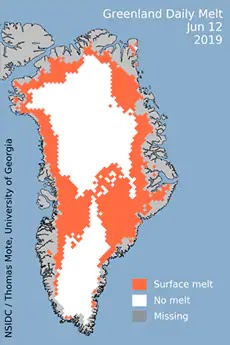
Extent of Greenland ice sheet melting on June 12. (National Snow and Ice Data Center)

Marco Tedesco, an ice researcher at Columbia University, added that it has been unusually warm in east and central Greenland, as well. “This has triggered widespread melting that has reached about 45 percent of the ice sheet,” he wrote in an email.

Normally, melting this widespread over the ice sheet doesn’t occur until midsummer, if even then.

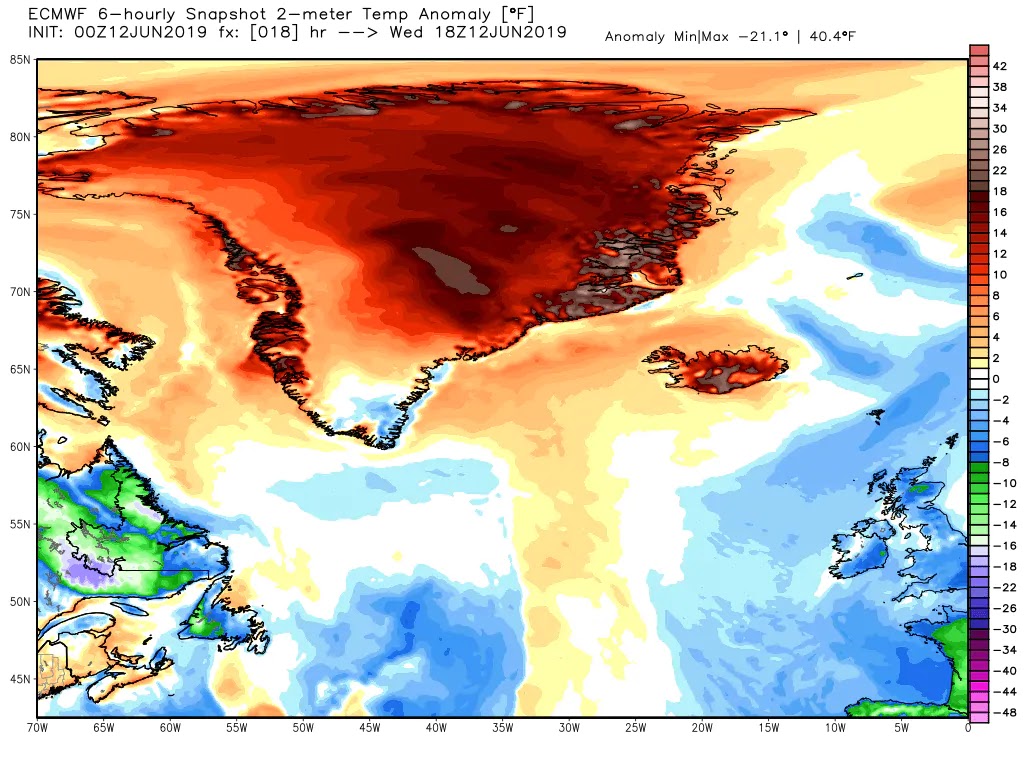
A simulation from the European Centre for Medium-range Weather Forecasting suggested that temperatures over Greenland may have peaked at around 40 degrees above normal on Wednesday.


European model simulation of temperature difference from normal over Greenland on Wednesday. (WeatherBell.com)

A big dome of high pressure has positioned itself over Greenland, resulting in sunny skies and mild temperatures, which have enabled melting. An automated weather station at the top of Greenland’s ice sheet topped freezing on June 12, a very rare event, which last occurred in July 2012.
2012 is the notorious year in which the Greenland ice sheet witnessed the most melting on record. Those monitoring the ice sheet say melting in 2019 could rival it.

Weather in the coming months will determine how much more the ice sheet melts and whether 2019 is a record-setter. If high pressure holds in place, “we should break a new record,” tweeted Xavier Fettweis, a climatologist at the University of Liège in Belgium.

But scientists studying the region know that Greenland’s weather is highly variable and can change rapidly.

Mike MacFerrin, a glaciologist at the University of Colorado, put it this way in a tweet: “2019 has been… anomalous… so far, but also quite variable. It’s early and weather is weather, so keep your eyes peeled. ...”

Arctic sea ice
(Zachary Labe)
 Weather satellites have monitored sea ice in the Arctic since 1979, and the current ice coverage is the lowest on record for mid-June.

The ice extent has been especially depleted in the part of the Arctic Ocean adjacent to the Pacific Ocean. “It’s pretty remarkable how much open water is in that area,” Labe said.

Labe explained high pressure over the Arctic has helped to pull sea ice way from the northern Alaska coast.
Sea ice loss over the Chukchi and Beaufort seas along Alaska’s northern coast has been “unprecedented” according to Rick Thoman, a climatologist based in Fairbanks.

Labe said there’s sufficient open water that you could sail all the way from the Bering Strait into a narrow opening just north of Utqiagvik, Alaska’s northernmost city, clear into the Beaufort Sea. “It’s very unusual for open water this early in this location,” he said.

With all of the exposed water, ocean temperatures in this region will rise, Labe said. This should delay the customary fall freeze and will likely result in a historically low late summer sea ice minimum, typically in mid-September.

Whether the Arctic sea ice minimum is record-setting, like the Greenland ice sheet, will depend on weather in the coming months.

“There is no indication that this year will be as low as 2012,” when Arctic sea ice reached its lowest extent on record, Labe said. “If cloudy weather occurs, it would slow down the rate [of melting]. It’s really hard to predict.”

Implications for weather over the United States?
The extreme conditions in the Arctic, which have resulted in these record-challenging melt events, have far-reaching implications. There is a saying often repeated by Arctic researchers: “What happens in the Arctic doesn’t stay in the Arctic.”

The bulging zones of high pressure in the Arctic, which have facilitated the unusual warmth and intensified melting, are displacing the cold air normally contained in that region into the mid-latitudes — like a refrigerator door left open. Much of the central and eastern United States have seen lower-than-normal temperatures in the past week.

Temperature difference from normal on Friday, as analyzed by the Global Forecast System model. (University of Maine Climate Reanalyzer)
 The jet stream, the high-altitude current separating cold air and warm air, has taken unusually erratic meanders.

“The jet stream this week was one of the craziest I’ve ever seen!” Jennifer Francis, one of the leading researchers who has published studies connecting Arctic change and mid-latitude weather, wrote in an email.

Francis had earlier suggested that conditions in the Arctic may have played a role in the extreme jet stream pattern that spurred the tornado swarm and record flooding in the central U.S. during the last two weeks of May.

“We can’t say that the rapid Arctic warming is causing this particularly pattern, but it certainly is consistent with that,” Francis, senior scientist at Woods Hole Research Center, said.

(Source: WP)

Monday, 29 April 2019

Antarctica: Thousands of emperor penguin chicks wiped out

Thousands of emperor penguin chicks drowned when the sea-ice on which they were being raised was destroyed in severe weather.

The catastrophe occurred in 2016 in Antarctica's Weddell Sea.

Scientists say the colony at the edge of the Brunt Ice Shelf has collapsed with adult birds showing no sign of trying to re-establish the population.

And it would probably be pointless for them to try as a giant iceberg is about to disrupt the site.

The dramatic loss of the young emperor birds is reported by a team from the British Antarctic Survey (BAS).

The developing chasm in the Brunt Ice Shelf may have doomed the colony anyway
Drs Peter Fretwell and Phil Trathan noticed the disappearance of the so-called Halley Bay colony in satellite pictures.

It is possible even from 800km up to spot the animals' excrement, or guano, on the white ice and then to estimate the likely size of any gathering.

But the Brunt population, which had sustained an average of 14,000 to 25,000 breeding pairs for several decades (5-9% of the global population), essentially disappeared overnight.

Emperors are the tallest and heaviest of the penguin species and need reliable patches of sea-ice on which to breed, and this icy platform must persist from April, when the birds arrive, until December, when their chicks fledge.

If the sea-ice breaks up too early, the young birds will not have the right feathers to start swimming.

This appears to have been what happened in 2016.

Emperor penguins need a reliable and stable platform of sea-ice

Strong winds hollowed out the sea-ice that had stuck hard to the side of the thicker Brunt shelf in its creeks, and never properly reformed. Not in 2017, nor in 2018.

Dr Fretwell said: "The sea-ice that's formed since 2016 hasn't been as strong. Storm events that occur in October and November will now blow it out early. So there's been some sort of regime change. Sea-ice that was previously stable and reliable is now just untenable."

The BAS team believes many adults have either avoided breeding in these later years or moved to new breeding sites across the Weddell Sea. A colony some 50km away, close to the Dawson-Lambton Glacier, has seen a big rise in its numbers.

Quite why the sea-ice platform on the edge of the Brunt shelf has failed to regenerate is unclear. There is no obvious climate signal to point to in this case; atmospheric and ocean observations in the vicinity of the Brunt reveal little in the way of change.

But the sensitivity of this colony to shifting sea-ice trends does illustrate, says the team, the impact that future warming in Antarctica could have on emperor penguins in particular.

Research suggests the species might lose anywhere between 50% and 70% of its global population by the end of this century, if sea-ice is reduced to the extent that computer models envisage.

This would have consequences beyond just the emperors themselves, commented Dr Michelle LaRue, an ecologist at the University of Canterbury, New Zealand.

"They're an important part of the food web; they're what we call a mesopredator. They're both prey for animals like leopard seals but they also prey themselves on fish and krill species. So, they do play an important role in the ecosystem," she told BBC News.

2018: The Dawson-Lambton colony has increased its numbers
Dr Trathan said: "What's interesting for me is not that colonies move or that we can have major breeding failures - we know that. It's that we are talking here about the deep embayment of the Weddell Sea, which is potentially one of the climate change refugia for those cold-adapted species like emperor penguins.

"And so if we see major disturbances in these refugia - where we haven't previously seen changes in 60 years - that's an important signal."

Whether the Halley Bay colony specifically really had a future is a moot point.

The Brunt Ice Shelf is being split apart by a developing crack.
Emperors are the tallest and heaviest of the penguin species
This chasm will eventually calve an iceberg the size of Greater London into the Weddell Sea, and any sea-ice stuck to the berg's edge may break up in the process.

The colony could have been doomed regardless of what happened in 2016.

Drs Peter Fretwell and Phil Trathan report their investigation in the journal Antarctic Science.

(Source: BBC)

Saturday, 2 February 2019

'Cold as ºF': Chicago residents make best of life in 'Chiberia' during polar vortex

Residents brave the weather to post photographs on social media showing just how cold things have got

In “Chiberia” – as locals have dubbed Chicago as temperatures have plummeted to -23F (-30C) – it is cold enough to freeze an egg on the sidewalk. Or to turn a bubble blown outside into a beautiful frosty snow globe before it splinters with the cold.

A blast of polar air has swept across many cities in the US leading to the lowest temperatures in a generation. Schools and businesses have closed, flights have been cancelled and as of Wednesday evening, at least eight deaths had been linked to the system.


Chicago isn’t the only city hit by the low temperatures, or the coldest, with the temperature dropping to -42F (-41C) in Park Rapids, Minnesota.

While the extreme cold is miserable for many, some have been trying to find a bright side. In Chicago, residents have posted photographs on social media showing just how freezing life has become.
Local news outlets have made their reporters brave the elements to test whether an egg placed in a frying pan at these temperatures would freeze – the opposite of frying an egg on the sidewalk in extreme heat, which the Guardian Australia team found required hotter temperatures than you might expect.

“Cold as ºF,” was the headline on the Loyola Phoenix, the official student newspaper of Loyola University in Chicago and on Tuesday, the Chicago Tribune ran sage weather-related advice on its front page: “Expert: avoid being outside”.

But many ignored the expert warnings and ventured into the cold to attempt the “boiling water challenge”, which saw people throw pots of boiling water into the air, which froze before hitting the ground.

Others posted videos of bubbles blown outside, which freeze into gorgeous baubles before cracking, or of their fork suspended in mid-air by a waterfall of frozen noodles. The hashtag #DogsofChiberia was created, showing pets rugged up in custom puffer jackets, hats and booties so they could survive a trip outside.

Videos also circulated that appeared to show train tracks across Chicago on fire. The fires, which actually run next to the rails, are used by Metra, the Chicago-area commuter rail, to make the rails expand in an attempt to avoid cracks forming and switches clogging.

Temperatures in Chicago were expected to fall into the -20s F (-30s C) again on early Thursday, but should warm up to the comparatively balmy 20Fs (-7 to -2C) by Friday.
(Source: The Guardian)

Polar vortex death toll rises to 21 as US cold snap continues

At least 21 people have died in one of the worst cold snaps to hit the US Midwest in decades.

Ninety million people - a third of the US - have seen temperatures of -17C (0F) or below. Some 250 million Americans overall have experienced the "polar vortex" conditions.

Hospitals have been treating patients reporting frostbite as parts of the country ground to a halt.

Temperatures are expected to swing to above average over the weekend.

Chicago's frozen shoreline

Who are the victims?
Homeless people have been particularly at risk, with warming shelters set up across cities.

But some still braved the freezing conditions and one woman, aged 60, was found dead in an abandoned house in Lorain, Ohio.

A hospital in Chicago has already treated 50 patients for frostbite, and some may end up losing a limb, CNN reports. Half of those patients were homeless individuals , while others had jobs that required them to be outdoors.

Some people were found dead a short walk from their homes:

  • A Michigan man who froze to death in his neighbourhood had been "inadequately dressed for the weather", officials said
  • In a wind chill of -46C (-51F) an 18-year-old student was found unresponsive a short walk from his dorm on Wednesday and later died in hospital
  • On Tuesday, a man froze to death in a garage in Milwaukee, Wisconsin, having "apparently collapsed after shovelling snow", according to a medical examiner

Dangerous roads have also been a factor in the deaths. A man was fatally struck by a snow plough near Chicago on Monday and in northern Indiana, a 22-year-old police officer and his wife died after a collision on icy roads.

What's the forecast?
The icy cold is expected to loosen its grip on Friday.

By the end of the weekend, Chicago could see temperatures as high as 10C (50F).

"It's going to be at least a 60-degree swing for Chicago," David Hamrick, a National Weather Service forecaster, told Reuters news agency.


The sudden weather change coming this weekend may be the fastest warm-up on record, meteorologists say.
But as the temperatures abruptly turn warmer, US emergency officials warn of flooding and utility risks.

Pipes can burst with such temperature fluctuations, and rapidly melting snow and ice could cause flooding, the Federal Emergency Management Agency cautioned.

How cold did it get?
More than 30 record lows were broken across the Midwest.

Cotton, Minnesota, was the coldest place in the US on Thursday with a low of -48C (-56F) based on preliminary data.

Chicago passed the record low for 31 January, while Mount Carroll has probably beaten the Illinois record with a morning temperature of -39C (-38F).
Cities across Iowa have also broken temperature records.

The chill drifted eastward on Thursday, bringing sub-zero temperatures to north-eastern cities such as Boston.

With wind chill factored in, temperatures of -40C (-40F) in the Midwest and Great Lakes have felt closer to -53C (-63F), which is enough to cause frostbite in less than five minutes.

Snow plough in Buffalo, New York
 How is the cold snap affecting daily life?
The Arctic weather could cost the US billions of dollars. In 2014, a similar polar freeze cost the country an estimated $5bn (£3.8bn), CBS News reports.

In Minnesota and Michigan, residents were asked by gas companies to turn down their home thermostats to help handle heating demands.

Consumers Energy, a natural gas provider in Michigan, had a fire on Wednesday morning that damaged equipment and temporarily affected how much gas could be sent out to customers.
Native American tribes in the northern Midwest states helped their members obtain heating supplies as many live in poor-quality housing, the Associated Press reports.

Andrea Cusack, a pharmacist in Michigan, began using her snowmobile to deliver essential prescriptions to snowed-in residents, according to the Lansing State Journal.

More than 2,300 flights have been cancelled and another 3,500 delayed due to the polar vortex.

Social media has been full of photos and memes showcasing just how shockingly cold the Midwest became.

Niagara falls covered with snow
 What about Canada?
Areas across the provinces of Ontario, Quebec and Saskatchewan, and in the north, remain under extreme cold warnings.

But many parts of the country are moving towards more seasonable temperatures on Friday and over the weekend.

In Toronto, wind chills near -30C (-22F) were expected to continue early Friday before beginning to warm.

There were also winter storm and blizzards warnings active across the country from the east to the west coast.

Environment Canada was urging residents to limit their exposure to cold and keep pets indoors.

Canada did not experience a spate of deaths linked to the polar vortex like the US.

Stephen Hwang, an associate professor with the University of Toronto's department of medicine, suggested that Canadian cities and public health authorities probably had more experience dealing with the deep cold.

Most homeless shelters also already had protocols in place for when the extreme cold hits.

But he said it was still "fortunate" that cities like Toronto, where homeless shelters have been stretched for resources in recent months, did not see any cold-related deaths among its most vulnerable citizens.

(Source: BBC)

Friday, 11 May 2018

I was buried alive in an avalanche

I was slowly suffocating, but fighting it off, trying to stay conscious, writes Rhianna Shaw sharing her experience in the Guardian. Read on: 

In 2012, I was 22 and doing a ski season in Ischgl, Austria. It had been snowing heavily for days, and no one could ski. Then the weather changed. On my day off, I woke to a clear blue sky and half a metre of fresh powder: a skier’s dream. So, I went out with my friend Gordon.

We ran into some friends on snowboards. I suggested an area good for going off-piste. My friends had nicknamed it Death Valley because it was prone to avalanches, but it was renowned for fresh powder. As an experienced skier, I was excited rather than concerned.

When we were skiing and snowboarding down, I wanted to be at the front to get fresh tracks. One of the snowboarders overtook me and I was reovertaking him when we collided. My skis came straight off and I tumbled a bit. Then I felt a whoosh of snow.

I wasn’t worried initially because I thought one of the snowboarders had come down behind me and sprayed snow on me. But then the snow swept me up and I was just falling. I couldn’t breathe. I later found out that our collision had caused an avalanche that had carried me along for about 150 metres.

Rhianna Shaw: ‘In our training we had been told that if someone is buried in an avalanche, after about 11 minutes you’re looking for a corpse.’ Photograph: Karen Robinson for the Guardian
When I finally came to a stop face-down about one metre under the snow, my first thought was, “At least I can breathe a bit now.” It was like trying to breathe through a heavy cloth. Everything was white, and I thought, “Is this one of these dreams where I almost die?” Then I realised it definitely was not a dream.

I was screaming for help, but trying not to use up too much oxygen. My phone was going off, but my arms were trapped so I couldn’t answer. It was horrible, lying there not being able to move, nobody knowing where I was or having any way of finding me. I was slowly suffocating, but fighting it off, trying to stay conscious.

The avalanche covered the area of a football pitch, so it was a needle-in-a-haystack scenario. Initially, the guys thought I’d skied on and would be waiting around the corner. They rang me to check. When I didn’t answer, they started to look for me.

In our training as ski reps, we had been told that if someone is buried in an avalanche, after about 11 minutes you’re looking for a corpse. That was the most traumatic part: there wasn’t one thing I could do to save myself. I was trying not to panic, but I did think, “This is it.” I was thinking of the summer I had planned with my sister, and my last thought was, “That’s a shame.” Then I let go. It was really quite peaceful: I saw a forest either side of me, and I was just walking into it.

No one had any avalanche gear – no transceivers to locate me, no probes and no shovels to dig me out – so the boys were just sticking their hands in the snow. After about 15 minutes, by pure chance, one of the boys hit the back of my leg. When they pulled me out, they couldn’t find a pulse and I wasn’t breathing, so Gordon started giving me CPR.

My next memory is Gordon giving me a hug and a sloppy kiss and saying, “Rhianna, I’ve never been so pleased to see you!” I remember going, “Eeeuuugh, don’t kiss me!” even though moments earlier he had given me the kiss of life.

My face was white, my lips were blue, and I had severe hypothermia, but didn’t feel cold. It was a sunny day, so I wasn’t wearing very much, which is one of the reasons I didn’t end up with brain damage – the hypothermia slowed my metabolism and reduced my brain’s need for oxygen.

I was taken by helicopter to the hospital, where they stripped me and blasted hot air across my body to warm me up. They also put me on a drip to reoxygenate my organs. When I woke in hospital, I turned my phone on. I had a voicemail from one of the ski instructors saying: “Hey, just to let you know it’s a really high avalanche risk today, there have been three people buried in avalanches in different areas already, so just be very careful.” He had left that message while I was buried.

After 36 hours in hospital, I flew home to England and within a week I was back in Ischgl to finish the ski season. I just couldn’t quit. Looking back, I was phenomenally lucky. I now carry avalanche safety equipment when I ski, and I won’t go out in heavy snow dumps without checking the avalanche risk factor. Skiing is still my biggest passion, but I don’t take risks any more. It’s not worth it.

Saturday, 5 May 2018

Hero surgeon treks for three hours through snow to help patient

A brave and dedicated surgeon battled against the snow and wind in freezing conditions in Glasgow to operate on a patient.

The unnamed female doctor reportedly walked eight miles for almost three hours from Anniesland in the West End of Glasgow to Paisley, Renfrewshire to complete the surgery.

According to the Scotsman, the anonymous individual did not want to be named as she didn't want to take credit for doing her job, despite going to extraordinary lengths to do so.

The patient in question was due to undergo surgery that day and she didn't want to let the person down. Her amazing commitment and effort was praised by her colleague Andy Renwick.


The colorectal surgeon told BBC Radio Scotland:

She walked from Anniesland to Paisley – it took her two hours and 50 minutes. I saw her come in, she had snow goggles on, Gortexed up, top and bottom, snow shoes and walking poles.

She is operating today on someone who has bowel cancer, she knew that had to be done and so she has made extra effort to get in here to make sure that was actually delivered.

Dr Renwick added that this wasn't the only selfless act that he had witnessed at the hospital during the bad weather.

Trainee foundation doctors stayed in the facility overnight waiting for others members of staff to arrive. He added:

Last night we had foundation year one doctors stay in hospital overnight without having bought anything with them.

They have remained overnight and remained in the hospital waiting for colleagues to turn up.

We have had phone calls from their colleagues assuring us that they are trying to get in and they are waiting for transport to try and get in so they can actually relieve them.

Hopefully, we will be able to take the ones who can get home today home later on.

Stories like this haven't been a rarity in during the adverse weather. Doctors and nurses in Sunderland and Newcastle slept in hospitals in overnight so that they could care for patients.

(Source: indy100)

Wednesday, 11 April 2018

Orange snow blankets Eastern Europe

No, the photos and videos haven’t been edited by the latest Instagram filter or otherwise digitally manipulated. Orange-tinted snow did blanket parts of Eastern Europe on Friday and over the weekend, creating eerie post-apocalyptic scenes and baffling people in countries such as Russia, Bulgaria, Ukraine, Romania and Moldova, the BBC reported.

Documentation of the strange snow appeared all over social media, with some making jokes about “skiing on Mars,” according to CNN.

A snowboarder makes his way down a run covered with orange-colored snow. (slivi4/Instagram)
While orange snow seems unearthly, meteorologists said the phenomenon occurs about every five years and that this instance was caused by sand from storms in the Sahara mixing with snow and rain, according to the BBC.

Unlike past occurrences, however, the concentrations of sand are much higher this time, with people even complaining of getting it in their mouths, the BBC reported.

Skiers in Sochi, Russia, aren’t deterred by the orange snow. (margarita_alshina/Instagram)
In a satellite image from NASA taken Friday, the dust was visible as a light brown streak staining the white clouds above Eastern Europe, according to the Weather Channel.

Steven Keates, a meteorologist with the United Kingdom’s National Weather Service, known as the Met Office, told the Independent that sand can spread once it reaches the upper levels of the atmosphere.

“Looking at satellite imagery from [NASA], it shows a lot of sand and dust in the atmosphere drifting across the Mediterranean,” Keates said. “When it rains or snows, it drags down whatever is up there, if there is sand in the atmosphere.”

(Source: WP)

Saturday, 13 January 2018

Snow falls in Sahara desert for third time in 40 years

Snow has fallen in the Sahara, covering desert dunes in a layer up to 40cm deep.

Snow started falling on the Algerian town of Ain Sefra in the early hours of Sunday morning, giving children an opportunity to race each other down the slopes. Rising temperatures meant it began to melt later in the day.

It is the third time in nearly 40 years the town, known as “The Gateway to the Desert”, has seen snowfall.


Snow in the Sahara is “unusual but not unheard of”, a spokeswoman for the Met Office told The Independent.

“It seems like the snowy pictures were taken across the higher areas in the north of the region, towards the Atlas regions, so it’s not surprising that the area would see some snow if the conditions were right.

“With the setup over Europe at the moment, which has given us cold weather over the weekend, a push southwards of cold air into that region and some sort of moisture would bring that snow.”

Ain Sefra, which was founded in 1881 as a French garrison town, sees average high temperatures of over 37C in summer and has seen record lows of -10.2C in winter.

(Source: Independent)

Sunday, 17 December 2017

First snows transform Kashmir into a mystical wonderland

This is the time when Kashmir mystically transforms into a pristine, white canvas that is bound to hypnotise even the most cynical with its snow-enveloped valleys and picture-postcard vistas.

One can never get enough of the serene and ethereal landscapes of Kashmir.

Be it a shikara ride along the tranquil Dal lake in the backdrop of snow-capped mountains or streets laden with auburn leaves of Chinar trees, any person who has had the privilege of visiting the valley is forever smitten with picturesque memories worth cherishing for a lifetime.

And as winter dawns and snow makes its first appearance, it is a different story whole together. This is the time when Kashmir mystically transforms into a pristine, white canvas that is bound to hypnotise even the most cynical with its snow-enveloped valleys and picture-postcard vistas.

Though a little late than usual, Kashmir has finally received its first snowfall of the year and with numerous pictures making rounds across the social media, one can’t stop heaving a sigh at the sheer beauty of Kashmir.

Take a look at some of the pictures shared by netizens and we warn you beforehand, be prepared to be spellbound beyond your senses:


(Source: The Better India)

Saturday, 5 August 2017

World’s ‘highest’ village in Spiti Valley runs dry as global warming hits the Himalayas

Spiti’s nearly 12,000 inhabitants, who eke out a living farming green peas and barley, have a much bigger concern: their main sources of water — streams, rivers, ponds — are drying up.

With a backdrop of the snow-capped Himalayas stretched out across a vibrant blue sky, it is hard to dispute the sign as you enter Komik that declares it to be the world’s highest village with a road.

Others also boast the title — from Nepal’s Dho Tarap to Bolivia’s Santa Barbara. But at 4,587 metres (15,050 feet), this remote Buddhist hamlet near India’s border with Tibet is no doubt among the planet’s topmost motorable human settlements.

Yet despite its coveted status, life is harsh for the 130 residents of Komik, a quaint collection of whitewashed mud-and-stone houses located in the desolate Spiti Valley.

The region is a cold trans-Himalayan desert cut off from the rest of India for six months of the year when snowfall blocks mountain passes. Phone and internet connectivity is almost non-existent. Schools and clinics are a tough trek away.

But Spiti’s nearly 12,000 inhabitants, who eke out a living farming green peas and barley, have a much bigger concern: their main sources of water — streams, rivers, ponds — are drying up.

“We are used to being in a remote place. We have our traditional ways of living,” said farmer Nawang Phunchok, 32, as he sat tying bundles of a prickly desert bush together to insulate the local monastery’s roof.

“But these days the water is not coming like it used to. The seasons are changing. We see there is less water than before.”

There is little doubt India is facing a water crisis.

Decades of over-extraction of ground water, wasteful and inefficient irrigation practices, pollution of surface water like lakes and rivers, and erratic weather patterns attributed to climate change, have left many parts of the country thirsty.

But while government, charities and media increasingly focus on the drought-stricken farmers in the plains, their Himalayan counterparts — ironically living in a region often called the Water Towers of Asia — also need help, say conservationists.

Pumped Dry
From its deepest aquifers to its biggest rivers, India is one of the most water-challenged countries in the world, according to the World Resources Institute.

More than half of country — including the breadbasket northern states of Punjab and Haryana which produce 50% of the national government’s rice supply and 85% of its wheat stocks — is considered highly water-stressed.

More than 50% of the country’s wells have registered a decline in volumes in the last decade. Up to 80% of rivers, lakes, ponds and streams are polluted with human waste and sewage.

Over 63 million rural Indians — the equivalent of the population of Britain — do not have clean water to drink, cook or wash with, says WaterAid. Around 76 million need improved water sources and 770 million require proper toilets.

And climate change is exacerbating the situation.

Overall rainfall in the last century has been erratic, and the annual average temperature has risen by 0.5 degrees Celsius, says India’s meteorological department.

“There exists a huge knowledge gap regarding the connection between water scarcity and climate change. There is an immediate need to fill this gap and make people aware about the importance of water conservation,” said WaterAid India’s Puneet Srivastava.

“The government also needs to undertake severe measures to regulate and monitor the use of groundwater resources.”

The risks posed to food security and the plight of around 200 million farm workers are also a major concern.

Thousands of farmers have committed suicide over the last decade as unseasonal rains and drought combined with lower global commodity prices have hurt farm incomes.

India is forecast to overtake China as the most populous nation with 1.7 billion people by 2050. With rapid urbanisation, rising demand for hydropower and changing weather patterns, the situation is set to worsen. Government data forecasts India’s annual water availability per person to drop by over 25% by 2050 to 1,140 cubic metres from 1,545 cubic metres in 2011.

Authorities have in recent years moved to better support farmers and boost water security in drought-prone areas.

Measures include providing insurance cover for crop failures and drought-resistant seeds to farmers, investments in irrigation, as well as a $3-billion project to clean up the Ganges, India’s largest and most sacred river.


Melting Glaciers
But environmentalists say the focus is largely on India’s plains — where populations and farm outputs are higher — neglecting those living in the far-off, sparsely populated Himalayas.

Experts say the food, water and energy security of not just the people here — but over one billion others across Asia who depend on rivers such as the Yangtze, Ganges and Mekong, which are fed by Himalayan glaciers — is at stake.

Yet the Himalayas are one of the world’s most sensitive hot spots to climate change. Melting glaciers, erratic rainfall, less snow and rising temperatures are taking their toll.

And Spiti Valley is clearly showing the signs.

“In 2015/16, there wasn’t enough snowfall and so when summer came, the springs — which are the main source of irrigation for people — were all dried out. There was hardly any crop,” said Ishita Khanna at Ecosphere, an eco-tourism company in Spiti Valley.

“With the climate changing, this could be disastrous for people living here if this keeps happening. There should be more support for people and a deeper understanding of their way of life here. It’s a very hard life.”

Tucked away in a corner of India’s northern state of Himachal Pradesh, Spiti is only accessible during the summer, and even then via treacherous rugged roads carved along cliffs.

Translated as the “Middle Land” — referring to the land between India and Tibet — Spiti is dotted with stupas and centuries-old monasteries perched on crags.

Due to its remoteness, time appears to have stood here. Despite the building of roads which has brought in some tourism, the traditional way of life continues.

From April to September, locals farm tiny plots of land before winter sets in and temperatures drop to minus 30 degrees Celsius.

“We thought the road would bring us more prosperity in terms of tourism and trade, but it has been disappointing,” said 55-year-old farmer Tenzin Andak from Komik.

“It is a worry for us. Life is getting more difficult these days, partly because there is less water,” Andak said, as he took down some clothes hanging from a washing line outside home.

Trekking further for water
Spiti’s water comes from snow — snowfall provides the moisture for farming and pastures for livestock rearing, while snow melt from glaciers feeds the streams and rivers which are the lifeline of these settlements.

And unlike in other parts of India where there are two farming seasons to plant and harvest crops, in Spiti there is only one — leaving farmers more vulnerable if one crop fails.

It has become warmer over the last few decades and there is less snowfall, say residents. The winters have become shorter and summers longer, they add.

Their main form of irrigation which are “kuls” — man-made channels running from glaciers to village ponds — are dry. As a result, sheep and goat herders have to trek higher to find grazing land and crops are much harder to cultivate.

A 2014 study by Jawaharlal Nehru University cited annual temperatures in the Indian Himalayas rose by up to 2 degrees Celsius over two decades, while the area of glaciers here have reduced by 13% over five decades.

“There is no doubt there is a big water crisis here,” said sub-divisional magistrate Arun Sharma, the senior-most government official in Spiti.

“We’ve put in place a lot of projects such as providing water tanks and constructing water catchment areas, but we are limited by the weather. For six months of the year, life stops as we are snowbound and we cannot do any major work.”

(Source: HT)