Showing posts with label West Bengal. Show all posts

Saturday, 28 May 2022

Why are kangaroos being spotted in India?

 When villagers walking along a road on the edge of a forested village in eastern India first saw three confused, weak and hungry animals, they couldn't believe what they were witnessing.

The animals looked nothing like anything they had seen before. They alerted West Bengal state's forest officials, who told them that the animals were kangaroos - native to Australia but not found in India.


The animals were rescued and sent to a wildlife park to be treated. One died later. The villagers were still confused and surprised by what they had seen. Soon, videos of the kangaroos in India went viral.
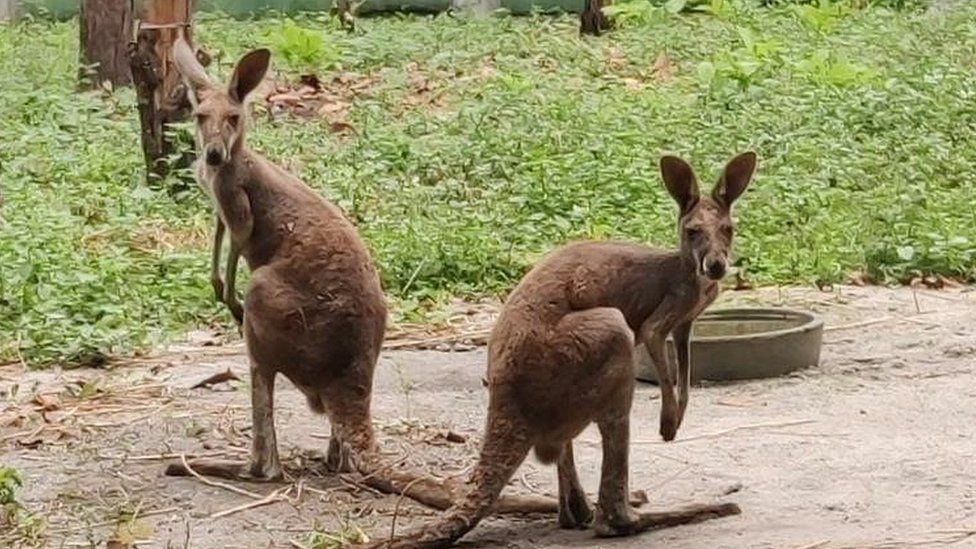

Wildlife officials say kangaroos are among the exotic animals smuggled into India. Bengal Safari Park


"How on Earth are kangaroos turning up in West Bengal," a Twitter user asked.


Debal Ray, the chief wildlife warden of West Bengal, tells the BBC that the animals were most likely left in the open during an anti-smuggling operation by his team.


When he received a tip-off that some exotic animals were being smuggled into the state, he immediately alerted his team. Acting quickly, the officers started checking vehicles along one of the main routes to enter the state.


"The smugglers probably got wind of it, and abandoned the animals on the highway," Mr Ray said.


"They probably ended up here from private breeding farms in southeast Asia," Agni Mitra, deputy director of the regional Wildlife Control Bureau, told the BBC, adding that smugglers often bring non-native, exotic animals to India's border states through Myanmar.

India's anti-smuggling intelligence agency, the Directorate of Revenue Intelligence (DRI), said that the country has seen a rise in demand for exotic animals.


Animals from Bangkok, Malaysia and other "top tourist destinations in South East Asia" are smuggled into the country and make their way to cities across India, it added.


Mr Mitra said smugglers use the "north-eastern corridor" to bring in exotic animals, ranging from a golden-headed lion tamarin, an endangered primate found only in Brazil, to threatened lemurs.


Indian wildlife officials often find that they can't prosecute these smugglers or traders because India's Wildlife Protection Act doesn't protect non-native, exotic animals.


Customs officials have the authority to stop people from transporting wild animals if they don't have proper permits. But they find it difficult to track illegal trade through porous borders.


The DRI said that since there is a ban on trade of native animal species, smugglers have shifted to "exotic species, which has led to disastrous global environmental consequences".


Wildlife activists say owning an exotic pet is considered prestigious - a trend that has only become more popular in recent years.


"A little while back, Zebras were seized in Bangladesh which were destined for a private zoo in India," Shubhobroto Ghosh, an activist with the group World Animal Protection said. "People are doing crazy things."


Indians have long had a liking for exotic animals.


In June 2020, India's Ministry of Environment, Forest and Climate Change announced a voluntary disclosure scheme, asking people to declare their exotic pets.


It said pet owners without proper documentation would not be prosecuted. The government wanted to "develop an inventory of exotic live species" in the country and streamline import procedures.


By early 2021, the government received 32,645 disclosure applications which listed exotic animals such as critically endangered lemurs, iguanas, macaws and even kangaroos, reported IndiaSpend, a data analysis website.


Wildlife officials said that despite an uptick in the number of exotic animals being brought into the country as pets, there was still no effective legislation to monitor the trade.


In 1976, India adopted the Convention of International Trade in Endangered Species (CITIES), an agreement ratified by 183 countries, which protects and monitors the trade of endangered plants and animals.


But the country has still not given the multilateral treaty any teeth - it can't be implemented under Indian law.


Lawmakers are reviewing an amendment to India's Wildlife Protection Act which would bring exotic flora and fauna, and other species protected by CITES provisions under wildlife authorities.


But Mr Ghosh is sceptical of its impact.


"Say I am a forest warden and I am your friend, and you have some rare primates from Brazil that you want to keep in your private zoo, you could very well just bribe your way through and get your permit," he explains.


"A lot of zoos unfortunately are becoming a part of this network - where traders and breeders work together to buy animals, sometimes non-native, exotic ones," Mr Ghosh added.


In April, two men were arrested when a red kangaroo was found in their truck during a routine police check on a highway close to West Bengal's border with the north-eastern state of Assam.


The men told forest officials that they had been handed these kangaroos at a farm in Mizoram, another state in the north-east, to be taken to a zoo in the central Indian state of Madhya Pradesh.


"They produced a supply order from the zoo, and the zoo even confirmed it," Mr Mitra said.


The zoo's curator told a news website that they had been "offered the consignment as a gift".


"Clearly this is a case of smuggling - the supply order was in the name of a farm in Mizoram, which does not even exist," Mr Ghosh said, explaining that under CITES provisions, protected animals have to be declared on a government website.


"There is no declaration of any kangaroos from any farm in Mizoram in government records," Mr Mitra said.


Meanwhile, the two kangaroos - Alex and Xavier - rescued by forest officials are being treated in the Bengal Safari Park, and are making good progress.


"They have some muscle atrophy, which is common in kangaroos when they are squeezed into small spaces while being smuggled," Mr Ray explained.


"If they feel at home, maybe we can display them [to the zoo-going public]. But they have to spend their life in a zoo. We cannot release them into the wild as India is not their natural habitat."


(Source: BBC)

Tuesday, 18 January 2022

‘Santiniketan taught us that there is no such thing as worthless activity’: Mahasweta Devi

 Remembering the writer and activist on her 96th birth anniversary with an excerpt from ‘Our Santiniketan’, translated from the Bengali by Radha Chakravarty.

About the plants and trees of the Santiniketan that lives within my heart, I feel compelled to say more.


The neem trees will feel offended if I don’t give you a proper account of them.


The neem trees that I know belong to three varieties. Akash neem, mahaneem and ghora neem. All three varieties blossomed in the warm month of Chaitra, and their fragrance filled the air. I saw the flowers, some white, some blue, but I can’t say which type of neem had white flowers and which had blue.


Mahasweta Devi. | Naveen Kishore.


I can say for sure though that just in front of Sri Bhavana, beyond a spreading sirish tree, stood a row of neem trees, stretching right up to the end of the path. Today, the Sabars bring me neem honey and neem oil. And all year round, I consume boiled neem leaves.


In front of the Kala Bhavana flourished a “jambuvana” or jamun grove. Why call it a grove? Because it was a unique type of jamun tree. Not the familiar high-crested black jamun, but low-growing trees that spread their boughs long and wide. As far as I can recall, none of these trees grew even to the height of an ata tree.


There was no dearth of fruit. Not too fleshy, the stone so large it felt like mango seed. Not too sweet either. But you could carry some salt wrapped in paper, and gorge on the fruits endlessly, until your throat began to choke on the bitter jamun sap.


Our entire cohort would invade the jamun grove together.


“What clever jamun trees, bhai!” Kitu (Krishna Roychoudhury) would exclaim. “Not growing too tall. How easily we can enjoy the fruit.”


I’ve never seen such jamun trees anywhere else. They were just right for a place like Santiniketan.


Very profound, cheerful and large-hearted was the Ghantaghar, the bell tower, located beyond the library, to the right (am I correct?). A giant banyan or peepul grew there. And other trees too: bakul, jamrul, gaab and sapeda. Close to Chhatimtola was a hapless tree that bore sour fruit which we knew by the name of “nol”.


That was the tree a boy from Garhwal (was his name Vinay?) tried to climb, when he slipped and fell, fracturing a bone. The name “banapulak” (“rapture of the forest”) was given by Rabindranath to the tree that grew to the left of the path to Uttarayan. It bore clusters of blossoms resembling hasnuhana, exuding a sweet fragrance.


To the left, on the way to Uttarayan, the road had a culvert, and below, on a deep slope, was the house where Sebak-da lived – Sebak Sen and Jamuna-di. Mastermoshai’s younger daughter Jamuna-di played the role of Kurupa Chitrangada in the first performance of Chitrangada. With her sculpted features, as if chiselled in black stone, she was exquisitely beautiful.


To continue what I was saying: in winter, beneath that culvert grew wild, flowering shrubs. In the month of Chaitra, those shrubs had dried up, but the ripe kul fruit still grew on every branch. Down I jumped, from the edge of the culvert, without a thought. Who was to know that, lying coiled under the bushes, was a hibernating gokhro snake? It was clear to me that all that stood between the snake and my feet was a kul shrub. I also realised that the coiled form was moving, beginning to unravel.


“Snake! Snake!” I shrieked.


The louder I screamed, I’m told, the entire bunch of Class Seven students shouted even louder: “Snake! Snake!”

The boys reached out to me.


“Khuku! Grab our hands, bend your legs and clamber up!”


Thankfully for us, Sebak-da came rushing to the scene. (I think he taught us arithmetic.) Getting to the road, he yanked me up. And killed the snake as well.


And after that, a storm of scoldings! We beat a hasty retreat.


Near the rail tracks grew wild kul shrubs. Crossing the Khoai, we’d go in search of the wild kul. At Uttarayan, on the wall of Bouthan’s (Protima Devi) private garden, Rathi-da had painted a guava tree in playful strokes, styled exactly like the trees in Mughal paintings. A branch of the tree, twisted around and secured to an iron hook on the wall, looked quite wonderful.


To our eyes, the most miraculous flower was the yellow palash from Goalpara village. A pure yellow, like the atasi blossom. Later, in 1945, when Abanindranath was Vice Chancellor, we went to him once and found him gazing in rapture at a yellow palash flower placed in front of him. Between the Shyamali and Udichi buildings, did they later plant a yellow palash tree? I forget.


Rabindranath educated us in the idea of beauty in the design of houses. And beauty in naming a house – that too was a lesson to be learnt from him. Amiya Chakravarty’s elder brother Arun died before his time. “Aruni” was the name chosen by their parents for the house they built in Puri. I believe that Rabindranath’s influence had something to do with it.


We saw birds. Birds of many species. In the years 1936-38, immediately upon entering Uttarayan, one saw an enormous room to the left with a metal grill in front. A pair of snow-white peacocks resided there. Someone must have gifted them to Rabindranath. When the rains approached, the peacocks would spread their fans and dance. That was a sight worth watching.


Santiniketan trained our vision. Learn to see, learn to see!


Chhabighar, the picture gallery, was located directly in front of the kitchen. So many pictures to be seen there! For a week they displayed a Chinese painting. The paintings were put up there by the teachers and students of Kala Bhavana. Then came a Japanese painting, then others. Everybody viewed them. In their comings and goings, they saw the pictures.


Observing images is also something to be learnt. I didn’t learn. Thanks to Baba, right from infancy, we were used to seeing paintings at home. The Jibansmriti edition of those days carried a painting by Gaganendranath. I still recall the lines jal parey pata narey, and daibadurjogey aparahata sei kalo chhatati dekha diyachhey. After reading Jibansmriti, I went to Santiniketan. This impossible addiction to reading was the reason why I learnt to recognise life and the world through my experience of books. That is what I believe now.


In Patha Bhavana, Jadupati-da offered art lessons. Sometimes he took us to Kala Bhavana. From morning to evening, what a varied work schedule!


A work schedule, indeed! Identifying trees, raiding fruit trees, and in the rains, running towards the Kopai with Jiban-da and Sudhir Gupta-da, all of us getting soaked together, learning how to swim as we plunged about in those red, muddy waters during that downpour – these were forms of action, after all.

Every so often, listening to the baitalik songs at night, joining in the singing (was that in my college days?) – all that was action too.


Santiniketan taught us that there is no such thing as worthless activity.


Excerpted with permission from Our Santiniketan, Mahasweta Devi, translated from the Bengali by Radha Chakravarty, Seagull Books.


(Source: Scroll)

Thursday, 4 November 2021

ಟ್ಯಾಗೋರ್ ಕಾದಂಬರಿಗಳ ರೆಬೆಲ್ ನಾಯಕಿಯರು: ಲೈಂಗಿಕತೆಯ ತುಮುಲದಲ್ಲಿರುವ ವಿಧವೆ ಬಿನೋದಿನಿ

ಟಾಗೋರರ ನಾಯಕಿಯರು ಚಲನಚಿತ್ರಗಳಲ್ಲಿ ತೋರಿಸುವಂತೆ ಸೈಡ್ ಲೈನಿನಲ್ಲಿ ಬರುವುದಿಲ್ಲ. ಅವಳೇ ನಾಯಕ ಹಾಗೂ ನಾಯಕಿ. ಅವಳು ತನ್ನ ರಕ್ಷಣೆಗೆ ನಾಯಕನ ಆಗಮನಕ್ಕಾಗಿ ಕಾಯುವುದಿಲ್ಲ- ತಾನೇ ಹೋರಾಡುತ್ತಾಳೆ. ಅನುರಾಗ್ ಬಸು ನಿರ್ದೇಶಿಸಿರುವ ನೆಟ್ ಫ್ಲಿಕ್ಸ್ ಸರಣಿ 'ಸ್ಟೋರೀಸ್ ಬೈ ರಬೀಂದ್ರನಾಥ್ ಟ್ಯಾಗೋರ್' ಟಾಗೋರರ ಆಶಯವನ್ನು ದೃಶ್ಯರೂಪದಲ್ಲಿ ಪ್ರೇಕ್ಷಕನ ಮುಂದೆ ತೆರೆದಿಡುತ್ತದೆ.

ಮಂಡ್ಯ ಜಿಲ್ಲೆ ಮದ್ದೂರು ಮೂಲದ ಚೈತ್ರಾ ಅರ್ಜುನಪುರಿ ಸದ್ಯ ದೋಹಾ, ಕತಾರ್, ನಿವಾಸಿ. ವಿಜಯ್ ಟೈಮ್ಸ್, ಟೈಮ್ಸ್ ಆಫ್ ಇಂಡಿಯಾ, ಡೆಕ್ಕನ್ ಕ್ರಾನಿಕಲ್ ದಿನಪತ್ರಿಕೆಗಳು, ಮತ್ತು ಕತಾರಿನ ಅಲ್ ಜಜೀರಾ ಟಿವಿ ಚಾನೆಲ್ ನಲ್ಲಿ ಪತ್ರಕರ್ತೆಯಾಗಿ ಕಾರ್ಯ ನಿರ್ವಹಿಸಿರುವ ಅನುಭವ ಬೆನ್ನಿಗಿದೆ. ನೈಟ್ ಫೋಟೋಗ್ರಫಿ ಇವರ ಹವ್ಯಾಸ, ಗೀಳು. ಸಿಂಪಲ್ ಸಂಗತಿಗಳು ಇವರಿಗೆ ಖುಷಿ ಕೊಡುತ್ತವೆ.ಇವರ ಚಿತ್ರಗಳು ನ್ಯಾಷನಲ್ ಜಿಯೋಗ್ರಾಫಿಕ್ ಮತ್ತಿತರ ಜಾಲತಾಣಗಳಲ್ಲಿ ಪ್ರಕಟಿತವಾಗಿವೆ. ಪುಸ್ತಕ ವಿಮರ್ಶೆ, ಕಥೆ, ಲೇಖನ ಮತ್ತು ಪ್ರವಾಸ ಕಥನ ಬರೆಯುವ ಹವ್ಯಾಸವಿದೆ. 'ಚೈತ್ರಗಾನ' ಕವನ ಸಂಕಲನ, 'ಪುಸ್ತಕ ಪ್ರದಕ್ಷಿಣೆ' ಮತ್ತು 'ಓದುವ ವೈಭವ' ವಿಮರ್ಶಾ ಸಂಕಲನಗಳು ಪ್ರಕಟಿತ ಪುಸ್ತಕಗಳು.


-


ಕೊರೊನಾ ಬಂದ ಮೇಲೆ ಜನರೆಲ್ಲಾ ನೆಟ್‌ ಫ್ಲಿಕ್ಸ್‌ ನ ಕಡೆಗೆ ವಾಲಿದ್ದು ಈಗ ಹಳೆಯ ಸಂಗತಿ. ದಿನಗಳೆದಂತೆ ಇದರಲ್ಲಿ ಪ್ರಸಾರವಾಗುವ ಚಲಚಿತ್ರಗಳ ಪಟ್ಟಿ ಬೆಳೆಯುತ್ತಿದ್ದರೂ, ಅದರಲ್ಲಿನ ಸರಣಿ ಕಾರ್ಯಕ್ರಮಗಳು ತಮ್ಮ ಆಕರ್ಷಣೆ ಕಳೆದುಕೊಂಡಿಲ್ಲ. ಇವುಗಳಲ್ಲಿ ಪ್ರತಿಯೊಂದೂ ನಾಲ್ಕೈದು ಕಂತುಗಳಾಗಿ, ಅದರೊಳಗೆ ಹಲವಾರು ಸಂಚಿಕೆಗಳನ್ನೊಳಗೊಂಡು ಪ್ರೇಕ್ಷಕರ ಗಮನವನ್ನು ನಿರಂತರವಾಗಿ ಹಿಡಿದಿಟ್ಟುಕೊಳ್ಳುವಲ್ಲಿ ಯಶಸ್ವಿಯಾಗಿವೆ. ಈ ಸರಣಿಗಳಲ್ಲಿ ಬರುವ ಕಥೆಗಳು, ಜರುಗುವ ಘಟನೆಗಳು ಎಲ್ಲೋ ಜನಸಂದಣಿಯಿಂದ ದೂರ, ಸಾಮಾನ್ಯರಲ್ಲಿ ಸಾಮಾನ್ಯರನ್ನು ನಾಯಕ ಅಥವಾ ನಾಯಕಿಯಾಗಿ ಮಾಡಿರುವುದರಿಂದಲೇ ಮನಸಿಗೆ ಬಹಳ ಆಪ್ತವೆನಿಸುತ್ತವೆ. 


ಹೆಣ್ಣು ಇಲ್ಲಿ ಬರಿ ಪೋಷಕ ಪಾತ್ರವಾಗಿಲ್ಲ

ನೆಟ್‌ ಫ್ಲಿಕ್ಸ್‌ ನ ಸಾಕಷ್ಟು ಸರಣಿಗಳಲ್ಲಿ ಸ್ತ್ರೀವಾದಿ ಪ್ರಜ್ಞೆ ಎದ್ದು ಕಾಣುವುದು ಇಲ್ಲಿ ಗಮನಿಸಲೇ ಬೇಕಾದ ಪ್ರಮುಖ ಅಂಶ. ನಮ್ಮ ದೈನಂದಿನ ಟಿವಿ ಧಾರಾವಾಹಿಗಳ ಹಾಗೆ ಅಥವಾ ಚಲನಚಿತ್ರಗಳ ಹಾಗೆ ಹೆಣ್ಣು ಇಲ್ಲಿ ನಾಯಕನ ಪಾತ್ರದ ಪೋಷಕಧಾರಿಯಲ್ಲ. ಇಲ್ಲಿ ಅವಳೇ ನಾಯಕ ಹಾಗೂ ನಾಯಕಿ. ಬಿಕ್ಕಟ್ಟಿನ ಸಮಯದಲ್ಲಿ ತನ್ನ ರಕ್ಷಣೆಗೆ ಆಕೆ ನಾಯಕನ ಅಥವಾ ಯಾವುದೇ ಪುರುಷ ಪಾತ್ರಧಾರಿಯ ಆಗಮನಕ್ಕಾಗಿ ಕಾಯುವುದಿಲ್ಲ - ತಾನೇ ಹೋರಾಡುತ್ತಾಳೆ, ತಾನೇ ಸಮಸ್ಯೆಯನ್ನು ಪರಿಹರಿಸಿಕೊಳ್ಳುತ್ತಾಳೆ. ಬಹುಶಃ ಇದೇ ಸ್ತ್ರೀವಾದಿ ಒಲವು ರವೀಂದ್ರನಾಥ್ ಟ್ಯಾಗೋರ್ ಅವರ ಕಥೆಗಳನ್ನು ಮತ್ತೊಮ್ಮೆ ಪ್ರೇಕ್ಷಕರ ಮುಂದೆ ತರುವಂತೆ ನೆಟ್ ಫ್ಲಿಕ್ಸ್ ಅನ್ನು ಪ್ರೇರೇಪಿಸಿರಬಹುದು. 


ಪಿತೃಪ್ರಭುತ್ವದ ವಿರುದ್ಧ ಬಂಡಾಯ

2015 ರಲ್ಲಿ ಮೊದಲ ಬಾರಿಗೆ ಬಿಡುಗಡೆಯಾದ ಟ್ಯಾಗೋರರ ಕಥೆಗಳನ್ನು ಆಧರಿಸಿದ 'ಸ್ಟೋರೀಸ್ ಬೈ ರಬೀಂದ್ರನಾಥ್ ಟ್ಯಾಗೋರ್' ಸರಣಿಯ ಮೊದಲ ಸೀಸನ್ ನಲ್ಲಿ ಟ್ಯಾಗೋರ್ ಅವರ ಅತ್ಯುತ್ತಮ 20 ಕಥೆಗಳಿಂದ ಆಯ್ಕೆ ಮಾಡಲಾದ 26 ಎಪಿಸೋಡ್‌ಗಳು ಪ್ರೇಕ್ಷಕರಿಗೆ ಈಗ ನೆಟ್ ಫ್ಲಿಕ್ಸ್ ನಲ್ಲಿ ರಸದೌತಣವನ್ನೇ ನೀಡುತ್ತಿವೆ. ನಿರ್ದೇಶಕ ಅನುರಾಗ್ ಬಸು ಈ ಸರಣಿಗೆ ಬಳಸಿಕೊಂಡಿರುವ ಎಲ್ಲಾ ಕಥೆಗಳೂ ತಮ್ಮದೇ ರೀತಿಯಲ್ಲಿ ಸ್ತ್ರೀವಾದಿ ಎಳೆ ಹೊಂದಿದ್ದು ಒಂದಲ್ಲಾ ಒಂದು ರೀತಿಯಲ್ಲಿ ಎಲ್ಲಾ ಎಪಿಸೋಡ್ ಗಳೂ ಮಹಿಳೆಯರು ಆ ದಿನಗಳಲ್ಲಿ ಹೇಗೆ ಅಸಹಾಯಕರಾಗಿದ್ದರು, ವರದಕ್ಷಿಣೆ ಆಧಾರಿತ ಪಿತೃಪ್ರಭುತ್ವದ ವಿರುದ್ಧ ಹೇಗೆ ತಮ್ಮದೇ ಶೈಲಿಯಲ್ಲಿ ಬಂಡಾಯವೆದ್ದಿದ್ದರು ಎನ್ನುವುದನ್ನು ತೋರಿಸುತ್ತವೆ. ಪುರುಷ ಪ್ರಧಾನ ಸಮಾಜದ ಹಿನ್ನೆಲೆಯಲ್ಲಿ ಚಿತ್ರಿಸಿದ್ದರೂ ಟ್ಯಾಗೋರ್‌ ರ ಮಹಿಳೆಯರು ವಿಭಿನ್ನವಾಗಿ ನಿಲ್ಲುತ್ತಾರೆ. ಇಲ್ಲಿ ಅವರ ಮುಂದೆ ಪುರುಷ ಪಾತ್ರಗಳು ಬಹಳ ದುರ್ಬಲವಾಗಿ ಕಂಡರೆ ಅಚ್ಚರಿಯೇನಲ್ಲ.


ಸರಣಿಯಲ್ಲಿನ ಕಥೆಗಳು

ತನ್ನ ಮೈದುನನನ್ನೇ ಪ್ರೀತಿಸುವ ಒಬ್ಬ ಏಕಾಂಗಿ ಗೃಹಿಣಿಯಿಂದ ಹಿಡಿದು ತನ್ನ ಲೈಂಗಿಕತೆಯನ್ನು ಅನ್ವೇಷಿಸಲು ಬಯಸುವ ಒಬ್ಬ ವಿಧವೆಯವರೆಗೆ ಟ್ಯಾಗೋರ್ ಬರೆದಿರುವ ಪ್ರತಿಯೊಂದು ಮಹಿಳಾ ಪಾತ್ರವೂ ನಿರಾತಂಕವಾಗಿ ಮುನ್ನುಗ್ಗುತ್ತವೆ. ಆ ಪಾತ್ರಗಳನ್ನು ಅಷ್ಟೇ ಸೊಗಸಾಗಿ ನಿರ್ದೇಶಕ ಪರದೆಯ ಮೇಲೆ ತಂದಿದ್ದಾರೆ. ಈ ಸರಣಿ ಟ್ಯಾಗೋರರ 20 ಕಥೆಗಳನ್ನು ಆಧರಿಸಿದ 26 ಕಂತುಗಳನ್ನು ಒಳಗೊಂಡಿದೆ: ಚೋಖೆರ್ ಬಾಲಿ (1903) - ಎ ಗ್ರೇನ್ ಆಫ್ ಸ್ಯಾಂಡ್; ಅತಿಥಿ (1895) - ದಿ ಗೆಸ್ಟ್; ಮಾನ್ ಭಂಜನ್ (1895) - ಫ್ಯೂರಿ ಅಪೀಸ್ಡ್; ಡಿಟೆಕ್ಟೀವ್ (1898), ಕಾಬೂಲಿವಾಲಾ (1892); ಷಷ್ಠಿ (1893) - ಪನಿಷ್ಮೆಂಟ್; ನಾಸ್ತಾನಿರ್ (1901) - ದಿ ಬ್ರೋಕನ್ ನೆಸ್ಟ್; ಖೋಕಬಾಬುರ್ ಪ್ರತ್ಯಬರ್ತನ್ (1891) - ದಿ ರಿಟರ್ನ್ ಆಫ್ ಖೋಕಬಾಬು; ಸಮಾಪ್ತಿ (1893) - ದಿ ಕನ್ಕ್ಲೂಷನ್; ಛುಟ್ಟಿ (1892) - ದಿ ಹೋಮ್ ಕಮಿಂಗ್; ತ್ಯಾಗ್ (1892) - ದಿ ರಿನನ್ಸಿಯೇಷನ್; ಸಂಪತ್ತಿ ಸಮರ್ಪಣ್ (1891) - ದಿ ಟ್ರಸ್ಟ್ ಪ್ರಾಪರ್ಟಿ; ದುಯಿ ಬೊನ್ (1933) - ಟು ಸಿಸ್ಟರ್ಸ್; ಸ್ತ್ರೀರ್ ಪತ್ರ (1914) - ವೈಫ್ಸ್ ಲೆಟರ್; ಅಪರಿಚಿತ (1916) - ದಿ ಅನ್ನೋನ್ ವುಮನ್; ಕಂಕಾಲ್ (1892) - ದಿ ಸ್ಕೆಲಿಟನ್; ಮುಸಲ್ಮಾನರ್ ಗೋಲ್ಪೊ (1941) - ದಿ ಸ್ಟೋರಿ ಆಫ್ ಎ ಮುಸ್ಲಿಂ ವುಮನ್; ಶೇಷ್ ರೋಖ್ಖ (1926-1929) - ಸೇವ್ಡ್ ಅಟ್ ಲಾಸ್ಟ್; ಮೊನಿಹಾರ (1989) - ದಿ ಲಾಸ್ಟ್ ಜಿವೆಲ್ಸ್; ದಾಲಿಯಾ (1892) - ದಲಿಯಾ.


ಸಂಚಿಕೆ 1- ಲೈಂಗಿಕತೆಯ ತುಮುಲದಲ್ಲಿರುವ ವಿಧವೆ ಬಿನೋದಿನಿ 

ಚೋಖೆರ್ ಬಾಲಿ - ಎ ಗ್ರೇನ್ ಆಫ್ ಸ್ಯಾಂಡ್: ರವೀಂದ್ರನಾಥ ಟ್ಯಾಗೋರರ ಬಂಗಾಳಿ ಕಾದಂಬರಿ ಚೋಖೇರ್ ಬಾಲಿ ಆಧಾರಿತ ಮೊದಲ ಕಥೆಯಿಂದ ಈ ಸರಣಿ ಪ್ರಾರಂಭವಾಗುತ್ತದೆ. ಚೋಖ್ ಎಂದರೆ ಕಣ್ಣು, ಬಾಲಿಯೆಂದರೆ ಮರಳಿನ ಕಣ. ಚೋಖೇರ್ ಬಾಲಿಯೆಂದರೆ ಕಣ್ಣಿನಲ್ಲಿ ಸೇರಿಕೊಂಡು ಬಹಳ ನೋವನ್ನು ಕೊಡುವ ಮರಳಿನ ಕಣ. ಸಮಾಜದ ಕಟ್ಟುಪಾಡುಗಳನ್ನು ಗಾಳಿಗೆ ತೋರಿ, ಅದರ ವಿರುದ್ಧ ಸೆಟೆದು ನಿಲ್ಲುವ ಯುವ ವಿಧವೆ ಬಿನೋದಿನಿಯ ಜೀವನದ ಸುತ್ತ ಕಥೆ ಸುತ್ತುತ್ತದೆ. 


ಆ ಕಾಲದ ಮಹಿಳೆಯರಂತೆ ಬಿನೋದಿನಿ ತನಗೊದಗಿದ ವೈಧವ್ಯವನ್ನು ಹಣೆಬರಹವೆಂದು ಮೌನವಾಗಿ ಸ್ವೀಕರಿಸುವುದಿಲ್ಲ, ತನ್ನ ಕನಸುಗಳನ್ನು ಕಾಪಾಡಿಕೊಳ್ಳಲು, ತನ್ನ ಹಕ್ಕುಗಳಿಗಾಗಿ ಹೋರಾಡುತ್ತಾಳೆ. ಒಂಟಿಯಾದ ವಿಧವೆಯ ಪಾತ್ರಕ್ಕೆ ಹೊಂದಿಕೊಳ್ಳಲು ಹಿಂಜರಿಯುತ್ತಲೇ ತನ್ನ ಸಂವೇದನಾಶೀಲ ನೋಟ ಮತ್ತು ಬಲವಾದ ಇಚ್ಛಾಶಕ್ತಿಯ ಸ್ವಭಾವದಿಂದಾಗಿ ಆಕೆ ಎಲ್ಲರ ಗಮನ ಸೆಳೆಯುತ್ತಾಳೆ ಮಾತ್ರವಲ್ಲ, ತನ್ನ ಲೈಂಗಿಕ ಮತ್ತು ಭಾವನಾತ್ಮಕ ಬಯಕೆಗಳಿಗೆ ದಾರಿ ಕಂಡುಕೊಳ್ಳುವ ಪ್ರಯತ್ನ ಪಡುತ್ತಾಳೆ. 


ತಾನು ವಿದ್ಯಾವಂತೆ ಹಾಗೂ ಬುದ್ಧಿವಂತೆ, ಹಾಗಾಗಿ ಇತರರ ಹಾಗೆ ಸಮಾಜದ ನಿರ್ಲಕ್ಷ್ಯವನ್ನು ಸುಲಭವಾಗಿ ಸಹಿಸಿಕೊಳ್ಳಲು ಸಾಧ್ಯವಿಲ್ಲವೆನ್ನುವ ಬಿನೋದಿನಿ ಕಥೆಯ ಕೊನೆಯಲ್ಲಿ, ಮಹಿಳಾ ಆಶ್ರಯದಲ್ಲಿ ವಾಸಿಸಲು ಪ್ರಾರಂಭಿಸಿ ಅಲ್ಲಿರುವ ಇತರೆ ವಿಧವೆಯರ ಪರಿಸ್ಥಿತಿಯನ್ನು ಸುಧಾರಿಸಲು, ಅವರ ಜೀವನದಲ್ಲಿ ಬದಲಾವಣೆ ತರಲು ತನ್ನ ಕೈಲಾದ ಪ್ರಯತ್ನ ಮುಂದುವರೆಸುತ್ತಾಳೆ.


(Source: Kannada Prabha)