Showing posts with label Arctic. Show all posts

Friday, 5 June 2020

Putin orders state of emergency after huge fuel spill inside Arctic Circle

President lambasts power plant owner ‘for not reporting earlier’ incident bigger than Kerch spill

Vladimir Putin has ordered a state of emergency after 20,000 tonnes of diesel fuel spilled into a river inside the Arctic Circle.

The spill occurred when a fuel reservoir at a power plant near the city of Norilsk collapsed on Friday.

The plant is operated by a division of Nornickel, whose factories in the area have made the city one of the most heavily polluted places on Earth.

During a video conference on Wednesday that was broadcasted on television, Putin lambasted the head of the Nornickel subsidiary that owns the power plant, NTEK, after officials said the company failed to report the incident.

“Why did government agencies only find out about this two days after the fact? Are we going to learn about emergency situations from social media? Are you quite healthy over there?” the Russian president told Sergei Lipin, the head of NTEK.

Nornickel said NTEK had reported what happened in a “timely and proper” way.

The governor of the Krasnoyarsk region, where Norilsk is located, told Putin he only learned of the real situation on Sunday after “alarming information appeared in social media”.

Putin said he agreed that a national state of emergency was needed in order to call in more resources for the cleanup effort.

Russia’s investigative committee, which deals with major crimes, announced it had launched three criminal investigations into the accident and detained a power plant employee.

Alexei Knizhnikov of the World Wildlife Fund said the environmental group was the one who alerted cleanup specialists after confirming the accident through its sources. “These are huge volumes,” he said. “It was difficult for them to cover it up.”

The volume of the spill is vastly larger than the 2007 Kerch spill, which involved 5,000 tonnes of oil, Knizhnikov said.
Vladimir Putin chairs a video conference meeting on dealing with the fuel spill in the Krasnoyarsk region. Photograph: Alexey Nikolsky/Sputnik/AFP/Getty Images

At the time the spill in the Black Sea strait was the largest of its kind for Russia and required intervention of the military and hundreds of volunteers.

Knizhnikov said diesel fuel is lighter than oil, so it was likely to evaporate rather than sink but was also “more toxic to clean up”.
The Ambarnaya River that bore the brunt of the spill will be difficult to clean up because it is too shallow to use barges and the remote location has no roads, officials told Putin.

Russia’s environment minister, Dmitry Kobylkin, said he thought burning the fuel, which some are suggesting, was too risky.
“It’s a very difficult situation. I can’t imagine burning so much fuel in an Arctic territory … such a huge bonfire over such an area will be a big problem.”

(Source: The Guardian)  

Tuesday, 25 June 2019

Temperatures leap 40 degrees above normal as the Arctic Ocean and Greenland ice sheet see record June melting

And it may be messing with our weather.

Ice is melting in unprecedented ways as summer approaches in the Arctic. In recent days, observations have revealed a record-challenging melt event over the Greenland ice sheet, while the extent of ice over the Arctic Ocean has never been this low in mid-June during the age of weather satellites.

Steffen Olsen, an Arctic researcher with the Danish Meteorological Institute, and dogs set out to retrieve oceanographic moorings and a weather station over meltwater topping sea ice in northwest Greenland on Thursday. (Steffen Olsen)

Greenland saw temperatures soar up to 40 degrees above normal Wednesday, while open water exists in places north of Alaska where it seldom, if ever, has in recent times.

It’s “another series of extreme events consistent with the long-term trend of a warming, changing Arctic,” said Zachary Labe, a climate researcher at the University of California at Irvine.

And the abnormal warmth and melting of ice in the Arctic may be messing with our weather.

Greenland ice sheet
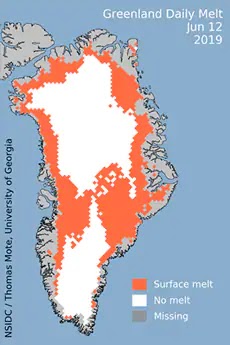
Data from the National Snow and Ice Data Center show that the Greenland ice sheet appears to have witnessed its biggest melt event so early in the season on record this week (although a few other years showed similar mid-June melting).
Melt extent on the Greenland Ice Sheet between April and October. The recent melt event (indicated by the blue line) appears to be the greatest on record in mid-June. (National Snow and Ice Data Center)

“The melting is big and early,” said Jason Box, an ice climatologist at the Geological Survey of Denmark and Greenland.

Box explained that temperatures over the western Greenland ice sheet have been abnormally high while snow has been well below normal.
Extent of Greenland ice sheet melting on June 12. (National Snow and Ice Data Center)

Marco Tedesco, an ice researcher at Columbia University, added that it has been unusually warm in east and central Greenland, as well. “This has triggered widespread melting that has reached about 45 percent of the ice sheet,” he wrote in an email.

Normally, melting this widespread over the ice sheet doesn’t occur until midsummer, if even then.

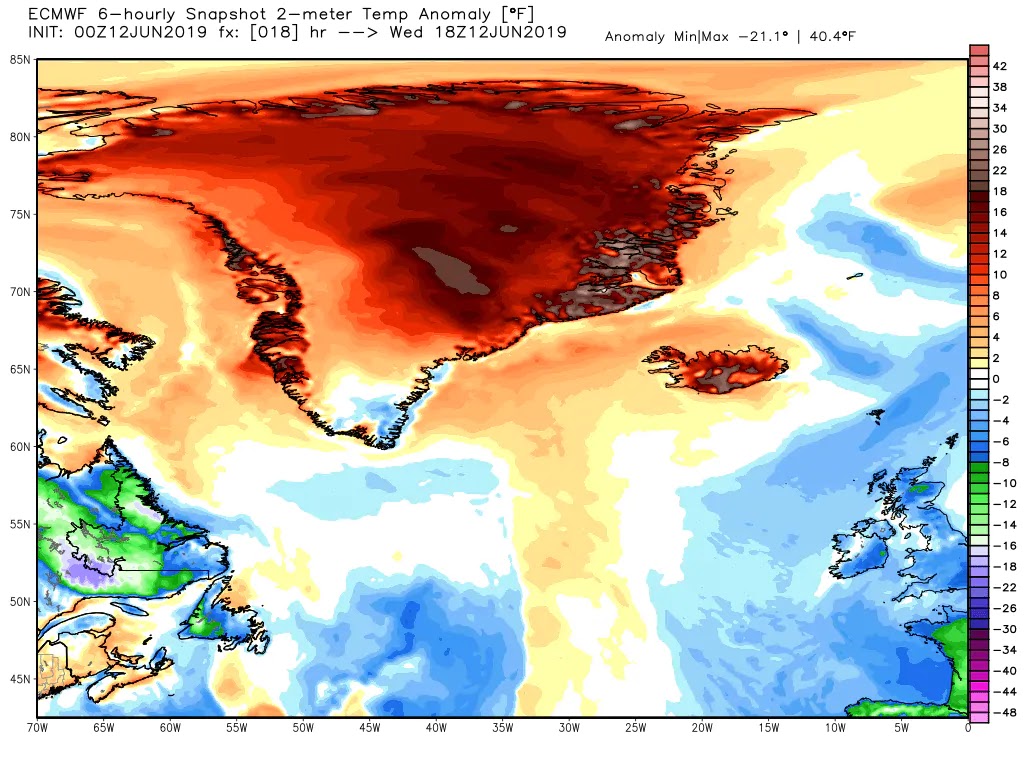
A simulation from the European Centre for Medium-range Weather Forecasting suggested that temperatures over Greenland may have peaked at around 40 degrees above normal on Wednesday.


European model simulation of temperature difference from normal over Greenland on Wednesday. (WeatherBell.com)

A big dome of high pressure has positioned itself over Greenland, resulting in sunny skies and mild temperatures, which have enabled melting. An automated weather station at the top of Greenland’s ice sheet topped freezing on June 12, a very rare event, which last occurred in July 2012.
2012 is the notorious year in which the Greenland ice sheet witnessed the most melting on record. Those monitoring the ice sheet say melting in 2019 could rival it.

Weather in the coming months will determine how much more the ice sheet melts and whether 2019 is a record-setter. If high pressure holds in place, “we should break a new record,” tweeted Xavier Fettweis, a climatologist at the University of Liège in Belgium.

But scientists studying the region know that Greenland’s weather is highly variable and can change rapidly.

Mike MacFerrin, a glaciologist at the University of Colorado, put it this way in a tweet: “2019 has been… anomalous… so far, but also quite variable. It’s early and weather is weather, so keep your eyes peeled. ...”

Arctic sea ice
(Zachary Labe)
 Weather satellites have monitored sea ice in the Arctic since 1979, and the current ice coverage is the lowest on record for mid-June.

The ice extent has been especially depleted in the part of the Arctic Ocean adjacent to the Pacific Ocean. “It’s pretty remarkable how much open water is in that area,” Labe said.

Labe explained high pressure over the Arctic has helped to pull sea ice way from the northern Alaska coast.
Sea ice loss over the Chukchi and Beaufort seas along Alaska’s northern coast has been “unprecedented” according to Rick Thoman, a climatologist based in Fairbanks.

Labe said there’s sufficient open water that you could sail all the way from the Bering Strait into a narrow opening just north of Utqiagvik, Alaska’s northernmost city, clear into the Beaufort Sea. “It’s very unusual for open water this early in this location,” he said.

With all of the exposed water, ocean temperatures in this region will rise, Labe said. This should delay the customary fall freeze and will likely result in a historically low late summer sea ice minimum, typically in mid-September.

Whether the Arctic sea ice minimum is record-setting, like the Greenland ice sheet, will depend on weather in the coming months.

“There is no indication that this year will be as low as 2012,” when Arctic sea ice reached its lowest extent on record, Labe said. “If cloudy weather occurs, it would slow down the rate [of melting]. It’s really hard to predict.”

Implications for weather over the United States?
The extreme conditions in the Arctic, which have resulted in these record-challenging melt events, have far-reaching implications. There is a saying often repeated by Arctic researchers: “What happens in the Arctic doesn’t stay in the Arctic.”

The bulging zones of high pressure in the Arctic, which have facilitated the unusual warmth and intensified melting, are displacing the cold air normally contained in that region into the mid-latitudes — like a refrigerator door left open. Much of the central and eastern United States have seen lower-than-normal temperatures in the past week.

Temperature difference from normal on Friday, as analyzed by the Global Forecast System model. (University of Maine Climate Reanalyzer)
 The jet stream, the high-altitude current separating cold air and warm air, has taken unusually erratic meanders.

“The jet stream this week was one of the craziest I’ve ever seen!” Jennifer Francis, one of the leading researchers who has published studies connecting Arctic change and mid-latitude weather, wrote in an email.

Francis had earlier suggested that conditions in the Arctic may have played a role in the extreme jet stream pattern that spurred the tornado swarm and record flooding in the central U.S. during the last two weeks of May.

“We can’t say that the rapid Arctic warming is causing this particularly pattern, but it certainly is consistent with that,” Francis, senior scientist at Woods Hole Research Center, said.

(Source: WP)

Friday, 21 June 2019

Norwegian island wants to erase the concept of time

Sun doesn't set on Sommaroy for 60 days a year

A Norwegian island is campaigning to get rid of the concept of time, allowing residents to do “what we want, when we want”.

Citizens of Sommaroy in West Tromso, north of the Arctic Circle, argue that normal business hours should not apply to them because they do not experience time like the majority of the rest of the world.

The sun doesn’t rise in winter or set in summer on Sommaroy, leading most of the island’s 300 residents to back a bid for it to become the world’s first time-free zone.

Kjell Ove Hveding, leader of the Time-Free Zone campaign, said the aim is to provide flexibility.


“All over the world, people are characterised by stress and depression,” he told Norwegian broadcaster NRK.

“In many cases this can be linked to the feeling of being trapped, and here the clock plays a role. We will be a time-free zone where everyone can live their lives to the fullest.

“Children and young people still have to go to school, but there is room for flexibility. One does not need to be put into a box in the form of school or working hours.

“Our goal is to provide full flexibility, 24/7. If you want to cut the lawn at 4am, then you do it.”

Between 18 May and 26 July the sun doesn’t set on Sommaroy for a full 60 days, making it difficult to differentiate between night and day. It's symbolised by the bridge from the mainland to the island, which is covered in discarded watches and timepieces.

According to Hveding, the move to abolish time would just be formalising something that happens already.

“There’s constantly daylight, and we act accordingly,” he added. “In the middle of the night, which city folk might call ‘2am’, you can spot children playing soccer, people painting their houses or mowing their lawns, and teens going for a swim.”

The campaign gained international attention after Hveding publicly handed a petition to local MP Kent Gudmundsen in June to discuss the practicalities and challenges of implementing it going forward.

Since then, other northern towns, including Finnmark and Nordland, have reportedly thrown their support behind the idea too.

(Source: Independent)

Sunday, 3 February 2019

Glacial melts in the Canadian Arctic reveal land that hasn't been seen in more than 40,000 years

Melting ice is exposing hidden landscapes in the Canadian Arctic that haven't been seen in more than 40,000 years, new research published in Nature Communications reveals.

Unsurprisingly, the study suggests climate change is the driving force behind this record-breaking glacial retreat and with Arctic temps rising at increasing speed thanks to strong positive feedback loops in the polar regions, we can expect things to heat up even quicker in the near future. According to researchers at the University of Colorado at Boulder, the Canadian Arctic may be seeing its warmest century in as many as 115,000 years.

Southern Baffin Island, Canadian Arctic, Arctic Ocean. Kike Calvo/AP

"The Arctic is currently warming two to three times faster than the rest of the globe, so naturally, glaciers and ice caps are going to react faster," Simon Pendleton, the lead author and a doctoral researcher in Colorado Boulder's Institute of Arctic and Alpine Research, said in a statement.
Pendleton and colleagues' research is based on plants collected at the edge of ice caps on Baffin Island, the fifth-largest island in the world. The landscape is dominated by deeply incised fjords and high-elevation, low-relief plateaus. The latter conserves lichens and moss in their original position in the ice for periods of time lasting thousands of years — a little like a cryogenic chamber.

Previous observations indicate that foliage is soon "removed" from the environment once it loses that protective ice layer, either by meltwater in the summertime or wind-blown snow in winter. This lets scientists make a reasonable assumption that vegetation collected today is vegetation that has been covered in ice since its original growth period. As such, it offers a pretty decent barometer for how far and how quickly glaciers are retreating.

Baffin Bay, Nunavut, Canada.City Escapes Nature Photo/Shutterstock
 "We travel to the retreating ice margins, sample newly exposed plants preserved on these ancient landscapes, and carbon date the plants to get a sense of when the ice last advanced over that location," Pendleton said.

"Because dead plants are efficiently removed from the landscape, the radiocarbon age of rooted plants define the last time summers were as warm, on average, as those of the past century."

In total, the team collected 48 plant samples from 30 ice caps on Baffin Island as well as quartz samples, which were used to help confirm the age and ice cover history of the environment. Analysis in the lab suggests that plants in all 30 ice caps were likely to have been preserved in a constant sheet of ice for the past 40,000 years — or longer.

Meltwater running through Baffin Island.INSTAAR/Youtube
The results were then compared to temperature data recovered from ice cores in Greenland and Baffin Island, which imply temperatures over the past 100 years have been the warmest in the region for 115,000 years.

"Unlike biology, which has spent the past 3 billion years developing schemes to avoid being impacted by climate change, glaciers have no strategy for survival," the senior author Gifford Miller, a professor of geological sciences at Colorado Boulder, explained.

Vegetation found underneath the melted ice.INSTAAR/Youtube
"They're well behaved, responding directly to summer temperature. If summers warm, they immediately recede; if summers cool, they advance. This makes them one of the most reliable proxies for changes in summer temperature."

And what with atmospheric carbon dioxide set to spike once again in 2019, we can expect more of these warm summers.

"We haven't seen anything as pronounced as this before," Pendleton added.

(Source: BI)

Wednesday, 22 August 2018

Arctic’s strongest sea ice breaks up for first time on record

Usually frozen waters open up twice this year in phenomenon scientists described as scary

The oldest and thickest sea ice in the Arctic has started to break up, opening waters north of Greenland that are normally frozen, even in summer.

This phenomenon – which has never been recorded before – has occurred twice this year due to warm winds and a climate-change driven heatwave in the northern hemisphere.

One meteorologist described the loss of ice as “scary”. Others said it could force scientists to revise their theories about which part of the Arctic will withstand warming the longest.

The sea off the north coast of Greenland is normally so frozen that it was referred to, until recently, as “the last ice area” because it was assumed that this would be the final northern holdout against the melting effects of a hotter planet.

But abnormal temperature spikes in February and earlier this month have left it vulnerable to winds, which have pushed the ice further away from the coast than at any time since satellite records began in the 1970s.

“Almost all of the ice to the north of Greenland is quite shattered and broken up and therefore more mobile,” said Ruth Mottram of the Danish Meteorological Institute. “Open water off the north coast of Greenland is unusual. This area has often been called ‘the last ice area’ as it has been suggested that the last perennial sea ice in the Arctic will occur here. The events of the last week suggest that, actually, the last ice area may be further west.”

 A giant iceberg that has drifted towards an Innaarsuit settlement in west Greenland. Photograph: Scanpix Denmark/Reuters

Ice to the north of Greenland is usually particularly compacted due to the Transpolar Drift Stream, one of two major weather patterns that push ice from Siberia across the Arctic to the coastline, where it packs.

Walt Meier, a senior research scientist at the US National Snow and Ice Data Center, said: “The ice there has nowhere else to go so it piles up. On average, it’s over four metres thick and can be piled up into ridges 20 metres thick or more. This thick, compacted ice is generally not easily moved around.

“However, that was not the case this past winter (in February and March) and now. The ice is being pushed away from the coast by the winds.”

How is climate change affecting the Arctic?
The world may have warmed by around 1C (1.8F) over the past century but the Arctic far outstrips this global average and is warming at around twice the rate of the rest of the world.

In places, the rate of warming has been astonishing. Novembers in the Alaskan town of Utqiaġvik, formerly Barrow, are now 5.5C warmer than they were in 1979. This past winter, the warmest on record in the Arctic, saw some locations exceed 20C hotter than normal.

The Arctic is dominated by sea ice, unlike the Antarctic which is essentially a huge land-based ice sheet. As the ocean and atmosphere warm, sea ice is shrinking in extent, at around 13% a decade since 1979, according to Nasa. The bright white surface of ice, known as albedo, is giving way to the dark ocean, meaning that sunlight is being absorbed rather than reflected, amplifying the warming effect.

These “rapid and dramatic changes” are introducing a “new normal” to the Arctic, according to US government scientists in a report card last year. Storms are eroding away ice-free coastlines, summer wildfires are becoming fiercer and certain species, such as polar bears, are increasingly struggling to find food. This is all providing a major challenge to communities in the Arctic, but a boon to the shipping industry, which can navigate the area more easily. This task will get even simpler once the Arctic is ice free in summertimes, forecast as soon as 2040s.

Ice is easier to blow around as a result of a warming trend, which has accelerated over the past 15 years. “The thinning is reaching even the coldest part of the Arctic with the thickest ice. So it’s a pretty dramatic indication of the transformation of the Arctic sea ice and Arctic climate.”

“Scary,” wrote Thomas Lavergne, a scientist at the Norwegian Meteorological Institute, in a retweet of a satellite-gif of the blue water penetrating white ice and exposing hundreds of miles of the Greenland coastline.
He said this would flush chunks of thicker ice out through the Fram or Nares Straits into warmer southern waters.

“I cannot tell how long this open water patch will remain open, but even if it closes in few days from now, the harm will be done: the thick old sea ice will have been pushed away from the coast, to an area where it will melt more easily,” he added.

This year’s openings are driven more by wind than melting but they have occurred during two temperature spikes. In February, the Kap Morris Jesup weather station in the region is usually below -20C, but earlier this year there were 10 days above freezing and warm winds, which unlocked the ice from the coast.

Last week, the crack opened again after Kap Morris Jesup briefly registered a record high of 17C and strong southerly winds picked up to 11 knots. Experts predict that coastal seas will freeze again but probably later than normal.

“I think that solar heating of the water column will increase during this opening and this will delay freeze-up and ice formation,” said Rasmus Tage Tonboe, a sea ice expert at the the Danish Meteorological Institute.

The latest readings by the Norwegian Ice Service show that Arctic ice cover in the Svalbard area this week is 40% below the average for this time of year since 1981. In the past month, at least 14 days in the past month have hit record lows in this region. Although thinner ice elsewhere in the Arctic means this is unlikely to be a record low year overall, they are in line with predictions that there will be no summer ice in the Arctic Ocean at some point between 2030 and 2050.

Keld Qvistgaard, the ice service coordinator in Denmark, said this was not the first time a gap had appeared between the shore and the main ice pack but the one formed from 1 to 5 August was different in its extent. “This event is a pretty big one going all the way to west of Kap Morris Jesup. This is unusual,” he said.

As well as reducing ice cover, the ocean intrusion raises concerns of feedbacks, which could tip the Earth towards a hothouse state.

Freakish Arctic temperatures have alarmed climate scientists since the beginning of the year. During the sunless winter, a heatwave raised concerns that the polar vortex may be eroding.

This includes the Gulf Stream, which is at its weakest level in 1,600 years due to melting Greenland ice and ocean warming. With lower circulation of water and air, weather systems tend to linger longer.

A dormant hot front has been blamed for record temperatures in Lapland and forest fires in Siberia, much of Scandinavia and elsewhere in the Arctic circle.

(Source: The Guardian)

Wednesday, 17 January 2018

Sun finally rises after 40 days of darkness in northern Russia

Russians north of the Arctic Circle have come out of their slumber with the year’s first glimmer of sunlight on Friday.


After just over 30 minutes of daylight, locals were eager to share their excitement with the rest of the world, leading to this collection of images from the past hours.

A natural phenomenon called polar night occurs when regions within the Arctic Circle descend into darkness for more than 24 hours. Russia’s Arctic port of Murmansk sees no sunlight for 40 days between Dec. 2 and Jan. 11.


Local residents traditionally gather at the city’s highest point on the last day of the polar night to witness the first rays of the sun rising above the horizon.

This year was no exception, with social media users and local television stations huddling at “Solnechnaya Gorka” (“Sunny Hill” in Russian) to observe the year’s first sunrise. 

It's all uphill from here!

(Source: MT)

Thursday, 28 December 2017

Arctic stronghold of world’s seeds flooded after permafrost melts

No seeds were lost but the ability of the rock vault to provide failsafe protection against all disasters is now threatened by climate change, writes Damian Carrington in the Guardian. Read on: 

It was designed as an impregnable deep-freeze to protect the world’s most precious seeds from any global disaster and ensure humanity’s food supply forever. But the Global Seed Vault, buried in a mountain deep inside the Arctic circle, has been breached after global warming produced extraordinary temperatures over the winter, sending meltwater gushing into the entrance tunnel.

The vault is on the Norwegian island of Spitsbergen and contains almost a million packets of seeds, each a variety of an important food crop. When it was opened in 2008, the deep permafrost through which the vault was sunk was expected to provide “failsafe” protection against “the challenge of natural or man-made disasters”.

The Svalbard ‘doomsday’ seed vault was built to protect millions of food crops from climate change, wars and natural disasters. Photograph: John Mcconnico/AP
But soaring temperatures in the Arctic at the end of the world’s hottest ever recorded year led to melting and heavy rain, when light snow should have been falling. “It was not in our plans to think that the permafrost would not be there and that it would experience extreme weather like that,” said Hege Njaa Aschim, from the Norwegian government, which owns the vault.

“A lot of water went into the start of the tunnel and then it froze to ice, so it was like a glacier when you went in,” she told the Guardian. Fortunately, the meltwater did not reach the vault itself, the ice has been hacked out, and the precious seeds remain safe for now at the required storage temperature of -18C.

But the breach has questioned the ability of the vault to survive as a lifeline for humanity if catastrophe strikes. “It was supposed to [operate] without the help of humans, but now we are watching the seed vault 24 hours a day,” Aschim said. “We must see what we can do to minimise all the risks and make sure the seed bank can take care of itself.”

The vault’s managers are now waiting to see if the extreme heat of this winter was a one-off or will be repeated or even exceeded as climate change heats the planet. The end of 2016 saw average temperatures over 7C above normal on Spitsbergen, pushing the permafrost above melting point.

“The question is whether this is just happening now, or will it escalate?” said Aschim. The Svalbard archipelago, of which Spitsbergen is part, has warmed rapidly in recent decades, according to Ketil Isaksen, from Norway’s Meteorological Institute.

“The Arctic and especially Svalbard warms up faster than the rest of the world. The climate is changing dramatically and we are all amazed at how quickly it is going,” Isaksen told the Norwegian newspaper Dagbladet.

 Plastic boxes containing plant seeds inside the international Svalbard Global Seed Vault on Spitsbergen, Norway. Photograph: Jens Buttner/dpa/Alamy
The vault managers are now taking precautions, including major work to waterproof the 100m-long tunnel into the mountain and digging trenches into the mountainside to channel meltwater and rain away. They have also removed electrical equipment from the tunnel that produced some heat and installed pumps in the vault itself in case of a future flood.

Aschim said there was no option but to find solutions to ensure the enduring safety of the vault: “We have to find solutions. It is a big responsibility and we take it very seriously. We are doing this for the world.”

“This is supposed to last for eternity,” said Ã…smund Asdal at the Nordic Genetic Resource Centre, which operates the seed vault.