Showing posts with label ice. Show all posts

Sunday, 15 December 2019

Climate change: Greenland ice melt 'is accelerating'

Greenland is losing ice seven times faster than it was in the 1990s.

The assessment comes from an international team of polar scientists who've reviewed all the satellite observations over a 26-year period.

They say Greenland's contribution to sea-level rise is currently tracking what had been regarded as a pessimistic projection of the future.

It means an additional 7cm of ocean rise could now be expected by the end of the century from Greenland alone.

This threatens to put many millions more people in low-lying coastal regions at risk of flooding.

It's estimated roughly a billion live today less than 10m above current high-tide lines, including 250 million below 1m.

"Storms, if they happen against a baseline of higher seas - they will break flood defences," said Prof Andy Shepherd, of Leeds University.

"The simple formula is that around the planet, six million people are brought into a flooding situation for every centimetre of sea-level rise. So, when you hear about a centimetre rise, it does have impacts," he told BBC News.


The British scientist is the co-lead investigator for Imbie - the Ice Sheet Mass Balance Inter-comparison Exercise.

It's a consortium of 89 polar experts drawn from 50 international organisations.

The group has reanalysed the data from 11 satellite missions flown from 1992 to 2018. These spacecraft have taken repeat measurements of the ice sheet's changing thickness, flow and gravity. The Imbie team has combined their observations with the latest weather and climate models.

What emerges is the most comprehensive picture yet of how Greenland is reacting to the Arctic's rapid warming. This is a part of the globe that has seen a 0.75C temperature rise in just the past decade.

The Imbie assessment shows the island to have lost 3.8 trillion tonnes of ice to the ocean since the start of the study period. This mass is the equivalent of 10.6mm of sea-level rise. What is more, the team finds an acceleration in the data.

Whereas in the early 90s, the rate of loss was equivalent to about 1mm per decade, it is now running at roughly 7mm per decade.

Imbie team-member Dr Ruth Mottram is affiliated to the Danish Meteorological Institute.

She said: "Greenland is losing ice in two main ways - one is by surface melting and that water runs off into the ocean; and the other is by the calving of icebergs and then melting where the ice is in contact with the ocean. The long-term contribution from these two processes is roughly half and half."

In an average year now, Greenland sheds about 250 billion tonnes of ice. This year, however, has been exceptional for its warmth. In the coastal town of Ilulissat, not far from where the mighty Jakobshavn Glacier enters the ocean, temperatures reached into the high 20s Celsius. And even in the ice sheet interior, at its highest point, temperatures got to about zero.

"The ice loss this year was more like 370 billion tonnes," said Dr Mottram.

Back in 2013, the Intergovernmental Panel on Climate Change (IPCC) - the authoritative body that reconciles all climate science - gave a mid-range projection for global sea level rise of about 60cm by 2100. A mixture of ice melt and expansion of warming water.

But when Imbie published its companion review of Antarctica in 2018, it found the White Continent's contribution by 2100 was likely being underestimated by 10cm. Now, for Greenland, Imbie is saying the shortfall is 7cm. The IPCC will have to incorporate these updates when it releases its next major assessment report (AR6) of Earth's climate in a couple of years' time.

Prof René Forsberg, from the Technical University of Denmark, said the Imbie exercise underlined the importance of flying satellites, especially those that can observe the top of Greenland, higher than 83 degrees North. Only two of the present fleet can, and one of those spacecraft is operating beyond its design life.
The Arctic has warmed 0.75C in the past decade, relative to 1951–1980

"Most of the changes we've seen in Greenland have been in the west, south and east; and now it has slowly moved up to the north. So, yes, the next satellite in the European Union's Copernicus programme needs to go to higher latitudes, and this is being discussed by the EU and the European Space Agency," Prof Forsberg told BBC News.

The new satellite system - for the moment known as Cristal, but to be called a Sentinel if it flies - would be a radar altimeter to measure the changing shape of Greenland.

Imbie's Greenland analysis is published in the journal Nature. Its release has been timed to coincide with the annual COP climate convention taking place this year in Madrid, and with the American Geophysical Union meeting here in San Francisco, where leading Earth scientists have gathered.

(Source: BBC)

Friday, 13 December 2019

Daisetsuzan: Life in the icy white forest

Winter lasts most of the year in Daisetsuzan, the high mountain range that stretches across the center of Hokkaido. The first flurries of snow arrive in September, and the final thaw doesn’t come till the following June. Yet some animals live successfully and apparently quite happily in this frozen world winter has come to Daisetsuzan.

Winter wonderland: As a blizzard lifts, the forest's appearance is transformed by a fresh coat of white. Snow newly settled on the top branches of birch trees glistens in the sunlight. | KENJI ITO
It’s only October, but the once-dazzling autumn foliage has all dropped from the trees. As cold air moves in from Siberia, the scene changes dramatically. Fresh snow settles first on the mountain peaks, then advances inexorably down the slopes until it reaches the bottom and the entire landscape has turned white. Day after day the vast forests are blanketed with sparkling ice crystals. Soon, all signs of human encroachment have disappeared from the high ridges, now the domain of no one but the wind.

Boasting several of the island’s highest peaks, the Daisetsuzan range is known as the “roof” of Hokkaido. It extends over an area of some 230,000 hectares, about the same size as all of Kanagawa Prefecture. Daisetsuzan was declared a national park 80 years ago, in 1934.

When a winter coat comes in handy: A male Ezo deer covered in snow. Coming face to face with one of Daisetsuzan’s yearlong residents makes you wonder who has it better — them or us. | KENJI ITO
The highest peak is Mount Asahi, 2,290 meters above sea level. For the most part the topography is gentler than on the highest summits of Honshu to the south, which rise to more than 3,000 meters. But here in the far north the tree line is much lower, yielding to a high-altitude zone of tundra where alpine flora reign in a unique natural environment.

As the source of the bountiful Ishikari River, the Daisetsuzan range is revered by the region’s indigenous Ainu people, who call it Kamui Min-tara — the garden of the gods.

It’s early morning and a blizzard has just cleared. The temperature is minus 25 degrees Celsius, so cold that your breath freezes and frost forms on your eyelashes. The snow is waist-deep, so skis must be fitted with nonslip devices. Even then, every step requires caution.

The biggest snowdrifts are as much as 5 meters deep. When the sun begins to shine through the trees, it casts a greenish light on the ground below, giving the white blanket a coral-like hue and fostering the illusion that you are traversing an ocean of snow.

Kya, kya, kya! A high-pitched cry suddenly echoes in the treetops as a Hokkaido red squirrel leaps from a branch, shaking fresh snow down onto the forest floor. As though responding to a signal, the snow piled high on the surrounding branches also begins to fall in one frozen shower after another, forming a curtain of crystalline light as the cascading flakes catch the sun.
A foxy perspective: As the sunlight filters softly through the trees, an Ezo red fox perks up its ears and sniffs the air for interesting scents. How does this landscape appear to the vulpine eye, do you suppose? | KENJI ITO

Stand still for a moment and you can feel your hands and feet turning numb. They seem to be on the verge of freezing — and yet you can’t take your eyes off the tiny animals scampering about in the woods. Leaving the trees for open fields of snow, you’ll see the tracks of mountain hares, rhythmic evidence of their hopping gait where they passed by just a short while ago.

Life thrives in this snowy realm all year round. Perhaps most astonishing of all is the fact that January and February, Daisetsuzan’s coldest time of year, are the months when brown bears snuggled away in their winter lairs give birth to their cubs.

(Source: JT)

Thursday, 28 November 2019

Alaska’s ice cellars melting due to climate change after being used to store food for generations

Rising temperatures are causing dramatic changes to an ancient way of life in Alaska’s far-north

After generations of storing their food in handmade cellars dug deep into the permafrost, growing numbers in Alaska’s far-north now find their cellars filling up with water and blood.

Dozens of the naturally refrigerated food shelters exist underneath the region’s mainly Inupiat whaling villages – where many rely on hunting and fishing to eat.

But now climate change and other modern factors are forcing changes to an ancient way of life, rendering traditional storage methods dangerously unreliable.

Ranging from small arctic root cellars to spacious, wood-lined underground chambers, ice cellars are typically stocked with vast amounts of whale, walrus, seal and caribou.
Alaska's traditional ice cellars, upon which many native communities rely upon for large portions of their diet in the harsher months, are being impacted by climate change ( Alaska Native Tribal Health Consortium/AP )

These chambers, usually built 10 to 12 feet below the surface, have long been used to age subsistence food to perfection and ensure a steady supply during the sparser months, which is critical for survival.

But increasingly, these cellars are beginning to collect mould and water, in some cases becoming completely submerged. Others collapse completely.

In Alaska’s northernmost community, Utqiagvik – which saw its warmest summer on record this year – about 60 per cent of the 1,500 households rely on subsistence foods for at least half of their diet, National Geographic wrote in 2015.

“I’m worried,” said Gordon Brower, a Utqiagvik whaling captain whose family owns two ice cellars.

One is more than a century old and used to store at least two tonnes whale meat set aside for community feasts. The other, built in 1955, is used to feed Mr Brower and his family.

He recently asked his son to retrieve some whale meat from the one of the cellars, and discovered both were in a bad state.

“He came back and said: ‘Dad, there’s a pool of blood and water at the bottom,’” said Mr Brower, who is now housing the community’s meat under a tarpaulin sheet above ground.

“It seems like slight temporary variations in the permafrost – that active layer – is affecting the temperature of our cellar,” Mr Brower said.

There were once at least 50 ice cellars in Point Hope, a native village built precariously on a thin spit of land caught between the Chukchi and Arctic oceans.

Now, there are less than 20 cellars in the village of 750 people.

Many in the community have little money and cannot afford to replace traditional methods with modern freezers.

To compensate, Point Hope whaling captains have use of three walk-in freezers that were donated for use by the whaling community.

But the much colder freezers do not impart the taste of aged whale meat so favoured throughout the region.

“It’s definitely a challenge at this time to be able to feed our people that acquired taste,” said 52-year-old whaling captain Russell Lane, who has spent his whole life in Point Hope.

The problem has been building for decades as a warming climate impacts multiple facets of life in the far-north – thawing permafrost, disruptions in hunting patterns and shorter periods of coastal ice that had long protected coastal communities from powerful storms. Other factors include development and soil conditions.

The changes have increased vulnerability to foodborne illnesses and raised concerns about food security, according to studies by the Alaska Native Tribal Health Consortium.

State health officials said so far they have not heard of anyone becoming ill.

Despite the unprecedented rate of modern climate change, ice cellars have failed as far back as the early 1900s, according to a 2017 study in Utqiagvik in response to reports of flooded and collapsed cellars.
An entrance to a traditional Alaskan ice cellar (Alaska Native Tribal Health Consortium/AP)
Researchers mapped 71 ice cellar locations around town and monitored five functioning cellars from 2005 to 2015, finding little thermal change over that relatively short timeframe. One of those cellars has since failed, however, and another is starting to collapse.

The study concluded that while a changing climate has great potential to affect ice cellars, there are other factors, including soil conditions and urban development.

“Climate change, air temperatures, all these physical changes are affecting them,” said Kelsey Nyland from George Washington University, one of the study’s authors.

“But also, a lot of it has to do with development and modern life in an arctic setting.”

Scientists had previously agreed that an underground tunnel, known as the utilidor, built in Utqiagvik in 1984 to provide water, electricity, and other utilities had been responsible for the failure of some cellars, National Geographic reported in 2015.

To adapt to the new environment, the village of Kaktovik, on the Beaufort Sea coast, took ambitious steps after it lost all but one family’s cellar to flooding.

In 2013, the village launched a project to build a community ice cellar incorporating traditional designs with contemporary technology used in Alaska’s North Slope oil fields – thermosyphons, off-grid tubelike refrigeration devices that cool the ground by transferring heat outside.

The hand-excavated cellar was ready for use in 2017, but it has yet to be filled. Whaling captains want to expand it first, according to whaling captain George Kaleak Sr, who represents Kaktovik on the Alaska Eskimo Whaling Commission.

Temperature sensors inside the cellar show it’s working as intended, Kaleak said. He expects the expansion to begin as early as next spring.

But experts warn melting ice cellars are a problem for hunters across the Arctic.

While some communities are able to avert crisis using modern technology, in Siberia the disappearance of millennia-old permafrost is now creating climate refugees.

With researchers continually revising their predictions for how quickly permafrost could melt, and how this could contribute to the warming of the planet, it seems increasingly likely those forced to leave their homes will not be the last.

“The permafrost is thawing so fast,” Anna Liljedahl, associate professor at the University of Alaska told The Washington Post in October “We scientists can’t keep up anymore.”

(Source: Independent)

Sunday, 8 September 2019

Climate change: Greenland's ice faces melting 'death sentence'

Greenland's massive ice sheet may have melted by a record amount this year, scientists have warned.

During this year alone, it lost enough ice to raise the average global sea level by more than a millimetre.

Researchers say they're "astounded" by the acceleration in melting and fear for the future of cities on coasts around the world.

One glacier in southern Greenland has thinned by as much as 100 metres since I last filmed on it back in 2004.

Why does Greenland matter?
Essentially because its ice sheet is seven times the area of the UK and up to 2-3km thick in places. It stores so much frozen water that if the whole thing melted, it would raise sea levels worldwide by up to 7m.

No one is suggesting that could happen for hundreds or even thousands of years but even a small increase in the rate of melting in coming decades could threaten millions of people living in low-lying areas.

Bangladesh, Florida, and eastern England are among many areas known to be particularly vulnerable to rises in sea level over the course of the century.

And although the island of Greenland is remote, stretching from the north of the Atlantic high into the Arctic, its fate could have major implications for the severity of future flooding and may even alter coastlines and force communities to move inland.

One of the scientists studying the ice sheet, Dr Jason Box of the Geological Survey of Denmark and Greenland (GEUS), says he's unnerved by the potential dangers and that coastal planners need to "brace themselves".

"Now that I'm starting to understand more of the consequences, it's actually keeping me awake at night because I realise the significance of this place around the world and the livelihoods that are already affected by sea level rise," he told me. 

Dr Jason Box, Geological Survey of Denmark
How much is Greenland melting?
Until recently, the ice sheet was generally in a state of balance - the amount of snow falling in winter was roughly equal to the amount of ice melting in summer.


Last year, there was actually a gain in ice but that was relatively unusual. Over the last 30 years, decade-by-decade, Greenland has tended to shed more ice.

Either the ice melts at the surface which sends torrents of water down to the surrounding seas or huge chunks of ice break off from the margins and float away as icebergs, gradually to melt.


Recent years have seen hundreds of billions of tonnes of ice lost - and a rough guide to the effect on sea level is that 362 billion tonnes of melt raises the average ocean level by a millimetre.

That doesn't sound a lot but in 2012 Greenland's loss totalled about 450 billion tonnes, and this year's melt is on course to produce about the same, or even slightly more, with some researchers suggesting it could raise sea levels by up to 2mm.

And on top of that you have to factor in the ice melting in Antarctica plus the effect of water expanding as it warms. It all raises the level of the oceans.


According to Dr Box, it's the recent increase in the average temperature that's being felt in Greenland's ice: "Already effectively that's a death sentence for the Greenland ice sheet because also going forward in time we're expecting temperatures only to climb," he said.

"So, we're losing Greenland - it's really a question of how fast."

How rapidly is the ice sheet changing?
I've seen for myself what's happened to one corner of it. Sermilik glacier at the southern end is not one of Greenland's largest but it does rank as one of the fastest-shrinking streams of ice anywhere in the world.

To reach it back in 2004, we flew past towering cliffs of ice, the front of the glacier an immense wall of pale grey and blue standing high above the sea.

At that time, we accompanied a scientist who checked instruments positioned on the ice and he was stunned to see how the surface of the glacier was dropping by as much as a metre every month.

And over the past 15 years, that rate of shrinking has continued so aggressively that now, on a return visit to the same glacier, the ice looks diminished, almost battered, and far less dominating in the landscape.


Jason Box is with me and he gathers the latest readings which show that over this summer alone the glacier has shrunk by an estimated 9m. "That's an astounding rate of loss," he said.

Since my last visit, the surface of this margin of the ice sheet has lowered by an extraordinary 100m, more than halving in thickness, exposing the remaining ice to the relatively warmer temperatures of lower altitudes.


What's happening to the ice itself?
While you might think of the Arctic as a pristine white landscape, the startling feature of the surface is how dirty it looks. Walking on it feels like arriving on the Moon.

There are big areas of pale grey and smaller patches that are much darker, covered with what appears to be mud or silt - it's a grim and rather depressing sight.

Algae growing on the Sermilik glacier
It used to be thought that this darkness was mainly caused by a mix of dust and pollution particles carried on the winds from distant power stations and industrial centres.

But since my last visit to Sermilik glacier, scientists have made an important breakthrough in understanding that a major cause of the darkening is in fact biological - algae, microscopically small plants that are flourishing in the melting ice.


By turning the surface grey, or black, from its usual bright white, the algae make it less reflective, so it absorbs more of the Sun's rays. This accelerates the warming and in turn leads to even more melting.

Who's trying to work out what's going on?
With the stakes so high for so many millions of people around the world, Greenland is the target of a major international research effort involving satellites, monitoring flights and expeditions on the ice itself.

The US space agency Nasa has for years run projects investigating exactly what's causing the ice to melt and what could happen to it in future.

Back in 2005, I reported on a Nasa-funded team that made an important discovery about the movement of the ice sheet.


Although the great mass of ice looks immobile, it's actually always inching down towards the coast and the team found that this movement doubles in speed in summer - as meltwater from the surface works its way to the bottom of the ice and helps it to slide along.


Another revelation is that the ice is not only being melted by the air, as the atmosphere heats up, but also by warmer water reaching underneath the fronts of the glaciers. One Nasa scientist describes the ice as being under a hair-dryer and at the same time also on a cooker.

And Jason Box and his colleagues at GEUS run a network of sensors on the ice to record details of the height of the surface and its reflectivity, and how they're changing.


The hardest challenge for the scientific community is understanding enough of the mechanisms of the ice sheet to be able to offer reliable forecasts of sea level rise.

Dr Masashi Niwano, a researcher with the Japan Meteorological Agency, is just back from a field trip to gather data to try to validate his computer simulations of the ice.

"The ice sheet mass is decreasing - that is very certain. And these results affect global sea-level rise - that is also very certain," he said.

"But maybe there are several physical processes that we don't understand, so developing future projections is very difficult."

What do the people of Greenland make of all this?
There are only 56,000 Greenlanders, and they live in communities perched on the narrow band of land at the edge of the ice sheet which, though close, is usually out of sight.

Inutsiaq Ibsen, 18, Naja-Theresia Høegh, 19, and Caroline Hartmann Hansen, 21, in Qaqortoq
In the village of Narsaq, Christian Mortensen tells me a glacier that was visible when he was younger has since retreated and that icebergs seem to "break more and more" into the waters.

Warmer conditions would allow more farming and, as we talk, cattle are grazing around us on pasture that's beside bright white chunks of ice bobbing in the sea.


But for some young Greenlanders, climate change is becoming a big concern, partly because of the impact of "their" ice on other areas of the planet.

Naja-Theresia Høegh, who's just finished school, was inspired by the Swedish campaigner Greta Thunberg to lead a climate strike in her town of Qaqortoq, a pretty port of brightly painted houses.

She describes a boat trip to the edge of the ice sheet where she found it "astonishing and scary" that so much water could flow out.

"All of that is ending up in our waters, into the sea, and to the rest of the world and, if this continues, it will someday just cover a whole country," Ms Høegh explained.

Her friend Caroline Hartmann Hansen also talked about her fears over the uncontrolled nature of the melting. "It's not our fault; it's everyone's," she said.


Can anything be done?
If the calculations of Jason Box and his colleagues are right, the ice sheet is already crossing a threshold into an era in which there may still be years with net gains of ice - like last year - but the new normal will see more big losses.


Even with a rapid move to cut emissions of warming gases - as outlined in the 2015 Paris climate agreement - Greenland could still see a growing rate of melting, though that could possibly be slowed.

So, as with the young Greenland climate campaigners, the scientists feel the need to take action of their own.

They have started a scheme to try to absorb some of the carbon dioxide emitted by the flights they take to conduct their research; Jason said he has been criticised for his high carbon footprint and "feels guilty about it".

Dr Faezeh Nick plants tree saplings near Narsarsuaq
Close to the airport at Narsarsuaq, which connects them to the glaciers of southern Greenland, the researchers are planting 6,000 saplings of Siberian larch, a type of tree known to do well in conditions here.

They admit that 10 of the trees would need to grow for 60 years to absorb the carbon produced by a return flight from London to San Francisco, but they say it's a start and that if the project later leads to a much larger forest, it might "make a dent" in climate change.

Meanwhile, as memories of last month's polar heatwave fade, the scientists are leaving ahead of the winter nights, to try to hone their predictions for what the scarred and darkened ice sheet is likely do next.

(Source: BBC)

Monday, 19 August 2019

How global warming is transforming Siberia

Climate change is thawing the Siberian permafrost. For the people and animals who live in one of the coldest inhabited places on earth, the consequences are severe

The lab assistant reaches into the freezer and lifts out a football-size object in a tattered plastic grocery bag, unwrapping its muddy covering and placing it on a wooden table. It is the severed head of a wolf.

The animal, with bared teeth and mottled fur, appears ready to lunge. But it has been glowering for some 32,000 years – preserved in the permafrost, 65 feet underground in Yakutia in northeastern Siberia.

As the Arctic, including much of Siberia, warms at least twice as fast as the rest of the world, the permafrost – permanently frozen ground – is thawing. Oddities like the wolf’s head have been emerging more frequently in a land already known for spitting out frozen woolly mammoths whole.

The thawing of the permafrost – along with other changes triggered by global warming – is reshaping this incredibly remote region sometimes called the Kingdom of Winter. It is one of the coldest inhabited places on earth, and huge; Yakutia, if independent, would be the world’s eighth-largest country.

The loss of permafrost deforms the landscape itself, knocking down houses and barns. The migration patterns of animals hunted for centuries are shifting, and severe floods wreak havoc almost every spring.

The water, washing out already limited dirt roads and rolling corpses from their graves, threatens entire villages with permanent inundation. Waves chew away the less frozen Arctic coastline.

Indigenous peoples are more threatened than ever. Residents joust constantly with nature in unpredictable ways, leaving them feeling baffled, unsettled, helpless, depressed and irritated.

“Everything is changing, people are trying to figure out how to adapt,” says Afanasiy V Kudrin, 63, a farmer in Nalimsk, a village of 525 people above the Arctic Circle. “We need the cold to come back, but it just gets warmer and warmer and warmer.”

Climate change is a global phenomenon, but the shifts are especially pronounced in Russia, where permafrost covers some two-thirds of the country at depths ranging up to almost a mile.

“People don’t comprehend the scale of this change, and our government is not even thinking about it,” says Alexander N Fedorov, deputy director of the Melnikov Permafrost Institute, a research body in Yakutsk, the regional capital.

In Yakutia, almost 20 per cent of Russia, distances are vast and transportation erratic. The population is just under 1 million. Natives joke that every resident could claim one lake.

Yakutia’s 33 districts are the size of countries. In the far northeast, the Srednekolymsk district, which lies entirely above the Arctic Circle, is slightly smaller than Greece. Just 8,000 residents live in 10 villages, including 3,500 in the capital, also Srednekolymsk.

The region has been a synonym for remote for centuries. Empress Elizabeth exiled the first prominent political prisoner to Srednekolymsk in 1744, when it took a year to reach overland from St Petersburg. There are just two main highways transiting Yakutia, with the one built mostly by Gulag prisoners under Communism still largely unpaved.

In Srednekolymsk, summer used to last from 1 June to 1 September but now extends a couple of weeks longer on both ends. Outsiders might not notice that the thermometer in January often hovers around -45C, rather than -60C. Residents call -45C “chilly”.

In a region-wide pattern, the average annual temperature in Yakutsk has risen more than four degrees, to -7.5C from -10C, over several decades, says Fedorov of the permafrost institute.

Warmer winters and longer summers are steadily thawing the frozen earth that covers 90 per cent of Yakutia. The top layer that thaws in summer and freezes in winter can extend down as far as 10 feet where 3 feet used to be the maximum.

Eroding cliffs on riverbanks expose other areas, like where the wolf head appeared, that had long been deeply buried.

The thawing permafrost, and increased precipitation, have made the land wetter. The snow and rain create a vicious circle, forming an insulating layer that speeds defrosting underground.

Water backing up behind ice floes now causes ravaging floods virtually every May.

In Srednekolymsk last year, floods swamped the dirt airstrip, with its separate outhouses for men and women. Often battered Soviet turboprops are the lifeline to the world, but the airstrip had to close for a week.

Nalimsk, 11 miles north of Srednekolymsk, has flooded five years in a row. Mosquitoes grown fat in the expanding bogs swarm like kamikaze pilots. “Free acupuncture!” jokes Vasily P Okoneshnikov, 54, the village headman.

Plump black Turpan ducks used to arrive regularly during the first week of June. This year migrating birds began to descend on 1 May. There were far fewer Turpans, and suddenly geese, a novelty.

Elsewhere, the migration routes of wild reindeer have shifted, while unfamiliar insects and plants inhabit the woods.

Nalimsk hunters once stored their fish and game in a 22-foot deep cave dug out of the permafrost, a kind of natural freezer. Now its thawing walls drip water, and the meat rots.

“We buy meat and it is no good, too dry,” Okoneshnikov says. “We have no choice, even if it’s shameful” to shop, rather than hunt.

Farther north, residents refuse to abandon their waterlogged, riverfront villages, afraid of losing access to whitefish, their staple diet.

The village of Beryozovka has flooded virtually every spring for a decade, its 300 residents forced onto boats for weeks to run errands like buying bread. They finally accepted a five-year project to move the village 900 yards uphill.

In the district, Beryozovka has the only concentration of Even people, one of various dwindling indigenous tribes.

The Even, who are reindeer herders, were settled only in 1954 through a government drive. They speak a distinct language; individual clans inherit ancestral songs.

“At some point, they talked about abandoning the village, but people did not want to move out,” says Octyabrina R Novoseltseva, chairwoman of the Northern Indigenous People’s Association in the Srednekolymsk region. “They would lose everything, the culture would all disappear.”

The government in distant Moscow is an abstract concept. Alaska is closer. Villagers throughout Yakutia bemoan relying on their own resources to adapt to climate change.

Even state-run institutions like the permafrost institute lack the means for the complicated fieldwork needed to assess the full extent of permafrost loss. Nor can they gauge other fallout, like how much methane that microbes in the newly thawed ground produce, adding to global warming.

“We do not really monitor the situation, so we just have to see what it brings,” says Yevgeny M Sleptsov, the head of the Srednekolymsk district, as he pilots a fishing boat along the Kolyma River at 10pm in the muted light of the endless Arctic day.

The government is also unable to do much about other environmental problems, including wildfires surging through millions of acres of remote forest across Yakutia and the rest of Siberia. Reaching them is too costly.

In 1901, the first woolly mammoth discovered whole in the permafrost emerged from a riverbank near Srednekolymsk, an event immortalised with a stylised red mammoth on the town’s shield.

But thawing permafrost is exposing more of the huge hairy beasts, which roamed a more temperate northern Siberia 10,000 years ago. And with agriculture and hunting unreliable, more locals are looking for them.

Digging for mammoths is illegal, so the hunters are secretive, but one ivory tusk sold to China can earn £13,000 – enough to live on for a year.

Tusk hunters unearthed the Pleistocene wolf head stored in the Department of Mammoth Studies at the Academy of Science in Yakutsk.

The loss of permafrost also afflicts the capital, Yakutsk. Subsiding ground has damaged about 1,000 buildings, says the mayor, Sardana Avksentieva, while roads and sidewalks require constant repair.

As the permafrost thaws across Yakutia, some land sinks, transforming the terrain into an obstacle course of hummocks and craters – called thermokarst. It can sink further to become swamps, then lakes. From the air, thermokarst looks as if giant warts are plaguing the earth. It makes ploughing or grazing on formerly flat fields impossible.

Thermokarsts besiege the Churapcha region, 120 miles east of Yakutsk.

Thirty-three families once inhabited the northern part of Usun-Kyuyol, a village of 750 people. After their cow barns and fences repeatedly collapsed, 10 families decamped. Those remaining feel beleaguered.

To find flat, dry land to grow hay, farmers work farther and farther away.

Across Yakutia, farmers have replaced tens of thousands of cows with native horses. Horses consume less hay, but produce less milk, and the market for their meat is limited. They also die in droves when their hooves cannot penetrate thicker snow and ice to forage.

Nikolai S Makarkov, 62, is building a new house. He tired of jacking up his old one after it sank four times so that the doors would not open. Water also seeped underneath, rotting the floorboards and freezing in winter, chilling the interior.

Years ago, the village road ran straight, with log cabins and cow barns arrayed along its length. Now the potholed muddy track meandering among the hummocks barely resembles a road. Abandoned houses tilt at odd angles.

“There might as well have been a war here,” says Makarkov, whose new house is raised off the ground on pillars sunk 16 feet, where there is still permafrost. “Soon there will be no flat land left in this village. I only have 30-40 years to live, so hopefully my new house will last that long.”

(Source: Independent)

Tuesday, 25 June 2019

Temperatures leap 40 degrees above normal as the Arctic Ocean and Greenland ice sheet see record June melting

And it may be messing with our weather.

Ice is melting in unprecedented ways as summer approaches in the Arctic. In recent days, observations have revealed a record-challenging melt event over the Greenland ice sheet, while the extent of ice over the Arctic Ocean has never been this low in mid-June during the age of weather satellites.

Steffen Olsen, an Arctic researcher with the Danish Meteorological Institute, and dogs set out to retrieve oceanographic moorings and a weather station over meltwater topping sea ice in northwest Greenland on Thursday. (Steffen Olsen)

Greenland saw temperatures soar up to 40 degrees above normal Wednesday, while open water exists in places north of Alaska where it seldom, if ever, has in recent times.

It’s “another series of extreme events consistent with the long-term trend of a warming, changing Arctic,” said Zachary Labe, a climate researcher at the University of California at Irvine.

And the abnormal warmth and melting of ice in the Arctic may be messing with our weather.

Greenland ice sheet
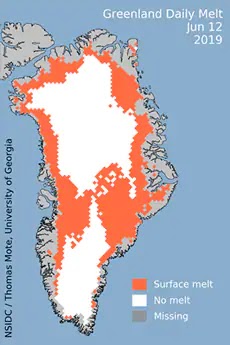
Data from the National Snow and Ice Data Center show that the Greenland ice sheet appears to have witnessed its biggest melt event so early in the season on record this week (although a few other years showed similar mid-June melting).
Melt extent on the Greenland Ice Sheet between April and October. The recent melt event (indicated by the blue line) appears to be the greatest on record in mid-June. (National Snow and Ice Data Center)

“The melting is big and early,” said Jason Box, an ice climatologist at the Geological Survey of Denmark and Greenland.

Box explained that temperatures over the western Greenland ice sheet have been abnormally high while snow has been well below normal.
Extent of Greenland ice sheet melting on June 12. (National Snow and Ice Data Center)

Marco Tedesco, an ice researcher at Columbia University, added that it has been unusually warm in east and central Greenland, as well. “This has triggered widespread melting that has reached about 45 percent of the ice sheet,” he wrote in an email.

Normally, melting this widespread over the ice sheet doesn’t occur until midsummer, if even then.

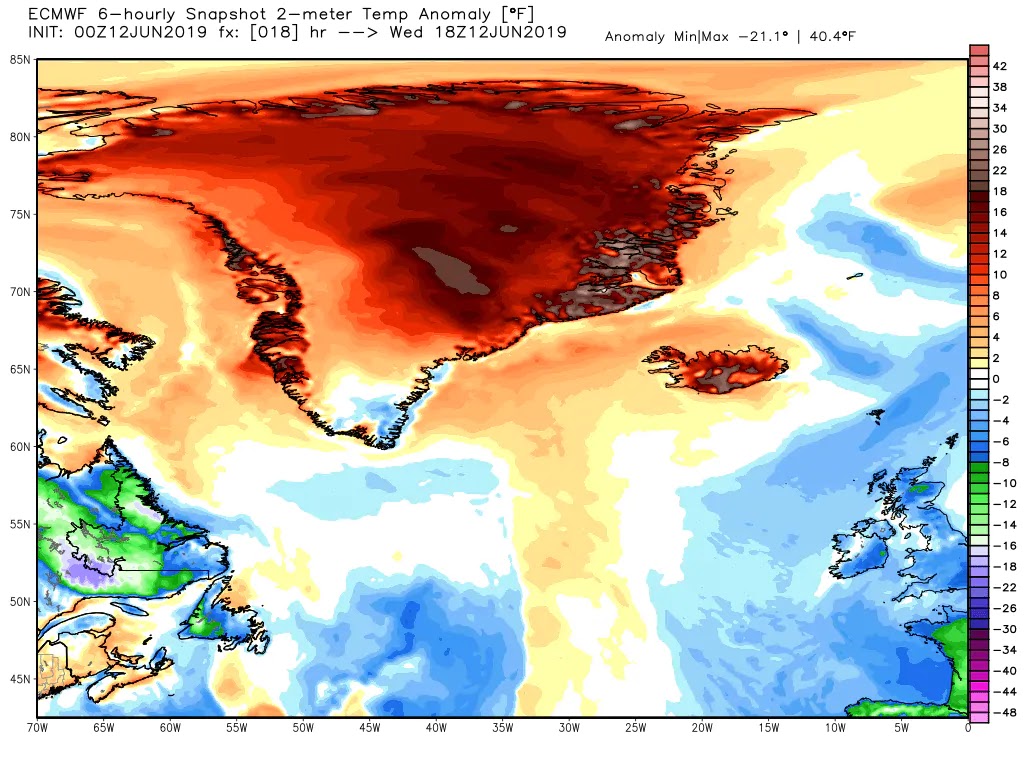
A simulation from the European Centre for Medium-range Weather Forecasting suggested that temperatures over Greenland may have peaked at around 40 degrees above normal on Wednesday.


European model simulation of temperature difference from normal over Greenland on Wednesday. (WeatherBell.com)

A big dome of high pressure has positioned itself over Greenland, resulting in sunny skies and mild temperatures, which have enabled melting. An automated weather station at the top of Greenland’s ice sheet topped freezing on June 12, a very rare event, which last occurred in July 2012.
2012 is the notorious year in which the Greenland ice sheet witnessed the most melting on record. Those monitoring the ice sheet say melting in 2019 could rival it.

Weather in the coming months will determine how much more the ice sheet melts and whether 2019 is a record-setter. If high pressure holds in place, “we should break a new record,” tweeted Xavier Fettweis, a climatologist at the University of Liège in Belgium.

But scientists studying the region know that Greenland’s weather is highly variable and can change rapidly.

Mike MacFerrin, a glaciologist at the University of Colorado, put it this way in a tweet: “2019 has been… anomalous… so far, but also quite variable. It’s early and weather is weather, so keep your eyes peeled. ...”

Arctic sea ice
(Zachary Labe)
 Weather satellites have monitored sea ice in the Arctic since 1979, and the current ice coverage is the lowest on record for mid-June.

The ice extent has been especially depleted in the part of the Arctic Ocean adjacent to the Pacific Ocean. “It’s pretty remarkable how much open water is in that area,” Labe said.

Labe explained high pressure over the Arctic has helped to pull sea ice way from the northern Alaska coast.
Sea ice loss over the Chukchi and Beaufort seas along Alaska’s northern coast has been “unprecedented” according to Rick Thoman, a climatologist based in Fairbanks.

Labe said there’s sufficient open water that you could sail all the way from the Bering Strait into a narrow opening just north of Utqiagvik, Alaska’s northernmost city, clear into the Beaufort Sea. “It’s very unusual for open water this early in this location,” he said.

With all of the exposed water, ocean temperatures in this region will rise, Labe said. This should delay the customary fall freeze and will likely result in a historically low late summer sea ice minimum, typically in mid-September.

Whether the Arctic sea ice minimum is record-setting, like the Greenland ice sheet, will depend on weather in the coming months.

“There is no indication that this year will be as low as 2012,” when Arctic sea ice reached its lowest extent on record, Labe said. “If cloudy weather occurs, it would slow down the rate [of melting]. It’s really hard to predict.”

Implications for weather over the United States?
The extreme conditions in the Arctic, which have resulted in these record-challenging melt events, have far-reaching implications. There is a saying often repeated by Arctic researchers: “What happens in the Arctic doesn’t stay in the Arctic.”

The bulging zones of high pressure in the Arctic, which have facilitated the unusual warmth and intensified melting, are displacing the cold air normally contained in that region into the mid-latitudes — like a refrigerator door left open. Much of the central and eastern United States have seen lower-than-normal temperatures in the past week.

Temperature difference from normal on Friday, as analyzed by the Global Forecast System model. (University of Maine Climate Reanalyzer)
 The jet stream, the high-altitude current separating cold air and warm air, has taken unusually erratic meanders.

“The jet stream this week was one of the craziest I’ve ever seen!” Jennifer Francis, one of the leading researchers who has published studies connecting Arctic change and mid-latitude weather, wrote in an email.

Francis had earlier suggested that conditions in the Arctic may have played a role in the extreme jet stream pattern that spurred the tornado swarm and record flooding in the central U.S. during the last two weeks of May.

“We can’t say that the rapid Arctic warming is causing this particularly pattern, but it certainly is consistent with that,” Francis, senior scientist at Woods Hole Research Center, said.

(Source: WP)