Showing posts with label police. Show all posts

Thursday, 23 January 2020

Once upon a time ... in Azabu Juban

Police harassment is a fact of life in Japan, but one time 'we' won

I was leaving my apartment a few days before Halloween and had made it no farther than a few steps before I was beckoned. “Sumimasen” (“Excuse me”), came the call from two on-duty cops. I was just running out for some ice cream, but now I’d have to go through an all-too-familiar song and dance of proving my identity.

The police rode over on their bikes and quickly went into their routine. They asked to see my residence card, and I immediately complied. The questions that followed were simple ones and all in Japanese: Where are you from? What are you doing in Japan? Do you live in this building? All of this information is printed clearly on my residence card, mind you, but they wanted me to explain it verbally.

When I told them I live in the building we were parked in front of, they reacted in disbelief, as if a non-Japanese, black 20-something could afford to live in a nice part of Koto Ward. However, based on my history with the cops over the past five years, I doubt it was my presence in the neighborhood that was the determining factor in their stopping me.
On the spot: The most important thing to remember in your interactions with the police is to remember to remain calm in order to avoid escalating tensions. | JASMIN PENDON

I let the officers know that I was just heading out to 7-Eleven, which was within view from where we were standing, to buy some ice cream, but they wanted to do a security check, a pat down just to be safe. I usually comply with the request, but this time I decided not to grant permission. To my surprise, they respected my decision but still insisted on checking my wallet for “dangerous materials.” What ensued was a 20-minute debate regarding the legality of searching my possessions.

The police then refused to return my residence card until I showed them my wallet. Standing up for myself earlier naturally worked to my disadvantage. 

So, I showed them every item in my wallet and explained what they were in English: cash, the card I use at the dentist, some unused stamps. They returned my wallet and residence card, and delivered a faux “arigatō gozaimashita” — which translates as “thank you very much” but could just as easily mean “until next time.”

Thirty minutes later, I’m in my apartment silently fuming. Most of my interactions with the police are frustrating to the point that I genuinely question whether it’s worth living here. If you’ve been in this situation, you’ll know what I mean. And it’s for you that I want to relay the story of another of my spot checks, one that could’ve been scripted by Hollywood considering how it turned out. It unfolded in Tokyo’s central neighborhood of Azabu Juban, and it’s the story I remind myself of nowadays when I start to get too negative about living in Japan.

An ill-timed joke
I initially moved to Japan in 2014 as a student enrolled at Temple University Japan. Prior to that, I had done a month-long homestay in my junior year of high school with a Japanese family in Yamanashi Prefecture.
There was no guidebook that could have told me what to expect as a black man living in Japan, but my homestay experience was so positive that it quashed any reservations I had harbored. Unfortunately, that feel-good vibe changed in college.

Throughout my time at Temple, I was aggressively harassed by the police — both in my own neighborhood and in the area around my school. At one point, when I lived in Arakawa Ward, I was being stopped twice a week on average on my walk home from Tabata Station. The officers would search my backpack, my wallet and even the tiny pockets inside my phone case. When I asked them why they routinely stopped me, the answer was almost always the same: “You’re a foreigner.”

They never seemed to remember the answers to the questions they asked the previous week: “Are you Nigerian?” “Are you coming from Roppongi?” It was so bad that one time the police escorted me to my apartment and entered, demanding that I show them my passport because my residence card and student ID weren’t good enough. I had never experienced this level of harassment in my life, not even back home in California.

Frustrated and out of ideas on what I should do, I turned to my school to assist me. I was living here via its sponsorship and thought that surely someone there would have an approach to dealing with this problem. Or, at the very least, they might have the contact information of people or organizations I could turn to. Unfortunately, they were unequipped to help me.

I bring this up because, if you are a person of color and you are considering attending university in Japan, I highly suggest looking into whether or not the school offers such kinds of services beforehand. Temple warns its students that it doesn’t offer direct assistance when it comes to matters of police harassment and instead points them to a police website. When I went to a school official in 2016, the person I was dealing with tried to laugh things off. 

A white man who likely hadn’t had to deal with police harassment back home, he told me with a chuckle, “You should be grateful police in Japan don’t have guns, you’d be shot in America.” I’m all for comedy, but not when I’m the butt of the joke. I can think of nothing else that so perfectly encapsulates the ambivalence to which non-Japanese who aren’t black view the struggles of those dealing with the legacy of racism.

In a country where contact with people of African decent is few and far between, I can’t always be sure nonblack individuals will understand what I’m going through. It can be difficult to rustle up support when you’re a minority within a minority. I learned it isn’t impossible, though. While my attempts to raise awareness of the lack of support I was receiving were initially met with racist vitriol rather than empathy on social media, eventually there emerged a group of non-Japanese students who offered their support by publicizing my case and, of course, other black students who had gone through similar experiences were quick to lend a hand.

I also received help from my Japanese friends, many of whom were appalled by what I was going through. Those same Japanese friends, cognizant of their privilege as Japanese citizens in this country, offered to go with me to the police department to file a complaint. For many of them, my being vocal about police harassment was their first instance of seeing the reality of being black in Japan at close range and they wanted to do something about it.

The surprise ending
In hindsight, there’s no way what we did should have worked, but it was a success. A Japanese friend and I went to the main Azabu police station one night and requested to speak with the chief.

He agreed to talk, and a nearly 60-minute conversation ensued with my friend and I describing the years of harassment I had received, in addition to recounting experiences that we had both had in which Japanese cops had stopped a group of us but only requested identification from the black people present. The police chief listened, apologized for those officers who had acted in an unprofessional manner and told us that he would make the force well aware of the number of students in the area and instruct them to give us the benefit of any doubts. Then, and this is the real kicker, he gave me his personal phone number to call in the event I was ever stopped in Azabu again. 

For the first time since coming to Japan, I felt like I had made actual progress.

I was watching Quentin Tarantino’s “Once Upon a Time … in Hollywood” recently, and I couldn’t help but think of that Azabu experience again. In his film, Tarantino alters history to allow the “good guys” a taste of bloody revenge, a plot twist that allows his audience to achieve some measure of satisfaction that is normally impossible. I feel like my interaction with the Azabu chief of police allowed me the same sort of catharsis: An outcome in which the “good guys” won against what I thought were impossible odds.

I realize this one instance was by no means indicative of the experiences other black people face here in Japan — including myself. Still, I think it’s a good story to hold on to, that one time where progress was made. That one time that taught me my Japanese friends are there for me and that maybe even the Japanese police are able to see the problem with racially motivated stop-and-frisk policies. And, I’ve never had to use the phone number. I never got stopped again — in Azabu Juban, anyway.

I’m not in a position to make sweeping changes as to how Japanese society is run, nor how the public perceives black people. However, as someone who has become something of an old hand in dealing with the police, I can offer this advice: Keep your ID on you and stay calm during your interactions. Public sentiment may be with us someday but, for now, we’re on our own.


(Source: JT)

Sunday, 30 June 2019

Mammootty and his various police attires

Unda is a reminder—of Mammootty as an actor who continues to fine tune, polish and reinvent his craft. An actor who knows after every fall, there is a rise.

Mani sir is in his 50s, with a slight paunch, greying sideburns and walks slowly and smiles gently. He is an SI and has been assigned to head a group of havildars and constables assigned to cover election duty at the Maoist-ridden Chhattisgarh. When you first meet him, he is sipping chai at a roadside kadai, watching a man strategically steal a purse from a man sitting in front of him. When he realises that a policeman has just witnessed the scene, he quickly slips it on the ground and nudges the man to pick it up.  SI Mani sir’s response to this scene is an unhurried smile, as he briefly narrates the scene to his fellow officer. “There are bigger thieves than him,” he reasons.

SI Mani is Megastar Mammootty’s nth outing as a cop and also a subversion of all the previous ones he has done on screen.

Mani is kind, gentle, vulnerable and carries a lot of insecurities and fears along with him. When an unexpected attack occurs at their camp at night, he goes panicky and numb with shock, and watches weakly as his subordinates’ take charge. In another film, two decades ago, Inspector Balram would probably have clenched his teeth and showered Mani with a volley of choicest expletives for his ineptness. Or an SI Narendran in Roudram would make him listen to a stunning monologue, the next morning about duty, honesty, bravery and a brief about the definition of Khaki. If it was Kasaba’s Rajan Zachariah, he would smirk and plant Mani a tight slap and stroll away amidst a celebratory BGM. The dichotomy between Mani and these alpha male cops are startling and thoroughly delineated by the actor, by way of his body language, dialogue delivery or even something basic as a smile and walk. Even among these alpha male dare-devil superstar cops, Mammootty brings an originality and nuance that doesn’t always looks like it was there on paper.

Balram (one of his most feted characters) despite being honest and duty-bound is unpleasant and bitter and the actor played him up with lot of drama. He was the classic angry young man, angry with himself, the world and the system. The line-up of cops (20 memorable ones) in a way also show his fruition as an actor. Balram’s evolution is what we saw in Inspector Narendran or Nari—the same anger, bitterness against the system and yet Narendran has internalised the trauma, unlike Balram. He seems more in control of his emotions than Balram, making him a formidable enemy to even his naysayers. While Black’s Head constable Karikkamuri Shanmugam is the system, he is the creator and the destroyer, a beast on a leash. Shanmugam’s past and present merge brilliantly in his attire (he only wears black) and bearing.  CI Amarnath (The Godman) and Ramanathan IPS (Rakshasa Rajavu) are essentially cops cut from the same loud-in-your-face-caricaturish sketches. They bark unnecessarily, are disgusted with the system and are yet kind and compassionate when need be, providing them a superman closure. 


In a KG George film, Inspector Rajan Zachariah would have thrived organically—he is flawed, salacious and a womaniser.  He passes lewd and sexually coloured remarks on his female colleagues and gets away with it and clearly sees women more as objects than individuals.  But in the hands of debutant director Nithin Renji Panicker, these obnoxious characteristics of Zachariah are leveraged and celebrated (accompanied by a robust BGM), thereby aborting what could have been an unconventional and challenging choice for an actor like him.

Yavanika’s no-nonsense sub-inspector Jacob Irazhi is counted as one of his earlier breakthrough roles but today he seems to be a preparatory to one of his most iconic cop roles that came a decade later—Sethuramaiyyer CBI of the CBI Diarykurippu series. The Mammootty who did Irazhi is raw and unpolished, almost awkward but when he comes to Iyer, he has modified himself. He deliberately controls some of his “mannerisms”, like keeping his hands tied behind his back. Iyer is deceptively calm, thinks on his feet, rarely raises his voice, yet gets things done his way, walks briskly and is ordinary to the point of being dull. There is nothing flamboyant about the man or his lifestyle (a sort of counterpoint to James Bond). But there is an urgency in his movements and a twinkle in his eyes that livens the proceedings.

Similarly, DYSP Perumal in August 1 and Superintendent Haridas Damodaran in Eee Thanutha Veluppankalathu are cops who primarily follow the calm-thinking-on-their-feet narrative. While Perumal is naturally flamboyant, Haridas comes across as casual and pragmatic.  There is also Pramanam’s DYSP Prathapan who has an interesting sketch—he is strict, playful and even romantic.

Antony Simon, CI Crime Branch in Daddy Cool suffers from lazy writing, with the focus drifting away to the superstar than the actor. Ditto for Masterpiece (2017) and Abrahaminte Santhathikal (2018), frivolous mass-set pieces where his stardom were brazenly exploited.  That’s why we don’t really recall anything more of Anto Antony IPS or ASP Derick Abraham than their physicality or their jackets and boots. Last year’s Streetlights CI James Abraham although had a less starry sketch still rallied around his stardom.

In the early 80s Mammootty played a petrified young cop in Nandi Veendum Varika, someone who was pushed into the profession by his ambitious father. But towards some point in the film, he morphs into a fiery angry young cop, which somehow looks unconvincing. Mudra’s Ramabadran can be considered as one of his most underrated acts. He is the superintendent of a reform school, who wins over the inmates with his patience and compassion. He is another version of Mani sir, younger and more capable though.

It’s easier to slot SI Mani sir as one of his finest cop acts in his career, not because it subverts every previous on-screen police role but also in how the actor merges himself into the body and soul of this kind, vulnerable, disarmingly humane cop. More importantly, how does one create the image of a man bone-tired, broken in spirit and struggling to sustain himself in a profession which demands exactly the opposite? Look out for that scene where he is trying to decipher the reality that he just had a minor heart attack or the one where he apologises to his juniors for his act of cowardice or the scene where he curls up on the floor, weary, helpless and anxious or that climactic scene where out of sheer desperation he musters enough courage for himself and his juniors to fight the Ministers gundas or his shock when he sees his otherwise frightened juniors gang up to protect him with empty guns.

Unda is a reminder—of an actor who continues to finetune, polish and reinvent his craft. An actor who knows after every fall, there is a rise. And that even after a spate of bad films, all he needs is a director who knows how to use Mammootty the actor in all its nuanced glory.

(Source: The Arabian Stories)

Sunday, 23 June 2019

Hong Kong protests: How Hallelujah to the Lord became an unofficial anthem

For the past two weeks, a Christian hymn has been cropping up in an unlikely place - the protests that have drawn millions of people on to the streets of Hong Kong.

"Hallelujah to the Lord" has become the unofficial anthem of crowds protesting against a controversial proposed law that would allow people accused of crimes in China to be extradited to the mainland.

For Christians in Hong Kong, the hymn is a sign of faith but also of their concerns that it's not only political but also religious issues that are at stake, should the bill ever pass.

Fears and uncertainty
The protests were already under way when the tune first started being sung.

But on 11 June - a day before the protests turned violent - a group of Christians holding a public prayer meeting through the night started singing Hallelujah to the Lord.

The hymn was picked up by other protesters - soon even non-Christians were singing it.

"People picked up this song as it is short and easy to remember," Edwin Chow, 19, acting president of the Hong Kong Federation of Catholic Students, told the BBC. "There's only one line: 'Sing Hallelujah to the Lord'."

Christian groups have played a significant role in the Hong Kong protests

The protesters said they sang it hoping it would have a calming effect on police, and would help diffuse tensions.

This was especially needed after police had earlier fired tear gas and shooting rubber bullets towards protesters.

The song also acted as a political shield, of sorts.

"According to the law, any religious assemblies in public areas are not considered as illegal, so if people sing hymns together, it could actually work as a protection and guarantee that [they] stay safe," said Mr Chow.

"Therefore people started to sing this song to protect themselves."
Mr Chow said the song had spiritual meaning for Christians.

"The word Hallelujah also means to praise the Lord, so it could [also] remind Hong Kong citizens [that He] holds the future," he said.

But the religious element to the protests have further significance.

Hong Kong has been part of China since 1997 under the "one country, two systems" principle, which means it has its own judicial independence, legislature and economic system.

But people fear that if this extradition bill passes, it would bring Hong Kong closer under China's control. They fear it could be misused to target those that China considers dissidents.

China in theory, allows religious freedom, but it has repeatedly taken action against religious leaders it considers to be threatening to its authority or to the stability of the state.

Christians are pressured to join state-sanctioned churches led by approved priests, while some risk prosecution for worshipping in secret, underground churches.

Some in Hong Kong fear that the extradition bill could be used by China to attack religious as well as political opponents.

People sang songs to boost morale during the protests

When the BBC asked Mr Chow if Christians in Hong Kong were afraid, he said simply "Of course".

"There have been cases of people who [bring] Bibles to the mainland [ending up] arrested. We are very worried that once the law passes, Christians here will be affected and our freedom of religion will be suppressed."

Hong Kong has now suspended the bill, though many are still protesting, saying they will not rest until it has been completely scrapped.

Hallelujah to the Lord was still being sung on Friday, among the thousands of people surrounding the city's police headquarters.

So it looks like the tune is on the way to joining umbrellas as a symbol of the protesting spirit of Hong Kong.

(Source: BBC) 

Tuesday, 18 June 2019

3 cops suspended after brutally beating up a Sikh tempo driver

While Delhi is slowly descending into becoming the city without a heart, there are increasing incidents around the city, to put that very fact into motion, even more fiercely.

There are watchdogs who do watch over the city's law and order, but sometimes, they fall short of judgment too and that's when you know the cog-wheel has stopped working and it's time for some serious systematic change.

Why am I getting so philosophical? Well, a highly alarming and disturbing incident just took place in the capital and we're not sure how else to react to it. Although the consequence of it was justified aptly, the actual incident was just another reason to imagine the city as unsafe, from our so-called 'watchdogs' as well.


Three policemen were suspended for beating up two men because of a faulty accident that took place in Mukherjee Nagar, New Delhi.

The Deputy Commissioner of Police (Northwest Delhi) Vijayanta Arya, suspended assistant Sub-inspector Sanjay Malik and Devendra and constable Pushpendra for acting unlawfully. The three officers dragged a Sikh man and his son out of their vehicle and thrashed them brutally, for no apparent reason.
However, the police have blamed the tempo driver for the incident and have claimed that he tried to attack them with a 'Kirpan' (his sword) and tried to injure another officer with his vehicle. According to the police, the driver was driving his vehicle recklessly when it bumped into a police vehicle. The tempo also allegedly injured a policeman's leg. The police obviously didn't take this too well and beat up the Sikh driver and his son.

The alleged incident was followed by an accident caused by a Gramin Sewa tempo to a police vehicle. Thereafter, a police officer was also assaulted on the head by the tempo driver with a sword,", a police note stated.

"Further, the tempo was driven dangerously and caused injuries to a policeman in the leg," it further added.
After the alarming and confusing incident, a protest broke out GT Ring Road, Mukherjee Nagar, in support of the driver. So much so, the former Delhi Gurudwara Prabhandak Committee president Manjit Singh compared the entire incident to the 1984 Sikh riots and demanded action against the cops who beat the two people up.

“Policemen stopped the auto driver and pointed a pistol at him. He was dragged out of the vehicle and brutally thrashed…the accused policemen should be dismissed and the case should be registered against them. We will continue our protest till our demands are not fulfilled.” said Manjit Singh

Obviously, there are tweets all across Twitter condemning the incident and it started with Chief Minister Arvind Kejriwal.


(Source: MensXP )


Tuesday, 28 May 2019

When a boy with Down syndrome became the sub-inspector of Chennai

Nineteen-year-old Stevin Mathew grew up chanting "I am police" like a mantra, partially influenced by the films he watched. For a boy with Down syndrome, that can never happen, but his parents decided to make his dream come true for a day.

Though originally from Chennai, the family is now settled in Qatar. On their trip to Chennai a few days ago, Stevin’s father Rajeev Thomas approached the Chennai police commissioner with the request of making his son wear khaki for a day. According to The Hindu, Rajeev said,

"He was fascinated by the police after watching his favourite stars Suresh Gopi, Vijay, and others. He always wanted to become a police officer. So I decided to write a mail to the commissioner when we came to Chennai for a vacation. They took his measurements and even got a police uniform with two stars stitched for him.”

Image: (L) –The Hindu; (R) – Deccan Chronicle
Paying heed to the strange request, Chennai's Assistant Commissioner Vincent Jayaraj and Inspector Suryalingam visited Stevin the day before to prepare him for his special day and made the necessary arrangements.

Upon reaching the station in his uniform he was welcomed with bouquets. He was also given a desk and walkie-talkie which were his for the day.

Once he was informed about the basic work involved in being a police officer and crime prevention, he accompanied two constables on patrol duty in the police Jeep.

Stevin studies at a school for special children run by his parents. Talking about dealing with special children, in an interview with Deccan Chronicle his father said,

“It is pertinent to parents who have special children and the society to know that children with disabilities have to be given an opportunity for them to achieve.”

(Source: Your Story)

Monday, 13 May 2019

Singapore fake news law polices chats and online platforms

Singapore has passed a controversial anti-fake news law that gives authorities sweeping powers to police online platforms and even private chat groups.

The government can now order platforms to remove what it deems to be false statements that are "against the public interest", and to post corrections.

Authorities say the bill protects citizens from fake news.

But critics say it poses a serious threat to civil liberties.

It is also unclear how it could be enforced in some instances, such as policing content in encrypted apps.
The law forbids false statements from being transmitted to users in Singapore
The Protection from Online Falsehoods and Manipulation bill was passed by lawmakers on Wednesday and will come into force in the next few weeks.

The government has emphasised that the law would not be used to target opinions, but only falsehoods that could prove damaging.

"Free speech should not be affected by this bill," Law Minister K Shanmugam told parliament, adding that the law is aimed at tackling "falsehoods, bots, trolls, and fake accounts".

What does the law cover?
It bans the spread of what the government decides are false statements against the public interest. A person found guilty of doing this in Singapore could be fined heavily and/or jailed for up to five years.

It also bans the use of fake accounts or bots to spread fake news - this carries penalties of up to S$1m (£563,000, $733,700) and a jail term of up to 10 years.

The law can be applied across a broad range of platforms, from social media to news websites, which also face penalties if they do not comply with orders to take down content or post corrections.

Could the bill police private chats?
Perhaps one of the most controversial aspects is that it could be applied to closed private platforms such as chat groups and social media groups, including apps with end-to-end encryption, where only recipients and senders can see messages.

This would mean apps like WhatsApp, which is extremely popular in Singapore, and Telegram would be affected.

On Tuesday, a minister said in parliament that the private nature of such apps meant they were "ideal platforms" for the spread of falsehoods as they could be hidden from public view, and noted that they could reach "hundreds or thousands of strangers at a time".

"Closed platforms, chat groups, social media groups, can serve as a public megaphone as much as an open platform," said Senior Minister of State for Law Edwin Tong.

WhatsApp is one of the most popular messaging apps in Singapore
The bill states that false statements cannot be transmitted to users in Singapore through the internet, or through systems "that enable the transmission through a mobile network" of text and multimedia messages.
Authorities have not said how exactly they would gain access to private discussions on encrypted apps to police them.

Encrypted app companies have resisted such efforts in other countries. Earlier this year, WhatsApp said an Indian government proposal for tech companies to hand over encrypted messages was "not possible".

But Mr Tong said Singapore could issue a "general correction order" to any platform, even one that is not carrying the falsehood in question. This could mean such platforms could be ordered to push out a mass correction note to users.

The BBC has asked Singapore's Law Ministry how the law would be enforced and whether it would encompass all chats, including those between individuals.

Phil Robertson, deputy director of Human Rights Watch's Asia division, called the idea of the Singapore government policing private chats "frankly insane".

"This is really moving towards a Big Brother style of control and censorship project," he told the BBC. "It's a direct threat to freedom of expression and is something the entire world should be alarmed about."

A WhatsApp spokesman told the BBC: "Societies have generally recognised the differences between private and more public forms of communication, and we look forward to doing our part to reduce the spread of misinformation while maintaining the private nature of our service."

The app, one of the world's most popular messaging platforms, has been increasingly used to spread fake news and it recently introduced restrictions on message-sharing.

What has the reaction to the bill been?
The fake news law has attracted mounting criticism since it was unveiled last month, with many saying it threatens freedom of expression.

One worry was that other states could follow suit in ordering platforms to push out corrections, said Singaporean civil rights activist and editor Kirsten Han.

"What would be the effect on our online space to engage in discourse when the platforms we use are required to serve government notices - or, to speak even more frankly, government propaganda - to its users?"

Amnesty International has said the law would "give the Singapore authorities unchecked powers to clamp down on online views of which it disapproves".

One main criticism is that the law is phrased too broadly and gives ministers too much power to decide what is true or false. The International Commission of Jurists has said the bill "does not provide any real definition of 'false statement of fact' and does not clarify what constitutes 'public interest'."

Leaders of Singapore's sole opposition party in parliament have denounced it, calling the bill's introduction "the actions of a dictatorial government that will resort to any means to hold on to absolute power".

But the bill was passed despite their objections, as Singapore's parliament is overwhelmingly dominated by the governing People's Action Party.

What does Singapore's government say?
The Singapore government has said the country needs strict laws given the potential for fake news to incite racial and religious disharmony, and that the government needs the power to act swiftly to halt the viral spread of falsehoods.

It has argued that the law safeguards against abuse of power by allowing judicial reviews of government orders.

Singapore now joins countries such as Russia, France, and Germany which in recent months have passed tough laws against fake news or hate speech.

It is ranked 151 out of 180 countries in this year's World Press Freedom Index.

(Source: BBC)

Tuesday, 26 June 2018

This elite police force guards the Himalayas - and also practices yoga

Members of the Indo-Tibetan Border Police wear military fatigues, with thick boots and heavy jackets. On the job, they guard the vast border between India and China, where the mountaintop temperature can drop to minus 50 degrees Fahrenheit. Outside their regular duties, they summit Mount Everest.

Members of the Indo-Tibetan Border Police practice tree pose during a yoga class in the Himalayan mountains.
They also practice yoga.

In remarkable locations virtually inaccessible to the rest of the world, these "Sentinels of the Himalayas," often in full military gear, train in one of India's most renowned and ancient traditions as part of their well-being regimen. Their routines include physical and mental exercises, as well as breathing techniques that help members acclimate to the high altitude, which ranges from 9,000 to 18,000 feet.

Members of the Indo-Tibetan Border Police practice yoga on a frozen lake in the Himalayan mountains ahead of International Yoga Day.
Now, the elite police force -- along with yogis around the globe -- are marking Thursday's fourth annual International Yoga Day, which aims to raise awareness of the many benefits of practicing yoga.

India proposed the holiday in 2014 at the United Nations. With support from 175 other member states, the UN General Assembly passed a resolution proclaiming June 21 as the International Day of Yoga.

A member of the Indo-Tibetan Border Police practice wheel pose at a military base in the Himalayan mountains.

"Yoga embodies unity of mind and body; thought and action; restraint and fulfillment; harmony between man and nature; a holistic approach to health and well-being," Indian Prime Minister Narendra Modi told the UN General Assembly in 2014. "It is not about exercise but to discover the sense of oneness with yourself, the world and the nature."

The UN resolution highlighted the importance of "making healthier choices and following lifestyle patterns that foster good health."

A member of the Indo-Tibetan Border Police meditates during a yoga session at a military post in the Himalayan mountains.
It also underscored the goal of sharing best practices worldwide.

"Yoga is an invaluable gift of our ancient tradition," Modi said in 2014. (Three years later, India set a new precedent when more than 55,500 people participated in the largest-ever yoga class -- and set a Guinness World Record.)

Among those extolling yoga's benefits is the Indo-Tibetan Border Police, whose official website cites "adventure and dare-devilry" as required skills for new recruits.

The force's Twitter page, which features ample evidence of its members' epic mountaineering, rock-climbing and skiing skills, recently has been hyping #InternationalYogaDay2018. The feed's more than 86,000 followers have gotten glimpses of troops holding sessions atop frozen lakes and glaciers and on mountain plateaus overlooking the sweeping Himalayas.

They practice bridge pose, tree pose, crow pose and runner's lunge. They manage headstands and handstands. They sit cross-legged with outstretched palms, their thumbs and index fingers linked.
All the while, the warriors -- like yogis everywhere -- live out what the UN once lauded as a "holistic approach to health and well-being."

(Source: CNN)

Wednesday, 23 May 2018

MBAs, lawyers, M Techs join Haryana Police as constables

As a result of the transparent recruitment process in the Haryana Police, highly qualified youth have been recruited in police, including 3,827 from rural areas and 398 from the urban background, the release stated. 

The current batch of the Haryana Police includes professional degree holders which include MBAs, law graduates, M Techs and other post-graduates, a senior police official said on Thursday. The Haryana Staff Selection Commission had earlier released a notification to fill 4,225 constables posts. At present, these constables are taking training, Director General of Police, BS Sandhu, said here in a release.

On May 20, the Chief Minister Manohar Lal Khattar will be the chief guest at the passing out parade of the 84th batch of Recruit Basic Course (RBC) to be organised at the Haryana Police Academy, Madhuban. The chief minister would also honour those recruits who would secure first, second and third place in the training programme.

After the passing out of this batch, the state police force would be further strengthened. (Representational image)
As a result of the transparent recruitment process in the Haryana Police, highly qualified youth have been recruited in police, including 3,827 from rural areas and 398 from the urban background, the release stated. “Out of these, 2 are M.Phil, 15 M.Tech, 16 MCA, 36 MBA, 33 M.Sc., 38 M.Com, 103 MA, 273 B.Tech., 51 BCA, 3 LLB, 434 B.Sc., 215 B.Com, 844 BA, 23 Diploma holders, 65 are having 10+2 with JBT qualification, two each ITI fitter and polytechnic and 2028 are 10+2 pass,” he said.

The DGP said that training on the topics of police administration, radio telecom, traffic management, maintenance of law and order, security, Indian Penal Code, Code of Criminal Procedure, human behaviour, community policing and computer learning have been imparted to these recruits. After the passing out of this batch, the state police force would be further strengthened, he added.

(Source: The Indian Express)

Wednesday, 18 April 2018

My only religion was my uniform: Officer who cracked Kathua case

Shwetambri Sharma, the only female member of the Special Investigation Team (SIT) of Crime Branch of the Jammu and Kashmir Police that investigated the rape and murder of the eight-year-old Bakerwal girl, reveals exclusively to The Quint how hard it was to carry out her job against heavy odds.

“The people we believed were involved in the gruesome rape and murder of that 8-year-old angel, their relatives and sympathisers, including a multitude of the lawyers, left no stone unturned to disrupt our investigation. They went to the extreme of our humiliation and harassment. But we stood our ground firmly till the end,” Shwetambri Sharma, the Jammu-based Deputy Superintendent of Police in Crime Branch of the Jammu and Kashmir Police, told The Quint.


An eight-year-old went missing on 10 January around Rasana village of Hiranagar in Jammu’s Kathua district. After the police failed to recover her amid allegations of kidnapping, which rattled a session of the Jammu and Kashmir Legislative Assembly, she was found dead on 17 January.

“We worked against heavy odds. At times we were disappointed, particularly when we learned that even the men of Hiranagar Police Station had been bribed to hush up the case and they had washed away the young victim’s clothes to destroy material evidences. Yet we cracked this rape and murder mystery during the holy navrataras. I believe there was a divine intervention to bring the culprits to justice. I believe Durga Mata had her hand on our head,” said Shwetambri, an officer of the 2012 batch of the Jammu and Kashmir Police (Gazetted) Service.


On 23 January, the government of Jammu and Kashmir assigned the investigation to the crime branch.

The SIT functioned under supervision of Inspector Generals of Police (IGPs) of Crime, Aloke Puri and Syed Ahfadul Mujtaba, besides Senior Superintendent of Police (SSP) Crime Branch Jammu Ramesh Kumar Jalla. Headed by Additional Superintendent of Police (SP) Crime Naveed Pirzada, it had Deputy SP Shwetambri, Sub Inspector Irfan Wani, Inspector KK Gupta and Assistant Sub Inspector of Police Tariq Ahmad as its members.

On 9 April, amid demands of shifting the investigation to the CBI from families of the accused and their sympathisers, the SIT filed two charge-sheets against the accused before the Chief Judicial Magistrate (CJM) holding eight of the accused guilty of rape, murder, kidnapping, wrongful confinement, criminal conspiracy and destroying of evidences.

The accused included a youth, who, according to the charge-sheet, committed rape twice on the captive child and murdered her brutally before dumping her body. He was declared as a Juvenile in Contravention with Law (JCL) by a judicial magistrate even as the SIT proved him an adult on the basis of school records. A team of doctors at Government Medical College Jammu also described his age as between 19 and 20 years.

Shwetambri taught management at Mata Vaishno Devi University and some other colleges affiliated to University of Jammu for 7 years. She was doing her Ph D in management when she joined the police service in 2012.

“As most of the accused were Brahmins, they over-emphasised their surnames. They particularly tried to influence me and communicated through different means that we belonged to one religion and one caste and I must not hold them guilty of the rape and murder of a Muslim girl. I told them that as an officer of the J&K Police, I had no religion and my only religion was my police uniform”.


“When all such tactics failed, their families and sympathisers resorted to blackmailing and intimidation through whatever means at hand. They carried lathis, shouted slogans, organised rallies under the tricolour and blocked our roads to different villages and finally the court. But with perseverance and patience we stood our ground to carry out our job with total determination, commitment and professionalism,” Shwetambri said.


The officer narrated how spine-chilling it was to discover that the child had been subjected to untold brutality inside private devsthan belonging to a retired girdawar named Sanji Ram. She was the officer who entered the devsthan and seized material evidences including the victim’s hair strands in the presence of a magistrate. Forensic Science Laboratory subsequently confirmed that the hair samples were that of the eight-year-old’s.

According to the officer, the biggest challenge was “to unravel the real culprits who had the courage to sexually violate a devi – kanjak – whom we Hindus consider as a Durga avatar and worship”.
“During the hearing of a bail petition, which was subsequently dismissed, we entered the court to make relevant arguments. But, instead of arguing as defence lawyers, a crowd of 10 to 20 lawyers held demonstrations. They insisted we name the accused, knowing well that we were barred. We repeatedly faced a hostile crowd outside the courts. We did nothing but to request the SHO to file an FIR. When he didn’t, we approached the district magistrate through the head of our SIT. There was anarchy and intimidation all around,” Shwetambri said.

She said the most gruelling moment came when she had to question all the accused men about graphic details of the rape and murder of the child who was her own son’s age.

It was terrible. But Mata Durga was on our side. She gave me courage and I asked all the required questions in presence of male members of our SIT.


She pointed out that Vishal Jangota, the devsthan custodian Sanji Ram’s son who had returned from his B Sc Agriculture studies in Meerut to “satisfy his lust”, was arrested on the 1st navaratara and Sanji Ram himself on the 3rd navratara.

“It was the most difficult task,” she said.

“Sleep eluded me. I stayed awake for nights. I was not available as my husband’s partner, when he went for family and social commitments. I couldn’t take care of my child properly who had to be prepared for exams. But thank God we have been successful in our job and I am satisfied that I, along with other members of my team, have done something to bring those rapists and killers to justice.”

“We have full faith in the judiciary. We are all hopeful that justice will be delivered as our investigation is fool-proof and supported not only by confessions but also by other necessary evidences including technical and scientific ones,” said the officer.

(Source: The Quint)

Monday, 16 April 2018

Kathua rape: Exposing a viral list of lies from ground zero

The now infamous Kathua rape and murder case has been given a communal tone by viral posts on social media. The chargesheet filed by the J&K police in the case revealed that an 8-year-old girl was sedated, raped repeatedly, and then bludgeoned to death in January this year.

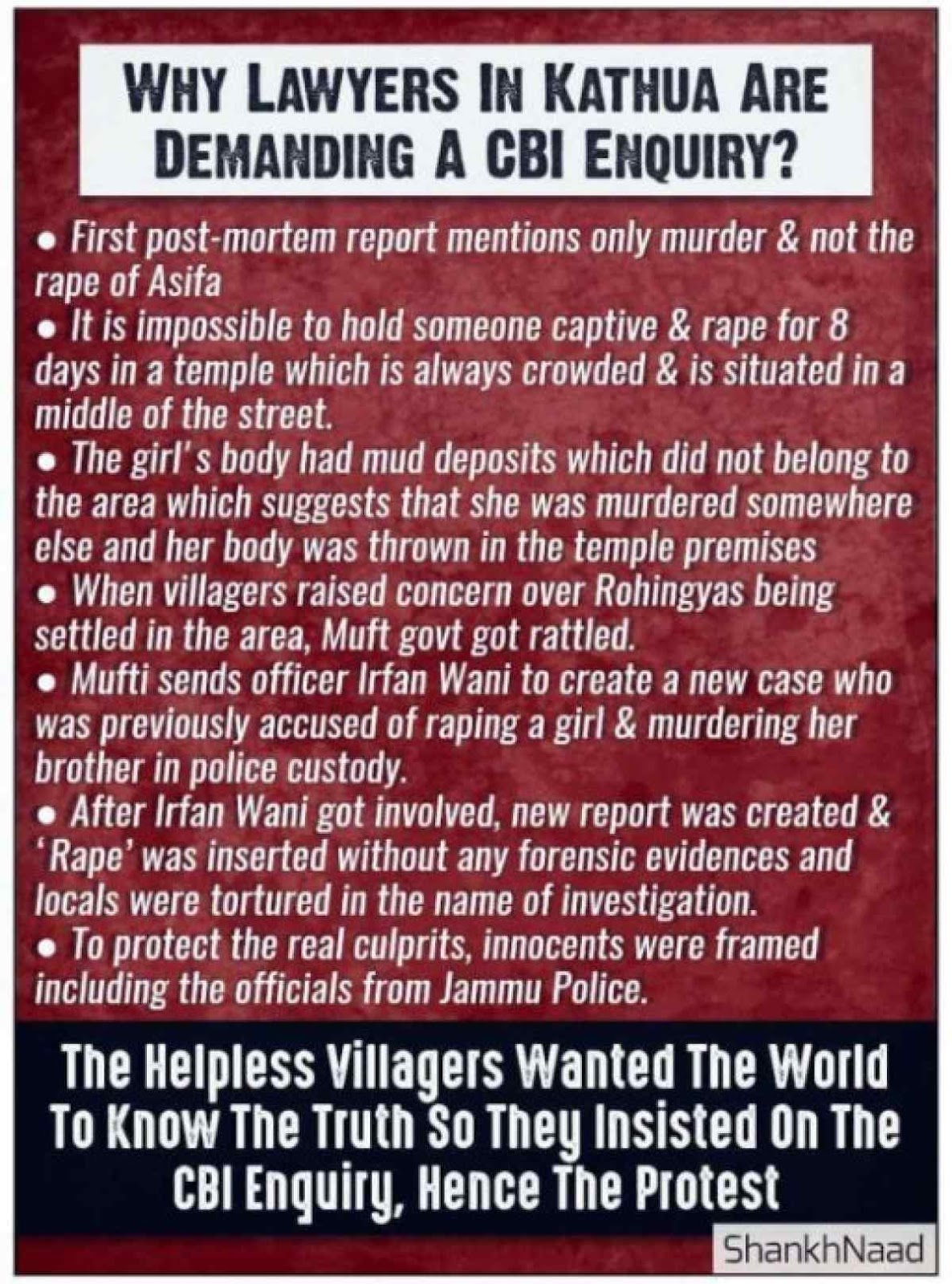
Of the many fake news posts doing the rounds on social media, there is one with the headline, 'Why lawyers in Kathua are demanding a CBI Inquiry'. The contents of this post are outrightly false.

This image, which has been shared over 7,600 times on Facebook, was posted by a page named ShankNaad, a repeat offender when it comes to spreading misinformation. The page has more than 1.3 million Facebook followers and 17.4 thousand Twitter followers.


Of the seven points mentioned above, not one is true. Let’s take them down one-by-one.

ShankhNaad Known for Spreading Communal Hatred
For those who don’t already know of the communal disharmony and hatred the page tries to perpetuate, we have a few examples of the numerous fake stories that have already been debunked.

In September 2017, ShankhNaad posted a video on Twitter that showed a blazing fire, stating that “Hindu temple, vehicle and cows in Gaushala were set on fire by Muslims mobs in Hyderabad.”

The Hyderabad police confirmed that no such violence had taken place anywhere in the city.
Another example of stoking communal disharmony — in October 2017, they put up a photo of a beheaded Swami Vivekananda statue and pinned the responsibility on Muslims in Badhohi, UP.

The SP of Bhadohi, following these rumours, issued a clarification stating that one Premchandra Gautam had been arrested for the vandalism, and as the name suggests, he isn’t a Muslim.
The list of these instances is very long. One more example is from July 2017, when ShankhNaad posted a video of a police station being attacked in Shamli, UP. The accusation was that members of the Muslim community were responsible for pelting stones, rioting and arson.

Shamli police issued a clarification stating that this video was 2 years old and appropriate action had been taken.

Now that we’ve provided you with a history of the kind of ‘news’ ShankhNaad peddles, let’s look at each of the ‘facts’ mentioned in the image above and see if any of them hold true.

Allegation 1: 'First post-mortem report mentions only murder and not the rape of the minor'

Wrong.

According to the chargesheet, accessed by The Quint, there is no mention of more than one post-mortem being conducted. The post-mortem of the 8-year-old was conducted by a team of doctors in District Hospital Kathua on 17 January at 2:30 pm.

The medical experts said that the victim was found prima-facie raped before being killed, the chargesheet states. Furthermore, investigations in this regard have established that the victim was raped by more than one accused.

Allegation 2: It is impossible to hold someone captive and rape for 8 days in a temple which is always crowded and is situated in the middle of the street.

Wrong.

This 'fact' is wrong on a number of levels.

Firstly, the child was held captive not for 8 days but for 6 days. She was sedated and taken in on 10 January and her body was dumped on 15 January in the Rasanna forests by two of the accused, including the juvenile.

Secondly, The Quint has visited the temple/prayer hall where the police states the girl was held captive and can certify that it is not a crowded temple. The temple is located in the middle of nowhere, with no houses adjacent to it for kilometres.

Thirdly, if only someone from ShankNaad had visited the temple, they would know not to add something as inaccurate as it being situated in 'the middle of the street'. It is situated on a hilltop and is isolated from the Rasanna village which lies about a kilometre away from the hall. The walk, which leads to the village, is a lonely one. It opens up to a number of houses including the home of Sanji Ram. It is on this same path that the body of the victim was found on 17 January.

Fourthly, the chargesheet states that that the Devisthan was exclusively manned by the main accused, Sanji Ram, to exclude any other person in the area.

Allegation 3: The girl's body had mud deposits which did not belong to the area which suggests that she was murdered somewhere else and her body was thrown in the temple premises.

Wrong. There is no mention whatsoever of mud in the investigation submitted by the police, which includes opinions by medical experts as well. They however do mention clay in their investigation.

The chargesheet reads: “The investigation has established, on the strength of evidence both oral as well as scientific, that the accused SI Dutta and Tilak Raj have in furtherance of Criminal Conspiracy hatched between themselves and the principal accused Sanji Ram washed the clothes worn by the deceased at the time of her death with the intention to remove the clay and blood stains/sperms etc and thereafter forwarded the same to FSL (forensic science laboratory) for expert opinion.”


Coming back to ShankNaad’s assertion.

1. The first part of the statement – "The girl's body had mud deposits which did not belong to the area"

The chargesheet doesn't say that the clay found on her was not of the kind found in the area, it only states that police officials conspired with Sanji Ram to ensure the clothes were not sent in their authentic state for testing.

2. The second part of the statement – “which suggests that she was murdered somewhere else and her body was thrown in the temple premises"

The assertion that she was murdered somewhere else and her body was thrown in the temple premises is baseless. The body was found in the Rasanna forest and not in the temple.

The police also adds in the chargesheet that on the basis of expert opinion, one of the hair strands found in the Devistan matched with the DNA profile of the victim. Thereby confirming that the victim was held captive there.

Allegation 4: When villagers raised concern over Rohingyas being settled in the area, Mufti govt got rattled

Well, the government has allowed Rohingyas with necessary documentation the right to settle in Jammu, and the locals have had a problem since this matter began three years ago.

This is a issue non-exclusive to the Kathua rape case and hence its doubtful it would have the ability to ‘rattle’ a government if it has been around for almost 3 years.

Allegation 5: Mufti sends officer Irfan Wani to create a new case, who was previously accused of raping a girl and murdering her brother in police custody

The first part is wrong. Mufti didn't choose the members of the crime branch who were asked to do this task. The SSP Crime Branch, Ramesh Kumar Jalla, who is a Kashmiri Pandit, chose the members of his team.

When The Quint spoke to him about Irfan Wani and the various cases against him, Jalla said, "I wasn't even aware of these allegations against inspector Irfan Wani. I got to know after it was brought up in the media. The man was booked under a case of raping a girl and killing a young boy, but he was acquitted in both cases around 2014. If the man is acquitted by the judiciary of the country there is no sense to not include him as part of my team. I had an excellent team that did a good job of delivering a chargesheet."

Allegation 6: After Irfan Wani got involved, new report was created and 'rape' was inserted without any forensic evidence and locals were tortured in the name of investigation.

As mentioned under the first allegation, rape was never ‘added’ to the existing charges, it was always part of the investigation. This charge is based on the post-mortem that was conducted on the same day her body was found.

Allegation 7: To protect the real culprits, innocents were framed including the officials from Jammu Police.

Now, who the real culprits are can only be deliberated upon once the court debates the chargesheet and then decides the relevant charges.

Whether the crime branch is right in its chargesheet or not can only be debated in a court of law and not on a Facebook page that evidently does not care about being on the ground. Or have the necessary intelligence-gathering mechanism and reliable sources to make the blatant assertion that 'innocents are being framed, including the officials from Jammu police.’

(Source: The Quint)

Thursday, 25 January 2018

Youths protesting practice of 'virginity test' for brides beaten up at a Pune wedding

The Kanjarbhat community beat the members of WhatsApp group 'Stop the V-ritual' at the do.

Three men were allegedly thrashed at a wedding in Bhat Nagar in Pimpri, Pune on Sunday night. They were attacked by almost 40 fellow members of their own community! All this, for the most regressive reason in the history of mankind: Those men were against the 'virginity test' ritual imposed by the elderly members of their community on the newlyweds and were a part of a WhatsApp group 'Stop the V-ritual' propagating the same.


The Regressive Lot's Name: The Kanjarbhat Community

Their Even More Regressive Ritual's Name: The 'V-Ritual' (virginity test)

The Terribly Regressive Procedure: Newly-married couples are taken to hotel rooms. The groom is given a white bedsheet to use while having sex with the bride while the caste panchayat members actually sit outside the room. If the groom walks out with a blood stains on the sheet, it means the bride has passed the test with flying 'colours'-and quite literally so. If not, she is accused of having a physical relationship with a man in the past by the panchayat members!

That's not it. The bride is punished as per the rules of the panchayat and sometimes even harassed and beaten up.


No points for guessing, there are no such "tests" for the groom!

The only good that has come out of it all is the fact that few of the younger members had formed a WhatsApp group 'Stop the V-ritual' upon realizing how unfair and well--regressive it was--and worked towards stopping the ritual altogether.

"I belong to the Kanjarbhat community and am getting married in May next year. My fiance and me are against this humiliating practice… we have declared that we would not be participating in it because it is against our right to live life with dignity and right to privacy… but just opposing it was not enough. So, we held a meet of all the members of the WhatsApp group in Akurdi on December 3 to plan an awareness campaign," Vivek Tamaichekar, a Masters student at the Tata Institute of Social Sciences in Mumbai had said in an interview to Indian Express in December.

However, when Prashant Ankush Indrekar, 25; Saurabh Jitendra Machale, 25 and Prashant Vijay Tamaichikar, 23 went to attend the above-mentioned wedding on Sunday night, they heard the caste panchayat discussing about carrying out the test as it was their "ritual".

Even though, they didn't oppose it on the spot, they were beaten up brutally by the members, who knew that they were a part of the 'Stop the V-ritual' WhatsApp group.
"Marriage ceremony was over by 9 pm. Then, the caste panchayat held a meeting from about 10 pm to 11.30 pm. They talked about demanding money from the bride and groom. Also, there was a discussion supporting the virginity test of bride, claiming it was a part of their tradition… We did not oppose anyone at the spot. But, they knew that my friends and I are part of the WhatsApp group 'Stop the V-ritual', which creates awareness in the community against the unjust practice of virginity test of brides. So, they got angry and questioned us and then 30-40 youths, including Sunny Malke, brother of the girl who got married on Sunday, attacked Saurabh Jitendra Machale and Prashant Vijay Tamaichikar. When I intervened, they also started beating me. A person even thrashed us with a leather belt. We condemn this act," said Indrekar, while speaking to The Indian Express.

Based on his complaint, 40 members including Malke, Vinayak Malke, and others have been booked under sections 143, 147, 149, 323, 509, 427 of the Indian Penal Code (IPC).

"As per our investigation, the quarrel erupted as the accused questioned the complainant regarding virginity tests,"Deputy Commissioner of Police (Zone III) Ganesh Shinde told the daily.

Shinde added that the accused were against the frequent campaigning being carried out by the complainant.

(Source: Odd Naari)

Saturday, 15 July 2017

The firebrand top cop who exposed Sasikala's VVIP treatment in Bengaluru jail

D Roopa, an IPS officer from Davangere, Karnataka exposed the sham running in the Bengaluru Parappana Agrahara Central jail and remains defiant in the face of controversy.

The maverick Deputy Inspector General (DIG) of Prisons who blew the whistle on the VVIP treatment given to AIADMK general secretary Sasikala in Bengaluru prison has decided to stick to her word.

D Roopa, an IPS officer from Davangere, Karnataka exposed the sham running in the Bengaluru Parappana Agrahara Central jail and remains defiant in the face of controversy.

In her report, she has mentioned how the Karnataka Director General of Prisons (DGP) Satyanarayana Rao was one of the officers on Sasikala's payroll who helped her avail special treatment- like a separate kitchen.

The report reads how Sasikala allegedly paid Rs 2 crore to jail officials for a 'comfortable stay'.

Quashing her report, DGP Rao lashed out against D Roopa and has asked for an explanation and evidences to back the allegations.


WHO IS D ROOPA?
D Roopa secured 43rd rank in the UPSC exam in 2000.

During her training at NPS Hyderabad, she was ranked fifth in her batch and was the sole officer allotted to the Karnataka cadre.

A sharp shooter, she has won numerous awards in NPA.

She was conferred with President's Police Medal for Meritorious service on 26 January 2016.

A trained Bharatnatyam dancer, D Roopa is also well versed with classical Hindustani music.

As a SP, Roopa arrested the then Chief Minister of Madhya Pradesh Uma Bharti after the court order in a rioting case.

When she was DCP of Bengaluru, she withdrew number of police personnel unauthorised to be attendants of VVIPs and politicians.

As DCP City Armed Reserve, she withdrew a number of police vehicles that were being used in the cavalcade of former Chief Minister BS Yediyurappa without permit.

Recently, she was involved in a Twitter spat with Mysuru Kodagu MP Pratap Simha after four senior IPS officers went on central deputation.

(Source: India Today)

Wednesday, 12 July 2017

Cop saves 5-year-old girl from burning house, attends her graduation 19 years later

A young girl was saved from a burning home 19 years ago by a cop. She reunites with her guardian angel 19 years later at her college graduation.

Josibelk Aponte was a 5-year-old girl when she was almost killed in a fire at her family’s home in Hartford, Connecticut, on June 25, 1998. Fortunately, a police detective, Peter Getz, rushed to the scene and saved her with CPR after a firefighter pulled her out of the building.

19 years later, Josibelk has graduated from Eastern Connecticut State University and wanted to share this important occasion with him.


“There are only a few moments that are so important in life. I wanted to share my graduation with everyone who’s important to me, who have been there for me, and who helped me through tough times,” she said in an interview with Hartford Courant.

“I almost died, but I was given a second chance at life, and it was because of Peter and all the authorities, everyone who came to help that day,” she added.

While Josibelk is full of gratitude for Peter, he said, “I did what I was trained to do, what I had to do.”

Josibelk had gone into cardiac arrest. As his partner drove them to the hospital nearby, he initiated CPR on Josibelk at the back of his patrol car. She was breathing on her own when they reached the hospital.

“I’m one cog in that wheel, from the dispatchers to the firefighters who risked their lives to go in and bring her out. We all did what [we were] trained to do that day; it’s not just about me. That’s how this process is supposed to work, that’s why we wear [the] uniforms we wear,” Peter said.

Josibelk also received a teddy bear from Peter during her stay in the hospital and she still has it.

She lost touch with Peter after her family moved away. A few years ago, she reconnected with him through Facebook after some “Facebook stalking” and also invited him to her graduation. To be able to see Josibelk receiving her degree, Peter said it “makes my heart beat faster.”

(Source: Inspired)

Friday, 24 March 2017

America's largest mental hospital is a jail

At Cook County, where a third of those incarcerated suffer from psychological disorders, officials are looking for ways to treat inmates less like prisoners and more like patients, writes MATT FORD on the Atlantic: 

It was 9 o’clock in the morning at Cook County Jail, but in the subterranean holding cells where dozens await their turn before a judge, you wouldn't be able to tell. Pre-bail processing here takes place entirely underground. A labyrinth of tunnels connects the jail’s buildings to one another and to the Cook County Criminal Court. Signs and directions are intentionally left off the smooth concrete corridors to hinder escape attempts. Even those who run the jail get lost down here from time to time, they told me.

No natural light reaches the tunnels. Human voices echoed off the featureless walls, creating an omnipresent din. On this Monday, when those arrested over the weekend in Chicago and its suburbs filled the fenced cages, that din became a roar. Many inmates were standing, sitting, or milling around. But some—perhaps two or three per holding pen—were lying on the floor, asleep.

If you can sleep through this, you’re fighting far greater demons than the commotion outside. And the doctors here want to know what they are.

At Cook County Jail, an estimated one in three inmates has some form of mental illness. At least 400,000 inmates currently behind bars in the United States suffer from some type of mental illness—a population larger than the cities of Cleveland, New Orleans, or St. Louis—according to the National Alliance on Mental Illness. NAMI estimates that between 25 and 40 percent of all mentally ill Americans will be jailed or incarcerated at some point in their lives.

“This is typically what I see everyday,” said Elli Petacque-Montgomery, a psychologist and the deputy director of mental health policy for the sheriff’s department. She showed me a medical intake form filled with blue pen scribbles. Small boxes listed possible illnesses: bipolar disorder, ADHD, schizophrenia, and so on. The forms are designed to help jail officials identify which inmates have mental illnesses as early as possible. Details from four new inmates could fit on a single sheet. She showed me a completed one. “Of those four,” she said, pointing to the descriptors, “I have three mentally ill people.”

The overwhelming majority had been arrested for “crimes of survival” such as retail theft (to find food or supplies) or breaking and entering (to find a place to sleep).
On a nearby counter, a nurse took down notes for a Hispanic inmate with an injured eye. A white inmate with dreadlocks wearing a Chicago Bears jersey—they had defeated the San Francisco 49ers the night before—stood next to them, translating his fellow inmate’s Spanish for the nurse.

What sort of crimes had these people been arrested for? One kid on the list had a tendency toward aggression, but officials emphasized that the overwhelming majority were “crimes of survival” such as retail theft (to find food or supplies) or breaking and entering (to find a place to sleep). For those with mental illness, charges of drug possession can often indicate attempts at self-medication. “Even the drugs of choice will connect to what the mental illness is,” Petacque-Montgomery told me. People with severe depression might use cocaine “to lift their mood.” Those who hear voices and have schizophrenia or bipolar disorder often turn to heroin to regulate their sleep. Marijuana use “is just constant for kids with ADD and depression,” she notes. “I’ll ask, ‘Can you eat or sleep without this?’ and they’ll say no.’”

Chicagoans with mental illness end up in jail through a chain of small decisions by different local officials. Police officers can choose to take a mentally ill person home, to the hospital, to a shelter—or to jail. Prosecutors can choose whether or not to not bring charges. Judges can choose to set higher or lower bail amounts, thereby determining whether poorer defendants can avoid pre-trial detention and keep their jobs and housing. But once a person reaches the jail, the local sheriff can’t simply decline to take them into custody.

In Chicago, that responsibility falls to Tom Dart, the 52-year-old sheriff of Cook County. Dart supervises about 6,900 sworn officers in the Cook County Sheriff’s Department. His jurisdiction encompasses the roughly 5.3 million people living in and around Chicago. As sheriff, Dart is also responsible for Cook County Jail, the largest single-site jail in the United States. Because so many people with mental illness pass through his custody, Cook County Jail can also be considered the largest mental-health facility in the nation. The jail has been run accordingly since Dart's election in 2006. All incoming staff, including the 300 to 400 new correctional officers hired annually, now receive 60 hours of advanced mental-illness treatment training. His officers can’t simply be guards anymore, Dart emphasizes. “You have to be a doctor. You have to be a nurse. You have to be a social worker. You have to be all of these things.”

Last month, Dart appointed Nneka Jones Tapia, a clinical psychologist who previously oversaw mental health care at Cook County Jail, as executive director of the facility. Jones Tapia is currently the only mental health professional in charge of a major jail in the United States. Her appointment underscores how much of the jail’s work is devoted to treating people with significant mental illnesses.

In most jurisdictions, the recently arrested are brought to local holding cells for fingerprinting and charges, then taken to the county jail for processing and a bond hearing. Cook County is no different—except for its mental-health screening. “What I did is, I put this new layer in between, so when they get dropped off before they go to the bond hearing, we interview them and we try to find some sort of alternatives for them to suggest to the judge,” Dart explained.

How did the judiciary respond, I asked? He shrugged. “They haven’t.” Dart has spent most of his career as part of the criminal justice system in some way. He previously worked in the state attorney’s office as a prosecutor until 1991, when he spent 11 years in the Illinois state legislature. “I’m not invited to a lot of their parties, let’s put it that way,” he said about the judges, cracking a grin.

All new detainees at the Cook County Jail go through mental health evaluations before their bond hearings.
Here it’s worth noting that a jail is not a prison. Every inmate I spoke with had been arrested or charged with a crime, but not necessarily tried and convicted for it. In the law’s eyes, they were still innocent until proven guilty. Jail officials told me that some of their cases would be likely dropped before reaching trial. The Cook County public defender’s office advised the inmates not to give me their last names or discuss details of their alleged crimes with me. Few of them listened. Because of the sensitive nature of these conversations—and because mental illness can carry a lifelong stigma, even if the person is not a threat to himself or others—I’ve omitted the inmates’ surnames throughout this story.

Demetrio’s battle with mental illness began at an early age. “My mother was murdered and I watched it when I was young, so that’s how it started,” he told me. Doctors diagnosed him with post-traumatic stress disorder and bipolar disorder as an adolescent. He served time for drug-related offenses in 1987 and 1993, then kept out of trouble for the next 18 years. He drifted in and out of Chicago-area hospitals during that period, checking himself in when he felt suicidal.

While on parole for a 2009 burglary charge, he went off his medication and stopped reporting to his parole officer. That landed him back in state prison to serve the remainder of his sentence. There, Demetrio received medication and treatment, but it ended the moment he became a free man last year.

Prison doctors tried to set him up with an appointment in one of the city’s remaining community mental-health clinics. “They said the earliest I could see a doctor was June [2014],” he told the sheriff and me.

“When were you released?” asked Dart.

Nine months earlier in October 2013, Demetrio replied. He knew that surviving until the following June wouldn’t be easy. “I was trying to stretch my medicine out by not taking it regularly like I should have every day,” he told me. “It didn’t work.” This spring, he was arrested on aggravated battery charges—for getting in a fight with a man selling drugs to his family, he told me—and landed back in Cook County Jail on a $250,000 bond. He said he wasn’t medicated when the fight erupted and was eager to get back out.

“I’ve been in Chicago my whole life. I have a 14-year-old son. His mother’s all messed up right now, she’s on drugs, that’s why I’m trying to get out of here,” he told me. Demetrio spoke lucidly and without difficulty during our conversation. He credited the hydroxyzine, Klonopin, and Prozac he was receiving at the jail. “I’ve been lucky so far,” he told me. “If I wasn’t on my medication, I’d be a whole different person.”

Cook County Jail does house its share of serious violent offenders. Some of them are mentally ill. Many aren’t. But the overwhelming majority of Cook County Jail’s mentally ill population is booked for minor offenses, Dart told me. “When people do not receive the care they need, they become symptomatic,” Jones Tapia explained. “When people become symptomatic with acute mental illness, a lot of times those behaviors look criminal. And we have done an excellent job of criminalizing people with mental illness in our state.”

“I’ve been lucky so far. If I wasn’t on my medication, I’d be a whole different person.”
When the criminal-justice system is your only hope, perverse incentives are also inevitable. In 1976, the Supreme Court ruled in Estelle v. Gamble that prisons are constitutionally required to provide adequate medical care to inmates in their custody. As a result, prisoners are the only group of Americans with a constitutional right to health care. Multiple city and county officials told me they had encountered mentally ill people who committed crimes simply to receive treatment.

The United States does not have a national mental-health system, nor has it ever had one. Caring for the severely mentally ill has long been the responsibility of the states, starting with the first asylums and mental-health hospitals established in the mid-19th century. In 1854, the social reformer Dorothea Dix pressured Congress to set aside 10 million acres of public lands for mental-health facilities. President Franklin Pierce, who viewed it as an overreach of federal power, vetoed the final bill. It would be another nine decades before Congress would enact the first mental-health law. As the scarred veterans of European and Pacific battlefields returned home from World War II, the National Mental Health Act of 1946 established the National Institutes for Mental Health and provided research funding to states.

The postwar era saw other changes in the way states addressed mental health. Foremost among these was the birth of psychopharmacology and the development of new drug treatments for mental illnesses. Chlorpromazine, best known in the U.S. under the brand name Thorazine, became the first widely adopted antipsychotic drug in 1955. Others soon followed, and they had an immediate impact on the therapeutic landscape. Although the effects varied from person to person, many patients with serious mental illnesses could now be reliably treated beyond the asylum and hospital walls for the first time.

Against this backdrop, Congress passed the Mental Health Study Act in 1955. The law established a joint commission on mental health to evaluate the nation’s mental-health policy and propose reforms. Greer Williams, a prominent psychiatrist and writer, became the editor of the joint commission’s final report, which was published in December 1960. In its July 1961 issue, when The Atlantic included a special supplement titled “Psychiatry in American Life,” Williams contributed an article that detailed the commission’s findings. “One of the most revealing disclosures” of the report, he wrote, “is that comparatively few of 277 state hospitals — probably no more than 20 per cent — have actively participated in the modern therapeutic trend toward humane, healing hospitals and clinics of easy access and easy exit, instead of locked, barred, prisonlike depositories of alienated and rejected human beings.” The typical state hospital, he explained, “does a good job of keeping patients physically alive and mentally sick.”

The solution, many activists and experts thought, would be to shift away from state-run mental hospitals altogether into a new model of mental-health treatment. Shaping this zeitgeist was a steady stream of depictions of the horrors of the asylum system by journalists and popular culture. Books like 1962’s One Flew Over the Cuckoo’s Nest, with its graphic depictions of electroconvulsive therapy and unsympathetic portrayals of mental-health workers, reflected popular views of psychiatric care.

New inmates are processed at the Cook County Jail.
These efforts found a receptive audience in President John F. Kennedy. His sister Rosemary, who suffered from intellectual disabilities, received a prefrontal lobotomy in 1941 and lived in private mental hospitals for the rest of her life. Kennedy highlighted the need for reform in a February 1963 special message to Congress.

There are now about 800,000 such patients in this nation's institutions—600,000 for mental illness and over 200,000 for mental retardation. Every year nearly 1,500,000 people receive treatment in institutions for the mentally ill and mentally retarded. Most of them are confined and compressed within an antiquated, vastly overcrowded, chain of custodial state institutions. The average amount expended on their care is only $4 a day—too little to do much good for the individual, but too much if measured in terms of efficient use of our mental health dollars. In some States the average is less than $2 a day.
Kennedy’s plan was to decentralize American mental health care. “We must move from the outmoded use of distant custodial institutions to the concept of community-centered agencies,” he told legislators. To replace the asylums, the president envisioned a national network of community-based mental health centers, equipped to provide “a coordinated range of timely diagnostic, health, educational, training, rehabilitation, employment, welfare, and legal protection services.”

The Senate responded accordingly by passing the Community Mental Health Act, but Kennedy’s legislation met with resistance when it reached the House committee on interstate commerce. House Republicans and the American Medical Association opposed including funds for personnel in the bill. Committee members reduced the building construction provision to $238 million and eliminated all $427 million set aside for staffing in the final House version. The House and Senate later compromised on $329 million overall, but with no funds for personnel. “For bricks and mortar, maybe, but for the care of human beings, nothing,” Williams later complained in The Atlantic. The Community Mental Health Act was the last legislation Kennedy signed into law before his murder in Dallas.

The act accelerated a process called “deinstitutionalization”—a national shift in mental-health treatment from state hospitals to community-based facilities. Between 1955 and 1998, the populations in state and county mental hospitals dropped from approximately 558,000 to fewer than 60,000. “The decline was even more dramatic if general population growth is taken into account,” wrote scholars Howard Goldman and Gerald Grob in their history of federal mental-health policy. “Had the proportion remained stable and the mix constant, mental hospitals would have had about 950,000 patients in 2000.”

“States proved more enthusiastic about emptying the old facilities than about providing new ones. Many patients went from straitjackets to steam grates.”

Other legislation contributed to the process. When Congress created Medicaid in 1965, it barred payments for people in “institutions of mental diseases” but allowed payments for community mental health centers. In the last year of his presidency, Jimmy Carter signed the Mental Health Systems Act of 1980, which provided grants directly to community mental health centers. The boost in funding was short-lived. In one of the first speeches of his presidency, Ronald Reagan complained that, through federal mandates, “a federal helping hand is quickly turning into a federal mailed fist.” His administration repealed the Mental Health Systems Act within its first year, converted direct funding into block grants for the states, and cut federal mental-health spending by one-third. No one picked up the slack.

By the mid-1980s, it was apparent that something had gone wrong. “The policy that led to the release of most of the nation’s mentally ill patients from the hospital to the community is now widely regarded as a major failure,” declared The New York Times in 1984. “States proved more enthusiastic about emptying the old facilities than about providing new ones,” the Chicago Tribune noted in 1989. “Many patients went from straitjackets to steam grates.”

Even then, it was arguably better than today. “We still had a semblance of a mental-health system in the 1980s and 1990s,” Dart told me. A study in 1990 found that 1 in 15 prisoners at Cook County Jail had some form of mental illness. Today, a conservative estimate is 1 in 3.

Deinstitutionalization’s aftershocks are still being explored by academics, but most concede its successes were mixed at best. “Cutbacks in mental health funds, together with cuts in federal money for public housing and other services, led to streams of apparently deranged people living on the streets,” wrote political scientist Marie Gottschalk. Their visibility “overshadowed the fact that many mentally ill people made successful transitions to community life.” But those who didn’t ended up in the mental institution of last resort: America’s jails and prisons.

On the Cook County sheriff’s webpage, a graph shows the percentage of people who self-reported a mental illness or substance abuse disorder at intake that day. Not all of them ultimately go into the jail; some of them bond out or have their cases dropped. But the number gives a glimpse of how many mentally ill people are arrested each day in the Chicago area. “Even if they don’t end up in the jail, they were picked up by the police and oftentimes for things that were petty and/or simply the fact that they were experiencing symptoms on the street,” said Moshe Brownstein, a manager at NAMI Chicago, “which is the criminalization of mental illness.”

Cook County Jail itself is a sprawling complex covering some 96 acres in the South Lawndale neighborhood. Inmate populations fluctuate with the seasons, but between 9,000 and 11,000 people are housed in 11 separate divisions on average. Dart also supervises roughly 2,000 people who are released on electronic monitoring. In addition to the jail itself, the complex also connects to the county’s criminal courts. The facility processes about 100,000 people through it each year.

“If you have someone diagnosed with a mental illness, can you think of a worse place to put them than a jail?” Dart asked me. “The living units we put them in change some of that dynamic—these wide-open dormitory settings—but traditionally around the county, you find they’ll be tossed in four-by-eight [foot] jail cells. I mean, can you think, if you were mentally ill, how that must feel? In addition to whatever else you’re having problems with, being locked in that cement four-by-eight room with a stranger, usually who has some other illness that has nothing to do with yours?”

A detainee lies in his bunk at Division 2, in a minimum security dorm that houses inmates with mental health issues. About a third of the jail's inmates suffers from mental illness.

Division 2 was not built to be a mental ward, but it has become one. I met Dart in a dormitory there as he spoke with a crowd of beige-garbed inmates. At one end, next to the entrance, a small television played soap operas, with steel tables and benches surrounding it. A list of rules on the wall near the showers reminded inmates that Chicago Bears games take priority over other TV shows. Between 40 and 50 people live in each dormitory, sleeping on rows of bunk beds in the middle of a large room.

When Dart arrived, the inmates gathered around and started telling him their problems one by one. A few described quality-of-life issues at the jail. Most of them asked him for help with their respective cases. Some asked for help arranging earlier hearing dates. Others complained about their public defenders. One inmate showed me a 50-page petition for a writ of certiorari that he wished to file with the Supreme Court. Dart patiently heard their grievances for about 90 minutes while jotting down names, case numbers, and other relevant details on blank printer paper. As we left the dormitory, he told me that he could only do something about perhaps 25 percent of the problems they raised. The rest were simply beyond his control.

The Great Recession accelerated the nation’s downward trend in mental-health spending. Between 2009 and 2012, America’s 50 state legislatures cut a total of nearly $4.5 billion in services for the mentally ill, even as patient intakes increased by nearly 10 percent during the height of the economic crisis. Until a few years ago, Chicago had 12 mental health clinics. In 2011, Mayor Rahm Emanuel's first budget proposed closing six of them. The closures—city officials referred to them as “consolidations”—would save the city an estimated $3 million as it struggled to balance its budget.

As mental-health advocates rallied, Dart publicly warned in editorials and interviews that many patients who lost their clinics would end up at his jail. But it didn’t work. The Chicago City Council passed Emanuel’s budget that November without dissent, 50 to 0. “People are still angry about it,” said Alexa James, the executive director of NAMI Greater Chicago. “There really wasn’t a hearing, [the clinics] just kind of closed, and people are very, very angry.”

“If I don’t get out of here by September 30,” Pierre repeatedly told me, “I’m going to lose my apartment.” His next court date was scheduled for October 1.
I asked Dart about his relationship with Emanuel. The sheriff’s office told Esquire last year that Dart hadn’t spoken with the mayor since Emanuel took office and that the mayor “might as well be Vladimir Putin or David Cameron” to him. But Dart demurred and instead told me that he had been in contact with some city aldermen and state legislators about the mental-health crisis. Around the same time the city closed half of its clinics, state budget cuts also shuttered three of the state’s nine mental health hospitals. One of them, Tinley Park Mental Health Center, treated nearly 1,900 patients each year in Chicago. Its closure caused a “world of disruption,” said John Jay Shannon, the CEO of the Cook County Health and Hospitals System. Many of the inmates I spoke with said they had received treatment there at least once.

Post-bail processing at Cook County Jail takes place in the afternoon. Inmates are brought to Building 7, one of the newer structures at the jail, where they line up in an orderly queue to be scanned, x-rayed, and thoroughly searched before entry. (The process resembled TSA screening lines at airports.) ID numbers are assigned. Fingerprints are taken. Khaki prison uniforms with “D.O.C.” stenciled on the back in large black letters are issued. Street garb is surrendered and vacuum-sealed. Jail officials then ask a series of pre-classification questions to determine where inmates should be housed. Those who give answers about significant mental illnesses, sexual-assault trauma, or other important classifications are often given protective custody.

What comes next is unusual, and possibly unique. After the normal post-bail intake procedure is complete, inmates file through a series of concrete cubicles staffed by a battalion of employees from the Cook County Health and Hospitals System. About 600 of the county hospital system’s 6,000 employees work at Cook County Jail. If the inmate is eligible, county officials can sign up him or her for CountyCare, a health insurance program for low-income Cook County residents created through the Affordable Care Act’s expansion of Medicaid. The assembly-line layout allows the county to process about 200 applications a day. Over 10,000 inmates have signed up so far.

For inmates with mental illness, who might struggle to afford prescription drugs or pay for mental health care, the program has the potential to significantly improve their quality of life. But it also has its limits. “I get really nervous when people start talking about it like it’s a panacea,” said Marlena Jentz, the deputy director of public policy at the jail. “I think there’s a lot of really positive change around this, but there are a lot of next steps too,” she told me, citing needs like health literacy and access to housing in the community.

A pervasive misconception is that violence and mental illness are closely linked. Dart and other jail officials repeatedly emphasized to me that the men I met were nonviolent, as were the vast majority of those they encountered overall. One of them, Pierre, had been charged with retail theft. Though he had no history of violence, the judge remanded him to the county’s custody on a $100,000 bond. “I can’t make a $100,000 bond,” Pierre told us pleadingly. “I couldn’t either,” Dart replied.

Pierre told me he’d been living in an apartment provided with the help of Thresholds, a local nonprofit, while surviving on disability checks. He feared that if he were cut off from Social Security while jailed, he would be unable to keep his housing.* “If I don’t get out of here by September 30,” Pierre repeatedly told me, “I’m going to lose my apartment. They’re going to put everything I own in the world out in the alley. I’ll only have what I walk out of here with.” His next court date was scheduled for October 1.

Cook County Sheriff Thomas Dart (right) speaks to a Division 2 resident. More than 5,000 inmates at Cook County Jail have signed up for Medicaid under a program that lets them apply while incarcerated

Pierre was diagnosed with schizophrenia and bipolar disorder when he was 13 years old. His regular clinic, Woodlawn, was one of the six public mental-health centers closed by budget cuts in 2012. “That’s where I went to see my doctor,” said Pierre, a Division 2 resident. “When they closed it down, I wasn’t able to continue my medication or anything.” For patients like him who relied on the clinics, the impact was immediate: “One day they was open, next it was closed.”

For people with bipolar disorder, schizophrenia, or other serious mental illnesses, losing access to treatment can lead to a loss of employment, housing, and freedom. “Closing six clinics was huge because people were comfortable there, it was in their community, they had clinical teams that spoke the language—literally and figuratively—that they understood,” said James. She added that when patients have to “hop on a few buses or trains” to get treatment in another neighborhood, “it’s a cultural change, it’s an added stressor, and it created a little more non-compliance. We saw hospitalization rates go up and we also saw incarceration rates go up. We’ve really just reallocated the money into a different type of spending that’s actually more expensive.”

Pierre hoped that the sheriff would be able to help him leave the jail and keep his housing. Dart told him he’d look into getting him equipped with an electronic-monitoring device; the county tracks roughly 2,000 inmates this way. “I don’t have no violence, I promise,” Pierre reassured us. “I’m not a bad guy.”

“It’s a system that makes absolutely no sense,” Dart told me later in the tunnels. “At the heart of it, you’ve got somebody who’s been picked up and removed from the street with some type of mental illness. Instead of treating them and then following their case for the next few years to make sure they’re stable in their communities, you basically just churn them into the criminal justice system—which was never set up for these people—and you turn them in here.”

The centerpiece of Dart’s reform efforts sits a few blocks away from the main jail campus, in a structure built on the site of a former boot camp. The Mental Health Transition Center, which opened last August, is designed to help inmates cope with mental illness and prepare to rejoin life on the outside. Phase one of the pilot program includes six weeks of daily group therapy sessions. The program’s goal is to reduce recidivism among mentally ill inmates who cycle in and out of the system.

“Many of them have come in and out of jail multiple times,” said Jones Tapia. “We have someone who’s been incarcerated 21 times.” At the time of my visit, 54 inmates had already completed the six-week program, and another 50 of them were set to begin it.

“Just think about how financially and fiscally dumb it is, too,” the sheriff said. “I mean, it’s inevitable they’re just coming back in.”
I met some of the program’s participants during one of their regular group therapy sessions. The counselor had the inmates seated on plastic chairs around a whiteboard filled with bullet points. The room felt more like a classroom than a jail. Though the day was overcast, light poured in through large windows. The youngest inmate in the group was 18 years old; the oldest was 64. All of them were black men.

Today’s theme was apologizing. The inmates listened intently, jotting down notes as their counselor spoke. She paced through the middle of the circle, asking each man in turn if there was something he should apologize for but hadn’t yet.

“There’s a lot…” mused one of the officers seated in the circle along with them.

“Join the club,” joked one of the inmates. Everyone laughed. After the reverberating chaos of the tunnels and the dormitories, it was a surreal sound.

Dart entered the room midway through the session and took a chair near the back. At the end, he asked the group how they were doing. “You’ve got about a thousand guys who want to come over here,” one inmate with thick glasses told the sheriff.

Dart nodded. “I’m trying.” Some of the participants, he later told me, used what they’d learned in the sessions to lead their own self-help groups with other inmates back at the dormitories.

Inmates gather in one of the communal areas of Division 2. 

The second phase of the pilot program adds in classroom education, GED study sessions, and job-readiness training. The classroom resembles something you’d find in an elementary school, with posters suitable for young children hanging on the walls. Counselors told me that kind of stimulation is necessary for some of the inmates who’ve cycled in and out of the criminal justice system for decades. Some of these habitual visitors have simply forgotten or never learned basic skills that many people take for granted, Jones Tapia told me. Persistent incarceration wears you down.

“And not just inside a correctional facility,” Jones Tapia said. “We’re re-teaching them things they learned in their family unit because a lot of these individuals come from dysfunctional families, unfortunately. What you see in correctional institutions are, more often than not, [symptoms] of a larger problem. And then you go into the communities and it’s single-parent homes, no-parent homes—it’s tough to teach your children when you’re not there. So we’re going back and teaching them those skills.”

Through the windows, a patchwork of gardens could be seen. Dart told me the inmates maintained the gardens themselves and then ventured to a local farmers’ market—accompanied by the sheriff and a few prison guards—to sell the fruits and vegetables. The staff had warned him against it, Dart says, but the gardening initiative had turned out to be “wildly successful.” Dart is also working on programs that will help inmates find jobs at local restaurants, learn interview and resume skills, find out how to apply for classes, track down local mental-health service organizations, and take part in a job fair with companies that have a track record of hiring ex-offenders.

It’s too early to measure the Transition Center’s success rate, but preliminary numbers are promising. As of April, 22 inmates had been successfully discharged back into the community and all of them are continuing to receive mental-health and substance-abuse treatment, jail officials told me. Some of them have found jobs or enrolled in schools. Eight of the participants were tried and convicted of the original charges against them; they are now serving state prison sentences.

For Dart, the shift from inaction to action is significant in itself. “Prior to our discharge plan, [inmate release] was an exercise in pumping people out into the street at all hours of the night,” he told me during our conversation in the tunnels. “Just cycle them out into the front here, and they wander around and they just fade away.”

The cyclical nature draws most of his ire. “Just think about how financially and fiscally dumb it is, too. I mean, it’s inevitable they’re just coming back in,” Dart told me in the tunnels. When I began to ask about the human-rights aspect, he scoffed. “Oh please,” he said. “I’ve almost given up trying to talk to people on that level because they don’t care.”

In some larger American jails, abuse of mentally ill inmates is routine. Since the 1980s, virtually every correctional facility of a certain size has been under a federal consent decree to improve conditions. Last December, Los Angeles County entered into a new federal agreement after settling an ACLU-led class-action lawsuit on behalf of abused inmates with mental illnesses. ACLU lawyers claimed that excessive use of force in L.A. County jails was endemic, and federal prosecutors brought charges against almost 20 current and former sheriff’s deputies.

In New York City, a months-long investigation last year by The New York Times last year found rampant abuse of mentally ill inmates at Rikers Island, the third-largest jail in the United States and, by default, one of the largest mental-health facilities in the country. Mayor Bill de Blasio announced in December that his administration would take radical steps to reform how the city’s justice system tackled mental-health issues. Many of the proposals in his plan, for which city officials earmarked $130 million, resemble Dart’s efforts in Cook County: strengthening pre-trial diversion programs, expanding reentry programs to prevent recidivism, and shifting from punishment to treatment.

“Instead of sitting in bed all day, I get to come over here and talk to guys that’s just tired of this life.”
Cook County Jail isn’t without its own problems. In 2008, shortly after Dart began his first term as sheriff, the Department of Justice’s Civil Rights Division accused the jail of systematically violating inmates’ constitutional rights. Some inmates had been badly beaten; others had been denied drugs for mental illness. One had to undergo an amputation because no one had treated an infected wound underneath his cast.

Cara Smith, who was the executive director of Cook County Jail when I visited, told me the sheriff’s office had brought the facility into compliance with almost all of the consent decree’s provisions and that federal monitors had recently described the jail as a “national model.” Both the U.S. attorney’s office in Chicago and the federal monitor tasked with overseeing Cook County Jail’s compliance declined to comment for this article, citing ongoing legal processes. Their June 2014 monitoring report, provided to The Atlantic by the U.S. attorney’s office, described “substantial improvements” in mental-health care since the consent decree’s implementation. Staff vacancies and inadequate programming space were cited as the two remaining areas where improvement was needed.

Still, Cook County Jail is clearly on the better end of a grim spectrum when it comes to mental-health services in jails. After their group therapy session ended at the treatment center, I spoke with five of the inmates about what they thought of the new re-entry program. All of them were soft-spoken, and deferential. We sat in a small circle at the center of the space. The guards left the room and a representative from the public defender’s office stood off to the side near the door.

Had any of them come across any therapy regimens or educational courses similar to this one before, I asked?

“No, I haven’t,” replied Marcus in a ponderous, gravelly voice. “I’ve been using drugs and coming in and out of the system for the last 30 years and I never received a break from no judge. I’ve always been sent right back to the penitentiary and I ain’t learned nothing.”

All of them were enthusiastic about the therapy regimen. “Oh man, there’s just so many words I’ve got to say about this program,” said Jermaine, sighing and leaning back in his chair before bolting back up and focusing intently on me. “Instead of sitting in bed all day, I get to come over here and talk to guys that’s just tired of this life. Being chosen, y’know, kind of hand-picked for this, it’s something that each individual should be beyond happy for.” They even seemed comfortable having guards participate in the therapy sessions. “[The guards] all feel that this is not a wasted opportunity or a waste of taxpayers’ money,” said Marcus.

As the officers came back and motioned that it was time to return to the jail, I asked each of the inmates what they want to do after their release. William wanted to go to trucking school and travel the country. “I just lost my wife in November and I’ve been locked up since July,” said Marcus, “so I’m looking forward to moving to another state and starting over fresh.” Roscoe, the oldest of the group, said he simply wanted to spend time with his children and grandchildren.

The other two said they hoped to help their communities. Jermaine told me he planned to get back on his feet as a public speaker and help the kids in his neighborhood. William had similar aspirations. “I’m going to take what I’ve learned,” he told me, “and show others it doesn’t have to be this way.”