Showing posts with label actor. Show all posts

Friday, 14 May 2021

Magic of Konkona Sensharma: A powerhouse performer who we're glad is an actress, not a 'star'

 "I'm an actor, not a star. Stars are people who live in Hollywood and have heart-shaped swimming pools." -- Al Pacino

Konkona Sensharma is not a star who is popular for her airport looks or who makes headlines for her Instagram videos, she is an actor who is known for gracefully exploring the arthouse independent genre to its best capacity; the one who--with her electric choice of films--has carved herself a niche in the world of showbiz. 


With a plethora of offbeat films in her kitty, she has always proved that her acting skills are par excellence. 


She is once again making fans go gaga over her stellar performance in Geeli Pucchi, one of the short films from the anthology Ajeeb Daastaans. In the film directed by Neeraj Ghaywan, she essays the role of a Dalit factory worker Bharti Mandal whose job and promotion are at stake after a pretty upper-caste woman Priya Sharma (played by Aditi Rao Hydari) joins the company. Her friendship with her also has some ups and downs.


But this isn't the first time she has left us floored. She has effortlessly stepped into the shoes of the characters that she has played in a variety of films as if they were all written for her.


She first shot to fame with Mr. and Mrs. Iyer, a film directed by her mother filmmaker–actress Aparna Sen, for which she National Film Award for Best Actress for her impeccable performance. Her nuanced performance as Brahmin woman Meenakshi is still etched in the hearts of those who watched the film as Sensharma effectively conveyed the emotions without saying much in the film. 


However, she only gained prominence with Page 3 in 2005 with the role of Madhvi Sharma, a Page 3 journalist. The film fetched her the limelight of mainstream cinema and Bollywood.


"I believe that any good idea can change the world. Now, all films are not meant to be thought-provoking but some of them are, surely!"


In Vishal Bhardwaj's Omkara, she essayed the role of Indu, Lagda Tyagi's wife, who seeks revenge from Omi, she was praised by one and all. So much so that she received a national award for best-supporting actress.


She won us over with Wake Up Sid, in which she plays Aisha, a guardian to Ranbir Kapoor’s man-child Sid. Just like Page 3, this too was a commercial hit. Similarly, in Atithi Tum Kab Jaoge, she taught everyone a new way to do comedy with her impressive performance.


It was a treat to watch her as Chutki in Laaga Chunari Mein Daag. In Luck By Chance, she made her presence felt with her impressive acting, even though she wasn't the central character.


She has been doing women-centric films from a time when they weren't even popular. She has carried many films on her shoulders without the need of a "hero". Talvar, Lipstick Under My Burkha, Dolly Kitty Aur Woh Chamakte Sitare and Ramprasad Ki Tehrvi are just some of the films through which she has broken barriers and stereotypes. She took a bold move and captured taboo subjects like sexuality in her films. 


With the plethora of roles that she has played, she has never been typecast. 


"It’s convenient to box men and women with certain roles. We are going to be like this, they are going to be like that. Everything is fine and we are all safe, is it?"


She has proved that she is as great behind the camera as she is in front of it. She donned the director's hat with unmatched ease in A Death In The Gunj, the film that premiered at the prestigious Toronto International Film Festival. 

She is here to bring a change, not only through her talks but through her work as well. 


"When it comes to portraying women on screen, we hardly see any representation of women over 30. So does that mean we don’t want to know about women once they cross 30 and have a husband and children?"


She has often enlightened us with her intelligent and progressive take on life. It is always a learning experience to watch her films or to watch talk about general things. 


"I do believe that life is a series of distractions from death. The only certainty is that you have to die, so do things that make you happy. At the end of your life, you will not remember your best work, but will remember just moments with people."


She is fearless too. When Indian celebrities were being trolled for their identical tweets during the farmers' protest, she fearlessly took to Twitter to say that they are all a victim of "fear".

Her personality is indeed unlike any star. She is not the kind of actress who sees how she can change the script so that it fits her personality or image. She is the kind of actress who gets excited to play different roles that demand her to experience a new character in reel life. Every time she appears on the big screen, she leaves us bowled over. 


We are glad that she doesn't have the aura, charisma and personality of a star, but the dignity, candor and maturity of a power-packed performer. After all, she has given zero bad performances till date.


(Source: India Times)

Saturday, 23 January 2021

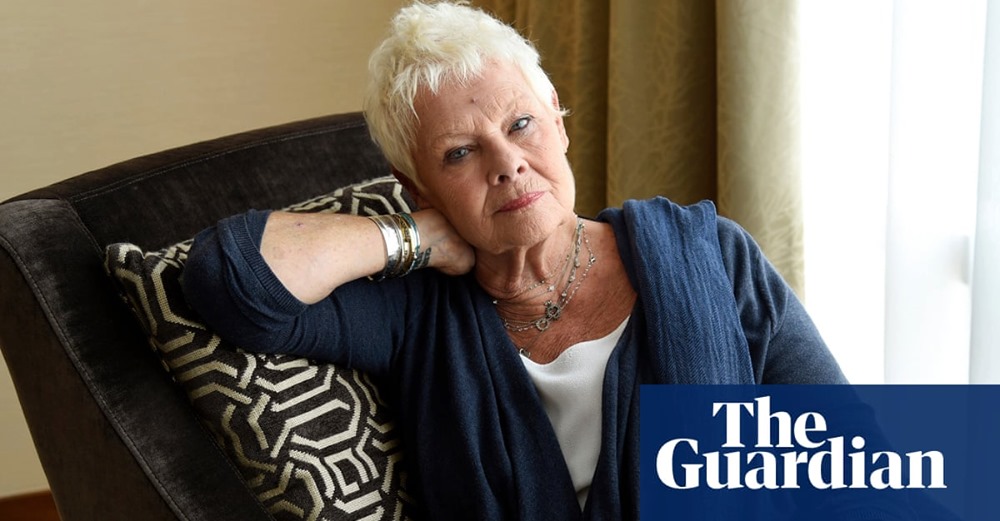
Judi Dench: 'In my mind's eye I'm six foot and willowy and about 39'

 At 86 and in lockdown, the actor finds herself in the rare position of not working. Instead, she talks about theatrical ghosts, her friendship with Harvey Weinstein and definitely not being a national treasure

It’s all go for Judi Dench, stuck at her house in deepest Surrey. What a freewheeling week; she is beside herself with excitement. Yesterday, she explains, she received her Covid vaccine. This required a trip to the village and was the first time she had left home since she can’t remember when. Then today it’s a phone interview, the thing she is doing right now. Her cup runneth over. Her world has turned Technicolor. “I’m not even joking,” she says with a sigh. “It’s nice to actually have something to do.”


Lockdown, I fear, is not the life Dench was born to. She used to practically eat and drink on the stage, but the theatres have closed, who knows for how long. She used to bounce from one film set to the next, but now production is mothballed and the industry has gone to ground. All of which means that she is confined to the house, an 86-year-old actor shoved into what she hopes is a partial and temporary retirement. She gets up each morning determined to keep herself busy. She crawls back to bed with most of the tasks left undone. After a while, she admits, the time starts to drag.


Dench recently learned a new word: synesthesia. “And I thought; ‘Well, that’s me.’ Because I always saw the days of the week in colour. I never gave it a second thought, it’s just how my mind works. And all of a sudden it’s not there any more. The days of the week have no colour at all. There’s no structure, no planning.” She is marooned with her memories and mementoes and various unquiet ghosts.


As luck would have it, her most recent film similarly throws her in among ghosts – although here, again, the experience soon starts to grate. Blithe Spirit is a galumphing reanimation of Noël Coward’s 1940s farce, played with gusto but fatally heavy-footed. Dench co-stars as Madame Arcati, a preposterous old medium who was previously embodied by the likes of Margaret Rutherford and Angela Lansbury. Down the years we have grown accustomed to seeing Dench making herself blissfully at home in any film, big or small, but her role as Arcati feels like so much heavy lifting. She huffs and she puffs. She falls into the orchestra pit. If the film is a notch or two up on 2019’s calamitous Cats (in which she played Old Deuteronomy), it is still a far cry from the heyday of Philomena, or Notes on a Scandal. Blithe Spirit is running on vapour, shouting to be heard. In the end it is a bit of a ghostly presence itself.


Dench says that in real life she probably has seen a ghost. She is reluctant to discuss it. People will think she’s gone daft. “But I remember being at [the actor] Michael Dennison’s memorial, which was at the Haymarket theatre, early in the morning. And I was walking down the stairs to the stalls and saw somebody in a black tailcoat run down in front of me. And then at the bottom there was nobody there at all.” She pauses. “But a lot of people say they’ve seen ghosts at the Haymarket, or at theatres all over. Ralph Richardson was certain that he did. And it makes perfect sense to me. There’s always a lot of spirits in the theatre, I think.”


Dench spent decades haunting the theatre herself – first in her home town of York, then at the Old Vic, then all over. These days, she tires more easily: an extended run can feel like a marathon. Also, her eyesight is almost completely shot (macular degeneration; she doesn’t want to harp on about it). But before that, good heavens, there was no stopping her. Directors knew her as “the Mighty Atom”, a 5ft 1in ball of fire, versatile and enduring. She says that when she wasn’t on stage, she would hang about in the wings, simply watching the show, drinking in the experience. She loved the interaction with an audience, the endless possibilities; the sense that a play could change and grow over time and that no performance was the same as the last.


It’s ironic, she says. She never especially wanted to be a film actor anyway. “Recently an American journalist said to me, ‘Oh, and I believe you did a little theatre as well’, and it was like an arrow going through my heart. I thought: ‘Oh dear, there goes the 60s, the 70s, the 80s, the 90s.’ Thousands of performances, gone in a flash.”


Besides, she adds, it’s not as if Hollywood was knocking the door down. When she was first starting out, a well-known film director turned her down for a role. He said that she was altogether too short and too plain. She should stick to the stage and leave cinema to the thoroughbreds.


I have heard this story before, but I don’t believe she has ever named the culprit. “No,” she says sharply, like a schoolmistress scolding an unruly pupil. “I never have and I never will. I’m not going to break my word today. The film in question, though, went on to be enormously successful. And I’m not going to tell you the name of the film, because then you’d know who it was right away.”


In which case we’ll move on from one louse to another. Dench’s film career is her own handiwork. She is a peerless performer; a commanding screen presence, as comfortable in a Bond film as she is in The Best Exotic Marigold Hotel. But her Hollywood breakthrough was engineered at least in part by Harvey Weinstein, who is serving a 23-year prison sentence for third-degree rape and first-degree sexual assault. It was Weinstein who spearheaded the awards campaign for 1998’s Shakespeare in Love. In her role as Elizabeth I, Dench was on screen for all of eight minutes. She went on to win the best supporting actress Oscar.


Besides, she adds, it’s not as if Hollywood was knocking the door down. When she was first starting out, a well-known film director turned her down for a role. He said that she was altogether too short and too plain. She should stick to the stage and leave cinema to the thoroughbreds.


I have heard this story before, but I don’t believe she has ever named the culprit. “No,” she says sharply, like a schoolmistress scolding an unruly pupil. “I never have and I never will. I’m not going to break my word today. The film in question, though, went on to be enormously successful. And I’m not going to tell you the name of the film, because then you’d know who it was right away.”


In which case we’ll move on from one louse to another. Dench’s film career is her own handiwork. She is a peerless performer; a commanding screen presence, as comfortable in a Bond film as she is in The Best Exotic Marigold Hotel. But her Hollywood breakthrough was engineered at least in part by Harvey Weinstein, who is serving a 23-year prison sentence for third-degree rape and first-degree sexual assault. It was Weinstein who spearheaded the awards campaign for 1998’s Shakespeare in Love. In her role as Elizabeth I, Dench was on screen for all of eight minutes. She went on to win the best supporting actress Oscar.


The problem, I suspect, is that Dench is a workaholic. She once claimed that she says yes to everything, never turns a gig down. I assumed this was a joke but she insists it is, by and large, true. Her agent reads the scripts first, weeds out the bad ones and provides a quick precis of what the good ones are about. After that, more often than not, it is simply a case of rearranging her diary.


What would it take to make her say no to a film? What is the one movie role she would totally balk at playing? “Probably an 86-year-old woman who’s not able to see.” She laughs shortly. “I’m not going to play that part, thanks.”


Ideally, she’d prefer some darker material. One of her favourite film roles was that of Barbara Covett, the vicious, miserable schoolteacher in 2006’s Notes on a Scandal. It would be nice to have the chance to make another picture like that one. “But I get put in a bracket. ‘Oh, would you like to play this person who’s sitting in a care home and she’s in love with a bird? And then she gets upset because, I don’t know, something happens to the bird.’”


Here, perhaps, is the downside of Dench’s film success; the consequence of being a part of the nation’s collective cultural fabric. We prefer our brightest stars to remain in one place. It is reassuring and soothing; it is how we plot our course through the world. When they start zigzagging about, it confuses the public; makes us lose our bearings.


Dench claims that she especially detests being described as a national treasure and who can blame her? It’s reductive and condescending. It puts lead boots on her feet. Others, though, have suggested that perhaps she doth protest too much. The late Geoffrey Palmer, her co-star in the BBC sitcom As Time Goes By, swore blind that she only pretends to dislike the term. “[That] would be an absolute bloody lie,” he said. “She loves it.”


I put this to Dench and she splutters with righteous indignation. That’s Geoffrey, she says, teasing her from beyond the grave, making her justify herself all over again. Because it is true that she hates it. Always has, always will.

“For one thing,” she says, “it’s a terrible label. So dusty, so dreary. For another, it relegates me to being an 86-year-old woman. Whereas in my mind’s eye I’m 6ft and willowy and about 39.”


She takes a breath and mulls it over. She says: “Do you know what it’s like? It’s like they’ve picked me up and put me inside a little glass-fronted cabinet. Then they’ve locked the door so I can’t get out.”


The line is breaking up. We have gone underwater again.


Smash the glass, I tell her, raising my voice to be heard. Smash the glass and run amok.

“Exactly,” she says. “And fuck being 86 years old.”


• Blithe Spirit is on Sky Cinema now


(Source: The Guardian)

Monday, 14 December 2020

Shanti: The iconic woman character from DD’s 1994 series that redefined Indian television

 One cannot really talk about women empowerment in Indian television without referring to the super hit series called Shanti - Ek Aurat Ki Kahani that was aired on Doordarshan in 1994.

We live in an era of web series and OTT platforms that provide fresh content, with intelligent plot lines and modern characters, almost every day. When Netflix’s Indian-origin film Bulbbul premiered in June, many raved about the lead character, played by Tripti Dimri, of a female vigilante who is bold, flawed yet progressive.


But bold female characters are not new, especially on Indian television. One of the most iconic characters had emerged in 1994, in the super-hit TV series called Shanti – Ek Aurat Ki Kahani that was aired on Doordarshan.


The Mandira Bedi starrer is remembered as one of the first daily TV soaps in an era when cable television had just entered India, giving Doordarshan stiff competition from channels such as Zee and Star Plus that also brought in contemporary, urban dramas centred around strong female characters.


Tara (1993) on Zee was another popular series that was broadcast in the afternoons, another novelty at the time.


Illustration: Ramandeep Kaur | ThePrint


Bold female protagonist

Shanti, played by Bedi, centered around an aspiring investigative journalist who worked hard to succeed in a man’s world. Over the course of the series, the lead character develops into a complex, multi-layered and flawed protagonist.


The story revolves around Shanti’s revenge on two men who had raped her mother. She uses her profession as a tool to unravel the crime committed on her mother ‘Tulsi’, played by Mohini Sharma, and seeks amends for the injustices done to them.


She enters the lavish ‘Shanti’ mansion where the male antagonists — Kamesh Mahadevan, played by Yatin Karyekar, and Raj ‘G.J.’ Singh, played by Amar Talwar — live with their respective families, on the pretext of writing a biography about the two men.


The story reveals how her mother was raped by the men while she worked as a labourer during the construction of the Shanti mansion.


Directed by Adi Pocha and produced by UTV Software Communications, the series had around 780 episodes.


Bedi, who after the success of Shanti became famous for her stint in cricket anchoring, became a household name in the 1990s.


In an interview to the Hindustan Times in 2016, Bedi said that her role as ‘Shanti’ made her a stronger person. “Shanti was a strong woman who stood for many things. I would find myself standing up for the rest of the unit when the food served was bad. Shanti made me a stronger person,” she had said.


Reeta Das, a Mumbai-based film student told ThePrint, “Bedi did a fantastic job playing the lead. It was so melodramatic and suspenseful that, as a child, I would keep wondering how it would end and if Shanti would get justice.”


“At a time when all female characters were only portrayed as being extremely submissive, Shanti waged a war against a family far more influential than she was. She was like a rebel who wouldn’t follow the rules. This kept us, as audiences, waiting to see how the plot would turn in each episode. The best part was how things were revealed through the lead character,” Das added.


A family show

The series that remained popular through the early and mid-1990s is still remembered across generations. Not surprisingly then, the Star Plus channel had aired it again 15 years later, in 2009.


“It’s been over 25 years since Shanti was aired on Doordarshan. Growing up in a middle class family, we didn’t have cable TV or colour television at that time. But that didn’t take away the urge to watch Shanti. Every day after school, my sister, mother and I would watch it while eating lunch, since it was aired in the afternoons. It was a complete family show full of emotions — revenge, love, sadness etc,” Delhi-based entrepreneur Arpita Singh told ThePrint.


Talking about the popularity of the show and her role in it, Bedi had also said how in Sri Lanka she is still remembered by the name ‘Shanti’.


(Source: The Print) 

Sunday, 16 August 2020

Tom Cruise never lets actors run on-screen with him, claims co-star

Actor made a rare exception for Annabelle Wallis in ‘The Mummy’

Tom Cruise never usually lets actors run alongside him in movies, according to his co-star in The Mummy, Annabelle Wallis.
Speaking about working on the 2017 film with Cruise, Wallis revealed that the actor made a rare exception for her.

“I got to run on-screen with him, but he told me no at first,” she told The Hollywood Reporter. “He said, ‘Nobody runs on-screen [with me],’ and I said, ‘But I’m a really good runner.


“So, I would time my treadmill so that he’d walk in and see me run. And then he added all these running scenes. So, that was it. It was, like, better than an Oscar. I was so happy! I was so happy that I got to run on-screen with Tom Cruise.”

Though Wallis – who is promoting her new film The Silencing – did not elaborate on Cruise’s running rule, it appears to be in place because Cruise is concerned that other actors cannot keep up with him.

Cruise has a reputation for being meticulous and extremely driven. Earlier this year, Rob Lowe reflected on working with him on the 1983 movie The Outsiders, saying the actor went “ballistic” when the pair were told to share a hotel room.

When the young stars went to New York for the final selection for Francis Ford Coppola’s film, Cruise was apparently upset about not having his own suite. “It was the first time I ever stayed at The Plaza Hotel," said Lowe. "I remember going, ‘Wow, this guy is the real deal.’ I mean it made me laugh, it was gnarly. But in the end of it, you can’t argue with the results. He’s had his eye on the ball since day one.”

Val Kilmer, who played Tom "Iceman" Kazansky in 1986’s Top Gun, also said that during filming, Cruise was so “laser-focused” on making his character Pete "Maverick" Mitchell the “greatest action hero in the history of film” that he “refrained from revelry” with the other actors.

Cruise can next be seen in Mission: Impossible 7, which has reportedly been hit by yet another delay after a motorbike stunt went dangerously wrong.

(Source: The Independent)

Thursday, 30 April 2020

Life itself: Rishi Kapoor (1952-2020) embodied romance and an irrepressible spirit

His output was unwaveringly steady and dependable, the shield of trust that came free with a movie ticket.

Rishi Kapoor, third-generation movie star, unofficial record keeper of Hindi film history, and widely acknowledged bon vivant, died on Thursday in Mumbai. He was 67. He is survived by his wife Neetu, his son Ranbir, and his daughter Ridhima and her family.

Kapoor was battling cancer, and had spent close to a year in New York City in treatment. He returned to Mumbai in September. He had been admitted to a hospital in Mumbai with breathing problems a few days ago.
Rishi Kapoor in Bobby (1973). | RK Films.

According to a statement issued by the family, “Our dear Rishi Kapoor passed away peacefully at 8:45am IST in hospital today after a two-year battle with leukemia. The doctors and medical staff at the hospital said he kept them entertained to the last. He remained jovial and determined to live to the fullest right through two years of treatment across two continents. Family, friends, food and films remained his focus and everyone who met him during this time was amazed at how he did not let his illness get the better of him.”

Kapoor had shot some portions of his comeback film, the comedy Sharmaji Namkeen, in Delhi in February. He was also on track to star in the Hindi remake of the Hollywood comedy The Intern.

His death has robbed show business of a seasoned entertainer. A member of the Hindi film industry’s most storied clan, Kapoor first appeared before the camera as a child in the 1950s. After he started his career in earnest as an adult in the 1970s, his choice of roles spanned romances, comedies, socially themed dramas, thrillers, historicals and melodramas. His films often had impassioned declarations of love, innocence, humour, chart-topping songs, trendy dancing and colourful costumes (most notably a series of bright jerseys).

Whatever the quality or outcome of the project, Kapoor’s output was unwaveringly steady and dependable, the shield of trust that came free with a movie ticket.

Given his spontaneity and ease before the camera, could he have stretched himself further, experimented a bit more? This true believer in mainstream Hindi cinema’s biggest pursuit – a positive commercial outcome – might have punched below his weight, but even in his most trite movies, he was a twinkly-eyed charmer, doing what was required without betraying too much effort.

Rishi Kapoor in Kabhi Kabhie (1976). Courtesy Yash Raj Films.

Some of this professionalism was learnt on the job and some of it was inherited. Like the doctor’s child who is familiar with medical jargon and the policeman’s kids who can distinguish between “handcuff” and “handkerchief”, Rishi Kapoor understood the pleasures, peculiarities and pitfalls of show business very early.

He was born on September 4, 1952, in Mumbai, the third of the five children of Raj and Krishna Kapoor. The family was already heaving with legends. Rishi Kapoor’s grandfather, Prithviraj Kapoor, had been a renowned stage and film performer since the late 1920s. His father Raj Kapoor directed, produced and starred in his own films, and had already rolled out one of his finest works, Awara , the year before Rishi Kapoor was born.

Raj Kapoor’s brothers, Shashi and Shammi, were leading men, and their wives were actresses (Shashi was married to Jennifer Kendal and Shammi to Geeta Bali). Rishi Kapoor’s uncles – Prem Nath, Rajendra Nath and Narendra Nath – were all actors. Rishi Kapoor’s mother, Krishna, was Prem Nath’s sister. Another of their sisters was the wife of screen villain Prem Chopra.

Rishi Kapoor’s brothers Randhir and Rajiv became actors too. Rishi would marry his co-star, Neetu Singh, and his son Ranbir would follow in his parents’ footsteps. So would some of his nieces and nephews, with Kareena Kapoor continuing to rule the roost.

“Acting was in my blood and there was simply no escaping it,” Kapoor wrote in his autobiography Khullam Khulla. The memoir, co-written with Meena Iyer, benefits from Kapoor’s refreshing honesty and prodigious memory. “My childhood was a dream, like an unending mela,” he wrote. “People from the film fraternity constantly streamed in and out of our home… The Kapoors have always been proud of our profession; nobody has ever been apologetic about belonging to the entertainment industry.”

As a child, he was frequently taken to the sets. Along with his siblings Randhir and Ritu, he was featured in the song Pyar Hua Ikraar from Raj Kapoor’s Shree 420 in 1955. Rishi Kapoor also appeared in a couple of plays as a child.

His first full-scale role was in his father’s Mera Naam Joker in 1970. When filming began in 1968, Rishi Kapoor was 16, and was recruited to play the younger version of Raj Kapoor’s character Raju, a circus clown. As a schoolboy, the tubby Raju has a crush on his svelte teacher Mary (Simi Garewal). Rishi Kapoor’s performance won him the National Film Award for Best Child Artist.

Rishi Kapoor in Mera Nama Joker (1970). Courtesy RK Films.

The sparkling eyes, robust complexion, ready smile and selfless romantic disposition were already on display in Mera Naam Joker. In the coming years, Kapoor sealed his reputation as the ideal lover boy, resulting in such popular romances as Hum Kisise Kum Naheen (1977), Laila Majnu (1976), Sargam (1979) and Prem Rog (1982).

“Rishi Kapoor comes across as the nice boy who wasn’t just led by his raging hormones but loved with his soul as well,” Madhu Jain wrote in the biography The Kapoors. “He danced like a dream, effortlessly. The star-crossed or tragic lover label fit him well, especially in films like Laila Majnu. He also came at a time when screen romance was about love, not obsession… He symbolised a sense of masti and youthful energy, not to forget those magic dancing feet.”

Rishi Kapoor hit the ground running with his debut as a leading man in 1973. Raj Kapoor made Bobby, a story of star-crossed lovers, as a way to recoup from the financial debacle of Mera Naam Joker. Rishi Kapoor, now slimmer but still bright-eyed and bushy-tailed, played Raj Nath, who falls in love with the Goan Catholic Bobby Braganza (Dimple Kapadia in her screen debut).

Rishi Kapoor in Bobby (1973). Courtesy RK Films.

Although Bobby was a box-office scorcher, Rishi Kapoor was soon exposed to one of the axioms of showbiz – you win some and then you lose some.

“I didn’t have to struggle for fame and fortune,” he said in Khullam Khulla. “But not even my extraordinary family legacy could prevent me from the realities of life.”

Bobby was immediately followed by the flop Zehreela Insan (1975). Rafoo Chakkar (1975), which was based on the Hollywood cross-dressing comedy Some Like It Hot, fared better although, as Kapoor wryly remarked, “…since I was made up like a girl for the major part of the film, I could not be endorsed as a bona fide heart-throb”.


The success of Khel Khel Mein in 1975 wasn’t just a much-needed breather. The romantic thriller cemented the pairing between Rishi Kapoor and Neetu Singh. She was a former child actor who was among the early candidates for the lead role in Bobby. Their shared delayed-1960s sartorial style – bell-bottoms, floral-patterned shirts, mini-skirts, floppy hair, oversized sunglasses – made them “fashion templates for teenagers before the MTV era”, Madhu Jain observed.

(Source: Scroll)

The story behind Irrfan Khan's moving speech in Ang Lee’s ‘Life of Pi’

Edited excerpts from Aseem Chhabra’s ‘Irrfan Khan’ reveal the actor’s contributions to the Oscar-winning movie.

After Delhi-based actor Suraj Sharma was cast to play the 16-year-old Indian boy (Suraj was 19 when the film was released) from the nearly 3,000 auditions, Ang and his casting agents started to look for an actor to play the adult Pi. Irrfan’s name was on top of the list. For one thing, he was taller than Suraj, and that made sense to Ang. The director had already seen Irrfan in Slumdog Millionaire, The Namesake (2006) and A Mighty Heart (2007).
Irrfan in Life of Pi (2012) | Fox 2000 Pictures

‘There were only a couple of actors to choose from in India and he was the top choice,’ Ang says. ‘Obviously I wanted to make an international film, but I also chose him for his good acting. It wasn’t like I had a list of five people to choose from. And his height was working.’ Ang cast another fine Indian actor, Adil Hussain, as younger Pi’s father. Tabu played Pi’s mother. Although the two played mother and son in the film, Tabu and Irrfan did not share any screen time.

Ang says that Life of Pi was ‘unfilmable’ for several reasons, but especially because it challenges the notion of narration. Irrfan’s Pi starts the film with a voiceover, giving the narrative a first person feeling. But much of the narration is also in third person, as we see the actual action taking place with the younger Pi and his lifeboat mate, Richard Parker, the CGI-created tiger. And Irrfan’s toughest task was to wrap up the movie emotionally, Ang adds.

The story that Pi narrates actually forms two narratives—and it is for the audience to believe in one of the two stories. ‘Irrfan had to emotionally develop his character and also grasp, both the philosophical way of the narration and also the trickster kind of a narrator,’ Ang says. And he adds, ‘I told Irrfan that Pi is bullshitting. Because it is tricky to believe in either of the stories. And the question that is asked—‘Which story do you prefer, not like?’—also makes one think.

Irrfan also had to match the innocence of the younger Pi, played by Suraj Sharma, and develop the cynical tone of an adult. ‘People might believe this way or that way,’ Ang says. ‘It has to be right on the edge where it would work for everybody. You can have two versions of the story and they all can debate, make sense. That was the most difficult task, other than creating a tiger in the ocean digitally.’

When the film’s shoot started, Irrfan went to Taiwan. But then Ang and his crew went off to shoot in India and returned to Taiwan to recreate the scenes of the lifeboat lost on the sea. Irrfan returned to Taiwan many months later to shoot the interior Montreal scenes. And later, the crew travelled to Montreal to wrap up the exterior scenes of the film. ‘He had not seen what we had shot and he would not see it until a year later when the film was finished, because a lot of it was going to be digital,’ Ang says. ‘And even I didn’t know how the digital scenes would shape up. I was just guessing. I told him what I had in my mind. I described the story, the pictures, how we were planning to shoot the rest of the film.’

Then came the key scene when Irrfan’s Pi talked about the lifeboat landing on the stranded beach and an emaciated Richard Parker walking away without looking back to say goodbye to his boat mate.

‘I was certain he was going to look back at me, flatten his ears to his head, growl,’ Irrfan’s Pi says in a voiceover, a long monologue, as he narrates his story to a writer, portraying Yann Martel, and played by the British actor Rafe Spall. ‘That he would bring our relationship to an end in some way. But he just stared ahead into the jungle. (By now the camera is on Irrfan’s face.) And then Richard Parker, my fierce companion, the terrible one who kept me alive, disappeared forever from my life.’ Then he adds, ‘I wept like a child. Not because I was overwhelmed having survived, although I was. I was weeping because Richard Parker left me so unceremoniously. It broke my heart.’

It is an emotionally devastating speech and Irrfan actually broke down, crying with tears rolling down his eyes, and it happened twice. Ang says he did not demand the tears from Irrfan. He simply explained the emotions, the background and how he felt thinking about the scene. ‘With actors I just want to see the results,’ he says. ‘I don’t care how they pull it off. What experience they use, they can keep that to themselves. But that was the effect I wanted, what the speech meant to me.’

Despite Irrfan’s fine acting, Ang Lee had to struggle with one concern—that the Indian actor mumbles while saying long dialogues. But Irrfan is not alone, he says, adding, ‘There are other great actors, Robert De Niro for instance, who mumble. It’s not that I couldn’t loop the voice. But it was a long dialogue so I just wanted to make sure that it was clear. He had to be understandable.’

There was also the concern about Irrfan’s English accent. As the film progresses, Pi matures from the teenager on the lifeboat to an adult living in Montreal and how he speaks English also changes. The film’s production team got a Montreal English accent coach for Irrfan. But despite the coaching, Irrfan’s dialogues—emotionally moving as they are—sound like they are being spoken by a man who does not speak English with ease.

At least one admirer of Irrfan was honest enough to say so.

‘I was delighted he (Irrfan) got roles in Hollywood films,’ Naseeruddin Shah says. But Naseer is known to be opinionated, calling a spade a spade. ‘Only in Life of Pi I didn’t care for his performance because he tried to put on a Canadian accent and it didn’t work. Angrezi woh itni achee nahi bolta ke accent badal sake. (He does not speak English well enough to change his accent.) That’s what I told him and he accepted it.’

But Ang Lee will always be grateful to Irrfan for what he did in the film. ‘I thank him for that. It’s very inspiring for a lot of people around the world. His speech was a dream for a filmmaker. He should have been nominated. He should have gotten an award for that speech.’

(Source: Scroll)

Tuesday, 7 January 2020

Australia bushfires: Fundraiser reaches A$20m in 48 hours

A fundraiser for fire services in New South Wales, Australia has raised more than A$20 million (£10.6m; $13m) in just 48 hours, as the state battles a bushfire crisis.

Australian comedian Celeste Barber launched the Facebook appeal on Friday, writing: "Please help any way you can. This is terrifying."

At least 24 people have died since the fires began in September.

Prime Minister Scott Morrison has called up 3,000 reserve troops to help.

In Canberra, the air quality has been ranked as the worst in the world, and residents have been told to avoid leaving their homes.
In some areas, helicopters have been brought in to help evacuate people


Australian airline Qantas has cancelled flights to and from the city for the remainder of Sunday.

An 'incredible' response
Comedian Ms Barber has family who were evacuated from the town of Eden in New South Wales, where officials told residents to leave immediately and head north if they did not have a bushfire response plan.

She called the rush of donations "incredible", and said the proceeds would go to NSW Rural Fire Service - a government-funded agency staffed by volunteers - and the Brigades Donations Fund, which channels charitable donations directly to fire brigades.


A number of celebrities have also donated money to support the fire-fighting effort in recent days - among them US singer Pink, and Oscar-winner Nicole Kidman, who pledged $500,000.

News of the donations was praised by Australians on social media, but some lamented that private citizens were raising funds they said should have been put in place by the government.

Almost 200 fires are still burning across the country. Although much attention has centred on worst-hit NSW, every state and territory has been affected. More than 1,200 homes have been destroyed and millions of hectares of land scorched.

Tens of thousands of homes in NSW and Victoria states are currently without power. Thousands of people have been evacuated from coastal towns over the past week.

The NSW town of Cooma suffered a further blow on Saturday night when a large tower carrying millions of litres of water exploded, flooding homes and sweeping away vehicles.

NSW Deputy Premier John Barilaro told ABC News the incident was a "massive disaster....on the back of a crisis and the threat of fires".

Prime Minister Scott Morrison, who has cancelled a planned visit to India scheduled for 13 January due to the crisis, said on Sunday that he had established a National Bushfire Recovery Agency to co-ordinate recovery efforts.


The body will help bushfire-hit communities recover, media reports said, through work ranging from rebuilding infrastructure to providing mental health support.

Mr Morrison, who has faced stinging criticism for his handling of the fires, promised the organisation "will be stood up for at least two years".

But he could not escape further condemnation on Sunday, as the head of the New South Wales Rural Fire Service revealed he had only learned of the plan to call up reserve troops through the media.

Singapore and Papua New Guinea have offered military support to Australia, while New Zealand is sending an additional three Air Force helicopters.

Sunday is expected to be cooler across the country's south-east, with some rain predicted. Fire officials have warned that the next major risks will come next week.

(Source: BBC)

Friday, 3 January 2020

How Sridevi shot for 'Devaraagam' in between her mother's botched up brain surgery


Despite the mental agony she must have been going through, Sridevi kept flying back to Kerala at regular intervals to shoot for 'Devaraagam'.

Director Bharathan, who had shot child Sridevi in her first-ever ad campaign for Chandrika soap, approached her to play Lakshmi in his biting social commentary Devaraagam (1996). More than the actress, it was Rajeshwari who was elated. She still remembered Bharathan from that calendar shoot and instantly persuaded Sridevi to accept the project.

With the actress’s professional front silent, her personal life was about to create headlines now. In early May 1995, Sridevi’s mother suffered a seizure and diagnosis confirmed a brain tumour. Following the advice of doctors in Madras, the actress took Rajeshwari to the reputed Memorial Sloan Kettering Cancer Center in New York for surgery. During this time, Boney Kapoor reached out to her once more. Boney shares: ‘My relationship with Sri normalized again. I helped her with all the arrangements in New York and also took time off to be with her family. I got closer to all of them. Many years later, Sri told me something that touched me deeply. She said that while flying to New York, her mother had told her in the plane that if she ever did another film with me, she should not charge any money. I think Sri also started seeing now that my feelings for her were sincere.’

Despite the mental agony she must have been going through, Sridevi kept flying back to Kerala at regular intervals to shoot for Devaraagam. Returning from her father’s last rites four years ago, she had performed a comedy scene for Lamhe. Now in between attending to her ailing mother in New York, she was shooting for Devaraagam in India. The actress was not only displaying professional ethic but also personal grit. Veteran actress and Bharathan’s wife, K.P.A.C. Lalitha, wonders where from was Sridevi drawing such impossible strength: ‘No one else could have done this when your mother is lying in a critical condition in a different country. I think it was Sri’s big heart that made this possible, her kindness and compassion for others. Her belief in the sanctity of her work. Her mother had promised us and she was honouring it no matter what.’

That teenage girl who had squabbled with K. Bhagyaraj on the sets of 16 Vayathinile, because she hardly understood the importance of continuity in a film, had now become a meticulous woman. K.P.A.C. Lalitha reveals: ‘Since the schedules of Devaraagam were erratic due to Rajeshwari amma’s illness, Sridevi maintained a diary. She would note down all her costume details before leaving so that when she would be back for the next schedule, there would be no continuity issues. Keeping track of such minute details in the middle of a personal crisis is exemplary. I have never seen anyone so dedicated and I don’t think I ever will.’

Bharathiraja, who met Sridevi during this time, found her putting up in a small apartment in New York. He advised her to rent a larger one but the actress wanted to keep things simple. She was cooking herself and taking care of her mother. In public, she had her brave face on. In private, she was anxious that the surgery goes well. 

Alas, that was not to be. The day Rajeshwari was being wheeled inside the operation theatre, she suddenly clutched her daughter’s hand, her nails digging into Sridevi’s skin. A spasm of terror passed through her face. Glancing at the actress and their family doctor who had accompanied them, Rajeshwari uttered these strange words, ‘Please tell them to operate me in the right place.’ Their family doctor laughed and assured her saying, ‘Of course they will. It is like telling your daughter to act well.’ Hours later, Rajeshwari’s fear had come true. In a bizarre case of medical negligence, the neurosurgeon, Dr Ehud Arbit, had operated on the right lobe of her brain while the tumour was in the left lobe. The botched-up surgery soon sparked headlines across America. While Arbit faced suspension, President Bill Clinton made it mandatory for US hospitals to disclose their medical malpractices. But in the middle of all this chaos stood a horrified daughter trying to make sense of what had just happened to her mother, wondering if she was to blame for bringing Rajeshwari here, clinging to her own sanity as the press hounded and lawyers bickered.


And yet, Sridevi turned up on time for the final schedule of Devaraagam in India. The actress was in absolute control while performing the last remaining scenes—the composure on her face hardly betraying the storm inside her. But when Bharathan gently inquired about Rajeshwari’s condition, Sridevi broke down. K.P.A.C.Lalitha recalls how the actress’s pent-up emotions spilled over: ‘She was in tears as she told us that the wrong surgery had affected the memory part of her mother’s brain. She said Rajeshwari amma was talking about things that had happened ten years back. But even in that state, Sridevi kept apologizing to my husband that because of her personal problems, Devaraagam had to be scheduled in an irregular manner.’

It was only after the tumour was removed at Cornell Medical Center that Sridevi returned to India after two harrowing months. While the actress was relieved now that Rajeshwari was recuperating, she was herself battling an enormous sense of guilt. She told Movie: ‘I cannot live without my mother. I need her for everything. If I have a problem, I still call her up and ask her what to do. We are virtually bound by an umbilical cord. How can a qualified doctor do something as drastic as this? It’s unpardonable. Today, when I look at her, I feel so guilty. There are so many good doctors even in Madras whom I could have taken her to. In the US, I felt so frightened, lonely and lost.’


Excerpted with permission from Sridevi The Eternal Screen Goddess by Satyarth Nayak, published by Penguin Randomhouse. 

(Source: TNM)