Showing posts with label Jammu Kashmir. Show all posts

Tuesday, 19 November 2019

Article 370 gone, Modi govt draws up plan to reopen 50,000 temples closed in Kashmir

The BJP's latest assertion comes on the back of the abrogation of Article 370 from Jammu and Kashmir. The Centre had claimed that a large section of people was being subjected to injustices due to the special status to the state which did not allow the schemes meant for the rest of India to be implemented in the state.

The Narendra Modi-led government at the Centre has set up a committee to survey around 50,000 temples that were closed in Jammu and Kashmir. Informing about the move, Union Minister G Kishan Reddy said that the central government has set up a committee to survey a number of closed schools in Kashmir valley and will reopen them. “Around 50,000 temples were closed over the years, of which some were destroyed, and idols were defaced. We have ordered a survey of such temples,” the minister said while addressing a press conference in Bengaluru.

He, however, stopped short of saying that the survey has been ordered to reopen or re-build all the closed or destroyed temples. When asked about the existence of 50,000 temples in the Valley, the minister said: “Yes, there are 50,000 temples including villages…and almost all of them have been closed.” When asked whether the government would re-open all of them, the minister while nodding his head said: ”We are conducting a survey — how many temples were there, of which how many of them are open, how many of them have been destroyed. We are doing a survey of all schools, temples and cinema theatres that are not open and working.”

In October 2012, the Jammu and Kashmir government run by Congress-NC had claimed that only 208 temples were damaged in the Valley. In a written reply to the state assembly in response to the question by a BJP MLA, the state government said that there were 438 temples in the Valley and out of these only ”208 had been damaged over the years”. It said that 57 temples were damaged in Srinagar, followed by Anantnag where 56 temples were damaged. However, the Kashmiri Pandits, who were driven out of their homes in the peak of militancy, claims that thousands of temples have been destroyed since the 1990s.

The BJP’s latest assertion comes on the back of the abrogation of Article 370 from Jammu and Kashmir. The Centre had claimed that a large section of people was being subjected to injustices due to the special status to the state which did not allow the schemes meant for the rest of India to be implemented in the state. Arguing that Article 370 was always a temporary measure, the Centre decided to divide the state of Jammu and Kashmir into two Union territories – Jammu and Kashmir, and Ladakh — putting the region under the direct control of the central government.

(Source: Financial Express)

Monday, 1 July 2019

Dangal star Zaira Wasim quits films: My relationship with my religion was threatened

In a detailed post on her Facebook page, the Kashmiri-born Dangal star Zaira Wasim said she realised "though I may fit here perfectly, I do not belong here".

National Award-winning actor Zaira Wasim on Sunday announced her "disassociation" from the field of acting, saying she was not happy with the line of work as it interfered with her faith and religion.

In a detailed post on her Facebook page, which she later shared across all social media platforms, the Kashmiri-born Dangal fame star said she realised "though I may fit here perfectly, I do not belong here".
Zaira Wasim will be next seen in Shonali Bose's The Sky Is Pink.
"Five years ago, I made a decision that changed my life forever. As I stepped my foot in Bollywood, it opened doors of massive popularity for me. I started to become the prime candidate of public attention, I was projected as the gospel of the idea of success and was often identified as a role model for the youth. However, that's never something that I set out to do or become, especially with regards to my ideas of success and failure, which I had just started to explore and understand," Wasim said in the lengthy post.

Zaira Wasim
on Saturday
5 years ago I made a decision that changed my life forever. As I stepped my foot in Bollywood, it opened doors of massive popularity for me. I started to become the prime candidate of public attention, I was projected as the gospel of the idea of success and was often identified as a role model for the youth. However, that’s never something that I set out to do or become, especially with regards to my ideas of success and failure, which I had just started to explore and under...
see more

The 18-year-old actor said as she completed five years in the profession, she wanted to "confess that I am not truly happy with this identity i.e my line of work".

"For a very long time now, it has felt like I have struggled to become someone else. As I had just started to explore and make sense of the things to which I dedicated my time, efforts and emotions and tried to grab hold of a new lifestyle, it was only for me to realise that though I may fit here perfectly, I do not belong here.

"This field indeed brought a lot of love, support, and applause my way, but what it also did was to lead me to a path of ignorance, as I silently and unconsciously transitioned out of 'imaan' (faith). While I continued to work in an environment that consistently interfered with my 'imaan', my relationship with my religion was threatened," she said.

Wasim said as she continued to "ignorantly pass through" while trying to convince herself that what she was doing was okay and was not really affecting her, "I lost all the 'Barakah' (blessing) from my life".

"I was constantly battling with my soul to reconcile my thoughts and instincts to fix a static picture of my 'imaan' and I failed miserably, not just once but a hundred times..."

"I kept procrastinating by tricking and deluding my conscience into the idea that I know what I am doing doesn't feel right but assumed that I will put an end to this whenever the time feels right and I continued to put myself in a vulnerable position where it was always so easy to succumb to the environment that damaged my peace, 'imaan' and my relationship with Allah (God)," she said.

Talking about her life as an actor, she said she continued to observe things and twist her perceptions as she wanted them to be, without really understanding that the key was to see them as they were.

"In the great and divine wisdom of the Quran, I found sufficiency and peace. Indeed the hearts find peace when it acquires the knowledge of Its Creator, His Attributes, His Mercy and His commandments," she added.
Wasim said she began to heavily rely upon Allah's mercy for help and guidance instead of valuing her own believability.

"I discovered my lack of knowledge of the basic fundamentals of my religion and how my inability to reinforce a change earlier was a result of confusing my heart's contentment and well being with strengthening and satisfying my own (shallow and worldly) desires," she said.

The actress, who made her big Bollywood debut in Aamir Khan's 2016 film Dangal, said she questioned the deepest sources of her ideas of success, meaning and the purpose of her life.

"The source code that governed and impacted my perceptions evolved into a different dimension. Success isn't correlated with our biased, delusional and conventional shallow measures of life. Success is the accomplishment of the purpose of our creation. We have forgotten the purpose we were created for as we ignorantly continue to pass through our lives; deceiving our conscience," she said.

Wasim said the journey has been "exhausting, to battle my soul for so long" and life was too short yet too long to be at war with oneself.

About announcing the decision on social media, the actor said she was openly doing so not to paint a holier picture of herself, but "this is the least I can do to start afresh".

"This is just my first step as I have arrived at the clarity of realisation of the path I wish to be on and strive for and during this time I may have consciously or unconsciously planted a seed of temptation in the hearts of many, but my sincere advice to everyone is that no amount of success, fame, authority or wealth is worth trading or losing your peace or the light of your 'imaan' for," she said.

Wasim will be next seen in The Sky is Pink, which also stars Priyanka Chopra Jonas and Farhan Akhtar. The shooting of the film was completed in March and the cast and crew recently celebrated its wrap-up party in Mumbai where Zaira was also present.

(Source: India Today)

Monday, 23 April 2018

Reporting rape: Court notices for naming Kathua victim?

The Delhi High Court levies a Rs 10 lakh fine on media houses which named the victim, but the offenders were many more than those issued notices by the court. How the Indian media reports such cases merits constant scrutiny, writes Sevanti Ninan on the Hoot. Read on: 

Does a heart-wrenching photograph of a child help elevate the response of a nation to her rape and murder, even as publicising it breaks the law?

In 2012, the Delhi gangrape victim’s photograph was not circulated and therefore did not become imprinted in public memory. But today, an unforgettable photograph of the eight-year-old Kathua rape victim – in which she gazes straight at the camera while dressed in a bright purple salwar kameez – has been widely used in the press, which has also revealed her name.

On April 13, news agency PTI reported that the Delhi High Court had issued notices to several media houses for revealing the Kathua victim’s identity. The report said that a bench comprising acting Chief Justice Gita Mittal and Justice C Hari Shankar, “took up the issue on its own after coming across print and electronic media reports”, and sought a response from them, asking why action should not be taken against them on the matter. Subsequently, on April 18 the Court levied a Rs 10 lakh fine on media houses which named the victim, but the offenders were many more than those issued notices  by the court.

"The father of the Kathua rape victim had given out her photograph to members of the press, and newspapers in Kashmir were the first to publish it"

A basic Google search shows that the list of newspapers, TV channels and websites that had revealed the identity of the Kathua victim is wide ranging. It starts with the Kashmir dailies, Rising Kashmir and Greater Kashmir, which have published news related to the crime prominently since January, when the rape and murder took place, along with the girl’s photograph. It goes on to include the Times of India, where the child’s name also figured in a headline; NDTV, which used her photograph, and later masked it; the website 

ScoopWhoop, which carried a photograph of a poster with the girl’s name and face; the website Newslaundry; the Indian Express, which had identified the girl (it removed the references later though they can still be found via a Google search); the National Herald newspaper; and the academic journal, Economic and Political Weekly. These references have been deleted subsequently.


What the law says
Was this unforgivable behaviour? Only by a strictly legalistic interpretation of the law (Section 228A of the Indian Penal Code), which says that in the case of a deceased victim or a minor the name can be revealed, but prescribes the procedure:

“[W]ith the authorisation in writing of, the next of kin of the victim: Provided that no such authorisation shall be given by the next of kin to anybody other than the chairman or the secretary, by whatever name called, of any recognised welfare institution or organisation.”

The father of the Kathua rape victim had given out her photograph to members of the press, and newspapers in Kashmir were the first to publish it. In the case of the Delhi woman who was brutally raped in December 2012 and died later of her injuries in a Singapore hospital, both parents were clear that they wanted the world to know their daughter’s name because she had done nothing wrong. Her mother even revealed her name in an NDTV programme. But the media did not deviate from calling her Nirbhaya, the pseudonym bestowed on her by the Times of India.

The contrast between the way the Indian media has reported the rape of the eight-year-old in Kathua and the minor girl in Unnao is this: while the Unnao victim’s name has not been publicised, there is TV footage of her in which only half her face is flimsily veiled. Footage of the Unnao victim has featured on ABP News channel, as well as on a page on the New Indian Express website.

This is perhaps because her immolation bid outside Uttar Pradesh Chief Minister Adityanath’s house in Lucknow on April 8 was captured by TV cameras.

Not just journalists?
Given the rising graph of cases of rape from all over the country, how the Indian media reports such cases merits constant scrutiny.

Irresponsible reporting acquires many dimensions. But it is not just about the media either. In mid-2016, the Delhi Police registered a case against Delhi Commission for Women chief Swati Maliwal for allegedly revealing the identity of a 14-year-old Dalit rape victim in a notice she sent to the police station chief of the area the victim was from. Last April, a Delhi court rapped the city police for revealing the identities of victims of sexual violence in a chargesheet it had filed.

"Irresponsible reporting acquires many dimensions. But it is not just about the media either"

A 2016 article on news website The Wire documented the ways in which the criminal justice system itself breaks the law regarding the identities of rape victims.


 The role of class
The class of the victim affects coverage too. A 2006 article in The Hoot on how the English press covered the brutal sexual assault of a Dalit woman and her daughter in Khairlanji, Maharashtra, notes how the English press practically ignored the crime. “The mother-daughter’s face and name – Surekha and Priyanka Bhotmange – should have become as much part of our consciousness as Jessica Lal’s and Priyadarshini Mattoo’s,” the author wrote. But they did not. (Both the Mattoo and Lal incidents happened in the national capital. While Mattoo, a law student, was raped and killed, Lal was shot dead at a restaurant for refusing to serve her killer a drink. Both the cases got widespread media coverage.)

Similarly, look at the initial media coverage of the Kathua crime. The child was abducted, raped and murdered in January. Why did the national media not wake up to the crime till April? Was it till other factors came into the story? Regardless of who the perpetrators were, was the incident not heinous enough to merit wide coverage?

At another level, the media sees privacy as less of an issue when it concerns Dalit and working-class victims. Does this explain why the Kathua victim was identified in Kashmir newspapers as soon as news of the crime first emerged? Combined perhaps with the communal angle, it instantly became a story to be followed by newspapers in the Valley. The same angle, however, possibly led to indifference from the majority community, which Rising Kashmir reported in January in an article titled Jammu’s saffron belt silent on Kathua child’s rape and murder.

A two-part investigation in The Hoot into how the media reports rape, looked at reporting in three English dailies over a two-month period in 2017. It found that 34% of reports, by providing names and other details about the perpetrator and his relationship to the victim, made the victim vulnerable to identification.

There are other dimensions that must be considered before journalists rush to report on, or write about, incidents of rape. For instance, should they risk prejudicing a case by writing about evidence that they might have been privy to? In 2014, the Network of Women in Media was sharply critical of two Delhi journalists who wrote articles in defence of former Tehelka editor-in-chief Tarun Tejpal, who was accused of rape by a junior colleague the previous year. In their articles, the journalists had referred to CCTV footage they had viewed. But this footage is not in the public domain, and is likely to have a bearing on the case, which now goes to trial.

When perpetrators of rape are influential, justice is difficult enough to obtain without the media’s heedlessness adding to the odds that are stacked against a victim.

Wednesday, 18 April 2018

My only religion was my uniform: Officer who cracked Kathua case

Shwetambri Sharma, the only female member of the Special Investigation Team (SIT) of Crime Branch of the Jammu and Kashmir Police that investigated the rape and murder of the eight-year-old Bakerwal girl, reveals exclusively to The Quint how hard it was to carry out her job against heavy odds.

“The people we believed were involved in the gruesome rape and murder of that 8-year-old angel, their relatives and sympathisers, including a multitude of the lawyers, left no stone unturned to disrupt our investigation. They went to the extreme of our humiliation and harassment. But we stood our ground firmly till the end,” Shwetambri Sharma, the Jammu-based Deputy Superintendent of Police in Crime Branch of the Jammu and Kashmir Police, told The Quint.


An eight-year-old went missing on 10 January around Rasana village of Hiranagar in Jammu’s Kathua district. After the police failed to recover her amid allegations of kidnapping, which rattled a session of the Jammu and Kashmir Legislative Assembly, she was found dead on 17 January.

“We worked against heavy odds. At times we were disappointed, particularly when we learned that even the men of Hiranagar Police Station had been bribed to hush up the case and they had washed away the young victim’s clothes to destroy material evidences. Yet we cracked this rape and murder mystery during the holy navrataras. I believe there was a divine intervention to bring the culprits to justice. I believe Durga Mata had her hand on our head,” said Shwetambri, an officer of the 2012 batch of the Jammu and Kashmir Police (Gazetted) Service.


On 23 January, the government of Jammu and Kashmir assigned the investigation to the crime branch.

The SIT functioned under supervision of Inspector Generals of Police (IGPs) of Crime, Aloke Puri and Syed Ahfadul Mujtaba, besides Senior Superintendent of Police (SSP) Crime Branch Jammu Ramesh Kumar Jalla. Headed by Additional Superintendent of Police (SP) Crime Naveed Pirzada, it had Deputy SP Shwetambri, Sub Inspector Irfan Wani, Inspector KK Gupta and Assistant Sub Inspector of Police Tariq Ahmad as its members.

On 9 April, amid demands of shifting the investigation to the CBI from families of the accused and their sympathisers, the SIT filed two charge-sheets against the accused before the Chief Judicial Magistrate (CJM) holding eight of the accused guilty of rape, murder, kidnapping, wrongful confinement, criminal conspiracy and destroying of evidences.

The accused included a youth, who, according to the charge-sheet, committed rape twice on the captive child and murdered her brutally before dumping her body. He was declared as a Juvenile in Contravention with Law (JCL) by a judicial magistrate even as the SIT proved him an adult on the basis of school records. A team of doctors at Government Medical College Jammu also described his age as between 19 and 20 years.

Shwetambri taught management at Mata Vaishno Devi University and some other colleges affiliated to University of Jammu for 7 years. She was doing her Ph D in management when she joined the police service in 2012.

“As most of the accused were Brahmins, they over-emphasised their surnames. They particularly tried to influence me and communicated through different means that we belonged to one religion and one caste and I must not hold them guilty of the rape and murder of a Muslim girl. I told them that as an officer of the J&K Police, I had no religion and my only religion was my police uniform”.


“When all such tactics failed, their families and sympathisers resorted to blackmailing and intimidation through whatever means at hand. They carried lathis, shouted slogans, organised rallies under the tricolour and blocked our roads to different villages and finally the court. But with perseverance and patience we stood our ground to carry out our job with total determination, commitment and professionalism,” Shwetambri said.


The officer narrated how spine-chilling it was to discover that the child had been subjected to untold brutality inside private devsthan belonging to a retired girdawar named Sanji Ram. She was the officer who entered the devsthan and seized material evidences including the victim’s hair strands in the presence of a magistrate. Forensic Science Laboratory subsequently confirmed that the hair samples were that of the eight-year-old’s.

According to the officer, the biggest challenge was “to unravel the real culprits who had the courage to sexually violate a devi – kanjak – whom we Hindus consider as a Durga avatar and worship”.
“During the hearing of a bail petition, which was subsequently dismissed, we entered the court to make relevant arguments. But, instead of arguing as defence lawyers, a crowd of 10 to 20 lawyers held demonstrations. They insisted we name the accused, knowing well that we were barred. We repeatedly faced a hostile crowd outside the courts. We did nothing but to request the SHO to file an FIR. When he didn’t, we approached the district magistrate through the head of our SIT. There was anarchy and intimidation all around,” Shwetambri said.

She said the most gruelling moment came when she had to question all the accused men about graphic details of the rape and murder of the child who was her own son’s age.

It was terrible. But Mata Durga was on our side. She gave me courage and I asked all the required questions in presence of male members of our SIT.


She pointed out that Vishal Jangota, the devsthan custodian Sanji Ram’s son who had returned from his B Sc Agriculture studies in Meerut to “satisfy his lust”, was arrested on the 1st navaratara and Sanji Ram himself on the 3rd navratara.

“It was the most difficult task,” she said.

“Sleep eluded me. I stayed awake for nights. I was not available as my husband’s partner, when he went for family and social commitments. I couldn’t take care of my child properly who had to be prepared for exams. But thank God we have been successful in our job and I am satisfied that I, along with other members of my team, have done something to bring those rapists and killers to justice.”

“We have full faith in the judiciary. We are all hopeful that justice will be delivered as our investigation is fool-proof and supported not only by confessions but also by other necessary evidences including technical and scientific ones,” said the officer.

(Source: The Quint)

Monday, 16 April 2018

Kathua rape: Exposing a viral list of lies from ground zero

The now infamous Kathua rape and murder case has been given a communal tone by viral posts on social media. The chargesheet filed by the J&K police in the case revealed that an 8-year-old girl was sedated, raped repeatedly, and then bludgeoned to death in January this year.

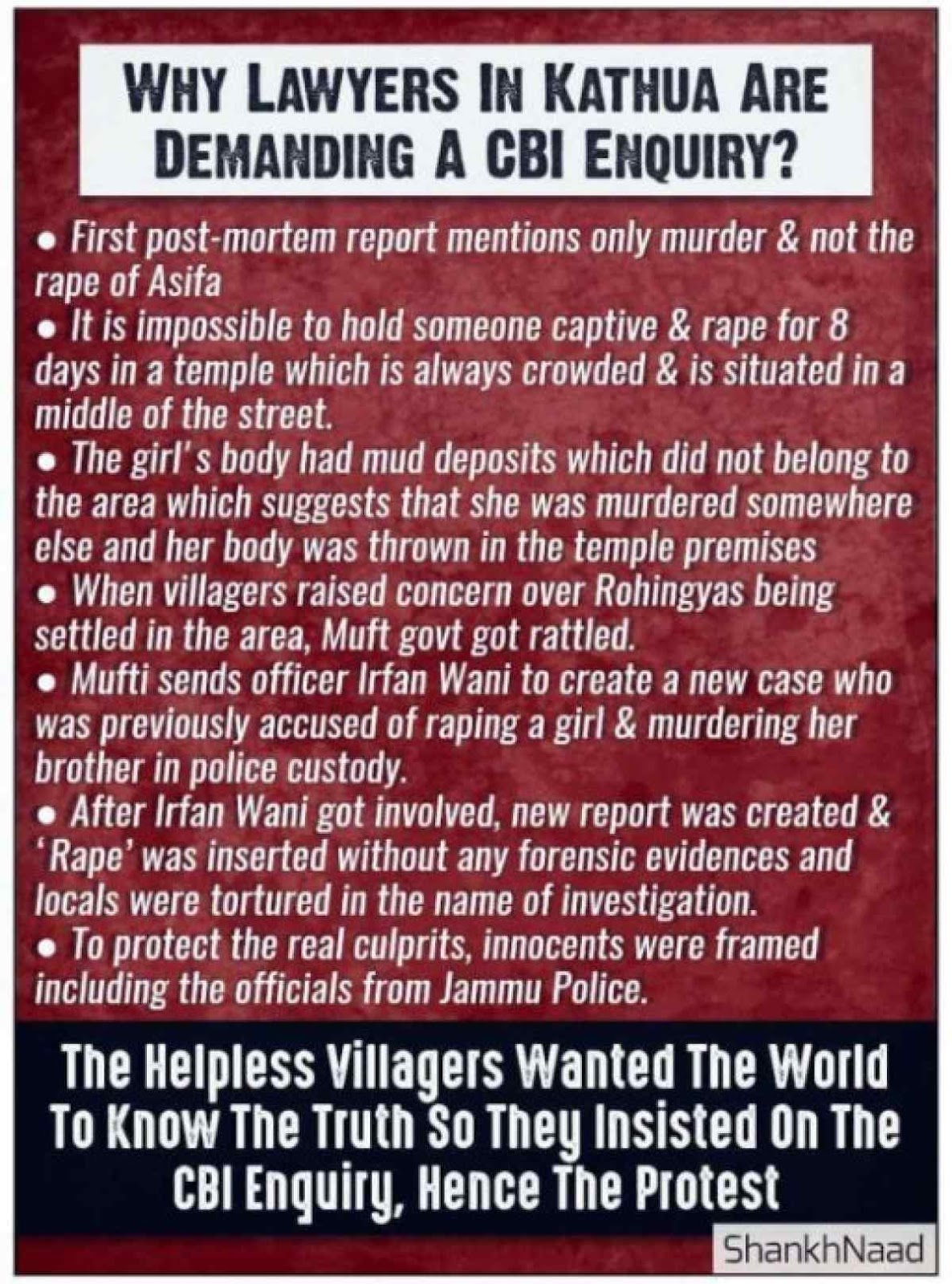
Of the many fake news posts doing the rounds on social media, there is one with the headline, 'Why lawyers in Kathua are demanding a CBI Inquiry'. The contents of this post are outrightly false.

This image, which has been shared over 7,600 times on Facebook, was posted by a page named ShankNaad, a repeat offender when it comes to spreading misinformation. The page has more than 1.3 million Facebook followers and 17.4 thousand Twitter followers.


Of the seven points mentioned above, not one is true. Let’s take them down one-by-one.

ShankhNaad Known for Spreading Communal Hatred
For those who don’t already know of the communal disharmony and hatred the page tries to perpetuate, we have a few examples of the numerous fake stories that have already been debunked.

In September 2017, ShankhNaad posted a video on Twitter that showed a blazing fire, stating that “Hindu temple, vehicle and cows in Gaushala were set on fire by Muslims mobs in Hyderabad.”

The Hyderabad police confirmed that no such violence had taken place anywhere in the city.
Another example of stoking communal disharmony — in October 2017, they put up a photo of a beheaded Swami Vivekananda statue and pinned the responsibility on Muslims in Badhohi, UP.

The SP of Bhadohi, following these rumours, issued a clarification stating that one Premchandra Gautam had been arrested for the vandalism, and as the name suggests, he isn’t a Muslim.
The list of these instances is very long. One more example is from July 2017, when ShankhNaad posted a video of a police station being attacked in Shamli, UP. The accusation was that members of the Muslim community were responsible for pelting stones, rioting and arson.

Shamli police issued a clarification stating that this video was 2 years old and appropriate action had been taken.

Now that we’ve provided you with a history of the kind of ‘news’ ShankhNaad peddles, let’s look at each of the ‘facts’ mentioned in the image above and see if any of them hold true.

Allegation 1: 'First post-mortem report mentions only murder and not the rape of the minor'

Wrong.

According to the chargesheet, accessed by The Quint, there is no mention of more than one post-mortem being conducted. The post-mortem of the 8-year-old was conducted by a team of doctors in District Hospital Kathua on 17 January at 2:30 pm.

The medical experts said that the victim was found prima-facie raped before being killed, the chargesheet states. Furthermore, investigations in this regard have established that the victim was raped by more than one accused.

Allegation 2: It is impossible to hold someone captive and rape for 8 days in a temple which is always crowded and is situated in the middle of the street.

Wrong.

This 'fact' is wrong on a number of levels.

Firstly, the child was held captive not for 8 days but for 6 days. She was sedated and taken in on 10 January and her body was dumped on 15 January in the Rasanna forests by two of the accused, including the juvenile.

Secondly, The Quint has visited the temple/prayer hall where the police states the girl was held captive and can certify that it is not a crowded temple. The temple is located in the middle of nowhere, with no houses adjacent to it for kilometres.

Thirdly, if only someone from ShankNaad had visited the temple, they would know not to add something as inaccurate as it being situated in 'the middle of the street'. It is situated on a hilltop and is isolated from the Rasanna village which lies about a kilometre away from the hall. The walk, which leads to the village, is a lonely one. It opens up to a number of houses including the home of Sanji Ram. It is on this same path that the body of the victim was found on 17 January.

Fourthly, the chargesheet states that that the Devisthan was exclusively manned by the main accused, Sanji Ram, to exclude any other person in the area.

Allegation 3: The girl's body had mud deposits which did not belong to the area which suggests that she was murdered somewhere else and her body was thrown in the temple premises.

Wrong. There is no mention whatsoever of mud in the investigation submitted by the police, which includes opinions by medical experts as well. They however do mention clay in their investigation.

The chargesheet reads: “The investigation has established, on the strength of evidence both oral as well as scientific, that the accused SI Dutta and Tilak Raj have in furtherance of Criminal Conspiracy hatched between themselves and the principal accused Sanji Ram washed the clothes worn by the deceased at the time of her death with the intention to remove the clay and blood stains/sperms etc and thereafter forwarded the same to FSL (forensic science laboratory) for expert opinion.”


Coming back to ShankNaad’s assertion.

1. The first part of the statement – "The girl's body had mud deposits which did not belong to the area"

The chargesheet doesn't say that the clay found on her was not of the kind found in the area, it only states that police officials conspired with Sanji Ram to ensure the clothes were not sent in their authentic state for testing.

2. The second part of the statement – “which suggests that she was murdered somewhere else and her body was thrown in the temple premises"

The assertion that she was murdered somewhere else and her body was thrown in the temple premises is baseless. The body was found in the Rasanna forest and not in the temple.

The police also adds in the chargesheet that on the basis of expert opinion, one of the hair strands found in the Devistan matched with the DNA profile of the victim. Thereby confirming that the victim was held captive there.

Allegation 4: When villagers raised concern over Rohingyas being settled in the area, Mufti govt got rattled

Well, the government has allowed Rohingyas with necessary documentation the right to settle in Jammu, and the locals have had a problem since this matter began three years ago.

This is a issue non-exclusive to the Kathua rape case and hence its doubtful it would have the ability to ‘rattle’ a government if it has been around for almost 3 years.

Allegation 5: Mufti sends officer Irfan Wani to create a new case, who was previously accused of raping a girl and murdering her brother in police custody

The first part is wrong. Mufti didn't choose the members of the crime branch who were asked to do this task. The SSP Crime Branch, Ramesh Kumar Jalla, who is a Kashmiri Pandit, chose the members of his team.

When The Quint spoke to him about Irfan Wani and the various cases against him, Jalla said, "I wasn't even aware of these allegations against inspector Irfan Wani. I got to know after it was brought up in the media. The man was booked under a case of raping a girl and killing a young boy, but he was acquitted in both cases around 2014. If the man is acquitted by the judiciary of the country there is no sense to not include him as part of my team. I had an excellent team that did a good job of delivering a chargesheet."

Allegation 6: After Irfan Wani got involved, new report was created and 'rape' was inserted without any forensic evidence and locals were tortured in the name of investigation.

As mentioned under the first allegation, rape was never ‘added’ to the existing charges, it was always part of the investigation. This charge is based on the post-mortem that was conducted on the same day her body was found.

Allegation 7: To protect the real culprits, innocents were framed including the officials from Jammu Police.

Now, who the real culprits are can only be deliberated upon once the court debates the chargesheet and then decides the relevant charges.

Whether the crime branch is right in its chargesheet or not can only be debated in a court of law and not on a Facebook page that evidently does not care about being on the ground. Or have the necessary intelligence-gathering mechanism and reliable sources to make the blatant assertion that 'innocents are being framed, including the officials from Jammu police.’

(Source: The Quint)

What PM Narendra Modi said about the Kathua and Unnao rapes

Prime Minister Narendra Modi on Friday, 13 April broke his silence on the gruesome Kathua and Unnao rape cases, that have rocked the conscience of the nation.

Speaking at the inauguration of the Ambedkar Memorial in New Delhi, the prime minister said that the “guilty” will not be spared. He asserted that “daughters will get justice”, and the government will ensure that happens.

The incidents in the past two days are an embarrassment to the civilised society. We bow our head before the founding figures of the nation. No culprit will be spared, justice will be delivered. Those daughters will get due justice; all of us have to fix the problem together. The guilty will not go unpunished and the Government of India will not leave any stone unturned to ensure that happens.
Narendra Modi, Prime Minister


Pressured into Making a Statement?
The Prime Minister’s statement comes after the Opposition led by Congress President Rahul Gandhi, and various sections of media pointed to his silence and demanded that he make a statement.

Just hours before Modi’s statement, the Gandhi scion hit out at the PM over his silence on violence against women and children, saying it was "unacceptable" and India was waiting for him to speak up.

Former Jammu and Kashmir Chief Minister Omar Abdullah on Friday, 13 April, urged incumbent state Chief Minister Mehbooba Mufti to take stringent action against the BJP ministers who are supporting the accused in the Kathua rape case.

Protests Erupt Across the Country
The Congress president led a midnight candle-light vigil on Thursday protesting against the two rape cases.

A day later, on Friday, 13 April, citizens gathered in Mumbai’s Azad Maidan protesting the incidents of rape, and demanded that the prime minister take immediate action. In Bengaluru too, people took to the streets demanding that the the PM speaks up.

What Happened in Kathua & Unnao?
The chargesheet filed by the J&K police in the Kathua rape case that took place in January revealed that an eight-year-old Muslim girl was held captive in Hindu temple, sedated, raped repeatedly, bludgeoned to death and discarded in a forest by three men.

Lawyers in Jammu and Hindu Ekta Manch members are rallying behind the accused, with two BJP MLAs seen waving the Tricolour as they marched in defence of the accused.

Politicians and lawmakers tried to stop the police from filing a chargesheet in the case, trying to further communalise the issue.

In Unnao, an 18-year-old girl along with her family, tried to immolate herself outside Chief Minister Yogi Adityanath’s house on 8 April. The girl alleged that she was raped by BJP MLA Kuldeep Singh Sengar in 2017.

Her father was taken into custody under the Arms Act on 5 April, after allegedly being beaten up by Sengar’s brother and his men. He died in police custody on 9 April.

While in the Unnao case, the CBI has initiated a probe on Thursday, in the Kathua case, those defending the accused are demanding a CBI probe, alleging bias in the J&K Police’s investigation.

(Source: The Quint)

Will make death penalty mandatory for those raping minors: Mehbooba Mufti

Even as Kathua gangrape continues to fuel national outrage, Jammu and Kashmir Chief Minister Mehbooba Mufti today said that her government will soon table a new law to make death penalty mandatory for those who rape minors.

"We will never ever let another child suffer this way. We will bring a new law that will make the death penalty mandatory for those who rape minors, so that minor's case becomes the last," said Mehbooba Mufti in a tweet.

The chief minister further assured the entire nation that she stands committed not to just ensure justice for the minor girl but will also seek exemplary punishment for the perpetrators of the heinous crime.

The eight-year-old girl, who went missing on January 12, was found dead on January 17 based on a tip off by a local. The chargesheet which was filed on Monday reveal chilling details of the crime. The minor girl was sedated and raped repeatedly before she was brutally murdered.

Several politicians and public figures joined the chorus to demand justice for the deceased. All eight accused in the gangrape have been arrested by the Jammu and Kashmir Police.

Meanwhile, Congress president Rahul Gandhi has called for a midnight candlelight march at India Gate to protest the Kathua and Unnao gangrapes, both incidents that have sparked nationwide outrage.

Gandhi plans to march from the Congress headquarters in New Delhi to India Gate at midnight and has called on everyone to join his protest. Here are the live updates from tonight's demonstration.

(Source: India Today)

Thursday, 27 April 2017

Why India won't remember the day Kashmiri Pandits were left to die

Not one person has been convicted, leave alone punished for the massacre of more than a thousand Hindus of the Valley.

January 19, 1990, a date etched in our collective memory, a date that is hard to forget no matter how hard one tries to erase the memories of that night, they come back to haunt you again and again.

But then January 19, 1990 did not happen in a day.

For years, Pakistan kept training and indoctrinating many young Kashmiri Muslims to wage a jihad against India in Kashmir. Training camps were being operated in PoK and many Kashmiri Muslim boys were being trained to fight the infidels. Armed with Kalashnikovs and the ideology of hate these terrorists came back to Kashmir to kill, maim and separate Kashmir from India. It wasn’t as if the state government or the central government did not know that all this was happening, but almost as if in a tacit understanding with the terrorists it did nothing to tackle the surge of terrorism. On the contrary, the NC government kept releasing dreaded terrorists - almost 70 of them between July to November 1989. During all this time, the writ of the terrorists went unchallenged. The National Conference government had run away and abdicated all its responsibilities. There was no administration at all.

The Kashmiri Pandits were sitting ducks waiting to be murdered.

Already the diktat of militants ran in vast swathes of Kashmir valley. Strange diktats started appearing on the walls. Everything Indian was the new untouchable. Terrorists would put out hit lists of people to be killed for being pro-India or “anti-movement”.

Prominent Kashmiri Pandits were already being targeted and killed. BJP leader and prominent social activist Tika Lal Taploo was killed in broad day light in down town Sringar...Justice Nilakanth Ganjoo was gunned down and it took hours for his body to be picked up from the road. Advocate Prem Nath Bhat was brutally killed in Anantnag area of South Kashmir. Many more not so well known were killed. The message was loud and clear. Kashmiri Pandits were targets and no one could save them. It seemed nobody cared about whether they lived, died or perished. It still wasn’t January, 1990. But Kashmiri Pandits hoped against hope that the powerful Indian nation would come to their rescue. They stayed put in the only place they knew as home.

On January 4, 1990, Aftab published a press release of Hizbul Mujahideen asking all Hindus to leave. Another newspaper Al-Safa published the same press release. Soon notices to leave were pasted on the doors of Pandits.

Yet all that happened so far would now pale into insignificance compared to what was to happen on the fateful night of January 19, 1990. It wasn’t as if one gali or one mohalla or one road was to erupt in a forceful orgy to scare and drive away Pandits.

As the darkness of the night overtook the feeble sunlight of the day the forces of evil had taken over entire Kashmir. From the bylanes of downtown Habbakadal to the nooks and corners of Rainawari, from the apple towns of Sopore and Shopian, from the bustling upscale Srinagar to sleepy hamlets of Kupwara and Handwara, there was just one cry. The one to drive away Pandits.

Thousands, nay lacs of adrenalin pumped Kashmiris, marched into the streets of the Valley shouting slogans never heard before. Mosques all over Kashmir blared out loud that Kashmir was to become Pakistan. Songs eulogising the Mujahideen were played over and over again.

Jago Jago Subah Huyee; Rus ne Baazi Haari Hain, Hind par larzaan tare hain, Ab Kashmir ki baaree hain

(Wake up, Russia has fallen and India eyes defeat, It is the turn of Kashmir to be freed.)

This song was played for a long duration, many times over and as soon as it ended, it gave way to sloganeering of a different kind, the kind that did not just target the establishment of India, but one which targeted the Pandits directly.

The slogans that were now filling the air left us in no doubt that we were about to be defiled or killed.

Hum Kya Chahte Azadi… (We want freedom)
Azzadi Ka Matlab Kya, La Illah Il lallah (Freedom means La Illah Il Laalh)
Agar Kashmir Main Rehna Hoga, Allah-u-Akbar Kehna Hoga (If you want to live in Kashmir, you have to say Allah-u-Akbar)
Ae Zalimo Ae Kafiro, Kashmir Hamara (Chod Do Oh Cruel people, you the Kafirs, Leave our Kashmir)
Yahan kya Chalega Nizam-e-Mustafa...
The rule of the Prophet will reign here... was still resounding in our ears when we started hearing:

We want Kashmir to become Pakistan without Pandit men but with their women.
It was this last slogan that terrified Kashmiri Pandits more than the fear of imminent death. Most families hid their womenfolk in attics or store rooms and gave them clear instructions to kill them just in case the crowd barged in. This was the night of doom and gloom one that refused to end. The darkness hid faces of people who were our friends and neighbours, our classmates and teammates, ones we had grown up with, yet those who were baying for our blood or wanting to rape our daughters and sisters.

The message was loud and clear. Raliv Galiv ya Chaliv - Join us, Die or Flee.


There wasn’t one village, one street, one locality, one society where these slogans weren’t shouted. The pre-planned and well orchestrated mobs that had descended on the streets of Kashmir left no one in doubt about the fate that awaited Kashmiri Pandits. As usual the administration or police was nowhere to be seen or heard of. It was an era when there was no social media and no mobile phones, and telephone density in Kashmir was next to nil. The unthinkable was to be done. Most Kashmiri Pandits started packing whatever little they could under the given circumstances and started fleeing to save their honour and lives. People fled in whatever they could. They hid under canvas covers of trucks, left in buses, hired taxis. The exodus had started. The government, intelligentsia, the seculars, the conscience keepers of this nation - all had gone to sleep. No one even talked about it.

The days that followed the night of January 19, 1990 saw Kashmiri Pandits being killed in scores every day. Atrocities against KPs had become the order of the day. From Budgam to Brijbehara, from Kupwara to Kanikadal there was hardly a day when Kashmiri Pandits weren’t been killed. Most brutal forms of torture from gouging out of eyes, to cutting genitals, to burning bodies with cigarette butts and even chopping off body parts were used to kill Pandits. Sarwanand Kaul Premi, a noted scholar had nails were hammered in place of his tilak. BK Ganjoo was killed in his home and his wife was asked to eat the rice soaked in his blood. Sarla Bhat a nurse was gangraped before being killed and her naked body was thrown on the street. The killers of Ravinder Pandita of Mattan danced over his body. The bodies of Brijlal and Choti were tied to a jeep in Shopian and dragged for 10 km.

Girja Tikoo, a school teacher in Bandipora, was gangraped before being killed. There are hundreds of such stories. One can almost write a book on the people who suffered at the hands of the terrorists while the meek and feeble Indian state looked the other way. A notorious terrorist named Bitta Karate alone killed more than 20 Pandits and had no shame accepting the same. JKLF was responsible for almost all the killings in 1990. More than a thousand Pandits were killed, tortured and raped.

The exodus meanwhile carried on.

By 1991, most Pandits had fled the valley. They were housed in huge inhospitable torn tented camps on the fringes of Jammu city. More than 50,000 families had fled and were living in camps which were bereft of even basic facilities like toilets. Each family was allotted a tent, sometimes more than 10 members shared a ramshackle tent where privacy was literally non-existent. In these camps, deaths were reported because of disease, more because of snakebites and, as the summer came, hundreds died of sun stroke and heat. No one seemed to bother. Neither the state administration nor the champions of human rights. No international aid agencies came to their rescue, neither did the government of India. The Kashmiri Pandits were left to die.

No more than 20,000 Pandits were living in Kashmir now. The process of ethnic cleansing continued in Kashmir with terrorists and a lot of Kashmiri Muslim population burning and desecrating shrines and temples of Hindu worship. Looting and arson took place in abandon. Thousands of Pandit homes, hundreds of temples were burnt and razed to ground. The land was later encroached upon. All this was happening in a multicultural, secular India but the secularists did not seem bothered.

But the Pakistan backed terrorists weren’t done yet. Their insatiable appetite for killings wasn’t satiated yet. More Pandits were to be killed. Seven massacres were inflicted on the hapless community. The terrorists did not even spare two-month old kids. Entire villages of Pandits were wiped off. Yet not a tear was shed, not an award returned, no protest marches taken out, no press statements came from film stars condemning the killing of an entire race.

As we stand today, not one person has been convicted, leave alone punished for the killing of more than a thousand Kashmiri Pandits. No commission of enquiry on the lines of 1984 anti Sikh riots or 2002 post Godhra riots has ever been commissioned to go into the cause of killings and exodus of Kashmiri Pandits. No government has bothered to go after the murderers of Kashmiri Pandits. As our homes lie deserted, encroached and our temples in ruins, we stand at the verge of extinction, but that doesn’t seem to be an issue bothering either our political parties or the so called human rights activists.

(Source: DailyO)

Monday, 27 March 2017

UK Parliament condemns Pakistan for declaring Gilgit-Baltistan as fifth frontier

A motion was passed in the British Parliament condemning Islamabad’s announcement declaring Gilgit-Baltistan as its fifth frontier, saying the region is a legal and constitutional part of Jammu and Kashmir illegally occupied by Pakistan since 1947.

The motion which was tabled on March 23 and sponsored by Conservative Party leader Bob Blackman, stated that Pakistan, by making such an announcement, is implying its attempt to annex the already disputed area.

“Gilgit-Baltistan is a legal and constitutional part of the state of Jammu and Kashmir, India, which is illegally occupied by Pakistan since 1947, and where people are denied their fundamental rights including the right of freedom of expression,” the motion read.

It was further noted that the attempts to change the demography of the region was in violation of State Subject Ordinance and the ‘forced and illegal construction’ of the China-Pakistan Economic Corridor (CPEC) further aggravated and interfered with the disputed territory.

Meanwhile, a spokesperson for the Chinese Foreign Affairs Ministry has said that Beijing was ready to work with Islamabad to take forward the CPEC to benefit the people of both countries.

The CPEC is a 51.5 billion dollar project that aims to connect Kashgar, in China’s western province of Xinjiang, with the port of Gwadar in the Pakistani province of Balochistan.

Baloch political and human rights activists have demanded a special rapporteur in the United Nations to probe gross human rights violations in Balochistan province.

With Pakistan planning to declare Gilgit-Baltistan region as its fifth province, the Baloch leaders have warned Islamabad of serious repercussions stating that this development will only lead to massive resistance by the people of Pakistan occupied Kashmir (PoK).

The Gilgit-Baltistan area is Pakistan’s northernmost administrative territory that borders the disputed Pakistan-occupied Kashmir.

A committee headed by Prime Minister Nawaz Sharif’s Advisor on Foreign Affairs Sartaj Aziz recommended to grant the region a provincial status, reports the GeoNews.

Balochistan, Khyber Pakhtunkhwa, Punjab and Sindh are four provinces of Pakistan.

However, India claims the Gilgit-Baltistan area as an integral part of its territory.

The area is significant to both Pakistan and China as the $46 billion CPEC passes through the region.

New Delhi has fervently maintained that the entire state of Jammu and Kashmir, which includes areas currently under Pakistan occupation, is an integral part of the Union of India.

(Source: Satya Vijayi)

Friday, 8 February 2013

King of Victimhood: Shah Rukh Khan bites the hand that fed him


Millions of Indian have showered fame, fortune and fan-love on Shah Rukh Khan, but all he can do in the autumn of his career is to play the Muslim victimhood card, writes Venky Vembu. 

Of Punjabi bhangra-pop artist Daler Mehendi, it was famously said that he built an entire entertainment career on the strength of just five nifty dance moves.

Much the same can be said of actor Shah Rukh Khan. A man of at best middling histrionic capabilities, he has fashioned a far more phenomenally successful career on the strength of far less discernible talent. More importantly, he was embraced by a generation of Indians who were evidently so swayed by his looks (or whatever else they saw in him) that they readily overlooked his vacuous performances, blessed him with fame and fortune - and even went on to crown him 'King Khan'.

At the peak of his career, Shah Rukh was spoken of in the same breath as the Shahenshah of Bollywood, Amitabh Bachchan. That comparison may have been valid in terms of the box-office appeal that both held, but a certain indefinable element of classy refinement that Bachchan exuded even when the cameras were not whirring remained forever out of reach of SRK.

In his eternal quest to be the ageless Peter Pan of Bollywood, Shah Rukh appears not to have come to terms with the fact that while once he may have commanded a forgiving fan following, he is well past his prime. Like the Norma Desmond character that Gloria Swanson essayed in Billy Wilder's Sunset Boulevard, he is only clinging on to the memories of a happier day when the arclights were turned on him and the adulation of fans enveloped him in a warm, glowing embrace.

So, by every verifiable metric, it's fair to say that Shah Rukh Khan has enjoyed more success - and earned more fame and fortune and fan-love - than he arguably deserves. Which is why it's difficult to account for the victimhood chip - rooted in his identity as a Muslim - that he bears on his shoulders.

In an interview that he gave to an overseas publication, Shah Rukh Khan is quoted as saying that he "sometimes become(s) the indvertent object of political leaders who choose to make me a symbol of all that they think is wrong and unpatriotic about Muslims in India."

There have been occasions, he said, when he had been accused of "bearing allegiance to our neighbouring nation rather than my own country - even though I am an Indian, whose father fought for India's freedom."

Oh, cry me a river, Shah Rukh. Millions upon millions of fans in India made you who you are - without pausing even to reflect once on your religious identity. In an earlier time, a Muhammad Yousuf Khan may have felt the need to rechristen himself Dilip Kumar to give himself a better shot at survival in Bollywood, but cinema fans in India today are truly blind to the religious identity of their stars; if anything, today, going by the number of Khans in Bollywood's top-bracket, the Khan surname has something of a premium appeal, even though many of them, with some rare exceptions like Aamir Khan, bring at best mediocre acting talent to the screen.

It's true, of course, that your films have had their problems with Shiv Sena leader Bal Thackeray, who kicked up a shindig by protesting against your film My Name Is Khanon specious grounds. But then you aren't the only person - or even the only person in Bollywood - to have faced the Shiv Sena's politically motivated ire. And while it's of course true that every such instance of intimidation of the entertainment industry deserves to be condemned, you - of all privileged people - shouldn't be seeking refuge in Muslim victimhood. More than most others, you always had access to sympathetic media treatment - and the unstinted support of everyone who spoke up in your defence (and even provided security cover for screenings of your film). And, by the way, have you given voice to a word of solidarity for Kamal Haasan, whose film Vishwaroopam too currently faces criminal intimidation from others like you who are feeding off Muslim victimhood?

Heck, even when you made a colossal ass of yourself by getting into inebriated fights with fellow-stars in Bollywood - or even just a lowly security guard at Wankhede Stadium who was merely doing his job - you've had media divas offering you therapy sessions on their studio couches to present your side of the matter, such as it is. Not many others get the chance to redeem themselves after such exceptionally boorish conduct.

In any case, My Name Is Khanwas itself premised on a sense of victimhood - and we haven't exactly forgotten how you milked your brief but propitiously timed detention at a US airport about that time to market your film. And to think that unlike what happens to countless other plebeians in similar situations, the Indian government scrambled to get US immigration authorities to let you off because, of course, you are a superstar. And you complain today - to an overseas publication - that you're being targeted for being a Muslim?

It was your Bollywood fame (and fortune) that gave you another foothold - in the IPL Cricket League - and, of course, with it came yet more fame, but also the critical attention of countless fans. Cricket and Bollywood are two of the biggest 'religions' in India, about which virtually everyone has an opinion, and you've got a giant footprint in both the spheres. So, get used to the fact that you will get a lot of criticism, just as you've got a lot of undeserved fan-love, particularly when you go against the grain of the prevalent national mood and argue for having Pakistani cricketers play in the IPL League.

So, grow up, Shah Rukh, and learn to take it on the chin like a man. Don't bite the hand that fed you - and made you who you are - by running off to an overseas publication and crying your heart out, thereby providing the space for low-life terrorists like Hafiz Saeed to take potshots at India.

India may not be a paradise - not by a long shot - but, as writer Patrick French observed at the Jaipur Literature Festival, you only have to look around India's neighbourhood - including the "neighbouring country" you couldn't even name in your interview - and ask yourself where else you would rather live...

(Source: Firstpost)

Wednesday, 19 September 2012

All-veg McDonald's eyes India's holy sites

Fast-food giant is opening its first-ever, all-vegetarian restaurants in India, but could stoke a religious backlash.

Move over greasy burgers, the world's most recognisable fast food chain is about to go vegetarian.

McDonald's has announced plans to open its first-ever, all-vegetarian restaurants in India - a country of 1.2 billion people - where cows are sacred to majority Hindus, and swine are considered unclean by minority Muslims.

The mega-chain - known for its "100 per cent pure beef" - has faced significant culinary obstacles in India, as 80 per cent of the population does not consume the restaurant's main staple.

India also boasts a Muslim population of about 150 million, meaning pork is culled from the menu.

Hence the focus on all-vegetarian outlets. McDonald's menu is already 50 per cent vegetarian in India, and the chain has made a significant effort to adapt to local tastes. On offer are items such as the McAloo Tikki burger, Pizza McPuff and Maharaja Mac - made with a chicken fillet.

"We have always been cognizant of the religion-based and other sensitivities of our customers," company spokesman Rajesh Kumar Maini told Al Jazeera. "We believe this endeavour of ours will also be well accepted." 


Read more here...