Showing posts with label Whatsapp. Show all posts

Thursday, 24 March 2022

Not smart but clever? The return of 'dumbphones'

Seventeen-year-old Robin West is an anomaly among her peers - she doesn't have a smartphone.

Instead of scrolling through apps like TikTok and Instagram all day, she uses a so-called "dumbphone".


These are basic handsets, or feature phones, with very limited functionality compared to say an iPhone. You can typically only make and receive calls and SMS text messages. And, if you are lucky - listen to radio and take very basic photos, but definitely not connect to the internet or apps.


These devices are similar to some of the first handsets that people bought back in the late 1990s.


Ms West's decision to ditch her former smartphone two years ago was a spur of the moment thing. While looking for a replacement handset in a second-hand shop she was lured by the low price of a "brick phone".


The Nokia 3310 phone is one of the best-selling handsets of all time, selling 126 million units. Getty Images 


Her current handset, from French firm MobiWire, cost her just £8. And because it has no smartphone functionality she doesn't have an expensive monthly data bill to worry about.


"I didn't notice until I bought a brick phone how much a smartphone was taking over my life," she says. "I had a lot of social media apps on it, and I didn't get as much work done as I was always on my phone."


The Londoner adds that she doesn't think she'll ever buy another smartphone. "I'm happy with my brick - I don't think it limits me. I'm definitely more proactive."


Dumbphones are continuing to enjoy a revival. Google searches for them jumped by 89% between 2018 and 2021, according to a report by software firm SEMrush.


And while sales figures are hard to come by, one report said that global purchases of dumbphones were due to hit one billion units last year, up from 400 million in 2019. This compares to worldwide sales of 1.4 billion smart phones last year, following a 12.5% decline in 2020.


Meanwhile, a 2021 study by accountancy group Deloitte said that one in 10 mobile phone users in the UK had a dumbphone.


"It appears fashion, nostalgia, and them appearing in TikTok videos, have a part to play in the dumbphone revival," says Ernest Doku, mobiles expert at price comparison site Uswitch.com. "Many of us had a dumbphone as our first mobile phone, so it's natural that we feel a sense of nostalgia towards these classic handsets."


Mr Doku says it was the 2017 relaunch of Nokia's 3310 handset - first released in 2000, and one of the biggest-selling mobiles of all time - that really sparked the revival. "Nokia pushed the 3310 as an affordable alternative in a world full of high-spec mobiles."


He adds that while it's true that dumbphones can't compete with the latest premium Apple and Samsung models when it comes to performance or functionality, "they can outshine them in equally important areas such as battery life and durability".


Five years ago, Przemek Olejniczak, a psychologist, swapped his smartphone for a Nokia 3310, initially because of the longer-lasting battery. However, he soon realised that there were other benefits.


"Before I would always be stuck to the phone, checking anything and everything, browsing Facebook or the news, or other facts I didn't need to know," he says.


"Now I have more time for my family and me. A huge benefit is that I'm not addicted to liking, sharing, commenting, or describing my life to other people. Now I have more privacy."


However, Mr Olejniczak, who lives in the Polish city of Lodz, admits that initially the switch was challenging. "Before I'd be checking everything, such as buses and restaurants, on my smartphone [when travelling]. Now that is impossible, so I have learned to do all those things beforehand at home. I got used to it."


One maker of dumbphones is New York company Light Phone. Slightly more clever that the norm for such products, its handsets do allow users to listen to music and podcasts, and link by Bluetooth to headphones. Yet the firm pledges that its phones "will never have social media, clickbait news, email, an internet browser, or any other anxiety-inducing infinite feed".


The company says it recorded its strongest year for financial performance in 2021, with sales up 150% compared with 2020. This is despite its handsets being expensive for dumbphones - prices start at $99 (£75).


Light Phone co-founder, Kaiwei Tang, says the device was initially created to use as a secondary phone for people wanting to take a break from their smartphone for a weekend for example, but now half the firm's customers use it as their primary device.


"If aliens came to earth they'd think that mobile phones are the superior species controlling human beings," he says. 


"And it's not going to stop, it's only going to get worse. Consumers are realising that something is wrong, and we want to offer an alternative."


Mr Tang adds that, surprisingly, the firm's main customers are aged between 25 and 35. He says he was expecting buyers to be much older.


Two phones pictured in 2005, two years before Apple released its first iPhone, and 11 years before TikTok. Getty Images 


Tech expert, Prof Sandra Wachter, a senior research fellow in artificial intelligence at Oxford University, says it is understandable that some of us are looking for simpler mobile phones.


"One can reasonably say that nowadays a smart phone's ability to connect calls and send short messages is almost a side feature," she explains. "Your smart phone is your entertainment centre, your news generator, your navigation system, your diary, your dictionary, and your wallet."


She adds that smartphones always "want to grab your attention" with notifications, updates, and breaking news constantly disrupting your day. "This can keep you on edge, might even be agitating. It can be overwhelming."


Prof Wachter adds: "It makes sense that some of us are now looking for simpler technologies and think that dumbphones might offer a return to simpler times. It might leave more time to fully concentrate on a single task and engage with it more purposefully. It might even calm people down. Studies have shown that too much choice can create unhappiness and agitation."


Yet back in London, Robin West says that many people are bewildered by her choice of mobile. "Everyone thinks it's just a temporary thing. They're like: 'So when are you getting a smartphone? Are you getting one this week?'."


(Source: BBC)

Wednesday, 26 January 2022

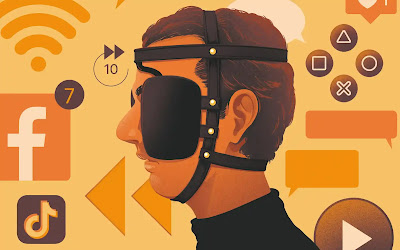
Your attention didn’t collapse. It was stolen

 Social media and many other facets of modern life are destroying our ability to concentrate. We need to reclaim our minds while we still can.

When he was nine years old, my godson Adam developed a brief but freakishly intense obsession with Elvis Presley. He took to singing Jailhouse Rock at the top of his voice with all the low crooning and pelvis-jiggling of the King himself. One day, as I tucked him in, he looked at me very earnestly and asked: “Johann, will you take me to Graceland one day?” Without really thinking, I agreed. I never gave it another thought, until everything had gone wrong.


Ten years later, Adam was lost. He had dropped out of school when he was 15, and he spent almost all his waking hours alternating blankly between screens – a blur of YouTube, WhatsApp and porn. (I’ve changed his name and some minor details to preserve his privacy.) He seemed to be whirring at the speed of Snapchat, and nothing still or serious could gain any traction in his mind. During the decade in which Adam had become a man, this fracturing seemed to be happening to many of us. Our ability to pay attention was cracking and breaking. I had just turned 40, and wherever my generation gathered, we would lament our lost capacity for concentration. I still read a lot of books, but with each year that passed, it felt more and more like running up a down escalator. Then one evening, as we lay on my sofa, each staring at our own ceaselessly shrieking screens, I looked at him and felt a low dread. “Adam,” I said softly, “let’s go to Graceland.” I reminded him of the promise I had made. I could see that the idea of breaking this numbing routine ignited something in him, but I told him there was one condition he had to stick to if we went. He had to switch his phone off during the day. He swore he would.


Illustration by Eric Chow.


When you arrive at the gates of Graceland, there is no longer a human being whose job is to show you around. You are handed an iPad, you put in little earbuds, and the iPad tells you what to do – turn left; turn right; walk forward. In each room, a photograph of where you are appears on the screen, while a narrator describes it. So as we walked around we were surrounded by blank-faced people, looking almost all the time at their screens. As we walked, I felt more and more tense. When we got to the jungle room – Elvis’s favourite place in the mansion – the iPad was chattering away when a middle-aged man standing next to me turned to say something to his wife. In front of us, I could see the large fake plants that Elvis had bought to turn this room into his own artificial jungle. “Honey,” he said, “this is amazing. Look.” He waved the iPad in her direction, and began to move his finger across it. “If you swipe left, you can see the jungle room to the left. And if you swipe right, you can see the jungle room to the right.”


If you read your texts while working, you lose that time, but also the time it takes to refocus afterwards, which is a lot.


His wife stared, smiled, and began to swipe at her own iPad. I leaned forward. “But, sir,” I said, “there’s an old-fashioned form of swiping you can do. It’s called turning your head. Because we’re here. We’re in the jungle room. You can see it unmediated. Here. Look.” I waved my hand, and the fake green leaves rustled a little. Their eyes returned to their screens. “Look!” I said. “Don’t you see? We’re actually there. There’s no need for your screen. We are in the jungle room.” They hurried away. I turned to Adam, ready to laugh about it all – but he was in a corner, holding his phone under his jacket, flicking through Snapchat.


At every stage in the trip, he had broken his promise. When the plane first touched down in New Orleans two weeks before, he took out his phone while we were still in our seats. “You promised not to use it,” I said. He replied: “I meant I wouldn’t make phone calls. I can’t not use Snapchat and texting, obviously.” He said this with baffled honesty, as though I had asked him to hold his breath for 10 days. In the jungle room, I suddenly snapped and tried to wrestle his phone from his grasp, and he stomped away. That night I found him in the Heartbreak Hotel, sitting next to a swimming pool (shaped like a giant guitar), looking sad. I realised as I sat with him that, as with so much anger, my rage towards him was really anger towards myself. His inability to focus was something I felt happening to me too. I was losing my ability to be present, and I hated it. “I know something’s wrong,” Adam said, holding his phone tightly in his hand. “But I have no idea how to fix it.” Then he went back to texting.


I realised then that I needed to understand what was really happening to him and to so many of us. That moment turned out to be the start of a journey that transformed how I think about attention. I travelled all over the world in the next three years, from Miami to Moscow to Melbourne, interviewing the leading experts in the world about focus. What I learned persuaded me that we are not now facing simply a normal anxiety about attention, of the kind every generation goes through as it ages. We are living in a serious attention crisis – one with huge implications for how we live. I learned there are twelve factors that have been proven to reduce people’s ability to pay attention and that many of these factors have been rising in the past few decades – sometimes dramatically.


I went to Portland, Oregon, to interview Prof Joel Nigg, who is one of the leading experts in the world on children’s attention problems, and he told me we need to ask if we are now developing “an attentional pathogenic culture” – an environment in which sustained and deep focus is harder for all of us. When I asked him what he would do if he was in charge of our culture and he actually wanted to destroy people’s attention, he said: “Probably what our society is doing.” Prof Barbara Demeneix, a leading French scientist who has studied some key factors that can disrupt attention, told me bluntly: “There is no way we can have a normal brain today.” We can see the effects all around us. A small study of college students found they now only focus on any one task for 65 seconds. A different study of office workers found they only focus on average for three minutes. This isn’t happening because we all individually became weak-willed. Your focus didn’t collapse. It was stolen.


When I first got back from Graceland, I thought my attention was failing because I wasn’t strong enough as an individual and because I had been taken over by my phone. I went into a spiral of negative thoughts, reproaching myself. I’d say – you’re weak, you’re lazy, you’re not disciplined enough. I thought the solution was obvious: be more disciplined, and banish your phone. So I went online and booked myself a little room by the beach in Provincetown, at the tip of Cape Cod. I announced triumphantly to everyone – I am going to be there for three months, with no smartphone, and no computer that can get online. I’m done. I’m tired of being wired. I knew I could only do it because I was very lucky and had money from my previous books. I knew it couldn’t be a long-term solution. I did it because I thought that if I didn’t, I might lose some crucial aspects of my ability to think deeply. I also hoped that if I stripped everything back for a time, I might start to be able to glimpse the changes we could all make in a more sustainable way.


In my first webless week, I stumbled around in a haze of decompression. Provincetown is a little gay resort town with the highest proportion of same-sex couples in the US. I ate cupcakes, read books, talked with strangers and sang songs. Everything radically slowed down. Normally I follow the news every hour or so, getting a drip-feed of anxiety-provoking facts and trying to smush them together into some kind of sense. Instead, I simply read a physical newspaper once a day. Every few hours, I would feel an unfamiliar sensation gurgling inside me and I would ask myself: what is that? Ah, yes. Calm.


Later, I realised when I interviewed the experts and studied their research that there were many reasons why my attention was starting to heal from that first day. Prof Earl Miller, a neuroscientist at Massachusetts Institute of Technology, explained one to me. He said “your brain can only produce one or two thoughts” in your conscious mind at once. That’s it. “We’re very, very single-minded.” We have “very limited cognitive capacity”. But we have fallen for an enormous delusion. The average teenager now believes they can follow six forms of media at the same time. When neuroscientists studied this, they found that when people believe they are doing several things at once, they are actually juggling. “They’re switching back and forth. They don’t notice the switching because their brain sort of papers it over to give a seamless experience of consciousness, but what they’re actually doing is switching and reconfiguring their brain moment-to-moment, task-to-task – [and] that comes with a cost.” Imagine, say, you are doing your tax return, and you receive a text, and you look at it – it’s only a glance, taking three seconds – and then you go back to your tax return. In that moment, “your brain has to reconfigure, when it goes from one task to another”, he said. You have to remember what you were doing before, and you have to remember what you thought about it. When this happens, the evidence shows that “your performance drops. You’re slower. All as a result of the switching.”


This is called the “switch-cost effect”. It means that if you check your texts while trying to work, you aren’t only losing the little bursts of time you spend looking at the texts themselves – you are also losing the time it takes to refocus afterwards, which turns out to be a huge amount. For example, one study at the Carnegie Mellon University’s human computer interaction lab took 136 students and got them to sit a test. Some of them had to have their phones switched off, and others had their phones on and received intermittent text messages. The students who received messages performed, on average, 20% worse. It seems to me that almost all of us are currently losing that 20% of our brainpower, almost all the time. Miller told me that as a result we now live in “a perfect storm of cognitive degradation”.


For the first time in a very long time, in Provincetown I was doing one thing at a time, without being interrupted. I was living within the limits of what my brain could actually handle. I felt my attention growing and improving with every day that passed, but then, one day, I experienced an abrupt setback. I was walking down the beach and every few steps I saw the same thing that had been scratching at me since Memphis. People seemed to be using Provincetown simply as a backdrop for selfies, rarely looking up, at the ocean or each other. Only this time, the itch I felt wasn’t to yell: You’re wasting your lives, put the damn phone down. It was to yell: Give me that phone! Mine! For so long, I had received the thin, insistent signals of the web every few hours throughout the day, the trickle of likes and comments that say: I see you. You matter. Now they were gone. Simone de Beauvoir said that when she became an atheist, it felt like the world had fallen silent. Losing the web felt like that. After the rhetorical heat of social media, ordinary social interactions seemed pleasing but low volume. No normal social interaction floods you with hearts.


I realised that to heal my attention, it was not enough simply to strip out distractions. That makes you feel good at first – but then it creates a vacuum where all the noise was. I realised I had to fill the vacuum. To do that, I started to think a lot about an area of psychology I had learned about years before – the science of flow states. Almost everyone reading this will have experienced a flow state at some point. It’s when you are doing something meaningful to you, and you really get into it, and time falls away, and your ego seems to vanish, and you find yourself focusing deeply and effortlessly. Flow is the deepest form of attention human beings can offer. But how do we get there?


I later interviewed Prof Mihaly Csikszentmihalyi in Claremont, California, who was the first scientist to study flow states and researched them for more than 40 years. From his research, I learned there are three key factors which you need to get into flow. First you need to choose one goal. Flow takes all your mental energy, deployed deliberately in one direction. Second, that goal needs to be meaningful to you – you can’t flow into a goal that you don’t care about. Third, it helps if what you are doing is at the edge of your abilities – if, say, the rock you are climbing is slightly higher and harder than the last rock you climbed. So every morning, I started to write – a different kind of writing from my earlier work, one that stretched me. Within a few days, I started to flow, and hours of focus would pass without it feeling like a challenge. I felt I was focusing in the way I had when I was a teenager, in long effortless stretches. I had feared my brain was breaking. I cried with relief when I realised that in the right circumstances, its full power could come back.


At the end of every day, I would sit on the beach and watch the light slowly change. The light on the cape is unlike the light anywhere else I have ever been and in Provincetown, I could see more clearly than I ever had before in my life – my own thoughts, my own goals, my own dreams. I was living in the light. So when the time came to leave the beach house and come back to the hyperlinked world, I became convinced I had cracked the code of attention. I returned to the world determined to integrate the lessons I had learned in my everyday life. When I was reunited with my phone and laptop after taking a ferry back to where they were stashed in Boston, they seemed alien, and alienating. But within a few months, my screen time was back to four hours a day, and my attention was fraying and breaking again.


In Moscow, the former Google engineer James Williams – who has become the most important philosopher of attention in the western world – told me I had made a crucial mistake. Individual abstinence is “not the solution, for the same reason that wearing a gas mask for two days a week outside isn’t the answer to pollution. It might, for a short period of time, keep certain effects at bay, but it’s not sustainable, and it doesn’t address the systemic issues.” He said that our attention is being deeply altered by huge invasive forces in wider society. Saying the solution was to just adjust your own habits – to pledge to break up with your phone, say – was just “pushing it back on to the individual” he said, when “it’s really the environmental changes that will really make the difference”.


Nigg said it might help me grasp what’s happening if we compare our rising attention problems to our rising obesity rates. Fifty years ago there was very little obesity, but today it is endemic in the western world. This is not because we suddenly became greedy or self-indulgent. He said: “Obesity is not a medical epidemic – it’s a social epidemic. We have bad food, for example, and so people are getting fat.” The way we live changed dramatically – our food supply changed, and we built cities that are hard to walk or cycle around, and those changes in our environment led to changes in our bodies. We gained mass, en masse. Something similar, he said, might be happening with the changes in our attention.


I learned that the factors harming our attention are not all immediately obvious. I had been focused on tech at first, but in fact the causes range very widely – from the food we eat to the air we breathe, from the hours we work to the hours we no longer sleep. They include many things we have come to take for granted – from how we deprive our children of play, to how our schools strip learning of meaning by basing everything on tests. I came to believe we need to respond to this incessant invasion of our attention at two levels. The first is individual. There are all sorts of changes we can make at a personal level that will protect our focus. I would say that by doing most of them, I have boosted my focus by about 20%. But we have to level with people. Those changes will only take you so far. At the moment it’s as though we are all having itching powder poured over us all day, and the people pouring the powder are saying: “You might want to learn to meditate. Then you wouldn’t scratch so much.” Meditation is a useful tool – but we actually need to stop the people who are pouring itching powder on us. We need to band together to take on the forces stealing our attention and take it back.


This can sound a bit abstract – but I met people who were putting it into practice in many places. To give one example: there is strong scientific evidence that stress and exhaustion ruin your attention. Today, about 35% of workers feel they can never switch off their phones because their boss might email them at any time of day or night. In France, ordinary workers decided this was intolerable and pressured their government for change – so now, they have a legal “right to disconnect”. It’s simple. You have a right to defined work hours, and you have a right to not be contacted by your employer outside those hours. Companies that break the rules get huge fines. There are lots of potential collective changes like this that can restore part of our focus. We could, for example, force social media companies to abandon their current business model, which is specifically designed to invade our attention in order to keep us scrolling. There are alternative ways these sites could work – ones that would heal our attention instead of hacking it.


Some scientists say these worries about attention are a moral panic, comparable to the anxieties in the past about comic books or rap music, and that the evidence is shaky. Other scientists say the evidence is strong and these anxieties are like the early warnings about the obesity epidemic or the climate crisis in the 1970s. I think that given this uncertainty, we can’t wait for perfect evidence. We have to act based on a reasonable assessment of risk. If the people warning about the effects on our attention turn out to be wrong, and we still do what they suggest, what will be the cost? We will spend less time being harassed by our bosses, and we’ll be tracked and manipulated less by technology – along with lots of other improvements in our lives that are desirable in any case. But if they turn out to be right, and we don’t do what they say, what’s the cost? We will have – as the former Google engineer Tristan Harris told me – downgraded humanity, stripping us of our attention at the very time when we face big collective crises that require it more than ever.


But none of these changes will happen unless we fight for them. Just as the feminist movement reclaimed women’s right to their own bodies (and still has to fight for it today), I believe we now need an attention movement to reclaim our minds. I believe we need to act urgently, because this may be like the climate crisis, or the obesity crisis – the longer we wait, the harder it will get. The more our attention degrades, the harder it will be to summon the personal and political energy to take on the forces stealing our focus. The first step it requires is a shift in our consciousness. We need to stop blaming ourselves, or making only demands for tiny tweaks from our employers and from tech companies. We own our own minds – and together, we can take them back from the forces that are stealing them.


(Source: The Guardian)

Friday, 22 January 2021

After global criticism, WhatsApp delays new privacy policy by three months

 Amid global backlash over its upcoming privacy policy, WhatsApp has now moved back the date of implementation of the policy. WhatsApp users will now be asked to accept the chat app’s new terms sometime in May to continue using its services.

“We’re now moving back the date on which people will be asked to review and accept the terms,” WhatsApp wrote in a blog. The Facebook-owned app also confirmed that no accounts will be suspended on February 8, which was previously meant to be the case for those who do not accept the new terms of services.


WhatsApp says that there is a lot of misinformation being spread about the app’s policies. It will now aim to clear up those and reiterate how the app handles privacy and security for its users. It will then “go to people gradually to review the policy at their own pace” before introducing new business options on May 15.


The three month delay in the rollout of the policy addresses massive criticism of the app’s upcoming policy update. WhatsApp users cried foul as the app readied its plan to share its user data with Facebook, its parent firm.


Now WhatsApp claims that the update does not bring in any such data sharing with Facebook. This platform exclusivity applies to personal conversations as well as profile information of WhatsApp users. The data, however, will be used to address business chats in the event a user converses with a company's customer service through WhatsApp Business.


As part of the criticism, millions of WhatsApp users migrated from it to rival chat apps including Telegram and Signal, skyrocketing their downloads on Android and iOS. With the push back for the update, WhatsApp now aims to salvage what is left of the service.


(Source: India Times)

Friday, 3 July 2020

What's wrong with WhatsApp

As social media has become more inhospitable, the appeal of private online groups has grown. But they hold their own dangers – to those both inside and out.


In the spring, as the virus swept across the world and billions of people were compelled to stay at home, the popularity of one social media app rose more sharply than any other. By late March, usage of WhatsApp around the world had grown by 40%. In Spain, where the lockdown was particularly strict, it rose by 76%. In those early months, WhatsApp – which hovers neatly between the space of email, Facebook and SMS, allowing text messages, links and photos to be shared between groups – was a prime conduit through which waves of news, memes and mass anxiety travelled.


At first, many of the new uses were heartening. Mutual aid groups sprung up to help the vulnerable. Families and friends used the app to stay close, sharing their fears and concerns in real time. Yet by mid-April, the role that WhatsApp was playing in the pandemic looked somewhat darker. A conspiracy theory about the rollout of 5G, which originated long before Covid-19 had appeared, now claimed that mobile phone masts were responsible for the disease. Across the UK, people began setting fire to 5G masts, with 20 arson attacks over the Easter weekend alone.


Illustration: Jo Raynsford/Guardian Design


WhatsApp, along with Facebook and YouTube, was a key channel through which the conspiracy theory proliferated. Some feared that the very same community groups created during March were now accelerating the spread of the 5G conspiracy theory. Meanwhile, the app was also enabling the spread of fake audio clips, such as a widely shared recording in which someone who claimed to work for the NHS reported that ambulances would no longer be sent to assist people with breathing difficulties.


This was not the first time that WhatsApp has been embroiled in controversy. While the “fake news” scandals surrounding the 2016 electoral upsets in the UK and US were more focused upon Facebook – which owns WhatsApp – subsequent electoral victories for Jair Bolsonaro in Brazil and Narendra Modi in India were aided by incendiary WhatsApp messaging, exploiting the vast reach of the app in these countries. In India, there have also been reports of riots and at least 30 deaths linked to rumours circulating on WhatsApp. India’s Ministry of Information and Broadcasting has sought ways of regulating WhatsApp content, though this has led to new controversies about government infringement on civil liberties.


As ever, there is a risk of pinning too much blame for complex political crises on an inert technology. WhatsApp has also taken some steps to limit its use as a vehicle for misinformation. In March, a WhatsApp spokesperson told the Washington Post that the company had “engaged health ministries around the world to provide simple ways for citizens to receive accurate information about the virus”. But even away from such visible disruptions, WhatsApp does seem to be an unusually effective vehicle for sowing distrust in public institutions and processes.


A WhatsApp group can exist without anyone outside the group knowing of its existence, who its members are or what is being shared, while end-to-end encryption makes it immune to surveillance. Back in Britain’s pre-Covid-19 days, when Brexit and Jeremy Corbyn were the issues that provoked the most feverish political discussions, speculation and paranoia swirled around such groups. Media commentators who defended Corbyn were often accused of belonging to a WhatsApp group of “outriders”, co-ordinated by Corbyn’s office, which supposedly told them what line to take. Meanwhile, the Conservative party’s pro-Brexit European Research Group was said to be chiefly sustained in the form of a WhatsApp group, whose membership was never public. Secretive coordination – both real and imagined – does not strengthen confidence in democracy.


WhatsApp groups can not only breed suspicion among the public, but also manufacture a mood of suspicion among their own participants. As also demonstrated by closed Facebook groups, discontents – not always well-founded – accumulate in private before boiling over in public. The capacity to circulate misinformation and allegations is becoming greater than the capacity to resolve them.


Brazil’s president Jair Bolsonaro with a printout of an opponent’s WhatsApp message about him. Photograph: Ueslei Marcelino/Reuters


The political threat of WhatsApp is the flipside of its psychological appeal. Unlike so many other social media platforms, WhatsApp is built to secure privacy. On the plus side, this means intimacy with those we care about and an ability to speak freely; on the negative side, it injects an ethos of secrecy and suspicion into the public sphere. As Facebook, Twitter and Instagram become increasingly theatrical – every gesture geared to impress an audience or deflect criticism – WhatsApp has become a sanctuary from a confusing and untrustworthy world, where users can speak more frankly. As trust in groups grows, so it is withdrawn from public institutions and officials. A new common sense develops, founded on instinctive suspicion towards the world beyond the group.


The ongoing rise of WhatsApp, and its challenge to both legacy institutions and open social media, poses a profound political question: how do public institutions and discussions retain legitimacy and trust once people are organised into closed and invisible communities? The risk is that a vicious circle ensues, in which private groups circulate ever more information and disinformation to discredit public officials and public information, and our alienation from democracy escalates.


When WhatsApp was bought by Facebook in 2014 for $19bn, it was the most valuable tech acquisition in history. At the time, WhatsApp brought 450 million users with it. In February this year, it hit 2 billion users worldwide – and that is even before its lockdown surge – making it by far the most widely used messenger app, and the second most commonly used app after Facebook itself. In many countries, it is now the default means of digital communication and social coordination, especially among younger people.


The features that would later allow WhatsApp to become a conduit for conspiracy theory and political conflict were ones never integral to SMS, and have more in common with email: the creation of groups and the ability to forward messages. The ability to forward messages from one group to another – recently limited in response to Covid-19-related misinformation – makes for a potent informational weapon. Groups were initially limited in size to 100 people, but this was later increased to 256. That’s small enough to feel exclusive, but if 256 people forward a message on to another 256 people, 65,536 will have received it.


Groups originate for all sorts of purposes – a party, organising amateur sport, a shared interest – but then take on a life of their own. There can be an anarchic playfulness about this, as a group takes on its own set of in-jokes and traditions. In a New York Magazine piece last year, under the headline “Group chats are making the internet fun again”, the technology critic Max Read argued that groups have become “an outright replacement for the defining mode of social organization of the past decade: the platform-centric, feed-based social network.”


It’s understandable that in order to relax, users need to know they’re not being overheard – though there is a less playful side to this. If groups are perceived as a place to say what you really think, away from the constraints of public judgement or “political correctness”, then it follows that they are also where people turn to share prejudices or more hateful expressions, that are unacceptable (or even illegal) elsewhere. Santiago Abascal, the leader of the Spanish far-right party Vox, has defined his party as one willing to “defend what Spaniards say on WhatsApp”.


A different type of group emerges where its members are all users of the same service, such as a school, a housing block or a training programme. A potential problem here is one of negative solidarity, in which feelings of community are deepened by turning against the service in question. Groups of this sort typically start from a desire to pool information – students staying in touch about deadlines, say – but can swiftly become a means of discrediting the institution they cluster around. Initial murmurs of dissatisfaction can escalate rapidly, until the group has forged an identity around a spirit of resentment and alienation, which can then be impossible to dislodge with countervailing evidence.


Faced with the rise of new technologies, one option for formal organisations and associations is to follow people to their preferred platform. In March, the government introduced a WhatsApp-based information service about Covid-19, with an automated chatbot. But groups themselves can be an unreliable means of getting crucial information to people. Anecdotal evidence from local political organisers and trade union reps suggests that, despite the initial efficiency of WhatsApp groups, their workload often increases because of the escalating number of sub-communities, each of which needs to be contacted separately. Schools desperately seek to get information out to parents, only to discover that unless it appears in precisely the right WhatsApp group, it doesn’t register. The age of the message board, be it physical or digital, where information can be posted once for anyone who needs it, is over.


WhatsApp’s ‘broadcast list’ function, which allows messages to be sent to multiple recipients who are invisible to one another (like email’s ‘bcc’ line), alleviates some of the problems of groups taking on a life of their own. But even then, lists can only include people who are already mutual contacts of the list-owner. The problem, from the point of view of institutions, is that WhatsApp use seems fuelled by a preference for informal, private communication as such. University lecturers are frequently baffled by the discovery that many students and applicants don’t read email. If email is going into decline, WhatsApp does not seem to be a viable alternative when it comes to sharing verified information as widely and inclusively as possible.


Groups are great for brief bursts of humour or frustration, but, by their very nature, far less useful for supporting the circulation of public information. To understand why this is the case, we have to think about the way in which individuals can become swayed and influenced once they belong to a group.


A WhatsApp newspaper ad in India warning about fake information on its service. Photograph: Prakash Singh/AFP/Getty Images


The internet has brought with it its own litany of social pathologies and threats. Trolling, flaming, doxing, cancelling and pile-ons are all risks that go with socialising within a vast open architecture. “Open” platforms such as Twitter are reminders that much social activity tends to be aimed at a small and select community, but can be rendered comical or shameful when exposed to a different community altogether.


As any frequent user of WhatsApp or a closed Facebook group will recognise, the moral anxiety associated with groups is rather different. If the worry in an open network is of being judged by some outside observer, be it one’s boss or an extended family member, in a closed group it is of saying something that goes against the codes that anchor the group’s identity. Groups can rapidly become dominated by a certain tone or worldview that is uncomfortable to challenge and nigh-impossible to dislodge. WhatsApp is a machine for generating feelings of faux pas, as comments linger in a group’s feed, waiting for a response.


This means that while groups can generate high levels of solidarity, which can in principle be put to powerful political effect, it also becomes harder to express disagreement within the group. If, for example, an outspoken and popular member of a neighbourhood WhatsApp group begins to circulate misinformation about health risks, the general urge to maintain solidarity means that their messages are likely to be met with approval and thanks. When a claim or piece of content shows up in a group, there may be many members who view it as dubious; the question is whether they have the confidence to say as much. Meanwhile, the less sceptical can simply forward it on. It’s not hard, then, to understand why WhatsApp is a powerful distributor of “fake news” and conspiracy theories.


As on open social platforms, one of the chief ways of building solidarity on WhatsApp is to posit some injustice or enemy that threatens the group and its members. In the most acute examples, conspiracy theories are unleashed against political opponents, to the effect that they are paedophiles or secret affiliates of foreign powers. Such plausibly deniable practices swirled around the fringes of the successful election campaigns of Modi, Bolsonaro and Donald Trump, and across multiple platforms.


But what makes WhatsApp potentially more dangerous than public social media are the higher levels of trust and honesty that are often present in private groups. It is a truism that nobody is as happy as they appear on Facebook, as attractive as they appear on Instagram or as angry as they appear on Twitter, which spawns a growing weariness with such endless performance. By contrast, closed groups are where people take off their public masks and let their critical guard down. Neither anonymity (a precondition of most trolling) nor celebrity are on offer. The speed with which rumours circulate on WhatsApp is partly a reflection of how altruistic and uncritical people can be in groups. Most of the time, people seem to share false theories about Covid-19 not with the intention of doing harm, but precisely out of concern for other group members. Anti-vaxx, anti-5G or anti-Hillary rumours combine an identification of an enemy with a strong internal sense of solidarity. Nevertheless, they add to the sense that the world is hostile and dangerous.


There is one particular pattern of a group chat that can manufacture threats and injustices out of thin air. It tends to start with one participant speculating that they are being let down or targeted by some institution or rival group – be it a public service, business or cultural community – whereupon a second participant agrees. By this stage, it becomes risky for anyone else to defend the institution or group in question, and immediately a new enemy and a new resentment is born. Instantly, the warnings and denunciations emanating from within the group take on a level of authenticity that cannot be matched by the entity that is now the object of derision.

But what if the first contributor has misunderstood or misread something, or had a very stressful day and needs to let off steam? 


And what if the second is merely agreeing so as to make the first one feel better? And what if the other members are either too distracted, too inhibited or too exhausted to say anything to oppose this fresh indignation? This needn’t snowball into the forms of conspiracy theory that produce riots or arson attacks. But even in milder forms, it makes the job of communicating official information – occasionally life-saving information – far more troublesome than it was just a decade ago. Information about public services and health risks is increasingly having to penetrate a thicket of overlapping groups, many of which may have developed an instinctive scepticism to anything emanating from the “mainstream”.


A security message on WhatsApp. Photograph: Thomas White/Reuters


Part of the challenge for institutions is that there is often a strange emotional comfort in the shared feeling of alienation and passivity. “We were never informed about that”, “nobody consulted us”, “we are being ignored”. These are dominant expressions of our political zeitgeist. As WhatsApp has become an increasingly common way of encountering information and news, a vicious circle can ensue: the public world seems ever more distant, impersonal and fake, and the private group becomes a space of sympathy and authenticity.


This is a new twist in the evolution of the social internet. Since the 90s, the internet has held out a promise of connectivity, openness and inclusion, only to then confront inevitable threats to privacy, security and identity. By contrast, groups make people feel secure and anchored, but also help to fragment civil society into separate cliques, unknown to one another. This is the outcome of more than 20 years of ideological battles over what sort of social space the internet should be.


For a few years at the dawn of the millennium, the O’Reilly Emerging Technology Conferences (or ETech), were a crucible in which a new digital world was imagined and debated. Launched by the west coast media entrepreneur Tim O’Reilly and hosted annually around California, the conferences attracted a mixture of geeks, gurus, designers and entrepreneurs, brought together more in a spirit of curiosity than of commerce. In 2005, O’Reilly coined the term “web 2.0” to describe a new wave of websites that connected users with each other, rather than with existing offline institutions. Later that year, the domain name facebook.com was purchased by a 21-year-old Harvard student, and the age of the giant social media platforms was born.


Within this short window of time, we can see competing ideas of what a desirable online community might look like. The more idealistic tech gurus who attended ETech insisted that the internet should remain an open public space, albeit one in which select communities could cluster for their own particular purposes, such as creating open-source software projects or Wikipedia entries. The untapped potential of the internet, they believed, was for greater democracy. But for companies such as Facebook, the internet presented an opportunity to collect data about users en masse. The internet’s potential was for greater surveillance. The rise of the giant platforms from 2005 onwards suggested the latter view had won out. And yet, in a strange twist, we are now witnessing a revival of anarchic, self-organising digital groups – only now, in the hands of Facebook as well. The two competing visions have collided.


To see how this story unfolded, it’s worth going back to 2003. At the ETech conference that year, a keynote speech was given by the web enthusiast and writer Clay Shirky, now an academic at New York University, which surprised its audience by declaring that the task of designing successful online communities had little to do with technology at all. The talk looked back at one of the most fertile periods in the history of social psychology, and was entitled “A group is its own worst enemy”.


Shirky drew on the work of the British psychoanalyst and psychologist Wilfred Bion, who, together with Kurt Lewin, was one of the pioneers of the study of “group dynamics” in the 40s. The central proposition of this school was that groups possess psychological properties that exist independently of their individual members. In groups, people find themselves behaving in ways that they never would if left to their own devices.


Like Stanley Milgram’s notorious series of experiments to test obedience in the early 60s – in which some participants were persuaded to administer apparently painful electric shocks to others – the mid-20th century concern with group dynamics grew in the shadow of the political horrors of the 30s and 40s, which had posed grave questions about how individuals come to abandon their ordinary sense of morality. Lewin and Bion posited that groups possess distinctive personalities, which emerge organically through the interaction of their members, independently of what rules they might have been given, or what individuals might rationally do alone.


With the dawn of the 60s, and its more individualistic political hopes, psychologists’ interest in groups started to wane. The assumption that individuals are governed by conformity fell by the wayside. When Shirky introduced Bion’s work at the O’Reilly conference in 2003, he was going out on a limb. What he correctly saw was that, in the absence of any explicit structures or rules, online communities were battling against many of the disruptive dynamics that fascinated the psychologists of the 40s.


Mark Zuckerberg talking about privacy at a Facebook conference in 2019. Photograph: Amy Osborne/AFP/Getty Images


Shirky highlighted one area of Bion’s work in particular: how groups can spontaneously sabotage their own stipulated purpose. The beauty of early online communities, such as listservs, message boards and wikis, was their spirit of egalitarianism, humour and informality. But these same properties often worked against them when it came to actually getting anything constructive done, and could sometimes snowball into something obstructive or angry. Once the mood of a group was diverted towards jokes, disruption or hostility towards another group, it became very difficult to wrest it back.


Bion’s concerns originated in fear of humanity’s darker impulses, but the vision Shirky was putting to his audience that day was a more optimistic one. If the designers of online spaces could preempt disruptive “group dynamics”, he argued, then it might be possible to support cohesive, productive online communities that remained open and useful at the same time. Like a well designed park or street, a well-designed online space might nurture healthy sociability without the need for policing, surveillance or closure to outsiders. Between one extreme of anarchic chaos (constant trolling), and another of strict moderation and regulation of discussion (acceding to an authority figure), thinking in terms of group dynamics held out the promise of a social web that was still largely self-organising, but also relatively orderly.


But there was another solution to this same problem waiting in the wings, which would turn out to be world-changing in its consequences: forget group dynamics, and focus on reputation dynamics instead. If someone online has a certain set of offline attributes, such as a job title, an album of tagged photos, a list of friends and an email address, they will behave themselves in ways that are appropriate to all of these fixed public identifiers. Add more and more surveillance into the mix, both by one’s peers and by corporations, and the problem of spontaneous group dynamics disappears. It is easier to hold on to your self-control and your conscience if you are publicly visible, including to friends, extended family and colleagues.


For many of the Californian pioneers of cyberculture, who cherished online communities as an escape from the values and constraints of capitalist society, Zuckerberg’s triumph represents an unmitigated defeat. Corporations were never meant to seize control of this space. As late as 2005, the hope was that the social web would be built around democratic principles and bottom-up communities. Facebook abandoned all of that, by simply turning the internet into a multimedia telephone directory.


The last ETech was held in 2009. Within a decade, Facebook was being accused of pushing liberal democracy to the brink and even destroying truth itself. But as the demands of social media have become more onerous, with each of us curating a profile and projecting an identity, the lure of the autonomous group has resurfaced once again. In some respects, Shirky’s optimistic concern has now become today’s pessimistic one. Partly thanks to WhatsApp, the unmoderated, self-governing, amoral collective – larger than a conversation, smaller than a public – has become a dominant and disruptive political force in our society, much as figures such as Bion and Lewin feared.


Conspiracy theories and paranoid group dynamics were features of political life long before WhatsApp arrived. It makes no sense to blame the app for their existence, any more than it makes sense to blame Facebook for Brexit. But by considering the types of behaviour and social structures that technologies enable and enhance, we get a better sense of some of society’s characteristics and ailments. What are the general tendencies that WhatsApp helps to accelerate?


First of all, there is the problem of conspiracies in general. 


WhatsApp is certainly an unbeatable conduit for circulating conspiracy theories, but we must also admit that it seems to be an excellent tool for facilitating genuinely conspiratorial behaviour. One of the great difficulties when considering conspiracy theories in today’s world is that, regardless of WhatsApp, some conspiracies turn out to be true: consider Libor-fixing, phone-hacking, or efforts by Labour party officials to thwart Jeremy Corbyn’s electoral prospects. These all happened, but one would have sounded like a conspiracy theorist to suggest them until they were later confirmed by evidence.


A communication medium that connects groups of up to 256 people, without any public visibility, operating via the phones in their pockets, is by its very nature, well-suited to supporting secrecy. 


Obviously not every group chat counts as a “conspiracy”. But it makes the question of how society coheres, who is associated with whom, into a matter of speculation – something that involves a trace of conspiracy theory. In that sense, WhatsApp is not just a channel for the circulation of conspiracy theories, but offers content for them as well. The medium is the message.


The full political potential of WhatsApp has not been witnessed in the UK. To date, it has not served as an effective political campaigning tool, partly because users seem reluctant to join large groups with people they don’t know. However, the influence – imagined or real – of WhatsApp groups within Westminster and the media undoubtedly contributes to the deepening sense that public life is a sham, behind which lurk invisible networks through which power is coordinated. WhatsApp has become a kind of “backstage” of public life, where it is assumed people articulate what they really think and believe in secret. This is a sensibility that has long fuelled conspiracy theories, especially antisemitic ones. Invisible WhatsApp groups now offer a modern update to the type of “explanation” that once revolved around Masonic lodges or the Rothschilds.


Away from the world of party politics and news media, there is the prospect of a society organised as a tapestry of overlapping cliques, each with their own internal norms. Groups are less likely to encourage heterodoxy or risk-taking, and more likely to inculcate conformity, albeit often to a set of norms hostile to those of the “mainstream”, whether that be the media, politics or professional public servants simply doing their jobs. In the safety of the group, it becomes possible to have one’s cake and eat it, to be simultaneously radical and orthodox, hyper-sceptical and yet unreflective.


For all the benefits that WhatsApp offers in helping people feel close to others, its rapid ascendency is one further sign of how a common public world – based upon verified facts and recognised procedures – is disintegrating. WhatsApp is well equipped to support communications on the margins of institutions and public discussion: backbenchers plotting coups, parents gossipping about teachers, friends sharing edgy memes, journalists circulating rumours, family members forwarding on unofficial medical advice. A society that only speaks honestly on the margins like this will find it harder to sustain the legitimacy of experts, officials and representatives who, by definition, operate in the spotlight. 


Meanwhile, distrust, alienation and conspiracy theories become the norm, chipping away at the institutions that might hold us together.


(Source: The Guardian)

Thursday, 26 December 2019

Popular chat app ToTok is actually a spying tool of UAE government – report

Government reportedly uses ToTok to track conversations, locations and other data of those who install the app

A chat app that quickly became popular in the United Arab Emirates for communicating with friends and family is actually a spying tool used by the government to track its users, according to a New York Times report.

The government uses ToTok to track conversations, locations, images and other data of those who install the app on their phones, the Times reported, citing US officials familiar with a classified intelligence assessment and the newspaper’s own investigation.

The Emirates has long blocked Apple’s FaceTime, Facebook’s WhatsApp and other calling apps. Emirati media has been playing up ToTok as an alternative for expatriates living in the country to call home to their loved ones for free.

The Times says ToTok is a few months old and has been downloaded millions of times, with most of its users in the Emirates, a US-allied federation of seven sheikhdoms on the Arabian peninsula. Government surveillance in the Emirates is prolific, and the Emirates long has been suspected of using so-called “zero day” exploits to target human rights activists and others. Zero days exploits can be expensive to obtain on the black market because they represent software vulnerabilities for which fixes have yet to be developed.
A man uses his phone at the airport in Dubai, United Arab Emirates. Photograph: Patrick Castillo/AP


The Times described ToTok as a way to give the government free access to personal information, as millions of users are willingly downloading and installing the app on their phones and unknowingly giving permission to enable features.

As with many apps, ToTok requests location information, purportedly to provide accurate weather forecasts, according to the Times. It also requests access to a phone’s contacts, supposedly to help users connect with friends. The app also has access to microphones, cameras, calendar and other data.
Patrick Wardle, a security expert who said he analyzed the app for the Times, said that ToTok “does what it claims to do” as a communications app, which is the “genius” of the app if it is being used as a spy tool. “No exploits, no backdoors, no malware,” he wrote in a blogpost. The app is able to gain insights on users through common functions.

In a blogpost on Monday, ToTok did not respond directly to Sunday’s New York Times report, but said that with “reference to the rumors circulated today about ToTok”, the one goal of the app’s creators was to create a reliable, easy-to-use communications platform. The post said ToTok had high-security standards to protect user data and a privacy framework that complied with local and international legal requirements.

ToTok said the app was temporarily unavailable in the app stores from Google and Apple due to a “technical issue”.

The Times says that based on a technical analysis and interviews with security experts, the company behind ToTok, Breej Holding, is most likely affiliated with DarkMatter, an Emirati cybersecurity company that has hired former CIA and National Security Agency analysts and has close business ties to the Emirati government.

Emails sent to ToTok through its website and to the Emirates embassy in Washington were not immediately returned.

(Source: The Guardian)