Showing posts with label cricket. Show all posts

Monday, 31 May 2021

A Pakistani cricket writer recalls watching Sachin in 1989

 Recalling the 16-year-old Indian who came to Pakistan as a boy, connected with young Pakistanis as one of their generation, and returned home a man, writes SM Hussain.

It was 1989. After more than 11 years of dictatorial rule that had ended the previous year, and with Benazir Bhutto as prime minister, Pakistan was taking baby steps towards re-establishing democracy. Meanwhile, India was preparing for another democratic election.


At the time, cricketing relations between the two volatile neighbors were thriving. Pakistan had returned with a Test series victory over its ‘nemesis’ in 1987 and, two years later, had also won the six-nation Nehru Cup (ODI tournament held from Oct 15 to Nov 1, 1989) on Indian soil.


The Indian tour party arrived in Pakistan in November, just a couple of weeks after Pakistan returned victorious from the Nehru Cup. The series would’ve been touted as a ‘revenge’ series by any modern day Indian captain but, in those days, there was no such word in the Indian captain’s dictionary. On the contrary, the Indian team, under the leadership of Kris Srikkanth, looked more interested in making friends in Pakistan.


The news about the ‘kid’ cricketer in their side made half of Pakistan fall in love with the visiting Indian team even before they had crossed the border. That wonder kid was Sachin Ramesh Tendulkar, whose first class cricketing endeavours were already making headlines in newspapers in India.
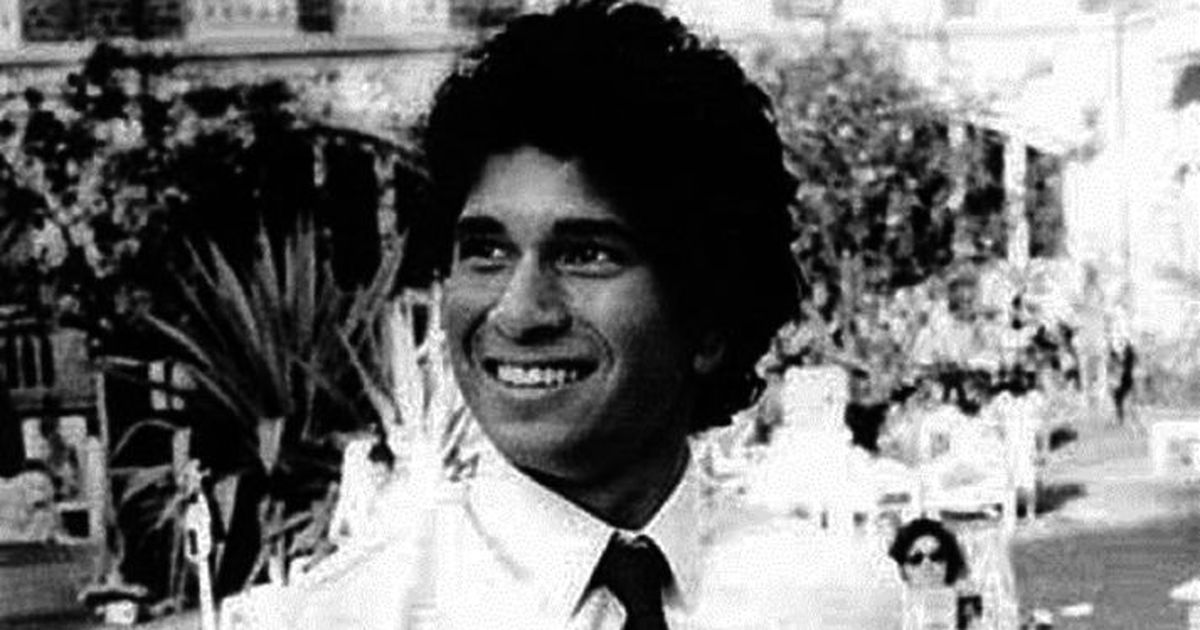

File photo of Sachin Tendulkar | Sachin Tendulkar / Facebook


In spite of his heroics with the bat, two out of five members of the selection committee had been reluctant to include a 16-year-old in the team, to face the deadly pace and swing of Wasim Akram and Waqar Younis. But the selection verdict had gone in favour of Tendulkar by 3-2.


When Sachin Tendulkar walked out to bat for the first time in Test cricket, wearing somewhat idiosyncratic batting pads and a white helmet, the Indians were reeling at 41 for 4 in the first Test at Karachi. As a boy who had recently fallen in love with the game, I was watching the Test match on our 20-inch Philips TV and I immediately felt that someone from ‘my generation’ had taken guard at the National Stadium pitch.


Tendulkar’s juvenile appearance felt out of place in a Test match setting; he looked more like a young lad surrounded by a few bullies in a school playground. But in reality, his presence on the TV screen touched a little chord in every young boy’s heart in Pakistan — every young boy who had experience of batting in the streets until dusk every day.


The sight of the young Tendulkar gave a glimmer of hope to every street cricketer that, if a ‘boy’ could make it to the highest level, so could they. Yes, Pakistan’s Mushtaq Mohammad had made his debut at the age of 15, but that had happened in 1959, before the television era, which would not have had the same impact. Plus ‘my generation’ had not even been born then.


I remember watching in awe Tendulkar’s on-drive for four against the bowling of Waqar Younis — his first ever boundary in Test cricket. But my joy was shortlived; Waqar didn’t take long to beat young Tendulkar’s bat and bowled him. Though he made only 15 runs, in my opinion, his innings was far from a failure. He had faced 24 balls, in which he hit two 4s against the bowling of Waqar Younis, who was also making his Test debut. Younis, who sported a thick moustache, certainly looked a tad bit older than his ‘documented age’ of 18.


In the second Test match at the Iqbal Stadium Faisalabad, in his second Test innings, Tendulkar reached his first milestone in Test cricket — he made a half-century. He was involved in a 143-run partnership with Sanjay Manjrekar and made 59 runs, before Imran trapped him LBW. It was quite evident that he looked more assured in that innings. In the third Test in Lahore, he scored a gritty knock of 41 runs off 90 balls.


If I say so myself, I was quite a studious boy, but one subject, mathematics, always remained Greek to me. So it was in my maths class that I decided to take out my tiny little ‘Ear AM Radio’ from my school bag and put it against my ear and covered it with my hand. My posture falsely portrayed that I was listening to my teacher with immense attention but, in reality, I was listening to the running commentary of the Pakistan and India Test match.


By that time I was so engrossed in the series that I had no other choice but resort to subterfuge to satisfy my craving for information about the Test match proceedings; especially the progress of Tenulkar, who was ‘one of us’.


That was perhaps the most ‘adventurous’ thing I did at the time, but it was nothing compared to a 16-year-old playing a courageous knock in the fourth and final Test, played at Sialkot.

The Indians were onerously placed at 4 wickets down for 38 runs when Tendulkar started to rebuild the innings. The pitch had plenty of green on it and Waqar Younis’s vicious bouncer hit Tendulkar on the nose, which made it bleed.


It was reported in the press that Pakistan skipper Imran Khan came to Tendulkar and asked him to rest and resume his innings later, but the young boy decided not to go off the field. Tendulkar made a match-saving 57 off 134 balls. Perhaps that was the precise moment when a 16-year-old boy became a man.


After the hard-fought drawn Test series, the two teams headed north towards the North West Frontier Province (now called Khyber Pakhtunkhwa) to play the first ODI in Peshawar.


There, due to a heavy downpour and a wet outfield, the umpires thought that the ground wasn’t fit enough to stage an international one-day match but, still, considering the presence of a large crowd, they gave the green signal for an exhibition match. The festive status of the match lifted ‘pressure’ from everyone involved, and a 16-year-old virtuoso wasn’t an exception.


Perhaps the Almighty had a script ready to put young Sachin Tendulkar on the road to success. First, a knock on the nose in Sialkot which hardened him, followed by a ‘friendly’ match in Peshawar, in which he batted without a care in the world, with utter confidence and self-assurance. I remember watching him coming down the wicket and smacking sixes off the bowling of Mushtaq Ahmed and Abdul Qadir. I can never forget that smirk on the late Qadir’s face, as if he could tell that the little maestro had arrived.


My elder sister was an avid listener of music on the BBC radio show ‘Multi Track’, which she used to tune into on a shortwave radio. It gave me the idea that, if there were music available, it only made sense that cricket commentary must also be accessible.


Eight months down the line, when Tendulkar made his first Test hundred at Old Trafford in Manchester, I was fortunate to be able to sit in my room in Pakistan and listen to the BBC Test Match Special commentators describing it. On that day, it became clear that the boy, who had made his debut in Pakistan a few months ago, was now a grown man, ready to take on the best bowlers of the cricketing world. And that he did.


India produced quite a few world class batsmen in the 1990s, with the likes of Rahul Dravid and Saurav Ganguly, but Sachin Tendulkar was nothing short of a phenomenona. The world may remember him simply as India’s greatest batsman, but for yours truly, along with many other Pakistani youngsters who saw him make his Test debut in Karachi, Tendulkar will always have a special place in our hearts.


Because at that time, he was ‘one of us’ — the boy from my generation.


(Source: Scroll) 

Monday, 18 November 2019

Smriti Mandhana beats Virat Kohli, becomes 2nd fastest Indian cricketer to reach 2000 runs

The Indian women’s cricket team once again took the world by surprise with its magnificent talent. This time, all eyes are on Mumbai based Smriti Mandhana who became the second-fastest Indian cricketer to reach 2000 runs.

Mandhana crossed the 2000 run mark on November 6, when she hit a match-winning fifty against West Indies in Antigua.

She is just behind Shikhar Dhawan who has achieved the milestone in 48 innings. Mandhana is also now the fastest Indian woman cricketer to reach the milestone runs in 51 innings.

In the world of women’s cricket, she is now the third-fastest woman to reach 2000 runs in One Day International (ODI) after two Australians – Belinda Clark and Meg Lanning.

It is quite interesting that Mandhana with her brilliant knocks surpassed several bigwigs such as Virat Kohli, Sourav Ganguly, and Navjot Singh Sidhu in reaching 2000 runs.

It took Mandhana only 51 innings to cross the 2000 runs mark against the Indian men’s team skipper – Virat Kohli who accomplished the target in 53 innings.

Currently, Hashim Amla of South Africa holds the world’s record of being the fastest player to score 2000 runs in just 40 innings.

Mandhana with four centuries and 17 half-centuries has scored 2025 runs so far at an average of 43.08. It is indeed surprising that this aggressive 23-year-old cricketer, even though she missed two matches in the series due to her toe injury, managed to reach the milestone.

In her Wednesday’s match-winning knock she hit 9 fours and 3 sixes. The Indian cricket team scored 195 runs against West Indies in the final match and emerged victorious with 2-1. Along with her fellow-opener Jemimah Rodrigues, she notched 141-run partnership. While Rodrigues scored 69 runs off 92 balls, Mandhana scored 73 runs out of 63 balls. This partnership helped India cruise towards the target much easily with eight overs left.

Twitter flooded the star player with all the accolades. Most of them expressed their pride at how just 23 years of age and also being a woman, she set world records on par with men cricketers.

(Source: The Logical Indian)

Thursday, 16 May 2019

Mo Salah watches daughter score goal, Shahid Afridi bans girls from cricket. Best reactions

Recently, Internet dragged cricketer Shahid Afridi for saying that he doesn't allow his daughters to play outdoor sports after footballer Mo Salah was spotted proudly watching his daughter scoring a goal after his match in England.

A heartwarming moment at Liverpool's Anfield stadium recently had the whole crowd erupt in cheer and the video is the best thing you will witness today.

Shahid Afridi and Mo Salah with their daughters
After a match between Liverpool and Manchester City, Mo Salah's young daughter, Makka, dribbled across the field to score a goal as the proud father watched her on.
The video of the little munchkin happily dribbling to score her goal in the open field, amid the crowd’s cheer, is going viral online.

The moment took place after Mo Salah won the Premier League Golden Boot.

After the video went viral, Twitterati started comparing the football player to cricketer Shahid Afridi, who in a controversial statement recently said that he does not give permission to his daughters to play outdoor sports and feminists can say whatever they want about his decision.
He also said, "It's for social and religious reasons that I've made this decision regarding my daughters not competing in public sporting activities and their mother agrees with me."
A Twitter user, Amena, had tweeted the comparison between the two players, after which the particular tweet went viral.

She wrote, "For every Shahid Afridi who tries to control his daughter there is a Mohammed Salah who lets his daughter run free and enjoy her life."

After she posted the tweet, many people agreed with her saying, "Beautiful. That is what girls need to be taught, to be independent and strong."

Another user wrote, "So true. Afridi is a caveman whole Mo Salah is a proper father...and sane too."

While the internet dragged Afridi for his sexist comments, Twitterati praised the footballer for his response to his adorable daughter scoring a goal.


Well we don't know about you, Mo Salah definitely is a proud father who knows that his daughter's got to spread her wings and shine.

(Source: India Today) 

Monday, 27 August 2018

When attacking Sidhu, keep in mind Punjab’s most famous live-in couple

The romance between Aroosa Alam and Captain Amarinder Singh is Punjab’s worst-kept secret, writes Shobhaa De in The Print. Read on:

India clearly has a major problem with hugs. No matter who hugs whom – the hugger and the huggee end up in hot water. Ab dekho – there was our man Navjot Singh Sidhu, doing his bit to improve neighbourly relations with Pakistan by attending his friend Imran Khan’s swearing-in ceremony. Nothing wrong with that warm gesture, right? Never mind that two other, even closer friends of the ‘Kaptaan’, Sunil Gavaskar and Kapil Dev, decided to be discreet and stay away, making some bahana or the other.

Sidhu bounded across the border eagerly and behaved like an over-enthusiastic schoolboy attending his first ‘adults only’ party. Then came ‘the hug’. Sidhu, clearly carried away by the mood, temporarily forgot that the man he was ‘galey lagao-ing’ with was none other than the Pakistani army chief – Qamar Javed Bajwa. That was it! All hell broke loose and Sidhu got his err…backside whipped. And what a whipping it was, my countrymen!

“I am not a robot,” whined a visibly upset Sidhu, going into elaborate explanations about the ‘emotional moment’ that led to the jhappi (but mercifully, no pappi).

The sound and fury should have ended right there. But no! The debate continued to rage on, with PM Imran Khan calling Sidhu an “ambassador of peace”, after Captain Amarinder Singh, the Punjab chief minister thundered, “It (the hug) was not a nice gesture and was completely avoidable.” Suddenly, the ‘Sherry on the top’, turned slightly sour.

Ajeeb. Very ajeeb.

It’s now a stand-off between the rugged Kaptaan and the burly Captain.

But such is our hypocrisy that nobody is addressing the tigress in the room – Aroosa Begum – often referred to as the ‘First Lady of Punjab’. This is one of Punjab’s worst-kept secrets! Aroosa Alam is a well-accepted hostess in Chandigarh, where she spends considerable time, as the chief minister’s long-term partner from across the border. I was seated next to the lovely lady at a lit fest in Kasauli a few years ago when she was there to attend Amarinder Singh’s high-profile book launch (‘The People’s Maharaja’) in the presence of an elite audience, which included authors and friends from Pakistan. Not a single eyebrow was raised! She spoke graciously and charmingly to everyone, posed for pictures, and left right after the function, leaving a trail of divine perfume behind. The two of them looked like any other elderly couple. Which they indeed are!


Going by published reports, the romantic Captain fell madly in love with Aroosa Alam, way back in 2004 on a trip to Pakistan. She was married, with two sons. At the time she was described as an ‘investigative journalist’, someone who was very well connected with the Pakistani military establishment. Interestingly, her mother, who was popularly known as ‘General Rani’, and often described as the ‘most powerful woman in Pakistan’ for being the “muse and mistress” of Yahya Khan, had left her six children and husband to better run the country! Reportedly, before her elevation, she used to host elaborate parties, with her well-trained dancing girls entertaining influential guests. So much for that.

The big question then, in today’s context, is: What role does Aroosa Begum play in Punjab politics? Or should we generously say she is nothing more than the chief minister’s adored one? The lady who campaigns for him and is regarded as his wife (she resides in his official residence), for all practical purposes? How can the Captain object to Navjot Sidhu’s public hug, when an ambitious lady who still holds a Pakistani passport is an inseparable part of his political and personal life?

Aroosa Alam, in an interview to Hindustan Times, had said, “It’s a sensitive issue… there are fundoos ( fundamentalists) back home… women are in trouble in Pakistan.” How fortunate for the Begum that she has successfully made her life in India. And India has scrupulously followed the ‘live and let live’ philosophy towards the much-in-love couple.

Perhaps, Captain Amarinder Singh should take the same route and back off from the current controversy. Navjot Sidhu has not broken any Indian law, nor committed a crime. He has only behaved like a bit of an idiot. But we are used to that, coming from him.

Wednesday, 10 January 2018

Soha Ali Khan on why she always felt her father's story needs to be told

I had to discover in articles and from friends just how brilliant a batsman he was before the injury, writes Soha Ali Khan about his father Mansoor Ali Khan Pataudi in her memoir. Read on: 

I’ve always thought Abba’s story should be told. Even when he was alive I would often ask him if he was going to write an autobiography. “The truth can never be told,” he liked to say mysteriously, “and I will not lie.” I soon gave up trying to figure out what he meant – he liked to speak in code –  I suspect in order to deter conversation as much as possible, except for the very persistent.

I did not persist then, but after he passed away, I have learnt so much more about him –from obituaries, personal stories, letters written to my mother from friends, colleagues and admirers. I have wallowed in those words of tribute and praise and felt privileged to be loved so dearly by one loved dearly by so many.

Soha says her father had an incredible vocabulary but he
didn’t believe in wasting words. Photo: India Today
My strongest memories of Abba are all lying down – his favourite place in the world was at home in his den in front of the picture window, overlooking the trees and birds, propped up on a gautakiya reading a book and having his feet pressed by Gyaasuddin, his loyal man Friday.

Whilst my mother, my brother, my sister and I travelled the world making films and speeches, giving and receiving awards, caught up in hectic schedules, you could always count on him to be at home by the landline, solid and dependable as a rock. He had a love-hate relationship with the phone – insisting on sitting practically on top of it and yet frustrated by the sound of it ringing.

A young Soha with parents Tiger Pataudi and Sharmila
Tagore. Photo: Mail Today
As a sixteen-year-old girl, you can only imagine how mortifying it was to have your friends call home asking to speak to you and for the grouchy man on the other end to hang up on them with a curt “no”. His ownership over the single landline with the infinitely long extension cord continued even after he went to bed, with the fastening of a lock on the dial pad.

Soha Ali Khan with brother Saif at Tiger Pataudi's
funeral in 2011. Photo: India Today
He had an incredible vocabulary but he didn’t believe in wasting words – and so it was to be for us! Abba didn't like to talk about the setbacks in his life. If I asked him about his father, he would say he didn’t remember him very much. If I asked about his eye, he would brush it off as “a bit of bad luck”.

I had to discover in articles and from friends just how brilliant a batsman he was before the injury. He had already earned himself a bit of a reputation in school as a natural cricketer, graceful and lightning quick in the field. In fact Badi Amman decided to employ the English professional cricketer, Frank Woolley, who had been Sarkar Abba’s coach, to train Abba when he was only twelve.


She would attend each of these coaching classes and watch attentively from afar. She soon noticed that for the most part Woolley was just standing to the side watching Abba practice in the nets. After multiple sessions of much the same, she finally went up to him to gently remind him that he was being paid handsomely for his instruction. Woolley looked at her and simply said, 'I wouldn't change anything. I wouldn't change anything at all.”

(Source: DailyO)

Tuesday, 19 December 2017

The bolly-cricket couples who didn’t make it beyond headlines

With Virushka becoming all the rage as they tied the knot on 11 December after months of speculation, we thought it would be interesting to look at some of the cricket-Bollywood jodis that didn’t quite make it to the altar. The attraction between the celebs from the two most celebrated professions in India is palpable and has generated a steady stream of relationships that have fuelled gossip columns over the years.

Isha Sharvani and Zaheer Khan


The fast pace bowler Zaheer Khan, who recently married actor Sagarika Ghatge, was first bowled out by Kisna actor Isha Sharvani in 2005. After an eight-year on-and-off relationship, the two called it quits in 2013. Though it is said that distance makes the heart grow fonder, it didn’t quite pan out in their case. Rather, it pushed them apart. It is said marriage was on the cards for the two, but they decided to part. In an interview with the Times of India, Isha said “I am single today. Yes, we were together for many years. But it is all over between Zaheer and me now."

Sourav Ganguly and Nagma


The Bengal ‘Tiger’ was once rumoured to be dating Telegu actor Nagma despite his marriage to Dona Ganguly (his childhood sweetheart). This is said to be one of the steamiest affairs between the world of cricket and Bollywood. Their love story started when Sourav was at the peak of his career during the 1999 World Cup in London. The news came as a shock to everybody, when the two were reportedly spotted at a temple near Arunachal Pradesh. They always denied the relationship and soon rumours of their split made headlines.


Sarika and Kapil Dev


The two made headlines in the 1980s when Kapil Dev was considered to be the god of cricket in India. The two were spotted together at various events and parties, which further sparked controversies. But fate played its hand and the cricketer met Romi Bhatia through one of his friends and fell head over heels for her. Soon the news of Sarika and Kapil’s break-up came and Kapil married Romi in 1980. Later, Sarika married actor Kamal Hassan.


Ravi Shastri and Amrita Singh


This is said to be one of the most talked about affairs of the ’80s. It was love at first sight for the two, and they had nothing to hide. It is said Amrita Singh was part of every match Ravi Shastri played. The two also appeared on a magazine cover and marriage was on the cards. But this affair was short-lived as things turned ugly and they called it off. Amrita later married actor Saif Ali Khan and Ravi also tied the knot Ritu Singh in 1990. However, both the marriages ended in divorce.


Yuvraj Singh and Kim Sharma


Yuvraj and Kim made several headlines over a span of four years. They were often spotted holding hands in events and parties. This is said to be the longest relationship for Yuvraj, but things didn’t work in their favour. It is said the two parted ways when Yuvraj’s mother Shabnam didn’t approve of his choice. Yuvraj married actor Hazel Keech last year and Kim tied the knot with a business tycoon.


Mahendra Singh Dhoni and Deepika Padukone


MS Dhoni, one of the most celebrated captains in Indian cricket, has been head over heels in love with actor Deepika Padukone. It is said that Dhoni had a huge crush on Deepika, and he asked his friends to introduce him to her. The actor, clearly flattered, was seen cheering for the Indian cricket team in a T20 match which Dhoni had invited her to watch. The brief romance ended soon after when Deepika started making headlines with Yuvraj Singh.


Mahendra Singh Dhoni and Raai Laxmi


The famous actor from South, Raai Laxmi who has now debuted in Bollywood with Julie 2, was dating Indian cricket team captain MS Dhoni. The two started dating when Raai Laxmi was the ambassador of Chennai Super Kings in Indian Premier League (IPL) and Dhoni was a captain of the team. The two dated for less than a year and called it off because of personal differences. While promoting Julie 2, the actor said, “This needs to stop. It was a long time ago, he is happily married now, he has kids... Certain things don't work out, and then you have to move on.”

(Source: The Quint)

Tuesday, 19 September 2017

Steve Smith warns India have weapons other than spin

Australia were undone by spin in the first one-day international but skipper Steve Smith has warned his side need to be ready for India's other bowling weapons.

The tourists were frustrated by wrist spinners Yuzvendra Chahal and Kuldeep Yadav, who took five wickets between them, to go down by 26 runs as they chased a rain-shortened target of 164 in 21 overs.

Australia had brought in local bowler KK Jiyas ahead of Sunday's game to practise facing a left-arm wrist spinner and Smith said the performance in Chennai was disappointing but that his side have got to be ready for more.

"We certainly haven't just been focusing on wrist spin. We've been facing our fast bowlers in the nets and other net bowlers as well," Smith said.

"There hasn't just been that focus on spin bowling, that's for sure. India have some quality seamers as well," he added.

It was fast bowlers Jasprit Bumrah and Hardik Pandya who rattled the Australian top order before the spinners moved in.


Leg-spinner Chahal and Yadav also slipped in a few knuckle balls - bowled with fingertips and released in a way to reduce any kind of rotation on the ball - for shock value.

Smith insisted there were no surprises in the game, as Australia had prepared for all challenges.
"The guys knew what they were going to come with before this game. Everyone had seen the footage and watched a bit of the series in Sri Lanka where they bowled quite a few (knuckle balls)," said Smith.

"It wasn't any surprise to us. Batting for 20 overs is difficult when you're losing wickets and trying to go quite hard.

"It didn't work out as we would have liked but we've got to turn things around in a couple of days' time in Kolkata," he added.

Smith also believes Australia spinner Adam Zampa has to respond, after taking a beating against Pandya whose 83-run blitz took India to 281-7 in 50 overs.

Pandya smashed the leg spinner for a four and three successive sixes in one over to bring up his third ODI fifty.

Zampa did make Pandya his only wicket of the innings. But the bowler's 10 overs cost 66 runs.
"I guess the message to Zampa as well was to try and bring his length back a little bit. He was bowling very full and Hardik looked like hitting every one of those for six," said Smith.

"As soon as he got his length back a little bit and made him go across the ball he got him out."

Chahal, who returned impressive figures of 3-30 in his five overs, felt there is no added expectation on the Indian spinners in such a high-profile series.

"No pressure as such. We don't think a lot about what's happening. We go by the situation of the wicket and since both of us are attacking, we go for wickets.

"Wrist spinners are mostly attacking and when your captain is so attacking you get more freedom to attack," he added.

The teams travel to Eden Gardens in Kolkata for the second ODI on Thursday.

(Source: ToI)

Thursday, 14 September 2017

Where many bhashas meet: The Bol of Indian cricket dressing room

The Indian cricket team’s dressing room is one place where languages meet and cultures melt. This is a place where the sophisticated Dada of Bengal is most comfortable with Virender Sehwag’s dry sense of humor, writes Nishant Arora, an award-winning cricket journalist, and the co-author of the best-selling book on Yuvraj Singh’s battle with cancer, on YKA. Read on: 

Sachin Tendulkar, the God of cricket, the mild mannered middle class Marathi has become the ‘Paji’ (elder brother) of Indian cricket. That’s how one generation, which is younger to him and the one after, fondly calls him. Around the early 2000s, when the likes of Harbhajan Singh and Yuvraj Singh walked into the Indian dressing room, they addressed him as “Paji”, and then it took over from there. So, it doesn’t matter if you are Zaheer Khan from Ahmednagar in Maharashtra, or Gautam Gambhir from Delhi, KL Rahul from Bengaluru or Mandeep Singh from Jalandhar, Sachin is Paji to all of them. That’s the power of language.

The Indian cricket team’s dressing room is one place where languages meet and cultures melt. This is a place where the sophisticated Dada of Bengal is most comfortable with Virender Sehwag’s dry sense of humor.

In the late 70s and early 80s, the difference of culture and region was huge and used to play a massive role in dressing room politics. That was also because in those times, Indian cricket was heavily divided into zones. The rivalries in domestic cricket were legendary and fierce. Therefore, the North Zone of Bishan Bedi was always a little skeptical about the West Zone of Sunil Gavaskar.

On the funny side, there are banters about music and the curse words in different languages. Obviously, in both, Punjabi music and Punjabi curse words win the race. (Photo: Saumya Pankaj/The Quint)
However, with the passage of time, these things faded, and under Sourav Ganguly, there was an evident effort to unify the fabric of Indian cricket. That’s the time when players made the most of diversity among the group. Javagal Srinath was an automatic mentor to the likes of Zaheer Khan and Ashish Nehra. Anil Kumble ensured that Harbhajan matures well as a spinner. The likes of Rahul Dravid and VVS Laxman were good sounding boards for Yuvraj Singh and MS Dhoni.

And since then, the mentor-mentee culture has thrived and prospered in Indian cricket. With the advent of the IPL, it has gone to new levels. It is the level where language or region or culture isn’t any hindrance. In fact, they are used to learn new things about cricket and life at large.

In the current set up, most of the players are keen and eager to learn from Virat Kohli. Kohli is the epitome of fitness and symbol of discipline. He is the ideal brand ambassador of how a modern cricketer should be and everyone is willing to observe and absorb from his work ethics. He is more than willing to share his experience and learnings from cricket and life.

On the field, every North Indian batsmen wanted to pick the typical ‘khadoos’ mindset of Mumbai batsmen. And on the contrary, South Indian players have been inspired by the flair and attacking mindset of North Indian players.

On the humorous side, there are banters about music and curse words in different languages. Obviously, in both, Punjabi music and Punjabi curse words win the race. Till today, Ganguly’s biggest challenge to Tendulkar is to speak fluent Bengali. Everyone knows two or three special Punjabi swears as you can’t survive without them. Srinath has always been in awe of North Indian player and their swag.

In the Punjab dressing room, the hilarious stories come from their ‘English day’, started by their seniors like Harbhajan Singh and Yuvraj Singh. (Photo: Saumya Pankaj/The Quint)
In the Punjab dressing room the hilarious stories come from their ‘English day’, started by their seniors like Harbhajan Singh and Yuvraj Singh, where every Sunday you have to speak in English only and if recorded, it will probably give a very good competition to “Comedy Nights with Kapil.”

This reflects in food as well. At the Eden Gardens dressing room, everyone expects good Mishti Dohi, and despite very strict diets, no one minds to cheat with one or two spoons of the local specialty. Down south in Vizag or Chennai, Dosas and Rasams are favorites for everyone in the dressing room. Every player swears by the Poha of Indore and Tandoori Chicken of Mohali.

Sourav’s room was flooded by Sachin. (Photo: Saumya Pankaj/The Quint)
Then there are friendships that are formed at an early age when most of them were playing junior cricket. At that time when no one knew them, when they lived away from the glamour and lived in dormitories to dream together, they forge bonds for life. Sourav’s room would always have Sachin come in, Virat knew everything about Ravindra Jadeja since his Under -16 cricketing days, and Mandeep Singh and KL Rahul are brothers in arms.

No other team in the world has such diversity of cultures, languages and faiths. And despite coming from such different backgrounds, their unity is a lesson. Communication is never a challenge. It doesn’t matter if you understand each other’s language or not. Eventually, they all speak the language of their religion. And that religion is cricket and they know the linguistics of cricket very well.

Sunday, 27 August 2017

Numbers don’t lie: Kohli, Tendulkar are great but Viv Richards remains ODI cricket’s original legend

Few can match the West Indian’s greatness in a time when the game was not as skewed in favour of the batsman.

The recently-concluded Champions Trophy made for compelling viewing, especially in the business end of the tournament. Four of the finest One-Day International batsmen of all time – Virat Kohli, AB de Villiers, Hashim Amla, and MS Dhoni – played this tournament and it was inevitable that at least two records would fall by the time the tournament ended.

Kohli, who has been dominating ODI cricket for more than five years now, became the fastest to reach 8000 ODI runs while Amla, almost unnoticed, became the quickest to get to 25 ODI centuries. This, I felt, would be a perfect time to take a detailed look at ODI greats (present and past) and figure out who might qualify as the best. I decided to approach this analysis very differently from the regular approach that analyses overall averages, strike rates etc.

Along with the four batsmen mentioned, the two others I selected for the analysis include the highest run-getter of all time, Sachin Tendulkar and Viv Richards, who was way ahead of his time and is regarded as the godfather of the modern ODI game. Every great batsman goes through a purple patch (or many) during his career where he appears almost invincible.


The opposite also happens more than once – where the batsman cannot seem to get the ball off the square. An interesting way to understand how the batsman’s career has progressed is by using the concept of the Moving Average (M Avg). How is this different from the concept of average?

Let us say the batsman has played 20 innings. The M Avg (for a set of ten innings) considers innings 1-10 in the first interval, innings 2-11 in its second, and so on. This eliminates sudden upward and downward shifts in the average and allows a player’s career progress to be understood much better. Further, to eliminate the confusion created by not outs, I have eliminated the not-out factor in the analysis and calculated the runs scored per innings (RPI). So, if a batsman has scored 200 runs in 10 innings and is not out twice, his RPI is 200/10 = 20 and his average is 200/8 = 25.

I have also defined the quality factor (QF) for batsmen as the product of the strike rate and the RPI. (QF = (SR*RPI)/100). The analysis of the QF throws up some very interesting and intriguing results. For almost all batsmen, periods of high RPI coincide with high SR; this does imply that batsmen seems to score more (and score quickly) during a purple patch. On the other hand, both the RPI and SR seem to take a plunge during a rough patch hinting that batsmen struggle not just to score runs when the going is tough but also find it challenging to score at a fast clip in that phase. The moving average concept is extended to both the strike rate (SR) and the quality factor (QF).

Factors considered:
M RPI – Moving average approach to Runs per Innings (RPI)
M SR – Moving average approach to Strike Rate
M QF – Moving average approach to Quality Factor ((RPI*SR)/100)
Ov RPI – Overall career Runs per Innings
Ov SR – Overall career Strike Rate
Ov QF – Overall career Quality Factor
The analysis excludes all matches where the batsman/team did not bat

Virat Kohli: Slow start but extraordinary resurgence
Like most other batsmen, Kohli had a slow start to his career. For the first 35 intervals, his RPI did not really stay higher than 40 for too long. In fact, there were phases where the RPI dipped to nearly 16. In the same period, his strike rate, although good, hovered in the mid 80s. However, in the period after that, Kohli’s career saw an extraordinary resurgence.

His RPI rose to reach a career-high 73 around the 77th interval. The corresponding strike rate also improved to top the 100 mark. The QF for this interval (73.80) is more than double his career QF (36.12). His form suffered another major dip around the 146th interval where his RPI fell to 16.33 and his SR dropped to 77. As a result, his QF in that phase was just 12.53, nearly 70% lower than his career mark. As he has demonstrated over the last few years, Kohli has the ability to get back to top form very quickly; in the last (and most recent) phase of his career, he has managed to up his game significantly and has maintained a very high RPI and a strike rate in the range of 100 thereby ensuring that the QF has been 25% higher than his career QF.


AB de Villiers: A recent plunge
AB de Villiers had a fairly ordinary start to his career with his RPI hovering in the 20s and 30s before finally reaching his career mark (43.75) around the 24th interval. His strike rate also rose higher than the 100 mark in that phase. Thereafter, both his RPI and strike rate stayed more or less higher than the career figures (43.75 and 100.25 respectively).

Following a major blip (in the 130-140 interval range), de Villiers’ QF went up beyond 70 and reached a career-high mark of nearly 98 in the 162nd interval. He continued to have a very high QF (80s and 90s) in the subsequent ten intervals with his SR reaching a jaw dropping 160 at one point. However, in the last (recent) phase, de Villiers has witnessed a plunge in form; his QF dropped to just below 22 around the 190th interval and now stands at 36.20, a 15% drop from his career figure.


Hashim Amla: An under-appreciated great
At first glance, Amla does not seem to fit into the category of dominant ODI batsmen. But beneath that placid exterior lies one of the most determined mindsets known to the international game. Amla has quietly and consistently gone about dismantling every major ODI record and is now undoubtedly ranked among the greats of the format.

His RPI hovered around the career mark (46.96) until the 65th interval with a high of 76.8 in the 24th interval. His QF in the 26th interval scaled the 80 mark (nearly double his career mark of 41.82). A major drop in form led to his QF falling to 22.08 in the 66th interval before another resurrection saw it reach the 75 mark in the 102nd interval. His form in the last 15 intervals has mirrored that of de Villiers; the QF is in the mid 30s and a good 20% lower than the career number.


MS Dhoni: Mostly consistent
It is probably fair to say that Dhoni has had the biggest impact on India’s ODI performance in the last decade. Starting off as a hitting option at No 3, Dhoni steadily transformed himself into an exceptional middle-order batsman capable to administering the perfect finish to an innings.

His stand-out display was in the 2011 World Cup final when he walked in at No 4 and crafted a fantastic, unbeaten 91 to lead India to a great win. When one observes Dhoni’s career journey, it is hard to miss the fact that his strike rate has consistently dropped off from over 100 to the mid 80s as his role in the team changed. His QF touched a career-high 60 in the 16th interval but fell away under 15 around the 40th interval before rising back up closer to his career number (33.04). An extraordinary drop in form around the 150th-160th intervals saw his strike rate drop below 60 and his QF fall to 10.67 (70% drop from career mark). Subsequently, there have been ups and downs but Dhoni’s numbers have mostly hovered around his career figures.


Sachin Tendulkar: A symbol of consistency after an initial blip
For nearly two decades, Tendulkar’s form was synonymous with India’s ODI hopes. When he clicked, India had a chance and when he didn’t, India stood virtually no chance. After starting off as a fast-scoring middle-order batsman, Tendulkar seized the opportunity to open during the tour of New Zealand in 1994 and never looked back.

Famously, Tendulkar had a very ordinary start to his career and his QF was most languishing in the mid 20s and even fell away under 10 a few times between the 47th & 55th intervals. His form saw a surge in the period post the blip and his QF reached the mid 50s around the 100th interval. After that phase, Tendulkar’s career was a symbol of consistency. His QF reached nearly 78 in the 181st interval and stayed well above his career mark (35.15) for almost 20 intervals.

Another major drop Tendulkar suffered was during the 287th interval when his SR fell to nearly 53 and his QF crashed to the lowest point (7.69). Despite a couple of other blips, Tendulkar pushed his QF back close to 70 and finished his career with a QF of 44, 20% greater than his career mark.


Viv Richards: A master before his time
At a time when the rest of the cricketing world was struggling to understand the ODI format, Viv Richards was nearly a generation ahead. His ability to play attacking cricket, improvise, and control the innings was well ahead of his time. Richards’ overall career numbers (average of 47 and a strike rate of 90) are on par with the best of this era when batting conditions are at their best.

Richards started off well with a strike rate close to 90 and a QF in the high 50s before a blip around the 20th and 28th interval when his QF fell to nearly 50% of his career mark of 36.30. A terrific run between the 85th and 97th intervals saw his strike rate go over 100 consistently with his QF topping out at 71. 62 (nearly double his career mark). Yet another surge between the 111th and 120th intervals (QF nearly touching 60) was followed by a below par end to his career as the QF dropped away to the early 20s (40% drop from the career figure).


Score pattern analysis
Analysing the score distribution for each player throws up some very interesting numbers. Both Kohli and Tendulkar make less than 15% of their overall RPI in more than 15% of their innings with Tendulkar topping at 22.6%. Amla tops the next two categories (15-30% and 30-50%) with 28.7% of his innings falling in these two ranges. Dhoni and de Villiers top the group in scores made in the 50-80% of RPI category. While Amla is way ahead of the group in terms of the proportion of scores made in the 80-100% of RPI category, Dhoni and Richards top the next two categories (100-150% and 150-200%).

Kohli’s penchant for big scores is evident from the fact that he tops the last two categories (200-300% and >300% of RPI) with close to 24% of his innings in these ranges. Tendulkar comes second, with 18.3% of his innings falling in the last two categories.


Cutting to the chase
For a while now, Kohli has demonstrated an amazing propensity to be able to lift his game in a chase, and even more so in a challenging chase. It is mind boggling to see him orchestrate the chase without ever being ruffled or affected by the rising run rate. But how does he stack up against the finest when it comes to his display in ODI chases? The numbers seem to point to the fact that Kohli might very well be the most effective batsman in a chase.

Kohli has a QF of 36.12 (RPI of 39.69 and SR of 91) overall, but this number rises up to a scarcely believable 47.26 in chases (RPI of 50.55 and SR of 93.5). His QF in chases (QF2) is a percentage improvement of 31% over his career QF (QF1). No other batsman has a QF2 exceeding their overall career numbers. Tendulkar comes closest with the QF ratio (QF2/QF1) working out to be 0.97 while most other batsmen have the corresponding number hovering around the 0.80 mark.

Further, Kohli has made a 50+ score on 43 occasions in chases representing an extraordinary 43% of the total chases he has been a part of (100 innings). Another terrific stat is that Kohli has been not out 18 times in a successful chase while scoring 50 or more (18% of total chases). While de Villiers and Tendulkar have made 50+ scores in 35% and 30% of the chases, de Villiers is second on the not-out % (50+ scores) in successful chases (17%).


When it really matters
The true test for every player comes when the going gets tough. Even more so when the game played is a knockout match. The player’s ability to leave a major impact on such an occasion is a huge factor in determining his greatness. While Kohli has had some superb numbers in chases, he has fallen short when it comes to the big-match days.

His QF in big matches (QF2) is much lower than his career QF (QF1) and the QF ratio (QF2/QF1) is just 0.72. While Dhoni and de Villiers have QF ratios close to the 0.80 mark, Amla is ranked well below with a poor QF ratio of 0.29. Tendulkar, who has often been (unfairly) criticised for not turning up on a big day, has actually done superbly when it matters. He has a QF ratio of 1.20 which is bettered only by the great Viv Richards who has a QF ratio of 1.22.

Richards, who won over 70% of the big games he played in, has made a 50+ score on 55% of the occasions he batted in a major game. This definitely does showcase his ability to rise to the occasion when it matters the most. Tendulkar is a close second with 44% while Kohli is well below at just 14%.


Richards: Unquestionably the greatest
Richards played in a time when batsmen the world over were quite clueless about the limited-overs format. In that period, Richards was so far ahead of the pack that it makes for some stunning reading. He made centuries in big finals (World Cup 1979, World Series finals in Australia) and smashed a world-record unbeaten 189 at Old Trafford in 1984, adding 106 for the last wicket with Michael Holding while scoring 94 of those runs. By the time he ended his glorious career, Richards had made three 150+ scores (and a 149 against India) and won 31 player-of-the-match awards in just 187 matches.

Moving RPI, SR and QF calculated for 3-year periods starting 1978 when ODIs were played more frequently. The period between 1971 & 1977 had very few matches and is not considered for the analysis.

To effectively compare batsmen across eras it is imperative that their numbers be adjusted based on a particular period. The current period (2015-’2017) has been by far the best for batsmen with the QF reaching a high of 31.07 (top six batsmen only from Test teams excluding the recent two entrants, Afghanistan and Ireland).

When each of the top batsmen is compared to his peers (QF comparison), Richards is more than twice as good as the rest of the fray while de Villiers, who is second, is 71% better than his peers. When the QF for each batsman’s career span is calculated, the QF for Richards’ career phase is the lowest (17.75) while it is the highest for Kohli and Amla (26.61). By adjusting the QF to map to the current phase (2015-’2017), we see that Richards’ QF jumps to a brilliant 63.52 which is more than 20% ahead de Villiers (52.75) and 26% ahead of Tendulkar (50.01) respectively.

It perhaps does make sense to assume that Richards, who scaled such heights in an otherwise slow-scoring era when the game was perhaps skewed in favour of bowlers (lighter bats, bigger boundaries, no field restrictions for many years), would have gone on to dominate the bowling like no other batsman ever can hope to.


(Source: Scroll)

Tuesday, 18 July 2017

Irfan Pathan trolled for posting ‘un-Islamic’ image with wife

Irfan Pathan, who uploaded a picture with his wife Safa Baig for the first time on social media, was ridiculed for showing her face and arms. Baig even drew hate for wearing nail polish in the picture uploaded by Pathan on Facebook.

Love is in the air for Irfan Pathan these days. Last week, the left-handed bowler was seen singing romantic songs dedicated to his wife Safa Baig. On Sunday, he uploaded a selfie for the first time with her from his official Facebook account with the caption, “This girl is trouble ?? #love #wifey”

It did prove trouble for Pathan as he was soon ridiculed for not only uploading picture of his wife, in which half of her face is visible, but also for wearing nail polish. The picture, in which Baig is covering her face, drew flak from fans on Facebook. Pathan is being ridiculed for ‘letting her show her arms and part of face.’

The comments ranged from advising him to remove the picture to slamming him for not being ‘a good Muslim’. A comment read, “WTF Tell her to cover her arms. Being a muslim and being a Pathan its your duty to do so.”


Pathan married Baig, a model from Jeddah in a low-key affair in February and the two were blessed with a baby boy in December.

The bowler has been out of the cricketing scene and last played for Gujarat Lions franchise in the Indian Premier League. He even scalped two wickets in his last match.

(Source: Indian Express)


Tuesday, 23 May 2017

Like the IPL, Indian sports journalism is a boys’ club with a sexism problem

The Indian Premier League (IPL) draws to a close today (May 21). Yet, a moment will stay with us for years. No, it was not a wonderful piece of skill on the field. Rather, an unseemly incident which passed away without much hullabaloo. Notwithstanding the largely muted reaction, it was another reminder of the parochial attitudes which lurk at every corner in the world of sport.

In case you missed it, here are the details. As the umpires walked out to officiate the clash between Kolkata Knight Riders and Rising Pune Supergiant at Eden Gardens, Kolkata, on May 4, a woman in a black gown awaited them. She stood next to a box of apples with the match ball nestled between them.

Once the umpires approached the lady, she picked out an apple and offered it to them in a suggestive manner. After one of the officials, K.N. Ananthapadmanabhan, refused the fruit twice, she then picked out the white ball and everyone carried on as if nothing had happened.

So, where does one begin? A woman being unable to identify the cricket ball from a box of apples seems like a good point. For a tournament that makes a play of attracting all kinds of viewers, it was revealing to see how it perceives women. Then, of course, there is the question that why the abhorrent sketch should even be allowed to exist.

But the incident was not out of place in the IPL. In fact, it is another low point for a tournament that actively reinforces sexual stereotypes. Indeed, back in 2013, the business head of the official broadcaster was quoted by Wisden India as saying, “The focus is on fun and entertainment and not on serious cricket. The girls are not chosen for their knowledge of cricket.” He added that the women presenters change every year because they need to be “younger and fresher.”

But whatever has come the IPL’s way as criticism in this regard has certainly had little impact. The pre-match show cannot do without cutting to studio dancers at least 20-30 times during its broadcast, the on-field female reporters are expected to carry out inane interviews and the cheerleaders are overwhelmingly white. The last of those issues was addressed by a cheerleader two years ago, “I hate the racism. Why is my team made up of 99% white girls? Why do Indians feel it’s ok to dress white girls up in skimpy outfits but they won’t let their fellow Indian women do it? It’s messed up.”

But any criticism of the IPL needs to understand the space afforded to women in popular sports media and the obstacles they constantly battle. The franchisee cricket tournament, one could argue, is only the tip of the iceberg. Sports journalism, like the IPL, is among the most male-dominated of spheres. Although more women enter the profession now than before, its perspectives remain overwhelmingly skewed in favour of male athletes and media professionals. Male perspectives on sport abound, the national team almost always signifies the men’s national team and women are often relegated to the status of second-class citizens.

Yet, the light does seep through the gaps in the wall. When it does, it shines brightly. In the sports media industry, women feature prominently among the best sports writers and TV journalists. A conversation with some of them opens one’s eyes to the discrimination which exists and how it is overcome.

Sharda Ugra, now a senior editor at ESPN India, has been a vocal critic of the sexism within the IPL. She believes that women who enter sports journalism today face greater pressures than when she began in the late ‘80s.

“I started working with Mid Day, which was an afternoon paper. My job was to find stories that were not in the morning edition. But, I would really struggle today. There are greater demands with the use of social media and access is much more difficult. It is simpler in other sports but not cricket.”

When it comes to the IPL, she sees major contradictions. After all, it is among the very few cricket tournaments to give space to ex-women cricketers as commentators for men’s matches. “It is a very strange thing in the IPL. Melanie Jones had been a commentator for 10 years and did not call a men’s match in Australia… There are two things at operation. One lot puts the commentators out and one puts the Extra Innings (the IPL show) staff together.”


It is a contradiction that continues to flourish seemingly unabated. But even the IPL has not been able to change the perception that television commentary is still a ‘man-den’. NDTV’s Rica Roy points out that women commentators still do not get a gig at major international cricket tournaments. There will be no women commentators for the Champions Trophy which begins in England next month. The sanctity of the gentleman’s club is only subjected to cosmetic threats.

Roy’s opinions about the general state of affairs for women in sports journalism only reinforces the point that women have to work doubly hard to justify their position within the profession.

“Men consider they belong here. Men tend to think what would a woman understand about sport? I began working at the age of 17 but people did not take me seriously as I didn’t have a press pass. I was once asked why would I require a media pass? But my work has changed perceptions.”

This is a struggle that is not alien to sportspersons either. Shooter Shagun Chowdhary spoke for many others when she told Scroll.in, “More than anything, it’s stressful and slow to be a professional in an industry that is dominated by men.”

Even when women do stellar work, they are often subjected to patronising feedback. Aakriti Mehrotra, a freelance sports writer in New Delhi, spoke about her experiences with ‘mansplaining’.

“I’ve been told constantly that my interest in sports is ‘surprising for a girl’, that my knowledge of football is ‘great for a girl’. I remember a piece I had written after an ISL match. Someone told me why my facts were entirely wrong, when those same facts/stats had been used by everyone to write their reports. It was an opinion piece! Online criticism of men is about the sporting issue, then why is most of the criticism women face about their gender? We want to talk sport!”

Yet, sport continues to be seen as a space which women should not ‘infiltrate’. As Mehrotra added, one man once told another woman on Twitter, “Sport is where he goes to get away from women.” The last time I checked, there was no asylum for his troubles.

But it is worrying that such attitudes are not rare. Even when similar opinions are not articulated, female journalists are constantly aware that they are functioning in a space which remains more male dominated than others. Dressing for work can become a task fraught with challenges. Ugra spoke about how she sought to be as ‘invisible’ as possible in her early years, not preferring to stand out in the crowd. In fact a women’s dress may go on to decide how seriously she is viewed, as Aakriti Mehrotra recounted in an anecdote.

“I have been made aware of the clothes I’m wearing, a few times. Funnily enough, a female colleague of mine, who has been in the field for the longest time, said to me that she has a whole collection of formals because in her position, people take women more seriously when they wear trousers etc and look like the equal of a man. I wonder if I will have to do the same in a few years.”

However, Roy is adamant that she does not “want to be like a man.” She adds that, “Dressing is about breaking barriers. I did get stares when I wore a skirt in the press box.” But she stuck to her choices and let her work speak for herself.

However, when one’s attire is supposed to signify one’s commitment to the job at hand, it should worry all of us about the culture of work that exists. Star Sports presenter Mayanti Langer is aware that she is, at times, judged by different standards. “Social media puts me in that box. People define me by my clothes and how I look. You can’t change the way they think. But that is certainly not the case with male anchors.”

Public perception challenges women in unexpected ways, even when they continue to set high standards for work. Indian Express’s Shivani Naik, who refuses to entertain any gendered expectations that people may have of her, talked about the backlash she received for a piece.

“Twitter had a field day when I called [P.V.] Sindhu ‘pretty’ and wrote about her hair. My three years of painstaking following of her badminton, writing a 100 pieces on her badminton, all the thread-baring of her game was tossed aside to pick up on my description of her as ‘pretty’… I’d rather write on my hardy rugby blokes – no one seems to mind my detailing of their beards and unruly hair which I routinely do. But I loved writing on Sindhu and will continue to sneak in details and if needed, call her gorgeous. Twitter can’t kill my enthusiasm for descriptive details.”

This can be said of every journalist who was gracious with her time for this piece. The IPL may present women in an inappropriate light, the sports media industry may systematically exclude or sideline women but their desire to provide perspectives which enrich our understanding of sport still thrives. If anything, there is a need for media professionals to counter the culture of public silencing or unfair criticism of women.

Some suggest that the conditions will change when female journalists take more senior roles in newsrooms. The implicit understanding is that ‘women’s issues in sport’ will get a fairer airing then. However, that would miss the point. When Sindhu wins an Olympic medal in badminton, it is not an occasion for only the women to rejoice. Female participation in sport and the interest we afford to it should not depend on the number of women who write about sport. The skewed coverage owes much to the same culture that privileges a ‘pretty face’ over her knowledge of cricket.

But if we are going to argue for a change of outlook, there is a need to understand what sport means to us. Playing and writing about sport is, worryingly, seen as something that men do. We need to challenge sport’s description as a male bastion. Countless times I have been told by women that they do not really care for sport. It is, arguably, reflective of what sport has come to signify. If women feel excluded from it, perhaps it is sport that we need to redefine.

Of course, it will help if a woman is not shown as someone who cannot pick a ball out from a box of apples. How do you like them apples, you ask?

No, seriously, put them away.

(Source: The Wire)

Friday, 10 February 2017

After 150 years, Japan is finally falling in love with cricket

It is a scene that will be familiar to cricket lovers the world over: furious running between the stumps after the smack of leather on willow, applause for a well executed cover drive, and cheers for a rare six.

Yet the shouts of encouragement from the edge of the boundary are in Japanese, and the aural backdrop is provided by countless cicadas nestling unseen in the trees.

Out in the middle, Japan’s batsmen are making a late attempt to close in on the 148 run target set by their opponents, West Kathmandu cricket club, in their Twenty20 match in Sano, a town of 120,000 people in Tochigi prefecture, north of Tokyo.

In a country where baseball is king, cricket was for many years a sporting curio, of interest mainly to a small number of Japanese expats who had been transferred to cricketing nations by their employers.

While the Japanese public has not taken cricket to their hearts as they have other “foreign” sports – baseball, football and rugby – the idea that Japan could one day compete in a major international tournament no longer sounds as preposterous as it would have done just a few years ago.

In November, the Sano ground – the first dedicated cricket pitch in Japan to meet international standards – will host Japan, China, South Korea and the Chinese Dragons from Hong Kong in the first ever East Asia Cup.

That Japan’s youthful team – their youngest player is 15 – are aiming to reach the latter stages is proof of how quickly the sport has developed in recent years, according to Naoki Alex Miyaji, chief executive of the Japan Cricket Association.

Advertisement

“The gap in ability in international tournaments used to be huge,” Miyaji, 37, said. “We didn’t have what it took to build an innings. If we batted first we were lucky to make it through to lunch.”

Miyaji, whose mother is Scottish, fell in love with cricket during childhood summer holidays spent in the UK, before taking it up at Keio university in Tokyo and going on to make his debut for Japan in 2000.

Japanese cricket’s turning point came several years ago when he returned from working in England, eager to share his love of cricket with his compatriots. To his amazement, local authorities and businesses, desperate to arrest population decline and bring more visitors to the area, agreed to support his plans to turn Sano into Japan’s first “cricket town”.
Cricket being played in the foreground of Mount Fuji, Japan.

The country’s cricketing roots stretch back to 1863, when British merchants and Royal Navy officers played a friendly match on a grassless patch of land in Yokohama. Over the next 150 years, though, Japan would discover a passion for baseball through commercial and diplomatic contact with the US. Cricket was limited to occasional matches between expat communities in Yokohama and another port city, Kobe.

Cricket did not register in Japan’s sporting firmament until the early 1980s, when inquisitive Japanese university students teamed up with foreign students to form an amateur league.

The formation of the national team in 1986 was the catalyst for a dramatic improvement in the game’s fortunes in a country where many people still confuse cricket with croquet. In 2000, the national team reached a milestone of sorts when they scored 100 runs for the first time in a 50-over match.

Japan, an associate member of the International Cricket Council, is now home to an estimated 3,000 players and 200 teams, including those for U15s, women and university students, in every region of the country. Kanto, where Sano is located, is considered the sport’s spiritual home, with five pitches and plans for the international ground to host 180 matches by the end of the year.

When the MCC toured in 2009, Sano’s cricketers used the opportunity to take the sport into local schools. “The schools around here weren’t that keen before, but when we told them that some important gentlemen from England were coming, they were interested,” Miyaji said.

Coaches from Australia now visit several times a year to teach children of all ages attending more than half of Sano’s 28 schools. “If you’re a kid in Sano, there’s a very good chance you’ve played cricket at least once,” he added.

Despite its roots in the British empire, cricket fits easily into the typical Japanese sports fan’s preoccupation with technique and form, and their fascination with statistics and records. “Cricket is not a sport you can understand just by watching it,” said Miyaji.

“You need to make the effort to learn about it properly, and the Japanese love that. But if you break it down to its basic components, cricket is deceptively simple. Baseball matches can be very low scoring, but in, say, a T20 cricket match, there are always lots of runs.”

As the match in Sano draws to a close, Japan’s battling middle order are struggling to close in on the Nepalese, who win by a comfortable 51 runs and take the three-match series 2-1.

“This is a renewal phase for the Japanese team,” said Chris Thurgate, the match’s Australian umpire and a board member of the Japan cricket association. “There’s genuine competition for places in the national team now that we’ve expanded the player base and there are more junior players coming through.”

Japan’s 33-year-old captain, Masaomi Kobayashi, hadn’t witnessed a single over of cricket until curiosity prompted him to start playing at university.

“This is a young side, so we have a lot to look forward to,” said Kobayashi, still kicking himself after being stumped early in his innings. “Our immediate aim is to become one of the top three or four teams in the region.

“But our dream is to one day make the qualifying rounds of the World Cup.”

(Source: Guardian)