Showing posts with label Sharmila Tagore. Show all posts

Sunday, 14 February 2021

Satyajit Ray at 100: Why Sharmila Tagore considers ‘Devi’ her best collaboration with the master

 The 1960 classic, an examination of the tussle between blind faith and rationality, was one of five Ray productions to feature Tagore.

Satyajit Ray arrived on the planet nearly a hundred years ago in 1921 and in the world of cinema with Pather Panchali in 1955. Devi, released in 1960, was his sixth feature, and followed the Apu Trilogy, Parash Pathar and Jalsaghar. Apur Sansar, the concluding chapter of the trilogy, introduced Soumitra Chatterjee and Sharmila Tagore. Both actors would become an indelible part of Ray’s cinematic universe.


The haunting Devi, set in nineteenth-century Bengal and at the intersection of blind faith and rationality, was Tagore’s first lead role. She plays Doyamayee, a member of an aristocratic family who is declared to be the living embodiment of the goddess Kali by her father-in-law Kalikinkar (Chhabi Biswas). The gentle and tradition-bound Doyamayee is unable to resist the cult that builds up around her. Her husband Umaprasad (Soumitra Chatterjee) is equally unable to persuade his father that his wife is all too human.


Adapted by Ray from a short story by Prabhat Kumar Mukherjee and beautifully shot by Subrata Mitra and designed by Bansi Chadragupta, Devi provides an early peek into Tagore’s estimable acting abilities. Then only 14 years old, Tagore delivered what she describes in the following essay as her “favourite performance”.
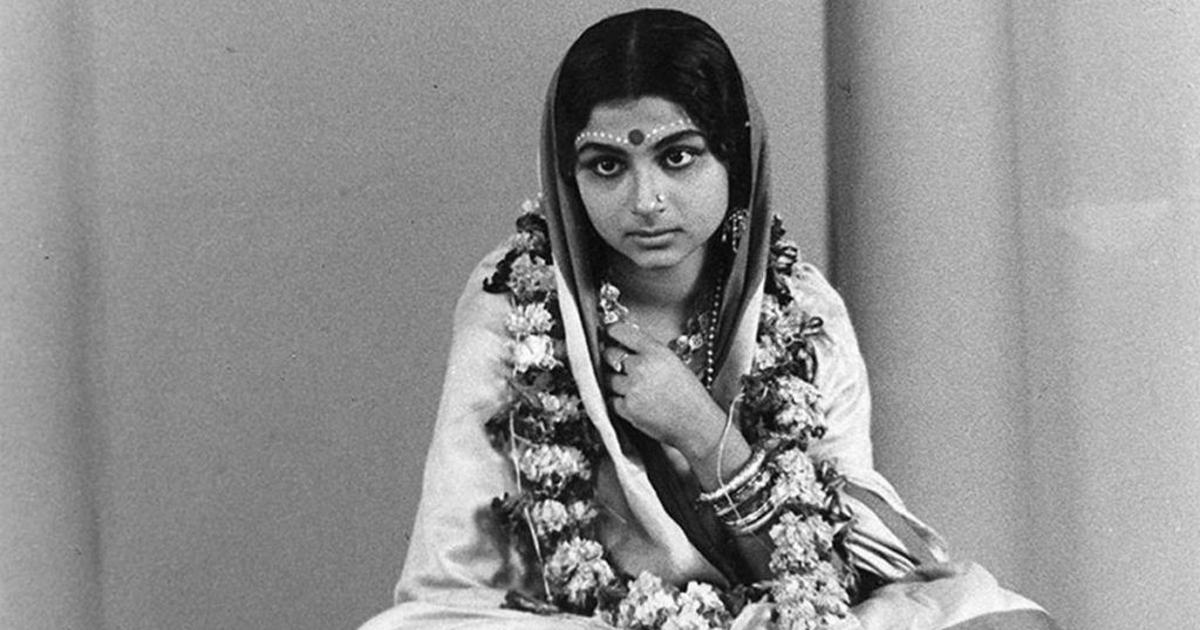


Sharmila Tagore in Satyajit Ray’s Devi (1960) | Satyajit Ray Productions


Meeting Manik da

I was thirteen when I first met Satyajit Ray. I called him Manik da, as did others who knew him well. He introduced me to this wonderful world of cinema. He was my mentor.


My first film was Apur Sansar, where I played Aparna, the child bride of Apu. Though the film made me a household name in Bengal, it came at a cost. I was asked to leave my school. The principal of the Bengali-medium school I studied in felt that I would be a bad influence on my fellow students.


When my father’s efforts to make her change her mind fell on deaf ears, he grandly proclaimed that working in a Ray film was a huge honour and he would prefer his daughter to be part of a Ray film than carry on in a school which did not appreciate this. It was an opportunity of a lifetime, he insisted.


In fact, I had no say in the matter. It was quite difficult for me to let go of my friends and begin life all over in a new school, this time an English-medium one. The transition to a new language was quite traumatic. I remember that the first essay I was given to write was On a Windy Day, and I wrote it in Bengali and then translated it almost word for word into English, with my grammar and syntax all haywire. I used to hide from people at school to avoid conversations in English.


Purnendu Mukherjee (left) and Chhabi Biswas in Devi (1960). Courtesy Satyajit Ray Productions.


It was during the summer vacations the next year that Manik da called me again for another film. This time for Devi. I was 14 at that time. It was made in 1959. Today, so many years, so many films later, it remains my favourite film, my favourite performance. Even the subject, set in 1860, in my opinion remains so relevant today.


In the second half of the nineteenth century, the period in which Devi is set, the confrontation between Hindu orthodoxy and rational reformism was at its most intense. The conflict had permeated the zamindar class and many young reformers, in fact, came from this class.


It is said the idea of the plot of Devi was given by Rabindranath Tagore to Prabhat Mukherjee, who is credited with this short story. The characters in Devi embody this conflict between blind superstition and the growth of cynicism and eventual revolt of the era. The father dominating his weak-willed elder son represents religious orthodoxy. The younger son, Umaprasad, represents the new generation inspired by Western learning and intellectualism. He studies in Calcutta and is influenced by the rational professor who advocates reformist thought.


Yet, that this reformist voice wasn’t yet strong enough to stand up to the entrenched dogmatic beliefs and bigotry is clear, when he is called back urgently by his sister-in-law. The chanting priests, the fervent crowd of worshippers and his father’s will hold him at bay.


Sharmila Tagore in Devi (1960). Courtesy Satyajit Ray Productions.


Harisundari, the elder daughter-in-law, stands somewhere in the middle. She is a rational woman, yet unable to let go of centuries of orthodox conditioning.


When I read the script this time, I realised what an opportunity it would offer me in terms of performing. As far as I can discern, there isn’t a false note in the film, the assured way in which it moves to the shattering climax, the haunting music, the cinematography which heightens the mood of the impending doom.


The opening shots reveal the fervid religiosity of the zamindar, Kalikinkar, almost setting the mood for what is to unfold. As the zamindar watches the Durga Puja as if in a trance, the incense shrouding the air, the cymbals and the drum on the soundtrack, it is impossible not to have a feeling of unease. One is immediately aware that one is in the presence of one intoxicated by faith.


I am immensely proud of this film. In fact, Manik da also felt that Devi and Charulata were his favourite films because, as he himself said, he made less mistakes in these. Even today, when I revisit the film, I am amazed at my own performance. But then I guess that was his greatest ability, to make newcomers feel at ease and get them to emote the way he had envisaged a scene, without probably the actor even realising it. That is why the performances in his films are so natural, they do not seem like performances at all.


Just watch the scene where the father-in-law comes running to Doyamoyee, muttering “Ma, ma”, after his dream where he sees Doya’s face and eyes morph into that of the goddess. He falls at Doya’s feet in abject worship, to be followed by Doya’s brother-in-law.


The revulsion and fear that Doya experiences is depicted not by traditional cinematic forms. One sees her nails digging into the wall next to her even as her toes curl away and you know she is revolted by the spectacle, her very being brutalised and shrinking, a feeling that as a viewer I feel when I watch the film fifty years on.


Sharmila Tagore and Soumitra Chatterjee in Devi (1960). Courtesy Satyajit Ray Productions.


In the absence of her Western-educated husband who stays in Calcutta, Doya is simply not strong enough to resist the fanatic will of the father-in-law. She is as much a victim of the patriarchal set-up in which she has grown up, where she has been taught not to question what is asked of her by the elders of the house. Even as she is garlanded and dressed up as goddess, one needs just a look at her face to know that she is full of doubts, though too timid, too-tradition bound, too young to assert her will of self-preservation. It is not long before the relentless assault of being worshipped disturbs her sense of reality as Ray proceeds to unfold the doom that is now Doya’s fate.


Somehow, the film’s set-up and character probably impacted me even during the shoot. In fact, unlike Apur Sansar, where I felt very energised on the sets, here I could not let go of of a feeling of heaviness, of carrying a weight on my chest, going through an ordeal of some sort; much of it must have been because of all the make-up, the long waits between shots, the heavy garland around my neck, but I also dare say that somehow the oppression that Doya probably felt had infected me, which worked for the character.


The film was widely misinterpreted in the West at the time. While everyone in Bengal is familiar with Kali worship and is aware of the nature of the orthodox family structure and its dos and don’ts, the Western audience was not, and therefore experienced a great deal of difficulty in following the course of events, as the development of the plot grows out of this orthodox Bengali nature of the theme.


Even in India, there was a lot of trouble at the time of its release. The film became quite controversial as it was seen as an attack on Hinduism. The Communist government of the time also seemed unwilling to promote a film that talked of what they deemed was outmoded superstition.


More so, because Ray was a Brahmo, it was hinted that he had chosen the subject to attack Hinduism, which was not true at all. Manik da had to clarify that the film was against the orthodoxy of religion and not against Hinduism per se.


Interestingly enough, about a fortnight after the subject was announced, there was a similar incident in western India, where a young village wife was declared to be a reincarnation of a minor local deity. I agree with Andrew Robinson, Rai’s biographer, who says that the film implies that it is humans who create and recreate gods and it is the human mind that decides whether they are used for the benefit of mankind or not.


If anything, the subject remains relevant even now, with dark pockets of ignorance and superstition still prevalent, not to speak of a societal order made by men where women are mere tools and end up as helpless victims.


For one, in large sections of the population, a woman remains captive, she has no escape, no option. Two, she is mentally conditioned that whatever your family decides for you is the best for you, you are there to serve the family, you cannot have a mind of your own.


Devi (1960). Courtesy Satyajit Ray Productions.


In Devi, even when Umaprasad urges Doyamoyee to accompany him to Calcutta, she is unwilling to do so, thinking about her father-in-law, about the child. And even towards the end, she fails to let go of the myth of incarnation only because she is afraid that it might bring bad luck to her husband, as she says, “Jodi ami devi hoi, tomar jodi amangal hoy” (if I am Devi and something bad luck befalls to you).


This thinking exists even now and religious dogmas kind of reinforce these. So, Devi continues to be important in the way it addresses the use of religious orthodoxy to victimise the woman. Underlying this is the need for education, the kind of education that fosters rational thinking, which saves us from the darkness of ignorance and takes us forward towards a more enlightened future. An issue that Ray, like Tagore, believed in and which informs both Apur Sansar and Debi.


Till such time that religion is used to perpetuate ignorance and superstition, till such time that the true tolerant, progressive nature of religion continues to elude mankind, Devi will remain extremely significant and a must-see for anyone who loves meaningful cinema.


(Source: Scroll)

Wednesday, 10 January 2018

Soha Ali Khan on why she always felt her father's story needs to be told

I had to discover in articles and from friends just how brilliant a batsman he was before the injury, writes Soha Ali Khan about his father Mansoor Ali Khan Pataudi in her memoir. Read on: 

I’ve always thought Abba’s story should be told. Even when he was alive I would often ask him if he was going to write an autobiography. “The truth can never be told,” he liked to say mysteriously, “and I will not lie.” I soon gave up trying to figure out what he meant – he liked to speak in code –  I suspect in order to deter conversation as much as possible, except for the very persistent.

I did not persist then, but after he passed away, I have learnt so much more about him –from obituaries, personal stories, letters written to my mother from friends, colleagues and admirers. I have wallowed in those words of tribute and praise and felt privileged to be loved so dearly by one loved dearly by so many.

Soha says her father had an incredible vocabulary but he
didn’t believe in wasting words. Photo: India Today
My strongest memories of Abba are all lying down – his favourite place in the world was at home in his den in front of the picture window, overlooking the trees and birds, propped up on a gautakiya reading a book and having his feet pressed by Gyaasuddin, his loyal man Friday.

Whilst my mother, my brother, my sister and I travelled the world making films and speeches, giving and receiving awards, caught up in hectic schedules, you could always count on him to be at home by the landline, solid and dependable as a rock. He had a love-hate relationship with the phone – insisting on sitting practically on top of it and yet frustrated by the sound of it ringing.

A young Soha with parents Tiger Pataudi and Sharmila
Tagore. Photo: Mail Today
As a sixteen-year-old girl, you can only imagine how mortifying it was to have your friends call home asking to speak to you and for the grouchy man on the other end to hang up on them with a curt “no”. His ownership over the single landline with the infinitely long extension cord continued even after he went to bed, with the fastening of a lock on the dial pad.

Soha Ali Khan with brother Saif at Tiger Pataudi's
funeral in 2011. Photo: India Today
He had an incredible vocabulary but he didn’t believe in wasting words – and so it was to be for us! Abba didn't like to talk about the setbacks in his life. If I asked him about his father, he would say he didn’t remember him very much. If I asked about his eye, he would brush it off as “a bit of bad luck”.

I had to discover in articles and from friends just how brilliant a batsman he was before the injury. He had already earned himself a bit of a reputation in school as a natural cricketer, graceful and lightning quick in the field. In fact Badi Amman decided to employ the English professional cricketer, Frank Woolley, who had been Sarkar Abba’s coach, to train Abba when he was only twelve.


She would attend each of these coaching classes and watch attentively from afar. She soon noticed that for the most part Woolley was just standing to the side watching Abba practice in the nets. After multiple sessions of much the same, she finally went up to him to gently remind him that he was being paid handsomely for his instruction. Woolley looked at her and simply said, 'I wouldn't change anything. I wouldn't change anything at all.”

(Source: DailyO)

Monday, 16 October 2017

The humiliating model of motherhood in ‘Aradhana’

Aradhana is an anti-feminist movie which uses sexual passion and folly as patriarchal examples of the undoing of chaste unmarried women, writes Jane Chelliah on the Feminism in India. Read on: 

Sometimes it’s only with time that you come to realise that you have been duped or brainwashed. So it is that I wonder how I ever viewed the model of motherhood in the Hindi movie Aradhana as being ‘romantic’.  Let me put some context around this self-revelation.


I loved Aradhana and must have watched it about 10 times through the 1970s and 1980s. Directed by Shakti Samanta in 1969, it foolishly fulfilled the romantic notions of a young girl, and a handsome man falling in love with a beautiful woman which results in an abiding love that endures even after death; and a mother who sacrifices everything for her child. I watched it again recently and was horrified.

In a nutshell, it is an intensely anti-feminist movie which uses sexual passion and folly as patriarchal examples of the undoing of chaste unmarried women. The plot line revolves around Sharmila Tagore’s role. It moves from her being a chaste and retiring virgin woman to being seduced as an unmarried woman by the man whom she loves, Rajesh Khanna, and pays the price for this by having the man die on her after impregnating her. Subsequently she has to give her son up for adoption, but the couple take pity on her and hire her as a servant to help her maintain maternal proximity with her son who doesn’t find out any of this till adulthood.

So many Indian movies weave the theme of the sacrificial mother through their plot lines even to this day. Whether this is a case of art imitating real Indian life expectations of mothers or a case of art driving a theme of the sacrificial mother to disseminate patriarchal messages is a case for debate. What is certain, in my view, is that the ‘Indian sacrificial mother’ model rarely goes unchallenged in both life and in Indian movies.

INDIAN FAMILIES WILL PUT THE MOTHER ON A PEDESTAL AS THE ‘DEVI’ OF THE FAMILY BUT WILL EXTRACT A PRICE FOR THIS THROUGH SERVITUDE.

There are two lines of literary inquiry which can be taken here. The hold and sway that Indian films have over movie goers – witness how ‘Eve Teasing’ was made mainstream largely because of it being portrayed favourably in movies; and how Indian families will put the mother on a pedestal as the ‘Devi’ of the family but will extract a price for this through servitude. As families and film going feature largely in Indian people’s lives, both scenarios are heavy ‘propaganda’ and ‘self-perpetuating’.

Feminists especially feminist mothers need to take down this ‘Indian sacrificial mother’ model. This does not mean that we are advocating being disrespectful to mothers. Nor does it take away the recognition that being a mother involves a whole lot of sacrifice. Mothers sacrifice time, energy and their own needs to bring children up.

There is only so much one person can do and sacrifice is a practical reality but the ‘Indian sacrificial mother’ model goes much, much further than this. There is an element of punishment and sadism involved.

Where Aradhana is concerned, Sharmila Tagore’s character was ‘punished’ by having her boyfriend and father die on her and then having to give up her child. This punishment provided a boundary for a mother’s behaviour considered acceptable and this being that she must be married before having a child, because sex can only take place within marriage. The repercussions of this so-called standard of behaviour are numerous. Women who have been impregnated through rape are seen as defiled. Indian men may sleep with a woman, but will mostly consider her as unacceptable wife and mother material.

The ’Indian sacrificial mother’ model is a patriarchal construct designed to keep us down. It celebrates a uniqueness about being a mother that is just degrading.

Friday, 28 April 2017

This Satyajit Ray film shows how ‘goddesses’ are the most abused in India

Remember young Sharmila Tagore’s kajal-lined haunting eyes from the black and white movie from 1960? “Devi” (The Goddess), by Satyajit Ray, is about a woman in a patriarchal Bengali household where she is pulled up from the servitude of men to a pedestal reserved for goddesses, overnight. A change too sudden for the benign, innocent woman who crumbles under the pressure, since she does not have ten hands or a lion to ride on. Unfortunately, she’s a little too human.

“Devi” is a Bengali black and white film based on a short story by Prabhat Kumar Mukhopadhyay. It is a study on how superstitions have the potential to ruin lives by simply stabbing rationality in the back. The film will incense the individual who hasn’t prayed even once.

Set sometime in the 19th century, “Devi” is the story of a zamindar family, where old and new age values constantly try to step on each other.

The film begins with Durga Puja celebrations taking place inside the family’s huge compound, culminating with the immersion of the goddess in the river. Actor Chhabi Biswas, who plays the patriarch of the household is a deeply religious man. Having lost his wife five years ago, he is well taken care of by his younger daughter-in-law (Doyamoyee), played by Sharmila Tagore. Her husband and Biswas’ younger son, played by Soumitra Chatterjee, is a learned man and finds it hard to digest the mindset of his father.


Everything is going fine until a dream of the patriarch in the middle of the night convinces him that his younger daughter-in-law is a reincarnation of a goddess. This dream motivates him to get up, go to Doyamoyee and bow down at her feet, claiming her to be a ‘devi‘. Unable to protest and influenced by the patriarch, his elder son does the same.

Overnight, the worship of a clay goddess inside the household takes a backseat and Doyamoyee is worshipped instead. The diya stand reserved for goddesses is moved around by the priest as the powerless ‘devi’ gazes into the abyss.

Patriarchy and feudalism shamelessly ensure that a patriarch’s dream in the middle of the night changes the course of everyone’s life in the family. The stubbornness of an old man unable to see the absurdity of blind faith results in a tragedy. The tragedy lies in the fact that it was unnecessary and could have been avoided.

Biswas’ educated son is shocked to know all that has transpired upon his return and is unable to convince his father that his daughter-in-law is as human as anyone else.

The film is a tragedy, for the trio of superstition, patriarchy, and feudalism, without any mercy, wreak havoc on the lives of people in an aristocratic family. The patriarch, responsible for the mess isn’t spared either. By the end of the film, you’ll be convinced that the barbarity of superstition takes pleasure in harassing the old and the young alike.

However, the worst sufferer is the ‘devi‘, whose world of innocence, which centred around writing letters to her husband and spending time with Khoka, her brother-in-law’s son, comes to a premature end.

Devi’s pain is real and her cries are ignored. One question will certainly come to your mind after watching this masterpiece. Is Doyamoyee a living deity or a slave? And you will know the answer to the question.

(Source: YKA)