Showing posts with label Indian. Show all posts

Sunday, 5 July 2020

American, Indian

You know why they call them Indians? Because Columbus thought he was in India. They’re called Indians because some white guy got lost.

—Herb Stempel, Quiz Show


We called them American bhua and American phupher, the middle of my father’s three older sisters and her husband. As the vanguard of my family’s transplants to the U.S., they’d been assigned these honorifics by their nieces and nephews living then in England. American phupher arrived in Chicago for a temporary stay in the late fifties, then returned permanently with bhua in 1971. Together they raised three children while she labored in an electronics assembly plant, and he worked first as a diesel engineer for the Chicago Transit Authority and later in its managerial ranks. In their earliest years here, they would occasionally receive a phone call from a stranger who had just arrived at O’Hare on British Airways or Air India. The callers didn’t speak much English, and they had no friends or family in the city; they’d simply found a pay phone in the terminal, opened the directory, and dialed the number next to any name that sounded like it came from their part of the world. When these calls came in, my uncle would drive from the family’s apartment in Logan Square to the airport and collect the newcomers, whether they were Punjabi, Pakistani, or Bangladeshi, whether they were Hindu, Muslim, or Sikh, and he and my aunt would host them, sometimes for months, until they had secured employment and apartment leases.


This is a kind of generosity that has been practiced by generations of immigrants to and from every part of the world. Among South Asians, such ethnic esprit de corps is captured most succinctly by the term desi, which Vijay Prashad defines to include those of Indian, Pakistani, Bangladeshi, Afghani, Sri Lankan, and Nepalese descent. It isn’t his invention. It’s commonplace enough among my family that I know it to mean one of us in a manner akin to the Italian paisan. Derived from Sanskrit, desi refers to umber skin and curried English, but—like paisan again—its application isn’t entirely seamless. Where outsiders might see homogeneity, immense internecine tensions permeate the histories of the desi peoples. 


Even among Indians arrived in the West from what is ostensibly a single country, there are chasms of cultural, linguistic, and religious difference that make India more like the fitful cohesion of Europe’s constituent nations than anything resembling the U.S. Uniting all our tongues, gods, cultures, and bodies under a single desi banner is tribalism elevated to a continental scale, and it doesn’t quite work.


Yet desi isn’t a wrong category for us to embrace. When you live in a place that doesn’t recognize differences between you and anyone who looks vaguely like you, you come to accept, even welcome, certain conflations. Partition isn’t much remembered. 


PHOTO: JOHN H. WHITE. COURTESY OF THE NATIONAL ARCHIVES AT COLLEGE PARK. PUBLIC DOMAIN, VIA WIKIMEDIA COMMONS.


Who assassinated whose head of state and for what reason doesn’t seem to matter any longer. The cold war over Kashmir, the occupation of Amritsar, the Bangladesh Liberation War, the centuries-long history of persecution and conflict across South Asia—these are hardly known, much less understood, in the West. Here, survival matters. Wellness matters. It matters that we have each other. Growing up in Chicago in the eighties and nineties, it seemed to me that I really might be related to anyone with brown skin and a Bollywood accent. My “uncles” and “aunties” were Gujarati and Pakistani, Hindu and Muslim, Jatt Sikh and Saini. They were shopkeepers and cab drivers, laborers and tailors, professors and physicians. If it takes a village, I lived in a flourishing and richly populated one.


Still, in that village, I have long felt like a freeloader. Though I understand and speak Punjabi and can muddle through a modicum of Urdu and Hindi, though I wore kurta pajamas as a kid and can cook a few sabzis, I know little of the vastness and diversity of the desi nations. From my one visit to India, when I was four, I remember nothing but a sensation here, an image there: a water well between stalks of what might have been sugar cane, saag and corn flour roti cooking under an open sky at night, bathing in the reservoir surrounding the Golden Temple, smoke and the lingering smell of burning hanging over farm fields. This is the entirety of my firsthand reporting on a nation of more than a billion people and its sixty-five thousand years of history. Like every other child of immigrants here, first-generation or fifth-, my distance, my detachment, and my ignorance make me an American.


*


The wide slab of the hi-fi system in my cousins’ suburban living room—different aunt and uncle, different era—sat at the center of a wooden wall unit like an idol upon an altar. In a wire rack to its left stood their collection of Hindi and Punjabi records; in an identical rack to its right was their American collection, which read like Billboard’s Top 100 for the eighties: Madonna, Michael Jackson, Prince, Whitney Houston, the Police, Tina Turner, Huey Lewis, David Bowie. An only child, I must have spent half my childhood sleeping over at that house, where my two teenage cousins would ask their younger sister and me to vote on what to play next. Those records became the soundtrack to our hiding and seeking, our bedsheet tents and board games, our chattering and reading and drifting off to sleep.


The voice that suited me best was Bruce Springsteen’s. I liked the gravel and strain in his singing, his grinning persona and cultivated relatability. I liked the stories his songs told and the stories he told in rambling introductions to live versions of them. They reminded me of our family. Only eight or ten years old, I knew almost nothing of New Jersey or the Rust Belt or the heartland, of Vietnam or recessions or the blue-collar whiteness his lyrics so often embrace, but our money was tight, too. We lived in regular homes in working-class neighborhoods. Our parents and aunts and uncles drove aging Oldsmobiles and Fords to their jobs in factories and other unglamorous places, and no matter the long hours they put in, they never seemed to get all they deserved. Just like the people in Bruce’s songs. Also like Bruce, we seemed to be having a good time anyway, and anyway I was born in the U.S.A., and all of this together meant his music was my music. Knowing a little more about Springsteen’s politics now, I imagine he’d be fine with my overeager empathies. Knowing a lot more about America, I’m not sure the people he sings about would.


The people he sings about are generally counted among the nebulous “white working class” whose political whims have alternately obsessed and held hostage the news media since the election of our current president in 2016. People who fit that description are corralled into televised focus groups and town halls, scrutinized and analyzed in print and in film and on podcasts, polled and pandered to by politicians of every persuasion—and what materializes is a portrait of a mostly decent but anxious people who fervently believe their own legends. They’re devoted to this land they believe is their land: a place discovered, settled, tamed, and civilized by ancestors who carved their pale faces into the indifferent mountains, who settled the “wild” West and built the railroad, who won the wars and spiked their banner into the oblivious moon. They’re proud of their folklore, and their pride makes them certain they deserve more than they’ve already taken. It allows some of them to imagine this country as an ethno-theocracy built by and for the white imagination, delivered unto them by a white god and a white messiah.


In this version of events, I have long felt like an interloper, my family and I counted among the invasive, inundating the American homeland, diluting its religious and ethnic culture, swallowing up its jobs and resources—and we’re only one breaker among several, arriving endlessly from so many “shithole countries” to deluge these shores. To celebrate the relentless advance of European-born settlers as evidence of a pioneer spirit while denigrating the progress of brown migrants here as an invasion is a bald hypocrisy, but the colonizer’s view of American history put the supremacy in whiteness long ago. That history—impressed even upon liberal lions like Springsteen—reflexively casts one people as prototypical, authentic, and heroic while dismissing the rest of us as outsiders to the “real” America: that of the focus group, the media narrative, the rock anthem and grammar school pageant. And so, like every other child born of brown immigrants, first-generation or fifth-, my difference keeps me detached and at a distance. My skin makes me an Indian.


*


Dots, not feathers, the other kids cracked in school, even though in my family’s part of the old country you see mostly turbans and chunis, not bindis. That a single word can conflate the descendants of one continent’s achingly ancient civilizations with those of another, half a planet away, is evidence of colonialism’s continued hold on the American imagination. Desis, of course, have little in common with North American “Indians” beyond the depth of our histories and the diversity among our peoples. But politicians, folk historians, and Americans who proudly recast exploitative expansionism as noble and civilizing have no need for any such distinctions. Our textbooks celebrate Columbus, Daniel Boone, Lewis, Clark, and every manifestly destined land-grabber who followed as trailblazers boldly claiming uncharted lands. 


In this telling, America is a nation of humble pioneers confronting brutal savages, a nation of industrious homesteaders terrorized by interloping raiders, a nation of—yes—cowboys versus Indians.

I remember these lessons from grammar school, their uninterrogated heroism. They are what we mean when we say Americana, and they bear no responsibility for the genocides committed here. They offer no reparations for slavery. They deliver no correction to the existential threats all our technology and growth and bellicosity have wrought on the planet. They only allow the heirs of colonial power to continue laying claim to this country’s historical successes while placing the blame for its failings elsewhere. And so those heirs become a burden for the rest of us. Their self-importance is our burden. Their oblivion is our burden. Their fear and anger over any challenge to their preferred narrative are our burden. Sooner or later, the question confronting the desi arrived in the U.S. is whether or not we will accept their version of history, whether we will cast our lot with the cowboys or with the Indians.


*


My family gathers in December 2012 for a birthday party at a cousin’s house—different cousin, different era—bringing together three generations of auto mechanics and physicians, laborers and homemakers, middle managers and entrepreneurs, professors and retirees. Observant Sikhs, casual Sikhs, and those of us who claim no religion at all. In an election year, it’s unsurprising that our conversation turns to politics, but in the familiarity of this space I’m startled to hear some of my elder relatives expressing so much anger about the state of the nation and directing their vitriol at President Obama. Some who barely speak English complain that Black people and Latinos are coming for their jobs. Some complain that other minorities, even those arriving from the desi homelands, are guilty of exploiting the same social safety net from which they themselves benefit. Too many, they claim, are coming here and straining our resources, and they lay all of this at the feet of our first Black president.


I’m less startled, at another gathering four years later, to learn that these same relatives are unified in their support of candidate Trump. They, too, want to see America made great again, in spite of the fact that they themselves, several of them bearded and turbaned, have had their homes in well-off suburbs and exurbs hatefully vandalized or riddled by xenophobic bullets. They support Trump’s every regressive diatribe in spite of the fact that they’ve benefited from affirmative action and unemployment, from social security protections they now believe are too economically burdensome, from the very immigration policies they now support ending. They align themselves with the same bigoted, jingoist inclinations that would have them barred or deported from here. They speak their allegiance in Punjabi. When other members of the family challenge them, not one is willing to admit the hypocrisy or absurdity in all of this. They have another version of history in mind.


It isn’t that any of them are daft enough to mistake themselves for white. It’s that an exclusionary and supremacist mindset doesn’t belong to the white imagination alone. It is possible for even the brown immigrant to begin to believe in his own triumphal legend: that he set out as a noble explorer and made his way, made a home for himself, that he owes nobody anything for his achievement, and that anyone arriving after him poses a threat to his own hold on resources and opportunity. Decent and devoted to this nation as he might be, he, too, can grow fearful and eager to blame anyone else for his misfortunes. He, too, can believe he deserves more than he’s already taken. He doesn’t have to mistake himself for a European in order to wish to be identified with white America rather than Black or brown or native America. He, too, can simply want to be on the side of power. He, too, can mistake the aggressor for the hero and adopt the aggressor’s values as his own. He, too, can betray the marginalized and the subjugated who need him most. This is how the turbaned desi comes to ally himself with white supremacists, how he becomes for someone else the very burden he wishes to escape.


This is the Indian taking the side of the cowboys, and that this is even possible ought to demonstrate how utterly invented race is, how incidental the white in white supremacy. The supremacist imagination is bigger than race. It merely invents race, over and over, as a means of claiming and clinging to power. Racism is not ignorant or oblivious: racism is willful. Where it is practiced, every manner of revisionism and contradiction required to preserve supremacy, every hypocrisy and absurdity, will follow. This is how the self-proclaimed greatest nation on Earth can also clamor to be made great again, how the leader of the free world can imprison children at our borders, how a nation of immigrants can turn away those tired refugees yearning to breathe free.


*


When my American phupher died in his sleep of a heart attack in 1997, hundreds gathered in mourning at his funeral. Just as many paid their respects after my American bhua’s passing in 2018. If their example in this country is instructive of anything, it’s that there’s an answer to America above and beyond exclusionary thinking. Had they turned their backs on those arriving after them, had they kept for themselves alone whatever progress they made, they may well have thrived here, but they would have done so in isolation, forever afraid that someone would come along to take whatever they were hungrily protecting. They didn’t do that. They chose generosity. They chose solidarity. They showed—and the desi experience writ large shows—that allegiance and community are possible even among those who would be strangers or enemies elsewhere.


So many of us have gotten it wrong in arriving here, whether by birth or by migration. Too many have sought to claim this country for themselves alone. We all want to believe we have earned it, but believing such a thing requires us to lie to ourselves, to create myths that demand we antagonize, wall off, deport, or eradicate anyone who would challenge them. To confront those myths is to surrender some power, but in surrender there can be a greater strength. The history of native America, of Black and Latin America, of broke and brown and immigrant America, is as epic and heroic as any invented legend. Those stories deserve to be a part of our Americana, too. Embracing them—and offering humility, conciliation, and reparation where they reveal injustice—is necessary to tell the larger story of a better nation. That’s the country I’d like to call home, the identity I’d like to claim, the song I’d like sung of myself and everyone else.


Jaswinder Bolina is an American poet and essayist. His latest book of poems, The 44th of July, was published by Omnidawn Publishing in April 2019. His previous collections include Phantom Camera, Carrier Wave, and the digital chapbook The Tallest Building in America. His essays can be found at The Poetry Foundation, McSweeney’s, Himal Southasian, The Writer, and other magazines. He teaches on the faculty of the M.F.A. program in creative writing at the University of Miami.


(Source: The Paris Review)

Wednesday, 22 April 2020

Indian origin man is feeding 24,000 families in Kenya amid lockdown, let’s Salute him

Amid the lockdown which was imposed to prevent the spread of the epidemic, which has claimed more than lakhs of people’s lives, an Indian-origin safari operator based in Kenya is feeding thousands of families there.

Pankaj Shah had started the initiative after he felt heartbroken to see people starving and struggling to live.

“People were getting hungry and angry,” Shah told Reuters.

As per news agency Reuters, Shah started communicating with citizens who were really interested in helping the less fortunate ones in this crisis. Luckily, a local school which was shut down due to the coronavirus epidemic had offered their campus premises as headquarters.

Kenya’s Asian community, which was officially acknowledged as the country’s 44th tribe three years ago, came altogether to contribute in every possible way. They even brought cheques and truckloads of food that could not be transported owing to the suspension of flights.

Meanwhile, the volunteers named “Team Pankaj”, have sent out 24,000 packages of food since March 22. Each hamper comprises enough food to last a family of five people for up to two weeks.

“One old woman told us she hadn’t eaten for days – her sons had stopped supplying her because they have no work,” Shah told Reuters. Pankaj Shah finds his spirit for community service from his idol Mother Teresa whom he says he met decades ago in Nairobi.

Shah is now urging wealthy Kenyans to do their bit to donate 4,000 Kenya shillings (Rs 2,890) for the food packages alone. He had also pointed out that amount is about the cost of two pizzas and a bottle of wine.

“I just need half the rich people here to care enough to fund a hamper,” he added in a statement.

It has been learnt that lorries full of food were sent for distribution in Deep Sea slum last week only. Pregnant woman and those with babies were also assisted by the volunteers.

(Source: The Youth)

Sunday, 3 March 2019

This viral bridal photoshoot of a cancer survivor that is an inspirational must-see

Navi Indran Pillai has taken Instagram by storm with her powerful and inspiring photo series of 'Bold Indian Bride', shattering stereotypes of not just a shy bride but how to empower cancer survivors and patients to embrace their transformation while fighting the disease.

Vashnavi Poovanedran is better known on Instagram as Navi Indran Pillai, and she took the photo-sharing platform by storm after her bridal photoshoot titled ‘The Bold Indian Bride’ went viral. In a series of posts, Poovanedran—who is a Malaysian of Indian descent—spoke of how cancer has robbed many women of looking their best on their wedding day, and that her photoshoot was aimed at helping survivors realise they are bold and beautiful.

“Nothing can stop me. Nope, NOTHING! Not even CANCER”. (Source: Navi Indran Pillai, Celes Gerard/ Instagram)

“Cancer treatments have given us a lot of limitations, robbed us of beauty and taken away our confidence. As little girls, we have always dreamt of what our big day will be like and how we would look like as a bride,” Poovanedran, who is a breast cancer survivor, wrote in one of her posts.

“But having cancer has stripped some of us from fulfilling these dreams. A lot of cancer survivors have postponed or even cancelled their big day,” she wrote.

Poovanedran wrote that she had thought she was cancer-free, when it returned after five years, and spread to her liver and backbone. However, she wrote that after lots of chemotherapy, she beat cancer again in December 2018. Although the journey wasn’t an easy one, it didn’t dampen her spirit or her zeal.

“For me, as a cancer survivor, I dreamt the day I marry the love of my life. Dreamt, what it is like to look like a bride, to feel like a bride. Having gone through cancer treatments (chemotherapy, etc.), losing my hair was by far the hardest thing I ever had to go through,” Poovanedran, who is a motivational speaker and dancer, wrote in a post.


“I felt that I was not beautiful enough to be loved and was not beautiful enough to look or ever feel like a bride. Hair, it is our ‘crowning glory’ and having that taken away from you is devastating. But we choose to accept what we have, appreciate what we are and welcome what is coming,” she wrote.

Dressed in a bight tomato red saree with a white tulle veil, and with mehendi on her feet and hands, Poovanedran is a breathtakingly beautiful bride in the photos. The photographs—taken by photographer Celes Gerard—have struck a chord with thousands of women.

In a message for fellow cancer survivors, she wrote, “Cancer has affected us in so many different ways however good or bad, we don’t and will not let it control our lives.”


As the photos went viral, a makeup artist at Blush, Beauty and Beyond explained the challenges they faced, but how they were driven by Poovanedran’s vision. “The first challenge was to create & carve eyebrows on a canvas that have lost their own,” the makeup artist wrote, adding, “I had to draw individual hair strokes to mimic the appearance of real brow hair & to ensure it didn’t look too fake.⁣”

And that wasn’t the only challenge. As she lost all her hair during chemotherapy, they had to come up with a plan to fix a traditional bridal headpiece. “The next challenge was to choose and fix a headpiece, without a single hairpin involved. This wasn’t easy but I’m so glad we figured it out,” the makeup artist wrote.

The viral photos have also given others hope online.

“How powerful, to burn and still come out stronger and more beautiful,” one user commented. “Stay stronger n see cancer is getting defeated every single day, with your smile and laughter” commented another user. “You’re so beautiful ♥️ thanks for being an inspiration to everyone ♥️ god bless you always,” wrote another online.

(Source: Indian Express)

Tuesday, 29 January 2019

My patient made racist remarks about me. I decided to do something about it

I’ve encountered racism since I was a junior doctor. We rarely talk about it, but it hurts like hell and damages the NHS, says Punam Krishan. Read on: 

Every day doctors experience some form of abuse in the NHS yet we rarely talk about it. There’s lots of evidence of the racism we face: I’ve seen it, colleagues have told me about it, and last week I experienced it. This time, however, I decided to do something about it.

I am a GP in Glasgow and one day last week, a patient saw me walk out at reception. They approached the receptionist and said they wanted an appointment but not with an Asian doctor. My receptionist said: “She’s Scottish.” The patient replied: “She doesn’t look Scottish”, to which my receptionist asked: “What do Scottish people look like?” I didn’t hear the conversation but my receptionist told me about it afterwards.


 Dr Punam Krishan, a GP in Glasgow. Photograph: Dr Punam Krishan
My immediate feeling was one of sadness, but also of pride that I had never experienced before. I feel I belong here – I was born and brought up in Glasgow – but I’ve never really had a white person who is “native to Scotland” stand up and make me feel that I was an equal.

I decided to talk about it. It’s important that people are made aware that these attitudes exist in Britain today. I hoped that if I could speak up and raise awareness, it might encourage other people to do the same and share stories where people haven’t been the bystander. I decided to send a tweet.
The response has been overwhelming. The tweet has had 17,000 retweets, 95,000 likes and 2,400 comments so far. I’ve had countless emails and direct messages, and been approached for interviews with various media outlets. The vast majority of comments have been positive and I’ve been so pleased by the conversations that have been started. A minority of people have trolled me with personal abuse, but it has highlighted that there is a problem that needs to be addressed and that speaking up was the right thing to do.

Advertisement

A lot of the messages I received were from doctors, nurses and other healthcare professionals telling me they had been inspired and that they feel hopeful about the future. They also shared some sad stories with me. A doctor from Australia sent me a message asking for help. He wants to restart his training after resigning from his junior doctor post because he had faced racial abuse at work. I’ve had emails from across the world – Colombia, Argentina, Ghana, Palestine, India, Canada and more. It’s made me think that globally we need to push the agenda of equality and diversity. We need to question the minority who still holds discriminatory views.

I also had responses from people closer to home, working in the NHS. One told me they remember being in a clinical exam in which the university had put forward an actor playing a patient who was racist. It made me think that there isn’t enough training on how to deal with racist patients (from all backgrounds – no one is immune). We are taught how to deal with angry or abusive individuals instead. I’ve had doctors get in touch to say they’ve had their names and the colour of their skin queried. There have been stories of people who have refused to be treated by black and minority ethnic doctors. In all these cases, the staff just stayed quiet and got on with their jobs. Many contacted me to say that I had given them courage to stop doing this and speak out instead.

I’ve encountered racism across the years. When I was a junior doctor, one of my colleagues was called “a ninja” by a nurse out in the waiting area. The nurse thought it was a joke but my colleague felt she couldn’t speak up, and I found her crying quietly in the doctors’ mess. When something like this happens, it hurts like hell. It’s also a wider issue: if we are exposed to bullying, harassment and racism, it impacts on the quality of care we provide, our mental wellbeing and ultimately leads to absenteeism and staff turnover.

It’s difficult to swallow because our job is to look at the whole human. We don’t judge. When people are on their last breath, they’re all the same. Two people suffering from cancer are still human beings going through the same processes. You can’t judge them because of the colour of their skin or the religion they follow. When we sign the hippocratic oath, we speak up to look after our patients and provide a duty of care. It’s never compromised. Patients are entitled to that, but it’s also their responsibility to give the same back to their healthcare professionals.

(Source: The Guardian) 

Monday, 7 May 2018

The Indian woman who sat for a notable American portrait in the ’60s and forgot about it – until now

In Donald Trump’s America, a painting by Alice Neel acknowledges the history of Indian immigrants.

In a 1966 portrait currently on display at an art gallery in Manhattan, a dimpled young Indian woman sits on a deck chair, looking amused. Her mauve bandhani sari, its pallu wrapped snugly around her hips, accentuates her figure. The white of her petticoat is visible under layers of chiffon (too diaphanous to be polyester, not crumpled or starched enough to be cotton). Her blouse, also white, is sleeveless. Bollywood heroines started wearing sleeveless blouses in the 1960s, so she must have been quite fashionable.

She looks a little like Sharmila Tagore.

Her thick braid falls down her right shoulder and dangles below the seat. She poses with the long fingers of her right hand resting on her cheek, her chin a few inches above her palm. Her large brown eyes are lined with kohl, her gaze is confident. She stands out in Alice Neel, Uptown, an exhibition of selected portraits by the American artist Alice Neel at the David Zwirner gallery in Chelsea.

Neel painted these portraits during the five decades she lived in New York City’s Spanish Harlem and the Upper West Side, until her death in 1984. Most of them focus on African Americans and Latinos whom she encountered in her neighbourhoods and in the art world. The others are of people of colour too: Cyrus, the Gentle Iranian (1979); Abdul Rahman (1964), a Black Muslim; Ron Kajiwara (1971), the Japanese-American designer.

There is no information, however, about the only South Asian face here – just the title, Woman (1966).

Woman, 1966. Oil on canvas 46 x 31 inches Private Collection, Miami.
© The Estate of Alice Neel. Courtesy David Zwirner, New York/London and
Victoria Miro, London
She also remains conspicuous by her absence in the art historian Pamela Allara’s Pictures of People: Alice Neel’s American Portrait Gallery, which chronicles Neel’s life and work. Allara writes that Neel “revived and redirected the dying genre of ameliorative portraiture by merging objectivity with subjectivity, realism with expressionism”. Neel described herself as a “collector of souls,” Allara writes, adding that she was categorised as “a sort of artist-sociologist”.

Neel painted the mysterious woman a year after the 1965 Immigration and Nationality Act profoundly changed the American immigration policy, removing longstanding quotas on newcomers from India (among other places). Indians called it the “brain drain”, as the highly educated – particularly doctors – left for the American dream.

Was the woman in the portrait a young doctor then?

She wears gold jewellery – balis, a bangle, and a ring on her middle finger. A red bindi dots her forehead. A pinkish shadow on her hairline seems like the remnant of sindoor. She evokes a picture of Ashima Ganguli, the Bengali housewife in Jhumpa Lahiri’s The Namesake, set in the American North East during the same time period.

Neel had moved to a “more middle-class neighborhood” near Columbia University when she painted this young woman. Was she then a student at Columbia? Or a professor?

Hilton Als, a theater critic at The New Yorker, who curated the Alice Neel exhibition in Chelsea, writes, “In the years since her death, viewers young and old have experienced the kind of thrill I feel, still, whenever I look at Neel’s work, which, like all great art, reveals itself all at once while remaining mysterious.”

The identity of this sitter of Neel’s portrait does seem a great mystery. Even the internet offers no clues.

Ujjaini Bhattacharya, just before she left for the US.
The answer to the mystery finally arrived in an email from a research archivist at the David Zwirner gallery: “The sitter in the portrait is known to be the daughter of the Indian social-realist novelist Bhabani Bhattacharya (1906-1988), who had been invited to New York at the time by his American editor Millen Brand of Crown Publishers. At the time of this sitting, Bhattacharya’s daughter was enrolled as a student at Columbia University.”

Bhattacharya was a pioneering Indian writer who wrote in English. He was a contemporary of RK Narayan, Mulk Raj Anand and Raja Rao. His books were translated into several European and Indian languages. The New York Times’ literary critic Charles Poore, in a 1952 review of Music for Mohini, wrote about Bhattacharya’s protagonist Mohini: “We’ll all be lucky if we meet a more appealing heroine this year.”

It took five hours to locate his family. Their names are not in any academic paper, news clipping or obituaries about Bhattacharya, who spent the last two decades of his life in the US. His two daughters and a son are mentioned in a small 1988 funeral notice in the St Louis Post-Dispatch, a local Missouri newspaper: “Surviving are his wife, Salila Bhattacharya; a son, Dr Arjun Bhattacharya of Ladue; two daughters, Ujjaini Khanderia of Ann Arbor, Michigan, and Indrani Mukerji of Calcutta, India; and six grandchildren.”

Ujjaini Bhattacharya in 1967.
Ujjaini Khanderia of Ann Arbor, Michigan, avoids all calls from phone numbers she doesn’t recognise. She is particularly bothered by a caller who leaves a morbid message: pick up the phone or you will die.

She ignores the first message left on her voice mail asking for an interview, but answers the phone in the middle of the second.

Khanderia, now in her seventies, remembers when the portrait was made, but the details are hazy. She remembers the artist, but not quite. “She said would you like me to… I didn’t even know who she was, she made a portrait of me.” Khanderia speaks in fragments, then stops mid-sentence, gathers her thoughts and asks: “So tell me a little bit more. This is some famous gallery? What’s her name again?”

Fifty one years ago, Ujjaini Bhattacharya came to America on a scholarship to attend the University of Michigan. (She never went to Columbia, the gallery had the information wrong.) Before starting graduate school, she spent a week in New York City, where she lived with the family of her father’s friend and publisher Millen Brand.

“I was terribly homesick and wanted to go back to India the same day that I landed in New York,” she said. “I was NOT good company given my depressed and sad state of mind.” Brand took her sightseeing, and they stopped by at his friend Alice Neel’s studio apartment. Khanderia says she agreed to sit for the portrait. “Since I was lonely and homesick, I thought this was a good opportunity to be left alone without having to act friendly.”

When she met her now husband Sharad Khanderia in college, she remembers telling him about the “lady who drew a portrait of me. And that’s all. That was the end of the conversation.”

It never came up again, she said. She didn’t even think about it.

“I just thought she was a local artist,” she said. “I thought she was just practicing something.” She remembers Neel to be friendly and unassuming, engrossed in painting more than talking. She sat for Neel for about seven hours and was pleased by the finished portrait, “But my thoughts were elsewhere – I was more concerned about how I would survive in Ann Arbor where I knew nobody and had no help.”

She wondered whether her portrait can be shown in public without her permission. She said she never heard from Neel again. She tried to remember if Neel sent her a picture of the painting.

It was so long ago. It takes her a few minutes to get her bearings.

“Oh, so you’re going to be writing about the portrait,” she said, with a nervous laugh. “Ah, I thought you were writing something about my father. My goodness! That’s unbelievable! I could never imagine what you’re saying!”

The day she reached the US, Ujjaini Bhattacharya wanted to return to Nagpur.
In 1966, New York was a blur, in an America where Indians were not yet a “model minority”. They lived in the margins of American society, straddling the line that kept people of colour firmly outside. It was overwhelming for a 21-year-old from Nagpur. “I was too homesick to think about anything but home.” As a young student in Michigan, she said, “I was terribly afraid, I was totally unprepared. It was very scary. It was very, very difficult for me.”

It took her years to adjust to the country, the culture, the clothes. “I used to wear saris when I came to the US,” she said. “In Nagpur, we didn’t wear Western dresses, we wore saris more comfortably.” (She bought that mauve bandhani in Nagpur.)

She lost her way on the first day of college and was almost in tears when “a young student from India who saw my plight, offered to show me my way around campus”. Soon after Ujjaini Bhattacharya married Sharad Khanderia in America. They both eventually taught at the university’s College of Pharmacy. They had two children. This year, they will celebrate their 50th wedding anniversary. They still live in Ann Arbor.

Indians have been in the news in America the last few weeks, and America has been in the news internationally, the last few months. In the midst of vicious attacks and vitriol, Neel’s portrait gently celebrates Ujjaini Khanderia’s – and that of other people of colour – contribution and belonging to America.
Cyrus, the gentle Iranian, 1979. Oil on canvas 39 7/8 x 30 1/8 inches © The Estate of
Alice Neel. Courtesy: David Zwirner, New York/London and Victoria Miro, London
Ron Kajiwara, 1971. Oil on canvas 67 7/8 x 35 1/8 inches
© The Estate of Alice Neel. Courtesy: David Zwirner,
New York/London and Victoria Miro, London
Alice Neel, Uptown was on display at the David Zwirner gallery, New York City, till April 22. It will be on show at the Victoria Miro Gallery, London, from May 18 to July 29.

(Source: Scroll)

Thursday, 3 May 2018

British peer calls Irish PM Leo Varadkar a 'typical Indian' in 'racist' tweet

'It is deliberate, calculated disrespect,' says Alliance Party leader Naomi Long

A former deputy leader of the Ulster Unionist Party (UUP) has been criticised for calling Irish prime minister Leo Varadkar, a “typical Indian”.

Lord John Kilclooney posted the comment on Twitter in response to a news story in which the Taoiseach was criticised for having “poor manners” on a visit to Northern Ireland.

Alliance Party leader Naomi Long immediately took to the social media site to criticise the Lord Kilcooney's comments.

Calling it a "racist slur", she said it was "insulting of not only the Taoiseach and the Irish people, but of Indian people too."

Lord John Kilclooney posted the comment on Twitter in response to a news story in which the Taoiseach was criticised for having 'poor manners' on a visit to Northern Ireland (file photo) AFP/Getty Images
She added the House of Lords needed "to address his conduct: it is deliberate, calculated disrespect”.

Mr Varadkar was born in Ireland to an Irish mother and an Indian father.

Following criticism from social media users for his comment, the lifelong peer said he had “great admiration for Indian people”, adding: “I help Indians very often.”

He later insisted there was “Nothing racist about it”, saying the remark was “simply factual”

Lord Kilclooney told critics: “You still do not understand the difference between nationality and race. Varadkar is a full Irish citizen and proud of it. He is also racially a half Indian and proud of it!”

It is the second time the peer has been accused of racially abusing the Irish prime minister. Last November referred to him as “the Indian”.

He admitted the remark had caused “upset and misunderstanding” and withdrew it.  A complaint to the House of Lords standards commissioner was dismissed.

UUP leader Robin Swann said Lord Kilclooney’s “excuse the last time was due to a restricted number of characters and being unable to spell a name – this time there is NO excuse”.

He later added: “He doesn’t speak for me”.

Miqdaad Versi, assistant secretary general of the Muslim Council of Britain, also criticised the post and pointed out that the veteran unionist peer has previously been accused of racism after tweeting about about cricketer Moeen Ali playing in an Ashes test for the England cricket team.

“Times have changed! The England team now needs non English people in order to win Test Games!” Lord Kilcooney wrote last year.

When one social media user said Mr Ali was born and raised in England, the former Ulster Unionist deputy leader responded: “Moeen Ali is proud to be British but racially he is not English. There is a difference between being English and being British!!”

Broadcaster Piers Morgan responded by saying: “Oh shut up you racist old dinosaur. Moeen Ali’s more English than I am, and I was born in Guildford.”

On Lord Kilcooney's latest tweet, Mr Versi said said: “Appalling racism is not new from Kilclooney. Let’s not forget his disgusting treatment of Moeen Ali. There needs to be basic standards in the House of Lords.”

(Source: Independent)

Saturday, 18 March 2017

Indian-American teen wins top science award worth $250,000

An Indian-American teen has won the top award, worth $250,000, in the oldest and most prestigious science and math competition in the US, for her research on preventing death of neurons due to brain injuries or neurodegenerative diseases.

Indrani Das, a 17-year-old resident of New Jersey, and four other Indian-origin students were among the top ten finalists to be honoured at the annual Regeneron Science Talent Search Awards Gala for their research projects demonstrating exceptional scientific and mathematical ability.

Forty finalists took home more than $1.8 million in awards.

A contributor to neuron death is astrogliosis, a condition that occurs when cells called astrocytes react to injury by growing, dividing and reducing their uptake of glutamate, which in excess is toxic to neurons.

In a laboratory model, Das showed that exosomes isolated from astrocytes transfected with microRNA-124a both improved astrocyte uptake of glutamate and increased neuron survival.

Arjun Ramani, an 18-year-old student from Indiana won the third place honours worth $150,000 for blending the mathematical field of graph theory with computer programming to answer questions about networks.

Indrani Das
Typically, these questions require statistical comparisons to hundreds or thousands of random graphs, a process that can take a relatively long time.

He developed an algorithm that greatly accelerated the process by reducing the time required to generate these graphs.

"Congratulations to the Regeneron Science Talent Search 2017 top winners," said George D Yancopoulos, president and chief scientific officer of Regeneron.

"My experience as a Science Talent Search winner led me to embark on a career in science, and I hope it will inspire these exceptional young scientists to become the next generation of innovators that will improve the world and solve some of our most pressing challenges as a society," said Yancopoulos.

Archana Verma, 17, from New York, received a $90,000 award for her study of the molecular orbital energy dynamics of dyes, which may someday result in windows that produce solar energy.

Prathik Naidu, 18, from Virginia, received a $70,000 award for his creation of a new machine learning software to study 3D interactions of the human genome in cancer.

Vrinda Madan, 17, from Florida, received a $50,000 award for her study of 24 potential compounds for the treatment of malaria, in which she found two potential candidates that appear to target the disease-causing organism in a novel way and may warrant further study.

Of more than 1,700 high school seniors who entered the Regeneron Science Talent Search 2017, roughly 300 were named scholars in January.

Of those scholars, 40 students were named finalists and invited to Washington, DC to compete for the top 10 awards.

(Source: ToI)

Tuesday, 14 March 2017

CBSE International discontinued in Indian schools in Qatar

Qatar Indian schools have informed their decision to discontinue the CBSE International Curriculum to the parents. The students from CBSE (i) will be merged into the National Curriculum (CBSE) starting from the next academic session in April 2017.

Birla Public School has informed the parents that in compliance with the instructions of the CBSE Delhi to discontinue the International Curriculum, the school is constrained to discontinue it from the Academic Year 2017 – ‘18. Accordingly, the International Curriculum in the school will be merged in the National Curriculum with effect from April 2017. The merging will be inclusive of International section of the Kindergarten school as well.

Parents of students in CBSE (i) were apprehensive since the discontinuing of the stream was announced in February. One of the main worry was that there was no clear communication from the school regarding the future of these students.

"There was a petition forwarded to the CBSE authorities to withdraw their decision of discontinuing the international stream. The school authorities were hoping that the international stream would be reinstated," said one of the worried parents.

The teaching method and text books are very different between the two streams and parents with students in higher classes are worried that the children will have a lot of adjustments to do to catch up with the CBSE stream.

Meanwhile another prominent Indian school with many children in International curriculum has informed the students that the school will change their curriculum to that of National curriculum starting April 2017. The students have been assured that they will continue in separate classes to ensure smooth transition from International curriculum to National.


DMIS issued a circular annoucing the merger and assuring parents and students of support to ensure trouble free transition. The school in the circular said that the teachers will continue to approach topics in similar way to the students in CBSEi as they were done earlier. "...we assure that the students adaptation needs will be fully taken care of by the school," the notice read.

The school also assured the students studying in grade IX CBSEi that a brief bridge course will be arrange as extended study option to cover knowledge gaps if any. (Though the notice immediately mentioned that there in no difference in content but only in its discourse.)  The school also informed parents that as this decision was announced only a few weeks back, there could be delay in receiving the textbooks for these students and for them the school will issue photocopies of the same till the books arrive.  

Another concern voiced by the parents is about the fees. The international stream fee is much more than the CBSE stream. Now that all students will be part of the same curriculum, the schools are expected to reimburse or adjust the extra amount with future payments as many parents have already paid the term or annual fees in advance for the next academic year.

Over 2,000 parents from Qatar, Oman and UAE had signed an online petition requesting CBSE to roll back their decision and to constitute a task force to improve the curriculum.

Birla Public School, Shantiniketan Indian School, Doha Modern Indian School, MES Indian School are some of the Indian schools in Qatar offering CBSE i along with the national CBSE curriculum.

(Source: The Peninsula)

Wednesday, 8 March 2017

Dubai-based Indian girl's invention could save hundreds of lives

Dubai-based Indian expatriate Priyanka Praseed says she has a simple yet innovative solution which could help save hundreds of children's lives in the UAE, every year.

"The idea first came to me after reading headline after headline about children accidently plunging to their death from balconies here," she told Khaleej Times.

But what makes Priyanka's idea so unique is the fact that she isn't even a teenager yet. However, age is no obstacle for her.

The impressive Grade 7 Millennium School Dubai student has even had her idea recognised by the Dubai Municipality (DM).

"I had approached the Dubai Municipality Building Division and presented them this solution and subsequently I was referred to Dubai Civil Defense. I am waiting for an appointment now to present the idea to them."

So what is the innovation exactly? Well, in laymen's terms, it's an inexpensive sensor that alerts parents when a small child approaches a balcony or window. She calls it the 'Fall Alarm'.

"It's just a basic motion sensor that detects movement, but you can adjust the measurement to the minimum or maximum height of your choice. It is probably the first-of-its-kind electronic solution that addresses this problem," Priyanka said.

The sensor works by sounding an alarm when a person enters the area fitted with the alarm, which in turn allows a parent to react to the situation.

After posting a message on the Dubai Municipality website which read: "I have an innovative solution to prevent child deaths here," Priyanka received an email from the department inviting her to showcase the product.

And that's when they suggested she present the idea to the Dubai Civil Defence.

"I think they liked my idea because I was young, and because it's based on new technology, it fits in well with the Smart City initiative."

Although Priyanka said effective safety measures are being taken by the government to ensure child safety in this regard, she hopes her idea can be pushed forward, with the eventual goal of making such motion sensors mandatory for residential buildings.

"This is one idea that doesn't cost much, but can save so many innocent children's lives. I read that about 33 children die annually as a result of accidental falls in the UAE and I don't want to read such headlines anymore. We can end it now."

Despite her young age, Priyanka's invention has been turning heads across the UAE, and back in February she bagged top prize at the Global Innovation Challenge, held at the Gems Wellington School.

Her project was selected as one of the winning projects in the 'Security' category, and she beat off competition from 22 other teams.

Now, she hopes the idea will be given the limelight it deserves as well as the right support for eventual release in the market.

Commenting on the importance of children here taking an innovative approach to combat everyday issues, Col. Sami Al Naqbi, Director-General of Sharjah Civil Defence, said that it will continue to "encourage all innovation and inventions" that contribute to ensuring the safety and security for all, especially children.

"Children falling from high-rise buildings has become an issue that needs to be tackled with the collaboration of all, including parents, authorities and innovators," he said.

(Source: Khaleej Times)

Thursday, 23 February 2017

Patients treated by Indian doctors in US have lower death rate: Harvard Study

Patient death rate in the US is lower for immigrant doctors from countries such India and Pakistan, as compared to trained medical graduates from American medical schools, according to a new study that comes amidst the immigrant controversy triggered by President Donald Trump.

The researchers, including those from Harvard Medical School in the US, examined whether patient outcomes varied by countries where international medical graduates were trained.

They were restricted to eight countries with the largest number of international medical graduates going to the US – India, Pakistan, Philippines, Syria, Nigeria, Mexico, Egypt, and China – to avoid unstable estimates.

In the US, international graduates are largely from India, the Philippines and Pakistan – not including US citizens who have gone abroad for medical education and returned to the US to practice.

The researchers said that current standards of selecting international medical graduates for practice in the US “appear sufficiently rigorous to ensure high quality care.” International medical graduates make up a quarter of the physician workforce in the US, UK, Canada and Australia.

Although international graduates are required to pass examinations to practice medicine in the UK and US, concerns have been raised about the quality of care provided by these graduates.

Yet no study has investigated differences in patient outcomes between international medical graduates and US medical graduates using nationally representative data.

Researchers set out to determine whether patient outcomes differ between general internists who graduated from a medical school outside the US and those who graduated from a US medical school.

They analysed a national sample of data for over 1.2 million Medicare beneficiaries aged 65 years or older admitted to hospital with a medical condition in 2011-14 and treated by over 44,000 international or US medical graduates who were general internists.

Compared with patients treated by US graduates, patients treated by international graduates had slightly more chronic conditions.

After adjusting for factors that could have affected the results – including patient characteristics, physician characteristics and hospital fixed effects – they found that patients cared for by international graduates had a lower risk of mortality (11.2 per cent versus 11.6 per cent) than patients cared for by US graduates across a broad range of clinical conditions.

The researchers said that for every 250 patients treated by US medical graduates, one patient’s life would be saved if the quality of care were equivalent between the international graduates and US graduates.

Readmission rates did not differ between the two types of graduates, whereas costs of care per admission was slightly higher for international medical graduates.

(Source: Medical Dialogues)

Thursday, 26 January 2017

How to choose the right school in Dubai

Now that you have decided to enroll your child in school, here are the next steps.

Parents are no strangers to scrambling for admission to schools in Dubai. While getting an admission in schools here is not an easy job, it would be helpful to have a handy list of things to do. Khaleej Times has got you covered.

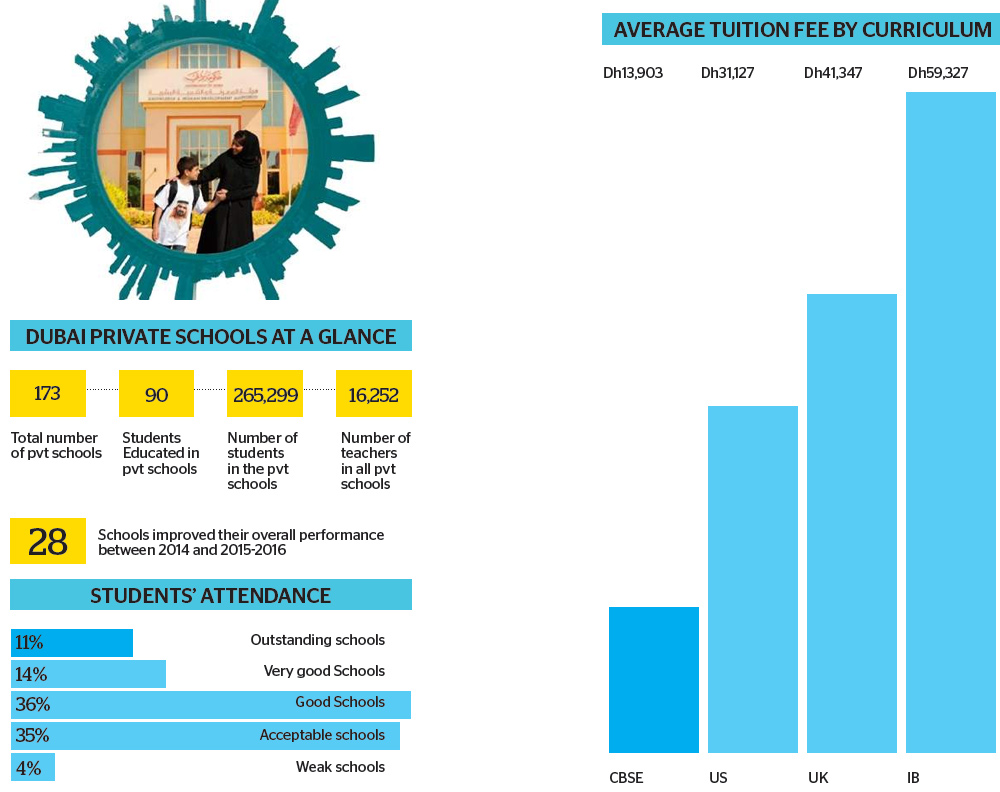
There are 173 private schools in Dubai with a total of 265,299 students, according to the Knowledge and Human Development Authority (KHDA).

Dubai private school at a glance


Getting admission

In the UAE, the academic year starts in September and runs till June. However for Indian and Pakistani curriculum schools, the academic year starts in April. Parents need to mandatorily enroll their kids to school starting from Grade 1.

Age criteria
The age of the child eligible for admission is calculated as his/her age on the 31st of July for Indian and Pakistani curriculum schools, or 31st December for others.

All schools will have to complete the admission formalities with KHDA. You will have to submit a copy of your child's passport and residence visa, a copy of the birth certificate (if the passport does not state the exact date of birth), a passport-sized photograph and attested certificates and/or transfer certificate (if registering at Grade 2 or above).

Choosing a school
The UAE Ministry of Education website provides an interactive service that uses Google Maps to show the details of each school in the UAE.


Academic calendar
Indian schools have a different schedule - Central Board of Secondary Education (CBSE) and the Indian Certificate for Secondary Education (ICSE) - follow an academic year from April to March. Pakistani and Japanese schools in the UAE also follow this schedule.

Here's the annual school calendar:

Dubai Private Schools - Academic Year 2016/2017
Start of academic yearAugust 28, 2016 *
Winter break beginsDecember 18, 2016 (Two weeks) **
Return from winter breakJanuary 2, 2017
Spring break beginsMarch 26, 2017 (Two weeks)
Return from spring breakApril 9, 2017
End of academic yearJune 22, 2017 *


Asian Schools in Dubai - Academic Year 2016/2017
Start of academic yearApril 3, 2016
Summer break beginsJune 26, 2016
Return from summer breakAugust 28, 2016
Winter break beginsDecember 18, 2016
Return from winter breakJan 2, 2017
End of academic yearMar 15-30, 2017 ***
New academic year beginsApril 2, 2017

Dubai Private Schools - Academic Year 2017/2018
Start of academic yearSeptember 10, 2017 *
Winter break beginsDecember 24, 2017 (Two weeks) **
Return from winter breakJanuary 7, 2018
Spring break beginsMarch 25, 2018 (Two weeks)
Return from spring breakApril 8, 2018
End of academic yearJune 28, 2018 *
Note:

*Asian schools calendar for AY 2017-18 will be communicated soon.

*Schools starting in September have the flexibility to adjust the opening and the closing date by one week (either earlier or later) subject to the school fulfilling the stipulated number of instructional and academic days and receiving KHDA approval.

**Private schools in Dubai following MoE curriculum have three weeks Winter Break in line with the MoE calendar:

- Winter Break 2016/2017: begins on December 18, 2016 and classes resumes on January 8, 2017 - Winter Break 2017/2018: begins on December 17, 2017 and classes resumes on January 7, 2018

***Private Schools in Dubai following Asian curriculum are allowed to close any day between March 15 and 30, subject to the school fulfilling the stipulated number of instructional and academic days. 

Note: Ramadan is expected to begin on Thursday May 25th in 2017. This has implications for school holidays. Eid Al Fitr in 2017 will fall on June 25 - just after the end of the summer term. Eid Al Adha in 2017 will be on September 1 - just before staff are expected to arrive back at work on the 3rd. Students follow one week later on September 10th.

(Source: Khaleej Times)

Saturday, 10 October 2015

Book review: Wondering Who You Are

Do you remember Balu Mahendra's Moondram Pirai Tamil film which came out in 1982? Ok, how about Sadma which came out in 1983? Sridevi and Kamal Hassan had mesmerized the audience with their fabulous performance in it. Sridevi plays the role of a young modern girl who meets with an accident and loses her memory and behaves like a seven-year-old girl. Kamal Hassan rescues her from a brothel and brings her home and spends several months together sharing an amazing and innocent relationship that treads the tender line between affection and love. 


Kamal takes Sridevi to the village's medical practitioner who cures her and brings her back to sanity as she regains her memory up to the point of her accident. When kamal comes to meet Sridevi later that day, she is unable to identify or remember him. Despite his efforts to make her understand that he was the one who had taken care of her for several months, she is indifferent to him and leaves the place for her hometown, thus abandoning kamal and the life and relationship that she once had with him.


How about facing such a situation in real life? After going through such a situation in her own life, Sonya Lea writes 'Wondering Who You Are: A Memoir' (2015) and tells the world how the course of her life changed completely after her husband forgot who he was and what relationship he shared with her and their two children during their blissful married life of 23 years. 


When Sonya and Richard were entering their 23rd year of married life, Richard was diagnosed with Pseudomyxoma Peritonei, also known as PMP, a very rare and deadly appendix cancer. He agrees to go through HIPEC, popularly called as Mother of all surgeries, which included a 10-hour grueling operation. Miraculously, Richard survives the surgery, but unfortunately forgets his past -- due to lack of oxygen supply to his brain all his memories were completely erased! 


He struggles to know who he is and the people around him. The man who went to the hospital was completely different from the man who came out. He does not even know how to talk or smile let alone remember his family. His situation not only put himself in trouble, but also his family members, especially the author, who continuously strives to help him regain his memory. 


The author does not hesitate to reveal her bad side and his bad side even though her husband had no memory of them. She goes on to build a new relationship, a new life with him. In a way, it is not Richard who asks "wondering who you are", but the author herself as she questions herself what is the role and place that she holds in the life of Richard, a new man, a complete stranger after the surgery. It's difficult to live with a stranger under the same roof, but hats off to the author, she not only lived with him,  but also found a new life with him. 


The book intertwines both her love story and the hospital days and readers instantly fall in love with the style of narration and the bitter truth, sometimes too private, the author dares to tell the world. 


The book looks like an answer to the questions asked by Richard in the hospital bed. She is fortunate that Richard loves her more than before and tries his very best to impress her. He does every possible thing to keep her happy, even agrees to her wish of having a boyfriend! 


One has to laud the efforts of Sonya for helping Richard in all the ways. She keeps encouraging him to regain memory, helps join back his job, and what more the way she stands like a strong pillar during his worse days is more than enough one can expect from a wife. 


As Sonya says Richard is a puzzle, a mystery for her, in fact, she herself is a mystery as she found a new love and life with him. Readers get the perspective of Sonya throughout and one wonders how Richard feels about the whole incident. But then one has to keep in mind that Richard has not regained his memory completely and he is constructing his memory based upon what his wife and children are telling him. So maybe this is where Sonya's perspective becomes important, not only to Richard, but also to readers. 


The book is interesting and keeps readers glued to it. It has everything, love, loss, confusion, deathbed, family, sex, health, most importantly memory loss and identity crisis. The book begins in a faraway western country and ends in the nearby Haridwar, bringing both East and West together in thoughts. Readers fall in love with the author's way of story narration and simple language. 


Note: This review was originally published in Sakhi magazine here:  http://sakhiexpress.epapr.in/584319/Sakhi/15-September-2015#dual/24/1