Showing posts with label Greece. Show all posts

Sunday, 6 February 2022

How a pioneering Greek scholar was robbed of the credit for translating Chanakya’s words in Sanskrit

Dimitrios Galanos, who was born in Athens in 1760, spent almost five decades in India and became the first Greek Indologist in the modern era. Galanos’s greatest lexicographical work was a Persian-Sanskrit-English-Greek dictionary. Sanskrit and Persian words were written in the Latin script and there was an accompanying English text with copious explanations. Although the dictionary was incomplete and missing some translated words, it was a pioneering attempt to help Greeks understand Sanskrit, writes Ajay Kamalakaran. Read on: 

In 1786, Dimitrios Galanos, a 26-year-old Greek teacher boarded a ship in Basra for Calcutta in search of a new life. A few months before, the young man who was formally educated in Ancient Greek, Latin, philosophy and music, had been galvanised by a chance encounter with a merchant in Constantinople. The merchant, one Madratzoglou, had extensive ties with the 200-strong Greek community that had settled in Bengal by the 1780s in places such as Narayanganj, Dhaka and Calcutta.


“Madratzoglou found him ideal for tutoring the children of the Greek merchants who had settled in Narayanganj (near Dhaka) and Calcutta and offered him a position as a teacher there,” wrote Dimitrios Vassiliadis, a noted Greek Indologist and Sanskrit and Hindi scholar, in 2020 for the Hellenic-Indian Society for Culture and Development. 


“Galanos, eager to expand his knowledge, gladly accepted Madratzoglou’s offer and prepared himself for his journey to the East; ‘…to carry the torch of the paternal education to the Greeks in India, and to send back from there to Hellas a few sparks of the ‘light of Asia’.’”


Spyridon Prosalentis/Wikimedia Commons [Public Domain]


After six months, Galanos reached India, a country where he would live for the next 47 years. Of this time, he spent a relatively brief six years as the teacher of the children and relatives of a wealthy merchant named Constantine Pandazy. But it was a time spent well.


The Greek scholar lived in a Bengal that was in the throes of the Hindu Revival Movement and came across Hindu reformers who were outward-looking and keen to interact with foreign scholars. This was also a period when European scholars developed a deep interest in Sanskrit and were moving to Calcutta because of the Royal Asiatic Society of Bengal. While working in Bengal, Galanos learned and mastered English, Hindustani, Persian and Sanskrit.


Some researchers studying Galanos’s life have suggested that he also got involved in business ventures and made a small fortune for himself. In a 1969 article for the Journal of the American Oriental Society, Siegfried Schulz, who taught languages at the Catholic University of America in Washington DC, wrote that Galanos left behind 75,000 to 80,000 gold francs when he passed away in 1833. “Having shrewdly invested his earnings (and possibly a generous gift from Pandazy as well), Dimitrios Galanos set out for Varanasi in 1793,” Schulz wrote.


Life in Varanasi

Not much is known about the life of Galanos in the Hindu holy city. So consumed was the scholar in translating texts from Sanskrit to Greek that he mostly kept aloof from other foreigners. He does, however, find a place in a book published in 1824-’25 titled Narrative of a Journey Through the Upper Provinces by Anglican Bishop Reginald Heber.


The British were initially suspicious about Galanos’s motives in living in Varanasi, according to Heber. But, after watching him for a long time, they came to the conclusion that there was nothing in his conduct to confirm their suspicions. “So few Europeans, however, who can help it, reside in India, that it seems strange that any man should prefer it as a residence, without some stronger motive than a fondness for Sanskrit literature, more particularly since he does not appear to meditate any work on the subject,” Heber wrote.


The Anglican bishop mentioned a special friendship that Galanos shared with a Russian trader who lived in Varanasi. “There is also a Russian here, who by a natural affinity lives much with the Greek,” Heber wrote. “He is, however, a trader, and has apparently moved in a much humbler rank of society than his friend.” The Russian, named Peter Federoff (Pyotr Fedorov), passed away in 1825 and was buried in Varanasi’s Chaukaghat cemetery. So close was their friendship that there was a Greek inscription from Galanos on Federoff’s tomb.


Besides his Russian friend, Galanos mainly chose to be in the company of learned Sanskrit scholars. “He has little intercourse with the English, but he is on very friendly terms with the principal Hindoo families,” Heber wrote. One of the Greek scholar’s closest Indian friends was a writer and an exceptionally learned man named Munshi Sital Singh, who helped Galanos with his Sanskrit. Sital Singh’s Persian work Silsilah-i-Jogiyan (Chain of Yogis) played an important role in the way the West understood Indian religious groups. It was under the Indian scholar’s guidance that Galanos embarked on a series of translations of Sanskrit texts to Greek.


Incredible legacy

In four decades in Varanasi, Galanos managed to translate 20 volumes of manuscripts. Unfortunately, none of his translated works were published in Greece when Galanos was alive, except The Aphorisms of Chanakya, which Greek captain Nikolaos Kephala, who carried the manuscript, published under his own name. Greek readers first came to know of Galanos after the plagiarised book was published since Kephala mentioned him in the acknowledgments as a most “erudite scholar of the Sanskrit dialect” who “assisted” him in translating the book.


The first volume of Galanos’s translations was posthumously published in Athens in 1845. It contained 330 verses from Bhartrhari’s Niti And Vairagya Satakas, 86 verses from Laughu Chanakya, and 98 verses from Panditaraja Jagannatha’s Bhaminivilasa.


The Greek scholar’s translation of the Bhagavad Gita was published in 1848. “It is the only occasion – in what is, apparently, his first completed translation – upon which Galanos names the Indian who helped him with the work: Kandaradasa,” Schulz wrote in his 1969 paper. “The note in the manuscript also records the exact date when he finished this study: November 12, 1802, in Kashi, the city of the Brahmans.”


Among his other notable translations were chapters from Devi Mahatmyam and Markandeya Purana.


Galanos’s greatest lexicographical work was a Persian-Sanskrit-English-Greek dictionary. Sanskrit and Persian words were written in the Latin script and there was an accompanying English text with copious explanations. Although the dictionary was incomplete and missing some translated words, it was a pioneering attempt to help Greeks understand Sanskrit.


Some Greek scholars are of the opinion that Galanos converted to Hinduism and was accepted as a Brahmin in Varanasi, but Greek Indologist Vassiliadis wrote that there is enough evidence to suggest that he retained his Christian faith. “Evidence that Galanos continued to retain his Christian faith throughout his life is found in his correspondence with Greek priests in Calcutta, and Greece,” Vassiliadis wrote. “Further, his last will starts out with the standard Christian formula, ‘In the Name of God. Amen’ and contains precise directions to be buried in a Christian cemetery.”


Galanos died at the age of 73 in Varanasi in May 1833. The city was in the midst of a cholera epidemic and the Greek scholar may have contracted the illness. He was buried in a churchyard in the city.


He willed a “moiety” of his fortune to his nephew Pandoleon Galanos, while leaving most of the rest to the Academy of Athens. In his will, Galanos wrote, “I hereby also give and bequeath to the principal Academy at Athens all my Sanskrit books, writings, translations and Memskey’s (Franciscus a Mesgnien Meninski) dictionary in all three volumes.” He also left some money for his teacher and servants and even set aside money to pay for his grave and tombstone in the churchyard.


It took almost four years for the manuscripts to reach Athens. “In Athens the manuscripts were bound into volumes with little attention to subject matter of sequence and incorporated into the library of the fledgling university,” Schulz wrote.


Munshi Sital Singh, who was the executor of Galanos’s will, composed a Persian quatrain as an epitaph for his Greek friend:

“Woe, a hundred times!
Demetrios Galanos has gone away from this world
To the eternal abodes.
Woe me! weeping and wailing have I said it.
I am out of myself.
Ah, he has gone away,
The Plato of this century!”


The Greek scholar’s long life in India was the first attempt to rekindle links that stretched back to the pre-Christian era. Concerted efforts have been made by academia in Greece and India to remember and celebrate the legacy of Galanos. In 2000, a Dimitrios Galanos Chair for Hellenic Studies was established at the Jawaharlal Nehru University in Delhi, while in 2016, the Athens Centre for Indian and Indo-Hellenic Studies was established to study India’s cultures, languages and traditions.


Ajay Kamalakaran is a writer and independent journalist, based in Mumbai. He is a Kalpalata Fellow for History & Heritage Writings for 2022.


(Source: Scroll)

Wednesday, 15 April 2020

Olive oil industry under increasing threat from 'olive leprosy'

Italian, Spanish and Greek farmers set to lose billions unless drastic action is taken to combat bacterium that has killed millions of trees

One of southern Europe’s most important staples, olive oil, is under pressure from a potentially deadly disease that new research shows could infect nearly all of the productive areas of Italy, Greece and Spain.

Economic losses could be as high as €5bn over the next 50 years for Italy, where at least 1m trees have already died, if nothing is done to halt the spread of the disease and olive groves are not replanted, the study found. In Spain, losses could total €17bn over the same period, and Greece could suffer to the tune of about €2bn.
Olive trees infected with Xylella fastidiosa are destroyed in Menton, southern France. Photograph: Yann Coatsaliou/AFP/Getty Images
Drastic action would be required to halt the spread, including felling seemingly healthy olive trees. However, if preventive measures are taken, and if orchards can be replanted with resistant strains of olive, the economic impact could be cut to as little as €10m a year in Italy, with proportionally similar benefits in Spain and Greece. The three countries represent 95% of European production.

About 17% of Italy’s olive producing areas are currently estimated to be infected with the disease, olive quick decline syndrome, which has become colloquially known as olive leprosy and has also struck in France, Spain and Portugal. There is no practical cure for the disease, though work to develop resistant varieties is under way.

The researchers analysed to what extent the climatic conditions in each of the three countries was suitable for the spread of Xylella fastidiosa, the bacterium that causes olive quick decline syndrome. 

The first cases of the disease, which is transmitted by insects and causes delayed growth, withering leaves, declining fruit and the eventual death of the tree, were found in Italy in 2013.

They found that most current olive production in all three countries falls within the range of climates in which the bacteria can be expected to flourish, with between 85% and 99% of all producing areas susceptible. The spread of the disease is currently 5km a year, but could be reduced to a little over 1km a year with appropriate measures.

Some of the measures likely to be needed to slow the spread of the disease, however, will cause hardship and will not be popular. They involve tree felling around areas where the disease has gained a foothold to create a cordon sanitaire, needed because many trees can be infected without showing outward symptoms of the disease. But the scientists noted that when these control measures were tried, they “resulted in great societal unrest in the affected region”.

Preparing for plant diseases, even of vital crops, is “a notoriously difficult problem”, said Kevin Schneider, of Wageningen University in the Netherlands, lead author of the paper published in the journal Proceedings of the National Academy of Sciences. “There are clear guidelines and protocols enacted to prepare as much as possible against the introduction of harmful plant diseases. [But] some species can change ecosystems, some have economic impact, and some do not establish successfully at all and in turn do not cause impact.”
A stricken olive tree in a field belonging to the Mediterranean Agronomic Institute (CNR) in Apulia, Italy, used for research into the disease. Photograph: Charles Onians/AFP/Getty Images

He told the Guardian that farmers and governments in the affected regions should heed scientific advice. “Farmers need to stay vigilant and adhere to the imposed mitigation measures. Government interventions are warranted with regard to economic considerations, and government support for adaptation strategies, such as [developing and propagating] resistant varieties, is important.”

The losses are not just economic, he added: “We did not account for the cultural heritage value associated with these trees. Some of the European olive trees are hundreds of years old and there is currently no practical cure under field conditions for the disease. I think aiming at containing the pathogen and finding ways to adapt to the situation is certainly a good idea.”

It is unlikely to be possible to eradicate the disease altogether, the researchers concluded, owing to the size of the area infected, the problem of symptomless but infectious host plants, and the fact that the tight network of olive orchards in Apulia in Italy will serve as a reservoir.

In 2017, the production value of olives in Europe was about €2.4bn, and for olive oil €6.7bn.

(Source: The Guardian)

Wednesday, 1 April 2020

And Alexander wept

All right, this particular canard has had all its feathers pulled off many times. I claim no originality. People explain it over and over on blogs. Every twenty seconds, somebody asks about it, and the explainers go to work.

The “quote” goes like this:
And Alexander wept, seeing as he had no more worlds to conquer.

“Alexander” is, of course, Alexander the Great, king of Macedon in the fourth century BC. A legend in his own time, et cetera, he died in his early thirties, et cetera, having won many battles. The quote is poetic. It touches a theme dear to everyone’s heart: the Tears of the Monster. However! From time to time, some bright person is forced by the laws of physics to ask: “In what ancient text does that passage appear?” Answer: it appears nowhere.
ALEXANDER THE GREAT, DETAIL OF AN ANCIENT ROMAN FLOOR MOSAIC FROM THE HOUSE OF THE FAUN IN POMPEII

Remember Die Hard? I don’t. I saw it right around the time it came out, and all I remember is Bruce Willis, barefoot, running through broken glass. That, for me, was a metaphor for watching the movie. 

Fans of the film, however, will recall its dapper German villain, Hans Gruber, smacking his silly lips and gloating at some private victory. He puts his fingertips together and says in facetiously tragic tones (clearly quoting something from High Culture and referring with cozy irony to himself): “And Alexander wept, seeing as he had no more worlds to conquer.” Then he smiles with evil-genius self-satisfaction and says: “Benefits of a classical education.”

Yeah. Except that quote would never come up in the context of a classical education, unless the instructor happened to be taking a jolly detour, nose in the air, to attack a piece of legendary crap that no student of his must ever traffic in. And even I, right now, have been forced to attach weights to my own nose to prevent its springing upward. (I can’t stop its sniffing though. There it goes again: sniff.)
A few facts. The monkeys who wrote Die Hard did not invent that quote. (And let me tell ya something: the people who write the scripts for action movies are literally forbidden to invent anything. Their mandate is to regift whatever is known to have worked in the past. More on this another day.) The quote, I was saying, is very old. It comes up in certain classic English poems from the seventeenth century. For example, here’s Edmund Waller addressing Oliver Cromwell in 1655:

When for more worlds the Macedonian cried,
He wist not Thetis in her lap did hide
Another yet, a world reserved for you
To make more great than that he did subdue …
—“A Panegyric to My Lord Protector,” lines 73–6

There it is. And a quick Google search turned up an even earlier item, printed in medieval Canada (1628, I mean).

But—and here’s where it gets good—but, nobody seems to have located any citation of the quote earlier than 1628. My homely contribution to this fuss is my hypothesis as to why instances of the quote are unlikely to turn up before 1579.

•

The quote is a hash of three passages in Plutarch, first century CE. Two of the passages were made available to English speakers (most notably Shakespeare) in 1579, in the translation by Thomas North. The other passage has a more complicated history. Let’s actually start with the tricky one.

Exhibit 1. [Orthography in all these quotations sic]
It is reported that King Alexander the Great, hearing Anaxarchus the philosopher discoursing and maintaining this position: That there were worlds innumerable: fell a-weeping: and when his friends and familiars about him asked what he ailed. Have I not (quoth he) good cause to weep, that being as there are an infinite number of worlds, I am not yet the lord of one?

That’s not from Plutarch’s Life of Alexander. It’s from Plutarch’s essays, usually called the Moralia. The essay in particular is called “On Tranquillity of Mind.” The translation above is that of Philemon Holland, 1603. This was not the first translation of that essay into English, but it might as well have been. The others all sank like stones; nobody ever heard of ’em. Look at this rather nicer version by everybody’s favorite courtier, Sir Thomas Wyatt:
Alexander, whan he herde Anaxarchus argue that there were infynite worldes, it is said that he wept. And whan his frendes asked hym what thing had happened him to be wept for: “Is it nat to be wept for,” quod he, “syns they say there be infynite worldes, and we are nat yet lorde of one?”

The above was done in 1527 at the request (sort of; she actually asked for a different book) of Catherine of Aragon. If you know who that is.

At any rate, the passage is crystal clear in both cases: Alexander is not weeping in sorrow that there are no more throats to cut. This is not a picture of a man at the end of a career of world conquest; he’s at the beginning. “Look at all these throats—and I haven’t even cut one!”

Exhibit 2.
For when they brought him [= Alexander, still a boy] newes that his father had taken some famous city, or had won some great battell, he was nothing glad to hear it, but would say to his playfellowes: Sirs, my father will have all, I shall have nothing left me to conquer with you, that shall be ought worth. For he delighting neither in pleasure nor riches, but only in valliantnes and honor, thought, that the greater conquests and realmes his father should leave him, the lesse he should have to do for himselfe. And therfore, seing that his fathers dominions and Empire increased dayly more and more, perceiving all occasion taken from him to do any great attempt: he desired no riches nor pleasure but warres and battells, and aspired to a signory, where he might win honor.

Now that’s from Plutarch’s Life of Alexander. No tears, but definitely the guy Gruber had in mind, the Godzilla he’d heard about in German day camp. Here’s a prince who wants to conquer for the sake of conquering; he doesn’t care whether Macedon comes out on top or not, except insofar as it’s compatible with his personal glory. (You could at least imagine this guy crying, if there were no more worlds to conquer.)

Our final passage is from Plutarch’s Life of Julius Cæsar.

Exhibit 3.
An other time also when he was in Spayne, reading the history of Alexanders actes, when he had red it, he was sorrowfull a good while after, and then burst out in weeping. His frends seeing that, marveled what should be the cause of his sorow. He aunswered them, Doe ye not thinke sayd he, that I have good cause to be heavie, when king Alexander being no older than my selfe is now, had in old time wonne so many nations and contries: and that I hitherunto have done nothing worthy of my selfe?

Tears! Indeed, it’s pretty much the same thing as Exhibit 1.

Exhibits 2 and 3 are translations by Thomas North, 1579. Here’s my copy of the 1895 reprint:

Like all Elizabethan translations, it seems pretty clotted and inelegant to me, but y’know, Shakespeare is Shakespeare, and what was good enough for him, et cetera. Indeed, he does quote North verbatim in places, just like he did with Florio’s Montaigne.

But you see what’s happening here. I’m setting out on the table all the ingredients for Gruber’s quote. In no case does Alexander weep because he’s accidentally put himself out of business by making himself king of the world. And it makes sense that he would not weep about such, because in point of fact he did not take over the world. He hits a wall in India, see. His men are tired, the river is deep, he can’t swim. Across the river: some vast Indian army, refreshed and ready. Alexander’s guys beg him to call it a day. “Call it a day, call it a campaign, call it an empire. Anyhow let’s go home.” And for once, Mr. Won’t-Listen-to-Anybody says okay. It’s all in the Life of Alexander. Read it sometime. Seventy pages of modern English, it’s not gonna kill ya.

But back to Gruber. What’s surely happened is some specially eloquent seventeenth-century British smarty-pants read the North and Holland translations, misremembered ’em, and created the mot that’s been repeated ever since.

How do I know the person didn’t misremember the original Greek? I don’t. But think about it. No one could read Greek, not even North (he was translating from Amyot’s French). Besides! is it not remarkable that the earliest instances of the Gruber version happen to crop up a few years after those important translations into English?

Here’s what would settle the matter against me: cases of the Gruber version from languages other than English, occurring before 1579. If anyone reading this can show me such, I promise to write another piece on this same topic, giving you full credit.

*

Uh-oh. This just in. There is another possibility altogether, a kind of Exhibit 4:
Nam Alexandri pectus insatiabile laudis, qui Anaxarcho comiti suo ex auctoritate Democriti praeceptoris innumerabiles mundos esse referenti “heu me” inquit “miserum, quod ne uno quidem adhuc sum potitus!” angusta homini possessio [gloriae] fuit, quae deorum omnium domicilio sufficit.
—Valerius Maximus, LIB. VIII, Cap. xiiii, Ext. §2

Alexander’s heart had an insatiable longing for glory. When his friend Anaxarchus told him, following the authority of his teacher Democritus, that there were innumerable worlds, Alexander said, “Alas, poor me, because so far I have not even gained possession of one!” To possess the world was too inglorious for this man, though the world is great enough to serve as the home of all the gods.
—from Book 8, Chapter 14 “The Desire for Glory,” Foreign Stories: section 2. [Translation Henry John Walker, 2004.]

That passage was written fifteen years before Plutarch was born; indeed, it might have been where he got it (?). And since it’s in Latin—and worse, in a frickin’ handbook of memorable sayings—anybody could have read it and misremembered it at any point in European history.

Okay, but then why do all these Gruber versions suddenly pop up in early seventeenth-century English, hmmm? I’m tellin’ ya: some Englishman started this. Some English Gruber. We’ll call him “John Miner.” 

Like Gruber, our Miner was pretending to have a classical education. Like Gruber, Miner had eloquence. But unlike Gruber, Miner actually created something worthy of a book of memorable sayings. He coined one of the very few classical tags that people still recognize on sight.

Unless even Miner didn’t invent it, but some Frenchman. Anyhow, I give up. My men are done. The river is deep. Call it an empire. Let’s go home.


(Source: The Paris Review)

Monday, 27 May 2019

A journey into Greece’s land of a thousand stories

One writer chronicles his voyage to the island of Ithaca, where Odysseus was once reputedly king.

I STEPPED INTO a taxi on my arrival in Athens and mentioned the name of one of the city’s most central five-star hotels. The driver was thrown into a frenzy, and not only because he seemed to speak no English. As we zigzagged at high speed through the jampacked streets, he tapped frantically on his smartphone and started calling friends, none of whom were any help at all. When, finally, we pulled up at the entrance, I was greeted by a wild-haired, gesticulating front-desk man who said, “We’re so sorry, sir. We have a problem, a big problem, today. So we have made a reservation for you in our other hotel. Half a block away.”

The problem, the taxi driver conveyed, was that every toilet in the hotel had flooded.

Olive trees along the shore of Dexa Beach on the Ionian island of Ithaca, thought to be Odysseus’ homeland, as told in Homer’s eighth-century B.C. epic poem “The Odyssey.”CreditAlex Majoli

In the fancy new place where I ended up — it took us 20 minutes to go around the corner thanks to narrow, one-way streets — I walked into an elevator to be confronted by two thickly bearded Orthodox priests in full clerical dress crammed into the same small space, cellphones protruding from their pockets as they wished me, in easy English, “Good evening.” The mayhem of the little lanes I’d just come through, the sunlit dishevelment of the buildings, which seemed to be collapsing as much as rising up, the graves in the middle of the city: I felt, quite happily, as if I were not in Europe but in Beirut or Amman.

The real antiquity in Greece, I thought — and this is its enduring blessing, for a visitor — is its daily life; on this return trip, retracing a course I’d followed 35 years before, from the classical sites of the Peloponnese (ill-starred Mycenae and healing Epidaurus) all the way to Odysseus’ storied home on Ithaca, I was noticing that it’s precisely the slow, human-scaled, somewhat ramshackle nature of arrangements here that gives the country much of its human charm. Yes, you can still see Caravaggio faces around the Colosseum in Rome; along the ghats in Varanasi, India, you’re among the clamor and piety of the Vedas. But in Greece, it’s the absence of modern developments — of high-rises and high-speed technologies — that can make you feel as if you’re walking among the ancient philosophers and tragedians who gave us our sense of hubris and catharsis.

Locals of the town of Nafplio fish at the harbor, which overlooks the Argolic Gulf on the eastern side of the Peloponnese.CreditAlex Majoli
Forget the fact that the Klitemnistra hotel is down the street from Achilles Parking; what really gives Greece its sense of being changeless is that the Lonely Planet guidebook gives you a cure for the evil eye, and a man is crossing himself furiously as he attempts to double-park. The Grecian formula that keeps the place forever young — and old, and itself — has less to do with the monuments of kings and gods than simply with the rhythms of the day: Fishing boats are heading out before first light and the shepherd’s son is leading the priest’s niece under the olive trees in the early morning. Black-clad women are gossiping in the shade and donkeys clop and stop over ill-paved stones in the siesta-silent, sunlit afternoon. At night, there’s the clatter of pots from the tavernas and the sound of laughter under lights around the harbor.

All in a landscape where the deep blue sea surrounds you on every side, and the indigo and scarlet and orange flowerpots are bright with geraniums and begonias. It’s not just that you feel the presence of a rural past everywhere in Greece; it’s that, amid this elemental landscape of rock and cobalt sky and whitewashed church, you step out of the calendar altogether and into the realm of allegory.

Sheep graze near a cemetery outside Ithaca’s isolated village of Anogi.CreditAlex Majoli
MY FIRST FULL day in Greece on this trip — I’ve been visiting the country for more than 50 years — I made my way to Mycenae, the 3,300-year-old acropolis 75 miles from Athens that was the turbulent base for the House of Atreus. After five decades of reading about the slaughter of Agamemnon in his bathtub, I was chilled: by the stubby rocks across the forbidding hillside, by the sound of the wind whipping in my ears, by the silence even amid the crowds. The whole site is monitory and stark, and the watchtower hilltops, made for spotting invaders, go with the tholos tombs and Bronze Age relics that encircle the red-tiled villas of the Peloponnese.

Barely 30 miles away, Epidaurus is tonic light to Mycenae’s shadow, a reminder of why we cherish ancient Greece as the home of harmony and wisdom. I stepped into the sunken dormitory known as the Abaton, inside Asclepius’ sanctuary there — the walls tell of visitors 24 centuries ago being healed by their dreams — and couldn’t resist the curative spell. The amphitheater in the distance offers up perfect proportions and acoustics; yellow butterflies were flitting between groves of trees along the so-called Sacred Way. Mycenae may be the black-and-blood-red landscape of Greek tragedies, but Epidaurus gives us the clarity and higher geometry of Pythagoras. In Homer, of course, both worlds magically converge in stories of how people try to clear their minds of the bad dreams of jealousy, murder and nostalgia.

Yet in all honesty, it was in Nafplio, my everyday base for these excursions across the Peloponnese, that I heard most consistently the whisper of the past. There was a raggedness to the narrow passageways of its Old Town, the uneven stones along its steep staircases, that jolted me into a sense of intimacy; as I roamed around the climbing lanes, I could hear bells clanging and the sound of cups rattling, a spoon against a pan. The interiors of the little homes were dark, cozy, plain, and there was a Sunday-morning stillness that took me back to the unhurried corners of the world.

Crones were walking, arm in arm, down to the water as the sun declined, past cafes where nine or 11 men sat together, nursing their small coffees in silence. Chants came down to us from a 15th-century shrine to the Virgin, tucked into a crag overlooking the sea. Candles flickered in little memorials along the waterfront, around framed portraits of lost sons, much as they might on the mountain roads of Bolivia.

Returning to my hotel room, I walked out onto my terrace and saw a onetime executioner’s home in front of me, a few hundred yards across the water. Up above was the Palamidi castle, thick with prison cells and “murder holes” through which defending warriors could project arrows and scalding water. Visiting another hotel that morning, I’d stepped out of the breakfast room and found myself on the battlements of a cluster of fortresses known to Venetians and Crusaders. Just down the street, in the incense-haloed church, a painting recalled this as the site where the first governor of an independent modern Greece had been assassinated, in 1831, by one assailant bearing a knife, one carrying a pistol.

A bust of Odysseus in another of Ithaca’s northern villages, Stavros.CreditAlex Majoli
GROWING UP IN England, I was encouraged to feel that Greece was the alpha and omega of the ancient world as my friends and I puzzled over its strange letters in our little green copies of Xenophon and Plato. My classmates regularly took off for Mount Athos, the independently ruled peninsula of 20 Orthodox monasteries that British travelers from Robert Byron and Patrick Leigh Fermor to William Dalrymple and, in fact, Prince Charles, have long haunted. Even now, one can watch monks there observe the Julian calendar and tell the hours, as Colin Thubron notes in his recent novel, “Night of Fire,” “in the old Byzantine mode.”

The frescoes on the holy mountain “seemed to return us to a primitive, purer time,” Thubron writes, “closer to scripture,” and this sense of Greece as an antechamber to the modern moment has never seemed to die. “There must be a God,” Bruce Chatwin wrote as he surveyed “an iron cross on a rock by the sea” on Mount Athos. The famously whimsical nomad startled his friends by planning to be baptized on the island; his funeral was held in the icon-cluttered Orthodox Cathedral of St. Sophia in Central London.

I thought of all this as I began riding buses around the Peloponnese, reminded at every turn that it’s precisely what makes Greece something of an outlier in the European Union that gives it its almost Asian magnetism. The first time I boarded a long-distance bus, for the two-hour trip from Athens to Nafplio, I saw six good-luck charms plastered on its windows and another dangling from the driver’s mirror. The trucks that passed us, as in India, bore hand-painted signs that said “God bless.”

A boy kicks a soccer ball in the sunlit streets of Nafplio, a stronghold city since antiquity.CreditAlex Majoli
The church of Agia Marina in Exogi, one of Ithaca’s oldest villages, perched high on a ridge to protect villagers from marauding pirates.CreditAlex Majoli

Raucous music was flooding through the aisles, and an elegant matron nearby mumbled prayers to herself every time the driver started up. When I had to change buses at Corinth, the station turned out to be a congested truck stop of sorts, with three “Toy Story” arcade games, a huge picture of James Dean and some cheap plaster statues of Apollo and Athena next to mugs depicting Che Guevara and the logo from “The Godfather.”

Of course, the wish to show off antiquity — and turn it to advantage — is seldom shy in a country that depends on tourism for its sustenance. On arrival in Nafplio, I found myself in a mess of signs advertising “traditional handmade ice-cream” and “traditional hotels” (not a term that inspires confidence). In a town said to be more than 3,000 years old, founded (it’s claimed) by the son of Poseidon, one shop wore the boast “since 1996” and another presented “traditional artist’s healing fidget toy (inspired exclusively since 1999).” There’s a worry-bead museum in Nafplio — not to be confused with the nearby worry-bead workshop — somewhere near the Antica Gelateria di Roma and the “ancient Greek” massage parlor featuring “Thai, shiatsu and reiki” treatments not, perhaps, so familiar to Agamemnon or his wife.

But that was the point, really. The adjectives Homer uses for Odysseus persistently are “crafty” and “resourceful” and “resilient”; it’s only natural that his descendants advertise an “original wood-fired oven” on his home island of Ithaca. Indeed, a modern visitor might easily suspect that one reason the enterprising hero took a decade to come home from the wars was that his ferryboat was constantly delayed.

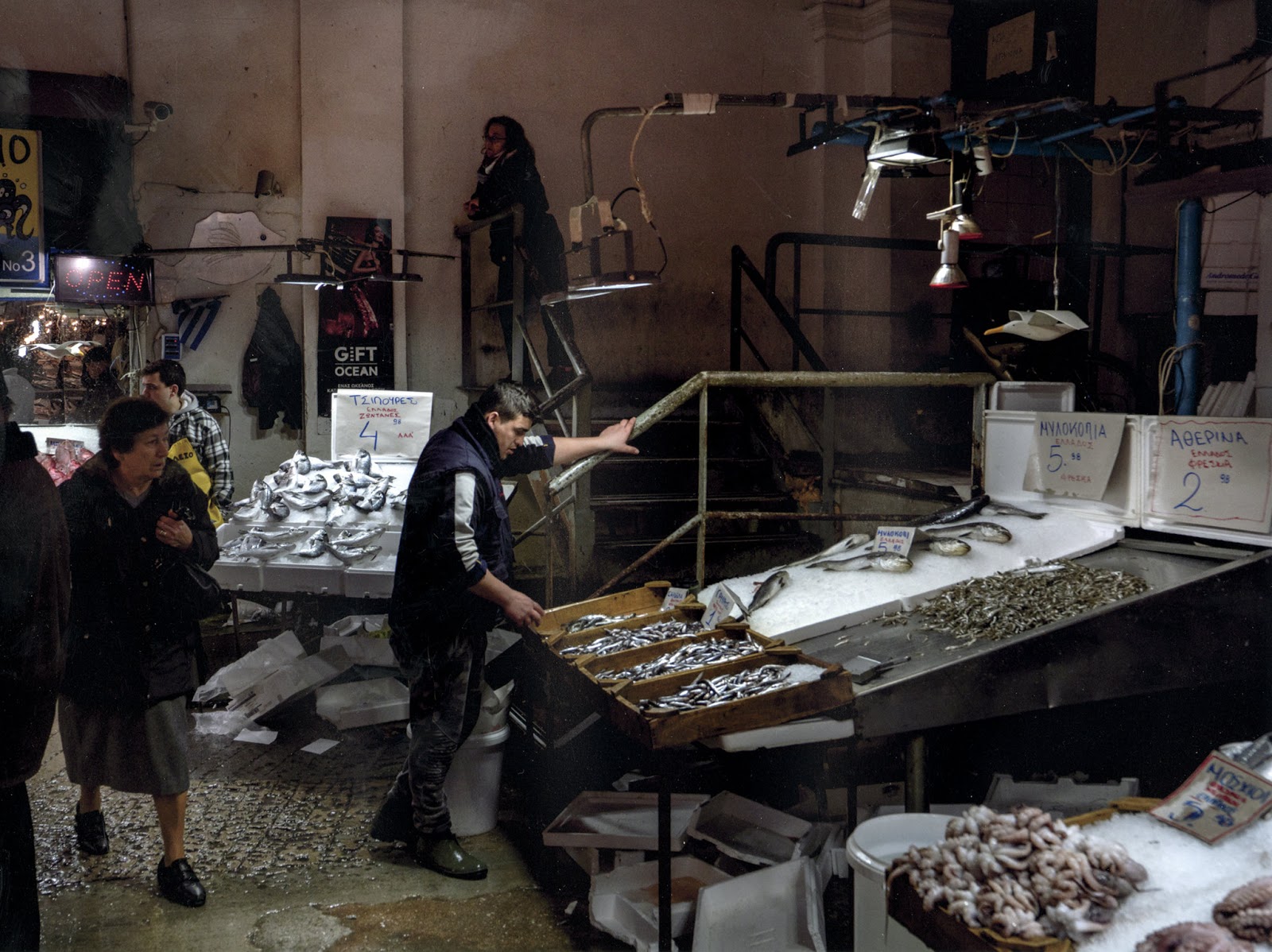
The fish stalls at the central market in Athens.CreditAlex Majoli
NO ONE IN GREECE seems in a hurry to get anywhere. It took me a taxi, two long bus rides, two boats and another taxi — 11 hours in all — to get from Nafplio to my next base, Ithaca, not many miles away, and no one I spoke to knew when, or even whether, the bus or boat would ever arrive. After I landed in Sami, on Cephalonia, the island that would lead to its neighbor, where Odysseus reputedly lived, I joined a small group of travelers to wait, and wait, in the sun, water lapping against our feet. Nobody tried to sell us things, as they might in Port-au-Prince or Mumbai. We were back in a child’s box of dazzling crayons, with no signs of industry or modernity to be seen.

When finally I did set foot on Ithaca, the site that was somewhat wishfully said to be that of Odysseus’ palace consisted of a hut and two buildings set across a barren hill. I managed to cadge a shared ride in one of the island’s only taxis, and when I arrived in the central town of Vathy, I asked a friendly travel agent about getting around. The bus, he told me, had likely finished its run for the season (it was mid-September).

I decided, therefore, to rent a car, and as I steered along the precipitous, one-lane road that soon placed me high above the sea, a sheer drop before me — no guardrail quite often — I was shocked, again and again, by the heart-clenching beauty of the place. A huge black dog stretched out behind the locked gate of a villa, waiting for a modern-day returnee from the wars. No traffic was visible save for two black goats strutting across the asphalt and, many minutes later, a man in a hard hat chugging along on his scooter at around six miles per hour. I came to the Kathara Monastery, a remote chapel on a hill overlooking the sea, and the silence extended for miles.

Even the daily life in the streets of Athens reflects the country’s deep past.CreditAlex Majoli
As ever, the specific sites on Odysseus’ island were enigmatic at best. Getting out of the car on my way to the stunning mountaintop village of Exogi, I walked along an unpaved path to the “School of Homer,” to be rewarded only by a ravishing view of olive trees and blue-green coves far below. In the small village of Stavros, a set of display boards featured an essay titled “Ithaca: Conceptual Place.” On Ithaca, the piece began, “the past nor the present exist. The present is not what one would consider contemporary, but it is situated in a limbo. A reality that would choose to be up-to-date but is unable to be so.” Noting that nobody really knows what existed here or didn’t, the author went on, “On the island, there is Nothing! … Nothing …”

As it happens, I’d brought along with me an American novel to complement all the classically trained Englishmen who’ve romanced Greece, and as I went through Don DeLillo’s “The Names” for the third time, I was chilled once more by a sense that Greece represents something distant and strong in our collective memory. A single rock, the haunted novelist wrote, has “a power like a voice in the sky.” “The light was surgical, it was binding,” he writes early on. “It fixed the scene before me as a moment in a dream.”

It’s the wildness of Greece that overwhelms, the writer seemed to recognize, not the so-called civilization. “I feel I’ve known the particular clarity of this air and water,” says one of his expat characters, very possibly a spy. “I’ve climbed these stony paths into the hills.” To which another replies, “There’s a generic quality, an absoluteness. The bare hills, a figure in the distance.”

The novel came out in 1982, and during that summer, I spent a whole month traveling around Greece, writing on the Peloponnese and the Ionian Islands for the $5-a-day student guidebook “Let’s Go: Greece.” It was a pivotal moment in my life; I’d just turned 25, and I was leaving grad school at last to get a job in Manhattan. As I prepared for adulthood, I woke up before dawn most mornings in a no-star hotel, went out to catch the first bus and rode along the coast to the next small town to look in on its sights and facilities before heading off the next day. I’ve seldom known a more dreamy and contemplative time.

An olive tree on Ithaca foregrounds a rainbow.CreditAlex Majoli
At the end of my trip, my girlfriend of six years came over to Ithaca from Boston to join me. She looked more beautiful than ever, arms and legs golden in her pink sundress, and that was because she’d come to say goodbye. I was heading off into a new life, we both understood. We spent our days on the island of Odysseus’ homecoming preparing for a separation. After a long evening at a taverna, under colored lights and grape leaves, she descended into a boat with a new friend while I trudged back to our small hotel alone.

Now, as I looked around the island at the other end of life, I was amazed at how little it had changed. Yachties had discovered Vathy, the little main town gathered around a port, and blond Knightsbridgeites encircled the bust of Homer. There were boutique hotels now, and swimming pools. But the Circean rhythms and mythical features were no different from before. I went into a market to buy peaches and chocolate and juice for a quiet dinner in my room one evening and the bill came to the equivalent of $2.30, as if I were back in my grandfather’s time.

On neighboring Cephalonia, at the idyllic edge of Agia Efimia known as Paradise Beach, a whole scatter of pastel villas has come up since “Captain Corelli’s Mandolin” (2001) was filmed on the island, transforming its fortunes. But the wonderful little taverna founded by Stavros Dendrinos still stands here, as it did 37 years ago, and when I asked if I could stay in a small room above the restaurant, as before, Dendrinos’s son Nikitas, who runs it these days, said, “Now, no more. But if you want, you can stay in my uncle’s house next door.”

Four days later, back on Ithaca, I sat on my terrace one morning to watch the island wake up. It never happened. Were Odysseus to come back next year, Penelope might hardly look up from her loom, even as Telemachus asks the old man if he knows of any good jobs in the city. In the absence of neon and traffic, we were back in something like Asclepius’ sanctuary: a place in which to fall asleep and wake up, inexplicably clarified.

(Source: NYT)

Tuesday, 16 April 2019

Athena, Goddess of copyediting

She wouldn’t worry about offending a writer or whether a writer liked her or not, and she wouldn’t let anyone get away with anything, writes Mary Norris, the author of 'Greek to Me' and the New York Times best seller 'Between You & Me', an account of her years in The New Yorker copy department, in the Paris Review. Read on:  

My first exposure to Greek mythology was at the Lyceum—not the famed Lykeion in Athens, where Aristotle and his pupils strolled around as they discussed philosophy and beauty, but a movie theater on Fulton Road in Cleveland, where my brothers and I spent Saturday afternoons. The Lyceum was classic as opposed to classical: popcorn in red-and-white striped boxes, a stern lady usher who confiscated the candy we snuck in from outside, buzzers under the seats for a gimmicky thrill.

Every week, the Lyceum showed a double feature, usually a horror movie—The Mummy, Godzilla, The Creature from the Black Lagoon—paired with something mildly pornographic (and highly educational). At one Saturday matinee, I laid eyes for the first time on the Cyclops. The movie was Ulysses (1955), starring Kirk Douglas as the man of many turnings. In a way, it, too, was a horror movie, full of monsters and apparitions: a witch who turned men into pigs, sea serpents, Anthony Quinn in a short tight skirt.

Ulysses is the Latinate name for Odysseus and the one preferred by Hollywood and James Joyce. How Odysseus became Ulysses is, like many things that happened between Greece and Rome, impossible to say for sure. Scholars have suggested that the d, or delta, of Odysseus in Ionic Greek was originally an l, or lambda, in the Dorian and Aeolic dialects. Delta (Δ) and lambda (Λ) are similar in form—a wedge with or without a bar—but to my knowledge no one has suggested that Odysseus was the ancient equivalent of a typo for Ulysses. The name may have reached Rome independently as Ulixes through Sicily, the traditional home of the Cyclops.

In Catania, a city under Mount Etna built largely of polished black lava, souvenir shops sell ceramic figurines of the Cyclops. Cyclopes (plural) were a race of giants, similar to the Titans, clumsy prototypes for human beings. Polyphemus worked on Mount Etna, forging lightning bolts for Zeus. A friend from Catania told me some Sicilians believe that the Cyclops was Mount Etna, which erupted like Polyphemus’s eye after Odysseus poked it with a pointed stick, spewing into the sea stones that formed the Faraglioni di Acitrezza, dramatic stacked rocks in the Gulf of Catania. At any rate, one can imagine the story of the Cyclops going out into the world ahead of the epic poem, the way the Cyclops episode in the movie at the Lyceum preceded my knowledge of Homer. There is nothing like an old-fashioned Cyclops to get your attention.

ANCIENT POTTERY DEPICTING ATHENA AND ENCELADUS FIGHTING.
LOUVRE MUSEUM. PUBLIC DOMAIN.

Athena must have appeared in the movie—what is the Odyssey without Athena? She is the protector of Ulysses; he would not survive without her. Surely the hero invokes her—I must have heard her name. But I don’t recall meeting Homer’s gray-eyed goddess at the Lyceum. No tomes of mythology by Bulfinch, the d’Aulaires, or Edith Hamilton sat on the bookshelves in our house—in fact, there were no bookshelves in our house. But we had comic books and library cards, and I subsisted happily on the Brothers Grimm and Little Lulu. I did not, like a prodigy, read the Iliad in translation at fourteen. I had a weakness for the genre of the girl detective, for Nancy Drew and Trixie Belden. I also liked Poe and Dickens and Mark Twain and tried to read Hawthorne (yawn) and Sir Walter Scott (snore) and Dostoyevsky (coma). Anything I learned about Greek mythology was either absorbed through popular culture or through writers in English. In junior year at Lourdes Academy, the all-girls Catholic high school I attended in Cleveland, we read Joyce’s Portrait of the Artist as a Young Man, the lesson of which, according to Sister Diane Branski, was that though Joyce had lost his faith (and left Ireland), he could never get away from the Church (or Dublin). And neither would we.

Perhaps the spirit of Athena hovered over Lake Erie, but in those days—the fifties and sixties, when the twentieth century still felt like the future—my primary model, like that of most girls in the normal course of things, was my mother. She cooked, made the beds, swept the floor. She was a world-class talker—“Your mom sure has the gift of gab,” people would say—and she sang as she washed the dishes, songs like “Fascination” and “I’ve Got You under My Skin.” But to me washing the dishes was nothing to sing about. And while her example was powerful—as a nine-year-old, I fantasized about having a toy carpet sweeper—I was dubious about following in her footsteps. For one thing, she rarely went anywhere.

My mother and I were outnumbered by the males in the family, and I disliked being grouped with her. I felt housebound. I remember the taste of the front door, which I pressed my tongue against in my desperation to get outside—harsh cold glass in winter, bitter metallic screen in summer. I was always comparing my mother with other girls’ mothers, wishing to trade up. The nuns gave me models other than my mother, and I had an inkling that I might be popular in the convent. I liked the idea of changing my name—it would be a fresh start—but I worried about having to get up early, at the gong of a bell, and go to Mass every day. The convent was something to fall back on in case I didn’t get married. I had a feeling I wasn’t going to get married. But the nun’s life seemed just as circumscribed as my mother’s.

Once, for sixth grade religion class, we were split into groups for a project on vocations. The nun handed out pamphlets describing what could be expected from each calling: you got married, you became a priest or a nun, or you remained single. I was put on the “single” panel. Remaining single did not feel like a choice—it was something you got stuck with, like the unmated card in a game of old maid. But the pamphlet pointed out that although you might not choose it, if you were to die tomorrow—tragically, at age twelve—you would perforce be single. The only model the Church offered a girl was the Blessed Virgin Mary.

I suppose Athena became a model to me without my even realizing it: a third way. Athena, like Mary, is a virgin—parthéna—but she does not carry the paradoxical burden of maternity. She was born, fully formed and armed for battle, a warrior, from the head of Zeus. Her mother, by most accounts, was Metis, one of the Titans, rivals of the Olympians, meaning that Athena came from old stock. Because Metis wasn’t around (I am sorry to report that Zeus swallowed her while she was pregnant), Athena had none of the conflicts a girl has with her mother. She gets along well with Zeus’s wife, Hera, that most irritable of goddesses. Zeus never pressures her to marry.

Other women and girls may favor a different goddess. Many opt for Artemis, the huntress; someone who longs for children might identify with Demeter; great beauties are chosen by Aphrodite. Hera is not popular; in her Roman guise as Juno she is statuesque and confident, but what a bitch. For me, it had to be Athena. Whereas the Virgin Mary is a model of humility and servitude, Athena is the template for a liberated woman.

Athena is unfettered: she has no masculine deity to accommodate, no children to appease, no family obligations to juggle with her career. She is beholden to no one—Zeus treats her with respect and indulgence. Like a favorite daughter, she knows how to handle him. He trusts her judgment and lets her have her way. Her virginity may be one of the reasons Athenians chose her to be the patron of their city: she would be dedicated. The founding myth of Athens is that Athena and Poseidon were rivals for top honors in the city. Athena planted an olive tree on the Acropolis, and Poseidon caused salt water to spring up on its slopes. The gods judged the olive the greater gift and awarded the city to Athena.

Not that Athena doesn’t have domestic virtues: she is a weaver and a patron of the crafts, a civilizing influence. She’s not a fertility goddess, like Demeter and Artemis, but more of a survivor. Olive trees are legendarily resilient. Chop one down or burn it up, and new shoots grow from the stump. And Athena didn’t just plant that olive tree—someone had to impart the knowledge of how to cultivate it and how to press from its hard, bitter green fruit the precious essence of what the earth has to offer. Olive oil is an ingredient in everything from salads to shampoo, and the Greeks even used it as fuel, burning it in lamps. Athena seems to me to be the great example of using your resources wisely.

Most of all, Athena has tremendous feminine strength. In the Iliad, when Zeus lets the gods take up arms along with the mortals on the battlefield, Athena lays out Ares flat—Ares, the god of war! Athena can be terrifying. She wears the head of Medusa on her breast, at the center of her shield, or aegis. The Gorgon’s head was a gift from Perseus, who slew the monster while looking at her reflection in his shield instead of directly at her face, which would have turned him to stone. In art history, Medusa leers comically from a round frame: snaky locks for hair, tusks, a pig’s snout for a nose. She sticks out her tongue at you. The message is “Don’t mess with me, you weakling.”

Athena is direct: she never tries to seduce anyone or wheedle to get her way. Her brand of wisdom is a form of common sense, which was something I lacked, a muscle that did not get much exercise in college or graduate school. I was a good worker, though—the only job I ever had that I was truly terrible at was waiting on tables—and by the time I got to The New Yorker there were different kinds of women to observe: a cheerful receptionist heading back to graduate school, proofreaders of all styles—zealous, jealous, quietly brilliant—and wickedly good writers, like Pauline Kael and Janet Malcolm. When I was promoted to the copydesk, my dream job, and it was just me and the words, I had a crisis of confidence. No one thanked you when you did something right, but when you screwed up they had ways of letting you know.

The copydesk was like a sieve for prose: the copy editor filtered out impurities without adding anything new. I swung back and forth between extremes, trying to do less rather than more while also trying not to draw attention to myself by missing anything egregious. I wanted to write, so I was envious when one of my contemporaries at the office succeeded in placing a story in The Talk of the Town. When I copyedited a colleague’s work, I had to filter out my own impurities. One evening I ran into William Shawn in the elevator vestibule. “You look troubled,” he said. Probably I was worried about having to share an elevator with Mr. Shawn, but I told him I was not sure I would ever master my job on the copydesk. He gave me a steady look—we were almost the same height; he was five foot five, and his eyes were at the same level as mine—and assured me that I would learn by osmosis.

Athena turned out to be a good model for a copy editor. She wouldn’t worry about offending a writer or whether a writer liked her or not, and she wouldn’t let anyone get away with anything. I just had to trust that my motives were pure: I was there for the language. Once I’d absorbed the ethos of copyediting, and moved from the copydesk, where you couldn’t correct things even when you knew they were wrong, to the next level, among the copy editors I most admired—page O.K.’ers, in The New Yorker’s terminology—I stopped worrying so much. At a museum, I was attracted to a print of a Gorgon, leering comically with her tongue stuck out. I bought that print and pinned it up over my desk.

Monday, 15 April 2019

'Three-person baby' born after world's first clinical trials of controversial technique

Doctors raise concerns over use of procedure to treat infertility rather than purely to prevent disease

Fertility doctors say a “three-person baby” has been born in Greece, using genetic material from two women and a man.

The technique was reportedly used to overcome the mother’s infertility – she had tried IVF treatment four times without success.

The 32-year-old Greek mother then heard about a clinical trial of the new method by Spanish doctors.

The medical team in Barcelona used a technique called maternal spindle transfer (MST), in which maternal DNA is put into the egg of a donor woman, which is then fertilised using the father’s sperm.

The technique hinges on cell structures called mitochondria which turn food sources into useable energy.

The procedure was developed to help existing IVF treatments in which mothers have mitochondrial diseases. To avoid passing these on, the nucleus in the donor woman’s healthy egg is removed, and the mother’s nucleus inserted. The vast majority of the mother’s DNA is contained in the nucleus, but a small amount of DNA remains in the mitochondria in the donor egg.

The healthy baby was born on Tuesday and reportedly weighed 6lbs (2.9kg). The mother is also well.

But the technique remains controversial and some doctors have questioned the ethics of the procedure.

A Spanish company called Embryotools collaborated with fertility specialists at a clinic in Athens called the Institute of Life.

The study took on 25 women under 40 years old who had already had at least two previous failed IVF attempts.

The team had to conduct the trial in Greece because the procedure is not approved in Spain, according to health news website Stat News, which reported the woman’s pregnancy in January this year.

The trial’s leader and co-founder Embryotools, Dr Nuno Costa-Borges, insisted the procedure is a useful solution for infertility.

He told the website that in this case 99 per cent of the baby’s genes come from its mother and father, and just one per cent from the egg donor. 


“For some patients, it’s very hard to accept that they cannot get pregnant with their own [eggs],” he said.

“Spindle transfer may represent a new era in the IVF field, as it could give these patients chances of having a child genetically related to them.”

The president of the Institute of Life, Dr Panagiotis Psathas, said: “Today, for the first time in the world, a woman’s inalienable right to become a mother with her own genetic material became a reality.

“As Greek scientists, we are very proud to announce an international innovation in assisted reproduction, and we are now in a position to make it possible for women with multiple IVF failures or rare mitochondrial genetic diseases to have a healthy child.”

Variations of the technique have been used before, with families from Jordan, Mexico, and Ukraine. Those cases also sparked controversy.

In the UK, doctors in Newcastle were given the green light in February last year to use the technique to create Britain’s first three-person babies for two women who may otherwise pass on genetic diseases to their children.

Some academics have expressed their concerns about using the procedure to treat infertility rather than only to prevent disease.

Tim Child, from the University of Oxford and the medical director of The Fertility Partnership, told the BBC: “I’m concerned that there’s no proven need for the patient to have her genetic material removed from her eggs and transferred into the eggs of a donor.

“The risks of the technique aren’t entirely known, though may be considered acceptable if being used to treat mitochondrial disease, but not in this situation.”

(Source: Independent)

Friday, 12 October 2018

Tracing the origins of rape culture in mythology

It would not be any exaggeration to assume that ever since early human beings were hunter-gatherers and the roles of men and women got defined according to their gender. With men’s roles in procreation and bringing up the progeny, patriarchy was established in its most basic form. Ever since then, it seems that the control over women’s sexuality and their “ownership” by the men of their clan, led to first their objectification and later on led to the significance of sexual conquest in all human conflict.

However, the term ‘rape culture’ came to be used extensively as late as the 1970’s in media and the public. First by feminists to explain the shameful state of normalising sexual violence by modern societies. This also highlighted a prominent presence of ‘rape culture’ in some of the oldest and so called glorious civilisations of the past. A documentary titled Rape Culture was released in January 1975 (produced by Margaret Lazarus and Renner Wunderlich) which clearly established the relationship between rape and culture’s sexual fantasies propagated in modern popular culture and media.


Almost all mythologies have stories of women/youth being “taken” by Gods as punishment, pleasure or as a conquest, thereby making “consent”, agency and/ or “sexual identity” of the victim/survivor almost redundant in the whole scheme of things.

Greek and Roman Mythology
The glorious stories of Ancient Greek mythology are deeply sexist and misogynist and seem to not just verify the existence of brutal sexual violence therein, but almost justify it. It is evident that rape culture existed as far back as 900 BC. The rape of women was a common theme throughout Greek mythology. The chief Greek God Zeus himself is part of many rape stories – he is believed to have ‘sexually violated’ several women, namely, Antiope, Europa, Hera, Leda and several others.  Medusa was raped by Poseidon and was subsequently also punished for being raped in Athena’s temple.

In the Roman context, The Rape of the Sabine Women, which was nothing other than forceful sexual violence perpetrated by Roman men, is often normalised as an important step in Roman history that helped them achieve a fairly “blended” population where some kind of consent and treaty was achieved after the said incident.

ALMOST ALL MYTHOLOGIES HAVE STORIES OF WOMEN/YOUTH BEING “TAKEN” BY GODS AS PUNISHMENT, PLEASURE OR AS A CONQUEST.

Medieval society
In Medieval England, both the crimes of abduction and rape were surprisingly punished as the same according to the then prevalent Raptus law. The word Raptus in Latin literally means “seized”, from the word rapere meaning “to seize”. In ancient Roman law, the term was used for several crimes of property, and women were also considered to be the property of men back then.

The misogynist Roman legacy seemed to suggest that the victim’s consent was of no consequence in cases of rape since raptus meant both a successful seduction as well as abduction or forced sex. This led to complete confusion in medieval society, and also later on regarding the ideas of consent and rape. Women’s agency was seen by the legal system then as only effective in terms of her inability or “not preventing” a crime against her.

The Rape of Lucretia by Tarquinius is one that brings to focus the notion of chastity and consent among women back then. During those times, adultery was punishable by death for women, whether they willingly participated in it or not. After her rape Lucretia committed suicide, a choice that is often made by several victims of sexual violence even now, due to the lack of laws in their favour and the gross societal notion of being ‘defiled by rape’. Lucretia was blamed by several historians for having committed the ‘sin of involuntary sexual pleasure.’

The first Christian emperor Constantine redefined rape as a public offense rather than as a private wrong, though he ordered that if a woman had provided consent, she should be punished with her male abductor by being burnt alive. But even if she had not provided consent, she would be still convicted as an accomplice. The onus of “saving herself” was put on the woman.

Indian Mythology
In Indian mythology, there are several instances of sexual violence. Ahalya’s story is one of the most known ones where Indra disguised himself as her husband Gautama, had sexual relations with her, for which both of them were cursed by Gautama when he found out. She was turned into a stone. Danda, son of Ikshavaku, raped Araja, and the sage Shukracharya cursed the kingdom to be destroyed and transformed it into a wilderness. Araja was told to do tapasya and “purify” herself.

Then there is the story of a demon called Jalandhar. He used his special powers of disguise to meet women as their respective husbands and thus deceived them into having sexual relations with him. However, when the husbands found out and raged a war against him, none could kill him because of his loyal and chaste wife Vrinda. Finally Vishnu decided to use Jalandhar’s own method to defeat him. He assumed Jalandhar’s form and seduced Vrinda, thus ‘destroying’ her chastity and making Jalandhar vulnerable to be killed in war.

Vrinda, it is believed cursed Vishnu and turned him into a stone before jumping into the pyre of her husband, and was later reborn as Tulsi, a holy plant. Tulsi and the stone Vishnu, called Shaligram, were then married to free them both of their penance.


Influence of these stories on rape culture
Each of these stories depicts how patriarchal standards appropriate the character of a woman to her sexual relationships, and reduces her purpose to child-bearing. Most cultures are so obsessed with the lineage of progeny, chastity, and virginity that imposing restrictions on women’s sexual freedom and agency became a norm and continues even today.

Even in the modern world sexual violence is often shamefully considered a way to avenge any kind of insult or injury. This notion mostly led to women being treated as “property” and their perceived sexual purity being held synonymous with the family/clan ‘honour’.

Misogynist classification of rape
The classification of rapes in mythologies and ancient legal systems further elucidates their misogynist, sexist and extremely insensitive stances. In most cultures, rape was not considered a sexual crime against a particular woman but as a theft/insult against her “owner” or against her chastity. Consequently the rape of a virgin girl was considered a more serious crime than that of a non-virgin. Furthermore the rape of a sex worker, slave or an “unchaste” woman was in some laws considered not even a crime because it was believed that she had no chastity that could be damaged.

The penalty for rape was also often a fine, payable to the ‘owners’ – father/husband of the defiled woman. In some cases the woman would be married to the rapist instead of any penalty, like the Tusli-Shaligram story. Rape, in the course of a war, also dates back to antiquity, and finds mention even in the Bible, several times. In the Bible, there are passages where Moses encourages soldiers to “take” the virgin daughters of the enemies as wives after killing them.

EACH OF THESE STORIES DEPICTS HOW PATRIARCHAL STANDARDS APPROPRIATE THE CHARACTER OF A WOMAN TO HER SEXUAL RELATIONSHIPS.

Modern times
In contemporary times, the clichés set by mythologies are often subconsciously followed to justify/normalise sexual violence. Often just like the mythological stories of the past, the victim/survivor is reduced to be a symbol of bravery, face of activism or a subject of popular media.

The rape victim/survivor is converted into some kind of a “beacon” for symbolic activism, vigilante justice or just publicity marches and protests. The victim is even sometimes denied her name and is granted a forced nomenclature, like Nirbhaya in the case of Jyoti Singh.

Referring to even the clichés used in news stories of rape, Heather Timmons in an article in The New York Times states, “…almost inevitably, the art to go with a story about rape depicts a “shamed woman.” Sometimes, this woman also happens to be somewhat scantily clad.” The article further rightly suggests that the woman is depicted as “disgraced” rather than wronged. Deriving precedents from mythology only, the woman is blamed for “crossing the Lakshman Rekha”, the symbol of restrictions put on women in the name of “protecting them”.

Destructive modern derivatives from mythological sexual violence can be multi-fold, and often shape how young men/women see virginity, chastity and honor and form opinions about sexual violence.


  • Sexual violence against a woman must be avenged by sexual violence against the offender’s women family members.
  • A woman’s “purity”, “virginity” and “chastity” determine the honour of her male relatives – father, brother, husband, son and even extended family and clan/caste.
  • In today’s society in India, it is common that a woman should always have the image of a virgin while a man can have complete sexual liberty.
  • Rape is almost always the “responsibility” of the victim/survivor, what was she wearing, where was she, when and why. Men get “enticed” to commit sexual violence.
  • Since a rape victim is believed to have been “damaged” for life, it is often resolved in community courts that she should marry her rapist, because no one else would marry a “defiled” woman.


Thus it is evident that across cultures there are instances of women being subjected to sexual violence with dominant narratives either trying to “victim blame” them or trying to justify the man’s act of violence on some pretext or the other. Its time these clichés are changed and reversed to create a less misogynist and sexist world.

(Source: FII)