Showing posts with label war. Show all posts

Friday, 23 April 2021

John Pilger on why the documentary must not be allowed to die

 Breaking the silence and speaking truth to power is the job of the film-maker, writes John Pilger, something that’s perhaps needed more today than ever before.

I first understood the power of the documentary during the editing of my first film, The Quiet Mutiny.


In the commentary, I make reference to a chicken, which my crew and I encountered while on patrol with American soldiers in Vietnam.


“It must be a Vietcong chicken – a communist chicken,” said the sergeant. He wrote in his report: “enemy sighted”.


The chicken moment seemed to underline the farce of the war – so I included it in the film.

That may have been unwise.


The regulator of commercial television in Britain – then the Independent Television Authority or ITA – had demanded to see my script.


What was my source for the political affiliation of the chicken, I was asked. Was it really a communist chicken, or could it have been a pro-American chicken?


Of course, this nonsense had a serious purpose; when The Quiet Mutiny was broadcast by ITV in 1970, the US ambassador to Britain, Walter Annenberg, a personal friend of President Richard Nixon, complained to the ITA.


He complained not about the chicken but about the whole film. “I intend to inform the White House,” the ambassador wrote. Gosh.


The Quiet Mutiny had revealed that the US army in Vietnam was tearing itself apart. There was open rebellion: drafted men were refusing orders and shooting their officers in the back or “fragging” them with grenades as they slept.


None of this had been news. What it meant was that the war was lost; and the messenger was not appreciated.


The Director-General of the ITA was Sir Robert Fraser. He summoned Denis Foreman, then Director of Programmes at Granada TV, and went into a state of apoplexy. Spraying expletives, Sir Robert described me as a “dangerous subversive”.


What concerned the regulator and the ambassador was the power of a single documentary film: the power of its facts and witnesses, especially young soldiers speaking the truth and treated sympathetically by the film-maker.


I was a newspaper journalist. I had never made a film before and I was indebted to Charles Denton, a renegade producer from the BBC, who taught me that facts and evidence told straight to the camera and to the audience could indeed be subversive.


This subversion of official lies is the power of documentary. I have now made 60 films and I believe there is nothing like this power in any other medium.


Journalist and documentary film-maker John Pilger, pictured in Vietnam during the war.


In the 1960s, a brilliant young film-maker, Peter Watkins, made The War Game for the BBC. Watkins reconstructed the aftermath of a nuclear attack on London.


The War Game was banned. “The effect of this film,” said the BBC, “has been judged to be too horrifying for the medium of broadcasting.”


The then chairman of the BBC’s Board of Governors was Lord Normanbrook, who had been Secretary to the Cabinet. He wrote to his successor in the Cabinet, Sir Burke Trend: “The War Game is not designed as propaganda: it is intended as a purely factual statement and is based on careful research into official material … but the subject is alarming, and the showing of the film on television might have a significant effect on public attitudes towards the policy of the nuclear deterrent.”


In other words, the power of this documentary was such that it might alert people to the true horrors of nuclear war and cause them to question the very existence of nuclear weapons.


The Cabinet papers show that the BBC secretly colluded with the government to ban Watkins’ film. The cover story was that the BBC had a responsibility to protect “the elderly living alone and people of limited mental intelligence”.


Most of the press swallowed this. The ban on The War Game ended the career of Peter Watkins in British television at the age of 30. This remarkable film-maker left the BBC and Britain, and angrily launched a worldwide campaign against censorship.


Telling the truth, and dissenting from the official truth, can be hazardous for a documentary film-maker.


In 1988, Thames Television broadcast Death on the Rock, a documentary about the war in Northern Ireland. It was a risky and courageous venture. Censorship of the reporting of the so-called Irish Troubles was rife, and many of us in documentaries were actively discouraged from making films north of the border. If we tried, we were drawn into a quagmire of compliance.


The journalist Liz Curtis calculated that the BBC had banned, doctored or delayed some 50 major TV programmes on Ireland. There were, of course, honourable exceptions, such as John Ware.


Journalist John Pilger, reporting from Vietnam during the war.


Roger Bolton, the producer of Death on the Rock, was another. Death on the Rock revealed that the British Government deployed SAS death squads overseas against the IRA, murdering four unarmed people in Gibraltar.


A vicious smear campaign was mounted against the film, led by the government of Margaret Thatcher and the Murdoch press, notably the Sunday Times, edited by Andrew Neil.


It was the only documentary ever subjected to an official inquiry – and its facts were vindicated. Murdoch had to pay up for the defamation of one of the film’s principal witnesses.


But that wasn’t the end of it. Thames Television, one of the most innovative broadcasters in the world, was eventually stripped of its franchise in the United Kingdom.


Did the prime minister exact her revenge on ITV and the film-makers, as she had done to the miners? We don’t know. What we do know is that the power of this one documentary stood by the truth and, like The War Game, marked a high point in filmed journalism.


I believe great documentaries exude an artistic heresy. They are difficult to categorise. They are not like great fiction. They are not like great feature movies. Yet, they can combine the sheer power of both.


The Battle of Chile: the fight of an unarmed people, is an epic documentary by Patricio Guzman. It is an extraordinary film: actually a trilogy of films.


When it was released in the 1970s, the New Yorker asked: “How could a team of five people, some with no previous film experience, working with one Éclair camera, one Nagra sound-recorder, and a package of black and white film, produce a work of this magnitude?”


Guzman’s documentary is about the overthrow of democracy in Chile in 1973 by fascists led by General Pinochet and directed by the CIA.


Almost everything is filmed hand-held, on the shoulder. And remember this is a film camera, not video. You have to change the magazine every ten minutes, or the camera stops; and the slightest movement and change of light affects the image.


In the Battle of Chile, there is a scene at the funeral of a naval officer, loyal to President Salvador Allende, who was murdered by those plotting to destroy Allende’s reformist government.


The camera moves among the military faces: human totems with their medals and ribbons, their coiffed hair and opaque eyes. The sheer menace of the faces says you are watching the funeral of a whole society: of democracy itself.


There is a price to pay for filming so bravely. The cameraman, Jorge Muller, was arrested and taken to a torture camp, where he “disappeared” until his grave was found many years later. He was 27. I salute his memory.


Former British Prime Minister, Margaret Thatcher.


In Britain, the pioneering work of John Grierson, Denis Mitchell, Norman Swallow, Richard Cawston and other film-makers in the early 20th century crossed the great divide of class and presented another country.


They dared put cameras and microphones in front of ordinary Britons and allowed them to talk in their own language.

John Grierson is said by some to have coined the term “documentary”. “The drama is on your doorstep,” he said in the 1920s, “wherever the slums are, wherever there is malnutrition, wherever there is exploitation and cruelty.”


These early British film-makers believed that the documentary should speak from below, not from above: it should be the medium of people, not authority. In other words, it was the blood, sweat and tears of ordinary people that gave us the documentary.


Denis Mitchell was famous for his portraits of a working-class street. “Throughout my career,” he said, “I have been absolutely astonished at the quality of people’s strength and dignity.”


When I read those words, I think of the survivors of Grenfell Tower, most of them still waiting to be re-housed, all of them still waiting for justice, as the cameras move on to the repetitive circus of a royal wedding.


The late David Munro and I made Year Zero: the Silent Death of Cambodia in 1979.


This film broke a silence about a country subjected to more than a decade of bombing and genocide, and its power involved millions of ordinary men, women and children in the rescue of a society on the other side of the world.


Even now, Year Zero puts the lie to the myth that the public doesn’t care, or that those who do care eventually fall victim to something called “compassion fatigue”.


Year Zero was watched by an audience greater than the audience of the current, immensely popular British “reality” programme Bake Off. It was shown on mainstream TV in more than 30 countries, but not in the United States, where PBS rejected it outright, fearful, according to an executive, of the reaction of the new Reagan administration.


In Britain and Australia, it was broadcast without advertising – the only time, to my knowledge, this has happened on commercial television.


Following the British broadcast, more than 40 sacks of post arrived at ATV’s offices in Birmingham, 26,000 first-class letters in the first post alone. Remember this was a time before email and Facebook.


In the letters was £1 million – most of it in small amounts from those who could least afford to give. “This is for Cambodia,” wrote a bus driver, enclosing his week’s wages. Pensioners sent their pension. A single mother sent her savings of £50.


People came to my home with toys and cash, and petitions for Thatcher and poems of indignation for Pol Pot and for his collaborator, President Richard Nixon, whose bombs had accelerated the fanatic’s rise.


For the first time, the BBC supported an ITV film. The Blue Peter programme asked children to “bring and buy” toys at Oxfam shops throughout the country. By Christmas, the children had raised the astonishing amount of £3,500,000.


Across the world, Year Zero raised more than $55 million, mostly unsolicited, and which brought help directly to Cambodia: medicines, vaccines and the installation of an entire clothing factory that allowed people to throw away the black uniforms they had been forced to wear by Pol Pot. It was as if the audience had ceased to be onlookers and had become participants.


Something similar happened in the United States when CBS Television broadcast Edward R. Murrow’s film, Harvest of Shame, in 1960. This was the first time that many middle-class Americans glimpsed the scale of poverty in their midst.


Harvest of Shame is the story of migrant agricultural workers who were treated little better than slaves. Today, their struggle has such resonance as migrants and refugees fight for work and safety in foreign places. What seems extraordinary is that the children and grandchildren of some of the people in this film will be bearing the brunt of the abuse and strictures of President Trump.


In the United States today, there is no equivalent of Edward R. Murrow. His eloquent, unflinching kind of American journalism has been abolished in the so-called mainstream and has taken refuge in the internet.


Britain remains one of the few countries where documentaries are still shown on mainstream television in the hours when most people are still awake. But documentaries that go against the received wisdom are becoming an endangered species, at the very time we need them perhaps more than ever.


In survey after survey, when people are asked what they would like more of on television, they say documentaries.

I don’t believe they mean a type of current affairs programme that is a platform for politicians and “experts” who affect a specious balance between great power and its victims.


Observational documentaries are popular; but films about airports and motorway police do not make sense of the world. They entertain.


David Attenborough’s brilliant programmes on the natural world are making sense of climate change – belatedly.

The BBC’s Panorama is making sense of Britain’s secret support of jihadism in Syria – belatedly.


But why is Trump setting fire to the Middle East? Why is the West edging closer to war with Russia and China?


Mark the words of the narrator in Peter Watkins’ The War Game: “On almost the entire subject of nuclear weapons, there is now practically total silence in the press, and on TV. There is hope in any unresolved or unpredictable situation. But is there real hope to be found in this silence?”


In 2017, that silence has returned.


It is not news that the safeguards on nuclear weapons have been quietly removed and that the United States is now spending $46 million per hour on nuclear weapons: that’s $46 million every hour, 24 hours a day, every day. Who knows that?


The Coming War on China, which I completed last year, has been broadcast in the UK but not in the United States – where 90 per cent of the population cannot name or locate the capital of North Korea or explain why Trump wants to destroy it. China is next door to North Korea.


John Pilger, during shooting for the film Utopia. This picture was taken at Irrultja, a small community in the Utopia homelands in Central Australia.


According to one “progressive” film distributor in the US, the American people are interested only in what she calls “character-driven” documentaries.


This is code for a “look at me” consumerist cult that now consumes and intimidates and exploits so much of our popular culture, while turning away film-makers from a subject as urgent as any in modern times.


“When the truth is replaced by silence,” wrote the Russian poet Yevgeny Yevtushenko, “the silence is a lie.”


Whenever young documentary film-makers ask me how they can “make a difference”, I reply that it is really quite simple. They need to break the silence.


This is an edited version of an address John Pilger gave at the British Library on 9 December as part of a retrospective festival, ‘The Power of the Documentary’, held to mark the Library’s acquisition of Pilger’s written archive.


(Source: New Matilda)

Saturday, 27 March 2021

Was Nur Jahan a scheming temptress or just an independent woman who historians couldn’t fathom?

 Whatever the truth, the impact this Persian refugee had on emperor Jahangir cannot be denied.

She was the 35-year-old widow of a man who had fallen out of favour with the Mughal emperor when she caught the eye of Jahangir. Within years, Mehr-un-Nisa, or Nur Jahan as she is known in history, rose to become the most powerful woman in the Mughal empire – coins were minted in her name, she enacted legislation, issued edicts, interacted with foreign traders and determined the empire’s policy.


But that is not the reason why I want to talk about her today, on Women’s Day. Nur Jahan saved the life and dignity of her husband – it is her bravery in this context that makes her my woman of the day.


Born in Kandahar to impoverished Persian parents fleeing Tehran in search for better opportunity in the Mughal empire, Mehr-un-Nisa grew up to be an extraordinarily beautiful and accomplished young girl. She was married at the age of 16 to Ali Quli Istajlu, who too was a refugee from Persia who had joined Khan-i-Khanan Abdur Rahim – a senior nobleman and poet popularly known as Rahim – in Emperor Akbar’s court.


Ali Quli later fought for Prince Salim (the future Jahangir) in a campaign against the Kingdom of Mewar and was awarded the title of Sher Afghan for his bravery. However, he fell out of favour with the prince after Salim rebelled against Akbar (the falling out had nothing to do with Mehr-un-Nisa). In 1605, after Akbar died, and Jahangir became emperor, he pardoned Ali Quli but transferred him far away, to Burdwan, in Bengal. Two years later, Ali Quli was killed in a fracas with Qutbuddin Khan, the Governor of Bengal.


The many romantic stories we hear of how the young Salim fell in love with Mehr-un-Nisa and eventually got Sher Afghan murdered, like many of its genre, are latter day fabrications that medieval Indian history expert Satish Chandra said serious historians do not accept.


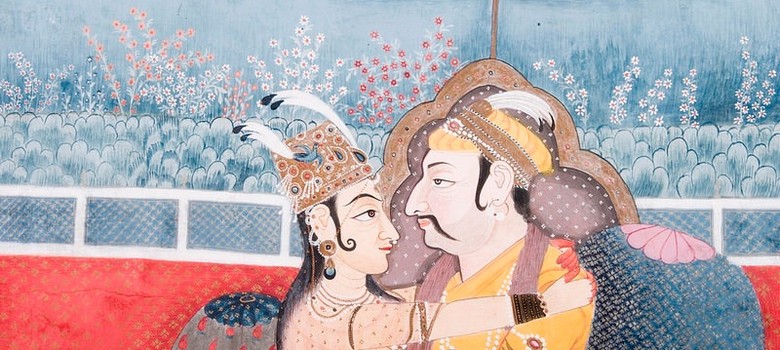
Nur Jahan and Emperor Jahangir. Opaque watercolor, gold, and silver on paper. Los Angles County Museum of Art | Photo courtesy: LCMA


Star of the harem

After Sher Afghan’s death, the young widow, and her daughter Ladli, were brought to Agra. Mehr-un-Nisa was made an attendant to Salima Sultana Begum, Akbar’s wife, and Jahangir’s stepmother. She lived in the Mughal harem for four years during which time she used her skill in embroidery and stitching to become a very popular designer for the Mughal ladies. She dressed very simply herself – mainly in whites – but fashioned brightly coloured brocades, tissues and silks for the ladies of the harem. Her designs were much sought after and often set the fashion trends. To her goes the credit for inventing the Dudámí (flowered muslin) for peshwáz (gowns open in the front), pánchtoliah for oá¹›hnís (a new design for veils), bádlah (embroidery with metal strips), kinárí (lace), and farsh-i-chandaní (white cloth for floor covering). She is also credited with designing gold ornaments with elegant new patterns.


In 1611, Jahangir happened to meet her at Meena Bazar – a new year fair started by Akbar in which the emperor was the only male present while noblewomen, princesses and other female members of the royal harem exhibited brocades, exquisite silks, fine muslins, bejeweled turbans and the like. Jahangir fell in love with her, proposed immediately, and they were married on May 25 of the same year. She was his 18th and last wife. Jahangir gave her the title of Nur Mahal or light of the palace and later Nur Jahan or light of the world. She was also given the title of Badshah Begum.


Poet and hunter

Mughal ladies were highly accomplished and studied art, literature, philosophy, and religious studies with learned tutors. 


Nur Jahan was no exception, but she was a brilliant conversationalist too. She composed Persian poems occasionally under the pen name of Makhfí, or the concealed one, a pseudonym also used by other female writers in the Mughal court like Salima Sultana Begum and Aurangzeb’s daughter Zebunnisá Begum.


Mughal women were trained in basic warfare and knew how to use swords and other weapons. Nur Jahan was a crack shot, and often accompanied Jahangir on tiger hunts. In his memoirs, Tuzuk-e-Jahangiri, the emperor described one such occasion in 1619:

My huntsmen reported to me that there was in the neighbourhood (of Mathurá) a tiger, which greatly distressed the inhabitants. I ordered his retreat to be closely surrounded with a number of elephants. Towards evening I and my attendants mounted and went out. As I had made a vow not to kill any animal with my own hands, I told Núr Jahán to fire my musket. The smell of the tiger made the elephant very restless, and he would not stand still, and to take good aim from a howda is a very difficult feat. Mírza Rustam, who after me has no equal as a marksman, has fired three or four shots from an elephant's back without effect. Núr Jahán, however, killed this tiger with the first shot.


He described another occasion in which she killed four tigers with six shots:

She shot two tigers with one shot each and knocked over the two others with four shots. In the twinkling of an eye she deprived of life the bodies of these four tigers. As a reward for this good shooting I gave her a pair of bracelets of diamonds worth 100,000 rupees and scattered 1,000 ashrafis over her. 


Nur Jahan had a refined cultural taste and ably assisted Jahangir in his pursuit of art and painting. Her mother, Asmat Begum, had discovered attar or essence of roses, but the credit of distilling and popularising it goes to her. Apart from this, she took care of orphans, especially girls, and is estimated to have arranged the marriages of, or provided for, five hundred such girls.


She was a great patron of architecture too, and built many beautiful palaces, gardens and mosques. The tomb she built for her father Mirza Ghias Beg (who was later given the title Itimad-ud-Daula or pillar of the state by the emperor) in Agra is one of the most exquisite examples of Indo-Persian architecture, and provided inspiration for the Taj Mahal. She also built the Pathhar Masjid mosque at Srinagar.


An emperor besotted

It has been implied that Nur Jahan’s dominant role during Jahangir’s reign led to rebellion and disaffection amongst nobles especially with his third son Prince Khurram or Shah Jahan. While some historians have painted her as an ambitious, scheming temptress who took advantage of Jahangir’s love for wine and opium to take over the reins of the empire, others like professor Satish Chandra have argued that the prejudice against Nur Jahan possibly reflected “the deep-seated anti-feminist bias of many contemporary historians which has often been repeated uncritically” by others.


However, her impact on Jahangir’s life can’t be denied. In his memoirs, the emperor said:

“Before I married her, I never knew what marriage really meant… She gradually reduced the quantity of wine I took, and guarded me against unsuitable food and improper things".


When Jahangir fell sick, which he did often in the latter part of his reign, Nur Jahan monitored his health and took over the reins of government with his permission. Except for the khuá¹­bah (prayer for the reigning monarch), she possessed all the privileges of a ruler. Farmans or edicts were issued in her name and grants were conferred under her seal. From 1623-27 AD coins were also struck in her name bearing the words:

Ba hukm Shah e Jahangir yaft sad zewar (front)

By order of the King Jahángír, gold has a hundred splendours added to it

Za naam e Nur Jahan Badshah Begum zar (on reverse)


By receiving the impression of the name of Núr Jahán, the Queen Begum.


She is the only Mughal woman in whose name coins were struck. She would even appear with Jahangir for jharokha darshan, a tradition that Akbar started in which the emperor would show himself at the window after dawn prayers every day to give the common people an audience.


Her father and brother rose to be important nobles during the reign of Jahangir but it was primarily because of their own abilities. As Jahangir said in his memoirs:

"… On the basis of seniority in service, extent of sincerity and experience in the affairs of government, I exalted Itimad-ud-Daula to the high post of Wizarat of the Dominion". 


Indian historian Prof Nurul Hasan pointed out that the rise of Itimad-ud-Daula and his family took place after 1616 when Nur Jahan was not so active in politics. She only stepped into the limelight in 1622 when Jahangir’s health was failing, his son Shah Jahan was in open rebellion, and her father was no longer alive to guide affairs. Ambitious nobles tried to take advantage of this situation but they underestimated her grit.


Woman in battle

In 1626, the emperor was weakened by ill health and Nur Jahan appointed as prime minister, her brother Asaf Khan. An important courtier and Mughal general Mahabat Khan felt slighted. He was considered a potential threat by some sections. Perhaps to put him in his place, Mahabat Khan was asked to render accounts, and to surrender war elephants he had captured during a campaign. A troop of soldiers was sent to escort him to court. But instead of meekly accompanying them, he came with a trusted body of Rajput warriors and seized the emperor as the royal camp was crossing the river Jhelum on its way to Kabul.


Mutamad Khan, the author of Iqbalnama-e-Jahangiri, who was present there, wrote:

After Núr Jahán had crossed the river, and reached the house of her brother, she summoned all the chief nobles, and addressed them in reproachful terms. “This,” she said, “has all happened through your neglect and stupid arrangements. What never entered into the imagination of any one has come to pass, and now you stand stricken with shame for your conduct before God and man. You must do your best to repair this evil, and advise what course to pursue.”


Nur Jahan joined the battle that ensued to release Jahangir from Mahabat Khan’s clutches. Despite a tactical disadvantage, the superior force of the enemy, the deep gushing water and severe injuries to her elephant, she kept shooting arrows at the enemy. But though she fought bravely, attempts to rescue the emperor proved fruitless.


She returned to Lahore and thought of other ways to rescue Jahangir. She had realised by then that she was powerless while separated from the emperor as both their lives were in danger. On Jahangir’s invitation, she joined him in Kabul. Mahabat Khan was now at ease as the emperor was reconciled with him, but Nur Jahan was planning their escape.


Said Mutamad Khan, in the Iqbalnama-e-Jahangiri:

Núr Jahán Begam worked against him both in private and in public. She maintained a number of followers, and attached them to herself by money and promises.


Within six months, taking advantage of Mahabat Khan’s weaknesses, Nur Jahan was able to wean away most of the nobles from his side. Realising that his position was precarious, Mahabat Khan fled from the court and later joined Shah Jahan who was biding his time till he ascended the throne. Nur Jahan’s sharp intellect, cool head and courage led her to her greatest victory, the defeat of Mahabat Khan. However, her triumph was short-lived as Jahangir died soon after in Lahore. The year was 1627.


Nur Jahan gracefully retired from public life once Shah Jahan became emperor, and died in Lahore in 1645. She was 72. She was buried in a red sandstone tomb she had built for herself in Shahadra Bagh, Lahore, a short walk away from her husband's last resting place.


(Source: Scroll)

Monday, 2 November 2020

3 myths in Russian history that won't die

 Dmitri Mendeleev didn’t dream up the periodic table, while Ivan the Terrible didn’t kill his son. But these tales, among others, were so believable and repeated so many times people still think they’re true.

1. Emperor Alexander didn’t really die but became a vagabond

In the years before his death, Alexander I of Russia seldom talked about his wish to withdraw from public life. In 1819, he said to his brother Nicholas: “I’m not who I used to be and I think it is my duty to withdraw.” In 1824, he said he wouldn’t mind “throwing off the burden of the crown.”


In the autumn of 1825, Alexander traveled to Taganrog with his wife and abruptly died there because of a fever. An autopsy was performed, and an act was signed by 9 doctors. After embalming, the emperor’s body was transported to St. Petersburg, but only the members of the Emperor’s family saw the emperor in the open coffin; during the subsequent 7 days that the body was in the Kazan Cathedral for public farewells, the coffin was closed.


In 1836, in Perm’ Region, an old man was been apprehended for vagrancy. He called himself Fyodor Kuzmich and was tall with grey hair. He was very physically fit, seemed educated and gentle, but refused to say anything about his past. For vagrancy, Fyodor was sent to Siberia, where he lived and then died in 1864. During his life, he often told stories of St. Petersburg and of famous people, including military commanders Kutuzov and Suvorov – apparently, the old man took part in the War of 1812. 


But who was the first to suggest that Fyodor was Alexander in disguise? Allegedly, Semyon Khromov, a merchant who invited Fyodor to live in his house in Tomsk and was completely sure that the old man was the Emperor – which accidentally made Khromov a celebrity of sorts. So it’s no wonder Khromov even tried to write to Alexander II – but in 1882, when he was apprehended by Tomsk authorities, Khromov said he really knew nothing about the old man’s past. Fyodor himself, while alive, didn’t deny nor confirm the legend.


Before his death, Fyodor gave Khromov an encrypted message that was to reveal his identity, but the message still hasn’t been deciphered up to the present day. Russian historians agree that Fyodor Kuzmich existed, but he wasn’t Alexander I – Fyodor probably was some high-ranked nobleman in the military service, but definitely not the Emperor. 


2. Dmitri Mendeleev dreamed up the periodic table

The legend goes as follows: in 1869, Dmitri Mendeleev strived to discover the periodic trends in the properties of chemical elements. Exhausted, he once fell asleep at his desk and dreamed up the table he couldn’t compose while awake. Springing up from his slumber, Mendeleev took a pen and a paper and quickly drafted the periodic table of elements.


Mendeleev himself never told anyone this story. But his friend, geologist Alexander Inostrantsev, often retold Mendeleev’s alleged story about discovering the table while asleep, despite Mendeleev himself denying this. Speaking to a journalist for the Peterburgskiy Listok (The St. Petersburg Paper) newspaper, he said: “No! Not a dime for a line, as you journalists do! I could have well spent 25 years inventing it [the periodic system], and you say I was just sitting there, and all out of the blue – one dime a line, one dime a line, and it’s cooked!”


Also, Mendeleev wasn’t the first to create a periodic table – in 1864, German chemist Julius Lothar Meyer created one, consisting of just 28 elements. 


3. Ivan the Terrible killed his son with a staff

This myth was, in large part, created by Ilya Repin’s painting ‘Ivan the Terrible and His Son’. However, the chronicles don’t contain any information on this, they just say Ivan’s son Ivan died because of “a disease”. 


In 1963, in Moscow Kremlin’s Arkhangelsky Cathedral, the place of interment of the Russian tsars, corpses of Ivan the Terrible and his sons Ivan and Fyodor were temporarily exhumed. All of them contained arsenic, usual for those times when tsars took homeopathic amounts of arsenic to develop tolerance to it – as it was the most common poison. However, the bones of Ivan and his son Ivan also contained high levels of mercury. Later in the 1990s, comparably high levels of mercury were then found in the bones of Anastasia, Ivan the Terrible’s first wife, and his mother Yelena Glinskaya. The research made it clear that Ivan the Terrible’s family has most likely fell victim to poisoning.


It is widely reported that Ivan was devastated after his elder son’s death. Ivan spent 4 full days next to his son’s bed, while Ivan Jr. was dying. This fact doesn’t fit in the image of a madman who slaughtered his son. Moreover, Ivan the Terrible was preparing Ivan Jr. for tsardom, making him a military commander and summoning him to discuss state affairs. So it was unlikely that Ivan could kill his heir, given the disastrous consequences it would bring – a dynastic crisis. It was clear Ivan’s death was a catastrophe, but who needed it to look like the Tsar killed his son?


The first mention of Ivan murdering his son is found in the papers of Antonio Possevino, a papal legate and the first Jesuit to visit Moscow, who tried to convince Ivan the Terrible to negotiate with the Pope about Russia becoming a Catholic country. When Possevino’s mission failed, the enraged legate smeared the Russian tsar with the accusation of filicide. This defamation was readily spread by other foreign and Russian foes of Ivan the Terrible. And finally, at the end of the 19th century, even made it onto Repin’s famous painting.


(Source: Russia Beyond)

Wednesday, 1 April 2020

And Alexander wept

All right, this particular canard has had all its feathers pulled off many times. I claim no originality. People explain it over and over on blogs. Every twenty seconds, somebody asks about it, and the explainers go to work.

The “quote” goes like this:
And Alexander wept, seeing as he had no more worlds to conquer.

“Alexander” is, of course, Alexander the Great, king of Macedon in the fourth century BC. A legend in his own time, et cetera, he died in his early thirties, et cetera, having won many battles. The quote is poetic. It touches a theme dear to everyone’s heart: the Tears of the Monster. However! From time to time, some bright person is forced by the laws of physics to ask: “In what ancient text does that passage appear?” Answer: it appears nowhere.
ALEXANDER THE GREAT, DETAIL OF AN ANCIENT ROMAN FLOOR MOSAIC FROM THE HOUSE OF THE FAUN IN POMPEII

Remember Die Hard? I don’t. I saw it right around the time it came out, and all I remember is Bruce Willis, barefoot, running through broken glass. That, for me, was a metaphor for watching the movie. 

Fans of the film, however, will recall its dapper German villain, Hans Gruber, smacking his silly lips and gloating at some private victory. He puts his fingertips together and says in facetiously tragic tones (clearly quoting something from High Culture and referring with cozy irony to himself): “And Alexander wept, seeing as he had no more worlds to conquer.” Then he smiles with evil-genius self-satisfaction and says: “Benefits of a classical education.”

Yeah. Except that quote would never come up in the context of a classical education, unless the instructor happened to be taking a jolly detour, nose in the air, to attack a piece of legendary crap that no student of his must ever traffic in. And even I, right now, have been forced to attach weights to my own nose to prevent its springing upward. (I can’t stop its sniffing though. There it goes again: sniff.)
A few facts. The monkeys who wrote Die Hard did not invent that quote. (And let me tell ya something: the people who write the scripts for action movies are literally forbidden to invent anything. Their mandate is to regift whatever is known to have worked in the past. More on this another day.) The quote, I was saying, is very old. It comes up in certain classic English poems from the seventeenth century. For example, here’s Edmund Waller addressing Oliver Cromwell in 1655:

When for more worlds the Macedonian cried,
He wist not Thetis in her lap did hide
Another yet, a world reserved for you
To make more great than that he did subdue …
—“A Panegyric to My Lord Protector,” lines 73–6

There it is. And a quick Google search turned up an even earlier item, printed in medieval Canada (1628, I mean).

But—and here’s where it gets good—but, nobody seems to have located any citation of the quote earlier than 1628. My homely contribution to this fuss is my hypothesis as to why instances of the quote are unlikely to turn up before 1579.

•

The quote is a hash of three passages in Plutarch, first century CE. Two of the passages were made available to English speakers (most notably Shakespeare) in 1579, in the translation by Thomas North. The other passage has a more complicated history. Let’s actually start with the tricky one.

Exhibit 1. [Orthography in all these quotations sic]
It is reported that King Alexander the Great, hearing Anaxarchus the philosopher discoursing and maintaining this position: That there were worlds innumerable: fell a-weeping: and when his friends and familiars about him asked what he ailed. Have I not (quoth he) good cause to weep, that being as there are an infinite number of worlds, I am not yet the lord of one?

That’s not from Plutarch’s Life of Alexander. It’s from Plutarch’s essays, usually called the Moralia. The essay in particular is called “On Tranquillity of Mind.” The translation above is that of Philemon Holland, 1603. This was not the first translation of that essay into English, but it might as well have been. The others all sank like stones; nobody ever heard of ’em. Look at this rather nicer version by everybody’s favorite courtier, Sir Thomas Wyatt:
Alexander, whan he herde Anaxarchus argue that there were infynite worldes, it is said that he wept. And whan his frendes asked hym what thing had happened him to be wept for: “Is it nat to be wept for,” quod he, “syns they say there be infynite worldes, and we are nat yet lorde of one?”

The above was done in 1527 at the request (sort of; she actually asked for a different book) of Catherine of Aragon. If you know who that is.

At any rate, the passage is crystal clear in both cases: Alexander is not weeping in sorrow that there are no more throats to cut. This is not a picture of a man at the end of a career of world conquest; he’s at the beginning. “Look at all these throats—and I haven’t even cut one!”

Exhibit 2.
For when they brought him [= Alexander, still a boy] newes that his father had taken some famous city, or had won some great battell, he was nothing glad to hear it, but would say to his playfellowes: Sirs, my father will have all, I shall have nothing left me to conquer with you, that shall be ought worth. For he delighting neither in pleasure nor riches, but only in valliantnes and honor, thought, that the greater conquests and realmes his father should leave him, the lesse he should have to do for himselfe. And therfore, seing that his fathers dominions and Empire increased dayly more and more, perceiving all occasion taken from him to do any great attempt: he desired no riches nor pleasure but warres and battells, and aspired to a signory, where he might win honor.

Now that’s from Plutarch’s Life of Alexander. No tears, but definitely the guy Gruber had in mind, the Godzilla he’d heard about in German day camp. Here’s a prince who wants to conquer for the sake of conquering; he doesn’t care whether Macedon comes out on top or not, except insofar as it’s compatible with his personal glory. (You could at least imagine this guy crying, if there were no more worlds to conquer.)

Our final passage is from Plutarch’s Life of Julius Cæsar.

Exhibit 3.
An other time also when he was in Spayne, reading the history of Alexanders actes, when he had red it, he was sorrowfull a good while after, and then burst out in weeping. His frends seeing that, marveled what should be the cause of his sorow. He aunswered them, Doe ye not thinke sayd he, that I have good cause to be heavie, when king Alexander being no older than my selfe is now, had in old time wonne so many nations and contries: and that I hitherunto have done nothing worthy of my selfe?

Tears! Indeed, it’s pretty much the same thing as Exhibit 1.

Exhibits 2 and 3 are translations by Thomas North, 1579. Here’s my copy of the 1895 reprint:

Like all Elizabethan translations, it seems pretty clotted and inelegant to me, but y’know, Shakespeare is Shakespeare, and what was good enough for him, et cetera. Indeed, he does quote North verbatim in places, just like he did with Florio’s Montaigne.

But you see what’s happening here. I’m setting out on the table all the ingredients for Gruber’s quote. In no case does Alexander weep because he’s accidentally put himself out of business by making himself king of the world. And it makes sense that he would not weep about such, because in point of fact he did not take over the world. He hits a wall in India, see. His men are tired, the river is deep, he can’t swim. Across the river: some vast Indian army, refreshed and ready. Alexander’s guys beg him to call it a day. “Call it a day, call it a campaign, call it an empire. Anyhow let’s go home.” And for once, Mr. Won’t-Listen-to-Anybody says okay. It’s all in the Life of Alexander. Read it sometime. Seventy pages of modern English, it’s not gonna kill ya.

But back to Gruber. What’s surely happened is some specially eloquent seventeenth-century British smarty-pants read the North and Holland translations, misremembered ’em, and created the mot that’s been repeated ever since.

How do I know the person didn’t misremember the original Greek? I don’t. But think about it. No one could read Greek, not even North (he was translating from Amyot’s French). Besides! is it not remarkable that the earliest instances of the Gruber version happen to crop up a few years after those important translations into English?

Here’s what would settle the matter against me: cases of the Gruber version from languages other than English, occurring before 1579. If anyone reading this can show me such, I promise to write another piece on this same topic, giving you full credit.

*

Uh-oh. This just in. There is another possibility altogether, a kind of Exhibit 4:
Nam Alexandri pectus insatiabile laudis, qui Anaxarcho comiti suo ex auctoritate Democriti praeceptoris innumerabiles mundos esse referenti “heu me” inquit “miserum, quod ne uno quidem adhuc sum potitus!” angusta homini possessio [gloriae] fuit, quae deorum omnium domicilio sufficit.
—Valerius Maximus, LIB. VIII, Cap. xiiii, Ext. §2

Alexander’s heart had an insatiable longing for glory. When his friend Anaxarchus told him, following the authority of his teacher Democritus, that there were innumerable worlds, Alexander said, “Alas, poor me, because so far I have not even gained possession of one!” To possess the world was too inglorious for this man, though the world is great enough to serve as the home of all the gods.
—from Book 8, Chapter 14 “The Desire for Glory,” Foreign Stories: section 2. [Translation Henry John Walker, 2004.]

That passage was written fifteen years before Plutarch was born; indeed, it might have been where he got it (?). And since it’s in Latin—and worse, in a frickin’ handbook of memorable sayings—anybody could have read it and misremembered it at any point in European history.

Okay, but then why do all these Gruber versions suddenly pop up in early seventeenth-century English, hmmm? I’m tellin’ ya: some Englishman started this. Some English Gruber. We’ll call him “John Miner.” 

Like Gruber, our Miner was pretending to have a classical education. Like Gruber, Miner had eloquence. But unlike Gruber, Miner actually created something worthy of a book of memorable sayings. He coined one of the very few classical tags that people still recognize on sight.

Unless even Miner didn’t invent it, but some Frenchman. Anyhow, I give up. My men are done. The river is deep. Call it an empire. Let’s go home.


(Source: The Paris Review)

Sunday, 1 March 2020

Afghan conflict: US and Taliban sign deal to end 18-year war

The US and the Taliban have signed an agreement aimed at paving the way towards peace in Afghanistan after more than 18 years of conflict.

The US and its Nato allies have agreed to withdraw all their troops from the country within 14 months if the militants uphold the deal.

US Secretary of State Mike Pompeo and Taliban leaders attended the signing ceremony in Doha in Qatar.

Talks between the Afghan government and the Taliban are due to follow.

Under the agreement signed in Doha, the militants also agreed not to allow al-Qaeda or any other extremist group to operate in the areas they control.

The US invaded Afghanistan weeks after the September 2001 attacks by the Afghanistan-based al-Qaeda group.

More than 2,400 US troops have been killed during the conflict. About 12,000 are still stationed in the country. President Trump has promised to put an end to the conflict.

How did US-Taliban talks come about?
Since 2011, Qatar has hosted Taliban leaders who have moved there to discuss peace in Afghanistan. It has been a chequered process. A Taliban office was opened in 2013, and closed the same year amid rows over flags. Other attempts at talks stalled.

In December 2018, the militants announced they would meet US officials to try to find a "roadmap to peace". But the hard-line Islamist group continued to refuse to hold official talks with the Afghan government, whom they dismissed as American "puppets".

Following nine rounds of US-Taliban talks in Qatar, the two sides seemed close to an agreement.

Washington's top negotiator announced last September that the US would withdraw 5,400 troops from Afghanistan within 20 weeks as part of a deal agreed "in principle" with Taliban militants.

Days later, Mr Trump said the talks were "dead", after the group killed a US soldier. But within weeks the two sides resumed discussions behind the scenes.

A week ago the Taliban agreed to a "reduction of violence" - although Afghan officials say at least 22 soldiers and 14 civilians have been killed in Taliban attacks over that period.

What's the background to the Afghan war?
It began when the US launched air strikes one month following the 11 September 2001 attacks and after the Taliban had refused to hand over the man behind them, Osama bin Laden.

The US was joined by an international coalition and the Taliban were quickly removed from power. However, they turned into an insurgent force and continued deadly attacks, destabilising subsequent Afghan governments.

The international coalition ended its combat mission in 2014, staying only to train Afghan forces. But the US continued its own, scaled-back combat operation, including air strikes.

The Taliban has however continued to gain momentum and last year the BBC found they were active across 70% of Afghanistan.

Nearly 3,500 members of the international coalition forces have died in Afghanistan since the 2001 invasion.

The figures for Afghan civilians, militants and government forces are more difficult to quantify. In a February 2019 report, the UN said that more than 32,000 civilians had died. The Watson Institute at Brown University says 58,000 security personnel and 42,000 opposition combatants have been killed.

Who are the Taliban?
The Taliban, or "students" in the Pashto language, emerged in the chaos that followed the withdrawal of Soviet troops in 1989.

They took Kabul in 1996 and were in charge of most of the country within two years, practising their own austere version of Sharia, or Islamic law.

Before being removed from power they banned TV, music and cinema, enforced strict dress codes, severely curtailed female education and introduced brutal punishments.

Mullah Omar continued to lead the Taliban after they were ousted. He died in 2013 although the Taliban did not confirm it for two years.

The Taliban are now led by Mawlawi Hibatullah Akhundzada.


(Source: BBC)