Showing posts with label Varanasi. Show all posts

Sunday, 6 February 2022

How a pioneering Greek scholar was robbed of the credit for translating Chanakya’s words in Sanskrit

Dimitrios Galanos, who was born in Athens in 1760, spent almost five decades in India and became the first Greek Indologist in the modern era. Galanos’s greatest lexicographical work was a Persian-Sanskrit-English-Greek dictionary. Sanskrit and Persian words were written in the Latin script and there was an accompanying English text with copious explanations. Although the dictionary was incomplete and missing some translated words, it was a pioneering attempt to help Greeks understand Sanskrit, writes Ajay Kamalakaran. Read on: 

In 1786, Dimitrios Galanos, a 26-year-old Greek teacher boarded a ship in Basra for Calcutta in search of a new life. A few months before, the young man who was formally educated in Ancient Greek, Latin, philosophy and music, had been galvanised by a chance encounter with a merchant in Constantinople. The merchant, one Madratzoglou, had extensive ties with the 200-strong Greek community that had settled in Bengal by the 1780s in places such as Narayanganj, Dhaka and Calcutta.


“Madratzoglou found him ideal for tutoring the children of the Greek merchants who had settled in Narayanganj (near Dhaka) and Calcutta and offered him a position as a teacher there,” wrote Dimitrios Vassiliadis, a noted Greek Indologist and Sanskrit and Hindi scholar, in 2020 for the Hellenic-Indian Society for Culture and Development. 


“Galanos, eager to expand his knowledge, gladly accepted Madratzoglou’s offer and prepared himself for his journey to the East; ‘…to carry the torch of the paternal education to the Greeks in India, and to send back from there to Hellas a few sparks of the ‘light of Asia’.’”


Spyridon Prosalentis/Wikimedia Commons [Public Domain]


After six months, Galanos reached India, a country where he would live for the next 47 years. Of this time, he spent a relatively brief six years as the teacher of the children and relatives of a wealthy merchant named Constantine Pandazy. But it was a time spent well.


The Greek scholar lived in a Bengal that was in the throes of the Hindu Revival Movement and came across Hindu reformers who were outward-looking and keen to interact with foreign scholars. This was also a period when European scholars developed a deep interest in Sanskrit and were moving to Calcutta because of the Royal Asiatic Society of Bengal. While working in Bengal, Galanos learned and mastered English, Hindustani, Persian and Sanskrit.


Some researchers studying Galanos’s life have suggested that he also got involved in business ventures and made a small fortune for himself. In a 1969 article for the Journal of the American Oriental Society, Siegfried Schulz, who taught languages at the Catholic University of America in Washington DC, wrote that Galanos left behind 75,000 to 80,000 gold francs when he passed away in 1833. “Having shrewdly invested his earnings (and possibly a generous gift from Pandazy as well), Dimitrios Galanos set out for Varanasi in 1793,” Schulz wrote.


Life in Varanasi

Not much is known about the life of Galanos in the Hindu holy city. So consumed was the scholar in translating texts from Sanskrit to Greek that he mostly kept aloof from other foreigners. He does, however, find a place in a book published in 1824-’25 titled Narrative of a Journey Through the Upper Provinces by Anglican Bishop Reginald Heber.


The British were initially suspicious about Galanos’s motives in living in Varanasi, according to Heber. But, after watching him for a long time, they came to the conclusion that there was nothing in his conduct to confirm their suspicions. “So few Europeans, however, who can help it, reside in India, that it seems strange that any man should prefer it as a residence, without some stronger motive than a fondness for Sanskrit literature, more particularly since he does not appear to meditate any work on the subject,” Heber wrote.


The Anglican bishop mentioned a special friendship that Galanos shared with a Russian trader who lived in Varanasi. “There is also a Russian here, who by a natural affinity lives much with the Greek,” Heber wrote. “He is, however, a trader, and has apparently moved in a much humbler rank of society than his friend.” The Russian, named Peter Federoff (Pyotr Fedorov), passed away in 1825 and was buried in Varanasi’s Chaukaghat cemetery. So close was their friendship that there was a Greek inscription from Galanos on Federoff’s tomb.


Besides his Russian friend, Galanos mainly chose to be in the company of learned Sanskrit scholars. “He has little intercourse with the English, but he is on very friendly terms with the principal Hindoo families,” Heber wrote. One of the Greek scholar’s closest Indian friends was a writer and an exceptionally learned man named Munshi Sital Singh, who helped Galanos with his Sanskrit. Sital Singh’s Persian work Silsilah-i-Jogiyan (Chain of Yogis) played an important role in the way the West understood Indian religious groups. It was under the Indian scholar’s guidance that Galanos embarked on a series of translations of Sanskrit texts to Greek.


Incredible legacy

In four decades in Varanasi, Galanos managed to translate 20 volumes of manuscripts. Unfortunately, none of his translated works were published in Greece when Galanos was alive, except The Aphorisms of Chanakya, which Greek captain Nikolaos Kephala, who carried the manuscript, published under his own name. Greek readers first came to know of Galanos after the plagiarised book was published since Kephala mentioned him in the acknowledgments as a most “erudite scholar of the Sanskrit dialect” who “assisted” him in translating the book.


The first volume of Galanos’s translations was posthumously published in Athens in 1845. It contained 330 verses from Bhartrhari’s Niti And Vairagya Satakas, 86 verses from Laughu Chanakya, and 98 verses from Panditaraja Jagannatha’s Bhaminivilasa.


The Greek scholar’s translation of the Bhagavad Gita was published in 1848. “It is the only occasion – in what is, apparently, his first completed translation – upon which Galanos names the Indian who helped him with the work: Kandaradasa,” Schulz wrote in his 1969 paper. “The note in the manuscript also records the exact date when he finished this study: November 12, 1802, in Kashi, the city of the Brahmans.”


Among his other notable translations were chapters from Devi Mahatmyam and Markandeya Purana.


Galanos’s greatest lexicographical work was a Persian-Sanskrit-English-Greek dictionary. Sanskrit and Persian words were written in the Latin script and there was an accompanying English text with copious explanations. Although the dictionary was incomplete and missing some translated words, it was a pioneering attempt to help Greeks understand Sanskrit.


Some Greek scholars are of the opinion that Galanos converted to Hinduism and was accepted as a Brahmin in Varanasi, but Greek Indologist Vassiliadis wrote that there is enough evidence to suggest that he retained his Christian faith. “Evidence that Galanos continued to retain his Christian faith throughout his life is found in his correspondence with Greek priests in Calcutta, and Greece,” Vassiliadis wrote. “Further, his last will starts out with the standard Christian formula, ‘In the Name of God. Amen’ and contains precise directions to be buried in a Christian cemetery.”


Galanos died at the age of 73 in Varanasi in May 1833. The city was in the midst of a cholera epidemic and the Greek scholar may have contracted the illness. He was buried in a churchyard in the city.


He willed a “moiety” of his fortune to his nephew Pandoleon Galanos, while leaving most of the rest to the Academy of Athens. In his will, Galanos wrote, “I hereby also give and bequeath to the principal Academy at Athens all my Sanskrit books, writings, translations and Memskey’s (Franciscus a Mesgnien Meninski) dictionary in all three volumes.” He also left some money for his teacher and servants and even set aside money to pay for his grave and tombstone in the churchyard.


It took almost four years for the manuscripts to reach Athens. “In Athens the manuscripts were bound into volumes with little attention to subject matter of sequence and incorporated into the library of the fledgling university,” Schulz wrote.


Munshi Sital Singh, who was the executor of Galanos’s will, composed a Persian quatrain as an epitaph for his Greek friend:

“Woe, a hundred times!
Demetrios Galanos has gone away from this world
To the eternal abodes.
Woe me! weeping and wailing have I said it.
I am out of myself.
Ah, he has gone away,
The Plato of this century!”


The Greek scholar’s long life in India was the first attempt to rekindle links that stretched back to the pre-Christian era. Concerted efforts have been made by academia in Greece and India to remember and celebrate the legacy of Galanos. In 2000, a Dimitrios Galanos Chair for Hellenic Studies was established at the Jawaharlal Nehru University in Delhi, while in 2016, the Athens Centre for Indian and Indo-Hellenic Studies was established to study India’s cultures, languages and traditions.


Ajay Kamalakaran is a writer and independent journalist, based in Mumbai. He is a Kalpalata Fellow for History & Heritage Writings for 2022.


(Source: Scroll)

Sunday, 4 April 2021

A dead body from the past kindles an enquiry into death and rebirth within a family in Varanasi

 An excerpt from ‘The City of Good Death’ by Priyanka Champaneri.

When the boatmen found the body in the river, they should have thought nothing of it. There was nothing unusual in steering past floating arms and blackened buttocks, in putting an oar into the river and having to reposition it when you found a soot-streaked foot barring your way.


Everyone knew the Doms were cheap folk with no respect for proper funeral rites, greedy for the few rupees they might save by snuffing a pyre before the fire had claimed an entire body, dumping the charred corpse into the river, and selling the half-burnt wood to another gullible family too grief-stricken to know the difference.


Author Priyanka Champaneri. | Laura Brennan.


The two boatmen had been out early, before the veil of morning fog lifted from the river. They shared a boat, one man at each end, and passed a bottle between them. They steered themselves to the middle of the river, to a spot shrouded in dense fog between the holy city of Kashi and the cursed far shore called Magadha.


Their spot was well chosen. Every man in Kashi knew three basic facts: dying in the holy city promised freedom from rebirth, bathing in the Ganges washed away the sins of a lifetime, and dying on Magadha guaranteed that you would come back as one of the lowest of the low, a donkey destined to bear burdens and insults until a merciful death started the cycle anew.


Here, the two boatmen hid their early morning libations from Kashi’s wandering tongues even as they kept a firm hand on the oars when the boat threatened to drift over to the cursed land. They sat and passed the bottle in silence, comfortable in a cocoon of mist, and they would have remained that way for some time if not for the interloper looming quietly in the distance.


An empty boat emerged from the fog and floated with unhurried purpose toward them. It thudded against the side of their craft and bobbed in a gentle rise and fall against the current, as if breathing, and the two men looked at it as they continued to pass the bottle, which they soon emptied. One boatman grabbed the side of the empty vessel and hoisted himself in while his friend held their own boat steady.


“This is Raman’s boat,” the first said as he rummaged through the scattered belongings. He held up a packet of mango beedis, which Raman was famously partial to, a pocket knife, a ball of jute twine, a glass bottle, some plastic envelopes of chewing tobacco.


“Anything in the bottle?” his friend asked. The bottle was as empty as their own, but the beedis were excellent consolation, and the two men shared the packet, musing over Raman’s negligence in allowing his boat to wander. 


The story currently making the rounds in Kashi through the mouths of beggars to the ears of merchants and housewives was that the young boatman spent his nights and early mornings in the dancing alleyways of Dal-Mandi to see his beloved Chandra.


Smoke curled from both men’s nostrils and melted into the grayness that clotted the air. Ghostly shades of sound reached them: hollow knocks on wood, a barking dog, a bell clanging. When the beedis shrank to stubs too small to fit between their fingers, the men flicked the ashy remains into the river and readied for their return to the holy city.

The first boatman pulled at the fickle anchor that lay over one side of Raman’s boat.


“Pull harder, Bhai,” his companion said, laughing when the anchor refused to rise out of the water. “And perhaps limit the pakora during chai this week, nah?”


The anchor dislodged from some obstruction deep below, and the rope crawled upward, though slowly and with considerable effort. As the wet rope coiled into the open boat, what emerged from the water was not the customary iron weight, but a fist. That hand was attached to an arm, and the rope knotted around that arm was tied in a neat double knot. While his companion sputtered, the first boatman kept a firm grip on the cold arm, steadied himself, and pulled the rest of the body up and into Raman’s boat.


The man’s life had flown long ago, and the body that remained was dark and swollen. His mustache, made thin with water, framed his parted lips, and the hairs of his wet eyelashes clung together, the long tips reaching toward his cheekbones like thick drips of kohl. A scar split one of his eyebrows in two, and a gold chain spooled around his neck. His bare feet had hardened soles and talon-like toes, and his thick black hair released a steady stream of water onto the boat deck, as did his soaked cotton pants and shirt.


“The liquor has taken your wits – put him back!” the companion hissed. “Before anyone sees, before his ghost sticks to you – where do you expect you’ll get the money to banish it?”


“Yes, but look, he is wearing clothes.”


“Nothing good enough to steal, if that is the thought dancing in your idiot skull. Dump him over.”


The first boatman wiped his brow and leaned back as he considered the body. “He still has his gold necklace.”


“Take it if you will. I will say nothing. But you’ll have to melt it down to rid its affiliation to the corpse, and that will cost just as much as the necklace itself; the goldsmiths are worse cheats than the Doms.”


“His skin isn’t burnt,” the first boatman continued, as if his companion had said nothing. “Did you see how the rope was tied to him?” He spoke the truth in a calm and unhurried manner. The body bore none of the talismans of cremation, of funeral rites. Every other charred and singed body in the river had endured an end that the two boatmen knew as well as the final scenes of a familiar story, but this body was like a tale with no ending at all.


“Bhaiya,” the first boatman said from his perch on Raman’s boat. “Think. How did this man die?”


“Rama knows. Dump him over, I say.”


“Where did he die?”


“Stop being foolish. He is dead.”


“On land? On water? And by whose hand?”


His companion refused to answer. A sigh bloomed from his lips in a white wisp that disappeared into the fog. The first boatman grabbed the oars, took his position position in Raman’s boat, and directed the bow toward Kashi.


“Don’t be blind to what is placed before you,” he said to his friend. He pumped his arms and glided back to the holy city.


Excerpted with permission from The City of Good Death, Priyanka Champaneri, Penguin Viking.


(Source: Scroll)

Tuesday, 1 January 2019

History, myths and lesser-known facts about Kashi or Varanasi – the world’s oldest city

There are some cities which are respected at the very mention of their name. Period. We are talking about Varanasi. One of the world’s oldest cities. However, do not go to this city, if you are not a worthy traveler. The city is old, and still retains the ancient charm of paying respect to God via the traditional methods and the cremation of dead bodies at the Ghats. It has a history of 3500 years. Come, let us know about the history and facts about Kashi in detail on today’s read.

Varanasi will always occupy prime importance in Hindu religion. It is said, that a Hindu has to go on a pilgrimage to Kashi at least once in their lifetime. In short, Kashi or Varanasi is to a Hindu what Mecca is to Islam and Vatican to a Christian.

Yantra means a machine. According to Sadguru, this Kashi is a large human machine without inertia. Shiva is a yogi and his favorite number is 5. So they built the city along the lines of 5. The fundamental geometry of Kashi is to connect the microcosm and macros. So, they designed 468 temples. The basic temples are 54 for Shiva, the same number for Shakthi.


History and Facts about Kashi
Everything in creation is a part of the cosmos itself. The history of Kashi is documented right from 3500 years ago. In short, the city has existed even when Athens had not laid its foundation for glory. In fact, this holy place existed even when Rome was just a city and Egypt was not even formed. Spelling the name “Kashi” brings vibration in the human body. In fact, the city is best described as a place where the micro (human) can connect with the macro (cosmos).

In the ancient Indian cities, places were differentiated for every activity. For washing clothes, there is the dhobi ghat; for bathing, there used to be a separate place and for cremation of bodies, there was the graveyard. In ancient Hindu texts, the city is referred to as Maha Smashana (large cremation ground). True to the name, the Manikarnika Ghat gets about 300 human bodies daily for cremation.

Also known as Benares and Kashi, this city is located on the banks of River Ganga. The name has been derived from the rivers of Varuna as well Assi tributaries where the city is located.

Importance – What You Should Know About Varanasi

  • Near Varanasi, there is an area known as Sarnath. Buddha delivered his first sermon after enlightenment.
  • Adi Shankaracharya has written Kasi Panchakam, a tribute to the city.
  • This city holds prominence as being the birthplace of at least four Jain Tirthankaras. They are Suparshvanath (7th), Chandraprabhu (8th), Shreyanshnath (11th) and Parshvanath (23rd).
  • Tulsi Das composed the evergreen Hanuman Chalisa and Ramcharitmanas in Kashi.
  • The guardian deity of Kashi is Kaal Bhairav. His image – a thick mustache, vahana is a dog, has a tiger skin as cloth, holds a sword by the right hand and the head of a demon on the other hand.

Varanasi is the city of temples. You have them in every nook and corner. Among the famous, Kashi Vishwanath Temple stands tall. Also prominent are Durga Temple, Mahadev Temple, Bharat Mata Temple etc. There is no city in the world which has a hundred ghats. And there are three types; the bathing ghats, cremation sites and praying ghats.

Evening Aarti – The topmost activity that a traveler should never miss is the glorious Evening Arati of Kashi. It is one moment that you will cherish forever. The rituals unfolding for the Lord is a treat to watch. The lamps (made of brass) come to 4.5 kilograms.


Weavers Village – One of the famous sarees of this city is the Banarasi Saree made of gold, silver and popular for its zari.

Prior to five decades, and even today, many Indian people have the notion that a bath in the Ganges will relieve the past diseases. This can be true to a certain extent. Before Ganga becomes a river, there is a place called the Gangotri. Before this place, the river water passes through mountains and valleys. Maybe, when the water passes through certain herbal plants, it may acquire medicinal properties. But now, Ganga has become polluted. People from the other Indian States come to take water away in small containers, stating that whoever is given a drop of Ganga water on their deathbed will attain salvation.

Facts About Kashi You Should Definitely Know About
The temple of Kashi Vishwanath is so old that it has been stated in the Skanda Purana. A legend goes like Lord Shiva’s mother-in-law was worried that her son-in-law does not have an abode. For his wife, Goddess Parvati, Lord Shiva asked the demon, Nikumbha to make a place suitable for his family at Kashi.

In this place, the Mother was so pleased that she offered food to everybody, the reason, she is worshipped as Annapoorani. In fact, Lord Shiva is known to be the Master of all in Shaiva literature. But the Lord himself seeks food from the Devi, that too, in a begging bowl. In fact, this place is considered to be one among the 52 Shakthipeedams (Kashi is the place where the Sakthi’s left arm fell after the body was cut by Sudarshana Chakra of Lord Vishnu).


An ancient Indian legend has it, on the day of creation of Mother Earth, the first light ray was shown to Kashi. There are also other legends which state that Lord Shiva actually stayed in the city in the form of  “Lord Kalabhairava” as the guardian of the city.

War Between Brahma and Vishnu
Do you know the famous war between Brahma and Vishnu about who is Supreme? And the wager to see the depth and height of Lord Shiva? Lord Shiva assumed the form of bright light which penetrated heavens and hell. He told Vishnu and Brahma to find the height and source. Brahma, in the form of a goose, flew to the sky. Vishnu, in the form of a boar, dug into the earth. Even though they searched for eons, they could not find the end of the light. Vishnu felt humbled and accepted defeat. But Brahman, unwilling to accept defeat, asked the Ketaki flower which dropped from Lord Shiva’s head to serve as a witness that he has seen the end. During the conversation with Lord Shiva, while Vishnu asked for pardon, Brahma lied. The angry Lord cursed Brahma that he will never be worshipped on Earth.

Lord Shiva also severed Brahma’s fifth head. After Shiva killed Brahma in the form of Kaalbhairava, he was cursed with Brahma-Hatya. The fifth head clung to his left hand. All efforts to remove the head proved futile. KaalBhairava wandered along the banks of River Ganga southwards. At a certain position, the river turned towards North and he entered Kashi. When he dipped his left hand in the river, the head unclung from his hand and he was liberated. This place became Kashi as told by the legend.

The city stands on the trident of Shiva
There is another myth which states that the city stands on the trident of Shiva. In short, Kashi is not on Mother Earth, it stands above the ground. There are three temples which act as the three points for the trident. They are Aumkareshwara in the North, Vishweshwara in the middle and Kedareshwara in the South.

As per local folklore, there are eight Kaal Bhairavs who guard the city; Ashta Dikkugalu. The temple for these Gods are present in eight cardinal directions and protect the sanctity of the Kashi Vishwanath temple.  In fact, this city is believed to be the abode of Lord Shiva. It is widely rumored that before death, Lord Shiva whispers Tarak mantra in the dead man’s ears to attain salvation.


There is another myth regarding Garudas and lizards. But it is true. Never in the city, an eagle will fly nor the lizards will make the sound. The story unfolds during the time when Rama killed Ravana. To atone for his sins, he wanted to perform puja to a swayambu lingam. He entrusted the task to Lord Hanuman. When Hanuman entered the city, the garuda and lizard helped him identify the linga. But he took the linga without seeking permission of the protective deity of the city, Kaal Bhairava. A fierce battle happened which was cut short by the Gods. Kaal Bhairava, in his anger, cursed the Garuda to not fly over the city, and lizard to not make the sound. The words hold true even to the present day.

History of Kashi Vishwanath Temple
In fact, the temple of Lord Shiva, known as Kashi Vishwanath Temple is known as one among the 12 Jyotirlingas. The other Jyotirlingas are Somnath in Gujarat, Mallikarjuna in Andhra Pradesh, Mahakaleshwar in Madhya Pradesh, Omkareshwar in Madhya Pradesh, Kedarnath (Uttarakhand), Bhimashankar (Maharashtra), Triambakeshwar (Maharashtra), Vaidyanath Jyotirlinga in Deogarh, Jharkhand, Nageswar (Gujarat), Rameshwar (Tamil Nadu), and Grishneshwar (Maharashtra).

Importance of Kasi Vishwanath Temple
You find rarely a temple or a religious place in any country ravaged many times, only to be built again. The present temple stands a little distance from the original site. It was built by Ahilya Bai Holkar and the gold for the dome was contributed by Maharaja Ranjeet Singh of Punjab.

In the temple, you can find numerous shrines of various Gods. The temple has been built in the form of a quadrangle. Numerous small temples shroud the complex. You can find temples of Dhandapani, Vishnu, Sanishwara, Virupaksha, Avimukteshwara and many more. Because of its importance, the temple gets nearly 3000 devotees daily. On a special occasion, the number can increase to 100000.


The small well in the temple is popular by the name of Jnana Vapi. At the time of invasion from the Moghuls, the Main priest jumped in the well along with Shiv Ling. There may be many temples in the world, but rarely will the deity be performed aarti five times. The duration of this auspicious activity,  every day in the temple are conducted as follows –

Mangala Aarti – At 3 AM in the Morning. It extends till 4 AM

Bhoga Aarti – From 11.15 AM to 12.20 PM

Sandhya Aarti – As the name suggests – it takes place in the evening. 7 PM to 8.15 PM

Shringara Aarti – it extends after evening from 9 PM to 10.15 PM.

Shayana Aarti – In the last hours of the evening. 10.30 PM to 11 PM.

If Delhi is the capital of India, then Varanasi can be called as the spiritual capital of our country. In fact, till the last century, it was believed, that if anyone died in Kashi, their soul goes to Heaven and there will be no rebirth. If they cannot die in Kashi, at least their human bodies if cremated in the holy place can make the soul attain salvation.

(Source: Metro Saga)

Saturday, 22 September 2018

Nat Geo names 4 ancient Indian rituals among world’s most unique traditions

India is a land of myriad cultures and customs, and here are a few that have been going on since ages.

Traditional observations and ritualistic practices have been a part of human societies all over the world. We may have progressed to the digital age, but these are still passed down through generations and practiced. Whether for the purification of the mind, the body or the soul or the pursuit of prosperity, these rituals all have their specific goals.

National Geographic magazine has chosen 25 unique traditions from all over the world. Of those, here are four uniquely Indian rituals.

1. Koovagam Festival:-

Transgenders celebrate the Koovagam festival held in India. Image Credit; Koovagam Festival 2017
Even before the historic judgement of the Supreme Court scrapping Section 377, a village in South India has been celebrating and cherishing the transgender identity for ages.

For 18 days between April and May each year, thousands of transgenders from across the country converge at the Koothandavar Temple in the Villupuram district in Tamil Nadu, for the Koovagam Festival.

The festival has been observed for hundreds of years, and has its roots in the Mahabharata and the battle between the Kauravas and Pandavas. Through the 18 days, there are all kinds of celebrations, dances, games and even a beauty pageant where the winner is crowned ‘Miss Koovagam’.

2. Ganga Aarti Ceremony:-

The awe-inspiring Ganga aarti ceremony, held in Varanasi, India. Image Credit:- Streetwise Varanasi Tours
Every evening, residents of the holy city of Varanasi practise the Ganga Aarti, a ceremony to honour the river Ganges. People provide floating offerings like lamps made of candles and flowers. Set adrift in the river, thousands of lamps light up the surface for an ethereal look and feel.

It begins when a group of pundits blow conch shells and light incense sticks and large lamps, which they hold while chanting hymns. Several oil lamps flicker in synchronicity, and, a pundit will pour a bowl of water into the river, signifying the end of the ritual.

This observance is made grander during Kartik Purnima, the Hindu month that falls during October-November.

3. Gochak ritual:-

Photo Source: VIEW of Ladakh
A Buddhist ritual in Ladakh, it is celebrated for three days, from February 20-22 each year. It is believed that Lord Buddha exhibited his miraculous powers from the 1st to the 15th day of the same month.

The Gochak ritual is a penance aimed at seeking world peace and prosperity, where Buddhists move from village to village, prostrating after every few steps. It is the belief of the devotees for the causes of world peace and prosperity that inspires them to leave home early and undertake the arduous journey.

4. Mundan Ceremony:-

The ‘mundan’ ritual, to mourn for the departed in India. Image Credit: Annil Chandra Masoor Jasoos‎
A ceremony where the head is shaved, this is one of the most prominent Hindu traditions. The ritual denotes purification of the soul and the body, and signals a kind of preparation for the bereaved to take forward the responsibilities left by the departed.

This ceremony is performed on two occasions. One is for the wife of the deceased soul and is rather permanent, while the other is for the males of the family to mourn the death of an elderly family member. Unlike the former, this is temporary, and more widely prevalent. An important tradition that is unique to our nation, it is also a mark of gratitude to the departed soul.

In a land full of myriad cultures and traditions, these continue to be authentic and unheard of anywhere else in the world!

(Source: TBI)

Thursday, 29 March 2018

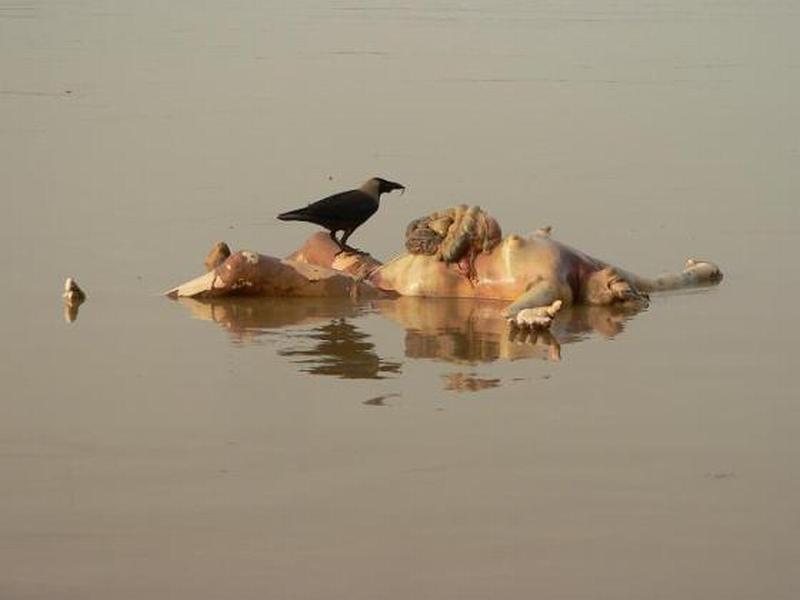
Over 50 scary images depicting filth of Varanasi and River Ganges that went viral in China

In 2008, about 50 images posted with a first-hand account of a visitor who had spent a few months in India, had gone viral in China. Many Chinese forums and columns published them.  The images are disturbing, but not for the government and Indian people except some activists and NGOs.


Surprisingly, the images  depicting ugly side of India did improve sanitation condition in China. China has its own flaws, but it can’t be denied that Indian aren’t treating scared river as it should be. On the other hand, Indians don’t mind such embarrassment or they don’t actually know how India is perceived by rest of the world.

India enjoys an image of ancient civilization with spiritual values. There is no country in the world like India when it comes to cultural and social diversity. Tourist are nuts for places like Varanasi. Every state has something unique to offer to tourists. From Himalayas in the north to the costs in the south, from billion dollar buildings to poverty stricken slums, India makes a perfect destination for those who seek exposure to world’s biggest and successful democracy.

But India and Indians are ridiculed and embarrassed by other nations for its filth and religious hypocrisy. The River Ganges is considered holiest river for Hindus, and also most polluted. Despite being so sacred, there is nothing that is not dumped into the river. Raw sewage, plastic bags and bottles, industrial effluents, human waste, chemical from tanneries, discarded idols, cow dung, partially cremated corpses, flower-garlands, human remains, animal carcasses, butcher’s offal, chemical dyes from sari factories and construction waste, everything ends up in River Ganges. Daily, people defecate on the banks of this sacred river, while many others come long way to take bath in the same water.

The condition hasn’t changed much in 2015. In January 2015, more than 100 corpses, including children, were found washed up in shallow tributary of the River Ganges. The bodies were decaying and dogs and birds could be seen feeding on them. About 102 bodies were spotted near the village Pariyar, in Uttar Pradesh. All credit goes to India’s custom to give water burial. Many people do it because they can’t afford proper cremation.

(Source: Planet Custodian)

Sunday, 30 July 2017

The language of ashes: The stories around Aghori babas

It is New Year’s Day, and in Banaras, it’s not the eve, but the first day of the year that is celebrated, for it being a new beginning, a good beginning, and rightly so. I seem to have begun the year with stories of death and of the dead. Stories of Aghori Babas, who walk around with chalk-smeared bodies and long beards, wearing nothing except some beads around their throats and wrists; carrying the trishul, the sign of Shankar Mahadev. They sit for long hours stoned, lost in dhyaan or meditation.

We are on a boat, being steered in the night from Dashashwamedh Ghat to Assi Ghat. It is cold, there is smog on the waters, we cannot see beyond a few feet. It is almost as though ghosts are travelling with us, or it may just be my imagination playing tricks.

I look at the man telling me the tale.“ Aghori Babas have strange powers,” Rakesh says. He leans back, “The Baba then said to us, ’ Give me the skull of a Jaiswal’.”

The boat rocks in the dirty green waters of the Ganges, mother to us Indians. We bathe in these waters to purify ourselves… this water into which the sewage waters pour from the city, this water where people wash dishes and clothes and throw the ash of the wood from the burning corpses.
“You know why the Baba asked for the skull of a Jaiswal?”
I nod, wondering what is so special about a Jaiswal skull. All I know that they are the Banias of Banaras, it is a common surname here.
“The skull of the Jaiswal is big, and it is hard. It is a hard skull and does not crack easily. That is why the Baba wanted me to give him the skull. It is big, so the Baba can cook a good meal in it, and it is hard, so it will last a long time as a vessel.”
“So why did you not give it to him?”
“Well, a Jaiswal skull is hard to crack,” he said, shrugging his shoulders. It was obvious that he did not want to give the Baba what he wanted. This Baba was his father’s friend, or acquaintance. Maybe he did not feel obliged enough to do what was required. A shiver ran up my spine. There was more to come, even as the fog enveloped us some more, and the boatman rowed harder, the oars moving slow against the water current.
“I have seen the Baba call a cat to him, a cat just walking along the river’s shore.”
“Hmm…”
And then rip the cat’s body, remove its heart and eat it in front of me.”
“Ha!”
Rakesh’s eyes gleam.“He puts the body back together again and the cat walks away.”
“No heart?”
“The Baba has eaten it in front of me, all raw and throbbing.”
“The cat walks away without a heart? It won’t fall dead?” I give a very cynical smile and raise my eyebrows; it’s such an impossible thing to believe.
“It ran away. It did not die.” He does not laugh. ”These are the powers. You have to see to believe. I have seen.”
His brother Dinesh, trailing his hand in the water, and cupping a few mouthfuls now and then, chimes in, “I have seen it too.”


For me, it’s a story. But I can imagine a heart cooking inside a skull over a lit fire, a chalk-bodied Baba watching over it, and I wonder for a moment what he puts in the curry. It seems like something out of a Hans Christian Andersen fairytale with an Indian flavour. My stomach churns, and it is not with hunger. Luckily, we have reached the Assi Ghat, where celebrations are on. Lights blink and the sound of people merry-making reaches our ears.
I rise slowly, not willing to show my eagerness to leave the fog and the waters behind, to reach stable land. I hold onto the hand of the boatman to steady myself, and see with a shock that he is naked, and his body is the colour of chalk. I stare at the beads around his wrist…each of them is a skull. I tell myself to pretend I do not see what I see and do not touch what I touch, and slowly step ashore.

The boat sways and disappears. I look at Rakesh who told me the story of the Baba. “The boatman,” I say, “where did you get him from?”
“He is one of my father’s friends. He offered to row us across. No one else was available or willing. It’s the night of first January and everyone is celebrating.”
“He is a Baba, this friend…the Baba?” My voice shakes.
“No, of course not, how can he be?” He laughs, then seeing the look in my eyes, becomes quiet.“I think he just wanted to tell you to believe.”
I shake my head. I would never believe. I clench my hand. There is something in the palm of my right hand. I open it, and see a small bead. It is skull-shaped. I hold it up to the light, and it seems to be grinning.
I toss it to Rakesh. “Is this a Jaiswal skull?” I attempt a joke.
He holds it in his hand and his face freezes. “The Baba is here,” is all he says. “We’ll meet him soon.”
I look at the revellers and wonder if any of them have had such a good beginning to their New Year. Not everyone is helped ashore by the hand of an Aghori Baba.
“Let’s move on, join the crowd. The night is getting morbid,” I tell Rakesh.
A cat mews as it passes me and I jump.
Then I am laughing, hysterically. “No, I don’t want to know any more,” I say. ‘This is enough, it’s enough.”

(Source: The Punch Magazine)

Friday, 9 October 2015

Varanasi in the eyes of a Westerner

Varanasi in the eyes of a foreigner

There have been so many books by westerners on Varanasi and the new addition to the list is Piers Moore Ede's Kaleidoscope City: A year in Varanasi. The writer explored the city during his one year stay and has given several interesting incidents that happened. He has successfully shown the other face, the darker one, the one which often gets missed by tourists, of the city. 

Whoever visits the city tries to grasp and go deep inside the veins to understand the pulse of the place and its people. Don't know if anyone has been successful in doing so, but everyone, including Ede, has understood that Death reigns here! 

Earlier writers have seen Varanasi in their eyes and seems to give their own perspective and it is where Ede differs from others. He never gives an impression that he knows everything about the city and its people despite living there for one year. He is eager to learn things happening in the city like a little child who is anxious to explore the world around. He patiently listens to people and keeps his curiosity to unravel the city till the end. 

Harishchandra ghat, the Ganga river, Varanasi, all become characters and breathe life in the book. Though he has tried to go deeper and personal into the lives of locals one wonders if he has been successful in it, as obviously there are two chances: one, people may open their personal secrets to him fearing no threat to their private life; second, people may exaggerate things to get sympathies or say things superficially as he's a foreigner. Whatever it is, the writer hasn't hurt the sentiments of the locals and one should laud his respect for the city and the local culture. Accepting the very fact that still there's lot to learn about the city, culture and its people brings the book closer to readers and wins their hearts. 

Note: The original review was published in Sakhi magazine here: http://sakhiexpress.epapr.in/538990/Sakhi/15-July-2015#dual/46/1

Wednesday, 15 July 2015

Book review: Kaleidoscope City: A Year in Varanasi

My latest book review: Kaleidoscope City: A Year in Varanasi in Sakhi magazine. Here's the link: