Showing posts with label mountain. Show all posts

Tuesday, 24 May 2022

How tall will Mount Everest get before it stops growing?

 Arching over 8,849 metres (29,032ft) into the sky, Everest is the world’s tallest mountain. But will it always be?

Aurora Elmore was approaching Mount Everest's South Base Camp in Nepal. But rather than taking the traditional 12-day hiking route, she was soaring between the frozen peaks, the rotor blades of her helicopter slicing through the thin air with a whap, whap, whap.


It was April 2019, and she was delivering supplies to a team of scientists working on the slopes of the world's tallest mountain. Her reward was a spectacular view: the day was crystal clear, exposing the entire Himalayan range.


Over the next two months, researchers on the National Geographic and Rolex expedition she helped to organise would study the effects of climate change on this part of the Himalayas. Elmore, a geologist and at the time senior programme manager of the National Geographic Society in the US, supported the team installing the world's highest weather station on the flanks of Mount Everest. During the course of their expedition, her colleagues discovered the world's highest evidence of microplastic pollution in snow and stream water close to the summit. 


Gliding closer to Everest's iconic peak, Elmore got a bird's-eye view of them. A miniature city of green and yellow tents, each sheltering mountaineers headed for the top, had formed at Everest Base Camp more than 5km (3 miles) above sea level. Thousands flock to Everest every spring to make an attempt to reach the roof of the world.


And while few of the climbers would have noticed, Everest grew a tiny bit bigger during their time on the mountain.

Mount Everest, along with the rest of the Himilayas, inches further skyward every year. It raises an interesting question – with enough time, just how tall can Mount Everest grow? There are mountains on other planets in our Solar System that dwarf those on our own, so are there limits to how big a mountain can get on Earth?


Mount Everest towers 8,848.86m (29,032ft) above sea level, according to the most recent official joint survey by China and Nepal, whose borders run across its summit. But it isn't the only giant in these lands – 10 of the world's 14 peaks higher than 8,000m (26,247ft) above sea level can be found in the Himalayan range. Everest, Elmore says, is among friends. "If you've ever flown over Greenland or the Canadian Rockies you can see big mountains, but [the Himalayas] are just on another level," she says.


Surrounded by so many other enormous peaks, is it possible to discern just what a monster Everest is? Elmore hesitates before answering. "It's kind of like trying to tell the tallest person on a basketball team," she says finally. "They're all tall, but which one is the teeny [bit taller]?"


The history of measuring the tallest mountain in the world stretches back to 1852. In Europe, Charles Dickens was publishing serialised instalments of his novel Bleak House. North America had started testing its first steam-powered fire engine. In Asia, the height of Mount Everest was a mystery. It was known only as "Peak XV". Radhanath Sikdar, an Indian mathematician, had been employed by the British to work on their Great Trigonometrical Survey. They wanted to gather a more accurate geographical picture of the territory they were occupying so they could control it more effectively, be it for trade or military purposes.


Sikdar used trigonometry. He measured the horizontal and vertical angles of Everest's summit from other mountaintops whose positions and heights were already known. In doing so he made a momentous discovery: the tallest mountain ever recorded. According to his calculations, the mountain stood at 8,839.8m (29,002ft) tall.


Though the technology behind measuring mountains has advanced since the 1850s, his figure was astonishingly accurate, just nine metres off the latest official height. Despite Sikdar's findings, the mountain eventually was named after his previous boss, British surveyor Sir George Everest, who had retired several years before Sikdar's discovery.


At more than 8,848m (29,032ft) tall, Mount Everest towers over the other giants in the Himalayas (Credit: Getty Images)


Since then, teams have continued to work to understand Mount Everest's height. In 1954 an Indian survey determined Mount Everest to be 8,848m (29,029ft) tall, a figure which was accepted by the Nepalese government. But then, in 2005, the Chinese measured it at 8,844.43m (29,017ft) – nearly four metres (13ft) lower. In 2020, teams from China and Nepal jointly agreed upon a new officially accepted height that was 0.86m (2.8ft) higher than the Survey of India's original calculation. 


While these changes in the measured height are partly due to improvements in the measuring technology available to surveyors, there has also been some politics involved. China and Nepal historically have argued over whether the snow cap on the summit should be included in the measurement or not.


But we mustn't ignore that Everest also grows a tiny little bit taller every year too.


Once, the craggy limestone peaks that skim the sky of Everest were on the ocean floor. Scientists believe it all began to change about 200 million years ago – at around the time the Jurassic dinosaurs were beginning to emerge – when the supercontinent of Pangea cracked into pieces. The Indian continent eventually broke free, journeying north across the vast swathe of Tethys Ocean for 150 million years until it smacked into a fellow continent – the one we now know as Asia – around 45 million years ago.


The crushing force of one continent hitting another caused the plate beneath the Tethys Ocean, made of oceanic crust, to slide under the Eurasian plate. This created what is known as a subduction zone. Then the oceanic plate slipped deeper and deeper into the Earth’s mantle, scraping off folds limestone as it did so, until the Indian and Eurasian plates started compressing together. India began sliding under Asia, but because it's made of tougher stuff than the oceanic plate it didn't just descend. The surface started to buckle, pushing the crust and crumples of limestone upwards.


Weather stations installed on Mount Everest were damaged by rocks the size of cricket balls that were picked up by the wind


And so the Himalayan mountain range began to rise skyward. By around 15-17 million years ago, the summit of Everest had reached about 5,000m (16,404ft) and it continued to grow. The collision between the two continental plates is still happening today. India continues to creep north by 5cm (2in) a year, causing Everest to grow by about 4mm (0.16in) per year (although other parts of the Himalayas are rising at around 10mm per year [0.4in]).

But understanding how and why Everest's height changes is more complex than just this. While plate tectonics push the summit higher into the sky, erosion claws away at it.


To understand this process better, scientists studied another mountain some 8,700km (5,405 miles) away from Mount Everest, in Alaska.


Rachel Headley, an associate professor of geosciences at the University of Wisconsin-Parkside, was part of a scientific expedition to Mount Saint Elias on the border of Alaska and Canada between 2005-2008. The mission intended to understand the complex roles of tectonics and erosion in how mountains grow and shrink. The second largest mountain in both Canada and the US, Saint Elias faces the same effects as Everest, from tectonic activity to erosion, but across a far smaller, more manageable area. "In that region, Alaska, there were very particular weather patterns that had helped these large glaciers grow," Headley says. "And then both glaciers and rivers, landslides, and avalanches were all kind of the processes that connected to tear them down."


Headley's role on the team was to understand the thickness of the Seward Glacier, which runs through the Saint Elias mountains, and how fast it was moving. Both can impact the rate of erosion, which can affect how quickly a mountain's height is worn away. "If we have a thinner glacier, and it's moving super fast… we know there has to be some sliding, which we think is really important for erosion," she says. "Sliding" can cause glacial abrasion, which is when the glacier drags rock fragments across the surface as it moves, creating a sandpapering effect.


Weather can also cause significant erosion to a mountain. Elmore describes one of the weather stations she helped install during the 2019 Mount Everest expedition as being "damaged by rocks the size of cricket balls that were picked up by the wind and thrown at it". Buffetting by debris and ice picked up by the wind takes its toll after a while.
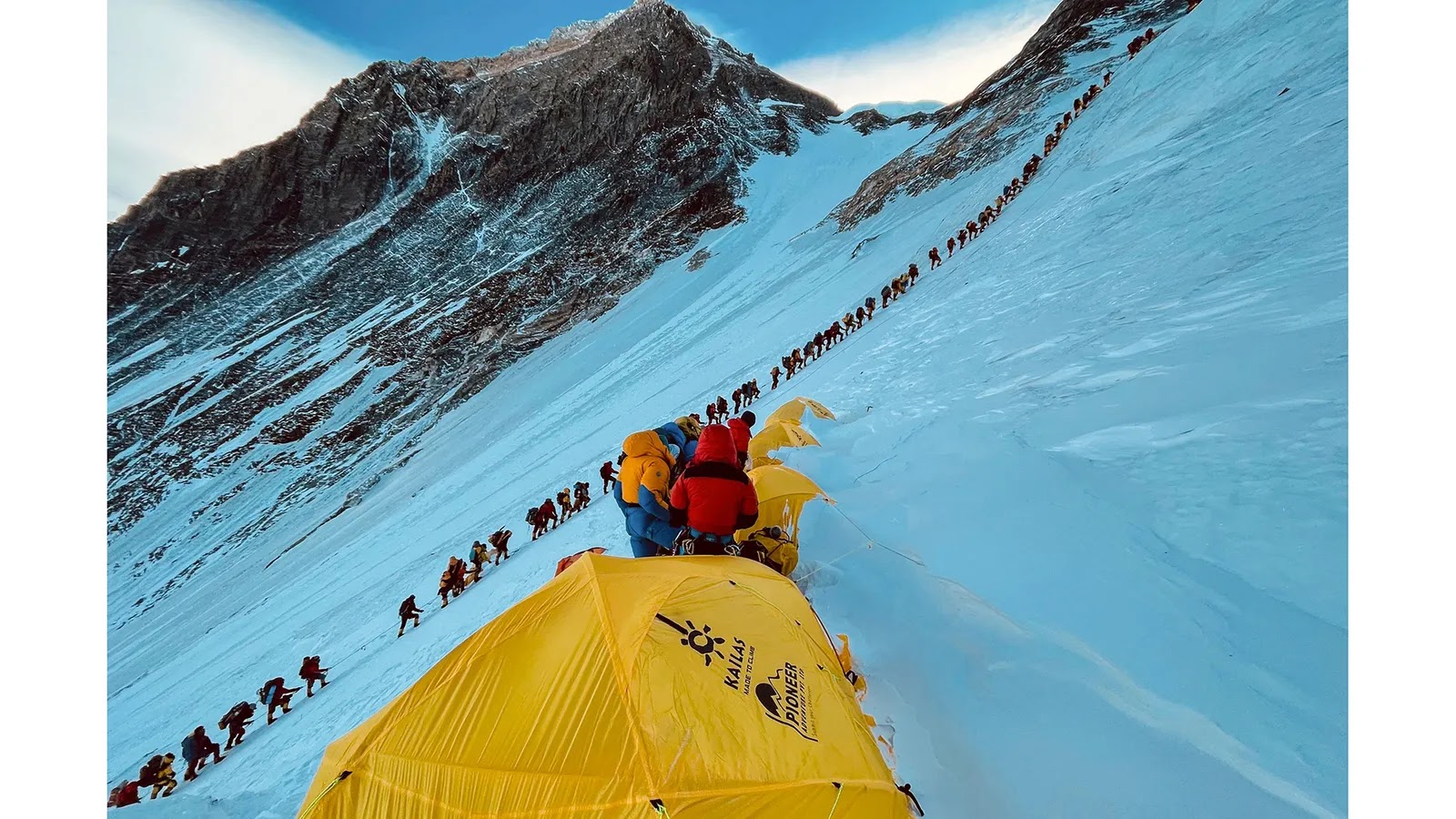

The main routes up Mount Everest have now become so popular with climbers that long queues can form (Credit: Lakpa Sherpa/AFP/Getty Images)


Many of the highest peaks in the world, including Everest, have permanent snow caps that help protect them from this wind-blown barrage. Rock covered in a soft blanket of snow suffers less weathering and erosion than bare rock, says Headley. It also protects the rock from chemical reactions with the air that can gradually degade the minerals in the limestone that comprises much of the uppermost parts of Mount Everest. But there are still places where the rock is exposed to the elements.


"For a tall mountain range, you can basically get to such a steep angle in the rock that it can't actually support ice, and snow, and then you start to get avalanches, and you get bare rock," says Elmore. Rock falls and land slides – a constant hazard on Everest and the surrounding area – both play a role in shaving away at Everest's height, and rivers too. They have been estimated to be cutting gorges into the rock at a rate of between 4-8mm (0.2-0.3in) a year.


But the exact impact erosion has on a mountain's height is still to be understood. Some scientists believe that reducing the weight of a mountain (by taking away the snow, ice and rock it's made of) might actually allow the tectonic plates to push the, now lighter, mountain even further into the sky. 


Headley's colleague Terry Pavlis, who was the lead investigator on the St Elias Erosion Tectonics Project (Steep), explains that, on a large scale, "erosion attacking a landscape allows it to rise up".


In some parts of the world, entire landmasses are still rearing up after the last ice age – something known as isostatic rebound. Parts of North America and northern Europe, including Scotland, are rebounding after the rocky crust there was squashed by enormous continental ice sheets that waxed and waned during the Pleistocene. According to one study by researchers at Germany's University of Postdam, up to 90% of the uplift in the European Alps can be explained by this surprisingly elastic response to the end of the ice age. Experts believe similar glacial isostatic rebound may have taken place on the Tibetan Plateau and in the Himalaya as the ice age glaciers receeded – contributing between 1-4mm (0.04-0.16in) a year to the uplift.


"But there's some kind of equilibrium between how fast that landscape can erode and how high those peaks can get," adds Pavlis.


The exact details of this equilibrium are still being explored. In a region like the Appalachians in north-eastern North America, or the Scottish Highlands, erosive forces like rivers and landslides are cutting mountains down lower and lower, Headley says. "But in regions with tectonic activity, the tectonic force can be driving the mountains up slower, faster, or at around the same rate as the erosion is cutting it down. We don't fully understand all the drivers in those types of systems."
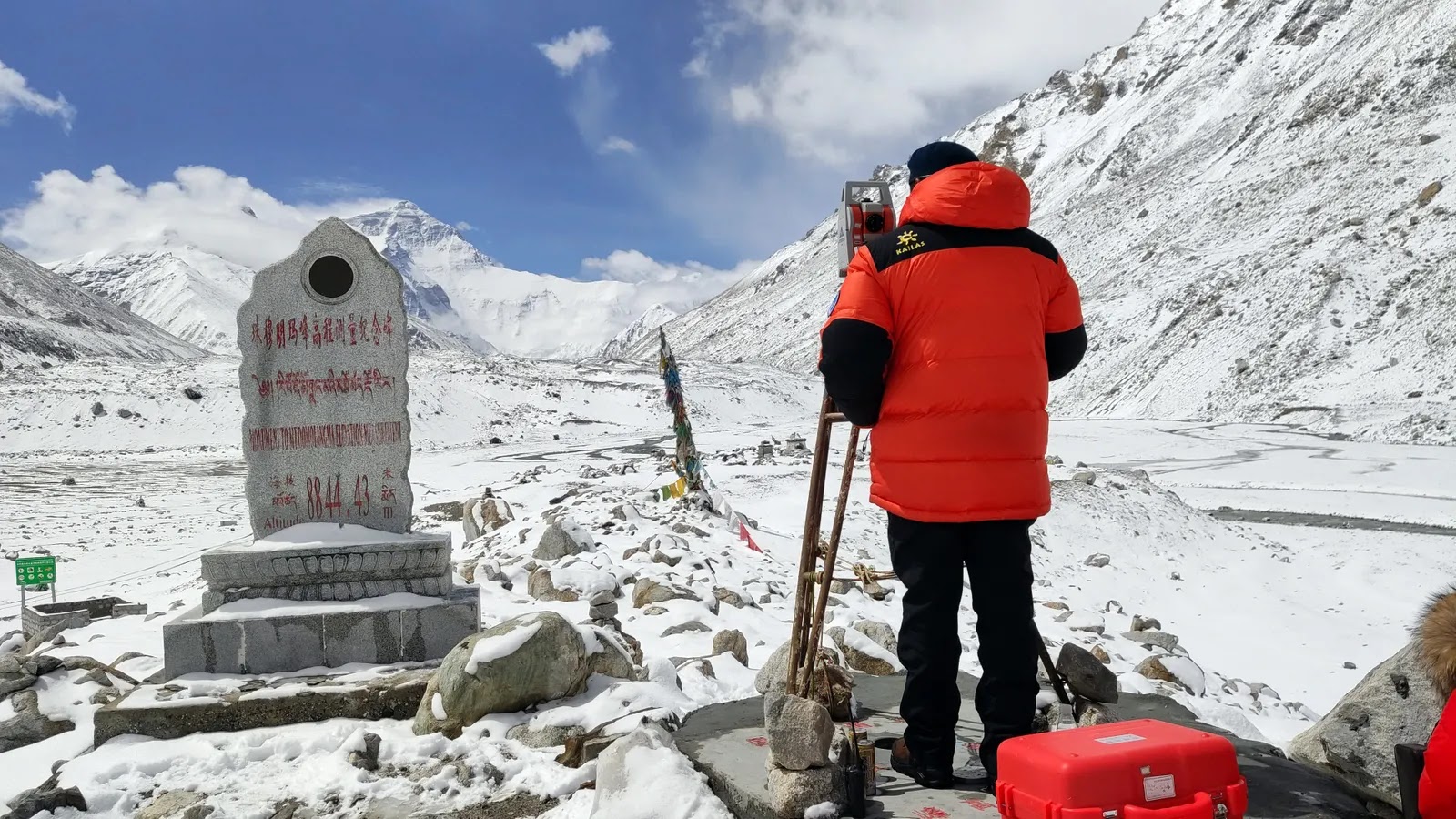

The most recent official height for Mount Everest was agreed following Chinese and Nepalese surveying expeditions to the summit (Credit: VCG/Getty Images)


So how are mountains actually measured nowadays? One of the most common instruments used is the Global Navigation Satellite System (GNSS), which records the precise position of the mountain peak using a network of satellites. GNSS can "measure heights to the millimetre," according to Pavlis. The challenge, for a mountain like Everest, has always been the weight of the equipment. "It's hard enough to get to the peak – try adding a 30lb (13kg) instrument," he says.


A helicopter taxi to the top with the heavy luggage is out of the question – the thin air around Everest's summit means the engine can't produce enough power and there's too much drag from the rotor blades to operate safely. The strong winds and jagged creeks also make touching down anywhere near the summit dangerous. One helicopter pilot did set a world record by touching down briefly on top of Mount Everest in 2005, but only after the manufacturer stripped it bare of every unessential item to make it feather light.


Luckily, GNSS systems have gotten smaller over the years. Now they weigh more like 1.2kg (2.6lbs) and are "about the size of a lunchbox, maybe a little smaller", says Pavlis. But the devices still need batteries, which can struggle in cold temperatures. The average temperature at the summit of Everest during the summer monsoon months is a balmy -19C. And there are other complications too. "There's an antenna that's about, you know, half a metre in diameter. And those have to be set up somehow so that they are absolutely stationary," Pavlis explains. 


To gather millimetre-accurate results the instrument then has to record for several hours. In the thin air of Everest's "death zone", operating these instruments can be hazardous for surveyors. Members of a Nepalese expedition to take GNSS measurements on Everest in 2019 spent two hours on the summit – far longer than most who make their way there – after arriving at 03:00 in the pitch black and biting cold.


Another option, often used in addition to GNSS for the most accurate readings, is Ground Penetrating Radar (GPR). "GPR uses radar pulses to image below the surface, so it can tell us the thickness and internal structure of snow and ice overlying the rocks on Everest's summit," says Elmore. "There's something like 4m (13ft) of snow and ice on the top of Mount Everest, but that can change depending on the climate."


The mountain that measures the greatest distance from the centre of Earth to its peak is Chimborazo in Equador, at 10,920m (35,826ft)


While Elmore and her team were conducting their own scientific experiments on Everest they leant the Nepalese expedition a GPR device so they could take measurements from the summit. "It had to be a specific design of GPR, one that was super lightweight so [it could be carried] to the top of Everest, but that also had the right transmitter and receiver to measure the ice," says Elmore. The device had recently been used at the summit of Denali, the tallest mountain in the US, so they knew it was up to the job.


Despite the many hurdles they faced, the Nepalese team's expedition to measure the height of Everest was successful. They had hoped to answer questions about whether a deadly 7.8 magnitude earthquake that hit Nepal in April 2015 had affected Mount Everest's height. Initial reports indicated the mountain had shifted 3cm (1.9in) to the south-west by the large earthquake, which killed 9,000 people and damaged hundreds of thousands of homes, but had not changed its height.


The project, however, soon became muddied with international politics. A few months later a team of Chinese surveyors conducted their own measurements during an expedition from the other side of the mountain. They had their own figure, which didn't include the snow cap. The Nepalese figure, on the other hand, did. In October 2019, the two countries decided to combine their data and in December 2020 they released the figure for the new official height – 8,848.86m (29,032ft), including the snow on top.


As China and Nepal found, deciding exactly what you measure, and how you measure, is fundamental to establishing a mountain's height. For example, to agree upon how tall a mountain is, we must first agree on where the bottom is. But that's not as easy as it might sound.


For centuries mountains have been measured using sea level as the base from where their height is calculated. But the Earth is not perfectly round: it bulges along the equator. And sea level isn't static, it is pulled and changed by our planet's gravity. Plus, Everest isn't sticking out of the ocean, it's nestled among a landscape of other mountains. 


Many complex calculations have to be done to establish where sea level would actually be, and Everest's relative height to it. When that starting point is changed, everything changes.


The Himalayas began rising around 45 million years ago as the Indian and Eurasian continental plates collided (Credit: Rik Olde Engberink/Alamy)


But let's say scientists started their measurements from the core of the planet instead. Everest would no longer be considered the tallest mountain on Earth. The mountain that measures the greatest distance from the centre of Earth to its peak is Mount Chimborazo, in Equador at 10,920m (35,826ft). What about starting from the seabed? The accolade of tallest mountain would then go to Mauna Kea, a volcano in Hawaii that arches 10,000m (32,808ft) from the ocean floor.


Looking beyond our own planet, we can see examples of just how enormous mountains can become. Olympus Mons, a volcano on Mars, towers 21km (19.2 miles) into the sky and stretches 624km (388 miles) wide. It is roughly the size of the state of Arizona. Because gravity on Mars is weaker than on Earth, and because Mars doesn't have tectonic plates shifting and colliding beneath the surface, the ooze of lava that flowed out of the Martian volcano in the planet's past was able to grow to monstrous proportions.


Could Everest become a similar giant? In the 1980s, a researcher at the Cavendish Laboratory in Cambridge, UK, attempted to estimate what such a limit might be on Earth, taking into account the strength of gravity and the strength of the rock underlying the mountain. The calculations, which made "no presensions to serious geophysics" estimated the theoretical maximum height of a mountain range with a granite base – as Mount Everest largely has – to be 45km (28 miles) on Earth. 


But there are a number of barriers – apart from our planet's relentless weather – that might stand in the way of this, according to Headley. For starters, "you would eventually run out of your tectonic forces, and then it would stop growing", she says. Scientists believe that eventually the Earth's mantle will cool to such a degree that the planet-wide dance of plate tectonics will end. Until then, earthquakes and landslides will also erode away the mountain too.


"At some point, [the mountain] becomes so steep that it's unstable and chunks start falling off," Elmore says.

With the wind, snow and ice buffeting, cracking and splitting the rock, Everest is unlikely to ever reach the sizes seen on Mars. "We have our weather systems, and weather is really good at creating erosional forces," Headley says. "Basically, the fact that we have water, whether in the form of ice or snow, or just rain, is what really can limit mountain growth."


For now, Everest keeps edging, bit by bit, into the sky as other forces try to tear it down. Elmore's 2019 team discovered global warming was yet another of these, driving considerable thinning of the snow and ice on the upper reaches of the mountain in recent decades and revealing more bare rock to the erosive impacts of weather.


Olympus Mons, a volcano on Mars, towers 21km (19.2 miles) into the sky and stretches 624km (388 miles) wide


Everest is also far from being the fastest-growing mountain on our planet. The closest contender for the top spot is perhaps Nanga Parbat, a neighbour to Everest located in the Pakistani Himalayan range, which is 8,126m (26,660ft) tall and growing at 7mm (0.27in) per year. In 241,000 years it could overtake Everest to be the tallest mountain on Earth, provided rates of erosion don't change.


Others, such as those in the Swiss Alps, are also growing rapidly thanks to an imbalance in the amount of erosion taking place. Scientists found that uplift is more than 50 times faster than any negative effects from erosion here. But the Swiss Alps are far shorter than Mount Everest and most studies suggest the mountains there are currently growing at 2-2.5mm (0.08-0.1 inches) per year. 


Meanwhile, Everest retains its allure as a mountain at the extreme of what can be found and endured here on Earth. Its reputation as the highest peak on our planet continues to attract climbers from all over the world, even as its height continues to shift.


Over a video call I ask Billi Bierling, a mountaineering journalist who hiked Everest herself in 2009, whether an extra millimetre, metre or mile higher matters to people like her. She is relaxing on the sofa at her mother's house in Germany, preparing to head back to Nepal for the summer season in March.


"The exact measurement doesn't matter," she says, laughing warmly at my question. "What matters is that it's the highest, and that you go to the highest point. If you're having a bad day, or someone is not very nice to you, or they put you down, you can think to yourself, you know what? I've climbed Everest."


For most who reach the summit, it is simply being there that counts.


(Source: BBC)

Saturday, 17 July 2021

The rise and fall of the world’s largest lake

 When continental plates smashed together about 12 million years ago, they didn’t just raise new mountains in central Europe—they created the largest lake the world has ever known. This vast body of water—the Paratethys Sea—came to host species found nowhere else, including the world’s smallest whales. Two new studies reveal how the ancient body of water took shape and how surrounding changes helped give rise to elephants, giraffes, and other large mammals that wander the planet today.

To build that timeline, paleo-oceanographer Dan Palcu of the University of São Paulo and his colleagues at the main campus assembled clues from geological and fossil records. At its largest, the body of water—which some scientists consider to have been an inland sea—stretched from the eastern Alps into what is now Kazakhstan, covering more than 2.8 million square kilometers. That’s an area larger than today’s Mediterranean Sea, they write this week in Scientific Reports. Their analyses further estimate the lake once contained more than 1.77 million cubic kilometers of water, more than 10 times the volume found in all of today’s fresh- and saltwater lakes combined.


At its largest, the megalake Paratethys (shown superimposed on modern geography) stretched from the eastern Alps to today’s Kazakhstan. DAN PALCU; NATURAL EARTH


But climate shifts caused the lake to shrink dramatically at least four times in its 5-million-year lifetime, with water levels falling by as much as 250 meters between 7.65 million and 7.9 million years ago. During that largest episode of contraction, the lake lost as much as one-third of its water and more than two-thirds of its surface area. That sent water salinity in the lake’s central basin—which closely matches the outlines of today’s Black Sea—skyrocketing, from about one-third as salty as today’s oceans to a level on par with seawater.


Those shifts wiped out many aquatic species, including numerous species of single-celled algae and other small free-floating organisms, the researchers report. Creatures that could survive the brackish water, including some mollusks, survived to repopulate the lake when it expanded during wetter times, Palcu says.


The Paratethys soon became home to a wide variety of mollusks, crustaceans, and marine mammals found nowhere else on Earth. Many of the whales, dolphins, and seals living there were miniature versions of those found in open seas, says evolutionary biologist Pavel Gol’din of the National Academy of Sciences of Ukraine’s I. I. Schmalhausen Institute of Zoology, who was not involved with the work. One species, the 3-meter-long Cetotherium riabinini—1 meter shorter than today’s bottlenose dolphin—is the smallest whale ever found in the fossil record. Such dwarfism might have helped these animals adapt to a shrinking Paratethys, Gol’din says.


The changes to the climate that triggered lake shrinkage also influenced the evolution of land animals, says evolutionary biologist Madelaine Böhme of the University of Tübingen. As water levels dropped, the newly exposed shorelines became grasslands—and hot spots for evolution, she notes.


The Paratethys Sea was home to many species found nowhere else, including Cetotherium riabinini (depicted with human for scale), the smallest known whale in the fossil record. PAVEL GOL’DIN; LENA GODLEVSKA/WIKIMEDIA COMMONS


Recently, Böhme and her colleagues focused on the geological record in western Iran, where sediments chronicle repeated long-term changes in climate. The fossil record shows that in areas north of the Paratethys, the ancestors of modern-day sheep and goats roamed side by side with primitive antelope. And in what is now western Iran, south of the lake, the progenitors of today’s giraffes and elephants thrived.


Four lengthy dry periods that occurred between 6.25 million and 8.75 million years ago likely drove those creatures to migrate southwestward into Africa, Böhme and her colleagues reported last month in Communications Earth & Environment. Here, they evolved to produce the diversity of creatures for which today’s African savanna is famous.


The Paratethys was destined for a sadder fate. It ceased to exist sometime between 6.7 million and 6.9 million years ago, when erosion created an outlet at the lake’s southwestern edge. This outlet—which is likely now submerged beneath the Aegean Sea—birthed a short river that eventually found its way to the Mediterranean. But the massive lake had one last hurrah, Palcu says: The water draining from it likely carved “an impressive waterfall” as it flowed down to the sea.


(Source: Science Mag)

Wednesday, 21 October 2020

Unique vine 'greenhouses' found by 91-year-old nature volunteer in Yamagata

 An unusual vine discovered by a 91-year-old volunteer nature guide in Japan has a “unique” way of using its leaves to curl around its fruits to envelop them in a protective microclimate, scientists have said.

The cucurbitaceous vine, a type found in East Asia, is an oddity because while leaves come in all shapes and sizes and perform a crucial role in photosynthesis, they are rarely associated with reproduction.


But a new study published in the journal Proceedings of the Royal Society B: Biological Sciences found that the vine had specialized leaves able to enclose fruit and enhance seed production in colder conditions.


Nobuyuki Nagaoka, a guide at Yamagata Prefectural Natural Museum Park, discovered the unusual vine in 2008 and has observed it every year since. | KYOTO UNIVERSITY / SHOKO SAKAI / VIA AFP-JIJI


The research was co-authored by Nobuyuki Nagaoka, a 91-year-old guide at Yamagata Prefectural Natural Museum Park, who first spotted the leaf behavior in 2008 and has observed it every autumn since.


Intrigued by the strange leaf “greenhouses,” he looked online for information about the vine, said co-author of the study Shoko Sakai, a professor at the Center for Ecological Research at Kyoto University.


“Our newsletter published in 1998 had an article about this plant. He saw the article and sent me a letter in 2008,” Sakai said.


He said initially when he saw a picture of the leaf enclosure he thought “it was a maldeveloped or pest-infected shoot.”


But “when we read subsequent observation records he sent to us, it became clear that this was an interesting phenomenon worth further investigation,” he said, adding that it was only when the researchers examined the real thing that they could confirm what it was.


“When I saw it, I was excited to find out that they were indeed leaves,” Sakai said.


The researchers looked at plants at different altitudes at the foot of Mount Gassan, in the southern part of the Dewa Mountains, in an area partly within Yamagata park.


They describe the vine as a slender, annual plant that often inhabits the edges of deciduous forests with disturbances like roads, rivers or mountains.


It can either be hermaphrodite or male and produces small, white flowers pollinated from August to September which later develop into fruits, each with a single seed.


The study, which also included experts from Japan’s Forestry and Forest Products Research Institute, reported “for the first time, a unique function of leaves that enclose immature fruits in an annual vine.”


They noted some leaves on hermaphrodite plants that were undeveloped in summer “expanded and overlapped with each other” to create a sort of cocoon around immature fruit.


The study found that these specialized “enclosure leaves” are produced towards the end of the growing season and produced a microclimate of up to 4.6 degrees Celsius warmer than was recorded around fruit where the leaves had been plucked off.


Removing the leaf enclosures negatively affected the survival and growth of the vine’s fruit, although they were unable to identify the mechanism, said the authors.


They also found that the leaves grew thicker protective layers in colder areas and said the results suggest that the vine enclosures allow the plant to produce seeds under the cold weather the plant encounters at the end of its life.


These enclosure leaves were found to have less photosynthetic ability and were different in greenness and structure from others.

he vine has a ‘unique’ way of using its leaves to curl around its fruits to envelop them in a protective microclimate. | KYOTO UNIVERSITY / SHOKO SAKAI / VIA AFP-JIJI


Previous research has described some functions of leaves that aid reproduction, such as the plant Saururus chinensis, whose leaves can temporarily turn white to attract pollinators.


But the study said such traits were likely “in conflict with traits that promote photosynthesis, the primary function of leaves”.


“Plants produce many leaves in their lifetime. Size, shape, and thickness among the leaves are often very diverse within an individual,” said Sakai, adding that previously this had been viewed in terms of photosynthesis.


“In this study, we found that some leaves play more important roles in reproduction rather than photosynthesis.”


The research was Nagaoka’s first scientific paper, Sakai said, adding that he was still guiding tours at the park and observing vines.


“I think he should be proud of his paper, but he is very humble,” he added.


(Source: JT)

Wednesday, 10 June 2020

'Everyone is in that fine line between death and life': inside Everest's deadliest queue

A year on from the loss of 11 people on the world’s highest mountain, survivors talk about what went wrong and why

irmal Purja is someone who responds to a crisis by becoming completely calm. When the Nepalese mountaineer saw the line of about 100 people waiting to reach the crest of Everest on 22 May last year, he knew there was no way he could overtake the slower climbers. Mentally, he abandoned the record he was attempting, for the fastest climb between the neighbouring peaks of Lhotse and Everest.

Poor weather at the start of the climbing season had meant there was only a very small window of time in which people could attempt the summit – just three clear days. In 2018, the year before, there had been 11 good days, allowing climbing companies to stagger their teams. Purja had known there would be queues, but was taken aback by the numbers.
Nirmal Purja’s photo of the Everest summit queue, May 2019. Photograph: published with permission of Nirmal Purja

Purja, a 36-year-old veteran of the Royal Navy’s elite Special Boat Service, has climbed Everest four times, and was philosophical. “It is what it is. I always try to stay calm on the mountain,” he tells me, speaking from his home in Winchester. In normal circumstances, he would have been up Everest this year, but he is defusing the frustrations of lockdown by writing a book about climbing all 14 of the world’s highest mountains in just 189 days last year.

Summits can be a disappointment when you see that number of people taking selfies in such a spiritual place

He took a picture of the queue at the top of Everest, which he later posted on Instagram, mainly as an explanation to his sponsors and supporters – a vivid image of the obstacle that had slowed him down. Then he tried to assess how he could help. He knew things could go catastrophically wrong, and quickly; this stretch of Everest, from the sheer rockface of the Hillary Step to the summit, was the most exposed part of the climb, with drops of up to 3,000 metres (9,842ft) on either side. As people queued, they got colder and used up unplanned-for quantities of their oxygen supplies. It was literally the worst place on Earth to get stuck in a queue.

Looking at the line, with climbers travelling in both directions, Purja realised it would be impossible to rescue anyone who needed to be taken off the summit fast. Every climber was clipped to a safety rope, and the path is too narrow to allow the more experienced climbers to unclip and pass the slower climbers. The queue continued to build. Purja couldn’t be confident that other climbers would be helpful in an emergency. “If you have to drag a body through that, no one would be able to give up the path to them. 

There is no path, and people are in their own survival state at that altitude, struggling to put one foot in front of another. Everyone is in that fine line between death and life.”
Nirmal Purja at the summit of Everest in May 2019. Photograph: published with permission of Nirmal Purja

Purja paused at Hillary Step and tried to quell flaring tensions between climbers; there were arguments about whether the people trying to get to the summit should be given priority over those trying to descend. “I managed the queue for two hours. Rather than people fighting over who should go up first, it’s better if it is managed systematically,” he says. He worked out who had been waiting in critically cold conditions for the longest and prioritised them, and tried to calm the other climbers, taking off his mask to issue instructions.

Purja’s experience and military background meant that climbers were happy to be guided by him. Elsewhere, local Nepalese guides were finding it harder to convince their clients that they needed to turn back. There was a dangerous clash between the typically alpha-plus personalities of people who want to summit Everest and their guides, who are dependent on their fees for survival.

“When people are in stressful situations, they do shout,” Purja says. 

“You can only get a few words out at that altitude: ‘Move faster! Come off!’ I disagree with it, but people come to Everest carrying a huge financial burden. Not only that, but they have spent more than two months and a lot of effort to be ready. That’s why everybody rushes for the top.”

A year on, Thomas Becker tells me he remains disturbed by the behaviour he witnessed while queueing to reach the highest place on Earth. He is a lifelong climber, although it was his first attempt at Everest. He describes the experience as being “very Lord Of The Flies”. At the worst part of the queue, he was stuck in a line of around 40 climbers, behind a woman who was struggling. He had never met her and didn’t know her name, but was worried by how inexperienced she seemed, unable to use her ice axe. He spent several hours helping her, so that he could shuffle forward himself, patiently advising her where to put her feet and catching her when she slipped. Behind them, tempers began to fray and climbers started swearing: “Fucking get moving!”, “Get the fuck off here!”, “What the fuck are you doing?”
Thomas Becker, who teaches law at Harvard, describes queuing on Everest as ‘very Lord Of The Flies’. Photograph: courtesy of Thomas Becker

Becker, a former rock guitarist who teaches human rights law at Harvard, was startled by the ruthlessness of his fellow climbers. Earlier in the day, he had discovered that someone had stolen eight of the oxygen tanks his team had stashed by their tents at base camp, which meant he was climbing the most dangerous stretch of the mountain with just two canisters instead of six. The theft was “disappointing”, he says now, with polite understatement. “There is a code of ethics on the mountain that you don’t steal anyone else’s oxygen, because it could be fatal.” He was also puzzled. “This is not the norm. Sometimes, someone might take one to stay alive, but to have a big chunk of tanks stolen... The folks we were with said this was the first time they had ever seen anything like that.”

He managed to feel a brief sense of elation as he embarked on the final stretch, edging closer to an ambition he had held since reading about Everest as a child. But it was a fleeting sensation. “It became less exciting when we started to see people being brought down, dead bodies. It became sad quickly.” By the time he got to the summit, he had walked past a number of corpses. “Just 10 minutes shy of Hillary Step, there was a guy attached to a rope who had passed away, dangling there. I think I saw five bodies that day, six maybe. There are people literally lying in your path, frozen,” he says. “It’s brutal.”

There are people who call up and ask: ‘I’ve never climbed anything. Can I go with your company? And I need a discount’

Purja’s startling images of the queue at the top of Everest quickly went round the world. People who know nothing about mountaineering were shocked by this contradiction between the mountain’s reputation as a lonely and unattainable peak, and the banal reality of a rush-hour crush. But it was more than banal: 11 people died on Everest that May, more than twice the number of climbers who had perished the previous year – a figure widely attributed to the crowded conditions and the extra physical stresses caused by waiting in temperatures of -30C, at an altitude where oxygen levels are not sufficient to sustain human life. Climbers call it “the death zone”.

But within the climbing community, people were less surprised. Last year’s was just a more extreme version of the bottlenecks that have been troubling the mountain with increasing frequency. The deaths were not caused by the queue itself, they argue, but a different problem: the rising numbers of inexperienced climbers who view Everest as the ultimate selfie destination, and the proliferation of companies willing to take their money and let them have a go, regardless of their ability.

“There are people who call up and ask: ‘I’ve never climbed anything. Can I go with your company? And I need a discount,’” says Greg Vernovage, Everest expedition leader with International Mountain Guides, a well-established climbing firm. “Unfortunately, there is probably a company out there now that will take them. It’s very easy to jump on your computer and dig around for the lowest common denominator.”
‘Climbers don’t know the risks and aren’t concerned with them,’ says expedition leader Greg Vernovage, centre, with his team. Photograph: courtesy of Greg Vernovage

Last year, 381 permits to climb the mountain were issued by the Nepalese government (a record number, 35 more than the previous year). The cost of climbing Everest varies wildly; cut-price operators will offer to take you up for as little as $30,000 (£24,600) – a price that includes the $11,000 (£9,000) permit – or you can pay $200,000 (£164,000) if you want to stay at the best hotels in the Nepalese capital of Kathmandu and be taken by the most experienced guides. Last autumn, Nepal’s Ministry of Tourism showed no sign of wanting to restrict the numbers of permits issued after last season, encouraging more people to come “for both pleasure and fame”.

There is suspicion that less well-established guides and companies find it harder to tell tourists they need to turn back if they see them struggling. “Just like a kid thinks they can eat a whole bag of candy without getting sick, climbers just want to stand on top. They don’t know the risks and they aren’t concerned with them,” Vernovage says. “Companies need to be a bit more forceful with clients. Just because you pay the money, that doesn’t give you a ticket to be on the summit team. I’ve had that difficult conversation with people.”

The cheaper firms have fewer backup staff, lower supplies of spare oxygen and less ability to manage things when dangerous situations arise. Purja, who runs his own climbing company, attributes the higher number of deaths in 2019 not so much to the numbers on the mountain as to the growth of cheaper operators, who employ less experienced guides. “We have backup people to help clients who are struggling. If everyone had been climbing with that support, no one would have struggled.”

Four Indian climbers were among the dead last year, leading to speculation that lower average salaries in India result in these climbers choosing cheaper tour operators, with tragic consequences. Attempting the mountain is expensive, so climbers are sometimes older, at the end of their careers, with expendable income but less physical stamina.

I saw people take 14 hours to cover a distance that took me two – people who usually have nothing to do with mountains
‘Most of these deaths were predictable,’ says David Göttler, who was climbing without oxygen and had to turn back because of the queues. Photograph: David Göttler

There has been no climbing season this year. The view from the ground has been spectacular: the disappearance of a pollution haze means the snow-capped peaks of Everest have been visible from Kathmandu for the first time in decades. But the only people on the mountain are a small group of Chinese researchers and surveyors – there to place 5G masts, and to mark the 60th anniversary of the first Chinese ascent of the north side of the mountain.

On 13 March, Nepal’s government locked down Everest, announcing that no climbing would be allowed on the mountain because of the Covid-19 pandemic. Police have patrolled the roads nearby to prevent anyone approaching. The cooks, porters and guides who help international tourists attempt the summit have mostly returned to their villages. With the disappearance of a year’s income, many have been pushed into destitution; a number of climbers have launched fundraisers to help Everest workers feed themselves and their families.

“I’m doing fine, I’m in England, I’ve managed to get income from my book,” Purja says. “But the community there is suffering. Some people don’t even have food to put on the table. It’s the saddest thing.”

***

David Göttler is a German climber who attempted the summit last May. As soon as he saw the queues at the top, he understood he was going to have to turn around. He was making an entirely self-sufficient attempt to summit, carrying his own kit and without oxygen – the most intensely challenging way to climb the mountain. 
‘It can be a good reality check; it reinforces the gravity of it all,’ says US guide Garrett Madison of seeing dead climbers. Photograph: courtesy of Garrett Madison

“There are only a tiny fraction of people who can climb without oxygen,” he says. He views its use as a form of cheating, “like doping, like an enhancing drug”. But without oxygen, it was too risky to wait in line. He abandoned his climb around 100 vertical metres from the summit. It wasn’t the crowds that surprised him: “You don’t go to Everest for a lonely adventure,” he says. But he was dismayed by the slowness of the people ahead of him.

“I saw people who took 14 hours to cover a distance that took me two hours – these are people who usually have nothing to do with mountains. I have the feeling that they hear Everest is a nice thing to do and say: ‘Let’s do it!’”

It was this inexperience that caused the spike in deaths, he says. “I don’t want to sound hard or without feelings, because it’s a tragedy for the families, but most of these deaths were predictable. It is surprising that there are not more of them, given how unprepared and naive people are. They pay the money and hire an agency, and think that this is a summit guarantee.”

Elia Saikaly, a Canadian film-maker, was on Everest last year to make a documentary about a team of four women from Saudi Arabia, Oman and Lebanon. Like Göttler, they made their ascent the day after Purja’s photograph was taken, when the queues were still long. Saikaly had attempted Everest many times before, and succeeded on two earlier occasions. But he remains troubled by what he saw that day; he is now making a film about how his attitude to the mountain was changed by his experiences.

There were between 25 and 40 people on and around the summit when Saikaly arrived at the tiny plateau at the top, a patch of mountain not much bigger than the surface area of a couple of ping-pong tables. He felt subdued as he arrived there. “I didn’t want anything to do with it, to be honest. Summits can be a bit of a disappointment, when you see that number of people taking selfies in such a spiritual place,” Saikaly says. “It wasn’t the pure experience it once was. The loss of life is very challenging. It makes you question why people do this and why you are there. We celebrated quietly.”

Becker also had mixed feelings as he stood at the peak, contemplating his achievement. “There wasn’t an ‘I found God’ moment at the top that some people say they have. I was torn,” he says. “I’ve dreamed about climbing it since I was a kid. But I think the 13-year-old me would have found it upsetting to go to the mountain and see it like that.”

Becker says he felt alienated by the “almost colonialist culture of must-conquer-the-mountains”. Some of his fellow climbers had already conquered figurative mountains in their business careers. 

“They think, because of that, they can conquer the mountain. There are people who paid six figures to get to the top and so they think: ‘I’m going to get my money’s worth. I must make it to the top of the mountain, who cares what happens?’ I think it draws certain people who will be happy to go to the top, at almost any cost to themselves and others.”

As well as this nagging ambivalence, Becker was in physical difficulty: his attempts to ration his depleted oxygen supply had led to his tank freezing; his mask had frozen on to his face and beard, the condensation inside it creating a cascade of ice down his front; his goggles were frozen to his suit. Without goggles, he was worried about developing ice blindness in the glare of the sun on the descent.

Most of all he, like other climbers on Everest last year, was very shaken by the experience of having to walk past so many dead climbers. Garrett Madison, a US guide who was climbing with Saikaly, says it is something climbers see every year, but remains hard to get used to. “For a first-time climber, it can be shocking,” he says. “It can be a good reality check; it reinforces the gravity of it all.”

Conditions are so harsh at the summit that it is usually impossible to expend energy on carrying bodies back. “It is a major effort to bring a corpse down,” Madison says. “It is not like you can just chuck them on your back and trot on down.”

Becker was unable to avert his eyes. “The first person had the same boots as me, the same scrawny build as me. It was scary – he looked like me. I imagined myself in that situation, and I very much did not want to be in that situation. I was just sad for this guy. I thought about his family – does he have kids or a wife, or parents? What are they going to think?”

Worse was a sense that some seemed unconsciously to revel in the danger. “I’m not saying that anyone saw a dead body and thought: ‘Oh, this is great!’” he says. “There were some people who seemed upset about it. But there were others whose attitude was – and I’m speculating – ‘Wow, this is such a dangerous mountain, and I made it!’ It almost made it more romantic that they made it to the top despite these deaths. That attitude was pretty uncomfortable.”

***

In the wake of last year’s queues, there has been renewed discussion in Nepal about how better regulation of firms and climbers could be introduced. Some trekking firms would like firmer control of how many climbers can attempt the summit on a given day. A government panel recommended that anyone applying for a permit must in future show that they have successfully completed a 6,500 metre (21,325ft) climb, but the proposals had not been implemented before Covid-19 prompted lockdown. The damage caused to the country’s tourist industry may have reduced the willingness to regulate.

This April, a team of Nepalese soldiers had been due to mount an expedition to remove the mess that has been accumulating on the mountain for years: piles of empty fuel canisters, tents (the climbing company’s logo carefully cut out before they were abandoned, to avoid responsibility), food wrappers and human excrement. But when climbing permits were cancelled, the cleanup operation was also abandoned.

Last year there was a line of people quite literally dying because of the over-commercialisation of the mountain

No one is sure whether the crowds will return next year. Most climbers who were forced to cancel trips this spring would like to return in 2021, which means the queues could be heavier still, with two years’ worth of tourists attempting to summit at once. But if there is a global economic slump, fewer people will have the spare money to fund this very expensive adventure travel.

Purja hopes that climbers will come back, to restore the livelihoods of the Nepalese climbing community, but he also hopes the next season will be cleaner and less chaotic. Other climbers say last year’s season has made them re-evaluate their attitude to Everest.
“Last year there was a line of people quite literally dying because of the over-commercialisation of the mountain,” Becker says. “People have come to think, if you throw money at it you can get to the top, which brings more inexperienced people to the mountain and more sherpas to work there. It does make me reflect on what kind of climbing I want to do, what’s responsible and doesn’t endanger myself and others. And to think about whether I am perpetuating this culture – the romanticisation of Everest. I worry that, am I in some way part of the problem?”

(Source: The Guardian)