Showing posts with label Vietnam. Show all posts

Friday, 23 April 2021

John Pilger on why the documentary must not be allowed to die

 Breaking the silence and speaking truth to power is the job of the film-maker, writes John Pilger, something that’s perhaps needed more today than ever before.

I first understood the power of the documentary during the editing of my first film, The Quiet Mutiny.


In the commentary, I make reference to a chicken, which my crew and I encountered while on patrol with American soldiers in Vietnam.


“It must be a Vietcong chicken – a communist chicken,” said the sergeant. He wrote in his report: “enemy sighted”.


The chicken moment seemed to underline the farce of the war – so I included it in the film.

That may have been unwise.


The regulator of commercial television in Britain – then the Independent Television Authority or ITA – had demanded to see my script.


What was my source for the political affiliation of the chicken, I was asked. Was it really a communist chicken, or could it have been a pro-American chicken?


Of course, this nonsense had a serious purpose; when The Quiet Mutiny was broadcast by ITV in 1970, the US ambassador to Britain, Walter Annenberg, a personal friend of President Richard Nixon, complained to the ITA.


He complained not about the chicken but about the whole film. “I intend to inform the White House,” the ambassador wrote. Gosh.


The Quiet Mutiny had revealed that the US army in Vietnam was tearing itself apart. There was open rebellion: drafted men were refusing orders and shooting their officers in the back or “fragging” them with grenades as they slept.


None of this had been news. What it meant was that the war was lost; and the messenger was not appreciated.


The Director-General of the ITA was Sir Robert Fraser. He summoned Denis Foreman, then Director of Programmes at Granada TV, and went into a state of apoplexy. Spraying expletives, Sir Robert described me as a “dangerous subversive”.


What concerned the regulator and the ambassador was the power of a single documentary film: the power of its facts and witnesses, especially young soldiers speaking the truth and treated sympathetically by the film-maker.


I was a newspaper journalist. I had never made a film before and I was indebted to Charles Denton, a renegade producer from the BBC, who taught me that facts and evidence told straight to the camera and to the audience could indeed be subversive.


This subversion of official lies is the power of documentary. I have now made 60 films and I believe there is nothing like this power in any other medium.


Journalist and documentary film-maker John Pilger, pictured in Vietnam during the war.


In the 1960s, a brilliant young film-maker, Peter Watkins, made The War Game for the BBC. Watkins reconstructed the aftermath of a nuclear attack on London.


The War Game was banned. “The effect of this film,” said the BBC, “has been judged to be too horrifying for the medium of broadcasting.”


The then chairman of the BBC’s Board of Governors was Lord Normanbrook, who had been Secretary to the Cabinet. He wrote to his successor in the Cabinet, Sir Burke Trend: “The War Game is not designed as propaganda: it is intended as a purely factual statement and is based on careful research into official material … but the subject is alarming, and the showing of the film on television might have a significant effect on public attitudes towards the policy of the nuclear deterrent.”


In other words, the power of this documentary was such that it might alert people to the true horrors of nuclear war and cause them to question the very existence of nuclear weapons.


The Cabinet papers show that the BBC secretly colluded with the government to ban Watkins’ film. The cover story was that the BBC had a responsibility to protect “the elderly living alone and people of limited mental intelligence”.


Most of the press swallowed this. The ban on The War Game ended the career of Peter Watkins in British television at the age of 30. This remarkable film-maker left the BBC and Britain, and angrily launched a worldwide campaign against censorship.


Telling the truth, and dissenting from the official truth, can be hazardous for a documentary film-maker.


In 1988, Thames Television broadcast Death on the Rock, a documentary about the war in Northern Ireland. It was a risky and courageous venture. Censorship of the reporting of the so-called Irish Troubles was rife, and many of us in documentaries were actively discouraged from making films north of the border. If we tried, we were drawn into a quagmire of compliance.


The journalist Liz Curtis calculated that the BBC had banned, doctored or delayed some 50 major TV programmes on Ireland. There were, of course, honourable exceptions, such as John Ware.


Journalist John Pilger, reporting from Vietnam during the war.


Roger Bolton, the producer of Death on the Rock, was another. Death on the Rock revealed that the British Government deployed SAS death squads overseas against the IRA, murdering four unarmed people in Gibraltar.


A vicious smear campaign was mounted against the film, led by the government of Margaret Thatcher and the Murdoch press, notably the Sunday Times, edited by Andrew Neil.


It was the only documentary ever subjected to an official inquiry – and its facts were vindicated. Murdoch had to pay up for the defamation of one of the film’s principal witnesses.


But that wasn’t the end of it. Thames Television, one of the most innovative broadcasters in the world, was eventually stripped of its franchise in the United Kingdom.


Did the prime minister exact her revenge on ITV and the film-makers, as she had done to the miners? We don’t know. What we do know is that the power of this one documentary stood by the truth and, like The War Game, marked a high point in filmed journalism.


I believe great documentaries exude an artistic heresy. They are difficult to categorise. They are not like great fiction. They are not like great feature movies. Yet, they can combine the sheer power of both.


The Battle of Chile: the fight of an unarmed people, is an epic documentary by Patricio Guzman. It is an extraordinary film: actually a trilogy of films.


When it was released in the 1970s, the New Yorker asked: “How could a team of five people, some with no previous film experience, working with one Éclair camera, one Nagra sound-recorder, and a package of black and white film, produce a work of this magnitude?”


Guzman’s documentary is about the overthrow of democracy in Chile in 1973 by fascists led by General Pinochet and directed by the CIA.


Almost everything is filmed hand-held, on the shoulder. And remember this is a film camera, not video. You have to change the magazine every ten minutes, or the camera stops; and the slightest movement and change of light affects the image.


In the Battle of Chile, there is a scene at the funeral of a naval officer, loyal to President Salvador Allende, who was murdered by those plotting to destroy Allende’s reformist government.


The camera moves among the military faces: human totems with their medals and ribbons, their coiffed hair and opaque eyes. The sheer menace of the faces says you are watching the funeral of a whole society: of democracy itself.


There is a price to pay for filming so bravely. The cameraman, Jorge Muller, was arrested and taken to a torture camp, where he “disappeared” until his grave was found many years later. He was 27. I salute his memory.


Former British Prime Minister, Margaret Thatcher.


In Britain, the pioneering work of John Grierson, Denis Mitchell, Norman Swallow, Richard Cawston and other film-makers in the early 20th century crossed the great divide of class and presented another country.


They dared put cameras and microphones in front of ordinary Britons and allowed them to talk in their own language.

John Grierson is said by some to have coined the term “documentary”. “The drama is on your doorstep,” he said in the 1920s, “wherever the slums are, wherever there is malnutrition, wherever there is exploitation and cruelty.”


These early British film-makers believed that the documentary should speak from below, not from above: it should be the medium of people, not authority. In other words, it was the blood, sweat and tears of ordinary people that gave us the documentary.


Denis Mitchell was famous for his portraits of a working-class street. “Throughout my career,” he said, “I have been absolutely astonished at the quality of people’s strength and dignity.”


When I read those words, I think of the survivors of Grenfell Tower, most of them still waiting to be re-housed, all of them still waiting for justice, as the cameras move on to the repetitive circus of a royal wedding.


The late David Munro and I made Year Zero: the Silent Death of Cambodia in 1979.


This film broke a silence about a country subjected to more than a decade of bombing and genocide, and its power involved millions of ordinary men, women and children in the rescue of a society on the other side of the world.


Even now, Year Zero puts the lie to the myth that the public doesn’t care, or that those who do care eventually fall victim to something called “compassion fatigue”.


Year Zero was watched by an audience greater than the audience of the current, immensely popular British “reality” programme Bake Off. It was shown on mainstream TV in more than 30 countries, but not in the United States, where PBS rejected it outright, fearful, according to an executive, of the reaction of the new Reagan administration.


In Britain and Australia, it was broadcast without advertising – the only time, to my knowledge, this has happened on commercial television.


Following the British broadcast, more than 40 sacks of post arrived at ATV’s offices in Birmingham, 26,000 first-class letters in the first post alone. Remember this was a time before email and Facebook.


In the letters was £1 million – most of it in small amounts from those who could least afford to give. “This is for Cambodia,” wrote a bus driver, enclosing his week’s wages. Pensioners sent their pension. A single mother sent her savings of £50.


People came to my home with toys and cash, and petitions for Thatcher and poems of indignation for Pol Pot and for his collaborator, President Richard Nixon, whose bombs had accelerated the fanatic’s rise.


For the first time, the BBC supported an ITV film. The Blue Peter programme asked children to “bring and buy” toys at Oxfam shops throughout the country. By Christmas, the children had raised the astonishing amount of £3,500,000.


Across the world, Year Zero raised more than $55 million, mostly unsolicited, and which brought help directly to Cambodia: medicines, vaccines and the installation of an entire clothing factory that allowed people to throw away the black uniforms they had been forced to wear by Pol Pot. It was as if the audience had ceased to be onlookers and had become participants.


Something similar happened in the United States when CBS Television broadcast Edward R. Murrow’s film, Harvest of Shame, in 1960. This was the first time that many middle-class Americans glimpsed the scale of poverty in their midst.


Harvest of Shame is the story of migrant agricultural workers who were treated little better than slaves. Today, their struggle has such resonance as migrants and refugees fight for work and safety in foreign places. What seems extraordinary is that the children and grandchildren of some of the people in this film will be bearing the brunt of the abuse and strictures of President Trump.


In the United States today, there is no equivalent of Edward R. Murrow. His eloquent, unflinching kind of American journalism has been abolished in the so-called mainstream and has taken refuge in the internet.


Britain remains one of the few countries where documentaries are still shown on mainstream television in the hours when most people are still awake. But documentaries that go against the received wisdom are becoming an endangered species, at the very time we need them perhaps more than ever.


In survey after survey, when people are asked what they would like more of on television, they say documentaries.

I don’t believe they mean a type of current affairs programme that is a platform for politicians and “experts” who affect a specious balance between great power and its victims.


Observational documentaries are popular; but films about airports and motorway police do not make sense of the world. They entertain.


David Attenborough’s brilliant programmes on the natural world are making sense of climate change – belatedly.

The BBC’s Panorama is making sense of Britain’s secret support of jihadism in Syria – belatedly.


But why is Trump setting fire to the Middle East? Why is the West edging closer to war with Russia and China?


Mark the words of the narrator in Peter Watkins’ The War Game: “On almost the entire subject of nuclear weapons, there is now practically total silence in the press, and on TV. There is hope in any unresolved or unpredictable situation. But is there real hope to be found in this silence?”


In 2017, that silence has returned.


It is not news that the safeguards on nuclear weapons have been quietly removed and that the United States is now spending $46 million per hour on nuclear weapons: that’s $46 million every hour, 24 hours a day, every day. Who knows that?


The Coming War on China, which I completed last year, has been broadcast in the UK but not in the United States – where 90 per cent of the population cannot name or locate the capital of North Korea or explain why Trump wants to destroy it. China is next door to North Korea.


John Pilger, during shooting for the film Utopia. This picture was taken at Irrultja, a small community in the Utopia homelands in Central Australia.


According to one “progressive” film distributor in the US, the American people are interested only in what she calls “character-driven” documentaries.


This is code for a “look at me” consumerist cult that now consumes and intimidates and exploits so much of our popular culture, while turning away film-makers from a subject as urgent as any in modern times.


“When the truth is replaced by silence,” wrote the Russian poet Yevgeny Yevtushenko, “the silence is a lie.”


Whenever young documentary film-makers ask me how they can “make a difference”, I reply that it is really quite simple. They need to break the silence.


This is an edited version of an address John Pilger gave at the British Library on 9 December as part of a retrospective festival, ‘The Power of the Documentary’, held to mark the Library’s acquisition of Pilger’s written archive.


(Source: New Matilda)

Tuesday, 14 April 2020

Apple likely to shift iPhone production from China to India, Vietnam

Wistron Corp., one of Apple's manufacturing partners, claimed that they will be shifting their half capacity outside China within a year. The decision comes as learning on how staking up all products in one country could be of trouble in situations like coronavirus outbreak.

However, the move in production out of China has been underway since the trade war between Washington and Beijing reached its zenith last year. With the coronavirus outbreak, things have become a little more clearer. Decisions by companies like Wistron and other Apple Inc. partners including Hon Hai Precision Industry Co., Inventec Corp. and Pegatron Corp., could re-shape tech supply chains.

It has been learned that the big tech companies like Wistron are planning to shift the production part in India along with Vietnam and Mexico, setting aside $1 billion to fund the expansion this year and next. "We understand from a lot of messages from our customers that they believe this is something we have to do," Chairman Simon Lin said on an earnings call.

"They’re happy and appreciate that we can continue to make such a move and they will continue to work with us."

Another iPhone assembler Pegatron has also said that they are hoping to kick-start manufacturing operations in Vietnam by 2021 after setting up a new plant in Indonesia. It said on Friday it had agreed to purchase land and a plant in northern Taiwan.

Apple’s main assembly partner for AirPods, Inventec, said Tuesday it’s preparing to establish a unit in Vietnam.

One of the biggest assemblers Foxconn is also believed to be shifting their operations on the same tunes. The company has facilities in India, where it began churning out iPhones last year, and Vietnam. "Trade, the virus, all these things will make the world very different in the next decade," Alex Yang, the company’s investors relations chief, told investors in a recent call.

(Source: News Heads)

Wednesday, 22 January 2020

How a boy from Vietnam became a slave on a UK cannabis farm

It was a horrifying death for the 39 Vietnamese nationals found in the back of a trailer in an industrial park in Essex, in October last year. The story shone a light on the subterranean world of people smuggling and human trafficking, reports Cat McShane, specifically the thriving route between Vietnam and the UK.

Ba is slight for 18. His body shrinks into a neat package as he recalls his experiences. We're sitting in a brightly lit kitchen, a Jack Russell dog darting between us under the table. Ba's foster mum fusses in the background, making lunch and occasionally interjecting to clarify or add some detail to his account of his journey here from Vietnam. She wants to make sure his story is understood.

Ba's lived here for nearly a year. He was placed with his foster parents after being found wandering, confused and scared, around a train station in the North of England, with just the clothes he was wearing. "You feel safe now though, don't you?" his foster mum asks, needing affirmation that the mental and physical scars Ba wears will heal with enough care.


His story is one both extraordinary, and typical of the growing number of Vietnamese men and women recognised as being potential victims of trafficking in the UK. For several years, Vietnamese have been one of the top three nationalities featured in modern slavery cases referred to the National Crime Agency, with 702 cases in 2018.


The Salvation Army, which supports all adult victims of modern slavery in the UK, says the number of Vietnamese nationals referred to them over the last five years has more than doubled. It's estimated 18,000 people make the journey from Vietnam to Europe each year.

Ba believes it was a Chinese gang that trafficked him to the UK. He was kidnapped off the streets of Ho Chi Minh City, where he was a street child, an orphan who slept in the bend of a sewage pipe. He sold lottery tickets for money, although older men sometimes beat him and grabbed his takings.

A 2017 Unicef report described Ho Chi Minh City as "a source location, place of transition and destination of child trafficking". And a 2018 report by anti-trafficking charities said numerous trafficked Vietnamese children had reported being abducted while living on the streets.

That's what happened to Ba. "An older man told me that if I came with him, he could help me earn a lot of money. But when I said no, he put a bag over my head. I couldn't believe what was happening," he says. He was then bundled into a small van, bound as well as blindfolded, his shouts stifled.

Somewhere along the way, Ba's captors changed, and now he couldn't understand the language they spoke. When they finally came to a standstill and the bag was removed, Ba found himself in a large, empty, windowless warehouse in China, and was told to wait. "I knew they were preparing to send me somewhere to work," he says.

During the months that Ba was held there, a guard regularly beat him. "I don't know why," Ba says with a shrug, "there was no reason." When he was caught trying to escape, his punishment was far worse than kicks and punches - the guard poured scalding water over his chest and arms.

"It was agony. I was shouting at him to stop but he didn't listen," he says. Ba became unconscious with the pain. "I just lay still for days. I couldn't walk. It was painful for a very long time."

His foster mum adds that his scarred skin is tight all over his body, and a permanent reminder of what happened to him.

Ba was then moved to the UK in a succession of trucks. He remembers the silence of the final container, where the human cargo hid among boxes. The quiet was broken only by the rustling of cardboard being ripped up, to be used as insulation from the gnawing cold. His long-sleeved top offered little protection.

"I was always scared on the journey, and very tired. I couldn't sleep because I was so worried. I didn't know what was happening to me. I wasn't told anything about where I was going."

In fact, Ba was destined to work as a "gardener" in the UK's illegal cannabis trade - which is valued at around £2.6bn a year. In an abandoned two-storey house surrounded by woodland, he was locked-up and told to look after the plants that grew on every available surface. It was a mundane vigil of switching lights on and off over the plants at set times and watering them every few hours.

But it was also punctuated by violence. When a plant failed, Ba was starved and kicked by a Chinese boss, who would aim for the burns on his chest.

Ba never received any payment for his work, and wasn't told he was earning to pay off his fare to the UK. He was a slave.

"How did I keep going? I kept telling myself to keep eating, keep working and to wait for the opportunity to run away," he says.

He finally escaped by smashing an upstairs window, and jumping to the ground. Then he ran for as long as he could.


"I was frightened, depressed and panicking. If I had been caught I would have been beaten even worse," Ba says. But he had to take that risk, because his life in the cannabis farm was "unbearable".

With no idea what direction to head in, he followed the path of a train line. He only had a packet of biscuits to eat. "I didn't even know I was in England."

The train line, predictably, led him to a train station - and to what was for him a very happy meeting with British Transport Police. "It had been a long time since anyone had been nice to me," he says.

Ba has now settled into British life. He recently won a prize at college for his grades, and celebrated his first Christmas. He'd never unwrapped a present before. The translator who met Ba when he was taken into police custody says the transformation is remarkable. She recalls how skinny and scared he was. "Like a rabbit in the headlights," adds his foster dad.

Ba doesn't know whether he'll be allowed to stay in the UK. His last meeting at the Home Office to discuss his application for asylum didn't go well. The official tried to persuade him that if he returned to Vietnam he'd be helped by the authorities, which Ba finds impossible to believe.

He is sure that if he is sent back, he will be trafficked again. That's a worry shared by Vietnamese trafficking expert Mimi Vu, who says that people who have been trafficked and returned are at serious risk of being re-trafficked, especially if their traffickers claim they owe them money.

It's the quiet that Ba likes about the tiny hamlet he lives in, filled with old stone cottages and sprawling bungalows. Crowds make him anxious; he's scared he'll see the man who held him captive in the cannabis farm and kicked his injured chest.

Chinh's scared too, but not of the people who smuggled him here to the UK. He's scared of the Vietnamese authorities.

These fears are grounded in bitter experience. The 17-year-old was forced to leave Vietnam early in 2019 to escape a 10-year prison sentence for distributing anti-government literature door-to-door. "I didn't think I would come out alive," he says.

There are harsh punishments for people who criticise Vietnam's Communist government. In a report last week, Human Rights Watch said that at least 30 activists and dissidents were sentenced to prison in 2019 "simply for exercising their fundamental rights to freedom of expression, association, and religion". That even includes writing something deemed anti-government on Facebook; Amnesty International says at least 16 people were arrested, detained or convicted in 2019 for this offence.

"[The year] 2019 was a brutal year for basic freedoms in Vietnam," Human Rights Watch's Asia director, Brad Adams, commented. "The Vietnamese government claims that its citizens enjoy freedom of expression, but this 'freedom' disappears when it is used to call for democracy or to criticise the ruling Communist Party."

Chinh's arrest was due to his family's membership of Vietnam's Hoa Hao Buddhist community. The religion is recognised by the government but there are many groups that don't follow the state-sanctioned branch, and these are monitored and forcefully suppressed by the authorities. It's the same for other unapproved religious groups. Human Rights Watch says followers are detained, interrogated, tortured, forced to renounce their faith and imprisoned "in the national interest".

Chinh lived in Hai Duong, a city in northern Vietnam. His dream, along with millions of other teenage boys and girls, was to be a footballer, and he avidly followed the Portuguese star, Cristiano Ronaldo. But he was also happy working on his mum's household goods stall, when he wasn't at school. He was very close to her, and to his grandfather, who lived with them.


In 2018 Chinh attended a demonstration with his grandfather. He recalls his nerves in the morning and the flags of 100 people waving in the wind as they chanted, calling for freedom of religion and the release of political prisoners. 

After that, Chinh struggles. "I find talking about that day very difficult," he says. Chinh's grandfather was arrested and sent to prison, where he died not long after. "When we visited him, he looked very weak," Chinh says.

According to Amnesty International, jailed activists are at risk of torture and other ill-treatment. Vietnamese prisons are reported to be unsanitary, with inmates denied adequate access to medical care, clean water, and fresh air.

His grandfather's treatment spurred Chinh to continue protesting but in early 2019 he too was arrested, for distributing flyers. He was held in a small, narrow cell for 10 hours and questioned alone. His faith helped to get him through, he says.

"Of course, I was scared. The police would come to the cell and question me about my family and why I had anti-government literature. They shouted at me when I didn't answer. I was very scared they might hit me." In court, he wasn't allowed to defend himself, convicted, and told his sentence would start when he turned 18. His mum then raised the money to pay an agent to smuggle him to the UK.

"My mum's last words were, 'Go over there, find someone to help you, and never come back.'"

At the airport, she handed him over to two agents, who kept his passport. "We got lots of flights and stayed at people's houses until we got to France," Chinh says. He hasn't a clue what countries he passed through, apart from Malaysia and Greece.

In France, one night, he was put into a lorry container. There was only one other man inside, but they didn't speak until they arrived in the UK, terrified of alerting a border official to their presence.

"It was very cold and it was very difficult to breathe, because it was a confined, small space," Chinh says. "I was lying on top of boxes piled up high on the lorry, almost to the top, so I only just had enough room to lie down. It was very dark. I just slept. I had nothing with me - no food, no water."

When the lorry finally stopped, Chinh was taken to a Vietnamese family, who fed him and gave him a bed for the night. "I can get you somewhere safe," his host said.

In the morning, Chinh was left outside the local Home Office building with a piece of paper showing his name and date of birth.

He remembers how strange he felt because he couldn't speak English. But he felt safe, he says, "because I was in the UK". The Home Office has recently granted him refugee status, which entitles him to remain in the UK for five years. Then a decision will be taken on whether he can remain indefinitely.

Chinh was lucky. His mum was able to pay his passage in advance.

When the bodies of 39 Vietnamese nationals were found in Essex last year, it was reported that these were economic migrants from some of the poorest regions in Vietnam, who had taken out loans of up to £30,000 in order to get here. Family houses had been used as security and they would have been obliged to pay off their passage once here, by working illegally in cannabis farms, nail bars and restaurants.

We may never know what the 39 people found in Essex had been promised, but it's likely that some of them would have ended up in slave-like conditions.
Jakub Sobik from Anti Slavery International says that Vietnamese people who have taken out loans to pay for their journey here are more vulnerable to being exploited.

"They start their journey believing they have paid to be smuggled in the search for a better life, but end up being victims of trafficking.

"The extent that they have to hide from the authorities makes it easy for traffickers. You are illegal and it is a criminal offence to be here. They can't risk being deported to Vietnam with huge amounts of money owed over their heads."

While males are typically siphoned off into cannabis factories, Vietnamese women are at risk of sexual exploitation. I have read an account given by a boy of 15, who said that while working in a cannabis factory he could hear the screams of women downstairs. He believed they were being sexually abused.
A young single mum, Amy, was raped on many occasions during her journey to the UK, and again after her arrival, until a health worker identified her as a potential victim of trafficking.

She had been excited to leave the family farm with her sister back in 2013, she told the charity that eventually started looking after her in the UK.

Two men had convinced her family to send the girls abroad to earn money. There was no upfront fee, so they would need to work to pay the fare. Amy left her young son with an uncle.

She was trafficked first to a clothes factory in Russia, where she worked for 10 to 12 hours a day without pay. She slept in a small room with about 10 other people, where she was raped repeatedly by the male workers.


After two years, she and eight others were taken overland to the UK, and told that if they worked hard they would be paid. Instead, after waking up alone in the lorry that brought them across the Channel (the traffickers had left her behind for reasons that are unclear) she was sucked into a fresh world of exploitation. She ended up being forced into prostitution in the home of a Vietnamese couple, which doubled as a cannabis farm.

It was only after becoming pregnant, and getting arrested in a raid on the house, that a midwife noticed that something was wrong and referred Amy to the National Crime Agency as an apparent victim of modern slavery. Then the Salvation Army found her a place in a refuge.

Now she's a mum again, focused on doing the best for her baby.

Chinh is living with a foster family. He is working hard on his English - and even the local Northern slang - and he remains a practising Buddhist. His 18th birthday, the day he would have been jailed, is fast approaching.

Ba still suffers nightmares and flashbacks to his time in the hands of traffickers. He is waiting nervously for a decision on whether he will be granted asylum. But he recently started counselling, and day by day, under the loving care of his foster mum and dad, he is beginning to feel safer.

The names Ba, Chinh and Amy are aliases

(Source: BBC)

Friday, 26 July 2019

Resistant malaria spreading in South East Asia

Malaria parasites resistant to key drugs have spread rapidly in South East Asia, researchers from the UK and Thailand say.

The parasites have moved from Cambodia to Laos, Thailand and Vietnam, where half of patients are not being cured by first-choice drugs.

Researchers say the findings raise the "terrifying prospect" drug-resistance could spread to Africa.

However, experts said the implications may not be as severe as first thought.

What is happening?
Malaria is commonly treated with a combination of two drugs - artemisinin and piperaquine.

The drug combo was introduced in Cambodia in 2008.

But by 2013, the first cases of the parasite mutating and developing resistance to both drugs were detected, in western parts of the country.

The latest study, published in the Lancet Infectious Diseases, analysed blood samples from patients across South East Asia.

Inspecting the parasite's DNA showed resistance had spread across Cambodia and was also in Laos, Thailand and Vietnam.

It had also picked up further mutations, making it even more problematic.

In some regions, 80% of malaria parasites were drug resistant.

"This strain has spread and has become worse," Dr Roberto Amato, from the Wellcome Sanger Institute, told BBC News.


Does this mean the disease is becoming untreatable?
No.

A second study, published in the same journal, showed half of patients were not being cured with standard therapy.

However, there are alternative drugs that can be used instead.

"With the spread and intensification of resistance, our findings highlight the urgent need to adopt alternative first-line treatments", Prof Tran Tinh Hien, from the Oxford University Clinical Research Unit, in Vietnam, said.

That could include using different drugs alongside artemisinin or using a combination of three drugs to overcome resistance.

What's the concern?
Huge progress has been made towards eliminating malaria. However, the development of drug resistance threatens that progress.

The other issue is if the resistance spreads further and reaches Africa, where more than nine in 10 cases of the disease are.

"This highly successful resistant parasite strain is capable of invading new territories and acquiring new genetic properties, raising the terrifying prospect that it could spread to Africa, where most malaria cases occur, as resistance to chloroquine did in the 1980s, contributing to millions of deaths," Prof Olivo Miotto, from the Wellcome Sanger Institute and University of Oxford, said.

What does this change for people living there?
The findings will not change much in people's day-to-day life in the Greater Mekong Subregion, in South East Asia.

Tackling malaria is about more than just picking the right treatment after an infection.

All the efforts around controlling the mosquitoes that spread the disease will not change.

However, the researchers say the drugs people are given after an infection should change.

The studies also show genetic analysis of malaria parasites can help doctors keep one step ahead of emerging drug-resistance in order to give patients the right treatment.

Is this the whole picture?
The spread of resistance is set against the backdrop of falling cases in the region.

"These parasites are scary beasts, there's no doubt," Prof Colin Sutherland, from the London School of Hygiene and Tropical Medicine, said.

"However, I wonder if these parasites are not very fit because the population as a whole is crashing."

In Cambodia there were:

262,000 cases of malaria in 2008
36,900 cases of malaria in 2018
So, while the drug-resistant parasite has undoubtedly spread, it is not necessarily a global threat, according to Prof Sutherland.

"The implications are not as severe as we might think," he said.

How bad is malaria?
There are about 219 million cases of malaria around the world each year.

Symptoms include cycles of feeling cold and shivering followed by a high temperature with severe sweating.

Without treatment, the parasite can lead to breathing problems and organ failure.

The disease kills about 435,000 people every year - most of them are children under the age of five.

(Source: BBC)

Thursday, 18 April 2019

Vietnamese man makes and sells straws out of wild grass found in Mekong delta

In recent times, plastic straws have been shunned due to its impact on marine animals.

One video in particular has stood out:


Now, numerous purportedly more eco-friendly alternatives to plastic straws have sprouted, such as metal straws and rice straws.

Very fresh idea
One rather innovative solution that has surfaced are straws made out of grass.

In a Facebook video that has since garnered more than 1.5 million views and 27,000 shares, Vietnamese Tran Minh Tien shows how he goes about his business of manufacturing grass straws.

The straws aren’t just made from random weeds, but a specific species of grass from the fields of the Mekong Delta in Vietnam, called Lepironia articulata.

The sedge grass grows wild in the wetlands of Vietnam, and is long with a hollow stem.


From grass to straw
What is the process of transforming a stem of grass to a fully functional drinking straw?

Here is the entire procedure, which Tran detailed in the video.

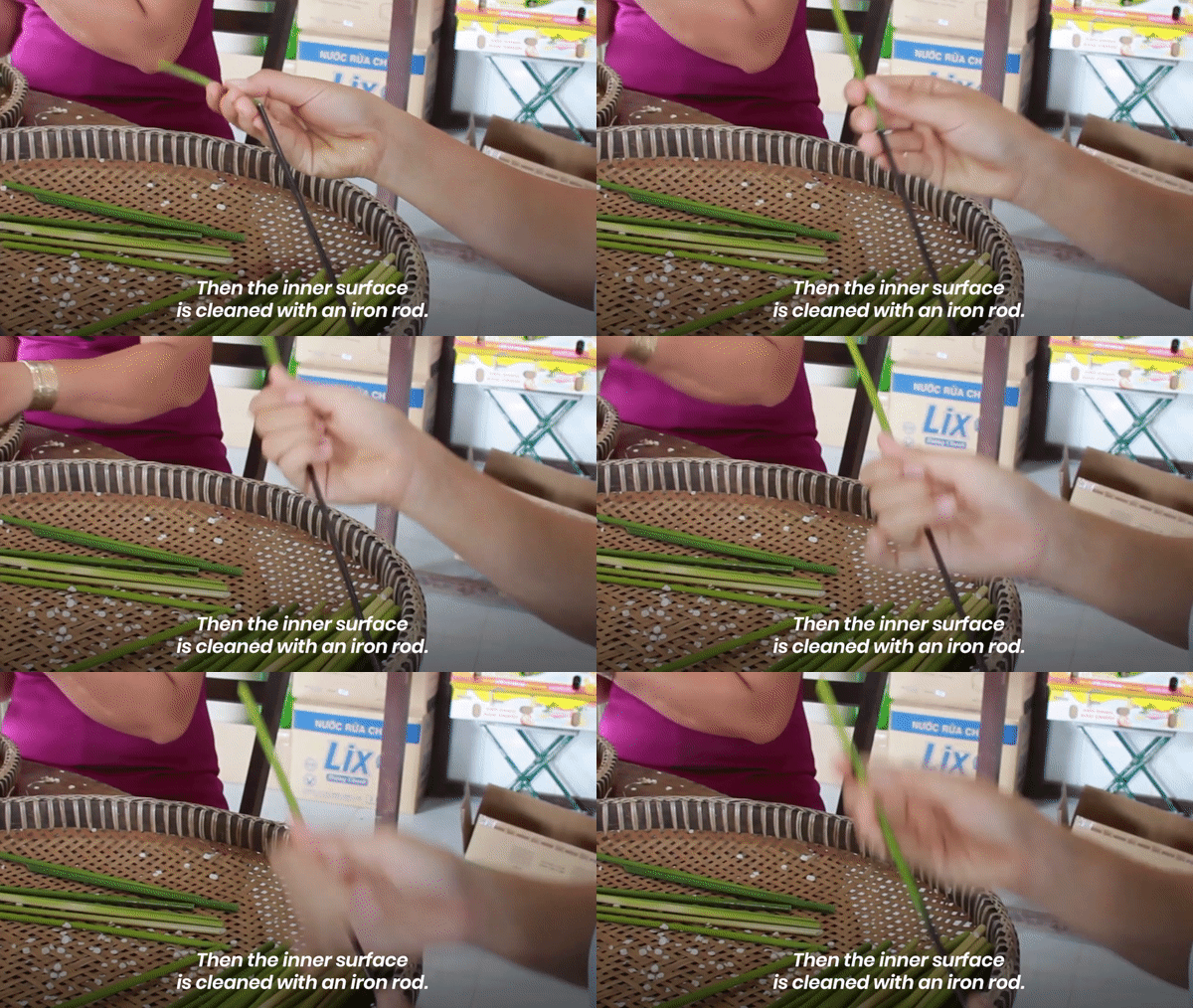
After the grass is collected, they are washed, and then neatly cut into 20cm tubes.


The insides of the hollow tubes of grass are then cleaned using a metal rod.


The straws are carefully rinsed a second time, and then packaged into bundles using banana leaves. Very environmentally-friendly.


Straws are single-use but biodegradable
The grass straws made by Ong Hut Co., the name of Tran’s business, come in both ‘fresh’ and ‘dry’ versions.

Freshly cut straws can be stored in the refrigerator for up to two weeks and in room temperature for up to a week, if not in use.

To make the dried straws, fresh straws are left out in the sun to dry, and then baked in an oven.

These are able to last much longer than fresh straws, and can be stored in the refrigerator for up to six months.

Both types of grass straws are intended for single-use only in F&B restaurants. However, Tran and his team encourage those who purchase the straws for personal use to reuse them at home.

The straws are not treated with any chemicals or preservatives and reportedly have a mild and pleasant natural fragrance.

Best yet, the straws are biodegradable.

If you’re still uncertain about using plants to drink, you can check out Ong Hut Co.’s FAQ here.

Currently, the grass straws are only shipped within Vietnam.

What about metal straws?
While metal straws have become a trending alternative to plastic straws and can be reused numerous times, it is not biodegradable.

This means that it cannot decompose into organic matter, unlike grass straws.

Tran, pictured in blue here, and his grass straws . Photo from Ong Hut Co.
Although reusable, metal straws still involve the mining of heavy metals themselves, which entails a whole host of environmental impacts such as water pollution and loss of biodiversity.

Therefore, these alternatives to plastic straws have their own set of pros and cons which consumers will have to weigh.

(Source: Mothership)

Sunday, 16 December 2018

Miss USA sorry for offending contestants over lack of English

An Instagram post by a beauty queen questioning the English language skills of fellow contestants has caused a stir across social media.

The incident took place in the run-up to this year's Miss Universe competition which is being held in Bangkok, Thailand, on Monday.

Miss USA, Sarah Rose Summers, was quick to apologise after realising her comments may have come across as offensive, although her original live video post had been liked more than 46,000 times.
A well-meaning comment from Miss USA resulted in a heated debate across social media
Ms Summers had said contestant H'Hen Nie, Miss Vietnam, is "so cute and she pretends to know so much English and then you ask her a question after having a whole conversation with her and she (nods and smiles)."

She added: "Miss Cambodia is here and doesn't speak any English, and not a single other person speaks her language.

"Can you imagine? Francesca (Miss Australia) said that would be so isolating and I said yes and just confusing all the time," Summers said. "Poor Cambodia."

In her apology, which received more than 24,000 likes, Ms Summers said she would "never intend to hurt another."

The three beauty contestants from Cambodia, USA and Vietnam have since had a discussion about what was said on Instagram.

Miss Summers added that it was also important to remember that the Miss Universe contest was an opportunity for women around the world to learn about other cultures and life experiences.

Reaction was swift across social media.

One Instagram user, debrasamuelbrown, added her comment to the original video: "Americans have issues with any non-American English speaking person. It's weird how they expect everybody to speak like a yankee! What a wonderful world we live in with so many beautiful accents and so much flavour!"

Sorany Var, a self-confessed 'proud Cambodian-American' posted on Facebook that Rern Sinat, the current Miss Cambodia, did speak English - it was just very basic.

She put this down to the fact that Cambodia was still a developing country, and offered to teach her English "for free".

Over in the Cambodian capital, Phnom Penh, Liya Rika called for more compassion, saying she didn't think Miss USA meant to look down on Miss Cambodia, and that people should forgive her:

One user, tinetoy18, did not regard Ms Summers as fit for the Miss USA title: "You deserved to be forgiven but you do not deserve the crown anymore...You're not a good example of a compassionate woman as you claimed."

However, other comments praised her for owning up to her mistake and apologising, including 'Team Elite Indonesia'.

(Source: BBC)