Showing posts with label afghanistan. Show all posts

Tuesday, 22 March 2022

Afghanistan world's unhappiest country, Lebanon second saddest

Afghanistan is the unhappiest country in the world - even before the Taliban swept to power last August. That's according to a so-called World Happiness report released ahead of the U.N.-designated International Day of Happiness on Sunday.

The annual report ranked Afghanistan as last among 149 countries surveyed, with a happiness rate of just 2.5. 


Lebanon was the world’s second saddest country, with Botswana, Rwanda and Zimbabwe rounding out the bottom five. Finland ranked first for the fourth year running with a 7.8 score, followed by Denmark and Switzerland, with Iceland and the Netherlands also in the top five.


Researchers ranked the countries after analyzing data over three years. They looked at several categories, including gross domestic product per capita, social safety nets, life expectancy, freedom to make life choices, generosity of the population, and perceptions of internal and external corruption levels.


Afghanistan stacked up poorly in all six categories, a confounding result coming as it did before the Taliban arrival and despite 20 years of U.S. and international investment. The U.S. alone spent $145 billion on development in Afghanistan since 2002, according to reports by the U.S. special inspector general for Afghanistan.

Still, there were signs of increasing hopelessness.


Gallup did a polling in 2018 and found that few Afghans they surveyed had much hope for the future. In fact the majority said they had no hope for the future.


Years of runaway corruption, increased poverty, lack of jobs, a steady increase in people forced below the poverty line, and erratic development all combined into a crushing malaise, said analyst Nasratullah Haqpal. Most Afghans had high hopes after 2001, when the Taliban were ousted and the U.S.-led coalition declared victory,

"Unfortunately the only focus was on the war, the warlords and the corrupt politicians,” said Haqpal.


"People just became poorer and poorer and more disappointed and more unhappy... that is why these 20 years of investment in Afghanistan collapsed in just 11 days," he said referring to the Taliban's lightning blitz through the country before sweeping into Kabul in mid-August.


When Masoud Ahmadi, a carpenter, returned to Afghanistan from neighboring Pakistan after the 2001 collapse of the Taliban, his hopes for the future were bright. He dreamed of opening a small furniture-making shop, maybe employing as many as 10 people. Instead, sitting in his dusty 6-foot by 10-foot workshop on Saturday, he said he opens just twice a week for lack of work.


"When the money came to this country, the leadership of the government took the money and counted it as their personal money, and the people were not helped to change their life for the better,” said Ahmadi.


The report warns that Afghanistan's numbers might drop even further next year when it measures Afghans' happiness level after the arrival of the Taliban.


The economy is currently in free fall as the group struggles to transition from insurgency to governing.


(Source: The Peninsula)

Wednesday, 20 October 2021

Was the Ramayana actually set in and around today’s Afghanistan?

 An examination of a book by physicist Rajesh Kochhar debunks the notion that the events of the epic took place in modern-day India.

History is said to be the original discipline in the faculties today known as humanities. This is owing to the fact that every discipline in knowledge discourse has a history – even abstract disciplines like mathematics or astronomy – and every piece of history has a geophysical contextuality.

Ever since Herodotus (484 BC - 425 BC, Greek-occupied Turkey) started the discipline, he recorded events during the reign of four Persian kings and chronicled life and society in their times. These were times of conflict between Greece and Persia and had a geographical contextuality.

Herodotus also speaks of “India”, where he saw the Himalayan marmot bathing in gold dust. Much later, deconstructing his text led to the conclusion that the great father of historical praxis must have passed through the North West Frontier province and reached the base of Hindu Kush.

This posed a question, which Herodotus did not ask himself: if he had indeed travelled to “India”, which “India” was this? For that matter, if he was “Greek”, which “Greece” did he live in? Similarly. if Ram of the epic poem Ramayana was an “Indian”, where was this “India” situated?


Wikimedia Commons


The so-called Ram Setu
A ship that wishes to sail from the Arabian Sea to the Bay of Bengal has to pass through the Indian Ocean to the south of Sri Lanka. The voyage would have been 30 hours shorter if it could have travelled along the Gulf Of Mannar, which separates India and Sri Lanka, but this isn’t possible. For there are thousands of small submerged rocks beneath its surface, stretching like a bridge across 47 km between the two countries. As a result, the sea is between one and 30 metre deep here, which isn’t favourable for sailing.

The British government of colonised India as well the government of independent India had often planned to dredge the channel to make it suitable for sailing; but the plans have remained elusive for various reasons. At present, for instance, Hindutva followers believe that this is the bridge built by an army of monkeys, as described in the Ramayana, which Ram and Lakshaman crossed to conquer Sri Lanka.

Their demand is that, far from dredging, let the Archaeological Survey of India declare this bridge a national monument. Not that the colonisers were any less fundamentalist. In 1804 a certain British cartographer named the structure Adam’s Bridge – according to him this was the bridge described in the Bible which Adam crossed to scale a mountain peak, where he meditated for 1,000 years while standing on one leg.

Even before this, we have seen Marco Polo describe the structure as a bridge, as did Al-Biruni in the book he wrote in 1030 CE. In other words, it has long been held that this row of rocks beneath the surface of the water is a bridge.

Not exactly a bridge
According to geologists this structure is actually a limestone shoal, the outcome of natural processes. Between 300 and 30 million years ago, a portion of the Indian subcontinent is believed to have broken off because of continental drift to form the island of Sri Lanka. The debris that this fragment of land left behind at birth in the water as it drifted away led to the creation of this so-called bridge.

It may have jutted out of the water at some point in history, in which case it might have been used as a bridge. But there is considerable doubt whether the users belonged to the age of the Ramayana. This is because the inhabitants of Sri Lanka went directly from the Stone Age to the Iron Age; the use of copper was not very prevalent here. On the other hand, the Ramayana is a tale from an advanced Copper Age – an epic in verse from a period two or three thousand years before the Iron Age.

Where was Ramayana set?
Let us drop the preamble and get to the point now. If the Lanka mentioned in the Ramayana was not the Sri Lanka of today, where was it located? Where did Ram belong, for that matter? Wherever he may have lived, he was certainly not an inhabitant of what is the Ganges valley today, or of “Ramjanmabhoomi” Ayodhya. For, civilised man did not live in the forest-infested Ganges valley before the Iron Age, since there were no axes with which to clear the vegetation before iron was discovered. There were no swords either, which proves that the Ramayana, unlike the Mahabaharata, is not an epic of the Ganges valley. It makes no mention of swords – the bow and arrow are the primary weapons in it.

The primary objective of this essay is to point to the geographical location of the Ramayana. It is not the writer who has arrived at the answer, nor an Indologist like Max Mueller or even a historian or archaeologist. The person in question is Rajesh Kochhar, a physicist with an inclination for history, who has broken through the traditional techniques of history in his work The Vedic People – Their History and Geography.

How the Ramayana is different from the Mahabharata
The primary difficulty of discussing the ancient history of India lies in the necessity of first demolishing several well-established inaccuracies, such as the Aryan Invasion Theory, for instance. Spun by white men and broadcast by colonial historians, this old wives’ tale is still taught in schools and colleges, with half of any written work – measured in terms of paper, ink and effort - being expended on it. We shall not entertain it. We will only examine whatever can be determined through the social and geographical pointers available in the Ramayana.

There are two other fundamental differences between the Ramayana and the Mahabharata – in the rivers and in the divine pantheon. In the Mahabharata the Ganga and the Yamuna are almost ubiquitous, but they’re completely missing from the Ramayana. In the Mahabharata we see the powerful presence of the Hindu trinity of Brahma, Vishnu and Maheshwar – but they’re absent from the Ramayana. We do not find these two rivers and these three gods together in the Rig Veda.

However, the rivers and gods that are to be found in the Rig Veda are also to be found in the Ramayana – the rivers Saraswati and Sarayu, and the original trinity of Agni, Varun and Pavan. From this it is easy to surmise that the Ramayana is a Rig Vedic epic. Which period was this? It would not be correct to estimate this using our current calendar: it would probably not be possible either. An approximation can be made from the sequence of events.

The somras clue
Vedic nomads travelled from the Eastern Europe to Bactria (present day Afghanistan). From here they went to Persia (today’s Iran). During their migration to Persia there was probably a battle for power amongst the gods, which led to the birth of the Avestan religion. As a result, Indra, the king of gods, became an inferior figure in the Avesta, while Yama, the god of death, turned into the finest of the gods. Worshipping Agni is a prominent practice within the Parsi community, but Hindus do not worship this ancient god. This indicates that the Rig Vedic age predated Persia. Kochhar has provided clues to whether this was the Afghan branch of the Vedic journey.

The first such clue that Kochhar alludes to is the Vedic drink somras. It was so important in ancient Vedic life that an entire mandala or chapter of the Rig Veda has been devoted to it. The importance of soma is evident in the Avestan Zend scripture – it is referred to as haoma in Persia. It is seen that the closer the Vedic nomads get to the Indian peninsula, the more they seek continuously new alternatives to the soma plant; that was how important somras was.

But the original soma plant was to be found only in what is modern day Afghanistan and Persia or Iran. In 1951 the German historian Karl Friedrich Geldner proved that the ephedra plant was what was described as soma in the Rig Veda. Ephedrin or somras is not alcohol – this intoxicant is an alkaloid. Kochhar’s investigations led to the discovery of four varieties of ephedra, found in Afghanistan, Iran, the northern Himalayas, and the Hindu Kush.

What we learn from summer solstice
There are 49 cosmic hymns in the Rig and the Yajur Vedas whose meanings have not been explained. But one particular hymn from Vedanga Jyotish informs us that the longest day of the year, or summer solstice, comprised 18 periods of daylight and 12 of night. Day and night are of equal length on the Equator; in the higher latitudes, summer days are longer than nights.

The latitude at which the proportion of daylight and darkness is 3:2 is 34 degrees North. It is worth noting that the cities to be found around this latitude today are Herat and Kabul in Afghanistan. In other words, the place and time of the composition of the Vedanga Jyotish is the same as that of Vedic Afghanistan and Iran. This second piece of evidence offered by Rajesh Kochhar further strengthens the perception of the location and time of the Rig Veda.

In search of the rivers
Kochhar has deconstructed the Rig Veda in search of the Saraswati and the Sarayu, the two rivers also mentioned in the Ramayana. Here too our current history has come in the way.

There is a tiny river named the Sarayu in Uttar Pradesh, which flows into the Ghaghara, which in turn merges with the Ganga. Many people consider the rainwater-fed Saraswati in the Aravallis, flowing along the Ghaggar (not to be confused with the Ghaghara) basin the mythical Saraswati. On viewing the scans of North-Western India made by the Russian Landsat satellite between 1972 and ’79, it is natural to assume that the Ghaggar was a wide river. It flows into the Rann of Kutch.

The scan reveals the basin of a dried up older river, which is up to 8 km broad in some places. It was this that led to the hasty conclusion of this basin’s belonging to the original Saraswati.

From Neil Roberts’s The Holocene it is clear that the basin of this river widened to the north of the Rann of Kutch because of the accelerated movement of a glacier during the previous Ice Age. But deconstructing the Rig Veda doesn’t suggest any of this. The Saraswati has been referred to as non-perennial towards the end of the Veda. The original stream of the Ghaggar enters India from present-day Pakistan, drying up in the Thar desert. Kochhar believes this is the non-perennial Saraswati.

However, the Saraswati of the Rig Veda is extremely powerful, grinding rocks with sheer force. Its roar subsumes all other sounds. And the Sarayu of the Rig Veda is immensely wide and deep, the mother river. None of these descriptions matches the actual rivers in present-day India with those names.

Hymn No. 5 | 53 | 9 of the Rig Veda says, “May the Rasa, Krumu, Anitabh, Kuva or Sindhu not be able to stop you; let the deep Sarayu not be an obstacle.” The order of the rivers clearly moves from east to west. So the Sarayu undoubtedly flows to the west of the Indus.

Kochhar believes it is the 650-km river known as the Hari-Rud in Afghanistan, whose source is in the Hindu Kush mountains. It flows past the city of Herat and then for 100 km along the Iran-Afghanistan border before disappearing in the Karakom desert of Central Asia.

In the Avesta we find the Saraswati as the Harahaiti – the similarity in sound is noticeable – which enters Iran along the combined basin of the river Arghandar on the Afghan-Iran border and the river Helmand. According to Kochhar, it is this Helmand that is the Vedic Saraswati river.

The source of the Helmand is in the Koh-i-Baba mountain range. Flowing for 1,300 miles through the heart of Afghanistan, the Vedic Saraswati joins the Vedic Drijadbati or Arghandar. The Avesta identifies this wide river as the Hetumanta (or, in varations, as Setumanta). In Iran the Saraswati is named the Harahaiti, which flows into the inland lake Hamun-e-Sabari in the Saistan area of northern Iran.

The conclusion
The political map of the ancient world, of the Copper Age, provides an extraordinary realisation. The kingdoms of the two main political powers – the Persians and the Greeks – all lie between and around the Red Sea and the Mediterranean Sea. None of these is a coastal civilisation, however.

This raises a question. What did ancient man refer to as a sea? The Mediterranean Sea, the Red Sea, and the Campian Sea are all saltwater lakes, and not seas in the way we understand them today. This make us wonder: perhaps the Lanka of the Ramayana was an island in the Hamun-e-Sabri.

The one thing that’s obvious: wherever it was that Ram and Lakshman went from Afghanistan, it could not have been to present-day Sri Lanka, for that would have meant crossing the Indian peninsula. And since Ravana, the lord of Lanka, was also partial to somras, it is unlikely that he went very far from the land of soma after abducting Sita.

Although it is not possible to prove archaeologically, there is considerable reason to assume that the lineage of Dasarath (and of Ram), the Ikshvakus, were from western Afghanistan. For the Puranas say that King Kubalasa slayed a demon on the shore of the Sabari. Vishwamitra received his second birth where the Saraswati met the sea. And Valmiki discovered Sita on the shore of the Sarayu. This is why there is little room for doubt that today’s Hamun-e-Sabri is the sea mentioned in the Ramayana, one of the islands in which was the kingdom ruled by Ravana, lord of the rakshases.

The focus of attention for those studying the lost history of India is the contentious issue raised by Hindutva historians, who have repeatedly asserted that western historians have been unable to identify the roots of ancient India. We find these assertions in the writings of Bal Gangadhar Tilak, as well as in those of certain lesser-known right-wing historians. It is surprising how easily conclusions unsupported by the array of Vedic texts can be arrived at because of mindless adherence to a popular brand of politics.

The rock formation between India and Sri Lanka could well be preserved, but not as Ram Setu or Adam’s Bridge. Let it be protected as a geological feature. For no matter how far one looks, no relationship is evident between this Lanka and the Lanka of the Ramayana.


(Source: Scroll)

Monday, 28 December 2020

Writer retreats to a Kabul that lives only in his memories and books

 FOUR large clocks tick out of sync, puncturing the silence of his Soviet-built apartment. A half-burned candle sits next to a stack of books. A small television is covered in soot.

This is where Rahnaward Zaryab, Afghanistan’s most celebrated novelist, locks himself up for weeks at a time, lost in bottles of smuggled vodka and old memories of Kabul, a capital city long transformed by war and money.


“We live in a vacuum, lacking heroes and ideals,” Mr. Zaryab reads from his latest manuscript, handwritten on the back of used paper. The smoke from his Pine cigarette, a harsh South Korean brand, clings to yellowed walls. “The heroes lie in dust, the ideals are ridiculed.”


The product of a rare period of peace and tolerance in Afghan history, Mr. Zaryab’s work first flourished in the 1970s, before the country was unraveled by invasion and civil war. Afghanistan still had a vibrant music and theater scene, and writers had a broad readership that stretched beyond just the political elite.
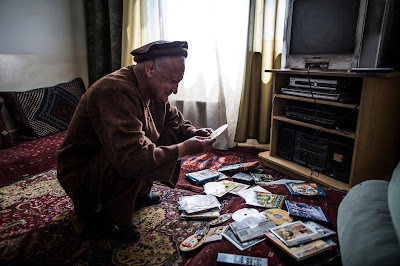

“Art, culture and literature have been forgotten completely,” said Rahnaward Zaryab. Credit... Bryan Denton for The New York Times


“I would receive letters from girls that would smell of perfume when you opened them,” Mr. Zaryab, who is 70, remembered fondly.


Mr. Zaryab’s stories are informed by his readings of Western philosophy and literature, the writer Homaira Qaderi said. He was educated on scholarships in New Zealand and Britain. But his heroes are indigenous and modest, delicately questioning the dogma and superstitions of a conservative society.


“He is the first writer to focus on the structure of stories, with the eye of someone well read,” Ms. Qaderi said. “We call him the father of new storytelling in Afghanistan.”


But after he became the standard-bearer for Afghan literature, Mr. Zaryab was forced to watch as Kabul, the muse he idealized as a city of music and chivalry in most of his 17 books, fell into rubble and chaos.


Some of the chaos has eased over the past decade, but that has caused him even more pain. He loathes how Kabul has been rebuilt: on a foundation of American cash and foreign values, paving over Afghan culture.


“Money, money, money,” he said, cringing. “Everyone is urged to make money, in any way they can. Art, culture and literature have been forgotten completely.”


FOR some Afghans, though, there is tragedy in the fact that one of their most renowned and enduring writers has largely withdrawn into his own memories, unable or unwilling to visualize a new identity amid a confusing and traumatic time for his country.


“Zaryab is enchanted by the past that to him is a symbol of the ideal life,” the critic and poet Mujib Mehrdad said. “He can’t disconnect from that past, he lives in the past.”


For his part, Mr. Zaryab insists that he is still looking at the problems of the day, though at times his allegories go unrecognized.

In one of his latest novels, a pompous gallant from Kabul’s old city in the early 1900s gives up his mundane routine after a chance meeting with a wise bird who introduces him to the philosophy of Socrates. He is thrown into meditation and soul-searching.


Mr. Zaryab says the bird is a symbol of the enlightenment push here in the early 20th century, and in the book, it is ceaselessly hounded by the city’s rulers and clergy — a clear and continuing theme in modern Afghanistan as well.


“Unfortunately, no one understood that part,” he said. “They thought it was an imaginative fantasy.”


For someone who reveled in his early fame, and whose international peers became global voices, translated across languages, the disconnect from an audience has not been easy.


Mr. Zaryab still enjoys minor celebrity status in public, and it once inspired him to try to reconnect to fans through a Facebook page. But he soon considered it a waste of time: Their interest was superficial, he felt; they were not after a deeper understanding of his work.


“In reality, I write for myself,” he said. “There is something inside that needs to come out, otherwise it bothers me. Not important whom I write it for.”


Born in the Rika Khana neighborhood of old Kabul in August 1944, Mr. Zaryab was one of three children. Neither his mother nor his father, a china trader, could read. A large age gap between him and his siblings meant that he grew up mostly a lone child.


After graduating from Kabul University with a degree in journalism, he went to Wales for postgraduate studies. His first job after his return was as a crime reporter for Zhwandoon Magazine, one of the prominent publications at the time. He sought the job because the details of the crime scene gave him inspirations for his stories, Mr. Zaryab said.


He continued to work as a reporter and editor for newspapers and magazines, as well as taking senior positions in the Culture Ministry, even after his fiction found acclaim.


Mr. Zaryab at his home in Kabul, where he shuts himself in for weeks at a time. Credit... Bryan Denton for The New York Times


When the civil war intensified in Kabul in the 1990s, Mr. Zaryab was briefly exiled to France; his wife and three daughters remain in Europe, not wanting to return to the violence and uncertainty of Afghanistan. After the Taliban were toppled, he returned to his old apartment in Kabul with more than 650 pounds of books and about $22 in his pocket, he said.


The city of his youth, of his stories, however, no longer existed. “I have this attachment to this place, I don’t know why,” he said. “I know there is poverty here, lies, hypocrisy, but still my heart is here.”


LITTLE of a readership culture remains these days, even in Kabul. Bookshops are saturated with bootleg copies of Iranian books. Local authors make no money from publishing their work. In return for a manuscript, Mr. Zaryab gets a number of copies from the publisher to distribute to friends.


Consider his latest work, “Qalandar Nama,” a collection of minimalist vignettes that he submitted in return for 150 free copies. The book has sold only 100 copies in the three months since its publishing, said the publisher, Wasim Amiri. In contrast, Mr. Amiri picks off the shelf a slim collection of poems by Fazel Nazari, a young poet from neighboring Iran. In its 32nd reprint over five years, the book has sold more than 80,000 copies.


Since Mr. Zaryab’s return, his daily routine has been simple, much of it spent reading and writing in his sixth-floor apartment. In the mornings, he goes for a walk around the block. If the air is too polluted already, he does yoga at home.


In the afternoons, a driver picks him up for his part-time job: For two hours a day, he edits news for Tolo TV, the country’s largest private channel. When he disconnects from the world during his weeks of solitude, his employer understands.


Mr. Zaryab’s desire for solitude has roots in his childhood. He fondly remembers walking alone along the Kabul River. “It had beautiful, clear water at the time,” he said. “Fishermen would fish with nets, not hooks. I would spend all my day along this river.” Not only has the river changed, he lamented, but also the city’s people. In a shrine on the same river, a mob recently accused a young woman of blasphemy and beat her to death in daylight. They dragged her body to the riverbed, now filled with trash, and set her on fire.


“In old Kabul’s Rika Khana, one shopkeeper had said something rude to a little girl once. Without a collective decision, the residents stopped buying from that shop and he was forced to move,” he said. “Do we have such people anymore? Today, they kill a girl and then burn her.


“How could I not be attached to the past?”


(Source: NYT)

Friday, 22 May 2020

Coronavirus: Afghan girls make ventilators out of car parts

Afghanistan's all-girl robotics team has turned its focus on coronavirus patients - by making affordable ventilators out of car parts.

The teenagers made headlines in 2017 when they won a special award at an international competition in the US.

Now they are racing against time to deliver ventilators by the end of May, at a fraction of the market price.

Afghanistan, reeling from years of war, has a maximum of just 400 ventilators for a population of 38.9 million.

So far, more than 7,650 coronavirus cases and 178 deaths have been confirmed, but the authorities fear the situation could get worse and overwhelm an already fragile healthcare system.
The girls are trying to produce ventilators for a fraction of the market price

"It's important even if we can save one life with our effort," team member Nahid Rahimi, 17, told the BBC.

Known as the "Afghan Dreamers", the girls come from the western province of Herat, where Afghanistan's first case of Covid-19 was reported.

It's the nation's hotspot for the pandemic because of its close proximity to Iran, the region's epicentre of the outbreak.

The girls, aged between 14 and 17, have built a prototype using a motor from a used Toyota Corolla and a chain drive from a Honda motorcycle.

They say their ventilators will give temporary relief to patients with respiratory difficulty in an emergency when standard ventilators are not available.

"I feel so proud to be part of a team that is trying to do something meaningful to support our doctors and nurses - they are our heroes at this time," says team captain, Somaya Faruqi.

The global shortage of ventilators is a problem and their hefty price of $30,000 (£24,000) to $50,000 (£40,700) on the global market means many poorer countries can't afford them.

But the teenagers say they are building the much-needed device for less than $600 each.

With shops closed and the city of Herat under lockdown, the challenge that the girls are facing is travelling outside the province to source parts.

But the founder of the group, Roya Mahboob, an entrepreneur who has been among Time Magazine's 100 Most Influential People in the World, says her team is still hoping to deliver the ventilators by the end of May.

"They're about 70% finished. The only thing we're lacking is the air sensor, which we're trying to source rather than build from scratch as it takes time.

"The first phase is complete and it was tested in a hospital two days ago. The team are working on phase two, which once completed can be introduced to the market."

With a less than 30% female literacy rate in the country, the teenagers hope their project will inspire others and change the perception of women in the engineering industry.
The girls shot to fame in 2017 when their initial visa applications to the US were denied. Reuters

"It [being able to make ventilators] shows the importance of teaching girls at a young age and the role of women as active citizens in our society," says another team member, Elham Mansori, 16.

The initiative has been welcomed by the Afghan government.
"I'm glad President Ashraf Ghani has personally ordered the authorities to look into our project and to help us in any way possible" says Ms Mahboob.

The Afghan health ministry is supporting the girls.

"We appreciate their initiative but like any other scientific research, there are phases for it, like discovery and development, pre-clinical research and when it's offered in the market it's analysed and approved," Waheed Mayar, spokesperson for the health ministry, told the BBC.

"Patient safety is our priority so we have to make sure the device is tested on animals in laboratories first before being tried on coronavirus patients."

(Source: BBC)

Monday, 2 March 2020

‘A step away from hell’: The young male refugees selling sex to survive

Photographer Heba Khamis spent a year and a half documenting the lives of ‘black birds’: the male Afghan and Iranian sex workers in Berlin’s Tiergarten
All photographs by Heba Khamis

The allure of romance is never far away in Berlin’s Tiergarten park, a vast 520-acre expanse home to manicured lawns, dense forest, a picturesque boating lake and the city zoo. As families lay out picnics and millennials fire up barbecues, those seeking something more illicit head to the park’s wooded north, where young male Afghan and Iranian refugees can be found selling sex to the hundreds of buyers who pass through Tiergarten each day.
Jochen* (71) and Mohamed* (21) sit in the Tiergarten

In 2017, Egyptian photographer Heba Khamis was studying in Hanover when a flurry of news reports about Tiergarten’s young male refugees made national headlines. “No one could get [photographic] access to the guys, but the German media were saying they were dangerous and to stay away [from them], that they were doing bad stuff,” said Khamis. “I felt I needed to see for myself.”

Initially accompanied by a male Farsi-speaking friend, Khamis spent ages searching for the refugees in Tiergarten, asking random park-goers if they’d seen or heard anything “unusual”. She stumbled upon a pair of ping-pong players, who said they knew nothing about the prostitution in the park, yet as Khamis spent more time in Tiergarten it became clear that the ping-pong tables and the area around them were at the very heart of the sexual activity. “If you didn’t pay any attention, you wouldn’t notice it,” says Khamis, 31. “But the prostitution was happening right in front of them [around the public toilets]. The elephant was in the room and no one wanted to see it.”
Mohamed, top, is one of many refugees who pretend to be gay or to have converted to Christianity to help strengthen his case for asylum. Obaied, 25, bottom, also works in a Chinese fast food van in another city


Khamis began to visit the park every day and, through persistence and with the aid of translators, managed to make contact with the “boys”, most of whom were ethnic Shia Hazaras from Afghanistan, a minority long persecuted by the Taliban, ranging in age from 15 to 32. Although they were wary of the press, one of the men, Ali*, became Khamis’s go-to guide, introducing her to other boys in the park and their collective way of life. Over the course of a year and a half, she ended up watching – and documenting – as relationships blossomed, long-awaited papers came through and the boys moved out of the park, or didn’t.

Germany legalised prostitution in 2002 and, in 2017, passed a law requiring sex workers to register with local authorities in order to prevent human trafficking and exploitation. But the 30-odd Afghan and Iranian men Khamis was photographing fell under no such support system, as refugees are barred from working legally or attending school while they wait for their documents. “When you are a refugee without papers, and you are Muslim and come from a background where gay sex is shameful and taboo, it is a very different situation,” she says. “These guys don’t represent ‘prostitution in Germany’ in any way. There are only a few of them, and this is a very different scenario.”

Heavily saturated in earthy browns and greens, Khamis’s photos have an eerily ethereal quality, the dappled light of the forest reflecting off the boys’ necklaces, their youth made evident by their protruding clavicles and bony backs.
‘I don’t steal, I don’t disrespect people, but I have to earn money,’ says Ali

The result is deeply unsettling, reflecting the boys’ experience of the park. “Once you are in the park,” says one of Khamis’s subjects Ahmed, an Afghan who had been selling sex in the park for three years, “you are one little step away from hell.” For Khamis, the boys’ search for belonging and humanity was what compelled her to continue photographing.

“When you look at them, [you can see] they’re not enjoying it at all. They hurt themselves, they have depression. On all of them you will find [self-inflicted] cigarette burns or cuts. Everyone wants to get out of the park.”

Drugs feature heavily in the boys’ lives, numbing them and providing a small respite from the agony of waiting to become “legal”, says Khamis. As Germany prioritises assistance to refugees from countries with an ongoing conflict, asylum seekers’ papers from non-conflict countries such as Afghanistan and Iran take longer to complete, and the applicants are more likely to be deported, says Khamis.
Hashem sleeps in the park

The singularity of their situation – engaging in culturally taboo work while waiting in political limbo – inspired Khamis to call the boys “black birds”, a nod to both the numerous blackbirds in the park and a play on the term “black sheep”. “When you are different in the family, you are the ‘black sheep’, and for me these guys were the same: their whole lives they’ve been undocumented, unable to ‘fly’, unable to live normal lives, unable to find anywhere that will accept them.”
  • The female public toilet is often used for sexual encounters. (bottom ) Mujtaba is an Afghan refugee born in Iran. If deported, he will be sent to Afghanistan, a country he has never seen


While some boys were lucky enough to get their papers and move out of the refugee camps or even the park itself, others were required to find another means of escape. For some that meant entering into relationships with their regular buyers (the photo of one such couple won Khamis second prize in the 2019 World Press Photo portraits category), or converting to Christianity as means of claiming political asylum. Still others have remained in Tiergarten.
Omran lost his father, sister and brother when their house was bombed by the Taliban when he was six years old


Khamis began her photographic career covering the 2011 and 2013 revolutions in Egypt, then turned her focus to socially taboo subjects relating to the body, such as breast ironing in Cameroon and Egypt’s transgender community. The practice of focusing on such “unacceptable” issues has transformed her as a person, she says.

“When you work long term on stories it’s not just one image you deliver, you invest your whole life in these stories and they teach you lessons and change you in the long run,” says Khamis.
Roman receives €239 (£200) a month in social aid. After paying his bills, he has around €40 left. He works in the park when he runs out of money

“You become less and less judgmental. You no longer look at things from the surface of your own perspective; you try to see through the people instead. From outside [Tiergarten], you could look at these boys and say, ‘Go work in the black market instead [of doing sex work]’. But they have fought their whole lives, first being born in Afghanistan, then fleeing to Iran and finally to Europe, thinking they will have a nice life at last. Yet they no longer have a home – or a destination.

“This is [what] human failure [looks like]: sometimes we all fight so hard for something that once we finally arrive, we’re so tired from fighting that we just surrender.”

* All subjects’ names have been changed to protect identities.

(Source: The Guardian)

Sunday, 1 March 2020

Afghan conflict: US and Taliban sign deal to end 18-year war

The US and the Taliban have signed an agreement aimed at paving the way towards peace in Afghanistan after more than 18 years of conflict.

The US and its Nato allies have agreed to withdraw all their troops from the country within 14 months if the militants uphold the deal.

US Secretary of State Mike Pompeo and Taliban leaders attended the signing ceremony in Doha in Qatar.

Talks between the Afghan government and the Taliban are due to follow.

Under the agreement signed in Doha, the militants also agreed not to allow al-Qaeda or any other extremist group to operate in the areas they control.

The US invaded Afghanistan weeks after the September 2001 attacks by the Afghanistan-based al-Qaeda group.

More than 2,400 US troops have been killed during the conflict. About 12,000 are still stationed in the country. President Trump has promised to put an end to the conflict.

How did US-Taliban talks come about?
Since 2011, Qatar has hosted Taliban leaders who have moved there to discuss peace in Afghanistan. It has been a chequered process. A Taliban office was opened in 2013, and closed the same year amid rows over flags. Other attempts at talks stalled.

In December 2018, the militants announced they would meet US officials to try to find a "roadmap to peace". But the hard-line Islamist group continued to refuse to hold official talks with the Afghan government, whom they dismissed as American "puppets".

Following nine rounds of US-Taliban talks in Qatar, the two sides seemed close to an agreement.

Washington's top negotiator announced last September that the US would withdraw 5,400 troops from Afghanistan within 20 weeks as part of a deal agreed "in principle" with Taliban militants.

Days later, Mr Trump said the talks were "dead", after the group killed a US soldier. But within weeks the two sides resumed discussions behind the scenes.

A week ago the Taliban agreed to a "reduction of violence" - although Afghan officials say at least 22 soldiers and 14 civilians have been killed in Taliban attacks over that period.

What's the background to the Afghan war?
It began when the US launched air strikes one month following the 11 September 2001 attacks and after the Taliban had refused to hand over the man behind them, Osama bin Laden.

The US was joined by an international coalition and the Taliban were quickly removed from power. However, they turned into an insurgent force and continued deadly attacks, destabilising subsequent Afghan governments.

The international coalition ended its combat mission in 2014, staying only to train Afghan forces. But the US continued its own, scaled-back combat operation, including air strikes.

The Taliban has however continued to gain momentum and last year the BBC found they were active across 70% of Afghanistan.

Nearly 3,500 members of the international coalition forces have died in Afghanistan since the 2001 invasion.

The figures for Afghan civilians, militants and government forces are more difficult to quantify. In a February 2019 report, the UN said that more than 32,000 civilians had died. The Watson Institute at Brown University says 58,000 security personnel and 42,000 opposition combatants have been killed.

Who are the Taliban?
The Taliban, or "students" in the Pashto language, emerged in the chaos that followed the withdrawal of Soviet troops in 1989.

They took Kabul in 1996 and were in charge of most of the country within two years, practising their own austere version of Sharia, or Islamic law.

Before being removed from power they banned TV, music and cinema, enforced strict dress codes, severely curtailed female education and introduced brutal punishments.

Mullah Omar continued to lead the Taliban after they were ousted. He died in 2013 although the Taliban did not confirm it for two years.

The Taliban are now led by Mawlawi Hibatullah Akhundzada.


(Source: BBC)

Tuesday, 5 November 2019

In a quiet corner, an old Afghan poet polishes ‘the heart’s mirror’

For more than 50 years, Haidari Wujodi’s desk in a Kabul library has been a stop for those seeking escape from the violence outside.

For more than 50 years now, a mystic poet has kept a quiet window desk at the Kabul Public Library. His seat overlooks the hustle and bustle of the Afghan capital city, all but unrecognizable from the day he arrived as a young library clerk — one with a dreamy mind and stammering speech, but fine calligraphic handwriting that helped land him his day job.
Haidari Wujodi’s library desk is a place of pilgrimage for musicians, poets and students, among others.Credit...Kiana Hayeri for The New York Times

As governments toppled around him, Afghanistan sank deeper into flames of war that still burn. But Haidari Wujodi, 80, maintained his daily routine, switching his shoes for comfortable sandals that he wears with socks as he arrives at his desk behind stacks of fraying periodicals. His flask of tea fills and empties.

Until his official retirement a few years ago, Mr. Wujodi was in charge of the periodicals section. But his life is so intertwined with the third floor corner of the library that the Afghan government continues to pay him a small stipend and Mr. Wujodi continues to show up every day, often the last to leave as the sound of evening prayer echoes in the dusk.

He no longer shelves magazines and newspapers; his assistants take care of that. Over the years, his desk has become an address for all kinds of visitors — musicians who need lyrics for a new composition, young poets who bring their latest publication for encouragement and feedback, university students who need references for a paper or a dissertation, and street vendors who just want some wise words to get them through troubled times.

Participants at a Rumi reading. Mr. Wujodi has hosted such readings twice a week for 30 years.Credit...Kiana Hayeri for The New York Times
The 80-year-old — tall, with broad shoulders and a long white beard — receives all of them the same, minister or beggar. He insists on walking each visitor to the door when they leave, despite their insistence that the ustad — “master” in Persian, as he is often called — not embarrass them by paying them such an honor.

“There’s a saying of the Prophet,” Mr. Wujodi told a young poet one recent morning as he was leaving, having dropped off several collections of his recently published work. “If your friends are visiting you, try to go out seven steps to receive them. And when they are leaving, go out with them at least seven steps.”

Mondays and Wednesdays have been special in Mr. Wujodi’s routine. Twice a week for 30 years now, he has hosted a two-hour reading of the works of the Mawlana Jalaluddin Balkhi — the 13th-century Persian poet, philosopher and Sufi mystic known in the West as Rumi. The lessons typically end up being less about poetry and more about spirituality and philosophy. He calls Rumi’s body of work “a factory of human making.”

About 15 men and women, members of a group called “The Society of Lovers of Mawlana,” arrive and quietly take their seats. Mr. Wujodi looks out of the window as the room fills with the warm afternoon sun and a peaceful silence. One of the members, a middle-aged man with a narrow beard and a beautiful melodic voice, sings several verses as the rest follow along in their copies of the book. Then, in a soft but shaky voice, his head trembling, Mr. Wujodi begins explaining the verses.

Mr. Wujodi no longer shelves magazines and newspapers. His younger assistants, like Sohaila Nazar, take care of that.Credit...Kiana Hayeri for The New York Times
On a recent Monday, lesson 415, on page 333 of one of Mawlana’s collections, focused on a conversation between a mystic and an interlocutor, with the mystic trying to explain to the man that the beauties in the outside world are simply reflections of what is inside.

The fruits and the gardens are inside the heart
What’s in this mud and water is the reflection of their grace.

Mr. Wujodi, spending an hour on these two lines, spoke of the heart as the physical “plasma on the left side of the chest,” and of the divine and spiritual capacity that he said could not be exactly defined. The way of reaching the divine is by focusing inward, he said.

“The heart is like a mirror,” Mr. Wujodi said. “If it is cleansed of the dust and fog, whichever way or object you aim it at the reflection of it would be reflected in the mirror.”

Two university students whose thesis project is on Mr. Wujodi’s life and poetry reading on the first floor of the library before a visit with him.Credit...Kiana Hayeri for The New York Times

Haidari Wujodi was born in 1939, in a small village in Panjshir Province in northern Afghanistan, one of five children of a cleric. In those days the Islam practiced in Afghanistan was deeply tied into Sufi traditions of poetry. His father kept about 200 books at home, many of poetry and handwritten. It was there that the young Haidari learned to read.

Mr. Wujodi has only a sixth-grade formal education. When he was completing his fifth-grade exams, he had a dream one night that he says sent him “tumbling between sanity and insanity.” Mr. Wujodi says he is unable to describe the state, but for several years he could not regain his balance. When he did, he was transformed.

At 15, Mr. Wujodi moved to Kabul, and found his way to the bookbinding shop of one of the most renowned mystic poets of the time, Sufi Ashqari. While he was just a teenager and Mr. Ashqari in his 60s, their relationship shaped his life. The teenager was admitted to the small group of poets who gathered at Mr. Ashqari’s shop in old Kabul, exchanging verses as Mr. Ashqari continued to bind books.

Years later, when Mr. Ashqari was 90 and on his deathbed, he entrusted his unfinished work — the last chapters barely legible, because his hand had started trembling — to Mr. Wujodi, who spent eight months working after hours at the public library to prepare it for publication.

As his own poetry drew attention, Mr. Wujodi made sure he stuck to his quiet corner at the library — a dream job that allowed him space for his poetic endeavors and an income to support his wife, a son who is now an artist and two daughters who are both teachers.

He repeatedly rejected offers of higher positions. In the early 1990s, when the Islamic government that followed the Soviet withdrawal insisted that Mr. Haidari lead an educational foundation, he agreed to a compromise: He would continue his day job at the library, and for one hour at the end of every day he would go to the foundation’s office.

Mr. Wujodi signed one of his books for a member of the Rumi poetry circle.Credit...Kiana Hayeri for The New York Times

Mr. Wujodi still does not own his own home, living in a house owned by his wife’s family. One time, in the waning days of the monarchy, he refused even to meet with a member of the royal family who wanted to set him up with his own place.

“I apologized,” Mr. Wujodi recalled. “I said ‘I know, my decision is beyond logic.’”

Every morning on his way to work, Mr. Wujodi would circle the park at the heart of the city. At 80 he is still fit — “these mystics eat very little,” one member of the society said — climbing the three stories to his desk without holding the railing. But in recent years, age has cut his walk in the park in half.

Most days, Mr. Wujodi’s desk feels like an oasis at the center of chaos. One Monday last November, a suicide bomber killed a traffic cop at the roundabout just outside. From a library window, the scene was framed in a picture that went viral. The officer’s body, separated from his white cap, was sprawled under a billboard that read: “The nation that doesn’t read books will have to experience the whole of history.”

The shrapnel from the explosion flew through Mr. Wujodi’s window, where he had just finished his afternoon prayer. Had he still been standing, he might have been killed.

“What is happening in our world — is this really humane?” Mr. Wujodi asked during a recent lesson, lamenting how far the world stands from the humanist teachings of mystics like Rumi. “We don’t need philosophy for this — even a kid knows that we haven’t reached that common sense worthy of humanity.”

“The world is still blacked out on the wine of the grape — all this human killing, all this destruction, this ruin” he added. “What is worthy of the dignity of a human, we haven’t reached that yet.”

(Source: NYT)