Showing posts with label world war. Show all posts

Wednesday, 2 February 2022

What happened to the British children born to black GIs?

 Eighty years ago, US soldiers began arriving in the UK to help in the fight against Hitler's Nazi Germany. In a small sleepy village in Suffolk, life was about to change forever.

Best friends Eldridge Marriot and Trevor Everett grew up together in Tostock, where they still live today.


As the pair, now aged in their 70s, reminisce over summers spent playing on the village green, it is clear they have a deep connection.


They were two of 14 children in the village, and about 2,000 across the UK, born to white British mothers and black American soldiers during World War Two.


"We definitely stood out with our curly hair," Eldridge laughs. "But we didn't have any racial problems; we were never treated differently."


"We had some good times and I've had a brilliant life, I wouldn't change it for nothing," Trevor adds.
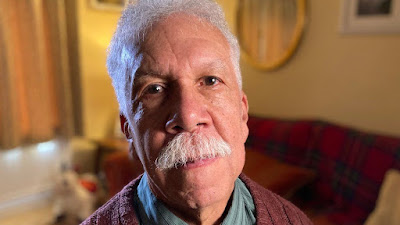

Eldridge says he would have loved to have met his father


As small boys they played in the woods by Tostock Hall, a large house taken over for the war effort, where their fathers were stationed a few years before.


It was very exciting for the village, near Bury St Edmunds, when the soldiers arrived in 1943, Eldridge says.


About 240,000 of the three million US troops, who began arriving in the UK in January 1942, were black.


It was the first time many British people in rural areas had seen a black person.


The US servicemen were mainly helping build airbases, such as Lakenheath and Mildenhall, but in nearby Tostock they were asked to look after Italian prisoners of war at the hall.


Dances were held at a ballroom attached to the house, where many romances began.
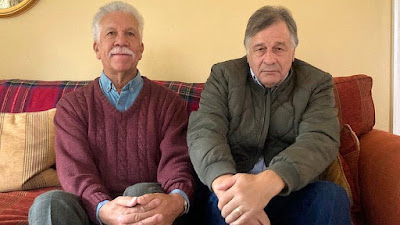

Eldridge and Trevor bonded as children over having absent fathers who were black US serviceman


"A lot of them figured they'd got nothing to lose anyway, they could just disappear back to the States," Eldridge says.

His mother Olive was already married to a merchant seaman who was away at war when Eldridge was born in November 1944. Two months later, his father William Ellis - known as Willie - "disappeared to France, never to be seen again".


When Olive's husband came back and discovered the baby, he said they could only stay married if she put Eldridge into care. Olive refused and they got divorced, while Eldridge went to live with his grandparents.


"My mother wasn't in a position to bring me up," Eldridge says. "She used to come over every Tuesday throughout her life. We never spoke about my father - it was a closed shop.


"My grandfather talked about my father a lot, he liked him. The circumstances were I was left behind and they had to bring me up but they didn't bear any malice at all."


Eldridge's aunt and uncle also lived in the family cottage while he was growing up and he was "spoilt rotten" by them and his grandparents. He later built a house at the end of the garden where he still lives today with his wife.


"All my life I've been on this patch of land. I've had a really good life. It's difficult to see how it could have been any better," he says.
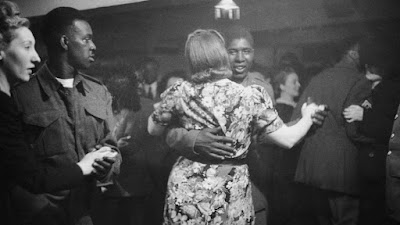

British authorities tried to discourage relationships between white British women and black troops but many romances began at dances like this one in London in July 1943


Trevor was born a few years after Eldridge and the others, in 1946, after his father Paul Woods left his post in France to go back and visit Trevor's mother.


"He got in a lot of trouble for that. He used to climb up a drainpipe to see her; it was very exciting," Trevor says.


His father, who he describes as "half-Indian, a native American" was born in Atlanta and later moved to Maryland.


Trevor still has seven years' worth of letters from his father to his mother, who brought Trevor up and later remarried.


"My mother used to worry someone would come and take me away so she was ever so protective of me. She used to watch me wherever I went," he says.
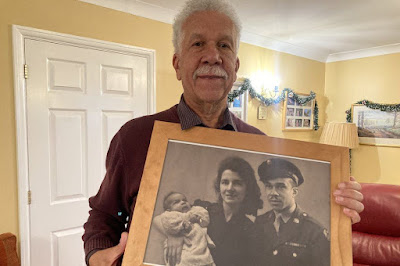

Eldridge's wife had this treasured photo produced for his birthday - a picture of his father Willie superimposed on to a photo of his mother Olive holding him as a baby


Both men grew up in loving homes but that was not the case for many of the so-called Brown Babies - the term given by the African-American press to these children born during the war.


Black troops were not allowed to marry their pregnant white girlfriends and many of the children were given up for adoption, according to Prof Lucy Bland, from Anglia Ruskin University, who interviewed 50 of them for a book called Britain's Brown Babies.


Many of them experienced racism and were shunned by society, like Babs Gibson-Ward. Her mother told her white naval officer husband that Babs was his daughter, until her skin darkened at six months old and the lie was revealed.


She was sent away from her family in Ipswich to live in a children's home until a foster family came forward, but local children avoided her and teachers refused to educate her.


Speaking on The Localist - Suffolk podcast, Prof Bland says: "Nearly half of these babies were put in children's homes. They were often lied to and told their fathers were dead and that their mothers didn't want them.


"They were often called names and didn't understand. Some of them didn't even realise they were a different skin colour; no-one was explaining it to them."


Very few of them were adopted. Officials said it would be impossible to place mixed-race children and the government blocked adoptions from the US, worried they would be seen as dumping them there.


Leon Lomax was one of only a few of the children who went to the US to be brought up by his father, Cpl Leon Lomax.


He arrived back in Ohio at the end of the war with a confession for his wife Betty - he had fathered baby Leon, who was born in Chelmsford, Essex in December 1945.


"As a kid I wondered 'why hasn't my mum tried to find me?,'" says Leon, speaking on the phone from his home in Ohio.


He had a difficult upbringing with his father, who never told him who his mother was or even that he was mixed race.


"I figured I was just black basically," he says. It was only when he had children of his own that he decided to find out more about his heritage.


Leon managed to trace his mother to England, but sadly she had died two years previously.


"I found that I had a sister, Pauline. She said our mother was always nervy around Christmas time and Pauline didn't know why, but I was born on 17 December. My mother never shared anything with her about me," he says.


He recently found a letter his mother had written to his father 75 years ago, detailing her visits to him in the children's home before he was flown to the US.


"She wanted to keep me but could not afford to. I smiled at her for the first time and she was really happy," he says, his voice thick with emotion. "I cried when I read that. It closed a circle for me."


Trevor and Eldridge both decided to trace their fathers when they grew up. Trevor traced his to the US in 1987 with the help of the Red Cross and flew out with his family to meet him.


"He worked in a military hospital and he took me to meet all his friends - he was proud. He used to say he had a son in England, but nobody would believe him."


Trevor spent two days with his father, who was then aged 68, but tragically on his third day out there, his father died.


"I was waiting for ages in this hotel and I thought he didn't want to know anymore," Trevor says. "But then his friend drove up and said 'we've got some bad news, your father died in the night'.


"He died in his chair. They said he died from being overjoyed."


Trevor was pleased to be able to attend the funeral but wishes he had got a photo of them together before he died.

"I didn't get the chance to ask all the questions I wanted to ask," he adds.


Eldridge recently traced his family to Los Angeles, but his father had died in 2004 at the age of 89. He discovered a half-sister called Elsie who was born before him and didn't know of his existence.


"She wasn't really shocked," Eldridge says. "Our father used to tell her he enjoyed his time in Europe. She still lives in the same house as he did.


"Elsie says I look just the same as he did when he was in his 70s," he adds.


Eldridge had always presumed his father was married with children so he didn't attempt to make contact earlier, concerned he would "intrude and spoil his life".


"He was married to his wife for 60 years and kept me a secret all that time. There was nothing he could do. He couldn't say what he had done."


Eldridge says he would have loved to have met him and asked about his time in Tostock.


His son is going to LA to meet Elsie and her family later this year and Eldridge is excited that they are all planning to come to Tostock next year.


And finding Elsie has solved a mystery that has puzzled him for his whole life.


"I always knew my mother in deep Suffolk would never ever have called me Eldridge, and I thought it must come from my father [Willie Ellis]," he says.


"Eldridge was his name at birth. So he obviously picked my name.


"It's a bit unusual, isn't it?" he adds proudly.


(Source: BBC)

Friday, 1 May 2020

Adolf Hitler: How the Nazi dictator met his death 75 years ago and brought the Second World War to a close

Feared German leader’s final days spent in darkness of the Fuhrerbunker as a ‘palsied, enfeebled, prematurely aged old man in a soup-stained uniform’ reduced to shrieking ‘nonsensical orders to half-exterminated armies’

Adolf Hitler took his own life on 30 April 1945, dying in ignominy in an underground shelter at the Reich Chancellery two days after his fascist ally Benito Mussolini had been assassinated by partisans in the small northern Italian village of Giulino di Mezzegra.

With the Western Allies days away from retaking Europe, Poland in the hands of the advancing Red Army and Berlin under relentless siege, the Fuhrer was forced to concede his vision of founding a new empire to last a thousand years lay in tatters, his hope of global conquest for the greater glory of the Teutonic “master race” doomed to end in failure.

He shot himself through the right temple with a 7.65mm Walther PP pistol, biting down on a cyanide capsule as he did so to ensure there would be no question of his survival.

His wife, Eva Braun – whom he had married a day earlier in their dank subterranean rooms – followed suit, ensuring that neither would have to face capture by the Russians or answer for the unprecedented atrocities carried out by the Third Reich under his direction.

Hitler, Braun, propaganda minister Joseph Goebbels, his wife Magda and their six children, plus members of the party’s trusted inner circle and staff had taken up residence in the Fuhrerbunker on 16 January as the once-mighty German army found itself pushed to the verge of collapse after six years of devastating conflict.

Each subsequent day had brought more news of steady British and American progress into Nazi-occupied territory from the west and the unstoppable march of Soviet troops to the east.

By 16 April, the Russians had arrived to commence the Battle of Berlin, bringing 2.5 million men and 6,525 tanks to the doorstep of the world’s third-largest city on three fronts, commanded in turn by marshals Georgy Zhukov, Ivan Konev and Konstantin Rokossovky. The exhausted Nazis were outnumbered and outgunned five-to-one with little serious hope of defending the capital, reliant on flimsy barricades thrown up in desperation to fend off invasion.

“It would be much better to have me shot,” remarked General Helmuch Weidling when he was tasked with mounting a last stand to save Berlin.

On 20 April, Adolf Hitler made his final appearance above ground as he emerged from the sanctuary that had become his prison to hand out the Iron Cross to members of the Hitler Youth, among the devastated remains of what had been the Chancellery’s garden.

It was his 56th birthday and the last time he would feel the brush of sunlight against his cheek. The occasion was marked by Russian soldiers firing on Hermannplatz and killing a number of people queueing outside the Karstadt department store.

“Through the fire-blackened ruins the scent of lilac rose in waves out of derelict gardens whose owners had fled or died,” Douglas Botting wrote of that spring in In the Ruins of the Reich (1985). “Crocuses struggled out of the rubble. The stumps of trees amputated by the bombing were bursting with green leaf. Only the birds were missing. There were no sparrows in the eaves, no thrushes singing in the Tiergarten.”

With only the hammering of saturation bombing by the Allies to listen out for, Hitler had suffered a total nervous breakdown on 22 April after becoming certain of defeat when he learned that Waffen-SS general Felix Steiner had disobeyed a direct order.

Steiner’s detachment had been instructed to attack Zhukov’s forces encircling the city from the north while the German Ninth Army under Theodor Busse approached from the south in a pincer movement. Steiner had baulked at so unrealistic a command, anticipating the massacre of his already-depleted forces, and declined to act on it.

“Hitler had been incarcerated in the bunker for over three months and his grasp on reality was fading fast,” writes Botting of the Fuhrer’s feverish state of mind. “Yet the palsied, enfeebled, prematurely aged old man in a soup-stained uniform living deep under the ground of the Reich Chancellery gardens continued to demand absolute obedience and fanatical resistance [and] continued to shriek nonsensical orders to non-existent or half-exterminated armies.”

Ranting tearfully and admitting the war was lost for the first time, the Fuhrer consulted his physician, Dr Werner Haase, later that same afternoon on the optimum means of committing suicide. It was Dr Haase, himself dying of tuberculosis, who recommended pistol-and-poison as the only truly foolproof method.

(Getty)

When Luftwaffe supreme commander Hermann Goering heard of Hitler’s outburst from Berchtesgaden, Bavaria, he dispatched a telegram asking him to step down in accordance with a 1941 decree naming Goering his successor. 

Persuaded by his secretary Martin Bormann that the Reichsmarschall intended a coup, Hitler had Goering relieved of his post, arrested by the SS and threatened with execution. Field Marshal Robert Ritter von Greim was summoned from Munich to replace him.

On 23 April, Eva Braun wrote to her sister Gretl, sending gifts of coffee and tinned food for their parents and giving instructions for the disposal of her gold and diamond watches, photograph albums and her love letters.

Within a week Berlin’s telephone lines would be dead, leaving short-wave radio transmitted from a tethered balloon the only means of communication between the bunker and the outside world.

The city’s streets continued to face heavy bombardment from Russian artillery fire, with the native citizens who had not succeeded in escaping left with little choice but to seek shelter in basements and candle-lit subway tunnels. The hospitals overflowed, supplies were scarce, disease and petty crime were rife and the only meat available was that which could be carved from dead horses.

Stores and private residences were looted for bottles of wine while some resorted to “Saturnalian orgies” or suicide to escape the hellishness of daily existence.

At 9pm on 28 April, a BBC report citing Reuters reached Hitler that Reichsfuhrer-SS Heinrich Himmler had approached the Allies with an offer to surrender, mediated by Swedish diplomat Count Folke Bernadotte. It had been declined but Hitler was infuriated that Himmler had assumed the authority to negotiate, branding him a traitor to the Fatherland and having his representative in Berlin, Hermann Fegelein, shot by firing squad in revenge.

That fact that Fegelein had married Gretl Braun and was therefore Hitler’s prospective brother-in-law did nothing to stay his hand.

General Hans Krebs and Bormann made desperate final appeals to Field Marshal Wilhelm Keitel and Admiral Karl Donitz respectively to order their commanders to make a final push against the Soviets but, in truth, all was lost. The Russians had reached Potsdamerplatz, a single city block away from the Fuhrerbunker, while Busse’s Ninth Army had been brutally cut down on the Berlin-Dresden autobahn.

“Reich Chancellery a heap of rubble,” Bormann admitted in a telegram.

In the early hours of 29 April – and shortly after poisoning his beloved Alsatian dog Blondi and handing out cyanide pills to his secretaries, who concealed their mounting panic behind subservient smiles – Hitler married Braun in a civil ceremony witnessed by their peers and toasted half-heartedly with glasses of champagne, after which the dictator made out his last will and testament.

(Getty)
Hitler spent the rest of that day putting his affairs in order, giving instructions for his papers to be destroyed and saying farewell to his entourage, shaking hands and mumbling whatever words of consolation he could muster. Gertrude Junge, one of the secretaries, later remembered tears in his eyes: “They seemed to be looking far away, beyond the walls of the bunker.”

Historian William L Shirer recounts that, after the dictator retired to bed, “a curious thing happened. The tension which had been building up to an almost unendurable point in the bunker broke, and several persons went up to the canteen – to dance. The weird party soon became so noisy that word was sent from the Fuhrer’s quarters requesting more quiet”.

On his last morning on earth, a pallid Hitler is said by biographer Hans-Otto Meissner to have greeted Magda Goebbels, the Nazi Party’s unofficial “first lady”, by taking the gold party insignia from his grey overcoat and fastening it to her lapel with trembling hands, prompting her to burst into tears at the honour. It was the highest recognition ever awarded to a woman by the Third Reich.

The bodies of Adolf and Eva Hitler were discovered at 3.30pm that afternoon slumped on a bloody sofa by Joseph Goebbels, Bormann, Hitler’s adjutant Otto Gunshe and his valet, Heinz Linge.

(Getty)
The latter was so shocked by the sight he simply picked up a Dresden vase Hitler had upset when his body had slumped forward from the fatal gunshot, rearranged the tulips and daffodils within and returned it to its rightful place on a side table, the Fuhrer’s favourite portrait of Frederick the Great of Prussia glowering down upon the scene.

Their cadavers were swiftly wrapped in brown army blankets, doused in petrol and burnt in a trench in the same Chancellery grounds where Hitler had received the boy soldiers two weeks previously, just as his will had dictated. “I don’t want to be put on exhibition in a Russian waxworks,” he had told Gunsche, anticipating his eventual cremation.

Donitz and Goebbels succeeded Hitler as head of state and chancellor respectively. The latter and his wife would have their children put to sleep by lethal injection just a day later. It is believed that Magda administered the poison herself, a chilling act she appears to have plotted at least a month in advance.

She had confided as much to her sister-in-law from her first marriage, Ello Quandt, according to Anja Klabunde’s 1999 biography: “We have demanded monstrous things from the German people, treated other nations with pitiless cruelty. For this the victors will exact their full revenge. We can’t let them think we are cowards.

“We will take the children with us, they are too good, too lovely for the world which lies ahead. In the days to come Joseph will be regarded as one of the greatest criminals that Germany has ever produced. His children would hear that said daily, people would torment them, despise and humiliate them.”

Frau Goebbels wept but nevertheless played Solitaire with her husband after going through with the executions, all six of their offspring lying unwaking in their beds in matching white nightgowns. Their parents too would be dead within hours, their end mirroring the demise of the Hitlers.

Berlin surrendered to the Soviet Union on 2 May, the same day that the US armed forces newspaper, Stars and Stripes, carried the news of the Fuhrer’s suicide and succession in the plainest terms imaginable, its headline announcing simply: “Hitler dead”.

Germany’s total concession would follow six days later on a date now marked as Victory in Europe Day. But the true extent of the horrors with which Adolf Hitler’s name will forever be associated would only subsequently become known to the wider world, which, in that moment, came together to cheer his downfall in jubilant celebration, daring to imagine a brighter tomorrow.

(Source: Independent)

Friday, 22 November 2019

The teenage girls who flirted with Nazis before luring them into woods and shooting them

‘They were teenagers and they were young and pretty. They would dress up very nicely and wear heavy makeup,’ says author

Red lipstick and shiny eye shadow were unlikely but important weapons deployed by members of the Dutch resistance when taking on Nazi soldiers.

Freddie and Truus Oversteegen, two sisters, and their best friend Hannie Schaft would put on their best clothes and fastidiously apply their make-up before going into bars to seek out unsuspecting targets.

The young girls, who were active in the Dutch resistance during the Second World War, would then strike up conversations with Nazi soldiers or Dutch collaborators. They would giggle and bat their eyelashes as they cajoled them into disclosing classified information.

Then they would lure them into the woods on the pretext of a “romantic walk” – and shoot them dead.

Freddie and Truus survived the war but Hannie, who is far more famous than the Oversteegen sisters, was caught and executed by the Nazis just three weeks before the war came to an end.

The last words she uttered are said to have been “I’m a better shot” after one of her executioners wounded her with the first attempt.

Sophie Poldermans was a close friend of Freddie and Truus, who both recently died at the age of 92, and intimately and regularly spoke to them about their memories of the war throughout their lives.

Ms Poldermans, a lawyer who specialises in women and war crimes, has now written about their harrowing experiences in a book titled Seducing and Killing Nazis – Hannie, Truus, and Freddie: Dutch Resistance Heroines of WWII.

“They were extremely brave women,” she told The Independent. “I would not want to have stood in their shoes. They started out small in the resistance – carrying illegal newspapers printed by the resistance news about Nazi troops. They would ride their bicycles and deliver them to specific addresses. They would also steal false identification papers for Jewish people in hiding.”

Freddie and Truus, who was two years older than her, were born and raised in Haarlem, a Dutch city close to Amsterdam, by a single mother.

The parents had divorced and their mother was a communist. She would get the young girls to make dolls for children who were victims of the Spanish Civil War.

Truus Oversteegen with a Sten gun (Sophie Poldermans)
Ms Poldermans, who worked with the siblings for over a decade as a board member of the National Hannie Schaft Foundation but also knew them personally, said Truus and Hannie would help transport Jewish children to safe houses but Freddie, 14 at the beginning of the war, had been too young to help.

“People also could have easily thought she was a Jewish child herself because of her appearance so it would have been too dangerous for her,” Ms Poldermans said. “But Truus and Hannie would take Jewish children from one safe house to another on their bikes if they knew there were traitors around. It was not suspicious for them to be carrying young children because they were women. They would sing songs to distract the children.”

But the three girls’ roles and tactics in the resistance grew increasingly dangerous as they got more heavily involved.

Freddie Oversteegen in 1945 (Sophie Poldermans)
“They would use explosives to blow up railway lines and trains to make sure Germans were not able to transport soldiers or weapons or Jewish people,” Ms Poldermans explains. “This was a heavier type of resistance. They wanted to make sure it was chaos on the railway line.”

It was not long before the teenage girls started seducing and shooting Nazis – with commanders assigning them particular targets.

“These are the only three women we know of who seduced and killed Nazis in the Netherlands,” Ms Poldermans says. “That is what makes it such a unique story. They were teenagers and they were young and pretty. They would dress up very nicely and wear heavy make-up. They would pretend to be kraut girls who were local women who had relationships with German officers, Dutch traders and general members of the Nazi party. Of course, their main target was the high-ranking officers.”

She adds: “They would go into bars and then they would flirt with these soldiers and giggle and smile and be girly girls. They would say ‘We can go for a romantic walk in the forest’. They would lure these guys into the woods to try to extract all the information they needed and then they would shoot them right there on the spot. Freddie was about 16. Truus was 18 and Hannie was 21. They started in the summer of 1943 and carried on until the end of the war.”

Truus was a real tomboy who had never worn make-up before, whereas Hannie always powdered her face right before an assignment in order to “die beautifully” in case she was captured by the Nazis.

Ms Poldermans, who notes the girls never slept with the Nazis, said they would have to relocate if their profile started to become known in the area to ensure they were not recognised. The girls kept their actions a secret from everyone – even friends and family – for security purposes.

The sisters always refused to reveal how many Nazis they had killed when asked about it after the war – with Freddie telling Ms Poldermans: “One should not ask a soldier any of that.”

“They did what they did because it had to be done,” Ms Poldermans says. “They believed in justice. They did not believe there was another way. At the same time, they tried to remain human. They suffered from depression and had nightmares and what we would now call PTSD.”

The lecturer says it took a long time after the end of the war before the sisters got the recognition they deserved – explaining many people wanted to look forwards rather than backwards, and stories of the resistance were dominated by men.

Ms Poldermans adds: “They had to fight for recognition. Truus was very outspoken. She would always tell her story but Freddie was very traumatised. She couldn’t talk about the war and it was only in the last few years of her life that she could. Freddie got all the recognition for her work after she died. It is too bad she doesn’t know.

“War affected everything in their lives. Truus became a well-known sculptor but the war was present in all of her artwork. The trauma never went away for them. Every day around liberation day in May, they would wake up screaming, having nightmares about the war. All the memories came back to them. It was so bad that Freddie would have to leave the country for a couple of months during that time of year.”

(Source: Independent)

Thursday, 29 August 2019

Emperor Showa prevented from expressing remorse over war in '52, newly disclosed documents reveal

Emperor Hirohito, known posthumously as Emperor Showa, wanted to express his regret and remorse over World War II in 1952 but was stopped from doing so by the prime minister at the time, newly disclosed documents showed Monday.

The records detailing exchanges between the emperor and Michiji Tajima, the first grand steward of the Imperial Household Agency, provide further evidence to support the view that the emperor may have sought to apologize over the war.

The documents, disclosed by public broadcaster NHK, which obtained 18 notebooks from Tajima’s family, showed the emperor saying on Jan. 11, 1952, “I just think I really need to include the word remorse” in a speech during a ceremony in May that year to mark Japan’s regaining of independence.

An item dated Feb. 20 the same year also quoted the emperor as saying, “If we reflect, we have all done bad things, so please write well and include in the upcoming speech the meaning that we must all reflect and not repeat them.”

But Prime Minister Shigeru Yoshida, who was consulted by Tajima, opposed the emperor’s plan to publicly express regret and remorse, saying it could prompt people to say he was responsible for starting the war.

Yoshida also said he no longer wanted the emperor to mention the war or Japan’s defeat.

His opinion was passed on to the emperor through Tajima, and the subsequent speech delivered by the emperor at the ceremony did not include the words regret or remorse.

The documents also showed the emperor reflecting on the path toward Japan’s defeat, saying “no one could stop the military,” particularly by the time Hideki Tojo was serving as the country’s prime minister.

Tajima was chief of the imperial household office from 1949 to 1953. In his notebooks, he wrote down details of conversations with the emperor during his service.

Under the prewar Meiji Constitution, the emperor, once considered divine, had supreme control of the army and navy. The emperor today is defined under the postwar Constitution as “the symbol of the state” with no political power.

In 2003, a draft of an apology speech believed to have been in preparation for Emperor Showa after the war was discovered by former Sophia University lecturer Kyoko Kato when she was going through documents left by Tajima.

The draft speech, which mentions “deep shame” due to “my fault,” was estimated to have been written around the autumn of 1948, and indicated that he may have been planning to admit responsibility for the war and apologize to the Japanese people.

A slew of other documents, including diaries of the emperor’s close aides, have shown the emperor was uneasy with Japan’s drift to war but was too weak to alter the course of events, and was in anguish in his final years for being blamed for his role in the war.

A diary of late chamberlain Shinobu Kobayashi revealed in 2018 that the aging emperor was haunted by talk of his wartime responsibility following the war.

The emperor said during his final years that he did not wish to live much longer as he would only experience more anguish at sad events and being blamed for his role in the war.

“There is no point in living a longer life by reducing my workload. It would only increase my chances of seeing or hearing things that are agonizing,” the emperor was quoted as saying in a diary entry dated April 7, 1987.

Emperor Showa fell ill during a party celebrating his birthday on April 29, 1987. Although he recovered after undergoing an operation, he died on Jan. 7, 1989.

(Source: JT)

Thursday, 25 July 2019

The Soviet children who survived World War II

Over the course of her career, the Nobel Prize–winning writer Svetlana Alexievich has tirelessly chronicled some of the most monumental events of the twentieth century, including World War II, the Chernobyl disaster, and the collapse of the Soviet Union. Each of her “documentary novels,” as she calls them, is the result of hundreds of interviews with ordinary people, whose accounts she meticulously synthesizes and weaves into sweeping, coherent narratives. “It all forms a sort of small encyclopedia, the encyclopedia of my generation, of the people I came to meet,” Alexievich has said. “How did they live? What did they believe in? How did they die and how did they kill? And how hard did they pursue happiness, and did they fail to catch it?” Last Witnesses, Alexievich’s 1985 collection of memories from Soviets who were children during World War II, has just been translated into English for the first time by Richard Pevear and Larissa Volokhonsky. A selection of stories from the book appears below.

ZHENYA BELKEVICH
SIX YEARS OLD. NOW A WORKER.

June 1941 …

I remember it. I was very little, but I remember everything …

The last thing I remember from the peaceful life was a fairy tale that mama read us at bedtime. My favorite one—about the Golden Fish. I also always asked something from the Golden Fish: “Golden Fish … Dear Golden Fish … ” My sister asked, too. She asked differently: “By order of the pike, by my like … ” We wanted to go to our grandmother for the summer and have papa come with us. He was so much fun.

In the morning I woke up from fear. From some unfamiliar sounds …

Mama and papa thought we were asleep, but I lay next to my sister pretending to sleep. I saw papa kiss mama for a long time, kiss her face and hands, and I kept wondering: he’s never kissed her like that before. They went outside, they were holding hands, I ran to the window—mama hung on my father’s neck and wouldn’t let him go. He tore free of her and ran, she caught up with him and again held him and shouted something. Then I also shouted: “Papa! Papa!”

My little sister and brother Vasya woke up, my sister saw me crying, and she, too, shouted: “Papa!” We all ran out to the porch: “Papa!” Father saw us and, I remember it like today, covered his head with his hands and walked off, even ran. He was afraid to look back.

The sun was shining in my face. So warm … And even now I can’t believe that my father left that morning for the war. I was very little, but I think I realized that I was seeing him for the last time. That I would never meet him again. I was very … very little …

It became connected like that in my memory, that war is when there’s no papa …

Then I remember: the black sky and the black plane. Our mama lies by the road with her arms spread. We ask her to get up, but she doesn’t. She doesn’t rise. The soldiers wrapped mama in a tarpaulin and buried her in the sand, right there. We shouted and begged: “Don’t put our mama in the ground. She’ll wake up and we’ll go on.” Some big beetles crawled over the sand … I couldn’t imagine how mama was going to live with them under the ground. How would we find her afterward, how would we meet her? Who would write to our papa?

One of the soldiers asked me: “What’s your name, little girl?” But I forgot. “And what’s your last name, little girl? What’s your mother’s name?” I didn’t remember … We sat by mama’s little mound till night, till we were picked up and put on a cart. The cart was full of children. Some old man drove us, he gathered up everybody on the road. We came to a strange village and strangers took us all to different cottages.

I didn’t speak for a long time. I only looked.

Then I remember—summer. Bright summer. A strange woman strokes my head. I begin to cry. I begin to speak … To tell about mama and papa. How papa ran away from us and didn’t even look back … How mama lay … How the beetles crawled over the sand …

The woman strokes my head. In those moments I realized: she looks like my mama …

*
SOVIET CHILDREN DURING A GERMAN AIR RAID IN THE FIRST DAYS OF WORLD WAR II. PHOTO: RIA NOVOSTI ARCHIVE, IMAGE #137811 / YAROSLAVTSEV / CC-BY-SA 3.0 (CC BY-SA 3.0 (HTTPS://CREATIVECOMMONS.ORG/LICENSES/BY-SA/3.0)). VIA WIKIMEDIA COMMONS.

GENA YUSHKEVICH
TWELVE YEARS OLD. NOW A JOURNALIST.

The morning of the first day of the war …

Sun. And unusual quiet. Incomprehensible silence.

Our neighbor, an officer’s wife, came out to the yard all in tears. She whispered something to mama, but gestured that they had to be quiet. Everybody was afraid to say aloud what had happened, even when they already knew, since some had been informed. But they were afraid that they’d be called provocateurs. Panic-mongers. That was more frightening than the war. They were afraid … This is what I think now … And of course no one believed it. What?! Our army is at the border, our leaders are in the Kremlin! The country is securely protected, it’s invulnerable to the enemy! That was what I thought then … I was a young Pioneer. [The All-Union Pioneer Organization, for Soviet children from ten to fifteen years old, was founded in 1922. It was similar to Scout organizations in the West.]

We listened to the radio. Waited for Stalin’s speech. We needed his voice. But Stalin was silent. Then Molotov gave a speech. Everybody listened. Molotov said, “It’s war.” Still no one believed it yet. Where is Stalin?

Planes flew over the city … Dozens of unfamiliar planes. With crosses. They covered the sky, covered the sun. Terrible! Bombs rained down … There were sounds of ceaseless explosions. Rattling. Everything was happening as in a dream. Not in reality. I was no longer little—I remember my feelings. My fear, which spread all over my body. All over my words. My thoughts. We ran out of the house, ran somewhere down the streets … It seemed as if the city was no longer there, only ruins. Smoke. Fire. Somebody said we must run to the cemetery, because they wouldn’t bomb a cemetery. Why bomb the dead? In our neighborhood there was a big Jewish cemetery with old trees. And everybody rushed there, thousands of people gathered there. They embraced the monuments, hid behind the tombstones.

Mama and I sat there till nightfall. Nobody around uttered the word war. I heard another word: provocation. Everybody repeated it. People said that our troops would start advancing any moment. On Stalin’s orders. People believed it.

But the sirens on the chimneys in the outskirts of Minsk wailed all night …

The first dead …

The first dead I saw was a horse … Then a dead woman … That surprised me. My idea was that only men were killed in war.

I woke up in the morning … I wanted to leap out of bed, then I remembered—it’s war, and I closed my eyes. I didn’t want to believe it.

There was no more shooting in the streets. Suddenly it was quiet. For several days it was quiet. And then all of a sudden there was movement … There goes, for instance, a white man, white all over, from his shoes to his hair. Covered with flour. He carries a white sack. Another is running … Tin cans fall out of his pockets, he has tin cans in his hands. Candy … Packs of tobacco … Someone carries a hat filled with sugar … A pot of sugar … Indescribable! One carries a roll of fabric, another goes all wrapped in blue calico. Red calico … It’s funny, but nobody laughs. Food warehouses had been bombed. A big store not far from our house … People rushed to take whatever was left there. At a sugar factory several men drowned in vats of sugar syrup. Terrible! The whole city cracked sunflower seeds. They found a stock of sunflower seeds somewhere. Before my eyes a woman came running to a store … She had nothing with her: no sack or net bag—so she took off her slip. Her leggings. She stuffed them with buckwheat. Carried it off. All that silently for some reason. Nobody talked.

When I called my mother, there was only mustard left, yellow jars of mustard. “Don’t take anything,” mama begged. Later she told me she was ashamed, because all her life she had taught me differently. Even when we were starving and remembering these days, we still didn’t regret anything. That’s how my mother was.

In town … German soldiers calmly strolled in our streets. They filmed everything. Laughed. Before the war we had a favorite game—we made drawings of Germans. We drew them with big teeth. Fangs. And now they’re walking around … Young, handsome … With handsome grenades tucked into the tops of their sturdy boots. Play harmonicas. Even joke with our pretty girls.

An elderly German was dragging a box. The box was heavy. He beckoned to me and gestured: help me. The box had two handles, we took it by these handles. When we had brought it where we were told to, the German patted me on the shoulder and took a pack of cigarettes from his pocket. Meaning here’s your pay.

I came home. I couldn’t wait, I sat in the kitchen and lit up a cigarette. I didn’t hear the door open and mama come in.

“Smoking, eh?”

“Mm-hmm … ”

“What are these cigarettes?”

“German.”

“So you smoke, and you smoke the enemy’s cigarettes. That is treason against the Motherland.”

This was my first and last cigarette.

One evening mama sat down next to me.

“I find it unbearable that they’re here. Do you understand me?”

She wanted to fight. Since the first days. We decided to look for the underground fighters—we didn’t doubt that they existed. We didn’t doubt for a moment.

“I love you more than anybody in the world,” mama said. “But you understand me? Will you forgive me if anything happens to us?”

I fell in love with my mama, I now obeyed her unconditionally. And it remained so for my whole life.

*

VERA ZHDAN
FOURTEEN YEARS OLD. NOW A MILKER.

I’m afraid of men … I have been ever since the war …

They held us at gunpoint and led us into the woods. They found a clearing. “No,” says the German, shaking his head. “Not here … ”

They took us farther. The polizei say, “It would be a luxury to leave you partisan bandits in such a beautiful place. We’ll leave you in the mud.”

They chose the lowest spot, where there was always water. They gave my father and brother shovels to dig a pit. My mother and I stood under a tree and watched. We watched how they dug the pit. My brother took one last shovelful and looked at me: “Hi, Verka! … ” He was sixteen years old … barely sixteen …

My mother and I watched how they were shot … We weren’t allowed to turn away or close our eyes. The polizei watched us … My brother didn’t fall into the pit, but bent double from the bullet, stepped forward, and sat down next to the pit. They shoved him with their boots into the pit, into the mud. Most horrible was not that they were shot, but that they were put down into the sticky mud. Into the water. They didn’t let us cry, they drove us back to the village. They didn’t even throw dirt over them.

For two days we cried, mama and I. We cried quietly, at home. On the third day that same German and two polizei came: “Get ready to bury your bandits.” We came to that place. They were floating in the pit; it was a well now, not a grave. We had our shovels with us, started digging and crying. And they said, “Whoever cries will be shot. Smile.” They forced us to smile … I bend down, he comes up to me and looks me in the face: am I smiling or crying?

They stood there … All young men, good looking … smiling … It’s not the dead, but these living ones I’m afraid of. Ever since then I’ve been afraid of young men …

I never married. Never knew love. I was afraid: what if I give birth to a boy …

*

YURA KARPOVICH
EIGHT YEARS OLD. NOW A DRIVER.

I saw what shouldn’t be seen … What a man shouldn’t see. And I was little …

I saw a soldier who was running and seemed to stumble. He fell. For a long time he clawed at the ground, he clung to it …

I saw how they drove our prisoners of war through our village. In long columns. In torn and burned greatcoats. Where they stayed overnight, the bark was gnawed off the trees. Instead of food, they threw them a dead horse. The men tore it to pieces.

I saw a German train go off the rails and burn up during the night, and in the morning they laid all those who worked for the railroad on the tracks and drove a locomotive over them …

I saw how they harnessed people to a carriage. They had yellow stars on their backs. They drove them with whips. They rode along merrily.

I saw how they knocked children from their mothers’ arms with bayonets. And threw them into the fire. Into a well … Our turn, mama’s and mine, didn’t come …

I saw my neighbor’s dog crying. He sat in the ashes of our neighbor’s house. Alone. He had an old man’s eyes …

And I was little …

I grew up with this … I grew up gloomy and mistrustful, I have a difficult character. When someone cries, I don’t feel sorry; on the contrary, I feel better, because I myself don’t know how to cry. I’ve been married twice, and twice my wife has left me. No one could stand me for long. It’s hard to love me. I know it … I know it myself …

Many years have passed … Now I want to ask: Did God watch this? And what did He think?

—Translated from the Russian by Richard Pevear and Larissa Volokhonsky


Svetlana Alexievich was born in Ivano-Frankivsk, Ukraine, in 1948 and has spent most of her life in the Soviet Union and present-day Belarus, with prolonged periods of exile in Western Europe. Starting out as a journalist, she developed her own nonfiction genre, which gathers a chorus of voices to describe a specific historical moment. Her works include The Unwomanly Face of War (1985), Last Witnesses (1985), Zinky Boys (1990), Voices from Chernobyl (1997), and Secondhand Time (2013). She has won many international awards, including the 2015 Nobel Prize in Literature “for her polyphonic writings, a monument to suffering and courage in our time.”

Richard Pevear and Larissa Volokhonsky have translated works by Pushkin, Gogol, Dostoyevsky, Tolstoy, Chekhov, Leskov, Bulgakov, and Pasternak. They have twice received the PEN Book-of-the-Month Club Translation Prize (in 1991 for The Brothers Karamazov and in 2002 for Anna Karenina). In 2006, they were awarded the first Efim Etkind International Translation Prize by the European University of St. Petersburg. Most recently, they have been collaborating with the playwright Richard Nelson on plays by Turgenev, Gogol, Chekhov, and Bulgakov. Read their Art of Translation interview.

From the book Last Witnesses: An Oral History of the Children of World War II, by Svetlana Alexievich. Published this month by Random House, an imprint and division of Penguin Random House LLC. Copyright © 1985 by Svetlana Alexievich. 

(Source: The Paris Review)

Friday, 24 May 2019

How National Gallery's art was hidden from Hitler in WW2

Almost 80 years ago Snowdonia prepared to keep a welcome in the hillside for some of the world's most treasured paintings.

Across Europe the advancing Nazis had already looted or destroyed millions of pounds worth of art.

As Allied troops fled Dunkirk, bombs fell on London and a German invasion seemed inevitable, attention turned to how to protect the National Gallery's collection.


Since the beginning of World War Two, the paintings had been stored in various temporary Welsh locations but they were not entirely suitable for long-term use.

In 1940, Winston Churchill famously said of the nation's art treasures: "Hide them in caves and cellars, but not one picture shall leave this island."

A huge painting of Cardinal Richelieu by Philippe de Champaigne is brought out for inspection at Manod Quarry in 1942
Experts scoured the UK for a hiding place - until they found Manod Quarry in Blaenau Ffestiniog, Gwynedd.

Manod Mountain had been a working quarry for over a century.

Its excavations created a cavernous space at the heart of the mountain, and covered with hundreds of feet of slate and granite it was virtually impregnable to bombing.

Storing the art in the quarry during World War Two improved the National Gallery's understanding of preserving art
Also, its very remoteness made it easier to keep the mission top secret.

Suzanne Bosman, the National Gallery's senior picture researcher and author of The National Gallery in Wartime, explains that moving almost 2,000 works by Leonardo da Vinci, Rembrandt, Van Dyck, Turner and Constable proved to be quite an undertaking.

"Cold, damp quarries aren't really good places for priceless works of art, so before they were moved in, six air-tight climate controlled brick huts were built inside the mountain," she explained.

"In fact the conditions in which they were stored at Manod were considerably better than those in which they were exhibited at the National Gallery before the war, and the evacuation taught staff a lot about preservation, even after the war."

The largest paintings were packed in specially designed "elephant cases" and transported by road.

The smaller paintings were transported in Post Office vans and Cadbury delivery trucks in order to avoid attracting attention.

Van Dyck's "monster" Equestrian Portrait of Charles I, measuring 12ft by 9.5ft, posed a particular challenge
From there, they were loaded on to a purpose-built narrow gauge railway which carried them through an airlock in sealed wagons right up to the doors of the huts, only unloaded once they were inside in the strictly-controlled air-conditioned space.

However, Ms Bosman said it did not always run that smoothly.

"Van Dyck's Equestrian Portrait of Charles I is a monster, at 12ft by 9.5ft, and in its case, loaded on the back of the truck, it was considerably taller," she said.

"On the approach to the quarry there is a tight S-bend, just where the road passes under the arch of a railway bridge.

"I liken it to trying to get a sofa around a corner on the stairs; there was enough height, but only if you could hit precisely the right angle.

"In the end they had to dig up the road surface to lower it by a few inches, and to this day you can see how the kerb in that section is noticeably higher than on the rest of the road; it's a measure of just how important the evacuation was."

Engineer JR Jones takes a reading of the humidity in a subterranean chamber at Manod Quarry
The government retained its lease on Manod until the 1950s, and it was to have performed the same role in the event of a third world war.

However, the quarry and the huts within are in a poor state of repair and access is strictly controlled.

Ms Bosman became one of the few people who have been inside in a quarter of a century, when she joined writer and explorer Will Millard as part of his BBC Wales series, Hidden Wales.

Mr Millard described it as one of the most moving experiences of his professional life.

Botticelli's 'Mother and Child' is brought out for inspection
"I was in absolute awe of what had been achieved there in just six months, it is truly a testament to the ingenuity and determination Britain showed during the War," he said.

"Inside you can still see the marks on the wall where the paintings hung, and the floor is littered with the hygrometers and thermometers which would have controlled every aspect of the conditions.

"It's such a shame that very few people will get to see it in the future. We've let a piece of our national heritage slip away."

(Source: BBC)

Tuesday, 13 November 2018

Forgotten women: Edith Cavell, war hero nurse who became a spy

Reading through most accounts of history, we could be forgiven for assuming that women were not the warriors, the great thinkers nor the pioneering scientists who shaped and changed our world.

That men alone birthed art, churned out literature and fiercely challenged the status quo, while women functioned only within the domestic realm. But though the canon has perpetually erased the contribution of women and their work has been systematically discredited, devalued and derided, their light has doggedly broken through the cracks.

She: A Celebration of 100 Renegade Women is dedicated to making the stories of women heard.


The excerpt below from the book celebrates one of the women who put the lives of others above and beyond her own, and deserves a place in the history books alongside the men already there.

Edith Cavell was included because when we think of heroic medical professionals from history, Florence Nightingale’s name is often at the top of the list – and for good reason.

And yet, her name is rarely spoken.

For such a historically gendered profession, you’d think a nurse like Cavell – whose remarkable bravery and fortitude mark her out as a real-life hero – would be a household name. And yet, following in the pattern of women throughout history being more often disregarded than not, Cavell’s impact has been largely lost to time. And for those whom Cavell’s name does ring a bell, it is often for the wrong reasons.

Remembered as a woman who indiscriminately saved soldiers from both sides of the German-Austrian conflict in the First World War, Cavell was actually doing far more than just the gruelling challenge of saving lives.

Devastatingly, the very thing she risked her life to counteract – war and conscription – was fuelled using her name following her assassination. For these reasons, she was a clear inclusion for this book about #RenegadeWomen.

Edith Cavell, Nurse and spy
4 December 1865 – 12 October 1915, UK

“It wasn’t until a century after her death that Edith Cavell’s true identity was revealed.

Cavell had trained as a nurse and in 1907 was recruited to head up a new nursing school in Belgium.

At the outbreak of the First World War, Cavell was in the safe environs of Norwich visiting her father. When she heard the news, she returned immediately to Brussels to help.

There she treated casualties from both sides, caring for German and Austrian soldiers without prejudice.

Soon she began helping in other ways, too. Cavell and her comrades started smuggling Allied soldiers out of German-occupied Belgium, saving 200 men in a single year.

In August 1915, her work was discovered by the Germans, who tried her for treason and placed her in solitary confinement.

The international pressure to release Cavell was enormous, but on 12 October 1915 she confessed and was executed by firing squad.


This ruthless punishment sparked outrage worldwide and she was hailed a martyr. Her death was leveraged as propaganda to drive conscription – something Cavell strongly objected to.

Upon the centenary of her death, evidence of Cavell’s involvement in an espionage network was revealed. Sewn into the clothes of the soldiers she saved were secret messages that passed vital intelligence to the Allies. Today, Cavell is remembered as a war hero.”

Extracted from ‘She: A Celebration of 100 Renegade Women’ by Harriet Hall, published by Headline Home is out now, £12.99.

(Source: The Independent)