Showing posts with label Mt Everest. Show all posts

Wednesday, 10 June 2020

'Everyone is in that fine line between death and life': inside Everest's deadliest queue

A year on from the loss of 11 people on the world’s highest mountain, survivors talk about what went wrong and why

irmal Purja is someone who responds to a crisis by becoming completely calm. When the Nepalese mountaineer saw the line of about 100 people waiting to reach the crest of Everest on 22 May last year, he knew there was no way he could overtake the slower climbers. Mentally, he abandoned the record he was attempting, for the fastest climb between the neighbouring peaks of Lhotse and Everest.

Poor weather at the start of the climbing season had meant there was only a very small window of time in which people could attempt the summit – just three clear days. In 2018, the year before, there had been 11 good days, allowing climbing companies to stagger their teams. Purja had known there would be queues, but was taken aback by the numbers.
Nirmal Purja’s photo of the Everest summit queue, May 2019. Photograph: published with permission of Nirmal Purja

Purja, a 36-year-old veteran of the Royal Navy’s elite Special Boat Service, has climbed Everest four times, and was philosophical. “It is what it is. I always try to stay calm on the mountain,” he tells me, speaking from his home in Winchester. In normal circumstances, he would have been up Everest this year, but he is defusing the frustrations of lockdown by writing a book about climbing all 14 of the world’s highest mountains in just 189 days last year.

Summits can be a disappointment when you see that number of people taking selfies in such a spiritual place

He took a picture of the queue at the top of Everest, which he later posted on Instagram, mainly as an explanation to his sponsors and supporters – a vivid image of the obstacle that had slowed him down. Then he tried to assess how he could help. He knew things could go catastrophically wrong, and quickly; this stretch of Everest, from the sheer rockface of the Hillary Step to the summit, was the most exposed part of the climb, with drops of up to 3,000 metres (9,842ft) on either side. As people queued, they got colder and used up unplanned-for quantities of their oxygen supplies. It was literally the worst place on Earth to get stuck in a queue.

Looking at the line, with climbers travelling in both directions, Purja realised it would be impossible to rescue anyone who needed to be taken off the summit fast. Every climber was clipped to a safety rope, and the path is too narrow to allow the more experienced climbers to unclip and pass the slower climbers. The queue continued to build. Purja couldn’t be confident that other climbers would be helpful in an emergency. “If you have to drag a body through that, no one would be able to give up the path to them. 

There is no path, and people are in their own survival state at that altitude, struggling to put one foot in front of another. Everyone is in that fine line between death and life.”
Nirmal Purja at the summit of Everest in May 2019. Photograph: published with permission of Nirmal Purja

Purja paused at Hillary Step and tried to quell flaring tensions between climbers; there were arguments about whether the people trying to get to the summit should be given priority over those trying to descend. “I managed the queue for two hours. Rather than people fighting over who should go up first, it’s better if it is managed systematically,” he says. He worked out who had been waiting in critically cold conditions for the longest and prioritised them, and tried to calm the other climbers, taking off his mask to issue instructions.

Purja’s experience and military background meant that climbers were happy to be guided by him. Elsewhere, local Nepalese guides were finding it harder to convince their clients that they needed to turn back. There was a dangerous clash between the typically alpha-plus personalities of people who want to summit Everest and their guides, who are dependent on their fees for survival.

“When people are in stressful situations, they do shout,” Purja says. 

“You can only get a few words out at that altitude: ‘Move faster! Come off!’ I disagree with it, but people come to Everest carrying a huge financial burden. Not only that, but they have spent more than two months and a lot of effort to be ready. That’s why everybody rushes for the top.”

A year on, Thomas Becker tells me he remains disturbed by the behaviour he witnessed while queueing to reach the highest place on Earth. He is a lifelong climber, although it was his first attempt at Everest. He describes the experience as being “very Lord Of The Flies”. At the worst part of the queue, he was stuck in a line of around 40 climbers, behind a woman who was struggling. He had never met her and didn’t know her name, but was worried by how inexperienced she seemed, unable to use her ice axe. He spent several hours helping her, so that he could shuffle forward himself, patiently advising her where to put her feet and catching her when she slipped. Behind them, tempers began to fray and climbers started swearing: “Fucking get moving!”, “Get the fuck off here!”, “What the fuck are you doing?”
Thomas Becker, who teaches law at Harvard, describes queuing on Everest as ‘very Lord Of The Flies’. Photograph: courtesy of Thomas Becker

Becker, a former rock guitarist who teaches human rights law at Harvard, was startled by the ruthlessness of his fellow climbers. Earlier in the day, he had discovered that someone had stolen eight of the oxygen tanks his team had stashed by their tents at base camp, which meant he was climbing the most dangerous stretch of the mountain with just two canisters instead of six. The theft was “disappointing”, he says now, with polite understatement. “There is a code of ethics on the mountain that you don’t steal anyone else’s oxygen, because it could be fatal.” He was also puzzled. “This is not the norm. Sometimes, someone might take one to stay alive, but to have a big chunk of tanks stolen... The folks we were with said this was the first time they had ever seen anything like that.”

He managed to feel a brief sense of elation as he embarked on the final stretch, edging closer to an ambition he had held since reading about Everest as a child. But it was a fleeting sensation. “It became less exciting when we started to see people being brought down, dead bodies. It became sad quickly.” By the time he got to the summit, he had walked past a number of corpses. “Just 10 minutes shy of Hillary Step, there was a guy attached to a rope who had passed away, dangling there. I think I saw five bodies that day, six maybe. There are people literally lying in your path, frozen,” he says. “It’s brutal.”

There are people who call up and ask: ‘I’ve never climbed anything. Can I go with your company? And I need a discount’

Purja’s startling images of the queue at the top of Everest quickly went round the world. People who know nothing about mountaineering were shocked by this contradiction between the mountain’s reputation as a lonely and unattainable peak, and the banal reality of a rush-hour crush. But it was more than banal: 11 people died on Everest that May, more than twice the number of climbers who had perished the previous year – a figure widely attributed to the crowded conditions and the extra physical stresses caused by waiting in temperatures of -30C, at an altitude where oxygen levels are not sufficient to sustain human life. Climbers call it “the death zone”.

But within the climbing community, people were less surprised. Last year’s was just a more extreme version of the bottlenecks that have been troubling the mountain with increasing frequency. The deaths were not caused by the queue itself, they argue, but a different problem: the rising numbers of inexperienced climbers who view Everest as the ultimate selfie destination, and the proliferation of companies willing to take their money and let them have a go, regardless of their ability.

“There are people who call up and ask: ‘I’ve never climbed anything. Can I go with your company? And I need a discount,’” says Greg Vernovage, Everest expedition leader with International Mountain Guides, a well-established climbing firm. “Unfortunately, there is probably a company out there now that will take them. It’s very easy to jump on your computer and dig around for the lowest common denominator.”
‘Climbers don’t know the risks and aren’t concerned with them,’ says expedition leader Greg Vernovage, centre, with his team. Photograph: courtesy of Greg Vernovage

Last year, 381 permits to climb the mountain were issued by the Nepalese government (a record number, 35 more than the previous year). The cost of climbing Everest varies wildly; cut-price operators will offer to take you up for as little as $30,000 (£24,600) – a price that includes the $11,000 (£9,000) permit – or you can pay $200,000 (£164,000) if you want to stay at the best hotels in the Nepalese capital of Kathmandu and be taken by the most experienced guides. Last autumn, Nepal’s Ministry of Tourism showed no sign of wanting to restrict the numbers of permits issued after last season, encouraging more people to come “for both pleasure and fame”.

There is suspicion that less well-established guides and companies find it harder to tell tourists they need to turn back if they see them struggling. “Just like a kid thinks they can eat a whole bag of candy without getting sick, climbers just want to stand on top. They don’t know the risks and they aren’t concerned with them,” Vernovage says. “Companies need to be a bit more forceful with clients. Just because you pay the money, that doesn’t give you a ticket to be on the summit team. I’ve had that difficult conversation with people.”

The cheaper firms have fewer backup staff, lower supplies of spare oxygen and less ability to manage things when dangerous situations arise. Purja, who runs his own climbing company, attributes the higher number of deaths in 2019 not so much to the numbers on the mountain as to the growth of cheaper operators, who employ less experienced guides. “We have backup people to help clients who are struggling. If everyone had been climbing with that support, no one would have struggled.”

Four Indian climbers were among the dead last year, leading to speculation that lower average salaries in India result in these climbers choosing cheaper tour operators, with tragic consequences. Attempting the mountain is expensive, so climbers are sometimes older, at the end of their careers, with expendable income but less physical stamina.

I saw people take 14 hours to cover a distance that took me two – people who usually have nothing to do with mountains
‘Most of these deaths were predictable,’ says David Göttler, who was climbing without oxygen and had to turn back because of the queues. Photograph: David Göttler

There has been no climbing season this year. The view from the ground has been spectacular: the disappearance of a pollution haze means the snow-capped peaks of Everest have been visible from Kathmandu for the first time in decades. But the only people on the mountain are a small group of Chinese researchers and surveyors – there to place 5G masts, and to mark the 60th anniversary of the first Chinese ascent of the north side of the mountain.

On 13 March, Nepal’s government locked down Everest, announcing that no climbing would be allowed on the mountain because of the Covid-19 pandemic. Police have patrolled the roads nearby to prevent anyone approaching. The cooks, porters and guides who help international tourists attempt the summit have mostly returned to their villages. With the disappearance of a year’s income, many have been pushed into destitution; a number of climbers have launched fundraisers to help Everest workers feed themselves and their families.

“I’m doing fine, I’m in England, I’ve managed to get income from my book,” Purja says. “But the community there is suffering. Some people don’t even have food to put on the table. It’s the saddest thing.”

***

David Göttler is a German climber who attempted the summit last May. As soon as he saw the queues at the top, he understood he was going to have to turn around. He was making an entirely self-sufficient attempt to summit, carrying his own kit and without oxygen – the most intensely challenging way to climb the mountain. 
‘It can be a good reality check; it reinforces the gravity of it all,’ says US guide Garrett Madison of seeing dead climbers. Photograph: courtesy of Garrett Madison

“There are only a tiny fraction of people who can climb without oxygen,” he says. He views its use as a form of cheating, “like doping, like an enhancing drug”. But without oxygen, it was too risky to wait in line. He abandoned his climb around 100 vertical metres from the summit. It wasn’t the crowds that surprised him: “You don’t go to Everest for a lonely adventure,” he says. But he was dismayed by the slowness of the people ahead of him.

“I saw people who took 14 hours to cover a distance that took me two hours – these are people who usually have nothing to do with mountains. I have the feeling that they hear Everest is a nice thing to do and say: ‘Let’s do it!’”

It was this inexperience that caused the spike in deaths, he says. “I don’t want to sound hard or without feelings, because it’s a tragedy for the families, but most of these deaths were predictable. It is surprising that there are not more of them, given how unprepared and naive people are. They pay the money and hire an agency, and think that this is a summit guarantee.”

Elia Saikaly, a Canadian film-maker, was on Everest last year to make a documentary about a team of four women from Saudi Arabia, Oman and Lebanon. Like Göttler, they made their ascent the day after Purja’s photograph was taken, when the queues were still long. Saikaly had attempted Everest many times before, and succeeded on two earlier occasions. But he remains troubled by what he saw that day; he is now making a film about how his attitude to the mountain was changed by his experiences.

There were between 25 and 40 people on and around the summit when Saikaly arrived at the tiny plateau at the top, a patch of mountain not much bigger than the surface area of a couple of ping-pong tables. He felt subdued as he arrived there. “I didn’t want anything to do with it, to be honest. Summits can be a bit of a disappointment, when you see that number of people taking selfies in such a spiritual place,” Saikaly says. “It wasn’t the pure experience it once was. The loss of life is very challenging. It makes you question why people do this and why you are there. We celebrated quietly.”

Becker also had mixed feelings as he stood at the peak, contemplating his achievement. “There wasn’t an ‘I found God’ moment at the top that some people say they have. I was torn,” he says. “I’ve dreamed about climbing it since I was a kid. But I think the 13-year-old me would have found it upsetting to go to the mountain and see it like that.”

Becker says he felt alienated by the “almost colonialist culture of must-conquer-the-mountains”. Some of his fellow climbers had already conquered figurative mountains in their business careers. 

“They think, because of that, they can conquer the mountain. There are people who paid six figures to get to the top and so they think: ‘I’m going to get my money’s worth. I must make it to the top of the mountain, who cares what happens?’ I think it draws certain people who will be happy to go to the top, at almost any cost to themselves and others.”

As well as this nagging ambivalence, Becker was in physical difficulty: his attempts to ration his depleted oxygen supply had led to his tank freezing; his mask had frozen on to his face and beard, the condensation inside it creating a cascade of ice down his front; his goggles were frozen to his suit. Without goggles, he was worried about developing ice blindness in the glare of the sun on the descent.

Most of all he, like other climbers on Everest last year, was very shaken by the experience of having to walk past so many dead climbers. Garrett Madison, a US guide who was climbing with Saikaly, says it is something climbers see every year, but remains hard to get used to. “For a first-time climber, it can be shocking,” he says. “It can be a good reality check; it reinforces the gravity of it all.”

Conditions are so harsh at the summit that it is usually impossible to expend energy on carrying bodies back. “It is a major effort to bring a corpse down,” Madison says. “It is not like you can just chuck them on your back and trot on down.”

Becker was unable to avert his eyes. “The first person had the same boots as me, the same scrawny build as me. It was scary – he looked like me. I imagined myself in that situation, and I very much did not want to be in that situation. I was just sad for this guy. I thought about his family – does he have kids or a wife, or parents? What are they going to think?”

Worse was a sense that some seemed unconsciously to revel in the danger. “I’m not saying that anyone saw a dead body and thought: ‘Oh, this is great!’” he says. “There were some people who seemed upset about it. But there were others whose attitude was – and I’m speculating – ‘Wow, this is such a dangerous mountain, and I made it!’ It almost made it more romantic that they made it to the top despite these deaths. That attitude was pretty uncomfortable.”

***

In the wake of last year’s queues, there has been renewed discussion in Nepal about how better regulation of firms and climbers could be introduced. Some trekking firms would like firmer control of how many climbers can attempt the summit on a given day. A government panel recommended that anyone applying for a permit must in future show that they have successfully completed a 6,500 metre (21,325ft) climb, but the proposals had not been implemented before Covid-19 prompted lockdown. The damage caused to the country’s tourist industry may have reduced the willingness to regulate.

This April, a team of Nepalese soldiers had been due to mount an expedition to remove the mess that has been accumulating on the mountain for years: piles of empty fuel canisters, tents (the climbing company’s logo carefully cut out before they were abandoned, to avoid responsibility), food wrappers and human excrement. But when climbing permits were cancelled, the cleanup operation was also abandoned.

Last year there was a line of people quite literally dying because of the over-commercialisation of the mountain

No one is sure whether the crowds will return next year. Most climbers who were forced to cancel trips this spring would like to return in 2021, which means the queues could be heavier still, with two years’ worth of tourists attempting to summit at once. But if there is a global economic slump, fewer people will have the spare money to fund this very expensive adventure travel.

Purja hopes that climbers will come back, to restore the livelihoods of the Nepalese climbing community, but he also hopes the next season will be cleaner and less chaotic. Other climbers say last year’s season has made them re-evaluate their attitude to Everest.
“Last year there was a line of people quite literally dying because of the over-commercialisation of the mountain,” Becker says. “People have come to think, if you throw money at it you can get to the top, which brings more inexperienced people to the mountain and more sherpas to work there. It does make me reflect on what kind of climbing I want to do, what’s responsible and doesn’t endanger myself and others. And to think about whether I am perpetuating this culture – the romanticisation of Everest. I worry that, am I in some way part of the problem?”

(Source: The Guardian)

Tuesday, 20 August 2019

Mount Everest: Climbers set to face new rules after deadly season

Climbers who want to attempt Mount Everest should first have to demonstrate that they are experienced mountaineers, a panel advising Nepal's government has recommended.

Its report proposes that applicants must already have climbed a Nepali peak of at least 6,500m (21,325ft).

They should also have to provide a certificate of physical fitness, and employ experienced guides, it adds.

Earlier this year at least 11 people died or went missing on Mount Everest.

Nine of the deaths occurred on the Nepali side of Everest and two on the Tibetan side, with four of them blamed on overcrowding.

The panel's report also proposes a fee of at least $35,000 (£29,000) for those wanting to climb Everest, and $20,000 for other mountains higher than 8,000m.

"We will take this forward by amending the laws and regulations. We will make our mountains safe, managed and dignified," Tourism Minister Yogesh Bhattari told reporters.

Nepal is home to eight of the world's 14 highest mountains, and foreign climbers are a major source of revenue.

The Nepali panel was staffed by government officials, climbing experts and climbing community agencies.

It was set up after criticism from experienced climbers and guides of the system that allows anyone who pays $11,000 to climb Everest.

Nepal's government issued a record 381 permits this season.

(Source: BBC)

Friday, 31 May 2019

Why I won’t be joining the queue at the top of Everest

A startling picture of overcrowding near the summit shows the peril of turning the mountain into a form of adventure tourism

Mountaineering is a physical pursuit demanding an affinity for suffering. Where it is cerebral is in its requirement of good judgment, most importantly in extreme situations when the mind is most clouded and consequences of bad decision-making tend to multiply.

Considering risks requires being honest with yourself. At what climbers call the objective level, that involves assessing dangers you may encounter – weather, avalanches, poor rock, even whether there will be overcrowding on your route.

Subjectively, it means asking yourself searching questions. Are you capable of safely attempting your objective? Even if you are, will you be tempted to push on for the wrong reasons – because of ego, because you fear failure, or because you have spent large sums on the trip of a lifetime? For a climber, looking at Nirmal Purja’s picture last week of the queues close to Everest’s summit – delays that may have contributed to several deaths – is something that inspires dread.

Nirmal Purja’s picture of the overcrowded approach to the summit of Everest last week. Photograph: Nirmal Purja/Project Possible/AFP
It depicts an anxiety-inducing conga line in the death zone above 8,000 metres, where the body can’t properly function. Where movement forwards and backwards is seriously impeded. In a sport where efficient autonomous movement is regarded as crucial to safety, you want to ask, why would you put yourself in this position? The answer is to be found, in large part, in the commodification of the world’s highest mountain.

Everest has become largely detached from the rest of climbing and mountaineering. It has become a trophy experience, drawing too many otherwise without much interest in the sport, validated by media coverage that sees Everest as being endlessly “conquered” rather than passé.

The costs involved, in the order of £50,000 with a reputable company for a single trip, have created dangerously competing dynamics for would-be “conquistadors of the useless” to borrow from the great French mountaineer Lionel Terray.

 For Nepal the Everest season is a valuable source of foreign currency and there is little interest in limiting numbers
If you can only afford to attempt the mountain once, the need to succeed risks doubling – even trebling – down on what is already a risky bet. “Summit fever””, as the accomplished US mountaineer and chronicler of Everest and the Himalaya Alan Arnette told me last week from his home in Colorado, is a real thing. But the economics of Everest operate in more subtle ways as well.

The transactional nature of most Everest attempts has seen a shift in how aspirants view responsibility, moving it away from a question of an individual’s own judgment and subcontracting it to guiding companies, some excellent, some of them far less scrupulous.

For Nepal, where the spring Everest season is a valuable annual source of foreign currency, there is little interest in either limiting numbers or regulating the new cut-price Nepalese companies that have been set up to compete with the expensive foreign-owned guiding outfits.

Perhaps most worrying is that the business model of these newer companies, often charging less than half the price of foreign competitors, critics suggest, relies on the volume of clients and a tacit understanding that many of those signing up will not get very high on the mountain, meaning there is no imperative to check climbing credentials.

Rounding off the whole equation is the question of pricing and value. Western companies, having fixed a price – both cultural and monetary – for an Everest summit, having created a desirable product and a growing market, have also motivated cheaper operators to try to undercut them, making an overcrowded business riskier for everyone.

A quote attributed to one of the pioneers of Everest, the New Zealand mountaineer George Lowe, who helped establish the route up the Lhotse face that most commercial clients now follow, suggested that Everest – 40 years later – had become the “greasy pole of Asia”.

It is not quite true. Looking at Purja’s photo, it is not only dread you sense, but hubris, too. In the suggestion that its summit can simply be bought, a key point has been lost: that climbing is as much about judicious turning back and failure as it is about reaching the top.

(Source: The Guardian)

Thursday, 30 May 2019

If you're dreaming of climbing Mount Everest, this is what it takes

Physical training and tens of thousands of dollars are just a few of the things adventure-seekers need to conquer Mount Everest. Experts say it takes much more than that to check it off your bucket list.

Hundreds of people from around the world travel to the Himalayas every year, dreaming of reaching the Everest summit. They spend weeks getting their gear, adjusting to the altitude and simply waiting for good weather.

Here's what you need to know if you are thinking of climbing Everest.

When is the best time to climb Everest?
Most mountaineers attempt to ascend the world's tallest peak in May. There's a brief window of time -- usually after May 15 -- when temperatures are warmer and the high-altitude winds known as the jet stream have moved away from the mountains.

It's also right before monsoon season. Climbers usually try to avoid visiting the Everest region if there's frequent rainfall, as it can make the trail conditions slippery and dangerous.

"It's the time of the year when you have the highest chance of getting to the summit," said Dale Remsberg, technical director for the American Mountain Guides Association.

Having good weather is crucial for climbers. Remsberg said climbers won't try to seek the summit without the right weather conditions. Many spent weeks at base camp just waiting without guarantee they'll actually reach it.


Where does the trip begin?
Mount Everest sits right at the border between Nepal and Tibet. There are many possible routes, but the majority of Everest climbers usually choose between two -- the south route in Nepal and the north route in Tibet.

Most trekking companies operate in Nepal, as climbing in Tibet has become more expensive and more controlled in recent years.

Those climbing on the south route fly into Nepal's capital of Kathmandu, then fly on to the village of Lukla, where travelers begin hiking to the Everest base camp.

How long does it take to climb Everest?
It takes about two months to climb Mt. Everest.

Gordon Janow, director of programs at Alpine Ascents International, a Seattle-based expedition company, flew a group of 12 climbers to the Himalayas in late March and doesn't expect them to come home until the end of May.

The climbers, along with staff members and Sherpa guides, would spend nearly two weeks hiking to the Everest base camp, which sits at an altitude of around 17,000 feet (5,200 meters).

They would then spend about two weeks adjusting to the altitude and waiting on good weather conditions before continuing for another four days, reaching other camps and finally ascending to the summit.

Most climbers spend months or even years before even thinking about making it to the Himalayas. Janow said his guides only take climbers to Everest who have successfully reached one or two other challenging peaks.

How much does it cost?
Going to Everest can be more expensive than buying a new car. Climbers can pay anything from $35,000 to more than $100,000.

The cost includes $11,000 for the climbing permit from the government of Nepal or Tibet, bottled oxygen and high-altitude gear that includes tents, sleeping bags and boots.

It also covers medical care, food and support from Sherpa guides and bottled oxygen for them, which is mandatory for every foreign climber.

Does anyone regulate how many people go up?
Yes, but there is no cap on how many people can make the climb.

A total of 381 permits were issued this year, just nine more than Nepal issued in 2017, according to Danduraj Ghimire, director general of Nepal's Tourism Department.

But Alan Arnette, who has climbed Everest four times, explained that many more people are trying to climb from the Nepalese side.

He believes that about 800 people could be making the journey up since each foreigner requires a Sherpa guide.

While most expedition companies review their clients' experience before helping them get a permit, Nepal does not currently require proof of climbing experience for those climbing Everest, Ghimire said. He said authorities are considering changing that practice.

(Source: CNN)

‘Walking over bodies’: Mountaineers describe carnage on Everest

Death toll grows on world’s highest summit as climbers face challenging conditions

An experienced mountaineer has described the “death, carnage and chaos” at the top of Mount Everest as climbers pushed past bodies to reach the world’s highest summit.

The death toll on the mountain grew to 11 in the past day after an American doctor was killed while descending from the peak. It emerged also that an Australian climber was discovered unconscious but had survived after being transported downhill on the back of a yak.

Elia Saikaly, a film-maker, reached Hillary Step, the final stage before the summit, on the morning of 23 May, where he said the sunrise revealed the lifeless body of another climber. With little choice at that altitude but to keep moving, his team – including Joyce Azzam, the first Lebanese woman to climb the world’s “Seven Summits” – made it to the peak a short time later.

“I cannot believe what I saw up there,” Saikaly said of the last hours of his climb in a post on Instagram. “Death. Carnage. Chaos. Lineups. Dead bodies on the route and in tents at camp 4. People who I tried to turn back who ended up dying. People being dragged down. Walking over bodies. Everything you read in the sensational headlines all played out on our summit night.”

This year’s Everest climbing season is so far the fourth deadliest on record, with mountaineers blaming poor weather, inexperienced climbers and a record number of permits issued by the Nepalese government, which, along with a rule that every climber has to be accompanied by a sherpa, led to there being more than 820 people trying to reach the summit.

“There were 200-plus climbers making their way to the summit,” Saikaly told the Guardian of his ascent. “I came across a deceased climber … that person’s body was fixed to an anchor point between two safety lines and every single person that was climbing towards the summit had to step over that human being.

 Mount Everest peak. Photograph: Niranjan Shrestha/AP
“It’s difficult for people at sea-level, who are not mountaineers, who have never been above 8,000 metres, to understand that particular scenario. When you are on Everest and you’re in the death zone and you can barely think … it becomes a very complicated situation and you realise in your mind that your fate could be the same. And with a line-up pushing you up the mountain there nothing you can do. You really have no choice but to carry on.”

The scene arising from the restricted chance to climb affecting large numbers of mountaineers was captured and widely circulated in a picture taken by Nirmal Pujra on the morning of 23 May. It showed more than 100 climbers waiting, some for up to 12 hours, for a turn on the summit. More than 200 people reached the top of the 8,848-metre peak that day.

Chad Gaston, another climber who successfully reached the peak, described the difficulty of passing incapacitated people as he ascended, including a man wrapped “like a mummy with ropes tied to him”. He wrote: “The climber was non-responsive and I never saw him open his eyes.”

Further up he saw a man “holding his chest and bent over”. Gaston said: “I waited for a moment and after he didn’t move, I approached him. He said he was having a hard time breathing, even though I saw his oxygen mask was fine. He was in really bad shape, pale faced, not coherent and shaking … I’m sad to say I heard he passed, that night on the mountain.”

Ten more people have died in the past month while trying to climb other Himalayan mountains, bringing the overall death toll to 21.

An Australian climber was found unconscious on the peak and was identified on Tuesday as Gilian Lee. The Canberra man, who survived the 2015 avalanche on the mountain, was attempting it for the fourth time without the use of supplementary oxygen when he was discovered on Wednesday by a Nepali team, said Mingma Sherpa, chairman of Seven Summit Treks. A yak carried Lee about 1,000 metres down the mountain to a vehicle stationed at about 5,600 metres. He was flown to hospital in Kathmandu and placed in intensive care.

Lee wrote of his experience in 2015 when the mountain was hit by an avalanche, on 25 April, triggered by a 7.8-magnitude earthquake. “I felt the ground shake, around 20cm lateral movement that unbalanced me inside the tent. We could hear an avalanche starting and it kept building … The biggest wall of vertical snow (guess 50m high of white fluff) was heading right towards us uphill.”

Ameesha Chauhan, from India, who survived dangerous overcrowding on Mount Everest, in hospital in Kathmandu on Tuesday. Photograph: Niranjan Shrestha/AP
The deaths have restarted a debate over whether better regulation is needed for Everest, especially on the Nepalese side, where 381 climbing permits were issued this year.

The number of people seeking to scale Everest has exploded in recent years, driven by surges in climbers from India and China. Dozens of cut-rate climbing companies have also sprung up in the past 10 years, with some accused of cutting corners or lowering requirements for clients’ fitness and experience levels.

Alan Arnette, an experienced climber and chronicler of the mountain, said that climbers waiting for hours on overcrowded peaks – putting pressure on oxygen supplies – was probably responsible for five of the 21 deaths so far this season; the remainder could have been due to poor training, inexperience, hidden health issues and inadequate support from guides.

“It is mainly due to the carelessness of climbers,” said a sherpa. “The government should ensure that prospective climbers should have prior experience of climbing peaks before trying to conquer the mighty Mount Everest.”

Saikaly said it may have been his last ascent of the mountain. “I was really turned off this year and I’m just worried,” he said. “I’m really worried for the years ahead of us and what the state of the mountain will be and how much more lives will be lost.

“I’m not sure if I’ll head back. I certainly know that as I was climbing up I was certainly doubting whether or not I would ever return.”

(Source: The Guardian)

Wednesday, 22 May 2019

Nepalese climber scales Everest record 24 times – with one more to go

Kami Rita Sherpa reaches summit for 24th time and aims to do it again before retiring

A Nepalese Sherpa has reached the summit of Mount Everest a record 24 times with his second ascent in a week, and he has set his sights on one more climb before he retires.

Kami Rita Sherpa, 49, reached the 8,850-metre (29,035ft) summit by the traditional south-east ridge route, Mira Acharya, an official in the tourism department, said.

Kami Rita Sherpa poses at the top of Mount Everest after reaching its summit for the 23rd time last week. Photograph: AFP/Getty Images

The route was pioneered by the New Zealander Sir Edmund Hillary and Sherpa Tenzing Norgay in 1953 and remains the most popular snow trail leading to the highest point on Earth.

Two other climbers, both Sherpas, have scaled Everest 21 times each. They have both retired from mountaineering.

Kami, who goes by his first name, said he wanted to climb the mountain one more time.

“I am still strong and want to climb Sagarmatha 25 times,” Kami told Reuters before leaving for his 23rd climb, referring to the Nepalese name for Everest.

(Source: The Guardian)

Monday, 25 March 2019

Glacier melt on Everest exposes the bodies of dead climbers

Mount Everest expedition operators are finding increasing numbers of climbers' dead bodies on the world's highest peak as high temperatures melt glaciers and snow.

More than 200 mountaineers have died on the peak since 1922, when the first climbers' deaths on Everest were recorded. The majority of bodies are believed to have remained buried under glaciers or snow.

"Due to the impact of climate change and global warming, snow and glaciers are fast melting and dead bodies are increasingly being exposed and discovered by climbers," Ang Tshering Sherpa, former president of Nepal Mountaineering Association, told CNN.

"Since 2008 my own company has brought down seven dead bodies of some mountaineers, some dating back to a British expedition in the 1970s."


'It's getting worse'
Studies suggest that glaciers in the Everest region are melting and thinning.

Sobit Kunwar, an official of Nepal National Mountain Guides Association, told CNN: "It's a very serious issue because it's increasingly common and affects our operations.

"We are really concerned about this because it's getting worse," he added. "We are trying to spread information about it so that there can be a coordinated way to deal with it."

The association's treasurer, Tenzeeng Sherpa, said that climate change is affecting Nepal rapidly, saying that in parts glaciers are melting by a meter every year.

"Most of the dead bodies we bring to the towns, but those we can't bring down we respect by saying prayers for them and covering them with rock or snow."

He lamented the authorities' lack of action in dealing with dead bodies encountered on the mountain. "We have not seen the government taking any responsibility," he said.

'Herculean task'
Recovering and removing bodies from the higher camps can be both dangerous and expensive.

Ang Tshering Sherpa, one of the first pupils to study at a mountaineering school built by the New Zealand climber Edmund Hillary and a pioneer of Everest tourism, said that one of the most dangerous recoveries was at 8,700 meters, near the peak.

"The body weighed 150kg [23.6 stone] and it had to be recovered from a difficult place at that altitude. It was a Herculean task," he said.

He added that it takes a long time to get funding from the government to remove bodies. "But we, the operators, feel it is our duty and so whenever we find them, we bring the bodies down."

(Source: CNN)

Sunday, 27 January 2019

Nepal helicopter rescue scams are costing lives, claim travel experts

'It's the instant Everest base camp scam – you go up, throw up and come down, usually by rescue helicopter, with 30 per cent commission to your guide or agent'

Stop the scams involving helicopter evacuations or we will exclude Nepal from coverage: that is the message from the travel insurance industry to the government of the Himalayan nation.

A trio of insurance underwriters have given the tourism minister in Kathmandu, Rabindra Prasad Adhikari, an ultimatum. Between them they cover over 100,000 visitors annually to Nepal.

They are demanding an end to what they call an “elaborate scam” that has “defrauded millions of dollars from global travel insurance companies” and even claimed lives, according to experts.

The accusation centres on helicopter evacuations from high-altitude locations such as Everest base camp, the high point for many treks. Each flight costs thousands of dollars, and some bills are inflated by fraudulent commission payments to trekking firms and guides.

One experienced UK guide in Nepal, who wanted to remain anonymous, called it “the instant Everest base camp scam”, saying: “You go up, throw up and come down. Usually by rescue helicopter, with 30 per cent commission to your guide or agent.”

In some cases, foreign visitors connive with the trekking firms. They are offered cut-price expeditions from Kathmandu on the understanding that they will feign acute mountain sickness (AMS, colloquially known as altitude sickness) and ask for a helicopter rescue. Their insurance documents are checked before they are accepted on the trip to ensure that the helicopter firm and its “agent” will be paid off.

It is alleged that other trekkers are made temporarily unwell by “spiking” their meals with baking soda, uncooked chicken or even rat droppings.

The scam is said to have cost lives. Leading figures in Nepal’s tourism industry have told The Independent of cases in which the evacuation of genuinely ill trekkers has been delayed until a helicopter known to pay commission was available. Before the “approved” rescue can happen, the victim has died.

World Nomads, based in Sydney, now warns trekkers to Nepal that they must get approval from its emergency assistance team before a helicopter rescue, saying: “Helicopter operators inflate flight hours to gain more money and guides of trekking companies gain commission payments as a result of calling for the helicopter evacuation of insured trekkers.

“All of this results in the insurer paying unnecessary bills, and trekkers often being taken off the mountain when they didn’t need to miss out on the rest of their trek.”

Some guides, it is alleged, have two mobile phones. They call the assistance company on one to warn them a trekker is ill, then turn it off so they cannot be instructed to halt the evacuation. Meanwhile they coordinate the “rescue” on their other phone.

Since the symptoms of AMS disappear once the patient is at low altitude, it is impossible to say with hindsight whether the evacuation was necessary.

Sometimes a number of trekkers are carried on a single flight but are charged for individual rescues. The insurers say that helicopter firms are being paid commission by hospitals for delivering patients to them.

The letter says that unscrupulous companies are “pushing trekkers to agree to a helicopter for minor illnesses, multiple claims for a single helicopter and overtreatment at hospitals.

“All of these added costs would be billed to the insurer through inflated helicopter and medical bills.”

The letter was hand-delivered to the Ministry for Culture, Tourism and Civil Aviation by Danny Kaine of the assistance company Traveller Assist.

He told The Independent: “In 2018, after an extensive investigation, our company uncovered an elaborate scam that defrauded millions of dollars from global travel insurance companies.”

Details of the investigation were passed on to the ministry, he said, which promised to clamp down on the practice – as well as prosecuting offenders for fraud and tax evasion.

But, he says: “Not a single charge has been laid.”

The letter tells the tourism minister: “If our clients stop issuing travel insurance policies in Nepal, it won’t be long until other insurers do the same. This will have a devastating effect on the tourism industry in Nepal, and your country’s reputation.”

The move would not affect policies issued before 15 February 2019.

Mr Kaine said: “My worry is that people will still go there but they won’t be insured.”

As a proactive measure, Traveller Assist is setting up a booth at Kathmandu airport to advise arriving trekkers about how to avoid AMS and remain healthy.

The firm is also deploying medics to two key locations from which there are frequent evacuations, in order to assess patients before a helicopter is summoned.

It has offered to help the government in Nepal to investigate the alleged practices.

Nepal’s embassy in London has rejected the accusations, saying: “This is not true. Government is always looking [at] this matter seriously and taking necessary measures to ensure the safety of the tourists and also facilitates travel insurer for their concern.”

The European Union has concerns about aviation safety in Nepal, and currently bans all Nepali air carriers.

(Source: The Independent)

Thursday, 29 November 2018

In Mount Everest region, world's highest glaciers are melting, receding

In this photo essay, the editor of the Nepali Times, Kunda Dixit, describes the dramatic changes underway in the ice and snow of the Himalayan Mountains.

For many tourists trekking to Mount Everest Base Camp, the trip is an adventure of a lifetime. The thin clear air, stark landscape and ice-tipped peaks pierce the inky sky providing Instagram backdrops.

However, what is stunning scenery to tourists is for climate scientists an apocalyptic sight. They see dramatic evidence all around of a rapidly warming atmosphere.

Visitors returning to the Everest region after many years will notice changes in the landscape: large lakes where there were none; glacial ice replaced by ponds, boulders and sand; the snowline moving up the mountains; and glaciers that have receded and shrunk.


All these features are visible from ground level right from the start of the trek in Lukla. The banks of the Bhote Kosi, part of the river system that drains the slopes of the Himalayas in Nepal and Tibet, still bear the scars of a deadly flash flood in 1985 that washed off a long section of the Everest Trail and the hydropower plant in the village of Thame. The flood was caused by an avalanche into the Dig Tso, a glacial lake.

Further up, near the village of Tengboche, the Imja Khola bears signs of another huge glacial lake outburst flood that thundered down the western flank of Ama Dablam in 1977. And below the formidable south face of Lhotse is Imja Tso, a lake 2 kilometers long that has formed and grown in the last 30 years. It does not exist on trekking maps from the 1980s. All these lakes were formed and enlarged as a result of global warming melting the ice.

Imja Tso, a glacial lake, did not exist on trekking maps 30 years ago. Today it is 2 kilometers long and 1 kilometer wide. Credit: Kunda Dixit/Nepali Times
"When I look at the Nepal Himalaya, we can see this is global climate change impact on fast-forward," said Dipak Gyawali of the Nepali Water Conservation Foundation and the Nepal Academy of Science and Technology.

Green and blue meltpools on the North Ama Dablam Glacier, where the vanishing icefall has exposed the eroded bedrock below. Credit: Kunda Dixit/Nepali Times
The Lobuje Icefall is now a hanging glacier, having retreated above the cliff. Credit: Kunda Dixit/Nepali Times
The terminal moraine of the Khumbu Glacier looms 400 meters above Dughla, a rest stop for climbers. This is the debris bulldozed down from Mount Everest and surrounding peaks over millions of years and represents the extent of the glacier's advance in the last Ice Age. Today, the surface ice on the world's highest glacier is all but gone due to natural and anthropogenic warming.

Khumbu Glacier, the world's highest glacier, has retreated as the planet has warmed. Its lower portion is largely covered by debris. Credit: NASA Landsat 8 image by Jesse Allen and Robert Simmon
For a dramatic glimpse of how global warming is changing the Himalayan landscape, there is nothing like the aerial perspective. The barren beauty foretells of a time when this terrain will be stripped of much of what remains of its ice cover.

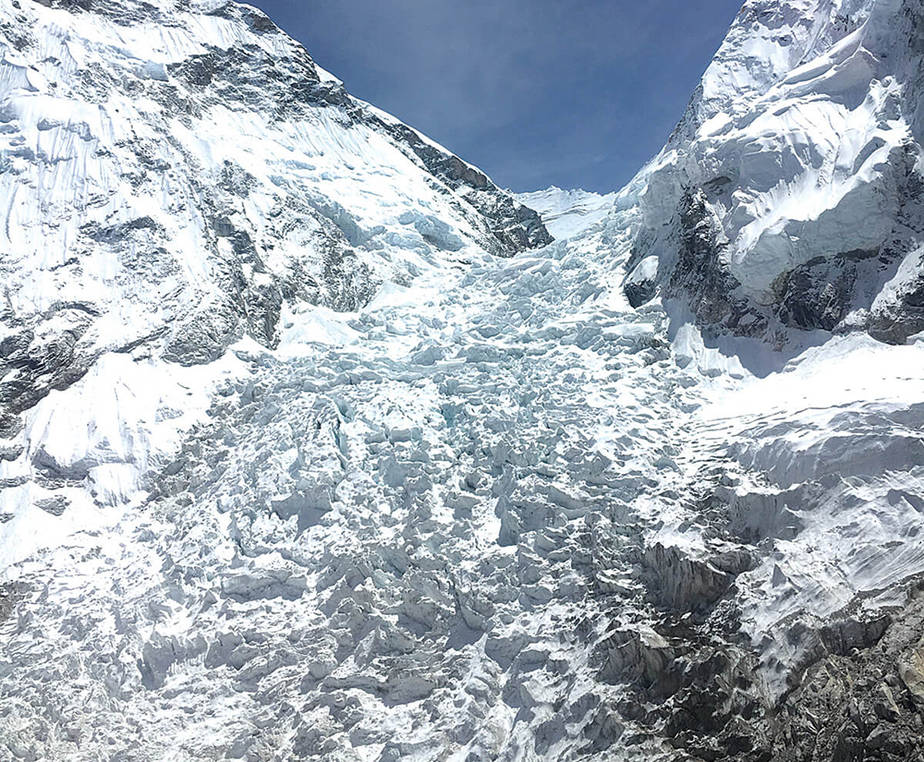
The Khumbu Icefall carries debris and ice from the Western Cwm to the Khumbu Glacier, 1,000 meters below. Credit: Kunda Dixit/Nepali Times
The Khumbu Icefall funnels ice from the Western Cwm below Everest, Lhotse and Nuptse to the glacier below. The ice here has receded at an average of 30 meters per year in the past 20 years, but it has also shrunk vertically, losing up to 50 meters in thickness. Everest Base Camp was at 5,330 meters when Sir Edmund Hillary and Tenzing Norgay climbed Mount Everest in 1953; today it is at 5,270 meters.

A map shows base camp and how a key climbing route up Mount Everest changed after a deadly avalanche in 2014. Credit: Gregory Leonard, with data by Digital Globe and Mark Fahey/USGS, via NASA
The glacier is also getting flatter: the darker debris makes the ice beneath melt faster near Base Camp, but the thicker layers of boulders and sand further down insulate the ice. Glaciologists say this flatter profile means the ice moves slower, leading to more ponding and more rapid melting of the ice underneath.

The velocity of the glacier is about 70 meters per year at Base Camp, and it slows to about 10 meters per year further below. It's zero at the terminus at 4,900 meters. This means the ice is decelerating as it is squeezed, and the pressure is being released by the melting of the ice mass.

Khumbu Glacier is receding at about 30 meters per year and shrinking: Base Camp is now 50 meters lower than when Sir Edmund Hillary and Tenzing Norgay climbed Mount Everest in 1953. Credit: Kunda Dixit/Nepali Times
Researchers monitoring the supraglacial ponds say their area has grown by 70 percent in the past 10 years alone. The ponds are fringed by ice cliffs and caves that accelerate the melting. The melted ice has carved an outflow channel through the left lateral moraine, so there is no large glacial lake on the Khumbu like elsewhere in Nepal.

Scientists conclude that the Khumbu Glacier is not about to vanish, and the Icefall is not going to turn into a waterfall any time soon. However, the permanent ice catchment of the glacier above 6,000 meters could start to deplete under a worst-case scenario of 5 degrees Celsius warming.

(Source: Inside Climate News)

Saturday, 22 September 2018

How difficult could Everest base camp trek be?

Every year thousands of tourists head to the gateway of the Himalayas; the beautiful Nepal. Many people come with the target of reaching the foot of the highest mountain in the world, Mt. Everest. And of course, a few of them come with the aim of conquering it spending many weeks risking their lives. Many trekkers succeed whereas a few find the trek as daunting and difficult as Everest itself. How difficult can it be? Spend a few minutes and see what you think?


What makes the Everest Base Camp Trek difficult?

Well, there are a list of things that might make this trek quite a challenge.

Length of the Trek
With no roads, the only way to visit to the mountains is by walking through the Khumbu region up to Base Camp itself. The distance from Lukla to Base Camp, if counted in kilometres, is 65 km; walking to Base Camp and back to Lukla is a total of 130 Kms.

On average 2 weeks is required to complete the Everest Base Camp Trek successfully. This can feel like a long time and can be difficult for a novice to complete.

It is therefore necessary to be well prepared mentally for the number of days one must walk to reach Base Camp and back to Lukla.

The journey that feels like forever
Increasing Altitude
One of the most underestimated things causing difficulty throughout the Everest Base Camp trek undeniably is the altitude. Kathmandu airport is situated at 1400 m whereas the airport at Lukla is situated at double the elevation than Kathmandu i.e. 2804 m. This increase in elevation is already high enough to induce a person with mild altitude sickness.

Talking about the trekking routes, the elevation increases 600-800 metres per day and the level of oxygen depletes moderately. This is one of the reasons to have an acclimatization day in between some trekking days. The increasing altitude can cause Acute Mountain Sickness which absolutely cannot be ignored.

In order to prevent altitude sickness, it is necessary to walk slowly, use as many days as possible to reach base camp, have at least 2 acclimatization and rest day to adjust to the elevation and drink plenty of water to overcome dehydration. Following these instructions can help adjust to the increasing altitude throughout the trek.

Sign of caution along the trail
Lack of Training
Despite being one of the most accessible treks to everyone, the trek to the Everest Base Camp should not be underestimated. Hiking in the Himalayas is a serious challenge which demands good preparation. With proper planning and proper training, however, one has the best possible chance to successfully and safely reach base camp and experience one of the most extravagant hikes in the world.

Trekking to Everest Base Camp is within the reach of those individuals who are physically fit. It is sensible to start training as early as possible before your scheduled trek. Conventional exercise routines which build strength, fitness and stamina, such as aerobics including swimming, jogging, cycling etc. Light weight-training can be beneficial, particularly if your fitness level is less than desirable. If possible, hiking up and down the hill or walking at least 1 to 2 hours a day can help build the stamina and also help to increase lung capacity and focus at higher elevations. This also increased your enjoyment. If there are no hills available to hike every day, walking up and down the stairs of a tall building can help train you for the Everest Base Camp Trek.

Training prior to the trek

Improper Diet/ Food Poisoning
There are cases where trekkers have returned to Kathmandu due to food poisoning, or due to improper diet before reaching even half way. The question is what should be eaten during the trek? Well, since the Everest Region is a Buddhist area, slaughtering of animals is strictly prohibited. For this reason, meat is flown over to Lukla and carried by porters or yaks to the upper regions. Thus, eating food items containing meat is not recommended at all since there is a threat of food poisoning.

It is best to eat what the local teahouses cook on a regular basis i.e. the local Nepali cuisine including rice, lentils and curry (dal, bhat, tarkari). The regular food will be good enough to keep your body healthy. Drinking water can easily be bought at the local guesthouses along the trekking route or one can carry the purification tablets as well.

The local Nepali thali with rice, lentils, curry and pickle
Unpredictable Weather
Travelling to EBC in every other seasons of the year is not possible due to its difficult and unpredictable weather. The nights are much cooler than the daytime hours in the Everest region. Many first-time trekkers are surprised to learn about the incredible temperature range that may occur in a given day.

During the day, the temperatures can reach as high as 25 degrees C (77 Degrees F), only to dip down as low as -20 degrees C (-4 Degrees F) in less than 24 hours. While there’s no way to know exactly what each day in the mountains will bring, the weather and temperature ranges tend to be somewhat predictable based on the month and season.

The spring season i.e. March, April, May and June and the autumn season i.e. mid of September, October and November are considered to be the best time to travel to the Everest region. On the contrary, monsoon season i.e. July, August, mid of September and the winter season i.e. December, January and February is not really recommended to travel.

Fog hovering around
Flight Delays To and From Lukla
Lukla Airport is situated in a wonderful valley surrounded by high mountains. Due to this reason, landing and taking off from Lukla is quite difficult and technical. The weather in the area can be unpredictable and is likely to change every few hours resulting in flight delays or cancellation. Usually in the monsoon months like June to September, the weather may not allow for the take-off since the visibility may not be as good. However, the flight delays cannot be guaranteed in other seasons as well.

The flight delays to and from Lukla therefore fall into the list as one of the most difficult and unpredictable things during the EBC trek.

Flights have been cancelled and the travellers have been stranded in the airports waiting to fly over to Lukla or head back to Kathmandu for many days. During such situations, we choose to fly our clients in a helicopter as far as possible.

Low visibility conditions at Lukla Airport (Image: Kathmandu Post)

This is a summary of some of the reasons people do not make it to Everest Base Camp. If one comes prepared for it, is life changing and a trek to treasure for lifetime.

Featured image source: Patty- Flickr

(Source: Ace the Himalaya)