Showing posts with label cartoon. Show all posts

Saturday, 8 January 2022

2-year-old boy thought Encanto character was him: "It was the impact of feeling seen"

 If seeing is believing, count 2-year-old Kenzo as a true believer in the power of representation.

This week, during a family viewing of Disney's Encanto, Kah Brand noticed the moment her son realized that one of the characters, a young boy named Antonio, looked very much like him.


"He seemed to be in awe, just smiling and staring at the screen," she told POPSUGAR. "Then he stood up and looked back at his dad and me, still smiling. For him, I truly believe that he thought he was seeing himself because of the resemblance between him and Antonio."


"It is essential for Black children to feel seen and to be connected to positive and empowering images for their self-esteem."


Kenzo's not alone: when Kah posted the picture of him proudly standing next to the TV screen to Instagram, her friends and family couldn't contain their excitement over the similarities.


"As a mom, I'm always trying to capture 'these' moments," she said. "I was amazed at his reaction. It just truly made me smile and my heart happy."


But for her, it was not only the resemblance that mattered.


"It was the impact of feeling seen," Kah added. "It is essential for Black children to feel seen and to be connected to positive and empowering images for their self-esteem."


In fact, Encanto prompted a conversation in her home – one in which everyone tried to think of a character from their own childhoods with which they connected.


"But these characters weren't around," she said, referencing her own generation. "We didn't have this growing up. 

What's so special about Encanto was that it didn't stop at just showing us brown characters. It showed the diversity in hair textures and skin tone. I'm so grateful for moments like this because I'm aware of its impact, especially for brown boys and girls. It brings joy to our family. There's power in representation and magic in creativity. This generation and future generations will experience inclusivity because the film industry is moving in a direction that reflects the true diversity of our world."


(Source: PopSugar)

Wednesday, 15 July 2020

‘Mottainai Grandma’ spreads her environmental message in new cartoon series

When author and illustrator Mariko Shinju’s son was 4 years old, he left food on his plate. Like many Japanese mothers, Shinju said to him, “Mottainai.”


“What is mottainai, Mom?” he asked innocently.


Although she grew up hearing her mother and grandmother say “mottainai,” she couldn’t find the right words to explain what it meant. It was just something that was said to express disappointment at a waste of food or other things. So instead, she picked up a pen and began to draw.


What emerged on the page was the story of Mottaianai Baasan, “Mottainai Grandma” in English, a wise and funky old woman who takes a young boy on a journey to show him the virtues of mindful consumption.


Waste not, want not: Mariko Shinju’s Mottainai Grandma character teaches children how to avoid being wasteful and to be respectful of their environment. | © MOTTAINAI GRANDMA PROJECT


“The model of the grandma’s face is Buddha,” Shinju tells The Japan Times. “Buddha’s eyes are half-open and you don’t always know where Buddha is looking, but Buddha sees everything. Mottainai Grandma also has half-opened eyes, so if you are doing something mottainai, (she) will see it all and come to you.”


A mottainai lifestyle is more than just eating what’s on your plate, though. It’s also a call to action echoing the more modern mantra of “reduce, reuse, recycle,” with an added fourth “R” — “respect.”


“All lives are connected and each one of them is precious,” Shinju says. “If we have a sharing mindset instead of being selfish, we can make this world a better place with the heart of mottainai. It is about being filled with gratitude, kindness, affection and respect for the people who made (the item).”


Shinju admits, however, that she herself wasn’t always so strict with making her son clean his plate. “And when something broke, I would consider simply buying it again since that would be cheaper than fixing what I had,” she adds. “I realized my child might grow up not understanding the meaning of mottainai. I was afraid of what would happen to our society if all children became accustomed to throwing away disposable items and grew up to become people who didn’t care about food.”


According to the United Nations, every year one third of global food production is wasted and roughly 8 million tons of plastic waste ends up in the ocean. Shinju realized that by teaching children about the importance of being mindful of waste and respecting their surroundings, perhaps it could have a positive impact, however small, on the environment.


Teachable moment: Mariko Shinju created the 'Mottainai Grandma' series as a way to teach her own son about wastefulness. | © MOTTAINAI GRANDMA PROJECT


She knew that she had hit on a good idea with “Mottainai Grandma” when her son enthusiastically asked her to read her self-made book over and over again.


“I thought maybe this story would be enjoyed by other kids,” she says. “I decided to create the picture book in the hopes that it would make children think with their hearts.”


Since releasing the first of the “Mottainai Grandma” series in 2004, Shinju has published a total of 17 installments and sold more than 1 million copies, which are read by children all over the world including those in South Korea, Thailand, China, France and India.


One installment in particular, “Mottainai Grandma Goes to the River,” inspired by her visit to the Ganges River in India, became the catalyst to turning the books into an animated series. In this story, Mottainai Grandma stops a boy from throwing a plastic bottle into a river, and together they follow a “baby river” to the ocean where they save other “babies” by collecting plastic waste.


In April 2019, Shinju released “Mottainai Grandma Goes to the River” in Hindi, which captured the attention of Sanjay Kumar Verma, the Indian ambassador to Japan. Soon after, Verma joined Environment Minister Tadahiko Ito and Yoshiaki Koga, a project manager for India at Shinju’s publisher, Kodansha, for dinner in Tokyo. When Verma was asked about how to promote “Mottainai Grandma” in India, an idea came to him. Why not animate the books to engage even more children in conversations about recycling, wastefulness and looking after the environment? Verma took this a step further by proposing to align with the United Nations’ Sustainable Development Goal program (SDG 12), which strives to “ensure sustainable consumption and production patterns.”


“I had always wanted to make animation series to let many people know the message of Mottainai Grandma,” Shinju says. With support from Japan’s Environment Ministry, Kodansha and members of the Alliance to End Plastic Waste, including All Nippon Airways (ANA), which agreed to screen the anime series on ANA flights, Shinju was able to realize that dream.


On June 5, World Environment Day, the “Mottainai Grandma” anime series was released for free on its website and YouTube. It is currently available in English and Japanese, and will also be available in French, Spanish, Chinese and Hindi later this summer.

The series of five-minute episodes are adapted from four books: “Mottainai Grandma,” “Mottainai Grandma: Let’s Eat with Gratitude,” “Mottainai Grandma Goes to Magic Land” and “Mottainai Grandma Goes to the River.” Each episode ends with a song and dance that features Grandma singing, “Are you doing anything mottainai?”


“This is an era where things are abundant, so you might not think about what is mottainai,” says Keiko Toda, who voices the Japanese version of Mottainai Grandma, as well as other kid-friendly characters such as Anpanman and Thomas the Tank Engine. 


“Mothers and fathers should also see this story, not just to say ‘mottainai’ to scold the children, but to understand why something is mottainai. I hope they will understand there is a good reason.”


Shinju adds that being more mindful of the environment is an important part of life amid a global pandemic as well. “Before we try to restore our lives to how it used to be, we should aim for a better world than before,” she says. “I would like to move forward by giving priority to what we should do to live and finding ways to make everyone happy in a sustainable society that protects the environment.”


Under the kind but watchful eyes of Mottainai Grandma, every day can be an opportunity to make the world a better place by respecting the environment.


(Source: JT)

Wednesday, 13 May 2020

In Japan, ‘Sazae-san’ — world's longest-running TV cartoon — switches to reruns

Millions of Japanese viewers of the world’s longest-running animated cartoon TV show will have to make do with reruns from next week after the coronavirus pandemic disrupted production, Fuji Television Network said on Sunday.

Aired every Sunday since 1969, the “Sazae-san” show featuring the everyday ups and downs of suburban Japanese housewife Sazae and her extended family, is a household name for many generations. 

It can still attract around 10 percent of the viewing audience, according to some estimates, for its 30-minute slot at 6.30 p.m. on Sundays.
Sazae-san (second from left) and her extended family | HASEGAWA MACHIKO ART MUSEUM / VIA KYODO

The show, adapted from four-frame comic strips by late author Machiko Hasegawa, was acknowledged by Guinness World Records in 2013 as the longest-running animated series, a title that had previously been attributed by the record-keeping organization to U.S. show “The Simpsons.”

A spokeswoman for Fuji TV, a unit of Fuji Media Holdings Inc, said reruns will begin next week for the first time since February 1975, when the global economy was massively disrupted by an oil price crisis.

While the number of confirmed coronavirus cases and deaths has been low in Japan by some international comparisons, the Japanese economy — the world’s third-largest — has been seriously hit by the global repercussions of the pandemic and is expected to have sunk into a recession this year.

Earlier this month the government extended the country’s state of emergency to the end of May as part of efforts to stem the spread of the virus, prolonging shutdowns for many businesses.

On Saturday, long-running manga publication Big Comic said its ruthless hitman series “Golgo 13” would take the first hiatus in its 52-year history as social restrictions to contain the virus have made it difficult to produce the hand-drawn cartoon.

(Source: JT)

Tuesday, 21 April 2020

Legendary Tom & Jerry and Popeye director Gene Deitch dies aged 95

Oscar-winning illustrator and legendary Tom & Jerry director Gene Deitch has died aged 95. 

Gene passed away in his apartment in Prague on Thursday, April 16, though no cause of death has yet been given.

His Czech publisher, Petr Himmel, confirmed the news, saying Gene died ‘unexpectedly’.

Gene, whose full name was Eugene Merrill Deitch, worked as a draftsman for North American Aviation before being drafted for the military and entering pilot training. He was discharged for medical reasons in 1944 and went back to work in the commercial art world, after which his animation career took off.
Metro-Goldwyn-Mayer/PA
In 1958, Deitch was nominated for an Academy Award for his film Sidney’s Family Tree. He went on to the Academy Award for Best Animated Short Film for his film Munro in 1960, and was nominated another two times in the same category in 1964 for Here’s Nudnik and How to Avoid Friendship.

During his career, Gene worked as creative director at of Terrytoons, under 20th Century Fox, where he created characters like Sidney the Elephant, Gaston Le Crayon, Clint Clobber and Terr’ble Thompson.

PA Images
 He went on to work with Rembrandt Films through the 1960s to produce a number of Popeye cartoons, as well as a dozen Tom and Jerry shorts for Metro-Goldwyn-Mayer.


He also co-produced and directed a series of King Features’ Krazy Kat shorts for TV, and created an original kids’ series called The Bluffers.

Gene is survived by his wife and three sons from his first marriage. Rest in peace.

(Source: Unilad)

Saturday, 4 April 2020

The Gruffalo author Julia Donaldson shows her characters social distancing

The makers of the children's book The Gruffalo have drawn their characters practising social distancing to help children understand the regulations.

Author Julia Donaldson and illustrator Axel Scheffler created the panels as a "light-hearted" way of spreading the message.
AXEL SCHEFFLER AND JULIA DONALDSON

They feature The Gruffalo, Stickman and The Smeds and The Smoos - all keeping a safe distance from one another.
The characters are also seen helping the vulnerable with their shopping.

The Gruffalo was first published in 1999, and tells the story of a mouse taking a walk in the woods - where he out-smarts a terrifying creature with terrible teeth and a "posionous wart on the end of his nose".

It went on to sell 13 million copies, and had been turned into a stage play and an Oscar-nominated animation.
AXEL SCHEFFLER AND JULIA DONALDSON

One of the new sketches shows the Gruffalo walking behind the mouse, accompanied by the couplet:

"Alright said The Gruffalo bursting with laughter / You go ahead, I'll follow two metres after."

"Axel had this idea of doing some witty sketches, each based on one of our books and each kind of incorporating a tip about coronavirus," Donaldson told BBC Breakfast on Friday.

Scheffler started the process by saying to himself, "what can I do as an illustrator?" during these troubled times.
AXEL SCHEFFLER AND JULIA DONALDSON

"I'm currently working on a digital, free non-fiction book about coronavirus, which is serious and informative and probably more important than this and is coming out next week," he said.

"[But] I wanted to do something light-hearted and cheer people up and I thought, 'what if I imagine our characters in corona situations?'"

"It's really more about entertainment than serious information," he added.
AXEL SCHEFFLER AND JULIA DONALDSON

As well as social distancing, the characters stress the importance of exercise and making video calls to their family members.

Donaldson hopes the images will emphasise best practices and help with home schooling, without being seen as "preaching".

While on lockdown, the author is also producing a weekly broadcast on The Gruffalo Facebook page, reading stories, poems and singing songs.

(Source: BBC)


Saturday, 28 March 2020

'One big virtual love-in': How children's book authors are creating online sanctuaries

Authors are going live in real time to engage children and create a safe place where imaginations are fired

The children’s author and illustrator wunderkind Oliver Jeffers has started a stay-at-home story time where he reads a book a day live on Instagram. And they are pure magic.

Jeffers, in quarantine in Belfast, is reading a story a day, having started with his first ever book How to Catch a Star.

According to Jeffers, “[This is] for all you folks stuck at home in the coming weeks due to Covid, I will be reading one of my books every weekday, and talking about some of the things that went into making it. We are all at home, but none of us are alone. Let’s be bored together.”

In this social-isolating time his live reads make you feel part of an intimate family Skype call, complete with interruptions from his young children.

And judging by the tsunami of love hearts, emojis and adoring comments, Jeffers clearly has quite the fan club. Each day, thousands of children and their parents around the globe tune in on IGTV to commune with their idol for what is one big virtual love-in.
Chris Haughten’s paper owl, which can be downloaded, printed and folded as a craft activity for children

His stories are usually about a boy – “Once there was a boy … ” – and the simple sparsity of his language captures your attention immediately, as you know you are in for a good yarn. The books are illustrated in his signature crayon and watercolour style, and full of little visual clues that make them a fun read for all ages. The plots are adult-friendly too, with quirky and often implausible storylines. They have a wicked sense of the bizarre yet are full of humanity.

The boy (and often his penguin or mouse) go on extraordinary yet ordinary adventures, but the real story is in how they deal with feelings. Jeffers doesn’t shy away from hard emotions (sad, lonely, scared) but importantly, offers uplifting, universal moments of connection, love and friendship – which makes his tales feel very real at their core.

In his fifth quarantine read, The Great Paper Caper, he had listeners come prepared with a piece of paper, a cryptic clue from this detective story plot. The paper is used to create paper planes, which Jeffers duly made and talked through with his young listeners so they could make their own at home.

With his live reads, Jeffers has created a calm sanctuary amid the fear, and it feels like a very safe, warm and cosy place to spend some time.

You can tune in weekdays on Instagram at 6pm GMT, 2pm EST, 11am PST.

Here are some other authors and organisations moving into the virtual literary world for kids.

Boredom busters just for girls
The good folk at Talu Tales have joined forces with some of our favourite authors and it’s just the feel-good story we need to soothe the soul, sparkle the heart and inspire the imagination.

As the Talu team see it, “The world is a bit topsy-turvy at the moment, and many of us are feeling the hits from cancelled events, lots of work, kids being cooped up at home and being isolated from friends and a regular routine. Today we’re celebrating all things community, reading, creativity and storytelling. Pop your head in when you need a little pep-up and we’ll be here all day!”
4835178136090097754.png
Talu Tales is a fantasy story world that inspires kids to learn about science, technology, engineering and mathematics. They are on a mission to close the gender gap one story at a time, with stories that feature female characters in non-stereotypical plotlines. So expect to spark some future female leaders with these empowering role models who embark on fantastical adventures.

They released little story surprises for 11 hours straight. You can access these surprises from their Facebook, Instagram and Twitter channels. Here are some of them.

Incredible Freedom Machine, read aloud by Kirli Saunders
In this story of exploration and breaking boundaries, a young girl uncovers her very own freedom machine, a vehicle that carries her to all kinds of wondrous places. A proud Gunai woman, with ties to the Yuin, Gundungurra, Gadigal and Biripi people, Saunders currently resides on Dharawal country.

All Bodies Are Good Bodies, read aloud by Charlotte Barkla
A book which is about celebrating awesome incredible bodies that do unbelievable things. Like digesting food. What a wild crazy thing. Charlotte is an Adelaide-based writer who worked as a civil engineer and physics teacher but now creates picture books. And perhaps if you ask her nicely she’ll share a cool physics fact!

My Dog Bigsy, read aloud by Alison Lester
A book she wrote about her dog, Bigsy, Alison’s picture books mix imaginary worlds with everyday life, encouraging children to believe in themselves and celebrate the differences that make them special.

Books and live cartoons with Mac Barnett
Mac Barnett’s Book Club show is an interactive treat. He’s created mini themed shows that have regular time slots kids can tune into each day. They are part live theatre, part comedy skit, part craft lesson. They score high on the entertainment value and regularly feature surprise guests. Someone needs to get this guy his own TV show (wait this is IGTV, so I guess he’s made his own).

Tune in for: chapter books After Dark where Barnett styles himself as a TV host reminiscent of the 1950s, where “Each night I’ll pour a glass of milk, put on my most comfortable tuxedo and read a chapter of my memoir, Mac B, Kid Spy #1: Mac Undercover, illustrated by @mikelowerystudio. New chapters go up about 5:00 California time and they’ll stay up on my IGTV till the end of the ‘school year’.”

If cartooning is your thing, Mac has teamed up with his oldest friend and racquetball arch-nemesis, @shawnharri5, to create what they claim to be the world’s first “live cartoon”. In his words “How is that possible? What does that even mean? Does Shawn own a dog, and if he does, is that dog super-cute? Stay home tomorrow and find out!”

Going by the Instagram stories of budding cartoonists joining in on the live drawing, and duly donning their hats (it’s a Barnett thing), Mac has hit the sweet spot with his old-school charm and off-beat humour and the fans keep coming back for more.

Stay-at-home readings and art class with Chris Haughton
Chris Haughton’s book reads are more live art tutorials for budding young illustrators, some with singalongs. He’s packaged resources on his site to download and join in at home. His cut-out stencils and colouring-in templates featuring his signature collages are a stay-at-home schooling parent’s dream.

Stayathome #2 had viewers learning how to make his “a bit lost owl” out of paper from the stencils available online.

As Haughton says: “Tune in to meet George himself. There will be cake. We will be well behaved. And of course bring a pen and paper for a bit of drawing afterwards ... I will show how I make my art and we will make a collage together.”

His books are simple and naive in style but feature stories with a social conscience where themes such as climate change, gender and racial equality are woven in as part of the narrative.

To keep the good vibe going, he’s offering free downloads of his app Hat Monkey which includes music and dance routines.

Tune in on Haughton’s Facebook page at 5pm GMT every weekday.


(Source: The Guardian)

Wednesday, 4 December 2019

Bye caramba! The Simpsons composer claims the show is 'coming to an end'

The world’s longest running animation could bow out after its current series, according to Danny Elfman

They have been a TV fixture for almost 30 years, but The Simpsons could finally be “coming to an end” according to Danny Elfman, the man behind its famous theme tune.
 D’oh ... is The Simpsons about to be gone for good? Photograph: Entertainment Pictures/Alamy

Speaking on a podcast hosted by the site joe.ie, the 66-year-old said he was aware of plans to stop the long-running series after its current run. “From what I’ve heard it will be coming to an end,” said Elfman. “I don’t know for a fact, but I’ve heard that it will be in its last year.” He went on to express his surprise at the show’s success. “I’m so flabbergasted and amazed that it has lasted as long as it did … you have to realise, when I scored The Simpsons, I wrote this crazy piece of music, and I expected no one would hear it, because I really did not think the show had a chance in hell.”

Created by Matt Groening, The Simpsons is currently the world’s longest-running animated show, and the longest-running US sitcom of all time. It started life as a segment on Fox’s Tracey Ullman Show in 1987, before it was developed into a standalone show, which has run for 670 episodes to date.

 At its peak it was a pop culture phenomenon ... The Simpsons. Photograph: Anonymous/AP
At its peak, it was a pop culture phenomenon, making household names of Homer, Marge and their offspring. Starry cameos ranged from Stephen Hawking to Paul McCartney, and Homer Simpson’s “d’oh” catchphrase was added to the Oxford English Dictionary in 2001. A film spinoff, The Simpsons Movie, also brought in over $500m at the box office in 2007.

While the show’s popularity has waned in recent years, with ratings at an all-time low for its 30th season finale earlier this year, its recent Treehouse of Horror Halloween special was watched by a respectable 5.7 million viewers in the US. The show currently airs on Channel 4 and Sky One in the UK, and Fox and Disney+ in the US, with the nascent streaming service pushing the series heavily in promotional materials.

Early this year, the show attracted attention for withdrawing an episode featuring the voice of Michael Jackson from TV and streaming services, in light of the HBO documentary Leaving Neverland. Prior to that, the show’s makers were embroiled in controversy regarding the character of Apu Nahasapeemapetilon, the Hindu convenience store owner seen by many to perpetuate racist stereotypes. Fox have been approached for comment.

(Source: The Guardian)

Sunday, 22 September 2019

Pokemon: 'Ash Ketchum failing for 22 years taught me being a loser is OK'

We're told to never give up on our dreams - but grafting for 22 years? That might be pushing things for most of us.

Not for Ash Ketchum though, who this weekend became a Pokemon Master in a new episode of the Pokemon anime.

Yes, obviously Ash is a cartoon character and Pokemon aren't real, but for many fans of the franchise it's a big moment.

He's been plugging away at being the very best ("like no one ever was") since 1997.

In the latest episode, he won the Alola Pokemon league, despite the fact that throughout much of his adventures, he's been quite bad at training Pokemon - losing every other championship he's ever entered.

'The lesson is to pick yourself back up'
But that - and Pikachu, obviously - was always part of the appeal.

"Pokemon was great escapism for me but it also taught me that not necessarily being the best, that was OK too," 27-year-old Jake Saunders from Bromborough tells BBC Radio 1 Newsbeat.

"Putting it bluntly, it was like being a loser is OK. The important lesson is to pick yourself back up, roll with the punches and keep going."

"It's taken Ash 22 years and obviously that's a lot of people's youth," says Jake
And Laura Kate Dale, who's 28 and from Surrey, says Ash proved to her that you could be "still worthy of praise" even if you failed every single time.

"He was always the underdog, half the times he won gym badges it was because he did something nice, not because he was the best at fighting," she tells Newsbeat.

"There was something really beautiful about seeing that growing up - that it's OK if you're not the strongest, the most qualified, as long as you keep trying to be the best person you can be, the nicest you can be to people around you."

Pokemon told 'relatable stories in digestible ways'
While it's easy to dismiss the franchise as just the game that had us all rummaging around in the park for a stray Nidoqueen or rogue Vulpix in 2016 when Pokemon Go was released, the cartoon helped people like Kate and Jake deal with serious issues in real life.

Kate says an episode in which Ash met a Charmander (small, red, dragon-ish, tail on fire - you know the one) which had been abandoned by its original trainer has stuck with her to this day.

"At the time, I was a child dealing with the fact that my biological dad had left and didn't seem to care the way he was supposed to," she says.

"If you keep trying at the things you want to do, they're attainable," says Laura, about Ash's Pokemon journey
"The episode's story was about learning to move on and be OK after someone who was supposed to look after you just vanishes - it was really tasteful in dealing with something that as a child was really difficult to comprehend.

"That's what the show was really good at. It told stories about relatable themes in digestible ways for children."

'A wonderful piece of closure'
But those children are now adults and Jake (a self-confessed "man-child" but in the process of buying a house and "juggling things quite successfully") says seeing Ash achieve his dreams reminds him of what's happening for him.

"I think I was around eight or nine-years-old when I started watching it and it's almost in parallel to where I am in my own life now," he says.

"I think a lot of young people will be able to relate to that.

"Looking at the show, it's a wonderful piece of closure for his character arc. It's brought everything full circle with all these people who have been watching the show since it began."

(Source: BBC)

Wednesday, 21 August 2019

Why I 'married' a cartoon character

There is a word in Japanese for people who are obsessed with video games and anime - otaku. An increasing number of otaku now say they have fallen in love with anime characters and given up on the idea of real-world romance, reports the BBC's Stephanie Hegarty.

Akihiko Kondo wakes up every day to the sound of his wife's voice. She calls him from across the room in her high-pitched, girlish, sing-song voice. She dances and swirls around, urging him to get out of bed.

At the same time, he's holding her in his arms on the bottom tier of their metal-framed bunk bed - and if he was more awake he could be watching an illustrated cartoon of her singing on YouTube.

This is because Akihiko's "wife" is an idea - an anime character called Miku.

She's the hologram that lives in a glass capsule on a shelf in the corner of the room, and the cuddly toy with its big soft head and small body that he holds close at night. But she can take innumerable other forms.

Each representation includes some essential characteristics, Akihiko says - including bright turquoise-coloured hair tied up in two long bunches, with a thick fringe framing her face.

Beyond that, Miku varies. She may be a childish, cartoon-like creature, or she may be more human, and sexier - with a low neckline and big boobs, schoolgirl blouse and short skirt. Akihiko considers all of these Mikus to be his wife.

The couple had a ceremony that Akihiko regards as a wedding in November last year. It wasn't official, but it was a pretty big bash with 39 guests. The number spells her name in Japanese - three for "mi" and nine for "ku".

Miku was present in the form of a cuddly toy, wearing a white, lace dress and a long veil, her outfit hand-made by a designer, who contacted Akihiko after he announced his engagement.

Akihiko himself wore a pure white coat and tails with white flowers in his lapel, his usual square-framed glasses and a big grin. He held her and her bouquet - one of her trademarks, a bunch of leeks tied with a big pink bow.

He said their vows and walked down the aisle holding her by his side, as guests smiled and clapped. Later they sat at the top table for dinner. Akihiko in one white chair and Miku in another, propped up in an empty flower vase.

Watching a video of the occasion, Akihiko smiles.

"There are two reasons why I had a wedding publicly," he says.

"The first one is to prove my love to Miku. The second one is there are many young otaku people like me falling in love with anime characters. I want to show the world that I support them."

Otaku is a Japanese word for a nerd or a geek, usually someone that's obsessed with video games and anime. A lot of gaming and anime obsessives wear the name with pride but it can also be used as a derogatory term for people who are socially awkward.

Some, like Akihiko, take their obsession to what some may consider an extreme level, turning away from real-life relationships. And it appears that their numbers are increasing.

Last year Gatebox, the company that made Akihiko's hologram of Miku, started issuing unofficial "marriage certificates" to customers; they say 3,700 people took them up on the offer.

That alone may not prove very much, but they are not the only ones reporting a rise in pseudo-relationships.

Prof Masahiro Yamada, a sociologist who also runs an agony aunt column answering questions on family and relationships for the Yomiuri newspaper, has for years carried out regular surveys asking young people what they feel affection for.

The list includes pets, pop stars, sports stars, anime characters, and virtual idols (digitally animated, anime-inspired YouTube stars). He also asks if people visit cafes where they are waited on by young women dressed up as maids, or use prostitution services that offer companionship as well as sex.

All of these pseudo-relationships are growing, he says. In this year's survey, about 12% of young people reported sometimes or often falling in love with an anime or video game character. But what could be driving this trend?

It has a lot to do with economics and tradition, Yamada says, primarily the fact that many Japanese women won't consider a boyfriend unless he makes a lot of money. In 2016, 47% of women aged between 20 and 29 agreed with the statement that husbands should work for money and wives should do housework, he points out - a higher proportion than in any other age group, including the over-70s.

"In Asia, Japan and South Korea, people are quite obsessed about this high salary and this tendency is not getting any weaker, it's getting stronger," he says.

"Japanese women tend not to believe in eternal love, but they can trust money."

This sounds like a sweeping statement - one that comes close to blaming a generation of women for the problem - but Yamada says it's a conclusion he has drawn after extensive surveys.

"In Japan working life is very, very hard and there is still a lot of sexual discrimination. Working hours are very long and there's lots of stress," he says.

Also, the burden of childcare is still firmly on the mother. Long hours, high-stress workplaces and long commutes make life difficult for working mothers. The easier option is to quit - but that's not possible unless your partner earns a certain amount of money.

At the same time there's a dwindling pool of well-paid men: as Japan's economy stagnates, wages are falling.

The result, he says, is an increasing number of young women who choose not to date and an increasing number of young men who know enough not to bother trying.

Akihiko never really entertained the idea of having a real-life girlfriend.

"I've never felt attracted to real women," he says. Why not, I ask? "Because I'm not popular among women," he replies.

In school he was bullied for being an otaku. And bullying followed him into the world of work. He was working as an administrator in a primary school about 12 years ago when he was picked upon incessantly by two women - one was close to his age, one was a lot older.

When he greeted them in the morning they would ignore him. They would stand in the kitchen where he could hear them and call him names. And if he made a small mistake they would shout at him, sometimes in front of the young students which he found humiliating.

The bullying got so intolerable that he left work. For almost two years he locked himself in his room and refused to leave.

"I was hikikomori," he says. This is a well-known phenomenon in Japan and South Korea where young people, mostly men, become hermits in their own parental homes, refusing to go outside or even to speak to their families. There are estimated to be about one million of them and it can go on for many years.

But then he met Miku.

"I was watching her video on YouTube and Niconico (a Japanese version of YouTube), looking at her images, listening to her songs, and I was healed by her," he says.

The constant bullying, he felt, had forced him to shut down, to retreat into a state where he was emotionally void. He was deeply and darkly depressed.

"Listening to her songs sometimes makes me very emotional. How she dances, moves and talks makes me feel. My heart starts moving again," he says.

"That's why I love her and why she's so important to me."

He started to feel like he was in a relationship with her, and with the support of that relationship he was able to go back to work.

"The emotion was no different from a real relationship," he says. "After I fell for her. You feel the pressure in your chest. I experienced this feeling, just like falling in love with a real person."

He says he dated her for 10 years before he decided to marry her.

For much of those 10 years Akihiko was only able to talk to Miku in his mind. Now he can have basic but significant conversations with his Gatebox hologram. He can tell her he loves her and she can respond.

But they can't do much else.

"I have to use some imagination in between," he says.

"Of course, if I could touch her that would be fantastic. Now we can't do that. But in the future, the technology will develop. In the future, maybe I can hold her hands or hug her."

Akihiko is well aware that many people think his marriage is strange. The one disappointment about his wedding was that his mother and sister refused to attend.

And he gets a lot of abuse from people online, especially after going public with his marriage in several interviews. But he has also received a huge number of messages of support from strangers.

"A number of people kind of 'came out'," he says. They wrote to him to tell him about their own affection for an anime character. "I received so many messages like that. So, I thought it was worthwhile."

Now he works in a secondary school where he's open about his relationship status. Some of the staff find it weird but he says the students tend to be more accepting.

He's working and socialising again and he has his own apartment - two tidy rooms in a quiet suburb, with his name and Miku's written above the doorbell.

And most importantly he's happy.

"In this society there's a template of what makes one happy - get married, have children, form a family. But that shouldn't be the only way. I don't fall into that template.

"We have to consider all kinds of love and all kinds of happiness."

(Source: BBC)

Sunday, 7 July 2019

Racists are trying to use ‘science’ to prove mermaids can’t be black. Yes, really

When all else fails, a cheeky bit of eugenics will go a long way, said no one ever.

People are trying really, really hard to justify why Ariel from The Little Mermaid should be played by a white actress.

This comes after an announcement that singer and actress Halle Bailey, who is of African American descent, has won the role, with many arguing that the mythological fish-person should remain “authentic” to the original aesthetic – that is a white mermaid with red hair.

As those arguments have been exhausted and proven invalid for multiple reasons, outlined in a previous indy100 article, some people have turned to science.
Picture: Disney/Twitter grab
Mermaid science.

Yes, according to science, mermaids are white because they live under water and have less melanin, which means a lighter skin colour.
One Twitter user wrote:

My opinion on why mermaids are white is that they live so deep underwater that sunlight hardly reaches them, thus the lack of melanin. It doesn't matter what ocean they're from cos they could've been migrating seasonally like fishes. But maybe im thinking too much.

Other Very Science-y People™ hopped on the theory.


And developed it.

Another studious Twitter user chimed in with Proper Social Theory™.​

People are trying to come to grips with these new academic ideas.


A student of medicine cleared up the details about melanin production.


But mostly, people are done with the veiled racism.

FYI...
Also, mermaids aren’t exclusive to European mythological history. Here's just one example: Yemaya is a Yoruba deity, also known as the goddess of the Oceans and owner of the seas. According to Yoruba beliefs, she is the mother of all living things. Yemoja, an Orisha (another deity) is another water deity that can be referred to in English as "daughter of a great fish".

(Source: Independent)

Wednesday, 29 May 2019

Ali Dorani: Iranian cartoonist on the drawings that saved his life

Cartoonist Ali Dorani fled Iran at the age of 21 before becoming trapped in Australia's controversial Manus Island detention camp for four years - but things changed after his artwork was posted online.

Here's his story - in his own words and drawings.

In 2013, I left Iran. I can't tell you why because it might affect my family's safety - but I knew my life was in danger.


I stayed in Indonesia for 40 days, and tried to get to Australia - I knew Australia was the best way for me to get to safety.

A people smuggler told me he could get us to Australia by boat.

When I saw the boat, I was afraid I would die. It was a fishing boat, not really well maintained, and there were about 150 of us. And I can't swim.


When the time came to get on the boat, I told myself: "This is it. If anything happens to that weak boat, I'm going to die."

The journey took us 52 hours - it was raining and the ocean wasn't normal. It was so scary.

The Australian navy intercepted us and took us to Christmas Island - a detention centre where Australia keeps asylum seekers who arrive by boat.


I had suffered from OCD [Obsessive Compulsive Disorder] for a number of years - but it got worse on Christmas Island.

I liked to keep my surroundings clean at all times - but I couldn't control it anymore because I was in a room with several other people.

At one point, I tried to wash my dictionary in the shower because I felt it was dirty. I kept telling myself I was going crazy - I was shaking and getting so nervous.


Doctors at the medical centre told me I had to take medication, or find some strategies to deal with my OCD.

I didn't want to take medication because I was worried the Australian government would call me crazy and blacklist me from entering.

But when I went back to my room I slowly remembered that I had a talent for drawing. So I started drawing again to deal with my OCD.

I've been drawing since I was five years old - it's one of my earliest memories.

I'd stopped a few years before I fled Iran, because I was so busy with work and life - but now I felt so sick that I started drawing again.


I didn't always have something to draw on. We could request materials from immigration officers, but they wouldn't always give us paper and pencils.

So I had to steal paper - I'd go into language classes, and take blank papers when the teacher was looking the other way.

Because I only had a limited supply of paper I couldn't make mistakes in my drawings - that also helped me improve my skills.

Drawing actually didn't help my OCD, which was still getting worse every day.

But I started showing my drawings to other detainees, and some of the immigration officers, and people got interested in my cartoons.

I drew about my life there - what happened when I lined up to get food, what it was like using dirty public toilets.

I remember the first time I realised people took my work seriously.

I drew a map of Australia on a white T-shirt, with two eyes crying, and the words "I am only a refugee".

Two immigration officers asked me why I drew on my T-shirt - they saw the drawing as a protest.

I hadn't meant it as a protest - I had no idea my drawing would be taken that seriously - but it made me realise that my drawings could affect others.

So I kept cartooning - drawing diaries about daily life in the detention centre - and getting lots of positive and negative comments.

I was afraid that my drawings could affect my asylum application - but I also thought there could be nothing worse than being kept in a detention centre. I was depressed and my OCD was really difficult - so I thought I was already in a nightmare, and there was nothing else to be afraid of.

In fact, Christmas Island was much nicer than where I went next.

I was moved to Manus Island after six months, in January 2014. They handcuffed us and I had five security officers around me.

It was my first time in a tropical country - it was really hot and it was difficult to breathe.


It didn't look like the detention centre on Christmas Island. It looked like somewhere where you would keep chickens, pigs or sheep.

We had tents, dirty rooms, dirty toilets, and horrible showers. There were hundreds of people crammed in a small camp.

Some of the guards tried to reassure me - they could see the shock on my face. They told me: "Don't worry, everything is going to be fine."

I felt I didn't have any choices left - I couldn't go home, couldn't stay in Australia, and didn't want to kill myself. I felt like a dead body who was forcing himself to stay alive.

I didn't have any pencils or paper when I arrived on Manus Island - they took away my pencils when I left Christmas Island - although I could keep my drawings.

At first, I didn't want to draw. When you're forced to live in a place, but don't know why you are there, or when it is going to end, you lose hope, you lose all motivation, and this, combined with the weather, the sun, the mosquitoes - all help to destroy you inside.


An incident happened on 17 February 2014 - some of the locals attacked the camp, smashing everything and beating people up. They killed one of the refugees as well.

For about a month after that, we didn't have access to much - no proper food, or services.

Then another company came to run the camp - they improved the dining room and brought different activities in the camp, including English classes and drawing activities.

I started drawing again, documenting life at the camp. I also drew the mosquitoes, the sun and the rain.

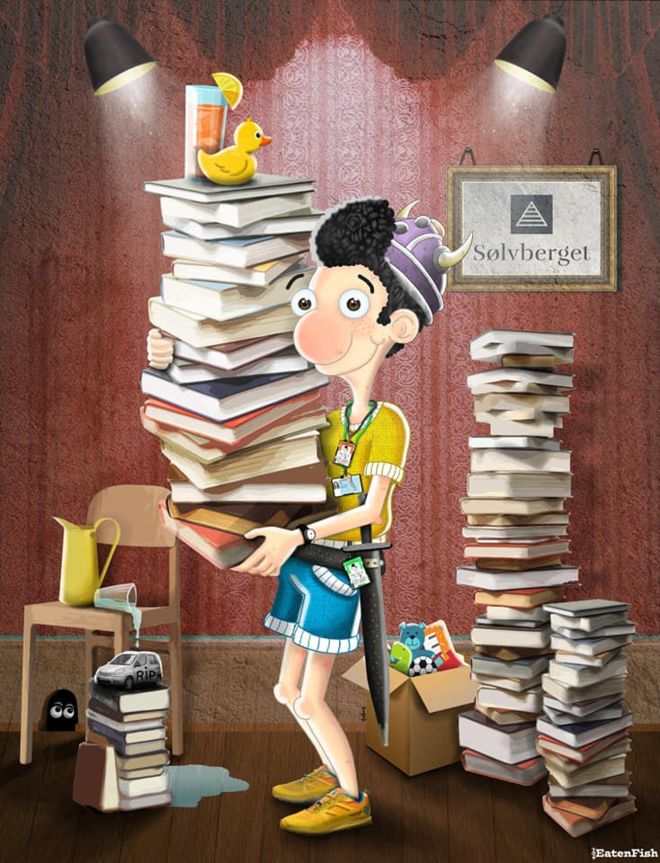
I chose EatenFish as my penname, because I was caught from the sea like a fish, "eaten" (processed) at an Australian detention camp, and then "thrown away" on Manus Island (the same way you throw fish bones into a rubbish bin).

In some of my pictures, I added graves for the refugees who had died.


Sexual harassment and sexual assault were serious problems on Manus Island.

It wasn't only me suffering from this - there were a lot of young people like me suffering.

I witnessed it a lot, but I couldn't do anything about it because I was already under too much pressure, suffering from OCD, panic attacks and anxiety.


We didn't have access to the internet at this time, and I didn't have any hope of sharing my drawings with the outside world.

However, the Australian government eventually decided we would each be allowed to use the internet for 45 minutes every week.

The connection was really slow, and was barely strong enough to get onto Facebook - but I started logging on, joining Australian humanitarian groups, and sending friend requests to each of the members.

I did that for 1.5 years - sending messages to thousands of strangers. No one replied.

However, it turns out a lot of the Australian workers and immigration officials at the camp were talking about my drawings, even when they got home.

An activist - Janet Galbraith - heard about my drawings and contacted me on Facebook - she said she was starting a gallery in Melbourne, and wanted to display one of my drawings.

It wasn't easy sending her my pictures because we didn't have access to a scanner, or cameras.

A few people had secretly kept their mobile phones, although most of the cameras weren't very high-quality.

Eventually, I managed to secretly take a photo of my drawing using a mobile phone, and sent it to her.

The drawing that was exhibited in Melbourne
After Janet displayed the photo in the gallery, one man working on Manus Island saw the picture, and told Janet he knew me and could help get my drawings out.

He was working for the government so I couldn't really trust him, but at the same time I didn't have many other choices.

He took photos of my drawings with his iPad and sent them to Janet - and then my drawings started getting published by news organisations.


In 2015, many of us went on hunger strike against Australia's policy, and conditions at the camp.

I ended up getting really sick - I had panic attacks, with muscle spasms, for almost 40 minutes. Sometimes I had panic attacks three times a day.

The doctors put me on different forms of medication, but there were days when I'd wake up and not be able to remember where I used to live or who I was. I was kept in isolation for almost one month.


After I got out of isolation, I contacted Janet again, and explained what happened to me. I also got in touch with Cartoonists Rights Network International (CRNI), and was put in touch with the Guardian cartoonist First Dog on the Moon.

The Guardian started publishing my work, and in 2016, CRNI gave me their Courage in Editorial Cartooning Award.

That got me a lot of publicity - but I didn't really realise it at the time, because my internet access was so limited.

I would hear from people that I'd been published, or get sent links to my work - but I'd have to wait to use the internet room each week, and often the connection wouldn't work well.

I didn't think the publicity would help me - I saw it as a chance to show my drawings to Australians, but I didn't see how it would get me out of detention.

In 2016, artists around the world started drawing cartoons to show their support for me.

When I was a child, one of my wishes was to become a cartoonist, because I would read cartoons in magazines and wish my cartoons could be published too.

So when I saw that all these cartoonists that I used to worship and see in magazines had drawn cartoons to save me, it was a big honour for me.

Cartoonists who had been published in the Washington Post, New Yorker, and New York Times, all drew cartoons about EatenFish.


I felt extremely grateful.

The International Cities of Refuge Network (Icorn), a Norwegian organisation that helps writers and artists, also started working on my case.

I didn't know anything about Icorn at the time - Janet just told me they were looking at my case - but I didn't believe they'd be able to help me.

I went on hunger strike in late 2016, because I was being harassed by other detainees, and workers on Manus Island.

The strike lasted around 22 days. I was already sick, but felt I didn't have any other choice - and by the end of the strike I weighed 43 kilos.

After my hunger strike, I was moved to a hospital in Papua New Guinea for almost three months. While I was there, I got a message from Norway's immigration department, welcoming me.

I couldn't believe it.

When I got onto the plane to Norway, Janet was there with me. I couldn't stop crying for a few hours - I don't normally cry easily, but this time I couldn't stop. All my years in detention came up in front of my eyes - and I couldn't believe that it was the end.


I was so excited and so scared when I arrived in Norway. A few people came to the airport to pick me up, showed me where I would be living, and told me about the support I'd get.

It wasn't easy at first. For the first six to eight months I was in a deep depression - even stronger than the one I had on Manus Island. It still affects me now.

But I got good support from the government, and help from refugee organisations, especially Icorn. I don't think it's possible to get better support than what I got in Norway.

Icorn gave me an office in a public library in Stavanger, so I can work on my projects. A lot of children visit the library, and sometimes I hold drawing courses.


I also go to different schools to talk about Australia's refugee policy. Icorn also helps me financially, and helps me interact with different artists around Norway.

A lot of people ask me if I feel happy now. It's complicated.

I didn't choose to come here - I didn't have any other choices. But now, I love the city that I live in.

I think Norway has the best support and services for refugees - there are detention camps for asylum seekers, but they are not locked in - they can go out, interact with people, and see children playing in parks.
Ali Dorani (centre) at an exhibition of his work in Norway . pic: Al Dorani
I always say that art saved me - it helped the Norwegian government find out about my situation.

While I was in detention on Christmas Island, and Manus Island, lots of people liked my drawings but told me they wouldn't get me anywhere. Some of the detainees asked me: "What are you going to achieve with this? You can't help get us out of here with these drawings."

But now, I think I have the right to say that art actually saved me. I started drawing cartoons in detention, to try and control my illness, and eventually, cartoons saved my life. I genuinely believe that art can help bring peace, and that I have to look after my art and respect that.

What is Australia's asylum policy?

  • Australia has sent asylum seekers arriving by boat to processing and detention centres on Christmas Island, Manus Island in Papua New Guinea, and Nauru in the South Pacific. They are not given the option of settling in Australia.
  • Australia argues its policy deters people from making the dangerous journey by sea. But doctors and the UN have criticised conditions on the islands.
  • At least 12 asylum seekers have died in detention on Manus Island. That centre was closed in 2017 after PNG's supreme court ruled it was illegal.


(Source: BBC)