Showing posts with label nature. Show all posts

Saturday, 28 May 2022

Why are kangaroos being spotted in India?

 When villagers walking along a road on the edge of a forested village in eastern India first saw three confused, weak and hungry animals, they couldn't believe what they were witnessing.

The animals looked nothing like anything they had seen before. They alerted West Bengal state's forest officials, who told them that the animals were kangaroos - native to Australia but not found in India.


The animals were rescued and sent to a wildlife park to be treated. One died later. The villagers were still confused and surprised by what they had seen. Soon, videos of the kangaroos in India went viral.
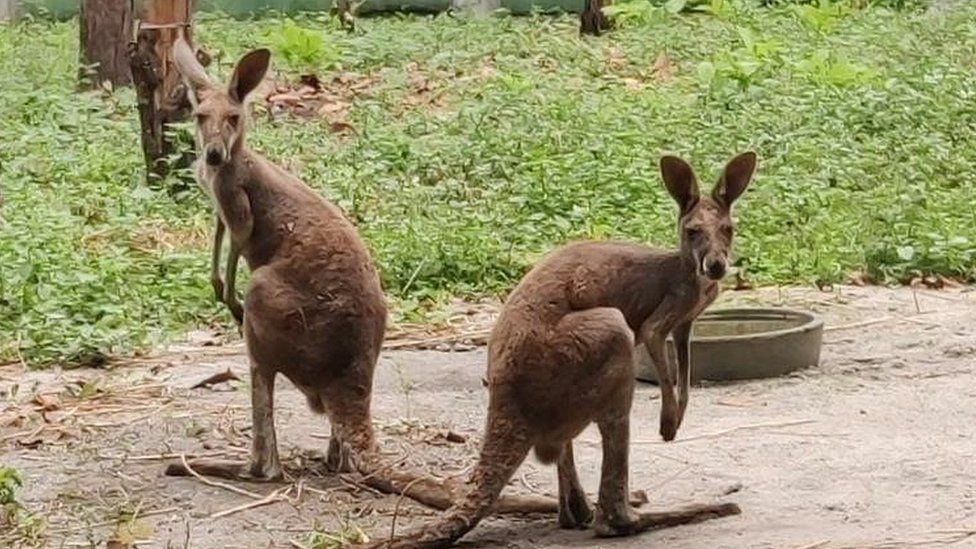

Wildlife officials say kangaroos are among the exotic animals smuggled into India. Bengal Safari Park


"How on Earth are kangaroos turning up in West Bengal," a Twitter user asked.


Debal Ray, the chief wildlife warden of West Bengal, tells the BBC that the animals were most likely left in the open during an anti-smuggling operation by his team.


When he received a tip-off that some exotic animals were being smuggled into the state, he immediately alerted his team. Acting quickly, the officers started checking vehicles along one of the main routes to enter the state.


"The smugglers probably got wind of it, and abandoned the animals on the highway," Mr Ray said.


"They probably ended up here from private breeding farms in southeast Asia," Agni Mitra, deputy director of the regional Wildlife Control Bureau, told the BBC, adding that smugglers often bring non-native, exotic animals to India's border states through Myanmar.

India's anti-smuggling intelligence agency, the Directorate of Revenue Intelligence (DRI), said that the country has seen a rise in demand for exotic animals.


Animals from Bangkok, Malaysia and other "top tourist destinations in South East Asia" are smuggled into the country and make their way to cities across India, it added.


Mr Mitra said smugglers use the "north-eastern corridor" to bring in exotic animals, ranging from a golden-headed lion tamarin, an endangered primate found only in Brazil, to threatened lemurs.


Indian wildlife officials often find that they can't prosecute these smugglers or traders because India's Wildlife Protection Act doesn't protect non-native, exotic animals.


Customs officials have the authority to stop people from transporting wild animals if they don't have proper permits. But they find it difficult to track illegal trade through porous borders.


The DRI said that since there is a ban on trade of native animal species, smugglers have shifted to "exotic species, which has led to disastrous global environmental consequences".


Wildlife activists say owning an exotic pet is considered prestigious - a trend that has only become more popular in recent years.


"A little while back, Zebras were seized in Bangladesh which were destined for a private zoo in India," Shubhobroto Ghosh, an activist with the group World Animal Protection said. "People are doing crazy things."


Indians have long had a liking for exotic animals.


In June 2020, India's Ministry of Environment, Forest and Climate Change announced a voluntary disclosure scheme, asking people to declare their exotic pets.


It said pet owners without proper documentation would not be prosecuted. The government wanted to "develop an inventory of exotic live species" in the country and streamline import procedures.


By early 2021, the government received 32,645 disclosure applications which listed exotic animals such as critically endangered lemurs, iguanas, macaws and even kangaroos, reported IndiaSpend, a data analysis website.


Wildlife officials said that despite an uptick in the number of exotic animals being brought into the country as pets, there was still no effective legislation to monitor the trade.


In 1976, India adopted the Convention of International Trade in Endangered Species (CITIES), an agreement ratified by 183 countries, which protects and monitors the trade of endangered plants and animals.


But the country has still not given the multilateral treaty any teeth - it can't be implemented under Indian law.


Lawmakers are reviewing an amendment to India's Wildlife Protection Act which would bring exotic flora and fauna, and other species protected by CITES provisions under wildlife authorities.


But Mr Ghosh is sceptical of its impact.


"Say I am a forest warden and I am your friend, and you have some rare primates from Brazil that you want to keep in your private zoo, you could very well just bribe your way through and get your permit," he explains.


"A lot of zoos unfortunately are becoming a part of this network - where traders and breeders work together to buy animals, sometimes non-native, exotic ones," Mr Ghosh added.


In April, two men were arrested when a red kangaroo was found in their truck during a routine police check on a highway close to West Bengal's border with the north-eastern state of Assam.


The men told forest officials that they had been handed these kangaroos at a farm in Mizoram, another state in the north-east, to be taken to a zoo in the central Indian state of Madhya Pradesh.


"They produced a supply order from the zoo, and the zoo even confirmed it," Mr Mitra said.


The zoo's curator told a news website that they had been "offered the consignment as a gift".


"Clearly this is a case of smuggling - the supply order was in the name of a farm in Mizoram, which does not even exist," Mr Ghosh said, explaining that under CITES provisions, protected animals have to be declared on a government website.


"There is no declaration of any kangaroos from any farm in Mizoram in government records," Mr Mitra said.


Meanwhile, the two kangaroos - Alex and Xavier - rescued by forest officials are being treated in the Bengal Safari Park, and are making good progress.


"They have some muscle atrophy, which is common in kangaroos when they are squeezed into small spaces while being smuggled," Mr Ray explained.


"If they feel at home, maybe we can display them [to the zoo-going public]. But they have to spend their life in a zoo. We cannot release them into the wild as India is not their natural habitat."


(Source: BBC)

Monday, 27 July 2020

A thousand years of walking through Japan

“I have met with but one or two persons in the course of my life who understood the art of Walking,” wrote the American naturalist and philosopher Henry David Thoreau (1817-62) in an essay titled “Walking.”


The first thing to understand is that it is an art — a religion, more precisely; whose real activity, “sauntering,” is no mere synonym for walking. It derives from “sainte terre” (holy land). “They,” writes Thoreau, “who never go to the Holy Land in their walks… are indeed mere idlers and vagabonds.”


No vagabond was he: “I think I cannot preserve my health and spirits, unless I spend four hours a day at least — and it is commonly more than that — sauntering through the woods and over the hills and fields, absolutely free from all worldly engagements.”


Thoreau would have loved Japan. Japan was a nation of saunterers — and, since the 17th century, a nation of roads, well built and scrupulously maintained, thronged with pilgrims (or pseudo-pilgrims), most of them on foot, many poor to the point of beggary, bound for this or that temple or shrine, open to any adventure or pleasure that might befall them along the way.


Walk on: Earlier paths chosen by Japan's philosophers were never so manicured. | GETTY IMAGES


There are three Japanese I would introduce Thoreau to, if I could arrange it. Their lives, taken together, span nearly a thousand years. All three are poets, monks (or at least monkish) and saunterers. They are Saigyo (1118-90), Matsuo Basho (1644-94) and Taneda Santoka (1882-1940). Thoreau might almost have been thinking of them when he wrote, “If you are ready to leave father and mother, and brother and sister, and wife and child and friends, and never see them again — if you have paid your debts, and made your will, and settled all your affairs, and are a free man — then you are ready for a walk.”


Saigyo, Basho, Santoka — one soul, it almost seems, in three men. They were off-roaders, traveling beyond the roads. All had cast off the high status they were born to. Saigyo in early life was a samurai serving at court. Basho’s more modest samurai rank was respectable all the same. Santoka’s family were landowners, brought to ruin by his alcoholic, philandering father.


Santoka was 10 when his mother flung herself into a well. He saw her body hauled up. No wonder he went off the rails. His rootlessness, at least, is easy to explain.


A chance encounter with Zen Buddhism, deepened by formal training, gave it a religious cast. His walking, like his drinking and his begging, became a kind of meditation. He wrote free-verse haiku, wisps and shards of poetry, oddly vast in their very littleness:

“Watching the moon go down / Me alone”


The moon. Japanese poets celebrated the moon — rarely the sun, never the stars. Love? A poet’s mistress was the moon; a poet’s god too, notwithstanding the sun goddess’ primacy in the Shinto hierarchy. To give the moon its due, and receive from it its light, one must (in Basho’s words) “shed the dust of this world.” He judged himself harshly: “My head is clean-shaven and… I am indeed dressed like a priest,” he wrote, “but priest I am not, for the dust of the world still clings to me.”


Traveling would cleanse him, he thought; and so, “Following the example of the ancient priest who is said to have traveled thousands of miles caring naught for his provisions and attaining the state of sheer ecstasy under the pure beams of the moon,” off he went, physically weak, prematurely aged, his dauntless spirit proof against physical infirmity, on a voyage after voyage, walk after walk, up and down mountains, through heat and through cold, the length and breadth of Japan.


Ecstasy under the moon?


“Fleas, lice, / The horse pissing / Near my pillow”


“Whatever such a mind sees,” Basho wrote of a mind in harmony with nature, “is a flower, and whatever such a mind dreams of is the moon.” “Whatever” fleas, lice, and horse piss included.


Saigyo, disgusted by the court machinations he saw all too close up, took the tonsure at age 23. The temple he retired to was itself mired in deceit; he withdrew further, then further still, until finally only the flimsiest “grass hut” would leave his spirit free enough of worldly entanglements for its ascents:

“This leaky, tumbledown grass hut / Left an opening for the moon / And I gazed at it…”


“The dust of this world” is not easily shed. On Earth, the moon is not everything. There is war, there is peace. “In the world of men,” wrote Saigyo, “it came to be a time of warfare” — the first stirrings in the 1150s of the war that would end the peaceful Heian Period (794-1185) and launch the militarist Kamakura Period (1185-1333). Saigyo, a born (though lapsed) warrior himself, was appalled:

“The river of death / Is swollen with bodies / Fallen into it”


Santoka’s “river of death” was the dreadful 1930s: “valiantly… pitifully… white boxes” — encoffined glory, home from the war in China.


Only Basho was spared the blight of war: “For now,” he wrote, “the august light of the Tokugawa rule illumines the whole firmament, and its beneficent rays reach into every corner of the land so that all the people may live in security and peace.”


The roads that bore the pilgrim traffic linked Edo (present-day Tokyo) and Kyoto. Our three travelers traversed the rougher country. Ease and comfort dimmed the moon; adversity brightened it. As Saigyo put it:

“(Religious) pledges are best when made / On precipices above it all”


Basho, ill, exhausted and “having such a long way yet to go,” calmed his failing heart with thoughts of death: “If I fall by the wayside and die in a ditch like a beggar, it will merely be my fate. As I mused thus, I gradually regained my spirits a little.”


“I hate begging,” Santoka confided to his diary. “I hate wandering.” He begged and wandered regardless, aspiring to “a realm of roundness, wholeness that transcends self and others… I have to walk, walk, walk until I get there.”


(Source: JT)

Thursday, 4 June 2020

What color is the sky?

Sky blue. Please picture it. Put a swath of sky blue in your mind. Just for a moment. Sky blue. Close your eyes. You see it. Now, look out the window, up and out to your sky. I wonder, what color do you see? Does it match the color your mind projected? In the room where I sit now, in my apartment on the first floor, in the small Northeastern city where I live, a little after eight in the morning, sun slants across the dusk-orange couch and the brown blanket slung on the back of it. The windowpanes repeat themselves in shadow, elongated squares over the dark red rug. From behind the roofline horizon, dish towel light seeps through a tangled net of branches. What little sky I can see is not so much color as light. Looking at it, I wonder, if I didn’t know what color the sky typically was, would I call it blue? I see a blue-ish-ness, a graywhiteblue glow, but is that only because I already know the sky is blue? How much of what we see is because we think we already know what’s there? What would I call this color if I saw it on a piece of cloth? And you—how much is the way I see you limited by the words we have been taught for each other?
What color is the sky?

Robin’s egg. Peach. Opal. Purple. Baby-hair blond as my brother’s was. Garnet. Lavender. Turmeric. Charcoal. Periwinkle. Dirt road. Yarrow. Powder. Bruise. Rice. Absinthe. Piss. Shadow. Mussel shell. Ash. Blood clot. Clementine. Pistachio. Mauve. Faun. Inner thigh. Midnight. Cantaloupe. Underblanket. Honey. Olive. Orgasm. 

Peppermint. Raisin. Sapphire like the wedding ring my mother wore, a thin band of tiny flat sapphires so dark it looked black, but off her finger, where always it is now, marriage done, held up in the light, deep dark blue. Heather. Smoke. Yolk. Bone. Baseball. Candle. Creamsicle. Lichen. Lilac. Bile. Black silk. Hawk eye. Camouflage. Amaranth. Lamb. Is vacancy a color? Is absence a color? If you try to think of nothing, does it have a color?
PAUL SIGNAC, VIEW OF SAINT-TROPEZ, 1896

In Clarice Lispector’s second novel, The Chandelier, the narrator makes figures out of clay she collects from the bank of a river. She makes all sorts of figures and shapes. “She could make anything that existed and anything that did not!” Except for the sky. With the sky, “she couldn’t even start. She didn’t want clouds—which she could obtain at least crudely—but the sky, the sky itself, with its inexistence, loose color, lack of color.” The sentence drifts off. The period occurs, but the sentence, the thought, dissipates, passes, becomes nothing, doesn’t quite complete itself but is also totally complete. What a thing Lispector does, to re-create the sky in a sentence about not being able to make the sky.

The lack of color of the sky—when I try to think of this, my brain offers me the inside and outside of a clamshell, the grays, whites, violets, golds, creams, smooths, not a color but a quality. Or a deep, dense white.

Deep white like when an airplane moves through clouds. I like to sit by the window when I am on an airplane. When else can you look at the earth like this? When else can you look at the sky like this? But I do not like to look when the thick white cloud consumes the plane. In those moments, I look at a book or close my eyes and hold my good luck rock. The deep white frightens me; there’s no way to orient. How close or far are we from anything? Everything too close, and yet we are in the infinite, there’s no beginning or end to anything. In that whiteness, there are no edges.

In his short essay “A Piece of Chalk,” G. K. Chesterton writes, “White is not a mere absence of colour; it is a shining and affirmative thing, as fierce as red, as definite as black.” For Chesterton, white is not an absence of color just as “mercy does not mean not being cruel, or sparing people revenge or punishment; it means a plain and positive thing like the sun, which one has either seen or not seen.” 

Our plain and positive star burning ninety-three million miles away lets us see, allows us the experience of color, color, “this infinitude,” as Dingeman Kuilman has it, “which we sooner feel than understand.” And if we look too long at the plain and positive star, our star that lets us see, if we aim our eyes right at it, we’re told as children, it can burn us into blindness, it can strip away our vision. If it weren’t true, we’d make a myth of it. The fable of looking too long at the sun. Look too long at the thing that brings vision, and it takes away your vision.

The paintings of Pisanello “instilled in me the desire to forfeit everything except my sense of vision,” writes W. G. Sebald in Vertigo. An endorsement for a work of art if ever there was one. He goes on to write of visiting Pisanello’s Saint George painting in a church in Verona, and the way sections of it have fallen into disrepair, disintegrated into nothing: “The vacancy into which the fragment dissolves still conveys something of the terror” that those dealing with the dragon would’ve felt. There is horror in the emptiness, horror in the fading into nothing. This dissolving into vacancy, into inexistence, into the dimensionless white of the clouds, provokes a singular sort of fear; our composure comes under threat. To look too long at the sun risks blindness. What of looking too long, thinking too long, of the sky?

How are we to deal with its inexistence? How are we to wrestle with its not-ness while we, here on the surface of the earth, pulse with our boned and wet-gutted presence? We can list colors. We can give shape to cloud—look, a wizard on the move; look, a white wolf; look, a volcano, a demon, a seahorse, an elephant, an infant, Jerry Garcia. The narrator in Lispector’s novel, trying to make the sky out of clay, “discovered that she needed to use lighter materials that couldn’t be so much as touched, felt, perhaps only seen, who knows.” Who knows!

The sky is blue. Oh? Look at it again. It might be that this morning or this afternoon, your sky is blue. Sky blue. But the sky holds all the colors, the whole infinitude, more sensed than understood. And yet, we agree, the sky is blue. It’s safer this way, to have things we know. What color are roses? Red! What color is the sky? Blue! It’s safer because if something can be everything at once, and perhaps not exist at all, it can snag at the threads—the loose threads—that hold us together. A bicycle seat doesn’t hold all the colors. It isn’t more than one thing at once. The sky is blue. The ocean is blue. I look at you. I see you as consistent day to day. The sky is blue. I look at you and see the things I expect to see from knowing you for all the days I’ve known you. I am seeing what I expect to see. There might be no blue in the sky. But I’ll see blue because that’s what I know the sky to be. Its essence is blue.

But it isn’t.

Its essence is absence. Its essence is all the colors. What do I miss by seeing you the way I expect to see you? The way that is safe? What do I not see in my own self? Watching the sunset of my own self? What do I not see because I expect to see the things that I’ve come to live with every single day of my life, just as I live with the sky every single day of my life? What absence do I miss? What colors?

The sky is blue! We need to put our feet on something solid. We need to rest our minds on something solid. The sky is not solid. We cannot rest anything on it.

All the colors exist in the sky. It holds all the colors, and none. Your own list of colors of the sky could have as many words as mine, more, a whole different accumulation of hues, the sky will take them all, has space for all of them. They are all correct, and none of them get close, not any of the words. This is a strange thing about the sky.

And there’s a strange thing about our days right now. The carbonation of our interaction has been flattened, the fizz and bubble of our social lives stilled, and we are left to drop into something quieter. Time takes on an unusual ooze and instants get denatured. What’s on offer now (always) is contact with a purer existence, not in any moral way, but the opportunity to observe the texture of one moment moving to the next, the same way one might watch the sky move itself across the surface of a puddle by the curb after it has rained.

Stomp the puddle. The sky explodes. One thousand droplets fly, the sky reflected in each one, spinning. Tiny globes of water leap up for a moment, showing the sky to itself, before showering down, smooth, soon to be reabsorbed into the still surface from which they came. Does it seem familiar? A plain and positive thing, sooner felt than understood, which one has either seen or not seen.

In this stillness, we drop through the surface of the sky, we sink into our minds, through the memories, the fantasies, the sticky cupboards of shame, the locked boxes of pain, we keep going, down down down, until we tumble off the cliff into our unremembered inexistence. Clamshell? Blood clot? Amaranth? Lamb? What color is it there? No one has ever told us.

(Source: The Paris Review)

Wednesday, 27 May 2020

Where does the sky start?

I have been alone and because of my aloneness I have started a relationship with the sky.

The sky said: “I am open.” And I knew: this was a place to aim my attention. Such is how relationships begin. It was no different with the sky.

I realized quickly I didn’t know anything about it. I did not hear its voice the way Charles Simic heard its voice: “Come, lovers of dark corners, / The sky says, / And sit in one of my dark corners.” I began to learn the way one comes to learn a new love, that initial state of revelation, of curtains pulling open. Show me: the major events, the altering traumas, the enthusiasms, the aversions, the fears. What do you eat? What do you dream? What is your favorite month of the year? The sky wasn’t showing me any more than it already always was, but I had wasted a lot of time not paying attention. It can be good to start at the beginning. What already always was turned out to be much more than I had anticipated.

The sky is a clock. The sky is an atmosphere, a mood, a temperature, a density. The sky is home to our home. The sky is each moment’s shifting fingerprint. I devoted myself.

The questions came.

Where does the sky start?

What a simple question. How obvious. But it unsteadied me; I was walloped by the force of how much I did not know.
CLAUDE MONET, COUCHER DE SOLEIL, C. 1868

When are you in the sky? There are the obvious times: in an airplane; a hot air balloon; a rocket; the moment of peak height after being launched from a diving board. But if you are in a room on the second floor and lean out the window and trees outside your window are taller than the roof, are you in the sky? If you are on a mountain and you are higher than the trees but there are peaks higher than you, are you in the sky? What distance must one travel up to meet it? Is there a scientific measure with numbers and variables and exponents riding the shoulders of the regular-size numbers? Does an equation exist? Sky = 11.19 squared over weather to the third times Time times light times height of person measuring minus birds? Does an invisible band like the Tropic of Capricorn trace a line above, an invisible eggshell of guarantee that delineates: this is sky, this is not sky?

“The front of my looking out pulls / beauty taking me taking you. The scab in the sky / is gone. We have to go beyond our calculations / and the small words,” writes Alice Notley. If answers exist, we’ll have to abandon our math, and make a new language. I was alone, and I was ready.

The Chilean poet Raúl Zurita knows about going beyond small words. In the sands of the Atacama Desert he used a bulldozer to scar words onto the surface of the earth. In letters a kilometer tall that stretched three kilometers long, he wrote “ni pena ni miedo.” It is illegible on the ground; it can only be read from the sky. One must be above it to see, to receive the message:

ni pena ni miedo
neither shame nor fear

These are words for how to approach an end or a beginning. At the beginning of my relationship with the sky I learned: the sky starts at the surface of the earth.

Does every child know that? They seem to, in their drawings. The single-line horizon, and the blue above. The sky starts at the surface of the earth! We are always in it.

The sky. Up. Up above. The bright-dark uncollapsing dome. Where the stars are in their dairy field. Where the rain falls from, and the snow. Where the clouds gather, swell, drift, draw, and then withdraw. Where the sun lives and tips its pitcher of light down on us. Crescent moon. Constellation. Thunder. Sunset. Gull. Way up.

But also, right here. All around. You’re touching it. It’s touching you. 

An intimate lifelong relationship. We penetrate it. We take it into ourselves. We are all in its embrace. This thing I thought was up was actually all around, this thing I thought was elsewhere was everywhere, seen and unseen.

Since when? That’s another question. We emerge into it from the bodies of our mothers. Before we emerge, for the time we are alive inside, we are not in the sky, the same way a person underwater is not in the sky. To dive below the surface is to leave the sky.

Is water the opposite of sky? Ankles shins kneecaps. Pause. Thighs inner upper. Pause. Crotch zing hips. Pause. Three inches above the belly button. Pause. Then, the lift and slow fall and the entering, all the way underwater. Deep comes quick at Walden Pond, where I often swim in summer. In the deepest part of the kettle, it’s nearly 110 feet deep. A little less than half the wingspan of a 747. Not far to walk, but a long way to sink. They are not opposite, water and sky, they love each other. The sky sees itself in the water, the water flings the sky back to itself. They touch all the time. And when I tread water, head, neck, shoulders above the surface, body below, I enter both at once, absorbed at once in both, a love triangle. This is what you realize when you are alone.

We are not in the sky when we are underwater. And we are not in the sky when we are alive inside before being born. And before that? That’s another question. Some people talk about stardust, suggest we’re all descended from the sky, that our pre-origin origin starts in the stars, which is to say, perhaps we’ve been in the sky the whole time, before we were born, before even the planets were born. Our bodies are made of elements, oxygen, carbon, hydrogen, nitrogen, calcium, and so on, and these elements, the scientists say, were formed in the stars billions of years ago. That we came dusting down as star parts sounds a little like a fairy tale. Or—not even like a fairy tale because fairy tales are scarier and more gruesome. It lands on me as wish-wash, too beautiful to be true. But I’m no longer sure of anything. What happens after the future? What is this unremembered memory of nothing? Sometimes my imagination comes tap-tapping against its eggshell like a hatchling.

I started a relationship with the sky, and wondered, what took me so long? What am I forgetting? Did the relationship start long ago? I thought back, and back. I thought back to a first grade classroom in 1986. Lights dimmed, shades drawn, the TV wheeled in on a cart (a special day!) to watch the rocket. There it was on earth, everything about its posture spoke of upward thrust, potential energy, blast off. Here we were, children, gathered to witness an event. Astronauts, seven of them, exploration, history, Cape Canaveral, countdown, bravery. The rocket was orange. Three two one, great white gusty barrels of smoke we have lift off and
up
it
went
Into the sky, up and up.

And then, one minute and thirteen seconds later, it exploded.
A foamy curve of smoke against the sky, tentacular throbs, up, elbowing out, spitting down, a jellyfish of smoke against the high-up night.

We were six years old. We didn’t know. This must be how it’s supposed to look. This smoke plume in the sky, this beautiful shape, this beautiful power, spaceship so fast it’s smoke. So fast and so powerful the smoke curves against the sky, shoots curving paths against the sky. Wow. They are in the sky. Everything is different in the sky. Beyond the sky, in outer space.

But the vibration in the room changed. The vibration from the adults in the room changed.

I was almost alone in the hallway after. Two teachers stood near a classroom door. They stood close and spoke quietly and one touched the other’s shoulder. I didn’t know what was happening, I didn’t know what had happened. The rocket in the sky, the rocket rushing spaceward, the swooping torrents of smoke in the sky. Was this when my relationship with the sky started?

But no, no. It wasn’t that day. That’s not when it started. When I think of that day, I do not think of the sky. I did not know what had happened. I did not know what would happen. What I did know that day: sadness and fear. Which, like the sky, were there from the start, and maybe before.

Remember: disaster means ill-starred.

(Source: The Paris Review)

Monday, 13 April 2020

Want to stop the next pandemic? Start protecting wildlife habitats

There are four critical facets of pandemic prevention, according to Lee Hannah, senior scientist at Conservation International. Three of them make immediate sense against the backdrop of our current emergency: stockpile masks and respirators; have testing infrastructure ready; and ban the global wildlife trade, including the open animal markets where COVID-19 may have first infected people.

His fourth recommendation is more grandiose: “Take care of nature.”

The assault on ecosystems that allowed COVID-19 to jump from animals to humans went far beyond merchants hunting and selling rare wildlife. Biodiversity—that is, the health of the entire ecosystem—can restrain pathogens before they ever leave the wild. “We need to tell people right now that there is a series of things we need to do once we’re out of this mess to make sure it never happens again,” Hannah says.

The role of biodiversity in disease prevention has received increased attention of late. In a 2015 “state of knowledge review” of biodiversity and human health by the United Nations, scientists wrote that “an ecological approach to disease, rather than a simplistic ‘one germ, one disease’ approach, will provide a richer understanding of disease-related outcomes.” Recent research has given more support to the idea that biodiversity protection in one part of the world can prevent novel diseases from emerging and leaping into another.
Old World monkeys at Son Tra Peninsula, Vietnam. Getty Images

It’s a numbers game, in part. Not all species in a community are equally susceptible to a given disease, nor are they all equally efficient transmitters. In diverse ecosystems well separated from human habitations, viruses ebb and flow without ever having a chance to make it to the big time.

But as people move in, those protections begin to break down. Disrupted ecosystems tend to lose their biggest predators first, and what they leave behind are smaller critters that live fast, reproduce in large numbers, and have immune systems more capable of carrying disease without succumbing to it. When there are only a few species left, they’re good at carrying disease, and they thrive near people, there may be nothing between a deadly pathogen and all of humanity.

“Virus spillover risk” from wildlife to people rises as contact increases between them, according to research published Tuesday by a team of researchers led by Christine Kreuder Johnson of the One Health Institute at University of California, Davis. Almost half of the new diseases that jumped from animals to humans (called zoonotic pathogens) after 1940 can be traced to changes in land use, agriculture, or wildlife hunting. SARS, Ebola, West Nile, Lyme, MERS, and others all fit the profile. There may be 10,000 mammalian viruses potentially dangerous to people.

“We are messing with natural systems in certain ways that can make them much more dangerous than they would otherwise be,” says Richard Ostfeld, a disease ecologist at the Cary Institute of Ecosystem Studies. “And biodiversity loss is one of those. Climate change is another.”

A longer-term strategy can help nations see the benefits of rethinking resource use. “The revenue from clearing new forest is extremely high—briefly,” says William Karesh, executive vice president at EcoHealth Alliance, a research nonprofit. “But the cost to the public-health system also goes up because you get very common diseases like malaria.” And as we’re now seeing, new zoonotic pathogens can be even more expensive to deal with.

Despite years of creative and resource-intensive work by governments and nonprofits, companies’ actions to mitigate habitat loss aren’t adding up. Many large companies have pledged to halt deforestation, the largest driver of biodiversity loss, through initiatives like the Consumer Goods Forum, the Banking Environment Initiative and their Soft Commodities Compact. “All have missed the mark,” according to a new report by the Rainforest Action Network.
Hannah, of Conservation International, is working to make sure that the reasons to promote biodiversity, including its pathogen-dulling potential, align with the other endangered elephant in the room: climate change.

In February, Hannah and colleagues announced findings on what the effects of achieving climate and conservation targets might be. Using data on 290,000 species, they were able to squint into the future and see where ecosystems might be saved from mass extinction if nations preserve 30% of natural habitats and meet UN limits for global warming. All told, meeting the goals would cut biodiversity losses in half.

The international community is positioned to make some progress. The Convention on Biological Diversity is a 196-nation effort to protect the richness of living things, tap natural resources sustainably, and share the benefits of the environment’s naturally occurring genetic innovations. (The U.S. and the Vatican are non-members.) The next phase of the biodiversity treaty, currently in draft form, proposes that at least 30% of land and ocean be conserved, up from 17% in the previous round. If governments agree to that goal, then nations and conservation scientists must take on the complicated step of figuring out which 30% is most important to protect and how to do it.

The way those areas are drawn today rarely reflects the scientific ideal of how to guard biodiversity. Looking at the existing protected lands, a paper in Nature last month found that 90% of conservation space fails to give bird, amphibian and mammal species the full range of environmental conditions across their existing habitats.

“We could be doing a much better job of getting things in the right places,” says Hannah. “There’s going to be right places for disease control and they may largely overlap the right places for biodiversity.”

(Source: Time)

Saturday, 28 March 2020

No, the coronavirus wasn’t made in a lab. A genetic analysis shows it’s from nature

Scientists took conspiracy theories about SARS-CoV-2’s origins seriously, and debunked them

The coronavirus pandemic circling the globe is caused by a natural virus, not one made in a lab, a new study says.

The virus’s genetic makeup reveals that SARS-CoV-2 isn’t a mishmash of known viruses, as might be expected if it were human-made. And it has unusual features that have only recently been identified in scaly anteaters called pangolins, evidence that the virus came from nature, Kristian Andersen and his colleagues report March 17 in Nature Medicine.

When Andersen, an infectious disease researcher at the Scripps Research Institute in La Jolla, Calif., first heard about the coronavirus causing an outbreak in China, he wondered where the virus came from. Initially, researchers thought the virus was being spread by repeated infections jumping from animals in a seafood market in Wuhan, China, into humans and then being passed person to person. Analysis from other researchers has since suggested that the virus probably jumped only once from an animal into a person and has been spread human to human since about mid-November (SN: 3/4/20).
But shortly after the virus’s genetic makeup was revealed in early January, rumors began bubbling up that maybe the virus was engineered in a lab and either intentionally or accidentally released.
The SARS-CoV-2 virus (seen in this transmission electron microscope image of virus isolated from a U.S. patient), which causes COVID-19, was rumored to be human-made, but scientists have now debunked that theory. NIAID-RML

An unfortunate coincidence fueled conspiracy theorists, says Robert Garry, a virologist at Tulane University in New Orleans. The Wuhan Institute of Virology is “in very close proximity to” the seafood market, and has conducted research on viruses, including coronaviruses, found in bats that have potential to cause disease in people. “That led people to think that, oh, it escaped and went down the sewers, or somebody walked out of their lab and went over to the market or something,” Garry says.

Accidental releases of viruses, including SARS, have happened from other labs in the past. So “this is not something you can just dismiss out of hand,” Andersen says. “That would be foolish.”

Looking for clues
Andersen assembled a team of evolutionary biologists and virologists, including Garry, from several countries to analyze the virus for clues that it could have been human-made, or grown in and accidentally released from a lab.

“We said, ‘Let’s take this theory — of which there are multiple different versions — that the virus has a non-natural origin … as a serious potential hypothesis,’ ” Andersen says.

Meeting via Slack and other virtual portals, the researchers analyzed the virus’s genetic makeup, or RNA sequence, for clues about its origin.

It was clear “almost overnight” that the virus wasn’t human-made, Andersen says. Anyone hoping to create a virus would need to work with already known viruses and engineer them to have desired properties.

But the SARS-CoV-2 virus has components that differ from those of previously known viruses, so they had to come from an unknown virus or viruses in nature. “Genetic data irrefutably show that SARS-CoV-2 is not derived from any previously used virus backbone,” Andersen and colleagues write in the study.

“This is not a virus somebody would have conceived of and cobbled together. It has too many distinct features, some of which are counterintuitive,” Garry says. “You wouldn’t do this if you were trying to make a more deadly virus.”

Other scientists agree. “We see absolutely no evidence that the virus has been engineered or purposely released,” says Emma Hodcroft, a molecular epidemiologist at the University of Basel in Switzerland. She was not part of Andersen’s group, but is a member of a team of scientists with Nextstrain.org that is tracking small genetic changes in the coronavirus to learn more about how it is spreading around the world.

That finding debunks a widely disputed analysis, posted at bioRxiv.org before peer review, that claimed to find bits of HIV in the coronavirus, Hodcroft says. Other scientists quickly pointed out flaws in the study and the authors retracted the report, but not before it fueled the notion that the virus was engineered.

Some stretches of the virus’s genetic material are similar to HIV, but that’s something that stems from those viruses sharing a common ancestor during evolution, Hodcroft says. “Essentially their claim was the same as me taking a copy of the Odyssey and saying, ‘Oh, this has the word the in it,’ and then opening another book, seeing the word the in it and saying, ‘Oh my gosh, it’s the same word, there must be parts of the Odyssey in this other book,” she says. “It was a really misleading claim and really bad science.”

Finding peculiar features
Andersen’s group next set out to determine whether the virus could have been accidentally released from a lab. That’s a real possibility because researchers in many places are working with coronaviruses that have potential to infect humans, he says. “Stuff comes out of the lab sometimes, almost always accidentally,” he says.

A couple of unexpected features of the virus caught the researchers’ eyes, Andersen says. In particular, the gene encoding the coronavirus’s spike protein has 12 extra RNA building blocks, or nucleotides, stuck in it.

This spike protein protrudes from the virus’ surface and allows the virus to latch onto and enter human cells. That insertion of RNA building blocks adds four amino acids to the spike protein, and creates a site in the protein for an enzyme called furin to cut. Furin is made in human cells, and cleaves proteins only at spots where a particular combination of amino acids is found, like the one created by the insertion. SARS and other SARS-like viruses don’t have those cutting sites.

Finding the furin cutting site was a surprise: “That was an aha moment and an uh-oh moment,” Garry says. When bird influenza viruses acquire the ability to be cut by furin, the viruses often become more easily transmissible. The insertion also created places where sugar molecules could be fastened to the spike protein, creating a shield to protect the virus from the immune system.

The COVID-19 virus’ spike protein also binds more tightly to a protein on human cells called ACE2 than SARS does (SN: 3/10/20). Tighter binding may allow SARS-CoV-2 to more easily infect cells. Together, those features may account for why COVID-19 is so contagious (SN: 3/13/20).

“It’s very peculiar, these two features,” Andersen says. “How do we explain how this came about?  I’ve got to be honest. I was skeptical [that it was natural]. This could have happened in tissue culture” in a lab, where viruses may acquire mutations as they replicate many times in lab dishes. In nature, viruses carrying some of those mutations might be weeded out by natural selection but might persist in lab dishes where even feeble viruses don’t have to fight hard for survival.

Clinching the case for nature
But then the researchers compared SARS-CoV-2 with other coronaviruses recently found in nature, including in bats and pangolins. “It looks like SARS-CoV-2 could be a mix of bat and pangolin viruses,” Garry says.

Viruses, especially RNA viruses such as coronaviruses, often swap genes in nature. Finding genes related to the pangolin viruses was especially reassuring because those viruses’ genetic makeup wasn’t known until after SARS-CoV-2’s discovery, making it unlikely anyone was working with them in a lab, he says.
Coronaviruses that infect pangolins gave researchers important clues that the SARS-CoV-2 virus is natural. 2630BEN/ISTOCK/GETTY IMAGES PLUS

In particular, pangolins also have the amino acids that cause the tight binding of the spike protein to ACE2, the team found. “So clearly, this is something that can happen in nature,” Andersen says. “I thought that was very important little clue. It shows there’s no mystery about its tighter binding to the human [protein] because pangolins do it, too.”

The sugar-attachment sites were another clue that the virus is natural, Andersen says. The sugars create a “mucin shield” that protects the virus from an immune system attack. But lab tissue culture dishes don’t have immune systems, making it unlikely that such an adaptation would arise from growing the virus in a lab. “That sort of explained away the tissue-culture hypothesis,” he says.

Similarity of SARS-CoV-2 to bat and pangolin viruses is some of the best evidence that the virus is natural, Hodcroft says. “This was just another animal spillover into humans,” she says. “It’s really the most simple explanation for what we see.” Researchers still aren’t sure exactly which animal was the source.

Andersen says the analysis probably won’t lay conspiracy theories to rest. Still, he thinks the analysis was worth doing. “I was myself skeptical at the beginning and I kept flipping back and forth,” Andersen says, but he’s now convinced. “All the data show it’s natural.”


(Source: Science News)

Friday, 27 March 2020

Home alone: coronavirus isolation and ecology

How much we reimagine diets, work, travel and how we connect as communities in view of the coronavirus pandemic?

The UK government's guidelines on how individuals should respond to the coronavirus pandemic has changed sharply over the past week - from one symptomatic member of a household self-isolating for seven days, to whole families self-isolating for fourteen days, to the wholesale closure of pubs, cafes and offices and the 'shielding' of at-risk groups: those with heart disease, diabetes, lung disease and compromised immune systems are being asked to stay home for twelve weeks. 

We now have an almost complete lockdown. People need to work from home where possible and to “stop non-essential contact with others,” but the repercussions of this for vulnerable people living alone are as daunting as the threat of the coronavirus itself. The reality is that many of these people may be at home alone, isolated and without any human contact. 

This plan hinges upon isolating vulnerable individuals for three months while proposing that the collective action of people working from home while avoiding pubs and restaurants will flatten the curve. With one group of people supposedly out of harm's way, another group can - in time - move back into public life to stimulate the economy: everyone wins, at least hypothetically. 

Nature
Meanwhile, the internet abounds with articles about the earth being the beneficiary of the coronavirus lockdowns in China and Italy. But there has been little reflection on the ethics of advocating social isolation as a form of environmental repair.

CNN points out one of the unexpected results of the lockdown in China’s Hubei province is ecological healing: the average number of "good quality air days" increased 21.5 percent in February, 
Many more media outlets have run similar pieces on the “unintended profit” of the coronavirus, on the way that this virus is “curbing carbon emissions,” and even on what climate change can teach us in fighting COVID-19. But are these truisms reason to push for social isolation as the future model for greener practices by both individuals and businesses?

We must ask ourselves if the human cost of undoing ecological damage need come in the form of Wuhan-style confinement or even in the lighter version that we see under Johnson’s leadership, which asks that the elderly and infirm pay the price of this virus through isolation? Are we not missing the forest for the trees?

Distancing 
Institutions are laying the groundwork for telecommuting - working from home - at pace, having posed barriers to these 'reasonable adjustments' for disabled people and pregnant people for decades. As Laura Elliott recently noted, “Apparently, accessibility really does matter, but only when it’s isn’t 'just' disabled people asking for it."

The Equality Act 2010 notes that these reasonable adjustments necessitate changes to policies, working practices, physical spaces, and the provision of specific equipment and support. 

As more people isolate, communities are becoming increasingly mindful of the fear that elderly feel in leaving their homes to go shopping. As a result, there a movement is emerging that is expanding the social distancing model to incorporate the safe-keeping and health of the elderly and at risk groups. These acts of solidarity are organised under the banner of mutual aid, where neighbours shop for the elderly and at risk members of their community.

Mutual aid demonstrates that physical distancing need not come at the cost of a sense of community. 

Behaviours 
It is indisputable that many of our everyday habits in the Global North have contributed to climate change, we are at odds over how best to make change and facilitate healing without compromising on community. The question is the degree to which moderating individual behaviours will effect change; how do we balance individual and social needs; what shape might more systemic change take?

Installing smart meters in your home or solar security cameras outside it might help with your ecological footprint, but nothing will approximate the kind of improvements that parts of China saw last month. Certainly, solar and wind power are part of the equation, but our habits must also change in tandem with green technology. In short, we must make more drastic changes to how we can curb climate change without reverting to the “pandemic model of green evolution.”

While this novel coronavirus is forcing us into behaviours that are having a positive knock-on effect to the environment, we must be sceptical about the suggestion that we can only reduce carbon emissions by restricting movement. We must be even more wary of the suggestion that the elderly and other at-risk individuals make such sacrifices as if their lives and freedoms are dispensable for the greater good.

As a freelance writer who often works for weeks without having much social contact outside my family, I am acutely aware of the importance of social connection. Yet, as I am in the midst of my fourth week of quarantine, I have had much time to reflect upon the pain of social isolation - particularly as a mother, having experienced a similar sort of isolation while parenting and cut off from social interaction.

This quarantine, however, takes things further, especially when coupled with the anxiety that many are experiencing as they worry about their families, communities and the economic impacts of quarantine. 

Change 
If Covid-19 is evidencing the ecological benefits of staying at home, we need to analyse what we can do better to achieve the same result without isolating ourselves. We also need to think about what and who is at stake here and how that drives change: it was only when the stock markets in Milan, New York and London started to crash that companies began to accommodate widespread telecommuting. 

It is certainly not - as Drew Arellano recently suggested - that humans “are the virus and COVID’s the cure.” This is a cynical and lazy approach to what we are getting wrong.

We might begin with scaling up individual change to the level of policy change. For instance, we must reimagine what and how we eat by understand the links between the emergence of zoonosis due to agricultural intensification and environmental change, and the negative Global Health Impacts (GHIs) of diets that include animal products. We need to take widespread telecommuting as a prompt for reimagining work, and the piecemeal renationalisation of public transport as a prompt for reimagining travel. 

In the end, Covid-19 is giving us much time in the coming weeks—and possibly months—to rethink everything about how we behave in the world. Let’s not pretend that we can or want to live without each other.

Instead we need to face the obstacles that keep us from creating a greener and happier future head-on, for that day when we can eventually step outside and breath a collective breath fresh air.


(Source: Ecologist)