Showing posts with label wildlife. Show all posts

Saturday, 28 May 2022

Why are kangaroos being spotted in India?

 When villagers walking along a road on the edge of a forested village in eastern India first saw three confused, weak and hungry animals, they couldn't believe what they were witnessing.

The animals looked nothing like anything they had seen before. They alerted West Bengal state's forest officials, who told them that the animals were kangaroos - native to Australia but not found in India.


The animals were rescued and sent to a wildlife park to be treated. One died later. The villagers were still confused and surprised by what they had seen. Soon, videos of the kangaroos in India went viral.
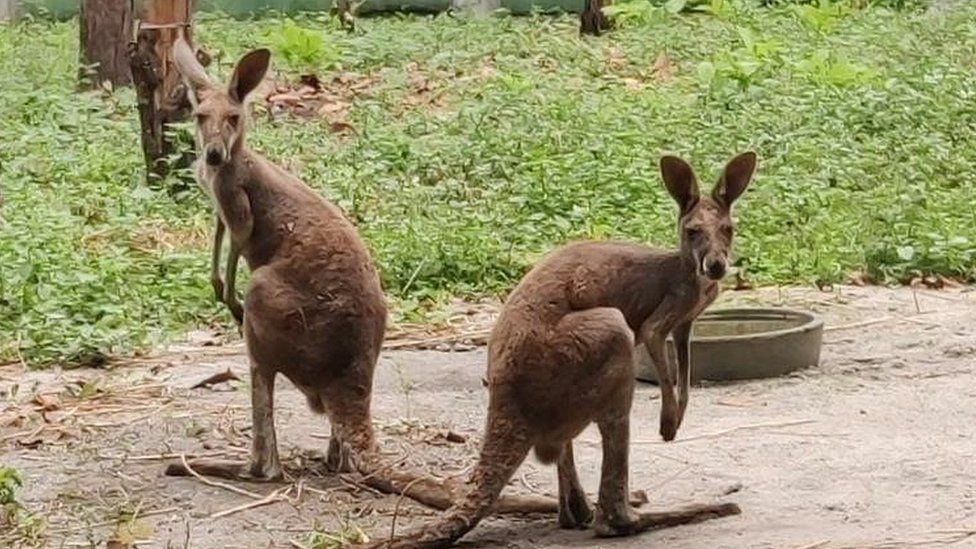

Wildlife officials say kangaroos are among the exotic animals smuggled into India. Bengal Safari Park


"How on Earth are kangaroos turning up in West Bengal," a Twitter user asked.


Debal Ray, the chief wildlife warden of West Bengal, tells the BBC that the animals were most likely left in the open during an anti-smuggling operation by his team.


When he received a tip-off that some exotic animals were being smuggled into the state, he immediately alerted his team. Acting quickly, the officers started checking vehicles along one of the main routes to enter the state.


"The smugglers probably got wind of it, and abandoned the animals on the highway," Mr Ray said.


"They probably ended up here from private breeding farms in southeast Asia," Agni Mitra, deputy director of the regional Wildlife Control Bureau, told the BBC, adding that smugglers often bring non-native, exotic animals to India's border states through Myanmar.

India's anti-smuggling intelligence agency, the Directorate of Revenue Intelligence (DRI), said that the country has seen a rise in demand for exotic animals.


Animals from Bangkok, Malaysia and other "top tourist destinations in South East Asia" are smuggled into the country and make their way to cities across India, it added.


Mr Mitra said smugglers use the "north-eastern corridor" to bring in exotic animals, ranging from a golden-headed lion tamarin, an endangered primate found only in Brazil, to threatened lemurs.


Indian wildlife officials often find that they can't prosecute these smugglers or traders because India's Wildlife Protection Act doesn't protect non-native, exotic animals.


Customs officials have the authority to stop people from transporting wild animals if they don't have proper permits. But they find it difficult to track illegal trade through porous borders.


The DRI said that since there is a ban on trade of native animal species, smugglers have shifted to "exotic species, which has led to disastrous global environmental consequences".


Wildlife activists say owning an exotic pet is considered prestigious - a trend that has only become more popular in recent years.


"A little while back, Zebras were seized in Bangladesh which were destined for a private zoo in India," Shubhobroto Ghosh, an activist with the group World Animal Protection said. "People are doing crazy things."


Indians have long had a liking for exotic animals.


In June 2020, India's Ministry of Environment, Forest and Climate Change announced a voluntary disclosure scheme, asking people to declare their exotic pets.


It said pet owners without proper documentation would not be prosecuted. The government wanted to "develop an inventory of exotic live species" in the country and streamline import procedures.


By early 2021, the government received 32,645 disclosure applications which listed exotic animals such as critically endangered lemurs, iguanas, macaws and even kangaroos, reported IndiaSpend, a data analysis website.


Wildlife officials said that despite an uptick in the number of exotic animals being brought into the country as pets, there was still no effective legislation to monitor the trade.


In 1976, India adopted the Convention of International Trade in Endangered Species (CITIES), an agreement ratified by 183 countries, which protects and monitors the trade of endangered plants and animals.


But the country has still not given the multilateral treaty any teeth - it can't be implemented under Indian law.


Lawmakers are reviewing an amendment to India's Wildlife Protection Act which would bring exotic flora and fauna, and other species protected by CITES provisions under wildlife authorities.


But Mr Ghosh is sceptical of its impact.


"Say I am a forest warden and I am your friend, and you have some rare primates from Brazil that you want to keep in your private zoo, you could very well just bribe your way through and get your permit," he explains.


"A lot of zoos unfortunately are becoming a part of this network - where traders and breeders work together to buy animals, sometimes non-native, exotic ones," Mr Ghosh added.


In April, two men were arrested when a red kangaroo was found in their truck during a routine police check on a highway close to West Bengal's border with the north-eastern state of Assam.


The men told forest officials that they had been handed these kangaroos at a farm in Mizoram, another state in the north-east, to be taken to a zoo in the central Indian state of Madhya Pradesh.


"They produced a supply order from the zoo, and the zoo even confirmed it," Mr Mitra said.


The zoo's curator told a news website that they had been "offered the consignment as a gift".


"Clearly this is a case of smuggling - the supply order was in the name of a farm in Mizoram, which does not even exist," Mr Ghosh said, explaining that under CITES provisions, protected animals have to be declared on a government website.


"There is no declaration of any kangaroos from any farm in Mizoram in government records," Mr Mitra said.


Meanwhile, the two kangaroos - Alex and Xavier - rescued by forest officials are being treated in the Bengal Safari Park, and are making good progress.


"They have some muscle atrophy, which is common in kangaroos when they are squeezed into small spaces while being smuggled," Mr Ray explained.


"If they feel at home, maybe we can display them [to the zoo-going public]. But they have to spend their life in a zoo. We cannot release them into the wild as India is not their natural habitat."


(Source: BBC)

Tuesday, 20 October 2020

Hidden camera's hugging tiger wins wildlife photo award

 To photograph one of rarest creatures on Earth you have to be incredibly skilled and remarkably lucky.

But Sergey Gorshkov is clearly both - as demonstrated by his stunning picture of a Siberian, or Amur, tiger deep in the forests of Russia's Far East.


The image has just won him the title of Wildlife Photographer of the Year.


The female tiger is seen embracing a tree, rubbing herself against the bark to leave her scent and mark territory in Land of the Leopard National Park.


Sergey Gorshkov's winning WPY image is called The Embrace. SERGEY GORSHKOV/WPY2020


"The lighting, the colours, the texture - it's like an oil painting," says WPY chair of judges Roz Kidman-Cox.


"It's almost as if the tiger is part of the forest. Her tail blends with the roots of the tree. The two are one," she told BBC News.


All the more extraordinary is that this is a camera-trap image. The equipment was set up in the forest and left, waiting to trigger automatically when a tiger came by.


Of course, Sergey had to know where he'd be most likely to frame the animal - and that's where the skill of an experienced wildlife photographer comes into play.


Eastern Russia's tigers were hunted to near-extinction and probably now number only a few hundred individuals. And with their prey - mostly deer and wild boar - also diminished, it means the Amurs must range over vast distances to find food.


It all adds to the difficulty of securing any sort of picture, never mind one that looks as impressive as Sergey's. But consider this: the camera-trap that took the winning picture was left in the field for 10 months before its memory card with its precious image file was recovered.


To be a top wildlife photographer you also have to be extremely patient.


Sergey's grand prize award was announced by Her Royal Highness The Duchess of Cambridge and TV presenters Chris Packham and Megan McCubbin during an online event organised by London's Natural History Museum.


The NHM runs the WPY competition, which is now in its 56th year.


The fox that got the goose by Liina Heikkinen, Finland


This image of a young fox consuming a barnacle goose earned Finnish teenager Liina not only a win in the category for 15-17 yearolds, but the overall grand prize for junior photographers. The fox had forced itself into a crevice to try to stop its siblings getting at the meal.


"The judges particularly liked it because only a really keen young naturalist would have been able to get such a picture," explained Roz Kidmand-Cox. "The composition is wonderful. Liina must have been lying on the ground because she's eye to eye with that young fox."


The pose by Mogens Trolle, Denmark


A young male proboscis monkey in profile. It is the WPY Animal Portraits winner this year. The picture was taken at the Labuk Bay Proboscis Monkey Sanctuary in Sabah, Borneo. That splendid nose will get even bigger as the young primate matures. It'll give his calls a bigger sound, and it will probably come to signal his status in the group.


Etna's river of fire by Luciano Gaudenzio, Italy


WPY isn't only about animals. This image taken on the north side of Europe's most active volcano won the Earth's Environments category. Luciano Gaudenzio had to brave heat and stinking steam to get close to his subject. He described the scene as hypnotic, the vent resembling "an open wound on the rough and wrinkled skin of a huge dinosaur".


Life in the balance by Jaime Culebras, Spain


This glass frog snacking on a spider is the winner in the WPY category for Behaviour: Amphibians and Reptiles. Jaime took this picture in Ecuador's Manduriacu Reserve - during a torrential downpour. He had to hold an umbrella and flash in one hand while operating the camera in the other.


A tale of two wasps by Frank Deschandol, France


A specially built, superfast shutter system was needed to frame and freeze these two wasps in Normandy, northern France. The red-banded sand wasp (left) and the cuckoo wasp are about to enter next-door nest holes. Frank Deschandol wins the Behaviour: Invertebrates category.


The golden moment by Songda Cai, China


The Under Water category winner for 2020. This is a tiny diamondback squid. It's a paralarva - meaning it's beyond a hatchling but not quite a subadult. Songda took this on a night dive off the coast of Anilao, in the Philippines. The animal is about 6-7cm in length.


When mother says run by Shanyuan Li, China


These are young Pallas's cats, or manuls, which are found on the remote steppes of the Qinghai-Tibet Plateau in northwest China. Shanyuan captured this image of the playful kittens after six years of tracking and studying the animals. The picture wins the Behaviour: Mammals category.


 The territory is huge and the tigers will travel hundreds of km to find prey. Below: Sergey Gorshkov preparing his camera traps ready to deploy in Leopard National Park. SERGEY GORSHKOV


The Wildlife Photographer of the Year awards are normally presented during a gala dinner at the NHM in South Kensington.


But, as with so many events in the era of Covid, organisers had no choice but to go virtual this time. The highly popular exhibition will proceed as normal, however. It opens on Friday, but is ticket only. Booking is essential.

Entries for next year's awards start being accepted on Monday.


(Source: BBC)

Wednesday, 20 May 2020

South Africa traffics thousands of endangered wild animals to China in ‘corrupt and growing’ trade, investigation finds

Stop the Wildlife Trade: Chimps, monkeys, giraffes, tigers and lions illegally sold by exporters linked to crime syndicates, study finds

South African traders with China are illegally selling thousands of wild animals threatened with extinction and endangered, under the guise of legal exports, according to an investigation.

Monkeys have been stolen from the wild, and together with cheetahs, tigers, rhinos, lions and meerkats, they have been trafficked to circuses, theme parks, laboratories, zoos and “safari parks”, researchers found.

Their report says at least 5,035 live wild animals were exported to China from 2016 to last year – “an extremely conservative” estimate – including chimpanzees and “a bewildering number” of giraffe, which “are also eaten in China”.

The researchers uncovered how some traders have links to international organised crime syndicates and the system is riddled with fake permits, but not a single offender has been prosecuted.
Tigers trained to ‘beg’ in a Chinese circus (Getty)

After arriving in China, where laws on captive-animal welfare are “non-existent”, South Africa’s animals often become untraceable or disappeared, suggesting they either died or were sold on, the report says.

To make matters worse, in a trade that is expanding, “treating wildlife as if it is merely a commodity to be farmed” risks “unleashing myriad Covid-type diseases”.

The South Africa-based groups Ban Animal Trading (BAT) and the charitable EMS Foundation, which examined wild animal exports from 2016-19, hit out at the supposed myth that legal trade crowds out the illegal trade and that animals are treated well in legal deals.

“The legal and illegal trade are so intertwined as to be functionally inseparable,” the report states. “The research demonstrates that South Africa’s live wild animal trade with China is riddled with irregularities that are exploited by traffickers. There are gaping loopholes in the global permitting, enforcement and oversight system.”

Zoos, as well as brokers and wholesale companies, are behind the trafficking of animals caught from the wild, going to destinations that are often pure fiction; most permits are in breach of regulations, and their verification largely absent, meaning most wild animal exports in 2016-19 were probably illegal, according to the report authors.

Regulation is “failing dismally, imparting a false sense of security for those who believe that the international trade in wildlife is justified and sustainable” while “such security is wildly misplaced and, far from contributing to conservation, the legal trade is one of the single biggest factors currently undermining conservation.”

The two groups examined the scope of South Africa’s trade with Beijing by visiting the claimed destinations, examining licences and analysing data from the Convention on International Trade in Endangered Species.

“Our investigation of theme parks and zoos revealed that nearly all trained primates are not bred in captivity, but were wild-caught and illegally traded out of Africa and Indonesia,” according to the study, which also says South African exotic primate breeders export hundreds of marmosets to Chinese laboratories or breeding farms each year.

And the trade in chimps violated several regulations, yet there were no repercussions, the groups said.

More than 100 South African giraffes were sent to a Chinese zoo that holds the world record for having the highest number of hybrid animals “which have zero conservation value”.

But a global system of paper export permits allows for pervasive fraud, with widespread false declarations by traders, agents and exporters, the research found, and “once animals leave South Africa it is impossible to identify where they will land up”.

The South African government says the country ranks as the fifth-richest in Africa and the 24th richest in the world for numbers of endemic species of mammals, birds, reptiles and amphibians. It says rhino horn sales are subject to strict regulation including documentation.

South Africa is not the only country that sells wildlife to Asia. Zimbabwe has regularly exported young elephants to zoos in China since 2012 – 108 in all, according to Humane Society International.
Zimbabwe has previously said it has more elephants than it can cope with, and must be allowed to benefit from their numbers.

Demand in China for products made from all types of wildlife remains high, with a 2018 investigation finding tiger wine openly sold in shops. The report authors note that consumption of animals including tigers, threatening wild populations, is legitimised by captive breeding. There are more tigers in captivity in the world than in the wild, WWF figures show.

The report authors say photos taken at Chinese importing centres, showing barren enclosures, “tell their own story of animal welfare violation and naked greed”, while the wildlife trade allows Covid-type disease to spread.

Calling for “transformative changes” to prevent more wildlife exploitation, and prevent more coronaviruses, the study warns: “Nothing short of a global paradigm shift is necessary if we are to prevent further planetary disruption that unleashes Covid-type viruses.”
An elephant at a zoo in Wuhan, China; the country regularly imports African wildlife ( Getty )

The changes would include a ban on “wet” live animal markets, captive wild animal breeding and the stigmatisation of wildlife trade and consumption.

“Certainly there is no clear evidence that the legal trade somehow crowds out illegal trade,” the report says. “If anything, the presence of a legal trade … normalises consumption and triggers demand for wild-origin animals for commercial use and consumption.” And it condemns the idea of well regulated markets as a smokescreen for vested interests.

“Animals confined to life in captivity are welfare-deprived to the point that we are eroding our own humanity by continuing to endorse this system,” the document says.

Two years ago, a report by the same groups concluded South Africa’s growing trade in lion bones should be halted, and keeping and breeding lions and tigers should be curbed.

The Independent is campaigning for tighter regulation of the world’s wildlife trade.

(Source: Independent)

Monday, 13 April 2020

Want to stop the next pandemic? Start protecting wildlife habitats

There are four critical facets of pandemic prevention, according to Lee Hannah, senior scientist at Conservation International. Three of them make immediate sense against the backdrop of our current emergency: stockpile masks and respirators; have testing infrastructure ready; and ban the global wildlife trade, including the open animal markets where COVID-19 may have first infected people.

His fourth recommendation is more grandiose: “Take care of nature.”

The assault on ecosystems that allowed COVID-19 to jump from animals to humans went far beyond merchants hunting and selling rare wildlife. Biodiversity—that is, the health of the entire ecosystem—can restrain pathogens before they ever leave the wild. “We need to tell people right now that there is a series of things we need to do once we’re out of this mess to make sure it never happens again,” Hannah says.

The role of biodiversity in disease prevention has received increased attention of late. In a 2015 “state of knowledge review” of biodiversity and human health by the United Nations, scientists wrote that “an ecological approach to disease, rather than a simplistic ‘one germ, one disease’ approach, will provide a richer understanding of disease-related outcomes.” Recent research has given more support to the idea that biodiversity protection in one part of the world can prevent novel diseases from emerging and leaping into another.
Old World monkeys at Son Tra Peninsula, Vietnam. Getty Images

It’s a numbers game, in part. Not all species in a community are equally susceptible to a given disease, nor are they all equally efficient transmitters. In diverse ecosystems well separated from human habitations, viruses ebb and flow without ever having a chance to make it to the big time.

But as people move in, those protections begin to break down. Disrupted ecosystems tend to lose their biggest predators first, and what they leave behind are smaller critters that live fast, reproduce in large numbers, and have immune systems more capable of carrying disease without succumbing to it. When there are only a few species left, they’re good at carrying disease, and they thrive near people, there may be nothing between a deadly pathogen and all of humanity.

“Virus spillover risk” from wildlife to people rises as contact increases between them, according to research published Tuesday by a team of researchers led by Christine Kreuder Johnson of the One Health Institute at University of California, Davis. Almost half of the new diseases that jumped from animals to humans (called zoonotic pathogens) after 1940 can be traced to changes in land use, agriculture, or wildlife hunting. SARS, Ebola, West Nile, Lyme, MERS, and others all fit the profile. There may be 10,000 mammalian viruses potentially dangerous to people.

“We are messing with natural systems in certain ways that can make them much more dangerous than they would otherwise be,” says Richard Ostfeld, a disease ecologist at the Cary Institute of Ecosystem Studies. “And biodiversity loss is one of those. Climate change is another.”

A longer-term strategy can help nations see the benefits of rethinking resource use. “The revenue from clearing new forest is extremely high—briefly,” says William Karesh, executive vice president at EcoHealth Alliance, a research nonprofit. “But the cost to the public-health system also goes up because you get very common diseases like malaria.” And as we’re now seeing, new zoonotic pathogens can be even more expensive to deal with.

Despite years of creative and resource-intensive work by governments and nonprofits, companies’ actions to mitigate habitat loss aren’t adding up. Many large companies have pledged to halt deforestation, the largest driver of biodiversity loss, through initiatives like the Consumer Goods Forum, the Banking Environment Initiative and their Soft Commodities Compact. “All have missed the mark,” according to a new report by the Rainforest Action Network.
Hannah, of Conservation International, is working to make sure that the reasons to promote biodiversity, including its pathogen-dulling potential, align with the other endangered elephant in the room: climate change.

In February, Hannah and colleagues announced findings on what the effects of achieving climate and conservation targets might be. Using data on 290,000 species, they were able to squint into the future and see where ecosystems might be saved from mass extinction if nations preserve 30% of natural habitats and meet UN limits for global warming. All told, meeting the goals would cut biodiversity losses in half.

The international community is positioned to make some progress. The Convention on Biological Diversity is a 196-nation effort to protect the richness of living things, tap natural resources sustainably, and share the benefits of the environment’s naturally occurring genetic innovations. (The U.S. and the Vatican are non-members.) The next phase of the biodiversity treaty, currently in draft form, proposes that at least 30% of land and ocean be conserved, up from 17% in the previous round. If governments agree to that goal, then nations and conservation scientists must take on the complicated step of figuring out which 30% is most important to protect and how to do it.

The way those areas are drawn today rarely reflects the scientific ideal of how to guard biodiversity. Looking at the existing protected lands, a paper in Nature last month found that 90% of conservation space fails to give bird, amphibian and mammal species the full range of environmental conditions across their existing habitats.

“We could be doing a much better job of getting things in the right places,” says Hannah. “There’s going to be right places for disease control and they may largely overlap the right places for biodiversity.”

(Source: Time)

Monday, 2 March 2020

China’s ban on wildlife trade a big step, but has loopholes, conservationists say

The coronavirus epidemic prompted China to permanently ban trade of wild animals as food, but not for medicinal use.

China this week announced a permanent ban on wildlife trade and consumption that international conservationists greeted as a major step, but one with troublesome loopholes for trade in wild animals for medicinal uses.

A wild animal market in Wuhan may have been where the outbreak of Covid-19 began, and pangolins, in particular, have been proposed as a possible host of the virus before it jumped to people.
Pangolins in particular have been proposed as a possible host of the virus before it jumped to people. Credit... Luc Forsyth for The New York Times
China had already banned the wildlife markets. The action on Monday by a standing committee of the 13th National People’s Congress went further. The decision on “Comprehensively Prohibiting the Illegal Trade of Wild Animals, Eliminating the Bad Habits of Wild Animal Consumption, and Protecting the Health and Safety of the People,” bans all trade and eating of non-aquatic wild animals.

But, according to an analysis by the Wildlife Conservation Society, the decision does not ban trade for fur, medicine or research. “This creates a potential loophole for traffickers who may exploit the nonfood exemptions to sell or trade live wildlife,” the group said in a statement.

Christian Walzer, the society’s chief global veterinarian, said the new ban “is a big step in the right direction.” The ban goes to the “root cause” of the Covid-19 outbreak, he said which he and most other scientists view as human harvesting of wild animals.

“But there is a huge trade in wildlife that is not related to consumption,” he said. In the case of pangolins, the scales are used by the ton in traditional medicine. The Chinese government controls the trade, but there is still room for illegal activity.

Daniel Challender, a researcher at the University of Oxford who has studied the pangolin trade, said the new decision made clear that China was “going to clamp down on pangolin meat.” But, he said, attempts to breed pangolins for medicinal purposes appear to be exempt.


(Source: NYT)

Monday, 10 February 2020

Pangolins may have spread coronavirus to humans

Endangered species could be missing link between bats and humans, researchers believe

Chinese researchers investigating the animal origin of the coronavirus outbreak in China have said that the endangered pangolin may be the “missing link” between bats and humans.

Bats are known carriers of the latest strain of the disease, which has infected at least 31,000 people and killed more than 630 worldwide, mostly in China where the outbreak started.

A genetic analysis showed that the strain of the virus currently spreading among humans was 96% identical to that found in bats.

But according to Arnaud Fontanet, from France’s Pasteur Institute, the disease did not jump straight from bats to humans. “We think there’s another animal that’s an intermediary,” he told AFP.
Experts speculate that the endangered pangolin is the intermediary host between bats and humans for the coronavirus. Photograph: Roslan Rahman/AFP via Getty Images

The Sars outbreak of 2002-3, involving a different strain of coronavirus, was transferred to humans by the civet, a small mammal whose meat is considered a delicacy in China.

Many animals are capable of transmitting viruses to other species, and nearly all strains of coronavirus contagious to humans originated in wildlife.

Several studies have shown that the bat-borne virus lacks the necessary hardware to latch onto human cell receptors. But it’s still not clear which animal is the missing link.

Fontanet believes the intermediary was “probably a mammal,” possibly belonging to the badger family.

After testing more than 1,000 samples from wild animals, scientists at the South China Agricultural University found that the genome sequences of viruses in pangolins to be 99% identical to those on coronavirus patients, the official Xinhua news agency reported.

But other experts urged caution. “This is not scientific evidence,” said James Wood, head of the department of veterinary medicine at the University of Cambridge. “Investigations into animal reservoirs are extremely important, but results must be then be published for international scrutiny.”

“Simply reporting detection of viral RNA with sequence similarity of more than 99% is not sufficient,” he added.

To conclusively identify the culprit, researchers would need to test each species that was on sale at the market – a near impossibility given that it is now permanently closed.

Martine Peeters, a virologist at France’s Institute for Research and Development (IRD), was part of the team that identified the host animal of the Ebola virus during recent epidemics.

They found that it was indeed a bat that passed the virus on to humans, and Peeters believes that is likely to be the case this time around. During her Ebola research, “we collected thousands of bat dropping from several sites in Africa,” Peeters told AFP.

Fontanet said that the Chinese are carrying out research now.

“They say they’ve analysed samples from a rubbish truck,” he said. “They don’t say which, but I think it’s likely to have been excrement that was just lying around.”

While it may be too late for this outbreak, identifying the carrier animal for the novel coronavirus could prove vital in preventing future flare-ups.
China, for example, outlawed the sale of civet for food during the Sars epidemic.

Eric Leroy, a virologist and vet at the IRD said that the search could well turn up a result quickly, as with Sars. Equally, it could take years. “With Ebola, research started in 1976 and we didn’t see the first results published until 2005,” he told AFP.

One determining factor could be what percentage of the same species are infected. “If that’s low, less than 1% for example, that’s obviously going to lower the chance you stumble upon an infected animal,” said Leroy.

For Fontanet, coronavirus is just the latest example of the potentially disastrous consequence of humans consuming virus-carrying wild animals. He said that China needed to “take pretty radical measures against the sale of wild animals in markets”.

Beijing has prohibited the practice, but only moved to do so last month, when the outbreak was already out of control.

“Each time, we try to put out the fire, and once it’s out we await the next one,” said François Renaud, a researcher at the Paris-based National Centre for Scientific Research.

He recommended compiling a watch list of all animals that could potentially transmit viruses to humans. “You need to see epidemics before they come, and therefore you need to be proactive,” he said.


(Source: The Guardian)

Friday, 7 February 2020

Coronavirus: China wildlife trade ban 'should be permanent'

Campaigners have urged China to apply a permanent ban on the wildlife trade following the coronavirus outbreak.

Markets selling live animals are considered a potential source of diseases that are new to humans.

There has been speculation just such a market in Wuhan could have been the starting point for the outbreak.
Getty Images

China put a temporary ban on the trade in wildlife as one measure to control the spread of coronavirus, but conservationists say it's not enough.

They argue that, in addition to protecting human health, a permanent ban would be a vital step in the effort to end the illegal trading of wildlife.

Campaigners say that China's demand for wildlife products, which find uses in traditional medicine, or as exotic foods, is driving a global trade in endangered species.

Major source of infection
More than 70% of emerging infections in humans are estimated to have come from animals, particularly wild animals.

Experts with the World Health Organization (WHO) say there's a high likelihood the new coronavirus came from bats. But it might have made the jump to a currently unknown animal group before humans could be infected.

The viruses behind Severe Acute Respiratory Syndrome (Sars) and Middle East Respiratory Syndrome (Mers) are also thought to have originated in bats. 
China is the biggest market for both legal and illegal wildlife products. AFP

But they are thought to have circulated in civet cats and camels, respectively, before being transmitted to humans.

"We are coming into contact with species of wildlife and their habitats that we were not with before," Dr Ben Embarek, with the department of nutrition and food safety at the WHO told the BBC.

"We are suddenly exposing ourselves to totally new viruses we have never been in contact with in the past.

"Therefore, we have a number of new diseases linked to new contacts between humans and previously unknown viruses, bacteria and parasites."

A recent analysis of the nearly 32,000 known land-based vertebrate species showed that around 20% of them are bought and sold on the global wildlife market - either legally or illegally.

A study by the conservation group WWF showed the illegal wildlife trade is worth around $20bn per year. It is the fourth biggest illegal trade worldwide, after drugs, people smuggling and counterfeiting.
The Sars virus was found to have come from civet cats sold in Chinese markets

The wildlife products industry is a major part of the Chinese economy, and has been blamed for driving several species to the brink of extinction.

"This health crisis must serve as a wake-up call for the need to end the unsustainable use of endangered animals and their parts, as exotic pets, for food consumption and for their perceived medicinal value," WWF said in a statement.

Dr Embarek agreed with this view.

"We want to avoid in the future having similar types of events, with new viruses that will again jump from animals to humans," he explained.

"In that regard, it makes sense over the long-term to regulate the wildlife trade both for conservation and public health reasons, because we know that there is a constant risk of dramatic events happening again."

The Chinese government, however, has made it clear the ban will be temporary.

"Raising, transporting or selling all wild animal species is forbidden from the date of the announcement until the national epidemic situation is over," said a directive issued jointly by three Chinese agencies.

Beijing did announce a similar ban during the outbreak of Sars in 2002.

But conservationists said that, a few months after the announcements, authorities relaxed the reins and the trade bounced back.

Changed scenario?
Circumstances may be about to take a turn.

In September this year, Beijing is hosting a major global meeting on natural and biological resources, known as the Convention on Biological Diversity.

The convention, signed in 1992, has the main goal of protecting global biodiversity.

A report last year by the Intergovernmental Science-Policy Platform on Biodiversity and Ecosystem Services (IPBES) found that one million species are at risk of extinction.

With the planet's sustainability as a major global agenda, China is under scrutiny not only for what it is doing within its territory but also outside.

Its Belt and Road Initiative (BRI) mega-scheme, that aims to build infrastructure across the globe to establish itself as a major global power, has been criticised for using natural resources unsustainably.

Chinese President Xi Jinping has repeatedly used the word "sustainability" while promoting the BRI in his speeches.

Recent editorials in China's state-controlled media outlets have denounced the uncontrolled wildlife market in the country.

Conservationists say the coronavirus outbreak could provide China with an opportunity to prove that it is serious about protecting biodiversity.

"We see this as an opportunity for a permanent move to end the keeping, breeding, domestication and utilisation of wildlife, not just for the purposes of meat but also for traditional medicine," said Debbie Banks, lead wildlife investigator with the London-based Environmental Investigation Agency (EIA).

Experts point to the success of the ban China has put on the import of ivory - after years of international pressure to save elephants from extinction.

But wildlife experts stress that the ban and regulation on wildlife products will need to be global - and not just in China.


(Source: BBC)