Showing posts with label Ganges. Show all posts

Thursday, 10 February 2022

Geography of god

With this, one gets the feeling that Hindu gods privilege the Gangetic plain, writes Devdutt Pattanaik. Read on: 

In north India, as per politicians, three major pilgrimage sites are important. The first is Ayodhya, where Ram was born and the kingdom of Ram was established. The second is Mathura where Krishna was born. The third is Kashi, with which Shiva is associated. Ram, Krishna and Shiva form the foundations of modern Hindu practices. With this, one gets the feeling that Hindu gods privilege the Gangetic plain.  


The early Hindu scriptures were restricted to North India. There is reference to Punjab and Haryana in the Rigveda. The Upanishads refer to the wider Gangetic plain. The Mahabharata refers to Bengal and Odisha. Ramayana  speaks of a more southern movement. By the Puranic period, we get more familiar with river systems, like the Narmada and Godavari, indicating a southward movement. Tamil scriptures, of course, talk of Kaveri. The Himalayan region gets increasingly connected with Shiva and many forms of Shakti whose shrines are found atop mountains and in caves.


Illustration/Devdutt Pattanaik


When the Parshuram mythology emerges, the western coast of India becomes more and more prominent. Very few people know about the connection of Anga, Vanga and Kalinga (modern-day Bihar, Odisha and Bengal) with the sage Dhirgatamas of the Mahabharata. The Godavari region is connected to the rishi, Gautama and his wife, Ahalya. Most southern rivers are considered to be extensions of the Ganga itself, brought from the north to the south by rishis. In the same way the southern mountains are considered Dakshina Kailasa, brought from the north to the south by rishis, like Agastya.


In a recent lecture, a guruji kept insisting that they have been able to date the Ramayana and Mahabharata, using astronomical data found in the scriptures. He was asked by a student whether this happened before the exodus of Moses or after? This irritated the guru. He retorted that he was not concerned about what happened in other countries. The student then countered this reasoning by saying that he thought god belonged to all countries, not just to India. The guruji had no answer to it, especially since he prided himself on getting white men from Europe and America to take part in Hindu rituals. 


This indicates how god is provincialised in religions. Even religions that claim to be universal such as Christianity and Islam are anchored in a holy land located in the Middle East, which seems odd to people, say, in the Artic circles who wonder why prophets are always in the land of sand, not snow.


As Buddhism spread to China, a new idea emerged. That there are many Buddhas with many Buddha heavens located in infinite worlds. This allowed Buddha to be located anywhere, not just India. So Buddhas were seen manifesting in Tibet, Japan, China and even Korea. Mormons did the same thing for America, by stating that hundreds of years ago prophets escaped from Babylon and took God’s word to America and this was rediscovered in the 19th century by Joseph Smith. While some religions stay anchored to geography, some choose to break the fetter, and others invent new stories to link geography to God.


Devdutt Pattanaik writes and lectures on the relevance of mythology in modern times.


(Source: Mid Day)

Thursday, 29 March 2018

Over 50 scary images depicting filth of Varanasi and River Ganges that went viral in China

In 2008, about 50 images posted with a first-hand account of a visitor who had spent a few months in India, had gone viral in China. Many Chinese forums and columns published them.  The images are disturbing, but not for the government and Indian people except some activists and NGOs.


Surprisingly, the images  depicting ugly side of India did improve sanitation condition in China. China has its own flaws, but it can’t be denied that Indian aren’t treating scared river as it should be. On the other hand, Indians don’t mind such embarrassment or they don’t actually know how India is perceived by rest of the world.

India enjoys an image of ancient civilization with spiritual values. There is no country in the world like India when it comes to cultural and social diversity. Tourist are nuts for places like Varanasi. Every state has something unique to offer to tourists. From Himalayas in the north to the costs in the south, from billion dollar buildings to poverty stricken slums, India makes a perfect destination for those who seek exposure to world’s biggest and successful democracy.

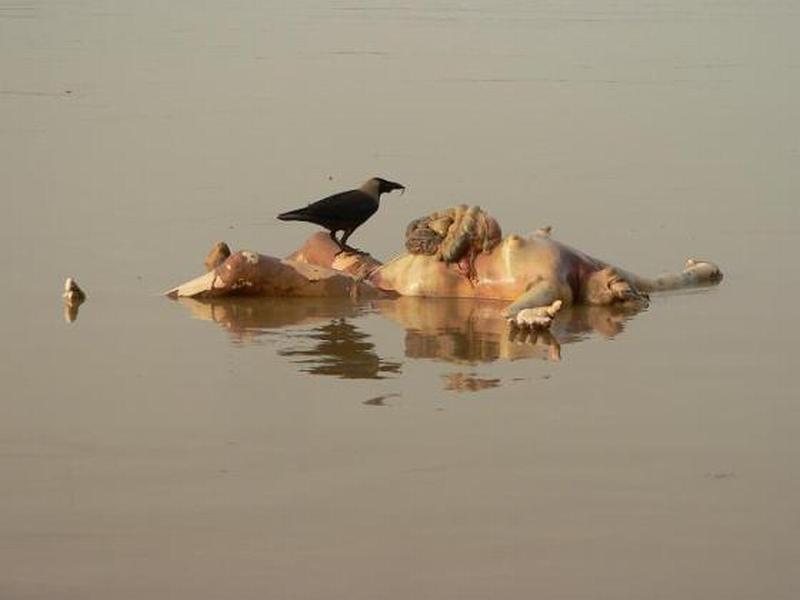
But India and Indians are ridiculed and embarrassed by other nations for its filth and religious hypocrisy. The River Ganges is considered holiest river for Hindus, and also most polluted. Despite being so sacred, there is nothing that is not dumped into the river. Raw sewage, plastic bags and bottles, industrial effluents, human waste, chemical from tanneries, discarded idols, cow dung, partially cremated corpses, flower-garlands, human remains, animal carcasses, butcher’s offal, chemical dyes from sari factories and construction waste, everything ends up in River Ganges. Daily, people defecate on the banks of this sacred river, while many others come long way to take bath in the same water.

The condition hasn’t changed much in 2015. In January 2015, more than 100 corpses, including children, were found washed up in shallow tributary of the River Ganges. The bodies were decaying and dogs and birds could be seen feeding on them. About 102 bodies were spotted near the village Pariyar, in Uttar Pradesh. All credit goes to India’s custom to give water burial. Many people do it because they can’t afford proper cremation.

(Source: Planet Custodian)

Friday, 22 December 2017

Patanjali appears in the list of companies polluting river Ganga

CAG's report draws attention to Namami Gange project, underlines serious flaws in implementation

Comptroller and Auditor General's report has found that Yoga Guru Baba Ramdev's 'Patanjali' is one of the many industries along the river Ganga are discharging effluents into the river. The detailed report on Namami Gange project was tabled in both Houses of the Parliament on Tuesday.

The report exposes the shocking gap between what the government preaches and it practices. Cleaning the Ganga was part of the BJP manifesto.

Ramdev isn't the only one falling foul of the authorities. Upmarket resorts like Sarovar Portico, eating joints like Chotiwala, or the plethora of plush resorts in the Corbett National park have didn't respond to authorities and the courts.

"Out of 180 defaulting industries to whom show cause notices were issued 42 defaulting units neither submitted their compliance to the show cause notice, nor approached the UEPPCB for inspection." The report goes on to point out that "These units were suo moto inspected by regional officers after the expiry of the compliance period. On their recommendations, the show cause notices were revoked by the UEPPCB", the CAG points out.

Of the many units that were supposed to have shut down for polluting the river, a sample check done of nine units in Hardiwar, the CAG found that seven were functioning.


The good news is that five of the famous ashrams in Haridwar have, after being threatened with closure, set up septic tanks so that untreated sullage does not flow into the river.

Another good development is that mobile magistrates have been posted along the river banks especially in pilgrimage sites such as Haridwar and Rishikesh to keep an eye on pilgrims using soap, shampoo and oil while taking a bath!

But the Clean Ganga project is a case of history repeating itself with little to show by way of a cleaner river. Just eight to 63 per cent funds were utilised between 2014-17. A large portion of the funds is still lying unutilised. State governments and the Centre are unable to spend even a paisa of the funds allocated for the project. The CAG audit is a familiar tale that lays bare the claims by then minister concerned, Uma Bharati. She had clearly blamed the UP government ahead of the elections for the river being dirty.

Now, as per the CAG report, the river in the Prime Minister's constituency of Varanasi happens to be along one of the most polluted stretches. In six cities of Uttar Pradesh, Bihar and West Bengal oxygen levels in the water have plummetted from the level it were in 2012-2013. Total coliform bacteria levels in all cities of UP, WB and Bihar was very high. The water quality in these cities was not even fit for bathing.

(Source: India Today)

Sunday, 30 July 2017

The language of ashes: The stories around Aghori babas

It is New Year’s Day, and in Banaras, it’s not the eve, but the first day of the year that is celebrated, for it being a new beginning, a good beginning, and rightly so. I seem to have begun the year with stories of death and of the dead. Stories of Aghori Babas, who walk around with chalk-smeared bodies and long beards, wearing nothing except some beads around their throats and wrists; carrying the trishul, the sign of Shankar Mahadev. They sit for long hours stoned, lost in dhyaan or meditation.

We are on a boat, being steered in the night from Dashashwamedh Ghat to Assi Ghat. It is cold, there is smog on the waters, we cannot see beyond a few feet. It is almost as though ghosts are travelling with us, or it may just be my imagination playing tricks.

I look at the man telling me the tale.“ Aghori Babas have strange powers,” Rakesh says. He leans back, “The Baba then said to us, ’ Give me the skull of a Jaiswal’.”

The boat rocks in the dirty green waters of the Ganges, mother to us Indians. We bathe in these waters to purify ourselves… this water into which the sewage waters pour from the city, this water where people wash dishes and clothes and throw the ash of the wood from the burning corpses.
“You know why the Baba asked for the skull of a Jaiswal?”
I nod, wondering what is so special about a Jaiswal skull. All I know that they are the Banias of Banaras, it is a common surname here.
“The skull of the Jaiswal is big, and it is hard. It is a hard skull and does not crack easily. That is why the Baba wanted me to give him the skull. It is big, so the Baba can cook a good meal in it, and it is hard, so it will last a long time as a vessel.”
“So why did you not give it to him?”
“Well, a Jaiswal skull is hard to crack,” he said, shrugging his shoulders. It was obvious that he did not want to give the Baba what he wanted. This Baba was his father’s friend, or acquaintance. Maybe he did not feel obliged enough to do what was required. A shiver ran up my spine. There was more to come, even as the fog enveloped us some more, and the boatman rowed harder, the oars moving slow against the water current.
“I have seen the Baba call a cat to him, a cat just walking along the river’s shore.”
“Hmm…”
And then rip the cat’s body, remove its heart and eat it in front of me.”
“Ha!”
Rakesh’s eyes gleam.“He puts the body back together again and the cat walks away.”
“No heart?”
“The Baba has eaten it in front of me, all raw and throbbing.”
“The cat walks away without a heart? It won’t fall dead?” I give a very cynical smile and raise my eyebrows; it’s such an impossible thing to believe.
“It ran away. It did not die.” He does not laugh. ”These are the powers. You have to see to believe. I have seen.”
His brother Dinesh, trailing his hand in the water, and cupping a few mouthfuls now and then, chimes in, “I have seen it too.”


For me, it’s a story. But I can imagine a heart cooking inside a skull over a lit fire, a chalk-bodied Baba watching over it, and I wonder for a moment what he puts in the curry. It seems like something out of a Hans Christian Andersen fairytale with an Indian flavour. My stomach churns, and it is not with hunger. Luckily, we have reached the Assi Ghat, where celebrations are on. Lights blink and the sound of people merry-making reaches our ears.
I rise slowly, not willing to show my eagerness to leave the fog and the waters behind, to reach stable land. I hold onto the hand of the boatman to steady myself, and see with a shock that he is naked, and his body is the colour of chalk. I stare at the beads around his wrist…each of them is a skull. I tell myself to pretend I do not see what I see and do not touch what I touch, and slowly step ashore.

The boat sways and disappears. I look at Rakesh who told me the story of the Baba. “The boatman,” I say, “where did you get him from?”
“He is one of my father’s friends. He offered to row us across. No one else was available or willing. It’s the night of first January and everyone is celebrating.”
“He is a Baba, this friend…the Baba?” My voice shakes.
“No, of course not, how can he be?” He laughs, then seeing the look in my eyes, becomes quiet.“I think he just wanted to tell you to believe.”
I shake my head. I would never believe. I clench my hand. There is something in the palm of my right hand. I open it, and see a small bead. It is skull-shaped. I hold it up to the light, and it seems to be grinning.
I toss it to Rakesh. “Is this a Jaiswal skull?” I attempt a joke.
He holds it in his hand and his face freezes. “The Baba is here,” is all he says. “We’ll meet him soon.”
I look at the revellers and wonder if any of them have had such a good beginning to their New Year. Not everyone is helped ashore by the hand of an Aghori Baba.
“Let’s move on, join the crowd. The night is getting morbid,” I tell Rakesh.
A cat mews as it passes me and I jump.
Then I am laughing, hysterically. “No, I don’t want to know any more,” I say. ‘This is enough, it’s enough.”

(Source: The Punch Magazine)

Friday, 9 October 2015

Varanasi in the eyes of a Westerner

Varanasi in the eyes of a foreigner

There have been so many books by westerners on Varanasi and the new addition to the list is Piers Moore Ede's Kaleidoscope City: A year in Varanasi. The writer explored the city during his one year stay and has given several interesting incidents that happened. He has successfully shown the other face, the darker one, the one which often gets missed by tourists, of the city. 

Whoever visits the city tries to grasp and go deep inside the veins to understand the pulse of the place and its people. Don't know if anyone has been successful in doing so, but everyone, including Ede, has understood that Death reigns here! 

Earlier writers have seen Varanasi in their eyes and seems to give their own perspective and it is where Ede differs from others. He never gives an impression that he knows everything about the city and its people despite living there for one year. He is eager to learn things happening in the city like a little child who is anxious to explore the world around. He patiently listens to people and keeps his curiosity to unravel the city till the end. 

Harishchandra ghat, the Ganga river, Varanasi, all become characters and breathe life in the book. Though he has tried to go deeper and personal into the lives of locals one wonders if he has been successful in it, as obviously there are two chances: one, people may open their personal secrets to him fearing no threat to their private life; second, people may exaggerate things to get sympathies or say things superficially as he's a foreigner. Whatever it is, the writer hasn't hurt the sentiments of the locals and one should laud his respect for the city and the local culture. Accepting the very fact that still there's lot to learn about the city, culture and its people brings the book closer to readers and wins their hearts. 

Note: The original review was published in Sakhi magazine here: http://sakhiexpress.epapr.in/538990/Sakhi/15-July-2015#dual/46/1