Showing posts with label Indus Valley civilization. Show all posts

Friday, 16 April 2021

This book visits the sites of India’s civilisations to reimagine 4,000 years of history

 Namit Arora combines the evidence gleaned from travel and research to draw informed conclusions in ‘Indians: A Brief History of a Civilisation’.

The book Indians: A Brief History of a Civilisation offers an unusual saunter through more than 4,000 years of India’s history. The milestones on the journey on which Namit Arora takes us are wondrous yet oft-ignored locales including Dholavira, Pataliputra, Nagarjunakonda, Nalanda, Khajuraho, Hampi and Varanasi.

Clockwise from top left: Historical sites at Dholavira, Nagarjunakonda, Hampi, and Patliputra. | Dholavira: Rahul Zota / CC BY-SA 4.0; Nagarjunakonda: Sabyk2001 / CC BY-SA 3.0; Hampi: Hawinprinto / CC BY-SA 4.0; Patliputra Manoj / Public Domain


As guides in addition to himself, Arora enlists history’s well-known travellers from other lands: Megasthenes from Greece, China’s Xuanzang, Central Asia’s Alberuni, Marco Polo the Italian, the Portuguese who visited Vijayanagara, Bernier the Frenchman, and more. Meeting the reader in chronological sequence, these travellers’ accounts form part of this 296-page book, along with Arora’s own reflections and comments, including those on philosophical debates and architectural puzzles.


The net result is a sobering assessment that greatness in our land was joined far too often by callousness and neglect, even though elements from the past continue to strike awe in the reader’s mind.

Imagining daily life

Arora is someone who abandoned his Silicon Valley perches (for which IIT Kharagpur had equipped him) for his love of India’s irresistible places. Also in play, it would seem, was a thirst in the writer to understand the springs of India’s history as also the statics/dynamics of Indian society. Pulled, too, by the capabilities of the camera – which, going by the book’s stunning colour photographs, he wields with great skill – Arora has repeatedly visited the celebrated landmarks.


He has studied these places intensively and reflected deeply on them. He scrutinises the aforementioned travellers even as he quotes them. In Indians, we see these observers in their national contexts too, not just as reporters of India, and thus glimpse their likely motivations.


But it’s more than the camera or the travellers. The book’s quotes and notes confirm to us that Arora has absorbed what a great many other scholars have written about these places and their histories. He also feels free to offer his own takes, and why not?


A refreshing feature in Indians is Arora’s effort to imagine the life and bustle of each locale in its heyday. After providing recorded perspectives and knowledge extracted from archaeology, Arora daydreams a bit. These short reveries where the past is recreated for the reader appear plausible and lifelike. Here, to give an example, is Vijayanagara’s large-scale construction activity in the 14th and 15th centuries:


“I imagine labourers, masons and sculptors doing the hard, back-breaking work of quarrying, moving, cutting, shaping and raising stones with the basic technologies of the day: chisel and hammer, ropes and ramps, human and animal muscle. Countless must have died in accidents.”


Through traveller’s eyes

Earlier, depicting how Chinese travellers during a period of three centuries (“400 -700 CE”) ended up enlightening Indians about India, Arora makes a different point: “Many Indian monks also went as missionaries and scholars to China but none of their observations have come down to us.” While the world has always described India, why is it that Indians, exceptions apart, have shown little interest in portraying the peoples beyond their borders, even when living amidst them?


Providing history’s dates with seeming certitude, Arora is similarly unequivocal and bold in his appraisals and assertions. Where the exact date or duration of a past exercise remains unknown, scholars are certainly entitled to offer their considered estimate, even if it’s a rough one. And if after examining arguments for or against a particular position, a scholar reaches a conclusion, there is something to be said for offering that conclusion in clear and even categorical language. Which is what Arora does.


How Buddhism was swept aside in India, including by being absorbed in Hinduism, is part of the history Arora examines. His historical tour also shows, sadly, that sati was an old and indigenous practice, recorded in the first century BCE, not something forced on Hindu society by aggressive Muslim males, whose religion entered the Indian scene many centuries later.


Of Alberuni’s famous text on India, written “around 1030” after the author spent “most of thirteen years” in India and learnt much (including Sanskrit), Arora says: “Alberuni approached India like a scholarly journalist… [His] is the work of a deeply intelligent, curious and decent mind.” Arora reminds us that Alberuni ended his book by writing, “We ask god to pardon us for every statement of ours which is not true.”


Some of Arora’s binaries may be too sharp. In his chapter on Varanasi, the city of (among so many others) Kabir, Ravidas and Tulsidas, Arora places Tulsidas in one column of “personal piety” and “the status quo”, and Ravidas and Kabir in an opposed column of “a casteless and classless society”. In countless homes, such a conflict was unknown or ignored. Many Indians were (and I hope are) raised on the similarities in the devotion and thought of these amazing poets. We learnt the songs of all three.


In Indians, caste seems to emerge as Indian society’s principal characteristic and bane, but coercions and oppressions within “low” castes are also visible. Much was indeed golden in India’s history, but was there a golden age that foreigners destroyed? Unfortunately, Arora’s long “tour” does not reveal any sizeable period when most of India gleamed.


Painstakingly researched, Indians is a pleasure to read. Significant arguments accompany the utterly fascinating information showered by it. Any rival history that wishes to refute this book’s conclusions had better find credible dates and solid evidence, for Namit Arora has set a high bar.


(Source: Scroll)

Sunday, 2 December 2018

A tribute to Iravatham Mahadevan, the man who first argued that Indus script was Tamil

In an article I wrote for a children’s magazine when I was in school, I said that the Indus script – as yet undeciphered – was Tamil. I could say it because Iravatham Mahadevan said so, writes Nadika N on the TNM. Read on: 

Iravatham Mahadevan died this Monday in Chennai, at age 88. His death is the deepest sense of loss I’ve felt in a really long time. A sharp pang, a great big jab of regret: I have never met the man I’ve thought of as my teacher, my mentor, my friend.

If there was one salve, it was that he died after a long-term archaeological and genetic study proved – as conclusively as these things can be proved – that the people of the Indus Valley were indeed Dravidian, were Tamil.

He lived to see the world slowly wake up to the truth he’d lived for 30 years. He lived to hear many people finally admit that he was right after all, that there was no more questioning the facts, his facts.

For years, since the 1970s, Mahadevan had been waging a very lonely battle to prove that the Indus script – one of the world’s most elusive archaeological mysteries – was indeed a language, and that language was Tamil, or at least Proto-Dravidian.


If there’s any doubt that this was groundbreaking work, that this was pioneering, go to any forum on Facebook and say “Tamil as a language is older than Sanskrit,” and count the number of civil replies. Iravatham Mahadevan did the academic equivalent of this in the 1970s and held his ground against the gale of academic, political, and public opinion. Even today, people doubt that the Indus scripts codify a language. Serious scholars question if the symbols and the scripts are not just totem signs, or brand marks of traders, or at best rudimentary hieroglyphs that do not add up to a comprehensive language.

For years, he wrote paper after paper, published research after research, with some pioneering linguistic studies to show that the scripts did indeed codify a language. He patiently explained the many ways in which one could read a language, and why the Indus was a language. He proved with statistics and analysis that the symbols have relationships to each other, follow specific patterns and have spatial significance, and that they are not – and cannot be – random symbols placed at the whim of an illiterate hand, but the careful and skilled markings of a literate, thinking human. He spoke at colleges and conferences of his findings. He gave away his research to others to build upon. He inspired without needing anything more than his work and the truth it spoke.

I was a masters student, pursuing a mix of archaeology and film production – a course specifically designed by British Archaeologist and Broadcaster Mick Aston to train professionals who could take archaeology out of the academic ivory tower to the communities and people to whom it mattered most. Despite failing health, and a tiring TV production schedule, Mick Aston sat me down one evening, even as cameras were waiting for him, and spoke to me at length about the responsibility each archaeologist had. He told me what I needed to do: tell my people the truth of their past. Tell the world the truth of my people. He spoke at length about communities, about giving people a deep connection to the land and the place they lived in, and a deeper connection to the past. This has been at the back of everything I have done since then. It has guided my actions, helped me understand and explain.

If Mick Aston was a mentor, so was Iravatham Mahadevan. And he did it long before I could pronounce archaeology, before I could put into words what my love of history meant.

His ‘Indus Script: Text & Concordance’ for the first time compiled and presented all of the symbols and signs of the Indus script, and presented statistical analysis of each, showing patterns and relationships that, before then, were not seen. For any linguist, for any epigraphist, this was essential to understand a language and a script.

But for me, the tables did more. They unlocked a world, unlocked an imagination of a past, a vision that would spur me on take up history and archaeology as both formal disciplines of study, and a life-long pursuit. Those symbols – written by my ancestors 4,500 years ago, and tabulated and presented by Iravatham Mahadevan five years before my birth – would give me my biggest passion.

In an article I wrote for a children’s magazine when I was in school, I said that the Indus script – as yet undeciphered – was Tamil. I could say it because Iravatham Mahadevan said so, and for 14-year-old me, it was the biggest thrill that the language I spoke (and was learning to read and write in) was perhaps older than any other.

Iravatham Mahadevan helped decipher the Tamil Brahmi script, which allowed later archaeologists to read the inscription on stone celts discovered in Keezhadi, thus telling us that Thisan or Theesan owned a stone celt in his life. Giving us not just history, but narrative. We could hold on to this name, these people and their stories and their lives and realise that the Tamil story, the Tamil civilisation stretched well into antiquity.

When the Roja Muthiah Library was set up, with a special Indus Research centre, Iravatham Mahadevan gave them all his papers and research on the Indus, thus allowing me – with an internet connection – to spend hours reading and understanding. And imagining.

Imagining a 4,500 year old Utopia, a living breathing actual Utopia that left evidence of its existence in archaeology. With its East-West cities where the walls never need be thick enough to ward off invaders, because peace and equality were taken for granted. Where the ruler was the priest and this was not a hereditary position, but just an office one went to. Behind every symbol Iravatham Mahadevan presented, and the many he deciphered and interpreted, I could imagine a story – an existence, a way of life, a truth.

It was Iravatham’s papers that allowed me to talk to students in community colleges on the antiquity of the Tamil language. It was his research which allowed me to glibly dismiss any claims to classic status by any other language. It was his research which allowed me to truly appreciate the importance of those fleeting lessons in school, and those rushed columns in newspapers.

These, and more, are why I have felt the sharpest pain of loss for any person’s death. That a person who left such a strong impact on the study of history, is no more. Someone who told the truth about history and allowed many others to dream of doing the same, is no more.

RIP sir.

Sunday, 26 August 2018

Shudras, not Aryans, built the Indus Valley Civilisation

The word Harappa sounds similar to the names given to divine figures in south India. Mallappa, Beerappa, Veerappa, for example, writes Kancha Ilaiah Shepherd, political theorist and social activist, on Daily O. Read on: 

Archaeological evidence shows that the first city to be built across the world - Harappa - came up in the Indian subcontinent around 2850-2900 BC. The word Harappa sounds similar to the names given to divine figures in south India. Mallappa, Beerappa, Veerappa, for example.

In Kannada and Telugu speaking regions, names ending with "Appa" are very popular among the Shudra and Dalit communities. Names like Mallappa and Beerappa are now names given to godheads that cattle rearing and agrarian communities believe in.

Harappa, the city built on the banks of Indus, went to Pakistan post partition. Harappa represents the advancements made in the area of construction of houses, streets, tanks, canals and forts. This advancement had been achieved a full 1,500 years before Rig Veda was composed.

The Indological and archaeological studies also established that this civilisation was built by Indo-Africans before the Aryan race even showed any signs of its existence in the Indian subcontinent.

Contemporary Indian villages show that it is actually villages that lay the foundation for cities. All cities have villages around them.

The tradition in the Indian subcontinent is to name villages and cities after people. For instance, my village is named Papaiah Pet. People from the older generation told us that a fisherman named Papaiah and my grandmother Lingamma, whose family name was Kancha and who was the widow of a shepherd, built the first thatched houses which went on to take the form of a village in which fishermen/women, shepherds, toddy tappers settled down.

During the time of my parents, people started tilling the land in the village using buffaloes while they also continued with their traditional occupations. Over a period of time, a tribe named Lambada, whose main occupation was cattle rearing, also settled down in the village. By now, around 4,500 people had started living in the village. For the last 10-15 years, the village has been witnessing people migrate to urban areas.

Similarly, the city of Harappa could have actually been a village to begin with and Harappa could well have been the man after whom it was named. Building the city of Harappa would have been impossible without several villages surrounding it.


So, these villages would have existed in the region where the Indus Valley Civilisation was spread, well before the city of Harappa was built. Building a city is impossible unless there is an agrarian economy to sustain it.

For instance, my house that was built during my childhood, was constructed without too many tools being used. Wood from the village was used to build the thatched house. Over time, I saw how many in the village trained to become carpenters and the exercise of building houses became sophisticated. The same applied to how mud walls of our houses gradually came down and were replaced by pucca houses with brick kilns coming up in no time.

Studies of Harappa show that the urban civilisation back then was far more developed than the town of Narsampet from where I completed Class 10.

The Harappan city could have only been built under the socioeconomic conditions similar to the one that I saw in my village.

The civilisation that started taking shape in Harappa soon spread to the cities of Mohenjodaro and Dholavira. While this civilisation spread along the river Indus, no such civilisation developed around the Ganga. We don't know if even villages exited in the Ganga region when cities were coming up in the Indus region.

Why?

The answer to this question needs to be searched in what is known as Vedic economy. Vedic economy is actually pastoral economy. It involves animal husbandry: the care, tending and use of animals such as cattle, camels, goats, yaks, llamas, reindeers, horses and sheep.

This in essence means that the Vedic economy and social life turned more backward after the Harappan civilisation declined. Urbanisation suffered a huge setback.

Archaeological studies show that the Harappan civilisation was built by Indo-Africans, whose physical characteristics were more similar to south Indians, who are racially Dravidians (The Dravidian race is nothing but Indianised mixed race Indo-Africans).

The Vedic civilisation, culture and linguistic society were built by Indo-Aryans, who apparently migrated from Middle East (mainly from the present day Iran). This civilisation is said to have thrived during 1500 to 1100 BC.

Historically, this civilisation is also known as the one which followed the Harappan civilisation.

The earliest and most authentic evidence of the Indo-Aryan civilisation comes from the Rig Veda, the first Brahminic scripture of India. A scripture that has roots of the caste structure within it.

The scripture was written in Sanskrit, which even today continues to be hegemonised by Brahmins as temple priests. They alone read, recite and interpret all Sanskrit texts even in the 21st century.

No Shudra has the right to do it. Many are still denied the right to study in Hindu schools and colleges. They cannot be priests in Hindu temples in almost the entire country. No Shudra philosopher has emerged from the Brahmin-dominated Hindu society. The philosophers to have emerged have only been Brahmins or Kshatriyas.

After the Hindu fundamentalist outfit, Bharatiya Janata Party, came to power in 1999 and then in 2014, it started mass mobilisation of Shudras with the active involvement of the Rashtriya Swayamsevak Sangh (RSS).

But no Shudra was empowered enough to become a priest in a Hindu temple.

The BJP and RSS only reach out to Shudras for their votes, they are not interested in any real empowerment of the community.

The Shudras have their historical roots in the Harappan civilisation. It is well known that there was no Brahmin, Brahminism or Sanskrit during Harappan civilisation.

It is not known how the entire Indus Valley civilisation disappeared and how the whole civilisation was taken back to pastoralism by the early Aryans, which as I mentioned earlier failed to even build proper villages.

A Rig Veda hymn shows how the scripture does not invoke God, but invokes Agni.

In those times Agni could not have been seen as a source of energy used for cooking but could have been seen as the most powerful agent to harm the enemy by burning his/her resources - houses, cattle, crops, grain and other resources central to life. The other natural agent worshipped was Vayu (wind).

In Rig Veda, Vayu and Agni have been accorded greater prominence than Brahma or Indira.

When I was about three-four years old, a massive fire in my village destroyed most of the houses. The fire rose to scary heights fanned by the wind. Houses that were not in the direction of the wind, however, escaped harm.

Villagers then started abusing Devudu (god of fire) and Vayu Devudu (god of wind) because the fire not only gutted houses, but also claimed a few lives.

These, however, are among the forces of nature that have been eulogised in the Rig Veda.

It is thus not surprising that the people who venerated destructive forces, created the caste system condemning a whole group of people into a life of ignominy.

Wednesday, 20 December 2017

Archaeologists decipher 3,200-year-old stone telling of invasion of mysterious sea people

Researchers say ancient writings could provide answer to 'one of the greatest puzzles of Mediterranean archaeology'

Ancient symbols on a 3,200-year-old stone slab have been deciphered by researchers who say they could solve "one of the greatest puzzles of Mediterranean archaeology".

The 29-metre limestone frieze, found in 1878, in what is now modern Turkey, bears the longest known hieroglyphic inscription from the Bronze Age. Only a handful of scholars worldwide, can read its ancient Luwian language.

The first translation has offered an explanation for the collapse of the Bronze Age's powerful and advanced civilizations.

The script tells how a united fleet of kingdoms from western Asia Minor raided coastal cities on the eastern Mediterranean.

It suggests they were part of a marauding seafaring confederation, which historians believe played a part in the collapse of those nascent Bronze Age civilisations.


Researchers believe the inscriptions were commissioned in 1190 BC by Kupanta-Kurunta, the king of a late Bronze Age state known as Mira.

The text suggests the kingdom and other Anatolian states invaded ancient Egypt and other regions of the east Mediterranean before and during the fall of the Bronze Age.

Archaeologists have long attributed the sudden, uncontrollable collapse of the dominant civilisations around 1200BC partly to the impact of naval raids. But the identity and origin of the invaders which modern-day scholars call the Trojan Sea People, had puzzled archaeologists for centuries.

The new findings follow research by an interdisciplinary team of Swiss and Dutch archaeologists.

They include Dr Fred Woudhuizen, thought to be one only 20 people in the world who can read Luwian. He translated the inscription.

The 35cm-tall, 10-metre-long limestone slab was found 1878 in the village of Beyköy, 34 kilometres north of Afyonkarahisar in modern Turkey. French archaeologist George Perrot copied the inscription before the stone was used by villagers as building material for the foundation of a mosque.

The copy was rediscovered in the estate of English prehistorian James Mellaart after his death in 2012 and was handed over by his son to Dr Eberhard Zangger, president of the Luwian Studies foundation, to study.

Mr Zangger, a Dutch linguist and expert in Luwian language and script, said the inscription suggested "Luwians from western Asia Minor contributed decisively to the so-called Sea Peoples’ invasions - and thus to the end of the Bronze Age in the eastern Mediterranean".

The foundations said: "One of the greatest puzzles of Mediterranean archeology can thus be plausibly solved."

The translation and researchers' findings will be published in December in the journal Proceedings of the Dutch Archaeological and Historical Society and in a book by Mr Zangger.

(Source: Independent)

Sunday, 22 June 2014

Who invented the zero?

A new collection of essays examines the most popular stories Indians tell each other about the nation's history. 

Excerpts from The Sceptical Patriot: Exploring the Truths Behind the Zero and Other Glories by Sidin Vadukut. Published by Rupa Publications.

One day, in March 2010, the editor of the newspaper I worked for summoned me to his room.

‘What do you know about Swiss watches?' he asked me out of the corner of his mouth as he typed away on his laptop, no doubt ripping some poor reporter somewhere.

‘My father used to collect some of the cheaper brands once upon a time. And I thought he was nuts for wasting his time and money on them.’

‘But you’ve heard of Omega and Rolex and TAG Heuer and all that?’

‘Yes, of course.’

‘Great. You’re going to Basel this year...’

A few days later, I was on a plane from Delhi to Zurich to cover Basel World, the world’s largest and most important annual watch and jewellery fair. Since then, watches have become something of a personal obsession. Each year, I travel to Switzerland at least half a dozen times to attend fairs, visit factories and interview watchmakers. And, on average, I publish approximately 200 pages worth of watch editorial each year.

I have also started behaving exactly like my father. I can spend hours outside a watch store, just looking through the display window and whimpering softly. I’ve even accumulated something of a fledgling collection. But none of them is particularly expensive or rare, though there is one HMT automatic, an NASL-03, that I am particularly proud of.

During one of these trips to Switzerland, I once interviewed a master watchmaker who actually had his brand named after himself. This, by itself, is not all that rare in the Swiss watch business; in fact, it is the norm. Almost every watch brand, barring a few such as Rolex, is named after the original founder. The Swiss are quite proud of this, and try to flaunt the age of their brands as widely as possible. But a successful watch brand named after a watchmaker who is still alive? That is pretty rare. Most Swiss brands are named after founders who died centuries ago.

The industry tends to be full of either grim, inscrutable automatons or flamboyant showmen who lie through their teeth. This fellow, one of the greatest watchmakers alive right now, was neither. In fact, he seemed something of a romantic and an amateur philosopher. ‘I love your country,’ he said. ‘You Indian guys are so intelligent, so smart. You discovered so many mathematical things.’ For the next thirty minutes or so, he spoke about the Fibonacci series, the golden ratio and other such mathematical curiosities. In the end, he returned to the subject of India: ‘But all this was made possible only because of you Indians. You guys invented the zero! Without the zero...’ He threw up his arms, shrugged and exhaled loudly. Nothing, he seemed to say. Without the zero, there would be nothing.

A few days later, I spotted him having lunch in a restaurant, surrounded by a bevy of Asian women. I was still in a daze after our glorious interview, so I quickly Googled up the French Wikipedia page for the ‘inventor of the zero’ – Aryabhatta, of course – and handed my phone over to him. I admit I was hoping to impress him with ‘Indian heritage’.

When I looked over a few minutes later, the phone was just lying on the table in front of the watchmaker; he was busy snacking on a woman’s ear while she giggled appreciatively. They did not notice when I gingerly walked over and retrieved my phone, with the Aryabhatta page untouched.

India’s claim to the invention of the zero is perhaps the most widely used – and abused – ‘India fact’. It appears on every single list of facts I have gathered in the course of my research. It is so popular that it has graduated from fact to dogma and then all the way to the butt of jokes. It is also one of those rare facts that is repeated with complete credulity in both Indian and international literature. A December 2012 news article on the Scientific American website about the 125th anniversary of the Indian mathematician Srinivasa Ramanujan, was subtitled: ‘India, home of the number zero, ends a year-long math party in unique fashion’.

Everyone, everywhere, it seems, is in broad agreement that the zero was invented in India.

Or was it? The Sceptical Patriot is not one to be fazed by national and international repetition. We must find the true story.

And what an intriguing story it proves to be.

***

In Gwalior, there is a fort commonly known as Gwalior Fort. Next to the fort is the small Chaturbuja temple. Inside the temple is a statue with four arms but no face. It did once have a face, but it has since been vandalised. There are two inscriptions in this temple. One is engraved over the main door. The other is inscribed into an indentation, roughly square in shape, on the left wall of the sanctum sanctorum as you enter it, to Lord Vishnu's right. 

The temple had fallen into ruin long before the first archaeologists began studying it in the late 19th century. The inscription over the main door lay unnoticed even after initial excavations. It was first noticed, copied down and translated into English in 1883 by our old friend and expert Indologist, Eugen Julius Theodor Hultzsch. The second one inside the sanctum sanctorum had been transcribed before, but Hultzsch copied it down again anyway.

Hultzsch seems surprised at the quality of the prose in the inscription over the door:

The first inscription consists of 27 Sanskrit verses and must have been composed by an ingenious pandit, who was well versed in alamkara. His extravagant hyperboles will appear startling and amusing even to one accustomed to the usual kavya style.

The second inscription from the tablet next to Vishnu is not so great. It is written, Hultzsch says, in ‘incorrect Sanskrit prose’.

But then, history and discovery are eccentric muses. Sometimes they care not for art and aesthetics. The first inscription that impressed Hultzsch has passed into the annals without emitting even a low whimper. Nice, but meh.

The second, shoddy inscription, on the other hand, is one of the most important records in the history of mathematics. If there is any record in all of India that is fully deserving of generating and maintaining its own cannon of India facts, this is it. There should be entire museums complete with multimedia displays and gift shops dedicated to this inscription.

So what does this piece of inscription say? Does it reveal the name of a mysterious king? Give a concrete date for a historical episode that experts had argued over for decades? Does it tell the future, then, in some Nostradamic way?

Bewareth thee the phone that is all touch but no buttons. For children will buyeth expensive apps...

No. It is merely an inscription informing one of a donation that has been made to this temple. It goes like this:

Om! Adoration to Vishnu! In the year 933, on the second day of the bright half of Magha...the whole town gave to the temple of the nine Durgas...a piece of land belonging to the village of Chudapallika...270 royal hastas in length, and 187 hastas in breadth, a flower-garden, on an auspicious day...

Then, a little later, the transcription says:

And on this same day, the town gave to these same two temples a perpetual endowment to the effect...for the requirements of worship, 50 garlands of such market flowers as available at the particular season.

There is more to this second Gwalior inscription. But these lines are the relevant bits.

So, what is so groundbreaking about these lines?

Simple. The numbers in them. Especially the two measures in hastas and the number of flower garlands. Inscribed in 876 CE, this inscription is the oldest text anywhere in India in which the zero is used in exactly the way we use it today. (The inscription itself refers to year 933 in the Saka calendar. In case you’re wondering.) And not just because the zero in 270 hastas or 50 garlands looks like the modern zero -- it does; it looks like a small circle. But also because it is used in the way it is, both as a placeholder for no value and a number in its own right.

There is broad agreement amongst researchers that the inscription at the Chaturbuja Temple in Gwalior is one of the earliest records anywhere of the modern zero. In February 2007, Bill Casselman, a professor at the University of British Columbia, wrote a brief essay titled ‘All for Nought’ for the website of the American Mathematical Society. In the essay, he talks of a journey he made to Gwalior to have a look at the inscriptions. He wrote:

What is surprising about these numbers is that they are so similar to what modern civilization uses currently. The more you learn about how our current number symbols developed – transmitted from the Hindus to the Persians, then to Mediterranean Islam, and differently in East and West – the more remarkable this appears...

What the Gwalior tablet shows is that by 876 CE our current place-value system with a base of 10 had become part of popular culture in at least one region of India.

So, are we done with this chapter, then? Pats on back all around, 10/10 for this ‘India fact’? Also, what is all that confusing talk of placeholders and numbers and usages?

Alas, that is the problem with the history of the zero. It is much more complicated than a little circle that stands for nothing.

And this is why establishing India’s ownership of the zero will take a little more sceptical enquiry, one that will take us far, far away from that little abandoned temple in Gwalior.
***

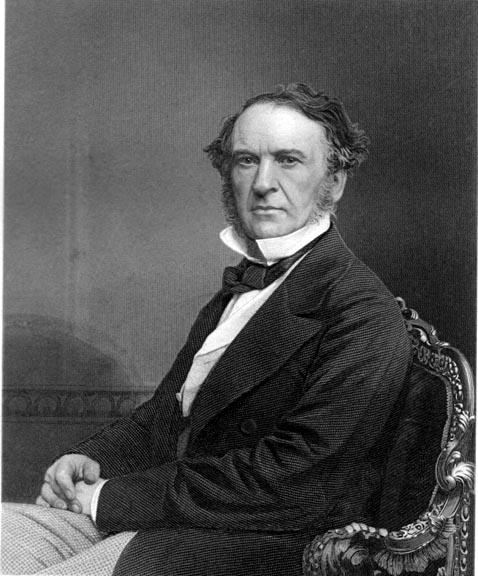
William Gladstone

William Ewart Gladstone was one of the greatest politicians in British history. He became prime minister not once or twice but four times. And he left the British government with a legacy of liberal thinking that continues to influence it in direct and indirect ways to this day.

Gladstone was also a Homer fanatic. He read, reread and re- reread works by the great Greek epic poet, first as a student of the classics, and then just for the pure awesome heck of it.

Then, suddenly, during yet another reading of the Greek epics, Gladstone noticed something strange. In all of Homer’s work, not once was there a reference to the colour blue. Not once. Never. Despite several mentions of seas and skies and other things we would normally associate with the blue colour, Homer never actually used the word ‘blue’ in his work.

Gladstone came to the conclusion that this was because Homer and most other Greeks of his period were colour-blind. Their eyes simply didn’t register the colour blue.

Since then, other researchers have disproved this theory and come up with many of their own. The German philosopher Lazarus Geiger took Gladstone’s analysis and extended it further, across several other great epic poems and religious texts of many other religions around the world. Geiger made a stunning discovery: Blue scarcely made an appearance anywhere.

He wrote in his 1880 book History and Development of the Human Race:

If we consider the nature of the books to which this observation applies, the idea of chance must here be excluded. Let me first mention the wonderful, youthfully fresh hymns of the Rigveda, the discovery of which amidst the mass of Indian literature seems destined to become as important to the present century in awakening a sense of genuine antiquity as the revival of Greek antiquity at the threshold of modern times was to that period in arousing the sense of beauty and artistic taste. These hymns, consisting of more than 10,000 lines, are nearly all filled with descriptions of the sky. Scarcely any other subject is more frequently mentioned; the variety of hues which the sun and dawn daily display in it, day and night, clouds and lightning, the atmosphere and the ether, all these are with inexhaustible abundance exhibited to us again and again in all their magnificence; only the fact that the sky is blue could never have been gathered from these poems by anyone who did not already know it himself.

Which is Geiger’s roundabout way of saying that while the Rigveda refers to the sky several times, it never actually calls it ‘blue’.

I first came across all this analysis by Gladstone and Geiger on an episode of Radiolab, my favourite radio show/podcast in the whole world. Produced by a New York public radio station, Radiolab explores one topic each episode through the medium of fascinating stories. The whole Gladstone bit came up during an episode called ‘Colours’.

Now if you’re wondering what all this has to do with the concept of zero...well, it doesn’t have anything to do with it directly. But indirectly, I wanted to bring up the complicated notion of identity.

Let us assume, for a moment, that the Greeks actually didn’t have a real word for the colour blue. Does this mean that they never saw the sky or noticed its colour? Absolutely not. Unless the Greeks didn’t have a sky, or had one but in purple. This seems unlikely. Awesome, but unlikely.

So did someone have to invent blue for them? Think about it. (I am trying to.) Blue was all around them all the time. They just didn’t have a name for it. Or find the need to. Until one day somebody decided that the colour of the sky deserved a name. And that name would be: blue. Or whatever was the local language equivalent for blue.

But would it make any sense to call this bright individual the inventor of blue? After all, it is not like the stuff wasn’t around till he/she came along and decided to call it something. It was there all along. All our inventor managed to do was to give it a name and an identity.

When we talk about the ‘invention’ of zero, we’re faced with a similar problem. How do you invent a number?

Now, the term ‘zero’ itself can mean many things. But for the purposes of this enquiry, just two or three of them should suffice.

First of all, zero stands for nothing. A void. Nothingness. An absence of anything. So if ‘one’ represents a single instance of something, ‘zero’ represents no instances of that thing. But, like blue, this is not really something you would expect someone to have invented.

Mrs Caveman: How many mastodon kebabs did I cook?
Mr Caveman: Three?
Mrs Caveman: How many did you eat?
Mr Caveman: Three?
Mrs Caveman: How many do I have left for myself now, you greedy pig?
Mr Caveman: I cannot answer that question because I am yet to develop a sense of nothingness or a term for this sense.
Mrs Caveman: Damn! Every single time...

And even if someone did invent the idea of nothingness and a term for it, it seems ludicrous to try to fix a time or place for it. Also, chances are that this sense of ‘nothing’ developed in many places simultaneously.

So let’s skip that definition of zero.

There are two more.

One of the best, most concise histories of the zero I’ve read anywhere is an online essay titled, would you believe it, ‘A History of Zero’, written by two professors of mathematics at the University of St Andrews.

Professors JJ O’Connor and EF Robertson write about the other two uses of zero:

One use is as an empty place indicator in our place-value number system. Hence, in a number like 2106 the zero is used so that the positions of the 2 and 1 are correct. Clearly 216 means something quite different. The second use of zero is as a number itself in the form we use it as 0. There are also different aspects of zero within these two uses, namely the concept, the notation, and the name.

To me, both of these ideas are somewhat less abstract than the notion of nothing. And therefore, in a sense, more ‘inventable’. Alas, in the very next paragraph the good professors write:

‘Neither of the above uses has an easily described history.’ Ugh.

So let us start, then, at one of the earliest systems of writing in the world: the Babylonian cuneiform. Did they have a sophisticated understanding of mathematics? And if so, how and when did they start representing zeroes in their texts?

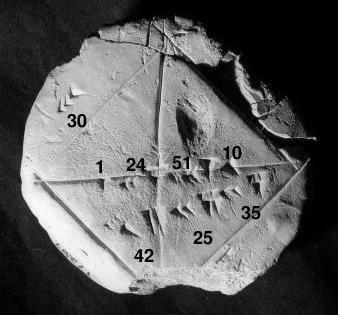
Babylonian Clay Tablet, with annotations

By 3000 BCE, more or less around the time the Indus Valley civilization was establishing itself, the Babylonians had developed a system of positional numbering very similar to the number system we use today. This means that they wrote long numbers with digits in the ‘one’s place’, then ‘ten’s place’, and so on. Except that while we use a base-10 system, the Babylonians used base-60. We have 10 digits in our number system, the Babylonians had 60. (Well 59 actually. They didn’t have a zero for a long time.)

The easiest way to explain the difference between base-10 and base-60 without making you want to throw this book against a wall/spouse in frustration is to ask you to look at your clock or watch. Credit the Babylonians and history’s propensity for memory, but to this day we still measure time on a base-60 system like the Babylonians. So, if I told you to add 1 hour and 34 minutes to 2 hours and 40 minutes, you’d effortlessly carry out a base-60 addition and tell me 4 hours and 14 minutes.

So how did the Babylonians indicate numbers like, say, 602? In the beginning, they did this by just leaving an empty space between the symbols for 2 and 600 to indicate that there was nothing in the ‘ten’s place’. After hundreds of years of doing this, sometime around 700 BCE (but perhaps earlier), the Babylonians started indicating these empty spaces with a special symbol to indicate positions with no numbers.

OH MY GOD, THE BABYLONIANS INVENTED THE ZERO BEFORE INDIA!

No! No! No! [Slap across the face.] Calm down.

This symbol – often two wedges but sometimes one or three – only indicated a zero as far as the first of the definitions that Professors O’Connor and Robertson outlined above: as an empty place indicator. The Babylonians still didn’t think of the zero as a digit by itself.

In fact, if you were to go back in time and ask a Babylonian to multiply the ‘wedge symbol by 10’, he’d probably laugh at your ignorance and then behead you just to be safe.

The wedge symbol was something of a half-zero. But not a zero in the modern sense.

Now, one popular embellishment of the ‘India invented zero’ fact is that without the zero it would have been impossible for mankind to accomplish complicated mathematics. One version even says: ‘If Indians had not invented the zero, man would have never walked on the moon.’

Cough.

So did that mean that Babylonian mathematicians fumbled about like little children, crippled with zero-lessness, cursed to spend their whole lives adding and subtracting and struggling to make a career out of it?

Not at all. The Babylonians, it turns out, were kickass at math. (Just like everybody in your class, right? I know the pain.)

They could do all kinds of cool things with fractions and binomial equations and even quadratic equations. But nothing, perhaps, indicates their mathematical ability more than a small round tablet that is part of Yale University’s Babylonian Collection. Around eight centimetres in diameter, the tablet is commonly referred to as object number YBC 7289, and has a calculation inscribed into it in the Babylonian cuneiform script.

According to this tablet, dated between 1800 and 1600 BCE, the Babylonians calculated the square root of 2 as 1.41421296. I just punched in square root of 2 on my laptop’s calculator and I got 1.41421356. Almost 4,000 years ago, the Babylonians could calculate the square root of 2 to within five decimal places of modern computers! The accuracy would remain unmatched for thousands of years. So they got along quite swimmingly without the modern notion of zero.

Over time, the Babylonian tendency to use a symbol to denote an empty placeholder would spread east and westwards. The Greeks, great mathematicians themselves, perhaps took one small step for zero-kind: Some records suggest that they used a circular symbol as a placeholder. However, we are still centuries away from zero being used as an actual number.

O’Connor and Robertson write:

The scene now moves to India where it is fair to say the numerals and number system was born which have evolved into the highly sophisticated ones we use today. Of course that is not to say that the Indian system did not owe something to earlier systems and many historians of mathematics believe that the Indian use of zero evolved from its use by Greek astronomers. As well as some historians who seem to want to play down the contribution of the Indians in a most unreasonable way, there are also those who make claims about the Indian invention of zero which seem to go far too far.

These are the biases and tendencies that make nailing down ‘India facts’ such as this one so difficult. So many commentators are driven not by a need to reveal the truth but to drive home a point. Swirl in some patriotism, racism or cultural chauvinism – and you have the perfect environment that breeds unsubstantiated cultural legend.

Indian: India invented the zero! And you know what Gandhi said when they asked him about Western civilization?
Non-Indian: Blah blah. You guys didn’t invent anything. And you killed Gandhi...
Indian: HOW DARE YOU!!!

Etcetera, etcetera.

Thankfully, amongst all this biased nonsense, there are always a few historians going about their job in a comparatively honest and ‘truthful’ way. (I say ‘comparative’ because no one is ever truly bias-free.)

And, at this point, we shall stop pontificating and leap onto their robust shoulders for the rest of this enquiry.

Perhaps the first celebrity mathematician in Indian history was Aryabhatta. Nobody really knows where he was born. Suggestions for his birthplace range from Kodungallur in Kerala to Dhaka in Bangladesh. In fact, much of what we know about the life of Aryabhatta has been pieced together over the last century and a half, like a messy jigsaw puzzle. For centuries, it was believed that there were two Aryabhattas. This was only sorted out as recently as the 1920s. There is greater agreement about the fact that he spent at least some of his time as a mathematician and astronomer working in or around modern-day Patna, then called Kusumapura. And it is in Kusumapura that Aryabhatta is believed to have written his most famous work: the mathematical and astronomical handbook Aryabhatiya.

Several translations of the Aryabhatiya were prepared in the early years of the twentieth century. One popular translation, published by Walter Eugene Clark, a professor of Sanskrit at Harvard, opens with an engrossing monologue. The monologue starts as follows:

In 1874 Kern published at Leiden a text called the Aryabhatiya which claims to be the work of Aryabhata, and which gives... the date of the birth of the author as 476 CE. If these claims can be substantiated, and if the whole work is genuine, the text is the earliest preserved Indian mathematical and astronomical text bearing the name of an individual author, the earliest Indian text to deal specifically with mathematics, and the earliest preserved astronomical text from the third or scientific period of Indian astronomy.

Clark does sound a tiny bit sceptical, doesn’t he? That is only because this was a period when forgeries of ancient manuscripts were rampant. Not because the forgers wanted to rewrite history but because they wanted to make money.

Of course, there is little doubt now that the Aryabhatiya was an authentic work that was widely quoted and criticised through the ages, perhaps even in Aryabhatta’s own lifetime. Today the work is lionised and put up on a pedestal; but other ancient Indian scholars seem to have treated it with much less veneration. Indeed, one great source of verification for the Arybhatiya’s authenticity and age is widespread reference to it in other treatises and writings.

Aryabhatta appears to have been something of a prodigy. In verse 10 of the third section – a section titled ‘Kalakriya’, the reckoning of time – he writes:

When three yugappdas and sixty times sixty years had elapsed (from the beginning of the yuga) then twenty-three years of my life had passed.

Twenty-three seems to be a young age, in any era, for a work of this historical importance. In fact, it seems a pity that the Aryabhatiya isn’t more widely read, not so much for its didactic value but for the sake of curiosity and enjoyment. It is a remarkably short work. Clark’s extremely accessible translation is around eighty-two pages long, and anyone with a decent school education in mathematics should be able to make most of their way through it.

According to the Internet, the Aryabhatiya has been credited with everything from modern mathematics to commerce, business and even quantum mechanics. Which may be over-chickening the biryani a little bit, as my grandmother used to say.

The Aryabhatiya is, however, at least partly responsible for the global use of the base-10 system. Developed to a certain fullness in India, the system was later taken by the Arabs, along with Indian numerals, and propagated throughout the world. One of the Aryabhatiya’s most frequently quoted verses is the second verse from the ‘Ganitapada’, or mathematics, section. Clark translates it thus:

The numbers eka [one], dasa [ten], sata [hundred], sahasra [thousand], ayuta [ten thousand], niyuta [hundred thousand], prayuta [million], koti [ten million], arbuda [hundred million], and vrnda [thousand million] are from place to place each ten times the preceding.

Boom. The decimal system outlined in a single verse. Five hundred years later, the great Persian mathematician and polymath Abu Rayhan Al Biruni would repeat the content of this verse almost word for word in his Indica, a compendium of Indian religion and philosophy.

But does the Aryabhatiya refer to a zero? At all?

Kind of. Like the Babylonians, Aryabhatta also suggests using a placeholder, called kha, whenever there is no digit in a certain place in a number. So Aryabhatta would write 2,106 as two-one-kha-six. But he still didn’t use kha as a number itself.

Early researchers tended to call the kha Aryabhatta’s version of the zero numeral. But this view seems to have changed since then. Instead, credit for pushing the idea of zero even further than Aryabhatta is given to another ancient Indian mathematician, Brahmagupta, who lived around a century later.

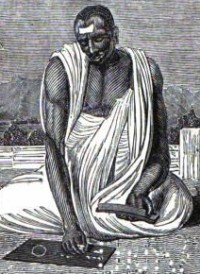
Brahmagupta

Around 630 CE, Brahmagupta wrote the Brahma-Sphuta- Siddhanta. One thing is immediately clear from this book: something had changed drastically in the way ancient Indian mathematicians dealt with the zero. It had gone from simply being a place-value holder or a null-value indicator in Aryabhatta’s time, to becoming a proper numeral in its own right.

Almost. Brahmagupta writes:

The sum of zero and a negative number is negative, the sum of a positive number and zero is positive, the sum of zero and zero is zero.

Also:

A negative number subtracted from zero is positive, a positive number subtracted from zero is negative, zero subtracted from a negative number is negative, zero subtracted from a positive number is positive, zero subtracted from zero is zero.

So far so good. But then he begins to waver.

A positive or negative number when divided by zero is a fraction with the zero as denominator. Zero divided by a negative or positive number is either zero or is expressed as a fraction with zero as numerator and the finite quantity as denominator. Zero divided by zero is zero.

This makes little sense. But Brahmagupta’s leap of thinking, which has him operating with the zero as a numeral, and not just an indicator of nothing or a placeholder, is phenomenal. As Connor and Robertson write: ‘...it is a brilliant attempt from the first person that we know who tried to extend arithmetic to negative numbers and zero.’

Given that Brahmagupta had already started thinking in these terms, the Gwalior inscription can be seen as the sign of a society at large slowly adopting cutting-edge mathematical ideas. Three centuries after Aryabhatta, and two after Brahmagupta, badly written temple donation inscriptions were using the zero not just as a null placeholder but exactly as we would use it today.

Now, if we put all these pieces together, a fairly unambiguous narrative begins to emerge.

India was certainly not unique in using a rudimentary form of the zero as a placeholder or as an indicator of null-value. Aryabhatta certainly did outline the decimal system in his work, and incorporated a kha into the decimal system. But he still didn’t really think of it as a numeral by itself. This had changed by the time of Brahmagupta, who was doing all kinds of nifty business with a zero. And then there is the Gwalior business. Surely India can then stake a claim for outstanding innovation in, if not invention of, applied and theoretical zero sciences?

Except for one more inscription. (I swear, no more in this chapter.) And here we need to bring back another one of our old friends: George Coedes of Sri Vijaya fame.

Right up until 1931, the Gwalior inscription wasn’t just the oldest instance of a zero numeral used in the modern sense in India, but in the whole world. In that year, Coedes published a paper in which he talked about an inscription in a ruined temple in Sambor in Cambodia. The inscribed tablet, that Coedes called K-127, said this in Old Khmer: ‘Chaka parigraha 605 pankami roc...’ which stands for: ‘The Chaka era has reached 605 on the fifth day of the waning moon...’ And it used a dot for the zero.

The date of this inscription? 683 CE.

Sure, it is not a little circular loop. But there is now widespread agreement that this is perhaps the oldest existing zero anywhere in the world, predating the Gwalior inscription by around two centuries.

So close. So close. If Gwalior had maintained its primacy, this chapter could have ended on a slightly more satisfying note.

Still, it is pleasing to know that this ‘India fact’ is not without substance. It is, in fact, quite agreeably watertight if one is willing to loosen the definitions of ‘invention’ just a little bit. Also who is to say that the Cambodians didn’t get their idea of the zero numeral from India? Entirely possible, given the huge sphere of influence Indian culture, religion and scholarship had in Southeast Asia around the time K-127 was carved.

But I also think that the story of the zero shows how invention in the ancient world was hardly a matter of eureka moments or light bulbs going off. Those guys sat and thought about things for a long time. They shared their ideas widely. They published widely. They criticised each other. It was as if they cared for the knowledge itself, and not the credit associated with discovering things.

How bizarre.

(Source: scroll.in)