Showing posts with label sea. Show all posts

Friday, 16 September 2022

State of Qatar gets new emblem

HE Sheikh Khalid bin Khalifa bin Abdul Aziz Al Thani, the Prime Minister and the Minister of Interior unveiled the new national emblem of the State of Qatar at the National Museum of Qatar on September 15, 2022. 

The new emblem features the historical Qatari symbols - the founder's sword, palm trees, sea and the traditional boat. All the historical symbols are in a maroon colour against a white backdrop. The emblem symbolises the country’s rich culture, preserving its heritage and bright future.


According to The Peninsula, the Director of the Government Communications Office, Sheikh Jassim bin Mansour bin Jabor Al Thani, affirmed that clarity in the message and visual identity is key to effective communication. He stated: "One of our primary objectives is to organise communication operations for various government agencies, but this cannot be accomplished without a truly effective communication system.” 


According to Gulf Times, Dr Mohamed Nuaimi a-Hajri, official spokesperson of the GCO, added: "The new Lusail font is distinguished by its historical significance, as it is derived from the original manuscripts written by the founder of Qatar, Sheikh Jassim bin Mohammed bin Thani, may God rest his soul. In parallel, the English font was inspired by Arabic calligraphy and hand movements."


The Government Communications Office published a video explaining the journey of the national emblem of the State of Qatar from 1966 to the present one on its Twitter account. 


The Jalboot

The Jalboot is the symbol of Qatari pride. The first traditional motor-powered boat, built in 1900 in Qatar, was owned by Sheikh Hamad bin Abdullah Al Thani and was called ‘Fath Al-Khair’. It was used in pearl diving, fishing and trade. It played a key role in the Qatari economy as pearl-making was the major source of income in the country. The triangular sail symbolises the flag of the State of Qatar fluttering freely in the sea.


The Palm Trees

The palm trees used in the previous logo have been retained in the new emblem. It is inspired by the palm tree plantation located on the farm of the Grandfather Amir Sheikh Khalifa bin Hamad Al Thani, at Al Ashra. These trees symbolise bountifulness and generosity.


The Sword

The Founder’s sword is a symbol for Qataris to cherish and be proud of. It symbolises courage and strength associated with the wisdom of its owner. It is one of the most prominent pillars used in the state emblem. It was used to protect the land and honour. 


The Sea

The country’s history is tied to the sea and so it is one of the most prominent symbols of Qatari heritage where Qatar once found its wealth and livelihood. It was from the sea the State of Qatar build its economy in the past through the oldest customs like sailing, fishing and pearl diving. The waves have been drawn using the nine-pointed, serrated edges of the flag of Qatar, which also depicts the power of the sea. As a peninsula, the State of Qatar is surrounded by water on three sides, which also shows the importance of the sea in the economic development of the nation, which is represented by three lines of waves in the emblem.


The ‘Lusail’ font

A modern script called ‘Lusail’ was created based on the original manuscripts written by the founder Sheikh Jassim bin Muhammad bin Thani. English calligraphy is also inspired by Arabic calligraphy and hand movements. This font is known as ‘Lusail’, as the founder ran the country's affairs from Lusail and took residence there from the end of the 19th century until his death.


Tuesday, 8 February 2022

‘I didn’t even know this was humanly possible’: The woman who can descend into the sea on one breath

Scientists once thought humans could swim to a maximum depth of 30m on a single breath. Amber Bourke has gone deeper than 70m and physiology alone can’t explain why.


Ten years ago, Australian Amber Bourke was in her early 20s and backpacking through Egypt when she discovered something astonishing about herself. In a little village on the Sinai peninsula she came across a place that taught “free diving” – underwater diving without any breathing apparatus – and decided to give it a try.


“I held my breath for four minutes and I dove to 18 metres,” says Bourke, who is the current women’s Australian pool and depth freediving champion. “And both of those things, I didn’t realise was possible.”


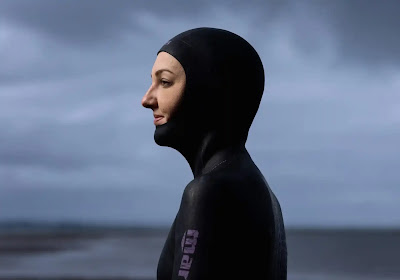
Amber Bourke, who says she got hooked on free diving and wanted to see ‘how deep I could go’, is now the Australian women’s pool and free diving champion. Photograph: David Kelly/The Guardian


Bourke had been a champion synchronised swimmer when she was a teenager, so already knew she could hold her breath for several minutes at a time. But discovering free diving “just opened my eyes to the possibilities … and I just got hooked on a feeling of diving deeper and wanted to see what I was capable of and how deep I could go.”


By 2018, Bourke had established herself as one of the best competitive free divers in the world, and in deep waters off the coast of the Philippines, was ready to attempt to break the women’s world record in the discipline of “constant weight no fins”.


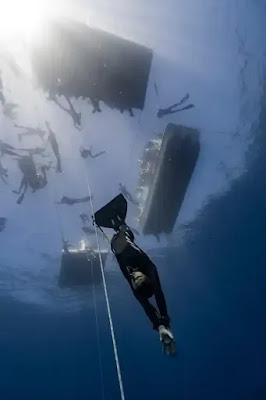
Considered one of the most challenging forms of the sport, a diver descends vertically in deep water on a single breath, using only muscle strength to propel them downwards. With every metre of descent, the compressive pressure on the body increases, shrinking the spaces that contain air. By 30 metres down – the maximum depth physiologists in the early days of the sport thought humans were capable of reaching – the pressure exerted on the body is four times greater than on the surface and the volume of air inside the body has shrunk to one quarter. Once negative buoyancy is reached, the diver begins to freefall.


Even at 70 metres down, Bourke says she can still ‘bring in’ more air from her lungs. Photograph: Daan Verhoeven


Bourke reached a depth of 73 metres – a world record – but a split second blackout once she reached the surface disqualified her. “If you stay underwater long enough, there’s always the chance that your oxygen will drop to a level where your brain will decide to shut down in order to protect itself from brain damage,” Bourke says. “So, in a way, it’s a good thing … but frustrating at the end of a long dive.”


The men’s world record for “constant weight no fins” is 102 metres, taking four minutes and 14 seconds. With fins, it is 131 metres. For the discipline of “static apnea”, where a competitor doesn’t dive but just submerges themselves under water, the longest breath-hold is 11 minutes and 54 seconds. When 100% oxygen is breathed in prior to the attempt, the record is 24 minutes and 37 seconds.


Dr Anthony Bain, a vascular physiologist from the University of Windsor in Canada, has researched the physiology of extreme breath-holding – including conducting experiments with elite free divers – and says many of those at the professional level have larger lung volumes than the average person. Studies in native diving populations, for example the Bajau people in south-east Asia, “have also demonstrated larger spleens, which will theoretically allow for longer breath holds via splenic contraction and release of oxygen bound red blood cells”.


Primarily, however, the ability to survive while submerged for a prolonged time is a learned skill. According to Bain, studies suggest that elite free divers have “enhanced” their Mammalian Dive Response. Theorised to be an evolutionary adaptation – a vestige from billions of years ago when all life was aquatic – it’s a reflex that’s triggered when a mammal’s face comes into contact with water. It prompts a number of physiological responses that promote survival, such as the slowing of the heart rate and metabolism, and a redirection of blood to vital organs, including to the lungs to bolster them against pressure.


While Bourke doesn’t know if she has any innate physiological differences – she has never been tested – she knows that over a decade of training she has learned how to better use the space in her lungs. Even at 70 metres down, she can still “bring in” more air from her lungs.


Free diving is gaining popularity as a pastime, with schools popping up along the Australian coastline, but becoming an elite free diver takes patience.


Progression is slow – it often takes years to achieve several extra metres in depth, as the body becomes accustomed to pressure. “When I first dove to 30 metres deep, I really felt a lot of pressure on my body, and especially on my chest, it feels like you’re being crushed,” Bourke says. “But now, diving to 70 meters, I don’t feel that pressure at all.”


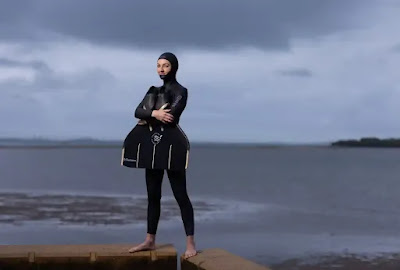
‘If you think about how long you’re planning to stay under water and how deep you’re planning to dive, then it’s easy to get overwhelmed and to panic,’ Bourke says. Photograph: David Kelly/The Guardian


The major adaptation though is psychological: developing a conscious ability to withstand the urge to breathe. 


According to Bain, an untrained person starts to undergo “involuntary breathing movements” after no longer than two to three minutes underwater, when the “body has barely desaturated with oxygen”. Elite free divers, however, are able to mentally push through this point, holding their breath until they “majorly desaturate their blood of oxygen”.


Among free diving instructors, like Clinton Laurence from the Gold Coast, who is also a clinical psychologist, psychological strategies such as mindfulness are key to training. “That is where you observe the thought, ‘I have to breathe’,” he says. “But you just observe it. ‘Yep, there’s that thought again. That’s OK.’ And you just keep going.”


Bourke says she enters a “meditative state” by slowing her breathing before she enters the water. Then, “it’s about maintaining that relaxed state, and for me, that’s really about staying in the moment and not thinking too far into the future, because if you think about how long you’re planning to stay under water and how deep you’re planning to dive, then it’s easy to get overwhelmed and to panic.”


While the pandemic has stalled most international competitions, Bourke is still training – she does long sessions swimming underwater in the pool around four times a week, plus working out in the gym – alongside her work as an electrician and a free-diving instructor. Once competition resumes, she’ll be back pursuing world records.


“When I first started, I was like, ‘I didn’t even know this was humanly possible’, but it’s just amazing what humans can do.”


(Source: The Guardian)

Sunday, 17 November 2019

Blue spaces: why time spent near water is the secret of happiness

Coastal environments have been shown to improve our health, body and mind. So should doctors start issuing nature-based prescriptions?

After her mother’s sudden death, Catherine Kelly felt the call of the sea. She was in her 20s and had been working as a geographer in London away from her native Ireland. She spent a year in Dublin with her family, then accepted an academic position on the west coast, near Westport in County Mayo. “I thought: ‘I need to go and get my head cleared in this place, to be blown away by the wind and nature.’”

Kelly bought a little house in a remote area and surfed, swam and walked a three-mile-long beach twice a day. “I guess the five or six years that I spent there on the wild Atlantic coast just healed me, really.”

She didn’t understand why that might be until some years later, when she started to see scientific literature that proved what she had long felt intuitively to be true: that she felt much better by the sea. For the past eight years, Kelly has been based in Brighton, researching “outdoor wellbeing” and the therapeutic effects of nature – particularly of water.

In recent years, stressed-out urbanites have been seeking refuge in green spaces, for which the proven positive impacts on physical and mental health are often cited in arguments for more inner-city parks and accessible woodlands. The benefits of “blue space” – the sea and coastline, but also rivers, lakes, canals, waterfalls, even fountains – are less well publicised, yet the science has been consistent for at least a decade: being by water is good for body and mind.
 ‘People who visit the coast at least twice weekly tend to experience better general and mental health,’ says Dr Lewis Elliott. Composite: Getty Images

Proximity to water – especially the sea – is associated with many positive measures of physical and mental wellbeing, from higher levels of vitamin D to better social relations. “Many of the processes are exactly the same as with green space – with some added benefits,” says Dr Mathew White, a senior lecturer at the University of Exeter and an environmental psychologist with BlueHealth, a programme researching the health and wellbeing benefits of blue space across 18 (mostly European) countries.

An extensive 2013 study on happiness in natural environments – to White’s mind, “one of the best ever” – prompted 20,000 smartphone users to record their sense of wellbeing and their immediate environment at random intervals. Marine and coastal margins were found by some distance to be the happiest locations, with responses approximately six points higher than in a continuous urban environment. The researchers equated it to “the difference between attending an exhibition and doing housework”.

Although living within 1km (0.6 miles) of the coast – and to a lesser extent, within 5km (3.1 miles) – has been associated with better general and mental health, it seems to be the propensity to visit that is key. “We find people who visit the coast, for example, at least twice weekly tend to experience better general and mental health,” says Dr Lewis Elliott, also of the University of Exeter and BlueHealth. “Some of our research suggests around two hours a week is probably beneficial, across many sectors of society.” Even sea views have been associated with better mental health.

White says there are three established pathways by which the presence of water is positively related to health, wellbeing and happiness. First, there are the beneficial environmental factors typical of aquatic environments, such as less polluted air and more sunlight. Second, people who live by water tend to be more physically active – not just with water sports, but walking and cycling.

Third – and this is where blue space seems to have an edge over other natural environments – water has a psychologically restorative effect. White says spending time in and around aquatic environments has consistently been shown to lead to significantly higher benefits, in inducing positive mood and reducing negative mood and stress, than green space does.

People of all socioeconomic groups go to the coast to spend quality time with friends and family. Dr Sian Rees, a marine scientist at the University of Plymouth, says the coastline is Britain’s “most socially levelling environment”, whereas forests tend to be accessed by high-income earners. “It’s not seen as being elite or a special place, it’s where we just go and have fun.

“By spending time in these environments, you’re getting what we call ‘health by stealth’ – enjoying the outdoors, interacting with the physical environment – and that also has some different health benefits.”

Even a fountain may do. A 2010 study (of which White was lead author) found that images of built environments containing water were generally rated just as positively as those of only green space; researchers suggested that the associated soundscape and the quality of light on water might be enough to have a restorative effect.

Although participants rated large bodies of water higher than other aquatic environments (and “swampy areas” were rated significantly less positively), the study suggested that any water is better than none – presenting opportunities for beneficial blue space to be designed or retrofitted. “You can’t change where the coast is, but when we’re talking about translating the benefits to other types of environments, there is nothing to stop a well-designed urban fountain,” says Elliott.

“People work with what they have,” says Kelly. When she lived in London, she would head for the Thames when she had a spare 10 minutes “and recalibrate”. Then, four times a year, she would go to Brighton “and the benefits would keep me going for the next few months – so I didn’t get into a place of being overwhelmed or stressed, just keeping myself topped up”.

The coast does seem to be especially effective, however. White suggests this is due to the ebb and flow of the tides. He points out that rumination – focusing on negative thoughts about one’s distress – is an established factor in depression. “What we find is that spending time walking on the beach, there’s a transition towards thinking outwards towards the environment, thinking about those patterns – putting your life in perspective, if you like.”

 To go to the sea is synonymous with letting go. Photograph: James Galpin/Getty Images
When you are sailing, surfing or swimming, says White, “you’re really in tune with natural forces there – you have to understand the motion of the wind, the movement of the water”. By being forced to concentrate on the qualities of the environment, we access a cognitive state honed over millennia. “We’re kind of getting back in touch with our historical heritage, cognitively.” Water is, quite literally, immersive.

As well as an academic, Kelly is a wellness practitioner who teaches classes in “mindfulness by the sea”. She says the sea has a meditative quality – whether it is crashing or still, or you are in the water or observing from the shore. “You can immerse yourself in it, which you can’t really do with a green space. You’re present in that moment, you’re looking at something with intention, and whether that’s for two minutes or half an hour, it gives you the benefits in that moment.”

In the future, she believes time in blue space will be a mainstream, formalised response. “The mental health crisis isn’t going anywhere,” she says.

Rees says support for the idea of “blue” or “green” prescriptions for individuals is growing. A “surfing for mental health” group in north Devon is one example she gives of how “nature-based interventions” can work.

By working to characterise and quantify benefits, BlueHealth’s cross-disciplinary team hopes to establish how “blue infrastructure” – the coast, rivers, inland lakes – can help tackle major public health challenges such as obesity, physical inactivity and mental health disorders. A 2016 paper – which White co-authored – put the monetary value of the health benefit of engaging with the marine environment at £176m.

Harnessing the power of blue space could also potentially help to alleviate inequality. “One of our recent papers finds that the benefits of coastal living are strongest for people living in the poorest areas,” says Elliott. For that reason, it is crucial to ensure everyone has access. With proximity to water associated with at least a 10% premium in house prices, White is concerned by the exclusivity of seaside urban development. “What will happen is you’ll get this kind of gentrification, where the people who benefit most will get squeezed inland.”

Access provisions under the revised Marine and Coastal Access Act, which is due to be completed next year, will help, says White. But seaside communities are particularly vulnerable, imminently from seasonal fluctuations in income and environmental degradation, and, in the longer term, sea level rise and extreme weather due to climate change.

Rees says that the benefits of marine environments for our wellbeing are tied to the health of those environments, and that conservation efforts need to factor in the “natural capital” of blue space in supporting our wellbeing. Kelly’s work has found a link between a sense of personal connection to the sea and environmentally friendly behaviours; researchers hope that we may be more inclined to protect blue space if the health benefits are proven.

“To go to the sea is synonymous with letting go,” says Kelly. “It could be lying on a beach or somebody handing you a cocktail. For somebody else, it could be a wild, empty coast. But there is this really human sense of: ‘Oh, look, there’s the sea’ – and the shoulders drop.”

(Source: The Guardian)

Thursday, 31 October 2019

Offshore windfarms 'can provide more electricity than the world needs'

Supplies from turbines will prove to be the next great energy revolution, IEA predicts

Erecting wind turbines on the world’s best offshore sites could provide more than enough clean energy to meet global electricity demand, according to a report.

A detailed study of the world’s coastlines has found that offshore windfarms alone could provide more electricity than the world needs – even if they are only built in windy regions in shallow waters near the shore.

Analysis by the International Energy Agency (IEA) revealed that if windfarms were built across all useable sites which are no further than 60km (37 miles) off the coast, and where coastal waters are no deeper than 60 metres, they could generate 36,000 terawatt hours of renewable electricity a year. This would easily meeting the current global demand for electricity of 23,000 terawatt hours.

“Offshore wind currently provides just 0.3% of global power generation, but its potential is vast,” the IEA’s executive director, Fatih Birol, said.
 A sailing boat passes the Kentish Flats offshore windfarm. Photograph: Gareth Fuller/PA

The study predicts offshore wind generation will grow 15-fold to emerge as a $1tn (£780bn) industry in the next 20 years and will prove to be the next great energy revolution.

The IEA said earlier this week that global supplies of renewable electricity were growing faster than expected and could expand by 50% in the next five years, driven by a resurgence in solar energy. Offshore wind power would drive the world’s growth in clean power due to plummeting costs and new technological breakthroughs, including turbines close to the height of the Eiffel Tower and floating installations that can harness wind speeds further from the coast.

The next generation of floating turbines capable of operating further from the shore could generate enough energy to meet the world’s total electricity demand 11 times over in 2040, according to IEA estimates.

The report predicts that the EU’s offshore wind capacity will grow from almost 20 gigawatts today to nearly 130 gigawatts by 2040, and could reach 180 gigawatts with stronger climate commitments.

In China, the growth of offshore wind generation is likely to be even more rapid, the IEA said. Its offshore wind capacity is forecast to grow from 4 gigawatts to 110 gigawatts by 2040 or 170 gigawatts if it adopts tougher climate targets.

Birol said offshore wind would not only contribute to generating clean electricity, but could also offer a major opportunity in the production of hydrogen, which can be used instead of fossil fuel gas for heating and in heavy industry.

The process of making hydrogen from water uses huge amounts of electricity but abundant, cheap offshore wind power could help produce a low-cost, zero-carbon alternative to gas.

In the North Sea, energy companies are already planning to use the electricity generated by giant offshore windfarms to turn seawater into hydrogen on a floating “green hydrogen” project, backed by the UK government. The clean-burning gas could be pumped back to shore to heat millions of homes by the 2030s. The UK has committed to reaching net zero carbon emissions by 2050.

The overlap between the UK’s declining oil and gas industry and the burgeoning offshore wind sector could offer major economic benefits for the UK, Birol said.

“Offshore wind provides a huge new business portfolio for major engineering firms and established oil and gas companies which have a strong offshore production experience,” he said. “Our analysis shows that 40% of the work in offshore wind construction and maintenance has synergies with oil and gas practises.”

(Source: The Guardian)

Saturday, 20 April 2019

Unique ‘oil-eating’ bacteria discovered in world’s deepest ocean trench

Mariana Trench believed to be home to greatest concentration of hydrocarbon consuming bacteria of anywhere on Earth

At the bottom of the Mariana Trench, the deepest part of the Earth’s oceans, scientists have discovered unique oil-eating bacteria.

Similar kinds of bacteria have previously been found and even used to help deal with oil spills, such as that from the Deepwater Horizon disaster in 2010, but the new research reveals the Mariana Trench is home to the greatest concentration of these life forms anywhere in the world.

The 2,550km (1,585 mile) long ocean trench is located in the western Pacific Ocean and reaches a maximum depth of about 11,000 metres. By comparison, Mount Everest is 8,848 metres high.

As a result, voyaging to the bottom of the trench is hazardous and expensive, and only a few expeditions have investigated the organisms inhabiting this ecosystem.

One expedition was organised and led by the film director and avid underwater researcher James Cameron, who built a specialised submersible to collect samples from the trench.

“We know more about Mars than the deepest part of the ocean,” said Prof Xiao-Hua Zhang of the Ocean University in China, who led the new study.


Dr Jonathan Todd, from the University of East Anglia's School of Biological Sciences, said: “Our research team went down to collect samples of the microbial population at the deepest part of the Mariana Trench – some 11,000 metres down. We studied the samples that were brought back and identified a new group of hydrocarbon degrading bacteria.

“Hydrocarbons are organic compounds that are made of only hydrogen and carbon atoms, and they are found in many places, including crude oil and natural gas.”

He explained the bacteria “essentially eat compounds similar to those in oil and then use it for fuel. Similar microorganisms play a role in degrading oil spills in natural disasters such as BP’s 2010 oil spill in the Gulf of Mexico.”

“We also found that this bacteria is really abundant at the bottom of the Mariana Trench.”

In order to understand the source of the hydrocarbons ‘feeding’ this bacteria, the team analysed samples of sea water taken at the surface, and all the way down the water column to the sediment at the bottom of the trench.

Dr Nikolai Pedentchouk, from the UEA’s School of Environmental Sciences, said: “We found that hydrocarbons exist as deep as 6,000 meters below the surface of the ocean and probably even deeper. A significant proportion of them probably derived from ocean surface pollution.

“To our surprise, we also identified biologically produced hydrocarbons in the ocean sediment at the bottom of the trench. This suggests that a unique microbial population is producing hydrocarbons in this environment.”

“These hydrocarbons, similar to the compounds that constitute diesel fuel, have been found in algae at the ocean surface but never in microbes at these depths.”

Dr David Lea-Smith, from UEA’s School of Biological Sciences, added: “These hydrocarbons may help microbes survive the crushing pressure at the bottom of the Mariana Trench, which is equal to 1,091 kilograms pressed against a fingernail.

“They may also be acting as a food source for other microbes, which may also consume any pollutant hydrocarbons that happen to sink to the ocean floor. But more research is needed to fully understand this unique environment.”


In 2017 it was reported a similar naturally occurring underwater bacteria had “eaten” a considerable proportion of the oil that spilled out of the Deepwater Horizon drilling platform.

Recovery teams poured millions of barrels of chemicals into the ocean to disperse the oil and force it to much deeper parts of the ocean, where it is believed to have been consumed by the microbes.

It is not yet clear if the newly discovered bacteria could also help clean up pollution from oil spills.


The research is published in the journal Microbiome.

(Source: Independent)

Sunday, 2 December 2018

Underwater rail travel between UAE and Mumbai?

After Hyperloop and driverless flying cars, UAE reveals another futuristic project.

The UAE is a land of innovations and setting benchmark in the world. After Hyperloop and driverless flying cars, now there is another futuristic but fanciful mode of transport for residents to look forward to - an underwater rail network.

In near future, residents might be able to travel from Fujairah to Indian city of Mumbai by undersea rail network. Apart from transit of passengers, there will be exchange of goods in the form of freshwater flowing from India to the UAE and oil being exported back through pipeline, National Advisor Bureau Limited managing director and chief consultant Abdulla Alshehhi said during the UAE-India Conclave in Abu Dhabi.

Alshehhi is the founder of National Advisor Bureau Limited - a consultancy firm based in Masdar, the breeding ground for start-ups.

Alshehhi noted the floating underwater network will benefit the UAE, India and others in the region.


"This is a concept. We plan to connect Indian city of Mumbai with Fujairah through ultra-speed floating trains. The project aims to boost bilateral trade. There will be export of oil to India from Fujairah port and import of excess water from Narmada River, north of Mumbai. In addition, other GCC partners can also improve export and import," he told a gathering of businessmen and industry experts.

Alshehhi said the concept will take shape as there are many aspects that needed to be taken into consideration.

"We will do feasibility study of the project. This is concept but a cool project to look at," the author of 'Filling the Empty Quarter Book' said. The total rail network will be less than 2,000km.

Globally, there are many similar projects in the pipeline. China has plans to connect Russia, Canada and the US. Indian cities of Mumbai and Ahmedabad will be connected by high-speed rail corridor including undersea aspect by 2022.

UAE Iceberg project's pilot phase by 2019
Alshehhi, however, is busy with the ambitious UAE Iceberg Project. It is aimed at solving issues of water crisis in the UAE. The project aims to tow icebergs from Antarctica to the UAE coasts to be used as freshwater. The pilot phase will be to Australia or South Africa by third phase of next year.

"We are finalising technical aspects. We will seek mutual cooperation with MIT in the US. There are many technical aspects and dimensions to this project. We will be able to do the pilot phase to Australia by third quarter of next year. At present due to global warming many icebergs disintegrate from Antarctica. They float northwards near the protected Australian island of Heard Island. It will be on a smaller scale and once we succeed we will do it on a bigger platform," he said and noted South Africa as another option.

"We will focus on water harvesting from the iceberg. Up to 30 per cent of ice mass will be lost during the transit," he acknowledged.

(SOurce: Khaleej Times)

The cigarette butts are literally as harmful to the ocean as plastic bags and straws

One of the rare pluses about social media is that it really brought up awareness regarding so many problems around us. Among the many things it has brought people’s attention to, is pollution.

We millennials are the first generation who actually have to worry about bringing kids into this world or not; not to mention, we might actually see all life on Earth end, thanks to us.

The last time one single species affected the Earth this much was billions of years ago, when the first photosynthetic microbes breathed the oxygen we breathe in, out. And we can safely say that our contribution has not been that positive.

Thanks to our cheap consumerism, there is literally an eighth continent floating in the ocean: a mass of junk dumped into the ocean, mostly plastic and other non-biodegradable objects that roam the ocean, suffocating and poisoning living things.

And these acts of choking have found their way to social media as videos of sea turtles with straws stuck in their nostrils and other animals dead from the poison become viral every day.


Thanks to many posts, including these viral videos, awareness about plastic straws has risen considerably. What is surprising is that, despite all this brouhaha, plastic straws have only formed 0.02% of ocean waste.

The main perp in this case is something that is far more commonplace and far more sinister, because it has avoided being regulated for so long thanks to its sheer commonality: “cigarette butts”.

To quote our source:

“The filters of the 5.6 trillion cigarettes (two-thirds of which are dumped irresponsibly) made around the world each year are composed of cellulose acetate, which can take more than a decade to decompose. Since 1986 cigarette butts have been the most collected item of ocean beaches, with about 60 million found in 32 years.”

During the mid 1900s cigarette filters were first invented in order to decrease the health risks of cigarettes but now they have turned into a major disaster. A study conducted by Professor Novotny in the year 2011 discovered that any kind of attempt to stop cigarette consumers to stop them from flicking their cigarette ends was not successful as several permanent ashtrays and ant-litter events remained unsuccessful.

There has been an online campaign too, called the Cigarette Butt Pollution Project.


Cigarettes and other tobacco products have always been a legislator’s nightmare. Marlboro for example has been engaged in one of the longest and most complex trials in Indonesia, where sales teams have targeted poor and under-age children as a consumer base.

In the US, anti-filter legislations have come to little effect and continue to remain as spectres.

But it would be wrong to say that things haven’t been begun at all. Throughout the world significant steps have been taken in the forward direction. For example, in the United States environmentalists have tried to pass forward legislation concerning banning the filters or even increasing the costs of cigarette packs so that clean-up drives can be funded. On the other side of the Pacific, in France, a theme park had decide to train the rooks in its care to clean litter and cigarette butt garbage by picking it up.

So while the war on plastic straws has been significantly and very important, the war on pollution and the war to reclaim our oceans for life is anything but over.

Also, quit smoking! For the planet as a whole, if not for your own health.

(Source: Truth Theory)

Saturday, 1 December 2018

Indonesia tsunami: 'It’s an absolute miracle' my child survived

When a powerful earthquake and tsunami hit the Indonesian island of Sulawesi, hundreds of children were separated from their parents. More than 2,000 people died, with large areas being declared mass graves. But in recent weeks there have also been some extraordinary reunions.

Fikri and Jumadil go missing

"What happened that day, my little one?" ADEK BERRY
Martha Salilama had left the stove on.

When the earth shook with incredible power, she grabbed seven year old Fikri, her great nephew, and rushed out of the house.

They had been cooking together, packets of yellow rice with fried chicken to sell at a beach festival to mark Palu city's anniversary.

"With things crumbling and falling around them, they ran out into the open. They were terrified that they would get trapped inside," says her sister Selfi Salilama, Fikri's grandmother.

When the earth stopped shaking, Marta left Fikri with some neighbours who had gathered around a horse statue that sits on the Palu bay.

She then went home to turn off the stove.

"When she came back Fikri was gone," says Selfi.

What she found was a scene of horror, a trail of destruction left by gigantic waves that had pounded the bay.
The earthquake and tsunami destroyed the city of Palu SOPA IMAGES
When the quake hit five year old Jumadil was on the beach building sandcastles.

His grandmother, Ajarni, who was looking after him that day, was selling food to festival goers on the street above the beach.

He had been clingy that day, she remembers.

"He wanted to be carried all the time, so I carried him around on my hip. He finally got bored and asked to be put down and went off and played in the sand," she says.

When the first quake struck she tried frantically to reach him but failed.

It was chaotic, she says, with people running in all directions as the earth threw them around.

"When I got closer to the shore I saw a wall of black water heading towards me."

"I ran as fast as I could, I had no idea where I was running"
With the monstrous waves about to pound the bay, she could look no more and ran.

"I ran as fast as I could, I had no idea where I was running. When the water swept me away I clung on to a motorbike."

The waves finally dumped her in the parking lot of a hotel.

She had survived. But Jumadil was gone.

That's where her husband, Daeng, the boy's grandfather, found her.

"I didn't recognise her at first, because she was covered in mud and blood and was crying. I turned to someone I knew and said I am looking for my wife and they said - that's her!"

"Her hair was caked with mud and blood, it was like instant noodles. I picked her up and cried out for help."

A passing motorbike rider took them to the nearest hospital.

"I was worried she would lose too much blood. There were lots of aftershocks, it was terrifying," he remembers.
Susi Rahmatia thought her son had drowned in the huge waves
The desperate search
News reached Jumadil's mum, Susi Rahmatia, at home.

"My uncle rushed in and said 'there are children's corpses everywhere near the shore'. I collapsed and cried, I thought for sure my son had been killed by the waves."

"That night my husband went searching for him. When he came across a body of a child he broke down and cried."

In the morning the grandfather, Asmudin, joined the search.

"The air around the beach was filled with the smell of corpses. I searched and searched for hours barefoot. I looked under the rubble and in places I thought he might have been washed up," he says.

Children's toys were scattered in the rubble of houses SOPA IMAGES
Satellite image ©2018 DigitalGlobe, a Maxar company.
Seven year old Fikri's family were also desperately searching for him.

His grandmother, Selfi Salilama, says they feared he, too, was dead.

"At the hospital we opened body bag after body bag that had a child in it," she says.

"Each time a wave of fear washed over us. And we would say 'Allah make us strong enough to do this' - each time hoping it wasn't Fikri."

"We were almost certain that we had lost him. We knew his 10-year-old brother had died. But in my heart I had a little hope that perhaps Fikri had run away in time."

Selfi Salilam feared both her grandsons were dead
Fikri's parents find out
Fikri's parents live and work 600km away in Gorontalo.

With telecommunications down Selfi says she couldn't contact them. She was also a little scared to tell them.

"I didn't want everyone to panic and worry. We wanted to search first and give them news with some certainty," she says.

But given the scale of the disaster keeping it a secret was impossible.

"We saw it all on television. I was just speechless. My husband Iqbal left straight away for Palu. I stayed here to look after my younger children," Susila says.

When Iqbal As Sywie arrived to hear both his sons were missing, he was devastated.

"He was angry and very upset and was saying to us 'why didn't you take better care of my sons?' I had to calm him down telling him this was out of our hands. That if Allah wanted to take them we had to accept that."

Photographs of missing people were displayed on the walls in days after
the disaster ULET IFANSASTI
They reported Fikri missing at child protection posts set up across the city.

They also did interviews with local television stations giving them details about the boy who was missing.

The break through
Jumadil's uncle posted a notice on a Facebook page for survivors in the city, hoping the picture of his nephew would jog someone's memory.

Sartini's daughter saw the picture and thought it bore a striking resemblance to the child her mother was looking after.

The social media post that help find Jumadil AFP
The wife of a local imam, Sartini, had met the boy at a police station in the aftermath of the quake.

She remembers that he was wailing uncontrollably, just repeating cries of "mummy" and "daddy".

"I only persuaded him by saying 'your mother is still buying milk for you'," she told AFP at the time. She befriended him and took care of him.

"What they saw on Facebook were old photos of Jumadil - so at first they weren't sure if it was really him," says his mother Susi.

"But when they read the details in the post about what he was wearing that day - a red striped shirt and that his pants were held up with a string because they were too big, that's when they knew it was the same boy."

A matching birthmark on the neck confirmed it was indeed Jumadil, setting the stage for a reunion.

"I couldn't sleep, I thought about him all night, wondering who saved my little boy," says Susi.

A reunion
Jumadil leaps off a motorbike into his mother's arms. Their emotional reunion after five long days is captured on film.

He clings to her while she smothers him in kisses, tears stream down both their faces. Jumadil crying so hard he is gasping for breath.

"He hugged me so tight like he never wanted to let go, his legs wrapped around me like a monkey," remembers Susi.

"We didn't speak. He was very scared. There were lots of people crowding around us. I just tried to show him that now everything was going to be alright."

Hundreds of children were separated from their parents in Palu GETTY IMAGES
She waited days before finally asking him what happened.

I asked him gently 'What happened that day, my little one? And he said 'I was playing in the sand and didn't understand why the whole world was shaking."

"So who picked you up, I asked? He said a police officer. We did try and find out who that was, but haven't been able to."

They believe he dodged the tsunami by a matter of minutes.

Jumadil reunited with his grandfather ADEK BERRY
Fikri is found
More days passed by and Fikri's family were close to giving up hope - when a social worker arrived at their door.

"They had a photo and they said - Mrs, is this your grandson? And it was him! We started telling everyone, 'they have Fikri. They have found Fikri!' We all gathered around and just cried and cried."

"They told us that he was alive and living in North Morowali - we had no idea how he had gone there."

He had ended up 500km away.

Fikri, shown here hugging his dad, had been washed up on the
side of a road UNICEF
It was not until they had Fikri in their arms, three weeks after he went missing, that the family understood how he had ended up there.

Twenty-year-old university student Kadek Ayu Dwi Mariati says she found Fikri on the side of the road.

He was injured. she remembers. and was crying out for his mother and father. He was only a wearing a t-shirt.

"To tell you the truth my first concern was saving my own life, I was in such a panic and was very scared," she said.

"But then I thought if I don't save this boy who will? I stopped and asked him where are your parents? He said they were gone and his house was destroyed, so I told him to come with me to higher ground."

When her parents reached Palu, a few days later, Fikri didn't want to leave her side.

"He didn't want to stay, he wanted to be with me. So he came home with us to our village," she says.

"I reported this to the police and social workers and told them if someone is looking for this child then he is with me. They told me, 'don't give him away to anyone' because there were fears of child trafficking at the time."

As the weeks past with no news her family built up a close bond with Fikri.

"He was a really good kid. Wasn't any trouble at all. I do really miss him now and was a little sad to see him go but at the same time I am so grateful, that it turns out, he had a family still alive to go home to," she says.

The miracle
Their reunion was also captured on film. His family was told by social workers to wait in a tent - no one speaks and they look at their hands nervously.

Then he was brought in. "Praise God," they cried as they hugged Fikri and held him tenderly.

Fikri was beaming, wearing a neat checked shirt and jeans.

"We cried and hugged and hugged him," Selfi recalled.

"I was so happy but also sad. I was filled with joy that Allah had given us more time with him but also sad that it was someone else that saved him. We could only cry and give thanks to Allah."

Fikri now lives with his parents UNICEF
The trauma
Fikri's parents have taken him back to live with them in Gorontalo. Schools are not back to normal in Palu and they want him close.

"He doesn't want to be left alone, even for a second, he said to us 'if you leave me and the earth shakes again where am I meant to go?," his mum Susila says over the phone.

"We have to wait for him outside the classroom. We don't talk about what happened. He just cries if it comes up. His older brother never came back."

His grandmother video calls with him often. "Show me your smile," she cries down the phone at him.

"Ah there you are! There is the most handsome boy in Gorontolo," she teases him.

Fikri's grandmother stays in touch with her grandson through video chats
Back to the beach
Jumadil too is still traumatised but each afternoon he has to go back to the same beach, to help his mother sell peanuts.

"He still has flashbacks, if the lights go off he jumps up and runs into my arms asking 'why are the lights off, Mum?' When the earthquake hit all the lights went off and it was black."

While we are talking at their stall another mother comes up and says her son was missing for four days.

He was caught up in the waves too, she says. Now it's a nightmare to get him to have a bath. He is terrified of water.

Jumadil's mother's peanut stall
While his mum serves the customer, Jumadil's grandfather, Daeng, takes him for a walk through the rubble.

He still can't quite believe his grandson has come back.

"It's hard for an everyday guy like me to get my head around it," he says.

"It's an absolute miracle he has come back"
"If you think about it logically it's amazing he was saved, given the power of the waves that destroyed everything. Buildings crumbled so humans shouldn't really have stood a chance. Lots of police officers died. I really want to know who saved our boy."

"It's an absolute miracle he has come back."

(Source: BBC)

Wednesday, 23 May 2018

Are octopuses aliens from outer space that were brought to Earth by meteors?

Octopuses are aliens. That’s the claim being made by a team of 33 researchers published in a peer-reviewed scientific journal.

They are not referring to aliens in a metaphorical sense, but literal aliens from outer space.

Since the paper was released on Sunday, a trickle of news coverage has turned into a torrent, with increasingly alarming headlines about octopuses and their extra-terrestrial origins.

It will not come as a surprise to many to learn that these claims have been roundly mocked by the scientific community, who have branded the paper – published in Progress in Biophysics and Molecular Biology – as ridiculous and unscientific.


What are the claims being made?
They suggest the Cambrian explosion, a sudden burst of life that occurred around 540 million years ago, was the result of extra-terrestrial intervention.

The paper asks whether this event, which saw the rapid emergence of most of the main animal groups that still exist on Earth today, was “terrestrial or cosmic”. Their conclusion is the latter.

How do the scientists suggest this would work?
Specifically, the researchers propose the idea that alien viruses crashed to Earth in a meteor, infected a population of primitive squid and caused them to evolve into octopuses.

Another theory they suggest is that fertilised squid or octopus eggs were delivered to Earth by a meteor.
The idea is essentially a reimagining of the “panspermia” hypothesis, which suggests that life on Earth was “seeded” by space dust or asteroids crashing into Earth. One of its first proponents, Chandra Wickramasinghe, is one of the authors of the new paper.

Why do the researchers look at the octopus in particular?
Octopuses are weird. They are molluscs, meaning they are closely related to snails, and yet they are incredibly intelligent.

On top of their large brains and sophisticated nervous systems, the authors of the new paper list camera-like eyes, flexible bodies and ability to camouflage themselves by changing colour and shape as evidence of their extra-terrestrial origins.

So suddenly did these features appear in the octopus family tree that “it is plausible then to suggest they seem to be borrowed from a far distant ‘future’ in terms of terrestrial evolution, or more realistically from the cosmos at large,” the authors write.

“Such an extraterrestrial origin as an explanation of emergence of course runs counter to the prevailing dominant paradigm,” they continue. This is a strong contender for understatement of the century.

What reason is there to doubt the claims being made in the paper?
There are plenty of reasons. First off, as Mark Carnall from the Oxford University Museum of Natural History pointed out in a series of tweets, not one of the paper’s authors is a zoologist.

Much of the authors’ speculation rests on the idea that the genetics of octopuses and their relatives are mysterious – yet a 2015 paper published in Nature revealed the octopus genome, so this is rather disingenuous.
In fact, octopus genes suggest they fit into the generally understood theory of the evolution of life on Earth, and require no alien invasion. They are thought to have split from the squid lineage around 135 million years ago.

Molecular geneticist Professor Karin Moelling of the Max Planck Institute Molecular Genetics, who was asked to review the report, concluded that it "cannot be taken seriously”.

The primary reason for doubt given by Professor Moelling is that there is “no evidence at all”.

Haven’t I heard something about octopuses being aliens before?
Writers are fond of comparing octopuses to aliens due to their unusual appearance and great intelligence. Philosopher Peter Godfrey-Smith, who has written a book about octopus intelligence titled Other Minds, has described them as “the closest we will come to meeting an intelligent alien”.

On top of that, this is not the first time octopuses have been mistakenly labelled aliens by the press.

An unfortunately worded press release concerning the Nature paper describing the octopus genome led to a slew of online news pieces in 2015 about researchers finding “alien DNA” in these creatures.

(Source: Independent)

Saturday, 12 May 2018

Cities from the sea: The true cost of reclaimed land

Asia is growing. Literally. From Malaysia to Dubai, luxury developments are rising on artificial islands and coastlines. Everybody wins – except the local sea life and the fishermen who depend on it, writes Wade Shepard in the Guardian. Read on: 

“Before, there were many fish,” says fisherman Mohd-Ishak Bin Abdul Rahman as he pulls a dried up crab from his net. A few years ago he could just walk out into the surf and pick up crustaceans with his bare hands, he tells me. “Now, nothing.”

He blames the palisade of new luxury condominiums that rise on the coastline behind him. Built on 240-acres of land artificially reclaimed from the sea, they are part of the Seri Tanjung Pinang 1 (STP1) project. Started in 2006, it brought a taste of new Asian modernity to what was then a rural area beyond the fringes of George Town, Penang’s only city. It also took away the fish, says Mohd-Ishak.

The 72-year-old is the undisputed chief of Tanjung Tokong, a fishing village of 100 houses built by the community a few decades ago. He is also the leader of a movement of fishermen protesting against development projects they claim are destroying the island’s fisheries, and with them their livelihoods.

 Land being reclaimed in Penang for the STP2 project
Fishing boats at Tanjung Tokong
Mohd-Ishak, the chief of the village 
Mohd-Ishak says his family has been fishing the area for at least five generations. As we talk, shirtless fishermen watch cautiously from handmade hammocks, half-broken plastic chairs and pieces of junk that washed up on the shore.

The contrast between the village with its shacks built from planks, beams and drift wood and the condos, swimming pools, luxury mall and Irish-themed pub is extreme.


Now the second phase of the STP project is in full swing. Dredgers, barges, bulldozers and diggers operated by a local subsidiary of the China Communications Construction Company (CCCC) are busy creating 1,000 more acres of land for luxury development. Slated for completion in 15 years, the STP2 development is expected to have an eventual value of $4.4bn.

Asia is growing. Literally


Land reclamation is nothing new in Asia – China, Hong Kong and Japan have been at it since the 19th century – but it has recently reached epidemic proportions. Maritime ecosystems are abruptly transformed as natural islands are artificially conjoined with coastlines, natural shorelines are extended and artificial islands are built from scratch.

Cities on China’s coast reclaimed an average of 700 square kilometres of land – that’s about the size of Singapore – from the sea every year from 2006 to 2010 for new houses, industrial zones and ports. The 130 sq km of land that was reclaimed to build the new city of Nanhui was significant enough to reconfigure China’s national map, and the reclaimed land for the Caofeidian economic zone was twice the size of Los Angeles.

Reclaimed sand is sprayed at the construction site for Colombo International Financial City, Sri Lanka
A general view of the construction site
A sign at the site
Concerned these megaprojects were getting out of control and doing irreparable harm to the environment, Beijing stepped in earlier this year and put an end to land reclamation projects that were not spearheaded by central government.

Meanwhile, many Asian cities are picking up where China left off. Besides the STP projects on Penang, Malaysia has massive reclamation works under way for the 700,000-person Forest City in Johor; the Philippines is reclaiming 1,010 acres from the sea for its New Manila Bay – City of Pearl; Cambodia is building a slew of Chinese-financed properties on reclaimed land; Dubai has turned reclamation into an art form; and Sri Lanka is building a new financial district on the dredged and deposited land of Colombo International Financial City. Around a quarter of modern-day Singapore was open sea when the nation state came into existence in 1955.

Fishing boats off the coast of George Town, Malaysia
Chinese dredging vessels in the waters around Mischief Reef in the Spratly Islands
Trucks carry sand at the Forest City development in Johor Bahru, Malaysia
Apart from acting as geopolitical flash points – reclamation in the South China Sea is repeatedly bringing the region to the brink of conflict – sourcing the sand is a major problem. Malaysia, Indonesia, Cambodia and Vietnam have already banned the export of sand, with reports of a multibillion dollar black market run by organised crime syndicates. Some of Indonesia’s Riau Islands have mysteriously disappeared – loaded on to barges and shipped to nearby Singapore, reports suggest.

‘Incredible profits’


The verdant, hilly island of Penang has been gripped by a development boom since the historic centre of George Town was declared a Unesco world heritage site in 2008. As tourists poured in from all over the world, so too did prospective property buyers looking to take advantage of the Malaysia My Second Home programme, and floods of east Asian real estate speculators.

“Penang has this obsession with wanting to become like Hong Kong and Singapore,” explains Andrew Ng Yew Han, a local film-maker who has documented Penang’s development.

But while 70% of the island is a forested blank slate for development, much of that is too hilly to build on safely – as proven by a recent landslide that wiped out a high-rise construction project and killed 11 workers.

Rescue workers search for victims of a landslide at a construction site in Tanjung Bungah, Penang
 Ariza terraces in Seri Tanjung, Penang

 Land reclamation next to a newly built hotel in the Forest City development
The state government’s crosshairs soon fell upon the other natural feature hemming in their ambitions: the sea. Taking a trick from the playbooks of their model cities, Hong Kong and Singapore, Penang launched several large-scale reclamation initiatives – many strategically placed in prime locations.

This ability to home in on high-value sections of cities to reclaim land for new development often produces incredible profits. Research from Ocean University of China professor Liu Hongbin found that land reclamation in China can produce a 10- to 100-fold profit.

The plans for land reclamation in the south of Penang
“If you are confident that you can sell the properties at a high price, which is likely the case at the fringe of large coastal cities or in popular coastal tourism destinations, reclaiming the land from scratch could potentially be more profitable than building on extremely expensive existing land,” explains Matthias Bauer, an urban designer who has worked on reclamation projects in China.

However, there is a lot more at stake with these projects than the money that is invested in them.

Habitat destruction


Not only are the fishermen of Tanjung Tokong banned from entering what was once an extremely productive fishing ground but there are now fewer fish in the waters near their village. Mohd-Ishak claims his catches have halved since development began.

Walking with him down the beach, another fisherman calls me over to his small house. His name is Haron Din, and his torso and legs are covered in the traditional tattoos that many fishermen in south-east Asia once wore.

At his feet lie piles of torn up old nets. He pulls out a dried up crab and explains it was dead long before it got tangled in his net. “The mud from the project suffocates them,” he says.

Haron Din says the mud from the reclamation area is killing local marine life
Fishermen inspect their nets in Kuala Muda, near the border between Penang and Kedah, Malaysia
 A long-dead crab in Din’s nets
Holding a shiny new white net next to one of the 40 or so damaged ones littering the beach, Din complains that mud from the nearby reclamation area is killing the local marine life and doing irreparable damage to their fishing equipment.

The fishermen must travel further out to sea to find fish, which drastically increases both the cost of petrol and the dangers of the job. Unable to make a living in their sheltered bay, they now have to cross a busy shipping lane and contend with higher waves. There have already been a few deaths, Mohd-Ishak says.

Film-maker Andrew Han with village chief Mohd-Ishak
Mageswari Sangaralingam, a research officer for Friends of the Earth Malaysia, says the thousands of sq km of land reclaimed across coastal Asia has meant the annihilation of mangroves, wetlands and reefs – destroying the habitats and breeding grounds for fish, sea turtles, crustaceans, plants and other marine life. In addition, the new cities, transport hubs and industrial zones built on the new land inevitably create added pollution and waste, he says.

“The multimillion-ringgit fisheries sector here on which thousands depend is being traded off for development,” says Sangaralingam. “Fish are being wiped out, and the fishermen will soon be too as they lose fishing grounds.”

Ghost town … Straits Quay, George Town, Penang
“You have this development and yet people are losing their jobs,” adds film-maker Han. “You have reclamation which promised development, but you have fishermen who are losing their livelihoods, looking for second jobs … You build so many buildings here but in the end it doesn’t belong to us, it will be bought up by other people and foreigners.”

I visit Straits Quay – the high-end shopping mall surrounded by luxury condos overlooking the fishing village. On three trips here I’ve never seen anyone actually shopping in its luxury boutiques. The hallways are bare wind tunnels and even the giant atrium that acts as an opulent entranceway to the mall appears desolate, echoing the caws of resident crows and little else. If it wasn’t for a few stragglers slipping in and out to pick up groceries at the small supermarket – and the yacht owners drinking on the patio of the Irish-themed pub – the place could be called a ghost mall.