Showing posts with label Burma. Show all posts

Friday, 21 May 2021

Kodak Krishnan, Eastman’s man from the East

 Krishnan Hariharan spent four decades with Kodak India and made invaluable contributions to some of Indian cinema’s classics.

In 1942, a young man fled Burma as a World War II refugee with his family and went to live in Bangalore with an uncle. This young man later joined the same film school as cinematographers VK Murthy and Govind Nihalani and landed up in Bombay in the late 1940s. Like his peers, he joined a film studio and worked for a pittance. He picked up enough skills to become a cinematographer, but instead chose to join the photographic film product company Kodak’s Bombay office as a salesman in 1950.


In 1953, he went to London to be trained in processing Eastman Color Negative, and was tasked with carrying a box of the stock back to India. He would spend four decades with Kodak, earning him the nickname “Kodak Krishnan”.


Krishnan Hariharan was indelibly associated with raw stock, the material that is the very essence and distinct marker of the pre-digital celluloid era of cinema. Krishnan’s job didn’t just involve selling the world’s best colour negative, but also ensuring that film processing laboratories handled the stock well, cinematographers exposed it correctly, the set decor was done appropriately, the costumers and make-up artists matched their approach to the quality of celluloid.


Between 1953 and 1973, Krishnan went out of his way and helped set up over a dozen colour processing laboratories in India, trained technicians and conducted workshops for students at film schools. For inexperienced cinematographers, in particular, he was a godsend.


Krishnan Hariharan


Colour film and red tape

Krishnan worked at a time when custom duties were prohibitive and there were difficulties in importing film rolls manufactured abroad. Eastman Color Negative stock, which was in high demand, could be purchased only in dollars and with an export replenishment guarantee.


Before commencing a shoot, producers who intended to use Eastmancolor had to show the Indian Motion Picture Export Corporation that they could receive the equivalent of the film’s cost in dollars from a client mostly situated in the US or the UK. Once this was done, the producers applied for a letter of credit with their banks and submitted it to Eastman Kodak at IMPEC weekly meetings. Having received the LC, Kodak India asked its parent company to dispatch the stock. Only big producers with deep pockets could fulfill the terms of the export replenishment guarantee.


In this context, Krishnan’s intervention was vital for ensuring that independent filmmakers could get their films made. Several filmmakers who were part of the Indian New Wave movement wanted to shoot their films in colour. They could do so with ORWO film stock, which was manufactured in East Germany, and was cheaper and available through rupee payments. The problem with this stock was a lack of consistency from batch to batch. The film often had a greenish tinge.


In the early 1970s, Kumar Shahani set out to make his first feature film Maya Darpan. He got the budget sanctioned from the Film Finance Corporation – the predecessor of the National Film Development Corporation – but there was no way to get the export replenishment guarantee permit to shoot with the Eastman Color Negative that could do justice for the elaborate colour schemes he had in mind.


Shahani landed up at Krishnan’s office chamber seeking advice. Krishnan called up AK Roongta, the owner of Famous Cine Labs in Mumbai, and pleaded with him to divert the licences that he had for his machinery imports to help Shahani make his film.


Roongta agreed on the assurance that the film would be processed at his lab. Within a week, Krishnan had arranged for the stock to let KK Mahajan, the cinematographer of Maya Darpan, make Shahani’s dream come true.


Mani Kaul shot his third feature Duvidha (1973) in Kodachrome, a reversal film stock typically used by amateurs for home movies. When shooting with Kodachrome, you didn’t get a negative but a positive image directly through an additive process. This meant that the colour dyes were physically added or transferred onto the exposed roll in authorised Kodak labs that were situated only in big cities.


To balance it out, Kodak provided Ektachrome, another reversal stock that gave direct positives but through a subtractive process. All you needed was an E6 chemistry kit and you could develop the exposed film in a bathtub with the unwanted dyes emptied into the drain.


The world over, this was a big boon for new emerging colour TV stations. They could send off their journalists to gather news footage every evening for immediate telecast.

In the case of Duvidha, Kaul was shooting his colour-coded interpretation of Vijaydan Detha’s folk story about a ghost who takes on human form on a shoestring budget from the Film Finance Corporation. The film was shot by Navroze Contractor.


The initial edited length of Duvidha was 60 minutes. When Mani Kaul approached Krishnan to make the negative from the only positive print he had, Krishnan pointed out that the film’s length had to be increased to help it qualify as a feature.


Krishnan helped Kaul get permits for Eastman negative film rolls and then arranged for a copy to be made through the Oxberry Cinescan step-printer at Film Center Labs in Bombay. This step printer, in turn, belonged to Prasad Labs in Madras. The regular special effect technicians at Prasad, MA Hafeez and SA Azim, helped expose/transfer/blow-up 16mm Kodachrome to 35mm ECN frame by frame with the step-printer.


This bizarre post-production process turned out to be a blessing in disguise. Since the transfer was in Kaul’s control, he could now freeze frames and extend the length of each shot as he wanted. A 60-minute film became a 72-minute feature. When Kaul spoke, following his icon Robert Bresson, about accidents and contingencies driving his film, he clearly wasn’t just talking about his aesthetic approach.


It’s worth discussing another significant but expensive additive process called Technicolor. This system involved a camera that could simultaneously shoot on three high-contrast B/W matrices, each strip capable of outlining the primary red, blue and green colours. These three rolls were run through three separate dye-transfer processes in a laboratory. Besides looking rich and brilliant, these prints could be preserved for a considerably longer period compared to Eastman positive stock.


Despite being cumbersome, Technicolor was the preferred mode of shooting in Hollywood to ensure high-quality release prints. In India, films such as Aan (1952), Jhansi Ki Rani (1953), Mother India (1957) and Konjum Salangai (1962) were released in Technicolor prints.


Sadly, the ordeal of sending prints to processing laboratories in the United States of America or the United Kingdom and getting them back in time for their release in India ensured that Technicolor eventually faded from view in India.

After Maya Darpan, Shahani returned to Eastman Color Negative for Tarang (1984). Once again, Krishnan came to Shahani’s rescue. This time around, the problems were different. The IMPEC had been dismantled in 1978. By the early 1980s, Kodak was experimenting with new kinds of raw stock that could provide a fine-grained effect and use less lights on location.


The magical 250 ASA stock, which was called 5293, came to Shahani’s rescue. However, this type of stock needed to be processed under closer supervision. For one thing, it had to be processed at high temperatures. So delicate was its nature that every shoot required a different approach. Unsurprisingly, the 5293 was withdrawn around the world. Yet, its nuances produced the ethereal, eternal quality of Tarang.


Shahani’s epic about class struggle and the dark deeds of a business family stars Smita Patil and Amol Palekar. Patil’s character, the maidservant Janaki, allows for multiple interpretations. She haunts the businessman Rahul (Palekar) with her indomitable spirit despite his repeated maneuvers to exploit and frame her for his criminal acts.


We remember Janaki’s spectral quality, especially in the dreamy final sequence, shot on a desolate bridge. Rahul wants to make amends with Janaki and offers her freedom. An impassive Janaki rejects the offer, telling Rahul, go back to your destiny. I am like the first rays of the sun. I am hard to catch as the wind.


One of the most enigmatic scenes in Indian cinema is enhanced by cinematographer KK Mahajan’s magical low-key lighting and the foggy texture that only ECN could provide. The desaturated but distinct colors add to the effect.


Kodak Krishnan’s interventions were not limited to the experiments of film school graduates. He had a long enduring relationship with many iconic cinematographers, including the brothers Jal and Fali Mistry, Raj Kapoor’s regular collaborator Radhu Karmarkar and NV Srinivas, the cinematographer of Subodh Mukherji’s Shammi Kapoor starrer Junglee (1961). The colour film had to be shot in snow-bound Manali, where exposures varied every minute.


Filming Shammi Kapoor cavorting to the wild song “Yahoo” that was set against an icy background, Srinivas remembers Krishnan telling him, don’t worry, do your best and ECN will take care of the rest.


Krishnan was also a close friend of Subrata Mitra, cinematographer for the legendary Satyajit Ray. When Kodak introduced Plus X Pan B&W stock in India in the 1960s, Krishnan encouraged Mitra to use it. Mitra conducted meticulous tests on the stock and used it in Ray’s Charulata (1964). The result is there for all to see.


Enthused by the higher speed of the stock, Mitra met the challenge of lighting vast indoor sets with box lights covered with soft butter paper. Mitra placed 25 bulbs of 100-watt capacity inside these boxes, creating a soft and uniform light that mimicked the interiors of a spacious mansion with tall ceilings. Imagine the camera tracking a character walking from one palatial room to another, all built on an old Calcutta shooting floor and with no shadows being cast on the walls. This feat undoubtedly says volumes about Subrata Mitra’s genius. But somewhere in the soft shadows of Charulata, one can observe an unassuming Krishnan walking into his office room and looking forward to yet another challenge, one day at a time.


Swarnavel Eswaran is a filmmaker and Associate Professor in the Department of English and the School of Journalism at Michigan State University. His research focuses on Tamil/Indian cinema. His film Kattumaram (2019), a collaboration with Tamil director Mysskin, is on the film festival circuit.


(Source: Scroll)

Sunday, 11 April 2021

The Burmese harp and the tales of the Buddha’s previous lives

 The earliest description of the music instrument in Buddhist literature, ‘Jātaka’ stories, can be traced back to the 8th century.

The British Library’s collection of digitised Burmese manuscripts, dating mainly from the 19th century, has many depictions of the Burmese harp or Saung. The Saung appears often in certain Jātaka stories, or tales of the previous lives of the Buddha, which have seduction and pleasure as one of the prevailing themes.


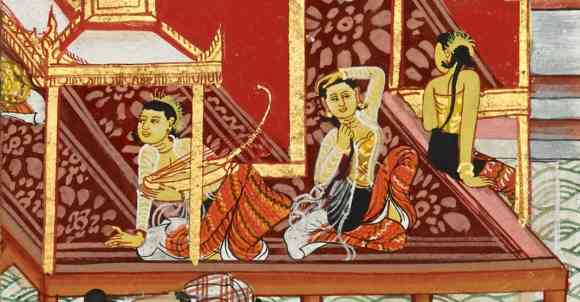
The Mandhātu Jātaka tells the story of Mandhātā, a powerful king who had everything he could ever desire. Although he ended up ruling even the heavenly realms, he still remained dissatisfied. Shown below is a detail from an illustrated manuscript of the Mandhātu Jātaka. It gives us a peek into Mandhātā’s court, which included beautiful musicians. The Saung player is turning curiously to see who is entering the palace.


The Boddhisatta and his four brothers at the enchanted pavilion of music. Telapatta Jātaka, 19th century | British Library, Or 4542/A f. 53r


The Saung is a unique musical instrument with a continuous history that stretches over a thousand years. It is known for its soothing, melodious sound and can be recognised by its horizontal boat-shaped body and its long, inwardly arched neck. 


The ends of the strings, which used to be made from silk, are decorated with red cotton tassels. The harp is held on the lap and the strings are plucked with one hand, while the other is used for damping and staccato notes. The Saung usually accompanies a singer, who also controls the tempo with a bell (Si) and a clapper (Wa).


Women of the court, including a musician holding the Burmese harp or Saung, Mandhātu Jātaka, 19th century. Photo credit: British Library, Or 4542/B, f.57r


The earliest description of the Saung comes from a temple relief at Bawbawkyi in Sri Ksetra from the 8th century. It depicts a dancer with an accompanying harpist and a rhythm keeper. Tang chronicles from the 9th century also describe a delegation from the kingdom with thirty-five musicians and dancers that enchanted the court with their elaborate music performance.


The orchestra included two harps and it performed twelve songs on Buddhist texts. These harps were tuned with pegs rather than strings, and interestingly peg-tuned harps are still used in Mon and Karen traditions. A later 10th-century Tang chronicle confirms that the music from these two geographic areas (from the present-day lower Myanmar) was the same.


Another of the Jātaka stories, the Telapatta Jātaka recounts the story of the Bodhisatta as a prince who had to travel through a dangerous, enchanted forest inhabited by ogresses. His five brothers accompany him but are eaten one by one by the ogresses who seduce them with different sensory pleasures.


Temiya’s last temptation. 'Temiya Jātaka', 19th century. Photo credit: British Library, Or 3676, f. 7r


In this manuscript illustration, the Boddhisatta (on the right in gold) has arrived to the ogresses’ magical pavilion of music. By this time he has already lost one brother in the pavilion of beauty. One of his remaining brothers, the lover of music, is raising the curtain in order to be fully immersed by the entertainment and is just about to become the next victim. The harpist is here accompanied by a flute and a singer.


The famous Temiya Jātaka is one of the ten last lives of the Buddha. He was a much wished-for son of the king of Benares. However, as soon as he discovered that his future kingly duties would involve inflicting punishment, he stopped speaking and sat motionless, as he did not want to inherit the throne.


The Bodhisatta hears beautiful music through his window and slowly falls in love with the harpist. ‘Culla Palobhana Jātaka’a, 19th century. Photo credit: British Library, Or 4542/B, f. 89r


The king tried to budge him in many different ways, from tempting him with cakes to scaring him with snakes and loose elephants, but with no success. When Temiya turned sixteen he was put to the final test with beautiful women, song and dance. Although this illustration actually shows him quite tempted, he did in fact hold firm and ended up not having to inherit the kingdom.


A somewhat similar story is recounted in the Culla Palobhana Jātaka. In this story as well, the Bodhisatta was born as a much-wanted prince, but from his earliest days as a baby he did not like to be nursed by women and was only attended by male members of the court. The king grew worried about his son’s lack of desire for pleasure, for surely this would also include ruling the kingdom.


The Boddhisatta and his lover are banished from the kingdom after a fit of jealousy. ‘Culla Palobhana Jātaka’, 19th century. Photo credit: British Library, Or 4542/B, f. 89r


A young dancing girl, accomplished in music and song, was therefore asked to seduce him. In return, she would become his queen. When morning came she played and sang outside the place where the prince was meditating. Little by little he fell in love with her and they became closer.


Unfortunately, the Bodhisatta became so enamoured with her that he ran amok the town in a fit of jealousy. As punishment for this bad behaviour both of them were banished from the kingdom and went on to live together in the forest.


In forthcoming blog posts I will give examples of how male harpists were depicted in manuscript illustrations, and how the Saung was inextricably entwined with the life of the Gautama Buddha.


References:

Muriel C. Williamson, The Burmese Harp: Its Classical Music, Tunings, and Modes. Dekalb, Ill.: Southeast Asia Publications, 2000.

Judith Becker, “The Migration of the Arched Harp from India to Burma”, The Galpin Society Journal, Vol. 20 (Mar., 1967), pp. 17-23.

E.B. Cowell (ed.), The Jātaka or stories of the Buddha’s former births, Vols. I-VI. Oxford: The Pali Text Society, 2004-2005.


(Source: Asian and African Studies blog)

Tuesday, 5 March 2019

After six decades, Manipur’s Burmese Tamils get a glimpse of their ancestral places in Myanmar

Opening of the land border last year has enabled Moreh’s Tamils, who were forced to flee Burma in the early 1960s, to connect with their roots.

Since he was a little boy, M Mohan had “only two aims” in life: to go to London and to visit his “father and mother’s houses in Burma”. On December 23, he fulfilled one of those dreams. He finally tracked down the house where his mother grew up, in Bago, a town around 100 km to the northeast of Yangon. “It was the most sentimental day of my life,” recalled Mohan, now 40. “I took a selfie with the house in the background and updated my Facebook status.”

Mohan, a Tamil who can speak five languages fluently, was born and brought up in Moreh, a dusty, one-street town in Manipur on the Indo-Myanmar border where idli dosa shops jostle for space with Manipuri rice hotels, and local brews share the shelf with Chinese lagers in paan shops owned by Biharis.
Moreh's Tamils celebrate the Pongal festival in January.

His parents trace their roots to Myanmar, where the family had lived and worked for decades before fleeing in 1962 after a military junta took over. In spite of living a few hundred metres from Myanmar all his life, Mohan’s expedition took many years because land travel to the country through Moreh was strictly regulated. Indians required a special permit from the Myanmar government, in addition to a visa.

This meant flying to Yangon was, for all practical purposes, the only way to enter the country for Indian passport holders. “I have to go to Kolkata, and then from there to Yangon. How can a simple man like me afford all that?” asked Mohan, who exports utensils manufactured in Tamil Nadu to Myanmar.

In August 2018, though, things changed. Myanmar opened its land boundary with India in August and made Moreh a legitimate “port of entry”. Most major towns in Myanmar were now only an affordable bus ride away. “It was a momentous occasion for all of us Tamils in Moreh,” exclaimed Mohan. “All of us had harboured this dream of going to Burma at least once in our lifetime to see how our ancestors lived, and it was finally going to come true.”

For the Tamils of Moreh, the opening of the new road meant a chance to connect with a past they could never quite let go of. Almost all of them, like Mohan’s family, had lived in Burma for decades before abruptly leaving in the 1960s.

M Mohan fulfilled his childhood dream of going to Myanmar
in December. Photo credit: Arunabh Saikia
Tracing their roots
Indians started flooding into Myanmar after it fell to the British Raj in the 19th century, filling government posts, manning its ports. By 1931, there were over a million Indians in the country. Then, in December 1941, at the height of the Second World War, the Japanese bombed Rangoon. As British troops retreated from the country, thousands of scared Indians trekked down from Myanmar to India via Manipur. The Long March, as it is called, was the first wave of forced migration of Indians from Burma.

The war ended and Myanmar gained freedom in 1948, but the Indian community remained in a perilous position. Burmese administrators systemically persecuted Indians, denying them citizenship on racial grounds and forcing thousands to return to their country of origin.

When the dictator Ne Win grabbed power in the early 1960s, he actively pursued an anti-minority agenda, nationalising all their businesses and properties. It triggered a mass expulsion of Indians, till then a significant population group. Between 1962 and 1964, more than three lakh Indians were forced out of Myanmar.

The Indo-Myanmar Friendship Gate separates Moreh and the market township
of Namphalong in Burma. Movement is free between 7 am and
4 pm. Photo credit: Arunabh Saikia

Khwaja Moinuddin’s family fled in a ship sent by the Indian government to retrieve Indians expelled by the Burmese military. The ship took them to Tamil Nadu, where they stayed for a few years in a refugee camp in Tiruchirappalli. “But my grandfather and others could not adjust – the food, the way of life, it was all very different from Burma,” Moinuddin said. “So, they decided to try and go back, this time via road, but were stopped at Moreh by the Burmese Army.” The family has lived in Moreh ever since.

When Moinuddin’s aging parents heard the border where they were stopped 50 years ago had finally been opened, they implored their son to take them to the place they were born. “They are old, they want to see their home, their land one last time,” he said.

To Moreh via Madras
By local estimates, there are around 3,000 Tamils, Hindu and Muslim, in Moreh, a town of less than 20,000 people belonging to at least a dozen distinct communities, including the Kukis and the Manipuri Meiteis. While Meitei is the lingua franca, the town’s pluralistic character means most people speak at least three languages – it is common for people in Moreh to switch languages mid-conversation.

The Namphalong market is awash with Chinese goods and alcohol.
Photo credit: Arunabh Saikia
The Tamils are in a minority now but they were the largest group until as recently as the mid-1990s, said the residents. Almost of them share a similar backstory: expelled from Myanmar, ill at ease in their new homes in Tamil Nadu, and marooned in Moreh since. “Our people came to Moreh because they wanted to go back to Burma,” explained Mohan. “They couldn’t, yet they stayed back. But people started to leave in the 90s as Moreh has few opportunities for higher education and employment.” Most left for Tamil Nadu, he said.

‘The king of Moreh’
In spite of their dwindling numbers, Moreh’s Tamils continue to be influential in the town. They dominate the trade, which is entirely informal but amounts to over Rs 50 crore annually, as per estimates of the town’s chamber of commerce. The community also controls the big-ticket furniture business, which thrives on the popular Burmese teak brought in from across the border.

It is not surprising then that the town’s most powerful trade body, the Border Trade and Chamber of Commerce, is populated almost entirely by the Tamils. Heading the association is V Shekhar, who enjoys a singular position in Moreh’s power structure. Shekhar, who is also president of the local branch of the Tamil Sangam, no longer lives in Moreh and visits only occasionally. Yet, his legend endures. As Abdul Gaffar, who deals in Burmese teak furniture, put it: “In Moreh, there’s no one above Shekhar anna.”

A hoarding in Moreh depicts the leaders of the town's four major
communities. Photo credit: Arunabh Saikia
The testament to Shekhar’s authority in Moreh lies in his steadfast control over the local businesses even while ethnic militias warred over the years to take control of the border town, and the lucrative contraband trade route it sits on. His patronage, local community leaders claimed, is required for all significant cross-border trade. “Without the support and approval of Shekhar, you cannot do any big business in Moreh,” said a Kuki community leader who asked not to be identified.

In the 1990s, Tangkhul Nagas, organised under the banner of the National Socialist Council of Nagaland (Isak-Muviah), tried to wrest control of the town from the Kukis and the Meiteis. A long bloody fight ensued, at the end of which the Kukis prevailed. Leading the Kuki charge was the Kuki National Organisation and its armed wing, the Kuki National Army. Ever since, the town of Moreh has been under the control of the Kukis, although Meitei nationalist groups continue to exert influence from their camps across the border. Yet, Shekhar never lost his control on the town’s trade.

Members of the Tamil community in Moreh. Photo credit: Arunabh Saikia
A leader of the United Naga Council, which was at the forefront of the Kuki-Naga clashes of the 1990s and is now the apex body of Nagas in Manipur, described Shekhar as “the king of Moreh town”. “He can manage all kinds of armed groups as well as the security forces,” said the Naga leader.

Underneath the apparent chaos of Moreh, a symbiotic system coordinated by Shekhar keeps the town together, said an executive member of the chamber of commerce. “All of us, depending on the size of our businesses, pay a survival tax to the armed groups annually,” he claimed.

The office of the Tamil Sangam in Moreh.
Photo credit: Arunabh Saikia
A second home
This year, Shekhar was the chief guest at the Pongal celebrations held by the Tamil community. Many of Moreh’s Tamils still long for Myanmar, a place they call home. But over the years, they have fashioned a home out of Moreh.

Its youth club is one of the most active in the area, regularly organising sports and cultural programmes. A fire-walking festival organised by the community is one of the biggest events in Moreh’s cultural calendar, with people from all communities thronging it in large numbers.

Sri Angalaparameshwari temple in Moreh. Photo credit: Arunabh Saikia
In the late 2000s, the Tamil Sangam flew in workers from Chennai to build the Sri Angalaparameshwari temple, among the grandest religious structures in the North East. The temple sees devotees not only from elsewhere in India but also Myanmar.

Today, with the border opening up, the Tamils can finally get a glimpse of Burma, a place close to their hearts. As SM Ganeshan, the Tamil Sangam’s education secretary, who recently took the land route to Yangon to see his birthplace, said, “I went there as a tourist only, but it felt really good to meet my relatives there for the first time after I left as a child. Everything is so nice there, surrounded by nature.”

(Source: Scroll)

Sunday, 28 January 2018

What connects Ratnagiri and Burma’s forgotten royals?

Travelling is an exercise which enables you to explore places and find hidden gems and information, which you never knew about.

For example, did you know that Ratnagiri, a coastal town in Maharashtra, has a link with Myanmar?


Yes, it sounds a little odd, but this is a fact. In the late 19th century, the last king of Burma—Thibaw Min—was living in exile in the sleepy village of Ratnagiri.

The evidence of this is the Thibaw Palace in Ratnagiri, which was built to accommodate King Thibaw and his family, who were deported from Burma (now Myanmar) by the British in 1885.


The Thibaw palace is a beautiful red-brick structure strategically located on top of a hill. It is interesting to note that King Thibaw who lived in Ratnagiri for 31 years, spent less than half of these years in this palace.

The information chart at the palace mentions that the British had sanctioned Rs 1,25,000 for the construction of the palace in the early 20th Century. Construction started in 1906, and the king and his family moved into the palace in 1910.

While it was being constructed, King Thibaw took a great interest in seeing the structure come to life.

This is why, the palace, built of laterite and lava rock, on a 20-acre property, has traces of Burmese architecture.


The palace itself is a modest structure, in terms of scale and size, compared to the other palaces in the country. However, it draws a fair share of an audience during the annual arts festival organised by the Ratnagiri Arts Circle.

When I visited the palace, I was expecting a museum which spoke about King Thibaw and the way he lived. However, there is not enough information available to visitors, and there are very few items on display.

A room on the first floor is dedicated to the king. There is also a chart which gives out basic information about his life. I learned that he belonged to the Konbaung dynasty, and was very well lettered in Buddhist scriptures. He had also published law books and created a code of conduct for his officers and town heads. It also stated that in Burma, he spent the royal money for freeing slaves and for their rehabilitation.

His reign ended when Burma was defeated by the forces of the British Empire in the Third Anglo-Burmese War, on 29 November 1885, and he was captured and exiled (along with his family) to Ratnagiri.


Today, the Thibaw palace is a state-protected monument. In case you are intrigued with this story, you should read the book, ‘The King In Exile: The Fall Of The Royal Family Of Burma,’ by Sudha Shah, which chronicles the poignant life of the last king of Burma.

(Source: TBI)

Wednesday, 13 September 2017

Forgotten history: Like the Rohingya, Indians too were once driven out of Myanmar

For most of Burmese history, Indians suffered bigotry for their ethnicity. Yet, India is now abandoning the persecuted Rohingyas, writes Shoaib Daniyal on the Scroll. Read on: 

In 1855, as the British were annexing parts of Burma to add to the Indian Empire, Henry Yule, an English civil servant, wrote of his travels in the South East Asian country. In this fascinating account of Burma, Yule also described the racial superiority the Burmese felt with respect to their dark-skinned, eastern neighbours:

“By a curious self-delusion, the Burmans would seem to claim that in theory at least they are white people. And what is still more curious, the Bengalees appear indirectly to admit the claim; for our servants in speaking of themselves and their countrymen, as distinguished from the Burmans, constantly made use of the term ‘kala admi’ – black man, as the representative of the Burmese Kola, a foreigner.”

This is probably one of the first written references to the Burmese racial slur “kala”. Later, as the Raj annexed all of Burma and made it a part of British India, Indians streamed into the region, where the local Burmese would often refer to them as “kala”.

Today there are very few Indians – defined as tracing their origin to British India – in Burma. But the term “kala” survives. It is used to racially target the Rohingya, a mostly Muslim minority living on the western coast of Burma who have been described as the most persecuted community in the world. But Rohingyas and Indians in Burma have more in common than a shared racial slur. Like the Rohingya today, Indians in Burma were also the target of racial discrimination and driven out in large numbers in the country between 1930 and the 1960s, a process that continues today with the forced expulsion of the Rohingya from Myanmar, who are considered foreigners in the country.

Browns in Burma
In 1826, the First Anglo-Burmese War was won by the British, giving the Raj control over much of what is now Northeast India as well as parts of the modern Burma. With it, Indians started to stream into Burma, a process that greatly accelerated with the complete annexation of the country into the British Indian Empire in 1885.

Indians had a significant presence in Burma and dominated commerce in what was then a province of British India. This included big merchants from the Chettiar, Marwari and Gujarati communities. Then, there were the Bengali babus. Like they spread West from Bengal under the aegis of the British Empire, they also spread East (Myanmar borders the Bengal delta). Among the more famous Burmese Bengalis, writer Sarat Chandra Chattopadhyay, the author of Devdas, worked as a government clerk in the South East Asian country. The third and largest group consisted of labourers – Indians working as coolies, servants and mistries. In George Orwell’s novel Burmese Days, for example, memsahibs in Burma rarely knew Burmese, but did need to speak “kitchen Urdu” in order to direct their mostly Indian domestic staff.

By 1931, Indians made up 7% of Burma’s population. They were also extremely prosperous and controlled large parts of the economy. Indians owned so much property that, for example, during the 1930s, they paid 55% of the municipal taxes in Rangoon – the capital of British Burma. The local Burmese, on the other hand, paid only 11%.

This same migration also brought at least a part of the Rohingya population into Burma from Bengal’s eastern-most district, Chittagong. Currently, this fact is fiercely contested politically since it is being used by Myanmar’s administration to paint the Rohingya as Bengali and hence non-Burmese, given that their citizenship laws – absurdly – are based not on birth but on race.
Vincent Clarence Scott O'Connor - The Silken East, Public Domain

Anti-Indian sentiment
The racial animus that is driving the mass killings of Rohingyas today rose first against Indians in general in 1930, as Telugu and Burman dockworkers clashed in Rangoon, sparking widespread anti-Indian violence. Much larger anti-Indian riots followed in 1938, a year after Burma was separated from British India (but still remained under British rule). Like with the Rohingya violence today, 1938 was simultaneously religious as well as racial – it was sparked off by a book written by a Muslim which was said to be critical of the Buddha, but almost immediately exploded into racial violence directed at all Indians in Burma.

In 1941, there was more violence as the Japanese attacked Burma during World War II. As the Japanese advanced into the country, the British began to withdraw. Without the protection of the British Indian Army, Indians feared attacks from both the Japanese as well as the local Burmese. This resulted in the first major exodus of Indians from Burma. Many Indians, in fact, trekked all the way from Burma to India, with thousands dying in the tropical forests on the way.

Institutionalised racism
In 1948, as Burma gained independence from the British, Indians had to face even more xenophobia as the new state defined itself in racial terms. The population of Burmese Indians had numbered more than 10 lakh before World War II – a number that dropped to around seven lakh in the mid 1950s. Between 1949 and 1961, out of 1,50,000 applications for Burmese citizenship by persons of Indian origin, less than a fifth were accepted.

In 1962, Burma saw a military takeover of its government. The dictator Ne Win followed an aggressive racial policy which affected every minority group. All property was nationalised, severely affecting rich persons of Indian origin. White collar Indians were expelled from the country. Between 1962 and 1964, more than three lakh Indians were forced out of Burma.

In 1982, Burma passed a new citizenship law that created a strict racial definition of citizenship. This rendered the Rohingya and most persons of Indian origin stateless. While the plight of the Rohingya has – deservedly – caught the attention of the world due to the genocide they face, these laws mean even people of Indian origin in Myanmar are discriminated against heavily even though they have lived there for generations. One estimate holds that 5 lakh people of Indian origin living in Myanmar are stateless.

Forced Burmanisation
Since then, faced with a Hobsons’ choice, persons of Indian origin have Burmanised – several government policies are aimed at making non-indigenous communities adopt Burmese norms, including language, religion and culture – rapidly in order to reduce the hostility that they faced. The Burmese language has replaced the various languages people of Indian origin spoke and even names have been Burmanised. Yet, this hasn’t entirely solved matters. Hindus and Muslims of Indian origin are not allowed any public celebration of religion and face racism.

In the 1960s, the Indian government was criticised for not helping its diaspora in Burma as they faced bigotry and were being expelled. In sharp contrast, China came to the aid of its Burmese diaspora (who were also targeted racially).

Little has changed today. The Rohingya are the victim of the same structural racism in Burma that persons of Indian origin faced. In the latest surge of violence between the state and Rohingya people who took up arms last year, more than 3,00,000 Rohingyas have fled the Rakhine state in Myanmar where they stay, most of them seeking refuge in Bangladesh.

However, the Indian government, rather than take up the cause of the disposed, is talking of pushing the few Rohingya migrants that have taken shelter in in India back to Myanmar – where they would face genocide.