Wednesday, 29 May 2019

Ali Dorani: Iranian cartoonist on the drawings that saved his life

Cartoonist Ali Dorani fled Iran at the age of 21 before becoming trapped in Australia's controversial Manus Island detention camp for four years - but things changed after his artwork was posted online.

Here's his story - in his own words and drawings.

In 2013, I left Iran. I can't tell you why because it might affect my family's safety - but I knew my life was in danger.


I stayed in Indonesia for 40 days, and tried to get to Australia - I knew Australia was the best way for me to get to safety.

A people smuggler told me he could get us to Australia by boat.

When I saw the boat, I was afraid I would die. It was a fishing boat, not really well maintained, and there were about 150 of us. And I can't swim.


When the time came to get on the boat, I told myself: "This is it. If anything happens to that weak boat, I'm going to die."

The journey took us 52 hours - it was raining and the ocean wasn't normal. It was so scary.

The Australian navy intercepted us and took us to Christmas Island - a detention centre where Australia keeps asylum seekers who arrive by boat.


I had suffered from OCD [Obsessive Compulsive Disorder] for a number of years - but it got worse on Christmas Island.

I liked to keep my surroundings clean at all times - but I couldn't control it anymore because I was in a room with several other people.

At one point, I tried to wash my dictionary in the shower because I felt it was dirty. I kept telling myself I was going crazy - I was shaking and getting so nervous.


Doctors at the medical centre told me I had to take medication, or find some strategies to deal with my OCD.

I didn't want to take medication because I was worried the Australian government would call me crazy and blacklist me from entering.

But when I went back to my room I slowly remembered that I had a talent for drawing. So I started drawing again to deal with my OCD.

I've been drawing since I was five years old - it's one of my earliest memories.

I'd stopped a few years before I fled Iran, because I was so busy with work and life - but now I felt so sick that I started drawing again.


I didn't always have something to draw on. We could request materials from immigration officers, but they wouldn't always give us paper and pencils.

So I had to steal paper - I'd go into language classes, and take blank papers when the teacher was looking the other way.

Because I only had a limited supply of paper I couldn't make mistakes in my drawings - that also helped me improve my skills.

Drawing actually didn't help my OCD, which was still getting worse every day.

But I started showing my drawings to other detainees, and some of the immigration officers, and people got interested in my cartoons.

I drew about my life there - what happened when I lined up to get food, what it was like using dirty public toilets.

I remember the first time I realised people took my work seriously.

I drew a map of Australia on a white T-shirt, with two eyes crying, and the words "I am only a refugee".

Two immigration officers asked me why I drew on my T-shirt - they saw the drawing as a protest.

I hadn't meant it as a protest - I had no idea my drawing would be taken that seriously - but it made me realise that my drawings could affect others.

So I kept cartooning - drawing diaries about daily life in the detention centre - and getting lots of positive and negative comments.

I was afraid that my drawings could affect my asylum application - but I also thought there could be nothing worse than being kept in a detention centre. I was depressed and my OCD was really difficult - so I thought I was already in a nightmare, and there was nothing else to be afraid of.

In fact, Christmas Island was much nicer than where I went next.

I was moved to Manus Island after six months, in January 2014. They handcuffed us and I had five security officers around me.

It was my first time in a tropical country - it was really hot and it was difficult to breathe.


It didn't look like the detention centre on Christmas Island. It looked like somewhere where you would keep chickens, pigs or sheep.

We had tents, dirty rooms, dirty toilets, and horrible showers. There were hundreds of people crammed in a small camp.

Some of the guards tried to reassure me - they could see the shock on my face. They told me: "Don't worry, everything is going to be fine."

I felt I didn't have any choices left - I couldn't go home, couldn't stay in Australia, and didn't want to kill myself. I felt like a dead body who was forcing himself to stay alive.

I didn't have any pencils or paper when I arrived on Manus Island - they took away my pencils when I left Christmas Island - although I could keep my drawings.

At first, I didn't want to draw. When you're forced to live in a place, but don't know why you are there, or when it is going to end, you lose hope, you lose all motivation, and this, combined with the weather, the sun, the mosquitoes - all help to destroy you inside.


An incident happened on 17 February 2014 - some of the locals attacked the camp, smashing everything and beating people up. They killed one of the refugees as well.

For about a month after that, we didn't have access to much - no proper food, or services.

Then another company came to run the camp - they improved the dining room and brought different activities in the camp, including English classes and drawing activities.

I started drawing again, documenting life at the camp. I also drew the mosquitoes, the sun and the rain.

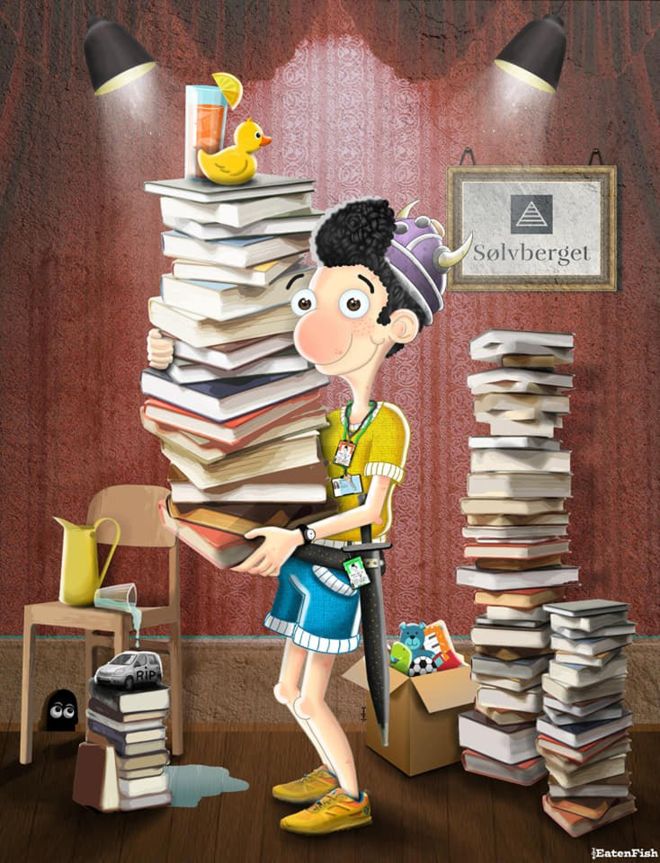
I chose EatenFish as my penname, because I was caught from the sea like a fish, "eaten" (processed) at an Australian detention camp, and then "thrown away" on Manus Island (the same way you throw fish bones into a rubbish bin).

In some of my pictures, I added graves for the refugees who had died.


Sexual harassment and sexual assault were serious problems on Manus Island.

It wasn't only me suffering from this - there were a lot of young people like me suffering.

I witnessed it a lot, but I couldn't do anything about it because I was already under too much pressure, suffering from OCD, panic attacks and anxiety.


We didn't have access to the internet at this time, and I didn't have any hope of sharing my drawings with the outside world.

However, the Australian government eventually decided we would each be allowed to use the internet for 45 minutes every week.

The connection was really slow, and was barely strong enough to get onto Facebook - but I started logging on, joining Australian humanitarian groups, and sending friend requests to each of the members.

I did that for 1.5 years - sending messages to thousands of strangers. No one replied.

However, it turns out a lot of the Australian workers and immigration officials at the camp were talking about my drawings, even when they got home.

An activist - Janet Galbraith - heard about my drawings and contacted me on Facebook - she said she was starting a gallery in Melbourne, and wanted to display one of my drawings.

It wasn't easy sending her my pictures because we didn't have access to a scanner, or cameras.

A few people had secretly kept their mobile phones, although most of the cameras weren't very high-quality.

Eventually, I managed to secretly take a photo of my drawing using a mobile phone, and sent it to her.

The drawing that was exhibited in Melbourne
After Janet displayed the photo in the gallery, one man working on Manus Island saw the picture, and told Janet he knew me and could help get my drawings out.

He was working for the government so I couldn't really trust him, but at the same time I didn't have many other choices.

He took photos of my drawings with his iPad and sent them to Janet - and then my drawings started getting published by news organisations.


In 2015, many of us went on hunger strike against Australia's policy, and conditions at the camp.

I ended up getting really sick - I had panic attacks, with muscle spasms, for almost 40 minutes. Sometimes I had panic attacks three times a day.

The doctors put me on different forms of medication, but there were days when I'd wake up and not be able to remember where I used to live or who I was. I was kept in isolation for almost one month.


After I got out of isolation, I contacted Janet again, and explained what happened to me. I also got in touch with Cartoonists Rights Network International (CRNI), and was put in touch with the Guardian cartoonist First Dog on the Moon.

The Guardian started publishing my work, and in 2016, CRNI gave me their Courage in Editorial Cartooning Award.

That got me a lot of publicity - but I didn't really realise it at the time, because my internet access was so limited.

I would hear from people that I'd been published, or get sent links to my work - but I'd have to wait to use the internet room each week, and often the connection wouldn't work well.

I didn't think the publicity would help me - I saw it as a chance to show my drawings to Australians, but I didn't see how it would get me out of detention.

In 2016, artists around the world started drawing cartoons to show their support for me.

When I was a child, one of my wishes was to become a cartoonist, because I would read cartoons in magazines and wish my cartoons could be published too.

So when I saw that all these cartoonists that I used to worship and see in magazines had drawn cartoons to save me, it was a big honour for me.

Cartoonists who had been published in the Washington Post, New Yorker, and New York Times, all drew cartoons about EatenFish.


I felt extremely grateful.

The International Cities of Refuge Network (Icorn), a Norwegian organisation that helps writers and artists, also started working on my case.

I didn't know anything about Icorn at the time - Janet just told me they were looking at my case - but I didn't believe they'd be able to help me.

I went on hunger strike in late 2016, because I was being harassed by other detainees, and workers on Manus Island.

The strike lasted around 22 days. I was already sick, but felt I didn't have any other choice - and by the end of the strike I weighed 43 kilos.

After my hunger strike, I was moved to a hospital in Papua New Guinea for almost three months. While I was there, I got a message from Norway's immigration department, welcoming me.

I couldn't believe it.

When I got onto the plane to Norway, Janet was there with me. I couldn't stop crying for a few hours - I don't normally cry easily, but this time I couldn't stop. All my years in detention came up in front of my eyes - and I couldn't believe that it was the end.


I was so excited and so scared when I arrived in Norway. A few people came to the airport to pick me up, showed me where I would be living, and told me about the support I'd get.

It wasn't easy at first. For the first six to eight months I was in a deep depression - even stronger than the one I had on Manus Island. It still affects me now.

But I got good support from the government, and help from refugee organisations, especially Icorn. I don't think it's possible to get better support than what I got in Norway.

Icorn gave me an office in a public library in Stavanger, so I can work on my projects. A lot of children visit the library, and sometimes I hold drawing courses.


I also go to different schools to talk about Australia's refugee policy. Icorn also helps me financially, and helps me interact with different artists around Norway.

A lot of people ask me if I feel happy now. It's complicated.

I didn't choose to come here - I didn't have any other choices. But now, I love the city that I live in.

I think Norway has the best support and services for refugees - there are detention camps for asylum seekers, but they are not locked in - they can go out, interact with people, and see children playing in parks.
Ali Dorani (centre) at an exhibition of his work in Norway . pic: Al Dorani
I always say that art saved me - it helped the Norwegian government find out about my situation.

While I was in detention on Christmas Island, and Manus Island, lots of people liked my drawings but told me they wouldn't get me anywhere. Some of the detainees asked me: "What are you going to achieve with this? You can't help get us out of here with these drawings."

But now, I think I have the right to say that art actually saved me. I started drawing cartoons in detention, to try and control my illness, and eventually, cartoons saved my life. I genuinely believe that art can help bring peace, and that I have to look after my art and respect that.

What is Australia's asylum policy?

  • Australia has sent asylum seekers arriving by boat to processing and detention centres on Christmas Island, Manus Island in Papua New Guinea, and Nauru in the South Pacific. They are not given the option of settling in Australia.
  • Australia argues its policy deters people from making the dangerous journey by sea. But doctors and the UN have criticised conditions on the islands.
  • At least 12 asylum seekers have died in detention on Manus Island. That centre was closed in 2017 after PNG's supreme court ruled it was illegal.


(Source: BBC)

Has legal cannabis killed the bong?

Under cannabis prohibition, nothing signified one’s love of the plant more than bongs – but health-conscious users who prefer to vape don’t have much use for them

In the stoner culture that flourished under cannabis prohibition, nothing signified one’s love of the plant more clearly than the water pipes known as bongs. This was for practical as well as symbolic reasons. Bongs offer more smoke and a smoother hit than pipes or joints. Whether in use or not, they convey a clear message: marijuana is smoked here.

They have been used to smoke cannabis since antiquity. When someone is sucking on a bong, mouth agape inside a glass tube, it’s a pose of the purest hunger, like a baby goat sucking on an udder. Users often named their bongs. To the fraternity of underground cannabis users, they were akin to sacred totems.

But with legalization under way, bongs have an image problem. The “wellness”-obsessed cannabis industry doesn’t have much use for them. Health-conscious users prefer to vape or eat cannabis than combust it. The bong as centerpiece of a room also isn’t a good fit for the industry’s new ethos, echoed in the slogan of the magazine Gossamer: “For people who also smoke weed.”

 ‘To the fraternity of underground cannabis users, they were akin to sacred totems.’ Illustration: George Wylesol
Simultaneously, the heaviest cannabis users have gravitated away from flower to stronger THC concentrates that they consume with dab rigs, contraptions that can look like bongs but are used to vaporize the drug with the help of a blow torch. Popular new products such as the PuffCo Peak and Vapexhale look like bongs and can be called bongs, but they are vaporizers, not pipes.

Even so, smoking accessories remain a sizable industry. In 2013, US head shops generated $10bn in revenue, about the same size as the 2018 legal US cannabis market.

Harrison Baum, CEO of Daily High Club, an online head shop that sends a monthly box of smoking accessories to subscribers, said today bongs were “a niche, but a very big niche”, popular with younger people and nostalgists in their 50s and 60s reliving their college days.

In four years, Baum said, the company had sold more than 300,000 bongs. Popular models include the “southern dabber”, which features a dab rig’s smaller chamber inside a bong chamber, and the “road rasta”.

In the early days of the green rush, Jane West, an event planner and mom in suburban Denver, made a name for herself throwing upscale pot parties, at least one of which featured a working bong ice sculpture. Today she has released a line of smoking accessories, including a glass bong called a “beaker” that would look at home on a tastefully appointed shelf next to a wine decanter. Its chamber is meant to approximate a person’s lung capacity.

Meanwhile, upscale head shops have popped up in places like the Los Angeles branch of the swank department store Barney’s.

There’s a parallel with sex toys. Once hidden behind counters, they now boast serious design credentials and can be bought in attractive shops, with chipper attendants happy to “educate” consumers about their various properties. And a community of glass workers has elevated elaborate bongs into a form of folk art, with pieces by well-known artists selling for more than $10,000.

So, yes, the bong is gentrifying. And it may always have its fans – as West says: “There’s nothing that compares.”

(Source: The Guardian)

Changing monarchy on display as imperial couple greets Trump and first lady using English

The language barrier fell away Monday when Emperor Naruhito and Empress Masako greeted U.S. President Donald Trump and first lady Melania Trump in English at the Imperial Palace, in what could be a taste of things to come for the most internationally minded imperial couple in Japan’s history.

Trump became the first world leader to meet with the emperor since he ascended the throne and the Reiwa Era began on May 1. Monday also marked the imperial couple’s first ever meeting with Trump.

The emperor and empress greeted the president and first lady with warm smiles upon their arrival at the palace. The party shook hands and then continued inside, where the imperial couple introduced their guests to other members of the imperial family. Prime Minister Shinzo Abe and his wife, Akie Abe, were also in attendance.

Emperor Naruhito chats with U.S. President Donald Trump as Empress Masako speaks with first lady Melania Trump — both without the help of interpreters — at the Imperial Palace in Tokyo on Monday. | POOL / VIA KYODO

Afterward, the imperial couple met with the president and first lady for further discussion. In the past, such meetings have been used to discuss the state of each nation.

The emperor is a graduate of Oxford University with experience traveling in Europe, and the empress, a graduate of Harvard, is a former diplomat and a polyglot fluent in English and French. The arrival of a multilingual imperial couple is seen by observers as representing a decisive shift in the Japanese monarchy and its relationship with other nations.

On Monday, the emperor and empress acted as translators for Trump and the first lady as they spoke to a seemingly endless line of politicians, ambassadors and other guests. Professional interpreters — who were presumably hired for the occasion — could only watch while the imperial couple handled themselves with poise while navigating countless introductions and interactions throughout the affair.

Trump’s meeting with the imperial couple was followed by a summit with Abe. In the evening, a banquet at the Imperial Palace was set to be attended by roughly 170 guests including members of the imperial family and several Cabinet ministers, among others.

(Source: JT)

Literature provides shelter. That's why we need it

In her Arthur Miller Freedom to Write Lecture, published here, Arundhati Roy asks what it means to be a writer in a world that is rapidly hardening

I am truly honored to have been invited by PEN America to deliver this year’s Arthur Miller Freedom to Write Lecture. What better time than this to think together about a place for literature, at this moment when an era that we think we understand – at least vaguely, if not well – is coming to a close.

As the ice caps melt, as oceans heat up, and water tables plunge, as we rip through the delicate web of interdependence that sustains life on earth, as our formidable intelligence leads us to breach the boundaries between humans and machines, and our even more formidable hubris undermines our ability to connect the survival of our planet to our survival as a species, as we replace art with algorithms and stare into a future in which most human beings may not be needed to participate in (or be remunerated for) economic activity – at just such a time we have the steady hands of white supremacists in the White House, new imperialists in China, neo-Nazis once again massing on the streets of Europe, Hindu nationalists in India, and a host of butcher-princes and lesser dictators in other countries to guide us into the Unknown.

While many of us dreamt that “Another world is possible”, these folks were dreaming that too. And it is their dream – our nightmare – that is perilously close to being realized.

Capitalism’s gratuitous wars and sanctioned greed have jeopardized the planet and filled it with refugees. Much of the blame for this rests squarely on the shoulders of the government of the United States. Seventeen years after invading Afghanistan, after bombing it into the ‘stone age’ with the sole aim of toppling the Taliban, the US government is back in talks with the very same Taliban. In the interim it has destroyed Iraq, Libya and Syria. Hundreds of thousands have lost their lives to war and sanctions, a whole region has descended into chaos, ancient cities—pounded into dust. Amidst the desolation and the rubble, a monstrosity called Daesh (Isis) has been spawned. It has spread across the world, indiscriminately murdering ordinary people who had absolutely nothing to do with America’s wars. Over these last few years, given the wars it has waged, and the international treaties it has arbitrarily reneged on, the US government perfectly fits its own definition of a rogue state. And now, resorting to the same old scare tactics, the same tired falsehoods and the same old fake news about nuclear weapons, it is gearing up to bomb Iran. That will be the biggest mistake it has ever made.

So, as we lurch into the future, in this blitzkrieg of idiocy, Facebook “likes,” fascist marches, fake-news coups, and what looks like a race toward extinction—what is literature’s place? What counts as literature? Who decides? Obviously, there is no single, edifying answer to these questions. So, if you will forgive me, I’m going to talk about my own experience of being a writer during these times—of grappling with the question of how to be a writer during these times, in particular in a country like India, a country that lives in several centuries simultaneously.

A few years ago, I was in a railway station, reading the papers while I waited for my train. On an inside page, I spotted a small news report about two men who had been arrested and charged with being couriers for the banned, underground Communist Party of India (Maoist). Among the “items” recovered from the men, the report said, were “some books by Arundhati Roy.” Not long after that, I met a college lecturer who spent much of her time organizing legal defence for jailed activists, many of them young students and villagers in prison for “anti-national activities”. For the most part this meant protesting corporate mining and infrastructure projects that were displacing tens of thousands from their lands and homes. She told me that in several of the prisoners’ “confessions” – usually extracted under coercion – my writing often merited a reference as a factor that led them down what the police call “the wrong path.”

“They’re laying a trail – building a case against you,” she said.

 ‘The place for literature is built by writers and readers.’ Photograph: Mayank Austen Soofi

The books in question were not my novels (at that point I had written only one – The God of Small Things). These were books of nonfiction – although in a sense they were stories, too, different kinds of stories, but stories nevertheless. Stories about the massive corporate attack on forests, rivers, crops, seeds, on land, on farmers, labour laws, on policy making itself. And yes, on the post 9/11 US and Nato attacks on country after country. Most were stories about people who have fought against these attacks – specific stories, about specific rivers, specific mountains, specific corporations, specific peoples’ movements, all of them being specifically crushed in specific ways. These were the real climate warriors, local people with a global message, who had understood the crisis before it was recognized as one. And yet, they were consistently portrayed as villains—the anti-national impediments to progress and development. The former Prime Minister of India, a free-market evangelist, called the guerrillas, mostly indigenous people, adivasis, fighting corporate mining projects in the forests of central India the “Single Largest Internal Security Challenge”. A war called “Operation Green Hunt” was declared on them. The forests were flooded with soldiers whose enemies were the poorest people in the world. It’s been no different elsewhere – in Africa, Australia, Latin America.

And now, irony of ironies, a consensus is building that climate change is the world’s single largest security challenge. Increasingly the vocabulary around it is being militarized. And no doubt very soon its victims will become the ‘enemies’ in the new war without end. Calls for a climate ‘emergency’, although well meaning, could hasten the process that has already begun. The pressure is already on to move the debate from the UNFCC (United Nations Framework Convention on Climate Change) to the United Nations Security Council, in other words, to exclude most of the world and place decision making straight back into the den of the same old suspects. Once again, the Global North, the creators of the problem, will see to it that they profit from the solution that they propose. A solution whose genius will, no doubt, lie deep in the heart of the ‘Market’ and involve more selling and buying, more consuming, and more profiteering by fewer and fewer people. In other words, more capitalism.

When the essays were first published (first in mass-circulation magazines, then on the Internet, and finally as books), they were viewed with baleful suspicion, at least in some quarters, often by those who didn’t necessarily even disagree with the politics. The writing sat at an angle to what is conventionally thought of as literature. Balefulness was an understandable reaction, particularly among the taxonomy-inclined—because they couldn’t decide exactly what this was—pamphlet or polemic, academic or journalistic writing, travelogue, or just plain literary adventurism? To some, it simply did not count as writing: “Oh, why have you stopped writing? We’re waiting for your next book.” Others imagined that I was just a pen for hire. All manner of offers came my way: “Darling I loved that piece you wrote on the dams, could you do one for me on child abuse?” (This actually happened.) I was sternly lectured, (mostly by upper-caste men) about how to write, the subjects I should write about, and the tone I should take.

But in other places, let’s call them places off the highway, the essays were quickly translated into other Indian languages, printed as pamphlets, distributed for free in forests and river valleys, in villages that were under attack, on university campuses where students were fed up of being lied to. Because these readers, out there on the frontlines, already being singed by the spreading fire, had an entirely different idea of what literature is or should be.

I mention this because it taught me that the place for literature is built by writers and readers. It’s a fragile place in some ways, but an indestructible one. When its broken, we rebuild it. Because we need shelter. I very much like the idea of literature that is needed. Literature that provides shelter. Shelter of all kinds.

Over time, an unspoken compromise was arrived at. I began to be called a “writer-activist.” Implicit in this categorization was that the fiction was not political and the essays were not literary.

I remember sitting in a lecture hall in a college in Hyderabad in front of an audience of five or six hundred students. On my left, chairing the event, was the vice-chancellor of the university. On my right, a professor of poetry. The vice-chancellor whispered in my ear, “You shouldn’t spend any more time on fiction. Your political writing is the thing to concentrate on.” The professor of poetry whispered, “When will you get back to writing fiction? That is your true calling. This other stuff you do is just ephemeral.”

I have never felt that my fiction and nonfiction were warring factions battling for suzerainty. They aren’t the same certainly, but trying to pin down the difference between them is actually harder than I imagined. Fact and fiction are not converse. One is not necessarily truer than the other, more factual than the other, or more real than the other. Or even, in my case, more widely read than the other. All I can say is that I feel the difference in my body when I’m writing.

Sitting between the two professors, I enjoyed their contradictory advice. I sat there smiling, thinking of the first message I received from John Berger. It was a beautiful handwritten letter, from a writer who had been my hero for years: “Your fiction and nonfiction—they walk you around the world like your two legs.” That settled it for me.

Whatever the case that was being built against me was, it didn’t – or at least hasn’t yet – come to fruition. I’m still here, standing on my two writing legs, speaking to you. But my lecturer friend is in jail, charged with participating in anti-national activity. India’s prisons are packed tight with political prisoners—most of them accused of being either Maoist or Islamist terrorists. These terms have been defined so broadly that they have come to include almost anyone who disagrees with government policy. In the latest batch of pre-election arrests, teachers, lawyers, activists, and writers have been jailed, charged with plotting to assassinate Prime Minister Modi. The plot is so ludicrous that a six-year old could have improved on it. The fascists need to take some good fiction-writing courses.

Reporters Without Borders say that India is the fifth most dangerous place for journalists in the world, ranked just above Afghanistan, Syria, Yemen and Mexico. Here I must pause to thank PEN for the work it does to protect writers and journalists who are have been imprisoned, prosecuted, censored and worse. From one day to the next, it could be any one of us that is in the line of fire. To know that there is an organization looking out for us is a consolation.

In India, those who’ve been jailed are the lucky ones. The less fortunate are dead. Gauri Lankesh, Narendra Dabholkar, MM Kalburgi, and Govind Pansare, all critics of the Hindu far right, have been assassinated. Theirs were the high-profile killings. Scores of other activists working with the Right to Information Act to uncover massive corruption scandals have been killed or found dead in suspicious circumstances. Over the last five years, India has distinguished itself as a lynching nation. Muslims and Dalits have been publicly flogged and beaten to death by vigilante Hindu mobs in broad daylight, and the “lynch videos” then gleefully uploaded to YouTube. The violence is flagrant, open and certainly not spontaneous. Although the violence against Muslims is not new and the violence against Dalits is ancient – these lynchings have a clear ideological underpinning.

The lynchers know that they have protection in the highest places. Protection not just from the government and the prime minister, but from the organization that controls them both—the far-right, proto-fascist Rashtriya Swayam Sevak Sangh (RSS), the most secretive and most powerful organization in India. It was founded in 1925, its founding ideologues were greatly influenced by European fascism. They openly praised Hitler and Mussolini, and compared Indian Muslims to the “Jews of Germany”. It has worked ceaselessly for 95 years toward having India formally declared a Hindu Nation. Its declared enemies are Muslims, Christians, and Communists.

The RSS runs a shadow government that functions through tens of thousands of shakhas (branches) and other ideologically affiliated organizations with different names – some of them astonishingly violent – spread across the country. Traditionally controlled by a sect of west coast Brahmins. known as Chitpavan Brahmins, the RSS today has white supremacists and racists from the United States and Europe circling around it, writing in praise of Hinduism’s age-old practice of caste. It’s what is more accurately known as Brahminism – a brutal system of social hierarchy they envy for its elaborate, institutionalized cruelty, which has survived more or less intact from ancient times. Brahminism also has admirers in the most unexpected places. One of them, you will be saddened to know, was Mohandas Gandhi – who considered caste to be the “genius” of Hindu society. I have written at length about Gandhi’s attitude toward caste and race in a book called The Doctor and The Saint, so I will not dwell on it now.

Let me just leave you with this: at a speech at a missionary conference in Madras in 1916, he said: “The vast organisation of caste answered not only the religious wants of the community, but it answered too its political needs. The villagers managed their internal affairs through the caste system, and through it they dealt with any oppression from the ruling power or powers. It is not possible to deny the organising capability of a nation that was capable of producing the caste system its wonderful power of organisation.”

Today the RSS boasts of having a trained militia of six hundred thousand members who proudly call themselves swayam-sevaks (volunteers), whose numbers include the prime minister and most of his cabinet. The ruling Bharatiya Janata Party (BJP) functions as the parliamentary political department of the RSS. Ram Madhav, its secretary is a member of the RSS. By insisting on viewing the BJP as an independent entity, as an ordinary, right wing, conservative political party, by inadvertently or deliberately minimizing its organic connection to the RSS, many in the Indian and the international media, as well as many who claim to be secular and liberal, have eased its path to political power.

Modi’s mainstream political career was launched, coincidentally, (or maybe not) just weeks after 9/11, when, he was appointed as the chief minister of the state of Gujarat, although he was not an elected member of the Legislative Assembly. Within months of that appointment, under Modi’s watch, a pogrom against Muslims took place in Gujarat, in which two thousand people were killed in broad daylight. Within months he called elections and won. At a grand convention of businessmen and industrialists in Gujarat, CEOs of several of India’s major corporations openly endorsed him as their future candidate for prime minister. Fascism and capitalism exchanged marriage vows in a not-so-quiet ceremony and moved in together. After three terms as Gujarat’s chief minister, Modi was elected prime minister of India in 2014. He was given a hero’s welcome by the liberal commentariat and he has traveled the world embracing and being embraced by world leaders, including Barack Obama and Emmanuel Macron. And Donald Trump of course, but that is no surprise. None of them is ignorant about who Modi really is, but all of them have something to sell to this “market” of more than a billion people. Now after five years in office and a vicious communal campaign, he and his cohorts, are seeking re-election. The candidates include a saffron robed Sadhvi Pragya, who is standing trial for being part of a terrorist strike that killed six people and is currently out on bail.

In what marks a dangerous turn of events, newspapers reported a public speech by Maneka Gandhi, a union minister in Modi’s cabinet in which she said that villages would be graded according to which ones voted for the BJP in the greatest numbers and they would be rewarded or punished by the award or withholding of ‘development’ proportionate to their loyalty. She is by no means the only one speaking this language, by no means the only one who has openly suggested that the Party knows who has voted for it and who has not. And that retribution will follow. And by no means the first to hint that political parties have access to data from what is supposed to be a secret ballot—data they can use to their advantage in dangerous ways that completely undermine elections and democracy itself.

In the era of surveillance capitalism, a few people will know everything about us, and will use this information to control us.

India is fighting for her soul. Even if the BJP loses the elections, which, despite having more money than all the other political parties put together, despite its more or less complete control of the mainstream media, it well might—it will not mean that we are out of danger. The RSS is chameleon-like, and moves on a million legs. Capturing power with an absolute majority, as it did five years ago, put motors on those legs. But merely losing an election will not prevent it from continuing its long walk to hell. It can change colour when it has to, wear a mask of reason and inclusiveness when it needs to. It has proved its ability to function as an underground organization as well as an over ground one. It is a patient, hardworking beast that has burrowed its way into every institution in the country – courts, universities, media outlets, security forces, intelligence services.

If a new, non-BJP government is sworn in – most likely a fragile coalition – it is likely to be met by a ferocious onslaught of manufactured communal violence and false-flag attacks to which we have become accustomed. There will be cow carcases discovered on highways, beef found in temples and pigs thrown into mosques. When the country burns the far right will once again present themselves to us as the only ones capable of running a ‘hard-state’ and handling the problem. Will a polity that has been deeply polarised be able to see through these games? It’s hard to say.

Much of this has been the subject of my writing, fiction as well as nonfiction, for several years.

. . .

The God of Small Things, published in the summer of 1997, was the result of a search for a language and a form to describe the world I had grown up in, to myself and to people I loved, some of whom were entirely unfamiliar with Kerala. I had studied architecture, written screenplays, and now I wanted to write a novel. A novel that could only be a novel—not a novel that really wanted to be a film, or a manifesto, or sociological treatise of some kind. I was astonished when some critics described it as a work of magical realism—how could that be? The setting of the book—the old house on the hill in Ayemenem, my grandmother’s pickle factory that I grew up in, (I still have some of the jars and labels), the Meenachal river—all of it gritty reality to me, was exotic and magical to many western critics. Fair enough. But I reserve the right to think that way about New York and London.

Back home in Kerala, the reception was pretty unmagical. The Communist party of India (Marxist), which had ruled Kerala on and off since 1959, was upset with what it considered a critique of the party in The God of Small Things. I was quickly labeled anti-communist, a crying-talking-sleeping-walking Imperialist Plot. I had been critical, it is true, and the sharp end of my critique was that the Left, by which I mean the various communist parties in India, has been not just opaque to caste, but, more often than not, overtly casteist. The transgressive relationship in the novel between Ammu (a Syrian Christian woman) and Velutha (a Dalit man) was viewed with consternation. The consternation had as much to do with the novel’s politics of caste as it did with gender. The portrayal of one of the main characters, Comrade KNM Pillai’s relationship with his wife Kalyani, and of Ammu, a divorced woman who “combined the infinite tenderness of motherhood and the reckless rage of a suicide bomber”, “who loved by night the man who her children loved by day,” was not received with applause and hallelujahs. Five male lawyers got together and filed a criminal case against me, accusing me of obscenity and “corrupting public morality.”

There were factors outside of the novel that were swirling around too. My mother, Mary Roy, had won a case in the Supreme Court that struck down the Syrian Christian Inheritance Law, which gave a woman “one fourth of her father’s property or Rs. 5,000, [$70] whichever is less.” Women could now inherit an equal share. This caused a great deal of anger. There was a palpable sense that mother and daughter needed to be taught a lesson. By the time the case came up for its third or fourth hearing The God of Small Things had won the Booker prize. That divided public opinion. A local Malayali woman, winning a prestigious international literary prize was not something that could be easily dismissed—should she be shunned or embraced? I was present in court with my lawyer, who had told me in confidence that he thought that parts of my book were “quite obscene.” But, he said, according to the law, a work of art should be seen as a whole and since the whole book was not obscene, we stood a fighting chance. The judge took his seat and said, “Every time this case comes before me, I get chest pains.” He postponed the hearing. The judges who came after him did the same. Meanwhile people celebrated the nontransgressive aspects of the book – the language, the evocation of childhood. It’s still hard for many to look at the relationship between Ammu and Velutha without flinching a little. It took almost 10 years before the case was dismissed.

In May 1998, less than a year after the publication of The God of Small Things, for the first time in India’s history, a BJP-led coalition formed the government at the centre. The prime minister at the time, Atal Bihari Vajpayee, was a member of the RSS. Within weeks of taking office, he fulfilled a longstanding dream of the RSS by conducting a series of nuclear tests. Pakistan responded immediately with tests of its own. The nuclear tests were the beginning of the journey toward the crazed rhetoric of nationalism that has become a normal form of public speech in India today. I was taken aback by the orgy of celebration that greeted the nuclear tests—including from the most unexpected quarters. That was when I wrote my first essay, “The End of Imagination,” condemning the tests. I said that entering the nuclear race would colonize our imagination: “If it’s anti-Indian and anti-Hindu to have a nuclear bomb implanted in my brain,” I wrote, “then I secede. I hereby declare myself a mobile republic.”

I will leave you to imagine the reaction that followed.

“The End of Imagination” was the first of what would turn out to be 20 years of writing nonfiction essays. They were years during which India was changing at lightning speed. For each essay, I searched for a form, for language, for structure and narrative. Could I write as compellingly about irrigation as I could about love and loss and childhood? About the salinization of soil? About drainage? Dams? Crops? About structural adjustment and privatization? About the per unit cost of electricity? About things that affect ordinary peoples’ lives? Not as reportage, but as a form of storytelling? Was it possible to turn these topics into literature? Literature for everybody—including for people who couldn’t read and write, but who had taught me how to think, and could be read to?

I tried. And as the essays kept appearing, so did the five male lawyers (not the same ones, different ones, but they seemed to hunt in packs). And so did the criminal cases, mostly for contempt of court. One of them ended in a very short jail sentence, another is still pending. The debates were often acrimonious. Sometimes violent. But always important.

Almost every essay got me into enough trouble to make me promise myself that I wouldn’t write another. But inevitably, situations arose in which the effort of keeping quiet set up such a noise in my head, such an ache in my blood, that I succumbed, and wrote. Last year when my publishers suggested they be collected into a single volume, I was shocked to see that the collection, My Seditious Heart, is a thousand pages long.

After twenty years of writing, traveling into the heart of rebellions, meeting most extraordinary as well as exquisitely ordinary people, fiction returned to me. It became clear that only a novel would be able to contain the universe that was building in me, spinning up from the landscapes I had wandered through, and composing itself into a story-universe. I knew it would be unapologetically complicated, unapologetically political, and unapologetically intimate. I knew that if The God of Small Things was about home, about a family with a broken heart in its midst, The Ministry of Utmost Happiness would begin after the roof had blown off the home, and the broken heart had shattered and distributed its shards in war-torn valleys and city streets. It would be a novel, but the story-universe would refuse all forms of domestication and conventions about what a novel could and could not be. It would be like a great city in my part of the world in which the reader arrives as a new immigrant. A little frightened, a little intimidated, plenty excited. The only way to know it would be to walk through it, get lost, and learn to live in it. Learn to meet people, small and big. Learn to love the crowd. It would be a novel that would say what cannot otherwise be said. Particularly about Kashmir, where only fiction can be true because the truth cannot be told. In India, it is not possible to speak of Kashmir with any degree of honesty without risking bodily harm.

About the story of Kashmir and India and India and Kashmir, I can do no better than to quote James Baldwin: “And they would not believe me, precisely because they would know that what I said was true.” The story of Kashmir is not the sum of its human rights reports. It’s not only about massacres, torture, disappearance, and mass graves, or about victims and their oppressors. Some of the most terrifying things that happen in Kashmir would not necessarily qualify as human rights violations. For a writer, Kashmir holds great lessons about the human substance. About power, powerlessness, treachery, loyalty, love, humor, faith… What happens to people who live under a military occupation for decades? What are the negotiations that take place when the very air is seeded with terror? What happens to language?

One of the first things I began to do when I began to travel in Kashmir is to collate what appears in The Ministry of Utmost Happiness as “The Kashmiri-English Alphabet,” starting with the letter A:

A: Azadi/army/Allah/America/Attack/AK-47/Ammunition/Ambush/Aatankwadi/Armed Forces Special Powers Act/Area Domination/Al Badr/Al Mansoorian/Al Jehad/Afghan/Amarnath Yatra

B: BSF/body/blast/bullet/battalion/barbed wire/brust (burst)/border cross/booby trap/bunker/ bite/begaar (forced labour)

C: Cross-border/Crossfire/camp/civilian/curfew/Crackdown/Cordon-and-Search/CRPF/ Checkpost/Counter-insurgency/Ceasefire/Counter-Intelligence/Catch and Kill/ Custodial Killing/Compensation/Cylinder (surrender)/Concertina wire/Collaborator

And so on….

Also: What happens to people who administer, digest, and justify the horror? What happens to people who allow it to go on and on—in their name? The narrative of Kashmir is a jigsaw puzzle whose jagged parts do not fit together. There is no final picture.

Strange people made their way onto my pages. Foremost among them, Biplab Dasgupta, an intelligence officer. I was unnerved when he arrived, speaking in the first person. I thought I was in his head, and realized later that perhaps he was in mine. What was chilling about him was not his villainy but his reasonableness, his intelligence, his wit, his self-deprecation, his vulnerability.

Even still, none of Dasgupta’s sophistication and erudite political analysis can see what the building contractor, Mr DD Gupta, one of the minor characters in The Ministry of Utmost Happiness easily can. Mr Gupta has returned to India from Iraq, after several years of earning his living building blast walls – pictures of which he proudly stores in his mobile phone. Sickened by what he has seen and lived through in Iraq, he looks around at the place he used to think of as home. His considered assessment of what is happening in his own country is that all of it in the long run will only end up creating a market for blast walls.

Novels can bring their authors to the brink of madness. Novels can shelter their authors, too.

As a writer, I protected the characters in The God of Small Things, because they were vulnerable. Many of the characters in The Ministry of Utmost Happiness are, for the most part, even more vulnerable. But they protect me. Especially Anjum, who was born as Aftab, who ends up as the proprietor and Manager of the Jannat Guest House, located in a derelict Muslim graveyard just outside the walls of Old Delhi. Anjum softens the borders between men and women, between animals and humans and between life and death. I go to her when I need shelter from the tyranny of hard borders in this increasingly hardening world.

(Source: The Guardian)

Tuesday, 28 May 2019

Has Narendra Modi ended dynastic politics in India?

Narendra Modi's landslide win proves that his story of a humble tea-seller who rose through the ranks of his party to become India's prime minister continues to resonate with people.

People love stories - even more so when it's a David and Goliath kind of story.

And that's what Mr Modi represents.

In his own words, he struggled to make ends meet, sold tea to make a living and lived in poverty while growing up. His story is similar to that of millions of Indians who fight every day to make a living, and are often marginalised by the elite.

People saw him as one of their own, as somebody who would fight for them and speak for them.

Mr Modi says he fought against all odds - big politicians, rich people and, above all, dynastic politics - to get the country's top political job.

During the campaign for his first term in 2014, he would often call Congress party president Rahul Gandhi a "shehzada" (prince).

It was a reference to the Nehru-Gandhi family that ruled India for much of its history since independence in 1947.

Now the tables have turned.

The "prince" is now looking at an uncertain future after his party received another humiliating drubbing in the elections.

To make matters worse, Mr Gandhi lost his family stronghold, Amethi, to Smriti Irani of the Bharatiya Janata Party (BJP).

But the results were not so bad for other dynasts.

Around 30% of the elected MPs are from political families, up from a quarter on average from elections between 2004 and 2014, a study by Trivedi Centre for Political Data suggests. But it's the defeat of Mr Gandhi and several other prominent dynasts that has raised questions if family ties still work in Indian politics.

Akhilesh Yadav, the former chief minister of India's most populous state of Uttar Pradesh, once told me that he would have to look for another job if his Samajwadi Party (SP) lost the 2019 general elections.

He did everything to win it.

He formed an alliance with his party's bitter rival, Mayawati, chief of the Bahujan Samaj Party (BSP).

Akhilesh Yadav (L) and his wife, Dimple Yadav, campaigned hard - but their party failed to defeat the BJP
He won his seat, but the coalition failed to stop the Modi juggernaut as the BJP won 62 of the state's 80 seats. This is his second major defeat. He also lost the state assembly elections in 2017 against the BJP.

His wife Dimple Yadav lost in Kannauj.

He is the son of political strongman Mulayam Singh Yadav, who served as India's defence minister and is also a three-term chief minister of UP.

The senior Yadav's legacy now hangs in the balance. Akhilesh Yadav wrestled control of the party from his father in a public family drama two years ago - father and son became estranged.

But Mulayam Singh came to his son's defence just before the 2019 elections and held rallies for him. That proved counterproductive because the BJP attacked the Yadav family precisely on this point.

It told people not to trust a party that only promotes people from a single family and referred to the Yadavs as the Gandhis of UP.

And the electorate appears to have received the message.

Rahul Gandhi said he respected the electorate message
But dynastic politics is not limited to India. It has been a longstanding feature in other south Asian countries including Bangladesh, Pakistan and Sri Lanka.

And in the west, both George Bush Sr and George Bush Jr served as US presidents. Canadian Prime Minister Justin Trudeau's father, Pierre Trudeau, also served as the country's PM.

But Mr Modi is a master of controlling narratives - and that became a differentiating factor.

Pratyush Rao, associate director for South Asia at Control Risks consultancy, says the right kind of messaging is very important in politics.

"Modi has upended the political order by cleverly tapping into his humble beginnings to craft a compelling tale of an outsider taking on the political establishment made up of elites," he says.

Mr Rao adds that "family names went a long way in the first few decades of India's independence".

"The relationship between political leaders and the electorate was still very much akin to that between a monarch and his or her subjects. This often translated to a certain deification of the ruling class. The ground has fundamentally shifted in today's India, where an aspirational electorate maintains a more transactional relationship with political leaders. If Mr Gandhi's defeat in his family borough of Amethi tells us anything, it is that leaders can no longer treat their constituencies like feudal pockets," he adds.

The neighbouring state of Bihar also saw its local dynastic family been handed a humiliating defeat.

Tejashvi Yadav, the son of former federal minister Laloo Prasad Yadav, took control of his Rashtriya Janata Dal (RJD) party when his father was jailed in a corruption case.

PM Modi thanked India for a second term
But politics wasn't his first choice.

Tejashvi Yadav first tried his hand at professional cricket. He played a few games as a middle-order batsman for his state team, and was also included in the Delhi Daredevils squad of the Indian Premiere League tournament.

Many at the time said he was selected because of his political legacy and not for his talent.

Though his cricket career ended without much glory, Tejashwi later became restless and eager to follow in the footsteps of his father.

The irony here is that Laloo Yadav's story is similar to that of Mr Modi's. He also rose from humble beginnings and was known for his rustic and grounded lifestyle.

Bihar's electorate connected with him because he came across as one of their own. But Tejashvi's political career is a work in progress, especially after his RJD party failed to win a single one of Bihar's 40 seats.

The once formidable RJD now has to revive itself to stand up against a resurgent BJP and its regional partner, the Janata Dal-United.

The story is not very different in other states.

Tejashwi Yadav's party failed to win a single seat in Bihar
Jyotiraditya Scindia, who comes from the erstwhile royal family of Gwalior in Madhya Pradesh state, also lost his seat. His father was one of the top leaders of the Congress party, and the family considered Guna constituency its political fortress.

It was the same story for the Gehlot family in In Rajasthan state, and the Deora family in Mumbai city.

In southern India, Nikhil Kumaraswamy, the son of Karnataka state chief minister H D Kumaraswamy, lost.

In Indian politics, it's not often that the sons of current and former ministers lose an election. These defeats reinforce the fact that Mr Modi's brand of politics - personality-driven, vocal and nationalistic - is here to stay.

But the BJP also has its own dynasts - and they fared slightly better.

Anurag Thakur, the son of former Himachal Pradesh chief minister Prem Kumar Dhumal, has won his Hamirpur seat.

Jyotiraditya Scindia lost in Guna
Elsewhere, YS Jaganmohan Reddy's YSR Congress party swept both the assembly and parliamentary elections in the southern state of Andhra Pradesh. He is the son of former chief minister YS Rajasekhara Reddy, who died in a helicopter crash in 2009.

Jagan Mohan Reddy inherited his father's legacy but quit the Congress party when they didn't accept his bid to take over his father's role. Instead he formed his own party and a decade later, he is on course to become chief minister like his father.

MK Stalin, the son of Tamil Nadu's former chief minister M Karunanidhi, also led his party to a resounding victory.

But Mr Reddy and MK Stalin are exceptions in this election. A majority of the dynasts have lost.

So is the era of dynastic politics over in India? And has it become an obsolete political term?

Pratyush Rao says yes, "but only for a while".

"It's premature to announce the end of political dynasties in India. Even now, political parties across the spectrum, including the BJP have such figures. But what these results do indicate is that leaders can no longer rely solely on the brand appeal of their family names to get past the finish line.

"It can still be a potent tool to attract voters if it is accompanied by a coherent narrative and actual delivery," he adds.

(Source: BBC)