Showing posts with label diving. Show all posts

Tuesday, 8 February 2022

‘I didn’t even know this was humanly possible’: The woman who can descend into the sea on one breath

Scientists once thought humans could swim to a maximum depth of 30m on a single breath. Amber Bourke has gone deeper than 70m and physiology alone can’t explain why.


Ten years ago, Australian Amber Bourke was in her early 20s and backpacking through Egypt when she discovered something astonishing about herself. In a little village on the Sinai peninsula she came across a place that taught “free diving” – underwater diving without any breathing apparatus – and decided to give it a try.


“I held my breath for four minutes and I dove to 18 metres,” says Bourke, who is the current women’s Australian pool and depth freediving champion. “And both of those things, I didn’t realise was possible.”
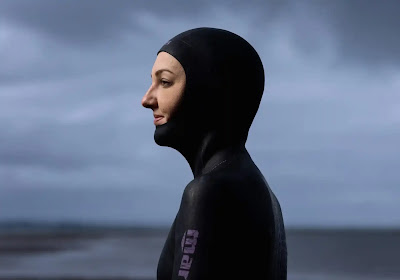

Amber Bourke, who says she got hooked on free diving and wanted to see ‘how deep I could go’, is now the Australian women’s pool and free diving champion. Photograph: David Kelly/The Guardian


Bourke had been a champion synchronised swimmer when she was a teenager, so already knew she could hold her breath for several minutes at a time. But discovering free diving “just opened my eyes to the possibilities … and I just got hooked on a feeling of diving deeper and wanted to see what I was capable of and how deep I could go.”


By 2018, Bourke had established herself as one of the best competitive free divers in the world, and in deep waters off the coast of the Philippines, was ready to attempt to break the women’s world record in the discipline of “constant weight no fins”.


Considered one of the most challenging forms of the sport, a diver descends vertically in deep water on a single breath, using only muscle strength to propel them downwards. With every metre of descent, the compressive pressure on the body increases, shrinking the spaces that contain air. By 30 metres down – the maximum depth physiologists in the early days of the sport thought humans were capable of reaching – the pressure exerted on the body is four times greater than on the surface and the volume of air inside the body has shrunk to one quarter. Once negative buoyancy is reached, the diver begins to freefall.
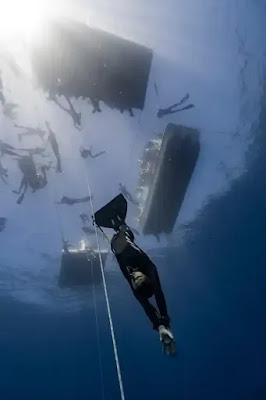

Even at 70 metres down, Bourke says she can still ‘bring in’ more air from her lungs. Photograph: Daan Verhoeven


Bourke reached a depth of 73 metres – a world record – but a split second blackout once she reached the surface disqualified her. “If you stay underwater long enough, there’s always the chance that your oxygen will drop to a level where your brain will decide to shut down in order to protect itself from brain damage,” Bourke says. “So, in a way, it’s a good thing … but frustrating at the end of a long dive.”


The men’s world record for “constant weight no fins” is 102 metres, taking four minutes and 14 seconds. With fins, it is 131 metres. For the discipline of “static apnea”, where a competitor doesn’t dive but just submerges themselves under water, the longest breath-hold is 11 minutes and 54 seconds. When 100% oxygen is breathed in prior to the attempt, the record is 24 minutes and 37 seconds.


Dr Anthony Bain, a vascular physiologist from the University of Windsor in Canada, has researched the physiology of extreme breath-holding – including conducting experiments with elite free divers – and says many of those at the professional level have larger lung volumes than the average person. Studies in native diving populations, for example the Bajau people in south-east Asia, “have also demonstrated larger spleens, which will theoretically allow for longer breath holds via splenic contraction and release of oxygen bound red blood cells”.


Primarily, however, the ability to survive while submerged for a prolonged time is a learned skill. According to Bain, studies suggest that elite free divers have “enhanced” their Mammalian Dive Response. Theorised to be an evolutionary adaptation – a vestige from billions of years ago when all life was aquatic – it’s a reflex that’s triggered when a mammal’s face comes into contact with water. It prompts a number of physiological responses that promote survival, such as the slowing of the heart rate and metabolism, and a redirection of blood to vital organs, including to the lungs to bolster them against pressure.


While Bourke doesn’t know if she has any innate physiological differences – she has never been tested – she knows that over a decade of training she has learned how to better use the space in her lungs. Even at 70 metres down, she can still “bring in” more air from her lungs.


Free diving is gaining popularity as a pastime, with schools popping up along the Australian coastline, but becoming an elite free diver takes patience.


Progression is slow – it often takes years to achieve several extra metres in depth, as the body becomes accustomed to pressure. “When I first dove to 30 metres deep, I really felt a lot of pressure on my body, and especially on my chest, it feels like you’re being crushed,” Bourke says. “But now, diving to 70 meters, I don’t feel that pressure at all.”
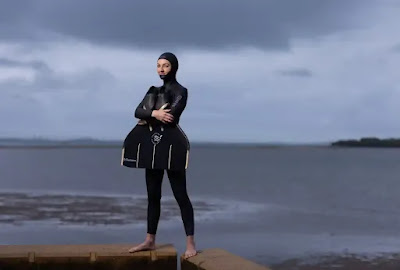

‘If you think about how long you’re planning to stay under water and how deep you’re planning to dive, then it’s easy to get overwhelmed and to panic,’ Bourke says. Photograph: David Kelly/The Guardian


The major adaptation though is psychological: developing a conscious ability to withstand the urge to breathe. 


According to Bain, an untrained person starts to undergo “involuntary breathing movements” after no longer than two to three minutes underwater, when the “body has barely desaturated with oxygen”. Elite free divers, however, are able to mentally push through this point, holding their breath until they “majorly desaturate their blood of oxygen”.


Among free diving instructors, like Clinton Laurence from the Gold Coast, who is also a clinical psychologist, psychological strategies such as mindfulness are key to training. “That is where you observe the thought, ‘I have to breathe’,” he says. “But you just observe it. ‘Yep, there’s that thought again. That’s OK.’ And you just keep going.”


Bourke says she enters a “meditative state” by slowing her breathing before she enters the water. Then, “it’s about maintaining that relaxed state, and for me, that’s really about staying in the moment and not thinking too far into the future, because if you think about how long you’re planning to stay under water and how deep you’re planning to dive, then it’s easy to get overwhelmed and to panic.”


While the pandemic has stalled most international competitions, Bourke is still training – she does long sessions swimming underwater in the pool around four times a week, plus working out in the gym – alongside her work as an electrician and a free-diving instructor. Once competition resumes, she’ll be back pursuing world records.


“When I first started, I was like, ‘I didn’t even know this was humanly possible’, but it’s just amazing what humans can do.”


(Source: The Guardian)

Sunday, 3 September 2017

Top diver’s death casts long shadow over deep beauty of the Blue Hole

The ‘underwater cathedral’ at the edge of the Red Sea is arguably the most perilous diving spot in the world – even for experts such as Dublin-born Stephen Keenan. What lies behind its fearsome reputation?

In the bars and cafes of Dahab this summer, one recurring observation has been made among the diving fraternity, a core constituency in this Egyptian coastal resort. “If it could happen to Steve, it could happen to anyone.”

Last month, Stephen Keenan, aged 39 and from Dublin, drowned while overseeing a dive by the freediving world record holder Alessia Zecchini. While attempting to cross “the arch” of the Red Sea’s notorious Blue Hole using only a single breath, the 25-year-old Italian became disoriented. Keenan rushed to her aid and guided her to the surface. She made it out unharmed but he blacked out and was found floating face down some distance away.

As a safety diver, Keenan was one of the best in the business. His death has cast a shadow over the summer and provided a stark reminder of the dangers involved in negotiating probably the most dangerous diving spot in the world

The Blue Hole is a 120-metre-deep sinkhole, five miles north of Dahab. Its nickname is the “divers’ cemetery”. Yet thousands continue to flock here each year, unperturbed by the increasing number of plaques that hang on the cliff opposite to mark those who never returned.

With no public record, it’s hard to say how many people have lost their lives. Divers in Dahab suggest as many as 200 in recent years. One man who doesn’t venture to guess is 53-year-old Tarek Omar. A technical diver from Dahab, Omar began exploring the Blue Hole in 1992, fascinated by tales of a curse laid upon it when an unwilling party to an arranged marriage drowned herself there. Omar rose to fame in 1997 when he retrieved the bodies of Conor O’Regan and Martin Gara. “They were the first bodies recovered from the Blue Hole.” Since then, he says he has pulled more than 20 bodies out of the water, earning himself the grim moniker “the bone collector”.

In recent years, as technical diving (a form of scuba that usually involves breathing special gas mixtures) has become more fashionable, Omar has witnessed a rise in the rate of fatalities. Deaths of freedivers such as Keenan are also a constant concern, with the sport growing in popularity since Luc Besson’s 1988 film The Big Blue, which brought it to the world’s attention.

Others maintain that as long as divers do their homework and exercise due caution, the Blue Hole’s fearsome reputation is undeserved. Instructor Alex Heyes says: “It just isn’t that dangerous.” Originally from Preston, Heyes, 32, moved to Dahab seven years ago and runs the H2O centre. She has dived the Blue Hole countless times and puts the high number of fatalities down to “people being idiots”. She maintains that most of the deaths are primarily the result of hubris. “People do 100 dives and think they know it all,” she says, “but they’re not prepared for that kind of depth. A bit of knowledge can be a dangerous thing.”

Many of those who died were attempting to swim under the arch. According to Heyes, this challenge is to scuba divers what Kilimanjaro is to hikers. Below 56 metres, the sea wall stops, revealing a cavernous, 26-metre-long tunnel from the Blue Hole to the open ocean. Those who descend 100 metres are faced with a 50-metre-high opening to the Red Sea. “It’s beautiful,” says Heyes. “There’s nothing else like it. It’s like standing in an underwater cathedral.”

But it can be disorientating. Divers have reported seeing light emerging from the tunnel and, believing it was the surface, have swum down to it. At this depth, it’s possible to succumb to a condition known as nitrogen narcosis, in which breathing gases at high pressure causes mental, and sometimes physical, impairment. According to Dr James Caruso, the chief medical examiner for Denver, Colorado and an avid scuba diver, narcosis is often called the “martini effect” where “as the diver goes deeper, the intoxication increases in a similar fashion to drinking more alcohol”.

 A freediver at the Blue Hole, a 120-metre-deep sinkhole near Dahab which has claimed many lives.
Photograph: Alamy Stock Photo

Much like alcohol, it affects everyone differently, but Caruso says, “no one is immune from the symptoms and if a diver goes deep enough, he or she will lose consciousness”. Add this to oxygen poisoning, where the gas becomes toxic under high pressure, and anyone continuing to breathe at this depth is on borrowed time.

It’s possible to counteract these effects with specialised equipment. Technical divers, such as Omar and Heyes, frequently swim under the arch, but it’s an expensive hobby requiring lots of training, and many are unwilling to put in the hours. As Omar puts it: “They want to get into deep water, before they get into deep knowledge.”

Yuri Lipski was one of these. Probably the most famous scuba death in the Blue Hole, the Russian-Israeli diving instructor became a household name in diving circles in 2000 after filming his own demise on a helmet camera.

Omar met Lipski one hour before his dive. “He wanted to film the arch,” says Omar. “I said ‘OK, so you’ll need two weeks’ training with me first, and then we’ll film’.” With only a weekend in town, Lipski turned down Omar’s offer and set off alone.

A YouTube video, viewed almost 10 million times, shows Lipski’s final moments. Almost immediately, he strays from his diving buddy and begins to descend fast. “He was too heavy for his buoyancy device,” says Omar, who thinks the extra weight of a camera might have tipped the balance. “He passes the point where narcosis sets in and by 80 metres, he’s under the control of the sea.” The video ends seven minutes in when a thrashing Lipski pulls out his regulator. The following morning, Omar retrieved his body from 92 metres down.

Safety precautions are being steadily introduced as the sport develops a system of self-regulation. Although some dive centres continue to permit trips under the arch for single-tank scuba divers, they’re part of an increasingly unpopular minority. Unqualified divers are now forbidden by law from entering the Blue Hole at all. With more common sense rules being enforced, Heyes reckons the so-called “divers’ cemetery” deserves a new name. “If you look at recent deaths worldwide, the Blue Hole is way down,” she says. “Even if you compare Egypt and the UK, I think the UK is probably up now.”

But as divers continue to push the limits of the sport, new dangers are never far behind. Omar says he has never believed in the curse of the Blue Hole, but after 20 years of fishing bodies out from it, he is convinced of one thing. “The people who dive here,” he says, “have created their own curse.”

(Source: The Guardian)