Showing posts with label home. Show all posts

Friday, 10 December 2021

Why kids should use their fingers in Math class

Evidence from brain science suggests that far from being “babyish,” the technique is essential for mathematical achievement.

A few weeks ago I (Jo Boaler) was working in my Stanford office when the silence of the room was interrupted by a phone call. A mother called me to report that her 5-year-old daughter had come home from school crying because her teacher had not allowed her to count on her fingers. This is not an isolated event—schools across the country regularly ban finger use in classrooms or communicate to students that they are babyish. This is despite a compelling and rather surprising branch of neuroscience that shows the importance of an area of our brain that “sees” fingers, well beyond the time and age that people use their fingers to count.


In a study published last year, the researchers Ilaria Berteletti and James R. Booth analyzed a specific region of our brain that is dedicated to the perception and representation of fingers known as the somatosensory finger area. 


Philippe Lissac / Godong / Corbis


Remarkably, brain researchers know that we “see” a representation of our fingers in our brains, even when we do not use fingers in a calculation. The researchers found that when 8-to-13-year-olds were given complex subtraction problems, the somatosensory finger area lit up, even though the students did not use their fingers. This finger-representation area was, according to their study, also engaged to a greater extent with more complex problems that involved higher numbers and more manipulation. Other researchers have found that the better students’ knowledge of their fingers was in the first grade, the higher they scored on number comparison and estimation in the second grade. Even university students’ finger perception predicted their calculation scores. (Researchers assess whether children have a good awareness of their fingers by touching the finger of a student—without the student seeing which finger is touched—and asking them to identify which finger it is.)


Evidence from both behavioral and neuroscience studies shows that when people receive training on ways to perceive and represent their own fingers, they get better at doing so, which leads to higher mathematics achievement. The tasks we have developed for use in schools and homes (see below) are based on the training programs researchers use to improve finger-perception quality. Researchers found that when 6-year-olds improved the quality of their finger representation, they improved in arithmetic knowledge, particularly skills such as counting and number ordering. In fact, the quality of the 6-year-old’s finger representation was a better predictor of future performance on math tests than their scores on tests of cognitive processing.


Many teachers have been led to believe that finger use is useless and something to be abandoned as quickly as possible.


Neuroscientists often debate why finger knowledge predicts math achievement, but they clearly agree on one thing: That knowledge is critical. As Brian Butterworth, a leading researcher in this area, has written, if students aren’t learning about numbers through thinking about their fingers, numbers “will never have a normal representation in the brain.”


One of the recommendations of the neuroscientists conducting these important studies is that schools focus on finger discrimination—not only on number counting via their fingers but also on helping students distinguish between those fingers. Still, schools typically pay little if any attention to finger discrimination, and to our knowledge, no published curriculum encourages this kind of mathematical work. Instead, thanks largely to school districts and the media, many teachers have been led to believe that finger use is useless and something to be abandoned as quickly as possible. Kumon, for example, an after-school tutoring program used by thousands of families in dozens of countries, tells parents that finger-counting is a “no no” and that those who see their children doing so should report them to the instructor.


Stopping students from using their fingers when they count could, according to the new brain research, be akin to halting their mathematical development. Fingers are probably one of our most useful visual aids, and the finger area of our brain is used well into adulthood. The need for and importance of finger perception could even be the reason that pianists, and other musicians, often display higher mathematical understanding than people who don’t learn a musical instrument.


Teachers should celebrate and encourage finger use among younger learners and enable learners of any age to strengthen this brain capacity through finger counting and use. They can do so by engaging students in a range of classroom and home activities, such as:


Give the students colored dots on their fingers and ask them to touch the corresponding piano keys:


youcubed.org


youcubed.org


Give the students colored dots on their fingers and ask them to follow the lines on increasingly difficult mazes:


(The full set of activities is given here.)


The finger research is part of a larger group of studies on cognition and the brain showing the importance of visual engagement with math. Our brains are made up of “distributed networks,” and when we handle knowledge, different areas of the brain communicate with each other. When we work on math, in particular, brain activity is distributed among many different networks, which include areas within the ventral and dorsal pathways, both of which are visual. Neuroimaging has shown that even when people work on a number calculation, such as 12 x 25, with symbolic digits (12 and 25) our mathematical thinking is grounded in visual processing.


A striking example of the importance of visual mathematics comes from a study showing that after four 15-minute sessions of playing a game with a number line, differences in knowledge between students from low-income backgrounds and those from middle-income backgrounds were eliminated.


Number-line representation of number quantity has been shown to be particularly important for the development of numerical knowledge, and students’ learning of number lines is believed to be a precursor of children’s academic success.


Visual math is powerful for all learners. A few years ago Howard Gardner proposed a theory of multiple intelligences, suggesting that people have different approaches to learning, such as those that are visual, kinesthetic, or logical. This idea helpfully expanded people’s thinking about intelligence and competence, but was often used in unfortunate ways in schools, leading to the labeling of students as particular type of learners who were then taught in different ways. But people who are not strong visual thinkers probably need visual thinking more than anyone. Everyone uses visual pathways when we work on math. The problem is it has been presented, for decades, as a subject of numbers and symbols, ignoring the potential of visual math for transforming students’ math experiences and developing important brain pathways.


It is hardly surprising that students so often feel that math is inaccessible and uninteresting when they are plunged into a world of abstraction and numbers in classrooms. Students are made to memorize math facts, and plough through worksheets of numbers, with few visual or creative representations of math, often because of policy directives and faulty curriculum guides. The Common Core standards for kindergarten through eighth grade pay more attention to visual work than many previous sets of learning benchmarks, but their high-school content commits teachers to numerical and abstract thinking. And where the Common Core does encourage visual work, it’s usually encouraged as a prelude to the development of abstract ideas rather than a tool for seeing and extending mathematical ideas and strengthening important brain networks.


To engage students in productive visual thinking, they should be asked, at regular intervals, how they see mathematical ideas, and to draw what they see. They can be given activities with visual questions and they can be asked to provide visual solutions to questions. When the youcubed team (a center at Stanford) created a free set of visual and open mathematics lessons for grades three through nine last summer, which invited students to appreciate the beauty in mathematics, they were downloaded 250,000 times by teachers and used in every state across the U.S. Ninety-eight percent of teachers said they would like more of the activities, and 89 percent of students reported that the visual activities enhanced their learning of mathematics. Meanwhile, 94 percent of students said they had learned to “keep going even when work is hard and I make mistakes.” Such activities not only offer deep engagement, new understandings, and visual-brain activity, but they show students that mathematics can be an open and beautiful subject, rather than a fixed, closed, and impenetrable subject.


Some scholars note that it will be those who have developed visual thinking who will be “at the top of the class” in the world’s new high-tech workplace that increasingly draws upon visualization technologies and techniques, in business, technology, art, and science. Work on mathematics draws from different areas of the brain and students need to be strong with visuals, numbers, symbols and words—but schools are not encouraging this broad development in mathematics now. This is not because of a lack of research knowledge on the best ways to teach and learn mathematics, it is because that knowledge has not been communicated in accessible forms to teachers. Research on the brain is often among the most impenetrable for a lay audience but the knowledge that is being produced by neuroscientists, if communicated well, may be the spark that finally ignites productive change in mathematics classrooms and homes across the country.


(Source: The Atlantic)

Saturday, 6 February 2021

Pinch of irony: As Indian restaurants embrace home food, home cooks are recreating restaurant dishes

 A new cooking culture is simmering in India.

Among the many delicious conversations I have with chef-friends are candid chats about who ate what where and how it tasted. These are honest conversations, unvarnished, untempered by politeness. They are not meant to be repeated, least of all in my food writing. This, then, is an exception.


Last winter, as I sat chatting with Manish Mehrotra, India’s top chef at the helm of the restaurant Indian Accent, he told me about a “perplexing” dahi bada he had recently eaten at the home of an acquaintance. It was a healthy version, he explained, stuffed with moong sprouts. “I kept wondering, how did she do it – fillit with so much stuff?” he said, to which I replied with a dismissive, “but dahi ki gujiya is also stuffed, no…”


The Bombay Canteen/Facebook


That dahi bada was unique, Mehrotra assured me. Unlike dahi gujiya, which is not stuffed that much (with chironjee, coconut and raisins), this one seemed a technical impossibility. It was stuffed to the gills with the healthy stuff but remained miraculously intact after the deep-frying. Mehrotra asked the homemaker for the hack, which when I heard, left me gasping at its ingenuity: a gol gappa filled with those sprouts had been buried inside the lentil paste. When the bada was fried, the wafer-thin walls of the gol gappa dissolved, leaving a perfect stuffed bada, crunchy outside, full of redeeming vitality inside.


Mehrotra subsequently adopted this hack and used it to experiment with other less virtuous fillings, including keema (inspired by the homely Rajasthani dish of keema tikiya served with yoghurt) and now does stuffed dahi bada counters at some of his caterings. The dahi bada (in yet another avatar) has even made it to his new tasting menu at the Indian Accent – a menu devoted to gentrified chaat as it is made, not necessarily on the street, but in homes with better ingredients, restrained masalas and dollops of inventiveness.


Manish Mehrotra's Indian Accent elevates home food to a new level of sophistication. Credit: Indian Accent Restaurant/Facebook.


For some years now, top chefs in Delhi, Mumbai, Goa and Bengaluru have been paying homage to home food by putting it on their restaurant menus. Whether serving Sindhi kadhi and arbi tuk or kathal ki tahiri (called biryani usually) and Goan caldin, some of the trendiest restaurants in the country make it a point to tell us how their chefs deep-dived into memories of their homes and those of others to recreate regional dishes that could never be found on commercial menus before.


Pinch Of Irony

The trend of putting homely bathua and yams, yakhni pulao or a fish recipe from the matriarchs of a specific Kerala village on restaurant menus is barely five years old. It turns on its head a much longer convention of Indian restaurant food being a separate genre in itself – unlike food cooked in our homes – with dishes like dal makhni, butter chicken, tandoori broccoli, tomatoey rogan josh, or a coconutty sludge in the name of Goan fish curry. This restaurantisation of regional recipes decimates the tyranny of the dishes liberally laced with GG (ginger garlic) paste and garam masala or chaat masala.


Metropolitan foodies are pleased with this transition. They have found new heroes in Thomas Zacharias of The Bombay Canteen (who makes it a point to highlight his regional inspirations), Prateek Sadhu of Masque (recreating his native Kashmiri food in his stylised, technique-perfect restaurant food), Amninder Sandhu (championing old ways of cooking on woodfire), apart from Mehrotra and others.


Even in London, chefs like Asma Khan of Darjeeling Express, Sameer Taneja of Benares (who has overturned the paradigm of the Frenchified Indian restaurants), Sriram Aylur of The Quilon (a vocal champion of coastal Indian food) have been winning over a newer audience by serving a more nuanced understanding of Indian gastronomy than curry or salmon tikkas entailed.


At Arth, chef Amninder Sandhu championed old ways of cooking on woodfire. Credit: Amninder Sandhu/Facebook.


However, while Indian restaurants finally underline the cooking of our home, ironically, pandemic-era home cooks themselves are aspiring to cooking food that is more “restaurant like”.


“Pandemic cooks have now graduated to becoming chefs,” said chef Ranveer Brar, tongue-in-cheek. Brar, a celebrity chef whose cooking shows on TV and social media are highly popular, notes the change in recipes preferred by his audience in the last eight months. At the beginning of the pandemic, as middle India took to cooking with a gusto, there were many beginners demanding simple recipes. Now, Brar says, this lot has become more confident in its skills and there is a hunger for generic restaurant-style dishes that can be cooked at home. “Things like the perfect burger, the perfect pasta… because people now feel creating these restaurant dishes is achievable and also because they miss this food,” he said.


While 50% of his audience, Brar contends, is now demanding street-food recipes like paani puri or chole bhaturey, 20% seems interested in Indian mithais (“since they have been scared of going to halwai shops”), and 30% wants to learn to cook generic restaurant food at home.


Sanjeev Kapoor, India’s best-known chef, who launched three online cooking courses during the pandemic, supports this hypothesis. “Of the three classes, the one with restaurant-style food has the maximum traction,” he said. “Even on Food Food [his TV channel], we have increased the frequency of content from hotels with restaurant-style food.” In fact, a cursory examination of the dozens of YouTube food channels floated in the last six months by amateur cooks throws up catchy captions like “Restaurant jaisa paneer chowmein banana ki vidhi (how to cook restaurant style paneer chowmein)”.


According to chef Ranveer Brar, there is a hunger among new home cooks for generic restaurant-style dishes. Credit: Ranveer Brar/Facebook.


Cooking Like Heston

Unlike in many countries where eating out is more frequent, in India, most homes cook regularly and cheaply (the current average of eating out, including coffee breaks, is about thrice a week, according to a National Restaurant Association of India study). The pandemic seems to be adding to this lifestyle by elevating cooking from being something functional to something of an entertainment too. This may explain the current aspiration cutting across social strata to cook more restaurant-like food.


For the privileged, of course, food has often been entertainment – India’s deep culinary traditions include royal or aristocratic cuisines, as well as middle-class party cooking of the 1980s that included dishes like veg au gratin in slushy white sauce or dum aloo. But millennial preoccupations with “authenticity” meant that in the last decade or so, such privileged entertainment too changed and show-off dishes on dining tables tended to be defined more by heritage than restaurants. Now, this equation is in a flux again.


While some home cooks aspire to create older generic restaurant-style dishes, those who consider themselves gourmands want to cook up signature dishes of the world’s top chefs. Internationally, pandemic pastimes of the elite have included cooking complicated Heston Blumenthal or Massimo Bottura recipes or putting together their meal kits. Many celebrated chefs have even launched or relaunched DIY kits in the hope of saving their luxury businesses and adding a revenue stream to cope with pandemic-induced losses.


Shivani Maitra, a partner with Deloitte in London, told me about a unique intimate dinner she was invited to at a friend’s home that involved cooking from Blumenthal’s kits, while a chef from Blumenthal’s team demonstrated alongside online. “We paid £75 per person for each kit and £75 for delivery since we had to send a cab to pick up the kits from the restaurant,” she said. “So that is about £100 per person for a DIY meal, with the wine being ours. Still, it was Heston’s.”


Prestige DIYness

Perhaps influenced by these new global formats, those who think of themselves as discerning in Delhi and Mumbai too seem to be looking at this kind of prestige cooking. Through the pandemic, I have received occasional queries from people wanting to know if such and such top chef will be willing to cook online alongside a “foodie” and teach his or her signature recipe as a special-occasion treat.


Unlike Blue Apron and other popular DIY meal kits internationally, meal kits in India had never taken off as a business because they were pitched as something functional. In a country where most homes managed to cook fresh meals relatively cheaply daily, the kits were not viable. However, with prestige cooking emerging as niche entertainment, top chefs and restaurants are pitching creamy restaurant-style khao suey, spicy kottu parotta and duck kebabs in snazzily packaged kits to the elite “foodie”.


The food at The Quilon, London, is a reflection of its chef, Sriram Aylur, a vocal champion of coastal Indian food. Credit: The Quilon/Facebook.


In fact, some kits have emerged as handy options for those travelling to hill stations or beach getaways in quiet cottages in the last few months. Reluctant to eat out, many families have nevertheless been simulating restaurant meals via these kits.


Special occasion cooking in homes may in fact be changing decisively with this kind of prestige cooking. This Dussehra, I broke my family tradition. Instead of frying aloo ki kachori, a rather unique festive dish my mother still cooks annually, I sat at the dining table plating up pulled pork phulka tacos from a DIY kit launched by Makery.in. The taco is of course Indian Accent’s signature dish. I knew I could never approximate the dainty prettiness of Mehrotra’s restaurant creation. Yet, it seemed a worthy pursuit. For Rs 2,000, the brunch for three involved tossing the pre-cooked meat in masala, grilling half-done phulkas on the tawa, and then layering these with lemon cream, tamatar chutney, potato salli, pickled cabbage and other condiments that came neatly in little paper cups. Not cheap, not too expensive either. Yeah, I would do it again.


We don’t know yet for how long this kind of entertainment will keep us in its thrall. Yet, even when we begin to escape our isolation, this aspiration towards restaurant-ness at home, whether at the level of a chowmein stall or World’s 50 Best, means that a new cooking culture is simmering.


(Source: Scroll)

Sunday, 1 November 2020

The Russian stove: More than just heating

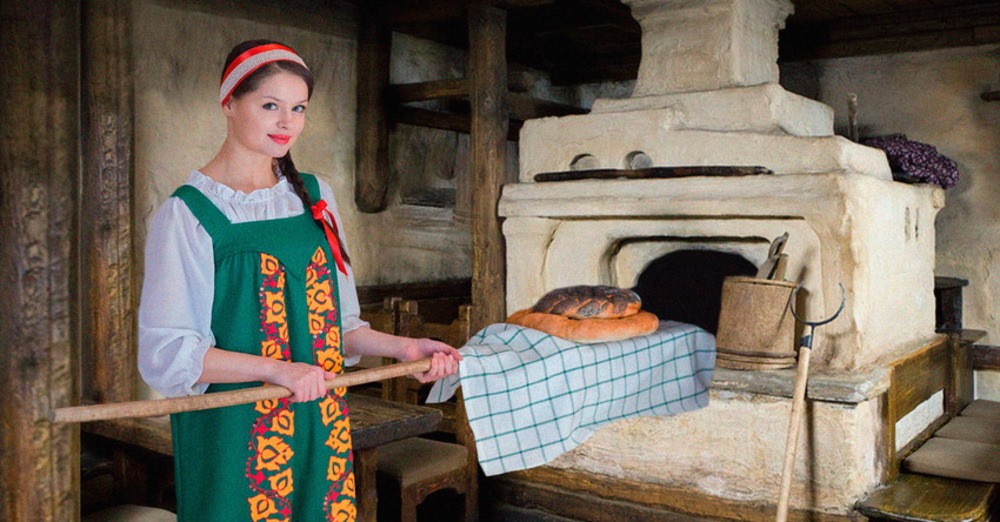
The Russian stove has always been more than just a source of heating. It is an element of culture, a sleeping place, a character in fairy tales and the focal point in a traditional Russian house. Find out who was fond of lying on the stove, in which part of the stove the household spirits lived and why unmarried girls hid behind the stove.

The two most famous Russian fairy tale characters - Ilya Muromets and Yemelya - are inextricably linked with the Russian stove. The former lay on a stove for 33 years until he was endowed with magical heroic powers and sent to fight evil. The latter never left the stove and rode it like a convertible. The stove entered folklore for a reason: Practically until the middle of the last century, it was the focal point around which Russians’ everyday life revolved.


The heart of the house

The stove is the warmest place in a house. To lie on it, feeling warm and cozy and for once idle was the ultimate dream for a peasant. During the winter months, that was the place where peasants spent most of their time. Interestingly, the place on the stove was reserved only for men: either the head of the family or an elder. Whereas women’s job was to keep the stove warm, cook and do other household chores. As for children, they were allowed to climb onto the stove only for a short time, for fun, and only with the permission of adults.


The stove features in numerous Russian literary works like, for example, in Maxim Gorky’s My Childhood:


“I slept on the floor between the stove and the window. There was not enough room, so I had to put my feet in the oven and the cockroaches used to tickle them. This corner allowed me not a little malicious enjoyment, for, when cooking, grandfather was continually breaking the window with the end of the oven-rale, or the poker…”


The stove usually had a “women’s corner”, known as a kut, where men were not allowed in. That was where dishes were kept and where women did their needlework. Often, the kut was separated from the main part of the hut by a special curtain. It was behind that curtain that brides hid before their wedding, women gave birth and breast-fed.


When building a new hut, the first thing to do was to design a stove, and only then everything else. Hence the Russian expression “to dance from the stove”, meaning to begin at the beginning. The stove features in many Russian proverbs, for example: Станешь лежать на печи, так не будет ничего в печи (“If you keep lying on the stove, there will be no food in it”); Хочешь есть калачи, так не лежи на печи (“If you want to eat rolls, don’t lie on the stove”).

What was the stove like?


The Russian stove developed its familiar look approximately in the 15th century. In different parts of the country, stoves could differ in terms of what they were made of (stone or clay) and what fuel they used (mostly firewood, but it could also be dung cakes, straw or peat).

The stove is the main element of the interior in a traditional Russian house. Old stoves could occupy almost half the room. Wooden benches that were used for sleeping were stretched from the stove to the opposite wal.

Stove building was an important element of Russian life. Stove-makers were much in demand and enjoyed much respect, as their job required a lot of knowledge and skill. 

The main part of the stove is the hearth, or the combustion chamber, where the firewood is burnt. The hearth was also used for cooking: clay or cast-iron pots were put inside the hearth when the stove was still burning. It was usually done with special oven forks, which can be found in any Russian ethnography museum. Some stoves had hearths large enough to have a bath inside.


Directly under the hearth is a special recess, known as hearth bottom, where bread was also baked. Dough was put inside when the stove was still hot to get a crispy crust, and was left inside when the fire was already out until it was ready. Stoves were also used for preparing baked milk (click here to find out more about this unique Russian drink).

The sleeping place on the stove (known as perekryshka) was usually located right under the ceiling, where the air was the warmest. Even when the fire was already out, the stove would take a very long time to cool, so food and water could be heated in and on it. Usually, there were small niches in the stove that were used for drying or storing food, like mushrooms or herbs, or for putting away clothes or shoes.


Firewood, a poker and other appliances were usually kept by the fireside, which was also the favorite place of mice and cockroaches. That was also where various unused items were usually stored.


In well-to-do households, stoves were decorated with painted clay tiles. This craft became particularly popular in the late 19th and early 20th century, with the fashion for the so-called ‘Russian Style’. This decorative element still remains popular. Click here to find out more about Russian stove tiles.


Mystical and practical significance of the Russian stove

Superstitious Russian peasants believed that household spirits lived behind or under the stove. It was believed that stoves could heal, so sick people would lie on a stove in the hope of a speedy recovery. Also, stove steam was used for inhalations, as it was believed to possess medicinal properties. Stove ash was not thrown away but used for making ointments, decoctions as well as for more mundane purposes, as soap and bleach for clothes.


Stoves were lit with the onset of cold weather: from October till April or May. Russians always had many signs and superstitions about the weather, and stoves were one of the sources of their weather forecasts. If the draft was strong or the fire red, one could expect frosty weather. Whereas, if the firewood was burning quietly and the fire was white, a thaw was on the cards.


The stove today

From the mid-19th century, massive Russian stoves began to give way to compact Dutch brick stoves. The latter not only took up less space, but had a much simpler design. One could not lie on them, but they had a small platform on top for preparing food, like a cooker.


These days, the traditional Russian stove has become a rarity and can only be found in museums. Whereas, its smaller and simpler Dutch variety is still in use in villages today.


(Source: Russia Beyond)

Thursday, 23 July 2020

By bike, boat and horseback: Epic coronavirus journeys home


With flights grounded and borders closed, some people have embarked on epic voyages to get home during the coronavirus pandemic.


Here, we take a look at four such journeys - and the distances travelled just get longer and longer.


Annabel Symes: 1,600km (1,000 miles)


Annabel Symes' journey included a half-day horseride. FOREIGN & COMMONWEALTH OFFICE


British teenager Annabel Symes was working as a volunteer on a remote horse and cattle ranch in Argentine Patagonia when her flight home was cancelled because of coronavirus travel restrictions.


It meant that Annabel was at the ranch as the region's winter season was setting in, when temperatures can drop below 0C.


The 19-year-old had planned to return home at the end of the summer season and had only packed light clothing.


Growing increasingly anxious, she called the UK Foreign Office, who organised a way for her to travel the more than 1,600 km to Buenos Aires airport, where she could get a flight home.


The first leg of the journey saw Annabel and her partner travel for half a day on horseback to the nearest road, with mules carrying their bags.


She then took a nine-hour taxi ride to the nearest town. At checkpoints along the way, her temperature was taken and the vehicle was sprayed with disinfectant.


The drive was followed by an arduous 17-hour bus journey to the airport.


"The horse part was the least frightening," she told The Argus newspaper after returning home.


"The scariest bit was being thrown back into civilisation and into a world with coronavirus and seeing other people wearing face masks and having their temperatures read at checkpoints. It was a really high-stress situation."


Kleon Papadimitriou: 3,200km


Kleon Papadimitriou said he welcomes "big challenges”. KLEON PAPADIMITRIOU


Student Kleon Papadimitriou said a "multitude of factors" led him to pick up his bike and cycle from his university in Scotland back to his home in Greece.


Flights had been cancelled because of the pandemic and the lease on his flat in Aberdeen was running out. But the 20-year-old said he also welcomes "big challenges" and thought a bike ride home to his family would help him test his limits.


"I wanted to challenge myself and I had nothing else to do," he told the BBC.


Prior to the trip, Kleon had only ever cycled "to get around". But he was confident that he was fit enough to make the journey.


Armed with food, a sleeping bag and tent, he set off in May on the 48-day voyage to Athens.


He said he designed his itinerary taking into account travel restrictions and did not have any problems in crossing borders.


While the 3,200km trip left him exhausted at times, he said loneliness was the most difficult challenge he faced.


"I struggled a lot with the time that I spent by myself," he recalled. "I also had some issues with my bicycle - I got flats relatively often and had to deal with that."


But there was much to keep the student occupied.


"I saw amazing terrain, I discovered amazing places, I saw people and beautiful things," he said.


Kleon arrived home in late June, where he was greeted by family, friends, acquaintances and strangers who had heard about his trip.


He said the journey taught him that he is "capable of a lot more... than I thought" and is now better able to deal with stressful situations.


But he plans to make the return journey back to Aberdeen in September by plane.


"It was a big learning experience but if I'm to cycle again I won't do the same route."


Garry Crothers: 6,500km


Garry Crothers said being an amputee made the journey even more challenging. SUPPLIED


Garry Crothers was determined not to miss his youngest daughter's wedding, so when flights were grounded he decided to make the 6,500km journey home by sailing solo across the Atlantic.


Garry had been sailing around the Caribbean on his boat, Kind of Blue, since early 2019, with friends and family joining him at various points along the way.


He was due to fly home to Northern Ireland at the end of March, in plenty of time to see his youngest daughter marry in September.


But when coronavirus hit, the 64-year-old found himself stuck on his boat in Sint Maarten, with no obvious way to get out.


As lockdown measures continued into April and hurricane season approached, he started devising a plan to get back home, concluding that the only way to do it was to sail solo.


While a journey across the Atlantic with no crew might sound daunting enough, Garry faced the added challenge of doing it with just one arm, having had the other amputated following a motorbike accident.


"Sailing long distance, single-handed is a challenge for anyone, even those with two arms. You have to prepare well, have a contingency plan for every contingency," he said.


One of the biggest challenges of the 37-day voyage was finding time to cook and eat.


"Because I was on my own, any down time was spent looking at weather patterns, trimming sails, altering course as necessary, keeping look out for other vessels and of course trying to catch some sleep," he said.


"My biggest fear was of becoming so fatigued that I would start making mistakes. Just one bad judgement call could likely be my last."


While the journey included struggles such as cold weather and "fierce electric storms", Garry enjoyed watching shooting stars and seeing whales and dolphins.


But the greatest highlight "was the satisfaction that came from overcoming my disability enough to achieve something that I'd always wanted to do."


When he arrived on dry land in July, he was greeted by friends, family and supporters.


He now has about two months before his daughter's wedding. The family are still hopeful that it will go ahead, even if the guest list has to be cut down.


Juan Manuel Ballestero: 11,000km


Argentine sailor Juan Manuel Ballestero said it was "mission accomplished" after making it home to his parents. AFP


Argentine sailor Juan Manuel Ballestero found himself stuck in Portugal when flights home were grounded because of coronavirus.


With his father about to turn 90, he was determined to make it home, so boarded his modest 9m boat and set sail.


"I thought the best way to reach home was sailing in a straight line in the middle of the ocean to prevent getting infected in another country," he told the BBC's Newsday.


"I didn't prepare myself. I just jumped on board with a bunch of food. I forgot medicine."


The 47-year-old seasoned sailor thought the trans-Atlantic journey might take between 60 and 80 days. In the end, he was alone at sea for 85 days with only his radio for company.


"It was really myself and the whole universe... at night there [were] a lot of stars and sometimes the dolphins would come at night too so they streaked the ocean with green fluorescent light," he said.


While Juan did not make it in time for his dad's 90th birthday, the pair did get to spend Father's Day together after Juan arrived in his hometown of Mar del Plata in June.


"We are sailors. It was another mission accomplished," Juan said of the voyage.


(Source: BBC)

Tuesday, 5 May 2020

No shelter

“It’s an elegy for New York,” my friend texts me. She’s just finished my book. It’s the end of February. We find barstools at a packed restaurant bar before a reading at St. Mark’s Church. “We’re ordering months of medication in case the supply chain fails,” she says, “and hand sanitizer—and masks. Masks, can you believe it.” 

Like me, she and her husbands are journalists, they’re hearing things from some of our friends in the field. She tells me she thinks people will still read the book, words of reassurance that only provoke anxiety. I think she sounds paranoid, like she’s speaking from a place of some dark cultish extremism.

The next two weeks change the world. Schools close. We need to rush the audiobook recording into three days, taping over the weekend. I take the subway for the last time, without knowing it, one of only three people in the entire car. Days before, I’d waited on a crammed platform for a train so jammed with bodies we couldn’t all press aboard. Now it feels like a late night in the early nineties, a city of emptiness and dread. It’s warm out, but I wear gloves, tiny red ones that belonged to a friend’s grandmother, calfskin from a different century that had known different fear and trauma and loss. 
© JEFF MCCOLLOUGH (ADOBESTOCK)

The sound engineer lets me into the building, squeezes nervously into the far corner of the elevator on the way up to the studio. We finish the recording Sunday evening. I wait in a supermarket line for an hour and a half and hoist home whatever I can carry. I write an article about homeless college students who have nowhere to go.
The book couldn’t come out in the fall; the fall news cycle would be too busy, the election too much of a distraction. April would be perfect. We would publish in time to do university events, but still close enough to the Democratic National Convention, when social issues, like the ones my book explores, would be on the forefront of discourse. The safety net. Housing. Childcare. The minimum wage. The cost of college. Race. Gender. My book follows Camilla, a young criminal justice student, through her first year of single motherhood, and the entire constellation of factors that keep her homeless, despite her tenacity, her ambition, her blade-sharp mind. I wrote this book like a zealous missionary, to grab people by their lapels, to make them feel the irreversible curse of being born poor in America. April was worth the abbreviated marketing schedule, worth the last-minute squeeze into the catalogue.

Justin, my husband, takes photos of the brokers packing up their computers at the stock exchange. Guards had taken his temperature before they allowed him to enter the building. Normal. But that night his fever spikes. We quarantine from him in the house; he takes the bedroom, I sleep on the living room floor. He changes his clothes before he leaves the bedroom, wears gloves in the kitchen and bathroom, sleeps for two days. My breathing shortens, I feel a boot heavy on my chest.

During the day, I report. Between interviews I tend to Dahlia, who is desperate for my attention and some semblance of solidity. She’s twelve, navigating her first breakup alongside her first global crisis, while her parents are sick. At night, I’m sleepless, processing the scale of what’s happening. My insomnia gradually pivots to my book. I feel drenched in shame for even thinking about it. The next evening, I completely lose it and scream at Justin and Dahlia like a mother out of Albee.

*

Morning. I’m bleary and breathless on the living room floor. I reach for my phone. There’s a text from my editor: Blessedly, we’re moving publication, to a time a bit later this year when the earth is back on its axis. I take the deepest breath I have in days, my chest suddenly unencumbered. At least this will be okay. An hour later: I have just been told that our April directive (that I wrote you about an hour ago) may be changing. Please stand by. It’s days before the phone rings to inform me of the publisher’s decision. Over those days, I hear that Amazon will not be shipping books as part of their focus on essential goods. All my beloved bookstores have closed.

I’d been patient: My editor got tied up in another project after I submitted my draft. Finally, I got notes. I revised. I waited. And just as I was anticipating my next round of edits, the imprint that had acquired my book was shuttered after its most successful year ever. My venerated and venerable editor, a cofounder of the imprint, was out of a job; my book was orphaned. So began a spell waiting to see which editor would be assigned the book at a different imprint. And then nine months awaiting edits on that year-old second draft, only to be rushed into production, squeezed last minute into the catalogue, so it could come out this April. Publishing.

Privileged problems to have. Our savings had been drained by this book process, but my life was anchored way above the line. My anxiety could crackle through a home to which I held a mortgage, my insomnia borne out beside a committed coparent. I felt left behind by New York’s Gilded Age, but that was in part by choice: to be a writer, and to write about inequality.

The women I’d met at the Brooklyn shelter where I was reporting had no such choices. Privilege is an inheritance game. They were, for the most part, born poor. And over their young lifetimes, the struggle of poverty had become a tightening noose. These were young women who, for the most part, didn’t grow up in shelters. During their childhoods, a Section 8 check could pay the rent, and rents, while untenable, weren’t yet entirely infeasible, even at minimum wage. No longer. Each of them had found themselves alone, with the crushing responsibility of new motherhood, in the shelter on Fourth Avenue. The shelter, and its soup kitchen, was mainly run by volunteers, who stopped coming once the coronavirus threat became a dire reality. The soup kitchen had served its last meal the week before.

Back when I reported at the shelter, the buildings nearby were unveiling their offering plans, which included pet spas and stroller concierge service. I followed my subjects through the vast labyrinth of our failed social service system: the welfare offices where people would wait for days on end to settle a single check; the NYCHA offices where they’d vainly apply for subsidized apartments; the WIC offices where the size of a check was dependent upon whether a mother could still nurse her baby. Beyond the system were the bodegas and supermarkets that took EBT cards, the miles of subway track that led to the end of each line, and the buses that ferried New Yorkers far beyond the city’s glittering nucleus. I watched these women shoulder the heavy yoke of administrative burden; I was a witness to what it meant to lose a public assistance case for reasons of bafflingly inconsistent policies, or a letter that got lost in the mail. I watched it happen to my protagonist who was as organized and prepared to take on the system as anyone I’d known; a woman who, as a teenager, had sued her parents for child support and won.

I saw how literally impossible it was to find stable housing in a city that had handed ten billion dollars of tax abatements to billionaires, a city that housed more millionaires than anywhere else, where even if a so-called affordable apartment came up in the lottery—a lottery for housing, my god—as it did for my protagonist, the minimum income was unattainable for anyone under the line. That was during New York’s age of unprecedented prosperity, of skyscraping new developments, of luxury everything, when the people in power decided to shred our safety net instead of strengthening it. In January, 62,679 people found a bed in city shelters, and thousands more slept in private shelters—or on the street. How many will there be now? How many will there be the next time we’re all instructed to stay “home”?

 *

The call comes the next day. They’re going ahead with the book. The pipeline is open, that’s the way they put it. The printer in North Carolina is printing books. The warehouse is shipping them. Amazon will keep stocking and selling, and so will a direct distributor. Fall will be just as bad, perhaps. I ask what the plan will be should North Carolina close essential businesses. We see no sign of that happening, I’m told, not the way the virus is spreading. In my best good-girl voice, I inquire if it might be possible to look into what will happen if the printer shuts down and if Amazon stops selling books. 

I think about the Amazon warehouse worker I interviewed, who described how in the crammed warehouse there was no space to escape her colleagues’ coughs and sneezes, how Amazon refused to supply masks and gloves. I feel complicit and conflicted.
It’s no relief to realize this book is more relevant than I’d known when I was writing it, that so many elements of the struggle I chronicle soon will be lived out by millions. I know they’re right, that it’s an uncanny moment in which to publish a narrative about individual trauma, about wide systemic failure, about life in a shockingly divided city. I’m so sorry, my editor writes me after the call. He was on the line but too sick to speak, in the middle of a fifteen-day fever, gasping at home. Justin has a friend in a medical coma. My heart flutters at a terrifying speed for hours on end; with each half breath, I don’t know what’s panic and what’s the virus. I text my book’s protagonist to check on her. She tells me she’s not worried about getting COVID-19. I should drink water with lemon and bicarbonate, she says; she heard it cures the virus.

My half-capacity breaths suddenly drop to a quarter; I’ve had asthma since I was a kid, I’ve been assessing my lungs my whole life. After I put Dahlia to bed the following night, I feel my breathing capacity drop suddenly, now more like 10 percent. It’s 11:30. We text a doctor for advice. He tells us not to go to the hospital unless we think I’m going to die. I don’t know if it’s going to drop again, and if it does, if it will be too late to get me to a place that can help. I don’t know if any place is equipped to help. If this crisis will deem me worthy of a ventilator. We stay home. We cry a bit, not knowing what is going to happen. I tell Justin that at least I won’t have to worry about my book anymore. I apologize for not getting a real job, for thinking that I could make this life work the way I’d hoped. It occurs to me, finally, to feel scared for us, too.

Soon I’m breathing better, but sleeping less. Motivated by an almost ironic cynicism, I search for coverage of North Carolina’s virus prevention plans. There it is, posted just hours before: the governor has decreed all nonessential businesses close up shop by Monday, until April 29, a day after my book’s scheduled publication. Justin sleeps soundly beside me. I debate opening a bottle for a 4 A.M. solitary drink, something I’ve never done before. Instead, until dawn, I just write.

The data begins to accumulate, the millions newly jobless. I text the women I’ve stayed in touch with, women who were working at Applebee’s, or as home health aides, trying to get through nursing school, trying to offer their children a measure of stability without stable housing. None of them reply. My protagonist isn’t working now, but she’s not worried, she assures me. Her partner offers her a stability the system never did. He’s smart, she texts me, and they’re praying, they’ll be fine. I wonder if she’s trying to convince herself as much as me.

 *

The book was printed over the weekend, I’m told, it should be arriving at the warehouse that afternoon. I won’t be able to hold it in my hands unless I buy myself a copy online—shipping has been limited to retailers exclusively. My publicist emails me a picture of two stacked copies. I stare at the picture like it’s a photo of a lover, tumbled from an airmail envelope at an army base. It’s beautiful. I allow myself to feel that before I check the news. Before I return myself to the numbers, the numbers of jobs lost, the number of deaths. Justin’s friend will soon be one. The book’s protagonist will have finally felt the virus encroach; she will mourn two people lost. 

The next two weeks blur in a panic of writing and emails, careening between feeling zealous purpose and existential pointlessness.
My sleeplessness pulls me into novels about the AIDS epidemic, about slavery. I need relative traumas, ones that may offer perspective. I know what is coming for anyone struggling in this country, anyone who survives the virus. As a country, we’ve lived through worse, I try to tell myself. But who cares. We could have ended homelessness with a twenty-billion-dollar investment in subsidized housing, we could have listened to every scholar, every think tank researcher, every HUD staffer, who knows that this problem is solvable with a tiny fraction of the stimulus package, or a tiny fraction of the wealth of the billionaires who feign their liberalism. I’ve seen the paralysis and failure of our social services system in what, for some, was the best of times. Now it’s the worst of times.

Justin, home from making pictures of makeshift morgues in Brooklyn and the mass grave in the Bronx, catches me in a moment of preoccupation about my book, says at least I’m not publishing a navel-gazing novel. I snap at him in defense of navel-gazing novels. 

We still want to connect, to feel, to bring another person’s inner life into our own, I tell him in less-polite language. I wrote this book from a place of outrage, to move people to confront the horrors we were willing to perpetuate in the near past. The emergency was there all along. Never have Americans so desperately needed the ability to internalize the pain of others, to spur themselves into addressing our many plagues. Pub dates be damned, books are what will provoke our empathic imaginations. Like this one, they’ll continue to be written and published, sold and read, discussed and passed on. Now more than ever, or same as it ever was.

(Source: The Paris Review)