Showing posts with label Winter. Show all posts

Wednesday, 23 February 2022

Winter food: Discovering Lucknow’s obscure black carrot halwa – and Delhi’s rarer white version

 Both variants are markedly less sweet than the popular red gajar halwa.

A few years ago, I discovered Lucknow’s black gajar halwa the old-fashioned way: serendipitously while strolling around the city. After a visit to Rahim Nihari – to dine on the restaurant’s incredible paya, trotters and flaky kulcha – I stumbled out, satiated, and walked down Phool Wali Gali in Chowk. To my left was the beautiful Tehsin Masjid, a 200-year-old mosque, built by a high-ranking noble in the Nawab of Awadh’s administration. Just outside was Rahmat Ali’s sweet shop. It was in this hole-in-the-wall establishment that I discovered the existence of black carrots, which the people of Lucknow grate and turn into a halwa during the winter.
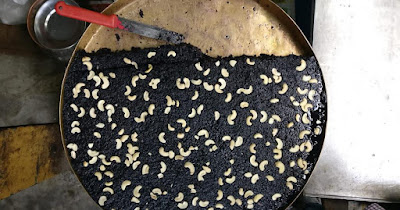

Lucknow's black carrot halwa | Shoaib Daniyal


The halwa was lovely. Slightly warm, it was markedly less sweet than the red carrot halwas I had eaten. The black carrots gave it an earthy taste, which was just a bit astringent on the tongue. It also had no khoya, a common confectionery ingredient across India, which is made by simmering full-fat milk for hours until the moisture evaporates, leaving behind the milk solids. Amir Ali, the owner of Rahmat Ali, had some strong views on the mass use of this ingredient: “It is a sign of laziness,” he said. “The real method is to use milk and reduce that. Since that takes time, people use a shortcut: khoya.”


Warming effect

The Arabic-origin word halwa means a variety of things across West and Central Asia. In India, though, it has always referred to as a lightly spiced, sweet pudding cooked in milk. The red carrot halwa is probably the most famous example of the dish, although several variants – with semolina, mung, chickpea, even egg – exist across the subcontinent.


In this panoply, the black carrot halwa is rare. Black carrots are grown in only a few places in North India. Even in Lucknow – arguably the world capital of this dessert – this halwa is not very well known. The few shops that do sell it are concentrated in the old city. In spite of – or maybe because of – this, the city’s older residents speak of fond associations with the sweet. “Kali gajar ka halwa was cooked in our house a lot when we were children,” said historian Rana Safvi, who grew up in Lucknow. Saad Rizvi, a restaurateur who also runs his own catering business, said it was a wedding season favourite: “At a shaadi, old Lucknow-walahs look for special sweets like kali gajar ka halwa.”
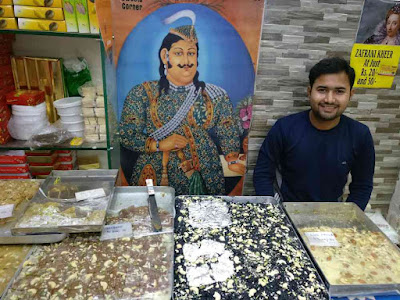

Amir Ali, the owner of Rahmat Ali, with trays of sweetmeats, including black gajar halwa. 

Photo credit: Shoaib Daniyal.


The wedding season in Lucknow, as it so happens, falls during peak winter. In the Chaupatiyan neighbourhood, black carrot halwai Shiv Narayan Tiwari aka Tayya maharaj tells me that the sweet is intimately linked to the cold. “Jitna sardi hoi, utna biki,” he explained in Awadhi. The colder it gets, the more the halwa is sold. Tiwari explains this correlation using the “garam taseer” or warming effect of black carrots. Food cultures across India have various interpretations for foods that are hot or cold. The multiple meanings of hot in this context usually refer to something that is physically warming – as Tiwari claims black carrots are – or anything that is difficult to digest. More advanced versions of this theory go on to link emotions, ranging from anger to sexual desire, with the food you eat.


Early carrots

Tiwari takes me to his house, which is right at the back of his shop, and shows me a wicker basket full of black carrots. Squat and deep purple, the vegetable appears disquietingly alien after a lifetime of cheery red and orange carrots.
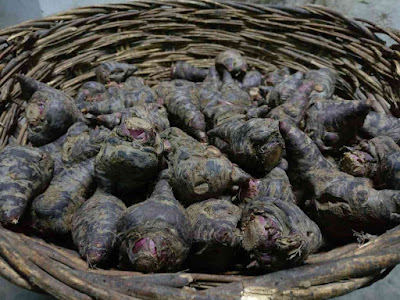

Black/purple carrots in a Lucknow halwai shop. Photo credit: Shoaib Daniyal.


Ironically though, black/purple carrots were the first carrots humans managed to grow – a feat accomplished not that far from Awadh, in Afghanistan. The carrots were incredibly high in anthocyanin, which gave them their dark colour – a pigment also present in other similarly coloured foods like brinjals and blackcurrants. Black carrots were, for the longest time, the only carrots humans knew of. So when Roman Emperor Caligula, frequently portrayed in history as a sadist tyrant, fed carrots to his Senate in the hope of sparking off an orgy (the root vegetable was thought to be an aphrodisiac due to its somewhat phallic shape), they were probably similar to the ones stocked in Tiwari’s house.


By the turn of the first millennium, writes the monomaniacally thorough World Carrot Museum, red and yellow mutant variations were bred from the original black. The red version is India’s most common cultivar, simply called “desi gajar” or local carrot in Hindi and Urdu. The West’s most common version – that I first saw in a Bugs Bunny cartoon film – appeared in the 1500s in the Netherlands, as a sweet orange cultivar that was bred from the earlier yellow ones. Orange carrots have become easier to find in India over the past few decades. They are frequently called Ooty carrots, referring to a major centre of their cultivation in India.
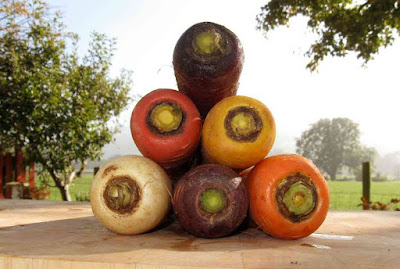

Six colours of carrots. Photo credit: World Carrot Museum.


White knight

The black carrot fell out of favour in the West, driven at least partly by anti-anthocyanin colourism: being water soluble, its pigment often ran, staining dishes and pottages. It did survive in some places though, even if barely. In Lucknow, confectioners mention the region of Malihabad as a centre of production. Punjabis also consume black carrots in the form of kanji – a fermented drink with chopped carrots, mustard powder and ginger, believed to do wonders for digestion. Coincidentally, another black carrot fermented juice, salgam, is popular in Turkey.
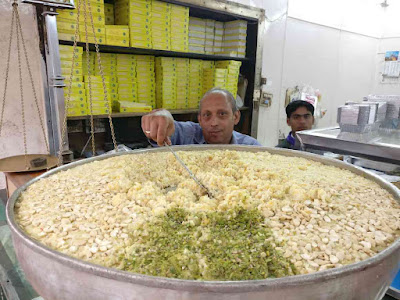

White carrot halwa at Old Delhi's Shireen Bhawan. Photo credit: Shoaib Daniyal.


Even in North India, the black carrot is rare, and its only dish – the root is not used in savoury preparations – the halwa, is scarce. Delhi, close enough to Lucknow to share language and poets, has no black carrot halwa. But, as city historian Sohail Hashmi says, Delhi has its own eccentric take on the dessert: a white carrot version. “It was very popular once upon a time,” said Hashmi. “Especially at weddings.” The red halwa only came to the city after Partition, he says, with the Punjabi refugees from Pakistan.


The white variety is now near-extinct and available commercially at very few places. One of those is Shireen Bhawan, a sweet shop in Old Delhi. Keshavanand, a cook at Shireen, is full of praise for the white carrot: he claims it does not shrink when cooked, unlike its more craven red cousin. I tasted some: it was true. The carrots held their own with a more granular mouthfeel. And like the black variant, this halwa was markedly less sweet than its red counterpart.


Which is of course not to say that the red version doesn’t taste excellent, commonplace though it might be. Winter is a time for culinary indulgence. And halwas – of any colour – are a must. To riff off from a politician who is a lovely carotene orange colour himself: make carrots grate again.


(Source: Scroll)

Sunday, 23 January 2022

‘Bard Al Azariq’ - coldest days of the year - in Qatar

The ‘Bard Al Azariq’ days, which are the coldest days in Qatar, will begin on Monday, Qatar Calendar House (QCH) announced.

QCH said that the days will start from tomorrow, Monday, January 24, and will last until next Monday, January 31, and these eight days are considered the coldest days of the year.


Qatar has been experiencing relatively cold weather during the last few days with temperatures dipping below 10 degrees Celsius in some places early in the morning.  


As per Qatar Meteorology Department report temperatures were ranging between 9-14°C today morning and the lowest temperature recorded this morning was 6°C in Sawda Natheel.


Apparent temperatures ranging between 0 and 13 degrees Celsius was felt around Qatar early in the morning on January 22, 2022, with the lowest apparent temperature of -2.4 degree Celsius felt in Abusamra.


Difference between the actual temperatures and the apparent temperatures: Actual temperatures are those recorded by thermometers, while apparent temperatures are those felt by humans and are related to several factors, including atmospheric humidity and wind speed. The higher the wind speed in the winter, the greater the feeling of coldness.


(Source: The Peninsula)

Saturday, 31 October 2020

French engineer designs minimalist shelters that retain heat during winter for the homeless

Warmth in the cold should never be underappreciated.


It’s sad how the things we take for granted are the same things others would give everything to have. When winter approaches every year, most people are often concerned with buying decorations, gift shopping, and sending out dinner invitations to friends and family. 


In the same energy, some people would only be bothered about finding a safe, warm place to lay their heads on the cold, dangerous nights. Since they cannot afford the luxury of gifts and parties, all they want is a place of warmth from the biting cold. While feeling sorry for them and occasionally handing out blankets might help, this forward-thinking French engineer was tired of seeing his fellow humans freezing out on the streets. 


Geoffrey De Reynal, an M.Eng holder in Energy Engineering spent several months creating a heat-retaining dome called the iglou. [1] These small, portable shelters are big enough to house one or two persons and offer real protection from the dangerously cold weather sweeping into France from the Siberian Alps. When his project was completed, he tested them and began handing out the first set of domes to homeless persons in the streets of Bordeaux and Paris, where the temperatures would occasionally drop to life-threatening levels.


A better option

When Reynal was drawing up the plans for his project, the major factor was warmth and heat retention. While the iglous are incredibly small and would only accommodate a maximum of two people at once, usually an adult and a child, they offered a small measure of protection from the violent nights out in the streets.


The iglous are made of layered polyethylene on the outside and aluminum foil on the inside. These materials are synthetic insulators that keep the temperature within the iglou about 15% higher (or 60oF more) than the outside temperature. This means the domes are only ideal during the winter or on very cold nights throughout the year. 


The domes were smartly designed with a small window to provide solar lighting so the occupants can control their own light and privacy. The aluminum foil interior absorbs heat from the solar panels and the occupants’ bodies to increase the temperature within the dome. 


After he’d created the first ten iglous, Reynal took them out into the streets of Bordeaux, France to be tested. He singlehandedly sponsored the design of the first batch and when they turned out to be a success, people from all over the world were eager to contribute to his cause. The domes were provided at no cost to the occupants and people were instantly in love with them. Everyone who tested one refused to leave and those who couldn’t get a dome pleaded with Reynal to come back with more.


Reynal set up a crowdfunding account for his charity and in short a while, he amassed over $20,000 to continue his work.

Speaking on his motivation for the project, Reynal said to ABC News, “I was living abroad in Montenegro for a year, and there are not many people living outside there. When I came back to France, I was surprised by the number of homeless in the streets, so I decided to come up with an idea to help them.”


A 2012 survey conducted by the French National Institute of Statistics and Economic Studies revealed that over 141,000 people were homeless across the country. [2] Compared to the survey from 2001, this is a 50% increase in the number of people without homes in France.


Reynal explains that while his iglou may offer a measure of warmth and protection, they are not permanent solutions, especially as they can only be used properly in the winter.


“I am not trying to replace emergency accommodations,” he argued. “I am just trying to make life a bit less difficult for homeless people. Having one of these igloos does not mean that you are not homeless anymore.”


Reynal hopes the French authorities will support his vision with funds as he plans to build thousands of iglous and make some modifications to the design. He also hopes they’d eventually be available in other countries as cold as France, such as Poland, Canada, Norway, and even Chicago in the U.S.


 According to one of the beneficiaries, Océane, who lives with her boyfriend on the streets, her iglou has provided the best shelter they’ve had in months. “It’s much easier to fall asleep at night, to wake up in the morning,” Océane said. “We have much better nights inside the igloo shelter. It’s very precious.”


References

  • “FRENCH ENGINEER INVENTS SHELTERS FOR THE HOMELESS THAT RETAIN HEAT DURING WINTER.” Truth Theory. Mayukh Saha. Retrieved September 16, 2020.
  • “GLOBAL HOMELESSNESS STATISTICS.” Homeless World Cup. Retrieved September 15, 2020.
  • “Igloos provide shelter for homeless population in France.” ABC News. Paul Pradier. Retrieved September 15, 2020.


(Source: Family Life Goals)

Wednesday, 4 March 2020

Climate change: Warm winter ruins German ice wine harvest

Germany's harvest of ice wine - a dessert wine produced from grapes that have frozen while still on the vine - has failed for the first time because the winter has been too warm.

None of Germany's 13 wine-growing regions had the necessary temperatures of -7C to produce the wine in 2019.

2019 was the second-warmest year on record globally, according to the US National Oceans and Air Administration.

The amount of ice wine produced has been dropping in recent years.
Ice wine is a dessert wine produced from grapes that have been frozen while still on the vine. AFP

"The 2019 vintage will go down in history here in Germany as the first year in which the ice harvest has failed nationwide," the German Wine Institute (DWI) said in a statement.

"If the warm winters continue in the next few years, ice wines from German wine regions will soon become even more of a rarity than they already are," said Ernst Büscher from the DWI.

Another problem for ice wine production is that, in recent years, the dates for a possible ice harvest have shifted later - to January and February - while the grapes are ripening earlier, the DWI said.

As a result, the grapes need to survive for longer.

The biggest ice wine markets include Japan and China as well as the Scandinavian countries and the US.

Due to their inherently low yields, ice wines have a very small share of the total harvest, often less than 0.1%.


(Source: BBC)

Thursday, 9 January 2020

Rain, single digit temp likely by weekend in Qatar

Temperature to drop below 10C in some southern areas for the first time this season

There are chances of scattered rain in the country during the coming weekend, followed a spell of cold weather and strong winds, the Qatar Met department has said.

The minimum temperature may drop below 10C in the southern parts of Qatar during the cold spell, according to a report issued by the department Tuesday.

The weather office has said a state of atmospheric instability is expected to affect the country from Thursday until Saturday due to the extension of a low-pressure system over the region.

The cloud cover is expected to increase gradually and there is a chance of scattered rain of variable intensity, which may become thundery at times in some areas, the report states.

Fresh to strong northwesterly winds are likely to begin blowing from Friday, with the wind speed exceeding 35kt offshore that will cause the wave height to exceed 10ft.

"Therefore, kindly avoid going to sea due to the unsettled weather conditions from Thursday, with the marine warnings continuing until Tuesday (January 14)," the Met department advised.

In addition, cold weather conditions are expected to accompany northerly winds, especially at night and early in the morning, with a noticeable drop in temperature, the report points out, adding that the minimum temperature is likely to drop below 10C in some southern areas for the first time this season.

The Met department has urged people to follow latest updates through its official social media accounts.

Meanwhile, Wednesday's forecast says it will be misty in some place in the early hours, followed by moderate temperature during the day and some clouds. It will be cold by night.

Offshore areas will see partly cloudy conditions at times.

The minimum temperature Wednesday is expected to be 13C in Wakrah and Mesaieed, 14C in Al Khor and Abu Samra, 16C in Doha, 17C in Dukhan and 18C in Ruwais.


On Tuesday, a minimum temperature of 11C was recorded in Turayna, followed by 12C in Mesaieed, 13C in Batna and Karana, 14C in Al Khor, Ghuwairiyah and Jumailiyah, 15C in Wakrah, Sheehaniya and Abu Samra, and 16C in Doha (airport area), Hamad International Airport area, Qatar University area and Mesaimeer.

(Source: Gulf Times)

Thursday, 2 January 2020

Cold waves killed more Indians than heat waves since 1980: IMD

There has also been a 506% increase in the number of cold waves in India in this decade

While North India is under the grip of severe 'cold days' and 'cold waves' in 2019, a look at the data provided by the India Meteorological Department (IMD) shows a worrying trend. In 23 of the last 38 years (1980-2018), the human death toll in India due to cold waves was higher than that due to heat waves. 
Photo: @sunder_barange / Twitter

In 1992, 41 times more lives were lost due to cold waves. Between 2010 and 2018. the trend was somewhat different. In this period, around 4,506 people died due to cold waves while 5,572 died due to heat waves. The notable exception was 2011. That year, human deaths due to cold waves were nearly 60 times more than those due to heat waves.

However, in 2018, the trend reversed again. About 136 people died due to cold waves in comparison to 16 deaths due to heat waves.

The other shocking statistic that emerged between 2010 and 2018 was a whopping 506 per cent increase in the number of cold waves in India, despite increasing temperatures worldwide due to global warming. 

Year
Human deaths due to  heat waves
Human deaths due to  cold waves

1
1980
156
185
2
1981
33
192
3
1982
16
63
4
1983
187
488
5
1984
58
155
6
1985
142
494
7
1986
156
276
8
1987
87
105
9
1989
43
215
10
1990
2
82
11
1992
114
303
12
1993
30
63
13
1996
20
68
14
1997
21
140
15
1999
119
222
16
2000
55
368
17
2001
56
490
18
2004
117
462
19
2008
111
114
20
2009
216
79
21
2010
242
450
22
2011
12
722
23
2018
16
136


Severe cold days in the next days: IMD
According to the IMD bulletin released on December 27, 2019, cold to severe cold day conditions are likely to remain over many areas of Punjab, Haryana, Chandigarh, Delhi, northern Rajasthan and Uttar Pradesh during the next two days. 

The maximum temperatures was markedly below normal (-5.1°C or less) at most places over Punjab, Haryana, Chandigarh, Delhi, eastern Uttar Pradesh, Bihar, Jharkhand and gangetic West Bengal. 

According to IMD, the maximum temperatures was appreciably below normal (-3.1°C to -5.0°C) at most places over Vidarbha and Chhattisgarh, at many places over Madhya Pradesh and at a few places over Gujarat too.

Along with severe cold days, some pockets in Haryana, Chandigarh, Delhi, north Rajasthan and Bihar may also experience cold to severe cold waves.

A cold day is defined on the basis of maximum day temperature while a cold wave is defined by looking at minimum temperatures recorded on two consecutive nights.

Wither planning?
The guidelines for Action Plan on Prevention and Management of Heat Wave prepared by the National Disaster Management Authority (NDMA) in 2016, were further revised in 2017. In fact, the Union Ministry of Health and Family Welfare too had issued guidelines to deal with heat-related illness. 

In 2019, the government had started working with 23 states and over 100 cities and districts to implement and develop heat action plans in India.


But do the states have plans to deal with cold waves so that human lives can be saved?

(Source: Down to Earth)

Friday, 13 December 2019

Daisetsuzan: Life in the icy white forest

Winter lasts most of the year in Daisetsuzan, the high mountain range that stretches across the center of Hokkaido. The first flurries of snow arrive in September, and the final thaw doesn’t come till the following June. Yet some animals live successfully and apparently quite happily in this frozen world winter has come to Daisetsuzan.

Winter wonderland: As a blizzard lifts, the forest's appearance is transformed by a fresh coat of white. Snow newly settled on the top branches of birch trees glistens in the sunlight. | KENJI ITO
It’s only October, but the once-dazzling autumn foliage has all dropped from the trees. As cold air moves in from Siberia, the scene changes dramatically. Fresh snow settles first on the mountain peaks, then advances inexorably down the slopes until it reaches the bottom and the entire landscape has turned white. Day after day the vast forests are blanketed with sparkling ice crystals. Soon, all signs of human encroachment have disappeared from the high ridges, now the domain of no one but the wind.

Boasting several of the island’s highest peaks, the Daisetsuzan range is known as the “roof” of Hokkaido. It extends over an area of some 230,000 hectares, about the same size as all of Kanagawa Prefecture. Daisetsuzan was declared a national park 80 years ago, in 1934.

When a winter coat comes in handy: A male Ezo deer covered in snow. Coming face to face with one of Daisetsuzan’s yearlong residents makes you wonder who has it better — them or us. | KENJI ITO
The highest peak is Mount Asahi, 2,290 meters above sea level. For the most part the topography is gentler than on the highest summits of Honshu to the south, which rise to more than 3,000 meters. But here in the far north the tree line is much lower, yielding to a high-altitude zone of tundra where alpine flora reign in a unique natural environment.

As the source of the bountiful Ishikari River, the Daisetsuzan range is revered by the region’s indigenous Ainu people, who call it Kamui Min-tara — the garden of the gods.

It’s early morning and a blizzard has just cleared. The temperature is minus 25 degrees Celsius, so cold that your breath freezes and frost forms on your eyelashes. The snow is waist-deep, so skis must be fitted with nonslip devices. Even then, every step requires caution.

The biggest snowdrifts are as much as 5 meters deep. When the sun begins to shine through the trees, it casts a greenish light on the ground below, giving the white blanket a coral-like hue and fostering the illusion that you are traversing an ocean of snow.

Kya, kya, kya! A high-pitched cry suddenly echoes in the treetops as a Hokkaido red squirrel leaps from a branch, shaking fresh snow down onto the forest floor. As though responding to a signal, the snow piled high on the surrounding branches also begins to fall in one frozen shower after another, forming a curtain of crystalline light as the cascading flakes catch the sun.
A foxy perspective: As the sunlight filters softly through the trees, an Ezo red fox perks up its ears and sniffs the air for interesting scents. How does this landscape appear to the vulpine eye, do you suppose? | KENJI ITO

Stand still for a moment and you can feel your hands and feet turning numb. They seem to be on the verge of freezing — and yet you can’t take your eyes off the tiny animals scampering about in the woods. Leaving the trees for open fields of snow, you’ll see the tracks of mountain hares, rhythmic evidence of their hopping gait where they passed by just a short while ago.

Life thrives in this snowy realm all year round. Perhaps most astonishing of all is the fact that January and February, Daisetsuzan’s coldest time of year, are the months when brown bears snuggled away in their winter lairs give birth to their cubs.

(Source: JT)

Monday, 5 August 2019

Winter babies at 'higher risk of mental health disorders'

Babies born during winter are at higher risk of developing mental health disorders, new research has found.

Researchers at Cardiff University found levels of the stress hormone cortisol were higher in women who give birth in autumn and winter than those who give birth in spring or summer.

Cortisol levels rise naturally during pregnancy, Prof Ros John said.

"Our data shows that autumn and winter babies are exposed to particularly high levels just before they are born".

Prof John said: "On average, women giving birth in the autumn or winter had 20% more salivary cortisol just before delivery than those giving birth in spring or summer.
Cortisol levels rise naturally during pregnancy

"As higher levels of cortisol in pregnant women have previously been associated with a higher risk of children developing mental health disorders, the new findings could explain why these disorders are more common in people born during the winter months.

"They don't, however, explain the reason why women who give birth in winter or autumn have these higher levels of cortisol."

Researchers investigated the relationship between the seasons and salivary cortisol concentrations, depression and anxiety symptoms in pregnant women living in south Wales.

The team found a link between season and concentrations of salivary cortisol at term in the study, which involved 316 women.

The university said data was gathered at pre-surgical appointments and immediately after birth, through a questionnaire and notes recorded by the research midwife.

(Source: BBC)

Wednesday, 27 February 2019

Canada will be hit with life-threatening -70°C wind chills in this March

Canada is under extreme cold weather warnings and could face wind chill temperatures dipping as low as -60 C and -65 C.

Environment Canada has issued an extreme cold weather alert for cold weather in Atlantic Canada and Quebec, “biting cold” in Ontario and “teeth-chattering cold” across the Prairies.

Environment Canada has issued an extreme cold weather alert forKugaaruk, Nunavut, which currently sits right in the heart of the polar vortex. People have been advised to stay indoors, especially younger children, older adults, individuals with chronic illnesses and outdoor workers due to high risks of hypothermia and freezing.

Cold stuff is just going to come and come and come,Environment Canada has issued that the period from February 23 to March 20 would likely be “the coldest part of the winter” for many parts of Canada.


Atlantic Canada
Get your boots ready, you have a snowy, but mild, winter ahead. Expect above-normal amounts of snow in the southwest areas (Nova Scotia, New Brunswick and  Prince Edward Island), and slightly below-normal amounts in the northwest (Newfoundland and Labrador, Northeastern Quebec). Your coolest temps will hit in late February and early-mid Marcg , and April and May will also be cooler than usual.

Canada’s southern regions may not have it as bad but are still affected to a significant degree. Parts of Manitoba are going to face with wind chills as low as -34 C, while northern Ontario and northern Quebec are going to see temperatures of around -45 C and -60 C, next month.

Southern Quebec
Expect a cooler and snowier winter, with the coldest periods stretching from early winter into the first beginning of February. The snowiest periods will take place in end of February until March.

Southern Ontario
This winter will see average temperatures, but there will be slightly above-normal precipitation and snowfall. The coldest periods will be mid and late February, with the heaviest snowfall periods, and early-to-mid-March. (Also, you may want to get mentally ready for the cooler and rainier summer predicted this year.)

The Prairies
We don’t want to be the ones to break the news, but next month winter will likely be colder, with more precipitation and snowfall. Be ready for colder temps in mid to late February, and extra coldest temperatures in March, then up until mid-to late April.  Maybe consider a 4-month getaway?

Southern British Columbia
You’re in for a pretty mild winter when it comes to temperature, but expect a slightly above-normal precipitation and snowfall. But good news, the snow won’t fully kick in until early January, Your coldest periods will take place in late February until March. Also, be ready for a cooler and rainier April and May.

Northwest Territories
This upcoming winter will be colder than normal with above-normal precipitation and snowfall for the entire season. April and May will also be cooler and rainier than usual with an average amount of snowfall.

Northern Ontario , is under extreme cold weather warnings and could face wind chill temperatures dipping as low as -60 C and -65 C, providing “some of the coldest temperatures this winter,”next month.

Yukon
Just like their neighbours to the West, Yukon’s in for a colder than normal winterwith above-normal precipitation and snowfall. The coldest periods will start in late February and last until early March, while the biggest snow storm will start to fall heavily in February and last until March (and still lightly continue until May). Thankfully, the summer is predicted to be warmer (and rainier) than normal.

(Source: Canada Eh?)